Charter Schools Exploit Children of Color

thumbnail_Screen Shot 2019-12-01 at 7.13.25 PM


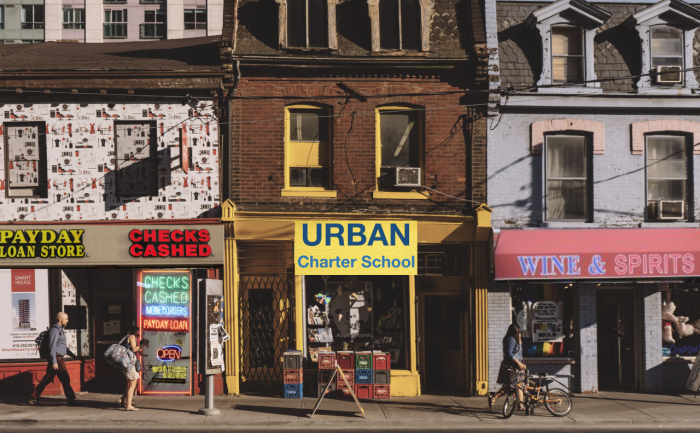
Go to most impoverished black neighborhoods and you’re bound to find three things in abundance.


Liquor stores, payday lenders and charter schools.


It is no accident.


In the inner city, the underemployed compete for a shortage of minimum wage jobs, healthcare is minimal, public transportation inadequate and the schools are underfunded and short staffed.


But that doesn’t mean money isn’t being made.


In capitalist America, we make sure to turn a profit off of everything – including our peculiar institutions of racial inequality.


Businesses are on every corner, but they aren’t set up for the convenience of those living there.


Ethnic isolation – whether caused by poverty, legal coercion, safety in numbers or white flight – often puts the segregated at a disadvantage. It creates a quarantined economy set up for profiteers and carpetbaggers to get rich off the misery of the poor.


The system is set up to wring as much blood as it can from people forced to live as stones.


Families struggle to survive in a community where they are exploited by grasping landlords and greedy grocers. And the system is kept in check by law enforcement officers who are either disposed to turn the other way or so overzealous as to shoot first and ask questions later.


As W.E.B. DuBois described it nearly a century ago, “Murder sat on our doorstep, police were our government, and philanthropy dropped in with periodic advice.”


The economy is glutted with enterprises offering cheap promises of relief but which actually reinforce the status quo.


Predominantly black, low-income neighborhoods are eight times more likely to have carry-out liquor stores than white or racially integrated neighborhoods, according to researchers at the Johns Hopkins School of Public Health.


Yet in higher income black neighborhoods in the same cities, you don’t find these same liquor stores.


They are established in the poorest neighborhoods to offer cheap, temporary respite from the trauma of living in poverty. Yet they increase the likelihood of alcoholism, addiction and violence.


The same goes for payday lenders.


These are basically legal loan sharks who offer ready cash at exorbitant interest rates.  Typically these payday loans are meant to last the length between paychecks – approximately two weeks. However, they come with extremely high interest rates. For instance, the average $375 loan ends up costing $520 (139%) in interest.


These businesses aren’t located in the suburbs or wealthy parts of town. You find them typically in the inner cities and poor black neighborhoods. They promise temporary help with one-time purchases and unexpected expenses, but in truth most are used to pay for necessities like rent or food.


They end up trapping users in a debt spiral where they have to take out payday loans to pay off previous payday loans. This is mostly because these loans are made based on the lender’s ability to collect, not the borrower’s ability to repay while meeting other financial obligations.


And these are just two of the most common features of this predatory economy – capitalist enterprises designed to enrich businesses for exploiting consumers beyond their ability to cope.


Others include high priced but limited stock grocery markets, fast food restaurants, gun stores, inner city rental properties and charter schools.


That last one may seem out of place.


Most descriptions of urban neighborhoods neglect to mention charter schools, but in the last few decades they have become an increasingly common part of the landscape. And this is no wonder. They fit the same pattern of exploitation as the other establishments mentioned above.


Think about it: (1) charter schools disproportionately locate in poor black communities, (2) offer the promise of relief from inequality but end up recreating or worsening the same unjust circumstances and (3) they are often owned by rich white folks from outside the neighborhood who profit off the venture.


1) LOCATION


Who attends charter schools and where are they located?


The charter sector represents only a tiny fraction of students attending public school.


Of the 50.4 million students in the public school system in 2015, only about 3.2 million students were enrolled in roughly 7,000 privately-operated charter schools across the country.


To put that in context, that means just a little more than 6% of all public school students are enrolled in charter schools.


According to 2016 data from the National Center for Education Statistics, only 26% of all charter school students are black (832,000) compared with 33% of Hispanics (1,056,000) and 32% of whites (1,024,000).


Screen Shot 2019-12-02 at 11.56.47 AM
Source: NCES


This doesn’t come close to a majority for any racial group. Consider the fact that authentic public schools enroll approximately:


•7 million black students (14% of the total)


•12 million Hispanic students (24% of the total)


•24 million white students (48% of the total)


Screen Shot 2019-12-02 at 11.40.38 AM
NOTE: These figures include charter school students. To get the totals of authentic public school students (above) I subtracted the charter students out. SOURCE: NCES


More students of all ethnicities attend authentic public schools than charter schools – by orders of magnitude. However, those that are enrolled at charter schools are not distributed evenly. Charter schools do educate a disproportionate percentage of students of color – especially among Hispanic students.


Why? Do black and brown families seek them out or is it just the opposite – charters seek out melanin abundant children.


Approximately 57% of charter schools are located in cities, according to 2017 data from the National Center for Education Statistics. That’s comparable with only 25% of authentic public schools.


Screen Shot 2019-12-02 at 12.44.05 PM


So like liquor stores and payday lenders, charter schools are disproportionately located in highly segregated, urban communities often with a majority black and Hispanic population. And since they are businesses (unlike their authentic public school counterparts), they literally target this demographic because it fits their profit model.


These are the people they think they can sell on the charter model. And they often do.


2) EXPLOITATION


How do charter schools disadvantage the students enrolled there?


Like other vulture capitalist enterprises, they exploit the students they purport to serve by convincing people of color to accept fewer services than they already get at authentic public schools.


Authentic public schools invariably are run by school directors elected from the community who have to make all possible decisions in public and present their records for review.


Charter schools are permitted to run without elected school boards. Decisions are often made by appointed bureaucrats behind closed doors. They are not required to hold public meetings or present school documents as public records. Parents have no way of having their voices heard except that they can take it or leave it.


Authentic public schools have to use all their funding for the benefit of the students.


Charter schools can cut student services and pocket the savings. This is true regardless of whether they are designated for-profit or non-profit. It’s just a matter of which loopholes you have to go through. In both circumstances there are ways for the business people running charter schools to make financial gains at the expense of the community and its children. And the result is larger class sizes, narrower curriculum, fewer field trips and extra-curricular activities – but also larger salaries and perks for administrators and investors.


Authentic public schools have to accept all students who live within their boundaries.


Charter schools are not required to accept all students who live in their coverage areas or even all who apply for enrollment. They can and often do cherry pick the easiest students to educate. The can dissuade special needs students or students with less stable families from applying by forgoing special services and/or requiring prerequisites like costly uniforms and parental voluntarism. Or they can simply choose whomever they wish from the applicant pool and claim the decision was based on a lottery that never needs to be audited for fairness.


Despite a lack of adequate funding and an abundance of high needs students, authentic public schools provide the best academic outcomes possible given their limitations.


Despite having every advantage, charter schools get the same or worse academic outcomes as authentic public schools.


Charters market themselves as providing a superior education, but this is not supported by the facts.


Nearly every study conducted on the matter has found that charter schools do NOT outperform authentic public schools. In fact, many charters get much worse results – especially cyber charter schools.


Moreover, according to the Department of Education’s National Assessment of Educational Progress (NAEP), authentic public school students in fourth, eighth and 12th grades outperform charter school students in math, reading and science. 
In addition, no other high performing nation even has charter schools.


But that’s just academics. There are even clearer economic indications of how charter schools squander the tax dollars that fund them while authentic public schools are more stable and provide better value for the money.


Authentic public schools don’t have nearly the same amount or degree of financial scandals because they are required to be much more transparent and their budgets are subject to frequent audits. By contrast, in many cases charter schools take public tax dollars and provide literally nothing in return.


According to a 2015 report by Wisconsin-based Center for Media and Democracy, dozens of charter schools that have accepted federal funding closed without even opening in the first place! The federal government has spent $3.7 billion to boost the charter sector only to have these “ghost schools” pop up and spirit away our tax dollars.


This includes:


•In 2011 and 2012, the federal government gave $3.7 million in taxpayer dollars to 25 Michigan “ghost” schools that never even opened to students.


•In California, more than $4.7 million in federal taxpayer money was handed out to create charter schools that subsequently closed within a few years.


•In Ohio, out of the 88 schools created by planning and implementation grants under the federal “Charter School Program” (CSP) for state education agencies between 2008 and 2013, at least 15 closed within a few years; a further seven schools never even opened. These charters received more than $4 million in federal taxpayer dollars.


There is even more evidence that charter schools are not nearly as stable as authentic public schools.


According to the National Center for Education Statistics, one in ten charter schools have closed over a three year period. That’s more than 765 charter schools that have been shuttered between 2014-15 and 2016-17.


This leaves thousands of families scrambling to find an education for their children.


Such scandals simply do not happen at authentic public schools.


So charter schools provide fewer services, worse results, and a greater chance of closure or wasting limited funding without even opening at all – not a good return on investment for students of color.


3) OWNERSHIP


And who owns and operates these charter schools?


There has been very little research on this topic.


The most detailed information I could find comes from the charter school industry, itself, specifically the National Alliance for Public Charter Schools (NAPCS), a nonprofit that describes itself as “committed to advancing the public charter school movement.”


According to the NAPCS, about one-third of charter schools in 2016-17 were operated by management organizations that run multiple schools. This includes KIPP, Success Academy, Green Dot Charter Schools, Uncommon Schools and Rocketship Charter Schools.


The remainder (57%) are owned by what they call freestanding charter schools – which just means organizations that run only one school.


These institutions can be run by a wide range of groups including religious organizations and local business organizations such as chambers of commerce or economic development authorities.


While it’s true that community groups also sometimes run charter schools, they are invariably funded by huge foundations such as the Bill and Melinda Gates Foundation, the Dick and Betsy DeVos Family Foundation, or the Walton Family Fund – all of whom profit off the industry.


Are these community groups authentic representations of an abiding belief in the power of school privatization to achieve equity or are they mere fronts for the big money behind them? Even when individuals approach the matter with an open mind, is it fair to say they’ve independently reached a decision when there is a huge paycheck from a prestigious name behind one option and nothing but logic and history behind the other? Billionaires are literally paying you to favor solutions that help their bottom line. Is it any wonder some folks can’t see past all that green?


Even with a lack of good data, it seems clear that the overwhelming majority of the industry is owned, operated and/or supported by rich white people from outside of the black and Hispanic community.


CONCLUSIONS


Charter schools are not a grassroots response to the problems of educating the urban poor.


They are not an authentic expression of what the majority of people of color want for their children.


They are a kind of “false consciousness,” an extension of the segregation economy exploiting black and brown children.


They are disproportionately located in poor and minority neighborhoods because operators think they can sell their educational model to people of color fed up with the inequality of their neighborhoods.


Yet they provide fewer services at greater cost to black communities – they convince impoverished minorities to give up the few educational guarantees they already have in favor of a worse situation. And the result is a continuation or worsening of the status quo while enriching vulture capitalists.


It’s a scam, a flimflam ripoff, a bamboozling hoax.


Like the liquor stores and payday lenders that dot the inner city landscape, charter schools are yet another way to exploit black people for the crime of putting their faith once again in capitalism to break their chains.


The only truly effective way to achieve equity is with collective action against white supremacy.


We need to tear down the systems of inequality that privilege some at the expense of others – and doing that requires a robust system of public education for all.


It is not only a prerequisite for social justice but it is one of the central facets of the fight, itself.


You can’t use capitalism – a system that relies on inequality – as a method to assure equity.


Justice requires fairness. And the road to fairness can only be discerned by enlightenment.


Education is both the path and the goal.


It’s passed time we stop exploiting those who wish to walk that path by convincing them to go another way.


Like this post? I’ve written a book, “Gadfly on the Wall: A Public School Teacher Speaks Out on Racism and Reform,” now available from Garn Press. Ten percent of the proceeds go to the Badass Teachers Association. Check it out!
book-4

Demand Reform to Pennsylvania’s Charter School Law – Before It’s Too Late

l_charter-protest
 

If no one answers a question, was it even asked?

 
Way back on August 24, 2019, the Pennsylvania Department of Education (PDE) quietly posted a little notice on the PA Bulletin Website asking for public comment on the state’s charter school law.


This is not exactly a high traffic site.


It’s a state-run page that includes proposed rules, notices, proclamations, court rulings, actions and executive orders.

 
Unless you work for the state, are a journalist or a policy wonk, you probably didn’t see it.


Since then, there has been little fanfare, no hoopla, nothing much in the media about the notice at all.


But this is a huge opportunity for residents fed up with the nonsense the school privatization industry has been getting away with in the Commonwealth for decades.


Pennsylvania has one of the worst charter school laws in the nation.


Charter schools are taxpayer-funded but privately operated.


Though there are about 180 of these privatized institutions throughout the state with more than 137,000 students, that represents only about 6 percent of the kids enrolled in public school.

 
Yet the state funding system pits authentic public schools against charter schools for the financing needed to stay open.


Charter schools siphon money from authentic public schools serving the neediest students creating a deficit spiral. Money gushes out of public districts which have to cut teachers and programs to patch budget gaps which in turn result in even more parents pulling their children out of the public schools and trying to enroll them in charters.


Though the legislature used to help authentic public schools by reimbursing them for 30% of the charter school costs, that funding has been eliminated.


Meanwhile, the charter school law has barely changed at all since it was enacted in 1997.


Gov. Tom Wolf has promised to correct that with sweeping reforms in 2020 – even if it means bypassing the gerrymandered and gridlocked legislature with executive orders.


But before he can begin, he needs to hear from commonwealth voters.


Charter schools are backed by billionaires like Betsy DeVos, Bill Gates and the Walton Family. To hold these privatized schools accountable, he needs tangible proof that he has voter support.

 
So the more comments he receives demanding action, the better the chances that gets done.


PDE has set no deadline for comments, but to make the most difference, we have until the end of the year – Dec. 31, 2019 – to make our voices heard.


There are two ways to do it. You can:


1) Write a letter to Secretary of Education Pedro Rivera at:


Pedro A. Rivera
Office of the Secretary
Pennsylvania Department of Education
333 Market St.
Harrisburg, PA 17120


2) Email your letter to Special Assistant to the Secretary Adam Schott at:


adschott@pa.gov


Comments can be as long or short as you want, but here are some suggestions to keep in mind when writing.


1) Begin by telling who you are.

 
2) Explain the problem with charter schools briefly. Use real world examples if you can. There’s nothing wrong with referring to a newspaper article or blog. And if you can mention specifics from your school district, all the better.

 
3) Make suggestions for reform. You can address anything, but PDE is specifically looking for comments on these topics:


· Charter school applications: Strong regulations would require the application be comprehensive, set high standards, ensure only operators with needed skills are approved and maintain maximum local control.


  · Admissions policies: Strong regulations would ensure charters conduct fair lotteries that don’t allow cherry picking. Schools should be located in areas that are accessible to poor students and those relying on public transportation. Charters should be required to create recruitment plans for specific groups of vulnerable students including EL students, students with disabilities, economically disadvantaged students and students in foster care.


     · Accountability for boards of trustees: Strong regulations would aim to prevent financial wrongdoing, eliminate conflicts of interest, and impose stronger penalties for the misuse of public funds.


  · Information on charter management companies: Strong regulations would end high fees paid to charter management companies and increase transparency of boards, budgets, costs and contracts.


· Insurance, financial and accounting standards: Strong regulations would ensure there were independent auditors and accountants as well as increased transparency.


  · Funding: This is about the subsidy redirection process that forces PDE to pay charters directly when they dispute a bill with a school district. Strong regulations would ensure all disputed funds go into an escrow account rather than just being paid.

 
   · Academic accountability: Strong regulations would ensure all charters should be part of a performance system that is used in renewal and revocation decisions. The lowest performing charter schools should be subject to closure without appeal.


Education Voters of Pennsylvania, a non-profit organization working to promote public education throughout the Commonwealth, published this suggestion:


“We are recommending that your comments include the following:


1. We strongly support the Pennsylvania Department of Education’s decision to develop these regulations.


2. The regulations must end the conflicts of interest, financial self-dealing and lack of transparency that occur in the charter sector today. Charters must be held accountable for their performance in operations, finance and academics.


3. We strongly support local control over charter school opening and closing. Elected school boards know the needs of the community the best and are responsible to taxpayers and families.


4. The charter school law acknowledges that charter schools have an impact on the finances of school districts. The districts should be able to consider that impact when making decisions to open or renew a charter.”


Here is the letter I will be sending:


Dear Pedro A. Rivera:


Thank you for seeking comments from Pennsylvania residents about our 22-year-old charter school law.


I live in the Pittsburgh area and am both a public school teacher and the father of a public school student.

 
I have seen the damage charter schools can do in my career at the Steel Valley School District in Munhall. We have a Propel charter school in our community. Just three years ago, the Propel franchise siphoned away $3.5 million from our district annually. This year, they took $5 million, and next year they’re projected to get away with $6 million. That’s about 16% of our entire $37 million yearly budget.


Meanwhile, enrollment at Propel has stayed constant at about 260-270 students a year since 2015-16. It’s only the amount of money that we have to pay them that has increased.


The state funding formula is a mess. It gives charter schools almost the same amount per regular education student that my district spends but doesn’t require that all of that money actually be used to educate these children.


In the 2015-16 school year, Steel Valley paid the 19th highest amount of its budget to charter schools in the state (9%) and that number is growing.


According to the state Department of Education, here’s how our charter school spending has increased:


Steel Valley Per Student Charter School Tuition:

2000-01 – 2012-13
Non-Special Ed: $9,321
Special Ed: $16,903

2013-14
Non-Special Ed: $9,731
Special Ed: $16,803

2014-15
Non-special Ed: $10,340
Special Ed $20,112

2015-16
Non-Special Ed: $12,326
Special Ed: $25,634

2016-17
Non-Special Ed: $13,879
Special Ed: $29,441

2017-18
Non-Special Ed: $13,484
Special Ed: $25,601

2018-19
Non-special ed: $14,965
Special ed: $32,809

 
All of this has real world consequences in the classroom. It means fewer teachers and larger class sizes. It means narrowed curriculum and fewer extracurricular activities. It means reduced options and opportunities for all children – just so a new business can duplicate the services already being offered but skim tax dollars off the top.


So here are the reforms I think we need to make.

 
There is zero reason why there should be charter schools at all. We do not need to spend public tax dollars on schools that are privately operated. If a school takes public money, it should be run by the public – specifically an elected school board. So we should repeal the charter school law in its entirety. We should be like Montana, North and South Dakota, Nebraska, Kentucky and West Virginia and have zero charter schools.


Of course, that leaves us with the question of what to do with the charter schools that already exist here. First, we have to commit to a complete moratorium on any new charter schools – ever. Then we need to decide what to do with those that already exist.


I think we should do a thorough audit of each of them. Any charter school that fails the audit, closes. They should have to prove they haven’t been wasting taxpayer funds and are providing a real service to students and families. They also should not be drawing any kind of profit from their efforts.


If we have any charter schools that meet these stipulations, we should reform them into fully authentic public schools. They should have to be run by elected school boards. They should have to abide by every rule authentic public schools already do – fully transparent, public meetings, accept all students in their coverage areas, etc.


Finally, any funding shortfall caused by keeping these schools in existence would have to be subsidized by the state. They would not get any funding that goes to the existing authentic public school. The charter schools that we are transforming into authentic public schools would have to be funded by an additional revenue stream from the state – and this may require an increase in state taxes. No one wants that but it’s the only fair way and will help reduce the number of ex-charter schools we rehabilitate.


I realize my suggestion goes against what we have always done and may provoke heated opposition. But I think it is what is best.


Moreover, if we have to find a compromise position, this is where we start from. If we must keep charter schools in Pennsylvania, they should be as transparent as authentic public schools, they should have to be run by elected school boards, they should not be able to make a profit (regardless of their tax status), they should have to accept all students in their coverage areas, and they should be fully funded by the state and not as parasites to authentic public schools.


Thank you for considering my position. There are thousands of parents, teachers, students and community members who feel as I do and we will work to support your efforts and/or push you to do right thing.


Thanks again.


Yours,


Steven Singer


If you live in Pennsylvania, I strongly encourage you to send a letter (whether by email or snail mail) today. Feel free to borrow as much as you like from what I have here.


Together we can make a difference for our children and our communities. Please share widely and encourage your commonwealth friends and family to raise their voices as well.


From Pittsburgh to Philadelphia and all places in between, it’s time we were heard.


Like this post? I’ve written a book, “Gadfly on the Wall: A Public School Teacher Speaks Out on Racism and Reform,” now available from Garn Press. Ten percent of the proceeds go to the Badass Teachers Association. Check it out!

book-4

White Billionaires Cannot Buy the Charter School Debate

Screen Shot 2019-11-23 at 12.37.53 AM


Betsy DeVos is not woke.

 
Bill Gates has not been to the mountaintop.

 
Nor is the Walton Family Foundation concerned with promoting civil rights.

 
So when white billionaires pour cash to charter school lobbying groups – as the Walton’s did Thursday for charter school protestors at an Elizabeth Warren rally – it isn’t exactly convincing.

 
Speaking at the historically black college Clark Atlanta University, Warren, who is seeking the Democratic nomination for President in 2020, was interrupted by audience members chanting charter school slogans.


She eventually met with the protestors after the rally.


Strangely enough, Warren hasn’t suggested any policy position that would adversely affect the charter schools from which the protestors hail.


Along with Presidential candidate Bernie Sanders, Warren has a progressive charter school platform calling for increased transparency and an end to federal funding of charters, which are paid for with tax dollars but privately run.


The Intercept journalist Rachel Cohen noted:


“Frankly suggesting that stronger transparency standards for publicly-funded charter schools would ‘limit parental choice’ is an incoherent talking point that really should not be taken seriously. Increased transparency only ‘limits choice’ if the charter schools themselves refuse to accept higher transparency standards.”


Intercept journalist Ryan Grim, who was present at the rally, noted that the group of protestors was funded by the Waltons.


The group was from Memphis Lift Parent Institute which bused in people from around the country. It was supported by a GoFundMe page showing numerous $1,000 donations from anonymous sources.


Published financial reports clearly show the Waltons backing Memphis Lift to the tune of $1.5 million since 2015. And since then, their 2017 filing shows $375,200 more, with a mere $200 coming from other public contributions. That’s pretty close to 100%. The Walton’s Website makes the connection even more undeniable.


Support also came from Nashville education consulting firm Strategy Redefined, the Tennessee’s chapter of Democrats for Education Reform and Chris Barbic, the original head of Tennessee’s disastrous Achievement School District.


That is not grassroots.


That is astroturf.


Both the NAACP and Black Lives Matter have called for a moratorium on new charter schools primarily because of how they increase school segregation and adversely affect children of color.


These are huge national organizations making decisions based on democratic input of their members. They are not solely representative of the tiny fraction of parents (6%) who send their kids to charter schools nationwide, nor are they funded primarily by corporations and billionaire investors who, in turn, make a profit off of the school privatization industry.


While it’s true that you’ll find polls showing strong support for charters among people of color, the overwhelming majority of these polls are conducted by pro-charter groups. They’re like the American Apple Foundation finding high support for U.S. apples – little more than paid advertising.


However, even a poll conducted by charter school lobbying organization Democrats for Education Reform found that both black and white respondents support a moratorium on new charter schools.


Billionaires like DeVos, Bill Gates and the Waltons have spent incredible amounts of money to convince the public that school privatization is grassroots, but we have the receipts.


The Walton foundation has promised $1 billion since 2018 to expanding charter schools.


Andre Perry, an education policy expert at the Brookings Institution, describes the Walton foundation as hiding behind black faces to obscure who’s really in charge – they’re exploiting black people for a “white agenda.”


“It’s a sad thing that education reform is about how much money you have and not about what connection you have with black communities,” Perry said.


The Walton Foundation gave $9 million to the United Negro College Fund for a scholarship to the organization’s fellowship program for students interested in education reform. They are literally paying to indoctrinate black people to the ideology that school privatization is in their best interests.


This also includes $530,000 to the Congressional Black Caucus Foundation to sponsor an affiliated education policy advocacy and campaign training workshop and an additional $170,000 to sponsor events.

 
Walton money has also gone to two other pro-charter groups – nearly $2 million to the 100 Black Men of America campaign and $7.3 million to the National Urban League.


And this is just the tip of the iceberg.


Charter schools are not required to provide the same basic services that authentic public schools must.


To suggest that providing fewer services to black and brown children is somehow in their best interest should insult Americans of every race.


Black children – just like white children – deserve schools run by elected school boards.


Black children – just like white children – deserve schools that accept all comers, not institutions that cherry pick which kids to enroll and which to counsel out to other institutions.


Black children – just like white children – deserve schools that will provide them with robust services and don’t try to cut programs and pocket the savings as profit.


None of this is controversial.


It is common sense.


The problem is that after decades of misinformation, people are becoming ever more aware of how charter schools are scamming the public in general and black communities in particular.


The billionaires funding this industry are using their vast wealth to try and buy the debate.


It is up to every thinking American to look at the facts and understand the extent to which we are being bamboozled by white elites at the expense of our black and brown brothers and sisters.


Like this post? I’ve written a book, “Gadfly on the Wall: A Public School Teacher Speaks Out on Racism and Reform,” now available from Garn Press. Ten percent of the proceeds go to the Badass Teachers Association. Check it out!
thumbnail_IMG_8249

GUEST POST: How Charter Schools Trick Parents into Thinking They are Private Schools

GuestPost

thumbnail_charter school marketing tricks


By Lisa Lightner


If you take a walk through any Costco on a weekend afternoon, you can see that Americans LOVE to get free stuff, no matter how small it is. Why else would we wait in line for a morsel of food that likely has lots of germs on it?


Because, it’s FREE.


So, what if I offered you the chance to send your child to private school, for free? You’d likely jump at the chance, right? After all, our perception is that private schools are exclusive. Private schools are much better than public schools, right?


You must pay for private schools, which puts them out of reach for many families. So, the chance to attend one for free? Sure!


But much like you might regret eating that bite of bacteria-laden food from the sample lady at Costco, you might want to really examine that “free” private school before you send your child.


Because that “private” school is not a private school at all. It’s a charter school. And charter schools are public schools. Besides, except for a few exceptions (that charter supporters never miss an opportunity to point out), they do not perform as well as traditional public schools. In fact, right here in Pennsylvania, we do not have one cyber charter school that is performing at an acceptable level per our own Pennsylvania Department of Education (PDE) reports.


First, let me be clear. I have never once heard a charter school say that they are a private school. However, they use smoke and mirrors to trick parents into thinking that they are a private school. And, they usually refer to themselves as “charter schools” instead of “public charter schools” and many taxpayers do not even know what a charter school is.


So, the lack of the word “public” combined with a few tricks leads parents to believe that they are getting something special, something exclusive, when in fact they are not.


School Uniforms: Now, mind you, I’m not against the idea of school uniforms. There certainly is a lot of value in the concept. But I think we’d all agree that school uniforms are not a public school kinda thing. Right? If I say the words “school uniform” my guess is that the first vision that pops into your brain is dark blue, dark green, maybe even plaid….but the vision of a Catholic/private school uniform.


“Tuition Free”: Look at any magazine or TV advertisements for charter schools, and you’re likely to see the phrase “tuition free.” Wow! Free! I love free! But guess what? It’s a public school. There never was any tuition. Again, another trick to make parents think that they are getting a private school for free.


Advertising: When was the last time you saw a television commercial for your local elementary school? Yeah, me neither. The very fact that they advertise on TV, billboards and magazines leads you to believe that they are private schools. After all, a public school wouldn’t spend millions of dollars on advertising, would they? No, traditional public schools wouldn’t, as the community likely would have a meltdown over it. But it’s standard practice with the public charter schools. Millions of taxpayer dollars are spent on advertising, much of it deceitful to attract students. And take note: one thing that is absent from the advertising is mention of how well that charter school is performing. Because it’s nothing to brag about!


Tricky Words: In their advertising and promotions, charter schools use tricky words to persuade parents into believing something, without outright saying it. Here are a few examples.


The most obvious is the lack of the word “school” in many of the names. I perused a list of all the charter schools in Pennsylvania. Almost a third of them contain the words “preparatory,” “academy,” “institute” or “center” in their name. When you see or hear those words, you don’t think about public education, do you?


“Specialized” or “tailored” curriculum are a few others. The words are actually pretty meaningless, but lead parents to believe that this school must be better than a public school, right?


Wrong.


Admissions Process: When you want to put your child in your local public school, it usually is called enrollment or registration. Charter schools call it an “admissions” process, which gives it an air of exclusivity about it. Truth is, they do get to pick their students. The lottery admissions process they use are not transparent, and they’re not accountable to telling anyone how they enroll students. But using the word ‘admissions’ is very much a loaded and slanted word, compared to enroll or register.


Marketing Exclusivity: Some charters like to promote themselves as exclusive or only being for a select group of students. Again, these are public charter schools using taxpayer dollars to operate. Allowing taxpayer money to promote exclusivity in our schools is a dangerous path to go down, in my opinion. After all, minorities and disabled children have only been in public schools for a few decades. Excluding groups of children, or insinuating that you do, is backwards progress.


Charter schools are public schools. Many parents and taxpayers do not know this due to deceptive marketing tactics. Charters in PA have been allowed to play by their own set of rules, and that has to stop.


I’ll be the first to stand up and say that our traditional public schools need some assistance. But diverting funds away from them and to charters with little accountability is not the way to improve our schools.


Lisa Lightner is a Special Education Advocate who lives in southeastern PA with her family. Her blog, A Day in our Shoes, offers free (yes really, free) IEP advice for parents.


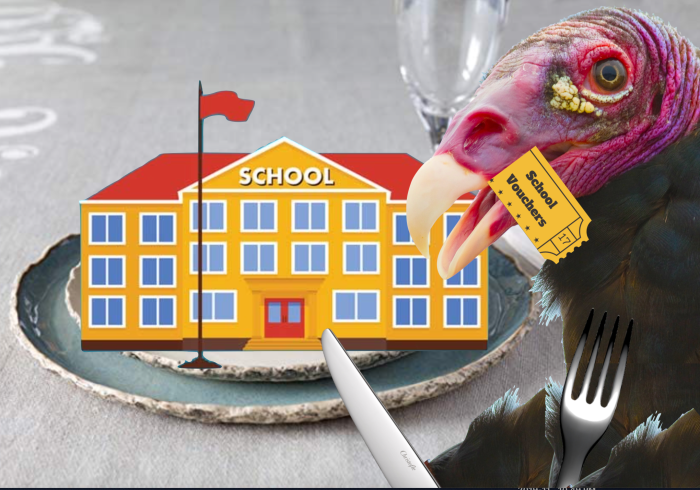
Vulture Voucher Bill Latest in Mike Turzai’s Quest to Please Betsy DeVos in PA

Screen Shot 2019-11-15 at 1.50.26 AM


The best way to help a struggling public school is to cannibalize it.


At least that’s what Betsy DeVos thinks – and so does her Pennsylvania puppet Mike Turzai.


The Republican Speaker of the state House is expected to propose a school voucher bill Monday that will treat Harrisburg Schools as nothing more than carrion fit for plunder by school privatization vultures.


Sure the district is in state receivership after decades of neglect and bad decisions by five members of the elected school board and administrators.


But instead of helping the school and its students get back on their feet, Turzai proposes siphoning away as much as $8.5 million in state funding set aside for the school’s aide. Alternatively, that money would go to help offset some of the cost of sending Harrisburg students to private or parochial schools if they so desire.


There are already 612 children living in district boundaries who attend nonpublic schools who would immediately benefit. So even if no additional students decided to take advantage of the program, that’s a $2.5 million cost to cover partial tuition for students the state is not currently paying to educate. If any additional students decided to take advantage of the program, the cost would increase.


However in lieu of any safeguards to make sure these children fleeing from the public system receive the same quality of services required by state law, Turzai’s bill goes out of its way to protect the vultures!


Under House Bill 1800, private or parochial schools won’t be held as accountable for how they spend the money they plunder from Harrisburg nor will it force them to enroll all comers like authentic public schools are required to do.


Specifically, non-public schools would be allowed to take public tax dollars but refuse any students they wished – based on gender, race, religion, even special educational needs.


It’s bad policy and bad politics.


Essentially Turzai is proposing we swoop in and tear the district to pieces – for its own good.


The bill would force state taxpayers to pay for half the cost of the voucher program – essentially making us shell out our hard earned money for two parallel education systems.


It’s unclear where the other half of the money would even come from that the state is supposed to match.


Thinking people know this is nonsense on so many levels. If the public schools have problems, there’s no reason to believe school vouchers hold the answer. After all, the best way to save yourself from drowning is to patch up the boat you’re already on. You shouldn’t jump to a lifeboat willy-nilly with no assurance that your escape craft is more seaworthy than the one you’re already sailing on.


And in fact, there is no evidence that voucher schools are better than authentic public schools.


Countless academic studies back this up. A recent 25-year meta analysis from Stanford University concluded that school vouchers do nothing to improve student achievement and distract from real solutions that could yield better results.


A 2018 Study from the University of Virginia found that once you take family income out of the equation, there are absolutely zero benefits of going to a private school. The majority of the advantage comes from simply having money and all that comes with it – physical, emotional, and mental well-being, living in a stable and secure environment, knowing where your next meal will come from, etc.


A 2018 Department of Education evaluation of the Washington, D.C., voucher program found that public school students permitted to attend a private or parochial school at public expense ended up getting worse scores than they had at public school.


Their scores went down 10 points in math and stayed about the same in reading.


The results of these studies were so damaging that school voucher lobbyists no longer even try to make the argument that sending kids to private or parochial schools has academic benefits. Instead they rely on the ideological belief that privatization is always better than public services.


Turzai is literally proposing legislation on an outdated far right talking point. But his whole plan isn’t exactly fresh. We’ve seen versions of it almost every legislative session.


Once Turzai introduces the bill next week, it’s expected that his Republican colleagues who have a majority in both the House and Senate due to grossly gerrymandered districts will vote to pass it. Democratic Gov. Tom Wolf has promised to veto it.


While Republicans have the numbers to overturn any veto, it is doubtful they would actually do so. Historically they only need to show DeVos and her billionaire friends like the Koch Brothers that they tried to pass their ALEC-written legislation. They don’t actually have to pass it. In fact, doing so would make them responsible for it and could result in voters – even in such gerrymandered districts – turning against them.


After all, school vouchers are incredibly unpopular. Every time the issue has been left to a popular vote, it has been turned down.


And Republicans know that. This is just theater to please the wealthy donor class.


Unless people stop paying attention. Then they may try to sneak it through.


Because there’s a lot more at stake than just disrupting the recovery process at Harrisburg schools.


The bill as drafted would only currently apply to Harrisburg – specifically when a receiver is appointed in a school district of the second class located in a city of the third class, within a county of the third class.


But all it would take is a receiver to be appointed for the following districts to be affected:


Allentown City, Bethlehem Area, Coatesville Area, Easton Area, Erie City, Hazleton Area, Hempfield Area, Lancaster, Penn-Trafford, Reading, Wilkes-Barre Area and York City school districts.


So this could easily become a backdoor voucher initiative for our poorest districts to become the next course on the buzzards’ menu.


But perhaps the strangest turn in this whole concern is Turzai’s apparent ambition.


He seems to be trying to position himself once again as the next gubernatorial challenger to Democrat Wolf.


And how is he planning to define that challenge? As a clone of the last dope who tried it – Scott Wagner.


Republicans don’t seem to get the message. Voters – regardless of political affiliation – care about public schools.


They ousted Tom Corbett when he slashed school funding. They voted against Wagner in droves. And the best Turzai can think to do is ape these two fools?


DeVos, herself, is perhaps the most unpopular Education Secretary in history – and that’s even with the stiff competition of Arne Duncan and John King.


School privatization is a political loser.


No one wants to violate the separation of church and state just to give private businesses a larger cut of our tax dollars.


We want equity for our public schools so all our students can learn.


Why can’t birdbrains like Turzai get that through their skulls?


Perhaps if they stopped picking through the bones of struggling schools they would.


If you live in Pennsylvania, please click here to ask your state representative to vote against the bill.


Like this post? I’ve written a book, “Gadfly on the Wall: A Public School Teacher Speaks Out on Racism and Reform,” now available from Garn Press. Ten percent of the proceeds go to the Badass Teachers Association. Check it out!

book-4

NAEP Test Scores Show How Stupid We Are… To Pay Attention to NAEP Test Scores

thumbnail_Taking-a-test-567860523df78ccc15365b27
 
Brace yourselves!


America’s NAEP test scores in 2019 stayed pretty much the same as they were in 2018!


And the media typically set its collective hair on fire trying to interpret the data.


Sometimes called the Nations Report Card, the National Assessment of Educational Progress (NAEP) test is given to a random sampling of elementary, middle and high school students in member countries to compare the education systems of nations.


And this year there was one particular area where US kids did worse than usual!


Our scores went down in 8th grade reading!


To be honest, scores usually go up or down by about one or two points every year averaging out to about the same range.


But this year! Gulp! They went down four points!


FOUR POINTS!


What does that mean?


Absolutely nothing.


They’re standardized test scores. They’re terrible assessments of student learning.


You might as well compare the relative body temperatures of randomly selected students and wonder why we aren’t bridging the body warmth gap with the somber hummingbird! I mean it has an average  temperature of 114 F! And the best we can do is a measly 98.6 F! Why won’t enough kids get a fever for America!?


If test scores have any meaning at all – it’s parental wealth. Rich kids tend to score higher than poor kids. That’s partially because of the inequality of resources each receive, but also because of racial, cultural and economic bias embedded in the questions.


So the NAEP shows us what any study of parental income would show. America has a lot of poor kids and underfunded schools.


Thanks, NAEP! There’s no way we could ever have figured that out without you!


But having this information come to us via test scores allows us to deflect from the real problem and instead continually blame the victim.


Why can’t these poor kids from impoverished schools score as well as kids from richer countries with more well-funded schools?


I can’t imagine!


Typically politicians used the results to push their pet policies.


Education Secretary Betsy DeVos used the scores to wash her hands of the entire public education system. I know – isn’t her job to safeguard public schools? It’s like a zoo keeper complaining that the penguins aren’t bringing in enough visitors and then refusing to feed them.


DeVos proposed we improve test scores by cutting $4.8 billion from public schools in 2020 and instead pumping $5 billion to a tax credit school voucher scheme that props up private schools.


I know that sounds dumb, but before you judge her, realize she also proposed cutting federal funding for afterschool programs, teacher professional development, student support and enrichment programs.


So there.


Education Blogger Peter Greene claims that this move is based on a reading comprehension problem the Education Secretary is having, herself.


She says that the NAEP results mean that 2/3 of American students read below grade level. However, Greene points out that she is conflating two different things – grade level proficiency and NAEP proficiency.


Here’s what the NAEP wrote:


“The NAEP Proficient achievement level does not represent grade-level proficiency, but rather competency over challenging subject matter. NAEP Achievement levels are to be used on a trial basis and should be interpreted and used with caution.”

 
Which kind of begs the question of why we need these scores in the first place.


There is much clearer data out there.


A study by the Center on Budget and Policy Priorities concluded that 29 states spent less per student in 2015 than they had before the Great Recession.


And the federal government has done little to help. Since 2011, spending on major K-12 programs – including Title I grants for underprivileged students and special education – has been basically flat.


According to the Economic Policy Institute in Washington, today’s public schools employ at least 250,000 fewer people than they did before the recession of 2008–09. Meanwhile enrollment has increased by at least 800,000 students.


So to ensure our students had the same quality of service children received only a decade ago, we’d need to hire almost 400,000 more teachers!


That’s how you cut class size down from the 20, 30, even 40 students packed into a room that you can routinely find in some districts today.


If we looked at realities like these instead of test scores – which at best provide us data at several removes – we might actually be motivated to reach solutions.


For instance, the U.S. is one of the only countries in the world – if not probably the ONLY country – that funds schools based largely on local taxes. Other developed nations either equalize funding or provide extra money for kids in need. In the Netherlands, for example, national funding is provided to all schools based on the number of pupils enrolled. But for every guilder allocated to a middle-class Dutch child, 1.25 guilders are allocated for a lower-class child and 1.9 guilders for a minority child – exactly the opposite of the situation in the U.S.


If we want to compare the US to other countries, this is a perfect place to start.


But a focus on test scores obscures the differences.


Virtually all of the top scoring countries taking these exams have much less child poverty than the U.S. If they had the same percentage of poor students that we do, their scores would be lower than ours. Likewise, if we had the same percentage of poor students that they do, our scores would go through the roof! We would have the best scores in the world!


These scores just mirror back to us our child poverty rate – that more than 1/3 of our students live below the poverty line and more than half of public school students qualify for free or reduced lunches.


But this myopic focus on standardized tests also blinds us to the ways our system is superior to that of many other countries.


We do something that many international systems do not. We educate everyone! Foreign systems often weed children out by high school. They don’t let every child get 13 years of grade school (counting kindergarten). They only school their highest achievers.


So when we compare ourselves to these countries, we’re comparing ALL of our students to only SOME of theirs – their best academic pupils, to be exact. Yet we still hold our own given these handicaps!

 
This suggests that the majority of problems with our public schools are monetary. Pure and simple.


At least House Democrats passed a Labor-HHS-Education funding bill to increase public school funding by $3.5 billion. Even if it were somehow passed by the Republican controlled Senate, that’s a drop in the bucket after decades of neglect – but it’s something!


It’s certainly better than DeVos who claims that funding somehow doesn’t matter for public schools – only for her pet charter and voucher schools.


A 2018 review by Northwestern University found that in 12 out of 13 studies increased spending had a positive effect on student outcomes. And that result has been verified by studies since then in California, Texas, Wisconsin and other states.

 
Money makes a difference.


Money spent on students – not more testing.


So why the drop in this year’s 8th grade reading scores?


Who knows? It could be a spike in the rate or effect of child poverty in the middle school years.


It could be the impact of decades of high stakes testing on middle school curriculum – narrowing what is taught and muscling out authentic instruction.


Frankly it doesn’t matter because the data is suspect.


Standardized testing will never give us an accurate picture of what is going on with our students or our schools.


And until we, as a society, finally realize that and focus on things that actually matter, we will continue to fail the only test that matters – how well we provide for our children.


Like this post? I’ve written a book, “Gadfly on the Wall: A Public School Teacher Speaks Out on Racism and Reform,” now available from Garn Press. Ten percent of the proceeds go to the Badass Teachers Association. Check it out!

book-4

Charter Schools Cherry Pick Students & Call it Choice – PART 2: The “EVERYONE’S DOING IT!” Excuse

Screen Shot 2019-10-18 at 2.23.57 PM


“Got school choice?” asks a charter school supporter.


But who exactly is she addressing – families or charter school operators?


Because it is the later group who is offered choice by school privatization – not parents, families or students.

 
Billionaire investors and charter school managers answer, “Heck yeah – we’ve got school choice! We get to choose to take your tax dollars but not your child!”


As we’ve seen in Part 1 of this article, charter schools unequivocally cherry pick the children who get to enroll there.


These institutions are funded by tax dollars but privately managed – and the private interests who run them get to decide how to spend that money with little oversight or strings attached. As businesses, they can increase their bottom line by letting in only the easiest kids to teach.


This is not opinion. It is fact.


Admittedly, every single charter school in the country is not guilty of this crime. Yet the charter concept explicitly allows such unscrupulous behavior, and it is widespread.


It’s like permitting a bank to work on the honor system – the safe being unlocked, people could just walk in and make withdrawals and deposits on their own. Not everyone would cheat, but that doesn’t make this a good way to safeguard your finances.


And that’s the situation at charter schools. Operators can pick and choose which students to enroll – so many do.


Charter school supporters usually respond to this critique in one of two ways. They either deny it happens or admit the truth while deflecting its importance.


In Part 1, we saw how the denial (or the “I Didn’t Do It” Excuse”) flies in the face of facts.


In this article, we will be examining those who relent that charter school do, in fact, cherry pick students but claim there’s nothing wrong with that.


In particular, we will look at their claim that charter schools are doing nothing different than what authentic public schools do.


In sum, they’re claiming that “Everyone’s doing it!”


In truth, everyone is NOT doing it. School privatizers are doing it while the rest of us aren’t allowed to do it and actually try to equitably educate all the children in our neighborhoods.


THE “EVERYONE’S DOING IT!” EXCUSE

Some charter school apologists admit this much.


They see the mountain of evidence that cherry picking exists at their schools and concede the point.


However, they claim that this is a practice at authentic public schools as well. After all, public schools expel students for all sorts of reasons and even have special magnet schools that enroll only certain students.


MAGNET SCHOOLS


One of the most frequent criticisms of authentic public schools is that they don’t give students and families enough choice. But that’s exactly what magnet schools are – institutions WITHIN the district that cater to individual choice and needs.


Magnet schools came into existence in the late 1960slong before the first charter school law was passed in 1991. They were a method of encouraging voluntary desegregation by attracting diverse groups to enroll around specific academic specialties.


Magnet schools are organized around a theme. This could be STEM – science, technology, engineering and mathematics – or fine and performing arts. As such, they cater to students with an interest and ability in that theme. This is not true of most charter schools, which have no particular theme or specialty.


The goal in magnet schools is to attract so many applicants that the school can select a racially diverse student body. However, this is exactly the opposite of what we find at charter schools where racial integration is extremely rare. As we’ve seen, many charter schools have students of one-race or ethnicity. Charters increase – not decrease – segregation wherever they are located.


Moreover, though a particular magnet school DOES allow only certain students enrollment, the public district does not. The district accepts everyone at SOME school within its boundaries. By comparison, charter schools are usually just one building and even when they are chains of schools owned and operated by the same people, they generally make no effort to accept all who apply.


There are many other differences between charter schools and magnet schools not the least of which is who runs them. Charters are often managed by appointed bureaucrats. Magnet schools are still run by the elected school board of the district. As such, they are still subject to all the rules and regulations of authentic public school districts. As we’ve seen, this is not true of charters.


In addition, many charter schools are run for-profit. Even those not directly labeled as such often contract with a for-profit management company thereby avoiding the negative connotations of the name while still indulging in the money-making practices. However, no authentic public schools do this. None. That removes the motivation for selective enrollment. Authentic public schools would get no financial benefit from doing so – in fact just the opposite.

 
One similarity about the two types of school, at least superficially, is enrollment. At both magnets and charters, admission is often determined by the use of a lottery system, due to high demand for limited seats.


In the 2015-16 school year, more than 2.6 million students were enrolled in magnet schools nationwide, compared with more than 2.8 million in charters across 43 states and the District of Columbia, according to the National Center for Education Statistics.


Does this mean that BOTH charter and magnet schools cherry pick students?

 
No, because of the most distinguishing feature between charters and authentic public schools: transparency.


When a charter school conducts a lottery, it does so behind closed doors. There is no one watching over its shoulder to make sure it is doing so fairly. And as we’ve seen those charter school lotteries result in student bodies that could not come from chance.


However, magnets are fully authentic public schools, which means that everything has to happen out in the open and in the light of day. Not only that but all nonsensitive public school documents are a matter of public record. Anyone can see that these lotteries are being conducted fairly, and the results of these lotteries produce much more equitable student distributions than we find at charter schools.


Magnet schools are like first class restaurants where the health inspector comes in and writes a glowing report of the kitchens. Charter schools are shady dives where the health inspector is not allowed where the food is prepared – ever.


Where would you take your family for dinner?


DISCIPLINE AND EXPULSIONS


Putting aside the issue of magnet schools, some critics of authentic public schools claim that they still engage in selective enrollment through discipline and expulsion policies.


But there are big differences in the ways both types of school engage in disciplinary actions.


Charter schools are known for excessive discipline policies that encourage difficult children to go elsewhere. They also kick out kids with behavior problems.


Do authentic public schools do the same?


Yes and no.


It has been documented that all school types suspend and expel black students at a higher rate than white students. However, the most draconian discipline policies – such as those designated zero tolerance – are to be found at charter schools.


Authentic public schools are restrained by state and federal law in this regard coupled with increased transparency. There’s less they’re legally allowed to do and a greater chance they’d get caught if they tried to do it anyway.


However, the biggest difference is one of motivation.


Think about it.


Charter schools only gain by getting rid of difficult children. It costs them less money to educate more well-behaved students and increases academic outcomes that they can use as marketing materials to entice greater enrollment.


Authentic public school districts lose out when students go elsewhere because they still are responsible for those students.


Authentic public school districts must ensure that all children living in their communities get a Free and Appropriate Public Education (FAPE). This is true whether a child attends the district or not.


If a child goes to a neighborhood charter school, the public school district has to pay that charter school to educate him or her. If the child has such special needs that make it necessary for him or her to attend a school outside of the district that specializes in ways to meet those needs, the district is responsible for paying. And in this case the cost will almost definitely be greater than the district receives in tax revenue – by orders of magnitude.


It costs authentic public school districts much more money to expel or outsource services for a child than to keep him or her in the district. Public schools are encouraged to find ways to meet student needs WITHIN the district and to send them elsewhere only as a last resort.


Even a child who attacked classmates in school with a weapon and ended up in jail would be the district’s responsibility. The district would still have to pay to educate that child at an alternative sight – probably in the prison system.


Authentic public schools are even responsible for homeless students and undocumented children.


This is all in the best interests of the child and represents an inclusive ideal of education you won’t find in many other countries.


But it’s not present in charter schools.


Charter schools are there to make a buck. If administrators don’t see how to do that with a given child, it makes economic sense to get rid of that child.


Not so at your local, neighborhood authentic public school.


CONCLUSIONS

So we’ve seen that charter schools really do cherry pick which students to enroll.


It’s all about the Benjamins.


Families with the easiest kids to educate are encouraged to enroll and all others are dissuaded away. Charters pick and choose between applicants often relying on test scores and academic records. And they kick out or otherwise encourage difficult students to find an education elsewhere – usually the local neighborhood authentic public school.


Moreover, these practices are radically different than what you find at authentic public schools.


It’s true that public districts sometimes include magnet schools organized around a theme that use lotteries to determine which kids get enrolled there. However, the standards of transparency are so much higher at public schools and the results so much more equitable that any charge of unfairness is much harder to support.


In addition, it’s true that public schools also discipline and sometimes expel students. But the discipline policies at public schools are never as extreme as the zero tolerance policies you’ll find at many charter schools.


Finally, expelling a difficult student is all gain for a charter school and all cost at authentic public districts. No matter which school a student attends, the district where that child resides is still responsible for FAPE, and the cost of educating that child outside the district is nearly always greater than inside the district.


These are just some of the reasons why the charter school experiment should end.


No reform in the world can make equity out of schools that are by definition “separate but equal.”


Schools paid for with tax dollars need to be accountable and transparent. And the only way to do that is to rip up every bogus charter contract in the country and make them all abide by the same rules and regulations that ensure every child gets the high quality education he or she deserves.


In other words, reverse the privatization. Public-ize them all.


Like this post? I’ve written a book, “Gadfly on the Wall: A Public School Teacher Speaks Out on Racism and Reform,” now available from Garn Press. Ten percent of the proceeds go to the Badass Teachers Association. Check it out!
book-3

Eight Things I Love About Elizabeth Warren’s Education Plan – And One I Don’t

105863950-1555953359609senatorelizabethwarren

 
My daughter had bad news for me yesterday at dinner.


She turned to me with all the seriousness her 10-year-old self could muster and said, “Daddy, I know you love Bernie but I’m voting for Elizabeth.”

 
“Elizabeth Warren?” I said choking back a laugh.


Her pronouncement had come out of nowhere. We had just been discussing how disgusting the pierogies were in the cafeteria for lunch.

 
And she nodded with the kind of earnestness you can only have in middle school.


So I tried to match the sobriety on her face and remarked, “That’s okay, Honey. You support whomever you want. You could certainly do worse than Elizabeth Warren.”


And you know what? She’s right.


Warren has a lot of things to offer – especially now that her education plan has dropped.


In the 15 years or so that I’ve been a public school teacher, there have been few candidates who even understand the issues we are facing less than any who actually promote positive education policy.


But then Bernie Sanders came out with his amazing Thurgood Marshall plan and I thought, “This is it! The policy platform I’ve been waiting for!”

 
I knew Warren was progressive on certain issues but I never expected her to in some ways match and even surpass Bernie on education.


What times we live in! There are two major political candidates for the Democratic nomination for President who don’t want to privatize every public school in sight! There are two candidates who are against standardized testing!


It’s beyond amazing!


Before we gripe and pick at loose ends in both platforms, we should pause and acknowledge this.


Woo-hoo!


Both Sanders AND Warren are excellent choices for President. And Biden might even do in a pinch.


So in honor of my precocious political princess backing Elizabeth Warren – I THINK she knows she doesn’t actually get to vote, herself, yet! – I give you eight things I love and one I don’t in Warren’s education plan.


Things I like:


1)       IT INVESTS IN PUBLIC SCHOOLS.


WARREN’S PROPOSAL:  Quadrupling Title I funding — an additional $450 billion over the next 10 years for the neediest children and their schools. Finally have the federal government pay 40% of all special education costs – a promise lawmakers made years ago but never kept. Invest an additional $100 billion over ten years in “Excellence Grants” to any public school. That’s roughly $1 million for every public school in the country to buy state-of-the art labs, restore afterschool arts programs, implement school-based student mentoring programs, etc. By 2030, she’ll help 25,000 public schools become community schools. Invest at least an additional $50 billion in school infrastructure — targeted at the schools most in need.

 
WHAT I LIKE: Everything! Our public schools are crumbling under decades of neglect and targeted disinvestment – especially those serving the poor and minorities. This could be a game changer for the entire country!


2)       IT ACTIVELY WORKS TO INTEGRATE PUBLIC SCHOOLS.


WARREN’S PROPOSAL: Spend billions of dollars annually that states can use to promote residential and public school integration. This includes infrastructure like magnet schools but also integrating communities. Support strengthening and robust enforcement of Title VI of the Civil Rights Act of 1964. This prohibits discrimination on the basis of race in any program receiving federal funding.

 
WHAT I LIKE: Segregation is the elephant in the room in our nation. We can’t be a single country pursuing liberty and justice for all when we keep our people “separate but equal.” If you want to undo our history of racism, prejudice and xenophobia, we must get to know and appreciate each other from a young age. Plus it’s harder to horde resources for one group or another when all children are in one place.


3)       IT SUPPORTS ALL OUR STUDENTS.


WARREN PROPOSES: Protecting the rights of LGBTQ+ students, immigrant students and their families, English Language Learners, students of color, etc.

 
WHY I LIKE IT: I love my students – all of my students. It breaks my heart that the same system that’s supposed to provide them an education oftentimes allows them to be discriminated against.


4)       IT ELIMINATES HIGH-STAKES TESTING.


WARREN PROPOSES: In particular:

“The push toward high-stakes standardized testing has hurt both students and teachers. Schools have eliminated critical courses that are not subject to federally mandated testing, like social studies and the arts. They can exclude students who don’t perform well on tests. Teachers feel pressured to teach to the test, rather than ensuring that students have a rich learning experience. I oppose high-stakes testing, and I co-sponsored successful legislation in Congress to eliminate unnecessary and low-quality standardized tests. As president, I’ll push to prohibit the use of standardized testing as a primary or significant factor in closing a school, firing a teacher, or making any other high-stakes decisions, and encourage schools to use authentic assessments that allow students to demonstrate learning in multiple ways.”


WHY I LIKE IT: High stakes testing is a curse on the education field. It warps nearly every aspect of our school system with biased and inappropriate assessments. Good riddance!


5)       IT SUPPORTS FEEDING ALL STUDENTS – NOT SHAMING THEM FOR THEIR POVERTY.


WARREN PROPOSES: Canceling student breakfast and lunch debt. In particular:

“I will also push to cancel all existing student meal debt and increase federal funding to school meals programs so that students everywhere get free breakfast and lunch.”


WHY I LIKE IT: No child should have to go hungry – especially at school. No child should have to feel guilty for their parent’s economic situation. And feeding all children removes any stigma and helps create community.


6)       IT SUPPORTS TEACHERS.

 
WARREN PROPOSES: Providing funding for schools to increase pay and support for all public school educators, strengthen the ability of teachers, paraprofessionals, and staff to organize and bargain. In particular:


“I pledged to enact the Public Service Freedom to Negotiate Act, which ensures that public employees like teachers can organize and bargain collectively in each state, and authorizes voluntary deduction of fees to support a union.”

 
WHY I LIKE IT: A robust system of public education needs teachers who are respected and appreciated. You cannot have this when salary is based on the wealth of the community you serve. The only choice as far as I see it is to have the spender of last resort (the federal government) take up the slack. I know some of my fellow bloggers are nervous about this because these funds could come with strings attached. Pay could be contingent on teachers increasing student test scores or using certain corporate curriculum, etc. However, any tool can be misused. I don’t see this as necessarily being a backdoor for corporate shenanigans, but we certainly must be cautious.


7)       IT FIGHTS THE CORRUPT SCHOOL PRIVATIZATION INDUSTRY.


WARREN PROPOSES: Ensuring charter schools are subject to at least the same level of transparency and accountability as traditional public schools. In particular:


“…I support the NAACP’s recommendations to only allow school districts to serve as charter authorizers, and to empower school districts to reject applications that do not meet transparency and accountability standards, consider the fiscal impact and strain on district resources, and establish policies for aggressive oversight of charter schools.”


Ending federal funding for the expansion of charter schools. Banning for-profit charter schools including non-profit charter schools that outsource their operations to for-profit companies. Directing the Internal Revenue Service (IRS) to investigate “so-called nonprofit schools that are violating the statutory requirements for nonprofits.”

 
WHAT I LIKE ABOUT IT: Everything! This is where Warren’s proposal really shines! She is even more comprehensive than Sanders’! She doesn’t stop with just “for-profit” charter schools but understands that many of these institutions circumvent the rules even without that tax status.


8)       IT PROTECTS STUDENT DATA FROM ED TECH COMPANIES AND BEYOND.


WARREN PROPOSES: Banning the sharing, storing, and sale of student data. In particular:


“My plan would extend the Family Educational Rights and Privacy Act (FERPA) to ban the sharing, storing, and sale of student data that includes names or other information that can identify individual students. Violations should be punishable by civil and criminal penalties.”

 
WHAT I LIKE ABOUT IT: Ed tech companies are seen for the danger they bring to education. Students are protected from having their entire lives impacted by the choices of ignorant school administrators or school directors. The road to the replacement of public school with digital alternatives is recognized and blocked.


And this just scratches the surface. These are just the points that jumped out at me on a first read.


I’m sure there is more policy gold in here we’ll find as the election season progresses.


However, there was one thing that jumped out at me in a less positive light.
 
One thing I did not like:


1)      WARREN’S EMPHASIS ON “CAREER AND COLLEGE READINESS” SOUNDS TOO MUCH LIKE THE WORST OF BARACK OBAMA’S EDUCATION POLICY.


On the one hand, Warren says unequivocally that she’s against high stakes testing. Then on the other she writes:


“We must also ensure that students are able to take advantage of those opportunities and that high schools are funded and designed to prepare students for careers, college, and life…

…I’ll work with states to align high school graduation requirements with their public college admission requirements. And I’ll also direct the Department of Education to issue guidance on how schools can leverage existing federal programs to facilitate education-to-workforce preparedness.”


This sounds an awful lot like Race to the Top and Common Core.


Is she really proposing all public schools have the same top-down academic standards? Is she proposing states force corporate-created academic standards on their schools? And is she threatening to use the power of the federal government – possibly the power of the purse – to make states and schools fall into line?


Warren needs to understand that Common Core cannot be separated into curriculum and testing. The testing drives the curriculum. You can’t say you’re against testing being used to make high stakes decisions and then have that same testing determine what is taught in schools.


Perhaps this isn’t her intention at all. But she needs to be asked and she needs to give a definitive answer.


Obama was all about teacher autonomy, too, before he got into office.


And that’s really the biggest issue for most education advocates like me.


We’ve been burned so many times before by politicians, it’s hard to accept that any of them might actually be serious about doing something positive for children’s educations.


I’m still a Bernie Sanders supporter. I’ll admit that.


But Warren has gone a long way with this proposal to getting me into her corner, too.


In the primary, I’ll probably continue to feel the Bern.


But who knows? In the general election, perhaps my daughter and I will get to root for the same candidate.


I’m extremely thankful to Warren and her team for coming up with such a thoughtful and detailed education plan. It couldn’t have been easy – either to draft or politically.


It really does appear to be an attempt not just to sway voters but to actually get things right.


Here’s hoping that voters do the same in about a year.


Like this post? I’ve written a book, “Gadfly on the Wall: A Public School Teacher Speaks Out on Racism and Reform,” now available from Garn Press. Ten percent of the proceeds go to the Badass Teachers Association. Check it out!

book-4

Charter Schools Cherry Pick Students & Call it Choice – PART 1: The “I Didn’t Do It!” Excuse

Screen Shot 2019-10-18 at 2.22.17 PM


It takes a certain kind of hypocrite to be a charter school champion.


You have to deny any wrongdoing one minute. And then admit you’re guilty but explain it away with the excuse “Everyone’s doing it!” the next.

 
Take cherry picking – one of the most common admonishments leveled against the school privatization industry.

 
Detractors claim that charter schools keep enrollment low and then out of those who apply, they pick and choose which students to accept.

 
Charters are run by private enterprise but funded with public tax dollars. So they are supposed to accept all comers just like the authentic public schools in the same neighborhoods.


But charter schools don’t have to follow the same rules as authentic public schools. They pretty much just have to abide by whatever was agreed upon in their charter contracts. Even then states rarely check up on them to make sure they’re in compliance.


So critics say many of these institutions are circumventing enrollment procedures. They’re welcoming the easiest kids to teach and dissuading others from enrolling – even to the extent of kicking out hard to teach children or pretending that an “unbiased” selection process just so happened to pick only the most motivated students.


Charter school supporters usually respond to this critique in one of two ways.


(1) Cherry picking!? How dare you!? We don’t cherry pick students! The demand to get in to our schools is so great that we put all the names in a hat and let chance decide!


Or


(2) Cherry picking!? Why of course we cherry pick students! But so do the public schools with their discipline policies and magnet schools!

 
You’d think these folks would suffer from some cognitive dissonance. Imagine if the Oscar Mayer company claimed that their hot dogs don’t contain any rat feces only to backtrack a minute later saying that their wieners have no more rat feces than the leading competitor’s franks.

 
And make no mistake – the charter school response is very much like a hot dog company’s damage control – a corporate press release written by various billionaire-funded think tanks to protect the industry’s market share.


It’s like a spoiled child saying, “I didn’t do it! And even if I did do it, there’s nothing wrong with it!”


Thankfully, there are these pesky things called facts that show both responses to be… well.. baloney!


Let’s take a look at each and examine why they’re wrong.


In Part 1, we’ll focus on the first excuse that charters don’t cherry pick students. In Part 2, we’ll look at the excuse that it’s okay for charters to cherry pick students because the authentic public schools do the same.


THE “I DIDN’T DO IT!” EXCUSE


Short answer: There is plenty of evidence that shows you did.


Long Answer:


Selecting the students you want to teach instead of families selecting the school they want their kids to attend is sometimes called cherry picking or creaming, and it comes in at least three varieties.


(1) Charter schools do things to encourage only the most motivated families to apply and discourage anyone else. This can involve long applications that may deter uneducated, non English-speaking and/or immigrant parents.


(2) Charter schools literally handpick students with higher test scores and sterling academic records.


(3) Charter schools “counsel out” or expel difficult students during the school year.


TYPE 1: APPLICATION SCHENANIGANS


The international news organization Reuters found evidence of the first type to be widespread at U.S. charter schools.


Reuters documented the following:


  • “Applications that are made available just a few hours a year.


  • Lengthy application forms, often printed only in English, that require student and parent essays, report cards, test scores, disciplinary records, teacher recommendations and medical records.


  • Demands that students present Social Security cards and birth certificates for their applications to be considered, even though such documents cannot be required under federal law.


  • Mandatory family interviews.


  • Assessment exams.


  • Academic prerequisites.


  • Requirements that applicants document any disabilities or special needs. The U.S. Department of Education considers this practice illegal on the college level but has not addressed the issue for K-12 schools.”


For a specific example, take a look at the online application form for 2016-17 at Roseland Accelerated Middle School, a charter school in Santa Rosa, California.


Applicants must fill out several dozen pages before a student is accepted, according to the website.


Students must write five essays that are each two pages in length using complete sentences covering a variety of topics including family background. One essay even asks applicants to write an essay beginning with “The qualities and strengths that I will bring to school are… .”


But that’s not all. Parents have to write seven small essays of their own and fill out their child’s medical history including medications the child takes (which some critics say violates federal privacy law).


Finally, students must write a minimum three-page autobiography, typed, double spaced and “well constructed with varied structure.”


This is all required BEFORE applicants are accepted to the school – a taxpayer funded school, by the way, that is supposed to accept everyone who applies unless too many enroll. Then the school is supposed to use a lottery to determine who gets in.
Funny how the lottery winners always seem to be those with the best essays and the lowest academic, psychological or medical needs.


Of course, that’s just one school.


The Southern California chapter of the American Civil Liberties Union (ACLU) along with Public Advocates looked at the application policies of 1,000 of the state’s 1,200 charter schools.


A quarter of them (including Roseland) had policies in violation of state law that could exclude some types of students. In particular, these charters are selecting against children from families with lower incomes or poorer English skills by requiring parents to volunteer, demanding students’ academic histories and/or failing to provide services for special-education students.


It should be obvious why this is unfair.


No family should have to do more to apply for a K-12 school than would be expected at a private college or university. We should not allow schools that are funded with public tax dollars to select against low-income students and families or foster children. No family should be forced to disclose their child’s medical histories as a prerequisite for enrollment so that school administrators could decide if asthma or a leukemia diagnosis makes the child a bad academic bet. No family should have to divulge members’ immigration status, religion or culture to apply to a school. Frankly, this is not the school’s business. No parent should have to volunteer on campus. Low income parents work two or more jobs, have younger children at home or just don’t have the time. And when you require parents to write essays, too, you’re really just trying to gauge family literacy and the ease of educating the student applicant.


TYPE 2 AND 3: HANDPICKING STUDENTS AND COUNSELING OUT


The good thing about the first type of selective enrollment is that you can see it on school applications which are free and open to the public.


The problem with proving the other two types of cherry picking is the lack of transparency at most charter schools.


Charter schools are notoriously tight lipped about what happens behind their closed doors. Unlike authentic public schools that have several monthly open meetings, open documents, and frequent state audits, charter schools don’t have to share hardly any of this with the public – even though we pay for their school.


The public is not allowed into the room where charter operators pick and choose students because of test scores or academics. Nor are many people allowed into private meetings with students and parents where children are highly encouraged to seek their education elsewhere or even given the boot.


However, there have been numerous studies that show this happens.


To be fair, there are competing studies that show it doesn’t happen. However, those studies are often paid for by the very industry under investigation. Their funding is predicated on finding a certain result and – GASP! – that’s what they usually end up finding.


It’s like the National Apple Institute funding a study that concludes “Pears suck.” It’s not a real study. It’s an advertisement.


The studies that DO show evidence of the second and third type of cherry picking, though, are independent and peer reviewed.


Here are a few results:


-Vasquez Heilig, J., Williams, A., McNeil, L & Lee, C. (2011). Is choice a panacea? An analysis of black secondary student attrition from KIPP, other private charters and urban districts. Berkeley Review of Education, 2(2), 153-178.

 
This paper concludes that charter school dropout rates – especially for black children – are much higher than at authentic public schools in Texas. In particular, KIPP charter schools claim that 88-90% of their students go on to college. The evidence does not support this claim. In fact, even though KIPP does spend 30-60% more per student, it still has a higher dropout rate and a higher rate for students transferring to other schools. Moreover, Texas charter schools were found to serve fewer black children than authentic public schools.


-Vasquez Heilig, J., LeClair, A. V., Redd, L., & Ward, D. (in press). Separate and Unequal?: The Problematic Segregation of Special Populations in Charter Schools Relative to Traditional Public Schools. Stanford Law & Policy Review, XX(X), XXX-XXX.

 
An analysis of charter schools in large metropolitan areas finds that authentic public schools have much greater rates of high needs students than charter schools in the same areas.


-Frankenberg, E., Siegel-Hawley, G., & Wang, J. (2011, January). Choice without equity: Charter school segregation. Education Policy Analysis Archives, 19(1). Retrieved from http://epaa.asu.edu/ojs/article/view/779/878

 
An examination of charter schools in 40 states and the District of Columbia found widespread evidence that charter schools are much more segregated by race and class than authentic public schools.


In particular:


“This analysis of recent data [2007-08] finds that charter schools are more racially isolated than traditional public schools in virtually every state and large metropolitan area in the nation.  In some regions, white students are over-represented in charter schools while in other charter schools, minority students have little exposure to white students.  Data about the extent to which charter schools serve low-income and English learner students is incomplete, but suggest that a substantial share of charter schools may not enroll such students.”


-Garcia, D. R. (2008). Academic and racial segregation in charter schools: Do parents sort students into specialized charter schools? Education and Urban Society, 40(5), 590- 612. doi: 10.1177/0013124508316044


This study found little evidence that charter schools were more segregated because of parental choice. “…parents enroll their students into charter schools with at least the same degree of academic integration as the district schools that students exited.” The segregation found at charter schools is due to some other source.


-Lacireno-Paquet, N., Holyoke, T. T., Moser, M., & Henig, J. R. (2002). Creaming versus cropping: Charter school enrollment practices in response to market incentives. Educational Evaluation and Policy Analysis, 24(2), 145-158. doi: 10.3102/01623737024002145

 
School choice makes disparities of race and class worse – not better – by selecting the easiest to teach in enrollment.


In particular:


“…competition for students will pressure individual schools into targeting students with the highest performance and the least encumbered with personal and social disadvantages. We suggest that some charter schools, by background and affiliation, are likely to be more market-oriented in their behavior than others, and test the proposition that market-oriented charter schools engage in cream-skimming…”


Market-based charter schools are not serving high needs students. They are “…skimming the cream off the top of the potential student population, [and] market-oriented charter schools may be “cropping off” service to students whose language or special education needs make them more costly to educate.”


Positioning Charter Schools in Los Angeles: Diversity of Form and Homogeneity of Effects. Douglas Lee Lauen, Bruce Fuller and Luke Dauter American Journal of Education Vol. 121, No. 2 (February 2015), pp. 213-239


This study finds:


“Charter school students were less likely to be Black, Latino, LEP, special education, and low income and were more likely to be White, academically gifted, high achieving, and have more highly educated parents. For example, about 12 percent of the parents of traditional public school students attained a college degree or higher, compared with 35 percent of the parents of charter school students.”


Researchers also concluded that despite serving more advantaged students, Los Angeles charter schools did not have much effect on student test scores.


In fact:


“We report no statistically significant positive effects of attending a charter school on achievement growth. For the first three cohorts studied, charter school effects on test score growth were negative and significant. For the last cohort studied, the effect was negative, but not statistically significant.”


-Government Accountability Office. (2012). Charter schools: Additional federal attention needed to help protect access for students with disabilities. Washington, DC: Author. http://www.gao.gov/products/GAO-12-543


This study found that charter schools enrolled a lower percentage of students with disabilities than traditional public schools.


In particular:


“In school year 2009-2010, which was the most recent data available at the time of our review, approximately 11 percent of students enrolled in traditional public schools were students with disabilities compared to about 8 percent of students enrolled in charter schools.


“GAO also found that, relative to traditional public schools, the proportion of charter schools that enrolled high percentages of students with disabilities was lower overall. Specifically, students with disabilities represented 8 to 12 percent of all students at 23 percent of charter schools compared to 34 percent of traditional public schools.”


Researchers could not prove a reason for this discrepancy but they did consider that “…some charter schools may be discouraging students with disabilities from enrolling.”


-Jabbar,  H. (2015). Every Kid is Money: Market-like competition and school leader strategies in New Orleans. Educational Evaluation and Policy Analysis. http://epa.sagepub.com/content/early/2015/04/27/0162373715577447.abstract


“This study examines how choice creates school-level actions using qualitative data from 30 schools in New Orleans. Findings suggest that school leaders did experience market pressures… [and some] …engaged in marketing or cream skimming.”


-Hirji, R. (2014). Are Charter Schools Upholding Student Rights? American Bar Association. Available online at http://apps.americanbar.org/litigation/committees/childrights/content/articles/winter2014-0114-charter-schools-upholding-student-rights.htm


The study concluded:


“The structures that allow charter schools to exist are marked by the absence of protections that are traditionally guaranteed by public education, protections that only become apparent and necessary when families and students begin to face a denial of what they were initially promised to be their right. [Charter operators] may encourage charter schools to push certain students out and make it easier to deny them the benefits of a publicly supported education.  The perception that charter schools are open to all students is being called into question by increasing evidence that children who are disadvantaged by a disability, poverty, or being a member of a minority group, or who have been accused of an offense, may not have the same access to charter schools as those [who] are not.”


-Taylor, J., Cregor, M., & Lane, P. (2014). Not Measuring Up: Massachusetts’ Students of Color and Students with Disabilities Receive Disproportionate Discipline, Especially in Charter Schools. Lawyers Committee For Civil Rights and Economic Justice. Available at: http://lawyerscom.org/wp-content/uploads/2014/11/Not-Measuring-up_-The-State-of-School-Discipline-in-Massachusetts.pdf


“…A significant number of charter schools, particularly those in the Boston area, had high discipline rates. Roxbury Preparatory Charter suspended 6 out of every 10 students out-of-school at least once… all for non-violent, non-criminal, non-drug offenses– for each suspended student.”


Civil Rights complaints and documents from the Katrina Truth (Education) page may be accessed here: http://www.katrinatruth.org/pages/education.html


“Accountability for what’s happening in New Orleans schools has been sorely lacking. While 92% of students are now enrolled in charters, many charter schools have failed to accommodate students with disabilities or limited English proficiency, violating federal law and prompting civil rights complaints to federal agencies. Making matters worse, students enrolled in New Orleans charters are subject to harsher charter-specific discipline policies aimed at pushing out even more students. Suspension rates at New Orleans charters, especially for out-of-school suspensions, are among some of the worst in the nation, with several schools above Louisiana’s already high statewide average and a select group at “rates of 40, 50, 60% and more each year.”


There is much more in comprehensive reports like Pushed Out: Harsh Discipline in Louisiana Schools Denies The Right to Education.


-Henig, J. R., & MacDonald, J. A. (2002). Locational decisions of charter schools: Probing the market metaphor. Social Science Quarterly, 83(4), 962–980. doi:10.1111/1540-6237.00126

 
The study examined why charters chose to locate in the District of Columbia (D.C.).


Researchers concluded:


“Charters are more likely to locate in areas with high proportions of African–American and Hispanic residents than in the predominantly white neighborhoods, and more likely to locate in neighborhoods with middle incomes and high home ownership than in either poor or wealthy areas of the city. This is especially true of those operated by for–profits…”


-Jennings, J. (2010). School choice or schools’ choice?: Managing in an era of accountability. Sociology of Education, 83(3), 227–247.


Looking at New York City charter high schools, researchers concluded:


“Although district policy did not allow principals to select students based on their performance, two of the three schools in this study circumvented these rules to recruit and retain a population that would meet local accountability targets.”


-Corcoran, S. & Jennings, 2015. The Gender Gap in Charter School Enrollment. 2015. NCSPE. http://www.ncspe.org/readrel.php?set=pub&cat=287


“Though many studies have investigated the extent to which the racial, socioeconomic, and academic composition of charter schools differs from traditional schools, no studies have examined whether charters enroll and/or retain a higher fraction of girls.


“…Analyzing enrollment data for all charter and public schools from 1999-00 through 2006-07, we find that charters enroll a significantly higher fraction of girls, an imbalance that is largest in the secondary grades, and has grown steadily each year.”


“…While attrition from charter schools is higher in all grades than from traditional schools, we find that boys are only slightly more likely to exit charter schools once enrolled. This suggests that much of the gender enrollment gap occurs at intake.”


VERDICT ON CHERRY PICKING


This really just scratches the surface. There are hundreds of more peer-reviewed studies and reputable news articles documenting that the second and third type of cherry picking takes place at many charter schools.


This is a problem even for charters that don’t engage in this practice because the laws governing the industry allow for selective enrollment.


Even charters that don’t cherry pick today could do so tomorrow and there’s nothing we could do about it.


Allowing schools that are publicly financed the freedom to pick whichever students they want to educate is like giving a match to an unsupervised child. It’s only a matter of time before something catches on fire.


In Part 2, we’ll examine the second excuse charter school advocates proclaim when confronted with the evidence above. Namely, that cherry picking students is okay since the authentic public schools do it, too.


NOTE: This article owes a debt to the research of Julian Vasquez Heilig whose Cloaking Inequality Website is an essential resource in the fight for equity in our schools.


Like this post? I’ve written a book, “Gadfly on the Wall: A Public School Teacher Speaks Out on Racism and Reform,” now available from Garn Press. Ten percent of the proceeds go to the Badass Teachers Association. Check it out!

thumbnail_IMG_8249

Charter School’s Two Dads – How a Hatred for Public School Gave Us School Privatization

Screen Shot 2019-09-17 at 5.02.21 PM

If bad ideas can be said to have fathers, then charter schools have two.


And I’m not talking about greed and racism.


No, I mean two flesh and blood men who did more than any others to give this terrible idea life – Minnesota ideologues Ted Kolderie, 89, and Joe Nathan, 71.


In my article “Charter Schools Were Never a Good Idea. They Were a Corporate Plot All Along,” I wrote about Kolderie’s role but neglected to mention Nathan’s.


And of the two men, Nathan has actually commented on this blog.


He flamed on your humble narrator when I dared to say that charter schools and voucher schools are virtually identical.


I guess he didn’t like me connecting “liberal” charters with “conservative” vouchers. And in the years since, with Trump’s universally hated Billionaire Education Secretary Betsy Devos assuming the face of both regressive policies, he was right to fear the public relations nightmare for his brainchild, the charter school.


It’s kind of amazing that these two white men tried to convince scores of minorities that giving up self-governance of their children’s schools is in their own best interests, that children of color don’t need the same services white kids routinely get at their neighborhood public schools and that letting appointed bureaucrats decide whether your child actually gets to enroll in their school is somehow school choice!


But now that Nathan and Kolderie’s progeny policy initiative is waning in popularity, the NAACP and Black Lives Matter are calling for moratoriums on new charters and even progressive politicians are calling for legislative oversight, it’s important that people know exactly who is responsible for this monster.


And more than anyone else, that’s Kolderie and Nathan.


Over the last three decades, Nathan has made a career of sabotaging authentic public schools while pushing for school privatization.


He is director of the Center for School Change, a Minneapolis charter school cheerleading organization, that’s received at least $1,317,813 in grants to undermine neighborhood schools and replace them with fly-by-night privatized monstrosities.


He’s written extensively in newspapers around the country and nationwide magazines and Websites like the Huffington Post.


But it all started for Nathan back in 1987 when he happened to see an advertisement on TV, according to Ember Reichgott, the former Minnesota State Senator who originally proposed the first charter school bill.


The ad was called “Ah, Those Marvelous Minnesota Schools,” writes Reichgott.


It dared to dispute the Reagan administration’s propaganda hit piece “A Nation at Risk” which painted public schools as failures that needed to be disrupted and replaced.


Well Nathan wasn’t about to take it.


According to Reichgott’s book, “Zero Chance of Passage: The Pioneering Charter School Story”, Nathan:


“…talked with the Minneapolis Foundation, among others, about what they might do. ‘The Minneapolis Foundation decided it was time to introduce into Minnesota some pretty radical ideas,’ said Nathan. So plans got underway for the Itasca Seminar, with a focus on public education.”


This seminar was instrumental in turning the tide in Minnesota that ultimately birthed the most infectious school privatization virus on an unwitting nation.


Nathan had always been a fan of transferring public services to private control. In fact, he had just finished lobbying for privatization in the National Governors Association. Now back in Minnesota, he joined together with Kolderie, a former journalist and self professed “policy entrepreneur” who had been pushing for the same thing since at least the 1970s.


Their ideology – expounded by southern segregationists and people like the divisive economist Milton Friedman – was extremely unpopular, but they were about to get a break.


In 1988, Albert Shanker, the union hero President of the American Federation of Teachers, had just given an infamous speech to the National Press Club praising the idea of a new concept called “charter schools.”


However, he wasn’t talking about the modern idea of a charter school. Shanker was building off an idea originally proposed by Ray Budde, a little-known professor of education from upstate New York.


It was Budde who actually coined the term “charter school.” He thought school boards could offer “charters” directly to teachers allowing them to create new programs or departments.


Shanker liked this idea because of his own teaching experience in East Harlem where administrators constantly got in the way of educators. “One of the things that discourages people from bringing about change in schools is the experience of having that effort stopped for no good reason,” he said.


Nathan saw in this an opportunity and invited Shanker to speak at the Itasca Seminar. His goal was to hide his side’s privatization aims under the shadow of progressive unionism.


And it worked. In fact, if you look up the history of charter schools, you’ll STILL find people who insist they were invented by Shanker.


With this cover, the Citizen’s League, which was underwritten by the Minneapolis Foundation, was able to pass a bill requiring mandatory statewide standardized testing. The bill, authored by the Minnesota Business Partnership put forth the evaluation system necessary to demonize the public schools and prepare the way for the ultimate goal – privatization.


In 1991, the same forces passed the nation’s first charter school bill.


But let’s be clear on this – the charter schools created in this bill and the “charter schools” talked about by Shanker and Budde are very different concepts.


Nathan and Kolderie wrote the majority of the bill and they stripped out almost everything any educator had ever proposed.


According to Budde’s conception, charters would be authorized by school districts and run by teachers. Central office administrators would step out of the way, but charter schools would still operate within collective bargaining arrangements negotiated between districts and unions.


Instead, Nathan and Kolderie proposed that schools be authorized by statewide agencies that were separate from local districts. The state had the power, not communities or their elected representatives. That meant charters could be run not just by teachers but also by entrepreneurs. And that’s almost always who has been in charge of them ever since – corporations and business interests.


This was the goal Friedman and the deregulators had been fighting for since the 1950s finally realized – almost the same goal, it should be noted, as that behind school vouchers.


From the start, this was a business initiative. Competition between charters and authentic public schools was encouraged. And that included union busting. Thus charters were free of all the constraints of collective bargaining that districts had negotiated with their unions. The needs of workers and students were secondary to those of big business and the profit principle.


Shanker eventually realized this and repudiated what charter schools had become. But by then the damage was done.


Shanker hadn’t created charter schools. He had suggested something very different. And that suggestion was used to help usher in a concept that has haunted our public school system ever since.


Kolderie had been working on it for two decades, and with Nathan’s help it became a reality.


With the backing of the American Legislative Exchange Council (ALEC), the two men went on to push a version of this same bill from legislature to legislature. Kolderie even boasts of helping 25 other states enact charter school legislation.


Today 43 states are afflicted with charter schools enrolling about 6% of the students in the country. An additional 4% go to private and parochial schools some of which are funded with school vouchers.


This distinction between charter and voucher schools is important to political pundits, but it’s really just hair splitting.  It’s like saying vanilla chocolate swirl ice cream is nothing like chocolate vanilla swirl.


Consider: charter schools are privatized schools paid for with taxes. Voucher schools are private schools paid for with money diverted from taxes.


False distinctions like these are another way of managing public perception just like the pettifogging contrast between for-profit and non-profit charter schools. Again they’re pretty much the same thing. They can each cut services to students and pocket the left overs – the only difference is which loopholes they have to jump through and how they designate their tax status.


They are both the flowering of the deregulationist dream of destroying public education and replacing it with business-operated schools. They are attempts to destabilize, defame and destroy public education.


And though the plan has worked for decades, here’s hoping that the current political pause represents the beginning of a change of course.


Kolderie and Nathan’s monster has devoured too many schools and with them too many children’s hopes of an excellent education.


It’s time to pin the monster down with facts and shove a stake through its heart.


Like this post? I’ve written a book, “Gadfly on the Wall: A Public School Teacher Speaks Out on Racism and Reform,” now available from Garn Press. Ten percent of the proceeds go to the Badass Teachers Association. Check it out!
book-3