I Love Teaching, But…


I love teaching. 


I love greeting the kids as they come into class every day. I love listening to their stories, making them laugh, giving advice, and calming their fears. I love accepting assignments, helping with problems, and making connections about things we talked about last week


I don’t love being perpetually exhausted.  


I don’t love struggling to keep my eyes open as I drive home every day. I don’t love shuffling through the door, dropping my bag on the floor and collapsing into bed for a few hours before I can even think about cooking dinner. I don’t love the paralysis every tiny decision gives me after making thousands of choices all day long in class. I don’t love missing giant chunks of my family’s life. 


I love teaching. 


I love inspiring kids to write. I love coming up with creative and interesting journal topics and poetry assignments. I love explaining the far out concepts – hyperbole, alliteration, onomatopoeia. I love jamming to Blackalicious’ “Alphabet Aerobics,” sharing “Whose Line is it Anyway” videos and trying to write paragraphs to the melodies of Miles Davis. 


I don’t love having so little planning time.  


I don’t love having to fly by the seat of my pants rehashing lessons that were getting stale two years ago but having no time to make them fresh or original. I don’t love trying to fit in as much grading as I can in class, trying to call or email parents on my lunch break. I don’t love having to fill in for missing staff 4 out of 5 days a week, being a glorified security guard in lunch duty, subbing for a teacher who isn’t absent but who has been called into an unnecessary staff meeting for yet another scattershot initiative to fight bogus learning loss.  


I don’t love the impossibly high expectations. 


I don’t love being praised for being the most important factor in school for student learning but bullied to ignore the importance of out of school factors. I don’t love being blamed for a child’s poverty or home life or the bias of standardized test questions. I don’t love being held responsible for everything by people who don’t listen to me and are, themselves, responsible for nothing


I love teaching. 


I love reading books with my students – both together and separately. I love going to the library and helping them find something suited to their tastes – try a Ray Bradbury classic;  maybe a new anime; and when you’re ready, a deep meditation by Toni Morrison. I love reading “The Outsiders” with my classes and experiencing Ponyboy’s story anew every year – feeling the highs, the lows, the losses, the victories. I love seeing the look on children’s faces when the realization dawns that they can no longer honestly say they hate reading, but only that sometimes it’s hard. I love catching them with a book in their bags or the same book on their desks being read over and over again because they love it so much. 


I don’t love the low pay.  


I don’t love that starting salary for most teachers is just $10,000 above the most generous minimum wage. I don’t love that becoming a teacher often means going into debt so you can earn a four-year degree in education and serve an (often unpaid) internship in the classroom just to make 14 percent less than those from professions that require similar levels of education. I don’t love that our salaries start low and grow even more slowly. I don’t love that many of us need a second or third job just to make ends meet. I don’t love that teachers get crap for having summers off (unpaid) but average 53 hours a week during the school year – making up for any downtime in June, July and August. 


I don’t love the lack of autonomy.  


I don’t love having to waste time writing formal lesson plans detailing what I hope to do every minute of every day complete with justifications and references to developmentally inappropriate academic standards written by the testing industry and political hacks. I don’t love being told to differentiate student learning but standardize my assessments. And when things go wrong, I don’t love being forced to enact scripted lessons when everything my students do and ask and feel and care about is unscripted. 


I don’t love the gaslighting. 


I don’t love having my health concerns about Covid-19 ignored as the school board votes to make our buildings mask optional while their children are quietly quarantined in greater numbers. I don’t love explaining to my administrators or principals about how useless standardized tests are and being told that my opinion is wrong. I don’t love how my educated viewpoints based on decades of classroom experience are always silenced by charter school operators, think tank goons and newly minted principals fresh out of prep schools funded by billionaire philanthropists who make money off the standardized testing industry. I don’t love being called a hero if I put my life on the line to keep children safe during a shooting or emergency but vilified if I ask for reforms to make sure it doesn’t happen (again).  


I love teaching.  


I love conferencing with students every step of the way as they write essays. I love providing whole group instruction, mini-lessons, and even reteaching it all at individual desks when they didn’t catch it the first time. I love watching students’ abilities grow with each passing day, with each line they write, with each assignment they turn in. I love cheerleading, championing and boosting their confidence until they can see their own powers increase. 


I don’t love the disrespect – sometimes in the classroom but often outside of it
. I don’t love being told I’m not man enough, not woman enough, too black, too brown, not black enough, not brown enough, not bilingual, not poor enough, too poor, too selfish, too selfless, too anything and everything. I don’t love being blamed for all the evils of society while having none of the power to change anything


I don’t love being used as a political football. I don’t love being scapegoated for the latest scare tactic jargon used to trick people into thinking public education is a failure when it works better than almost any other social program we have and would work even better than it does if we adequately, equitably and sustainably funded it. I don’t love having my work compared to that of teachers in other countries when our public education system teaches everyone and most others are extremely selective about who gets 12 years of schooling. I don’t love having to explain why complaints about per pupil spending in the US are misleading since they’re talking about averages and we don’t spend the money equally – some kids get riches and many get pennies. I don’t love getting hate mail and risking pink slips for teaching honest history or science while politicians foam at the mouth hurling racist dog whistles like “Critical Race Theory.” 


I don’t love getting death threats just for doing my job. I don’t love TikTok challenging students to slap a teacher or encouraging nationwide school bomb threats and shootings.  I don’t love going to trainings where the police offer advice on how to fight back if there’s a shooter because at that point it’s survival of the fittest in the middle school. I don’t love being in class and all of a sudden everything goes quiet and you hear a strange noise in the distance and wonder if this is the moment you have to make sure the door is locked and get the kids to take up their positions in the dark.  


I love teaching. 


I do.  


I really love teaching.  


But all this other stuff makes it hard to keep coming back and doing this thing I love


Like this post?  You might want to consider becoming a Patreon subscriber. This helps me continue to keep the blog going and get on with this difficult and challenging work.

Plus you get subscriber only extras!

Just CLICK HERE.

Patreon+Circle

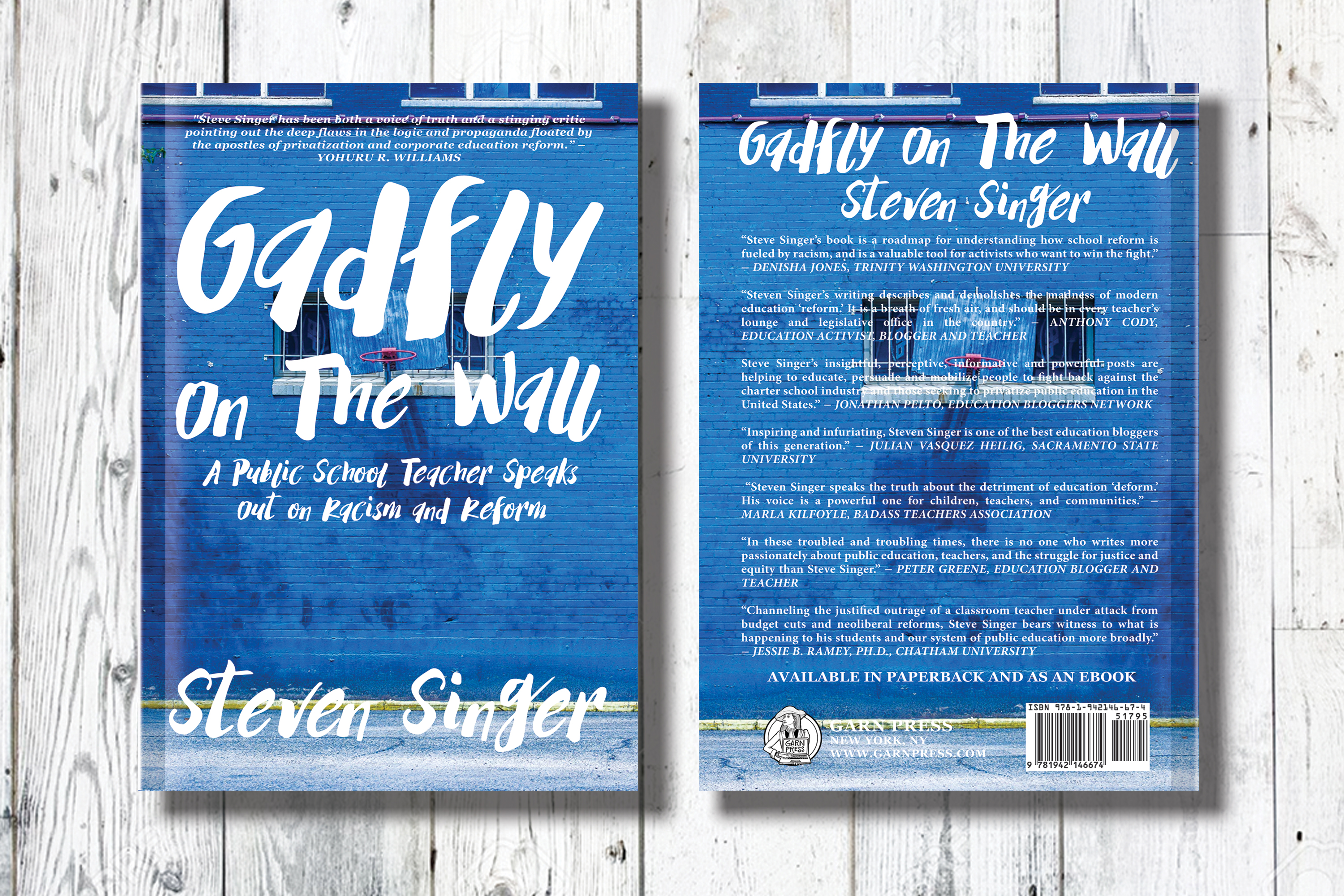
I’ve also written a book, “Gadfly on the Wall: A Public School Teacher Speaks Out on Racism and Reform,” now available from Garn Press. Ten percent of the proceeds go to the Badass Teachers Association. Check it out!

I Teach Banned Books   


If you want people to do something, forbid them from doing it.  


As a middle school language arts teacher, that’s always worked for me.   


Many of my students are reluctant readers.  


If a text is longer than a Tweet or a YouTube description, most of them would rather skip it.  


And when it comes to books, many of them wouldn’t intentionally crack one open under any circumstances.  


Unless you tell them not to.   


Unless you point out a specific book on the shelf and say it’s off limits.   


Unless you open it up right in front of them before quickly snatching it away and saying, “Oops! I forgot! We can’t read that one!”  


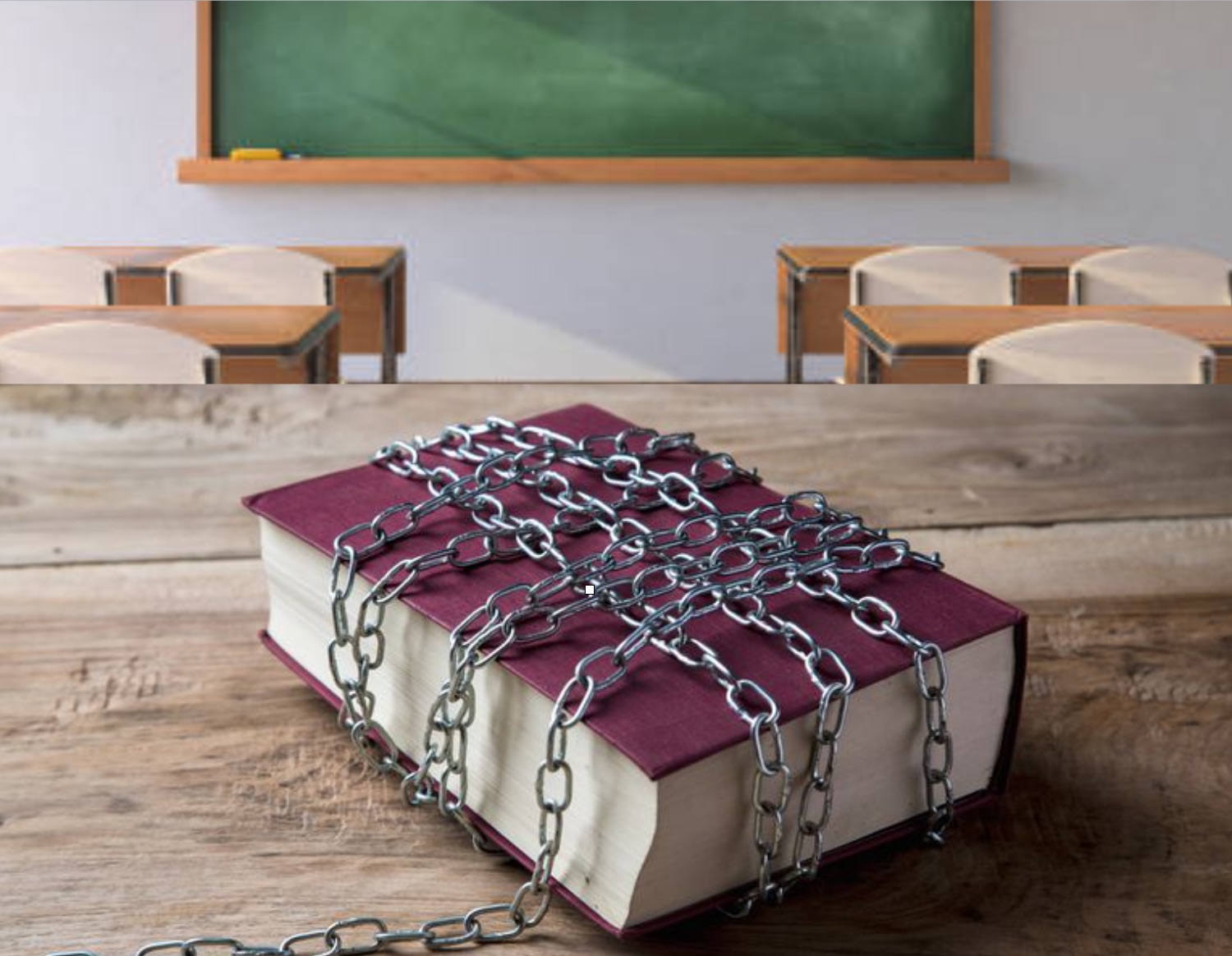
So most of my curriculum is made up of banned books.  


The Giver, Silent to the Bone, The Diary of Anne Frank, To Kill a Mockingbird – all forbidden in one place or another.   


Just not in my district.   


In fact, my school board has included each of these books on the approved reading list.


That doesn’t mean I have to use them.  


Language Arts teachers like me have a few different options at each grade level. And some of us actively avoid the more controversial texts to keep out of trouble.   


But not me.   


I go right for these taboo, prohibited, and oh so naughty books – for very good reasons


The Giver

  
Take “The Giver” by Lois Lowry.  


It’s almost the poster child for why we shouldn’t ban books in the first place. The story is set in a dystopian society where everyone is raised to be the same and people are discouraged from questioning things or having deep feelings.  


The book is most often challenged because parents don’t want their children to have to wrestle with its deep social criticism.  


When it first came under fire, Lowry responded thusly


”Submitting to censorship is to enter the seductive world of ‘The Giver’: the world where there are no bad words and no bad deeds. But it is also the world where choice has been taken away and reality distorted. And that is the most dangerous world of all.”  


However, not everyone is willing to let children think through these issues themselves – and what a bundle of issues Lowry presents! 


In the plot, she mentions sex, infanticide, suicide, starvation, and euthanasia.   


Nothing is graphic or developmentally inappropriate for middle schoolers, but the very idea of children thinking about S-E-X and challenging authority is enough to put it afoul of some censors.  


Which is exactly why my students love it.   


Too often teachers give students short passages taken from standardized tests where the only reason to read is to hunt for multiple choice answers. It’s dry, boring and meaningless to their everyday lives. 


That’s why they enjoy books like “The Giver” so much. This isn’t just for a grade. It’s reading something worth taking the time to consider, something that gets under their skin and makes them want to think.  


They’re at an age (12-14) when they’re starting to find their own place in society and struggling to understand adult issues like reproduction and romantic attachment. Making these topics explicit and being able to talk through them in the safety of the classroom can be liberating – and worth the effort to decode.   


That is – if you accept that children are little human beings who deserve the chance to consider these things aloud.  

Silent to the Bone

  
And speaking of adult issues, there’s the other comprehensive novel I teach in 7th grade – “Silent to the Bone” by E. L. Konigsburg.  


It’s a classic detective story where the characters try to discover why a young teen, Branwell, refuses to speak after his baby sister suffers a potentially life threatening injury.   


The plot grabs readers from the beginning and students find themselves really invested in unraveling the mystery. But to do so they come face-to-face with topics ranging from family, divorce, death, bigotry, sexuality and exploitation.   


It’s not about finding textual details to satisfy the number crunchers at Data Recognition Corp. or NCS Pearson Inc. It’s about getting textual to better understand what happened in the plot and why. 


Again the narrative is written for middle school readers but the concepts get them thinking and enthusiastic.  


As we come to the big reveal, I’ve had students turn to me with huge smiles saying they can’t believe we’re actually reading about this stuff in school.  


In an age where they usually communicate with emojis, I’m just glad that they’re reading. 


It can get uncomfortable, but by the end I definitely feel like I’ve reached them.

The Diary of Anne Frank


Speaking of uncomfortable, one of the hardest books I teach in 8th grade is “The Diary of Anne Frank.”


It’s not that the text is so difficult, but as a person of Jewish ancestry, I find it personally harrowing to relive this story every year.  


The plot centers on Anne, a historical Jewish girl in 1940s Amsterdam who with her family and others hid from the Nazis before eventually being captured and dying in a concentration camp. 


Like most teachers, I eschew the actual diary for the play version by Frances Goodrich and Albert Hackett.  


At first glance, it’s hard to imagine why this book would be banned. After all, it’s a true story of the Holocaust written by one of the people who lived it.   


However, there are an increasing number of people in this country these days who want to deny that the Holocaust even happened or claim that it was exaggerated. It’s hard to do that with a witness staring you in the face – even if that witness is just the book she left behind.  


Usually the text is challenged not on the basis of its plot so much as its sexual frankness. Not that there is much sex going on with people hiding above a factory in WWII. But the character of Anne is so real, she writes about everything including what it’s like to become a mature woman.   


For example, in Act II, scene 1, she mentions getting her period for the first time:  


“There is one great change, however. A change within myself. I read somewhere that girls of my age don’t feel quite certain of themselves. That they become quiet within and begin to think of the miracle that is taking place in their bodies. I think what is happening to me is so wonderful… not only what can be seen, but what is taking place inside. Each time it has happened I have the feeling that I have a sweet secret… and in spite of any pain, I long for that time when I shall feel that secret within me again.” 


My students often read over this passage without comment. I usually have to draw their attention to it and ask them what Anne is talking about before someone gets it.   


You might be surprised at how freeing this kind of discourse is. Menstruation is a natural part of life for nearly half the population, but it’s something we don’t often talk about.   


It’s not central to the story and Anne certainly goes into greater detail in her actual diary. However, even this little digression goes to further humanize her and make her relatable, especially to people like my students who are nearly the same age she was when she wrote it. 


She becomes so much more than a victim. She’s someone we know – inside and out.


To Kill a Mockingbird

 
The most challenged book I teach is “To Kill a Mockingbird” by Harper Lee.  


It tells the story of Atticus Finch, a white lawyer in the 1930s Alabama who defends Tom Robinson, a black man, of a crime he did not commit. The story is told from the point of view of the lawyer’s children who go from blissful naivety to uncomfortable understanding. 


In the past, people used to object most often to the book’s language since it makes liberal use of the N-word.  


It’s still an issue, and I make sure not to have myself or any of the students read these parts aloud. We only hear it on an audiobook as we follow along in the text. And even this only comes after we discuss how hurtful that word is. 


However, the language isn’t the book’s biggest sticking point today. It’s more often objected to these days on the basis of white saviorism. Critics complain that the narrative should be centered on Tom, the black man accused of the crime, and not Atticus, the defense attorney and his children.  


What makes this particularly troubling is the critics have a point. If the story is about racism, wouldn’t it be better to focus on the target of that racism?  


They suggest the book be replaced by more modern novels that center such a narrative appropriately – something like “The Hate U Give” by Angie Thomas (itself, a frequently challenged book). 


However, in the final analysis, I disagree.  


As good a book as Thomas’s is, it just isn’t as well-written or multifarious as Lee’s.  


Thomas reveals a lot about racism and the fight against it in today’s world, and her book is certainly worth reading. But it is a mistake to think that racism is only about people of color. White people are the cause of racism. White people have a responsibility to tear down the systems of white supremacy.

By the end of the book, my whole class – regardless of race – is devastated by what happens to Tom and furious at the injustice he experiences. To be honest, that might not happen to the same degree in a book that signals its message right from the beginning.  


“Mockingbird” starts quietly. It doesn’t even appear to have anything to do with racism at the beginning. We slowly get acclimated to this world, this time and place before prejudice creeps into view and surprises us. 


In my classroom, the book allows us to discuss so many intersectional issues – gender, economics, belief systems, etc. Plus it gives my students more cultural capital than other texts would. Having read “Mockingbird” allows them to understand more and talk to more people than other more modern books. 


If they haven’t already, when they go to the high school, they’ll read novels centered on blackness. Their education and discussion of this issue would be incomplete without them. But I don’t think we need to stop reading such a classic as “Mockingbird” that was, itself, part of the civil rights movement.  


In any case, the school board has not approved any similar texts at that grade level. If I put aside “Mockingbird,” it would mean not discussing the issue at all. I think that would be much worse. 


Conclusions

So this is how I teach. 


I know there are some adults out there who would rather my students not read these books.  


I know some grownups would rather my kids not think about these things and not come to their own conclusions.  


They’d rather children be seen and not heard – like furniture.  


But my students know it, too. And they’d rather be treated like actual human beings – even if that means… yuck… reading.

Now don’t get me wrong. I’d much rather decision makers put no restrictions on which books students can and cannot read. Even trash like Hitler’s “Mein Kampf” shouldn’t be forbidden. I make sure to tell my students that it’s readily available in the library but not recommended.  

Children should not be restricted to only some ideas. They will come into contact with all kinds as they grow older. They need the skill to sort through them and decide for themselves their value.  

In my experience the bigger threat isn’t prohibition, it’s indifference. 

 
As Ray Bradbury famously said, “You don’t have to burn books to destroy a culture. Just get people to stop reading them.” 


Focusing on banned books helps me keep reading real and relevant in my classroom.  


Like this post?  You might want to consider becoming a Patreon subscriber. This helps me continue to keep the blog going and get on with this difficult and challenging work.

Plus you get subscriber only extras!

Just CLICK HERE.

Patreon+Circle

I’ve also written a book, “Gadfly on the Wall: A Public School Teacher Speaks Out on Racism and Reform,” now available from Garn Press. Ten percent of the proceeds go to the Badass Teachers Association. Check it out!

I Triggered Bill Maher By Writing About Standardized Testing and White Supremacy 


Bill Maher is mad at me. 


And I’ve never even met the man.  


I guess you could say we’re from different worlds. 


He’s on the West Coast. I’m on the East.  


He’s a political comedian. I’m a public school teacher. 


He’s a multimillionaire. I can barely make ends meet. 


What could I possibly do to provoke the ire of this man so much so that he took aim at me on his HBO TV show? 


 As near as I can tell, it started when I wrote a blog.  


Then people read that blog.  


It got popular and was republished throughout the Internet.  


And Maher disagrees with what I wrote.  


In fact, the very idea annoyed him as a prime example of namby-pamby liberals taking their agenda too far. 


What did I write in the article?  


Only that standardized testing is a tool of white supremacy


In fact, that was the title of the article, which seems to be about as far as Bill read because he ignored any arguments, facts or historical citations in the piece.  


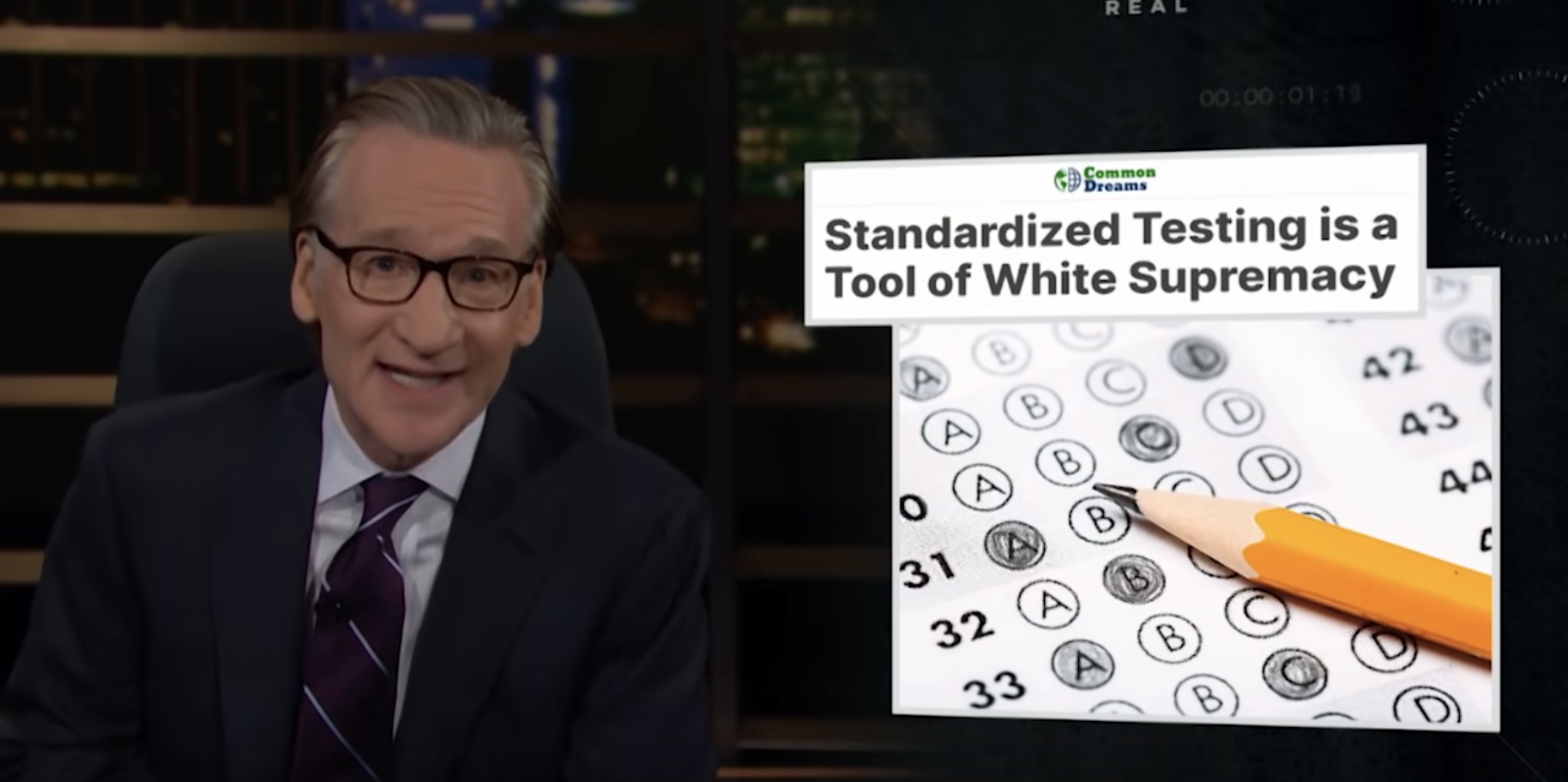
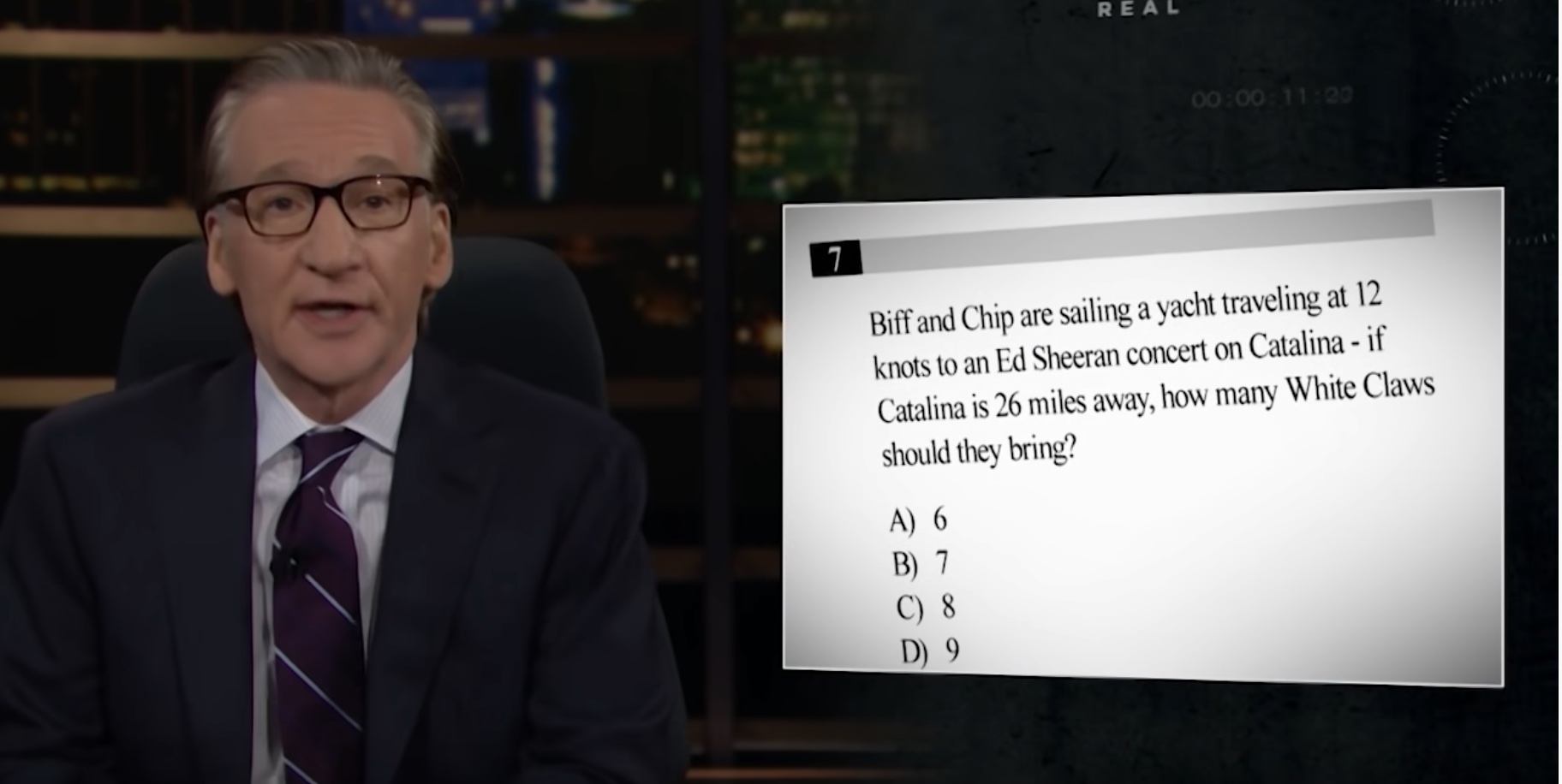
On his show, “Real Time with Bill Maher” this week, he posted the title of the article and the graphic that appeared with it when it was republished on commondreams.org


What he didn’t post was my name. I am the author, after all, but I guess that’s not important.  


The crucial bit was how triggered Bill was by my assertion.  


By connecting such allegedly alien concepts as standardized testing and racism, Maher thinks I devalued the meaning of “white supremacy.” 


Maher never actually examined my claim or what I wrote backing it up. Never mind the arguments I made in favor of my point, the sources I cited, the examples of actual bias or the documented history of standardized testing as a creation of the eugenicist movement.  


He was content to speak in a smarmy tone and make a pretty lame joke about what a racially biased test question might look like.


In fact, that’s probably why he (and his staff) picked my piece in the first place. They saw it as an opportunity to make a joke and whiffed at it pretty terribly. 


Here’s the relevant bit of his monologue: 


“In 2010 the New York Times used the term “White Supremacist” on 75 occasions. Last year, over 700 times. Now some of that to be sure is because Trump came along and emboldened the faction of this country that is truly white supremacist. It is of course still a real thing. But it shouldn’t apply to something like – as more than a few have suggested – getting rid of the SAT test. Now if we find the SAT test is slanted in such a way as to stack the deck in favor of Caucasians, if there are questions like Biff and Chip are sailing a yacht traveling at 12 knots to an Ed Sheeran concert on Catalina – if Catalina is 12 miles away, how many White Claws should they bring? Yes, then maybe. But of course the SAT doesn’t have questions like that so it becomes a kind of ludicrous exaggeration that makes lovers of common sense roll their eyes – and then vote for Trump.”  


Queue audience laughter and applause.  


Funny stuff I guess.  


Not the comedy staff’s fake SAT question but Maher’s assurance that “The SAT doesn’t have questions like that.” 


Really, Bill? 


How about this one? 


Runner: Marathon 
(a) envoy: embassy 
(b) martyr: massacre 
(c) oarsman: regatta 
(d) horse: stable 


It’s a real SAT question famously discussed in the infamous 1994 book, The Bell Curve, by Richard Herrnstein and Charles Murray – a book that tried to use discrepancies in test scores to prove white people are smarter than black people. 


The answer is C, and it relies on a test taker’s knowing the meaning of regatta – something more likely to have come up in the daily lives of affluent white students than in the lives of less affluent minority students. If you don’t live by a body of water and/or don’t have much experience with rowing, you’re probably going to fail this question.  

It’s the same kind of question Maher’s comedy team came up with – find something white people are more likely to know than black people – but the Real Time writers just pilled it on over-and-over.

It doesn’t take five repetitions of something to make it biased. All it takes is one.


To be fair, my example is from the SAT analogy section, which was removed from the test in 2005. However, that doesn’t mean they got rid of the bias. 

In fact, the College Board, the organization that develops and administers the SAT, tacitly admits its test is biased.

It now provides an “adversity score” for poor and minority students to adjust raw SAT scores to account for high schools and neighborhoods “level of disadvantage.”

In other words, they know that poor and minority kids get lower scores so they’re trying to fudge the results to give them a boost.

Which would be entirely unnecessary if the SAT assessed them accurately in the first place.

They are literally trying to make up for how biased their test scores are.

Consider this.

Total SAT scores range from 400 to 1600 – or from 200-800 in both Math and Reading respectively.

According to 2018 data, combined SAT scores for Asian and White students average over 1100, while all other groups average below 1000. Meanwhile, students with family income less than $20,000 score lowest on the test, and those with family income above $200,000 scored highest, according to 2015 data. And the difference is significant – a 433 average Reading score for those with the lowest family incomes compared to an average Reading score of 570 for those with the highest family income. That’s a 137 point difference!

And it holds for racial groups, too. The average Reading score on the SAT was 429 for black students – 99 points behind the average for white students.

However, the College Board is trying to justify this by saying the discrepancy is because poor and minority students are more disadvantaged than white, affluent ones. In other words, it’s not the test that is unfair, but American society in providing better resourced schools with lower class sizes and more resources for white kids than children of color.

And while American society IS unfair to the poor and minorities, several studies indicate that the problem is even deeper than that.

The SAT is biased, too.

Several studies ( Roy Freedle of the Educational Testing Service from 2003, Maria Santelices and Mark Wilson from 2010, etc.) find notable differences between the verbal scores of black and white students whose educational background and skill set suggest that they should get similar scores.

Freedle says this is because SAT questions likely reflect the cultural expressions that are used commonly in the dominant (white) society, so white students have an edge based not on education or study skills or aptitude, but because they are most likely growing up around white people.

This makes sense if you examine how test questions are selected for the SAT. In his book How the SAT Creates Built-in-Headwinds, national admissions-test expert, Jay Rosner, explains the process:


“Compare two 1998 SAT verbal [section] sentence-completion items with similar themes: The item correctly answered by more blacks than whites was discarded by the Educational Testing Service, whereas the item that has a higher disparate impact against blacks became part of the actual SAT. On one of the items, which was of medium difficulty, 62% of whites and 38% of African-Americans answered correctly, resulting in a large impact of 24%…On this second item, 8% more African-Americans than whites answered correctly…”


 In other words, the criteria for whether a question is chosen for future tests is if it replicates the outcomes of previous exams – specifically tests where students of color score lower than white children. And this is still the criteria test makers use to determine which questions to use on future editions of nearly every assessment in wide use in the US.

But if all this isn’t enough to convince you that standardized tests really are a tool of white supremacy, consider their sordid history.

They are literally the product of the American eugenics movement.

Modern testing comes out of Army IQ tests developed during World War I.


 In 1917, a group of psychologists led by Robert M. Yerkes, president of the American Psychological Association (APA), created the Army Alpha and Beta tests. These were specifically designed to measure the intelligence of recruits and help the military distinguish those of “superior mental ability” from those who were “mentally inferior.” 


These assessments were based on explicitly eugenicist foundations – the idea that certain races were distinctly superior to others. In 1923, one of the men who developed these intelligence tests, Carl Brigham, took these ideas further in his seminal work A Study of American Intelligence. In it, he used data gathered from these IQ tests to argue the following: 


“The decline of American intelligence will be more rapid than the decline of the intelligence of European national groups, owing to the presence here of the negro. These are the plain, if somewhat ugly, facts that our study shows. The deterioration of American intelligence is not inevitable, however, if public action can be aroused to prevent it.”


Eventually Brigham took his experience with Army IQ tests to create a new assessment for the College Board – the Scholastic Aptitude Test – now known as the Scholastic Assessment Test or SAT. It was first given to high school students in 1926 as a gatekeeper. Just as the Army intelligence tests were designed to distinguish the superior from the inferior, the SAT was designed to predict which students would do well in college and which would not. It was meant to show which students should be given the chance at a higher education and which should be left behind. 


And unsurprisingly it has always – and continues to – privilege white students over children of color.

Is it an exaggeration to say that assessments specifically designed to favor affluent white people over impoverished minorities still does the same thing?

Is it ridiculous to describe the century long racial and economic discrepancy in test scores as something that supports white supremacy – especially when these results are shown time and again to be a feature of the tests and not just an artifact that recreates economic inequality?

Is it going too far to call out the racism of the SAT and other standardized tests like it when even the College Board admits its own scores are biased?

Does it devalue the term “White Supremacy” to point out real world white supremacy?

But Maher apparently isn’t interested in these questions.

After a few moments he moved on to another example of the left gone wild.


But I can’t do that because this isn’t just a bit for me.  


As I mentioned, I’m a public school teacher.  


I deal with the impact of standardized testing every day.  


I watch my students degraded, depressed and dehumanized by it year after year.  

It’s become cliche for privileged white people like Bill Maher to get cranky when someone points out real world prejudice.

But for those of us in the trenches, it is an everyday reality.

And that’s what triggers me.


Here’s the segment from “Real Time with Bill Maher”: (the relevant bit starts at 4:45)


Like this post?  You might want to consider becoming a Patreon subscriber. This helps me continue to keep the blog going and get on with this difficult and challenging work.

Plus you get subscriber only extras!

Just CLICK HERE.

Patreon+Circle

I’ve also written a book, “Gadfly on the Wall: A Public School Teacher Speaks Out on Racism and Reform,” now available from Garn Press. Ten percent of the proceeds go to the Badass Teachers Association. Check it out!
What is Taught in Public Schools? Volunteer as a Substitute Teacher and See for Yourself! 

Some lawmakers want more transparency in public schools.

Meanwhile, there’s a nationwide substitute teacher shortage.

It seems to me we can solve both problems at once.

PROBLEM 1: BOGUS LEGISLATION

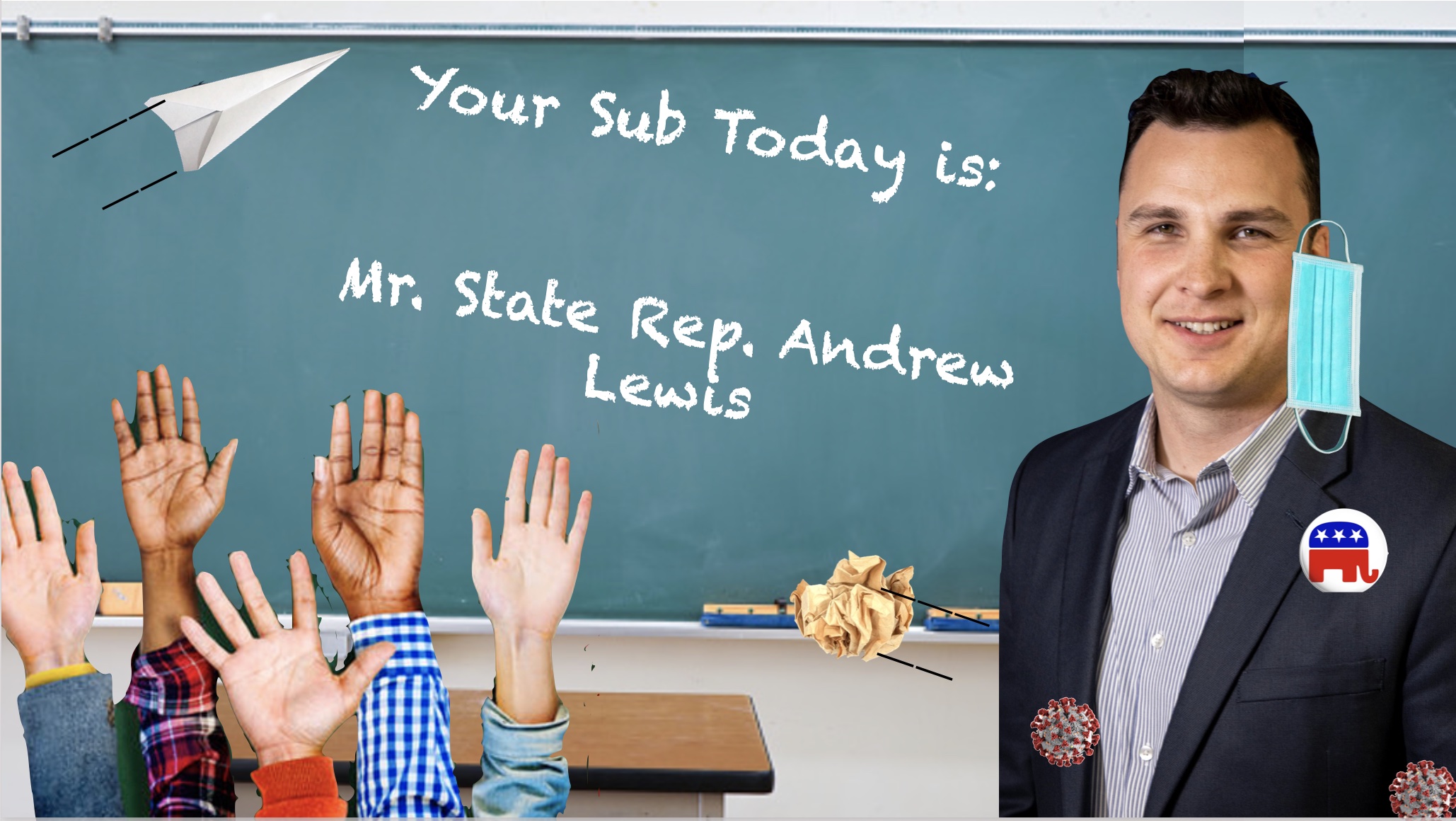
Pennsylvania state Representative Andrew Lewis is terrified that students are being taught things in school.

Things like history and science and – oh my word! – socialism.

To make sure this doesn’t happen, the Republican businessman is sponsoring a bill requiring public schools to post curriculum materials online.

This would include a course syllabus or written summary of every class, the state academic standards for each course, and a link or title for every textbook used.

It sets up a mountain of paperwork for the state’s already overburdened teachers to repeat information that’s readily available elsewhere.

Moreover, the whole thing is really just a political sham to stoke the radical Republican base. The measure has little chance of actually being implemented.

The bill (HB 1332) passed the House largely along party lines last week with a few Republicans joining Democrats against it.

Now it is set for a full vote by the Senate where it will probably sail through with GOP support after which Democratic Governor Tom Wolf has already promised to veto it.

So why is Lewis putting on this dog and pony show?

In a now deleted Facebook post, the 33-year-old Dauphin County man wrote:

“Parents need to be in the driver’s seat when it comes to education, not some out-of-state textbook publisher teaching heaven knows what (hint: anti-American socialism) to our students.”

Apparently Lewis doesn’t understand that parents vote and serve on school boards that, in fact, pick the textbooks which are used in public schools.

Moreover, I guess no one told him that state law already requires that public schools give parents and guardians access to information about instructional materials.

Or that Medicare, Social Security, Minimum Wage and Child Labor Laws are all examples of – GASP! – socialism.

Lewis and other Republicans continue to spread the insinuation that something nefarious is happening behind the closed doors of our public schools.

Well guess what, fellas! Those doors aren’t closed at all.

PROBLEM 2: SUB SHORTAGE

Nationwide there’s a substitute teacher shortage. And you can apply!

Even schools in the Keystone state are scrambling to find enough subs.

If you want to know what happens in public schools, you can do better than clicking on some Website. You can actually volunteer to come in and cover an absent teacher’s class!

“Substitute lists are very small in most districts,” says Mark DicRocco, Executive Director of Pennsylvania Association of School Administrators (PASA).

The organization reports that the Commonwealth is experiencing a dramatic decline in the supply of new teachers. 

The number of state Instructional I licenses granted for all subject areas in grades K-12 has decreased by at least 49% from 2011 to 2018. 

About eight years ago, 40,000 teachers were graduating from Pennsylvania colleges a year. This past year, it was only 14,000. 

That means not only fewer classroom teachers to replace those who retire, but fewer substitute teachers to take over for professional absences.

The situation has gotten so bad that the legislature (on which Lewis serves) had to pass a new measure allowing college students who are studying education to fill in as substitutes.

Many districts such as Erie, Greater Latrobe and State College have increased substitute pay to entice more people to apply for the job.

And, frankly, almost anyone can do it.

Even folks like Lewis and his Republican buddies! Heck! The legislature is only in session a few weeks every month! They have plenty of time to moonlight as substitute teachers and get the low down about what’s really happening in our public schools!

To be a sub in most public school districts in Pennsylvania, essentially all you need is a bachelors degree (it doesn’t even have to be in education) and pass criminal background checks.

Districts that aren’t experiencing a shortage may require a teaching certificate as well, but beggars can’t be choosers. In districts where it is hard to get subs (i.e. those serving poor and minority kids) you can get emergency certified for a year.

And many states are lowering the bar even further!

In Oregon, where the shortage of subs is even worse, the state is even temporarily waiving the need to have a bachelor’s degree!

SOLUTION: VOLUNTEER AS A SUB

Just imagine!

Republicans uneasy about public school can get in there and see it all first hand.

And they’ll even get paid to do it!

Not as much as they make as lawmakers. Pennsylvania’s legislature is paid the third highest salary in the country! Way more than classroom teachers or certainly substitutes. But they’d get remunerated for their time.

All they’d have to do is watch over classes of 30 or more real, live students!

Not only would lawmakers have a chance to look over teacher’s lesson plans, but they’d get detailed instructions from the absent teacher about how to actually teach the lesson!

They’d get to interact with principals as they’re told which additional classes they have to cover in their planning periods and which extra duties they’d be responsible for performing.

They’d get to do things like monitor the halls, breakfast and lunch duty, watch over in-school suspension, and – if they’re lucky – they might even get to attend a staff meeting and be front row center for all the educational initiatives being conducted in the school!

If our representatives took this opportunity, they would learn so much!

They might even understand that this critical race theory thing they’re being warned about on Fox News and on talk radio isn’t actually taught in public schools. It’s a legal framework you only find in colleges and universities, and even there it’s mostly in the law department.

They’d see that indoctrination isn’t really something we do in public schools.

I mean, sure, we encourage kids to stand for the pledge to the flag and things like that but when it comes to telling them how to think – that’s not a public school thing. That’s a private and parochial school thing.

They’d see that public school lessons give students information on a subject but then ask them to come to their own conclusions about it.

They’d see our students struggle with large class sizes, crumbling infrastructure and facilities, and an overabundance of standardized tests.

They’d see kids grappling with social and emotional needs caused by the Covid-19 pandemic, generational poverty, and systemic racism.

They’d see the scarcity of resources available to classroom teachers to meet those needs and the profusion of expectations heaped on them. (For example, the expectation of bills like HB 1332 that they post all their curriculum and daily lessons on-line in addition to everything else they have to do on a daily basis.)

They’d see the dangers of putting themselves on the front line of a global pandemic and in the line of fire of potential school shooters without adequate gun safety laws.

In fact, this would be such an educational experience, I think legislators on both sides of the aisle should take advantage of this unique opportunity.

And not even just those in Harrisburg. What better way for school directors to understand the institutions they’re overseeing than to volunteer as subs? What better way for the mayor and city council to understand the needs of children than putting themselves in the classroom when the teacher can’t be there?

Instead of pontificating about the culture wars, class grievances, business interests or innuendos, lawmakers might actually learn what the real problems are in our public schools and what needs to be done about them.

It could make them better public servants who craft legislation that would actually do some good in this world and not – like Lewis – just showboat to enrage partisans and stoke them to vote for people willing to feed their fears and prejudices.

Any takers?


Like this post?  You might want to consider becoming a Patreon subscriber. This helps me continue to keep the blog going and get on with this difficult and challenging work.

Plus you get subscriber only extras!

Just CLICK HERE.

Patreon+Circle

I’ve also written a book, “Gadfly on the Wall: A Public School Teacher Speaks Out on Racism and Reform,” now available from Garn Press. Ten percent of the proceeds go to the Badass Teachers Association. Check it out!
If You’re Afraid Kids Will Learn Racism is Bad, Perhaps Public School is Not For You   

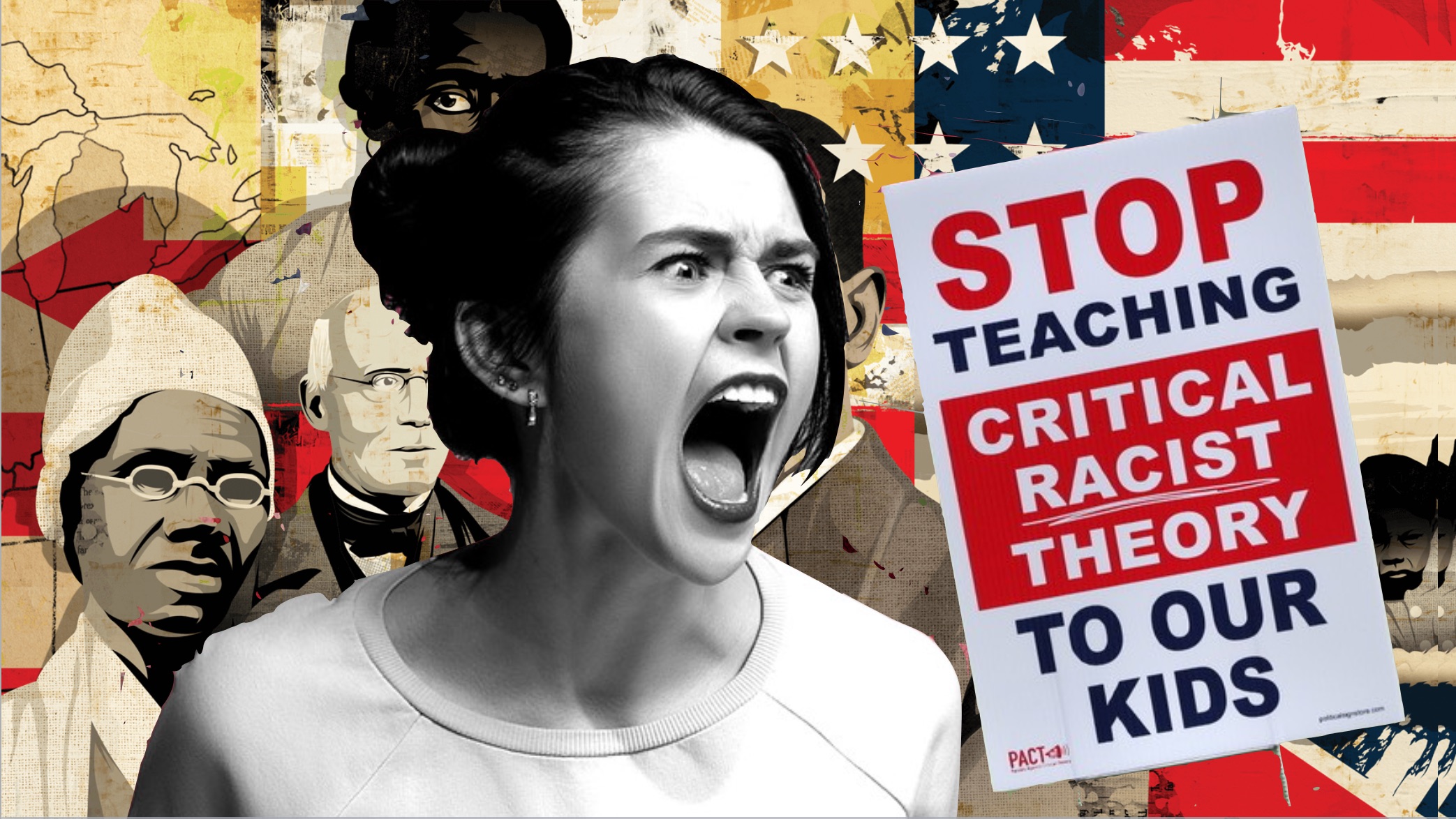
Some people are terrified that kids will learn about racism.   
  
Especially white people.   
  
Especially that white KIDS might learn about it.   
  
How would that affect a white child’s self-esteem, they say.   
  
Imagine learning that racism existed in the United States.   
  
A country founded by white people.   
  
(Taken from brown people.   
  
Made largely profitable by the enslavement of black people.) 
  
Wouldn’t that make white kids feel bad?   
  
It’s a strange question.  
 
First of all, wouldn’t it make the black and brown kids feel worse than the white kids?  
 
After all, it was their ancestors who were brutalized and subjugated.  
  
Second of all, what does history have to do with your feelings? 
 
This isn’t aroma therapy or yoga. It’s the past.   
  
We never worry about how learning any other subject will impact a student’s emotional states.   
  
It makes me wonder about all the sentiments pedagogues ignore when designing curriculum.  
  
Does learning to read harm a happy illiterate’s self-respect?  
  
Does learning science make a know-it-all feel less confident?  
  
How does learning fractions dispel a person’s sense of the oneness of being?  
  
No. We never even stop to consider such things.   
  
We don’t bother with emotions or feelings. We just fuss over whether it’s true.   
  
Moreover, how would one even teach American history without talking about racism?  
  
This is the United States – a country that built much of its economy on the backs of black people kidnapped from their homes across the sea and then bought and sold here as property.  
  
Not only that but the very land we stand on was once the domain of dark-skinned indigenous people.  
  
People who were tricked, coerced and killed if they did not give up this land – if they did not move on to ever shrinking corners of the continent until they were almost all dead, assimilated or stashed away on reservations.  
   
  
What would it do to a white child to learn all this?   
  
Provide an accurate account of events, I suppose.   
  
These people terrified that children will learn about racism – I don’t think it’s facts that they’re trying to deny. 
 
I mean I’m sure they would certainly like to gloss over the ugliest atrocities committed by their ancestors, but they don’t really seem to dispute the story of conquest that makes up our founding. It’s more the way the facts are being presented.  
  
History is written by the winners and these white people won.  
  
That’s not what they want to hide.  
  
It’s the TONE in which the story is told.  
  
If we talked about the ingenuity of white people in colonizing these others, they might find that tolerable.   
  
If we talked about how great the white people were and how bad the brown and black people were, that might be acceptable.   
  
Even if we spun a tall tale about how subjugating these others was really in their best interests in the long run, that would be okay.   
  
After all, that’s what they do in many private and parochial schools.   
  
They use textbooks that frame the history of our country just like that – books from The American Christian Education group, the A Beka Book and Bob Jones University Press textbooks. A Beka publishers, in particular, report that about 9,000 schools nationwide purchase their textbooks.  
  
So it’s not the story, it’s the way it’s told.  
 
We can’t focus on the victims.   
  
We can’t humanize them by looking at things from their point of view.   
  
We can’t empathize or admit wrongdoing in any way.  
  
In fact, that’s the problem, they say, with public schools. 
  
That’s what they object to. 
  
Public schools teach what it was like to live as an enslaved person. How you could be beaten and murdered with no cause. How you had no rights to anything. How your own children were likewise doomed to a life of servitude and could even be taken away from you never to be seen again.   
  
And not just that but they’re teaching about Jim Crow. They’re teaching about how even after slavery, black people’s rights were almost nonexistent. How they were denied an education, kept in menial jobs, red-lined into ghettos, and often lynched without the slightest provocation.   
  
When children hear about all that, they start to get ideas.   
 
Even the white kids. 
  
It’s not just the history of racism these children are learning, but they’re starting to think that racism is WRONG.   
  
And that’s a problem because it has an impact on how we view the modern world today.   
  
Because there are still black and brown people in the United States.   
  
They make up about 40% of the population and still protest the way they’re treated.  
  
They say it’s harder to get well-paying jobs than whites with the same education and experience. They say their neighborhoods and schools are segregated. They say their right to vote is being suppressed. They say they’re incarcerated at greater rates even though they don’t commit more crimes. They say they’re being killed by police at greater rates even though they aren’t more violent.   
  
And the facts back them up!  
  
So if we teach the history of racism, how do we justify saying that it ever ended?   
  
How do we not admit that it merely evolved into the status quo?  
  
That’s really the issue.   
 
Not the past but the present. 
   
It’s not the racism of the antebellum South or even the pre-civil rights period North of the Mason-Dixon line.  
  
It’s the everyday racism of today that they want to ignore.  
  
It’s voter ID laws spreading across the country.   
  
It’s military style policing, especially in neighborhoods housing mostly people of color.  
  
It’s providing less education funding to schools serving mostly brown and black students than those serving mostly white kids.  
  
The people complaining about teaching the history of racism don’t want to have to do anything about all that.  
  
They want to ensure that the extra rights and privileges given to people like them don’t come to an end. Especially as more black and brown people are born and white skin becomes less common.  
  
This is not about educational transparency.   
  
It’s not about history, truth or pedagogy.   
  
It’s about indoctrination.   
  
They want to ensure that white kids ARE indoctrinated into the world view of their parents – a world of white nationalism.  
  
We can do two things about this.   
  
One, we can give in to them and water down the public school curriculum until it contains nothing of any importance about our history of racial subjugation and white hegemony.   
  
Two, we can ignore them and teach the truth.   
  
The way I see it, the second is our only real option.   
  
There are many reasons for this, but perhaps the most obvious is representation.  
 
Everyone doesn’t want to whitewash our history. Most people want us to actually teach the facts.  
  
Some of these people even have white skin.   
  
Moreover, public schools serve a large population of students of color. They certainly don’t want to be denied an accurate record of how we got to this time and place.  
  
Public schools serve the public, and these history censors are a small minority of the whole.  
  
Moreover, even if we gave in to them, it wouldn’t be enough.  
 
At their best, public schools don’t actively inculcate kids. We don’t tell students what to think. We tell them the facts and then exhort them TO think.   
  
The conclusions are all up to them.   
  
Even if we did as these people want, it would still be up to their kids to make the same twisted conclusions as their parents. They don’t just want us to refrain from pointing in any given direction, but to stop providing counter examples and facts so their kids can’t come to an educated decision. 
 
And that is unacceptable. 
  
As a public school system, it is our responsibility to provide those facts.   
  
We must provide children with the truth about what came before them. We must show them how things were and what injustices occurred.  
  
We must even point out how the inequalities of the past lead to the wrongs of today.   
  
What kids make of all this is up to them.   
  
If after knowing the truth, they still decide that today’s racist practices are acceptable, that is their right.   
  
But we cannot hide the reality from them.  
  
If that is objectionable to some people, then perhaps public school is not for them.   
  
Perhaps a system of education where truth is considered a human right is not what they’re looking for.   
  
In that case, there are plenty of private and parochial schools that will indoctrinate their children into whatever shape they’d like.   
  
That’s where they’ll probably send them anyway.  
  
And public schools are foolish to try and court the kinds of people with value systems antithetical to them.   
 
If you want to abolish public schools, if you don’t share the community values of truth and independent thinking, perhaps public school is not for you. 


Like this post?  You might want to consider becoming a Patreon subscriber. This helps me continue to keep the blog going and get on with this difficult and challenging work.

Plus you get subscriber only extras!

Just CLICK HERE.

Patreon+Circle

I’ve also written a book, “Gadfly on the Wall: A Public School Teacher Speaks Out on Racism and Reform,” now available from Garn Press. Ten percent of the proceeds go to the Badass Teachers Association. Check it out!
What I Don’t Want My School to be Like this Covid Year

I’m going to confess something.

I don’t like wearing a mask.

For a few hours on Halloween it’s fine, but trying to teach middle schoolers through a piece of fabric for 8 hours a day is no one’s idea of professionalism or efficacy.

You know what else?

I hate getting shots.

When they put that vaccination needle to my arm, I had to turn my head away and think about something else. Both times.

But guess what?

I did them.

And I am still WILLING to do them again.

If teaching in 2021-22 requires wearing a mask and even getting a third booster to the Covid vaccine, I’ll do it.

You know why?

Because I am an adult.

Even if we have to go back to teaching students completely on-line (which I don’t want to do), I’ll put on my big boy pants and do it.

It’s not optimal. It causes problems for working parents, but it’s better than the alternative if infections continue to rise.

I’m not saying I like it.

I’m not saying I want to do any of this, but we have to deal with the world as we find it.

I don’t want to have to teach during a pandemic, but that’s the world we’re living in.

That’s the world we’ve MADE.

Time to face it.

After a summer where not enough people chose to get vaccinated, Covid-19 cases are on the rise again. And now we have the new more contagious delta variant that can even infect and be spread by those who got the shot.

We had a chance to turn things around in June and July. Frankly, we blew it.

Restrictions were lifted too early. Safety precautions continued to be politicized. Folks just pretended it was over.

All we had to do was be cautious and get our Fauci ouchies.

Not enough of us did.

So here we are.

I’m going to be honest with you.

I don’t want this school year to be as bad as last year.

The last year and a half has been a nightmare for classroom teachers like me.

We were teaching remote, then in-person, then BOTH at the same time! Social distancing was erratic because there just wasn’t the space, some students were chronically absent, kids and adults got sick every week but the authorities could never seem to admit anyone might have caught the disease at school…

I watched my district and most of those around me fail at almost every level.

And just when we looked to the government for support, we were told to waste whatever class time we were able to scrap together on another meaningless standardized test.

It was a year that left me feeling blamed for things beyond my control and silenced from the decision making process.

I felt unsafe, subordinate, impotent and neglected.

And I don’t want to do that again.

It’s no wonder that one in four teachers might not return to the classroom this year according to a survey given at the beginning of 2020 by the Rand Corporation.

Research from Education Week published this week had similar findings. According to Lora Bartlett, an associate professor of education at the University of California, Santa Cruz, 20 percent of teachers either have already left the profession or are actively seeking employment elsewhere.

Most years teaching has an 8% attraction rate, according to the U.S. Department of Education. 

Educators like me are simply sick of being ignored, scapegoated, deprofessionalized and or actively obstructed from doing our jobs.

But we didn’t make this situation.

We didn’t create Covid-19. We didn’t ignore the warnings that it was coming here, we didn’t dismantle the pandemic task force, didn’t shirk our duties to put adequate safety precautions in place, didn’t make compliance entirely voluntary, didn’t prioritize economics over public health or a multitude of other things that lead us down this deep, dark rabbit hole.

We’re dealing with the situation, and frankly the rest of the country needs to do the same.

We need universal masking in schools.

Not suggestions from the Centers for Disease Control (CDC). We need government mandates, and the fact that some states have mandated exactly the opposite just goes to show that some lawmakers aren’t grown up enough to do the job for which they were elected.

Magical thinking may get you re-elected, but it could also get me and my family killed.

Time for serious solutions.

While we’re at it, we need to require vaccinations for all eligible adults and children going to school in-person. Otherwise, we can find a remote option for them.

Because if we don’t, there are only two likely alternatives – a remote option for everyone or a steady increase in Covid cases in school. The former isn’t good and the later is just not acceptable at all.

We need frequent testing to see if anyone in the building has the disease – and NO I’m not talking about contact tracing. Anecdotes from people who unequivocally have the virus about who he or she may have come into close contact with is not good enough. We need blood tests – hard data.

Speaking of which, every district should have to prove they’ve been able to adequately circulate airflow in the buildings with HEPA filters and other equipment. If they can’t, the federal government should write them a check on the spot. Make them accountable for how they spend it, and make them accountable if they DON’T get the job done.

I know, I know.

This is America and no one can tell me what to do.

Wrong.

We live in a society, not the old West.

We already have a plethora of rules people have to abide by – even list of vaccinations you already need to be enrolled in school – mumps, measles, rubella, polio, etc. Just add Covid-19 to the list.

And grow the heck up.

Too many people can’t tell the difference between fantasy and reality.

Too many people have bought the myths and legends about what it means to be an American.

That’s why they’re having conniptions that teachers might actually be including the history of racism in their history.

We’re a country that couldn’t exist if white settlers didn’t first steal the land we’re living on from native peoples. We’re a country founded by mostly slave holders.

You think that’s not an important part of history because you believe our own bull crap propaganda.

And that’s why you don’t have the mental acuity to deal with real problems like a global pandemic.

When this whole Covid thing began, many of us hoped when it was all over we’d have changed things for the better.

We thought they’ll have to change the old way of doing things just to survive this mess, so maybe when we put it all back together, we can put it back together better.

But the reality is, we couldn’t even figure out how to change things enough just to survive this.

In the United States, about 630,000 of us haven’t survived it – more than our soldiers who died in World War II (405,000), the Vietnam War (58,000) and the Korean War (36,000) combined.

I don’t want more people to die.

I don’t want more students and staff to get sick in schools.

I don’t want us to have to go back to remote instruction.

I don’t want this school year to be as bad or worse as the last year and a half.

And I’m willing to make sacrifices to make sure these don’t happen.

I’m willing to wear a mask all day in school and require others to do so, too.

I’m willing to be vaccinated (again if necessary) and make sure everyone eligible is, too.

I’m willing to do all these things I don’t want (and more) in order to make sure worse things don’t happen.

That’s the choice we’re left with today.

And if enough people aren’t grown up enough to make it correctly, we need to make it for them.

Or else we’re all choosing to let the worst come to pass – again.


Like this post?  You might want to consider becoming a Patreon subscriber. This helps me continue to keep the blog going and get on with this difficult and challenging work.

Plus you get subscriber only extras!

Just CLICK HERE.

Patreon+Circle

I’ve also written a book, “Gadfly on the Wall: A Public School Teacher Speaks Out on Racism and Reform,” now available from Garn Press. Ten percent of the proceeds go to the Badass Teachers Association. Check it out!


Muzzling America’s Teachers with a Ban on Critical Race Theory is What Orwell Warned Us About

I first read George Orwell’s dystopian novel “1984” while in high school almost a decade past its titular date.

At that time, it didn’t seem to be a prediction. It seemed to be a description of life in the Soviet Union.

I never would have guessed that it could be a warning of what the public school system could become in this country if Republican lawmakers have their way.

Far right legislators have proposed bans on so-called Critical Race Theory in at least 20 states that would muzzle classroom teachers from discussing racism and other “controversial” and “divisive” topics or risk being disciplined, fired or facing other legal consequences if they don’t obey.

It is an attempt to legislate history.

These lawmakers are working to control information and let politics – not facts – be the guiding principle of what gets accepted in our chronicle of the past.

Those of us who’ve read “1984” have seen this before.

The text is set in Oceania, a state where the government controls the media, education and even people’s thoughts.

The main character, Winston Smith, works at the Ministry of Truth where he rewrites history to match the party line – whatever it is this week.

For example, at a “Hate Week” demonstration near the beginning of the story, people are gathered to cheer their country’s alliance with Eastasia. However, when the speaker abruptly declares that Eastasia is the enemy, people quickly crumple up their banners and acknowledge that Eastasia was always the enemy and they must have been mistaken to think otherwise.

The prospective ban on Critical Race Theory is strikingly similar.

Politicos are trying to erase the United States’ troubled history of systemic racism, gas light any discussion of its current existence and otherwise stifle and control any topic that goes against their party line.

It’s a policy enshrined in page after page of the most famous description of totalitarianism in modern literature.

Let’s take a closer look at some key passages.

TRUTH

‘”There was truth and there was untruth, and if you clung to the truth even against the whole world, you were not mad.”‘

Central to the book is a belief in objective truth.

No matter what we think or say, there are facts out there in the world.

For example, throughout the 17th and 18th centuries, millions of people were kidnapped from Africa, forced into slavery in the American colonies and exploited in the production of tobacco and cotton. Any denial of that fact, any minimization of the degree of dehumanization in it, is a rejection of reality.

Sanity is our adherence to that reality. Psychological well being is the attempt to bring our thoughts and ideas about what was and what is in line with these facts.

Moreover, doing so is the definition of freedom, itself.

“Freedom is the freedom to say that two plus two make four. If that is granted, all else follows.”

If we take away an individual’s right to try and square the reality of the world with their internal ideas about it, we take away all of their freedoms.

One must come to an understanding of the world. It cannot be handed down. It must be the result of observation and understanding.

In short, it is a product of education. We’re taught the facts, but it is up to us to make sense of them.

If the facts are obscured from us or if they are misrepresented, our freedom is impinged.

REWRITING HISTORY

“Every record has been destroyed or falsified, every book rewritten, every picture has been repainted, every statue and street building has been renamed, every date has been altered. And the process is continuing day by day and minute by minute. History has stopped. Nothing exists except an endless present…”

In direct opposition to the idea of objective truth is the mutability of history.

To some extent it is completely natural. Over time we come to new understandings. We discover things that had been accepted as facts were misunderstood.

For example, it was long accepted as true that Christopher Columbus discovered America. Now we realize that not only wasn’t he the first European to come to these shores, the idea that he “discovered” anything is incoherent. You can’t “discover” lands where people are already living. More over, given the details of pillage, rape and violence in his own journals, Columbus’ accomplishment should be viewed in far less positive terms than it has been up to this point.

Ideas change and we must keep up with that changing understanding.

However, the danger is when that change is NOT the result of new information or recontextualizing what we already knew. It’s when we allow history to be dictated by politics.

“And if all others accepted the lie which the Party imposed – if all records told the same tale – then the lie passed into history and became truth. ‘Who controls the past’ ran the Party slogan, ‘controls the future: who controls the present controls the past.'”

This idea is essential to the work Winston does at the Ministry of Truth. By rewriting the events of the past and controlling the narrative of history, the Party maintains its authority.

This is the goal of the proposed bans on Critical Race Theory. One political party is attempting to stop the freedom of history based on facts and replace it with history based on whatever is in the best interests of that party maintaining power.

Whitewashing the history of slavery as less exploitative and more mutually beneficial to both the white owners and black enslaved peoples helps to reduce the impetus to contemporary reform in the systems of racism maintained in this country since our failed Reconstruction. Likewise, representing Columbus as a hero and adventurer instead of a murderer and tyrant helps justify similar actions today.

Or as Orwell puts it:

‘”The masses never revolt of their own accord, and they never revolt merely because they are oppressed. Indeed, so long as they are not permitted to have standards of comparison, they never even become aware they are oppressed.”‘

EDUCATION

Much of the book is focused on how fascist regimes control thought. And primarily this is done through education and the media.

“Power is in tearing human minds to pieces and putting them together again in new shapes of your own choosing.”

That’s a kind of education. Replacing what is known with whatever the Party wants to be known.

“Don’t you see that the whole aim of Newspeak is to narrow the range of thought? In the end we shall make thoughtcrime literally impossible, because there will be no words in which to express it.”

If you don’t have the words to express an idea, it’s incredibly difficult to have that idea. We do, after all, think in language.

For example, the definition of “Racism” has shifted over time to mean more than just prejudice or discrimination against a person or people based on their race or ethnicity.

It is now more commonly understood as prejudice plus power – racial prejudice, AND social power to codify and enforce this prejudice into an entire society.

This is what is meant by Systemic Racism, a concept at the core of this fight. Much of the battle against Critical Race Theory is really an attempt to stop this concept of racism from becoming widespread and codified through our school system.

It is an attempt to keep the original definition of racism, to stop people from seeing systemic racism by refusing to accept its reality through control over speech.

Yet the movement, itself, is based on redefinitions and insinuations.

Critical Race Theory is not a concept taught at public schools. It’s a decades old legal framework. It’s about how laws function to create and maintain social, economic, and political inequalities.

It’s as much a part of K-12 public schools curriculum as torts, contract law or civil forfeiture. Which is to say, not at all.

However, the GOP is using it because they think it sounds scary. It’s a self-created boogeyman to incite the Republican base against a nebulous and ever changing idea of what they take to be liberal indoctrination.

As Orwell wrote:

‘”It’s a beautiful thing, the destruction of words.”‘

And that’s what we have here. The destruction of words, the destruction of Critical Race Theory from its actual meaning into a trigger point.

It is about insinuation instead of talking about Republican grievances of what this so-called liberal indoctrination is head on. Because if they were to discuss the issue openly, it could never be proven. However, to imply, to hint, to whisper avoids the ability to disprove.

It is Newspeak, the fictional language of Oceania where simplified grammar and restricted vocabulary limit the individual’s ability to think and even articulate certain facts or concepts.

PURPOSE OF EDUCATION

But what is the difference between what Republicans are doing with these bans and the naturally evolving course of history? If education is the process of forming an individual’s ideas and thoughts, how is any of it ever free?

Consider this. Orwell describes the goal of education in Oceania:

‘”Doublethink means the power of holding two contradictory beliefs in one’s mind simultaneously, and accepting both of them.”‘

That is not the goal of our current education system.

We do not want students to be handed down information and simply accept it even if it doesn’t make sense.

Teachers strive to get their students to interact with information, to look at it critically.

And that is the important point – CRITICALLY.

At some point even in Oceania, everyone comes across different ideas, concepts that you may not have considered before or may have actively rejected.

What do you do when this happens?

Winston is expected to believe what the Party tells him to believe. And even in the USA we often act as if being confronted with this reality is the worst case scenario for students. It is the end of the world if they are confronted with a different point of view.

Nothing could be further from the truth.

It is essential that they be confronted with opposing views so that they can think critically.

That is the purpose of education.

Not to tell students what to think, but to give them the tools to think.

It is up to each and every student to come to their own conclusions.

Educators should give them the facts and even expose them to varying concepts about the facts.

But it is up to the individual student what to do with them.

This makes some parents and politicians uneasy because it treats students as human beings with freedom of choice.

Such freedom is not allowed in Oceania, and if Republicans have their way, it will not be allowed here, either.

We must preserve academic freedom for both students and their teachers.

It is absolutely essential.

Otherwise Orwell’s book will be less a warning than a guide.


Like this post?  You might want to consider becoming a Patreon subscriber. This helps me continue to keep the blog going and get on with this difficult and challenging work.

Plus you get subscriber only extras!

Just CLICK HERE.

Patreon+Circle

I’ve also written a book, “Gadfly on the Wall: A Public School Teacher Speaks Out on Racism and Reform,” now available from Garn Press. Ten percent of the proceeds go to the Badass Teachers Association. Check it out!
Public Schools Are Not Indoctrinating Kids About Racism. Voucher Schools ARE

Republican frenzy has reached a fever pitch with attacks in at least 16 states on schools that allegedly teach Critical Race Theory.

Right-wingers claim public schools are indoctrinating America’s youth in lies and deception about race and racism – namely the “lie” that these things remain problems.

They grudgingly concede that racism was a (slight) problem in this country before the civil rights movement, but then Rosa sat down and Martin stood up and – POOF – racism was over.

End of story. Let’s move on.

However, there are several things wrong with this besides its basic reductivism.

First, no public school actually teaches Critical Race Theory.

Second, racism is not over in the US, and talking about the facts of history and how they led to our current situation is not indoctrination. It’s education – the job of public schools.

And finally, if you really want to see taxpayer funded indoctrination, look at private and parochial schools accepting taxpayer funding through voucher and tax credit programs.

Let’s start with Critical Race Theory.

It is entirely absent from public school curriculum.

Laughably so.

Critical Race Theory is a legal framework that’s been taught for decades in law schools around the country. And just like torts, contract law, civil forfeiture and a host of other valid topics in law school, the K-12 public schools really don’t cover them much.

But right wing lawmakers and the billionaire funded think tanks that provide their propaganda ideas want to turn Critical Race Theory into a scare tactic to close down discussions of race and racism in America’s classrooms.

Which brings us to the second point – racism is not over in America.

Facts are facts.

In a country where the average Black worker earns just 62% of what the average white worker makes, and where black people are 3.23 times more likely than white people to be killed by police – racism is not over.

One out of every three Black boys born today can expect to be sentenced to prison, compared to 1 out 6 for Latino boys, and one out of 17 for White boys.

Black people are convicted at higher rates and given longer sentences than white people for the same crimes – 5% of illicit drug users are African American, yet Black people represent 29% of those arrested and 33% of those incarcerated for drug offenses. Moreover, African Americans and White people use drugs at similar rates, but the imprisonment rate of African Americans for drug charges is almost 6 times that of White people.

And on and on.

One has to live in a factually neutral bubble to insist that racism no longer exists in this country, but that’s exactly where these right wing lawmakers are coming from.

The GOP is terrified they might actually have to protect voting rights or provide equitable school funding for black kids up to par with white kids, so they have to keep creating scary monsters to frighten the populace into believing their bogus world view.

After all, their base is almost exclusively White. If they can’t find something to rile up these people and make them feel unduly put upon, they won’t come to the polls. And nothing gets people more eager to vote than fear and anger.

Except maybe ignorance.

Which brings us to the third point – indoctrination doesn’t happen at public schools; it happens at taxpayer funded voucher schools.

The last decade has seen a steady, incremental increase in taxpayer funding in most states for private and parochial schools as public school budgets have been robbed and raided to pay for it.

In some states, this comes from outright school voucher programs. In others like Pennsylvania, this comes from tax credit programs like the Educational Improvement Tax Credit (EITC) and Opportunity Scholarship Tax Credit (OSTC) programs.

In essence, they all do the same thing. They take taxpayer money that was (or would have been) put aside for public education and funnel it to parochial or private schools.

The schools that accept this money have little to no oversight in how they spend it nor do they have to follow any of the rules that public schools do.

And many of these schools actually do indoctrinate their students into untruths about science, history and politics. On our dime.

How do we know that? We know which books they use in their curriculum. And many of them are filled with factually incorrect bigotry and bias.

For example, here’s a few justifications of slavery from America: Land I Love, an A Beka Book:

“The slave who knew Christ had more freedom than a free person who did not know the Savior…”

“…Although the slaves faced great difficulties, many found faith in Christ and learned to look to God for strength. By 1860, most slaveholders provided Christian instruction on their plantations.”

“To help them endure the difficulties of slavery, God gave Christian slaves the ability to combine the African heritage of song with the dignity of Christian praise. Through the Negro spiritual, the slaves developed the patience to wait on the Lord and discovered that the truest freedom is from the bondage of sin…”

And here’s a defense of the kindness of most slave owners from United States History for Christian Schools published by Bob Jones University Press (BJU):

“A few slave holders were undeniably cruel. Examples of slaves beaten to death were not common, neither were they unknown. The majority of slave holders treated their slaves well.”

And here’s another excerpt from the same book teaching that black people were just as responsible for slavery as white people and that white people suffered from slavery just as much:

The story of slavery in America is an excellent example of the far-reaching consequences of sin. The sin in this case was greed – greed on the part of the African tribal leaders, on the part of the slave traders, and on the part of slave owners, all of whom allowed their love for profit to outweigh their love for their fellow man. The consequences of such greed and racism extended across society and far into the future. It resulted in untold suffering – most obviously for the black race but for the white race as well.(emphasis mine)

Here’s another excerpt from the same book about the benefits of the KKK:

“[The Ku Klux] Klan in some areas of the country tried to be a means of reform, fighting the decline in morality and using the symbol of the cross. Klan targets were bootleggers, wife-beaters, and immoral movies. In some communities it achieved a certain respectability as it worked with politicians.”

Meanwhile, the Teacher’s Resource Guide to Current Events for Christian Schools published by BJU wrote this about how liberal Democrats and desegregation were bad:

“While the end was a noble one – ending discrimination in schools – the means were troublesome. Liberals were not willing to wait for a political solution.”

As bad as these excerpt are, they focus only on racism.

The books are riddled with counter factual claims and political bias in every subject imaginable such as abortion, gay rights and the Endangered Species Act, which one labels a “radical social agenda.” They disparage religions other than Protestant Christianity and cultures other than those descended from White Europeans.

They teach that humans and dinosaurs lived at the same time, some dinosaurs survive into the present day (i.e. the Loch Ness monster), evolution is a myth disproved by REAL science as is the claim that homosexuality is anything but a choice.

Teaching these things in school is not just educational malpractice, it’s exactly the kind of indoctrination the right is claiming without evidence happens at public schools.

And this kind of brain washing is common at voucher schools.

Along with publisher Accelerated Christian Education, A Beka and BJP are being used in countless taxpayer-funded schools. Nearly 6 million students attend private schools in the United States and about three-quarters of those are Christian schools. And that doesn’t even count the roughly 1.7 million American children who are homeschooled many of whom use these texts.

These books are used almost exclusively at religious schools or through homeschooling. However, that’s the majority of the school voucher program – even the tax credit scholarship programs.

Nearly 80 percent of scholarship students attend religious schools, and most of those institutions are Christian, according to an investigation by the Orlando Sentinel. The books mentioned above all come from a Protestant point of view. However, roughly 16 percent of scholarship schools are Catholic and use their own curriculum as do other schools including Islamic or Jewish institutions (which combined make up about 5 percent of the schools).

It is clear then that this controversy is worse than a tempest in a teacup.

It’s misdirected anger.

Political indoctrination IS going on in the United States, but it is not happening at our public schools.

It is happening at our private and parochial schools through school voucher programs.

If we ban anything, it shouldn’t be Critical Race Theory – It should be school vouchers.

For more on this subject, see the short documentary film, “School Choice: Taxpayer-Funded Creationism, Bigotry and Bias” by Rachel Tabachnick.


Like this post?  You might want to consider becoming a Patreon subscriber. This helps me continue to keep the blog going and get on with this difficult and challenging work.

Plus you get subscriber only extras!

Just CLICK HERE.

Patreon+Circle

I’ve also written a book, “Gadfly on the Wall: A Public School Teacher Speaks Out on Racism and Reform,” now available from Garn Press. Ten percent of the proceeds go to the Badass Teachers Association. Check it out!
Diversity is the Most Important Reason to Save Public Schools

Public schools are under attack.


So what else is new?


It’s been so since the first moment the institution was suggested in this country  by revolutionaries like Thomas Jefferson:

“Education is here placed among the articles of public care… a public institution can alone supply those sciences…”


And John Adams:


“The whole people must take upon themselves the education of the whole people and be willing to bear the expenses of it.


But as the founders saw public education as primarily a means of securing democracy by creating informed citizens able to intelligently vote, that is only one of its many benefits today.


Compared to its main alternatives – charter, voucher, and private schools – public schools are more fiscally responsible, democratically controlled and community oriented.


However, these are not the most important reasons to cherish our system of public schools.


For all the system’s benefits, there is one advantage that outshines all the others – one gleaming facet that makes public schools not just preferable but necessary.


That is diversity. 


Public schools ARE the American Dream


They are the melting pot made real. 

Where else can you go and see so many different races, cultures, ethnicities, religions, abilities and genders learning together side-by-side from adolescence to adulthood?


Nowhere. 


I don’t think you can understate how important that is.


When you grow up with someone, you can’t really remain strangers. Not entirely.


When you sit beside different kinds of people in every class, you learn that you and people like you aren’t the center of the universe. You learn that there are many other ways to be human.


And make no mistake. I’m not talking about mere tolerance. I mean seeing the beauty in difference.


I’m talking about seeing the grace and originality in black names and hairstyles, the fluidity of Arabic writing, the serenity of Asian philosophy…


When you make friends that are diverse, have different beliefs, styles, cultures, you open your mind to different ideas and concepts.


If children are our future, we become that future in school. If we’re educated together in a multifaceted society, we are more at home with our country’s true face, the diversity that truly is America. By contrast, if we become adults in secluded segregation, we find difference to be alien and frightening. We hide behind privilege and uphold our ways as the only ways worth considering.


In fact, privilege is born of segregation. It is nurtured and thrives there.


If we want to truly understand our fellow citizens and see them as neighbors and equals, it is best to come to terms with difference from an early age in school.


Integration breeds multiculturalism, understanding and love. 


I’m not saying this happens in every circumstance. All flowers don’t bloom in fertile soil and not all die in a desert. But the best chance we can give our kids is by providing them with the best possible environment to become egalitarian.


That’s public schools.


Of course, diversity was not there from the beginning. 


Through much of our history, we had schools for boys and schools for girls that taught very different things. We had schools for white children and schools (if at all) for black children – each with very different sets of resources.


But as time has gone on, the ideal embodied by the concept of public schooling has come closer to realization. Brown v. Board took away the legality of blatant segregation and brought us together as children in ways that few could have dreamed of previously.


Unfortunately, a lot as happened since then. That ruling has been chipped at and weakened in subsequent decades and today’s schools still suffer from de facto segregation. In many places our children are kept separate by laws that eschew that name but cherish its intent. Instead of outright racial or economic discrimination, our kids are kept apart by municipal borders, by who goes to which school buildings and even by which classes students are sorted into in the same building.


But it’s really just segregation all over again. The poor black kids are enrolled here and the rich white kids there.


The surprising fact is how much we’ve managed to preserve against this regression. Even with its faults, the degree of diversity in public schools far outshines what you’ll find at any other institution.


That’s no accident. It’s by design. 


Each type of education has a different goal, different priorities that guide the kind of experiences it provides for students.


Privatized schools are by definition discriminatory. They only want those students of a certain type – whatever that is – which they specialize in serving. This is true even if their selection criteria is merely who can pay the entrance fee.


After all, the root word of privatization is “private.” It means “only for some.” Exclusion is baked in from the start.


By contrast, public schools have to take whoever lives in their coverage area. Sure you can write laws to exclude one group or another based on redlining or other discriminatory housing schemes, but you can’t discriminate outright. Yes, you can use standardized testing to keep children of color out of the classes with the best resources, but you need a gatekeeper to be intolerant in your place. You can’t just be openly prejudiced.


That’s because you’re starting from a place of integration. The system of public education is essentially inclusive. It takes work to pervert it.


And I think that’s worth preserving.


It gives us a place from which to start, to strengthen and expand.


There are so many aspects of public schools to cherish. 


But for me it is increased diversity, understanding and integration that is the most important.


What kind of a future would we have as a country if all children were educated in such an environment!?


Like this post?  You might want to consider becoming a Patreon subscriber. This helps me continue to keep the blog going and get on with this difficult and challenging work.

Plus you get subscriber only extras!

Just CLICK HERE.

Patreon+Circle

I’ve also written a book, “Gadfly on the Wall: A Public School Teacher Speaks Out on Racism and Reform,” now available from Garn Press. Ten percent of the proceeds go to the Badass Teachers Association. Check it out!

How to Vote on Ballot Measures in Pennsylvania’s 2021 Primary Election

Can you feel it?

The primary election is just a few weeks away.

Voters will decide all kinds of things like who will represent their respective parties for school board, judges, magistrates, county council, etc.

However, that’s not all.

There also will be four statewide ballot initiatives. All Allegheny County residents will get a fifth. And Pittsburgh residents will get a sixth.

If you’re like me, you don’t want these questions to come as a surprise on May 18 or before (if you’re casting a mail in ballot).

These queries can change the state for better or worse in dramatic ways, yet for some reason, they don’t write these things in the way everyday people talk.

This is lawyer speak. You have to wear a long black robe and put on a white haired wig (called a peruke) just to understand these things.

But don’t get your gavel in a tizzy.

As a public service, I’m going to translate each question and make a suggestion on how you should vote.

QUESTION 1:

“Shall the Pennsylvania Constitution be amended to change existing law and increase the power of the General Assembly to unilaterally terminate or extend a disaster emergency declaration—and the powers of Commonwealth agencies to address the disaster regardless of its severity pursuant to that declaration—through passing a concurrent resolution by simple majority, thereby removing the existing check and balance of presenting a resolution to the Governor for approval or disapproval?”

Translation: Allow the legislature to second guess the governor and terminate an emergency disaster declaration without just cause

Suggestion: VOTE NO

This is yet another example of the endless far right hissy fit from science denying lawmakers still mad that Gov. Tom Wolf had the gall to close down the state because of the global Covid-19 pandemic. If passed, this would erode the powers of the governor and give them to our gerrymandered Harrisburg legislature.

We have three branches of government for a reason – checks and balances. Robbing the executive to boost a dysfunctional legislature would make the declaration of emergencies and natural disasters a matter or politics not facts.

Emergencies could be terminated at a moment’s notice without cause sending our first responders into chaos. Emergency managers could lose precious time and resources, communities could lose relief and recovery funding from the state and federal governments, all while our chuckleheaded legislature debates reality.

The Covid-19 pandemic may not be over yet. We’re working overtime to distribute vaccines and combat threats from emerging variants. The last thing we need is a political show prematurely eliminating masking, social distancing and other safety precautions so performative ideologues can win points on Fox News.

QUESTION 2:

“Shall the Pennsylvania Constitution be amended to change existing law so that: a disaster emergency declaration will expire automatically after 21 days, regardless of the severity of the emergency, unless the General Assembly takes action to extend the disaster emergency; the Governor may not declare a new disaster emergency to respond to the dangers facing the Commonwealth unless the General Assembly passes a concurrent resolution; the General Assembly enacts new laws for disaster management?”

Translation: Limit an emergency disaster declaration to 21 days regardless of the severity of the emergency

Suggestion: VOTE NO

Disasters do not come with time limits. But randomly limiting them all to 21 days again takes power away from the Governor and gives it to the legislature. The only way to extend emergency declarations would be passage of a resolution by the state House and Senate.

Do we really want our emergency responses tied to the endless back and forth of legislators who rarely even pass their annual budgets on time? This is unnecessary bureaucracy so politicians can grandstand while emergency personnel wait for the go ahead to save lives.


QUESTION 3:

“Shall the Pennsylvania Constitution be amended by adding a new section providing that equality of rights under the law shall not be denied or abridged because of an individual’s race or ethnicity?”

Translation: Make it illegal to deny or cut short anyone’s rights because of race or ethnicity

Suggestion: VOTE YES

This should be a no brainer. No one should be able to deny a person’s civil rights because of race or ethnicity. Or any other reason!

However, we just lived through four years of a reality TV show President who packed the federal courts with dozens of questionable and unqualified judges who made their careers discriminating against people of color, people of different creeds, religions, etc.

So it makes sense to enshrine equal protection for all at the state level and protect Commonwealth residents from federally sanctioned prejudice especially focused around workers’ rights, criminal justice reform, housing and healthcare.


Moreover, as a part of the state Constitution, this amendment would stop even our own state legislature from passing any laws inconsistent with it.

QUESTION 4:

“Do you favor expanding the use of the indebtedness authorized under the referendum for loans to volunteer fire companies, volunteer ambulance services and volunteer rescue squads under 35 PA.C.S. §7378.1 (related to referendum for additional indebtedness) to include loans to municipal fire departments or companies that provide services through paid personnel and emergency medical services companies for the purpose of establishing and modernizing facilities to house apparatus equipment, ambulances and rescue vehicles, and for purchasing apparatus equipment, ambulances and rescue vehicles, protective and communications equipment and any other accessory equipment necessary for the proper performance of the duties of the fire companies and emergency medical services companies?”


Translation: Allow municipal fire departments and EMS companies to apply for state loans to modernize critical safety equipment

Suggestion: VOTE YES

Both municipal fire departments and EMS companies with paid employees and volunteer departments and companies would be able to apply for state loans.

This vital funding could be used to modernize or purchase necessary safety equipment for first responders. It would keep fire fighters up to date and able to serve residents – especially those in rural areas. It would make sure every fire department could have up to date equipment.

Question 5 (Allegheny County Only):

“Shall the Allegheny County Code, Chapter 205. Allegheny County Jail, be amended and supplemented to include a new Article III, as set forth below, which shall set forth standards governing conditions of confinement in the Allegheny County Jail?”

Translation: Should we prohibit solitary confinement at Allegheny County Jail except in extreme emergencies?

Suggestion: VOTE YES!

Solitary confinement is cruel and unusual punishment. A lawsuit filed in September by ACJ inmates alleges that solitary confinement was being used as a punishment against inmates seeking mental health care. Recent research from Cornell University demonstrates that even a short amount of time in solitary confinement can increase recidivism rates, as well as unemployment rates.

Question 6 (Pittsburgh residents only):

“Shall the Pittsburgh Home Rule Charter be amended and supplemented by adding a new Article 10: Powers of the Pittsburgh Police, containing Section 1001, which shall bar employees of the Pittsburgh Bureau of Police from executing warrants at any residence without knocking and announcing themselves?”

Translation: Should we eliminate no-knock warrants?

Suggestion: VOTE YES!

This would require all Pittsburgh Police to physically knock and announce themselves before gaining entry to execute a warrant.

No knock warrants are dangerous and often a component of racial discrimination in law enforcement.

Briana Taylor’s death in Louisville, KY, during the execution of a “no knock” warrant clearly shows how this practice recklessly endangers human life. Many municipalities now have banned no-knock warrants including Louisville, KY. Pittsburgh City Council also introduced legislation to ban the use of no-knock warrants by Pittsburgh Police officers.

So those are my suggestions for this race’s ballot initiatives.

NO. NO. YES. YES. YES.

And if you happen to be a Democrat living in Allegheny County’s District 9, please vote for me for County Council.

Together we can build a better world.


Like this post?  You might want to consider becoming a Patreon subscriber. This helps me continue to keep the blog going and get on with this difficult and challenging work.

Plus you get subscriber only extras!

Just CLICK HERE.

Patreon+Circle

I’ve also written a book, “Gadfly on the Wall: A Public School Teacher Speaks Out on Racism and Reform,” now available from Garn Press. Ten percent of the proceeds go to the Badass Teachers Association. Check it out!