
Top 11 Education Articles of 2022 Hidden by Facebook, Buried by Twitter, and Written by a Gadfly

If you’ve stumbled across this article on social media, congratulations!

You’re one of the few people allowed to read it!

This blog, Gadfly on the Wall, used to be read by at least half a million people each year. Now it’s seen by barely 100,000.

The reason? Poor writing? Flagging interest in the subject?

I don’t think so.

Education is still as important today as it was in 2014 when I started this venture. And as to my writing ability, it’s no worse now than it was 8 years ago.

The difference it seems to me is the rise of social media censorship – not in the name of fact checking or peer review. After all, I’m a nationally board certified classroom teacher with a masters in education writing about the field where I’ve been employed for two decades.

However, the tech bros who gate keep what could have been the free exchange of information on the Internet insist they get paid for access.

You want your voice to be heard? You’ve got to pay like any other advertiser – even if your product is simply your opinion backed by facts.

So this year, my blog had the fewest hits since I started – 124,984 in 2022. By comparison, last year I had 222,414.

I’d write an article, post it on social media and see it reposted again and again. You’d think that would mean it was popular, but no. The people who saw it liked it enough to suggest it to others, but it went little further. With each share, fewer people saw it. Like someone put up a wall in front of it.

In truth, I’m lucky as many people had the opportunity to read my work as did.

The question is where do I go from here?

Should I continue, knowing only a select few will get to hear me? Should I try paying the billionaire tech bros to let more readers in?

My work isn’t a product and no one is paying me to do it.

Oh well…

In any case, here’s a look back at my most popular articles from the year that was and one honorable mention:

HONORABLE MENTION

11) WPIAL is Wrong! Racist Taunts at a Football Game are NOT a Matter of Both Sides

Published: Feb. 4

Views: 301

Description: My school’s football team is mostly black. They played a mostly white football team and were greeted by racial slurs and an allegedly intentional injury to one of our players. However, the Western Pennsylvania Interscholastic Athletic League (WPIAL) blamed both sides for the incident.

Fun Fact: It’s one of those decidedly local stories that community newspapers used to cover before almost all went bankrupt or were sold to the media giants. Having this platform allowed me to call out an injustice when most voices were silenced. The injured player’s mother thanked me for doing so. Stories like this keep me going.

10) Federal or State Legislature May Raise Teacher Salaries so Schools Have Enough Staff to Reopen

Published: June 8

 Views: 1,468

 Description: At the beginning of the summer, governments were so shaken by the exodus of teachers from the classroom that they were discussing raising our salaries or giving us bonuses. Parents were so adamantly against distance learning they demanding in-person classes with real, live human teachers. What a shock to the super elite education “experts” who had been pushing ways to eliminate teachers for decades and ignoring our consistent march out of the field under these conditions.

 Fun Fact: The federal government is still discussing pay raises with a bill to increase the minimum salary nationwide. Will this lead to any action? Who knows? It’s actually surprising that legislators even recognize the issue exists.

9) Why Even the Best Charter Schools are Fundamentally Inequitable

Published: Sept. 17

 Views: 1,514

 Description: Charter schools are inequitable because they have charters. These are special agreements that they don’t have to follow all the rules other authentic public schools funded by tax dollars must follow. That’s unfair and it applies to EVERY charter school because every one has a charter. Hence, the name.


 Fun Fact: Criticism of charter schools in general usually degrades to defense of individual charter schools avoiding whatever general criticism is leveled against the industry. The argument in this article has the benefit of avoiding any such evasion. All charter schools are guilty of this (and many are guilty of much more). All of them.

8) Every Teacher Knows

Published: March 17

 Views: 1,675

 Description: Just a list of many things classroom teachers know about schools and education but that the general public often ignores. These are the kinds of things missing from the education debate because we rarely include teachers in the discussion about the field where they are the experts.


 Fun Fact: For a few hours people were talking about this article far and wide. And then – boom – it got shut down with a bang. This one was so universal it should have been popular for weeks. But it just disappeared.

7) With the Death of Queen Elizabeth II, the US Should End Its Biggest Colonial Enterprise – Charter Schools
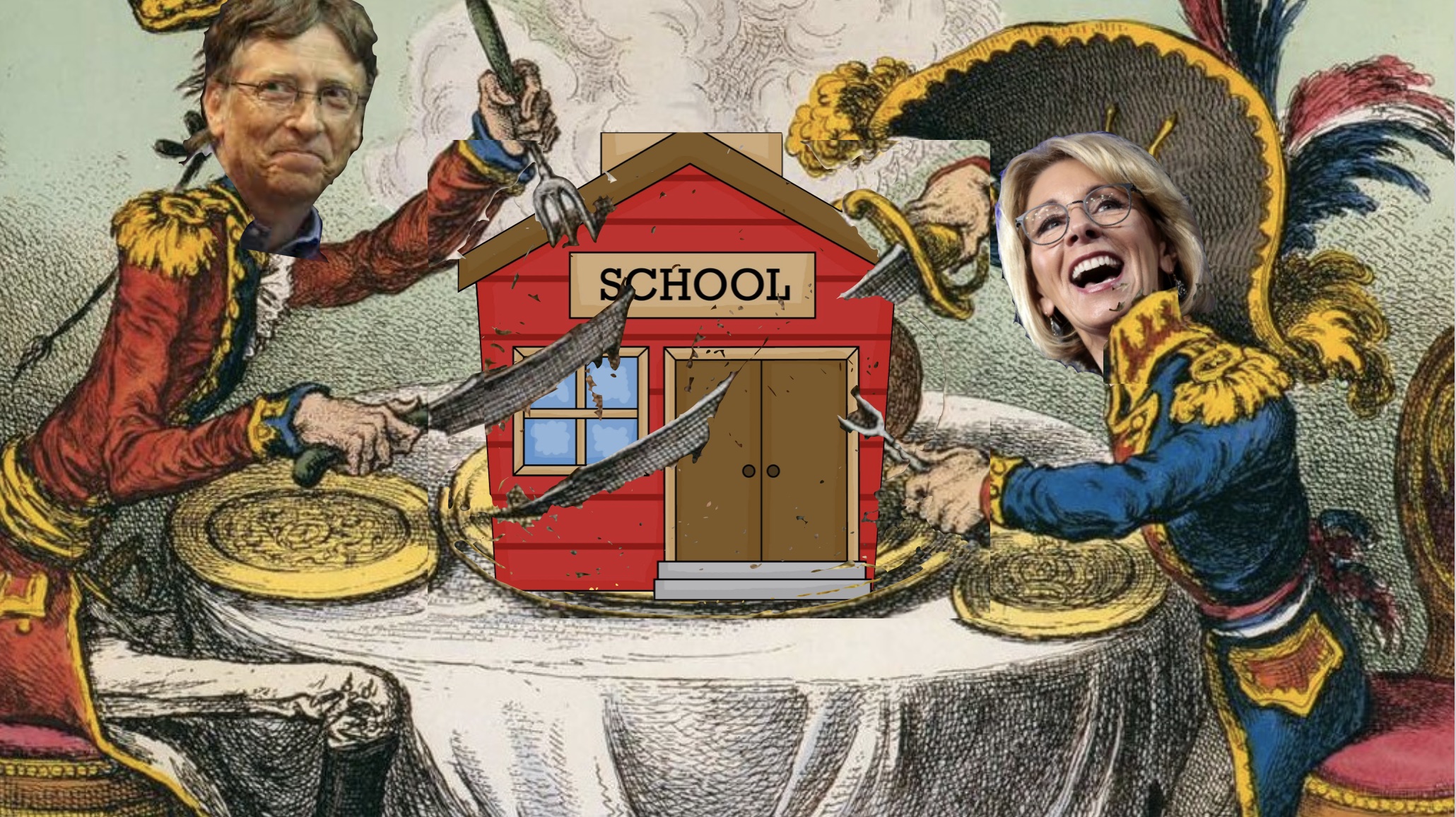
Published: Sept. 10

 Views: 1,817

 Description: Charter schools are colonial enterprises. They loot and pillage the local tax base but without having to be governed by school boards made up of community members – otherwise known as local taxpayers. They can be run by appointed boards often made up of people who do not come from the community in question. They are outsiders come merely for personal profit. These invaders are quite literally taking local, community resources and liquidating them for their own use – the maximization of personal profit. The public is removed from the decision-making process about how its own resources are utilized and/or spent.

 Fun Fact: It’s an argument from consistency. If we’re against the colonial enterprise, we must be against charter schools, too. I’m particularly proud of the graphic (above) I created to go with this article.

6) Holtzman Resigns as MASD Superintendent After Questions Over Contract Shenanigans

Published: May 26

 Views: 1,933

 Description: Dr. Mark Holtzman, the Superintendent from the district where I live, left under strange circumstances. He resigned and took a new contract in a matter of hours so he could get a raise from a lame duck school board without having to wait for the people the community elected to decide the matter to take office first. Then when it all came to light, he left the district for greener pastures.


 Fun Fact: More than any other news source, I documented what happened in detail. Without a series of articles I wrote on this, most people would have had very little idea what happened. It would have just been rumors. This is why we need local journalism. It shouldn’t be left to bloggers like me.

5) Silencing School Whistleblowers Through Social Media 

Published: Feb. 12

 Views: 2,065

 Description: This was social media’s latest crackdown on edu-bloggers and other truth tellers. I used to get 1,000 readers a week. Now I’m lucky to get a few hundred. There’s a strict algorithm that determines what people get to see on their Facebook pages. And if it says you’re invisible, then POOF! You’re gone and the people who would most enjoy your writing and want to pass it on don’t get the chance. It’s undemocratic in the extreme but totally legal because Facebook is a for-profit company, not a public service. Money wins over free exchange of ideas. 

 Fun Fact: There used to be so many other education bloggers like me out there. Now there are just a handful. This is why.

4) If Standardized Tests Were Going to Succeed, They Would Have Done So By Now

Published: April 7

 Views: 2,478

 Description: Standardized tests were supposed to improve our public schools. They were supposed to ensure all students were getting the proper resources. They were supposed to ensure all teachers were doing their best for their students. But after more than four decades, these assessments have not fulfilled a single one of these promises. In fact, all they’ve done is make things worse at public schools while creating a lucrative market for testing companies and school privatization concerns.  

 Fun Fact: Pundits still talk about standardized testing as if it were innovative. It’s not. It’s the status quo. Time to end this failed experiment.

3) Top 5 Charter School Myths Debunked 

Published: April 15

 Views: 3,604

 Description: Let’s examine some charter school propaganda – one piece at a time – and see if there’s any truth to these marketing claims. Charter schools are actually not public schools in the same way as other taxpayer funded schools. They do not save money – they waste it. Their students do not outperform authentic public school students. They are not innovative – they are regressive. They do not protect children’s civil rights – they violate them.


 Fun Fact: I designed the title and picture to trick readers into thinking this was a pro-charter school article. So many people were butt hurt when they read it! I just hope it helped clarify the matter to those who were undecided.

2) The MAP Test – Selling Schools Unnecessary Junk at Student Expense

Published: Aug 27

 Views: 3,937

 Description: The Measures of Academic Progress (MAP) test is an assessment made by Northwest Evaluation Association (NWEA), a so-called non-profit organization out of Portland, Oregon. Some states require the MAP as part of their standardized testing machinery. However, in my home state of Pennsylvania, the MAP is used as a pre-test or practice assessment by districts that elect to pay for it. What a waste! Why do we need a test BEFORE the test? The assessment’s job is to show how our students are doing in Reading, Math and Science compared with an average test taker. How does that help? I don’t teach average test takers. I teach human beings. Students learn at their own rates – sometimes faster, sometimes slower. We don’t quicken the timescale with needless comparisons.

 Fun Fact: I think this article was as popular as it was because people could relate. So many teachers told me how relieved they were to hear someone else expressing all the frustrations they were experiencing in their own districts with the MAP and other tests like it. If administrators and school boards would just listen to teachers! If they’d even bother asking them!

1) Posting Learning Objectives in the Classroom is Still a Dumb Idea

Published: Nov. 25

 Views: 7,285

 Description: When it comes to dumb ideas that just won’t go away, there is a special place in the underworld for the demand that teachers post their learning objectives prominently in the classroom. It presupposes that teachers control everything their students learn in the classroom and can offer it to them on a silver platter. It’s not just a useless waste of time but a dangerous misunderstanding of what actually happens in the learning process.


 Fun Fact: This isn’t exactly news, but teachers were relieved to hear their truth finally given voice. So many of us still have to abide by this nonsense when we could be doing something that actually makes a difference. It’s nice to have your sanity and frustration confirmed. If only administrators could admit they were wrong and stop demanding this crap!


Gadfly’s Other Year End Round Ups

This wasn’t the first year I’ve done a countdown of the year’s greatest hits. I usually write one counting down my most popular articles and one listing articles that I thought deserved a second look. Here are all my end of the year articles since I began my blog in 2014:


2021:

Gadfly’s Most Outrageous Articles in 2021 That You May Have Missed or Been Too Polite to Share

Gadfly’s Top 10 Articles of 2021 – Shouts in the Dark

2020:

The Most Important Education Articles (By Me) That You Probably Missed in 2020

Outrunning the Pandemic – Racing Through Gadfly’s Top 10 Stories of 2020


2019:

Sixteen Gadfly Articles That Made Betsy DeVos Itch in 2019

Screen Shot 2019-12-28 at 3.51.03 PM


2018:

A Gadfly’s Dozen: Top 13 Education Articles of 2018 (By Me)

thumbnail_IMG_8445


2017:


What’s the Buzz? A Crown of Gadflies! Top 10 Articles (by Me) in 2017


thumbnail_Screen shot 2017-12-26 at 3.44.17 PM


Hidden Gadfly – Top 5 Stories (By Me) You May Have Missed in 2017

 

7fd6a56c2ffc7a03c9fd2f431a543e92


2016

Worse Than Fake News – Ignored News. Top 5 Education Stories You May Have Missed in 2016

 

ignoring-wisdom


Goodbye, 2016, and Good Riddance – Top 10 Blog Post by Me From a Crappy Year


screen-shot-2016-12-27-at-3-29-49-am


2015


Gadfly’s Choice – Top 5 Blogs (By Me) You May Have Missed from 2015


Screen shot 2016-01-02 at 11.01.09 PM


Who’s Your Favorite Gadfly? Top 10 Blog Posts (By Me) That Enlightened, Entertained and Enraged in 2015


Screen shot 2015-12-30 at 12.57.49 AM


2014


Off the Beaten Gadfly – the Best Education Blog Pieces You Never Read in 2014

 

Wonderfull illusion art painting


Top 10 Education Blog Posts (By Me) You Should Be Reading Right Now!

 

computer-people-png-300x202


Like this post?  You might want to consider becoming a Patreon subscriber. This helps me continue to keep the blog going and get on with this difficult and challenging work.

Plus you get subscriber only extras!

Just CLICK HERE.

Patreon+Circle

I’ve also written a book, “Gadfly on the Wall: A Public School Teacher Speaks Out on Racism and Reform,” now available from Garn Press. Ten percent of the proceeds go to the Badass Teachers Association. Check it out!

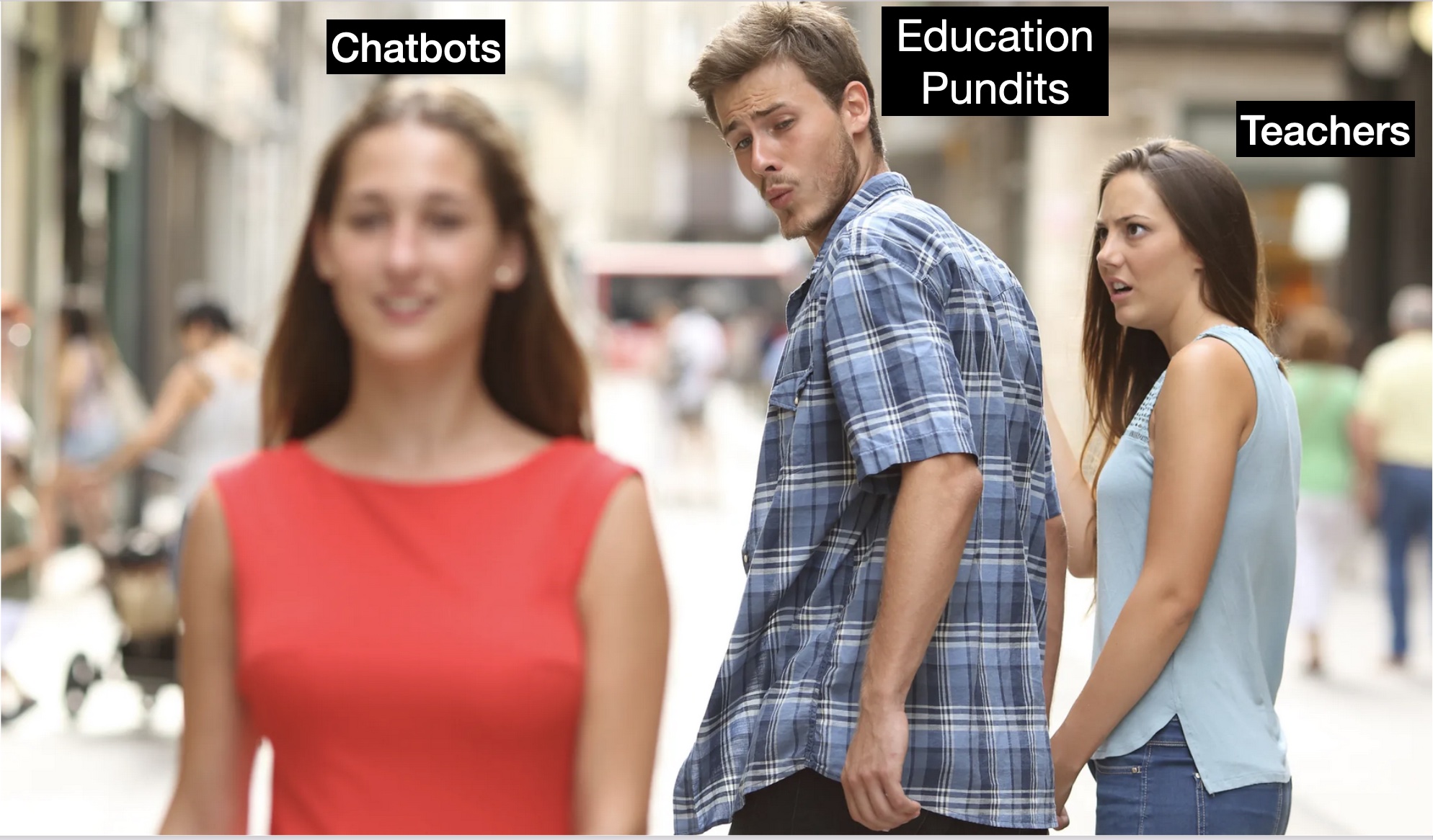
 

Artificially Intelligent Chatbots Will Not Replace Teachers

Education pundits are a lot like the guy in the “Distracted Boyfriend”meme.

They’re walking with teachers but looking around at the first thing possible to replace them.

This weekend it’s AI chatbots.

If you’ve ever had a conversation with Siri from Apple or Alexa from Amazon, you’ve interacted with a chatbot.

Bill Gates already invested more than $240 million in personalized learning and called it the future of education.

And many on social media were ready to second his claim when ChatGPT, a chatbot developed by artificial intelligence company OpenAI, responded in seemingly creative ways to users on-line.

It answered users requests to rewrite the 90s hit song, “Baby Got Back,” in the style of “The Canterbury Tales.” It wrote a letter to remove a bad account from a credit report (rather than using a credit repair lawyer). It explained nuclear fusion in a limerick.

It even wrote a 5-paragraph essay on the novel “Wuthering Heights” for the AP English exam.

Josh Ong, the Twitter user who asked for the Emily Bronte essay, wrote, “Teachers are in so much trouble with AI.”

But are they? Really?

Teachers do a lot more than provide right answers. They ask the right questions.

They get students to think and find the answers on their own.

They get to know students on a personal level and develop lessons individually suited to each child’s learning style.

That MIGHT involve explaining a math concept as a limerick or rewriting a 90’s rap song in Middle English, but only if that’s what students need to help them learn.

It’s interpersonal relationships that guide the journey and even the most sophisticated chatbot can’t do that yet and probably never will have that capacity.

ChatGPT’s responses are entertaining because we know we’re not communicating with a human being. But that’s exactly what you need to encourage the most complex learning.

Human interaction is an essential part of good teaching. You can’t do that with something that is not, in itself, human – something that cannot form relationships but can only mimic what it thinks good communication and good relationships sound like.

Even when it comes to providing right answers, chatbots have an extremely high error rate. People extolling these AI’s virtues are overlooking how often they get things wrong.

Anyone who has used Siri or Alexa knows that – sometimes they reply to your questions with non sequiturs or a bunch of random words that don’t even make sense.

ChatGPT is no different.

As more people used it, ChatGPT’s answers became so erratic that Stack Overflow – a Q&A platform for coders and programmers – temporarily banned users from sharing information from ChatGPT, noting that it’s “substantially harmful to the site and to users who are asking or looking for correct answers.”

The answers it provides are not thought out responses. They are approximations – good approximations – of what it calculates would be a correct answer if asked of a human being.

The chatbot is operating “without a contextual understanding of the language,” said Lian Jye Su, a research director at market research firm ABI Research.

“It is very easy for the model to give plausible-sounding but incorrect or nonsensical answers,” she said. “It guessed when it was supposed to clarify and sometimes responded to harmful instructions or exhibited biased behavior. It also lacks regional and country-specific understanding.”

Which brings up another major problem with chatbots. They learn to mimic users, including racist and prejudicial assumptions, language and biases.

For example, Microsoft Corp.’s AI bot ‘Tay’ was taken down in 2016 after Twitter users taught it to say racist, sexist and offensive remarks. Another developed by Meta Platforms Inc. had similar problems just this year. 

Great! Just what we need! Racist Chatbots!

This kind of technology is not new, and has historically been used with mixed success at best.

ChatGPT may have received increased media coverage because its parent company, OpenAI, was co-founded by Tesla Inc. CEO Elon Musk, one of the richest men in the world.

Eager for any headline that didn’t center on his disastrous takeover of Twitter, Musk endorsed the new AI even though he left the company in 2018 after disagreements over its direction.

However, AI and even chatbots have been used in some classrooms successfully.

Professor Ashok Goel secretly used a chatbot called Jill Watson as an assistant teacher of online courses at the Georgia Institute of Technology. The AI answered routine questions from students, while professors concentrated on more complicated issues. At the end of the course, when Goel revealed that Jill Watson was a chatbot, many students expressed surprise and said they had thought she was a real person.

This appears to be the primary use of a chatbot in education.

“Students have a lot of the same questions over and over again. They’re looking for the answers to easy administrative questions, and they have similar questions regarding their subjects each year. Chatbots help to get rid of some of the noise. Students are able to get to answers as quickly as possible and move on,” said Erik Bøylestad Nilsen from BI Norwegian Business School.

However, even in such instances, chatbots are expensive as yet to install, run and maintain, and (as with most EdTech) they almost always collect student data that is often sold to businesses.

Much better to rely on teachers.

You remember us? Warm blooded, fallible, human teachers.

The best innovation is still people.


Like this post?  You might want to consider becoming a Patreon subscriber. This helps me continue to keep the blog going and get on with this difficult and challenging work.

Plus you get subscriber only extras!

Just CLICK HERE.

Patreon+Circle

I’ve also written a book, “Gadfly on the Wall: A Public School Teacher Speaks Out on Racism and Reform,” now available from Garn Press. Ten percent of the proceeds go to the Badass Teachers Association. Check it out!
 

School Vouchers Don’t Increase Academics; They Increase Bigotry   


Let’s be honest.  


At best, school vouchers are a failed education policy experiment.  


At worst, they’re an attempt to normalize bigotry. 


Using taxpayer money to send your child to a private or parochial school has got nothing to do with getting a quality education.  


If we look at the facts, using a school voucher to go from a public school to a private one actually hurts kids academically.  


Large-scale independent studies in Indiana, Louisiana, Ohio and Washington, D.C., show that students who used vouchers were as negatively impacted as if they had experienced a natural disaster. Their standardized test scores went down as much or more than students during the Covid-19 pandemic or Hurricane Katrina in 2005.  


This should come as no surprise. When we give children school vouchers, we’re removing their support systems already in place.


They lose the friends, teachers, and communities where they grew up. It’s like yanking a sapling from out of the ground and transplanting it to another climate with another type of soil which may not be suited to it at all.  


Vouchers have nothing to do with helping kids escape struggling public schools.  


School vouchers overwhelmingly go to kids who already attend private or parochial schools.  


In the states that have released their data, more than three quarters of families who apply for vouchers for their children already send their kids to private schools. That’s 75% of voucher students in Wisconsin, 80% in Arizona, and 89% in New Hampshire. So these kids didn’t need our tax dollars in the first place.  We’re just paying for services they’re already receiving.


Moreover, the very idea is absurd. If the school where the student is enrolled is struggling, why wouldn’t you simply invest in that school to make it better and fix the underlying problem? Why disrupt children’s educations by moving them to another school in another system that is entirely unproven, itself? 


Vouchers have nothing to do with more efficient schools.  


Let’s get one thing straight – voucher schools are businesses, often new businesses just opening up. And like any other start-up, the failure rate is extremely high. According to Forbes, 90% of start-ups fail – often within the first few years.  


The same is true here. Like charter schools (another privatized education scheme), most voucher schools close in the first few years after they open. In Wisconsin, for example, 41% of voucher-receiving schools have opened and subsequently closed since public funding began in the early 1990s.  


Yet when they close, they take our tax dollars with them leaving less funding available to educate all kids in the community.  


Public schools, by contrast, are community institutions that usually last (and have been around) for generations. Their goal isn’t profit – it’s providing a quality education. 


Lastly, vouchers have nothing to do with freedom or choice.  


Unless it’s the choice to be a bigot and indoctrinate your child into your own bigotry. 


Vouchers are about exclusion – who gets to attend these PRIVATE schools –  and indoctrination – what nonsense they can teach that public schools cannot.  


Private schools can and do discriminate against children based on religion, race, gender, sexuality, special needs – you name it – even if those schools take public money.  


For example, in Florida, Grace Christian School, a private institution that refuses to enroll LGBTQ kids has received $1.6 million so far in taxpayer funding. In Indiana, more than $16 million has gone to schools banning LGBTQ kids—or even kids with LGBTQ parents! That’s roughly 1 out of every 10 private schools in the state with just this one discriminatory enrollment.  


Meanwhile thousands of parochial schools that receive public funding use textbooks provided by The American Christian Education (ACE) group. This includes the A Beka Book and Bob Jones University Press textbooks. A Beka publishers, in particular, reported that about 9,000 schools nationwide purchase their textbooks.  


In their pages you’ll find glowing descriptions of the Ku Klux Klan, how the massacre of Native Americans saved many souls, African slaves had really good lives, homosexuals are no better than rapists and child molesters, and progressive attempts at equal rights such as Brown vs. Board of Education were illegal and misguided. You know – all the greatest Trump/MAGA hits!  


Call me crazy, but I don’t think that’s a curriculum worthy of taxpayer dollars. I think if you’re going to take public money, you should have to accept all of the public, and you shouldn’t be allowed to teach counterfactual claims and prejudice as if they were fact.  


You want freedom? Fine.  


You are free to be as intolerant as you want to be, but do it on your own dime.  


If racism, homophobia, classism or xenophobia is your thing, you can jolly well pay for it, yourself.  


But biased, partisan and sectarian education isn’t in the interest of the public good.   

  
We should reserve our tax dollars to pay for things in the common interest. Not Klan camp.   


 Don’t get me wrong. 


Every private or parochial school isn’t like that.  


But a heck of a lot of them are! 


We shouldn’t be wasting our time trying to sort through other people’s businesses when we have our own educational enterprise – public schools – which cumulatively do a much better job. 


And our public system would do an even better job than that if instead of trying to “save kids” from underfunded public schools, we simply funded them enough to meet student need and beyond.  


It should come as no surprise that removing students from public school and sending them to a private or parochial school doesn’t work to help them academically.  


It would be much more effective to provide support where students are than make them undergo the trauma of uprooting.  


Finally let me say something about the issue of standardized testing.  

 
I still believe that standardized test scores are a terrible way to try to assess student learning. And the fact that voucher students tank their tests – by itself – does not prove to me that private and parochial schools provide a substandard education compared to public schools.  


It is the surrounding factors – like that most voucher schools don’t have to use certified teachers with the same quality degrees as public schools, that they don’t have to use the same kind of high-quality curriculum or pass the same kinds of public scrutiny.  


However, test scores do matter to policymakers. They are using the same test scores to disparage public schools and then in the same breath ignore the scores when they delegate more taxpayer funding for school vouchers.  


This is hypocritical. We need to demand more from our lawmakers in this regard.  


The same far right ideologues that support Trump and the MAGA fascists are the driving force behind the push for more school vouchers.  


Undoubtedly, they are helped by unscrupulous Democrats, but at least the Dems CLAIM to still believe in facts and representative government. 


It’s time they paid heed to the facts and represented us by ending their support for school vouchers and the MAGA factories most of these vouchers go to support. 


Bigotry is a losing proposition in a democracy where you need as many votes as possible to get elected to office.  


And dressing up indoctrination as if it were just freedom and economics only works if we’re foolish enough to let it. 


NOTE: In this article, I am indebted to the work of Josh Cowen, a professor at Michigan State University who has been studying school vouchers for more than two decades.


Like this post?  You might want to consider becoming a Patreon subscriber. This helps me continue to keep the blog going and get on with this difficult and challenging work.

Plus you get subscriber only extras!

Just CLICK HERE.

Patreon+Circle

I’ve also written a book, “Gadfly on the Wall: A Public School Teacher Speaks Out on Racism and Reform,” now available from Garn Press. Ten percent of the proceeds go to the Badass Teachers Association. Check it out!

Standardized Test Scores are Incompatible with Your School’s Equity Plan  


The primary goal of public education is to teach all children fairly.  


But since its inception, the system has never been set up to actually accomplish this.  


So these days you hear a lot of talk about fixing the problem – of how we can ensure students of color and other historically underserved children get the same high-quality education racially and economically privileged kids always have received.


This almost always concludes with two types of plan.  


First, there is the serious venture made up of things like increasing spending to meet student need, wraparound services, early intervention, reducing class size, redistributive justice and cultural competence – a plan that looks the reality in the face and makes bold attempts to come to terms with it. 


Then there is the cheap knockoff proposition – a buzzword-laden scheme where someone is trying to convince you their half hearted proposal is actually a solution to the very real problem of educational inequality. 


And the number one thing you can use to tell the difference between the two is this – standardized test scores


The first plan that is centered around actually fixing disparities makes no mention of test scores – or at least relegates them to obstacles. The second is built all around them – as an essential component of the overall scheme. 


This is because the second feel-good-accomplish-nothing plan is essentially performative.  


Therefore, it is constructed around standardized test scores as a metric of success.  


Planners think: We’re going to do A, B and C to make our schools more equitable. And how will we know we’re doing it right? We’ll use our standardized test scores! 


That’s not accuracy. It’s ostentation. These scores don’t demonstrate anything at all about equity. True, they purport to show readily apparent increases or decreases in academics.  


However, even this is an illusion.  


A rise or fall in test scores is not, in fact, based on authentic academic success but merely success at taking standardized tests designed for very different purposes.  


And anyone who understands the history of these types of assessments and how they still work will know that this mirage is built at the cost of genuine equity.  


In fact, the inequalities plaguing our public school system are due in large part to our national insistence that standardized test scores be the ultimate measure of success.  


So constructing your plan to fix this problem around one of its root causes is like claiming you can fix a sinking ship by drilling more holes in its hull.  


At best, it’s naive. At worst, it’s self-defeating and disingenuous.  


The problem centers around the difference between standardized tests and assessments created by classroom teachers. 


Both types of assessment are supposed to measure what students have learned. But not all learning is equal


For example, a beginning chef needs to know how to use the stove, have good knife skills and how to chop an onion. But if you give her a standardized test, it instead might focus on how to make foie gras – something that would only come in handy at a high end French restaurant.


That’s not as important in your everyday life, but the tests make it important by focusing on it.  


The fact of the matter is that standardized tests do NOT necessarily focus on the most important aspects of a given task. They focus on obscurities – things that most students don’t know.  


This is implicit in the design of these exams and is very different from the kinds of tests designed by classroom teachers.  


When a teacher makes a test for her students, she’s focused on the individuals in her classes. She asks primarily about the most essential aspects of the subject and in such a way that her students will best understand. There may be a few obscure questions, but the focus is on whether the test takers have learned the material or not.  


When psychometricians design a standardized test, on the other hand, they aren’t centered on the student. They aren’t trying to find out if the test taker knows the most important facts or has the most essential skills in each field. Instead, there is a tendency to eliminate the most important test questions so that the test – not the student – will be better equipped to make comparisons between students based on a small set of questions. After all, a standardize test isn’t designed for a few classes – it is one size fits all.  


New questions are field tested. They are placed randomly on an active test but don’t count toward the final score. Test takers aren’t told which questions they’ll be graded on and which are just practice questions being tried out on students for the first time. So students presumably give their best effort to both types. Then when the test is scored, the results of the field test questions determine if they’ll be used again as graded questions on a subsequent test.  


According to W. James Popham, professor emeritus at the University of California and a former president of the American Educational Research Association, standardized test makers take pains to spread out the scores. Questions answered correctly by too many students – regardless of their importance or quality – are often left off the test.  


If 40 to 60 percent of test takers answer the question correctly, it might make it onto the test. But questions that are answered correctly by 80 percent or more of test takers are usually jettisoned.  


He writes:  

   “As a consequence of the quest for score variance in a standardized achievement test, items on which students perform well are often excluded. However, items on which students perform well often cover the content that, because of its importance, teachers stress. Thus, the better the job that teachers do in teaching important knowledge and/or skills, the less likely it is that there will be items on a standardized achievement test measuring such knowledge and/or skills.”  


Think about what this means.  


We are engaged in a system of assessment that isn’t concerned with learning so much as weeding people out. It’s not about who knows what, but about which questions to ask that will achieve the predetermined bell curve.  


This is important when it comes to equity.  


If we are guided in large part by standardized test scores, we aren’t guided by authentic learning. We’re guided by a false picture of learning. Therefore, the most effective way – perhaps the only practical way – of raising test scores is to teach directly to a specific test. And not only the test, but the specific version of the test being given that year.

So if we do somehow manage to raise test scores, we haven’t improved academics at all but a mere semblance of it. And thus the equity we might celebrate in such a situation would be just as false. 


You got a good score on the MAP test. Hurrah! But that doesn’t mean you know anything of real value except how to take this particular MAP test which, itself, will change after the next round of questions are field tested.


This has huge implications for the quality of education being provided at our schools. Since most administrators have drunk deep of the testing Kool-Aid, they now force teachers to educate in just this manner – to use test scores to drive instruction. So since the tests doesn’t focus on the most essential parts of Reading, Writing, Math, and Science, neither does much of our instruction. 

And if we insist on evaluating the equity of our schools on these test scores, we will only make things that much worse. 


We end up chasing the psychometricians. We try to guess which aspects of a subject they think most students don’t know and then we teach our students that to the exclusion of more important information. And since what students don’t know changes, we end up having to change our instructional focus every few years based on the few bread crumbs surreptitiously left for us by the state and the testing corporations.  


That is not a good way to teach someone anything. It’s like teaching your child how to ride a bike based on what the neighbor kid doesn’t know.  


It’s an endless game of catch up that only benefits the testing industry because they cash in at every level. They get paid to give the tests, to grade the tests and when students fail, they get paid to sell us this year’s remediation material before kids take the test again, and – you guessed it – the testing companies get another check!  


It’s a dangerous feedback loop, a cycle that promotes artificially prized snippets of knowledge over constructive wholes. 


And let’s not forget where these tests come from


They were created in the 1910s and 20s by eugenicists to prove the supremacy of white Europeans over other racial and ethnic groups.  


While these original tests are no longer in circulation, the assumptions behind them are an essential part of our modern day standardized tests. 


The very method of question selection in today’s tests builds economic and racial bias into the very fabric of the enterprise.  


According to Prof. Martin Shapiro of Emory University, when test makers select questions with the greatest gaps between high and low scorers, they are selecting against minorities. Think about it – if they pick questions based on the majority getting it right, which minority got it wrong? In many cases, it’s a racial or ethnic minority. In fact, this may explain why white students historically do better on standardized tests than black and Hispanic students.  


This process may factor non-school learning and social background into the questions. They are based on the experiences of white middle-to-upper class children.  


So when we continually push for higher test scores, not only are we ultimately dumbing down the quality of education in our schools, but we’re also explicitly lobbying for greater economic and racial bias in our curriculum trickling down from our assessments.  


As Ibram X. Kendi, author of “How to be an Antiracist” puts it:  


“Standardized tests have become the most effective racist weapon ever devised to objectively degrade Black minds and legally exclude their bodies.”  


This is incompatible with any enterprise aimed at increasing equity.  


You are engaged in a never-ending cycle of teaching to the test at the expense of authentic learning. You’re engaged in making minorities think like their privileged peers – of overcoming who they are just to be accepted into a game.


This is not education. It is assimilation, and it will always put the assimilated at a disadvantage to the majority – those they are being forced to imitate.  


Equity and standardized testing do not go together.  


They CANNOT go together. They are anathema.  


Those who suggest otherwise are either well-meaning fools or duplicitous malefactors.  


There is a multi-billion dollar standardized testing industry dependent on keeping us testing our kids.  


But we can no longer continue feeding that beast and pretending that we can somehow provide equity to our underserved children, too.  


We have to choose – equity or testing.  Fairness or unrestrained capitalism.


Do not believe anyone who tells you to support a plan built on both. 

It does not exist.


Like this post?  You might want to consider becoming a Patreon subscriber. This helps me continue to keep the blog going and get on with this difficult and challenging work.

Plus you get subscriber only extras!

Just CLICK HERE.

Patreon+Circle

I’ve also written a book, “Gadfly on the Wall: A Public School Teacher Speaks Out on Racism and Reform,” now available from Garn Press. Ten percent of the proceeds go to the Badass Teachers Association. Check it out!


Top Five Republican Nightmare Fantasies About Public Schools

Republicans are fighting against a version of public education that does not exist.

Critical race theory, pornographic school books, and other bogeymen haunt their platforms without any evidence that this stuff is a reality.

Doug Mastriano, the GOP nominee for Governor of Pennsylvania, actually promises to ban pole dancing in public schools.

Pole dancing!

“On day one, the sexualization of our kids, pole dancing, and all this other crap that’s going on will be forbidden in our schools,” he says.

Mr. Mastriano, I hate to tell you this, but the only school in the commonwealth where there was anything like what you describe was one of those charter schools you love so much. The Harambee Institute of Science and Technology Charter School in Philadelphia used to run an illegal nightclub in the cafeteria after dark.

But at authentic public schools with things like regulations and school boards – no. That just doesn’t happen here.

Maybe if your plan to waste taxpayer dollars on universal school vouchers goes through you’ll get your wish.

But reality has never stopped the state Senator from complaining about a list of fictional public education woes.

On Twitter he routinely makes statements like this from August:

“Democrats are pushing woke ideology, racism, and sexuality on children in the classroom. As your governor, I will ban this on day one…”

Yikes. This is like promising to ban sorcery in school – another thing we don’t teach.

This isn’t the Republican Party I remember when I was growing up.

Instead of personal autonomy and free trade, today’s GOP solemnly swears to eliminate a series of racially and sexually motivated phantasms that are like shadows under a child’s bed. I suppose it’s easier to get rid of something that’s never existed than to fix the real problems we actually have.

But let’s be honest – for some folks this kind of unhinged messaging works.

Perhaps if we examine the most common claims against public schools, maybe we can see through the mist and electioneering to the very real fears the GOP is using in a desperate attempt to manipulate voters to their side.

So here are the top 5 Republican nightmare fantasies about public schools:

1) Teaching boys to hate themselves

“I believe that white men are the most persecuted identity in America.”

Georgia Congressperson Marjorie Taylor Greene actually said this – out loud – in an interview.

And the GOP attention-seeker is not alone.

Many Republicans claim anti-male discrimination is wide spread. Men are blamed for so many things in our society they’re forced to turn to porn and video games because they have no other options, Green claimed.

And women have become “… too weak and pathetic to take care of themselves. They want a great big giant government to take care of them. It’s such a hypocrisy. They claim they want the future to be female, but they aren’t capable of taking care of themself.”

How did we get here? Public schools that teach sexual politics.

But, Marjorie, the following ARE facts:

-The US is one of only eight countries in the world that does not provide any form of paid maternity leave by federal law.  

-Women earn 83 cents for every dollar a man makes.

-Despite being almost 60% of the population, women hold only 26% of the seats in Congress.

Should we teach such facts in school?

Contrary to Republican opinion, teaching about the many ways women are unfairly treated in the US does not turn men into victims or make women helpless.

Male students are not responsible for a world created by past generations but they ARE responsible for picking a side and doing something about it as they become adult members of society.

In a country where a GOP-controlled Supreme Court has usurped women’s bodily autonomy by overturning Roe v. Wade and men still have untold economic advantages, redefining men as victims and education as infantalizing is, itself, a fantasy.

2) Teaching kids to be gay

Republicans literally think public school teachers are turning kids gay.

That’s the impetus behind Florida Gov. Ron DeSantis’s controversial “Don’t Say Gay” bill and several copycat bits of legislation the American Legislative Exchange Council (ALEC) is pumping out across the country.

They insist that even mentioning LGBTQ people exist is grooming children into a sexuality they wouldn’t otherwise have.

First, believing this shows massive ignorance.

No one can really be coerced into a sexuality they didn’t already possess. As you grow and mature, you have sexual preferences. It’s not really a matter of nurture – it’s nature. People are born this way.

Second, stubbornly refusing to acknowledge that there are other ways to express your sexuality is not going to make people ignore their innate inclinations. The idea seems to be that if kids never find out there are other options, they’ll simply be satisfied with heterosexuality – how they’re told to think and feel.

And finally, it is extremely unfair to LGBTQ people. We already live in a culture that celebrates cis hetero-normativity. Trying to erase everyone else causes real harm and trauma to both people who are different and to those who are not but never get to fully understand the entire spectrum of humanity.

Teachers are not making kids gay, but they are telling kids that gay people are real. We are trying to stop bullying and homophobia. And let’s be honest – that’s really what Republicans are objecting to here.

They want it to be okay to hate gay people.

Sorry. Not in public school.

3) Teaching kids to be trans

This is where the backlash against using appropriate pronouns and recognizing trans people is coming from.

As much as Republicans hate gay people, they absolutely despise and fear the trans community.

Once again they conflate acknowledging the existence of the other with coercing students to become the other. Just knowing that trans is an authentic way human beings can live is seen as a threat. But if this kind of knowledge makes you trans, you almost certainly were trans already.

It hurts no one to call another person by the pronouns they would prefer you use. That’s just respect – treating others like you would want to be treated.

It hurts no one to see the world as bigger than just one way of living. This is reality, after all. And that’s what Republicans are rebelling against.

Far from teachers coercing students to become trans, the GOP wants us to bully children not to be. They want to constrain difference, punish and hide it.

This cannot be the mission of public schools. At its best, it is for everyone and must respect each child on their own terms.

It’s not easy. Recognizing such differences can be messy and challenging, but that’s life. Deal with it.

4) Teaching kids to hate white people

This is one of the most common complaints of Republicans everywhere.

Thy say public schools are woke. Public school teachers talk about racism and prejudice. They teach what was, what is and encourage kids to act to dismantle systems of injustice against people of color that persist.

Yeah. We do that.

I make no apologies.

It’s not Critical Race Theory (which is a legal framework) nor do we teach anyone to hate white people. But we do teach what whiteness has done and continues to do.

It’s called history and current events.

White kids today are not responsible for slavery, Jim Crow or a host of evils perpetrated throughout our collective past. But that doesn’t remove their responsibility to do something about it today.

Republicans, though, try to flip the script and call this teaching, itself, racism. That’s absurd! It is not racist to show kids injustice.

For example:

-Median household income for Black people, at $43,862, is 37 precent less than that of white people, at $69,823.

-Census data shows Black couples are more than twice as likely as whites to be denied a mortgage or a home improvement loan, which leads to just 59 percent of the median home equity white households have, and just 13 percent of Black wealth.

-A Black child born today can expect to live four years less than a white one.

-Black people have been more than twice as likely as white people to experience threats or uses of force during police encounters, and three times more likely to be jailed if arrested.

These facts matter.

They shouldn’t make children hate white people, but they may encourage them to hate white supremacy.

And that’s what Republicans are really against.

5) Teaching kids to be sexually active

This may be the strangest fantasy the GOP is trying to spread about public school.

They say we’re making kids engage in sexual activity. Which is strange because according to the Centers for Disease Control, fewer US children are choosing to engage in sexual activity.

An estimated 55% of male and female teens have had sexual intercourse by age 18, according to the CDC’s National Center for Health Statistics (NCHS).

However, these percentages have declined since 1988 when 51% of female and 60% of male teens had engaged in sexual activity.

If public schools are teaching kids to bump uglies, we’re doing a bad job.

Are kids more sexualized today than in the past? Probably. But that’s a result of the culture. When you sell teenagers shorts with the word “juicy” on the butt, don’t complain about public schools.

Some schools offer sex education classes, but they are focused on health and wellness. There is no encouragement to have sex. In fact, many such classes are still teaching abstinence only instead of safe contraception.

The idea that public schools are teaching sex is just dog whistle politics. It is Republicans trying to scare parents that public schools are instilling values they don’t share. It is blaming public schools for social ills that the schools didn’t cause and don’t control.

Looked at calmly and rationally, all of these fantasies are just scare tactics to get the gullible to react emotionally on election day.

They want to terrify responsive voters into giving GOP candidates the power to stop a host of things that never really existed. They want an excuse for doing nothing to solve the actual problems of the day.

There’s a reason they spend so much time railing against woke education – they want to ensure America remains asleep.

A fitful sleep – tossing and turning in various Republican nightmares.


Like this post?  You might want to consider becoming a Patreon subscriber. This helps me continue to keep the blog going and get on with this difficult and challenging work.

Plus you get subscriber only extras!

Just CLICK HERE.

Patreon+Circle

I’ve also written a book, “Gadfly on the Wall: A Public School Teacher Speaks Out on Racism and Reform,” now available from Garn Press. Ten percent of the proceeds go to the Badass Teachers Association. Check it out!

The Racist Origins of Standardized Testing Still Matter

Would you walk across a bridge that was designed to break?

Of course you wouldn’t.

But what if someone told you the bridge had been fixed?

Would you trust it – especially if people were still falling off of it all the time?

That’s the situation we’re in with standardized testing.

The tests were explicitly created more than a century ago to fail minorities and the poor.

And today, after countless revisions and new editions, they still do exactly the same thing.

Yet we’re exhorted to keep using them.

A BRIEF HISTORY LESSON

Modern testing comes out of U.S. Army IQ tests developed during World War I.


 In 1916, a group of psychologists led by Robert M. Yerkes, president of the American Psychological Association (APA), created the Army Alpha and Beta tests. These were specifically designed to measure the intelligence of recruits and help the military distinguish those of “superior mental ability” from those who were “mentally inferior.” 


These assessments were based on explicitly eugenicist foundations – the idea that certain races were distinctly superior to others.

Colleague Lewis Terman made the goal clear in his book, The Measurement of Intelligence, that these “experimental” tests will show “enormously significant racial differences in general intelligence, differences which cannot be wiped out by any scheme of mental culture.” 

In 1923, another psychologist, Carl Brigham, took these ideas further in his seminal work A Study of American Intelligence. In it, he used data gathered from these IQ tests to argue the following: 


“The decline of American intelligence will be more rapid than the decline of the intelligence of European national groups, owing to the presence here of the negro. These are the plain, if somewhat ugly, facts that our study shows. The deterioration of American intelligence is not inevitable, however, if public action can be aroused to prevent it.”


 Thus, Yerkes, Terman and Brigham’s pseudoscientific tests were used to justify Jim Crow laws, segregation, and even lynchings. Anything for “racial purity.” 


People took this research very seriously. States passed forced sterilization laws for people with “defective” traits, preventing between 60,000 and 70,000 people from “polluting” America’s ruling class. 

The practice was even upheld by the US Supreme Court in the 1927 Buck v. Bell decision. Justices decided that mandatory sterilization of “feeble-minded” individuals was, in fact, Constitutional.


 Of the ruling, which has never been explicitly overturned, Justice Oliver Wendell Holmes wrote, “It is better for all the world, if instead of waiting to execute degenerate offspring for crime, or to let them starve for their imbecility, society can prevent those who are manifestly unfit from continuing their kind…. Three generations of imbeciles are enough.” 


Eventually Brigham took his experience with Army IQ tests to create a new assessment for the College Board – the Scholastic Aptitude Test – now known as the Scholastic Assessment Test or SAT. It was first given to high school students in 1926 as a gatekeeper. Just as the Army intelligence tests were designed to distinguish the superior from the inferior, the SAT was designed to predict which students would do well in college and which would not. It was meant to show which students should be given the chance at a higher education and which should be left behind. 


And unsurprisingly it has always – and continues to – privilege white students over children of color. The same as nearly every standardized test still does.

HAS IT CHANGED?

None of this can be challenged. These are historical facts. They are simply what happened justified in the words of the people who perpetrated them.

However, champions of continuing the practice of standardized testing most often defend the practice by appealing to time.

This was all a long time ago, they say. Much has changed between now and then.

But has it? Really?

We certainly don’t use the editions of the tests written by the original eugenicists, but the practices used to create them and the results of these assessments are extremely similar.

In 1964, a Department of Education report found that the average black high school senior scored below 87% of white seniors (in the 13 percentile) on standardized assessments. Fifty years later, the National Assessment of Educational Progress (NAEP) found that black seniors had narrowed the gap until they were merely behind 81% of white seniors (scoring in the 19th percentile).

Is that really the kind of progress you want to champion?

The reason for the disparity has nothing to do with the learning students of color (and the poor whose scores are similar) achieve nor their worth as human beings.

It is in the very concept of standardized testing.

Discrimination is purposefully built in to the standardization process, according to W. James Popham, PhD, Professor Emeritus at the University of California at Los Angeles and former test maker. He explained in an interview with Frontline:

“Traditionally constructed standardized achievements, the kinds that we’ve used in this country for a long while, are intended chiefly to discriminate among students … to say that someone was in the 83rd percentile and someone is at 43rd percentile. And the reason you do that is so you can make judgments among these kids. But in order to do so, you have to make sure that the test has in fact a spread of scores. One of the ways to have that test create a spread of scores is to limit items in the test to socioeconomic variables, because socioeconomic status is a nicely spread out distribution, and that distribution does in fact spread kids’ scores out on a test.”

The scores have to fall into categories – Below Basic, Basic, Proficient and Advanced, for instance. If too many students cluster in the middle, the results are invalid. We need the scores spread out – even if we must resort to non-educational factors to get there.

Family income is not something the tests ignore, says Popham. It is an essential component specifically tested for in question construction. In fact, he claims that between 15-80% of the questions (depending on the subject area) on norm-referenced exams are linked to socio-economic status (SES).

Thus minorities with higher percentages of impoverished people are selected against. Not because of any explicit racist ideology – but to get the pretty bell curve standardized assessments require.

Young Whan Choi, Manager of Performance Assessments at Oakland Unified School District in Oakland, California, agreed.

“Too often, test designers rely on questions which assume background knowledge more often held by White, middle-class students. It’s not just that the designers have unconscious racial bias; the standardized testing industry depends on these kinds of biased questions in order to create a wide range of scores.”

For example, Choi recalled a 10th grade student in his class asking him about a standardized test question. “With a puzzled look, she pointed to the prompt asking students to write about the qualities of someone who would deserve a “key to the city.” Many of my students, nearly all of whom qualified for free and reduced lunch, were not familiar with the idea of a ‘key to the city.’”

So when they get such a question wrong, it isn’t necessarily because they don’t know the concept being tested, but they don’t understand what was being asked in the first place.

Test makers could work to eliminate such instances but that would reduce the spread of answers. It would destroy the bell curve – and thus invalidate the goal of the test which ultimately is not assessing learning but sorting and ranking students.

Jay Rosner, a national admissions test expert, explained how this bias is built-in to the process for each revision of assessments like the SAT:


“Compare two 1998 SAT verbal [section] sentence-completion items with similar themes: The item correctly answered by more blacks than whites was discarded by the Educational Testing Service, whereas the item that has a higher disparate impact against blacks became part of the actual SAT. On one of the items, which was of medium difficulty, 62% of whites and 38% of African-Americans answered correctly, resulting in a large impact of 24%…On this second item, 8% more African-Americans than whites answered correctly…”


 In other words, the criteria for whether a question is chosen for future tests is if it replicates the outcomes of previous exams – specifically tests where students of color score lower than white children. And this is still the criteria test makers use to determine which questions to use on future editions of nearly every assessment in wide use in the US.

Public schools have no control over these factors. That’s why schools serving poor and minority students invariably have lower test scores. Popham concludes there will always be a testing gap because that’s the way the system is designed.

He says it’s “A game without winners.” Or more likely a game where the poor and minorities cannot win.

And that’s how the system was designed.

Whether it’s the 1920s or the 2020s.

Standardized tests came from racists assumptions about human intelligence.

And that still matters today.

We no longer profess eugenicist ideas of racial purity embedded in our assessments as self evident or based on science. But they’re there none-the-less.

Today, the very concept of intelligence being quantifiable remains in question.

In “The Mismeasurement of Man,” evolutionary biologist Stephen Jay Gould challenged many of these ideas – in particular those of Terman. Rather than see intelligence as a genetic trait, Gould envisioned it more abstractly and thus shattered the idea that any mere number could capture human value.

Complex instances of learning cannot be accurately standardized. They have to be measured in context of the students and the learning community where they were acquired.

But this is a relatively new idea. Accepting it requires us to turn the page on a rather dark passage of our national history.

We must move on from the original test makers narrow-minded, racist ideas about intelligence and human worth.

And to do that we must leave standardized testing far, far behind.

We can’t just give a faulty bridge a new coat of paint. We must demolish it and rebuild an entirely new structure to carry us into the future.


Like this post?  You might want to consider becoming a Patreon subscriber. This helps me continue to keep the blog going and get on with this difficult and challenging work.

Plus you get subscriber only extras!

Just CLICK HERE.

Patreon+Circle

I’ve also written a book, “Gadfly on the Wall: A Public School Teacher Speaks Out on Racism and Reform,” now available from Garn Press. Ten percent of the proceeds go to the Badass Teachers Association. Check it out!

With the Death of Queen Elizabeth II, the US Should End Its Biggest Colonial Enterprise – Charter Schools

In the United States, colonialism isn’t just something we do to other people – we do it to our own citizens.

A prime example of this is the charter school industry.

Now that the UK’s longest-reigning monarch has died, perhaps we can admit that.

To many people, Queen Elizabeth II is more than just a 70-year figure head – she remains a symbol of the British colonial empire — an institution that enriched itself through violence, theft and oppression.

But one needn’t look solely at European nations pillaging Africa and Asia to condemn the practice.

Nor should we limit ourselves to United States’ hegemony in the Caribbean, Pacific and Middle East.

We’ve got colonialism right here – down the street, in our own neighborhoods.

According to the Oxford English Dictionary, colonialism is:

“the policy or practice of acquiring full or partial political control over another country, occupying it with settlers, and exploiting it economically.”

That’s a pretty good description of the relationship between charter schools and the communities where they insert themselves.

Consider what a charter school does.

It is a school funded by taxpayer dollars but free from regulations protecting the people it supposedly serves.


Like a colonial power, a charter school loots and pillages the local tax base but is not required to be governed by the local taxpayers.

This is fundamentally different from authentic public schools which are funded in the same way but subject to the leadership of an elected board of directors made up of members of the community. At charter schools, decisions can be made entirely by an appointed board who are not beholden to the public but to the organizers and investors who created the charter school in the first place.

And often those investors do not come from the community in question. They are outsiders come merely for personal profit.

These invaders are quite literally taking local, community resources and liquidating them for their own use – the maximization of personal profit. The public is removed from the decision-making process about how its own resources are utilized and/or spent.

To be fair, a charter school cannot exist in a community unless its operators can convince enough parents to enroll their children. However, no one needs to invite the charter school into the community in the first place.

Like with any business, these entrepreneurs can decide to set up shop pretty much anywhere, and though local public schools are tasked with approving or disapproving their request to locate within district boundaries, most state charter school laws provide very few resources to authentic public schools to turn charter schools away. Moreover, when charter applications are denied, the community that turned them away are often overruled by unelected privatization-friendly functionaries in state government.

Think about what a transformation has been thus accomplished.

Stakeholders such as students, families, teachers, and communities become merely economic resources ripe for hegemony – not free people with the right to control their own destinies.

After all, just because a small number of parents have decided to enroll their kids at a charter school, that doesn’t mean the community at large – which is far more numerous and will have to fund this endeavor – supports it. Moreover, the money taxpayers are expected to offload on the charter school come from their existent public schools – and the slight reduction in students does not equal a proportionate reduction in cost. Most expenses are fixed regardless of enrollment. You still have to heat and cool the building, staff the classes, etc. So the community has to decide whether to shortchange the majority of children who continue to be enrolled at the authentic public school or (as often is the case) pay more in taxes to make up the difference.

In this context, the colonizers aren’t foreign governments but hedge fund managers and other investors who treat the charter school in the same manner as real estate or stocks, playing a gambler’s game of speculation while local taxpayers are left with the tab and the lion’s share of risk. After all, if the speculators lose, they are out a certain dollar amount. If the charter school fails, the community loses a quality education for its children. Moreover, money that should have been spent according to community needs and priorities—hiring school nurses, keeping music programs, reductions in class size, etc. – is wasted.

Make no mistake – this is theft. It is pillaging and looting a community. The citizens lose their right to self government, how their land is used and how their resources are utilized. They become enslaved to the so-called free market.

Perhaps the most pernicious effect is the change in attitude, as Ohio social studies teacher Dr. Chuck Greanoff writes:

“Our minds are targets of colonization, the goal being the replacement of any sense of a common good and shared responsibly with the neoliberal axiom that economic self-interest is the only right and natural course of action. You are to think like consumers, not citizens. You are to shop for the best schools for your student, not invest your time and effort in improving them for everyone.” 

Others have gone even farther finding racism in the daily administration of charter schools, themselves. After all, many charter schools locate themselves around inner city black communities and therefore exploit the children of color they find there.

Bloggers Russ Walsh and Jonathan Pelto noted how similarly both colonialists and charter school operators often treat the people in the communities where they are located.

Colonialism is often white Europeans acting on brown indigenous people. The colonizers are going to “raise those savages up” or in the words of noted imperialist Rudyard Kipling, ease the “white man’s burden.”

Walsh notes that we see the same apparent motivation among charter school operators with regard to the often black and brown children enrolled in their schools. They use militaristic, highly autocratic systems of discipline to keep these children in-line.

He writes:

“The children of the inner city are being treated by their “benefactors” as inferiors. Charter schools are colonial enterprises.”

However, the most damning testimony comes from Julian Vasquez Heilig’s Cloaking Inequality blog. He published a guest piece written by a former New Orleans charter school dean of students decrying just such colonial practices.

He writes about the experience first hand:

“…while working as the Dean of Students for a charter school in New Orleans, it took me some time to realize that I had been enforcing rules and policies that stymied creativity, culture and student voice…

My daily routine consisted of running around chasing young Black ladies to see if their nails were polished, or if they added a different color streak to their hair, or following young men to make sure that their hair wasn’t styled naturally as students were not able to wear their hair in uncombed afro styles. None of which had anything to do with teaching and learning, but administration was keen on making sure that before Black students entered the classroom that they looked “appropriate” for learning. As if students whose hair was natural or those whose parents could not afford a uniform tie could not achieve like others who possessed these items…

…everything at the school was done in a militaristic/prison fashion. Students had to walk in lines everywhere they went, including to class and the cafeteria. The behavioral norms and expectations called for all students to stand in unison with their hands to their sides, facing forward, silent until given further instruction.”

Students should not be treated like prisoners. Children should not be forced to comply with such harsh rules of conduct. And no one should be compelled to give up their cultural heritage for any reason – but especially because those in charge don’t value them as human beings.

It’s way past time we admit it.

This is colonialism.

Charter schools are colonial enterprises.

We can and should criticize the UK for its history of violence and oppression. We can and should include many US international policies in the same condemnation.

But we mustn’t stop there.

Colonialism is on our streets and in our schools.

We have been colonized by the rich and powerful and our children of color have received the worst of it.

We must end the charter school experiment.

We must end the neighborhood colonialism that too few are willing to call by its rightful name.

Further Reading:

Fisher, David R.   Education in the Settler Colony: Displacement, Inequality, and Disappearance via Charter Schools. University of South Florida ProQuest Dissertations Publishing,  2019. 27548561.

-Vasquez Heilig, J., Khalifa, M., & Tillman, L. (2013). Why have NCLB and high-stakes reforms failed?: Reframing the discourse with a post-colonial lens. In K. Lomotey and R. Milner (Eds.), Handbook of Urban Education. New York: Routledge.


Like this post?  You might want to consider becoming a Patreon subscriber. This helps me continue to keep the blog going and get on with this difficult and challenging work.

Plus you get subscriber only extras!

Just CLICK HERE.

Patreon+Circle

I’ve also written a book, “Gadfly on the Wall: A Public School Teacher Speaks Out on Racism and Reform,” now available from Garn Press. Ten percent of the proceeds go to the Badass Teachers Association. Check it out!
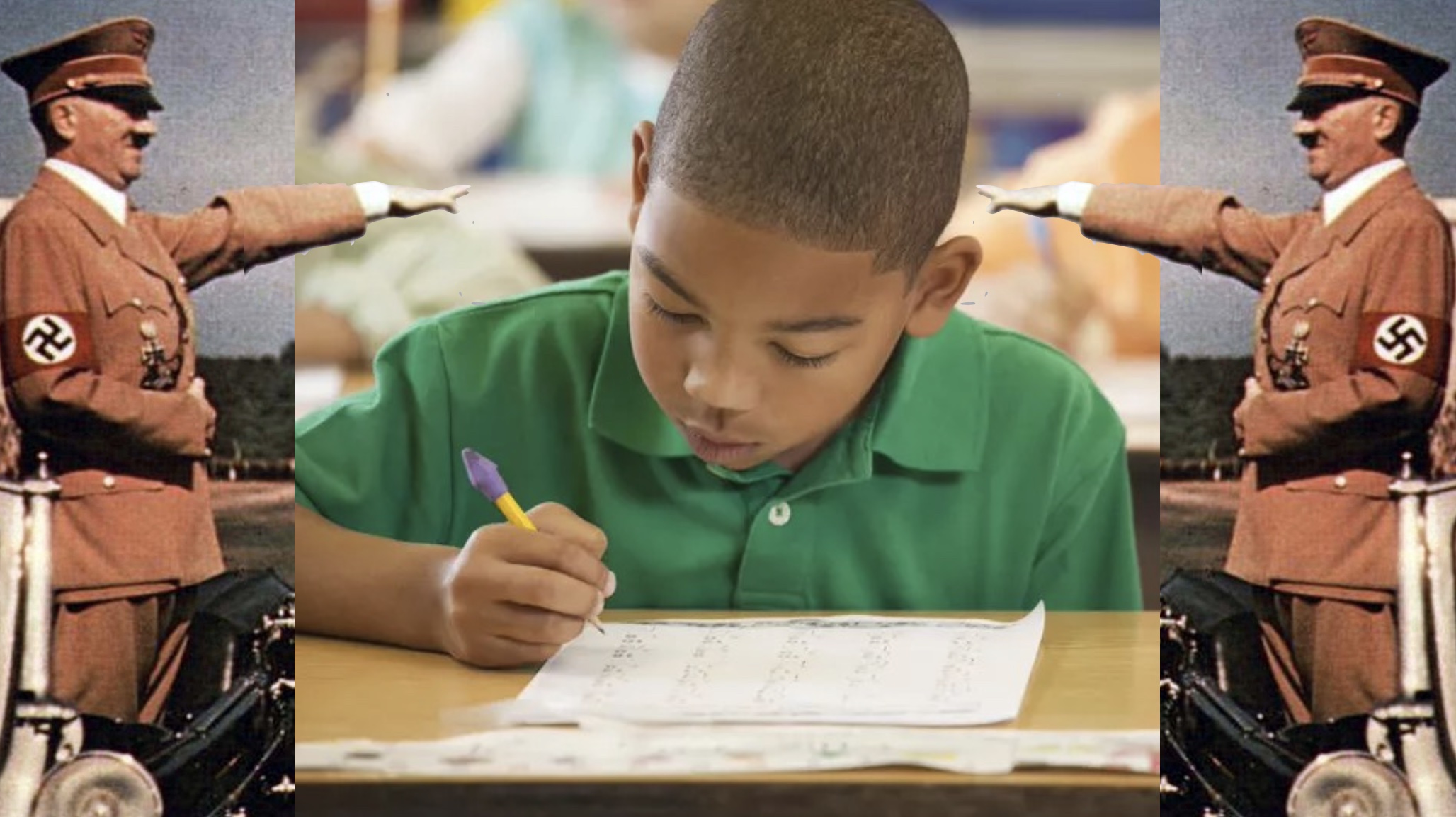
Great Replacement Theory and School Choice

What do QAnon conspiracy theorists and school privatization promoters have in common?

Answer: ideology.

The two groups do everything they can to disassociate with each other in public.

But examine their ideas and you’ll see a lot of family resemblances.

For example, take Great Replacement Theory and School Choice.

Great Replacement Theory is the idea that people of color are replacing white people both numerically and politically. Adherents claim Democrats are overrunning native-born white people with brown skinned immigrants in order to wrest political power. The claims have no basis in fact, but that doesn’t stop the narrative from gaining traction in the darkest corners of the Internet and right wing circles.

It is a favorite of far right pundits, immigration catastrophists and mass shooters. In fact, several white men have used it as justification for mass murder.

In May a white teenager cited it as his motivation for killing 10 black people and wounding several others at a supermarket in Buffalo, New York.

In 2018, another white man claimed he was trying to stop Jewish people facilitating immigration by killing 11 Jewish people at the Tree of Life synagogue in Pittsburgh.

School choice, on the other hand, seems to be something much less extreme.

At least you don’t have to be a card carrying member of the lunatic fringe to espouse its supposed virtues.

It’s the idea that kids should be segregated into different school systems based on parental choice. This means that parallel systems will compete for students in a Darwinian marketplace where some will get better resources than others with profit being the prime motivator for school operators most of whom are private corporations. In practice, this usually means that the worst racial and economic segregation is justified and even preferable so long as consumers think doing so will get them some kind of advantage.

It’s quite a popular idea among certain market first ideologues. This includes both Democrats and Republicans, investment bankers, and even some social justice advocates.

These are not always the same people who publicly champion Great Replacement Theory. However, as Tucker Carlson proves on his Fox News platform, sometimes they are.

Carlson has used his media empire to promote both ideas.

For more than a year he’s been claiming on Fox News that there’s a deliberate effort by the Democrats to undermine Republicans by replacing native-born Americans with immigrants.

In July, he said:

“You can’t just replace the electorate because you didn’t like the last election outcomes. That would be the definition of undermining democracy, changing the voters… The great replacement. It’s not a conspiracy theory. It’s their electoral strategy.”

And when it comes to school choice, he goes even further. Not only has he promoted it on Fox News, he is co-founder and editor-in-chief of The Daily Caller, a media source that constantly promotes school privatization and other corporate education reform strategies – school vouchers, charter schools, etc.

So what do the two concepts have in common?

In short: racism and white supremacy.

Great Replacement Theory is a kind of grievance politics complaining about the steady loss of white privilege.

School choice is an attempt to recapture or maintain white privilege at the educational level and by extension into the adult economic and political world.

Great Replacement Theory has its roots in French nationalism books dating back to the early 1900s, according to the Anti-Defamation League (ADL).

Chief among these is French Author, Jean Raspail, whose 1973 novel, The Camp of the Saints, told a fictional tale of migrants banding together to take over France. However, the concept’s more contemporary use is attributed to Renaud Camus, a French writer who wrote “Le Grand Remplacement” (“The Great Replacement”) in 2011.

White supremacists blame Jewish people for nonwhite immigration to the U.S., and the concept is closely associated with antisemitism, according to the ADL.

Adolphus Belk Jr., professor of political science and African American studies at Winthrop University, said white nationalist movements arise when people of color are seen as a threat politically and economically.

Belk said white nationalists are worried that, “whites will no longer be a majority of the general population, but a plurality, and see that as a threat to their own well-being and the well-being of the nation.”

What makes individual extremists and white nationalist groups so dangerous, according to Belk, are the lengths they are willing to go to in order protect their position in society:

“They are willing to use any means that are available to preserve and defend their position in society … it’s almost like a sort of holy war, a conflict, where they see themselves as taking the action directly to the offending culture and people by eliminating them.”

By contrast, school choice is a quieter ideology, but based on similar foundations.

School choice originated in America’s racially segregated past. Around the time when the Supreme Court’s Brown v. Board ruling outlawed direct segregation in public schools, white lawmakers created programs for redirecting public money to private institutions so that white families didn’t have to send their children to schools with their Black peers.

And we see the same in charter schools and private schools accepting taxpayer funded vouchers today. The prime motivation behind sending children to these schools is often “white flight”. White parents use these options to flee schools with higher percentages of non-white students. And choice options tend to lure the more motivated and compliant students away from public schools.

This isn’t to say that the authentic public school system is unequivocally integrated, either. While there has been tremendous progress in many districts, unscrupulous school boards, administrators and lawmakers have drawn district lines in such a way as to limit integration even in a substantial number of public schools. However, the degree of segregation at privatized schools dwarfs anything you’ll see in public education.

School choice programs create the ideal situation for Black-white segregation. An analysis of high schools in more than 100 of the largest U.S. public school districts found a positive correlation between districts that offer school choice programs and the degree to which their high schools were racially imbalanced for Black and white students.

A national study of the trends in the racial makeup of nearly every school district in the U.S. found that charter expansions made segregation worse within school districts. An analysis of national enrollment data of charter schools, conducted by the Associated Press in the 2014-2015 school year, found more than 1,000 of the nation’s 6,747 charter schools had minority enrollments of at least 99%, and the number has been rising ever since.

We see the same effect with school vouchers. A 2018 study of Washington, D.C.’s voucher program found that 70% of voucher students were enrolled in heavily segregated schools with 90% or more minority students, and 58% were enrolled in all-minority schools.

So both concepts – Great Replacement Theory and school choice – center around increasing white supremacy.

Both seek to shore up white political and economic power regardless of white people’s numeric majority. In fact, as white people become less of the majority – not through any importing of people of color from other nations but as a natural consequence of birth rates – they seek to disempower people of color.

In education, this means keeping Black and white students separate and unequal. It’s a way to divert more resources to the white students and ensure the Black students do not receive the same opportunities.

Sadly, these ideas are not really new in this country. Both share the spirit of George Wallace who in 1963 proudly proclaimed:

“Segregation now, segregation tomorrow and segregation forever!”

As Malcolm X observed:

“America preaches integration and practices segregation.”

The question remains whether voters will support such artifacts of the past or turn to a future where our ideals of equality and fairness triumph over our reality of inequality and injustice.

QAnon and school privatization may share a family resemblance, but it is up to us whether we reject that family or not.


Like this post?  You might want to consider becoming a Patreon subscriber. This helps me continue to keep the blog going and get on with this difficult and challenging work.

Plus you get subscriber only extras!

Just CLICK HERE.

Patreon+Circle

I’ve also written a book, “Gadfly on the Wall: A Public School Teacher Speaks Out on Racism and Reform,” now available from Garn Press. Ten percent of the proceeds go to the Badass Teachers Association. Check it out!

Teachers are Being Spied on for Thoughtcrimes

Teachers, be careful.

Big Mother is watching you.

When you post a rainbow flag on your Facebook profile…

When you tweet support for Black Lives Matter…

When you like a YouTube video of someone punching a Nazi…

Big Mother is watching.

Or more specifically, Moms for Liberty is watching.


And, no, the group’s members probably don’t get the irony of their name.

Moms for Liberty (MFL) is a billionaire-funded front group dedicated to spreading disinformation and chaos at public schools across the country.

They’ve offered cash prizes for turning in teachers who dare to educate on topics that go against far right doctrine. They’ve demanded books on similar topics be removed from school libraries and curriculum. And they’ve even stormed school board meetings where they don’t necessary live to complain about every petty grievance Fox News is broadcasting this week.

Now they’re coming after teachers social media.

They’re creating workshops to encourage people to find public educators’ online accounts and report anything they don’t like at school board meetings or in the media, ultimately demanding the offenders be fired.

After all, if Miss Roosevelt has a rainbow flag on her personal Facebook account, what’s to stop her from making her students gay!?

If Mr. Kennedy tweeted in favor of Black Lives Matter, what’s to stop him from making our White children hate themselves because of the color of their skin!?

And if Mrs. Gore liked a YouTube video where a Nazi got punched in the face, how do we know she won’t condone such violence in the classroom!?

MFL is based in Florida, but operates on a county-by-county basis, claiming 200 chapters in 37 states including Pennsylvania (Allegheny, Eerie, Bucks, Lancaster counties, etc).

This is an image advertising one such workshop in Nueces, Texas, but they are popping up everywhere.

One of the many ironies about the situation is how the idea has been pulled almost directly from George Orwell’s dystopian novel, “1984.”

Orwell coined the term “thoughtcrime” to describe a person’s politically unorthodox thoughts – anything that runs counter to the party line. In criminalizing thought and even tasking the Thinkpol (i.e. thought police) with monitoring things people say, write or how they act, Orwell could be describing MFL.

In the fictional country of Oceania, the party controls all speech, actions and thoughts of citizens. This is pretty much what MFL is trying to do here.

It’s a strange way to love “liberty.”

These right-wingers actively harass people on the left for their politics, but cry foul when anyone dares to call them out on theirs.

The Florida-based organization claims to be just “moms on a mission to stoke the fires of liberty.” Yet it’s infamous for encouraging a “mass exodus from the public school system” while disrupting that same system at every turn.

Its members are using culture war shenanigans to intimidate and harass people into silence.

They’re weaponizing fear to coerce people into curtailing political speech of which they don’t approve.

As infuriating as this is, it’s not new.

There have always been a few petty people in nearly every community willing to scroll through teachers feeds looking for trouble. Frankly, it’s why new educators are warned to keep their personal lives off the Internet or to keep their information private.

The only difference now is how concentrated these spying efforts may become.

We’re not talking about just the local crank looking for photos of teachers drinking or engaged in the crime of living an adult life.

We’re talking about well-funded ideologues out to destroy the public school system, one teacher at a time.

Incorporated in 2021, MFL is a 501(c)4 corporation, so it doesn’t have to disclose its donors. However, one of the group’s founders is Bridget Ziegler, wife of the Florida vice chairman of the Republican Party. The organization is affiliated with at least three separate PACs, and has the funds to pay for keynote speakers like Megyn Kelly and Ben Carson at its fundraisers. Some of its biggest supporters are the Koch family, the DeVos family, former Trump officials and The Federalist Society. 

They have the money to go through your Web footprint with a fine toothed comb.

So what should teachers do about it?

As a public school teacher, myself, the way I see it, there are two things we can do:

1) Lock down or disengage from social media


2) Keep doing what you’re doing

Your response will depend on your own situation.

If you live in a so-called Right to Work state or where worker protections are few and far between, you should probably get a tight grip on your online presence.

Make sure your personal Facebook account and any groups you belong to are private and secure. Ensure that anyone invited into these groups is verified through either questions or personal invitation. Check that everyone has agreed not to screen shot any discussions happening – and even then be careful what you post because nothing is ever 100% secure.

Use a privacy audit to make sure you don’t have something embarrassing out there. This guide from Violet Blue is a good starting place to ensure your private information is not easily findable online.

On the other hand, if you live in a state with strong union protections, you have a reliable union at your school, etc., then you have less to worry about.

You can’t be fired for expressing your freedom of speech on your own time on your own social media accounts. As long as you’re not on school devices, using or sharing such accounts in school or with students, you should be fine.

That doesn’t mean someone won’t try to harass you over your digital presence. But if you understand the dangers and feel relatively safe, you probably are.

I’ve been writing on education and civil rights issues for 8 years. I actively TRY to get people to read this stuff.

In that time, there have been a lot of folks mad at me for what I write. I sometimes get hate mail (usually email) calling me everything you can think of and more you can’t. And when some of these folks find out where I work, they sometimes call up to complain and demand I be let go with haste!

Nothing has come of it.

That doesn’t mean it couldn’t happen tomorrow. But I refuse to live in fear.

I am who I am.

I shout it to the world.

And if someone wants to fire me for it, then fine.

There are lots of things I could be doing other than this.

We’re in a national crisis with teachers leaving the profession in droves at least in part because of fascist shenanigans like this.

Bottom line: I love teaching, but I’m not going to change who I am to do it.

Moms for Liberty can rage. They can spend all of Betsy DeVos’ billions trying to fire me and other educators who dare to have thoughts that may deviate from the right-wing.

Big Mother is not MY mom. And I don’t owe her anything.


Like this post?  You might want to consider becoming a Patreon subscriber. This helps me continue to keep the blog going and get on with this difficult and challenging work.

Plus you get subscriber only extras!

Just CLICK HERE.

Patreon+Circle

I’ve also written a book, “Gadfly on the Wall: A Public School Teacher Speaks Out on Racism and Reform,” now available from Garn Press. Ten percent of the proceeds go to the Badass Teachers Association. Check it out!


‘To Kill a Mockingbird’ is Still Relevant Because it Forces Us to Confront Ourselves 


Parris is peering into a crumpled paperback with a huge smile on his face. 


“Mr. Singer, I love this book…” he says.  


He stops, pauses and adds, “I hate what’s happening, but I love the book.” 


In my middle school classroom, that’s a pretty routine reaction to Harper Lee’s classic, “To Kill a Mockingbird.” 


My 8th grade students approach the climax and resolution with equal parts dread and delight.  


But it doesn’t always start that way. 


No book I teach has gone through a greater change in cultural opinion than “Mockingbird.” 


It used to be considered a bastion of anti-racism. Now some folks actually consider it to be racist. 


The story is about Scout and her brother Jem as they grow up in Alabama during the Great Depression. Most of the drama centers on their father, Atticus, who defends a black man, Tom Robinson, in court against trumped up charges of raping a white woman.  


Ever since its publication in 1960, people have tried to ban the book from school libraries and from school curriculum.  


And that’s still true today. However, this used to be the work of the far right. Today there are almost as many objections from the far left – though for very different reasons. 


For 50 years, the biggest complaints came from conservatives about the book’s strong language, discussion of sexuality, rape, and use of the n-word. Though today you’ll find almost as many on the left proclaiming that the book actually perpetuates the racial intolerance it purports to be against. 


Republicans have become more extreme than ever. They see any discussion of race as “Critical Race Theory” – a conflation of a legal framework not actually taught in K-12 schools with any substantive discussion of racial inequality. It’s really just a simple dog whistle to try and shut down any discussion of the racial status quo. 


Teachers have become accustomed to conservatives hyperventilating that discussing racism and prejudice might mean having to admit these things still exist and therefore requiring us to do something about them. They’re terrified their kids might come to different conclusions about the world than their parents, and instead of confronting their own views with the facts, they prefer to sweep reality under the rug to preserve the fictions underlying their ideologies. 


These sort of complaints are typified by the Biloxi Public School Board in Mississippi which in 2017 removed Lee’s Pulitzer Prize-winning novel from its curriculum because, “It makes people uncomfortable.” 


What they don’t seem to realize is that the discomfort is part of the point. 


On the other side of the coin are people on the other pole of the political spectrum. Writers like Kristian Wilson Colyard don’t object to a discussion of racism and prejudice. They think “Mockingbird” doesn’t go far enough – or at least that the discussion it has is framed incorrectly. 


Colyard doesn’t think the book should be banned or removed from libraries, but instead insists it isn’t a good teaching tool.  


She writes


“Lee’s is not the best book to teach white kids about racism, because it grounds its narrative in the experiences of a white narrator and presents her father as the white savior.” 


While I think Colyard has a fair point of literary analysis, I don’t agree with her conclusion.  


At first glance, there is something strange about approaching racism through the lens of white people, but that doesn’t make it invalid. In fact, racism is a product of whiteness. In this country, white people are the ones doing it. Therefore, it makes sense to speak directly to and from the experience of white people. 


 Oppression, after all, is relational. It takes both the experience of the oppressed and the oppressor to fully understand it. And if we want to help end the cycle, it makes sense to show the oppressor how to bring that about. 


Moreover, the book sneaks up on its themes. There’s very little about outright intolerance on the first page or even the first few chapters. The idea creeps up on you as the narrator slowly becomes aware of the prejudices around her and the trial comes deeper into focus. 


As to the question of white saviorism, I think this is more often a buzzword than a legitimate criticism. White people are not heroes for attempting to put right something they put wrong. It is their responsibility, and seeing someone do that in fiction is a really powerful thing.  


Atticus doesn’t think he’s saving his client Tom Robinson. He doesn’t think he’s special for doing so. He’s doing what he thinks is right. Now Scout certainly views this through rose-colored glasses and lionizes him for it, but that’s a character’s point of view. It’s up to the reader to look at all this critically and come to your own judgement about it.  


Frankly, I think that’s one of the real values of the book. It provides a deep narrative, well told, for readers to examine and discuss very complex issues.  


If you think Atticus is given too much credit for what he does, that’s something you can discuss with other readers. I don’t see how doing so cheapens or hurts the cause of antiracism.  


In addition, the problem of centering the story on the white people is rectified by reading more widely in the literature. “Mockingbird” shouldn’t be the only book on the topic you read. To be well-rounded, you should read more from the point of view of people of color subjected to white people’s intolerance. And there are so many wonderful books to choose from – Toni Morrison’s “Beloved,” Ralph Ellison’s “The Invisible Man,” Alice Walker’s “The Color Purple,” etc.  


However, teachers shouldn’t be made to feel like they’ve wasted an opportunity by using “Mockingbird” in the classroom – even if it’s the only book that year they read on this topic. There must be more opportunities in years to come. Racism and prejudice should not be a one-and-done topic in US schools. It is too important for that. 


In my classroom, this book is far from our first discussion of the issue.  


We talk about Fred Hampton and the Black Panther Party. We talk about the 1968 Olympics Black power fist. We talk about Black cowboys like Bass Reeves. We talk about Bessie Coleman, Angela Davis, James Baldwin, and so many others.  


When we read S.E. Hinton’s “The Outsiders,” – a book that almost entirely eschews the topic – I make sure to point out that the narrative takes place in and around Tulsa, Oklahoma, and we discuss Black Wall Street and the massacre of Black people perpetrated by their White neighbors.  


And so when we get to “Mockingbird,” the discussions we have of the text is rich and deep. Students of color feel seen because of the book’s portrayal of the kind of racial injustice they experience in their own lives. Likewise, white students feel empowered to join in the struggle against it. 


When the verdict of the trial comes down, there are real tears and stares of disbelief.  


One of my students this year, Mya said, “I shouldn’t be surprised, but I thought it was going to turn out differently.” 


Me, too. Every time I read it. 


The book confronts students with the world as it is and challenges them to do something about it.  


White or Black, it holds up the reality of injustice and demands we take a side.  


And that’s why this book remains relevant and just as important today as it ever was. 


Like this post?  You might want to consider becoming a Patreon subscriber. This helps me continue to keep the blog going and get on with this difficult and challenging work.

Plus you get subscriber only extras!

Just CLICK HERE.

Patreon+Circle

I’ve also written a book, “Gadfly on the Wall: A Public School Teacher Speaks Out on Racism and Reform,” now available from Garn Press. Ten percent of the proceeds go to the Badass Teachers Association. Check it out!