Why is a Gates-Funded, Anti-Union, Charter Advocacy Group Part of Pennsylvania’s New Plan to Stop the Teacher Exodus?

Teachers are fleeing the profession in droves.

So Pennsylvania has unveiled a new plan to stop the exodus with the help of an organization pushing the same policies that made teaching undesirable in the first place.

The state’s Department of Education (PDE) announced its plan to stop the state’s teacher exodus today.

One of the four people introducing the plan at the Harrisburg press conference was Laura Boyce, Pennsylvania executive director of Teach Plus.

Why is this surprising?

Teach Plus is a national 501(c)(3) nonprofit organization that works to select and train teachers to push its political agenda.

What is that agenda?

Teach Plus has embraced the practice of widespread staff firings as a strategy for school improvement.

Teach Plus mandates that test scores be a significant part of teacher evaluation.

Teach Plus advocates against seniority and claims that unions stifle innovation.

Teach Plus has received more than $27 million from the Gates Foundation and substantial donations from the Walton Family Foundation.

How can an organization dedicated to the same ideas that prompted the exodus turn around and stop the evacuation!?

That’s like hiring a pyromaniac as a fire fighter!

“Pennsylvania’s educator shortage is the biggest threat facing not only our educational system but our future prosperity as a commonwealth,” Boyce said at the press conference.

“If schools are engines of educational and economic opportunity, then educators are the conductors who keep the train moving forward. Teach Plus teachers have been sounding the alarm about this crisis and are eager to partner with the Department to enact ambitious and transformational changes to better recruit and retain educators in Pennsylvania.”

However, she’s already getting things wrong.

The importance of education is NOT as the “engine of economic opportunity.” Its importance is to help students become their best selves. It is creating critical thinkers who can navigate our modern world, become well-informed participants in our democratic system and live good lives.

Given the track record of Teach Plus, any well-informed individual should be wary of the how “eager [the organization is] to partner with the Department to enact ambitious and transformational changes.”

But what’s actually in the plan?

A lot of vague generalizations.

The plan (titled The Foundation of Our Economy: Pennsylvania Educator Workforce Strategy, 2022-2025) sets forth five focus areas:

1) Meeting the educator staffing needs of rural, suburban, and urban areas;

2) Building a diverse workforce representative of the students we serve;

3) Operating a rigorous, streamlined, and customer service-oriented certification process;

4) Ensuring high-quality preparation experiences for aspiring educators; and

5) Ensuring educator access to high-quality and relevant professional growth and leadership development opportunities.

As you can see, it is full of corporate education reform buzzwords like ‘rigorous” and “high quality” that neoliberals have used as code for their policies for decades.

There are 50 steps outlined in the report. While many seem important and well-intentioned, they lack any kind of urgency, and though organized under these five areas, still seem kind of scattershot.

For example, the number one most important thing any state has to do to retain current teachers and to attract new teachers is to increase wages.

Teachers make 14 percent less than those from professions that require similar levels of education, according to the Economic Policy Institute.

Teacher salary starts low, and grows even more slowly.

More than 16 percent of teachers have a second or third job outside of the school system. They simply can’t survive on the salary.

They can’t buy a home or even rent an apartment in most metropolitan areas. They can’t afford to marry, raise children, or eke out a middle class existence.

Yet increasing teacher salary is only briefly mentioned in step 13 of the first focus group as follows:

“13. Based on the resources that PDE develops on competitive compensation and incentives, advocate for and secure funding from the General Assembly that enables hiring entities to compete more effectively in the regional labor market.”

Talk about anemic language!

Imagine being on a sinking ship and someone only mentioning plugging the leak in such terms – if we can, based on our resources, yada, yada, yada.

Another point that jumped out to me was recruitment of new teachers.

Under focus two, the plan calls for:

“6. Partner with nonprofit organizations working to develop recruitment, training, and mentoring programs for middle and high school students from diverse backgrounds to identify and recruit future educators.”

Getting more people to become teachers sounds great, but why are we partnering with “nonprofit organizations” and which ones in particular do you have in mind?

There are plenty of neoliberal organizations of a similar type to Teach Plus that call themselves “nonprofit” – for example Teach for America.

Are we advocating for teacher temps with a few weeks crash course in education? It sure sounds like it to me.

Moreover, there’s the issue of charter schools. These are schools funded by tax dollars but often run by corporations or other organizations. Many of these consider themselves nonprofit.

So doesn’t this new plan help push more educators into the charter school network? Isn’t it open to funding more charter schools and calling it teacher retention?

Considering that charter schools are not subject to the same regulations as authentic public schools and allow all kinds of fiscal and student abuses, I’m not sure how encouraging such practices will help anyone but the profiteers behind these schools.

Then there’s the emphasis on building a diverse workforce.

In itself, that’s an excellent and necessary goal. However, if you aren’t going to make the profession more attractive, you aren’t going to increase diversity. Right now one of the major reasons our schools are full of mostly white, middle class teachers is because white, middle class people are the only ones who can afford to take the job.

Teaching often requires economic white privilege and often a second member of the household to earn the lion’s share of the income. Without addressing the pure dollars and cents of this issue – something Teach Plus is overjoyed to do when talking about the importance of education – all this talk of diversity is mere tokenism. It’s hiding behind a veneer of “wokeness” with no real intention of doing anything to help people of color as teachers or students.

Finally, let’s talk about the kinds of teacher preparation, professional development and leadership opportunities in this plan.

They are described as:

“high-quality preparation experiences for aspiring educators” and

“access to high-quality and relevant professional growth and leadership development opportunities”

But “high quality” by whose definition?

That’s the point here. Classroom teachers would consider classroom management, effective discipline and time for effective planning to be “high quality.” Educators would value more autonomy and less paperwork. But I’m willing to bet that isn’t what the authors of this plan think it means.

This is what Teach Plus does. It advocates for neoliberal disruptions in school management.

In the past, Teach Plus has insisted older more experienced educators be fired while shielding “promising young teachers” from the brunt of these firings. There is a great deal of evidence that teacher effectiveness, on a wide range of indicators – not just test scores – increases as teachers gain experience. However, new teachers are easier to brainwash into corporate education reform – to be driven by standardized test scores and data instead of the needs of the living, human beings in front of them in the classroom.

So this proposed teacher preparation and professional development is of what kind exactly? I’ll bet it’s mostly reeducation to accept corporate education reform. I’ll bet it’s focused on ways to increase student test scores which will then be used to evaluate teacher effectiveness – a program that has been roundly disproven for decades.

So where does that leave us?

A decades ago roughly 20,000 new teachers entered the workforce each year, while last year only 6,000 did so, according to PDE.

The minimum teacher salary in the Commonwealth stands at $18,500 — and has since 1989.

Meanwhile lawmakers – especially Republicans – push for bills to monitor teachers, restrict them from teaching an accurate history, and ban books from their libraries and curriculums.

Standardized tests are everywhere the main metric of success or failure, and school funding is determined by them. While authentic public schools serving the poor and middle class starve for funding, the legislature gives an increasing share of our tax dollars to charter and voucher schools without oversight on how that money is spent.

This new plan is not going to change any of that.

It is at best a Band-Aid – at worst a public relations stunt.

If we really wanted to stop the teacher exodus, we wouldn’t partner with one of the architects of the current crisis to do so.

We would roll up our sleeves and take the actions necessary for real change – and chief among these would be an increase in teacher salary, autonomy and prestige.


Like this post?  You might want to consider becoming a Patreon subscriber. This helps me continue to keep the blog going and get on with this difficult and challenging work.

Plus you get subscriber only extras!

Just CLICK HERE.

Patreon+Circle

I’ve also written a book, “Gadfly on the Wall: A Public School Teacher Speaks Out on Racism and Reform,” now available from Garn Press. Ten percent of the proceeds go to the Badass Teachers Association. Check it out!
 

Teachers are Being Spied on for Thoughtcrimes

Teachers, be careful.

Big Mother is watching you.

When you post a rainbow flag on your Facebook profile…

When you tweet support for Black Lives Matter…

When you like a YouTube video of someone punching a Nazi…

Big Mother is watching.

Or more specifically, Moms for Liberty is watching.


And, no, the group’s members probably don’t get the irony of their name.

Moms for Liberty (MFL) is a billionaire-funded front group dedicated to spreading disinformation and chaos at public schools across the country.

They’ve offered cash prizes for turning in teachers who dare to educate on topics that go against far right doctrine. They’ve demanded books on similar topics be removed from school libraries and curriculum. And they’ve even stormed school board meetings where they don’t necessary live to complain about every petty grievance Fox News is broadcasting this week.

Now they’re coming after teachers social media.

They’re creating workshops to encourage people to find public educators’ online accounts and report anything they don’t like at school board meetings or in the media, ultimately demanding the offenders be fired.

After all, if Miss Roosevelt has a rainbow flag on her personal Facebook account, what’s to stop her from making her students gay!?

If Mr. Kennedy tweeted in favor of Black Lives Matter, what’s to stop him from making our White children hate themselves because of the color of their skin!?

And if Mrs. Gore liked a YouTube video where a Nazi got punched in the face, how do we know she won’t condone such violence in the classroom!?

MFL is based in Florida, but operates on a county-by-county basis, claiming 200 chapters in 37 states including Pennsylvania (Allegheny, Eerie, Bucks, Lancaster counties, etc).

This is an image advertising one such workshop in Nueces, Texas, but they are popping up everywhere.

One of the many ironies about the situation is how the idea has been pulled almost directly from George Orwell’s dystopian novel, “1984.”

Orwell coined the term “thoughtcrime” to describe a person’s politically unorthodox thoughts – anything that runs counter to the party line. In criminalizing thought and even tasking the Thinkpol (i.e. thought police) with monitoring things people say, write or how they act, Orwell could be describing MFL.

In the fictional country of Oceania, the party controls all speech, actions and thoughts of citizens. This is pretty much what MFL is trying to do here.

It’s a strange way to love “liberty.”

These right-wingers actively harass people on the left for their politics, but cry foul when anyone dares to call them out on theirs.

The Florida-based organization claims to be just “moms on a mission to stoke the fires of liberty.” Yet it’s infamous for encouraging a “mass exodus from the public school system” while disrupting that same system at every turn.

Its members are using culture war shenanigans to intimidate and harass people into silence.

They’re weaponizing fear to coerce people into curtailing political speech of which they don’t approve.

As infuriating as this is, it’s not new.

There have always been a few petty people in nearly every community willing to scroll through teachers feeds looking for trouble. Frankly, it’s why new educators are warned to keep their personal lives off the Internet or to keep their information private.

The only difference now is how concentrated these spying efforts may become.

We’re not talking about just the local crank looking for photos of teachers drinking or engaged in the crime of living an adult life.

We’re talking about well-funded ideologues out to destroy the public school system, one teacher at a time.

Incorporated in 2021, MFL is a 501(c)4 corporation, so it doesn’t have to disclose its donors. However, one of the group’s founders is Bridget Ziegler, wife of the Florida vice chairman of the Republican Party. The organization is affiliated with at least three separate PACs, and has the funds to pay for keynote speakers like Megyn Kelly and Ben Carson at its fundraisers. Some of its biggest supporters are the Koch family, the DeVos family, former Trump officials and The Federalist Society. 

They have the money to go through your Web footprint with a fine toothed comb.

So what should teachers do about it?

As a public school teacher, myself, the way I see it, there are two things we can do:

1) Lock down or disengage from social media


2) Keep doing what you’re doing

Your response will depend on your own situation.

If you live in a so-called Right to Work state or where worker protections are few and far between, you should probably get a tight grip on your online presence.

Make sure your personal Facebook account and any groups you belong to are private and secure. Ensure that anyone invited into these groups is verified through either questions or personal invitation. Check that everyone has agreed not to screen shot any discussions happening – and even then be careful what you post because nothing is ever 100% secure.

Use a privacy audit to make sure you don’t have something embarrassing out there. This guide from Violet Blue is a good starting place to ensure your private information is not easily findable online.

On the other hand, if you live in a state with strong union protections, you have a reliable union at your school, etc., then you have less to worry about.

You can’t be fired for expressing your freedom of speech on your own time on your own social media accounts. As long as you’re not on school devices, using or sharing such accounts in school or with students, you should be fine.

That doesn’t mean someone won’t try to harass you over your digital presence. But if you understand the dangers and feel relatively safe, you probably are.

I’ve been writing on education and civil rights issues for 8 years. I actively TRY to get people to read this stuff.

In that time, there have been a lot of folks mad at me for what I write. I sometimes get hate mail (usually email) calling me everything you can think of and more you can’t. And when some of these folks find out where I work, they sometimes call up to complain and demand I be let go with haste!

Nothing has come of it.

That doesn’t mean it couldn’t happen tomorrow. But I refuse to live in fear.

I am who I am.

I shout it to the world.

And if someone wants to fire me for it, then fine.

There are lots of things I could be doing other than this.

We’re in a national crisis with teachers leaving the profession in droves at least in part because of fascist shenanigans like this.

Bottom line: I love teaching, but I’m not going to change who I am to do it.

Moms for Liberty can rage. They can spend all of Betsy DeVos’ billions trying to fire me and other educators who dare to have thoughts that may deviate from the right-wing.

Big Mother is not MY mom. And I don’t owe her anything.


Like this post?  You might want to consider becoming a Patreon subscriber. This helps me continue to keep the blog going and get on with this difficult and challenging work.

Plus you get subscriber only extras!

Just CLICK HERE.

Patreon+Circle

I’ve also written a book, “Gadfly on the Wall: A Public School Teacher Speaks Out on Racism and Reform,” now available from Garn Press. Ten percent of the proceeds go to the Badass Teachers Association. Check it out!


Dr. Tia Wanzo is the First Black Superintendent at McKeesport Area School District

It only took 138 years, but McKeesport Area School District finally has a Black Superintendent.

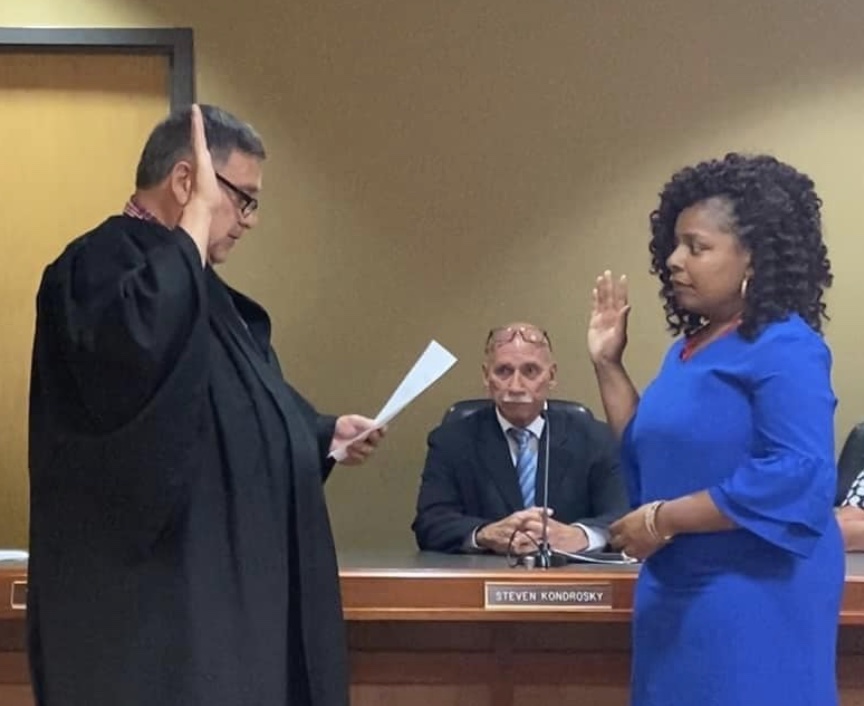
Dr. Tia Wanzo was sworn in yesterday at a well attended special meeting of the board.

Dr. Wanzo had been Assistant Superintendent under outgoing Superintendent Dr. Mark Holtzman who left the district for a corresponding position at Beaver Area School District at the end of June.

The McKeesport district, established in 1884 and located just southeast of Pittsburgh, Pennsylvania, has had a sizable Black population for decades. According to the National Center of Education Statistics, the district is 71 percent white and 23 percent Black. It serves the City of McKeesport, and boroughs of Versailles, Dravosburg and White Oak as well as a small portion of South Versailles Township.

“It’s an honor to sit on the board at this time as history was made,” Board Member LaToya Wright Brown wrote on a Facebook post.

“Dr. Wanzo is the first African American to be appointed in the role of superintendent at MASD. I look forward to working in collaboration with our central administration teams, MASD staff and communities to give our students what they deserve.”

Dr. Wanzo will be paid $165,000 per year – $25,000 more than Dr. Holtzman had been paid in his original contract from March 29, 2017.

The board voted unanimously to hire Dr. Wanzo as Superintendent though School Director Matt Holtzman – the former Superintendent’s brother – was absent.

During the previous administration, Dr. Wanzo was often put in difficult positions.

In 2019 when the ACLU of Pennsylvania filed a federal civil rights lawsuit against the district on behalf of 11 district students, she had the difficult job of defending her boss, Dr. Holtzman, while still advocating for the students.

Dr. Holtzman, who was named in the suit, refused to let the students create a Black Student Union. He claimed his objection wasn’t due to the organization’s content but the participation of one of the student’s mothers – Fawn Montgomery Walker who was running for McKeesport Mayor at the time and who is lead organizer of Take Action Mon Valley, a community action group.

Dr. Wanzo was quoted in the Pittsburgh Tribune Review on the matter as follows:

“The frustrating part is the students clearly did not understand that they’re in the middle of this. And also, it’s frustrating that they feel that we are telling them they cannot do that, you’re not allowed to have this club, because that was never ever stated by any of us.”

The district eventually reached a settlement agreement with the American Civil Liberties Union and the students.

The students were allowed to create the club as long as no “non-school persons or entities” are named as advisors or participants of the club.

Dr. Wanzo was also put in a difficult position more recently when the previous school board voted to extend Dr. Holtzman’s contract two years before it expired – a potential violation of state law.

Dr. Holtzman resigned and was rehired at the same board meeting. When this proved contentious, the previous board did the same thing a month later for Dr. Wanzo and then claimed any criticism of what they did for Holtzman was either unfair for not including Wanzo or racially motivated because Dr. Wanzo is a person of color.

The matter concluded with Dr. Holtzman leaving the district.

Unlike her predecessor, Dr. Wanzo spent her entire career at MASD. She was a fifth grade teacher at Francis McClure Middle School, a second grade teacher at White Oak Elementary School, a fourth grade teacher at Cornell Intermediate School, Assistant Principal at Founders’ Hall Middle School, and ninth grade principal at the high school.

She graduated from the district and still lives in its borders. As a student, she attended Centennial Elementary, Cornell Middle School, and graduated from McKeesport High School in 1997. 

She has a BA in Elementary Education from Clarion University, a degree in Educational Leadership from Carlow University, and a Doctorate in Educational Leadership from Duquesne University.

Hopefully she will be able to lead the district to a brighter future.

To many students she may appear a beacon of representation as well as proof that a student from McKeesport can rise to the top.

WATCH DR. WANZO BEING SWORN IN:


Like this post?  You might want to consider becoming a Patreon subscriber. This helps me continue to keep the blog going and get on with this difficult and challenging work.

Plus you get subscriber only extras!

Just CLICK HERE.

Patreon+Circle

I’ve also written a book, “Gadfly on the Wall: A Public School Teacher Speaks Out on Racism and Reform,” now available from Garn Press. Ten percent of the proceeds go to the Badass Teachers Association. Check it out!

Doug Mastriano’s Rootin’ Tootin’ School Shootin’ Prevention Plan in PA

A teenage boy in a black trench coat walks down a school hallway.

A young girl abruptly turns a corner and is about to walk past when she stops and notices an oblong shape in his coat.

He pulls out an AR-15 and points it at her head.

She gasps. He smiles.

“Hold it right there, Patrick.” Says a voice behind him.

“Mr. Callahan?” The boy says starting to bring the barrel around.

‘Uh-uh. Stop right there,” says the voice shoving something in the boy’s back.

“I know what you’re thinking,” the teacher continues. “My homeroom teacher, Mr. Callahan, has a gun in his desk. Did he remember to bring it with him to hall duty? Well to tell you the truth in all this excitement I kinda lost track myself. But being it’s a 500 S&W Magnum, the most powerful handgun in the world and would blow your head clean off, you’ve gotta ask yourself one question: “Do I feel lucky?” Well, do ya, punk?”

Apparently this is how Doug Mastriano thinks school shootings can best be prevented.

The Pennsylvania State Senator and Republican candidate for governor plans to introduce a bill allowing school employees to arm themselves while on school property if they have a concealed carry permit and pass a firearms course.

Not gun control. Not stopping teens from buying assault weapons. Not keeping guns out of the hands of the mentally ill.

Instead, arm the teachers. Arm the principals. Put a piece in the hands of Lunch Lady Doris. Maybe even the custodians will be packing heat with a bucket and mop.

This is not the kind of serious proposal Commonwealth residents deserve from a representative of the legislature or executive branch. It’s not the kind of serious proposal you’d expect from a grown adult. Heck. It’s not what you’d expect from a small child still unable to tie his own shoes.

School shootings are not action movie scenarios. They’re not run-and-gun video games. They’re not cops and robbers. They’re real life.

They’re the cause of elementary kids being decapitated by assault weapons fire.

They’re the cause of fifth grade bodies so unrecognizable they have to be identified by their green Converse sneakers.

They’re the cause of child sized coffins adorned with cartoon doggies and kitties – brightly colored friends to accompany little kids to their final resting places.

Mastriano’s suggestion would be pathetic if it weren’t so dangerous.

He thinks school shooters are attracted to places where they know people aren’t armed.

However, history proves him wrong.

The overwhelming majority of school shootings either involved armed police stationed at the school or police responding quickly thereafter.

Lest we forget, there were police officers on both the campuses of Robb Elementary School in Texas and Stoneman Douglas High School in Parkland, Florida, where shootings cumulatively took the lives of more than 30 students.

According to a 2021 JAMA Network study that looked at 133 school shootings from 1980 to 2019, armed guards did not significantly reduce injuries or deaths during school mass shootings.

In fact, when researchers controlled for location and school characteristic factors, “the rate of deaths was 2.83 times greater in schools with an armed guard present.”

Put simply, school shootings are not rational activities subject to cost benefit analysis from the people contemplating doing them. Would-be shooters do not expect to come out alive. They don’t care if there is armed resistance or not. In fact, the presence of armed resistance only encourages them to bring deadlier weaponry – especially semi-automatic guns.

That’s why police in Uvalde, Texas, were too scared to go into Robb Elementary School and stop the perpetrator armed with an AR-15 – perhaps the most common weapon used in school shootings.

And when trained police are afraid, Mastriano expects better from school staff – teachers, secretaries, aides, and nurses!!!?

A similar proposal permitting the arming of school employees passed the state Senate in June 2017 but it died in a House committee. In the district where I work as a middle school teacher, we talked about the issue at a staff meeting.

The few people who thought it was a good idea and said they would gladly bring a gun with them to school are nice people – but they’re the last ones you’d want armed.

Moreover, we have a school resource officer who said he was not in favor of the measure because it would make things tougher for law enforcement responding to a shooting. It would make it that much more unclear who the shooter was and increase the chances of friendly fire.

It’s hardly surprising Mastriano is making such boneheaded proposals.

If elected governor, he also promises to cut public school funding IN HALF and make it harder for educators to collectively bargain for better salaries, benefits, and working conditions.

He is an extremist who wants to destroy public education in favor or charter and voucher schools, take away people’s freedom to choose what to do with their own bodies, discriminate against anyone with a different sexuality or religious belief and give away as much tax money as possible to private businesses.

Mastriano is either a fool who does not understand the issues or a patsy of the lunatic fringe of his party or both.

He wouldn’t arm teachers with books, funding or resources to teach – just guns.

He is an embarrassment to the people of Franklin County who elected him to the legislature and the Republican base who chose him to represent them in the governor’s race.

I know it’s trendy for the GOP to pick the candidate most likely to piss off the people across the aisle, but this isn’t a game.

Fools like Mastriano are going to get innocent people and their children killed – not to mention the suffering thousands will have to endure if his policies ever see the light of day.

He thinks the answer to school shootings is to turn the school librarian into Yosemite Sam.

If you vote for him in the general election, you will reap what you sow – misery and death.


Like this post?  You might want to consider becoming a Patreon subscriber. This helps me continue to keep the blog going and get on with this difficult and challenging work.

Plus you get subscriber only extras!

Just CLICK HERE.

Patreon+Circle

I’ve also written a book, “Gadfly on the Wall: A Public School Teacher Speaks Out on Racism and Reform,” now available from Garn Press. Ten percent of the proceeds go to the Badass Teachers Association. Check it out!
Federal or State Legislatures May Raise Teacher Salaries so Schools Have Enough Staff to Reopen

What will we do when schools reopen and there aren’t enough teachers to instruct our kids?

People complain when there aren’t enough servers at restaurants or baggers at the grocery store.

What will they say in August if school buildings in many districts remain closed or the only viable option is online remote schooling?

Lawmakers at the state and federal level are taking the matter seriously with measures to increase teacher salary or provide one-time bonuses.

Alabama, New Mexico, and Mississippi have already boosted teacher pay, with Florida, Iowa and Kentucky potentially set to do the same. Meanwhile, even US Congress could pass a nationwide measure to heighten teacher salary and encourage educators to stay in the classroom.

After decades of neglect only made worse by Covid-19, we’re missing almost a million teachers.

And we only have about 3.2 million teachers nationwide!

According to the Bureau of Labor Statistics, there are 567,000 fewer educators in our public schools today than there were before the pandemic. And that’s on top of already losing 250,000 school employees during the recession of 2008-09 most of whom were never replaced. All while enrollment increased by 800,000 students.

Meanwhile, finding replacements has been difficult. Across the country, an average of one educator is hired for every two jobs available.

So what are we doing about it?

Surprisingly, something!

Congress has at least one bill under consideration that would raise teacher salaries nationwide.

The Respect, Advancement, and Increasing Support for Educators (RAISE) Act would provide teachers with a minimum of $1,000 in refundable tax credits and as much as $15,000.

The more impoverished the school where teachers work, the higher the tax credit available to increase their salaries. The bill would also double the educator tax deduction to offset the cost of school supplies, and expand eligibility to early childhood educators.

The bill was introduced by Senator Cory Booker (D-NJ) and U.S. Representatives Adam Schiff (D-CA), Jahana Hayes (D-CT), John Larson (D-CT), and Mark Takano (D-CA). It is supported by a broad coalition of organizations including the American Federation of Teachers (AFT) and the National Education Association (NEA).

Such a measure is long overdue.

Teachers are paid 20% less than other college-educated workers with similar experience. A 2020 survey found that 67% of teachers have or had a second job to make ends meet.

Why would you go into debt earning a four year degree in education and serve an (often unpaid) internship in the classroom just to earn little more than a fry chef or Walmart greeter?

Why enter a field where you can’t buy a home or even rent an apartment in most metropolitan areas? Why volunteer for a job where you won’t be able to afford to marry, raise children, or eke out a middle class existence?

Thankfully, Congressional proposals aren’t the only attempt to make teaching more attractive.

Some states have already taken action.

The Alabama Senate passed a budget that would raise minimum salaries for teachers with nine or more years experience. The raises would range from 5% to nearly 21%, depending on years of experience.

A teacher with a bachelor’s degree and 20 years of experience would see their salary rise from $51,810 to $57,214. A teacher with a master’s degree and 25 years experience would see their pay rise from $61,987 to $69,151.

In New Mexico, Gov. Michelle Lujan Grisham signed a bill that would increase base salary levels by an average of 20 percent. This advances minimum salary tiers for educators by $10,000 to $50,000, $60,000 and $70,000. 

In Mississippi, Gov. Tate Reeves signed off on an average increase of $5,100 that will raise educator salaries by more than 10 percent.

According to Politico, both Republican and Democratic Governors are proposing teacher salary increases or one-time bonuses as part of budget proposals and legislative priorities.

Even Governors like Iowa’s Kim Reynolds and Florida’s Ron DeSantis are promoting teacher bonuses while also stoking classroom culture wars. On the other side of the aisle, Kentucky’s Democratic governor Andy Beshear is trying to push through a teacher pay plan through opposition by the state’s GOP-controlled legislature.

Such measures are even being proposed in Pennsylvania. Sen. Judith Schwank (D-Berks) recently introduced Senate Bill 1211 to boost starting pay for teachers from the current minimum of $18,500 listed in state law. She proposes increasing it to $45,000 a year. However, the bill sent to the Senate Education Committee has several Democratic co-sponsors but no Republicans, making it doubtful it will progress anytime soon.

The main factor behind these plans seems to be the $350 billion in state and local recovery funds under the American Rescue Plan. These federal dollars have few strings attached and only about half of the money has been spent so far.

After decades of neglect, these plans may not be enough and they may not even come to fruition. However, at least lawmakers seem to understand the problem exists.

It’s gratifying that politicians finally seem to feel a sense of urgency here.

Because this problem didn’t spring up overnight and it won’t go away in a flash.

If we don’t do something to make teaching more attractive, the problem will only be compounded in coming years.

Not only are we having a hard time keeping the teachers we have, few college students want to enter the field.

Over the past decade, there’s been a major decline in enrollment in bachelor’s degree programs in education.

Beginning in 2011, enrollment in such programs and new education certifications in Pennsylvania — my home state— started to decline. Today, only about a third as many students are enrolled in teacher prep programs in the Commonwealth as there were 10 years ago. And state records show new certifications are down by two-thirds over that period.

And it’s not just classroom teachers – substitutes are even harder to find.

The shortage of substitute teachers has gotten so bad in 2021-22, it forced some schools across the country to temporarily move to remote learning. Even Pittsburgh Public Schools was forced to go to cyber learning on Nov. 29 because of a staffing shortage and a lack of substitute teachers.

And it doesn’t look to get better next year.

Last June almost a third of working educators expressed a desire to leave the profession.

According to a survey in June of 2,690 members of the National Education Association, 32% said the pandemic was likely to make them leave the profession earlier than expected. So we don’t have enough teachers now and one in three educators we do have are ready to walk out the door.

What could we do about it?

In the long term, we need structural solutions to the problem:  

 Money

 Autonomy

 Respect.  

And in the short term we need: 

 Less Paperwork

 Reduced case load

 Dedicated planning periods

But don’t take my word for it.

A survey by the RAND Corp. reported that the pandemic has increased teacher attrition, burnout and stress. In fact, educators were almost twice as likely as other adult workers to have frequent job-related stress and almost three times more likely to experience depression.

The CDC Foundation in May released similar results – 27% of teachers reporting depression and 37% reporting anxiety.

However, the RAND survey went even deeper pinpointing several causes of stressful working conditions. These were (1) a mismatch between actual and preferred mode of instruction, (2) lack of administrator and technical support, (3) technical issues with remote teaching, and (4) lack of implementation of COVID-19 safety measures. 

It’s a problem of exploitation and normalization. 

 Exploitation is when you treat someone unfairly for your own benefit. 

 Our schools have been doing that to teachers for decades – underpaying them for the high responsibilities they have, expecting each individual to do the work of multiple people and when anything goes wrong, blaming them for it. 

 We piled on so many extra duties – online teaching, hybrid learning, ever changing safety precautions – these became the proverbial straw that broke educators’ backs.  

There are things we can do to alleviate this situation – reducing nonessential tasks, eliminating unnecessary paperwork, refraining from excess staff meetings, forgoing new initiatives, letting teachers work from home on professional development days – anything to give them a break and an opportunity to heal from the years of overburdening.

But we also have to start paying teachers more.

Thankfully our lawmakers are taking this matter to heart and actually getting some results.

Hopefully this trend will continue until every teacher in the nation is adequately, equitably and sustainably compensated for the work done in the classroom.


Like this post?  You might want to consider becoming a Patreon subscriber. This helps me continue to keep the blog going and get on with this difficult and challenging work.

Plus you get subscriber only extras!

Just CLICK HERE.

Patreon+Circle

I’ve also written a book, “Gadfly on the Wall: A Public School Teacher Speaks Out on Racism and Reform,” now available from Garn Press. Ten percent of the proceeds go to the Badass Teachers Association. Check it out!

Holtzman Resigns as MASD Superintendent After Questions Over Contract Shenanigans

For the second time in a year, McKeesport Area School Directors accepted the resignation of Superintendent Dr. Mark Holtzman.

However, this time his resignation appears to be permanent.

At a special meeting in July of 2021, the board both accepted Holtzman’s resignation and then immediately gave him a new 5-year contract.

However, after months of controversy over the legality of the move, at last night’s special meeting, the board voted to let him go FOR REAL.

Holtzman has accepted a new position at Beaver Area School District, approximately 50 miles northwest of McKeesport.

His last day is June 30. Assistant Superintendent Dr. Tia Wanzo will serve as Acting Superintendent immediately upon his departure.

The controversy stems from a move last year by the outgoing board to retain Hotlzman in McKeesport when he had been poised to accept a new superintendents position at Kiski Area School District. He resigned and was rehired at MASD in order to secure him a new contract with a competitive salary and years of service.

But this didn’t sit well with three board members (Steven Kondrosky, James Brown and Mindy Sturgess) who walked out of the meeting before it was officially called to order.

Then in January – a month after three new board members were sworn in following the election – the board voted 5-4 to look into whether Holtzman’s resignation and subsequent rehire were enforceable.

Lawyer William C. Andrews wrote a letter stating that the measure could be viewed as circumventing the intent of the Pennsylvania school code. The law does not allow such contracts to be extended with more than a year left before they expire. Holtzman still had two years left on his contract.

Holtzman’s own legal council, Mark E. Scott, wrote that the move was, in fact, legal and that it was common practice at other districts.

At a February board meeting where letters from both lawyers were read into the record, Holtzman offered to resign, then and there:

“I will clearly state if they want me to move on, and I’ve said it to them in private, I want a year’s salary and benefits and I will resign tonight. This witch hunt and issue is over, overdone, overstated and we need to move on and once I’m compensated for my attorney fees.”

At the time, it was unclear whether the board could move forward with Holtzman at the head of the district or not.

Apparently Holtzman couldn’t continue to work with them.

A mere three months later, he put in his current resignation.


Holtzman’s tenure at McKeesport was fraught with controversy from the beginning.

He was hired as high school principal without any principal experience while his own father, Mark Holzman, Sr., was on the school board.

Before this, he had been dean of discipline at McKeesport’s vocational department for two years before taking a similar role at West Mifflin Area High School. However, he was mostly known in MASD for his years on the high school football team when he had been a student there (he graduated in 1997) and then at Syracuse University.

His family also had a close relationship with one of the most controversial figures in the Mon-Valley, Pat Risha. The late Risha, who had been a superintendent, himself, at McKeesport, West Mifflin and South Allegheny districts, could have opened many doors, and was heralded as a “power broker” in his obituary.

Holtzman was originally hired as MASD superintendent at a special meeting on March 29, 2017, at a salary of $140,000, according to minutes from that meeting.

His time as superintendent was rocky, to say the least.

The Covid-19 pandemic offered hard challenges for every district, but Holtzman often made decisions that put students and staff at risk, keeping buildings open during times of high community spread and often with mask optional policies. The result was hundreds of people testing positive for the disease who might not have otherwise.

The district offered a cyber option for students whose parents wanted to keep them safely at home during the worst of the pandemic. Many districts were able to provide live teachers from the child’s grade level to instruct through on-line services like Zoom. However, MASD used the corporate Edmentum program to provide academics. The problem is it wasn’t created for that purpose. It was created for credit recovery, not robust academics. As a result, the district cyber program was developmentally inappropriate, and full of typos and inaccuracies.

It was no better for students who came to school in-person. Thousands of children were unable to get to school because bus routes were cancelled daily over the last year.

Holtzman blamed the problem on a contract with bus company, PA Coach Lines, which didn’t have enough drivers and would cancel the routes just hours before the buses were set to arrive.

The district had to go to court to break the contract and just entered into a new 6-year contract with Krise Transportation out of Penn Hills starting next year.

Holtzman’s controversies predate the pandemic.

In 2019, he refused to allow 11 high school students to create a Black Student Union. He claimed his objection wasn’t due to the organization’s content  but the participation of one of the student’s mothers – Fawn Montgomery Walker who was running for McKeesport Mayor at the time and who is lead organizer of Take Action Mon Valley, a community action group.

The district eventually reached a settlement agreement with the American Civil Liberties Union and the students who had filed a federal civil rights lawsuit against the district and Holtzman.

The students were allowed to create the club as long as no “non-school persons or entities” are named as advisors or participants of the club.

Not everything Holtzman did in the district was contentious.

He had a talent for getting donations from large companies.

Last year, he was instrumental in getting Comcast to provided 2,500 free laptops for students, teachers and staff in the middle and high school. The gift also included one year of free high-speed internet access for eligible families – services that can be extended annually. 

The news was broadcast live on NBC’s “Today” show.

Around the same time, Holtzman helped broker a partnership with The DICK’S Sporting Goods Foundation and MASD for investment in students at Twin Rivers Elementary School. The agreement is supposed to involve co-designing a new school model and wrap-around services for the community.

Here’s hoping MASD has success with Dr. Wanzo or whoever eventually takes the Superintendent’s position on a permanent basis.


Like this post?  You might want to consider becoming a Patreon subscriber. This helps me continue to keep the blog going and get on with this difficult and challenging work.

Plus you get subscriber only extras!

Just CLICK HERE.

Patreon+Circle

I’ve also written a book, “Gadfly on the Wall: A Public School Teacher Speaks Out on Racism and Reform,” now available from Garn Press. Ten percent of the proceeds go to the Badass Teachers Association. Check it out!

Public School Boards Need to Do Better at Embracing Transparency 


They say sunlight is the best disinfectant.  


So why do so many public school boards hide in the shadows?  


One of the shining virtues of public schools is the requirement that they be transparent and open to the public.  


And they are! 


But too often school directors do so in ways that are unnecessarily burdensome, equivocal or combative.  


Let me give you an example.  


I live in the McKeesport Area School District (MASD) – a community just south of Pittsburgh in Pennsylvania.  


When I heard my school board was considering a proposed district budget for 2022-23 without a tax increase, I wanted to take a look at it. So I went to the district Website and there was a link labelled:  


“Preliminary Budget Information for 2022-23 School Year.”


I clicked on it and got this: 


“The Board of Directors of the McKeesport Area School District has prepared a Preliminary Budget in the amount of funds that will be required by the School District for the fiscal year beginning July 1, 2022. The Proposed Budget is on file in the Office of the Business Manager/Board Secretary, and is available for public inspection in the McKeesport Area School District Administration Building…” [Emphasis mine.


What the heck!?  


Why not just post the preliminary budget on the Internet!? Why make me go all the way to the administration building (during business hours) to see a copy? 


It’s not like I can even turn to my local newspaper to tell me about the district’s budget. With so many cutbacks in local media, our papers rarely even cover school districts anymore unless there’s a big story.  


If I want to know how my district proposes to spend the community’s tax dollars next year, I need to either go to the school board meeting or go to the administration office and look at a copy. Will I be able to take a copy with me to peruse at my leisure? Maybe or maybe not.  


We should be able to do better than this. 


Don’t get me wrong. 


Authentic public schools are way better than privatized schools.  


They’re preferable to anything you’d find at charter or private schools that take school vouchers.  


And one of the biggest reasons why is this requirement of local control, self-government, and a free exchange of information between representatives and the community who elected them.   


Authentic public schools HAVE TO hold public meetings to conduct their business.  


They HAVE TO take comments from the community. 


They HAVE TO make their documentation available to the public.  


And except under extreme circumstances, they HAVE TO be run by elected school boards.


None of that is a given at charter and voucher schools. 


The problem is how too many public school directors meet these obligations. 


MASD, for example, makes its proposed budget available – but not in the most convenient way that it could.  


Let’s be honest. It wouldn’t take much to improve this.  


Posting the full budget online would take just a few seconds. In fact, it’s actually more trouble to have it available in the administration building and task a secretary with presenting it to anyone who comes in-person and asks for it. 


The same thing goes for school board meetings.  


Before I became a public school teacher, I was a journalist often covering public schools.  


I’ve gone to a lot of school board meetings in my life. A LOT.  


And almost every board put unnecessary or onerous restrictions on public comments.  


Residents could come to the meetings and address the board but they often had to sign in before-hand. They couldn’t just show up and speak. They had to let the board know days in advance that they were coming and the subject they planning to speak on.  


If something came up during the meeting unplanned, technically residents weren’t allowed to comment – though I admit I’ve never seen a school board hold to such a policy in the case of unexpected events.


Also there are almost always time limits on public comments.  


Now I know it’s unreasonable to expect members of the public who volunteer to serve as school directors to spend all night listening to rambling or incoherent comments. But these time limits are often way too restrictive – especially when only a handful of people actually turn up to speak.  


Limiting people to two minutes of public comment in a month or even a two-week period is ridiculous.


Then we have the issue of audio visuals at board meetings.  


Many school boards have microphones for people to speak into during the proceedings. This is supposed to allow everyone present to hear what is being said. However, the equipment is often so bad that it actually ends up blurring the speaker’s voice until its incomprehensible or board members who don’t want to be heard simply don’t speak into the microphone.  


Sure – the entire proceedings are being taken down by hand by an administrator for an official written copy of the minutes. But this isn’t even available to the public until a month later when the board votes on last month’s minutes document. The public can’t get a copy of this material until more than a month has passed from it taking place. And it probably isn’t available on-line. 


Finally, we have recordings of the meetings.  


Many school boards now video tape their meetings and stream them live on YouTube, Facebook or some other social media site.  


This is a nice improvement from when community groups had to do this, themselves. And, in fact, it’s really a response to that phenomenon to gain control over what becomes public record. School boards began recording the meetings to discourage others from doing it so the district would have control over this material. And in most cases it worked. 


However, these recordings are almost always of exceedingly poor quality.


Cameras (and microphones) are placed so far away that it is almost impossible to tell what is happening, what is being said or who said it.  


Any teenager with a smart phone and a YouTube channel could do a better job.  


Moreover, these videos often don’t stay posted online for very long. They could easily remain posted so anyone could rewatch them and catch up with what happened at a school board meeting they were unable to attend in-person. But school boards make the express decision to take these videos down so that record is not available. 


Very few of these are accidents. In most cases these are intentional to push the public away at the exact time when they should be inviting them in.  


These are just some examples of how school boards comply with transparency requirements but do so in ways that are inconvenient, onerous or antagonistic. 


It is so unnecessary. 


Things don’t have to be this way.  


School boards should welcome transparency. They should embrace public participation in the process.  


After all, this is one of the major factors that distinguish authentic public schools from privatized ones.  


School directors complain about losing revenue to charter and voucher schools. If they treated the public more like valued members of the decision-making process, they would do a lot to boost their own reputation.  


President James Madison wrote


 “[a] popular Government, without popular information, or­ the means of acquiring it, is but a Prologue to a Farce or a Tragedy.”  


School directors should take this to heart. 


Public schools should not be shadowy corners for school directors to try to sneak through policies under the nose of stake holders.  


They should be shinning centers of the community. 


The sooner school boards understand this, the better it will be for the state of public education and the students, families and communities we are supposed to be serving in the first place. 


Like this post?  You might want to consider becoming a Patreon subscriber. This helps me continue to keep the blog going and get on with this difficult and challenging work.

Plus you get subscriber only extras!

Just CLICK HERE.

Patreon+Circle

I’ve also written a book, “Gadfly on the Wall: A Public School Teacher Speaks Out on Racism and Reform,” now available from Garn Press. Ten percent of the proceeds go to the Badass Teachers Association. Check it out!
Covid Has Hobbled Public Schools. Here’s Why They’re Worth Saving 


Is public education worth saving? 


That’s the question in the air these days.  


In the last century, the US academic system helped us reach the moon, defeat Communism and become the world’s largest super power.    


However, today our public schools are more damaged than ever before.  


An increasing number of families are leaving them for charter and voucher schools.  


Teachers are quitting their jobs in droves with few people willing to fill the vacancies they leave behind.


And above all, many people seem to think the schools, themselves, are failing


Isn’t it time to move on to something else? 


I’m here to tell you – no, it is not. 


In fact, we need to guard and cherish our public schools more than ever before. Because we face the real possibility of losing them for good.  


The Covid-19 pandemic on top of years of corporate sabotage and propaganda have obscured what public education really means and why it is absolutely necessary to the functioning of our society and any possibility of social, racial or economic justice. 


Let’s begin by looking at how the current disaster exacerbated an already difficult situation and then consider why we should care enough to fix the mess. 


The Pandemic Effect 


Public schools got a bloody nose from the Coronavirus crisis.


After decades of segregation, inequitable funding, incentives to privatize, and federally mandated standardized testing, it took a deadly virus to finally hobble the system.  


Being forced to contend with the uncertainties of Covid-19 damaged people’s faith in public education more than anything that had come before it. 


Issues of masking, contact tracing, safety of immunocompromised students and staff, and when to open or close buildings (among other issues) lead to inevitable dissatisfaction from all fronts.  


However, none of these issues should have been decided at the local level in the first place.  


These were issues of national significance. We needed a unified strategy to fight a global pandemic as it washed over our shores – not scattershot policies by part-time officials unequipped to deal with them


These problems should have been tackled by the Centers for Disease Control (CDC) and enforced by the federal government without deference to big business.  


Instead, the CDC made conflicting decisions based more on the needs of the economy than public health (many of which were roundly ignored anyway). Then federal and state governments either refused to decide safety protocols leaving it up to individuals or municipalities, or when they did decide matters, they were embroiled in partisan battles over any kind of restrictions.  


In fact, it was the failure of federal, state and even local municipal governments that often made public schools the de facto legislators of last resort. And this is something they were never meant to be. 


Public health should be decided by scientists not school directors


The result was widespread dissatisfaction no matter what school boards decided and an exodus of students and faculty. 


Many families, upset at local school board decisions, enrolled their children in charter, cyber or voucher schools.  


Overall, charters saw a 7% increase in enrollment – an influx of roughly 240,000 students -during the 2020-21 school year, according to a new report from the National Alliance for Public Charter Schools. This is the largest increase in five years. By comparison, public school enrollment dropped by 3.3% – or 1.4 million students – in the same period. 


The biggest increases were in cyber charter schools. For example, in Pennsylvania 99.7 percent of the charter enrollment growth occurred in virtual charter schools. Enrollment at the Commonwealth’s 14 cyber charter schools swelled from about 38,000 students in October 2019 to more than 60,000 students in October 2020, according to the Pennsylvania Department of Education. 


But it wasn’t just students leaving our public schools. It was staff, too. 


Teachers and other school employees who felt unsafe or were crushed by the incredible pressure thrust on their shoulders either quit or retired in droves.  


According to the Bureau of Labor Statistics, there are 567,000 fewer educators in our public schools today than there were before the pandemic. And finding replacements has been difficult. Nationwide, an average of one educator is hired for every two jobs available. 


This has left us with a weakened system suffering from more problems than before the pandemic hit.


Why Are Public Schools Important? 


Because of what they are and what they represent.  


We hear about public education so often – usually in deprecating terms – that we forget exactly what the term signifies.  


A public school is a school meant for everybody and anybody.  


It is a school where any child can go to get an education.  


You don’t have to pay tuition. You don’t have to have a special ability or qualification. You don’t have to be neurotypical, a certain race, ethnicity, belong to a certain faith or socioeconomic status. If you’re living in the US – even if you’re here illegally – you get to go there.  


That may seem simple, but it is vitally important and really quite special.  


Not all nations have robust systems of public education like we do in the US. 


This country has a commitment to every single child regardless of what their parents can afford to pay, regardless of their access to transportation, regardless of whether they can afford uniforms, lunch or even if they have a home.  


We simply define education differently. We look at it as a right, not a privilege. And for a full 13 years (counting kindergarten) it’s a right for every child, not just some. 


Perhaps even more significant is our commitment to children with special needs. 


We have developed a special education system to help children at the edges that many other countries just can’t touch. In some nations these students are simply excluded. In others they are institutionalized. In some countries it’s up to parents to find ways to pay for special services. The United States is one of the only countries where these children are not only included and offered full and free access, but the schools go above and beyond to teach these children well beyond their 12th academic year. 


In every authentic public school in the United States these students are included. In math, reading, science and social studies, they benefit from instruction with the rest of the class. And this, in turn, benefits even our neurotypical students who gain lessons in empathy and experience the full range of human abilities. 


That isn’t to say the system has ever been perfect. Far from it. 


There are plenty of ways we could improve. Even before the pandemic, we were incredibly segregated by race and class. Our funding formulas were often regressive and inadequate. Schools serving mostly poor students didn’t have nearly the resources of those serving rich students.


But at least at the very outset what we were trying to do was better than what most of the world takes on. You can’t achieve equity if it isn’t even on the menu. 


Without public schools, equity is definitely not on offer. 


 Public is Better Than Private 


That’s really the point.  


Charter, cyber and voucher schools are not set up around this ideal.  


They are not instruments of inclusion. They are instruments of exclusion.  


They are about who is sent away, not about letting everyone in.  


The United States is a big country – the third most populous in the world. We have 332,630,000 people and growing. That’s about 50 million students in public schools. 


No private system in the world has ever been able to work at that scale. If we lose our public schools, many kids will be left wanting.  


The market-driven approach does not guarantee an education. It guarantees competition for an education


It forces students to compete to get into schools and schools to compete for their very existence. Think of how that affects instruction. Schools have to spend a considerable amount of time and money attracting students to enroll. That’s time and money that doesn’t go to education. It goes to advertising. 


Moreover, any school that attracts a surplus of students can choose which ones its wants to enroll. The choice becomes the school’s – not the parents’ or students’. In fact, administrators can turn away students for any reason – race, religion, behavior, special needs, how difficult it would be to teach him or her. This is much different from authentic public schools. There, any student who lives in the district may attend regardless of factors such as how easy or difficult he or she is to educate. 


Another major change with this approach is how privatized schools are run. Many are operated behind closed doors without the input of a duly-elected school board, without transparency for how they spend tax dollars, without even the guide rails of most regulations


Like in the charter school sector, these schools get almost free reign to do whatever they want.  


This means corporate interests get to run charter schools while cutting services and increasing profits. In fact, administrative costs at charter schools are much higher than at traditional public schools. Students lose, the market wins. 


Moreover, many charter schools provide a sub-par education. To put it more bluntly, they do things that would be impossible for public schools to do. One in Philadelphia literally transformed into a nightclub after dark. Another funneled profits into the CEO’s personal bank account to be used as a slush fund to buy gifts and pay for rent at an apartment for his girlfriend. Another CEO used tax dollars to buy a yacht cheekily called “Fishin’ 4 Schools.”  


And virtual charter schools are even worse. A study found that cyber-charters provide almost less education than not going to school at all. Even brick and mortar charter schools can close on a moments notice leaving students in the lurch. 


It’s a Darwinian model made to benefit the predators, not the prey. It’s a boon for any unselfconscious businessman who doesn’t mind getting rich stealing an education from children. 


We Must Fight 


That’s why we must fight to keep our public schools.  


As flawed and bruised as they are, the public school model is far superior to the alternative.  


But many will look only at their own individual situation and stop there.  


They will say, “At MY charter school we do this…” Or “That’s not the way things are at MY voucher academy…” 


First of all, a well-functioning privatized school is like a castle built precariously on a cliff. Things may work well now, but they could change at any moment and there’s nothing you could do but vote with your feet. When authentic public schools go bad, you have a democratic process to fix the problem.


But you may luck out. Every privatized school isn’t a scam. Just most of them. So if you have found a charter, cyber or voucher school that is working for your child and doesn’t self-destruct in the time your child is enrolled, you may wonder why you should worry about the rest of us – the kids caught up in a web of privatized predation and neglect?  


Because it’s not all about you and your child. Selfishness cannot be the foundation of a just society.


Even a well-functioning charter or voucher school is publicly funded. It splits the funding that would normally go to one school and divides it among two or more. So students at both have to make do with less. 


You have to live in this society. Do you really want to live in a country with a large population of undereducated citizens who cannot figure out how to vote in their own interests? Do you really want to live in a society where crime is a better career choice for those who were not properly educated?  


That’s why we can’t let public education disappear.  


It is a necessary condition for democracy, shared economic prosperity and a just society.  


I know it may sound like an insurmountable task, but saving our public schools can be done.  


It will require collective action. 


We will need to actively participate in our school board elections, go to school board meetings and possibly even run to serve on the board, ourselves. 


Many people are upset with what local boards did during the pandemic, but the way to solve this isn’t to flee to schools without democratic principles. It is to seize those principles and make them work for you and your community. 


We will need to change the way our system treats teachers. If we want to encourage educators to stay on the job and even entice young people to enter the field, we need to make the profession more rewarding. That means higher salaries, more autonomy, more respect, smaller classes, less paperwork, and actually listening to educators on the subject of education.  


We also need to discontinue countless policies and programs that have been dragging our public schools down for decades. We need to eliminate high stakes standardized testing. We need to ensure every school is adequately, equitably and sustainably funded. We need to actively integrate our schools and classrooms. We need to stop supporting privatization through charter and voucher schools and instead support authentic public schools.  


And to do that, we need real political change at every level of government – local, municipal, state and federal.  


None of this is easy. All of it takes work.  


But it is the fight we must wage if we are ever to keep our democracy.  


It is the fight we must win to create the better world our children deserve.  


Public schools are worth saving, but it is up to you and me to do it. 


Like this post?  You might want to consider becoming a Patreon subscriber. This helps me continue to keep the blog going and get on with this difficult and challenging work.

Plus you get subscriber only extras!

Just CLICK HERE.

Patreon+Circle

I’ve also written a book, “Gadfly on the Wall: A Public School Teacher Speaks Out on Racism and Reform,” now available from Garn Press. Ten percent of the proceeds go to the Badass Teachers Association. Check it out!


It’s Open Season on Teachers – Again  

  
I am so sick of being a scapegoat.  


But Republican lawmakers seem to think they can’t get elected without finding some boogeyman with which to terrify their base.  


Whether it’s climate scientists or Hollywood elites or a mythical caravan of brown people determined to burst through our southern border, the GOP cannot function without someone to cast as the monster. 


For a political party that scornfully calls others snowflakes, you will never find a more concentrated gathering of self-proclaimed victims than today’s GOP.   


Now they’re turning their attention once again to teachers like me.  


Across the country, Republican politicians are refusing to let educators give an accurate recounting of history. 


In Florida, the GOP is banning math books.   


And on Fox News, Tucker Carlson is even calling for mad dads to storm the school and “thrash” the teacher.   


In my home state of Pennsylvania, it’s no different.  


State Rep. Barbara Gleim (R – Cumberland County) stoked the flames in the Commonwealth this week with the following message to her social media crew:  


“We also need conservative eyes and ears in the schools. If anyone can substitute even one day a week, the teachers who are activists and indoctrinating children can be revealed. Not all teachers are for [Critical Race Theory] CRT, etc. We need to identify the ones who are pushing the professional development they received over the summer. Are they putting black children’s tests in separate piles and grading them differently? Have they separated the classrooms? We won’t know these things until parents are allowed back into schools, so the best way is to sub.”  


What a load of crap! 


Pennsylvania’s public schools are experiencing a sub shortage. I WISH people would volunteer to sub in our public schools.  


In fact, back in October I even suggested lawmakers like Gleim volunteer to sub a few times a week to see what’s going on in the classroom instead of pulling vacuous lies out of their butts.  


They certainly have the time!  Legislators from the Keystone State make the third highest salary in the country, and they’re only in session a few weeks every month! They could easily spend a few days a week struggling with overstuffed classes, in-school suspension, hall duty and the like. 


To be a sub in most public school districts in Pennsylvania, essentially all you need is a bachelors degree (it doesn’t even have to be in education) and pass criminal background checks. 


Districts that aren’t experiencing a shortage may require a teaching certificate as well, but beggars can’t be choosers. In districts where it is hard to get subs (i.e. those serving poor and minority kids) you can get emergency certified for a year. 


But when I made such a suggestion, I naively thought lawmakers might see the problems schools actually have and start to support them.  


Fat chance of that! 


People with an agenda like Gleim would simply take the most innocent of interactions and pretend they were examples of indoctrination.  


In Florida they banned 41% of the math books for being “woke” without a single concrete example and then patted themselves on the back for being transparent. It would be the same here. It would be like the Puritan girls in “The Crucible” finding witches in every classroom and hallway.  


This state representative really thinks teachers are putting black children’s tests in separate piles and grading them differently!? As if we’re somehow changing their grades or assessing them more leniently?


NEWS FLASH: Children of color are not suddenly acing all their tests or rocketing to the head of the class. In fact, just the opposite. There has been a racial proficiency gap for decades based on segregation, lack of resources and punitive and biased standardized tests. 


For decades teachers like me have been screaming for change but lawmakers like Gleim either shrug or double down on it. 


But back to her social media tirade. She wonders if there are separated classrooms – by which I assume she means classrooms segregated by race. 


BINGO! She got that one right! But it’s not what she seems to think.  


A majority of children of color are not getting privileged treatment. They’re being underprivileged. They’re in the lower academic tracks and a majority of the white kids are in the honors courses.  


Using standardized tests to sort students into academic tracks has hurt minority children and benefited richer white kids.  


But back to her social media bubble. She wants parents to be allowed “back” into public schools!? Parents have never been excluded. As long as they can pass the background check, they can come in almost any time.  


And if they want to know what’s going on, they can come to any school board meeting and be in the room where all things are decided and be heard during public comment periods. They can even run for school board and make those decisions, themselves.  


But way better to pretend a grievance where no such problem exists.  


Public schools do not indoctrinate kids.  


We teach them to think and come to their own conclusions.  


Yes, we teach history, science, English and math. But it’s up to kids to decide what to make of it all.  


However, if she wants to see REAL indoctrination all she has to do is look at the private and parochial schools who accept school vouchers – a policy her party usually supports.  


These schools use books like America: Land I Love, an A Beka Book; United States History for Christian Schools; and the Teacher’s Resource Guide to Current Events for Christian Schools, the last two published by Bob Jones University Press (BJU). 


The books are riddled with counter factual claims and political bias in every subject imaginable such as abortion, gay rights and the Endangered Species Act, which one text labels a “radical social agenda.” They disparage religions other than Protestant Christianity and cultures other than those descended from white Europeans. 


They teach that humans and dinosaurs lived at the same time, some dinosaurs survive into the present day (i.e. the Loch Ness monster), evolution is a myth disproved by REAL science as is the claim that homosexuality is anything but a choice. 


Teaching these things in school is not just educational malpractice, it’s exactly the kind of indoctrination the right is claiming without evidence happens at public schools. 


And this kind of brain washing is common at voucher schools. 


If there’s one thing we need to understand about today’s GOP leaders, it’s this: their accusations are always admissions.  


They accuse Democrats of the pedophilia Republican congresspeople like Matt Gaetz are already under investigation for.  


They accuse Democrats of fixing elections while the last GOP President actually tried to steal an election. 


They accuse public schools of indoctrination while private schools routinely do that already


Or as the old proverb puts it: 


“I looked, and looked, 
 And this I came to see:  
That what I thought was you and you, 
 Was really me and me.”   


We could stop these shenanigans if the rest of society actually took it seriously.  


But that would require news sources to point out the hypocrisy above every time a MAGA supporter started making these sorts of claims.  


And that won’t happen because modern media is committed to giving equal measure to both sides of a story – even if one is patently false. They’re too afraid to appear biased to report the truth.  


It would stop if the Democrats actually prosecuted the former President and his cronies for the Jan. 6 insurrection.  


But that won’t happen because they’re terrified it might lose them a vote. They’re too afraid of being called partisan. Yet there is no middle ground with justice. You either have it or you don’t. 


It would require a stance on principle.  


So far, it hasn’t happened, and I doubt it will.  


So Republicans will continue to take aim at all the usual scapegoats like teachers.  


Like when Chris Christie threatened to punch educators in the face.  


Their base will get fired up – perhaps maybe even too fired up – and someone will walk into a school with gun-in-hand to take down all these indoctrinating teachers.  


That’s the kind of thing that happened a few years ago at the Tree of Life Synagogue in Pittsburgh. A MAGA gunman was convinced by Trump that Jews were helping immigrants come into the country illegally. So he decided to kill as many Saturday worshipers as he could. 


If we don’t stand up to this, it’s only a matter of time before it happens again.


Look. I don’t want to be at the center of this ridiculous culture war.  


I just want to teach. I just want to do right by my students and their families.


But as our country burns to the ground, the school house often seems to be the center of the blaze.  


I am sick of it. 


I am sick of it.  


I am just so sick of it. 


Like this post?  You might want to consider becoming a Patreon subscriber. This helps me continue to keep the blog going and get on with this difficult and challenging work.

Plus you get subscriber only extras!

Just CLICK HERE.

Patreon+Circle

I’ve also written a book, “Gadfly on the Wall: A Public School Teacher Speaks Out on Racism and Reform,” now available from Garn Press. Ten percent of the proceeds go to the Badass Teachers Association. Check it out!

Hope Grows as Argument Ends in PA School Funding Lawsuit 

Is it safe to hope?

That’s what I’m wondering as closing arguments are set to begin tomorrow in the historic Pennsylvania school funding lawsuit.

In my home state, public schools have had to band together and sue the legislature for adequate funding.

Though a final decision may not come until summer or fall, it actually seems possible that things could change for the better. 

I feel cautiously optimistic that Commonwealth Court will decide in favor of the state’s schools and not the legislature. 

But frankly I am also disgusted that it has even come to this.

The schools had to take our own government to court to force lawmakers to pay for kids to get an adequate education.

Can you imagine the kind of person who refuses to care about children?

As a public school teacher and father, I just can’t.

Pennsylvania is one of seven states with a Constitution that specifically requires the state to provide a sufficient education. Some of these other states – like New Jersey – have used similar Constitutional requirements to force their legislatures to increase state funding to public schools.

Specifically, our state Constitution says:

“The General Assembly shall provide for the maintenance and support of a thorough and efficient system of public education to serve the needs of the Commonwealth.” 

“Thorough and efficient.”

Not lavish. Not extravagant. Just complete and productive.

Yet for nearly 8 years getting to court and for three months, 13 weeks, 48 days in court, the state has argued that it already does that.

It’s one of the most absurd assertions I have ever heard. They might as well argue that water is not wet and fire is not hot.

Walk into any wealthy school in the Commonwealth and look around. You’ll see the equivalent of the Taj Mahal. Now walk into any poor district and look around. You’ll see the equivalent of a slum.

One has brand new facilities, marble columns, and wood paneling scrubbed to a shine with a bustling staff moving to-and-fro. 

The other has badly maintained structures, exposed insulation, dusty corners, leaky ceilings and animal droppings while a skeleton crew of adults try their all to do the impossible without the tools to get it done. 

The Pennsylvania legislature has been paying less and less of public schools’ budgets over the last four decades. The state used to contribute 54% of all public school costs in the early 1970s. Today it pays just 38% of the cost. Only five states cover a smaller share with the national average at 47%. This leaves local taxpayers to take up the slack. Since districts are not equally wealthy, that increases the disparity of resources between rich and poor districts.

During the trial, the state had tried to argue that money doesn’t matter. Yet poor schools can spend $4,800 less per student than wealthy districts. What’s worse, impoverished students have greater needs than rich ones. They often don’t have books in the home or access to Pre-kindergarten. Poor students often suffer from food insecurity, malnutrition, a lack of neonatal care, worse attendance, are less well rested and have greater special needs and suffer greater traumas than wealthier students. Yet we provide them with fewer resources!?

According to a benchmark written into state law, public schools need $4.6 billion in additional funding just to give students a shot. And 277 districts – whether they be in cities, small towns or suburbs – need $2,000 in additional funding per student to get up to snuff.

This affects the great majority of our children – 86% of students attend schools that don’t receive adequate resources.

But it’s even worse for children of color. Half of the state’s Black students and 40% of the state’s Latino students go to schools in the bottom 20% for local wealth.

John Krill, a lawyer for the state, sees no problem with this disparity. In fact, he argued in favor of it.

In perhaps the most revealing moment of the trial, Krill, who represents GOP Senate President Pro Tempore Jake Corman, asked:

 
“What use would a carpenter have for biology? […] What use would someone on the McDonald’s career track have for Algebra 1? […] The question in my mind is, thorough and efficient to what end? To serve the needs of the Commonwealth. Lest we forget, the Commonwealth has many needs. There’s a need for retail workers, for people who know how to flip a pizza crust.” 

So the Commonwealth actually argued that inequitable funding is okay because all kids don’t need a thorough education. Some just need the bare minimum to do whatever menial jobs they’re destined to have while the elite kids need more for the high skilled jobs they’re going to get.

I wonder which kids Krill and his defendants in the legislature think deserve less funding. I’ll bet it’s the black and brown kids already suffering most from this disparity.

Luckily, the school districts asking the courts to intervene feel differently.

Six school districts – William Penn, Lancaster, Panther Valley, Greater Johnstown, Shenandoah Valley, and Wilkes Barre Area – filed the suit along with the Pennsylvania Association of Rural and Small Schools, the NAACP PA State Conference, and families whose children attend under-resourced schools.

Essentially, they are asking for two things.

First, for the court to declare the current funding system unconstitutional.

Second, for the court to order the legislature to create and maintain a fair funding system.

You might say, wait. Didn’t the legislature adopt a new Basic Education Funding formula in 2016 that already provides a fairer way to allocate money based on need?

And the answer is – yes, it did, BUT this funding formula is hardly ever used. Lawmakers only apply it to distribute new money, and increases have been few and far between. So the lion’s share of education funding is still inequitably distributed. We need to change that, to make sure everyone is getting their fair share AND that the money is adequate for the task.

Gov. Tom Wolf’s 2022-23 budget proposal has already begun to address this.

He suggests a $1.75 billion down payment to schools on the $4.6 billion gap.

The state has the money to do this. It just needs to cut wasteful spending elsewhere and close tax loopholes.

For example, the state throws away $240 million a year to The Race Horse Development Fund. These are taxpayer funded subsidies to wealthy horse racing enthusiasts and hobbyists. Since 2004, the legislature has lavished $3 billion on the horse racing industry. Shouldn’t we prioritize school children over cash prizes and inflated pensions for wealthy horse owners, breeders, and trainers? Aren’t kids more important than paying to drug test horses and for racetrack marketing?

It’s these kind of shenanigans that forced 57% of school districts to increase taxes this year.

If the state was doing its job and looking after kids instead of giving handouts to wealthy oligarchs, you and I wouldn’t feel as much pain in our wallets.

Moreover, local school districts will pay $2.8 billion in charter school tuition this year. Why does the state keep opening these expensive privatized institutions that have less fiscal accountability than our authentic public schools? Again the ideology of far right lawmakers is funded by you and me with our tax dollars.

So what’s next after closing arguments this week?

Both parties in the case will file a series of post-trial briefs saying what they believe they proved during the testimony, the “conclusions of law” they are asking the judge to reach, and their analysis of the legal questions presented—such as the meaning of the state Constitution’s “thorough and efficient” education clause.

The final post-trial brief is due on July 6. Then — after oral argument on legal issues at a later date — the court will make its final decision weeks or months later.

In the meantime, the budget is supposed to have been approved by the legislature (one way or another) and signed by the Governor by June 30. If not, funding for some state programs may be delayed. But you never know. The legislature has been late on this before.

So what am I learning from all of this?

The value of hope?

The evil of lawmakers who want to continue shortchanging our children?

The bravery of public school districts that challenge the state to follow its own darn rules?

All of the above.


Like this post?  You might want to consider becoming a Patreon subscriber. This helps me continue to keep the blog going and get on with this difficult and challenging work.

Plus you get subscriber only extras!

Just CLICK HERE.

Patreon+Circle

I’ve also written a book, “Gadfly on the Wall: A Public School Teacher Speaks Out on Racism and Reform,” now available from Garn Press. Ten percent of the proceeds go to the Badass Teachers Association. Check it out!