I just can’t believe that in light of such a flame dancing ever more quickly down an ever-shorter fuse that people aren’t interested in reading about how to stomp it out.
Mass media is not particularly kind to educators like me.
Even when journalists are writing about schools and learning, they rarely ask classroom teachers their opinions. Instead, the media often turns to self-appointed experts, think tank flunkies, billionaire philanthropists or politicians.
It’s like they can’t even conceive of the fact that someone with a masters degree or higher in education who devotes her whole life to the practice of the discipline has anything worthwhile to say.
So many of us have taken to the blogosphere to circumvent the regular media channels.
And so people like Joe Rogan make millions on their podcasts spreading science denial, vaccine disinformation and racist dog whistles.
A guy like me just trying to make the world a better place?
I get silenced.
I guess when money is speech, poverty is the real cancel culture.
Like this post? You might want to consider becoming a Patreon subscriber. This helps me continue to keep the blog going and get on with this difficult and challenging work.
Players from Steel Valley School District contend that during a November playoff game at their home field, rivals South Side Area School District called them the N-word and “monkeys” as well as purposefully incapacitated their star player.
WPIAL Executive Director Amy Scheuneman said her organization is refusing to take sides and students, coaches and administrators for both districts will have to undergo racial sensitivity training.
It is absurd. Imagine making a gunman and the person he shot go through firearms training.
Talk about false equivalency!
“We don’t want to walk away saying you’re right and you’re wrong, but we need to learn from this,” Scheuneman said. “We need to all work together to make that happen.”
Calls for unity are great but justice needs to come first. It’s nearly impossible for everyone to just get along when you don’t hold wrongdoers accountable for their actions – especially when the victims are mostly black and the perpetrators are mostly white.
Though Steel Valley went on to win the game, their star senior running back and linebacker Nijhay Burt suffered a season ending ankle injury which his family alleges was caused by South Side Players on purpose.
Burt’s mother Shunta Parms says, “…The two players that tackled him, they were pushing off his ankle. They were twisting it as they got up. After they got up they cheered in his face and said ‘Yeah! We got you now!’”
WPIAL board of directors and Diversity and Inclusion Council heard testimony for more than four hours on Wednesday.
The meeting was closed to the public at the request of the South Side District from Beaver County, and WPIAL officials have refused to give specific details of what was said behind closed doors.
However, Scheuneman was adamant that the board did not find any evidence the official used racial taunts.
“…The board did not find that to be accurate,” Scheuneman said.
I would love to know what evidence there was to so unequivocally clear the referee.
Especially since she noted the other allegations came down to a matter of he said-she said.
There were “conflicting reports” about what happened and “direct testimony against” the claims of Burt and the Steel Valley School District, Scheuneman said.
“Based on what we heard, I would say that, while there may be tendencies to lean one way or another, it was inconclusive, specifically, one way, as opposed to another.”
Ma’am, isn’t it your job to lean one way or another?
You need to be impartial at first but then you listen to the evidence and decide who was at fault.
Either South Side Beaver players used hate speech against Steel Valley players or not. Either they intentionally injured Steel Valley’s star player or not.
And if they did not, that means Steel Valley players made the whole thing up.
Do you really find that possibility credible?
“There was testimony on both sides, and there were missed opportunities by adults from both schools, so we do feel that it’s important for everybody to learn from the events that happened and take something positive from it,” Scheuneman said.
And Steel Valley’s coach did not report his player’s accusations to the head referee.
Therefore, they’re both to blame!?
What the heck are you smoking!?
Steel Valley Superintendent Ed Wehrer issued a statement that shed some light on the previous incident at South Side Beaver:
“The testimony by South Side Area confirmed that a month prior to the playoff game at issue a member of their team had behaved the same way in a game against Carlynton High School, as witnessed by the Athletic Director at Carlynton. Combined with our statements, that admission established a pattern of racist behavior by our opponent, which should have reinforced the trustworthiness of our complaint.”
The only specific mention of wrongdoing on Steel Valley’s part is neglecting to alert the head referee. But the district’s actions make perfect sense in context. Why would the district go to the referees after allegations that one of them was also guilty of making racial taunts!? Isn’t it logical that Steel Valley and Burt waited to file a report against the Beaver County District!?
South Side Beaver district is 96% white. There are so few black students, 2019 Census data puts the number at 0%.
Meanwhile, Steel Valley is 72% white and 23% black with a higher percentage of children of color on the football team than in the district as a whole.
Are you telling me it’s likely that a mostly black team who is already crushing their rivals (they won 20-12) would make up being the target of racism? Are you saying Burt would make up how his leg was manhandled by the opposing team?
And then we have the issue of socioeconomics.
South Side Beaver is a wealthier district than Steel Valley.
Median household income at the South Side district is $69,905. At Steel Valley it’s $42,661.
At the South Side, 7.7% of residents live below the poverty line. At Steel Valley it’s 17.4%.
These make a difference.
More privileged students are way more likely to think they deserve to win just because of who they are. Underprivileged kids have to work for everything they have.
And officials are way more likely to ignore poorer black kids in favor of richer white ones.
Scheuneman said, “Regardless if one side was more wrong than the other, it takes both parties to mend that bridge and get through anything. So we want those schools to work together in moving forward in cultural competency.”
This is a bad idea.
It won’t do anything to stem the increasing tide of racism from whiter, wealthier districts directed at poorer blacker ones.
These sorts of trainings are not in themselves enough to stop hate speech.
It’s true that having South Side Beaver and Steel Valley go through racial sensitivity training won’t hurt anyone.
Steel Valley students won’t suffer being forced to undergo this measure.
But the fact that they HAVE TO do this will underscore the injustice of the systems they have to live under.
They were the victims, and they got the same punishment as the oppressor.
And at South Side Beaver we can HOPE the training will do some good.
But let’s be honest – this sort of thing is only effective when those attending the training are receptive to its message.
The fact that South Side got away with this will poison everything being taught.
WPIAL is supposed to be about fair play.
They got it really wrong here.
If anyone needs this training, it’s them.
Steel Valley’s Statement:
Like this post? You might want to consider becoming a Patreon subscriber. This helps me continue to keep the blog going and get on with this difficult and challenging work.
Sometimes you can only tell by the vanishing students and teachers or the everyday need to sub for staff members mysteriously absent for days or weeks in a row.
“We have learned that two High School students, two High School staff members, three Middle School students, six Elementary students and one Elementary staff member have tested positive for COVID-19. Close contacts have been identified and notified. Thank you.”
What does it all mean?
One thing’s for sure – we aren’t taking this pandemic very seriously.
Judging by the emails in the last week and a half, alone, there have been at least 60 people in my small western Pennsylvania district who tested positive for Covid. That’s 17 in the high school (10 students and 7 staff), 22 in the middle school (17 students and 5 staff), and 21 in the elementary schools (16 students and 5 staff). And this doesn’t include close contacts.
However, with the new CDC guidelines that people who test positive only need to quarantine for 5 days, some of these people are probably back at school already. Though it is almost certain they will be replaced by more people testing positive today.
I have a student who just came back a day ago who’s coughing and sneezing in the back of the room with no mask. And there’s not a thing I can do – except spray Lysol all over his seating area once he leaves.
Don’t get me wrong. I hated teaching remotely on and off during the last few years. But safety is more important to me than being as effective as I can possibly be.
When the Titanic is sinking, you get in the life boats and don’t worry that doing so might mean you won’t dock on time.
Somewhere along the line in the past few years we’ve come to accept the unacceptable:
–We’re not in this together.
–I don’t have your back. You don’t have mine.
–When it comes to a disease like Covid – you’re on your own.
Like this post? You might want to consider becoming a Patreon subscriber. This helps me continue to keep the blog going and get on with this difficult and challenging work.
Here are some things for school directors and administrators to consider:
–If you don’t require all students and staff to wear masks – don’t blame teachers.
–If you don’t regularly test students and staff for Covid – don’t blame teachers.
–If you don’t require all students and staff to be vaccinated – don’t blame teachers.
–If your classrooms are not well ventilated – don’t blame teachers.
–If you force staff to come into the building for professional development and don’t allow them to attend remotely – don’t blame teachers.
–If you don’t provide K95 masks to all students and staff – don’t blame teachers.
–If you didn’t devise a schedule to keep students socially distanced – don’t blame teachers.
–If you don’t deep clean each classroom and other student spaces between classes – don’t blame teachers.
–If you don’t have lunches outdoors or in some other extremely well-ventilated space – don’t blame teachers.
–If you don’t require a negative Covid test before sick students or staff can return to school – don’t blame teachers.
–If students and staff have steadily been getting sick for weeks and you’ve done nothing to prepare – Don’t Blame Teachers.
–In short, if you haven’t done everything you can do to prevent an outbreak sweeping through your school and your community – DON’T. BLAME. TEACHERS.
BLAME YOURSELF.
Like this post? You might want to consider becoming a Patreon subscriber. This helps me continue to keep the blog going and get on with this difficult and challenging work.
I love inspiring kids to write. I love coming up with creative and interesting journal topics and poetry assignments. I love explaining the far out concepts – hyperbole, alliteration, onomatopoeia. I love jamming to Blackalicious’ “Alphabet Aerobics,” sharing “Whose Line is it Anyway” videos and trying to write paragraphs to the melodies of Miles Davis.
I don’t love having so little planning time.
I don’t love having to fly by the seat of my pants rehashing lessons that were getting stale two years ago but having no time to make them fresh or original. I don’t love trying to fit in as much grading as I can in class, trying to call or email parents on my lunch break. I don’t love having to fill in for missing staff 4 out of 5 days a week, being a glorified security guard in lunch duty, subbing for a teacher who isn’t absent but who has been called into an unnecessary staff meeting for yet another scattershot initiative to fight bogus learning loss.
I love reading books with my students – both together and separately. I love going to the library and helping them find something suited to their tastes – try a Ray Bradbury classic; maybe a new anime; and when you’re ready, a deep meditation by Toni Morrison. I love reading “The Outsiders” with my classes and experiencing Ponyboy’s story anew every year – feeling the highs, the lows, the losses, the victories. I love seeing the look on children’s faces when the realization dawns that they can no longer honestly say they hate reading, but only that sometimes it’s hard. I love catching them with a book in their bags or the same book on their desks being read over and over again because they love it so much.
Like this post? You might want to consider becoming a Patreon subscriber. This helps me continue to keep the blog going and get on with this difficult and challenging work.
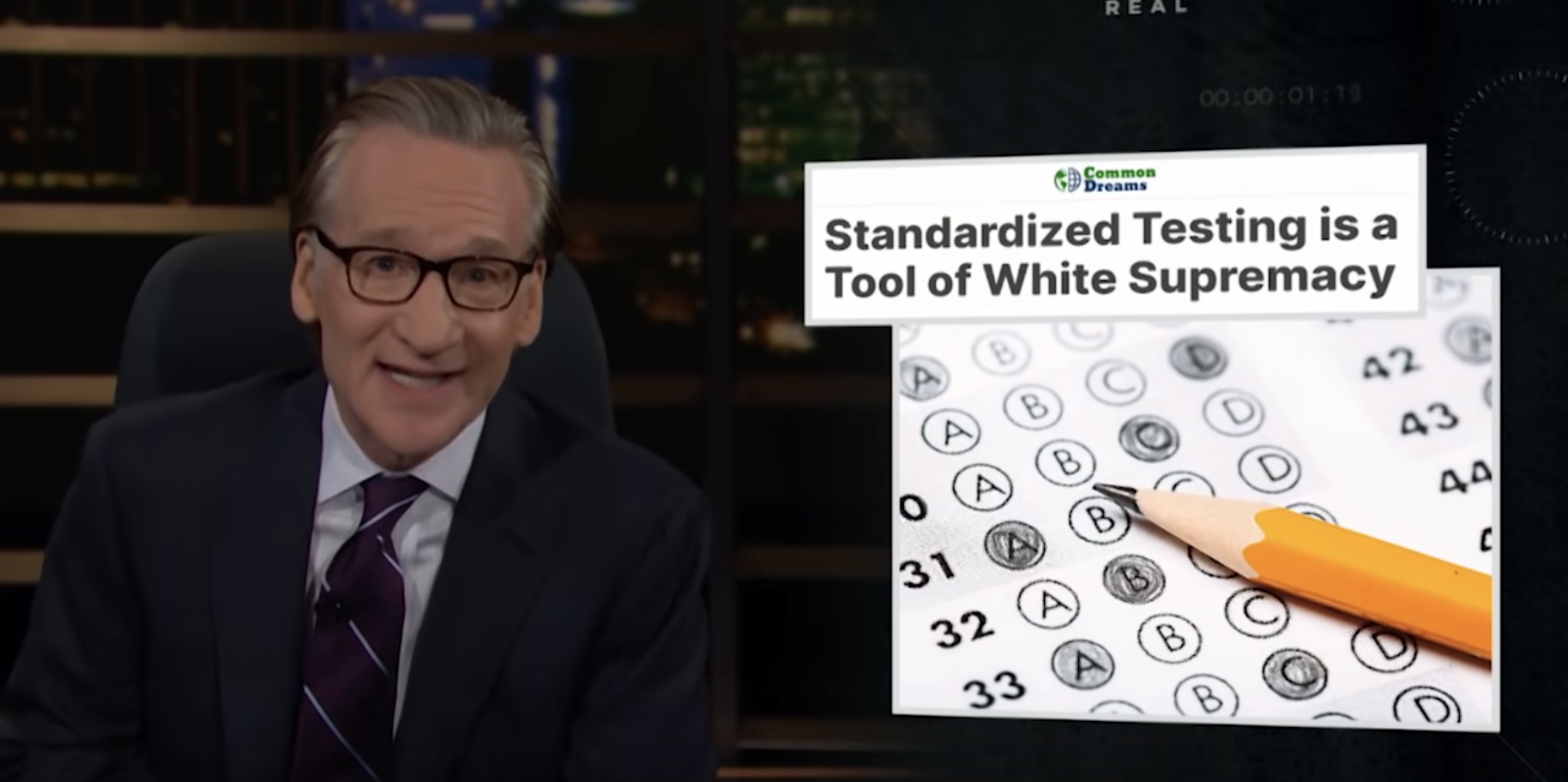
In fact, that was the title of the article, which seems to be about as far as Bill read because he ignored any arguments, facts or historical citations in the piece.
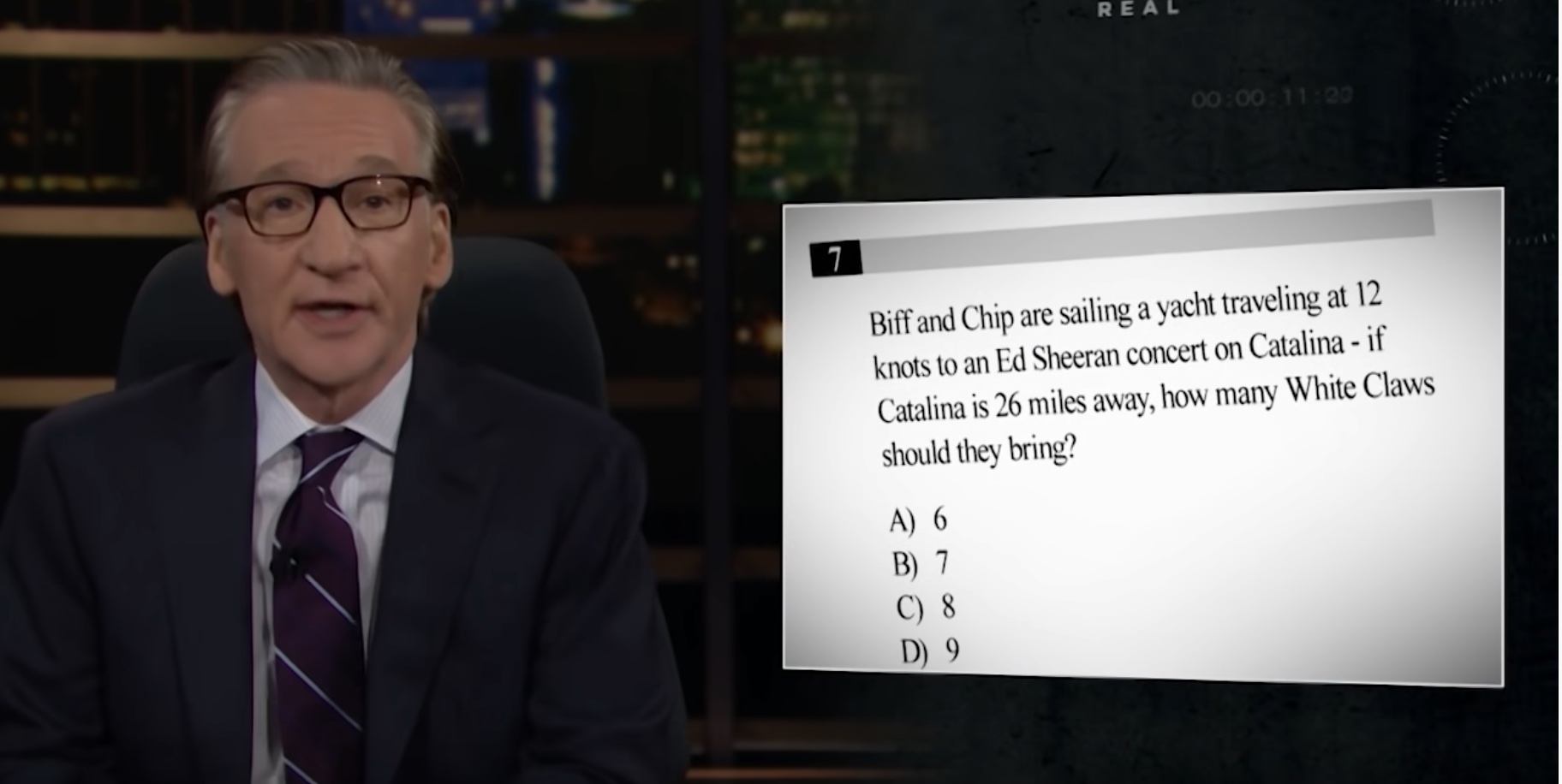
He was content to speak in a smarmy tone and make a pretty lame joke about what a racially biased test question might look like.
In fact, that’s probably why he (and his staff) picked my piece in the first place. They saw it as an opportunity to make a joke and whiffed at it pretty terribly.
Here’s the relevant bit of his monologue:
“In 2010 the New York Times used the term “White Supremacist” on 75 occasions. Last year, over 700 times. Now some of that to be sure is because Trump came along and emboldened the faction of this country that is truly white supremacist. It is of course still a real thing. But it shouldn’t apply to something like – as more than a few have suggested – getting rid of the SAT test. Now if we find the SAT test is slanted in such a way as to stack the deck in favor of Caucasians, if there are questions like Biff and Chip are sailing a yacht traveling at 12 knots to an Ed Sheeran concert on Catalina – if Catalina is 12 miles away, how many White Claws should they bring? Yes, then maybe. But of course the SAT doesn’t have questions like that so it becomes a kind of ludicrous exaggeration that makes lovers of common sense roll their eyes – and then vote for Trump.”
Queue audience laughter and applause.
Funny stuff I guess.
Not the comedy staff’s fake SAT question but Maher’s assurance that “The SAT doesn’t have questions like that.”
It’s a real SAT question famously discussed in the infamous 1994 book, The Bell Curve, by Richard Herrnstein and Charles Murray – a book that tried to use discrepancies in test scores to prove white people are smarter than black people.
The answer is C, and it relies on a test taker’s knowing the meaning of regatta – something more likely to have come up in the daily lives of affluent white students than in the lives of less affluent minority students. If you don’t live by a body of water and/or don’t have much experience with rowing, you’re probably going to fail this question.
It’s the same kind of question Maher’s comedy team came up with – find something white people are more likely to know than black people – but the Real Time writers just pilled it on over-and-over.
It doesn’t take five repetitions of something to make it biased. All it takes is one.
To be fair, my example is from the SAT analogy section, which was removed from the test in 2005. However, that doesn’t mean they got rid of the bias.
It now provides an “adversity score” for poor and minority students to adjust raw SAT scores to account for high schools and neighborhoods “level of disadvantage.”
They are literally trying to make up for how biased their test scores are.
Consider this.
Total SAT scores range from 400 to 1600 – or from 200-800 in both Math and Reading respectively.
According to 2018 data, combined SAT scores for Asian and White students average over 1100, while all other groups average below 1000. Meanwhile, students with family income less than $20,000 score lowest on the test, and those with family income above $200,000 scored highest, according to 2015 data. And the difference is significant – a 433 average Reading score for those with the lowest family incomes compared to an average Reading score of 570 for those with the highest family income. That’s a 137 point difference!
And it holds for racial groups, too. The average Reading score on the SAT was 429 for black students – 99 points behind the average for white students.
However, the College Board is trying to justify this by saying the discrepancy is because poor and minority students are more disadvantaged than white, affluent ones. In other words, it’s not the test that is unfair, but American society in providing better resourced schools with lower class sizes and more resources for white kids than children of color.
Freedle says this is because SAT questions likely reflect the cultural expressions that are used commonly in the dominant (white) society, so white students have an edge based not on education or study skills or aptitude, but because they are most likely growing up around white people.
This makes sense if you examine how test questions are selected for the SAT. In his book How the SAT Creates Built-in-Headwinds, national admissions-test expert, Jay Rosner, explains the process:
“Compare two 1998 SAT verbal [section] sentence-completion items with similar themes: The item correctly answered by more blacks than whites was discarded by the Educational Testing Service, whereas the item that has a higher disparate impact against blacks became part of the actual SAT. On one of the items, which was of medium difficulty, 62% of whites and 38% of African-Americans answered correctly, resulting in a large impact of 24%…On this second item, 8% more African-Americans than whites answered correctly…”
In other words, the criteria for whether a question is chosen for future tests is if it replicates the outcomes of previous exams – specifically tests where students of color score lower than white children. And this is still the criteria test makers use to determine which questions to use on future editions of nearly every assessment in wide use in the US.
But if all this isn’t enough to convince you that standardized tests really are a tool of white supremacy, consider their sordid history.
They are literally the product of the American eugenics movement.
Modern testing comes out of Army IQ tests developed during World War I.
These assessments were based on explicitly eugenicist foundations – the idea that certain races were distinctly superior to others. In 1923, one of the men who developed these intelligence tests, Carl Brigham, took these ideas further in his seminal work A Study of American Intelligence. In it, he used data gathered from these IQ tests to argue the following:
“The decline of American intelligence will be more rapid than the decline of the intelligence of European national groups, owing to the presence here of the negro. These are the plain, if somewhat ugly, facts that our study shows. The deterioration of American intelligence is not inevitable, however, if public action can be aroused to prevent it.”
Eventually Brigham took his experience with Army IQ tests to create a new assessment for the College Board – the Scholastic Aptitude Test – now known as the Scholastic Assessment Test or SAT. It was first given to high school students in 1926 as a gatekeeper. Just as the Army intelligence tests were designed to distinguish the superior from the inferior, the SAT was designed to predict which students would do well in college and which would not. It was meant to show which students should be given the chance at a higher education and which should be left behind.
And unsurprisingly it has always – and continues to – privilege white students over children of color.
Is it ridiculous to describe the century long racial and economic discrepancy in test scores as something that supports white supremacy – especially when these results are shown time and again to be a feature of the tests and not just an artifact that recreates economic inequality?
Is it going too far to call out the racism of the SAT and other standardized tests like it when even the College Board admits its own scores are biased?
Does it devalue the term “White Supremacy” to point out real world white supremacy?
But Maher apparently isn’t interested in these questions.
After a few moments he moved on to another example of the left gone wild.
But I can’t do that because this isn’t just a bit for me.
It’s become cliche for privileged white people like Bill Maher to get cranky when someone points out real world prejudice.
But for those of us in the trenches, it is an everyday reality.
And that’s what triggers me.
Here’s the segment from “Real Time with Bill Maher”: (the relevant bit starts at 4:45)
Like this post? You might want to consider becoming a Patreon subscriber. This helps me continue to keep the blog going and get on with this difficult and challenging work.
Students as young as Kindergarten (and sometimes younger) are asked to read a text aloud in a given time and each mispronunciation is recorded and marked against them.
To my knowledge none are actually used on the DIBELS test but they give you an idea of what an adult version might be like if given to people our age and not just the littles.
Can you imagine being a child, feeling the pressure of a test and being presented with something that looked like those passages!?
The fear! The sense of urgency to say something before the time runs out! The feeling of inadequacy and confusion as you finished knowing you got it wrong!
Today I was forced to leave my class of 8th grade students with a sub so an “expert”from the Allegheny Intermediate Unit could lecture me and the rest of my school’s English department in using DIBELS as a gatekeeper assessment for all students.
That way we can group the students more easily based on their reading deficiencies.
I literally had to stop teaching for THAT.
I was bopping around the classroom, reading students’ writing, helping them organize it, helping them fix their explanations and craft sophisticated essays on a short story.
And the rest of the department with similar experience and education. In the group was also the holder of a doctorate in education. Almost all of us at least held a masters degree.
However, you’d need a classroom teacher to explain that to you. And these are more business types. Administrators and number crunchers who may have stood in front of a classroom a long time ago but escaped at the first opportunity.
They look at a class full of students and don’t see human children. They see numbers, data.
Unfortunately there’s a whole world of reality up here above ground that they’re ignoring. And up here continuing with their willful fantasy is doing real harm.
When I look at my classes of students, I don’t see overwhelming academic deficiencies.
Even their test scores don’t justify that myth.
According to the Pennsylvania System of School Assessments (PSSA), they’re pretty much where I’d expect them any other year.
My students are desperate for attention – any kind of attention – and will do almost anything to get it.
They’d prefer to be respected, but they don’t understand how to treat each other respectfully. So they aim for any kind of response.
To a large extent this is due to a disruption in the social and emotional development they would have received at school. But robbed of good role models and adequate consequences, they’re somewhat at sea.
We have to recognize the reality teachers, students and parents are living through.
And we have to make decisions based on that reality, not the same old preconceptions that have never gotten us anywhere.
Like this post? You might want to consider becoming a Patreon subscriber. This helps me continue to keep the blog going and get on with this difficult and challenging work.
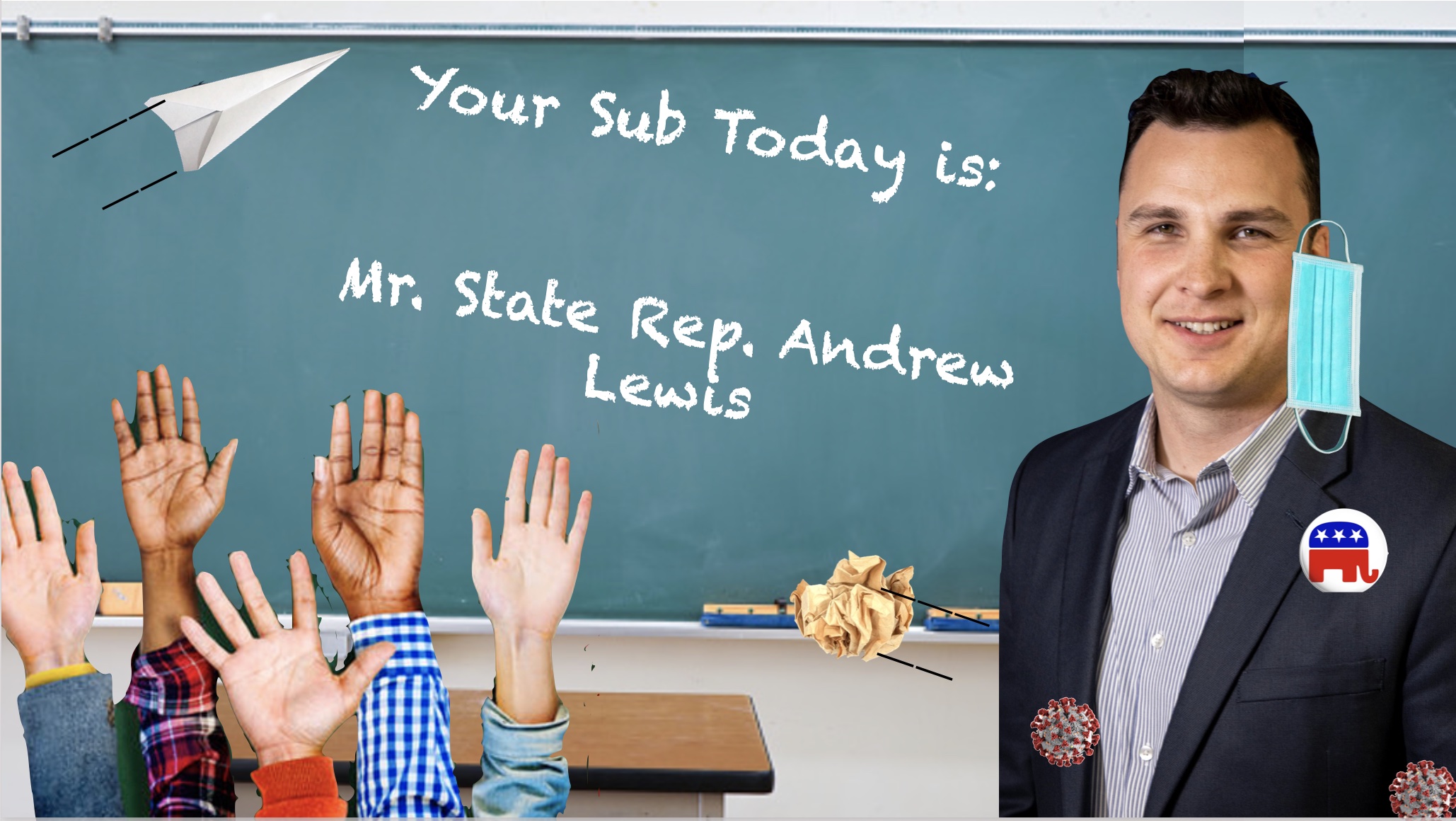
This would include a course syllabus or written summary of every class, the state academic standards for each course, and a link or title for every textbook used.
Moreover, the whole thing is really just a political sham to stoke the radical Republican base. The measure has little chance of actually being implemented.
The bill (HB 1332) passed the House largely along party lines last week with a few Republicans joining Democrats against it.
Now it is set for a full vote by the Senate where it will probably sail through with GOP support after which Democratic Governor Tom Wolf has already promised to veto it.
So why is Lewis putting on this dog and pony show?
“Parents need to be in the driver’s seat when it comes to education, not some out-of-state textbook publisher teaching heaven knows what (hint: anti-American socialism) to our students.”
Moreover, I guess no one told him that state law already requires that public schools give parents and guardians access to information about instructional materials.
Even schools in the Keystone state are scrambling to find enough subs.
If you want to know what happens in public schools, you can do better than clicking on some Website. You can actually volunteer to come in and cover an absent teacher’s class!
About eight years ago, 40,000 teachers were graduating from Pennsylvania colleges a year. This past year, it was only 14,000.
That means not only fewer classroom teachers to replace those who retire, but fewer substitute teachers to take over for professional absences.
The situation has gotten so bad that the legislature (on which Lewis serves) had to pass a new measure allowing college students who are studying education to fill in as substitutes.
Many districts such as Erie, Greater Latrobe and State College have increased substitute pay to entice more people to apply for the job.
And, frankly, almost anyone can do it.
Even folks like Lewis and his Republican buddies! Heck! The legislature is only in session a few weeks every month! They have plenty of time to moonlight as substitute teachers and get the low down about what’s really happening in our public schools!
Districts that aren’t experiencing a shortage may require a teaching certificate as well, but beggars can’t be choosers. In districts where it is hard to get subs (i.e. those serving poor and minority kids) you can get emergency certified for a year.
And many states are lowering the bar even further!
Not only would lawmakers have a chance to look over teacher’s lesson plans, but they’d get detailed instructions from the absent teacher about how to actually teach the lesson!
They’d get to interact with principals as they’re told which additional classes they have to cover in their planning periods and which extra duties they’d be responsible for performing.
They’d get to do things like monitor the halls, breakfast and lunch duty, watch over in-school suspension, and – if they’re lucky – they might even get to attend a staff meeting and be front row center for all the educational initiatives being conducted in the school!
If our representatives took this opportunity, they would learn so much!
I mean, sure, we encourage kids to stand for the pledge to the flag and things like that but when it comes to telling them how to think – that’s not a public school thing. That’s a private and parochial school thing.
They’d see that public school lessons give students information on a subject but then ask them to come to their own conclusions about it.
In fact, this would be such an educational experience, I think legislators on both sides of the aisle should take advantage of this unique opportunity.
And not even just those in Harrisburg. What better way for school directors to understand the institutions they’re overseeing than to volunteer as subs? What better way for the mayor and city council to understand the needs of children than putting themselves in the classroom when the teacher can’t be there?
It could make them better public servants who craft legislation that would actually do some good in this world and not – like Lewis – just showboat to enrage partisans and stoke them to vote for people willing to feed their fears and prejudices.
Any takers?
Like this post? You might want to consider becoming a Patreon subscriber. This helps me continue to keep the blog going and get on with this difficult and challenging work.
He is holding his gut and rocking back and forth in cries of wordless emotional pain as the rest of the class looks on in bewilderment.
Students from other rooms start to cluster around the door until a security guard makes them go away.
I close the door to my own classroom and try to settle my students down – but we can still hear him through the walls.
And then:
“Shut up!”
“You’re stupid!”
“Why don’t you make me!?”
Believe it or not, this is not what teaching middle school used to be like.
Eighth grade students were never perfect angels, but at least by then they used to know how to talk to one another. They could usually interact without constant sniping. They knew what was expected to get respect from each other and at least tried to do it.
But things have changed.
After 18 months of a pandemic, even when they aren’t infected with disease, children still are suffering tremendously from the effects of Covid-19.
Adolescents are dealing with higher rates of anxiety, depression, stress, and addictive internet behaviors.
Suicide attempts among 12- to 17-year-old girls increased by about 50 percent over winter 2019, according to the CDC.
And these numbers are probably under reported since these increases took place at the height of a pandemic when many people were hesitant to seek medical attention.
When Covid-19 swept our shores last year, much of the benefit of formal education fell through the cracks.
Consistency went out the window. Many schools went to on-line learning or a hybrid model of in-person and on-line offset with increasingly common periods of quarantine.
These were often necessary to keep kids and their families safe – and in some cases still are. As a society, we could have done more to blunt the blow such as paying parents to stay safe at home as well as supervise their children, but economic concerns took precedence to human ones.
Many students attended school haphazardly and their parents often weren’t around to give them the kind of stability, role models or attention they’d normally get at school.
According to the CDC, more than 140,000 children in the U.S. lost a primary or secondary caregiver such as a live-in grandparent or another family member to the virus.
No wonder kids are having trouble dealing with their emotions! Their support systems are shot!
My students are bright, caring, energetic and creative people. They have the same wants and needs as children always have. They just have fewer tools with which to meet them.
My students are not suffering from a lack of academics. They’re suffering from a lack of social and emotional development.
I teach Language Arts and, sure, my kids may not have been exposed as deeply to certain concepts as those who came before them. They may not have written an acrostic poem or read Dickens or had as much experience writing. But that doesn’t mean they’re deficient.
Teachers know this. That’s why we scaffold our lessons. We get to know our kids and where they are before we can gauge what they still need to learn.
My students may not have read the play they would have in 7th grade, but I can help them understand the components of drama when we read a play in the curriculum for 8th grade. They may not have written a particular type of poem last year, but we can still read one and understand it this year.
Many students have difficulties with spelling and punctuation. That’s true this year as well as any other. That doesn’t mean they’ve lost anything. It means they need more instruction and practice.
I’m not worried about that. It’s really pretty similar to any other year.
What does concern me is the level of immaturity and social awkwardness I’m seeing.
Part of that is creating a class culture where everyone feels respected and safe. That’s difficult to do when kids don’t know how to communicate without conflict.
In schools, we’re trying to instill a sense of consistency and care. We’re trying to teach kids the basics of human interaction again – something even some adults are having to relearn.
And let me tell you – it’s extremely hard in large, anxious groups dealing with the continuing uncertainty of our times.
My own health has suffered under the pressures with which educators are forced to contend. Unnecessary paperwork, increased expectations, lack of respect and compensation have teachers stretched to a breaking point.
I was in and out of the hospital all last week and the district had great difficulty finding an adult to sub for me.
For two days they resorted to hiring parents from the community to watch my classes. I’m told that one of them reported to the office at the end of the day and promptly told the secretary not to call her tomorrow, that she was never coming back.
It’s hard for professional educators, too.
According to a 2020 survey by the New York Life Foundation and American Federation of Teachers, only 15% of teachers feel comfortable addressing grief or trauma tied to the pandemic.
Like this post? You might want to consider becoming a Patreon subscriber. This helps me continue to keep the blog going and get on with this difficult and challenging work.
But in each of these disasters, the majority of people thought they had somewhere to turn for knowledge and advice.
We had trusted authorities to tell us what to do, to counsel us how to handle these seemingly insurmountable disasters.
Today many of us face the Covid-19 pandemic feeling there are few sources to believe in – and that more than anything else – is why we are having such a difficult time coming together to overcome this crisis.
The media, government, science, religion – none hold a central place of confidence in most people’s lives. So when tough decisions about health and safety come into play, many of us aren’t sure what to do.
When we entered the fray, the US government organized new research initiatives targeting influenza, bacterial meningitis, bacterial pneumonia, measles, mumps, neurotropic diseases, tropical diseases and acute respiratory diseases.
And because there was an immense trust in government – after all, as a nation we had been attacked together as one at Pearl Harbor – there was enormous trust in these initiatives.
Before World War II, soldiers died more often of disease than of battle injuries. The ratio of disease-to-battle casualties was approximately 5-to-1 in the Spanish-American War and 2-to-1 in the Civil War. In World War I, we were able to reduce casualties due to disease through better sanitation efforts, but we could not protect troops from the 1918 influenza pandemic. During that outbreak, flu accounted for roughly half of US military casualties in Europe.
Much of the groundwork for innovation in vaccinations had already been laid before WWII. However, it was the organization of the war effort and the trust both the civilian and military population had in government that catapulted us ahead.
I’m not ignoring that some of this trust was misplaced. The US government has never been fully trustworthy – just ask the Asian American population forced into internment camps. However, the general feeling at the time that the government was a force for good, that we were all in this together and we all had to do our part had a vast effect on how we handled this crisis.
Today that kind of trust is gone.
In some ways that’s a good thing. It could be argued that “The Greatest Generation” put too much faith in government and the following years showed why too credulous belief in the good will of our leaders was unearned and unhealthy.
From Richard Nixon’s Watergate scandal to Bill Clinton’s sexual misconduct to George W. Bush lying us into a war of choice to Barack Obama’s neoliberalism to Donald Trump’s gross mismanagement and blatant racism – we can never go back to a WWII mentality.
Skepticism of government is kind of like seasoning. A certain amount is a good thing, but the inability to trust even government’s most basic ability to take care of its citizens and function in any meaningful way is hugely detrimental.
And this earned distrust has seeped into just about every source of possible certitude that might have helped us survive the current crisis.
The media used to be considered the fourth estate – one of the most important pillars of our society. After all, the freedom of information is essential to the free exercise of democracy.
However, the erosion of impartiality has been going on since at least the 1980s when the FCC under President Ronald Reagan abolished the Fairness Doctrine. Since 1949 this had required the media to present both sides’ of opinions. In 1987 a Democratic Congress passed a bill to reinstate the Fairness Doctrine but it was vetoed by Reagan.
This, along with the rise of talk radio and the insistence that news departments turn a profit, lead directly to the creation of more biased reporting skewed to a particular audience – Fox News and Sinclair Broadcast Group being the most prominent.
The fact that just six corporations own 90% of the media outlets in the country skew coverage to what’s in the best interests of big business. These corporations are GE, Newscorp, Disney, Viacom, Time Warner and CBS.
Finally, the loss of local newspapers and the purchase of those few that do exist by large media conglomerates further increase bias.
Few people feel they can trust the news anymore. They turn to the Internet, social media, Twitter and other sources that often are just echo chambers for what they already believe.
The irony is not lost on me that you are reading a blog by a public school teacher, not a professional journalist. But my aim is to use my experience in education to inform the debate.
It’s just too bad that I’m often forced to report the news when traditional news sources drops the ball.
Again skepticism of mass media is a good thing, but we should at least be able to count on the press as a reliable source of facts. However, these days few facts are free from bias, spin and editorial comment.
Another blunder was the guidelines on what counts as “close contact.” It went from “within 6 feet” to “within 3 feet”, and the duration went from 30 minutes consecutively to 30 minutes cumulatively. It’s not so much that the evidence changed, but that political pressure forced the CDC to lower its standards.
World scientific consensus now is that the coronavirus is capable of airborne spread without close contact between two people. Airborne droplets can linger in the air indoors and infect any number of people from one superspreading host subject.
The CDC’s advice on close contact is based on old scientific research that just isn’t as good as modern experiments.
And the organization has misjudged so much more from the importance of masking (at first they said it wasn’t important, now they say it is important), whether children can catch the virus (at first they said this was unlikely and now they admit it happens but is often asymptomatic), whether Covid spreads in schools (they used to say the limited protections in place at schools made this unlikely and now they admit it is happening), etc.
One could argue that these were simple mistakes that have changed as better science comes in. However, in each case they appear to have initially been politically motivated and justified with limited or flawed studies that could not continue to be supported as new data came in.
At first the CDC told us that masking wasn’t important not because it was true, but to hide a shortage of masks that needed to be prioritized for medical staff. These needs are understandable, but hiding the truth and then changing your messaging doesn’t engender trust.
Why do so many people refuse to have their children wear masks at school? Why is there so much vaccine hesitancy? Why anxiety about reopening plans that focus on close contacts?
The CDC owns a lot of the responsibility because it has repeatedly earned our distrust.
I think there is evidence that people need to wear masks in schools. I think we need to vaccinate as many people as possible.
But these are just bare minimums.
I think the CDC is still focusing too much on the economic impact of its guidelines when it should be solely focused on the health and safety of students, staff and the community.
This is not a time for scientists to be playing politics.
We need them to be as transparent as possible – as trustworthy as they can be.
Unfortunately, the erosion of institutional credibility at so many levels has become a cycle to itself.
At multiple levels, sources that should be bedrock have become wet sand.
The federal government has not taken enough action to keep people safe. State governments have not taken enough action – and some have even taken action to prevent safety.
Even at the local level, many school boards have cowardly refused to put in place mask or vaccine mandates.
It is the systematic breakdown of a society.
We have few places left we can trust.
And that is why we are fractured and scared.
We don’t know what to do to keep our loved ones safe.
People seem forced to choose between taking the virus seriously and ignoring it.
Many refuse to admit that it could hurt them. They think it’s just the sniffles. Few healthy people die and they discount the potential longterm effects of catching it.
In large part, it’s because we don’t know how to combat the virus because we don’t know who to trust.
And the resulting credibility vacuum has enabled unscrupulous politicians, agents of chaos and other charlatans to position themselves as experts.
When all information is equal, disinformation is king.
The solution to the pandemic may end up being easier than this riddle.
How our institutions can regain their credibility.
Especially when our politics doesn’t allow them to be honest, and fewer people are even listening to them every day.
Like this post? You might want to consider becoming a Patreon subscriber. This helps me continue to keep the blog going and get on with this difficult and challenging work.









 gadflyonthewallblog