Meet the Test Before the Test – Pennsylvania’s Classroom Diagnostic Tools (CDT)

BoredStudentIPad_iStock_monkeybusinessimages


It’s test time.


My students are dutifully pecking answers onto their iPads before a hand goes up.


“Mr. Singer, I can’t log in to the server.”


Another hand.


“It keeps kicking me out.”


Another.


“Mr. Singer, what does this question mean?”


Then every single hand in the room pops up all at once.


“What’s the matter!?” I say, trying not to let the frustration into my voice.


A lone student in the front offers to speak for the group.


“The Website just kicked us all off.”


If that sounds like the optimum environment to assess student learning, then you must work for Data Recognition Corp (DRC).


It is typical of the company’s Classroom Diagnostic Tools (CDT) test in Pennsylvania.


The assessment, which cannot be taken with pencil and paper but must instead be taken on a computer or personal device, has always been glitchy.


You type in a response and what you typed only appears after a delay.


When moving from one screen to another, you have to wait through a seemingly endless interval until the next screen loads.


And during this year’s first sessions, multiple teachers told me of students whose tests cycled through all the questions without input from the students and then gave them an unalterable grade.


This is not the best way to diagnose students’ abilities in reading, math and science.


Yet that’s what the state Department of Education strongly encourages we use it for – three to five times a year!


This is not a mandatory test.


It’s strongly suggested by administrators in Harrisburg. And that’s enough to make some local principals march wherever they’re told.


Ironically, Gov. Tom Wolf proudly proclaimed that he was reducing the amount of time students in the Keystone state would take standardized tests. But he’s only talking about the federally mandated Pennsylvania System of School Assessment (PSSA) and Keystone Exams which he’s cut by a total of almost 2 hours a year.


There are still a battery of suggested pretests on the state’s wish list – tests that are supposed to predict success on the PSSA or Keystone Exams – tests used to show whether kids are getting the skills they need.


Do you understand it now?


No.


Do you understand it Now?


No.


Do you understand it NOW!!!!!!!?


Of these, the most common is the CDT.


If schools follow the state’s instructions and give students this exam in reading, math and science 3 to 5 times a year, that’s an additional 50-90 minutes per test. That comes to 22.5 hours of additional testing!


So 22.5 hours minus 2 hours equals… NOT A REDUCATION IN TESTING!


Moreover, the CDT test is cumbersome to proctor.


I’ve given my students this test for about seven years now and it never fails to be anywhere from tricky to an outright disaster.


This week, I had a class of students on their iPads unable to log on to their accounts at DRC headquarters. In another group, five students were dropped from the server without warning and couldn’t finish.


Defective software and having to repeatedly log back in to the system are hallmarks of even the most successful CDT session.
Even if you like standardized tests and think they are the best way to assess students, the product and service provided by DRC is extremely low quality.


But keep in mind – you’re paying for it, folks! In the last 8 years alone, taxpayers forked over more than $1 billion for this service and the PSSA and Keystone tests, which DRC also produces.


It’s incredibly frustrating, a waste of classroom time and taxpayer money.


No one does their best when they’re exasperated, and this test is almost designed to make students feel that way.


Yet some local administrators are trying to use the assessment as part of a high stakes matrix to determine classroom placement.


Whether your child is registered in the remedial, general or advanced class could be determined by this shoddy excuse for an assessment. Whether your son or daughter has the advantages and esteem of the advanced class could rest on a malfunctioning data system. Whether he or she has to settle for months of mind numbing test prep instead of authentic education could be decided by defective software.


No matter how you look at it, this doesn’t help the teacher diagnose academic deficiencies and remediate them. That is, unless your idea of remediation is printing out a worksheet of test look-a-like questions based on the ones the student got wrong on the CDT.


This is bad assessment supporting bad pedagogy forced on us by bad policy.


But that’s not even the worst part.


Why are we doing this in the first place?


Have standardized tests ever been proven accurate assessments of student learning? Moreover, has it ever been proven useful to give pre-test after pre-test before we even give the ultimate high-stakes test?


Answer: No.


Most countries don’t test their students nearly as much as we do in the United States. Finland, which has students who routinely return some of the highest scores among developed nations, only makes its children take one standardized test.


One test from K-12!


In addition, countries like those in Scandinavia don’t have nearly the child poverty rate we do. Nor do they fund their schools based on local property taxes. They provide more funding and resources for needy students than rich ones – we do just the opposite.


Numerous studies have shown a strong correlation between parental income and the test scores of their children. In short, kids from wealthy families who go to schools with the best of everything generally score very well on standardized tests. Students from poor homes who go to underprivileged schools do much worse.


So all this testing does nothing to help students learn. It simply reinforces the inequality already in place. And then it’s used as a justification for that same inequality.


High stakes standardized testing is not about increasing student outcomes. It’s about boosting corporate incomes – corporations like Data Recognition Corp.


Finally, there’s another danger we haven’t even hinted at involved with the CDT.


As an on-line test, it collects an awful lot of data about the children taking it. This information is kept in a database for students entire academic career so that it can be compared with subsequent results.


This is private student data in the hands of a private company.


The chances that this information and thus students’ privacy will be violated are extremely high.


We are putting our children’s futures in the hands of a for-profit company with little to no assurance that it is safe. There is little oversight, accountability or even awareness of the issue.


Therefore, any knowledgeable parent would be entirely within his or her rights by refusing to let their child take any of these tests.


Yes, you can refuse to let your child participate in test prep the same way you can opt out of the PSSA and Keystone Exams.


You need refer to the same part of the law:


“PA School Code Chapter 4.4(d)(1)(2)(3):

(d) School entities shall adopt policies to assure that parents or guardians have the following:

(1) Access to information about the curriculum, including academic standards to be achieved, instructional materials and assessment techniques.

(2) A process for the review of instructional materials.

(3) The right to have their children excused from specific instruction that conflicts with their religious beliefs, upon receipt by the school entity of a written request from the parent or guardians.”


That includes the CDT.


Opt Out PA has provided this helpful form letter you can use and modify to meet your needs before sending it to your local principal:


“Dear Principal/Teacher(s):

Pursuant to Pennsylvania Code Title 22 Chapter 4, section 4.4 (d)(1)(2)(3) I am hereby exercising my right as a parent to have my child, [NAME], excused from PSSA test prep, including (but not limited to) CDT’s and Study Island because of religious beliefs.

Sincerely,”


So while Pennsylvania’s lawmakers dither back and forth about the political realities of standardized testing as an accountability measure and as they blithely ignore the threat posed to student privacy by on-line testing, parents can take matters into their own hands.


Your child’s teacher would like nothing better!


Imagine being able to actually teach and not have to spend days of instruction time troubleshooting a Website while corporate lackies cash our check!


Imagine students in school to actually learn something – instead of testing them into oblivion.


Imagine a student raising her hand to ask a question about the curriculum and not the software!


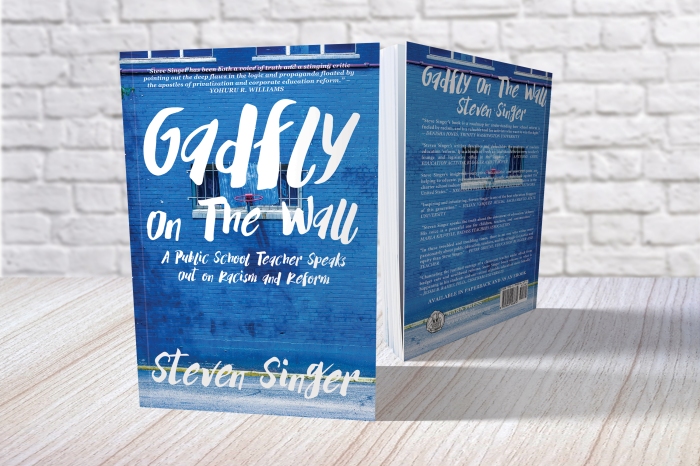
Like this post? I’ve written a book, “Gadfly on the Wall: A Public School Teacher Speaks Out on Racism and Reform,” now available from Garn Press. Ten percent of the proceeds go to the Badass Teachers Association. Check it out!

WANT A SIGNED COPY?

Click here to order one directly from me to your door!

cropped-book-1.jpg

There is Virtually No Difference Between Nonprofit and For-Profit Charter Schools

Screen Shot 2018-09-06 at 3.18.04 PM


Stop kidding yourself.


Charter schools are a bad deal.


It doesn’t matter if they’re for-profit or nonprofit.


It doesn’t matter if they’re cyber or brick-and-mortar institutions.


It doesn’t matter if they have a history of scandal or success.


Every single charter school in the United States of America is either a disaster or a disaster waiting to happen.


The details get complicated, but the idea is really quite simple.


It goes like this.


Imagine you left a blank check on the street.


Anyone could pick it up, write it out for whatever amount your bank account could support and rob you blind.


Chances are you’d never know who cashed it, you’d never get that money back and you might even be ruined.


That’s what a charter school is – a blank check.


It’s literally a privately operated school funded with public tax dollars.


Operators can take almost whatever amount they want, spend it with impunity and never have to submit to any real kind of transparency or accountability.


Compare that to a traditional public school – an institution invariably operated by duly elected members of the community with full transparency and accountability in an open forum where taxpayers have access to internal documents, can have their voices heard and even seek an administrative position.


THAT’S a responsible way to handle public money!


Not forking over our checkbook to virtual strangers!


Sure, they might not steal our every red cent. But an interloper who finds a blank check on the street might not cash it, either.


The particulars don’t really matter. This is a situation rife with the possibility of fraud. It is a situation where the deck is stacked against the public in every way and in favor of charter school operators.


But most people don’t want to take such a strong stance. They’d rather find good and bad people on both sides and pretend that’s the same thing as impartiality.


It isn’t.


Sometimes one side is just wrong.


Policymakers may try to feign that there are good and bad charter schools and that the problems I’m talking about only apply to the nefarious ones.


But that’s a delusion.


There is no good way to write a blank check and leave it on the street to the whims of passers-by.


Most apologists want to draw the distinction between for-profit and nonprofit charters.


But as Jeff Bryant, an editor at Education Opportunity Network, puts it, this is a “Distinction without a difference.”


These terms only define an organization’s tax status – not whether it is engaged in gathering large sums of money for investors.


The law is full of loopholes that allow almost any organization – not just charter schools – to claim nonprofit status while enriching those at the top.


We live in an age of philanthrocapitalism, where the wealthy disguise schemes to enrich themselves as benevolence, generosity and humanitarianism.


So-called “nonprofit” charter schools are just an especially egregious example. No matter what label you pin to their name, they all offer multiple means to skim public funding off the top without adding any value for students.


For instance, take the use of management companies.


A for-profit charter school can simply cut services to students and pocket the savings as profit.


A nonprofit charter school can do the same thing after engaging in one additional step.


All I have to do is start a “nonprofit” charter school and then hire a for-profit management company to run it. Then my management company can cut services and pocket the profits!


It’s really that simple! I turn over nearly all of my public tax dollars to the management company that then uses it to operate the school – and keeps whatever it doesn’t spend.


Heck! It doesn’t even matter who owns the company! It could even be me!


The law actually allows me to wear one hat saying I’m nonprofit and then put on a different hat and rake in the cash! The only difference is what hat I’m wearing at the time!


SO I get to claim to be a nonprofit while enjoying all the advantages of being for-profit.


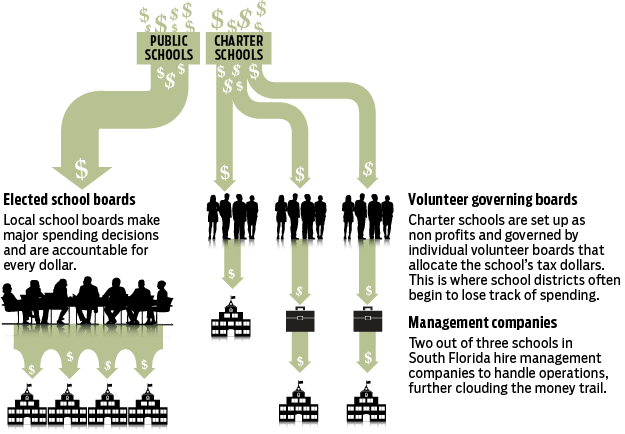
flowchart960
SOURCE: Florida Sun Sentinel


I may even be able to buy things with public tax dollars through my for-profit management company and then if my “nonprofit” school goes belly up, I get to keep everything I bought! Or my management company does.


So the public takes all the risk and I reap all the reward. And I’m still graced with the label “nonprofit.”


Oh, and speaking of spending, being a “nonprofit” doesn’t stop me from the worst kind of real estate shenanigans routinely practiced by the for-profit charter schools.


Both types of privatized institution allow for huge windfalls in real estate. If I own property X, I can sell it to my charter school (or management company) and then pay myself with tax dollars. Who determines how much I pay for my own property? ME! That’s who!


And I can still be a nonprofit.


Think that’s bad? It’s just the tip of the iceberg.


Thanks to some Clinton-era tax breaks, an investor in a charter school can double the original investment in just seven years!

I can even get the public to pay for the same building twice! And even then taxpayers still won’t own it!


But that’s the complicated stuff. There’s an even easier way to get rich off the public with my “nonprofit” charter school, and operators do it all the time: write myself a fat check!


After all, I’ve gotta’ pay, myself, right? And who’s in charge of determining how much I’m worth? ME!


I can even pay myself way more than my counterparts at traditional public schools who oversee exponentially more staff and students.


For instance, as New York City Schools Chancellor, Richard Carranza is paid $345,000 to oversee 135,000 employees and 1.1 million students. Meanwhile, as CEO of Success Academy charter school chain, Eva Moskowitz handles a mere 9,000 students, for which she is paid $782,175.


And this is by no way a unique example.


There are just so many ways to cash in with a charter school even at a so-called “nonprofit” – especially if I want to dip my toe into legally dubious waters!


I could do like the almost exclusively “nonprofit” Gulen charter schools and exist solely as a means to raise money for an out-of-favor political movement in Turkey.


I could use charter funds to finance other businesses. I could decide to discontinue programs that students receive in traditional public schools such as providing free or reduced lunches but keep the cash. I could fake enrollment and have classes full of “ghost students” that the local, state and federal government will pay me to educate.


Fraud and mismanagement are rampant at charter schools because we don’t require them to be as accountable as their traditional public school counterparts.


If a traditional public school tried this chicanery, we’d almost certainly catch it at the monthly meetings or frequent audits. But charter schools don’t have to submit to any of that. They’re public money spent behind closed doors with little to no requirement to explain themselves – ever.


And all of this – nearly every bit of criticism I’ve leveled against the industry – doesn’t even begin to take into account the educational practices at these types of schools.


There is plenty of evidence that charters provide a comparable or worse education than children routinely receive at traditional public schools.


Where it is comparable, the issue is clouded by selective enrollment, inadequately servicing students with special needs and generally encouraging the hardest to teach to get an education elsewhere. Where it is worse, it is colossally worse, robbing children not just of funding but what is likely their only chance at an education.


But we don’t even need to go there.


We only need the issue of fiscal responsibility to bring down this behemoth.


Charter schools are no way to run a school. They are a blatant failure to meet our fiduciary responsibilities.


Traditional public schools are the best way to run a school. They protect the public’s investment of money and resources while providing a quality education to students.


So all this talk about nonprofit and for-profit charter schools is either a mark of supreme ignorance or a ploy for weak willed politicians to weasel their way out of taking a stand on an issue whose merits are obvious to anyone who knows what really happens in our education system.


It’s time to stop wasting taxpayer money on this expensive fraud.


It’s time for the charter school experiment to end.


And it’s way passed time to support fully public schools.


Like this post? I’ve written a book, “Gadfly on the Wall: A Public School Teacher Speaks Out on Racism and Reform,” now available from Garn Press. Ten percent of the proceeds go to the Badass Teachers Association. Check it out!

WANT A SIGNED COPY?

Click here to order one directly from me to your door!
book-1

Nationwide Poll Shows Overwhelming Support for Public Schools in All Areas Except One

5e6d4156-a078-4458-bdec-72746eca6e98


Waylon Jennings classic country hit advises Mama’s not to let their babies grow up to be cowboys.


Now, I guess we can add teachers to that list.


According to the 50th annual PDK Poll of attitudes about public schools, Americans trust and support teachers, but don’t want their own children to join a profession they see as underpaid and undervalued.


In almost every other way, they support public schools and the educators who work there.


When it comes to increasing school funding, increasing teacher salary, allowing teachers to strike, and an abundance of other issues, the poll found a majority of people unequivocally in favor of endeavors meant to bolster learning.


In fact, support for education and educators has never been so high in half a century.


“Two-thirds of Americans say teachers are underpaid, and an overwhelming 78% of public school parents say they would support teachers in their community if they went on strike for more pay,” according to PDK’s Website.


If true, this result illuminates an incredible tone deafness among politicians like Scott Wagner in Pennsylvania who is running for governor on the platform that teachers make too much money. According to the poll, only 6% of Americans agree with him.


Moreover, those who support teachers strikes include 6 in 10 Republicans.


“Those who would be most affected by a teacher walk-out — say they would support teachers in their community if they went on strike for more pay. Among the general public, 73% say they would support a job action for higher wages.”


These are record high results that are also reflected in respondents unwillingness to encourage their own children to become teachers in the current political landscape.


For the first time since the question was asked in 1969, a majority of 54% say they would not want their child to become a teacher.


The reason? Poor pay and benefits.


Moreover, a lack of adequate funding is cited as the most common problem facing public schools – a finding that’s held true since the early 2000s. In fact, for the 17th consecutive year, Americans have named the lack of funding as the biggest problem facing their local schools.


It seems that either or both major political parties could easily pick up broad popular support by doing an about face on education. Instead of backing standardization and privatization, they should get behind public education.


The topic has typically served as a wedge issue between progressives and corporate Democrats while Republicans have almost exclusively backed a strategy to “starve the beast” and promote privatization.


However, Democrats and/or Republicans who ran on respecting and remunerating teachers as well as increasing support for the public schools that employ them would find major support among voters.


The PDK poll is based on responses from 1,042 adults including 515 parents of school-age children. They were randomly and representatively sampled in May 2018 through on-line surveys.


The 2018 results include particular support for the public school system as opposed to charter and voucher schools.


Nearly 8 in 10 people said they prefer reforming the existing public school system rather than finding an alternative approach.


That’s a higher response than any year since the question was first asked 20 years ago. Moreover, it’s not just an opinion about nationwide schooling: 78% say they’d rather reform than replace the local school system, as well.


In addition, there is support among Americans to not only increase funding, but also spend it more equitably.


A majority (60%) support spending more on students who need extra help than spending the same amount on every child (39%).


Responds were more divided on where the influx of funding should come from.


Half of respondents favor raising taxes and half say the schools should spend less on students who require fewer resources.


This is related to public perception of exactly which students are receiving unfair funding. The poll revealed that most people recognize some resource inequality based on race and geographic region but they think most is based on parental wealth: 75% of respondent say public school students serving mostly poor students have fewer resources than those serving rich students.


One of the most interesting findings is always the public’s overall perception of schools.


And this poll – as in previous editions – found a sharp difference in respondents appraisal of schools nationwide vs. the schools in their own neighborhoods.


Fifty-five percent say that on a national scale students today get a worse education than those in previous generations.


However:


The public schools continue to suffer from an image deficit. Among those who know them best, parents of current students, 70% give their oldest child’s school an A or B grade. Among the public more broadly, by contrast, only four in 10 give their local schools an A or B. In results that are typical across the years, far fewer give top grades to the public schools nationally, just 19%.”


In other words, people seem to think that nationally our schools stink. But the schools in our own neighborhoods are pretty good.


The reason is simple. National perception is formed by the media. Local perception is formed by actual empirical evidence.


The forces of school privatization and their propaganda network has pushed the lie of “failing schools” for so long, that people believe it – except in their own neighborhoods where they see it to be false.


But the questions weren’t all about how schools should be run. They also asked about security – a hot topic when school shootings happen at least once a month.


“Parents lack strong confidence that schools can protect their children against a school shooting but favor armed police, mental health screenings, and metal detectors more than arming teachers to protect their children.”


This bodes badly for the Trump administrations plans to push guns on public school teachers instead of enacting common sense gun regulations.


As usual, policymakers are trying to herd Americans to their point of view instead of listening to their constituencies.


And that seems to be the big take away from this year’s poll.


Americans want and support public education.


It’s time our so-called leaders got with the program.


Like this post? I’ve written a book, “Gadfly on the Wall: A Public School Teacher Speaks Out on Racism and Reform,” now available from Garn Press. Ten percent of the proceeds go to the Badass Teachers Association. Check it out!

WANT A SIGNED COPY?

Click here to order one directly from me to your door!
book-2

No One Ever Remembered a Teacher for Raising Standardized Test Scores

gradhug


It’s the day before school begins.


I’m out to eat with my family and have just taken a big bite of a juicy beef taco.


That’s when I notice someone standing right next to me at the restaurant.


So I raise my eyes upward, a meat filled tortilla overfilled with lettuce and beans hanging from my mouth, and I’m greeted with a familiar face.


“Mr. Singer!” the woman says with a nervous smile on her lips.


“Do you remember me?”


I think for a moment but realize I have more pressing concerns. I couldn’t reply with an answer to the woman’s question even if I did remember her.


So I chew and swallow and then look again.


“It’s me,” she says. “Tamarind.”


And then it hits me like a flash.


The face in front of me ages backward. The adult eyes soften. The taut cheeks become chubbier. And her whole figure shrinks three feet closer to the ground.


“Oh my God! Tamarind! Of course I remember you!” I say.


She smiles and blushes. I’m surprised by how nervous she is. I’m no one to inspire anxiety. I’m just a guy out with his wife, daughter and father-in-law shoving a taco in his face.


“When I saw you here I just had to come up to you,” she said. “I was in your 6th grade class.”


“I think it was 8th grade, wasn’t it?” I said.


“Yes! That’s right! Eighth grade!”


“How old are you now? My gosh I remember you when you only came up to here off the ground.”


“I’m 22. I’m doing really well. I just wanted you to know that you taught me how to write. If it wasn’t for you I never would have made it anywhere. I just wanted to thank you so much for everything you did for me.”


We chatted a bit more and then she left us to finish our meal.


But, of course, the whole interaction got me thinking.


As a teacher, you are something of a minor public figure.


When you’re out and about – especially if you’re somewhere in your district – you’re bound to be recognized and invariably someone will want to chat.


I remember one time at the bakery counter a former student gave me my order and told me he threw in a few donuts.


I remember laughing and telling him he didn’t need to do that.


“Nah, Mr. Singer, you never wrote me up for falling asleep in your class. You knew I was watching my brothers and sisters at home and never gave me shit for it. You keep those donuts.”


Another time at the theater I was almost late to my movie because I was listening to a former student at the concession stand catch me up on her life and what all of her friends from my class were doing these days.


So many students. So many kids that have now become adults.


You lose track of how many lives you’ve had an impact on.


The first few days of school are always filled with endless administrative meetings. The superintendent welcomes you with testing data. Then your principal breaks it down by building and subject.


You find out which diagnostic exams you have to give your students and when. You find out what your Pennsylvania Value Added Assessment Score (PVAAS) is – how good a teacher you are based on how well your students from last year did on the state standardized test.


On the one hand, I suppose I have no reason to feel like much of a good teacher.


Most of my students didn’t pass the test. They rarely do.


The same number of 7th graders (that’s what I taught last year) passed the reading test as in previous years. However, many more passed that were expected to fail.


The state uses a mystery metric based on Classroom Diagnostic Assessment (CDT) data to come up with a prediction of who they expect to pass and who they expect to fail. No one really knows how they calculate this. For all we know, the state secretary of education could examine a pile of chicken entrails before entering it all into the system.


Does all that data mean I’m a good teacher or not?


I don’t know.


But I do know what Tamarind thinks.


And I know what a host of former students have told me. I know how they react when they see me out in the wild, just living my life.


I’m sure there are probably former students who don’t like me. There must be those who hold a grudge for getting a 59% on an assignment. Or maybe they remember me yelling at them for something. Or – who knows – maybe they just didn’t respond to The Singer Charm.


But an awful lot of people come up to me who don’t have to.


Yesterday was the first day of classes for the year.


For the first time, all my classes were looped. I taught 7th grade Language Arts last year and I’m teaching the 8th grade course this year.


When those kids came into the class on Friday, it was like a homecoming.


So many smiles. So much laughter and joy. And, yes, impromptu hugs.


It felt like a family gathering, not a school function.


As I left the building feeling more exhausted than I have in months, another teacher stopped me.


“Steve! I wanted to catch you before you left!” she said.


She told me that she gave her students a survey in her class as an icebreaker. One of the questions was to name their favorite teacher from last year. My name came up a lot.


What can you say about that?


I’m actually getting choked up just typing this.


In my years in the classroom, I’ve helped a lot of kids get better test scores.


But that’s not why they come up to me. That’s not why they remember me.


I touched their lives in some meaningful way.


And they have done the same for me.


I’m just a guy who should really take smaller bites of his tacos.


But they make me feel like a hero.


I am so grateful.


Like this post? I’ve written a book, “Gadfly on the Wall: A Public School Teacher Speaks Out on Racism and Reform,” now available from Garn Press. Ten percent of the proceeds go to the Badass Teachers Association. Check it out!

WANT A SIGNED COPY?

Click here to order one directly from me to your door!
book-2

Scott Wagner Wants to be Pa.’s Anti-Education Governor. Will We Let Him?

39408873_306034386897393_1481697570328674304_n
Art by Sue Goncarovs


If there’s one thing Scott Wagner hates, it’s education.


He hates science. He hates schools. He hates teachers. And if students get in the way, he’ll hate them, too.


These are the qualities he thinks Pennsylvanians are looking for in their next governor.


The York Township Republican will challenge incumbent Democrat Tom Wolf on Nov. 6, 2018.


So who is this guy?


Wagner’s a college dropout who made a fortune starting a garbage hauling firm. He became a state senator four years ago after winning a write in campaign during a special election where only 17% of the electorate could be bothered to vote.


And ever since, he’s been consistent about one thing: he really, Really, REALLY hates teachers.


“We have 180,000 teachers in the state of Pennsylvania,” Wagner said in 2015. “If we laid off 10 percent of the teachers in the state of Pennsylvania, we’d never miss them.”


Let’s be clear.


Scott wouldn’t miss them. But the 1.75 million Commonwealth school children would.


Ever since the last Republican Governor, Tom Corbett, slashed funding by almost $1 billion a year to the poorest schools with the full help of a state legislature that is even now still under GOP control, our institutions of learning have been reeling.


We lost 27,000 education jobs, most of which were teaching positions.


That’s a deficit we still haven’t recovered from. Even today, state schools are staffed at a 10-year low. Class sizes are at an all time high.


Yet Wagner wants to fire even more teachers!?


That’s not the policy of a man who wants to help improve life throughout the state for all. That’s not the policy of a man who wants to help kids learn.


It’s the policy of a man who has a personal grudge against educators.


And his other legislative objectives?


Wagner wants to further slash education funding. He wants to spend whatever is left inequitably. And he really wants to help his heroes Donald Trump and Betsy DeVos enact school vouchers so business people like him can continue to cash in on children from Pittsburgh to Philadelphia and all places between.


By contrast, in his four years in office, Gov. Wolf has pushed to increase education funding, pushed to spend it more fairly, and even cut the time it takes for students to take high stakes standardized tests.


The good news: voters throughout the Commonwealth have never had a clearer choice for governor.


The bad news: when has that ever stopped them from getting it wrong?


Here’s a couple of Wagner’s other big ideas cribbed from the American Legislative Exchange Council (ALEC) and his buddies the Koch Brothers.


He Thinks Teachers Make Too Much Money


“We have created a special class in this state and the special class is the public sector union employee,” Wagner told Keystone Crossroads in a 2015 interview.


“Teachers are doing very well in this state,” he said. “People would be appalled if they knew what their teachers made, in certain areas.”


Unfortunately, Wagner has no idea, himself.


He keeps quoting a bogus salary figure that I’m not going to repeat. It’s not true statewide, it’s not an average, nor is it true in his home district.


In truth, the low end for teachers entering the field nationwide is around $30,000, according to the National Association of Colleges and Employers (NACE). So go to college, get a four – sometimes five – year degree including a rigorous internship of student teaching and you make a mere $10,000 above the most generous minimum wage!?


However, Pennsylvania pays its teachers better than average. We have the 12th highest pay in the country, according to financial services outlet GOBankingRates which compiled average teacher salaries by state using 2015 federal data.


According to that data, Pennsylvania teachers make on average $63,063 per year. Of neighboring states, teachers in Maryland ($65,247) and New Jersey ($71,687) make more. Teachers in Ohio (59,063) and Delaware ($59,853) make less.


Screen Shot 2018-08-16 at 2.11.40 PM
Highest and Lowest Teacher Salaries – Source: GoBankingRates


But those numbers are deceiving. They’re averages. Districts serving the wealthy pay their teachers much better than those serving the poor. Actual pay ranges from $99,253 in the affluent Philadelphia district of Lower Merion to $27,592 at Wonderland Charter School in Centre Country.


As everywhere else, many teachers struggle to make ends meet working multiple jobs while others are well compensated.


No matter how you slice it, nationwide teachers’ salaries are 14% less than those from professions that require similar levels of education, according to the Economic Policy Institute.


In other words, if prospective teachers want to make more money, all they have to do is switch majors.


That may be part of the reason for our national teachers shortage. Not only have states like ours laid off tens of thousands of educators, many don’t stay in the field if given the chance. Across the country , 46 percent of educators quit before reaching the five year mark. And it’s worse in urban districts, where 20 percent quit every single year!


We could take steps to ensure all teachers earned a living wage and even encouraged our best and brightest to enter the field. But, nah, Wagner thinks Pennsylvania already spends “enough” money on public schools.


As Governor, he would do whatever he could to win his personal crusade against teachers even if Pennsylvania’s school children were collateral damage.


He Wants to Eliminate Teachers Sick Days


Wagner has been vocal about eliminating benefits that educators earn, including sick days. He introduced a bill that’s still floating around in the state senate to strip sick days from the school code and make teachers bargain for them with their districts.


So forcing sick teachers to come to school and spread the germs to children is fine with Wagner as long as it hurts his nemesis – those evil teachers.


He Wants to Cut Teachers Pensions


He also plans to end pensions for working educators, and even wants retired educators to give back 10% of the retirement they earned.


He’s right to want reform to the state pension system but disingenuous or misinformed about the cause.


Pennsylvania pension costs have increased primarily because our legislature made bad plans and bad investments that were upended by the crash of 2008. You don’t fix that by stiffing your employees. If you do that, no one will believe any promises the state makes and no one of any substance will want to work for the state.


He Wants To Pay Teachers Based on Student Test Scores


No kidding:


“There are teachers that will exceed expectations while teaching a classroom of 100 of the toughest-to-teach students. There are also teachers that would struggle to teach just one student at a time. I want the first teacher to make a small fortune, and I want the second teacher to find a new career that is better suited for him or her.”


So if you teach the best students, you should make the most money? And if you teach struggling students, you should be fired?


But It’s Not Just Teachers. He Hates Other Working People, Too


If there is a corner to cut, he wants to take it – especially if it screws a working person. As a state senator, Wagner even introduced a bill that would exempt school districts from paying laborers the “prevailing wage” on construction projects.


Cheaper labor, shoddier work. That’s surely a recipe for success in buildings housing school children!


He Wants to Disband Unions


Oh, but he’s not done.


The man who once compared the tactics of public employee unions – including those representing teachers – to those of Adolf Hitler and Vladimir Putin also wants to end tenure end tenure, seniority, and disband unions.


I’m sure reducing teaching to a career without benefits, workers rights or protections will do wonders for the educational quality students receive.


Teachers working conditions are students learning conditions. Putting children in a building that has fewer safety precautions because there’s no union to collectively bargain for them is a great way to cut costs. But parents aren’t thrilled about having their kids try to learn in a sweat shop filled with Trump brand Russian asbestos.


He Loves School Vouchers and Charter Schools


Call them education saving accounts, education tax credits, personalized learning accounts or opportunity scholarships. It doesn’t matter. Wagner loves them all.


“I support all school choice,” he said in an interview.


Charter schools, funding private and parochial schools with public tax dollars. He’s in for all of it.


So long as it hurts public schools and enriches private businesses without helping students learn at all.


Go ahead! Take scarce funding from public schools and divert it to programs with little to no accountability. Let private school operators fraudulently misrepresent enrollment data. Let them fail to provide safe and academically appropriate learning environments. Let them game the system in any and every way.


That’s what Wagner calls fiscal accountability.


It doesn’t matter that these schools don’t improve student achievement. Evaluations of voucher programs in Milwaukee, Cleveland, and Washington, D.C., have all found no statistically significant differences in the academic achievement of voucher students compared to public school students. And recent evaluations of programs in Ohio, Indiana, and Louisiana revealed that voucher students scored lower than their peers attending public school.


But who cares about facts? This is all ideology for Wagner.


Vouchers have a record of undermining student’s civil rights – especially students with disabilities. Private school students give up due process and other rights guaranteed in public schools. Private schools are allowed to discriminate by denying admission based on religion, sexual orientation, citizenship status, English language proficiency and disability. Private schools that enroll students with disabilities may decide not to provide the services or accommodations guaranteed to such students in public schools. Or they may charge parents extra for them. Moreover, there is nothing to stop them from segregating these kids from other children. And, finally, private schools often suspend or expel students without due process.


This may be Trump and Wagner’s ideal. But it is certainly not what Commonwealth voters want for their children.


He Wants to Get Rid of Many State Colleges


Wagner caused an uproar when he said the state’s 14 state colleges will not be around in four years. “So, for those of you who think your school’s going to be around four years from now, it isn’t going to be around,” Wagner said.


Fewer institutions of higher learning. Fewer opportunities to get a college degree. That sounds like the policy of a college dropout.


He Wants to Slash School Funding


Wagner has made no bones about this from day one.


This is a guy who took a television reporter on a helicopter tour of schools in his district in 2015 to highlight the fact that “we spend a lot of money on schools.”


“They think the solution is more money,” he said of Wolf and the Democrats. “Every time you do that the money disappears and the problem is still there.”


It’s like taking a bath, Scott. You can’t just do it once and be clean for the rest of your life. You need to bathe every day. One-time funding windfalls don’t work. You need equitable and sustainable funding revenues.


But that’s either too complicated for Wagner or he just doesn’t care.


He supported Gov. Corbett’s plan to decimate Pennsylvania’s schools. And he doesn’t think the culling should be over.


When asked point blank about Corbett’s cuts in 2011, he said, “Yes, I believe that Governor Corbett needs to stick to his plan.”


He’s said repeatedly that we spend “enough money” on public schools, while stressing the need for frugality and fewer regulations.


He Wants to Play with How Schools Are Funded


He’s an advocate for legislation that would eliminate school property taxes and replace them with increased state sales and income taxes.


True we need a better funding mechanism than local property taxes. But you can bet Wagner’s plan is worse than the current system.


It would lock funding inequities among Pennsylvania’s 500 school districts into place.


He Thinks Global Warming is Caused by the Earth Getting Closer to the Sun


Wagner is an incredibly stupid man who thinks he’s rather intelligent.


But of all the dumb or evil things that come spewing out of his mouth, this one has to be my favorite.


When asked about global climate change, he didn’t simply deny that it was happening. He had an alternative theory to why it was taking place.


It’s not business and industry or fossil fuels that is causing global temperatures to rise. He actually said that it’s because the earth is getting closer to the sun every year. Another cause? Human bodies on the planet are giving off enough heat to raise the global temperature.


Perhaps it shouldn’t be surprising that a person who hates schools and teachers so much knows very little, himself.


These comments made him a national laughing stock.


His words were repeated on every late night comedy show across the country for giggles and guffaws.


The question is “Will the joke be on us come Election Day?”


It’s not “How dumb is Scott Wagner?”


It’s “Is Pennsylvania dumb enough to vote for him?”


NOTE: Special Thank you to Sue Goncarovs for the Wagner cartoon with which I began this piece. I love your work!


Like this post? I’ve written a book, “Gadfly on the Wall: A Public School Teacher Speaks Out on Racism and Reform,” now available from Garn Press. Ten percent of the proceeds go to the Badass Teachers Association. Check it out!

WANT A SIGNED COPY?

Click here to order one directly from me to your door!
book-1

Top 10 Reasons You Can’t Fairly Evaluate Teachers on Student Test Scores

Screen Shot 2018-08-02 at 12.49.24 AM


I’m a public school teacher.


Am I any good at my job?


There are many ways to find out. You could look at how hard I work, how many hours I put in. You could look at the kinds of things I do in my classroom and examine if I’m adhering to best practices. You could look at how well I know my students and their families, how well I’m attempting to meet their needs.


Or you could just look at my students’ test scores and give me a passing or failing grade based on whether they pass or fail their assessments.


It’s called Value-Added Measures (VAM) and at one time it was the coming fad in education. However, after numerous studies and lawsuits, the shine is fading from this particularly narrow-minded corporate policy.


Most states that evaluate their teachers using VAM do so because under President Barack Obama they were offered Race to the Top grants and/or waivers.


Now that the government isn’t offering cash incentives, seven states have stopped using VAM and many more have reduced the weight given to these assessments. The new federal K-12 education law – the Every Student Succeeds Act (ESSA) – does not require states to have educator evaluation systems at all. And if a state chooses to enact one, it does not have to use VAM.


That’s a good thing because the evidence is mounting against this controversial policy. An evaluation released in June of 2018 found that a $575 million push by the Bill and Melinda Gates Foundation to make teachers (and thereby students) better through the use of VAM was a complete waste of money.


Meanwhile a teacher fired from the Washington, DC, district because of low VAM scores just won a 9-year legal battle with the district and could be owed hundreds of thousands of dollars in back pay as well as getting his job back.


But putting aside the waste of public tax dollars and the threat of litigation, is VAM a good way to evaluate teachers?


Is it fair to judge educators on their students’ test scores?


Here are the top 10 reasons why the answer is unequivocally negative:


1) VAM was Invented to Assess Cows.

I’m not kidding. The process was created by William L. Sanders, a statistician in the college of business at the University of Knoxville, Tennessee. He thought the same kinds of statistics used to model genetic and reproductive trends among cattle could be used to measure growth among teachers and hold them accountable. You’ve heard of the Tennessee Value-Added Assessment System (TVAAS) or TxVAAS in Texas or PVAAS in Pennsylvania or more generically named EVAAS in states like Ohio, North Carolina, and South Carolina. That’s his work. The problem is that educating children is much more complex than feeding and growing cows. Not only is it insulting to assume otherwise, it’s incredibly naïve.


2) You can’t assess teachers on tests that were made to assess students.

This violates fundamental principles of both statistics and assessment. If you make a test to assess A, you can’t use it to assess B. That’s why many researchers have labeled the process “junk science” – most notably the American Statistical Association in 2014. Put simply, the standardized tests on which VAM estimates are based have always been, and continue to be, developed to assess student achievement and not growth in student achievement nor growth in teacher effectiveness. The tests on which VAM estimates are based were never designed to estimate teachers’ effects. Doing otherwise is like assuming all healthy people go to the best doctors and all sick people go to the bad ones. If I fail a dental screening because I have cavities, that doesn’t mean my dentist is bad at his job. It means I need to brush more and lay off the sugary snacks.


3) There’s No Consistency in the Scores.

Valid assessments produce consistent results. This is why doctors often run the same medical test more than once. If the first try comes up positive for cancer, let’s say, they’re hoping the second time will come up negative. However, if multiple runs of the same test produce the same result, that diagnosis gains credence. Unfortunately, VAM scores are notoriously inconsistent. When you evaluate teachers with the same test (but different students) over multiple years, you often get divergent results. And not just by a little. Teachers who do well one year may do terribly the next. This makes VAM estimates extremely unreliable. Teachers who should be (more or less) consistently effective are being classified in sometimes highly inconsistent ways over time. A teacher classified as “adding value” has a 25 to 50% chance of being classified as “subtracting value” the next year, and vice versa. This can make the probability of a teacher being identified as effective no different than the flip of a coin.


4) Changing the test can change the VAM score.

If you know how to add, it doesn’t matter if you’re asked to solve 2 +2 or 3+ 3. Changing the test shouldn’t have a major impact on the result. If both tests are evaluating the same learning and at the same level of difficulty, changing the test shouldn’t change the result. But when you change the tests used in VAM assessments, scores and rankings can change substantially. Using a different model or a different test often produces a different VAM score. This may indicate a problem with value added measures or with the standardized tests used in conjunction with it. Either way, it makes VAM scores invalid.


5) VAM measures correlation, not causation.

Sometimes A causes B. Sometimes A and B simply occur at the same time. For example, most people in wheelchairs have been in an accident. That doesn’t mean being in a wheelchair causes accidents. The same goes for education. Students who fail a test didn’t learn the material. But that doesn’t mean their teacher didn’t try to teach them. VAM does not measure teacher effectiveness. At best it measures student learning. Effects – positive or negative – attributed to a teacher may actually be caused by other factors that are not captured in the model. For instance, the student may have a learning disability, the student may have been chronically absent or the test, itself, may be an invalid measure of the learning that has taken place.


6) Vam Scores are Based on Flawed Standardized Tests.

When you base teacher evaluations on student tests, at very least the student tests have to be valid. Otherwise, you’ll have unfairly assessed BOTH students AND teachers. Unfortunately standardized tests are narrow, limited indicators of student learning. They leave out a wide range of important knowledge and skills leaving only the easiest-to-measure parts of math and English curriculum. Test scores are not universal, abstract measures of student learning. They greatly depend on a student’s class, race, disability status and knowledge of English. Researchers have been decrying this for decades – standardized tests often measure the life circumstances of the students not how well those students learn – and therefore by extension they cannot assess how well teachers teach.


7) VAM Ignores Too Many Factors.

When a student learns or fails to learn something, there is so much more going on than just a duality between student and teacher. Teachers cannot simply touch students’ heads and magically make learning take place. It is a complex process involving multiple factors some of which are poorly understood by human psychology and neuroscience. There are inordinate amounts of inaccurate or missing data that cannot be easily replaced or disregardedvariables that cannot be statistically controlled for such as: differential summer learning gains and losses, prior teachers’ residual effects, the impact of school policies such as grouping and tracking students, the impact of race and class segregation, etc. When so many variables cannot be accounted for, any measure returned by VAMs remains essentially incomplete.


8) VAM Has Never been Proven to Increase Student Learning or Produce Better Teachers.

That’s the whole purpose behind using VAM. It’s supposed to do these two things but there is zero research to suggest it can do them. You’d think we wouldn’t waste billions of dollars and generations of students on a policy that has never been proven effective. But there you have it. This is a faith-based initiative. It is the pet project of philanthrocapitalists, tech gurus and politicians. There is no research yet which suggests that VAM has ever improved teachers’ instruction or student learning and achievement. This means VAM estimates are typically of no informative, formative, or instructional value.


9) VAM Often Makes Things Worse.

Using these measures has many unintended consequences that adversely affect the learning environment. When you use VAMs for teacher evaluations, you often end up changing the way the tests are viewed and ultimately the school culture, itself. This is actually one of the intents of using VAMs. However, the changes are rarely positive. For example, this often leads to a greater emphasis on test preparation and specific tested content to the exclusion of content that may lead to better long-term learning gains or increasing student motivation. VAM incentivizes teachers to wish for the most advanced students in their classes and to push the struggling students onto someone else so as to maximize their own personal VAM score. Instead of a collaborative environment where everyone works together to help all students learn, VAM fosters a competitive environment where innovation is horded and not shared with the rest of the staff. It increases turnover and job dissatisfaction. Principals stack classes to make sure certain teachers are more likely to get better evaluations or vice versa. Finally, being unfairly evaluated disincentives new teachers to stay in the profession and it discourages the best and the brightest from ever entering the field in the first place. You’ve heard about that “teacher shortage” everyone’s talking about. VAM is a big part of it.


10) An emphasis on VAM overshadows real reforms that actually would help students learn.

Research shows the best way to improve education is system wide reforms – not targeting individual teachers. We need to equitably fund our schools. We can no longer segregate children by class and race and give the majority of the money to the rich white kids while withholding it from the poor brown ones. Students need help dealing with the effects of generational poverty – food security, psychological counseling, academic tutoring, safety initiatives, wide curriculum and anti-poverty programs. A narrow focus on teacher effectiveness dwarfs all these other factors and hides them under the rug. Researchers calculate teacher influence on student test scores at about 14%. Out-of-school factors are the most important. That doesn’t mean teachers are unimportant – they are the most important single factor inside the school building. But we need to realize that outside the school has a greater impact. We must learn to see the whole child and all her relationships –not just the student-teacher dynamic. Until we do so, we will continue to do these children a disservice with corporate privatization scams like VAM which demoralize and destroy the people who dedicate their lives to helping them learn – their teachers.


NOTE: Special thanks to the amazingly detailed research of Audrey Amrein-Beardsley whose Vamboozled Website is THE on-line resource for scholarship about VAM.


Like this post? I’ve written a book, “Gadfly on the Wall: A Public School Teacher Speaks Out on Racism and Reform,” now available from Garn Press. Ten percent of the proceeds go to the Badass Teachers Association. Check it out!

WANT A SIGNED COPY?

Click here to order one directly from me to your door!
book-1

Wealth – Not Enrollment in Private School – Increases Student Achievement, According to New Study

pq2iPfteRemNHu7D5w9c_richkid


Students enrolled in private schools often get good grades and high test scores.


And there’s a reason for that – they’re from wealthier families.


A new peer-reviewed study from Professors Richard C. Pianta and Arya Ansari of the University of Virginia found that once you take family income out of the equation, there are absolutely zero benefits of going to a private school. The majority of the advantage comes from simply having money and all that comes with it – physical, emotional, and mental well-being, living in a stable and secure environment, knowing where your next meal will come from, etc.


The study published in July 2018 attempts to correct for selection bias – the factors that contribute to a student choosing private school rather than the benefits of the school, itself.


The study’s abstract puts it this way:


“Results from this investigation revealed that in unadjusted models, children with a history of enrollment in private schools performed better on nearly all outcomes assessed in adolescence. However, by simply controlling for the sociodemographic characteristics that selected children and families into these schools, all of the advantages of private school education were eliminated. There was also no evidence to suggest that low-income children or children enrolled in urban schools benefited more from private school enrollment.”


This has major policy implications.


Corporate school reformers from Barack Obama to Donald Trump, from Arne Duncan to Betsy DeVos, from Cory Booker to Charles and David Koch, have proposed increasing privatized school options to help students struggling in public schools.


Whether it be increasing charter schools or vouchers to attend private and parochial schools, the implication is the same – such measures will not help students achieve.


We need programs aimed at poverty, itself, not at replacing public schools with private alternatives.


According to the abstract:


“By and large, the evidence on the impact of school voucher programs casts doubt on any clear conclusion that private schools are superior in producing student performance…


“In sum, we find no evidence for policies that would support widespread enrollment in private schools, as a group, as a solution for achievement gaps associated with income or race. In most discussions of such gaps and educational opportunities, it is assumed that poor children attend poor quality schools and that their families, given resources and flexibility, could choose among the existing supply of private schools to select and then enroll their children in a school that is more effective and a better match for their student’s needs. It is not at all clear that this logic holds in the real world of a limited supply of effective schools (both private and public) and the indication that once one accounts for family background, the existing supply of heterogeneous private schools (from which parents select) does not result in a superior education (even for higher income students).”


Researchers repeatedly noted that this study was not simply a snapshot of student performance. It is unique because of how long and how in depth students were observed.


The study looks at student outcomes at multiple intervals giving it a much longer time frame and much greater detail than other similar investigations. Researchers examined wide ranging family backgrounds and contextual processes to reduce selection bias.


Participants were recruited in 1991 from ten different cities: Little Rock, Arkansas; Irvine, California; Lawrence, Kansas; Boston, Massachusetts; Philadelphia and Pittsburgh, Pennsylvania; Charlottesville, Virginia; Seattle, Washington; Hickory and Morganton, North Carolina; and Madison, Wisconsin. They were followed for 15 years and had to complete a month long home visit. In addition, they submitted to both annual interviews and home, school, and neighborhood observations.


The final analytic sample consisted of 1,097 children – 24% of whom were children of color, 15% had single mothers, and 10% had mothers without a high school diploma.


Moreover, student academic achievement wasn’t the only factor examined.


Researchers also assessed students social adjustment, attitudes, motivation, and risky behavior. This is significant because they noted that no other study of private schools to date has examined factors beyond academics. Also, there is a general assumption that private school has a positive effect on these nonacademic factors – an assumption for which the study could find no evidence.


From the abstract:


“In short, despite the frequent and pronounced arguments in favor of the use of vouchers or other mechanisms to support enrollment in private schools as a solution for vulnerable children and families attending local or neighborhood schools, the present study found no evidence that private schools, net of family background (particularly income), are more effective for promoting student success.”


One reason behind these results may be the startling variation in “the nature and quality of private school classrooms.” There is no consistency between what you’ll get from one private school to the next.


The x-factor appears to be family income and all that comes with it.


We see this again and again in education. For instance, standardized test scores, themselves, are highly correlated with parental wealth. Kids from wealthier families get better test scores than those from poorer families regardless of whether they attend public, charter or private schools.


It’s time our policymakers stop ignoring the effect of income inequality on our nations students.


If we really want to help our children, the solution is not increased privatization. It is increased funding and support for anti-poverty programs, teachers and a robust public school system.


Like this post? I’ve written a book, “Gadfly on the Wall: A Public School Teacher Speaks Out on Racism and Reform,” now available from Garn Press. Ten percent of the proceeds go to the Badass Teachers Association. Check it out!

WANT A SIGNED COPY?

Click here to order one directly from me to your door!


book-3

Five Things I Learned About Ed Tech While Playing ‘Zelda: Breath of the Wild’

the-legend-of-zelda-breath-of-the-wild-guardian-e1489251354463 

I don’t mean to brag, but I just beat “Zelda: Breath of the Wild.”


This summer I sat down with my 9-year-old daughter and together we played the most popular Nintendo Switch game for hours, days, weeks.


And at the end of all that time, I came away victorious – something I wasn’t sure I’d be able to do when I started.


There are so many buttons to learn, two joy sticks, various info screens and menus.


But when it was all over, I had cleared all four divine beasts. I got all 18 captured memories. I completed about 80 shrines. I mastered about 45 side quests. I shredded guardians, lynols and bokoblins. And, yes, I opened a major can of whoop ass on Calamity Gannon.


As the kids say, I’m jelly.


My video game skills are lit.


You can’t handle me, bro.


And so on.


But I’m not a kid. I’m a grown man.


Didn’t I have anything better to do?


Couldn’t I have found a more productive use for all that time?


Maybe. Maybe not. However, beyond the sheer fun, I did learn something from the whole experience.


As a public school teacher, I learned about my students by following in their footsteps.


That’s really why I started playing in the first place – my middle school kids this year loved that game.


I got more Zelda doodles, more Hyrule poetry, more Link fan fiction than you might at first believe.


The world of the game was really important to my children and having even a passing knowledge of that world helped me relate to them.


I even asked for a few tips after class.


One of my best students took her Switch out of her backpack and showed me a prime location to pick hot peppers so I could withstand the cold of Mount Hyrule (Don’t ask).


It was worth doing just for that – I showed my willingness to be the student and for them to be the teachers. I showed them we were all a community of learners.


At least, that’s my hope.


But now that the dog days of summer are here and my video game victory is complete, I keep thinking of the implications of my experience in Hyrule on the world of education.


Specifically, I’m thinking about education technology or Ed Tech.


I’m thinking about how we use various software packages to try to teach students and how they invariably fail at the task.


Well-meaning administrators hear about this program or that classroom management system or an assessment app and they spend beaucoup bucks on it.


We’re instructed to give up valuable instruction time so our kids can sit in front of a computer while a digital avatar attempts to do our job.


Kids listen to a cartoon person instruct them in the rudiments of grammar or literacy, play loose skills exercises and earn digital badges.


It may sound like fun to us, but they hate it.


The reason: nine times out of ten it’s little more than a standardized test given on a computer.


Sure, there are lots of bells and whistles, but the kids catch on mighty quickly. There is no student as bored as a student forced to play an educational video game.


I have real concerns with issues of student privacy and how the data being collected by these apps is used. I have real problems with how this technology facilitates dumbing down the curriculum – narrowing it to only that which can be measured on a multiple choice assessment. I take umbrage that these programs are used by some as “evidence” that human educators and brick and mortar schools are unnecessary. And I shed real tears at the massive amounts of funding being funneled to corporations that could be better spent in our own districts.


But playing this game has given me hope.


In seeing how “Zelda” succeeds with kids – because it succeeded with me – I think we can illuminate some ways ed tech goes awry.


I found five distinct lessons from the game, five areas where “Zelda” succeeds where ed tech fails.


Perhaps these could be used to improve the quality of ed tech devices to make them better at teaching students.


Or they could show why ed tech will never be as effective at teaching as flesh and blood instructors.


In any case, here is what I learned.

1) Focus on Fun


One of the biggest differences between ed tech and “Zelda” was the focus.


The games we make children play at school are designed to teach them something. That is their purpose. It is their raison d’être. The point behind the entire activity is to instruct, test and reward.


By contrast, the purpose of “Zelda” is fun.


Don’t get me wrong. “Zelda” can be very educational.


There are points where the game is actively trying to teach you how to do things usually associated with game play.


You have to learn how to make your character (Link) do what you want him to do. You have to learn how to manipulate him through the world. How to run, how to climb, how to heal, how to use weapons, how to cook and make elixirs, etc.


However, the point behind the entire game is not instructional. It’s fun – pure and simple.


If you have to learn something, it is all in service to that larger goal.


In the world of the game, learning is explicitly extrinsic. It helps you have more fun playing. Only the pursuit of winning is intrinsic or even conceptualized as being so.


In real life, this may not be the right approach to education, but it seems to be a rule of virtual experience. If it is superseded, the game becomes just another class assignment – lifeless, dead, boring.


If educational software is going to be effective in the classroom, it must find a way to bridge this divide. It must either put fun before pedagogy or trick the user into thinking it has done so.


I’m not sure this is possible or desirable. But there it is.


2) Logic and Problem Solving Work but not Curriculum


There are many aspects of “Zelda” one could consider educational.


However, when it comes to things that have importance outside of the game, the biggest would be problem solving and logic games.


A great deal of game play can be characterized under this umbrella.


The ostensible mission is to defeat the bad guy, Calamity Gannon. However, to do so you often have to solve various puzzles in order to have the strength and skills to take him down.


The most obvious of these puzzles are shrines. There are 120 special areas throughout Hyrule that Link needs to find and solve.


Each one involves a special skill and asks the gamer to decipher problems using that skill. For example, one asks you to manipulate fans so that the air flow makes windmills turn in a pattern. Another asks you to get a ball through an obstacle course.


In each case, the emphasis is on logic and critical thinking.


That has tremendous educational value. And it’s something I’ve seen done easily and well in many educational video games.


The problem is it doesn’t teach any particular curriculum. It doesn’t teach math, science, English or social studies – though it does help contribute to all of these pursuits.


Ed tech games are not nearly so coy. They often try to go right for the curriculum with disastrous results. Ed tech software, for instance, will have you find the grammatical error in a sentence or solve an equation in order to move on in the game.


That just doesn’t work. It feels false, extraneous and forced. It’s doesn’t seem like an organic part of the experience. It’s something contrived onto it from outside and reminds the gamer exactly why you’re playing – to learn.


3) Option to Seek Help


One of the most surprising things to me about playing “Zelda” on the Switch was how much of an on-line gaming community has formed around the whole experience.


If you get stuck in a particular area, you can find numerous sites on-line that will help you get passed it. You can even find gamer videos where YouTubers will show you exactly how they solved this or that problem. And they don’t all have the same solution. Some provide elegant, well-detailed advice, and others seem to stumble on it and offer you their videos as proof they could actually get the job done somehow.


It’s a lot different from when I was a kid playing video games. Back then (30 years ago) you had your friends but there were few other places to go for help. There were fan magazines and a few video game companies had tip hotlines. But other than that, you were on your own.


One of my favorite YouTubers this summer was Hyrule Dude. His videos were clear, informative and helpful. However, I didn’t always agree with his solutions. But they invariably helped me find things that would work for me.


It reminded me a bit of Khan Academy and other learning sites.


If kids really want to grasp something today, they have so many places they can go on-line. As educators, it’s hard to incorporate them into a classroom environment because there are certain things we want kids to find out for themselves.


For instance, as a language arts teacher, I want my students to do the assigned readings on their own. Yet I know some of them try to skip to the on-line summaries they can find and use that instead of reading the text. I have no problem if they access good summaries and analysis but I don’t want them to take the place of trying to comprehend the text on their own first.


I think there are ways to use this larger social media community to help support learning without spoiling the hard work kids need to put in on their own. But it’s something we need to think about more and find better ways to incorporate.


4) Open Ended


One of the most striking things about this new “Zelda” is how much choice the gamer has. In most games you have to complete the first board and then the second and so on until you win.


On the Switch, the world you’re thrust into is incredibly open ended. You can do pretty much what you want, when you want. Or at least you can try.


At first, your character is limited to one area of the world – a plateau. But once you complete a certain number of the challenges there, you get the paraglider which allows you to access most of the rest of the world.


It’s a huge area to explore – impossible to travel the entire length of it without spending hours of game play. And it’s entirely up to you where to go and what to do next.


The central mission of the game is to defeat Calamity Gannon in Hyrule Castle. However, that would be incredibly difficult early on. You’re advised to get the four Divine Beasts first. And you can do them in any order you want.


Moreover, I mentioned shrines earlier. When you complete four shrines, you can either increase your hearts (the amount you can be hurt without dying) or your stamina (how long your character can do something hard like climbing or swimming without having to rest). Technically, you don’t have to complete more than a few shrines, but doing so makes your character stronger and better able to get the Divine Beasts and defeat Gannon.


There are also side-quests (totally optional) that reward your character with money, items, etc.


I think this is the secret to the game’s success. It’s why game play is so immersive and addictive.


Ed tech software is exactly the opposite. You must do section A before section B before section C. It’s little more than a multiple choice test with only limited possible answers of which only one is correct.


In “Zelda” there are often multiple ways to achieve the same end. For instance, I would assume the programmers wanted me to fight my way through every room of Hyrule Castle to get to Calamity Gannon. However, I simply climbed over the walls and swan through the moats – a much quicker and efficient method.


If we could recreate this freedom of movement and multifarious solutions within educational software, we might really be onto something. But, frankly, it’s something that even traditional video games have difficulty being able to recreate.


5) Choice to Play or Not


And speaking of choice, there is the choice whether to play or not.


Video games are one of the things kids choose for leisure. When we force kids to play them in school, that choice is gone.


They become a task, a trial, an assignment.


Moreover, not every child enjoys video games.


We can’t mandate kids learn from games – even the best of ed tech games. At best, they should be an option. They could be one tool in the toolbox.


In summary, I think the goal of the ed tech industry is deeply flawed.


Ed tech will never adequately replace brick-and-mortar schools and flesh and blood teachers.


At best, it could provide a tool to help kids learn.


To do so, games would have to primarily be focused on fun – not learning. They would have to be organized around critical thinking and logic – not curriculum. They would need to utilize the on-line community for help but not cheating. They would need to be open ended worlds and not simply repackaged standardized testing. And finally, students would need the choice whether to play them or not.


Unfortunately, I am skeptical that the ed tech industry would even attempt to incorporate these ideas in its products.


They are market driven and not student driven. The corporate creatures behind these products don’t care how well they work. They only want to increase profitability and boost market share.


Cheaper commodities are better – especially when the consumer isn’t the student forced to play the game but the politician or administrator in charge of school policy.


Ed tech’s potential as a positive tool in a school’s toolbox has been smothered by the needs of business and industry. Until we recognize the harm corporations do in the school, we will be doomed to dehumanizing students, devaluing teachers and wasting our limited resources on already wealthy big business.


Like this post? I’ve written a book, “Gadfly on the Wall: A Public School Teacher Speaks Out on Racism and Reform,” now available from Garn Press. Ten percent of the proceeds go to the Badass Teachers Association. Check it out!

WANT A SIGNED COPY?

Click here to order one directly from me to your door!

book-1

Thank You, Wealthy Robber Barons, for the Freedom to be a Free Rider!


wealhty-myths-business-man_large


Wow! I now have a real choice when it comes to my union!


At least, that’s what the email I got from the Mackinac Center says!


Now that the Supreme Court ruled 5-4 in the Janus vs. AFSCME case, I don’t have to pay any of my hard earned cash to my union!


I can be a free rider! I can get all the advantages of belonging to a union – higher salary, better benefits, better safety precautions – and I can leave it to the rest of the membership to pay for me!


That’s amazing!


And what’s even more amazing is who is sending this email to me!


I mean the Mackinac Center is funded by Betsy DeVos and her family, the Koch Brothers, Eli Broad, the Scaifes, and the Walton family!


Who would have ever thought some of the richest people in the world would take an interest in my union membership!?


How nice of them!


I’m merely a public school teacher! In my more than a decade in the classroom, they’ve spent billions of dollars to weaken my profession!


They lobbied for education funding nationwide to be gutted so they could get another tax cut!


They invested in charter and voucher schools and then demanded we build more of these privatized institutions with little to no accountability so they could rake in record profits!


They’ve weakened education at schools serving the highest populations of students of color and then benefited when those same kids turned to crime and were incarcerated in their private prisons!


Instead of holding politicians accountable for inequitable funding and instead of supporting teacher autonomy, they forced high stakes standardized testing and Common Core on me and my students!


They demanded my administrators undervalue what I actually do in the classroom but instead evaluate me based on my student test scores – so being given struggling students means I’m somehow a worse teacher than the person across the hall with the honors class!


They did all that but suddenly they’re concerned about my freedom to withhold union dues!?


Well Golly!


Jeepers!


Gee Willikers!


Goodness gracious and bless my soul!


I must have been wrong about these fellers and these ladies all along!


They really DO care about little people like me!


Did you know that a 2011 study by researchers at Harvard and the University of Washington concluded that higher union membership encourages higher pay across the economy!?


It’s true!


They said the decline of unions accounts for as much as one-third of the increase in wage inequality since the 1970s!


According to the Economic Policy Institute, when union membership goes down, the wealthy make more money! Conversely, the more union membership goes up, the less money goes to the wealthy!


6BILJESJ744BVLL2QVZYGJRNCM


And despite all that, the rich are concerned that I have the right to stop paying union dues!


I mean if I stop paying my dues and my fellow working stiffs stop paying their dues, then my union might just have to close up shop!


And that would mean my wages would go down!


But these same rich people who just sent me an email would see their investments go up!


They’d take home sacks of cash! So much money that they’d probably drop some and maybe I might be able to pick up a few pennies they leave on the curb!


Isn’t that great!?


You know public sector employees including firefighters and police, and teachers like me are the largest sector left of the workforce still represented by unions!


According to BLS statistics, 38 percent of public sector employees are represented by unions!


It’s true!


Back in 1945, union membership nationwide was at its highest rate of 33.4%! That means back then about a third of all American workers belonged to a union!


Last year it was down to 10.7 percent!


YC4GHPZ5MI5DHNQVM2TN4E4JZI


In the intervening years, manufacturing jobs have declined, blue collar jobs have been outsourced and both political parties have passed laws making it harder to unionize and collectively bargain!


But thank goodness I now have the right to get something for nothing from my union!


That’s going to perk things right up!


Sure, numerous studies have shown that declining union membership is one of the major causes why middle class wages have remained basically flat! But I get to keep a hundred bucks in my pocket so everything’s square!


One thing worries me, though!


I’m not sure many union workers are going to take advantage of this new freedom!


Don’t get me wrong – I don’t agree with everything my union does! No one could say that!


I don’t agree with everything my government does, either, but I still pay taxes!


And I wouldn’t stop paying taxes even if I could! I like being an American citizen, and I like much of what my government provides by way of our military, infrastructure and social programs!


It’s the same with my union!


I mean I LIKE earning higher wages! I LIKE getting better benefits! I LIKE knowing I work in a safe environment!


And when I have a better working environment, my students have a better learning environment!


I doubt many of my co-workers are going to stop paying their dues just because they can!


UWLMMCVEKY3ZFDE5K6LGDY42PE


We’re not stupid! We know that if you want union benefits, you have to pay union dues! The Supreme Court can say whatever it likes! It can’t legislate passed reality!


Moreover, who would want to associate with a co-worker who refuses to pull his or her own weight!?


If I found out one of my colleagues was leaving it to me to pay for both of us, I’d throw a fit! I wouldn’t associate with that person!


If he or she came to my room asking for advice, I’d tell them to get lost! I wouldn’t eat with them at lunch, I wouldn’t chat about their day, I’d give them their walking papers, myself!


Frankly, the social cost would be higher than just paying your union dues!


So thanks anyway, Mackinac Center! Thanks anyway, Charles and David Koch! Thanks anyway, Betsy DeVos!


I’m sticking with my union.


36468177_10156001729458860_2645036208874323968_n


Like this post? I’ve written a book, “Gadfly on the Wall: A Public School Teacher Speaks Out on Racism and Reform,” now available from Garn Press. Ten percent of the proceeds go to the Badass Teachers Association. Check it out!

WANT A SIGNED COPY?

Click here to order one directly from me to your door!
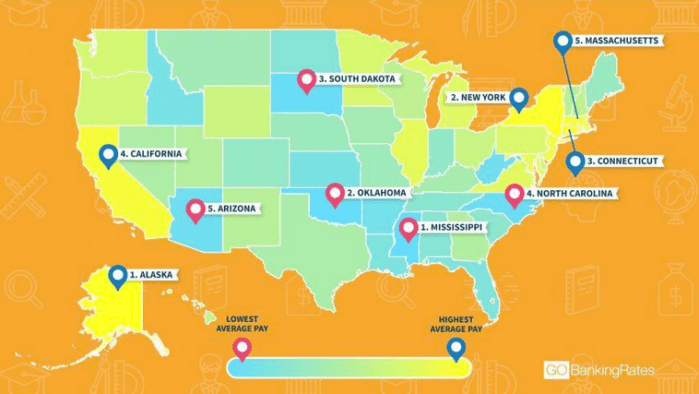
 

book-2


The Necessity and Importance of Teachers

teacher-elementary-Getty-blog


Are teachers necessary?


That’s the question big business is asking.


Well, “asking” isn’t really the right word. They’re implying an answer.


Hedge fund mangers and ed tech soothsayers are betting hundreds of millions of dollars that educators aren’t really all that important.


They’re planning a future where real live people play a much smaller role in student learning.


They’re mapping out a world where kids don’t even have to go to school to grasp the basics, where learning can be accomplished anywhere but instigated, tracked, and assessed on-line through various computer platforms.


It’s called a learning ecosystem, personalized learning, competency based or individualized education. With little to no guiding principles, management or oversight, kids would engage in educational tasks on various devices in order to earn digital badges.


Children would bounce from a few hours of Khan Academy videos here to a software package there and Voila! “Modern” education!


It’s a brave new world where investors hope to make a bundle by reducing the cost and pocketing the savings.


Since teachers are the biggest cost, they’re the first things to go.


Since their rights as workers and human beings are a roadblock on this learning superhighway, they’re the first to go.


And since they’re in a prime position to see exactly what’s going on and to object when this ed tech paradise exploits the students it ostensibly is being built for, they MUST go – now, as soon as possible.


The Supreme Court’s recent decision in Janus v AFSCME is part of that process. It’s another way to weaken labor and clear the path for business – the collusion of politics and corporations to steamroll the rest of us and swipe more of our money regardless of the children in the steamrollers way.


So when I ask “Are teachers necessary?” it’s not a purely philosophical question.


The answer will have a major impact on both the education of today and where we go in the future.


If teachers are not necessary, that removes one of the biggest obstacles to this frightening and uncertain future.


Unfortunately, no matter how much I want to answer in the affirmative that teachers are necessary, I can’t do so.


Even after thousands of years of recorded history, learning remains a mysterious process. Yet it doesn’t take much reflection to realize that it can take place without the presence of a teacher.


Some things can be figured out solely by the learner in the right circumstances.


In fact, many academic studies have shown that teachers are not even the most important factor in the process.


Roughly 60% of academic achievement can be explained by family background – things like income and poverty level. School factors only account for 20% – and of that, teachers account for 15%. (see Hanushek et al. 1998; Rockoff 2003; Goldhaber et al. 1999; Rowan et al. 2002; Nye et al. 2004).


Estimates vary somewhat from study to study, but the basic structure holds. The vast majority of impact on learning comes from the home and out-of-school factors. Teachers are a small part of the picture. They are the largest single factor in the school building, but the school, itself, is only one of many components.


In short, teachers are not necessary to student learning.


But neither are doctors necessary to healing or lawyers necessary to acquittals.


Necessity is a very high bar.


To survive, you need food, shelter and clothing. However, having all three does not mean you have a good life. Slaves had all three – no free person would choose to trade places with someone in generational servitude simply because they had everything they needed to survive.


The same with medicine. If shot in the arm, you could provide me with all the medical equipment necessary to remove the bullet, but I would still have a difficult time doing it by myself. I COULD. A doctor is not NECESSARY for that operation. But without a doctor present, my chances of getting the best medical care drop dramatically.


Moreover, you could pop me in a courtroom without the benefit of legal counsel and it’s not impossible that I could argue my way to the dismissal of all charges against me. But the likelihood of doing so is infinitesimal – as undocumented youngsters are discovering when forced into the courtroom to defend against deportation without an attorney or even their parents present.


The same is true of education.


Though teachers are not necessary to learning, they are vital to it.


Having a teacher dramatically boosts a student’s chances, and the more disadvantaged that student is, the more he or she benefits from an educator.


The academic schemes of the corporate class amount to changing the field into the equivalent of an automated teller or a business robocall.


You can purchase your groceries through the self-checkout line. You can get your customer service from an automated list. But neither of these are the highest quality service.


They are cheap alternatives.


They are ways for the business to cut costs and boost profits. Neither have anything to do with making things better for the customer.


And when it comes to education, eliminating (or even drastically reducing access to) the teacher will decrease the quality of the service beyond recognition.


A 2009 report, Poverty and Potential: Out-of-School Factors and School Success, released by the Great Lakes Center for Education Research and Practice outlined several real world solutions to increase academic outcomes. None of them involve the elimination of teachers.


They are:


1. Reduce the rate of low birth weight children among African Americans

2. Reduce drug and alcohol abuse

3. Reduce pollutants in U.S. cites and move people away from toxic sites

4. Provide universal and free medical care for all citizens

5. Insure that no one suffers from food insecurity

6. Reduce the rates of family violence in low-income households

7. Improve mental health services among the poor

8. More equitably distribute low-income housing throughout communities

9. Reduce both the mobility and absenteeism rates of children

10. Provide high-quality preschools for all children

11. Provide summer programs for students from low-income homes to reduce summer losses in their academic achievement.


These are ways you improve education FOR CHILDREN.


This is how you make things better FOR THE LEARNER and not necessarily for the investor class.


And when it comes to teachers, there are numerous ways you can help them provide support for students.


First of all, hire more of them!


Today’s public schools employ 250,000 fewer people than they did before the recession of 2008–09. Meanwhile enrollment has increased by 800,000 students.


So if we wanted our kids to have the same quality of service children received in this country only a decade ago, we’d need to hire almost 400,000 more teachers!


That’s how you cut class size down from the 20, 30, even 40 students packed into a room that you can routinely find in some districts today.


And if you want to improve the quality of the teachers in those classrooms, here’s an easy fix – pay them.


According to the Economic Policy Institute, teachers in the United States make 14 percent less than people from professions that require similar levels of education.


Sadly, it only gets worse as time goes on.


Teacher salary starts low, and grows even more slowly.


original


According to a report by the Center for American Progress, on average teachers with 10 years experience only get a roughly $800 raise per year. No wonder more than 16 percent of teachers have a second or third job outside of the school system. They simply can’t survive on the salary.


They can’t buy a home or even rent an apartment in most metropolitan areas. They can’t afford to marry, raise children, or eke out a middle class existence.


If you want to attract the best candidates to the profession, you need to make it more attractive. One way to do that is to increase the salary.


And finally, stop micromanaging everything teachers do and stomping on their rights. To do their job effectively teachers need autonomy. They need the ability to make decisions on the ground based on the empirical evidence gathered in the classroom.


Moreover, they need the freedom to speak out when something is going wrong in their buildings or districts. When software packages are purchased that spy on students for corporations, they need the ability to sound the alarm. When high stakes standardized testing is out of control, they need to be able to voice their objections. When shoddy, second-rate academic standards are forced onto them by politicians and business people, they need to be able to blow the whistle.


To do that, they need their union protections. They need collective bargaining rights to give them the power to counterbalance the forces of greed and corruption that have always been at the schoolhouse door.


As a country we have taken our attention away from what’s really important. We’ve stopped focusing on how to make education better and instead equated it with how to make it more profitable for those who are already wealthy.


Teachers are vital to education. They are lifelines to struggling students. We should find ways to support them and not constantly undercutting their social standing, autonomy and rights.


The importance of teachers is beyond doubt. As is the importance of society in supporting them.


Like this post? I’ve written a book, “Gadfly on the Wall: A Public School Teacher Speaks Out on Racism and Reform,” now available from Garn Press. Ten percent of the proceeds go to the Badass Teachers Association. Check it out!

WANT A SIGNED COPY?

Click here to order one directly from me to your door!


book-1