It’s been nearly 70 years. We must have a recourse to such things these days. Mustn’t we?
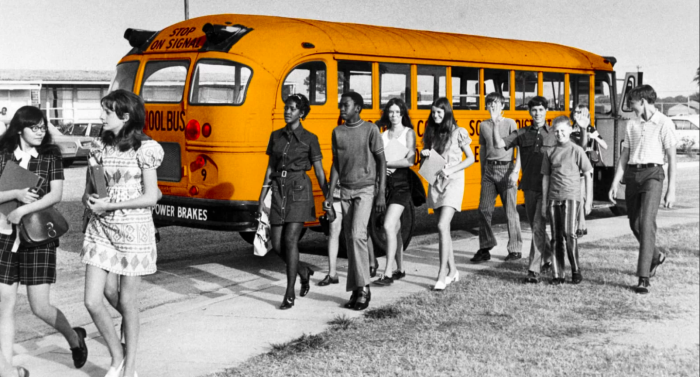
Well, the highest court in the land laid down a series of decisions, starting with Milliken vs. Bradley in 1974, that effectively made school integration voluntary especially within district lines. So much so, in fact, that according to a report from the U.S. Government Accountability Office, from 2000 to 2014, school segregation more than doubled nationwide.
But let’s say you did find some right-minded individuals who cared enough to make the effort to fix the problem.
What could they do?
The most obvious solution would be to build a single new school to serve both populations.
So if you could find the will and the money, you could give it a try.
We have exactly this situation in my own western Pennsylvania district, Steel Valley. We have two elementary schools – Barrett and Park – one of which serves mostly black kids and the other which serves mostly white kids. However, even when the children get to our single middle and high schools, segregation persists.
They may finally be in the same building, but they aren’t in the same classes.
Moreover, being in the higher level course comes with increased opportunities for mentoring, field trips, special speakers, contests, prizes, and self esteem. And the lower courses can degenerate into mindless test prep.
Which would you rather your child experience?
We don’t enroll students in one or the other at random. Nor do we place them explicitly based on their race or ethnicity.
Classroom grades, student interest, even teacher recommendations are largely ignored. Kids who pass their state mandated standardized assessments generally get in the higher classes and those who fail get in the lower classes.
In short, standardized assessments at best show which kids have had all the advantages. Which ones have had all the resources, books in the home, the best nutrition, live in the safest environments, get the most sleep, don’t live with the trauma of racism and prejudice everyday.
It was invented by eugenicists – people who believed that white folks were racially superior to darker skinned people. And the purpose of these tests from the very beginning was to provide a scientific (now recognized as pseudo scientific) justification for their racism.
I don’t mean that 2+2=4 has a racial bias. But most questions aren’t so simple. They ask test takers to read passages and pick out certain things that are more obvious to people enculturated as white than those enculturated as black. They use the vocabulary of middle to upper class people just to ask the questions.
This is white supremacy. Using these tests as a gatekeeper for funding, tracking, and self-respect is educational apartheid.
For example, according to a Department of Education Office for Civil Rights report from 2014, black students in the northern California city of Sacramento make up 16.3 percent of the population but only 5.5 percent of GATE programs. Meanwhile, in the south of the state, in San Diego, 8 percent of students are black, but make up just 3 percent of GATE classes.
Those are big disparities. In fact, the phenomenon is so common that social scientists created a term to describe it – racialized tracking.
But it has also been the subject of civil rights complaints.
In New Jersey the imbalance was so extreme the American Civil Liberties Union (ACLU) filed a complaint in 2014 against the South Orange–Maplewood School District. In a statement, the ACLU said racial segregation across academic tracks “has created a school within a school at Columbia High School.” More than 70 percent of students in lower classes were black while more than 70 percent of students in advanced classes were white.
Even so there wasn’t much that could be done. The matter ended with the Office for Civil Rights ordering the district to hire a consultant to fix the problem, but it still persists to this day.
This “school within a school” went from metaphor to reality in Austin, Texas. In 2007, a city school, the Lyndon Baines Johnson Early College High School, split into two different entities existing within the same building. And the main factor separating the two was race.
The second floor became the Liberal Arts and Science Academy (LASA), a public magnet high school serving mostly white and Asian students. Meanwhile, the majority black and Latino students stayed on the first floor taking regular education courses.
How can that be legal? Because too many people want it that way.
Being gifted, talented or advanced can’t be reduced to a score on a standardized test. In fact, I’d argue that such measures should be banished from our conception of excellence altogether as the tests, themselves, should be discontinued.
This doesn’t mean we can ignore the centuries of racist policies that keep our children of color down – housing segregation, inequitable funding, over policing, a lack of resources, being left out of specialized programs. Nor does it mean that we can ignore implicit bias white teachers invariably have about black students.
But we have to dismantle the systemic racism enshrined in our school policies. The most well-meaning individuals will make little headway if the system, itself, is corrupt.
The two must be accomplished hand-in-hand, at the micro and macro level.
Integration is absolutely essential. We must ensure that all of our students get to go to school together – but not just in the same buildings, in the same classes.
It is important to meet the needs of every student, but we cannot in doing so allow unspoken bias to be the gatekeeper of opportunity.
Equity is not just a pretty word. It has to be one of our most cherished goals.
Otherwise our policies and our people will leave many children behind.
Like this post? You might want to consider becoming a Patreon subscriber. This helps me continue to keep the blog going and get on with this difficult and challenging work.
In order to belong to both worlds, I’ve had to abide by one ironclad rule that I’m about to break:
Never write about my home district.
Oh, I write about issues affecting my district. I write about charter schools, standardized testing, child poverty, etc. But I rarely mention how these things directly impact my school, my classroom, or my students.
I change the names to protect the innocent or gloss over the specifics with ambiguity.
To put it bluntly, we have two elementary schools – one mostly for white kids and one mostly for black kids.
Our district is located on a steep hill with Barrett Elementary at the bottom and the other schools – Park Elementary, the middle and high school – at the top.
These schools serve students from K-4th grade. By 5th grade they are integrated once again when they all come to the middle school and then the high school. There the mix is about 40% black to 60% white.
But having each group start their education in distinctly segregated fashion has long lasting effects.
Maybe it has something to do with the differences in services we provide at each elementary school. Maybe it has to do with the resources we allocate to each school. Maybe it has something to do with how modern each building is, how new the textbooks, the prevalence of extracurricular activities, tutoring and support each school provides.
But it also has to do with the communities these kids come from and the needs they bring with them to school. It has something to do with the increasing need for special education services especially for children growing up in poverty. It has something to do with the need for structure lacking in home environments, the need for safety, for counseling, for proper nutrition and medical services.
No one group has a monopoly on need. But one group has greater numbers in need and deeper hurts that require healing. And that group is the poor.
According to 2017 Census data, around 27% of our Steel Valley children live in poverty – much more than the Allegheny County average of 17% or the Pennsylvania average of 18%.
And of those poor children, many more are children of color.
Integrating our schools, alone, won’t solve this problem.
If you’ll allow me a brief diversion, it reminds me of a historical analogue of which you’ve probably never heard – the Great Stink of 1858.
Let me take you back to London, England, in Victorian times.
The British had been using the Thames River to wash away their garbage and sewage for centuries, but the river being a tidal body wasn’t able to keep up with the mess.
Moreover, getting your drinking water from the same place you use to wash away your sewage isn’t exactly a healthy way to live.
But people ignored it and went on with their lives as they always did (if they didn’t die of periodic cholera outbreaks) until 1858.
That year was a particularly dry and hot one and the Thames nearly evaporated into a dung-colored slime.
But the politicians of the time refused to do anything to fix the problem. They sprayed lime on the curtains. They even sprayed it onto the fecal water – all to no avail.
It took two decades but they did it right and almost immediately the cholera outbreaks stopped.
They calculated how big a sewage system would have to be constructed for the contemporary population and then made it twice as big. And the result is still working today!
Scientists estimate if they hadn’t doubled the size it would have given out by the 1950s.
This seems to be an especially important bit of history – even for Americans more than a continent and a century distant.
It seems to me an apt metaphor for what we’re experiencing here in Steel Valley.
Everyone knows what’s causing the stink in our district – school segregation.
Likewise, we know what needs to be done to fix it.
We need a new elementary complex for all students K-4. (I’d actually like to see 5th grade there, too.) And we need busing to get these kids to school regardless of where they live.
The excuse for having two segregated elementary schools has typically been our segregated communities and lack of adequate public transportation.
We’re just a school district. We can’t fix the complex web of economic, social and racial issues behind where people live (though these are matters our local, state and federal governments can and should address). However, we can take steps to minimize their impact at least so far as education is concerned.
In short, our kids have always walked to school. Kids at the bottom of the hill in Homestead and West Homestead walk to Barrett. Kids at the top in Munhall walk to Park. But we never required elementary kids to traverse that hill up to the middle and high school until they were at least 10 years old.
We didn’t think it fair to ask young kids to walk all the way up the hill. Neighborhood schools reduced the distance – but kept the races mostly separate.
We need busing to remove this excuse.
I’ve heard many people deny both propositions. They say we can jury rig a solution where certain grades go to certain schools that already exist just not on a segregated basis. Maybe K-2 could go to Park and 3-4 could go to Barrett.
It wouldn’t work. The existent buildings will not accommodate all the children we have. Frankly, the facilities at Barrett just aren’t up to standard. Even Park has seen better days.
We could renovate and build new wings onto existing schools, but it just makes more sense to build a new school.
After all, we want a solution that will last for years to come. We don’t want a Band-Aid that only lasts for a few years.
And I do sympathize with this position. After all, as Superintendent Ed Wehrer said, the district is still paying off construction of the high school, which was built in the 1970s.
I’m sure McKeesport administrators and school board members along with those at other neighboring districts could provide Steel Valley with the expertise we need to get this done. I’m sure we could find the political will to help us get this done.
And that’s really my point: our problem is less about what needs to happen than how to do it.
We should at least try to do this right!
We can’t just give up before we’ve even begun.
Debates can and should be had about where to build the new school, how extensive to have the busing and other details. But the main plan is obvious.
Sure, some fools will complain about sending their little white kids to class with black kids. We heard similar comments at the town hall meeting. But – frankly – who cares what people like that think? The best thing we could do for their children would be to integrate the schools so that parental prejudices come smack into conflict with the realities of life.
And if doing so makes them pull out of Steel Valley, good riddance. You never need to justify doing the right thing.
If children of all races went to the same schools with each other, it would be harder to treat them unequally.
Moreover, it would be harder for them to grow up prejudiced because they would have learned what it’s like to have classmates who are different from them.
Perhaps that’s why it was so astounding when Kamala Harris brought up the issue of school segregation and busing at the first Democratic debates.
If you’re anything like me, for the first time these debates made Harris look like a viable contender for the party’s Presidential nomination to face Republican incumbent Donald Trump in 2020.
During the debates, Harris called out front runner and former vice president Joe Biden for opposing court-ordered busing in the 1970s as a way of combating school segregation.
The California Democrat and former federal prosecutor rightly said that 40 years ago there was a “failure of states to integrate public schools in America,” so “that’s where the federal government must step in.”
But her star-making moment was when she made the whole matter extremely personal.
“There was a little girl in California who was part of the second class to integrate her public schools and she was bused to school every day,” Harris said. “That little girl was me.”
While perfectly happy to support busing as a measure to stop segregation in the past, she seems much less comfortable using it to stop our current school segregation problems.
So the question remains: in some areas should we bus kids from black neighborhoods to schools located in white ones and vice versa to ensure that our classrooms are integrated?
Since the debates, Harris has waffled saying busing should be “considered” by school districts but she would not support mandating it.
In subsequent comments, she said she’d support a federal mandate for busing in certain situations where other integration efforts have not been effective or when the courts have stepped in to provide the federal government that power. However, she does not believe that either of these conditions have been met.
Frankly, it sounds a whole lot more like someone desperately making things up as she goes along than someone with a true plan to fix a deep problem in our public education system.
In fact, it is a cornerstone of his “Thurgood Marshall Plan for Education.” Not only would he repeal the existing ban on using federal transportation funding to promote school integration, he would put aside $1 billion to support magnet schools to entice more diverse students. However, the most ambitious part of his desegregation effort goes beyond legislation. Sanders promises to “execute and enforce desegregation orders and appoint federal judges who will enforce the 1964 Civil Rights Act in school systems.”
At least two Supreme Court rulings have taken away the federal government’s power to enforce Brown v. Board. The first was 1974’s Milliken v. Bradley ruling which established that federal courts could not order desegregation busing across school district lines. They could only do so inside districts. So in big cities like Detroit – where the case originated – you have largely black city schools surrounded by mostly white suburban ones. The ruling forbids busing from city to suburban districts and vice-versa thereby destroying any kind of authentic desegregation efforts.
“Fulfill the promise of Brown v Board of Education through a progressive housing policy that includes affirmatively furthering fair housing, implementing zoning reform, and expanding affordable housing in high opportunity areas. These efforts will reduce racial segregation in classrooms.”
In other words, Castro hopes to work around the courts by incentivizing integration in neighborhoods which would also increase it in our schools.
It’s a good plan – though perhaps not enough in itself.
For instance, the second point of his plan is called “Reimagining High School” – a monicker stolen from the XQ Superschools program, a philanthrocapitalist scheme to rebrand school privatization funded by Laurene Powell Jobs, the widow of Steve Jobs.
And speaking of standardized testing and edtech, there are other telling hints that he’s on the neoliberal bandwagon in his current education plan:
“Provide educators and public schools flexibility in defining success, including competency-based assessments and support for transitions away from seat-time requirements. Provide maximum flexibility for school leaders, teachers, and students to work together to develop rigorous, competency-based pathways to a diploma and industry recognized credentials,” [Emphasis mine].
Castro has some good ideas, but his troubling associations and language give any person familiar with these issues reason to pause.
Of course, Castro has not yet made a real mark among those Democrats seeking their party’s nomination.
Perhaps more important is the relative silence of a more popular candidate, Sen. Elizabeth Warren.
She hasn’t spoken much about integration efforts on the campaign trail. Along with Sanders, she is a co-sponsor of the Strength in Diversity Act, the leading congressional vehicle for school integration. However, that legislation is deeply flawed because it not only increases grant money for desegregation but also gives a big chunk of change away to charter schools.
For most of my life, the United States has been neglecting its public school children – especially the black and brown ones.
Since the mid 1970s, instead of integrating our schools, we’ve been slowly resegregating them on the basis of race and social class.
Since the 1980s, instead of measuring academic success by the satisfaction of an individuals curiosity and authentic learning, we’ve been slowly redefining it to mean nothing but achievement on standardized tests.
And since the 1990s, instead of making sure our schools meet the needs of all students, we’ve been slowly allowing charter schools to infect our system of authentic public education so that business interests are education’s organizing principle.
But now, for the first time in at least 60 years, a mainstream political candidate running for President has had the courage to go another way.
We didn’t see this with Barack Obama. We didn’t see it with Bill Clinton. We certainly didn’t see it with any Republican Presidents from Reagan to the Bushes to Trump.
It doesn’t take a deep dive into the mass media to find this out. You don’t have to parse disparate comments he made at this rally or in that interview. If you want to know what Bernie thinks about education policy, you can just go on his campaign Website and read all about it.
In almost every regard, only Sanders has the guts to tell you straight out exactly what he thinks. And that’s clear right from the name of his proposal.
I’m not saying it’s perfect. He doesn’t go as far as he might in some areas – especially against high stakes testing. But his plan is so far advanced of anything anyone else has even considered, it deserves recognition and strong consideration.
Bernie proposes we increase funding to integrate schools, enforce desegregation orders and appoint federal judges who will support these measures. He wants to triple Title I funding for schools serving poor and minority children and increase funding for English as a Second Language programs. He even suggests racial sensitivity training for teachers and better review of civil rights complaints and discipline policies.
Moreover, charters increase segregation – 17 percent of charter schools are 99 percent minority, compared to 4 percent of traditional public schools.
To reverse this trend, Bernie would ban for-profit charter schools and impose a moratorium on federal dollars for charter expansion until a national audit was conducted. That means no more federal funds for new charter schools.
Moving forward, charter schools would have to be more accountable for their actions. They would have to comply with the same rules as authentic public schools, open their records about what happens at these schools, have the same employment practices as at the neighborhood authentic public school, and abide by local union contracts.
I think we would find very few that could meet this standard – but those that did could – with financial help – be integrated into the community school system as a productive part of it and not – as too many are now – as parasites.
Could Bernie as President actually do all of this? Probably not considering that much of charter school law is controlled by the states. But holding the bully pulpit and (with the help of an ascendant Democratic legislature?) the federal purse strings, he could have a transformative impact on the industry. It would at least change the narrative and the direction these policies have been going. It would provide activists the impetus to make real change in their state legislatures supporting local politicians who likewise back the President’s agenda.
Once again, this isn’t something the President can do alone. He needs the support of Congress and state legislatures. But he could have tremendous influence from the Oval Office and even putting this issue on the map would be powerful. We can’t solve problems we don’t talk about – and no one else is really talking much about this. Imagine if the President was talking about it every day on the news.
4) He’d Provide More Funding for Special Education Students
Bernie wants to not only fulfill the age old promise of special education funding but to go beyond it. He proposes the federal government meet half the cost for each special needs student. That, alone, would go a long way to providing financial help to districts and ensuring these children get the extra help they need.
Bernie suggests working with states to ensure a minimum starting salary of $60,000 tied to cost of living, years of service, etc. He also wants to protect and expand collective bargaining and tenure, allow teachers to write off at least $500 of expenses for supplies they buy for their classrooms, and end gender and racial discrepancies in teacher salaries.
It’s an ambitious project. I criticized Kamala Harris for proposing a more modest teacher pay raise because it wasn’t connected to a broad progressive education platform like Sanders. In short, we’ve heard neoliberal candidates make good suggestions in the past that quickly morphed into faustian bargains like merit pay programs – an initiative that would be entirely out of place among Sanders initiatives.
In Harris’ case, the devil is in the details. In Sanders, it’s a matter of the totality of the proposal.
6) He Wants to Expand Summer School and After School Programs
It’s no secret that while on summer break students forget some of what they’ve learned during the year and that summer programs can help reduce this learning loss. Moreover, after school programs provide a similar function throughout the year and help kids not just academically but socially. Children with a safe place to go before parents get home from work avoid risky behaviors and the temptations of the streets. Plus they tend to have better school attendance, better relationships with peers, better social and emotional skills, etc.
Under the guidance of Betsy Devos, the Trump administration has proposed cutting such programs by $2 billion. Bernie is suggesting to increase them by $5 billion. It’s as simple as that. Sanders wants to more than double our current investment in summer and after school programs. It’s emblematic of humane and rational treatment of children.
7) He Wants to Provide Free Meals for All Students Year-Round
One in six children go hungry in America today. Instead of shaming them with lunch debts and wondering why they have difficulty learning on an empty stomach, Bernie wants to feed them free breakfast, lunch and even snacks. In addition, he doesn’t want to shame them by having the needy be the only ones eligible for these free meals. This program would be open to every child, regardless of parental wealth.
It’s an initiative that already exists at many Title I schools like the one where I teach and the one where my daughter goes to school. I can say from experience that it is incredibly successful. This goes in the opposite direction of boot strapped conservatives like Paul Ryan who suggested a free meal gives kids an empty soul. Instead, it creates a community of children who know that their society cares about them and will ensure they don’t go hungry.
That may seem like a small thing to some, but to a hungry child it can make all the difference.
8) He Wants to Transform all Schools into Community Schools
This is a beautiful model of exactly what public education should be.
Schools shouldn’t be businesses run to make a profit for investors. They should be the beating heart of the communities they serve. Bernie thinks all schools should be made in this image and provide medical care, dental services, mental health resources, and substance abuse prevention. They should furnish programs for adults as well as students including job training, continuing education, art spaces, English language classes and places to get your GED.
Many schools already do this. Instead of eliminating funding for these types of schools as the Trump administration has suggested, Bernie proposes providing an additional $5 billion in annual funding for them.
There are a lot of issues that fall under this umbrella, but they are each essential to a 21st Century school. Solutions here are not easy, but it is telling that the Sanders campaign includes them as part of his platform.
So there you have it – a truly progressive series of policy proposals for our schools.
Not since Lyndon Johnson envisioned the Elementary and Secondary Education Act (ESEA) has there been a more far reaching and progressive set of education initiatives.
What About High Stakes Testing?
Unfortunately, that also highlights Sanders biggest weakness.
The glaring omission from Sanders plan is anything substantive to do with high stakes testing.
The Thurgood Marshall plan hardly mentions it at all. In fact, the only place you’ll find testing is in the introduction to illustrate how far American education has fallen behind other countries and in this somewhat vague condemnation:
“We must put an end to high-stakes testing and “teaching to the test” so that our students have a more fulfilling educational life and our teachers are afforded professional respect.”
However, it’s troubling that for once Bernie doesn’t tie a political position with a specific policy. If he wants to “end high-stakes testing,” what exactly is his plan to do so? Where does it fit within his education platform? And why wasn’t it a specific part of the overall plan?
Thankfully, it is addressed in more detail on FeelTheBern.org – a Website not officially affiliated with Sanders but created by volunteers to spread his policy positions.
After giving a fairly good explanation of the problems with high stakes testing, it references this quote from Sanders:
“I voted against No Child Left Behind in 2001, and continue to oppose the bill’s reliance on high-stakes standardized testing to direct draconian interventions. In my view, No Child Left Behind ignores several important factors in a student’s academic performance, specifically the impact of poverty, access to adequate health care, mental health, nutrition, and a wide variety of supports that children in poverty should have access to. By placing so much emphasis on standardized testing, No Child Left Behind ignores many of the skills and qualities that are vitally important in our 21st century economy, like problem solving, critical thinking, and teamwork, in favor of test preparation that provides no benefit to students after they leave school.”
The site suggests that Bernie supports more flexibility in how we determine academic success. It references Sanders 2015 vote for the Every Child Achieves Act which allows for states to create their own accountability systems to assess student performance.
In addition, the site notes the problems with Common Core and while citing Sanders reticence with certain aspects of the project admits that he voted in early 2015 against an anti-Common Core amendment thereby indicating opposition to its repeal.
I’ll admit this is disappointing. And perplexing in light of the rest of his education platform.
It’s like watching a vegan buy all of his veggies at Whole Foods and then start crunching on a slice of bacon, or like a gay rights activist who takes a lunch break at Chick-fil-a.
My guess is that Sanders hasn’t quite got up to speed on the issue of standardized testing yet. However, I can’t imagine him supporting it because, frankly, it doesn’t fit in with his platform at all.
One wonders what the purpose of high stakes testing could possibly be in a world where all of his other education goals were fulfilled.
For me, the omission of high stakes testing from Sanders platform is acceptable only because of the degree of detail he has already provided in nearly every other aspect. There are few areas of uncertainty here. Unlike any other candidate, we know pretty well where Sanders is going.
It is way more likely that advocates could get Sanders to take a more progressive and substantial policy stand on this issue than that he would suddenly become a standardized testing champion while opposing everything else in the school privatization handbook.
Conclusion
So there it is.
Bernie Sanders has put forth the most progressive education plan in more than half a century.
It’s not perfect, but it’s orders of magnitude better than the plans of even his closest rival.
This isn’t to say that other candidates might not improve their education projects before the primary election. I hope that happens. Sanders has a knack for moving the conversation further left.
However, he is so far ahead, I seriously doubt that anyone else will be able to catch him here.
Who knows what the future will bring, but education advocates have a clear first choice in this race – Bernie Sanders.
He is the only one offering us a real future we can believe in.
In this article, I’m going to try to explain in the most simple terms I know the reality of segregation in our schools, how it got there and the various forms it takes.
I do this not because I am against public education. On the contrary, I am a public school teacher and consider myself a champion of what our system strives to be but has never yet realized. I do this because until we recognize what we are doing and what many in power are working hard to ensure we will continue doing and in fact exacerbate doing, we will never be able to rid ourselves of a racist, classist disease we are inflicting on ourselves and on our posterity.
America, the Segregated
It’s never been one monolithic program. It’s always been several co-existing parallel social structures functioning together in tandem that create the society in which we live.
I’m reminded of possibly the best description of American segregation on record, the words of the late great African American author James Baldwin who said the following on the Dick Cavett Show in 1968:
“I don’t know what most white people in this country feel. But I can only conclude what they feel from the state of their institutions. I don’t know if white Christians hate Negroes or not, but I know we have a Christian church that is white and a Christian church that is black. I know, as Malcolm X once put it, the most segregated hour in American life is high noon on Sunday.
That says a great deal for me about a Christian nation. It means I can’t afford to trust most white Christians, and I certainly cannot trust the Christian church.
“I don’t know whether the labor unions and their bosses really hate me — that doesn’t matter — but I know I’m not in their union. I don’t know whether the real estate lobby has anything against black people, but I know the real estate lobby is keeping me in the ghetto. I don’t know if the board of education hates black people, but I know the textbooks they give my children to read and the schools we have to go to.
“Now this is the evidence. You want me to make an act of faith, risking myself, my wife, my woman, my sister, my children on some idealism which you assure me exists in America, which I have never seen.”
As Baldwin states, there are many different ways to keep black people segregated. There are many different flavors of the same dish, many different strains of the same disease.
We can say we’re against it, but what we say doesn’t matter unless it is tied to action.
You can say you’re in favor of equity between black and white people all day long, but if the policies you support don’t accomplish these things, you might as well wear a white hood and burn a cross on a black person’s lawn. It would at least be more honest.
Segregated Schools
In terms of public education, which is the area I know most about and am most concerned with here, our schools are indeed set up to be segregated.
If there is one unstated axiom of our American Public School System it is this: the worst thing in the world would be black and white children learning together side-by-side.
They point to inequalities they, themselves, helped create and use them to push for a system that would create even worse inequality. They point to the segregation that they, themselves, helped install and use it as an excuse to push even more segregation.
And they do so by controlling the media and the narrative. They call themselves reformers when they’re really vandals and obstructionists looking to subvert the best in our system in order to maximize the worst.
School Segregation Today
Sure we don’t have very many all white or all black schools like we did before Brown v. Board. Instead we have schools that are just predominantly one race or another.
ALL kids are not divided by race. Just MOST of them.
White people and black people tend to live in different neighborhoods. Some of this is a choice. After a history of white oppression and racial strife, people on both sides of the divide would rather live among those with whom they identify.
Black people don’t want to deal with the possibility of further deprivations. White people fear retaliation.
However, white people generally enjoy a higher socio-economic status than black people, so there is some push back from black folks who can afford to live in whiter neighborhoods and thus enjoy the benefits of integration – bigger homes, less crowding, less crime, access to more green spaces, etc. But even when there is a desire, moving to a white neighborhood can be almost impossible.
State and federal laws, local ordinances, banking policies and persistent prejudice stand in the way.
In short, red lining still exists.
Real estate agents and landlords still divide up communities based on whom they’re willing to sell or rent to.
And this is just how white people want it.
They’re socialized to fear and despise blackness and to cherish a certain level of white privilege for themselves and their families.
And if we live apart, it follows that we learn apart.
The system is set up to make this easy. Yet it is not uncomplicated. There is more than one way to sort and separate children along racial and class lines in a school system.
There are several ways to accomplish school segregation. It comes in multiple varieties, a diversity of flavors, all of which achieve the same ends, just in different ways.
By my reckoning, there are at least three distinct paths to effectively segregate students. We shall look at each in turn:
Put the white neighborhoods in District A and the black ones in District B. It’s kind of like gerrymandering, but instead of hording political power for partisan lawmakers, you’re putting your finger on the scale to enable academic inequality.
However, sometimes you can’t do that. Sometimes you don’t have the power to determine the makeup for entire districts. Instead, you can do almost the same thing for schools within a single district.
That means the whiter districts get higher paid and more experienced teachers. It means they have broader curriculum, more extracurricular activities, a more robust library, more well-trained nursing staff, more advanced placement courses, etc.
Fewer funds mean fewer resources, fewer opportunities, more challenges to achieve at the same level that white students take for granted. A budget is often the strongest support for white supremacy in a given community or society as a whole. In fact, if you want to know how racist your community is, read its school budget. You want accountability? Start there.
The same holds even when segregation is instituted not at the district level but at the level of the school building.
It may sound ridiculous but this is exactly what happens much of the time. You have gorgeous new buildings with first class facilities in the suburban areas and run down crumbling facilities in the urban ones – even if the two are only separated geographically by a few miles.
Like any parasite, charter and voucher schools only survive in the proper environment. It usually looks like this.
Sometimes no matter how you draw the district lines or how you appropriate the buildings, you end up with a black majority and a white minority. That’s a situation white parents find simply intolerable.
White children must be kept separate and given all the best opportunities even if that means taking away the same for black children.
Once again, this creates the opportunity for a resource gap. The charter and voucher schools suck away needed funds from the public schools and then are subsidized even further by white parents.
The quality of education provided at these institutions is sometimes better – it’s often worse. But that’s beside the point. It’s not about quality. It’s about kind. It’s about keeping the white kids separate and privileged. It’s about saving them from the taint of black culture and too close of an association with black people.
Second, the situation can work in reverse. Instead of dividing the whites from the blacks, it divides the blacks from the whites.
This happens most often in districts where the divide is closer to equal – let’s say 60% one race and 40% another. Charter and voucher schools often end up gobbling up the minority students and leaving the white ones in the public school. So instead of white privatized and black public schools, you get the opposite.
And make no mistake – this is a precarious position for minority students to be in. Well meaning black parents looking to escape an underfunded public school system jump to an even more underfunded privatized system that is just waiting to prey on their children.
Unlike public schools, charter and voucher institutions are allowed to pocket some of their funding as profit. That means they can reduce services and spending on children anytime they like and to any degree. Moreover, as businesses, their motives are not student centered but economically driven. They cherry pick only the best and brightest students because they cost less to educate. They often enact zero tolerance discipline policies and run themselves more like prisons than schools. And at any time unscrupulous administrators who are under much less scrutiny than those at public schools can more easily steal student funding, close the school and run, leaving children with no where to turn but the public school they fled from in the first place and weakened by letting privatized schools gobble up the money.
The result is a public school system unnaturally bleached of color and a privatized system where minority parents are tricked into putting their children at the mercy of big business.
3) Tracking
But that’s not all. There is still another way to racially segregate children. Instead of putting them in different districts or different schools, you can just ensure they’ll be in different classes in the same school.
However, it most often results in further stratifying students socially, economically and racially.
Here’s how it works.
Often times when you have a large enough black minority in your school or district, the white majority does things to further horde resources even within an individual school building or academic department.
In such cases, the majority of the white population is miraculously given a “gifted” designation and enrolled in the advanced placement classes while the black children are left in the academic or remedial track.
It enables bleaching the advanced courses and melanin-izing the others. This means administration can justify giving more resources to white students than blacks – more field trips, more speakers, more STEAM programs, more extracurriculars, etc.
And if a white parent complains to the principal that her child has not been included in the gifted program, if her child has even a modicum of ability in the given subject, more often than not that white child is advanced forward to the preferential class.
CONCLUSIONS
Segregation is a deep problem in our public school system. But it cannot be solved by privatization.
In fact, privatization exacerbates it.
Nor is public education, itself, a panacea. Like any democratic practice, it requires participation and the economic and social mobility to be able to participate as equals.
Schools are the product of the societies that create them. An inequitable society will create inequitable schools.
Segregation has haunted us since before the foundation of our nation.
They don’t want their children to be educated among black students – maybe SOME black students, maybe the best of the best black students, but certainly not the average run of the mill brown-skinned child.
This has to stop.
There are plenty of benefits even for white students in an integrated education. It provides them a more accurate world-view and helps them become empathetic and prize difference.
We need to demilitarize law enforcement. We need new training programs that emphasize de-escalation of violence – not a shoot-first-ask questions-later mentality.
And it’s hard to focus on that when racism and prejudice get in the way. We need to fix racism first. Only then can we address the root issue.
Instead we’d have schools that serve everyone – a broad mix of cultures, races and ethnicities all properly resourced and offering a broad range of curriculum and extra-curricular activities.
There’s one thing you have to understand. Racism isn’t an ideology. It’s a sickness. It’s a virus that blinds people to real truths about the world and makes them more prone to holding views that are just plain wrong.
The same with sexism, anti-Semitism, homophobia and a plethora of modern day maladies that should have gone the way of small pox and polio.
Do you want to get into college just because you’re white?
Do you want to get a job just because of the hue of your epidermis?
Do you want the sum total of your value as a human being to be dependent on the way light reflects off your skin?
I don’t.
I’m white, and I don’t want that for me or my posterity.
I want people to judge me for me – not some preconceived notion of who I am based on culturally received generalities and the amount of melanin in my outermost cells.
Fuck that shit.
I’m me. And if that’s not good enough for anyone they can just go and jump in the river.
I don’t need white supremacy. And I don’t want it.
White will no longer be considered normal. Neither will male.
It’s just another way to be – no better or worse than any other.
That doesn’t mean being ashamed of your whiteness. Hell. We can revel in it.
Imagine reconnecting with all the messy ethnicities we’ve plastered over to claim this homogenous white overclass! Imagine being Polish again, and Czech and German and Scandinavian and so many other nationalities that we barely connect with because we don’t want to draw attention to ourselves as anything other than white — That’s me. Just white. Plain white. Nothing to see here. White.
We’ve had to sacrifice a whole lot to get that status. But we don’t have to keep sacrificing. We can be who we are, too.
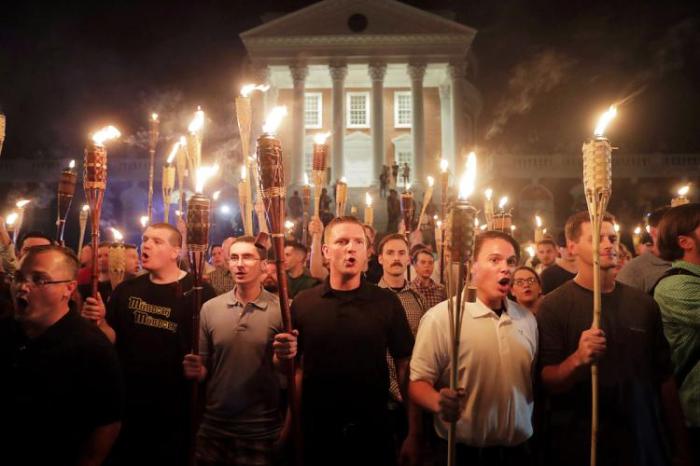
The Alt-Right Nazis are out there in the streets chanting, “You will not replace us.”
How about we replace ourselves.
Why don’t we redefine who we are as – who we are.
Not homogenous. Not white. But specific human beings belonging to various cultural, ethnic and religious groups and societies.
Human beings all taking part in the symphony of homo sapia, engaged in a robust love of all things people and a recognition that all people are human.
Think for a moment what that truly means.
Take a deep breath.
Let it in. Let it out.
It means letting go of this irrational fear that anti-racism is anti-white.
So, let me say it again – no. Black progress will not come at white expense. Nor will female progress or anyone’s progress.
On the one hand, we’re one of the first modern Democracies, a product of Enlightenment thinking and unabashed pluralism and cultural diversity.
On the other, we’ve built our entire society on a cast system that is the basis of our economics, politics and cultural mores.
We’re the land of Benjamin Franklin, the Wright brothers, Duke Ellington, Toni Morrison, and Sandra Day O’Connor.
But we’re also the land of Andrew Jackson, Jefferson Davis, Charles Lindberg, Bull Connor, and David Duke.
Tolerance and love are as American as apple pie. But so are racism, sexism, prejudice and anti-Semitism.
“It is not as though the United States is the land of opportunity, or a hypocritical racist state,” says sociologist John Skrentny. “It is one or both, depending on context.”
To which I reply, “Hell, yes, it is! Where have you been the last 241 years!?”
We base our salary scales on genitalia! You think we’re really so freaking advanced!?
The shade of your epidermis determines the likelihood of police arresting you, charging you, even killing you regardless of your having a weapon, whether you resist arrest or simply lay on the ground with your hands in the air.
Regardless of the evidence, if you’re convicted, the length and severity of the sentence are all partially determined by the amount of melanin in your skin. The cultural derivation of the name on your resume determines the likelihood of employers calling you back for an interview. In many places, your rights are legislated based on whom you love.
Our schools are segregated. Our taxes are levied most heavily on those with the least means to pay. Our prisons house more black people today than did slave plantations in the 1860s.
Yet a bunch of white dudes carrying Tiki torches shouting hate filled puns (“Jew will not replace us”? Seriously?) somehow doesn’t compute?
Come on.
This is America.
Racism and prejudice are not threats smuggled in past border security. They’ve always been here. At least since Europeans came offering trade and peace with one hand and guns and smallpox with the other.
The land of the free was stolen from the Native Americans. Our national wealth was built on the backs of slaves. Our laws and electoral system were built to empower one group at the expense of others.
Yet reformations in this process are rarely met with celebration. Instead of memorializing the end of slavery, we embrace the institution with fond remembrance.
Nor did prejudice and bigotry end when Rosa Parks refused to give up her seat, after Brown vs. Board, the Voting Rights Act, Freedom Rides, sit-ins or civil rights protests.
America has always been a place hostile to the under privileged, the second sex, religious dissenters, the brown skinned.
At most, we had become less confrontational in recent years, but we never really changed our core values, our social structures, who has power and who does not.
During my lifetime, people started to equate having a black President with the end of racism. Somehow they ignored the everyday reality for most black people.
They ignored the constant prejudice against the poor, the continued bigotry against LGBTs, the Islamophobia, the increase in hate crimes.
If there has been any change during the past eight months, it hasn’t been with the degree to which Americans are prejudiced. It’s the degree with which we’re willing to hide it.
Whereas before racists would claim to be colorblind, that their actions were completely devoid of racial bias, today they sigh and repeat the dusty slogans of Jim Crow Alabama or 1930s Berlin.
And somehow people are actually surprised about this.
It’s because too many of us have swallowed the lies about living in a post-racial society.
You thought we were beyond all that. It was a brave new world, morning in America, and we were finally treating everyone equally – unless you looked at what we were actually doing.
Mainly this is the reaction you get from white people. They rub their eyes and just can’t believe it.
You don’t see this too often from people of color, Muslims, LGBTs and some Jews. Why? Because they never had the luxury to ignore it.
That’s what we white folks have been doing since the beginning.
Whenever these issues come up, we have a knee jerk reaction to minimize it.
Things aren’t that bad. You’re just blowing it out of proportion.
But, no. I’m not.
That’s why you’re so damn shocked, son.
You haven’t been looking reality square in the face.
So when we’ve got undeniable video footage of angry white males (mostly) marching through Southern streets brandishing swastikas and assault rifles, it catches many white folks off guard.
They’re not prepared for it – because they haven’t been doing their homework.
We’ve been living in a bubble. Especially those living in major metropolitan areas.
That kind of thing never happens around here, right?
Of course it does!
Just because you live above the Mason Dixon Line doesn’t mean you’re safe.
You have a black friend, you like authentic Mexican food and you laugh while watching “Modern Family.”
But you haven’t opened your eyes to the reality outside your door.
You send your kids to private school or live in a mostly upper class white district. You have an exclusive gym membership that keeps out the riff-raff. You work in an office where that one token person of color makes you feel sophisticated and open-minded.
You’ve got to wake up.
You’ve got to educate yourself about race and class in America.
Because those people you saw in Charlottesville aren’t an anomaly.
They are an authentic part of this country, and if you don’t like it, you have to do something about it.
You can’t hide behind denial.
You have to take a stand, pick a side, and be counted.
Because one day soon, the torches will be outside your door.
You have to decide now – do you want to brandish or extinguish them?
In what must count as another new low in American discourse, the school voucher industry is striking back against claims that their products lead to greater segregation of students.
Randi Weingarten, President of the American Federation of Teachers (AFT), had the audacity to voice the truth:
“Make no mistake: This use of privatization, coupled with disinvestment are only slightly more polite cousins of segregation,” she said a week ago during a speech at the AFT’s yearly convention.
To which school privatization mouthpieces quickly countered with the truth:
“If vouchers are the polite cousins of segregation, then most urban school districts are segregation’s direct descendants. The vast majority of our urban public school districts are segregated because of white flight and neighborhood neglect.”
This was from a statement by Kevin Chavous, founding board member of the American Federation for Children, the school privatization advocacy group that Secretary of Education Betsy DeVos used to lead.
So there you have it.
A nation of more than 325 million people, with a more than 241-year history reduced to – I Know You Are But What Am I?
Does that mean that both systems – privatized and public – are equally at fault? Does it mean that both somehow get a pass for reprehensible behavior?
No and no.
First, we must explain why segregation is bad.
Peter Cunningham, former assistant secretary for communications and outreach at the Education Department under Obama, wagged his finger at Weingarten on the privatization propaganda Website, the 74.
He called out Weingarten’s hypocrisy, which takes some cojones for a man who only last year pondered aloud and in public whether segregation was really such a bad thing.
“Maybe the fight’s not worth it. It’s a good thing; we all think integration is good. But it’s been a long fight, we’ve had middling success. At the same time, we have lots and lots of schools filled with kids of one race, one background, that are doing great. It’s a good question.”
Funny, isn’t it?
He calls out Weingarten because of public school segregation but defends charter schools because their segregation is somehow just swell.
Keep in mind. Cunningham is the executive director of the Education Post, a well-funded charter school public relations firm that packages its advertisements, propaganda and apologias as journalism. And he’s not about to poop where he eats.
So, yes, Mr. Cunningham, segregation is worth fighting.
That’s why in Brown v. Board the U.S. Supreme Court struck down “Separate but Equal” – because when races are kept separate, their schools are rarely equal.
This game of excusing one system based on the deficiencies of the other is pure sophistry.
To be fair, Weingarten seems to tacitly admit this about public schools.
She acknowledges the disinvestment in public education, how public schools have been systemically undermined by politicians and lobbyists, many of them advocating for privatized schools, so that they could use this disinvestment as an excuse for their own for-profit education schemes.
“…no amount of facts or evidence will sway voucher proponents from their agenda to starve public schools to the breaking point, then criticize their deficiencies and let the market handle the rest, all in the name of choice,” she said in a statement.
Schools serving poor and minority students aren’t getting the proper resources. So they propose further segregating them.
That’s a terrible idea. It’s like escaping from a leaky cruise ship by jumping into a leaky lifeboat. You’ll sink in both, but the lifeboat will sink quicker.
Yes, our public schools are segregated by race and class and therefore poor and minority students receive inequitable funding and resources. Charters and vouchers cannot possibly remedy that. They will always make it worse. Only a robust and integrated public school system can be truly equitable. A system that deifies choice cannot combat racism if it is freely chosen.
We have let the wolf write our education policy. It should be no shock that his solution isn’t to build more houses of bricks but to process our little piggies into bacon.
Full disclosure: I am no fan of Weingarten.
I recently called for both her and National Education Association (NEA) President Lily Eskelsen Garcia to voluntarily step down because of undemocratic practices and mismanagement in both teachers unions.
However, I’ll stand up for her when she’s right, and in this instance, she is.
Frankly, it makes her ineffective in speaking out on this matter. I have nothing against charter school teachers. I know, personally, several very good educators who work at charter schools. In this job market, sometimes you have to take what you can get. However, the sad fact of the matter is that by their very structure, charter schools are inferior to public schools. They are less democratic, less transparent, less accountable and more easily subject to fraud and abuse of children. That’s not to say all charters are guilty of this, but just by being a charter school and being subject to the deregulated rules governing them, they are more susceptible to these errors than their traditional public school brethren.
Perhaps the biggest mistake Weingarten made was in glossing over the worst abuses of public schools. If she was going to call out the segregation at voucher schools, she also should have explicitly called it out at public schools.
But everywhere you look in the education debate you’ll find people clinging to their segregated charter schools, pushing for more segregated school vouchers, and lobbying to increase segregation at our traditional public schools.
You might be forgiven for thinking that the issue was resolved way back in 1954 when the US Supreme Court ruled in the landmark Brown vs. Board of Education case.
Justices decided that it was unconstitutional to have substandard schools for black and minority students while also maintaining pristine schools for white children, as was the practice in most parts of the country at the time.
They struck down the previous justification of “separate but equal” because when you have separate schools, they are rarely equal.
You might think that’s just common sense. When you have schools just for blacks and schools just for whites, the resources aren’t going to be divided fairly or evenly. One group will always get the upper hand. Better to mix the two groups so it’s harder to select against one or the other.
And this is true of almost every cultural division you can think of: race, gender, class, religion, etc. The only way to protect everyone is to make it harder to hurt one group without hurting them all.
Everyone should already know that. But it still strikes some as news.
Take vouchers – allocating tax dollars to parents so they could “choose” to send their kids to private schools that won’t accept minorities – they tried it.
Or charters – setting up schools that are privately run but publicly funded so parents can “choose” to send their kids to schools allowed to discriminate against minorities during enrollment – they tried it.
And they’re still trying it and getting away with it.
It took decades for Brown v. Board to truly be enforced nationwide, and even after it became unavoidable, the fight to undermine it never truly died.
According to a report from the U.S. Government Accountability Office, from 2000 to 2014, school segregation has more than doubled nationwide. That’s twice the number of schools comprised almost entirely of students living in high poverty and/or students of color.
Classrooms were the most diverse from the 1970s through the early 1990s. At peak integration, four out of 10 black southern students attended a white school, while less than a third of all black students attended majority black schools.
What went wrong? The Supreme Court.
The highest court in the land laid down a series of decisions, starting with Milliken vs. Bradley in 1974, that effectively put the breaks on school integration. In fact, that first case is often criticized as “one of the worst Supreme Court decisions” ever.
It dealt with Detroit’s plan to integrate students by busing them from the inner city to the suburbs. The court ruled that such a plan was unconstitutional, because black students only had the right to attend integrated schools WITHIN THEIR OWN SCHOOL DISTRICT. If few white people lived there, well oh well.
And thus, de facto segregation was born.
If black and white people didn’t live together in the same neighborhoods – and they rarely do – then they wouldn’t be forced to go to school together. Forget that banks and insurance companies often refuse or limit loans, mortgages, and insurance to people of color for properties within specific geographical areas – a practice known as red lining. There was nothing municipal or school officials from minority jurisdictions could do to force integration across these artificial borders.
Between1991 and 1995, the Court made matters even worse in three additional rulings. Justices decided that integration was merely a temporary federal policy and once the imbalance was righted, school districts should be released from any desegregation orders.
The results can be seen in almost every traditional public school in the country. There are rich schools and poor schools. There are black schools and white schools. And our federal and state education policies take advantage of the separation making sure that privileged schools get the lions share of resources while the others have to make do with less.
It is the key issue holding back our system of public education. Almost every school where students have low test scores has a disproportionately high level of poverty and students of color. If our schools were truly integrated, there would be none labeled “failing.” There would only be students who need extra help though they would be equally distributed throughout and thus not stigmatized. Unfortunately, re-segregation has allowed an easy scapegoat, and this, in turn, has been an excuse to build more charter schools and pass more school vouchers that drastically increase that same segregation.
Some people look at this situation and claim that it means we should abandon traditional public schools. If they’re already segregated, they argue, we should just invest in the choice schools.
However, doing so would not solve any of our problems. It would only exacerbate them. The solution to smoking is not more cigarettes. It’s quitting.
School segregation is terrible. That’s true at charter, voucher and traditional public schools.
The presence of segregation is no reason to abandon public education. It just means we need to fix it.
We need to value all children, not just those who resemble us racially, socially and/or economically.
That’s why school segregation is so bad.
It divides our children into discrete groups. It sets up the social structure and ensures the privileged will continue to be prized and the underprivileged will continue to be devalued. It teaches children to trust those like themselves and to distrust those who are different.
School segregation is the mother of racism and prejudice. And until we, adults, have the courage to tackle it, the next generation will grow up just like us – selfish, racist and blind.
John Oliver recently reported on the same issue (Warning: vulgarity):
“Why should I care about other people’s children?”
One reader put it this way:
“Why should my child’s education and safety have to suffer because of difficult and violent students? …it isn’t my responsibility to pay for a miscreant’s education.”
It is the root cause of most of our problems in education today and has nothing to do with children. It’s all about adults – adults lacking empathy.
On the one hand, I get it. As a parent, you can’t help but love your child more than anyone else’s. You would beg, cheat and steal to make sure your child has enough to eat, is clothed and sheltered, has everything she needs to succeed in this world.
That’s a position for which few would show any embarrassment. It’s just being human.
But it shouldn’t also mean that you don’t care at all for other children.
I’d like to pose a radical thought – loving my child does not mean I’m indifferent to yours.
When you look at a babe in arms do you feel the same indifference? I don’t.
Perhaps it’s just the way we’re built. I feel an immediate nurturing instinct. I want to protect and provide for children – any children – even if they’re not mine.
If you saw a baby all alone crying on the side of the road, would you stop to help her? I would. I couldn’t help it. I can do no other.
If I saw a toddler in distress, a tween, even an unruly teenager in need, I would try to help. And I think most of us would do the same.
Doing so wouldn’t hurt my child. In fact, it would show her how a decent person acts towards others. It would teach her empathy, kindness, caring. It would demonstrate the values I try to instill in her – that we’re all in this together and we owe certain things to the other beings with which we share this world.
Why would you not want to do that?
We do not live in a world where you have to choose between your child and all others. There is a middle course. We can do for all society’s children without unduly sacrificing our own.
And if we can, why wouldn’t we?
Public school is essentially a community endeavor. It is an attempt to give everyone in your neighborhood the same start, the same opportunity, the same advantages.
It means allowing all children who live in the community the ability to attend the community school. That’s better than selecting the best and brightest and to Hell with the rest.
It means having an elected school board who holds public meetings, deliberates in the open and has to offer almost all documents to the light of day. That’s just better than an appointed board of directors who hold private meetings behind closed doors and who aren’t compelled to show any documentation for how they’re spending public tax money.
When you send your child to school – any school – she will have to deal with other students. She will meet children who are mean, unkind, unruly and a bad influence. But this is true at all schools – public and private, voucher or charter, secular or parochial. The biggest difference is racial and economic.
Our educational institutions today have become so segregated by class and race that even our public schools offer white middle class and wealthy students the opportunity to learn in an environment nearly devoid of children of color or children who live in poverty. This divide is drastically widened by charter, private and parochial schools.
So when people complain about the class of children they want to keep separate from their progeny, it is always imbued with a racist and classist subtext.
What they mean is: I don’t want my child to have to put up with all those black students, all those brown children, all those unwashed masses of impoverished humanity.
I proudly send my daughter to public school for the same reasons that many withhold their children from it. I want her to experience a wide variety of humanity. I want her to know people unlike her, and to realize that they aren’t as different as they might first appear. I want her to know the full range of what it means to be human. I want her to be exposed to different cultures, religions, nationalities, world views, thoughts and ideas.
And I want it not just because it’s better for my community – I want it because it’s better for her, too.
I want my daughter and I to both live in a world populated by educated citizens. I want us both to live in a society that treats people fairly, and where people of all types can come together and talk and reason and enjoy each other’s company.
Imagine! Thinking I could offer my child all the richness of a public school experience, all the knowledge of a district’s worth of teachers, all the variety of social contact – how vain I would need to be to think I could do all that, myself!
Some people want their children to become little versions of themselves. They want to create a generation of mini-me’s who’ll carry on their way of thinking into the future.
That’s not my goal at all.
I want my daughter to share my core values, I want her to learn from my experiences, but I don’t want her to think like me at all. I want her to be a new person, special and unique.
If you stop and think about it, that’s what most of us want for our children.
It’s a common goal that can be achieved with a common mechanism.
So why should we care about other people’s children?
Because it’s better for ours. Because doing so makes us better people. Because all children are ends in themselves. Because they’re beautiful, unique sparks of light in a dark universe.










 gadflyonthewallblog