In whose interest are we sending our kids to school?
Is it for businesses so that they’ll have the kinds of workers they need?
Is it so that our students’ educations will align with the demands of industry?
Or is it for the children? So they’ll become mature, intelligent adults capable of independent thought and making rational decisions?
Who, after all, is this education for?
I mean our society has jobs that need doing and people need to do those jobs or we won’t survive – but is that really the overriding, predominant impetus behind school? Survival?
Are we primarily helping the economy by subjecting our kids to the classroom? Or are we doing something to benefit THEM?
Is there a value in being educated? A value to the person who has become educated?
Does it provide any advantage to a person to know things? To be able to think about things? To be able to express oneself in writing? To be able to make calculations? To use logic and reason? To know history? To be able to read and comprehend what one’s read? To form an educated opinion on what one’s read? To know and practice the scientific method? To express one’s creativity? To do any of a hundred other things kids learn in school?
Or are we just filling the factories with button pushers to keep smoke spilling out of the chimneys?
It’s more than two decades past the millennium, and I can’t believe I still have to ask such questions.
But I do. Because nearly every day some policymaker, pundit, billionaire or other over-privileged talking head feels free to answer these questions wrong.
Five minutes alone in the dark and the answers are inescapable. But these guys (and it’s usually men) don’t have that kind of time or integrity.
In what they say, what they do, what they promise, what they ponder in earshot of the press, they show a persistent ignorance of what education is and who it is for.
I’m tired of telling them the truth. I’m tired of correcting them. Because they don’t care to be corrected. They have a fixed conception of the world, and understanding the truth about education might make that all come tumbling down.
“The unexamined life is not worth living.”
Socrates is purported to have said that 2,400 years ago.
It’s not exactly news.
What’s the purpose of life if you don’t think about things?
But no matter how much money they have, the plutocrats can’t afford to think about things. And they certainly can’t afford for YOU or your children to think about things.
What would happen if we all went around examining our lives? Would we still submit to being cogs in an economy designed to benefit them and not us?
Would we still show up everyday to jobs we hate for salaries incapable of paying the bills?
Would we still shop constantly to fill the aching void in our hearts, not thinking but just re-enacting the American mantra of consume, Consume, CONSUME!?
Would we still worship the rich like gods regardless of the reality – their immature actions, their crude posturing, their obvious amoral banality?
Would we still pretend that skin color determines character, that nationality determines morality, that sex determines temperament, that biology determines gender, that rationality determines politics?
Would we still vote for one of two prepackaged, preconceived, preprocessed options neither of which will actually do what we know needs done but one of which will hurt us and the other of which will hurt others more or not hurt us worse than we already are?
The answers are obvious. We all know. You don’t need me to tell you.
Just like the purpose of education.
It is the most dangerous thing in the world to the status quo.
Education, learning, thought is a cocoon. And no one knows what will come crawling out after the metamorphosis.
So how can we let anyone truly be educated? They might end up different – different from their parents, different from their congregations, their friends, neighbors, society.
Who is education for?
For whom would we risk all this?
Who is worth such danger, such terror, such uncertainty?
You know who.
Like this post? You might want to consider becoming a Patreon subscriber. This helps me continue to keep the blog going and get on with this difficult and challenging work.
ChatGPT’s responses are entertaining because we know we’re not communicating with a human being. But that’s exactly what you need to encourage the most complex learning.
Human interaction is an essential part of good teaching. You can’t do that with something that is not, in itself, human – something that cannot form relationships but can only mimic what it thinks good communication and good relationships sound like.
Even when it comes to providing right answers, chatbots have an extremely high error rate. People extolling these AI’s virtues are overlooking how often they get things wrong.
Anyone who has used Siri or Alexa knows that – sometimes they reply to your questions with non sequiturs or a bunch of random words that don’t even make sense.
ChatGPT is no different.
As more people used it, ChatGPT’s answers became so erratic that Stack Overflow – a Q&A platform for coders and programmers – temporarily banned users from sharing information from ChatGPT, noting that it’s “substantially harmful to the site and to users who are asking or looking for correct answers.”
The answers it provides are not thought out responses. They are approximations – good approximations – of what it calculates would be a correct answer if asked of a human being.
The chatbot is operating “without a contextual understanding of the language,” said Lian Jye Su, a research director at market research firm ABI Research.
“It is very easy for the model to give plausible-sounding but incorrect or nonsensical answers,” she said. “It guessed when it was supposed to clarify and sometimes responded to harmful instructions or exhibited biased behavior. It also lacks regional and country-specific understanding.”
Eager for any headline that didn’t center on his disastrous takeover of Twitter, Musk endorsed the new AI even though he left the company in 2018 after disagreements over its direction.
However, AI and even chatbots have been used in some classrooms successfully.
Professor Ashok Goel secretly used a chatbot called Jill Watson as an assistant teacher of online courses at the Georgia Institute of Technology. The AI answered routine questions from students, while professors concentrated on more complicated issues. At the end of the course, when Goel revealed that Jill Watson was a chatbot, many students expressed surprise and said they had thought she was a real person.
This appears to be the primary use of a chatbot in education.
“Students have a lot of the same questions over and over again. They’re looking for the answers to easy administrative questions, and they have similar questions regarding their subjects each year. Chatbots help to get rid of some of the noise. Students are able to get to answers as quickly as possible and move on,” said Erik Bøylestad Nilsen from BI Norwegian Business School.
However, even in such instances, chatbots are expensive as yet to install, run and maintain, and (as with most EdTech) they almost always collect student data that is often sold to businesses.
Like this post? You might want to consider becoming a Patreon subscriber. This helps me continue to keep the blog going and get on with this difficult and challenging work.
I’m not saying teachers should go into the classroom with no idea of what they hope their students will learn everyday.
But the idea that we have so much control over our students that we can tell them with pinpoint accuracy exactly what knowledge and/or skills will be implanted in their skulls on any given day is so reductively stupid as to be laughable.
Because, Brother, you don’t understand how teaching works!
So let’s begin with the reasons why this idea is still attractive.
First, we want to let students know what they’ll be experiencing in class on a day-by-day basis.
It’s a reasonable request to a degree. How many times have students walked into the classroom and the first thing that comes out of their mouths are, “What are we doing today?”
However, experienced classroom teachers know that this isn’t the real question. Most of the time when a student asks this they aren’t interested in what we are doing. They’re interested in what we AREN’T doing.
I hear this question most often in my last period classes because the students are exhausted from a full day of academics. They want to know if I’m going to tire them further or if there might be a chance at a breather here and there.
The second reason this practice is attractive is for principals.
They think it’s to be a toady to the Superintendent or higher level administrators. They think they have to demonstrate their performance to their bosses with whatever data is available at every turn. (This is also what they expect teachers to do for them.)
When I think of how principals used to manage their buildings and create an environment conducive for learning – for teachers to best impact their students – it makes me want to cry.
I miss real principals.
In any case, we can see why this demand is attractive.
Students will be able to…WRONG! Students will have the OPPORTUNITY to, they will be ENCOURAGED to, their ENVIRONMENT will be altered to make it most conducive to…
You can’t say “Learn how to use nouns!” And WOOSH students can distinguish nouns from pronouns with pinpoint accuracy. You can’t put hands on a student’s head and say “Reading Comprehension!” And suddenly they pick up a book and start reading Shakespeare with absolute fidelity.
Yes, you can post these things on the wall. But what good does it do?
Students may see it and think to themselves, “So that’s what the teacher is trying to get me to know!” But how does that help?
When I took piano lessons, my teacher never told me the lesson was on the chromatic scale. She just gave me a few pieces to practice and helped me over the parts where I was stumbling.
Moreover, even if she had told me that, it wouldn’t have meant anything to me. Because I didn’t know what the chromatic scale was!
So much of education is skill based. We learn HOW to do something. We don’t spend much time on WHAT it is or any theories of how it all comes together. And even if we did, that would come at the end, not the beginning.
When I teach my students how to write a single paragraph essay, for example, I have them write three drafts – a prewriting, a first draft (heavily scaffolded with a planner) and a final copy.
They often complain that this is a lot of writing and want to know why I’m making them do all this when they feel they could probably skip one or two steps and still come to almost as good of a final project.
I ask them to trust me. I tell them this is the best way, and that they’ll understand later. And since I’ve spent so much time creating a relationship of give-and-take, of trust, they often just get on with the work.
What I’m really doing with all these drafts is getting the format of the single paragraph essay embedded in their minds. They’re memorizing it without even knowing it.
Moreover, writing multiple drafts is good practice when you get to more complicated and longer essays. It forces you to re-evaluate what you wrote previously and it encourages you to improve it before you are finished.
Finally, it instills a process into your mind. You start to feel like this is the right way to do something and you resist taking the easier road because the way you were taught has lead to success in the past (and it will probably serve you well in the future as things get more complex).
Do you really think I should stop and explain all that to my students before we begin? Do you think it would help?
Absolutely not! Children (like tech entrepreneurs and business tycoons) often think they know everything when they really know nothing. If you explain everything to them at the beginning, they can get contrary and refuse to do all you ask to demonstrate they know better. This often leads to dead ends and reteaching – if possible.
Maybe it might help encourage some of them to stay in the profession?
Maybe that might actually help student learning?
Huh? Maybe?
Like this post? You might want to consider becoming a Patreon subscriber. This helps me continue to keep the blog going and get on with this difficult and challenging work.
Large-scale independent studies in Indiana,Louisiana, Ohio and Washington, D.C., show that students who used vouchers were as negatively impacted as if they had experienced a natural disaster. Their standardized test scores went down as much or more than students during the Covid-19 pandemic or Hurricane Katrina in 2005.
They lose the friends, teachers, and communities where they grew up. It’s like yanking a sapling from out of the ground and transplanting it to another climate with another type of soil which may not be suited to it at all.
Vouchers have nothing to do with helping kids escape struggling public schools.
School vouchers overwhelmingly go to kids who already attend private or parochial schools.
In the states that have released their data, more than three quarters of families who apply for vouchers for their children already send their kids to private schools. That’s 75% of voucher students in Wisconsin, 80% in Arizona, and 89% in New Hampshire. So these kids didn’t need our tax dollars in the first place. We’re just paying for services they’re already receiving.
Moreover, the very idea is absurd. If the school where the student is enrolled is struggling, why wouldn’t you simply invest in that school to make it better and fix the underlying problem? Why disrupt children’s educations by moving them to another school in another system that is entirely unproven, itself?
Vouchers have nothing to do with more efficient schools.
Let’s get one thing straight – voucher schools are businesses, often new businesses just opening up. And like any other start-up, the failure rate is extremely high. According to Forbes, 90% of start-ups fail – often within the first few years.
Lastly, vouchers have nothing to do with freedom or choice.
Unless it’s the choice to be a bigot and indoctrinate your child into your own bigotry.
Vouchers are about exclusion – who gets to attend these PRIVATE schools – and indoctrination – what nonsense they can teach that public schools cannot.
For example, in Florida, Grace Christian School, a private institution that refuses to enroll LGBTQ kids has received $1.6 million so far in taxpayer funding. In Indiana, more than $16 million has gone to schools banning LGBTQ kids—or even kids with LGBTQ parents! That’s roughly 1 out of every 10 private schools in the state with just this one discriminatory enrollment.
Meanwhile thousands of parochial schools that receive public funding use textbooks provided by The American Christian Education (ACE) group. This includes the A Beka Book and Bob Jones University Press textbooks. A Beka publishers, in particular, reported that about 9,000 schools nationwide purchase their textbooks.
In their pages you’ll find glowing descriptions of the Ku Klux Klan, how the massacre of Native Americans saved many souls, African slaves had really good lives, homosexuals are no better than rapists and child molesters, and progressive attempts at equal rights such as Brown vs. Board of Education were illegal and misguided. You know – all the greatest Trump/MAGA hits!
Call me crazy, but I don’t think that’s a curriculum worthy of taxpayer dollars. I think if you’re going to take public money, you should have to accept all of the public, and you shouldn’t be allowed to teach counterfactual claims and prejudice as if they were fact.
Every private or parochial school isn’t like that.
But a heck of a lot of them are!
We shouldn’t be wasting our time trying to sort through other people’s businesses when we have our own educational enterprise – public schools – which cumulatively do a much better job.
It should come as no surprise that removing students from public school and sending them to a private or parochial school doesn’t work to help them academically.
It would be much more effective to provide support where students are than make them undergo the trauma of uprooting.
Finally let me say something about the issue of standardized testing.
It is the surrounding factors – like that most voucher schools don’t have to use certified teachers with the same quality degrees as public schools, that they don’t have to use the same kind of high-quality curriculum or pass the same kinds of public scrutiny.
This is hypocritical. We need to demand more from our lawmakers in this regard.
The same far right ideologues that support Trump and the MAGA fascists are the driving force behind the push for more school vouchers.
Undoubtedly, they are helped by unscrupulous Democrats, but at least the Dems CLAIM to still believe in facts and representative government.
It’s time they paid heed to the facts and represented us by ending their support for school vouchers and the MAGA factories most of these vouchers go to support.
Bigotry is a losing proposition in a democracy where you need as many votes as possible to get elected to office.
And dressing up indoctrination as if it were just freedom and economics only works if we’re foolish enough to let it.
NOTE:In this article, I am indebted to the work of Josh Cowen, a professor at Michigan State University who has been studying school vouchers for more than two decades.
Like this post? You might want to consider becoming a Patreon subscriber. This helps me continue to keep the blog going and get on with this difficult and challenging work.
All-in-all, it was a good night. Especially in an election cycle where Republicans had every advantage. The President’s party usually loses seats during the midterms, and just last week it seemed that Joe Biden would be no exception. However, now that the dust has cleared, the losses seem to be minimal to nonexistent.
The Critical Race Theory panic (A.K.A. – teaching actual history) will fade to just another wing nut conspiracy theory thrown to the Republican base to generate support instead of an actual policy proposal to restrict academic freedom.
For the first time in years, Republicans may have to push toward the center instead of constantly to the lunatic fringe. Otherwise, they’ll continue to lose.
Second, we may actually see some positive education policies make their way through the state legislature.
Shapiro has promised to increase education funding. That and the still pending court decision on a lawsuit against the state demanding adequate funding may be enough to turn the funding faucet on a few cranks. With Democrats holding an increasing share of seats, all it takes is a few moderate Republicans (are they out there?) to join them to get things done.
However, it isn’t all wine and roses.
During the general election, Shapiro came out in favor of some school voucher programs. This puts him to the right of our current Governor Tom Wolf. So we can look forward to our new Governor supporting an increase for tax credit scholarships and other de facto voucher plans that will drain public education coffers just as we’re working to increase them.
It is also anyone’s guess whether a pro-voucher Governor would support charter school reform – something we desperately need and that Wolf championed during his tenure.
And though both Wolf and Shapiro criticized standardized testing, it would take a mightily informed and courageous state politician to go up against the economic powerhouse of the testing industry.
Things might even get better here and there – especially with additional funding.
However, we will have to monitor our representatives as if they were little kids sulking by the cookie jar. They will almost definitely try to sneak in some garbage legislation to hurt our students and enrich their corporate buddies.
A robust Democratic Party determined to enact progressive legislation could make much of such a situation, but as we’ve seen in the past, that is not the case with the current leadership.
The most we can realistically hope for is that they put a stop to insane GOP legislation.
The question is whether we can build on such Democratic gains at both the state and national level. Usually that doesn’t happen. But it will have to be the goal moving forward.
So let us celebrate a worthy election cycle while we prepare for all the political battles still to come.
A sigh of relief, a renewed fighting stance and back into the fray.
Like this post? You might want to consider becoming a Patreon subscriber. This helps me continue to keep the blog going and get on with this difficult and challenging work.
This almost always concludes with two types of plan.
First, there is the serious venture made up of things like increasing spending to meet student need, wraparound services, early intervention, reducing class size, redistributive justice and cultural competence – a plan that looks the reality in the face and makes bold attempts to come to terms with it.
Then there is the cheap knockoff proposition – a buzzword-laden scheme where someone is trying to convince you their half hearted proposal is actually a solution to the very real problem of educational inequality.
And the number one thing you can use to tell the difference between the two is this – standardized test scores.
The first plan that is centered around actually fixing disparities makes no mention of test scores – or at least relegates them to obstacles. The second is built all around them – as an essential component of the overall scheme.
This is because the second feel-good-accomplish-nothing plan is essentially performative.
Therefore, it is constructed around standardized test scores as a metric of success.
Planners think: We’re going to do A, B and C to make our schools more equitable. And how will we know we’re doing it right? We’ll use our standardized test scores!
And anyone who understands the history of these types of assessments and how they still work will know that this mirage is built at the cost of genuine equity.
So constructing your plan to fix this problem around one of its root causes is like claiming you can fix a sinking ship by drilling more holes in its hull.
At best, it’s naive. At worst, it’s self-defeating and disingenuous.
Both types of assessment are supposed to measure what students have learned. But not all learning is equal.
For example, a beginning chef needs to know how to use the stove, have good knife skills and how to chop an onion. But if you give her a standardized test, it instead might focus on how to make foie gras – something that would only come in handy at a high end French restaurant.
The fact of the matter is that standardized tests do NOT necessarily focus on the most important aspects of a given task. They focus on obscurities – things that most students don’t know.
This is implicit in the design of these exams and is very different from the kinds of tests designed by classroom teachers.
When a teacher makes a test for her students, she’s focused on the individuals in her classes. She asks primarily about the most essential aspects of the subject and in such a way that her students will best understand. There may be a few obscure questions, but the focus is on whether the test takers have learned the material or not.
When psychometricians design a standardized test, on the other hand, they aren’t centered on the student. They aren’t trying to find out if the test taker knows the most important facts or has the most essential skills in each field. Instead, there is a tendency to eliminate the most important test questions so that the test – not the student – will be better equipped to make comparisons between students based on a small set of questions. After all, a standardize test isn’t designed for a few classes – it is one size fits all.
New questions are field tested. They are placed randomly on an active test but don’t count toward the final score. Test takers aren’t told which questions they’ll be graded on and which are just practice questions being tried out on students for the first time. So students presumably give their best effort to both types. Then when the test is scored, the results of the field test questions determine if they’ll be used again as graded questions on a subsequent test.
If 40 to 60 percent of test takers answer the question correctly, it might make it onto the test. But questions that are answered correctly by 80 percent or more of test takers are usually jettisoned.
“As a consequence of the quest for score variance in a standardized achievement test, items on which students perform well are often excluded. However, items on which students perform well often cover the content that, because of its importance, teachers stress. Thus, the better the job that teachers do in teaching important knowledge and/or skills, the less likely it is that there will be items on a standardized achievement test measuring such knowledge and/or skills.”
If we are guided in large part by standardized test scores, we aren’t guided by authentic learning. We’re guided by a false picture of learning. Therefore, the most effective way – perhaps the only practical way – of raising test scores is to teach directly to a specific test. And not only the test, but the specific version of the test being given that year.
So if we do somehow manage to raise test scores, we haven’t improved academics at all but a mere semblance of it. And thus the equity we might celebrate in such a situation would be just as false.
You got a good score on the MAP test. Hurrah! But that doesn’t mean you know anything of real value except how to take this particular MAP test which, itself, will change after the next round of questions are field tested.
And if we insist on evaluating the equity of our schools on these test scores, we will only make things that much worse.
We end up chasing the psychometricians. We try to guess which aspects of a subject they think most students don’t know and then we teach our students that to the exclusion of more important information. And since what students don’t know changes, we end up having to change our instructional focus every few years based on the few bread crumbs surreptitiously left for us by the state and the testing corporations.
That is not a good way to teach someone anything. It’s like teaching your child how to ride a bike based on what the neighbor kid doesn’t know.
It’s an endless game of catch up that only benefits the testing industry because they cash in at every level. They get paid to give the tests, to grade the tests and when students fail, they get paid to sell us this year’s remediation material before kids take the test again, and – you guessed it – the testing companies get another check!
It’s a dangerous feedback loop, a cycle that promotes artificially prized snippets of knowledge over constructive wholes.
But we can no longer continue feeding that beast and pretending that we can somehow provide equity to our underserved children, too.
We have to choose – equity or testing. Fairness or unrestrained capitalism.
Do not believe anyone who tells you to support a plan built on both.
It does not exist.
Like this post? You might want to consider becoming a Patreon subscriber. This helps me continue to keep the blog going and get on with this difficult and challenging work.
In fact, the very idea seems ludicrous now – and this was being discussed like it was a foregone conclusion just a few months ago at the beginning of the summer.
It doesn’t matter – as long as we can keep them coming.
The young and dumb.
Or the old and out of options.
Entice retired teachers to come back and sub. Remove hurdles for anyone from a non-teaching field to step in and become a teacher – even military veterans because there’s so much overlap between battlefield experience and second grade reading.
If you have a hole in your pocket and you keep losing your keys, wallet and other vital things from out of your pants, the first thing you do is sew up the hole! You don’t keep putting more things in your pocket!
But that’s only true if you’re actually interested in solving the problem.
And make no mistake – experienced teachers are incredibly valuable. That’s not to say new teachers don’t have their own positive aspects, but the profession’s expert practitioners are its heart and soul.
Think about it.
Like any other profession, the longer you practice it, the better you usually get. For example, no one going under heart surgery would willingly choose a surgeon who had never operated before over a seasoned veteran who has done this successfully multiple times.
Republicans are literally running a political platform on weakening teachers, schools and education because they need the poorly educated to make up their voting base.
It is a political and economic plot against increasing the average intelligence and knowledge of voters, stealing government funding for personal gain and refusing to increase the quality of a government sponsored service.
In August, the national Education Association (NEA) sounded the alarm that an additional 300,000 educators had left since the report was issued. And it’s only getting worse. An NEA union poll found that 55% of educators were considering leaving education earlier than they had originally planned.
In my own district, there are several teachers who have taken leaves of absence or are sick and had to be temporarily replaced with long term subs. We’re located in western Pennsylvania south of Pittsburgh, just across the river from a plethora of colleges and universities with teacher prep programs. Yet it was pretty difficult to find anyone to fill these positions or serve as day-to-day subs.
There is so much we could be doing to encourage seasoned teachers to stay in the classroom beyond increased pay.
What we have here is a crisis that cuts to the very heart of America’s identity as a nation.
What do we want to be? A capitalist experiment in school privatization whose only regulation is the free hand of the market? Or a nation supported by a secure system of education that took us to the moon and made us the greatest global superpower the world has ever known?
There is a cost to becoming a great nation and not just emblazoning the idea on a hat.
That cost is education. It is paying, supporting and respecting veteran teachers.
Are we still willing to pay it?
Like this post? You might want to consider becoming a Patreon subscriber. This helps me continue to keep the blog going and get on with this difficult and challenging work.
“Teachers, we are operating on a lockdown. Please keep your doors locked until we tell you it has been lifted.”
Before me a sea of wide eyes and scared faces.
I slowly walked toward the door continuing the lesson I had been giving before the announcement. The door was already shut and secured but I nonchalantly turned the extra deadbolt.
“Click!” it sounded like a gunshot across the suddenly silent room.
I continued talking while making my way back to the blackboard pretending that nothing out of the ordinary was happening.
That’s just life in the classroom these days.
According to Eduction Week, there have been 38 school shootings in the US this year resulting in injuries or deaths. That’s up from 34 last year and the highest it’s been since the media source began tracking such things in 2018.
During the height of the Covid-19 pandemic, there were only 10 such shootings in 2020, and 24 each in 2019 and 2018.
That comes to a total of 130 school shootings in the last five years.
“Mr. Singer, can I go to the bathroom?” DeVon asked.
“I’m sorry,” I said. “We’re still under lockdown. I’ll write you a pass as soon as it’s lifted.”
It seems like nowhere is safe.
Three of this year’s shootings were in my home state of Pennsylvania.
A 14-year-old student was killed and four others wounded (ages 17, 15, 14, and 14) in a shooting near the high school athletic field after a football scrimmage.
“Mr. Singer, what’s happening?” Olivia asked.
I turned to her confused at first then I realized what she meant.
“The lockdown? Let me check my laptop. No…. Nothing. I really don’t know, Honey. But I’m sure whatever it is, it will be over soon. Why don’t you get back to the assignment?”
Every few years we do this. Teachers huddle in classrooms and try to react to a shooting scenario. We either barricade ourselves in our classrooms or try to find an escape route. We help train police and local medical personnel.
At this years training, teachers were given a talk by a law enforcement “expert” who regaled us with his time working as a Blackwater mercenary in Afghanistan. He told us how difficult it was to make decisions under fire but that sometimes you had to make the hard decisions.
“Some of you teachers have kids in wheelchairs in your classrooms. You think you’re going to get your whole class out of the building and to safety!? You have to ask yourself, how are you going to get that kid in the wheelchair out? What are you going to do if a child flips out or is too scared to move? I know it’s not nice to think about, but sometimes you have to make decisions that will save the most people – not necessarily everyone.”
It made me want to vomit. But he wasn’t telling me anything I didn’t already know.
I like to believe I’d pick the child up out of his wheelchair, throw him over my shoulder and carry him to safety. I hope I could calm down a child having a panic attack and whisk her out of the building.
“Mr. Singer, I really have to go to the bathroom.”
“You can’t hold it just a little longer, DeVon?”
“No,” he said hoping from foot to foot.
“Number 1 or number 2?”
He giggled and held up one finger.
I reluctantly pointed to the trash can.
“Take it over there to the corner. I’ll stand in front of you so…”
“Attention teachers! The lockdown has now been lifted. You may continue as normal.”
I sighed, unlocked the door and wrote DeVon a bathroom pass.
We never did find out what triggered the lockdown. One time it was a gunshot in the surrounding neighborhood. Another time it was an unauthorized adult seeking access to the building.
Not just on the days when one of these tragedies strike – but every day.
It is not safe for students and teachers – it will NEVER be completely safe, but it can be safer.
That’s the point – how safe can we make it?
And why aren’t we doing anything to reach that goal other than preparing for the worst?
Like this post? You might want to consider becoming a Patreon subscriber. This helps me continue to keep the blog going and get on with this difficult and challenging work.
“Democrats are pushing woke ideology, racism, and sexuality on children in the classroom. As your governor, I will ban this on day one…”
Yikes. This is like promising to ban sorcery in school – another thing we don’t teach.
This isn’t the Republican Party I remember when I was growing up.
Instead of personal autonomy and free trade, today’s GOP solemnly swears to eliminate a series of racially and sexually motivated phantasms that are like shadows under a child’s bed. I suppose it’s easier to get rid of something that’s never existed than to fix the real problems we actually have.
But let’s be honest – for some folks this kind of unhinged messaging works.
Many Republicans claim anti-male discrimination is wide spread. Men are blamed for so many things in our society they’re forced to turn to porn and video games because they have no other options, Green claimed.
And women have become “… too weak and pathetic to take care of themselves. They want a great big giant government to take care of them. It’s such a hypocrisy. They claim they want the future to be female, but they aren’t capable of taking care of themself.”
How did we get here? Public schools that teach sexual politics.
Male students are not responsible for a world created by past generations but they ARE responsible for picking a side and doing something about it as they become adult members of society.
Republicans literally think public school teachers are turning kids gay.
That’s the impetus behind Florida Gov. Ron DeSantis’s controversial “Don’t Say Gay” bill and several copycat bits of legislation the American Legislative Exchange Council (ALEC) is pumping out across the country.
They insist that even mentioning LGBTQ people exist is grooming children into a sexuality they wouldn’t otherwise have.
First, believing this shows massive ignorance.
No one can really be coerced into a sexuality they didn’t already possess. As you grow and mature, you have sexual preferences. It’s not really a matter of nurture – it’s nature. People are born this way.
Second, stubbornly refusing to acknowledge that there are other ways to express your sexuality is not going to make people ignore their innate inclinations. The idea seems to be that if kids never find out there are other options, they’ll simply be satisfied with heterosexuality – how they’re told to think and feel.
And finally, it is extremely unfair to LGBTQ people. We already live in a culture that celebrates cis hetero-normativity. Trying to erase everyone else causes real harm and trauma to both people who are different and to those who are not but never get to fully understand the entire spectrum of humanity.
Teachers are not making kids gay, but they are telling kids that gay people are real. We are trying to stop bullying and homophobia. And let’s be honest – that’s really what Republicans are objecting to here.
They want it to be okay to hate gay people.
Sorry. Not in public school.
3) Teaching kids to be trans
This is where the backlash against using appropriate pronouns and recognizing trans people is coming from.
As much as Republicans hate gay people, they absolutely despise and fear the trans community.
Once again they conflate acknowledging the existence of the other with coercing students to become the other. Just knowing that trans is an authentic way human beings can live is seen as a threat. But if this kind of knowledge makes you trans, you almost certainly were trans already.
It hurts no one to see the world as bigger than just one way of living. This is reality, after all. And that’s what Republicans are rebelling against.
Far from teachers coercing students to become trans, the GOP wants us to bully children not to be. They want to constrain difference, punish and hide it.
It’s not Critical Race Theory (which is a legal framework) nor do we teach anyone to hate white people. But we do teach what whiteness has done and continues to do.
-Median household income for Black people, at $43,862, is 37 precent less than that of white people, at $69,823.
-Census data shows Black couples are more than twice as likely as whites to be denied a mortgage or a home improvement loan, which leads to just 59 percent of the median home equity white households have, and just 13 percent of Black wealth.
-A Black child born today can expect to live four years less than a white one.
They shouldn’t make children hate white people, but they may encourage them to hate white supremacy.
And that’s what Republicans are really against.
5) Teaching kids to be sexually active
This may be the strangest fantasy the GOP is trying to spread about public school.
They say we’re making kids engage in sexual activity. Which is strange because according to the Centers for Disease Control, fewer US children are choosing to engage in sexual activity.
An estimated 55% of male and female teens have had sexual intercourse by age 18, according to the CDC’s National Center for Health Statistics (NCHS).
However, these percentages have declined since 1988 when 51% of female and 60% of male teens had engaged in sexual activity.
If public schools are teaching kids to bump uglies, we’re doing a bad job.
Are kids more sexualized today than in the past? Probably. But that’s a result of the culture. When you sell teenagers shorts with the word “juicy” on the butt, don’t complain about public schools.
Some schools offer sex education classes, but they are focused on health and wellness. There is no encouragement to have sex. In fact, many such classes are still teaching abstinence only instead of safe contraception.
The idea that public schools are teaching sex is just dog whistle politics. It is Republicans trying to scare parents that public schools are instilling values they don’t share. It is blaming public schools for social ills that the schools didn’t cause and don’t control.
Looked at calmly and rationally, all of these fantasies are just scare tactics to get the gullible to react emotionally on election day.
They want to terrify responsive voters into giving GOP candidates the power to stop a host of things that never really existed. They want an excuse for doing nothing to solve the actual problems of the day.
There’s a reason they spend so much time railing against woke education – they want to ensure America remains asleep.
A fitful sleep – tossing and turning in various Republican nightmares.
Like this post? You might want to consider becoming a Patreon subscriber. This helps me continue to keep the blog going and get on with this difficult and challenging work.
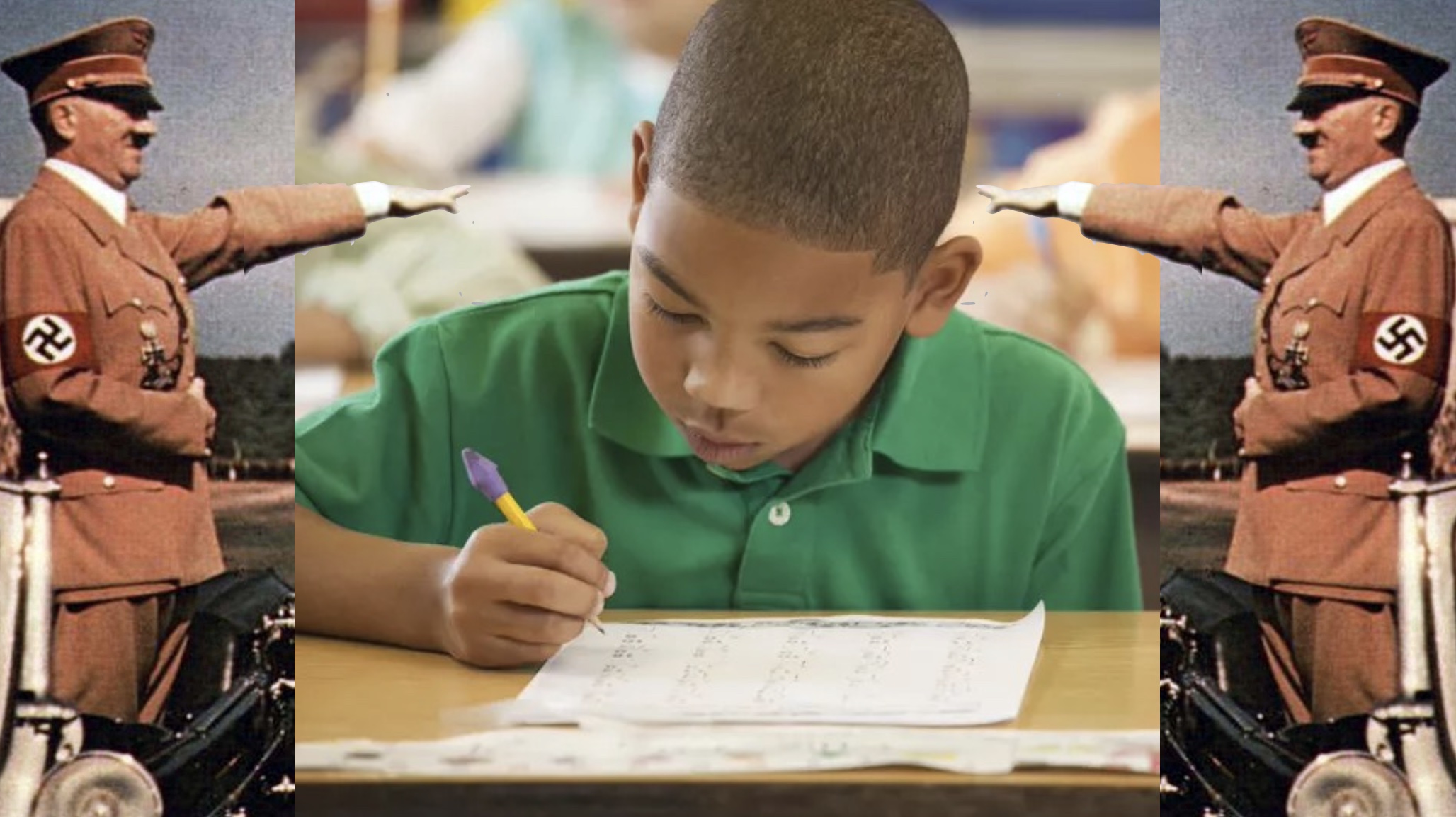
These assessments were based on explicitly eugenicist foundations – the idea that certain races were distinctly superior to others.
Colleague Lewis Terman made the goal clear in his book, The Measurement of Intelligence, that these “experimental” tests will show “enormously significant racial differences in general intelligence, differences which cannot be wiped out by any scheme of mental culture.”
In 1923, another psychologist, Carl Brigham, took these ideas further in his seminal workA Study of American Intelligence. In it, he used data gathered from these IQ tests to argue the following:
“The decline of American intelligence will be more rapid than the decline of the intelligence of European national groups, owing to the presence here of the negro. These are the plain, if somewhat ugly, facts that our study shows. The deterioration of American intelligence is not inevitable, however, if public action can be aroused to prevent it.”
The practice was even upheld by the US Supreme Court in the 1927 Buck v. Bell decision. Justices decided that mandatory sterilization of “feeble-minded” individuals was, in fact, Constitutional.
Of the ruling, which has never been explicitly overturned, Justice Oliver Wendell Holmes wrote, “It is better for all the world, if instead of waiting to execute degenerate offspring for crime, or to let them starve for their imbecility, society can prevent those who are manifestly unfit from continuing their kind…. Three generations of imbeciles are enough.”
Eventually Brigham took his experience with Army IQ tests to create a new assessment for the College Board – the Scholastic Aptitude Test – now known as the Scholastic Assessment Test or SAT. It was first given to high school students in 1926 as a gatekeeper. Just as the Army intelligence tests were designed to distinguish the superior from the inferior, the SAT was designed to predict which students would do well in college and which would not. It was meant to show which students should be given the chance at a higher education and which should be left behind.
And unsurprisingly it has always – and continues to – privilege white students over children of color. The same as nearly every standardized test still does.
HAS IT CHANGED?
None of this can be challenged. These are historical facts. They are simply what happened justified in the words of the people who perpetrated them.
In 1964, a Department of Education report found that the average black high school senior scored below 87% of white seniors (in the 13 percentile) on standardized assessments. Fifty years later, the National Assessment of Educational Progress (NAEP) found that black seniors had narrowed the gap until they were merely behind 81% of white seniors (scoring in the 19th percentile).
Is that really the kind of progress you want to champion?
The reason for the disparity has nothing to do with the learning students of color (and the poor whose scores are similar) achieve nor their worth as human beings.
Discrimination is purposefully built in to the standardization process, according to W. James Popham, PhD, Professor Emeritus at the University of California at Los Angeles and former test maker. He explained in an interview with Frontline:
“Traditionally constructed standardized achievements, the kinds that we’ve used in this country for a long while, are intended chiefly to discriminate among students … to say that someone was in the 83rd percentile and someone is at 43rd percentile. And the reason you do that is so you can make judgments among these kids. But in order to do so, you have to make sure that the test has in fact a spread of scores. One of the ways to have that test create a spread of scores is to limit items in the test to socioeconomic variables, because socioeconomic status is a nicely spread out distribution, and that distribution does in fact spread kids’ scores out on a test.”
The scores have to fall into categories – Below Basic, Basic, Proficient and Advanced, for instance. If too many students cluster in the middle, the results are invalid. We need the scores spread out – even if we must resort to non-educational factors to get there.
Family income is not something the tests ignore, says Popham. It is an essential component specifically tested for in question construction. In fact, he claims that between 15-80% of the questions (depending on the subject area) on norm-referenced exams are linked to socio-economic status (SES).
Thus minorities with higher percentages of impoverished people are selected against. Not because of any explicit racist ideology – but to get the pretty bell curve standardized assessments require.
“Too often, test designers rely on questions which assume background knowledge more often held by White, middle-class students. It’s not just that the designers have unconscious racial bias; the standardized testing industry depends on these kinds of biased questions in order to create a wide range of scores.”
For example, Choi recalled a 10th grade student in his class asking him about a standardized test question. “With a puzzled look, she pointed to the prompt asking students to write about the qualities of someone who would deserve a “key to the city.” Many of my students, nearly all of whom qualified for free and reduced lunch, were not familiar with the idea of a ‘key to the city.’”
So when they get such a question wrong, it isn’t necessarily because they don’t know the concept being tested, but they don’t understand what was being asked in the first place.
“Compare two 1998 SAT verbal [section] sentence-completion items with similar themes: The item correctly answered by more blacks than whites was discarded by the Educational Testing Service, whereas the item that has a higher disparate impact against blacks became part of the actual SAT. On one of the items, which was of medium difficulty, 62% of whites and 38% of African-Americans answered correctly, resulting in a large impact of 24%…On this second item, 8% more African-Americans than whites answered correctly…”
In other words, the criteria for whether a question is chosen for future tests is if it replicates the outcomes of previous exams – specifically tests where students of color score lower than white children. And this is still the criteria test makers use to determine which questions to use on future editions of nearly every assessment in wide use in the US.
We no longer profess eugenicist ideas of racial purity embedded in our assessments as self evident or based on science. But they’re there none-the-less.
Today, the very concept of intelligence being quantifiable remains in question.
In “The Mismeasurement of Man,” evolutionary biologist Stephen Jay Gould challenged many of these ideas – in particular those of Terman. Rather than see intelligence as a genetic trait, Gould envisioned it more abstractly and thus shattered the idea that any mere number could capture human value.
We can’t just give a faulty bridge a new coat of paint. We must demolish it and rebuild an entirely new structure to carry us into the future.
Like this post? You might want to consider becoming a Patreon subscriber. This helps me continue to keep the blog going and get on with this difficult and challenging work.







 gadflyonthewallblog