The Necessity and Importance of Teachers

teacher-elementary-Getty-blog


Are teachers necessary?


That’s the question big business is asking.


Well, “asking” isn’t really the right word. They’re implying an answer.


Hedge fund mangers and ed tech soothsayers are betting hundreds of millions of dollars that educators aren’t really all that important.


They’re planning a future where real live people play a much smaller role in student learning.


They’re mapping out a world where kids don’t even have to go to school to grasp the basics, where learning can be accomplished anywhere but instigated, tracked, and assessed on-line through various computer platforms.


It’s called a learning ecosystem, personalized learning, competency based or individualized education. With little to no guiding principles, management or oversight, kids would engage in educational tasks on various devices in order to earn digital badges.


Children would bounce from a few hours of Khan Academy videos here to a software package there and Voila! “Modern” education!


It’s a brave new world where investors hope to make a bundle by reducing the cost and pocketing the savings.


Since teachers are the biggest cost, they’re the first things to go.


Since their rights as workers and human beings are a roadblock on this learning superhighway, they’re the first to go.


And since they’re in a prime position to see exactly what’s going on and to object when this ed tech paradise exploits the students it ostensibly is being built for, they MUST go – now, as soon as possible.


The Supreme Court’s recent decision in Janus v AFSCME is part of that process. It’s another way to weaken labor and clear the path for business – the collusion of politics and corporations to steamroll the rest of us and swipe more of our money regardless of the children in the steamrollers way.


So when I ask “Are teachers necessary?” it’s not a purely philosophical question.


The answer will have a major impact on both the education of today and where we go in the future.


If teachers are not necessary, that removes one of the biggest obstacles to this frightening and uncertain future.


Unfortunately, no matter how much I want to answer in the affirmative that teachers are necessary, I can’t do so.


Even after thousands of years of recorded history, learning remains a mysterious process. Yet it doesn’t take much reflection to realize that it can take place without the presence of a teacher.


Some things can be figured out solely by the learner in the right circumstances.


In fact, many academic studies have shown that teachers are not even the most important factor in the process.


Roughly 60% of academic achievement can be explained by family background – things like income and poverty level. School factors only account for 20% – and of that, teachers account for 15%. (see Hanushek et al. 1998; Rockoff 2003; Goldhaber et al. 1999; Rowan et al. 2002; Nye et al. 2004).


Estimates vary somewhat from study to study, but the basic structure holds. The vast majority of impact on learning comes from the home and out-of-school factors. Teachers are a small part of the picture. They are the largest single factor in the school building, but the school, itself, is only one of many components.


In short, teachers are not necessary to student learning.


But neither are doctors necessary to healing or lawyers necessary to acquittals.


Necessity is a very high bar.


To survive, you need food, shelter and clothing. However, having all three does not mean you have a good life. Slaves had all three – no free person would choose to trade places with someone in generational servitude simply because they had everything they needed to survive.


The same with medicine. If shot in the arm, you could provide me with all the medical equipment necessary to remove the bullet, but I would still have a difficult time doing it by myself. I COULD. A doctor is not NECESSARY for that operation. But without a doctor present, my chances of getting the best medical care drop dramatically.


Moreover, you could pop me in a courtroom without the benefit of legal counsel and it’s not impossible that I could argue my way to the dismissal of all charges against me. But the likelihood of doing so is infinitesimal – as undocumented youngsters are discovering when forced into the courtroom to defend against deportation without an attorney or even their parents present.


The same is true of education.


Though teachers are not necessary to learning, they are vital to it.


Having a teacher dramatically boosts a student’s chances, and the more disadvantaged that student is, the more he or she benefits from an educator.


The academic schemes of the corporate class amount to changing the field into the equivalent of an automated teller or a business robocall.


You can purchase your groceries through the self-checkout line. You can get your customer service from an automated list. But neither of these are the highest quality service.


They are cheap alternatives.


They are ways for the business to cut costs and boost profits. Neither have anything to do with making things better for the customer.


And when it comes to education, eliminating (or even drastically reducing access to) the teacher will decrease the quality of the service beyond recognition.


A 2009 report, Poverty and Potential: Out-of-School Factors and School Success, released by the Great Lakes Center for Education Research and Practice outlined several real world solutions to increase academic outcomes. None of them involve the elimination of teachers.


They are:


1. Reduce the rate of low birth weight children among African Americans

2. Reduce drug and alcohol abuse

3. Reduce pollutants in U.S. cites and move people away from toxic sites

4. Provide universal and free medical care for all citizens

5. Insure that no one suffers from food insecurity

6. Reduce the rates of family violence in low-income households

7. Improve mental health services among the poor

8. More equitably distribute low-income housing throughout communities

9. Reduce both the mobility and absenteeism rates of children

10. Provide high-quality preschools for all children

11. Provide summer programs for students from low-income homes to reduce summer losses in their academic achievement.


These are ways you improve education FOR CHILDREN.


This is how you make things better FOR THE LEARNER and not necessarily for the investor class.


And when it comes to teachers, there are numerous ways you can help them provide support for students.


First of all, hire more of them!


Today’s public schools employ 250,000 fewer people than they did before the recession of 2008–09. Meanwhile enrollment has increased by 800,000 students.


So if we wanted our kids to have the same quality of service children received in this country only a decade ago, we’d need to hire almost 400,000 more teachers!


That’s how you cut class size down from the 20, 30, even 40 students packed into a room that you can routinely find in some districts today.


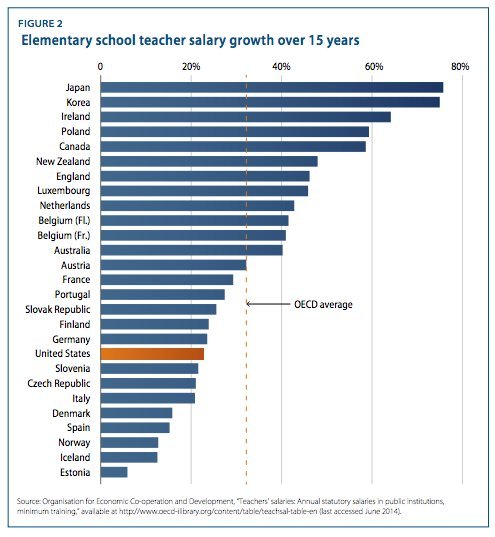
And if you want to improve the quality of the teachers in those classrooms, here’s an easy fix – pay them.


According to the Economic Policy Institute, teachers in the United States make 14 percent less than people from professions that require similar levels of education.


Sadly, it only gets worse as time goes on.


Teacher salary starts low, and grows even more slowly.
 

original


According to a report by the Center for American Progress, on average teachers with 10 years experience only get a roughly $800 raise per year. No wonder more than 16 percent of teachers have a second or third job outside of the school system. They simply can’t survive on the salary.


They can’t buy a home or even rent an apartment in most metropolitan areas. They can’t afford to marry, raise children, or eke out a middle class existence.


If you want to attract the best candidates to the profession, you need to make it more attractive. One way to do that is to increase the salary.


And finally, stop micromanaging everything teachers do and stomping on their rights. To do their job effectively teachers need autonomy. They need the ability to make decisions on the ground based on the empirical evidence gathered in the classroom.


Moreover, they need the freedom to speak out when something is going wrong in their buildings or districts. When software packages are purchased that spy on students for corporations, they need the ability to sound the alarm. When high stakes standardized testing is out of control, they need to be able to voice their objections. When shoddy, second-rate academic standards are forced onto them by politicians and business people, they need to be able to blow the whistle.


To do that, they need their union protections. They need collective bargaining rights to give them the power to counterbalance the forces of greed and corruption that have always been at the schoolhouse door.


As a country we have taken our attention away from what’s really important. We’ve stopped focusing on how to make education better and instead equated it with how to make it more profitable for those who are already wealthy.


Teachers are vital to education. They are lifelines to struggling students. We should find ways to support them and not constantly undercutting their social standing, autonomy and rights.


The importance of teachers is beyond doubt. As is the importance of society in supporting them.


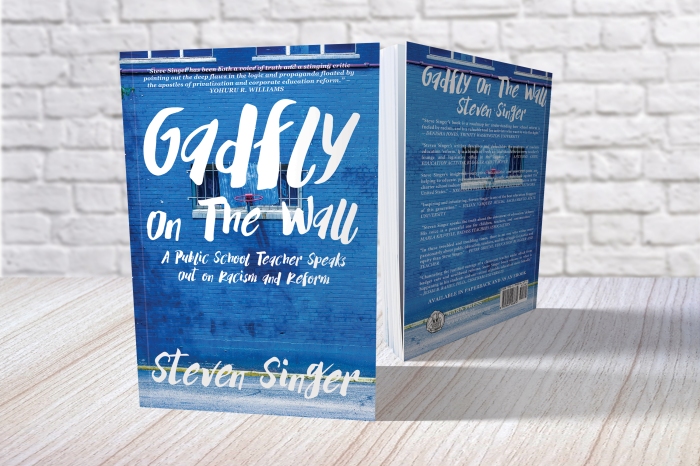
Like this post? I’ve written a book, “Gadfly on the Wall: A Public School Teacher Speaks Out on Racism and Reform,” now available from Garn Press. Ten percent of the proceeds go to the Badass Teachers Association. Check it out!

WANT A SIGNED COPY?

Click here to order one directly from me to your door!
 

book-1

I Voted for Jill Stein. Was I Wrong?

jill-stein-green-placard


On November 8, 2016, I had a heart attack.


That’s not a metaphor.


I went to vote. I went to the doctor. I was sent to the hospital.


How much of that was a result of the Presidential election? I will never know.


But whenever I think back on that day, I am filled with a sense of bone-deep sadness.


After only a little more than a year in office, Donald Trump is already the worst President of my lifetime – and that’s saying something after the disaster that was George W. Bush.


Yet today our country is separating parents and children seeking asylum on the border and locking them away in detention centers. Nearly every cabinet secretary is an incompetent plutocrat put in office to dismantle the department in which they’re in charge. Meanwhile, Trump insults traditional allies and consorts with dictators all over the globe. And nationwide white supremacists of all stripes are emboldened, on the rise, and openly running for office.


I wish there is something I could do to go back in time and change the results of that day. I wish there was something I could do to stop Donald Trump from being elected President. And though I did not vote for her, I would do anything to have Hillary Clinton defeat him.


On that day, though, I voted for Jill Stein.


There’s nothing I can do about that now.


I imagine going back in time and telling myself not to do it. “Go vote for Hillary,” I imagine Future Me telling an ailing younger version.


Yet even now, I’m not sure if I’d say that to myself.


Go vote for Hillary? Would it have made a difference?


Factually, no. One more vote wouldn’t have put her over the top in my home state of Pennsylvania.


But I wrote articles advising readers to do like me and vote Jill Stein. Does that mean I’m responsible for every Stein vote cast in the Keystone state?


No, not really. I may have influenced some people. But I certainly didn’t influence them all.


I suppose the bigger question is this: did Stein spoil the 2016 election for Clinton?


Let’s look at some numbers.


In Pennsylvania, the results went like this:


Screen Shot 2018-06-20 at 10.21.41 AM
Source: New York Times.


Trump got 2,970,733 votes.


Clinton got 2,926,441 votes.


So he won the state by 44,292 votes.


Stein got 49,941 votes – 5,649 more than Trump’s margin of victory.


So if every Stein voter had cast a ballot for Clinton, she would have won the state – though she’d still lose the Presidency by 10 electoral votes.


But if the same process were repeated even in a few other swing states Clinton lost, the result would change. Clinton would have won and be sitting in the Oval Office right now.


Those are just facts. Or at least they’re facts manipulated in a game with counterfactuals.


If this had happened, then this other thing would have happened, too.


However, it is rarely so clear even with numbers.


For instance, Stein ran in 2012, too. She ran against Obama and Romney. She got 20,710 votes in Pennsylvania.


Screen Shot 2018-06-20 at 10.22.27 AM
Source: New York Times


That’s tens of thousands of Green voters who didn’t cast a ballot for centrist Obama. I don’t think it’s fair to assume they would have voted for centrist Clinton, either.


So if we subtract that 20,000 from Stein’s 2016 totals, (49,941 – 20,710) you get 29,231 new people who voted Green who didn’t do so in 2012.


That’s less than Trump’s margin of victory (44,292).


So even if every NEW Stein voter cast a ballot for Clinton, Trump still would have won the state.


The point?


I don’t think it’s factual or fair to assume Stein or Stein voters gave Trump the election.


If I had voted for Clinton, even if I had advised my readers to vote for her, the end result probably would have been the same.


These are the things I think about in the middle of the night when sleep won’t come.


Is there anything I could have done to change things? In trying to make things better, did I make things worse?


I don’t assume I have that much power – either way.


I’m just a school teacher with a blog.


And that’s why I voted for Stein.


Hillary Clinton made her name politically going against teachers unions. She and her husband have done quite a lot to weaken my profession and the school my daughter attends.


The national teachers unions may have supported her run for President, but they did so without fairly polling members. Her entire nomination process was marred by unfair and undemocratic practices by the Democratic Party that left many progressive voters who favored Bernie Sanders feeling left out and silenced.


I still think THAT more than any scribbling on my blog contributed to her loss.


Compared to Trump, Barack Obama was one of the best Presidents we’ve ever had. But compared to Trump, so was George W. Bush. So would be an inanimate carbon rod!


However, Obama was not particularly good for education. He and the corporate Democrats favored every anti-union, pro-privatization scheme they could. What a missed opportunity!


You’d think our first African American President might do something about school segregation – which has been on the rise in the last few decades. Instead, he helped make it worse by promoting charter schools. You’d think he might do something to stop the school-to-prison pipeline. Instead he helped lubricate it by championing high stakes standardized tests.


I think that’s another reason Clinton lost. Many of us were fed up with Obama’s neoliberal policies and wanted a candidate who might change course. Clinton promised only more of the same.


Don’t get me wrong. In retrospect, more of the same sounds lovely. Give me that old time Obama neoliberalism over Trump’s neo-fascism, any day!


But back in 2016 I thought we had a chance for something more – real hope and change. Was I wrong to vote for a candidate who promised to end high stakes testing and school privatization? Was I wrong to vote for a candidate who promised to fairly fund public schools, provide free college for all and end all student debt?


Maybe.


I suppose I should have been more frightened of Trump back then. But my anger at the Democrats who continually stabbed me and other progressives in the back outweighed my fear of this buffoon.


Perhaps I was wrong in that.


I don’t think it’s too much of an assumption to say we all underestimated Trump. We all underestimated how many people in this country would vote for him.


So was I wrong to vote for Jill Stein?


I still don’t know.


I’m sure many people will criticize me for this article. They’ll blame me for every horrible thing Trump does. If I have any point here, it’s that there’s plenty of blame to go around.


Perhaps we’d do better fighting against Trump than fighting amongst ourselves.


I still believe there is a silent majority of Americans for whom the status quo is unacceptable. Most of us don’t want a wall on our border – we want healthcare for all. Most of us don’t want families separated and undocumented immigrants scapegoated and rounded up – we want a path toward citizenship. Most of us don’t want our democracy subverted and the wealthy to have a greater say in our policies – we want freedom and justice for all.


We just need a way to find each other again. We need to find a way to look past any political, social, racial, gender or cultural differences and find a common humanity.


What better way to do that than in a common cause?


I hope you’ll join me by stopping the recriminations and take on the fight.


We may never fully solve the riddle that was the 2016 election.


There are political and social lessons to be had. But the most important thing is to remember the value of unity and to hold on to each other tight.


We’re all we’ve got.


Like this post? I’ve written a book, “Gadfly on the Wall: A Public School Teacher Speaks Out on Racism and Reform,” now available from Garn Press. Ten percent of the proceeds go to the Badass Teachers Association. Check it out!

WANT A SIGNED COPY?

Click here to order one directly from me to your door!

book-4

This Fathers Day Let’s Be Worthy of Our Children

Fathers-Day-Gifts-for-Kids-to-Make


My daughter wrote me a card for Father’s Day.


It had a heart on the front and the following message on the back:


“Happy Fathers Day! Dad, you are my superstar. You help me when I’m sad. And I love everything you do for me. That is why I wish you a Happy Fathers Day.”


It was a sweet token of affection from a 9-year-old to her sleepy daddy sitting at the kitchen table.


But it got me thinking.


All over this country fathers are probably receiving something similar from their children.


Hawaiian shirts, blotchy neckties and more finger paintings than you could fit in the Louvre.


But the sentiment is probably the same.


Thank you for being there for me.


But are we there for America’s children?


We may be there for our own kids, but where genetics end, are we there for others?


Our government has separated approximately 2,000 children from their parents at the border, according to the Department of Homeland Security.


Two thousand children forcibly separated from their parents in our name and we dare to celebrate Father’s Day?


From April through May, the policy has separated 1,995 minors from 1,940 adults traveling with them who said they were the children’s guardians.


A country that doesn’t respect the rights of parents – even if those parents aren’t documented US citizens – has no right to pretend it values fatherhood or motherhood.


At best, we value WHITE parenthood, and that, my friends, is not good enough.


Look at what we subject our own children to in the public school system.


We segregate our schools by race and class so we can horde resources for wealthy and middle class white kids while providing the bare minimum to the poor and children of color.


In the name of accountability we bestow upon them high stakes standardized tests to “prove” even those meager funds are wasted – yet we ignore the financial disparity, the social problems, the health issues and a host of other obstacles the underprivileged face.


The only help we’re willing to offer is privatized schools that can pocket a portion of their funding and reduce resources for these kids. We demand local control and democratically elected school boards for rich white kids, but expect the poor brown ones at charter and voucher schools to get along with appointed boards where their parents have no choice except to take it or leave it.


Does a society that routinely treats its children this way deserve a thank you card? I think not.


Last month, the CDC released a report indicating that the U.S. birth rate ― the number of babies born nationwide ― is the lowest it’s been in 30 years and is below the “replacement” rate needed to sustain the population.


Various media sources were quick to blame women nationwide. Women put off having kids because they want to focus on careers. They aren’t sexy or submissive enough.


Yet few look at the responsibilities of men in this equation.


Who is it behind the salary gap between men and women? Who conflates women’s healthcare with abortion and communism? Who makes it easier to get a gun in this country than proper maternity leave, childcare or any adequate resources to make having a family sustainable?


Answer: men.


We’re grossly over-represented in government, business and management.


We don’t even support men who want to have families. Men make more money than women, but salaries are down for them as well. If there’s little support for pregnant women, there’s little support for the fathers who impregnated them.


We pretend family values are the bedrock of our society but we don’t do much to support families.


And when we look to the future, it doesn’t appear to be getting any better.


Big business and huge corporations are salivating all over the prospect of further monetizing our children.


They’re piloting scores of so-called personalized learning programs, apps and devices to spy on children and monitor every aspect of their learning.


Not only are they asking kids whether they feel excited or bored by canned test prep lessons provided on-line, they’re focusing cameras on children’s faces, monitoring their breathing and heart rate. They’re collecting mountains of data with little accountability, privacy or even the promise of these things.


Investment bankers and hedge fund managers are funding these programs and more to create a priceless database on each individual child that can be used for lifelong marketing, job placement, even profiling by law enforcement.


These are not practices that are done in the best interest of children. They are in the best interest of investors and free market privateers.


No wonder fewer people are having children! They don’t want their kids to become helpless victims to a society that cares less and less about our humanity and more and more about our marketability.


It is us vs. them – where the us is significantly limited by race, economics and class.


So this Fathers Day, we need to do more than accept a congratulatory pat on the back.


We need to accept our responsibility for the status quo.


If we don’t like the way things are, we need to commit ourselves to doing something about it.


Call and/or write your Senators and Representatives about the policy of separating undocumented parents and children. Visit your lawmakers’ offices and demand fair funding and an end to school segregation, high stakes testing and school privatization. Get active in your local school district going to meetings and making your voice heard. Do everything you can to educate the powers that be on the coming Ed Tech scandal and remove or block it from your district.


We’re not just fathers on Fathers Day.


We’re fathers all year long.


Let’s do something more to deserve it.


Like this post? I’ve written a book, “Gadfly on the Wall: A Public School Teacher Speaks Out on Racism and Reform,” now available from Garn Press. Ten percent of the proceeds go to the Badass Teachers Association. Check it out!

WANT A SIGNED COPY?

Click here to order one directly from me to your door!

book-3

African Immigrants Excel Academically. Why Don’t African Americans?

static.politico.com


The presence of melanin in your skin shouldn’t affect your academics.

But in America, it does.

On average, black students achieve less academically than white students. They have worse grades, lower test scores, meager graduation rates and fewer achieve advanced degrees.

The question is – why?

Why does pigmentation matter so much in this country? What about it brings such negative academic consequences?

This is especially apt since it doesn’t apply to foreign born black students who come here to study or those who recently emigrated here.

In fact, they see just the opposite effect – they earn some of the best grades, have some of the highest test scores, and disproportionately graduate from high school and achieve advanced degrees.

This is something that distinguishes foreign-born Africans – especially those from Sub-Saharan Africa – even from other immigrants. African immigrants sit near the top of the scale of so-called model minorities.

According to a report by Christine Gambino and associates at the Census Bureau, 41% of the African-born immigrant population earned a bachelor degree compared with 28% of the overall foreign-born population in the US.

The four African birth countries with the highest percentages of bachelor and higher degrees among their expat populations in the US are Egypt at 64%, Nigeria at 61%, South Africa at 57% and Kenya at 47%.

So why the difference?

Obviously, it’s not skin color.

Part of it seems to be qualities selected for in the immigration process, itself.

We don’t let just anyone come to the U.S. We have rigorous qualifications and prerequisites that have to be met. For instance, students who want to study here must get high marks on the SAT, Act and/or the TOFFEL – the language proficiency test. To do that, they need the money and resources to study for these exams. They are already some of the best achievers in their native countries.

Moreover, there is a huge cultural difference coming from Africa as opposed to coming from the United States. Native-born Africans have to deal with the effects of post-colonialism. It wasn’t so long ago that European nations conquered and plundered the African continent for gold and resources. That era has mostly ended, but those living there still have to deal with lingering consequences. This has an effect on everything from gender, ethnicity, class, language, family relationships, professions, religions and nation states.

However, native-born Africans do not have to navigate the world of American white supremacy. The affects of being black in this country may be much more harmful than negotiating post-colonialism.

For instance, most mainland Africans enjoy intact cultures. They are not the product of families that were torn apart, religions that were displaced and entire belief systems, world views and genealogies that were stolen.

Nigerian cultures, in particular, highlight the importance of learning.

One typical Nigerian saying goes like this:

“The best inheritance that a parent can give you is not jewelry or cash or material things, it is a good education.”

This is why academics in Nigeria are widely supported, mandatory and free.

Meanwhile, in America native-born black students grow up in a much more stressful and unstable environment. This translates to academic struggles.

For one, they are the victims of educational apartheid. Brown v. Board is more than 60 years old, but American schools have become increasingly segregated by race and class. Black students receive fewer resources than whites and their schools struggle to provide the same quality of education. Moreover, they are the target – either directly or indirectly – of privatization schemes that result in less control over their own schools and the further reduction of resources through charter and voucher schools that can cut services and pocket the savings as profit.

However, the problem is not just systemic. I hate to say it, but sometimes even American teachers put up obstacles to black students success due to (often unconscious) bias.

Most teachers are white. They have certain societally reinforced expectations of black students. When these children struggle, they are more often put into special education and stigmatized for their differences.

It is no doubt that black students are more often disciplined and suspended than white students – numerous studies have shown this.

I think this is due at least partially to white teachers’ expectations. It is tempting to see black student behavior as negative in the default. We too often label them “bad kids” and then try to find evidence to support it instead of giving them the benefit of the doubt or assuming they’re smart and well-behaved until proven otherwise.

African immigrants don’t have to deal with these stigmas to nearly the same degree. They don’t get the same negative label. They have more support from close-knit families. They have more positive role models including more college graduates in the family.

Another obstacle for American born black students is a cultural imputation against academic achievement. Doing well in school can be seen as “acting white.” In order to maintain popularity and prestige, they are steered away from the exact things that immigrant Africans are steered toward.

The poverty of American blacks plays a huge factor, too. Even in moderately successful African American homes, parents or guardians are often working multiple jobs or long hours to make ends meet. This reduces their ability to oversee their children’s homework and monitor academic progress.

It seems then that the so-called proficiency gap between native-born black and white students in this country is due to generational poverty, white racism and coping mechanism in their own culture.

If we want to help American-born black students, we need to realize, first, that this problem is not due to inherent racial deficiencies. It is the product of class warfare and white supremacy.

As such, it can be cured through progressive economic policies and anti-racist efforts.

The strongest argument for reparations comes from a recognition of the lingering effects of our history of slavery, segregation, Jim Crow and the prison industrial complex.

These are daunting problems, but they can be solved.

It just takes an honest appraisal of the issues and the social will to make things right.


Like this post? I’ve written a book, “Gadfly on the Wall: A Public School Teacher Speaks Out on Racism and Reform,” now available from Garn Press. Ten percent of the proceeds go to the Badass Teachers Association. Check it out!

WANT A SIGNED COPY?

Click here to order one directly from me to your door!

book-4

School Vouchers and Runaway EdTech Pave the Way for the Destruction of the Very Concept of School

andres


School is where you learn to learn.


A teacher with an advanced degree and decades of experience devotes her time to figuring out what helps you comprehend the world around you.


And, if she’s good, she imparts that lesson to you as well.


Imagine if we took that away.


Imagine a world where there are no schools – just free range children plopped in front of a computer or an iPad and told to go learn something.


No schools, no teachers, just gangs of students walking the streets, stopping along the way to thumb messages to each other on social media, play a video game or take an on-line test.


That’s the world many EdTech entrepreneurs are trying to build.


And school vouchers are helping them do it.


Take Education Savings Accounts (ESAs) and other market based privatization schemes.


Normally, the federal, state and local government collect taxes to fund an individual child’s education, which is then spent at a public or charter school.


At a public school all that money must be spent on the student. At a charter school some of that money can be pocketed as profit by the private company who runs the school.


Public schools provide a better alternative because the funding must be dedicated to the student, living within a district’s coverage area guarantees enrollment, the school must be managed by an elected school board with open meetings and a plethora of other amenities you won’t find at a privatized institution. But at least the charter school is a school!


However, an ESA or other voucher would allow that money to go elsewhere. It could go to funding the tuition at a private or parochial school where organizers can use it however they like – pocketing some and using the rest to help the child as you’ll find in most charter schools.


But as bad as that is, vulture capitalists want to add another destination for that money – let it pile up in the bank where it can be used for discrete education services provided by the EdTech industry.


It’s almost like homeschooling – without the loving parent being in charge.


It goes by many names – a learning ecosystem, personalized learning, competency based or individualized education.


But it’s really a single person cyber school with little to no guiding principles, management or oversight.


Education is reduced to a series of badges students can earn by completing certain tasks.


Reading a book or an article gives you a badge. Answering a series of multiple-choice questions on a reading earns you more badges. And if you’ve completed a certain task satisfactorily, you can even earn a badge by teaching that same material to others.


It’s the low wage gig economy applied to education. We just transform a crappy job market where workers bounce from a few hours of minimum wage labor here to a few hours of minimum wage toil there – all without benefits or union protections – into learning. Children bouncing from a few hours of Khan Academy videos here to a software package there and Voila! “Modern” education!


In short, it’s school without the school or teachers.


And make no mistake, it’s not about improving the quality of education. It’s about providing the cheapest possible alternative and selling it to rubes as innovation.


The wealthy will still get institutions of learning. They will still be educated by the most qualified teachers in the world. They will still learn how to learn.


The best path to becoming a truly educated person involves human interaction and mentorship. You need experienced professional educators who use the empirical evidence they see in the classroom about your child to tailor lessons to their needs. The wealthy would never dream of making their children learn from the academic equivalent of an automated check out aisle or telemarketer robocall.


It is only the poor and middle class who will be released like chickens into the pasture of a learning ecosystem.


And as an added benefit, the badge structure creates a market where investors can bet and profit off of who gains badges and to what degree on the model of crypto-currencies like Bitcoin! So all the stability of the pre-crash housing market! What could possibly go wrong!?


Let me be clear – this is the ultimate goal of the school privatization movement.


Charter and voucher schools are only the tip of the iceberg. They still require real human beings to act as teachers (though they need not be as well educated or have as much experience as public school teachers). They still require buildings and grounds.


But this depersonalized learning approach allows them to do away with all of that. They can just provide students with an Internet accessible device and some dubious on-line tracking and management system.


Then they can pocket all the rest of the money taxpayers put aside to educate children and call it profit.


And they can use the programs students access to “learn” as a way to gather valuable marketing data about our kids. Everything students do on the device is free market research – every word they input, every keystroke, every site visited down to the slightest eye movement.


This is the logical conclusion of the monetization of education and an economy that only sees value in others as human capital that can be bought, sold and exploited.


This is where the privatization movement is going. And they’re laying the groundwork in legislation being proposed in our state capitals today.


In Pennsylvania, for instance, Senate Bill 2 proposes the creation of just such ESAs. If approved, the immediate result would be to boost private and parochial schools.


However, given a few years to strengthen the technologies and systems needed for a full learning ecosystem, the same law would allow taxpayer money to be used in this way.


And it’s something hardly anyone is talking about.


We’re fighting the privatization systems of today as the plutocrats set up the privatization systems of tomorrow.


Even if school vouchers never take off to the degree necessary to scaffold the most robust learning ecosystems, EdTech lobbyists are trying to install as much of this garbage as they can into our existing schools.


They are using one-to-one iPad initiatives and grants to fund up-to-date computers, Wi-Fi networks and software packages to pave the way for this brave new world of digital exploitation. They are selling our test score obsessed bureaucrats software like iStation and IXL that bridge the gap between test prep and learning ecosystems lite.


You can walk into many schools today where students spend hours on-line earning digital badges for watching videos and taking stealth assessments.


Few people are sounding the alarm because few people understand what’s going on.


This is not conjecture. This is not a conspiracy theory. This is the goal the edtech entrepreneurs will gladly tell you all about hoping you’ll invest.


There are hours of videos, pages of documents, mountains of graphs, charts and graphics about how this scheme will pay off for investment bankers and venture capitalists. (See below)


The only true way to win this battle is a cultural shift away from dehumanizing runaway capitalism.


We need to stop thinking that the private sector is always better than the public good. We need to stop allowing big business and corporations to get away without paying their fair share. We need to increase the voice of citizens and decrease the megaphone of money and privilege.


Otherwise, the science fiction dystopias of books like “Ready Player One” will no longer be fiction.


They will become the reality for every school child in this country.


A reality where school, itself, is a thing of the past.


And education is reduced to the mercenary collection of discrete skills that add up to nothing of value for the students except their own enslavement.


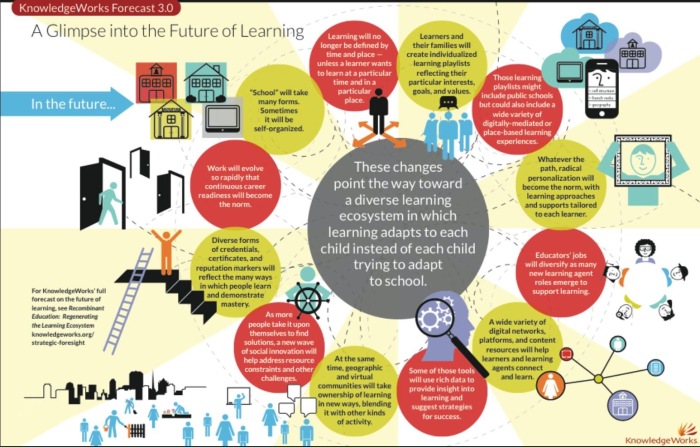
But don’t take my word for it. Here is the learning ecosystems model from the EdTech industry, itself, in corporate officers own words and graphics:

LEARNING IS EARNING – the scariest 6:58 video you’ll ever see.


KNOWLEDGEWORKS Vision for the Future of Education:

IMG_9654

Graphic as a PDF

More on KnowledgeWorks

Listing for PARENTS AS CONSUMERS Symposium

Read all about it here.


FIGHT BACK AGAINST SCHOOL PRIVATIZATION AND RUNAWAY EDTECH:

Like this post? I’ve written a book, “Gadfly on the Wall: A Public School Teacher Speaks Out on Racism and Reform,” now available from Garn Press. Ten percent of the proceeds go to the Badass Teachers Association. Check it out!

WANT A SIGNED COPY?

Click here to order one directly from me to your door!
book-2


The Best Charter School Cannot Hold a Candle to the Worst Public School

Screen Shot 2018-05-24 at 7.43.41 AM.png


There are good charter schools.


I admit that.


There are bad public schools.


I admit that, too.


But if one had to choose between the worst public school and the best charter school, you’d still be better off with the public school.


Does that sound crazy? Does it sound ideological, partisan, or close-minded.


I don’t think so.


Imagine if we said the same thing about tyrannies and democracies.


There are good tyrannies.


There are bad democracies.


Still, I’d prefer the worst democracy to the best tyranny.


Why?


Because even a badly run democracy is based on the principle of self rule. The government gets its right to make and enforce laws from the consent of the will of the governed.


Even if our representatives are corrupt and stupid, even if our federal, state and local agencies are mismanaged and disorganized – there is the potential for positive change.


In fact, the catalyst to that change is embedded in democracy, itself.  Egalitarian systems founded on the principle of one person, one vote tend toward fairness, equity and liberty much more than others.


Bad leaders will be replaced. Bad functionaries will be retrained or superseded. Bad agencies will be renovated, renewed, and made to serve the will of the people.


However, in a tyranny, none of this is true.


Even if you have a benevolent tyrant who does nothing all day but try to do whatever is best for his or her subjects, that is a worse state of affairs.


Eventually the tyrant will change. Absolute power will corrupt him or her absolutely. Or even if this bastion of human goodness is incorruptible, he or she will eventually be deposed, replaced or die.


And there is nothing – absolutely nothing – to ensure the next tyrant is likewise benevolent. In fact, the system is set up to increase the likelihood that the next ruler will be as selfish, greedy and malevolent as possible.


This is because it is the system of tyranny, itself, that is corrupt – even if those that fill its offices are not.


The same goes for good charter schools.


These are schools that are publicly funded but privately run.


As such, the overwhelming majority have no elected school board, their meetings are held in private, their documents are kept secret, they discriminate in enrollment and they take advantage of a plethora of legal loopholes and bad policy to embezzle funds, overcharge for nonexistent utilities and cut services for students while pocketing the “savings” as profit.


If you can find a charter school that does none of these things – congratulations! You have found a diamond in the rough! But it is a diamond that is more likely to turn to coal the second you turn away.


Let’s say you find the rare charter school run by an elected school board. THEY AREN’T REQUIRED TO DO THAT. Organizers could at any time revert to an appointed board. Community members could be making all the decisions when you send your child to school, but by dismissal time they could have all been replaced with flunkies appointed by the private business people who took out the charter from the state in the first place!


Let’s say your charter school has open meetings and public documents. They invite the public to their deliberations. They take public comment and share all their internal communications with taxpayers and the media.  THEY AREN’T REQUIRED TO DO THAT. They could close the doors any day they wanted. And there’s nothing you could do about it.


Why? Because that’s what a charter school is. Despite all the propaganda to the contrary, it is not fundamentally a public school. It is a private school at public expense.


All these things that are optional at a charter school are required at public schools. Not just some public schools – ALL OF THEM!


Public schools are required to have elected school boards (unless taken over by the state). They are required to have open meetings and public documents. They are essentially democratic, whereas even the best charter schools are only democracies because of someone’s goodwill. When the wind changes, so will their system of government.


But that’ not all.


Let’s say you find a charter school that has open enrollment. It accepts every student who applies from its coverage area. Or at least it does so until it runs out of room. If demand exceeds supply, it conducts a lottery to determine which students to let in and which it has to unfortunately turn away.


First of all, if the school doesn’t have open meetings and public documentation, you have no way of knowing whether these lotteries are fair and unbiased. Operators are often charged with cherry picking the best and brightest and denying students with disabilities or behavioral problems – they’ve even been known to discriminate based on race and class.


Second of all, even if your charter school is one of the magical few that just does the right thing with no oversight, THEY AREN’T REQUIRED TO DO THAT. Once they figure out how much money they can save by only accepting the cheapest students to educate, inclusive enrollment policies will be a thing of the past. And you’ll probably never even know the difference.


Public schools aren’t allowed to do that. They have to accept every student from their coverage area regardless of academic deficits, emotional needs, race, religion, class or creed. And if there isn’t enough space, they still can’t turn students away. They have to expand!


And what about the most salient feature of charter schools?


Unlike public schools where all the funding has to be spent on student services, most charter schools are run for profit. They are allowed to cut services for students and swipe the savings for their investors.


Some charter schools don’t do this. BUT THEY CAN! Any day now they could cut little Timmy’s gym class down to twice a week so a shady group of business people in a smoke filled room could stuff a bunch of bills in their own wallets.


Offering French AND Spanish? Adios muchachos. And bonjour to a fistful of dollars going directly into their bank accounts.


All of that is perfectly legal even though it’s your money they’re collecting – money you put aside to help your child learn – there’s not a thing you can do about it.


Sure, you can take your child out of the charter school. But the money funding the school isn’t just your child’s. You’re paying for every student enrolled there. Even if you don’t have kids, you’re footing the bill. And unlike the public school system where you get a voice in how that money is spent, here you don’t get to say a thing.


You just get to pay.


Call me crazy, but I think there’s something wrong with that.


I think that’s worse than even the most decrepit public school.


If a public school has a terrible school board, they can be replaced. In fact, they most certainly will be given time. With each bad policy and unpopular decision, bad school directors motivate taxpayers to vote them out.


This is the exact opposite of charter schools. There is more reason for a charter to replace an elected board with an appointed one so as to increase their autonomy and ability to make money.


Most of the problems with public schools aren’t located in the schools, themselves.


They are the result of strategic disinvestment – archaic funding formulas that allocate less to districts without a large tax base than those in richer neighborhoods. They are the result of segregation schemes that keep the poor and minorities in neighborhoods where they can be ignored and then blamed for their own underprivileged status. They are the result of national and state policies allowed to play the parasite on their budgets – high stakes testing, Common Core and – yes – charter schools.


So, no, I don’t think it’s unreasonable to be so positive about public schools and so negative about charter schools.


The problem with privatized education isn’t just specific to individual schools. It is a feature of the very kind of school we’re talking about in the first place.


Charter schools are at heart a less democratic system than public schools.


Therefore, public schools are always preferable.


I wouldn’t give up my country just because we have an idiot in the oval office. Nor would I give up my public school just because of inadequacies in my local district.


Democracy isn’t for wimps. You have to fight for it.


Those people who are telling you to switch teams are trying to pull the wool over your eyes.


Don’t fall for it.


Public school proud.


Today.


Tomorrow.


Always.


Like this post? I’ve written a book, “Gadfly on the Wall: A Public School Teacher Speaks Out on Racism and Reform,” now available from Garn Press. Ten percent of the proceeds go to the Badass Teachers Association. Check it out!

WANT A SIGNED COPY?

Click here to order one directly from me to your door!

book-4

Pennsylvania’s Zombie School Voucher Bill is Back! And It Wants Your Tax Dollars!

1526935669194

First, there was the horror of a School Voucher Bill.


No one wanted it.


It robbed kids of a quality education. It violated the Constitution. And raised taxes.


So it was soundly defeated.


Then there was Bride of the Voucher Bill.


And it likewise went down in flames.


This was soon followed by Son of the Voucher Bill.


Return of the Voucher Bill.


School Vouchers from the Black Lagoon.


Plan 9 from Voucher Space.


And a host of B-grade legislation straight from the desk of a billionaire think tank to Harrisburg.


All ended up in the same place – the legislative graveyard. Oooh! Scary!


Now we have the latest shambling zombie iteration of a voucher bill, called Senate Bill 2.


Yesterday, after years of false starts and political wheeling and dealing, it’s finally been voted out of the Education Committee.


Which means it will come to a vote by the state Senate and then the state House.


And who do we have to thank for yet another version of legislation billionaires insist we need but voters don’t want?
These guys:


  • Senator John Eichelberger, (R-Blair),
  • Senator Richard Alloway, (R-Franklin)
  • Senator Ryan Aument, (R-Lancaster),
  • Senator Pat Browne, (R-Lehigh),
  • Senator John DiSanto, (R-Dauphin)
  • Senator Mike Folmer, (R-Lebanon)
  • Senator Joe Scarnati, (R-Jefferson)


All Republicans. All bought and paid for by wealthy oligarchs. All convinced that we need to give School Vouchers yet another try in the Keystone state.


And who voted against letting the monster out once again? These guys:


  • Senator James Brewster (D-Allegheny)
  • Senator Andrew Dinniman (D-Chester)
  • Senator Daylin Leach (D-Montgomery)
  • Senator Robert Tomlinson (R-Bucks)
  • Senator Anthony Williams (D-Philadelphia)


This time the beast has a new look – something called Education Savings Accounts (ESAs).


It’s really just putting another horn on the same old rubber creature.


They say ESAs allow state money to pay for private school tuition of elementary and high school students in struggling public school districts.


Oh great. Another way to siphon off hundreds of millions of dollars in taxpayer money from the public schools serving 90% of the state’s students.


Just what we need. A boondoggle for private businesses and religious schools.


Will there be any way to make sure the money in these education savings accounts is going to the right place or is being used to help kids learn?


Nope.


These schools will be able to grab your tax money and use it just about however they please with little to no oversight.


Thanks a lot, so-called fiscal conservatives.


And guess who gets to pay the bill? YOU DO!


Watch property taxes increase to make up the shortfall in funding so your local public school can have the privilege of continuing to operate.


I wouldn’t mind more of my taxes going to public schools that are run democratically, are held accountable and teach things in the American mainstream.


But – call me crazy – I don’t want my money going to help indoctrinate the next generation of zealots who deny science, deny history, and deny the moral standards of our society.


When Evangelical Christians pretend the moral high ground by backing a President who pays off porn stars and belittles war heroes and the disabled, you can see why they need to demand government assistance to keep their pews filled.


Will not on my dime, Buster.


“Congress shall make no law respecting an establishment of religion, or prohibiting the free exercise thereof…”


Remember that?


It’s the establishment clause from the First Amendment. And if you need to wipe your ass with something, it certainly won’t be the U.S. Constitution!


Separation of church and state. Keep them separate.


This law would allow many of the rich kids who already attend private and religious schools to be subsidized by taxpayers.


It would rob us of hundreds of millions of dollars ($500 million at last estimate) that we need just to keep our public schools where they’re at!


Moreover, school vouchers are nothing new.


We’ve been trying this crap for years and they haven’t done a thing to help students learn.


Three out of the four most recent studies on voucher programs, which examined the nation’s largest and oldest voucher strategies in Washington DC, Indiana, Ohio and Louisiana, all show student performance getting worse or not improving at all with vouchers.


A 2017 report from the Economic Policy Institute concluded that extensive research on vouchers over the past quarter century demonstrates that gains in student achievement – if present at all – are at best small. Students show no significant improvement in reading or math. In addition, the report showed that the risks outweigh any insignificant gains in test scores.


Another report from June 2017 by the US Dept of ED found that students using a voucher had statistically significant lower performance in math compared to students who did not receive a voucher.


And THIS is what a gaggle of ideologues want to increase in the Commonwealth!?


Look. The problem with our public schools is poverty. Pure and simple.


Giving out vouchers to private and parochial schools won’t help. It just hides the problem and makes it worse.


Most of the lowest-performing schools are in high poverty districts that are already struggling financially and cannot afford even less funding.


Poverty has a significant impact in student achievement. The average acute poverty rate (% of children living in families with income less than 100% of federal poverty limits) in school districts with more than one low-achieving school was 33.3% – more than double the state average of 16.3%.


Higher poverty means lower standardized test scores.


On average, the proficiency rate for students in the highest poverty schools is 33% less than students in the wealthiest districts. Struggling schools need MORE resources – not less.


Yet, the highest poverty school districts receive more than $2,000 less per student than their wealthy counterparts. This means they are unable to make the investments necessary to overcome the barriers posed by being poor in America.


Diverting state subsidies from these school districts, to ESA vouchers reduce fair access to educational opportunities for these students.


Despite what voucher proponents think, this does not “Save Money.” It does not force struggling districts to do more with less. It forces them to do less – or get more.


Schools don’t budget or spend money on a per student basis. Fixed costs remain the same regardless of how many students are led away by the pied piper of school vouchers.


Costs such as building operations and maintenance, utilities, technology, food service, staff salaries and benefits, transportation including fuel and bus drivers, remain.


Vouchers result in no savings. They produce a greater financial burden for local taxpayers. With less in state funding to provide the same education, that money would have to be raised from other sources – namely, YOU and your local taxes!


I know this is all very tiresome.


It seems like any positive legislation is impossible to get through Harrisburg, but garbage like Senate Bill 2 is ubiquitous.


How many times have we defeated this voucher nonsense?


How many times have taxpayers made it clear they don’t want to fund this nonsense?


But it doesn’t matter. Like a spoiled child, ideologues keep bringing it up again and again in the hopes that this time they’ll wear us down and we’ll let this terrible legislation pass.


Vouchers can be defeated a hundred times. All it takes is one victory and it becomes law and much more difficult to expunge.


So please call, write and visit your state senator and representative.


Tell them you’re against the latest horror show voucher monstrosity.


And maybe when you’re at the polls remember the names of the tools who keep making you repeat yourself.


Give them an unequivocal answer by voting them out of office.


Only then do we stand a chance of nailing a stake through vouchers’ undead heart – for good.


Like this post? I’ve written a book, “Gadfly on the Wall: A Public School Teacher Speaks Out on Racism and Reform,” now available from Garn Press. Ten percent of the proceeds go to the Badass Teachers Association. Check it out!

WANT A SIGNED COPY?

Click here to order one directly from me to your door!
book-3

The State Penalized My School Because We Tried to Integrate

Screen Shot 2018-05-11 at 3.05.22 PM


The original sin of American education is segregation.


Yet in Pennsylvania, taking steps to integrate can result in a penalty from the state legislature.


That’s what happened to my school this year.


After years of innovation and academic growth, my school added a new program to bring in struggling students from another institution – and the state rewarded us by putting us on a list of “failing” schools and forcing us into a voucher program.


I teach in a racially diverse, high poverty district in the western part of the state, just outside of Pittsburgh.


Charter schools have been leeching off us for years.


But today was the first day school vouchers sunk their teeth into us, too.


It’s called the Opportunity Scholarship Tax Credit Program (OSTCP) – a ridiculous bit of legislation that allows children in struggling public schools to use public tax dollars to pay for tuition at a private or parochial school.


I’d say they could use that money at a participating public school, too, but in Pennsylvania the public schools taking part in the program can be counted on one hand with fingers to spare.


And why does my school now qualify for this dubious distinction? Because of our standardized test scores.


Not our test scores from this year. They won’t be released until at least June – more likely August or September.


This is based on test scores from last year – 2016-17.


Moreover, it’s not district wide. It’s just the middle school and one elementary school.


In previous years, the middle school was the district powerhouse. We had the highest test scores and the most innovation. So what happened?


In short, we integrated.


From a state-wide standpoint, my district is hugely segregated.


About 60% of our students are poor and/or minorities. Yet if you go a few miles north, south, east or west, you’ll find schools serving every flavor of white privilege. Beautiful big buildings with the best of everything and a tax base to pay for it. My district, on the other hand, is made to do the best it can with what we’ve got, which isn’t much.


To make matters worse, the structure within our district, inherited from decades of unenlightened social planning, doubles down on that segregation.


Though we only have one middle school and one high school where all our students rub shoulders, we have two elementary schools – one for the middle class white kids and one for the poorer black ones.


This has dramatic academic consequences. Kids at the better-resourced white school flourish scholastically more than kids from the crumbling black school. So the racial and economic skills gap becomes entrenched by the time kids move to the middle school in 6th grade.


If only we could integrate the elementaries.


However, we can’t bus kids from one neighborhood to the other because we can’t afford it. We have a walking district. Moreover, parents would revolt at the idea of elementary kids having to trudge long distances or take a city bus to school.


The only long-term solution is to create a new, centrally located elementary center serving both populations. However, that takes money we don’t have.


So last year we tried a partial solution – move the 5th grade up to the middle school. That way, we can at least integrate our students a year earlier.


Of course, this means taking kids from the black school with terrible test scores up to the middle school. This means adding more struggling students from the school that already is on the state’s bottom 15% list and making them the middle school’s responsibility. It means a new program, new trials and challenges.


You’d think we’d get praise or at least understanding for tackling such a problem. But no.


Taking on the 5th grade tipped the middle school’s test scores over the edge.


Now we’re in the bottom 15%, too. Now we have to let our students go to a private or parochial school with public tax dollars.


Why? Because we tried to right a wrong. We tried to correct a social and academic injustice. And the result was a kick in the gut.


Thanks, Harrisburg legislators! Way to support students of color!


This is just another way that school vouchers support white supremacy. They make it harder to battle segregation.


Why would anyone integrate if doing so could mean losing funding and looking like a failure in the press?


Moreover, forget all the junk you hear from the state about growth.


This penalty is based on whether we hit testing benchmarks – what percentage of students we have earning proficient or advanced on the tests. It doesn’t matter how much they’ve improved. It doesn’t matter if they’ve gone from the lowest of the low to scratching at the ceiling of proficient.


My 8th graders last year (the year we’re being penalized for) experienced tremendous growth just like my students this year are doing. From where they came in to where they’re leaving, the difference is phenomenal!


But apparently that doesn’t count in Pennsylvania.


A poor school serving mostly underprivileged minorities needs to meet the same benchmarks as schools with Cadillac resources serving kids who have everything money can buy. There’s certainly no need for the state or federal government to do anything about equitable resources (At least, not until the result of a lawsuit is handed down where local districts are suing the state over just such strategic disinvestment).


Instead, we’ve got to offer our student the “opportunity” to go to a private school on the public dime.


And what an opportunity it is!


The chance to send your child to a cooperating private or parochial school at public expense.


The opportunity to lose your duly-elected school board. The opportunity for decisions about how your money is spent being made behind closed doors with little to no input from you. The opportunity to send your child to a school with fewer resources and fewer certified teachers. The opportunity to send your child to (an often) religious school on the public dime.


Wow! I can’t imagine why so few parents take advantage of that opportunity! My district has had a few schools on the OSTCP list before, and families overwhelmingly opt to stay put.


Let’s not forget the justification for this “opportunity” is low test scores.


Wait a minute. These cooperating private and parochial schools don’t even take the same standardized tests, if they take any at all.


In our community, there is only one cooperating private school – a catholic school located right next door.


Students enrolled there don’t take the PSSA or Keystone Exams. I believe they take the Terra Nova test. And the school must do a great job because its Website is three years out of date about the results of those tests.


What a great way to improve test scores for our students – comparing apples-to-pears or, to be honest, actually making no comparison at all.


This OSTCP law is based on an unjustified assumption that private schools are always better than public ones. The reality is that if the resources both schools receive are similar, the public school usually greatly outperforms the private or parochial one.


I’ve seen this first hand. I’ve toured our next door Catholic institution. A few years ago, we relocated our students there temporarily during an emergency drill.


It’s a quaint school. Cobblestones and a shaded green campus.


But the buildings are crumbling – especially on the inside. Watermarks on the walls and dirt collecting in the corners.


It’s also much smaller than my school. They only have less than 300 students from K-8. We have about 1,500 from K-12.


I can see why parents who graduated from that school and have a history with it might want to send their kids there to continue that legacy. But anyone else would be giving up much better facilities, a much wider curriculum, much better trained and experienced teachers and even smaller classes!


The OSTCP bill has nothing to do with providing better opportunities for children and families.


It’s a public tax giveaway to private businesses.


The private/religious schools benefit and so do the businesses who “donate” their taxes to these programs.


In 17 states you can get substantial tax credits for contributing to this scam.


Louisiana, Oklahoma, Pennsylvania, Rhode Island, and Virginia, for example, all provide tax credits worth between $65 and $95 on every $100 donated. Alabama, Arizona, Georgia, Montana, and South Carolina go even further by reimbursing 100% of the donation. You read that right. Donate $100, get $100 back.


Oh, but it gets much worse. Since these are considered donations, you can also claim them as charitable deductions and get an additional 35% off your taxes. So you donate $100 and get back $135! Yes. You actually make money off this deal!


In Pennsylvania, investors can even “triple dip” receiving a state tax credit, a reduction in their state taxable income, and a reduction in their federal taxable income. And, yes, that means they sometimes get back more in tax breaks than they provide in contributions.


Meanwhile all of these “savings” come from money stolen from local public schools like mine. Businesses and individual investors are profiting off the industrial testing complex.


In the Keystone state, we have the OSTCP and the Educational Improvement Tax Credit (EITC).


This blatant swindle is championed on both sides of the political aisle.


We already waste $200 million in business taxes to these programs in the Commonwealth, yet both Democrats and Republicans keep trying to pass another bill to increase that sum by another $50 million.


In Allegheny County, where I teach, that includes Democratic State Reps. Dom Costa, Daniel J. Deasy, William C. Kortz II (who represents part of my school district) and Harry Readshaw.


Because of this bogus philanthropy, there will always be a bottom 15% of state schools – approximately 400 “failing schools” – that are ripe for the picking from private and parochial school vultures.


I’m sorry, but this just isn’t right.


That money should be going to public schools not private or religious institutions many of which espouse fundamentalist or racist teachings.


There is a reason our founders legislated a separation of church and state. We’d do best to remember it.


We could be using our resources to help solve our problems, alleviate segregation and increase equity.


Instead our lawmakers are too interested in giveaways to business and corporations even if that means stealing the money from our children.

Burning Down the House at TEDxCCSU – Speaking Truth to Power with a BOOM!

31265515_10157264415409018_6319846807568384_n


There’s a reason our society rarely hands teachers the microphone.

We’ll tell you the truth.

Oh, we’re too good mannered to be brazen about it. We’d rather encourage you for trying than criticize you for getting something wrong.

But if you ask us for truth, that’s usually what you’ll get.

Just ask any first grader.

“Is my finger painting good, Miss Pebbles?”

“Oh my, it is!”

“Really?”

“Why yes. I love what you did with that smear of yellow and blue in the corner. Where they overlap, it turns green.”

“Do you think it’s good enough to compete against the seniors in the high school?”

“Maybe you’d better practice a bit more, Dear. At least wait until you can spell your name correctly before devoting your life to art.”

That’s why I was so delighted to get an invitation to do a TED talk.

Here was my chance to tell it like it is.

Sure, some people look to TED for encouragement and life affirming inspiration.

But the way I see it, the only real affirmation is honesty.

Otherwise, it’s just a bromide, a deception, an intellectual hard candy to plop into your skull and let your cranium suck on until all the sugar is gone.

We’ve all seen these TED talks on YouTube or the Internet – some well-dressed dude or dudette standing in front of a crowd with a headset microphone and a grin offering anecdotes and words of wisdom to a theater full of eager listeners.

But after hundreds of thousands of talks in scores of countries, the format has almost become a parody of itself. At many of these events, you’re just as likely to find some Silicon Valley tech millionaire waxing philosophic about his casual Friday’s management style as you are to hear something truly novel.

No, the way I see it, the TED extravaganzas are just asking for a bundle of truth wrapped in a plain brown box – quiet, unassuming and ticking!

For me, doing one was a long time coming.

The first I heard about it was at United Opt Out’s Education and Civil Rights Summit in Houston, Texas, two years ago.

I was rooming with Jesse “The Walking Man” Turner – an education professor at Central Connecticut University and famed social justice activist. He’s been involved with everyone from Moral Monday’s to S.O.S. Save Our Schools. But he’s most well-known for walking from Hartford to Washington, DC, to protest school privatization and standardization  – a feat he did not once, but twice!

Anyway, one night as I was fading into sleep, he whispered to me from across the room, “Steve, you ever thought about doing a TED talk?”

“Huh? Whas tha, Jesse?”

“A TED talk. You ever thought about doing one?”

“Oh I don’t know. That would be pretty cool, I guess.”

“I organize an independent TED event at my school every year. We should get you on the schedule.”

And that was it.

I think. If there was any more to that conversation my conscious mind wasn’t involved in it.

But then the following year I got a call from Jesse asking if I was ready to come to Connecticut.

I wasn’t. I’d just had two mild heart attacks and wasn’t in a condition to go anywhere. I could barely gather the strength to go to school and teach my classes.

What followed was a year of recovery.

I dedicated myself to my students and my blog and made it through the year. In the summer, I put together my favorite on-line articles into a book for Garn Press – “Gadfly on the Wall: A Public School Teacher Speaks Out on Racism and Reform.”

After it was published in November, I worked to promote it, going from event-to-event, book store-to-book store lecturing, signing, and listening. I was even invited to Chatham College to address their graduating class of teaching students.

Then another surprise. I was one of three educators in western Pennsylvania nominated for a Champions of Learning Award in Teaching from the Consortium for Public Education. In the final analysis, I didn’t end up winning the award, but it was a huge honor.

And then to top it all off, Jesse called me back and asked me if I was ready to come to Hartford and give the TED talk another try.

I jumped on it.

How could I say no?

This year has been like a second chance, a new lease on life. I’ve been eating healthier, exercising, losing weight and taking nothing for granted.

But that comes with certain responsibilities.

I couldn’t go there and just mouth platitudes and self-help advice. I couldn’t just tell some touchy-feely stories from my classroom and conclude about how great it is to be a teacher.

Even though it is great – the best job in the world.

But our profession is under attack.
Public schools are being targeted for destruction. The powers that be are using segregation, targeted disinvestment and standardized testing to destabilize public schools and replace them with privatized ones.

The school house is on fire! This is no time for heart-warming stories. It’s time for anger, agitation and activism!

So that’s what I decided to speak about.

Frankly, that wasn’t what I originally planned.

At first, I was going to talk about how society expects too much of teachers – how we expect educators to do it all.

But then the opportunity came to “practice” my speech in front of my entire school building.

I thought to myself, is THIS really what I want to talk about?

If I only get one shot at this – and I probably will get only one shot – do I really want to spend it on society’s unfair expectations?

That’s when I scrapped what I had and started over, this time focusing on “The Plot to Destroy Public Education.”

I must have rewritten my presentation at least five times.

Jesse said I’d have no more than 15 minutes so I practiced just about every night to make sure I was within that time.

The word may have gotten out around my school because the invitation to speak to the entire building quickly evaporated. Maybe there really was a scheduling mix up. Maybe not.

But it didn’t matter. My presentation was ready like a bomb – no hand holding, no concessions, just the truth.

The weeks flew by.

Before I knew it, it was time to fly to Connecticut. I couldn’t believe it was really happening.

When I got there, Jesse picked me up from the airport. He was a consummate host. He couldn’t have treated me better if I was royalty. He paid for my hotel, paid for most meals, drove me everywhere, kept me in good company and entertainment and even gave me a “Walking Man” mug as a token of his appreciation.

I was the only person flying in from outside of the Hartford area. Most of the other seven speakers were from there or had roots in the community.

All but two others were PhDs. The list of names, vocations and stories were impressive. Dr. Dorthy Shaw, a famed education and women’s studies professor, talked about surviving cancer. Dr. Noel Casiano, a sociologist, criminal justice expert and marriage counselor, told a heartbreaking personal story about the three people who mentored him from troubled teen to successful adult. Dr. Kurt Love, a CCSU professor focusing on social justice and education, talked about the greed underlying our economic and social problems. Dr. Barry Sponder, another CCSU professor focusing on technology in education, talked about flipped classrooms. Dr. Johnny Eric Williams, a sociology professor, talked about the myth of whiteness and how it corrupts how we speak about race.

Elsa Jones and her son Brian Nance were the only other non-PhDs. Jones is an early education consultant and the daughter of the Rev. Dr. William Augustus Jones, Jr., a famed civil rights leader who worked with Dr. Martin Luther King, Jr.

They were the ones I bonded with the most. All four of us went out for pizza after the talks.

But when I first entered the Welte Auditorium in the Central Connecticut State University campus, it was truly frightening.

The building could hold hundreds, perhaps thousands of people. Yet organizers had limited the audience to only a hundred. All the seats were up on the stage.

There was a little circular rug where we were to stand and the camera people were setting everything up.

Behind us, a ceiling high blue-purple backdrop would showcase the TED logo and any slides we had prepared.

31392968_10155840677638860_1951634311957953781_n

Which brings up an interesting distinction.

This was not a corporate TED event organized by the TED conference and sanctioned by their foundation. It was a TED “X” event, which means it was independently organized.

TED licenses its name for these grassroots X-events. There are a list of rules that organizers must follow. For example, all tickets to the event must be free. Contrast that with the corporate TED events where tickets go for thousands of dollars.

I was glad I was where I was. This was going to be the real deal – a thoughtful discussion of authentic issues. And somehow I was up there with these incredible thinkers and activists.

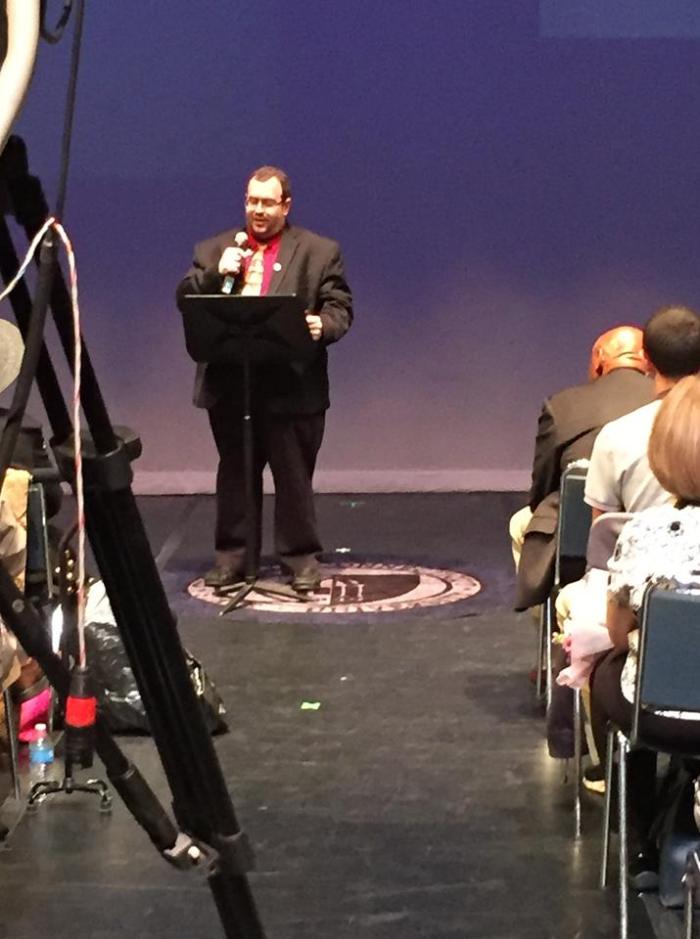
The moment came. Drs. Shaw and Casiano had already spoken. I got up from my seat in the front row to get my lapel microphone attached.

Jesse gave me a warm introduction letting everyone in on the secret of my tie – the design was a picture of my daughter repeated to infinity.

So I walked to my mark and started speaking.

It seems there was some sort of technical difficulty with the microphone. My voice didn’t appear to be coming from the speakers – or if it was, it wasn’t projecting very well. So I spoke louder.

Then Jesse came from the wings and gave me a hand mic and a music stand for my notes.

It took a moment to get used to handling the microphone, the clicker for my slides and my iPad (where I had my notes), but I got the hang of it.

And I was off and running.

I said it. I said it all.

The audience certainly didn’t seem bored. All eyes were on me. A few heads were nodding in agreement. Some faces seemed stunned.

When I ended, there was universal applause. A few folks patted me on the back when I got back to my seat and shook my hand.

And that was it.

I thoroughly enjoyed the remaining presentations but it was hard to concentrate in the post-TED elation.

Jones and Nance were probably the closest to what I was talking about and we got along like we’d known each other for years.

When I got back to the hotel, I felt elation and exhaustion in equal measure.

I had done it.

After months, years of planning, it was over.

Jesse tells me the video will be on-line in a matter of weeks. (I’ll revise this post with the video when it goes live.) Though he did mention that one point in my presentation made him a bit nervous – I had called out Bill Gates for his role in the destruction of public schools. However, Gates is a big donor to TEDs. Jesse half-jokingly said that the TED folks might take issue with that and refuse to upload my speech.

But whatever. I told the truth. If that gets me censored, so be it.

This will be something I’ll never forget.

I’m sorry this article has gone on so long, but there was much to tell. It’s not every day that someone like me gets such a stage and such a potential audience.

Hopefully, my video and my speech will be seen by many people who have never heard of this fight before. Hopefully it will open minds and stoke people to act.

And hopefully the mic issues at the opening won’t be distracting.

Thank you for following my blog and being there with me on this incredible journey.

I left nothing important unsaid. I gave it my all.

Now to see where it goes.


The video is available on YouTUBE and directly on the TED Website.


Kiss My Assessment – A High Stakes Testing Poem

1*ek7Qa4T4-jUcRA2QOZG8Xg


Double, Double, test and trouble;

Standards stern so fill in that bubble.


Little Laquan, Empty belly

Reading passages by Maichiavelli

Does he know what the author thinks

Last night did he get forty winks

Drive-by shooting in his neighborhood

Answer questions that he should

Interrogated by the cops

Took away and locked his pops

Now he sits slumped in school

Testing, testing, it’s a rule

Will he – this time – make the grade

A debt to society he has paid


For being poor and his black skin

Success and riches, let me in!

But not unless you answer right

Like wealthy kids whose hue is white

Not two plus two or three and four

Context implied when you ask for

European culture and white society

If you know it, you’re in propriety

If not, take a longer road

Hurdles to jump and words to decode


But do not label the test unfair

Rich folks will blast you with hot air

Testing makes them bundles of billions

Leaching off of us civilians

Test prep, grading and remediation

Never mind that it keeps you in your station

Need new books, here’s Common Core

So big corporations can make some more

Money off your starving schools

The funding is drying up in pools


As politicians vote to gut

So they can give bankers another tax cut

Hotels and yachts and Maltese vacations

Touring havens in other nations

To hide their money and avoid paying

Anything to keep preying

On little kids and their moms

So long as they aren’t forced to pay alms


No nurses, no librarians, no psychologists

Nothing to feed a tummy or an esophagus

No fancy buildings, no small class sizes

Nothing to match the suburban enterprises

Fewer resources, fewer tutors,

Crumbling classrooms, archaic computers

Just give them tests as charity

And pretend it means populace parity

When he fails, we’ll blame Laquan

Fire his teacher and make her move on


Close his school and open a charter

And then his services we can barter

To turn his funding into profit

Democracy melts like warm chocolate

Private boards get public voice

Deciding who to enroll and calling it choice

Spending tax money behind closed doors

Filling classrooms with Americorps

Instructors who never earned a degree

But cheap trumps any pedigree

For teachers to teach the darkest of humans

As long as they don’t form any pesky unions

Reformers they’re called, really just hypocrites

Wolves with sheep skin in their identity kits


They might refuse to come out of the closet

But don’t burn this humble prophet

Who tells you the truth about high stakes tests

About the school system and the unholy mess

We’ve made for kids so hedge funders

Can bark and rave and push for blunders

To make money off of kids misery

And a better world – not for you, not for me.

Am I obsessed and distressed by oppressive divestment?

Oh who cares? Kiss my assessment!


Double, Double, test and trouble;

Standards stern so fill in that bubble.


NOTE: I wrote this poem during and after proctoring this year’s PSSA test for my 7th grade students. Can’t imagine where the inspiration came from! I’ll just say that the opposite of standardized testing has always seemed to be poetry. I hope you enjoyed my verses.  It was either that or spit curses!


Like this post? I’ve written a book, “Gadfly on the Wall: A Public School Teacher Speaks Out on Racism and Reform,” now available from Garn Press. Ten percent of the proceeds go to the Badass Teachers Association. Check it out!

book-2