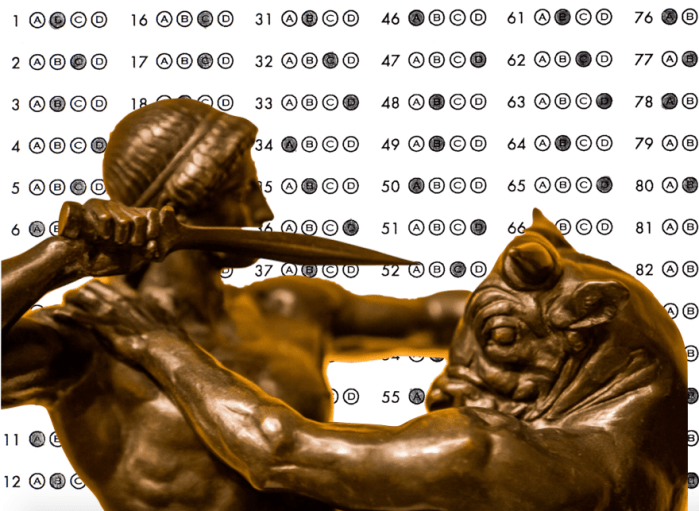
Let’s say there was a monster loose in Pennsylvania and you caught it.
Its days of wandering loose causing chaos and destruction were over.
But what would you do with such a beast now?
Would you kill it outright? Stop it from ever hurting anyone ever again?
Or would you simply neutralize it – place it perhaps in the center of a labyrinth, continue feeding it, and in fact create a whole religion based on worshipping it?
In the keystone state, we have just such a creature, and we’re going with the second option – the maze, nourishment and a cult.
And, heck, it would just make more sense to stop doing something that isn’t working, wastes money and causes legitimate problems for students.
But this is Pennsylvania! We’re not going to admit we made a mistake. Better to bury it under red tape and pretend like this is what we meant all along. Nothing to see here, folks. Nothing to see…
Pass an Advanced Placement or International Baccalaureate exam;
Complete a dual-enrollment program;
Complete an apprenticeship program;
Get accepted to an accredited four-year nonprofit institution of higher education;
Complete a service-learning project;
Secure a letter of full-time employment;
Achieve an acceptable score on a WorkKeys assessment, an exam administered by the ACT which assesses workplace skills including math, reading comprehension and applied technology.
To sweeten the pot even further, this won’t even go into effect until the 2021-22 school year.
So in four years, high school seniors will be racing to submit their letters of college admission, or letters of employment or SAT scores or whatever to prove they actually deserve that diploma.
But that will not be the end of it.
Just because victims thrown into the labyrinth have an easy path to avoiding the monster doesn’t mean the monster won’t affect them.
Heck, many districts will probably “voluntarily” decide to make passing the test a graduation requirement just to force their students to take them seriously.
So anyone who’s out celebrating that the Keystone Exams are dead is premature.
State Sen. Andy Dinniman, at least, understands this.
“Remember, the Keystones have been delayed and the graduation requirement associated with them has been stopped, but they will still be required in Pennsylvania schools for federal accountability,” he said in statement.
“Meanwhile, we know they are expensive, redundant and unnecessary and I will continue to work to end them once and for all.”
Dinniman, a Democrat, is minority chair of the Senate Education Committee.
It’s a problem all too typical in the state.
Most lawmakers are too timid to take any type of real stand. They’d rather support some half-measure so they can claim to be in favor of either or both sides of an argument.
For instance, consider the time it takes to finish the tests.
So Gov. Wolf cut the Keystone Exams and Pennsylvania System of School Assessment (PSSA) test by a total of almost 2 hours a year.
However, at the same time, his administration suggests students take a series of additional pretests that are supposed to predict success on the PSSA or Keystone Exams – tests such as the Classroom Diagnostic Tools (CDT) assessment.
If schools follow the state’s instructions and give students this exam in reading, math and science 3 to 5 times a year, that’s an additional 50-90 minutes per test. That comes to 22.5 hours of additional testing!
But there are no details about who will provide these services, who will be responsible for the money, exactly what else the money might be used for or almost anything substantive about it.
It’s just a check with “For Kids” scrawled in the Memo and everything else left blank.
The Children’s Fund would be financed by 0.25 mills of property tax — $25 on each $100,000 of assessed value, beginning Jan. 1.
That’s expected to generate roughly $18 million a year that would begin to be distributed in 2020.
If approved, it would change the county Home Rule Charter to establish the fund as part of county government. It would create a new office under the supervision of the county manager.
However, County Council and County Executive Rich Fitzgerald would have to do the work of actually creating all this stuff. They’d have to pass an ordinance establishing how this all works, what powers the advisory commission has, etc. They would have to determine whether the money goes to existing programs or new ones. They’d have to set up audits of the money every five years, conduct a study to recommend goals and a focus for how the funding is spent.
That’s an awful lot left undecided.
It makes no sense for voters to hand over the money BEFOREwe figure all this other stuff out.
It’s not at all how good government works.
You’re supposed to define a problem or need and then come up with a plan to meet that need. You prepare a budget that justifies raising taxes and then you vote on it.
This is exactly the opposite. We’re getting the money before the plan of how to spend it.
That’s a recipe for fraud and financial mismanagement.
2) It’s Unclear Who Would Be In Charge of the Money
Who would be accountable for this money?
We know who gets to decide this – County Council and the Chief Executive. But we don’t know who they will pick or what powers they’ll delegate to these people. Nor do we know what kind of oversight there will be or what kind of regulations will exist for how it can be spent.
This is a blind statement of trust.
It’s like saying – “Here’s $18 million. Go buy us something nice.”
What if they mismanage the money? And what would that even mean for money with so few strings attached? And how would we know? How transparent would this process be?
It’s kind of hard to approve such a plan with so many variables up in the air.
Financial documents show that the whole initiative has been funded by various nonprofit organizations that could, themselves, become beneficiaries of this same fund.
According to the Children’s Fund’s own campaign finance report, as of June there were three nonprofit corporations who donated $427,000 to the campaign: the Human Services Center of Turtle Creek gave $160,000, Pressley Ridge Foundation gave $150,000, and Allies for Children gave a donation of $45,000 and another for $72,000.
That’s like McDonalds spending a hundred thousand dollars to fix up the school cafeterias so it could land a multi-million dollar annual contract!
It’s a huge conflict of interest.
At very least, it’s purposefully misleading.
Many of those “volunteers” gathering signatures weren’t working for free. They were part of the $100,000 spent by the campaign to hire Vote Goal Organizing for paid signature collectors.
That doesn’t look like charity. It looks like philanthrocapitalism – when corporations try to disguise grabs for power and profit as philanthropy.
I see no reason to think this “Children’s Fund” is any different.
4) It Works Around Instead of With Local Government
Though almost everyone agrees with the stated goals of the Children’s Fund, many organizations and government officials complained that they were not consulted and made a part of the process.
“First and foremost, we have not had any conversations with the organizers of the referendum,” board president Regina Holley said. “There are lots of ifs and whats that have not been answered.”
Kevin Carter, another city school director added, “In my role as a school board member, they didn’t talk to us about this at all.”
“When you leave your largest school district in the region out of this conversation, are you doing this around children?” he asked, citing that the district serves 25,000 students daily.
This has been a common thread among officials. No one wants to say they’re against collecting money that’s ostensibly for the benefit of children, but it’s hard to manage the money if you’re not part of the process.
And it’s not just protocol. Many are worried that this lack of communication may be emblematic of how the fund will be run. If organizers aren’t willing to work with local governments to get the job done, how will they know what each community needs? How will they meet those needs? Is that even what the fund will really be about?
Richard Livingston, Clairton school board president, noted concern that the money collected might not be spent evenly throughout the county. For all he knows, it could just be spent in the city or in select areas.
Indeed, this is not the best way to start any endeavor funded by all, for the benefit of all children.
5) It’s Redundant
While it’s true that the county could use more funding to meet the needs of students, numerous organizations already exist that attempt to provide these services.
There are a plethora of Pre-K, after school tutoring and meal services in the Mon Valley. In fact, much of this is done at the county’s various neighborhood schools.
If organizers were only concerned with meeting these needs, why form an office within county government that would have an appointed advisory commission? Why not just increase the funding at the local schools and/or organizations already doing this work?
“At PIIN, we believe that the faith community is a sacred partner with our public schools, and we have long been supportive of both the community schools model and increasing state funding to provide an excellent, high-quality education to every child in our region. We believe in funding for early childhood learning, after school programs, and nutritious meals. However, we cannot support a ballot initiative that creates an unnecessary entity, with an unknown advisory board, and an unclear process for directing our tax dollars.
This is why we are urging our membership to reject the Allegheny County Children’s Fund Initiative at the polls this November.”
Another related organization, Great Public Schools-Pittsburgh, also released a statement with “several specific concerns” about the potential fund. These include how the money would be distributed, which organizations would benefit from it, and questions about its redundancy.
Several pre-K programs already exist but are not fully funded, the organization noted. Why don’t we just fund them?
The group is a coalition of the Education Rights Network, One Pennsylvania, the Pittsburgh Federation of Teachers, PIIN, and the Service Employees International Union.
The group’s statement noted concerns but fell short of urging an outright NO vote.
Pam tried to bring up a few other topics – about how Republicans in our state of Pennsylvania are actively working to cut this man’s healthcare, calling this man’s generation “the greediest generation” and other topics.
But it did no good. Fox News had gotten there first.
So we handed him our campaign literature, thanked him and went on our way.
Sometimes that’s the best you can do.
And it’s not nothing.
If you’re reading this blog, I’m assuming you’re a lot like me.
A reality TV show clown is President of the United States of America. And all over this country, the conservative clown car is spitting out candidates for major office.
It will take all of us, doing incremental good, every day we can.
So my suggestion is to make a commitment to voting this Nov. 6.
I know our electoral system is a mess. I know many people are being purged from the rolls and our districts are gerrymandered and the entire system is set up against us.
But if all of us try to vote, we can still win.
Find a candidate you can support and go out there and campaign for him or her.
I know there are a lot of phonies running for office. There are an awful lot of fake progressives who will talk nicely to your face and then sell you out to corporations and the wealthy at their first opportunity.
Just know that they’re not all like that.
Find yourself someone you can trust – probably someone new to the game coming on the scene to change things.
She’s an amazing lady with real conviction running for State Senate in the 38th District – that’s most of Northern Allegheny County from Franklin Park eastward, as well as Highland Park and sections of East Liberty in Pittsburgh.
When her campaign literature says she “won’t back down” fighting for working families. That’s what it means.
And her priorities – education, healthcare and labor – aren’t pie in the sky promises. She has a fiscally responsible plan to support them by creating a severance tax on natural-gas drilling and closing a loophole that allows businesses headquartered in other states to avoid state taxes. She wants to keep taxes low for homeowners while making sure the wealthy and corporations pay their fair share.
Perhaps that’s why a conservative dark money organization aligned with her Republican challenger, Jeremy Shaffer, has created knockoff campaign signs that look just like Williams with the word “Socialist” emblazoned on them.
It’s a desperation tactic.
Shaffer is down in the polls. The district – once a Republican stronghold – went to Hillary Clinton in the last election.
Even Shaffer, a Ross Township supervisor, is a throwback – he’s a far right extremist who primaried incumbent state Sen. Randy Vulakovich (R-Shaler) in May.
So not only is Williams a candidate I can believe in, her race really matters to the overall state picture. If the Democrats only pick up her seat in November and don’t lose any others, we’ll crush the GOP’s veto-proof majority!
But I didn’t come out this weekend just for Williams.
I also was there to canvass for Betsy Monroe, a Fox Chapel medical professional at Highmark running for State House in the same North Hills area.
She noticed that state Rep. Hal English (R-Hampton) had run unopposed in the last two elections, so she decided to run against him, herself.
Monroe was particularly angered by English’s vote to criminalize abortions after 20 weeks for all women in the Commonwealth. (The bill was vetoed by Democratic Gov. Tom Wolf back before the GOP had a veto proof majority.) She thought it was unfair for lawmakers to decide what adult women can do with their own bodies.
However, there was one other woman I was there to support – my own daughter.
For someone in elementary school, she is incredibly interested in politics. I caught her on Saturday literally writing political stump speeches for her stuffed animals. Let me tell you, Eeyore the donkey from the Hundred Acre Wood has some mighty progressive views on women’s rights!
I wanted my little one to see real women in politics, fighting to make a difference.
The news is always so grim. I wanted her to see that there are people out there fighting for the good.
And you know what? It helped me, too.
At this point I need to pause and give a huge “Thank You” to two people – Pamela Harbin and Jodi Hirsch.
Me and Pamela Harbin
Jodi is an amazing organizer who put together the event in the first place.
I wanted to get more involved in the election and Jodi knew exactly how I could do that and which candidates I’d be most interested in.
They wouldn’t commit to anything – just took our literature, heard us out and said they’d decide at the polls.
I always wondered what an undecided voter looked like. I saw a lot of them this weekend.
But that’s why we were there – to help nudge the uncommitted.
Hopefully on Nov. 6 they’ll think of Pam, my daughter and me.
Maybe even the Fox News fan who thought Kavanaugh got a raw deal will have his resolved softened.
Maybe he’ll think of my daughter’s chubby cheeks and innocent eyes as he considers voting for people who’d gladly steal her future for the prospect of more tax cuts for the rich.
Then again, maybe not. But who knows?
We tried.
If you live in Pennsylvania and want to get involved, click HERE.
The defining moment of Pennsylvania’s one and only gubernatorial debate wasn’t made by incumbent Tom Wolf or his challenger Scott Wagner.
It was made by former Republican Gov. Tom Corbett.
At least it was made by him seven years ago.
Before voters overwhelmingly choose the Democratic Wolf to replace him, Corbett told a whooper about his administration and education funding – namely that he DIDN’T cut almost $1 billion from the poorest schools in the Commonwealth.
“Trebek: What you have not mentioned is education suffered immensely about seven years ago when Gov. Corbett knocked off about a billion dollars. And…
Wagner: That’s totally false.
Trebek: Oh, it’s false.
Wagner: That’s totally false. Those were federal stimulus dollars. Gov. Wolf went around and told that. It was a lie. Gov. Corbett … (Clapping)… And the stimulus money came in during Gov. Rendell’s administration. And so Gov. Corbett’s here tonight. People need to know that Gov. Corbett did as much for education as really any governor. (Clapping) And he needs to be remembered for that. He didn’t cut the billion dollars. It was a billion dollars of stimulus money that came in and they were told – the education system – I wasn’t there – Don’t hire teachers, don’t… They did all that. Guess what? Here’s the problem with the system, Alex. The billion dollars. It’s gone. We have nothing to show for it.”
Here’s the crux of the bedtime story he’s telling.
The big bad federal government gave us money, and when that money was spent, we didn’t have it anymore. So what mean ol’ Gov Wolf calls a budget cut was no one’s fault.
It’s as if someone gives you a couple hundred dollars for your birthday and then your boss stops paying you your salary. That may work this week, but next week you need your paycheck. Otherwise you don’t have money to pay the bills.
Your boss can’t say to you: I’m not cutting your wages. Look I gave you just as much money this week as last week.
But now that his campaign has seen how unpopular that position is, very recently he’s changed his tune.
Suddenly he says we should increase education funding.
And good for him.
However, if he’s using the Corbett playbook, it seems that “increase” really won’t be anything of the sort.
It will just be more creative accounting and fantasy storytelling. He’ll pay for pensions and say he’s increasing school funding. Or maybe he’ll fudge something else from column A and pretend it’s funding column B.
It’s disingenuous, dishonest and Pennsylvanians aren’t going to put up with it.
Perhaps that’s why Wolf is leading in the polls.
Wagner may have found a way to get his supporters into the debate hall – they certainly clapped loud at his points – but they are a minority among voters.
I wish Trebek had called him out on it.
I wish Gov. Wolf had challenged him.
But time was running short and Wagner still had to complain about a college swimming coach with too high a pension, and he had to whine about mean old Wolf demanding the Marcellus Shale industry pay its fair share of taxes.
There were plenty of other sparks at the debate.
Wagner raged about this and lied about that. He thinks running a state like Pennsylvania is like managing his $75 million garbage hauling company. But if given the chance, it will be our children’s future’s that are left in the trash.
Meanwhile, Gov. Wolf looked like the adult in the room, soberly explaining the improvements he’d overseen in his term in office (a balanced budget, healing some of the Corbett education cuts, etc.) and outlining where we need to go in the future.
Every time Wagner slammed him for taking support from unions, I wished he’d spoken up. But he just let it pass like Casey at Bat looking for a perfect pitch.
Don’t get me wrong. I think Pennsylvania voters have a clear choice here – the sane, sensible Wolf vs. the blowhard and capricious Wagner. But how I wish Wolf had shown more fight!
Twitter squeaky wheels thought the Jeopardy host’s moderation was weird. I’ll admit a tangent into the Catholic church and pedophile priests may not have been necessary. But he made the entire event more watchable and he called out Wagner’s lies more often than not.
The lesson we were supposed to take away from the activity was that hiding was a losing strategy.
“Do something,” one of the police officers conducting the drill said.
They wanted us to swarm the shooter, throw things at him (Nerf balls in our scenario) or make a run for it. Anything but simply staying put and being sitting ducks.
It made me wonder why our lawmakers don’t heed the same advice.
But it’s impossible. You can’t keep out human nature.
The same things that cause shooters to enter the school and go on a killing spree are already in our classrooms.
O’Grady may have imagined he was a member of Al-Qaeda as he pretended to blow his co-workers away, but if a shooter ever enters our building, he’s more likely to be a co-worker, parent or student.
Turning the school into a prison will not help. Turning teachers into guards (armed or otherwise) will not solve anything.
Back in 1999 in the wake of the Columbine school shooting, the Secret Service and U.S. Department of Education warned against all the things we’re doing now – police officers in the schools, metal detectors, cameras, etc.
Instead, they advised us as follows:
“Specifically, Initiative findings suggest that [school] officials may wish to consider focusing their efforts to formulate strategies for preventing these attacks in two principal areas:
developing the capacity to pick up on and evaluate available or knowable information that might indicate that there is a risk of a targeted school attack; and,
employing the results of these risk evaluations or “threat assessments” in developing strategies to prevent potential school attacks from occurring.”
That means prevention over disaster prepping. Homeland Security and education officials wanted us to pay close attention to our students, their needs and their struggles.
We keep our schools safe by looking to the humans in them and not new ways to barricade the building or watch the whole disaster unfold on closed circuit TV.
The fact is that our schools are actually much safer than the communities that support them. Numerous studies have concluded that students are more secure in school than on the streets or even in their own homes.
If we want to make the schools safer, we need to make the communities safer.
And, no, I’m not just talking about high poverty neighborhoods populated mostly by people of color. I mean everywhere – in our society, itself.
According to the Graduate Institute of International and Development Studies in Geneva, Americans now own 40 per cent of all guns in the world – more than the next 25 countries combined. And with every mass shooting and the hysteria trumped up by gun manufacturers with each surge in profits, that number continues to climb.
You can do whatever you want to the schools, but you’ll never increase safety until you deal with THAT problem.
“There is no clear research evidence that the use of metal detectors, security cameras, or guards in schools is effective in preventing school violence (Addington, 2009; Borum, Cornell, Modzeleski, & Jimerson, 2010; Casella, 2006; Garcia, 2003). In fact, research has shown that their presence negatively impacts students’ perceptions of safety and even increases fear among some students (Bachman, Randolph, & Brown, 2011; Schreck & Miller, 2003). In addition, studies suggest that restrictive school security measures have the potential to harm school learning environments (Beger, 2003; Phaneuf, 2009).”
At this week’s active shooter drill in my school, one of the student aides asked the principal when he thought the state would be arming teachers.
For him, it wasn’t a matter of if. It was a matter of when.
Security cameras were present at Sandy Hook and Virginia Tech. They didn’t stop anything from happening.
Armed resource officers were present at Columbine and Parkland. That didn’t stop anything from happening.
All these measures do is criminalize our students. It turns them from prospective learners into would-be prison inmates – and as we know, our prisons are not exactly the safest places to be.
“How’d I do?” asked Mr. O’Grady, my co-worker who had posed as the shooter during the last scenario.
“You shot me in the dick,” I said.
He laughed. And I laughed.
But it was the kind of laugh that dies in your throat and leaves a taste of ashes.
School safety is a joke in 2018. Not because of what teachers and districts are doing.
The assessment, which cannot be taken with pencil and paper but must instead be taken on a computer or personal device, has always been glitchy.
You type in a response and what you typed only appears after a delay.
When moving from one screen to another, you have to wait through a seemingly endless interval until the next screen loads.
And during this year’s first sessions, multiple teachers told me of students whose tests cycled through all the questions without input from the students and then gave them an unalterable grade.
This is not the best way to diagnose students’ abilities in reading, math and science.
There are still a battery of suggested pretests on the state’s wish list – tests that are supposed to predict success on the PSSA or Keystone Exams – tests used to show whether kids are getting the skills they need.
Do you understand it now?
No.
Do you understand it Now?
No.
Do you understand it NOW!!!!!!!?
Of these, the most common is the CDT.
If schools follow the state’s instructions and give students this exam in reading, math and science 3 to 5 times a year, that’s an additional 50-90 minutes per test. That comes to 22.5 hours of additional testing!
So 22.5 hours minus 2 hours equals… NOT A REDUCATION IN TESTING!
Moreover, the CDT test is cumbersome to proctor.
I’ve given my students this test for about seven years now and it never fails to be anywhere from tricky to an outright disaster.
This week, I had a class of students on their iPads unable to log on to their accounts at DRC headquarters. In another group, five students were dropped from the server without warning and couldn’t finish.
Defective software and having to repeatedly log back in to the system are hallmarks of even the most successful CDT session.
Even if you like standardized tests and think they are the best way to assess students, the product and service provided by DRC is extremely low quality.
This is bad assessment supporting bad pedagogy forced on us by bad policy.
But that’s not even the worst part.
Why are we doing this in the first place?
Have standardized tests ever been proven accurate assessments of student learning? Moreover, has it ever been proven useful to give pre-test after pre-test before we even give the ultimate high-stakes test?
So all this testing does nothing to help students learn. It simply reinforces the inequality already in place. And then it’s used as a justification for that same inequality.
We are putting our children’s futures in the hands of a for-profit company with little to no assurance that it is safe. There is little oversight, accountability or even awareness of the issue.
Therefore, any knowledgeable parent would be entirely within his or her rights by refusing to let their child take any of these tests.
(d) School entities shall adopt policies to assure that parents or guardians have the following:
(1) Access to information about the curriculum, including academic standards to be achieved, instructional materials and assessment techniques.
(2) A process for the review of instructional materials.
(3) The right to have their children excused from specific instruction that conflicts with their religious beliefs, upon receipt by the school entity of a written request from the parent or guardians.”
Pursuant to Pennsylvania Code Title 22 Chapter 4, section 4.4 (d)(1)(2)(3) I am hereby exercising my right as a parent to have my child, [NAME], excused from PSSA test prep, including (but not limited to) CDT’s and Study Island because of religious beliefs.
Sincerely,”
So while Pennsylvania’s lawmakers dither back and forth about the political realities of standardized testing as an accountability measure and as they blithely ignore the threat posed to student privacy by on-line testing, parents can take matters into their own hands.
Your child’s teacher would like nothing better!
Imagine being able to actually teach and not have to spend days of instruction time troubleshooting a Website while corporate lackies cash our check!
Imagine students in school to actually learn something – instead of testing them into oblivion.
Imagine a student raising her hand to ask a question about the curriculum and not the software!
I’m out to eat with my family and have just taken a big bite of a juicy beef taco.
That’s when I notice someone standing right next to me at the restaurant.
So I raise my eyes upward, a meat filled tortilla overfilled with lettuce and beans hanging from my mouth, and I’m greeted with a familiar face.
“Mr. Singer!” the woman says with a nervous smile on her lips.
“Do you remember me?”
I think for a moment but realize I have more pressing concerns. I couldn’t reply with an answer to the woman’s question even if I did remember her.
So I chew and swallow and then look again.
“It’s me,” she says. “Tamarind.”
And then it hits me like a flash.
The face in front of me ages backward. The adult eyes soften. The taut cheeks become chubbier. And her whole figure shrinks three feet closer to the ground.
“Oh my God! Tamarind! Of course I remember you!” I say.
She smiles and blushes. I’m surprised by how nervous she is. I’m no one to inspire anxiety. I’m just a guy out with his wife, daughter and father-in-law shoving a taco in his face.
“When I saw you here I just had to come up to you,” she said. “I was in your 6th grade class.”
“I think it was 8th grade, wasn’t it?” I said.
“Yes! That’s right! Eighth grade!”
“How old are you now? My gosh I remember you when you only came up to here off the ground.”
“I’m 22. I’m doing really well. I just wanted you to know that you taught me how to write. If it wasn’t for you I never would have made it anywhere. I just wanted to thank you so much for everything you did for me.”
We chatted a bit more and then she left us to finish our meal.
But, of course, the whole interaction got me thinking.
As a teacher, you are something of a minor public figure.
When you’re out and about – especially if you’re somewhere in your district – you’re bound to be recognized and invariably someone will want to chat.
I remember one time at the bakery counter a former student gave me my order and told me he threw in a few donuts.
I remember laughing and telling him he didn’t need to do that.
“Nah, Mr. Singer, you never wrote me up for falling asleep in your class. You knew I was watching my brothers and sisters at home and never gave me shit for it. You keep those donuts.”
Another time at the theater I was almost late to my movie because I was listening to a former student at the concession stand catch me up on her life and what all of her friends from my class were doing these days.
So many students. So many kids that have now become adults.
You lose track of how many lives you’ve had an impact on.
The first few days of school are always filled with endless administrative meetings. The superintendent welcomes you with testing data. Then your principal breaks it down by building and subject.
You find out which diagnostic exams you have to give your students and when. You find out what your Pennsylvania Value Added Assessment Score (PVAAS) is – how good a teacher you are based on how well your students from last year did on the state standardized test.
On the one hand, I suppose I have no reason to feel like much of a good teacher.
Most of my students didn’t pass the test. They rarely do.
The same number of 7th graders (that’s what I taught last year) passed the reading test as in previous years. However, many more passed that were expected to fail.
The state uses a mystery metric based on Classroom Diagnostic Assessment (CDT) data to come up with a prediction of who they expect to pass and who they expect to fail. No one really knows how they calculate this. For all we know, the state secretary of education could examine a pile of chicken entrails before entering it all into the system.
Does all that data mean I’m a good teacher or not?
I don’t know.
But I do know what Tamarind thinks.
And I know what a host of former students have told me. I know how they react when they see me out in the wild, just living my life.
I’m sure there are probably former students who don’t like me. There must be those who hold a grudge for getting a 59% on an assignment. Or maybe they remember me yelling at them for something. Or – who knows – maybe they just didn’t respond to The Singer Charm.
But an awful lot of people come up to me who don’t have to.
Yesterday was the first day of classes for the year.
For the first time, all my classes were looped. I taught 7th grade Language Arts last year and I’m teaching the 8th grade course this year.
When those kids came into the class on Friday, it was like a homecoming.
So many smiles. So much laughter and joy. And, yes, impromptu hugs.
It felt like a family gathering, not a school function.
As I left the building feeling more exhausted than I have in months, another teacher stopped me.
“Steve! I wanted to catch you before you left!” she said.
She told me that she gave her students a survey in her class as an icebreaker. One of the questions was to name their favorite teacher from last year. My name came up a lot.
He hates science. He hates schools. He hates teachers. And if students get in the way, he’ll hate them, too.
These are the qualities he thinks Pennsylvanians are looking for in their next governor.
The York Township Republican will challenge incumbent Democrat Tom Wolf on Nov. 6, 2018.
So who is this guy?
Wagner’s a college dropout who made a fortune starting a garbage hauling firm. He became a state senator four years ago after winning a write in campaign during a special election where only 17% of the electorate could be bothered to vote.
And ever since, he’s been consistent about one thing: he really, Really, REALLY hates teachers.
“We have 180,000 teachers in the state of Pennsylvania,” Wagner said in 2015. “If we laid off 10 percent of the teachers in the state of Pennsylvania, we’d never miss them.”
That’s a deficit we still haven’t recovered from. Even today, state schools are staffed at a 10-year low. Class sizes are at an all time high.
Yet Wagner wants to fire even more teachers!?
That’s not the policy of a man who wants to help improve life throughout the state for all. That’s not the policy of a man who wants to help kids learn.
It’s the policy of a man who has a personal grudge against educators.
And his other legislative objectives?
Wagner wants to further slash education funding. He wants to spend whatever is left inequitably. And he really wants to help his heroes Donald Trump and Betsy DeVos enact school vouchers so business people like him can continue to cash in on children from Pittsburgh to Philadelphia and all places between.
By contrast, in his four years in office, Gov. Wolf has pushed to increase education funding, pushed to spend it more fairly, and even cut the time it takes for students to take high stakes standardized tests.
The good news: voters throughout the Commonwealth have never had a clearer choice for governor.
The bad news: when has that ever stopped them from getting it wrong?
“We have created a special class in this state and the special class is the public sector union employee,” Wagner told Keystone Crossroads in a 2015 interview.
“Teachers are doing very well in this state,” he said. “People would be appalled if they knew what their teachers made, in certain areas.”
Unfortunately, Wagner has no idea, himself.
He keeps quoting a bogus salary figure that I’m not going to repeat. It’s not true statewide, it’s not an average, nor is it true in his home district.
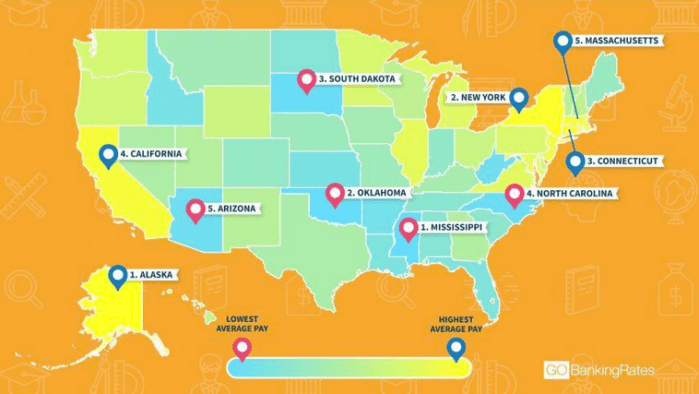
In truth, the low end for teachers entering the field nationwide is around $30,000, according to the National Association of Colleges and Employers (NACE). So go to college, get a four – sometimes five – year degree including a rigorous internship of student teaching and you make a mere $10,000 above the most generous minimum wage!?
According to that data, Pennsylvania teachers make on average $63,063 per year. Of neighboring states, teachers in Maryland ($65,247) and New Jersey ($71,687) make more. Teachers in Ohio (59,063) and Delaware ($59,853) make less.
Highest and Lowest Teacher Salaries – Source: GoBankingRates
As everywhere else, many teachers struggle to make ends meet working multiple jobs while others are well compensated.
No matter how you slice it, nationwide teachers’ salaries are 14% less than those from professions that require similar levels of education, according to the Economic Policy Institute.
In other words, if prospective teachers want to make more money, all they have to do is switch majors.
That may be part of the reason for our national teachers shortage. Not only have states like ours laid off tens of thousands of educators, many don’t stay in the field if given the chance. Across the country , 46 percent of educators quit before reaching the five year mark. And it’s worse in urban districts, where 20 percent quit every single year!
So forcing sick teachers to come to school and spread the germs to children is fine with Wagner as long as it hurts his nemesis – those evil teachers.
He Wants to Cut Teachers Pensions
He also plans to end pensions for working educators, and even wants retired educators to give back 10% of the retirement they earned.
He’s right to want reform to the state pension system but disingenuous or misinformed about the cause.
Pennsylvania pension costs have increased primarily because our legislature made bad plans and bad investments that were upended by the crash of 2008. You don’t fix that by stiffing your employees. If you do that, no one will believe any promises the state makes and no one of any substance will want to work for the state.
He Wants To Pay Teachers Based on Student Test Scores
“There are teachers that will exceed expectations while teaching a classroom of 100 of the toughest-to-teach students. There are also teachers that would struggle to teach just one student at a time. I want the first teacher to make a small fortune, and I want the second teacher to find a new career that is better suited for him or her.”
So if you teach the best students, you should make the most money? And if you teach struggling students, you should be fired?
But It’s Not Just Teachers. He Hates Other Working People, Too
If there is a corner to cut, he wants to take it – especially if it screws a working person. As a state senator, Wagner even introduced a bill that would exempt school districts from paying laborers the “prevailing wage” on construction projects.
Cheaper labor, shoddier work. That’s surely a recipe for success in buildings housing school children!
He Wants to Disband Unions
Oh, but he’s not done.
The man who once compared the tactics of public employee unions – including those representing teachers – to those of Adolf Hitler and Vladimir Putin also wants to end tenure end tenure, seniority, and disband unions.
I’m sure reducing teaching to a career without benefits, workers rights or protections will do wonders for the educational quality students receive.
Teachers working conditions are students learning conditions. Putting children in a building that has fewer safety precautions because there’s no union to collectively bargain for them is a great way to cut costs. But parents aren’t thrilled about having their kids try to learn in a sweat shop filled with Trump brand Russian asbestos.
Charter schools, funding private and parochial schools with public tax dollars. He’s in for all of it.
So long as it hurts public schools and enriches private businesses without helping students learn at all.
Go ahead! Take scarce funding from public schools and divert it to programs with little to no accountability. Let private school operators fraudulently misrepresent enrollment data. Let them fail to provide safe and academically appropriate learning environments. Let them game the system in any and every way.
That’s what Wagner calls fiscal accountability.
It doesn’t matter that these schools don’t improve student achievement. Evaluations of voucher programs in Milwaukee, Cleveland, and Washington, D.C., have all found no statistically significant differences in the academic achievement of voucher students compared to public school students. And recent evaluations of programs in Ohio, Indiana, and Louisiana revealed that voucher students scored lower than their peers attending public school.
But who cares about facts? This is all ideology for Wagner.
Vouchers have a record of undermining student’s civil rights – especially students with disabilities. Private school students give up due process and other rights guaranteed in public schools. Private schools are allowed to discriminate by denying admission based on religion, sexual orientation, citizenship status, English language proficiency and disability. Private schools that enroll students with disabilities may decide not to provide the services or accommodations guaranteed to such students in public schools. Or they may charge parents extra for them. Moreover, there is nothing to stop them from segregating these kids from other children. And, finally, private schools often suspend or expel students without due process.
This may be Trump and Wagner’s ideal. But it is certainly not what Commonwealth voters want for their children.
He Wants to Get Rid of Many State Colleges
Wagner caused an uproar when he said the state’s 14 state colleges will not be around in four years. “So, for those of you who think your school’s going to be around four years from now, it isn’t going to be around,” Wagner said.
Fewer institutions of higher learning. Fewer opportunities to get a college degree. That sounds like the policy of a college dropout.
“They think the solution is more money,” he said of Wolf and the Democrats. “Every time you do that the money disappears and the problem is still there.”
It’s like taking a bath, Scott. You can’t just do it once and be clean for the rest of your life. You need to bathe every day. One-time funding windfalls don’t work. You need equitable and sustainable funding revenues.
But that’s either too complicated for Wagner or he just doesn’t care.
He supported Gov. Corbett’s plan to decimate Pennsylvania’s schools. And he doesn’t think the culling should be over.
When asked point blank about Corbett’s cuts in 2011, he said, “Yes, I believe that Governor Corbett needs to stick to his plan.”
He’s said repeatedly that we spend “enough money” on public schools, while stressing the need for frugality and fewer regulations.
He Wants to Play with How Schools Are Funded
He’s an advocate for legislation that would eliminate school property taxes and replace them with increased state sales and income taxes.
True we need a better funding mechanism than local property taxes. But you can bet Wagner’s plan is worse than the current system.
It would lock funding inequities among Pennsylvania’s 500 school districts into place.
He Thinks Global Warming is Caused by the Earth Getting Closer to the Sun
Wagner is an incredibly stupid man who thinks he’s rather intelligent.
But of all the dumb or evil things that come spewing out of his mouth, this one has to be my favorite.
When asked about global climate change, he didn’t simply deny that it was happening. He had an alternative theory to why it was taking place.
It’s not business and industry or fossil fuels that is causing global temperatures to rise. He actually said that it’s because the earth is getting closer to the sun every year. Another cause? Human bodies on the planet are giving off enough heat to raise the global temperature.
Perhaps it shouldn’t be surprising that a person who hates schools and teachers so much knows very little, himself.
These comments made him a national laughing stock.
His words were repeated on every late night comedy show across the country for giggles and guffaws.
The question is “Will the joke be on us come Election Day?”
It’s not “How dumb is Scott Wagner?”
It’s “Is Pennsylvania dumb enough to vote for him?”
NOTE: Special Thank you to Sue Goncarovs for the Wagner cartoon with which I began this piece. I love your work!
Fewer states require high stakes tests as graduation exams and/or use them to evaluate their teachers. Across the nation, states are cutting the size of standardized tests or eliminating them altogether. And more state legislatures passed laws explicitly allowing parents to opt their children out of the tests.
I think we have different definitions of “Slows” and “Crawl.”
That may not be surprising since we also seem to have different definitions of “Anti-Test.”
The Opt Out Movement is not “Anti-Test.” It is anti-high stakes standardized test.
It is against the federal government forcing states to use corporate written, corporate graded and corporate remediated standardized assessments.
It is against the federal government requiring each state to participate in a corporate boondoggle that not only wastes billions of tax dollars that could be better spent to educate children but also unfairly assesses their academic progress and feeds the push to privatize public schools.
Calling these folks “Anti-Test” is like labeling those pushing for stricter gun regulations “Anti-Gun” or smearing those protesting government corruption as “Anti-Government.”
And that’s just the title!
The author Alyson Klein further misdirects readers by conflating opt out rates and test resistance.
She implied that the only measure of opposition was the percentage of students who opt out. However, as noted above, there are multiple measures of resistance.
Moreover, few states advertise their opt out rates. Especially after the movement began, states made that information harder to come by to dissuade more people from joining it.
Of those states where information is available, Klein puts the most negative possible spin on the facts in order to make her point – a point that it seems to me is not at all justified.
“At least some of the steam has gone out of the opt-out movement in states such as New Jersey and New York, considered hotbeds of anti-testing fervor.”
And New York is one of our most densely populated states. That percentage represents more than 225,000 parents across the Empire State who refused to let their children take the tests despite threats from many administrators and district officials for doing so.
In New Jersey, opt out rates were marginally lower this year than last year. They went from 7% to 5%. But once again New Jersey is a populous state. That percentage represents about 68,500 students.
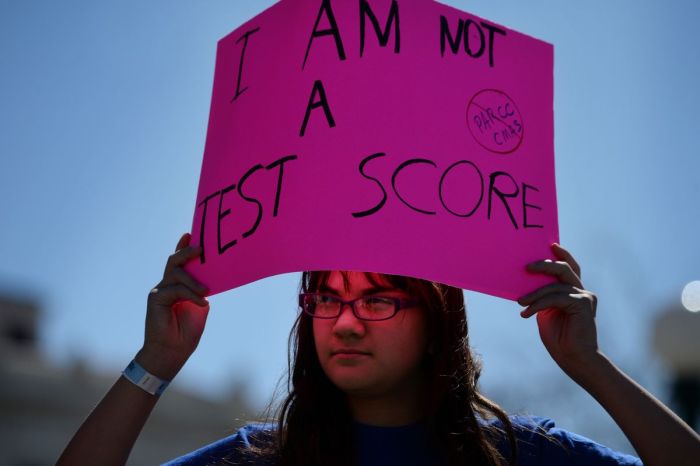
In addition, this is after massive opt outs three years ago that forced the state to change its federally mandated assessment. Testing boycotts pushed the state education association to get rid of four PARCC assessments and allow students who fail the remaining two tests to take an alternative assessment. And this is in a state where there is no law explicitly allowing parents to opt out of the tests.
I don’t know if I’d call that running out of steam.
And it nearly doubled in Utah over the past two years to about 6%. In some schools in the Beehive State, rates are much higher. According to the Salt Lake Tribune, 1 in 5 students in the Park City school district refused to take the tests.
Though my own state of Pennsylvania has been mum on last year’s opt outs, from my own personal experience as a teacher in suburban Pittsburgh, I never had more students boycott our federally mandated standardized test than I did last year.
There were so many they had to be quarantined in a special room.
Moreover, an increasing number of parents ask me about the issue, express concern and wonder about their rights.
So even when examining just the rate of opt out, I don’t see any reason to assume the movement is slowing down.
As recently as 2012, half of all U.S. states required high school exit exams in order for students to graduate. Today that number has dropped to 12. The reason? Exit exams don’t raise student achievement – they raise the dropout rate. At least that’s what The National Research Council of the National Academy of Sciences tells us.
And when it comes to opt out, two more states – Idaho and North Dakota – now have explicit laws on the books allowing parents to refuse the test for their children – in whole or in part. That brings the total number of states up to 10. It would have been 11, but Georgia Governor Nathan Deal, a Republican, vetoed an opt-out bill. The federal government still wants us to penalize these districts for non-participation in flagrant violation of its authority. But as more states respect parents’ rights on this matter, it will be increasingly difficult for the U.S. Department of Education to continue trampling them.
There is already some proposed legislation to make positive changes. Sen. Jon Tester (D-Mont.) and Rep. Krysten Sinema (D-Ariz.) introduced legislation last year to replace annual assessments with grade-span tests. The United States is, after all, one of the only countries in the world – if not the only one – to require students be tested every year. These proposed changes are not nearly enough, but they’re a step in the right direction.
One of the biggest obstacles to abolishing federally mandated testing last time was that some of the oldest and most well funded civil rights organizations opposed it. Many of them get their money and support from the same billionaires who profit off of the standardized testing and privatization industries.
That’s less than two years in jail for defrauding tens of thousands of students and multiple districts across the Commonwealth.
In addition, once he serves his time he’ll be on probation for 3 years.
And even though there is no mystery about the amount of money he defrauded from the Internal Revenue Service by shifting his income to the tax returns of others – $437,632, to be exact – the amount he’ll have to pay back in restitution is yet to be determined.
One would think that’s easy math. You stole $437,632, you need to pay back at least that amount – with interest!
And what of the $8 million? Though I can’t find a single explicit reference to what happened to it in the media, it is implied that the money was recovered and returned to Pa Cyber.
Yet there seems to be no discussion of a financial penalty for embezzling all that money. If my checking account dips below a certain balance, I’m penalized. If I don’t pay the minimum on my credit cards, I’m charged an additional fee. Yet this chucklehead pilfers $8 million and won’t be docked a dime!? Just paying it back is good enough!?
But what makes this sentence even more infuriating to me is the paltry jail time Trombetta will serve.
They each got three years in prison, seven years probation, $10,000 in fines and 2,000 hours of community service.
So in America, cheating on standardized tests gets you a harder sentence than embezzling a fortune from school kids.
I’m not saying what the Atlanta teachers and administrators did was right, but their crime pales in comparison to Trombetta’s.
Think about it.
Atlanta city schools have suffered under decades of financial neglect. The kids – many of whom are students of color – receive fewer resources, have more narrowed curriculum and are forced to live under the yoke of generational poverty.
Yet their teachers were told to increase test scores with little to no help, and if they didn’t, they’d be fired.
I can’t imagine why they tried to cheat a system as fair as that.
It’s like being mugged at gunpoint and then the judge convicts you of giving your robber a wooden nickel.
The worst part of all of this is that we haven’t learned anything from either case.
High stakes standardized testing has become entrenched in our public schools by the newly passed federal law – the Every Student Succeeds Act (ESSA).
And though Trombetta resigned from his post as CEO of PA Cyber in September 2013, cyber charters are as popular as ever.
You can’t turn on the TV without a commercial for a cyber charter school showing up. You can’t drive through a poor neighborhood without a billboard advertising a virtual charter. They even have ads on the buggies at the grocery store!
Yet these schools have a demonstrated track record of failure even when compared to brick-and-mortar charter schools. And when you compare them to traditional public schools, it’s like comparing a piece of chewed up gum on the bottom of your shoe to a prime cut of filet mignon.
Keep in mind there are only 180 days of school in Pennsylvania!
That means cyber charters provide less math instruction than not going to school at all.
When it comes to reading, the same study found cyber charters provide 72 days less instruction than traditional public schools.
That’s like skipping 40% of the school year!
And this isn’t just at one or two cyber charters. Researchers noted that 88 percent of cyber charter schools produce weaker academic growth than similar brick and mortar schools.
They concluded that these schools have an “overwhelming negative impact” on students.
AND THAT’S ALL LEGAL!
In Pennsylvania, nearly 35,100 of the 1.7 million children attending public schools are enrolled in cyber-charter schools. With more than 11,000 students, PA Cyber is by far the largest of the state’s 16 such schools.
If Trombetta had just stiffed Pennsylvania’s students that much, he wouldn’t have been in any trouble with the law.
However, he got even greedier than that!
He needed more, More, MORE!
Justice – such as it is in this case – was a long time coming.
Trombetta was first indicted back in 2013 – five years ago.
He was facing 11 counts of mail fraud, theft or bribery, conspiracy and tax offenses related to his involvement in entities that did business with Pa. Cyber. He pleaded guilty to tax conspiracy almost two years ago, acknowledging that he siphoned off $8 million from The Pennsylvania Cyber Charter School.
He has been free on bond all this time.
His sister, Elaine Trombetta, agreed to cooperate with prosecution, according to federal court filings. She pleaded guilty in October 2013 to filing a false individual income tax return on her brother’s behalf and has yet to be sentenced.
It was only yesterday that her brother – the kingpin of this conspiracy – was ultimately sentenced.












 gadflyonthewallblog