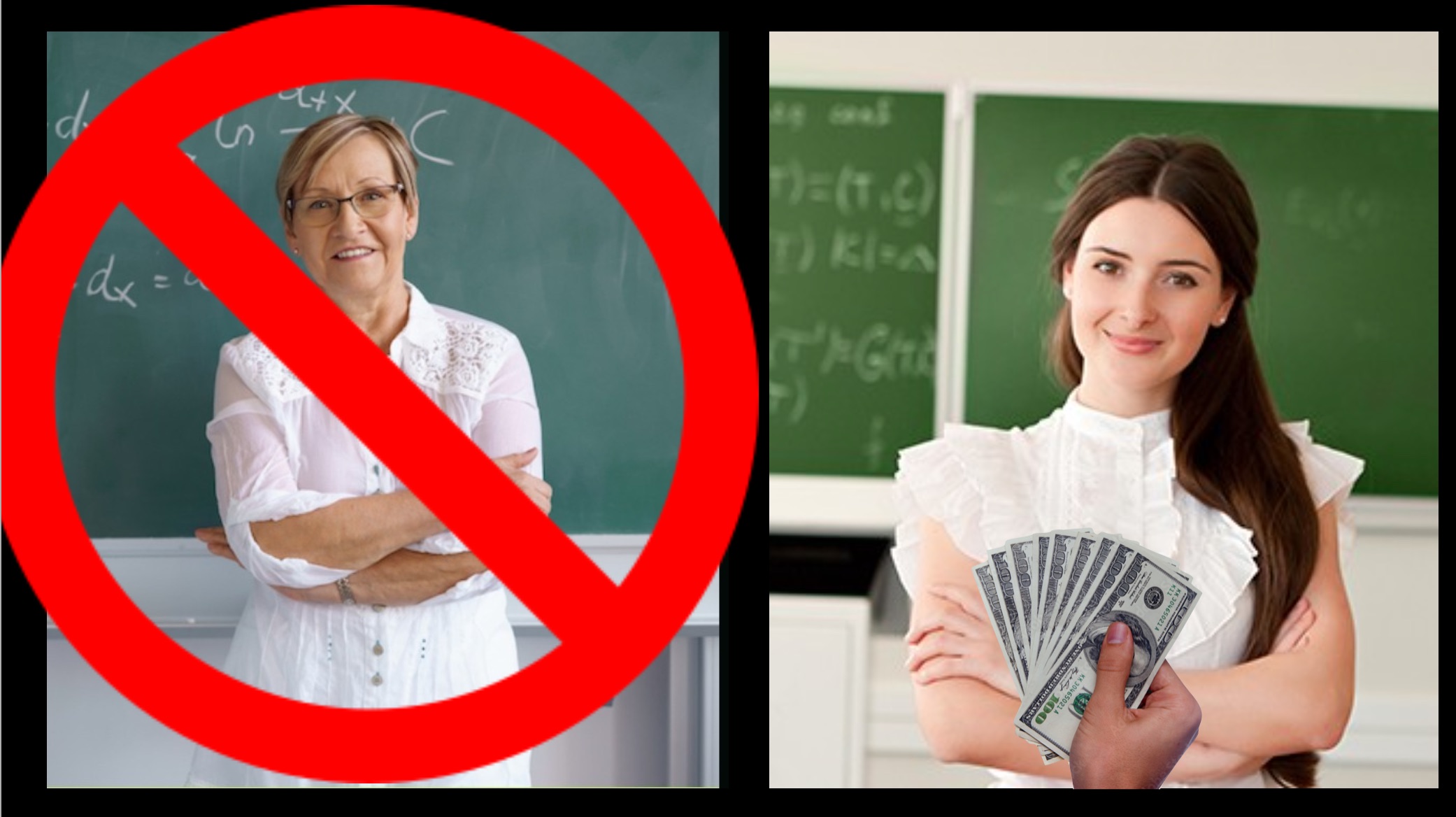
Teach for America Promised to Fix the Teacher Exodus Before Anyone Even Noticed There Was One. Now It’s Choking on Its Own Failure

Teach for America (TFA) was a solution to a problem it helped create.

Educators have been leaving the profession for decades due to poor salary, poor working conditions, heavy expectations and lack of tools or respect.

So Wendy Kopp, when in Princeton, created a program to fast track non-education majors into the classroom where they would teach for a few years and then enter the private sector as “experts” to drive public policy.

These college graduates would take a five week crash course in education and commit to at least two years in the classroom thereby filling any vacant teaching positions.

Surprise! It didn’t work.

In fact, it made things worse. Apparently deprofessionalizing education isn’t an incentive to dive into the field.

That isn’t to say everyone who went through the program became a bad teacher. But the few good and committed educators that did come through the program could have done so even more successfully by graduating with a degree in education.

Now the organization created in 1990 is expecting its lowest enrollment in 15 years. TFA anticipates placing slightly less than 2,000 teachers in schools across the country this fall. That’s two-thirds of the number of first-year teachers TFA placed in schools in fall 2019, and just one-third of the number it sent into the field at its height in 2013.

Apparently fewer people than ever don’t want to train for four to five years to become lifelong teachers – and neither do they want to be lightly trained for a few years as TFA recruits, either – even if that means they can pass themselves off as education experts afterwards and get high paying policy positions at think tanks and government.

On the one hand, this is good news.

Watering down what it means to be a teacher is even less popular than actually being an educator.

On the other hand, we have a major crisis that few people are prepared to handle.

The US is losing teachers at an alarming rate.

After decades of neglect only made worse by the Covid-19 pandemic, we’re missing almost a million teachers.

Nationwide, we only have about 3.2 million teachers left!

According to the Bureau of Labor Statistics, there are 567,000 fewer educators in our public schools today than there were before the pandemic. And that’s on top of already losing 250,000 school employees during the recession of 2008-09 most of whom were never replaced. All while enrollment increased by 800,000 students.

Meanwhile, finding replacements has been difficult. Across the country, an average of one educator is hired for every two jobs available.

Not only are teachers paid 20% less than other college-educated workers with similar experience, but a 2020 survey found that 67% of teachers have or had a second job to make ends meet.

It’s no wonder then that few college students want to enter the profession.

Over the past decade, there’s been a major decline in enrollment in bachelor’s degree programs in education.

Beginning in 2011, enrollment in such programs and new education certifications in Pennsylvania — my home state— started to decline. Today, only about a third as many students are enrolled in teacher prep programs in the Commonwealth as there were 10 years ago. And state records show new certifications are down by two-thirds over that period.

To put that more concretely, a decade ago roughly 20,000 new teachers entered the workforce each year in the Commonwealth, while last year only 6,000 did so, according to the state Department of Education (PDE).

But don’t look to most of the so-called experts to solve the problem. A great deal of them are former TFA recruits!

Through programs like TFA’s Capitol Hill Fellows Program, alumni are placed in full-time, paid staff positions with legislators so they can “gain insights into the legislative process by working in a Congressional office” and work “on projects that impact education and opportunities for youth.”


Why do so many lawmakers hire them? Because they don’t cost anything.
 

Their salaries are paid in full by TFA through a fund established by Arthur Rock, a California tech billionaire who hands the organization bags of cash to pay these educational aides’ salaries. From 2006 to 2008, alone, Rock – who also sits on TFA’s board – contributed $16.5 million for this purpose.


This isn’t about helping lawmakers understand the issues. It’s about framing the issues to meet the policy initiatives of the elite and wealthy donors.


It’s about selling school privatization, high stakes testing and ed-tech solutions.


As US Rep. Alexandria Ocasio-Cortez (D-New York) said on a call with Justice Democrats:

“I don’t think people who are taking money from pharmaceutical companies should be drafting health care legislation. I don’t think people who are taking money from oil and gas companies should be drafting our climate legislation.”


I’d like to add the following: people taking money from the testing and school privatization industry shouldn’t be drafting education policy. People who worked as temps in order to give themselves a veneer of credibility should not be treated the same as bona fide experts who dedicate their lives to kids in the classroom.

 The whole point of this scam is to serve the needs of the privatization movement.

Investors want to change public education into a cash cow. They want to alter the rules so that corporations running districts as charter or voucher schools can cut services for children and use the extra cash for profits.

And that starts with teachers.

If we allow privatizers to replace well-prepared and trained teachers with lightly trained temps, we can reduce the salaries we pay instructors. We delegitimize the profession. We redefine the job “teacher.” It’s no longer a highly-trained professional. It’s something anyone can do from off the street – thus we can pay poverty wages.

And the savings from cutting salaries can all go into our corporate pockets!

This kind of flim-flam would never be allowed with our present crop of highly trained professionals because many of them belong to labor unions. We have to give them the boot so we can exterminate their unions and thus provide easy pickings for the profiteers.

This helps explain why so many plans to address the teacher exodus are focused almost exclusively on recruiting new hires while completely ignoring the much larger numbers of experienced teachers looking for the exits.

According to the National Education Association (NEA), it is teachers who are quitting that is driving a significant part of the current educator shortage. More teachers quit the job than those who retire, are laid off, are transferred to other locations, go on disability or die. And this has remained true almost every year for the last decade with few exceptions.

To put it another way, you can’t stop a ship from sinking if you don’t plug up the leak first!

But experienced teachers always have been the biggest obstacle to privatizing public schools and expanding standardized testing.

That’s why replacing them with new educators has been one of the highest priorities of corporate education reform.

After all, it’s much harder to try to indoctrinate seasoned educators with propaganda that goes against everything they learned to be true about their students and profession in a lifetime of classroom practice than to encourage those with no practical experience to just drink the Kool-Aid.

So it should come as no surprise that supply side policymakers are using the current teacher exodus as an excuse to remake the profession in their own image.

As Rahm Emanuel, Chief of Staff to President Barack Obama (Later Chicago Mayor) said:

“You never let a serious crisis go to waste. And what I mean by that [is] it’s an opportunity to do things you think you could not do before.”

If our policymakers really want to solve the problem, we’d spend at least as much time keeping the experienced teachers we have as trying to get new ones to join their ranks.

Research shows that teacher experience matters.

“The common refrain that teaching experience does not matter after the first few years in the classroom is no longer supported by the preponderance of the research,” Tara Kini and Anne Podolsky write in Does Teaching Experience Increase Teacher Effectiveness?

“We find that teaching experience is, on average, positively associated with student achievement gains throughout a teacher’s career.”

Their analysis is based on 30 studies published over the past 15 years and concludes:

1) Experienced teachers on average are more effective in raising student achievement (both test scores and classroom grades) than less experienced ones.

2) Teachers do better as they gain experience. Researchers have long documented that teachers improve dramatically during their first few years on the job. However, teachers make even further gains in subsequent years.

3) Experienced teachers also reduce student absences, encourage students to read for recreational purposes outside of the classroom, serve as mentors for young teachers and help to create and maintain a strong school community. 

The road to keeping experienced teachers isn’t exactly mysterious.

First, there must be an increase in salary. Teacher pay must at least be adequate including the expectation that as educators gain experience, their salaries will rise in line with what college graduates earn in comparable professions. This is not happening now.

In addition, something must be done to improve teachers working conditions. Lack of proper support and supportive administrators is one of the main reasons experienced teachers leave a building or the profession.

And perhaps most obviously, politicians have to stop scapegoating educators for all of society’s problems and even for all of the problems of the school system. Teachers don’t get to make policy. They are rarely even allowed a voice, but they are blamed for everything that happens in and around education.

If we want teachers to work with socially disadvantaged students, they must be provided with the institutional supports needed to be effective and steadily advance their skills. 

But this requires making education a priority and not a political football.

To do that, you would need to stop bankrolling organizations like TFA.

However, the billionaires funding school privatization and the standardized testing industry would never allow it.

So unlike our public schools, as fewer and fewer applicants come to TFA, there will always be money to keep it afloat.

Those who are causing the teacher exodus will never be the ones to fix it.


Like this post?  You might want to consider becoming a Patreon subscriber. This helps me continue to keep the blog going and get on with this difficult and challenging work.

Plus you get subscriber only extras!

Just CLICK HERE.

Patreon+Circle

I’ve also written a book, “Gadfly on the Wall: A Public School Teacher Speaks Out on Racism and Reform,” now available from Garn Press. Ten percent of the proceeds go to the Badass Teachers Association. Check it out!

Disaster Capitalists Try Ending the Teacher Exodus by Erasing Experienced Educators

“You never let a serious crisis go to waste. And what I mean by that [is] it’s an opportunity to do things you think you could not do before.”

Rahm Emanuel, Chief of Staff to President Barack Obama (Later Chicago Mayor); Nov. 19, 2008

Experienced teachers always have been the biggest obstacle to privatizing public schools and expanding standardized testing.

That’s why replacing them with new educators has been one of the highest priorities of corporate education reform.

After all, it’s much harder to try to indoctrinate seasoned educators with propaganda that goes against everything they learned to be true about their students and profession in a lifetime of classroom practice than to encourage those with no practical experience to just drink the Kool-Aid.

So it should come as no surprise that supply side policymakers are using the current teacher exodus as an excuse to remake the profession in their own image.

Schools are facing a shortage of 300,000 teachers and staff, according to the National Education Association (NEA), the country’s largest teachers union.

The Bureau of Labor Statistics puts the number closer to 567,000 fewer educators in America’s public schools today than there were before the pandemic. That’s 0.57 new hires for every open position – completely unsustainable.

This was exacerbated by the Covid pandemic, but the slow march of teachers out of the classroom has been going on for at least a decade. The federal government and most states have been either unwilling or unable to act – until now.

But it’s instructive to see exactly what it is they’re doing.

They haven’t even attempted to turn the tide. Nor have they simply tried to stop losing more educators. Instead they’ve taken steps to recruit new teachers while doing nothing to stop the loss of experienced professionals running for the exits.

In my home state of Pennsylvania, the state Department of Education (PDE) put forward a plan with the help of Teach Plus, a national 501(c)(3) nonprofit organization that works to select and train teachers to push its political agenda.

That agenda includes:

1) Embracing the practice of widespread staff firings as a strategy for school improvement.

2) Mandating that test scores be a significant part of teacher evaluation.

3) Advocating against seniority and pushing the false narrative that unions stifle innovation.

Unsurprisingly, Teach Plus has received more than $27 million from the Gates Foundation and substantial donations from the Walton Family Foundation.

And so we see nothing but policies to bring in new blood to the Commonwealth’s teaching force with no help to the veterans already in the field.

The minimum teacher salary in the Commonwealth stands at $18,500 — and has since 1989.

Newly elected Democratic Gov. Josh Shapiro proposed a tax credit in his budget of $24.7 million in its first year for police, nurses and teachers.

If approved by the legislature, newly certified members of those three professions would be eligible to receive up to $2,500 off their state income taxes.

However, the credit would be nonrefundable — recipients would save only the amount of tax they would have paid rather than also receiving the unused portion of the credit as a refund.

According to an Associated Press analysis in March, to receive the full $2,500 annual benefit with the state’s 3.07 flat income tax rate, a teacher (nurse or police officer) would have to make almost $82,000 — far above the normal starting wage for those professions.

The proposal, which seems unpopular on both sides of the aisle, doesn’t even do much to increase recruitment.  It should have been used to raise the base salary of teachers instead of focusing on just newbies.

But its intent was clear – get more teachers in the door.

We see the same concerns in the state’s new guidelines for antiracist teacher training programs.

PDE is putting forward a new program starting in July called Culturally Relevant and Sustaining Education (CRSE) which includes 49 cultural competence standards to encourage teachers to be more aware of racial issues in our schools.

They were created by the previous Democratic Gov. Tom Wolf’s administration with help from The New America Foundation. In fact, most of these guidelines come directly from the foundation by use of a creative commons attribution.  

This is a left-leaning DC think tank with ties to President Barack Obama’s administration. Why does that matter? Look at who funds the organization – The Bill and Melinda Gates Foundation, Bloomberg Family Foundation, JPMorgan Chase Foundation, etc.  

 These are the architects of the most dominant education policies of the last two decades – high stakes standardized testing, charter schools, etc.  

The impetus behind enacting these standards is to help recruit more new teachers of color. It’s a worthy goal considering how few teachers are non-white in the Commonwealth. However, increased salary, prestige and autonomy would go a lot farther than this kind of whitewashing.

After all, if the state, the New America Foundation or the billionaire philanthropists backing them actually wanted to decrease racism, they’d be much more successful attacking racist structures than random interactions – reversing the neoliberal policies (charter schools, high stakes testing, etc.) that they, themselves, promote.

However, new teachers won’t know any of this context.  They’ll be perfectly happy trying to change the world, themselves, while many of those responsible for it cheer them on safely hidden behind their performative group of standards.

The excuse constantly given for such an emphasis on recruiting new teachers is that so few graduates are entering the profession.
A decade ago, roughly 20,000 new teachers entered the workforce each year in the Commonwealth, while last year only 6,000 did so, according to the state Department of Education (PDE).

However, recruitment is only part of the picture.

Nationally, our teaching workforce is already more inexperienced than in the past. In 2008, more than one in four of America’s teachers – 28 percent – had less than five years of experience. This is especially true in underprivileged areas where schools often have much higher proportions of novices in the classroom.


According to the NEA, educators quitting is driving a significant part of the current educator shortage. More teachers quit the job than those who retire, are laid off, are transferred to other locations, go on disability or die. And this has remained true almost every year for the last decade with few exceptions.

If our government really wanted to solve the problem, it would spend at least as much time keeping the experienced teachers we have as trying to get new ones to join their ranks.

Research shows that teacher experience matters.

“The common refrain that teaching experience does not matter after the first few years in the classroom is no longer supported by the preponderance of the research,” Tara Kini and Anne Podolsky write in Does Teaching Experience Increase Teacher Effectiveness?

“We find that teaching experience is, on average, positively associated with student achievement gains throughout a teacher’s career.”

Their analysis is based on 30 studies published over the past 15 years and concludes:


1) Experienced teachers on average are more effective in raising student achievement (both test scores and classroom grades) than less experienced ones.

2) Teachers do better as they gain experience. Researchers have long documented that teachers improve dramatically during their first few years on the job. However, teachers make even further gains in subsequent years.

3) Experienced teachers also reduce student absences, encourage students to read for recreational purposes outside of the classroom, serve as mentors for young teachers and help to create and maintain a strong school community. 

The road to keeping experienced teachers isn’t exactly mysterious.

First, there must be an increase in salary. Teacher pay  must at least be adequate including the expectation that as educators gain experience, their salaries will rise in line with what college graduates earn in comparable professions. This is not happening now.


In addition, something must be done to improve teachers working conditions. Lack of proper support and supportive administrators is one of the main reasons experienced teachers leave a building or the profession.


And perhaps most obviously, politicians have to stop scapegoating educators for all of society’s problems and even for all of the problems of the school system. Teachers don’t get to make policy. They are rarely even allowed a voice, but they are blamed for everything that happens in and around education.

If we want teachers to work with socially disadvantaged students, they must be provided with the institutional supports needed to be effective and steadily advance their skills. 

But this requires making education a priority and not a political football.

As it is now, the same disaster capitalist shenanigans echo over-and-over again in the halls of our country’s education history with disastrous consequences for students.

Perhaps the most obvious example is in New Orleans.

In 2005, the state and federal government didn’t rebuild the city’s public schools following Hurricane Katrina. Instead, they ushered out as many of the local teachers of color as possible so they could create an entirely new system of charter schools without opposition from the grassroots educators who would oppose such a grand experiment on poor and minority children.

The disaster took place under George W. Bush, but Obama’s Education Secretary Arne Duncan certainly approved, even going so far as to say, ”I think the best thing that happened to the education system in New Orleans was Hurricane Katrina.”

Republicans, Democrats – it doesn’t matter. They both champion nearly the same education policies of standardized testing and school privatization.

Thus it should come as no surprise that our contemporary policy makers are using the current crisis – an ongoing teacher exodus – as an excuse to remodel the education workforce into a more ignorant and malleable one.

When will they ever learn?

When will we ever learn not to trust them?


Like this post?  You might want to consider becoming a Patreon subscriber. This helps me continue to keep the blog going and get on with this difficult and challenging work.

Plus you get subscriber only extras!

Just CLICK HERE.

Patreon+Circle

I’ve also written a book, “Gadfly on the Wall: A Public School Teacher Speaks Out on Racism and Reform,” now available from Garn Press. Ten percent of the proceeds go to the Badass Teachers Association. Check it out!


Congress May Raise Educators’ Minimum Salaries to Combat the Teacher Exodus

When it comes to teachers, America doesn’t mind getting away cheap.

The minimum salary for a teacher in Pennsylvania is $18,500 a year.

That’s not a lot of money – roughly $9.63 an hour.

It’s barely more than the federal minimum wage of $7.25 an hour ($15,080 annually).

But in many states there is no minimum teacher salary – so the minimum wage IS a teacher’s minimum salary!

You could probably make more as a dishwasher, cashier or parking lot attendant. So why take on a four-year education degree, mountains of student loan debt, and the added challenge of a (likely unpaid) internship?

Just pick up a broom and start sweeping.

Perhaps that’s why a group of Congressional Democrats have proposed a national minimum salary for teachers.

Rep. Frederica Wilson and Rep. Jamaal Bowman, (both former teachers) and six other members of the House have introduced The American Teacher Act establishing a minimum salary of $60,000 for all public school teachers working in the U.S. – the first legislation of its kind.

Though state minimums are less (assuming your state has one at all), the average starting salary of teachers nationwide was $41,770 in the 2020-21 school year, according to the National Education Association (which supports the bill).

However, even that number shows how poorly we reimburse teachers for their labor.

It means on average teachers make about 77 cents on the dollar compared to their peers in similar professions, according to the Economic Policy Institute, a nonprofit think tank.

So a potentially $20,000 base increase would help.

If passed, the bill wouldn’t simply force all states to comply. It would offer funding through federal grants encouraging states and school districts to raise their minimum starting salary to $60,000 by the 2024-25 academic year.

In the short term, the funding would pay to implement the new salary minimum but states would be responsible for sustaining the cost in the long run.

No cost projection for the program has yet been conducted.

The new minimum salary would be adjusted for inflation each year, beginning with the 2025-26 school year, and any grant funding would have to be used toward salaries and not to supplant any existing funding that goes toward schools.

Sponsors hope the bill would affect more than just minimum salaries.

The idea is that states would adjust their entire teacher salary schedules with $60,000 as the floor and all other salary steps increasing incrementally based on education levels and years of experience. So even veteran teachers should see their wages increase.

However, the bill doesn’t stop there. The authors of the legislation know that respect for the teaching profession is important to ensure salaries remain adequate.

In addition to wages, 4 percent of the grant funding would be used to launch a national campaign about the teaching profession, highlighting its importance and value as well as encouraging high school and college students to pursue a career in education.

It’s high time something were done because the US is losing teachers at an alarming rate.


After decades of neglect only made worse by the Covid-19 pandemic, we’re missing almost a million teachers.

Nationwide, we only have about 3.2 million teachers left!

According to the Bureau of Labor Statistics, there are 567,000 fewer educators in our public schools today than there were before the pandemic. And that’s on top of already losing 250,000 school employees during the recession of 2008-09 most of whom were never replaced. All while enrollment increased by 800,000 students.

Meanwhile, finding replacements has been difficult. Across the country, an average of one educator is hired for every two jobs available.

Not only are teachers paid 20% less than other college-educated workers with similar experience, but a 2020 survey found that 67% of teachers have or had a second job to make ends meet.

It’s no wonder then that few college students want to enter the profession.

Over the past decade, there’s been a major decline in enrollment in bachelor’s degree programs in education.

Beginning in 2011, enrollment in such programs and new education certifications in Pennsylvania — my home state— started to decline. Today, only about a third as many students are enrolled in teacher prep programs in the Commonwealth as there were 10 years ago. And state records show new certifications are down by two-thirds over that period.

Legislation like The American Teachers Act is absolutely necessary to stop the teacher exodus and ensure our children receive a quality education.

However, at present not a single Republican lawmaker has expressed support for legislation of this type, only support in individual states when it becomes obvious the whole system will collapse without help.

Moreover, even neoliberal Democrats want to use such measures to sneak in unnecessary and destructive policies like more standardized testing, evaluating teachers on student test scores and increased funding for charter schools and school voucher programs.

At present it seems unlikely that this legislation would pass in any manner that would be helpful if at all.

It may take further crumbling of the public school system and/or a change in political leadership and power for anything to be done.

On the bright side, it is encouraging that for the first time (ever?) lawmakers actually seem to recognize there is a real problem here.

It has finally come down to a simple matter of dollars and cents.


Like this post?  You might want to consider becoming a Patreon subscriber. This helps me continue to keep the blog going and get on with this difficult and challenging work.

Plus you get subscriber only extras!

Just CLICK HERE.

Patreon+Circle

I’ve also written a book, “Gadfly on the Wall: A Public School Teacher Speaks Out on Racism and Reform,” now available from Garn Press. Ten percent of the proceeds go to the Badass Teachers Association. Check it out!

Federal or State Legislatures May Raise Teacher Salaries so Schools Have Enough Staff to Reopen

What will we do when schools reopen and there aren’t enough teachers to instruct our kids?

People complain when there aren’t enough servers at restaurants or baggers at the grocery store.

What will they say in August if school buildings in many districts remain closed or the only viable option is online remote schooling?

Lawmakers at the state and federal level are taking the matter seriously with measures to increase teacher salary or provide one-time bonuses.

Alabama, New Mexico, and Mississippi have already boosted teacher pay, with Florida, Iowa and Kentucky potentially set to do the same. Meanwhile, even US Congress could pass a nationwide measure to heighten teacher salary and encourage educators to stay in the classroom.

After decades of neglect only made worse by Covid-19, we’re missing almost a million teachers.

And we only have about 3.2 million teachers nationwide!

According to the Bureau of Labor Statistics, there are 567,000 fewer educators in our public schools today than there were before the pandemic. And that’s on top of already losing 250,000 school employees during the recession of 2008-09 most of whom were never replaced. All while enrollment increased by 800,000 students.

Meanwhile, finding replacements has been difficult. Across the country, an average of one educator is hired for every two jobs available.

So what are we doing about it?

Surprisingly, something!

Congress has at least one bill under consideration that would raise teacher salaries nationwide.

The Respect, Advancement, and Increasing Support for Educators (RAISE) Act would provide teachers with a minimum of $1,000 in refundable tax credits and as much as $15,000.

The more impoverished the school where teachers work, the higher the tax credit available to increase their salaries. The bill would also double the educator tax deduction to offset the cost of school supplies, and expand eligibility to early childhood educators.

The bill was introduced by Senator Cory Booker (D-NJ) and U.S. Representatives Adam Schiff (D-CA), Jahana Hayes (D-CT), John Larson (D-CT), and Mark Takano (D-CA). It is supported by a broad coalition of organizations including the American Federation of Teachers (AFT) and the National Education Association (NEA).

Such a measure is long overdue.

Teachers are paid 20% less than other college-educated workers with similar experience. A 2020 survey found that 67% of teachers have or had a second job to make ends meet.

Why would you go into debt earning a four year degree in education and serve an (often unpaid) internship in the classroom just to earn little more than a fry chef or Walmart greeter?

Why enter a field where you can’t buy a home or even rent an apartment in most metropolitan areas? Why volunteer for a job where you won’t be able to afford to marry, raise children, or eke out a middle class existence?

Thankfully, Congressional proposals aren’t the only attempt to make teaching more attractive.

Some states have already taken action.

The Alabama Senate passed a budget that would raise minimum salaries for teachers with nine or more years experience. The raises would range from 5% to nearly 21%, depending on years of experience.

A teacher with a bachelor’s degree and 20 years of experience would see their salary rise from $51,810 to $57,214. A teacher with a master’s degree and 25 years experience would see their pay rise from $61,987 to $69,151.

In New Mexico, Gov. Michelle Lujan Grisham signed a bill that would increase base salary levels by an average of 20 percent. This advances minimum salary tiers for educators by $10,000 to $50,000, $60,000 and $70,000. 

In Mississippi, Gov. Tate Reeves signed off on an average increase of $5,100 that will raise educator salaries by more than 10 percent.

According to Politico, both Republican and Democratic Governors are proposing teacher salary increases or one-time bonuses as part of budget proposals and legislative priorities.

Even Governors like Iowa’s Kim Reynolds and Florida’s Ron DeSantis are promoting teacher bonuses while also stoking classroom culture wars. On the other side of the aisle, Kentucky’s Democratic governor Andy Beshear is trying to push through a teacher pay plan through opposition by the state’s GOP-controlled legislature.

Such measures are even being proposed in Pennsylvania. Sen. Judith Schwank (D-Berks) recently introduced Senate Bill 1211 to boost starting pay for teachers from the current minimum of $18,500 listed in state law. She proposes increasing it to $45,000 a year. However, the bill sent to the Senate Education Committee has several Democratic co-sponsors but no Republicans, making it doubtful it will progress anytime soon.

The main factor behind these plans seems to be the $350 billion in state and local recovery funds under the American Rescue Plan. These federal dollars have few strings attached and only about half of the money has been spent so far.

After decades of neglect, these plans may not be enough and they may not even come to fruition. However, at least lawmakers seem to understand the problem exists.

It’s gratifying that politicians finally seem to feel a sense of urgency here.

Because this problem didn’t spring up overnight and it won’t go away in a flash.

If we don’t do something to make teaching more attractive, the problem will only be compounded in coming years.

Not only are we having a hard time keeping the teachers we have, few college students want to enter the field.

Over the past decade, there’s been a major decline in enrollment in bachelor’s degree programs in education.

Beginning in 2011, enrollment in such programs and new education certifications in Pennsylvania — my home state— started to decline. Today, only about a third as many students are enrolled in teacher prep programs in the Commonwealth as there were 10 years ago. And state records show new certifications are down by two-thirds over that period.

And it’s not just classroom teachers – substitutes are even harder to find.

The shortage of substitute teachers has gotten so bad in 2021-22, it forced some schools across the country to temporarily move to remote learning. Even Pittsburgh Public Schools was forced to go to cyber learning on Nov. 29 because of a staffing shortage and a lack of substitute teachers.

And it doesn’t look to get better next year.

Last June almost a third of working educators expressed a desire to leave the profession.

According to a survey in June of 2,690 members of the National Education Association, 32% said the pandemic was likely to make them leave the profession earlier than expected. So we don’t have enough teachers now and one in three educators we do have are ready to walk out the door.

What could we do about it?

In the long term, we need structural solutions to the problem:  

 Money

 Autonomy

 Respect.  

And in the short term we need: 

 Less Paperwork

 Reduced case load

 Dedicated planning periods

But don’t take my word for it.

A survey by the RAND Corp. reported that the pandemic has increased teacher attrition, burnout and stress. In fact, educators were almost twice as likely as other adult workers to have frequent job-related stress and almost three times more likely to experience depression.

The CDC Foundation in May released similar results – 27% of teachers reporting depression and 37% reporting anxiety.

However, the RAND survey went even deeper pinpointing several causes of stressful working conditions. These were (1) a mismatch between actual and preferred mode of instruction, (2) lack of administrator and technical support, (3) technical issues with remote teaching, and (4) lack of implementation of COVID-19 safety measures. 

It’s a problem of exploitation and normalization. 

 Exploitation is when you treat someone unfairly for your own benefit. 

 Our schools have been doing that to teachers for decades – underpaying them for the high responsibilities they have, expecting each individual to do the work of multiple people and when anything goes wrong, blaming them for it. 

 We piled on so many extra duties – online teaching, hybrid learning, ever changing safety precautions – these became the proverbial straw that broke educators’ backs.  

There are things we can do to alleviate this situation – reducing nonessential tasks, eliminating unnecessary paperwork, refraining from excess staff meetings, forgoing new initiatives, letting teachers work from home on professional development days – anything to give them a break and an opportunity to heal from the years of overburdening.

But we also have to start paying teachers more.

Thankfully our lawmakers are taking this matter to heart and actually getting some results.

Hopefully this trend will continue until every teacher in the nation is adequately, equitably and sustainably compensated for the work done in the classroom.


Like this post?  You might want to consider becoming a Patreon subscriber. This helps me continue to keep the blog going and get on with this difficult and challenging work.

Plus you get subscriber only extras!

Just CLICK HERE.

Patreon+Circle

I’ve also written a book, “Gadfly on the Wall: A Public School Teacher Speaks Out on Racism and Reform,” now available from Garn Press. Ten percent of the proceeds go to the Badass Teachers Association. Check it out!

Covid-19 Has Eroded My Faith in Public Schools

I am a public school advocate.

I teach at a public school.

My daughter goes to a public school.

I have spent most of my professional career fighting for public schools against every form of school privatization imaginable.

But since the beginning of this school year and the incredibly reckless way many public schools have dealt with reopening and keeping students and staff safe, I feel much of that enthusiasm drying up.

It’s not something I’m proud of feeling.

I’m actually kind of embarrassed about it.

But there are so many people I will never be able to look at the same way ever again.

There are so many organizations, unions, school boards, administrators, policy makers who have lost my trust – perhaps forever.

I’m not saying I love charter schools or private schools.

I don’t.

I still think they’re mostly scams bent on using the laws to cash in on kids while taking our tax money and running.

But the idea that public schools are fundamentally better – that idea has suffered tremendously.

I used to believe that local control was something to cherish, that a board made up of neighbors duly elected by the community would more often than not have the best interests of that neighborhood at heart when making decisions.

And, frankly, I just don’t feel that way anymore.

How can you preserve such an ideal in the face of so much evidence to the contrary – so many school boards who vote to open classrooms – and keep them open – despite raging infection rates? Despite students and teachers getting sick? Despite quarantines and warnings from epidemiologists?

SCHOOL BOARDS

McKeesport Area School District, where I live, has had more than 14 cases of Covid among students and staff since September and the school board isn’t even considering closing.

In fact, in October when most of these cases were coming to light and Center for Disease Control (CDC) guidelines suggested schools should temporarily close to ensure the virus wasn’t running out of control, administration chose to ignore the CDC on the basis of advice by the Allegheny County Health Department.

Seriously.

Administrators prioritized local officials telling them what they want to hear over national experts in infectious disease with hard truths. In short, keeping the doors open was considered more important than student safety.

Meanwhile, the district where I work, Steel Valley Schools, smartly decided to open with virtual learning in September. However, the board decided to change to a hybrid model in November to test the waters.

Yes, the board decided to make students and teachers guinea pigs in an experiment to see if they could somehow avoid getting sick while cases surged throughout the country and state.

And after only five days, a high school student tested positive and numerous kids and staff had to quarantine.

Yesterday the state Website announced that our county, Allegheny County, – which had been considered moderate in terms of infections – is now in the substantial category. The incidence rate is 138.7 per 100,000.

Also in the substantial category are nearby Armstrong, Butler, Beaver, Washington, and Westmoreland counties.

Will Western Pennsylvania schools do the right thing and go to remote learning? Will Steel Valley finally give up this in-person experiment? Will McKeesport?

Without a strong leader like a Governor or President to order a shut down and take the heat, I’m not sure local school directors will have the courage to act.

They keep blaming everything on academics, saying they have provide what is best to help students learn – never mind the dangers to child, parent and teachers’ bodies. But even more hypocritically they ignore the well being of huge swaths of their students who refuse to take part in their in-person experiment.

In both districts, about 60% of parents favor in-person schooling and 40% prefer remote.

So the boards are doing what the majority wants, but it’s a slim majority.

There is a significant portion of parents who feel these in-person plans are unsafe and very little is being done to educate their children.

At McKeesport, parents can enroll their kids in the district cyber program. No live teachers. No synchronous lessons on-line. Just a canned credit recovery program through the Edmentum company.

It’s terrible, and administration knows it’s terrible.

I’ve heard Superintendent Dr. Mark Holtzman say as much at school board meetings. But he and most of the board feel they have done all they need to do by providing this option.

They are actually betting that the poor quality of the cyber program will increase the number of parents sending their kids to in-person instruction.

And I’ve heard similar comments among administration at Steel Valley.

There at least we don’t force kids into our (likewise crappy) cyber program. We just have classroom teachers post assignments on-line.

Remote students in K-5 get live teachers instructing on-line. But remote students in 6-12 only get one half day of synchronous instruction on-line a week. The rest is asynchronous worksheets, etc. And somehow that’s supposed to be enough.

We have enough teachers that we could provide more, but why encourage remote learning? Might as well let them eat asynchronous and hope their parents will lose hope and just make them come to school during a global pandemic.

I have zero respect for administrators who think this way. I have zero respect for school board members who vote for it.

So how do I keep my respect for local control and the school board system?

This is very personal to me.

I have heart disease and Crohn’s Disease. My doctors tell me I can’t risk my life going into the school buildings to teach as infections run rampant through the state.

But my district has refused to allow me a safe work environment.

I am not allowed to teach remotely.

I have to burn my sick days so I can stay safe at home. But at the same time, I’m encouraged to take overtime hours to put up remote lessons, grade papers and contact parents.

I’m ready to do that as part of my job, but they won’t let me. They’d rather pay me and a sub who babysits my students in-person while I do what I’m allowed to do remotely at the same time.

So how do you look an administrator in the eye who refuses to lookout for his own employee’s safety?

Answer: you can’t. Ever, ever again.

UNIONS

And the same goes for many in my union.

Let me tell you, I love my union. I’m a union man. I believe in collective bargaining and worker solidarity.

I just wish my local did, too.

Because the leadership is perfectly fine with agreeing for the staff to work in unsafe conditions and no special protections for those like me who are more likely to contract the disease.

Leaders throw up their hands and say “We’re an association not a union,” and “If the boss says you come back to work, you have to come back to work.”

It’s even worse that I work in Homestead – the site of the historic strike.

So how do I look union leaders in the eye who have no problem throwing me to the wolves?

Answer: I can’t. Never, ever again.

And the state and national unions aren’t much better.

To be fair, I was pleasantly surprised when Pennsylvania State Education Association (PSEA) President Rich Askey called for schools in areas with substantial infection rates to follow state guidelines and go to remote learning.

This after months of…. Nothing.

And what is PSEA threatening if districts don’t comply?

Nothing…. So far.

But I guess saying something about it is better than what they were doing before.

The national unions – the National Education Association (NEA) and American Federation of Teachers (AFT) – certainly haven’t taken any hardline stances.

No one wants to rock the boat, but we’re talking about human life here.

There is no place further back to draw the line. We can compromise on salary and benefits but not on health and safety!

My God! That’s a human right!

We’re either unions in solidarity with our members – all our members – or we’re not.

And right now there is no solidarity, no leadership, nothing.

When I say things like this, people tell me I’m angry.

OF COURSE I’M ANGRY!

How many lives are we going to put at risk before it’s enough?

How many children? How many parents? How many staff?

Even if healthy people catch this thing, even if they get over it, they could have lifelong debilitating injuries from it.

That is not worth risking.

EDUCATION ACTIVISTS

And even the education activist community has been complicit in it.

When I tell some of my fellow grassroots organizers that schools should be open remotely, they complain about how that opens an opportunity for ed tech companies, charter and private schools.

They’re afraid teaching on-line will make ed tech companies an eternal part of school curriculum and replace real, live educators.

But that’s obviously false.

We’ve seen during lockdown periods that no one likes asynchronous teaching programs. No one likes these ed tech learning platforms. What works best in these times is curriculum created by classroom teachers taught by those classroom teachers to their students over online platforms like Zoom.

The technology should be merely a tool to connect students and teachers not as a provider of that learning.

The backlash against ed tech has been far greater than any embrace.

Yet some education activists decry how public schools going remote makes privatized schools who don’t look good.

That’s nonsense, too.

Teaching recklessly is bad – no matter who does it. If parents want to endanger their own kids, that’s their prerogative, but in the long run no one will earn brownie points for enabling such negligence.

However, where privatized schools will earn points with parents is for providing high quality remote learning when public schools refuse to do so.

I know all of them aren’t doing that. But some of them are.

And, frankly, they deserve any praise they get for it.

Look, I love public schools, too. But when public schools abandon their duties to their students as so many have done during this crisis, they deserve to have their students stolen. Even if these privatized schools often have more money to work with in the first place.

CONCLUSIONS

Bottom line: This is a crisis the school board system should have been able to overcome.

It’s a crisis the unions should have been able to battle.

It’s a crisis the activist community should have been able to see clearly.

But leadership has failed at every conceivable level. Time and again.

Strangely, that’s the only saving grace of the whole situation.

It isn’t the system that failed. It is the people in power in the system.

I know in my heart that the best way to run a school is still duly elected members of the community.

Just not THESE duly elected members.

I know that unions are vital to protecting workers rights. Just not unions lead by such wishy washy timid officers.

I know that education activism is necessary to keeping school privatization at bay. But activists can’t let their fears of what might be thwart people’s health and safety right now.

That’s the problem with Democracy. The leaders you get are representative of the community.

And our communities are perverted by one overwhelming belief – capitalism.

That’s why the schools are open. School boards are afraid keeping them closed will hurt business in the community.

That’s why administrators make such reckless reopening plans. They’re afraid that if we stay on remote it will become obvious how irrelevant they are to the running of a virtual school.

That’s why union leaders put up next to no resistance. They’re more afraid of furloughs than death or lifelong health consequences.

That’s why some parents support reopening schools – so they have someone to watch their kids while they’re at work. They never spare a moment for how the government is cheating them out of stimulus checks, mortgage relief, rent forgiveness, free testing, hazard pay and healthcare so they don’t have to put their own lives on the line working during a pandemic.

In all honesty, we were a sick country long before COVID-19 hit our shores.

We are sick with outdated and malicious economic ideas.

When you look across the ocean at the more socialist countries, you see much better plans to deal with the pandemic. Not perfect, but better.

When everything isn’t dependent on money changing hands, you can more easily prioritize human life.

So, yes, my faith has been shaken in our public schools.

I still think the idea of a public school is one to be cherished and fought to protect.

But the leaders we have – nearly all of them – should be rejected.

We need an army of citizen activists, parents and teachers to come forward at the first opportunity to replace them.

Anyone in a leadership role this year should have to explain themselves – what did you do to protect students and staff during the pandemic?

If they can’t prove they took real steps to keep people safe and not sacrifice the people they were charged to protect on the altar of capitalism – if they can’t do that they should step down.

They should step down with tears in their eyes and forever have their names sullied by their cowardice and stupidity.

They have failed us all.


Like this post?  You might want to consider becoming a Patreon subscriber. This helps me continue to keep the blog going and get on with this difficult and challenging work.

Plus you get subscriber only extras!

Just CLICK HERE.

Patreon+Circle

I’ve also written a book, “Gadfly on the Wall: A Public School Teacher Speaks Out on Racism and Reform,” now available from Garn Press. Ten percent of the proceeds go to the Badass Teachers Association. Check it out!

Five Reasons to be Cautiously Optimistic About the Biden Presidency

President-elect Joe Biden.

Go ahead and say that aloud once.

“President-elect Joe Biden.”

How does it feel?

If you’re like me, it feels pretty good.

And to be honest I never expected that it would.

Sure, I voted for Joe. I gave money to the campaign. I volunteered.

But Biden was far from my first choice. In fact, looking over the field of Democrats seeking the party’s nomination, he might have been my last pick.

I was a Bernie Sanders guy and probably will be until the day I die.

But damn if it doesn’t feel good to say “President-elect Joe Biden!”

Before today, I would have said the best thing about Joe was that he isn’t Trump. And, frankly, I think that is mainly the fact that won him the election.

It was a repudiation of Trump more than a celebration of Biden.

However, now that the dust has cleared and all the states but Georgia, Alaska and North Carolina have been called, I’m starting to have some thoughts about what a Biden administration might actually look like.

And it might not be too bad.

So here are what I see as the five main hurdles coming up for the Biden administration and why we might be cautiously optimistic about their outcomes:

1) Trump Will Fail to Successfully Challenge the Election Results

As of this writing, Biden has 290 electoral votes to Trump’s 214.

Alaska will probably go to Trump and North Carolina is a bit of a toss up. Georgia will almost certainly go to Biden.

It actually doesn’t really matter.


The world and the media have already accepted the results.

Biden has been elected the 46th President of the United States.

In the absence of solid evidence of massive voter fraud in multiple states – many of which are controlled by Republican governments – it is unlikely that these results can be successfully changed.

Many Republican leaders like Pat Toomey, Rick Santorum and Mitt Romney have already accepted this fact. Far right leaders of other countries like Boris Johnson and Benjamin Netanyahu have already congratulated Biden.

It’s over.

And if there were any doubt about it, the Trump administration accidentally booking a press conference at Four Seasons Total Landscaping in Philadelphia instead of the Four Seasons hotel – and then pretending that’s what they intended all along – should put the final nail in the coffin.

You don’t know Four Seasons Total Landscaping? It’s a landscape gardeners located between a crematorium and a dildo shop.

That is not the work of people capable of running an effective challenge to a national election.

Yes, there are enough far right justices on the Supreme Court to pull off this Coup d’état. But I don’t think even they would have the guts to do it in light of the world’s acceptance of Biden, the acceptance of many in the GOP and the blatant incompetence of the Trump administration.

I admit that I could be wrong. And I certainly don’t think we should underestimate these neofacists.

Trump is a cornered rat, and that is when rats are at their most dangerous.

However, I think there is good reason to think he will not be able to steal this election no matter how many tantrums he throws on the floor of the Oval Office or Mar-a-Lago.

2) Control of the Senate Rests on Georgia

It appears that the election will not, by itself, change the balance of power in Congress.

The Democrats have lost seats in the House but not enough to lose a majority. They do not appear to have picked up enough seats in the Senate to rest control away from the GOP.

However, on January 5th there will be runoff elections for both U.S. Senate seats in Georgia.

Yes, you read that right – Georgia!

If Democrats Raphael Warnock and Jon Osoff both win, Joe Biden will have a congressional majority to actually get his policies passed.

No more Mitch McConnell as Senate Majority Leader.

No more obstruction.

It would be HUGE.

And it is incredibly positive that this is taking place in Georgia where Stacey Abrams has done an amazing job organizing grassroots efforts to turn the state blue.

We have a real chance here.

No doubt Republicans will try to throw whatever they have left to stopping the Dems in these races. But how much do they really have after being beaten nationwide?

Will momentum and an existent grassroots network be enough to flip the script for Dems?

Chances are good. It all depends on what we do in the next few months.

3) Progressives Will Not Let Neoliberals Ignore Them

A huge hurdle for the Biden Administration and the Democratic Party will be how we try to move forward together.

Biden won a huge national majority of votes – 75 million – the most any candidate ever has received.

However, a similar record was true of Hillary Clinton in 2016 and she still lost because of the electoral college.

Thankfully things are not playing out that way in 2020. But they could have very easily.

Frankly, the fact that Biden didn’t beat Trump by an even greater margin is extremely troubling.

Almost half of the voting public – 71 million – support this racist, neofacist, incompetent fool. And only a slight majority oppose him.

I believe firmly that this is because of the Democrats’ strategy in this campaign.

Both this year and in 2016, there was very little positive policy being offered – very little popular positive policy positions that would have directly impacted the majority of Americans.

Many folks voted for Trump out of despair. They wanted a change – any change – burn it all down if necessary.

Had Medicare For All or the Green New Deal been on the ballot, things might have gone differently – or more emphatically – our way.

But, instead, it was all about getting rid of Trump.

Thankfully, that was enough. But had the party actually offered voters something more – things that are overwhelmingly popular with everyday people but unpopular with party elites and their wealthy backers – the results could have been a landslide in Biden’s favor.

Representative Alexandria Ocasio-Cortez spoke for many progressives in a New York Times interview.

She said that every candidate that co-sponsored Medicare for All in a swing district was reelected. Even Mike Levin, who many thought had committed political suicide by co-sponsoring the Green New Deal, kept his seat.

Supporting progressive policies did not sink anyone’s campaigns. In fact, that’s how insurgent Democrats have been unseating centrists across the nation.

“I’ve been unseating Democrats for two years,” Ocasio-Cortez said. “I have been defeating D.C.C.C.-run campaigns for two years. That’s how I got to Congress. That’s how we elected Ayanna Pressley. That’s how Jamaal Bowman won. That’s how Cori Bush won. And so we know about extreme vulnerabilities in how Democrats run campaigns.”

This is a fight for the heart and soul of the Democratic party.

We cannot continue to move to the right and expect the base – which are much further left – to continue to vote for increasingly conservative candidates.

There is already a party for that – it’s the Republicans.

“I need my colleagues to understand that we are not the enemy,” she said. “And that their base is not the enemy. That the Movement for Black Lives is not the enemy, that Medicare For All is not the enemy. This isn’t even just about winning an argument. It’s that if they keep going after the wrong thing, I mean, they’re just setting up their own obsolescence.”

We will see if the Biden administration learns these lessons or not.

I think there is good reason to be cautiously optimistic here. It is in the party’s own self interest.

But only the future will tell.

4) Biden will Take Steps to Control the Coronavirus

Unlike his predecessor, Biden has been a consistent voice of sanity on the COVID-19 pandemic.

Yesterday, he tweeted:

“We cannot repair the economy, restore our vitality, or relish life’s most precious moments — hugging a grandchild, birthdays, weddings, graduations, all the moments that matter most to us — until we get this virus under control.”

And true to his word, this appears to be the first thing on his agenda.

Tomorrow he is expected to name a group of leading scientists and experts as transition advisers so his administration can get started combating the virus on inauguration day, Jan. 20, 2021.

The Coronavirus Task Force is expected to be led by former Surgeon General Dr. Vivek Murthy and Dr. David Kessler, who led the Food and Drug Administration during the 1990s.

Specifically, Biden’s plan calls for empowering scientists at the Centers for Disease Control and Prevention (CDC) to help set national guidance based on evidence to stop outbreaks, work on a vaccine, testing, contact tracing and other services.

His administration would use the CDC to provide specific guidance — based on the degree of viral spread in a community — for how to open schools and businesses, when to impose restrictions on gathering sizes or when stay-at-home orders may be necessary.

He would create a national “pandemic dashboard” to share this information with the public.

He would work with every governor to make mask-wearing in public mandatory in their state – a measure that, alone, could save more than 100,000 lives.

He would make sure that everyone has access to regular, reliable, free testing.

He would hire 100,000 additional public health workers to coordinate with local organizations around the country to perform contact tracing and other health services. These people would help with everything from food insecurity and affordable housing to training school officials about when and how to make it safe to reopen buildings.

He proposes the federal government cover 100% of the cost of Consolidated Omnibus Budget Reconciliation Act (COBRA) coverage for the duration of the crisis for people who get sick from the virus. If someone loses employer-based health insurance, they would still have health insurance through this plan.

He also will push to strengthen the Affordable Care Act, expanding coverage by making more people eligible.

He’d use the Defense Production Act to increase production of masks, face shields and other personal protective equipment so that supply exceeds demand.

I don’t know about you, but to me this seems a breath of fresh air. It is what the federal government should do and what it hasn’t been doing under Trump.

And I see no reason why the Biden administration can’t get it done.

5) Biden Can’t Afford to Re-up Betsy DeVos’ Education Policies

When it comes to public education, neither party has really been an ally to teachers and students.

Betsy DeVos was worse than President Obama’s Education Secretaries – Arne Duncan and John King. But let’s not fool ourselves that these Democratic functionaries were any good, either.

They all supported charter schools, high stakes testing, increased segregation, the school-to-prison pipeline, evaluating teachers on student test scores, targeted disinvestment to schools in poor neighborhoods serving mostly students of color, and more.

Duncan and King were competent at destroying public education while hiding behind neoliberal rhetoric. DeVos was incompetent in every conceivable way and could barely hide her glee at the prospect of destroying public education.

Since Biden’s wife, Jill, was an actual teacher, he has more to lose than previous chief executives if he gets this wrong. He can’t take schools for granted and he can’t appear to be doubling down on the same policies of Trump and DeVos – which to be honest were mostly the same as those of Obama and Bush but on steroids.

Biden promised a public school teacher would be his next education secretary and Politico is already making predictions. The media outlet suggests ex-National Education Association (NEA) President Lily Eskelsen Garcia, American Federation of Teachers (AFT) President Randi Weingarten or Stanford Education Professor Linda Darling-Hammond.

Frankly, we could do much worse than any of these people. Hammond, in particular, was Obama’s education policy advisor UNTIL he was elected and changed courses to the neoliberal set.

Of all the hurdles coming his way, I have the least hope Biden will overcome this one.

Pressure will be huge for him to pick another supply side hack with little actual education experience.

But who knows? The stakes are high. Jill has his ear.

We can make our voices heard, cross our fingers and hope for the best.

At a time when teachers are struggling just to have a safe environment in which to work, actual education policy is almost a distant luxury.

For the meantime, I’ll give Joe a chance and remain cautiously optimistic.

The ball is in Biden’s hands. He deserves the right to make a shot.

And if he misses, at least we can celebrate the end of the Muslim ban, reinstating the DREAM Act, rejoining the Paris Climate Accords, rejoining the World Health Organization and the restoration of a functioning federal government to the USA.


Like this post?  You might want to consider becoming a Patreon subscriber. This helps me continue to keep the blog going and get on with this difficult and challenging work.

Plus you get subscriber only extras!

Just CLICK HERE.

Patreon+Circle

I’ve also written a book, “Gadfly on the Wall: A Public School Teacher Speaks Out on Racism and Reform,” now available from Garn Press. Ten percent of the proceeds go to the Badass Teachers Association. Check it out!

Save Our Schools From Coronavirus Budget Cuts


Screen Shot 2020-05-02 at 4.36.09 PM


America is one dumbass country.


We don’t do the metric system.


We don’t do universal healthcare.


And during a global pandemic, we don’t demand the government pay us to stay home and stop the spread of the disease.


Instead, we demand the government let us go out and get sick.


It should come as no surprise, then, that we deeply under-fund our public schools.


There’s always money for a new war or to subsidize fossil fuels or give billionaires another tax cut, but when it comes to teaching kids how to think critically about their world – time to take out the scissors and slash some budgets.


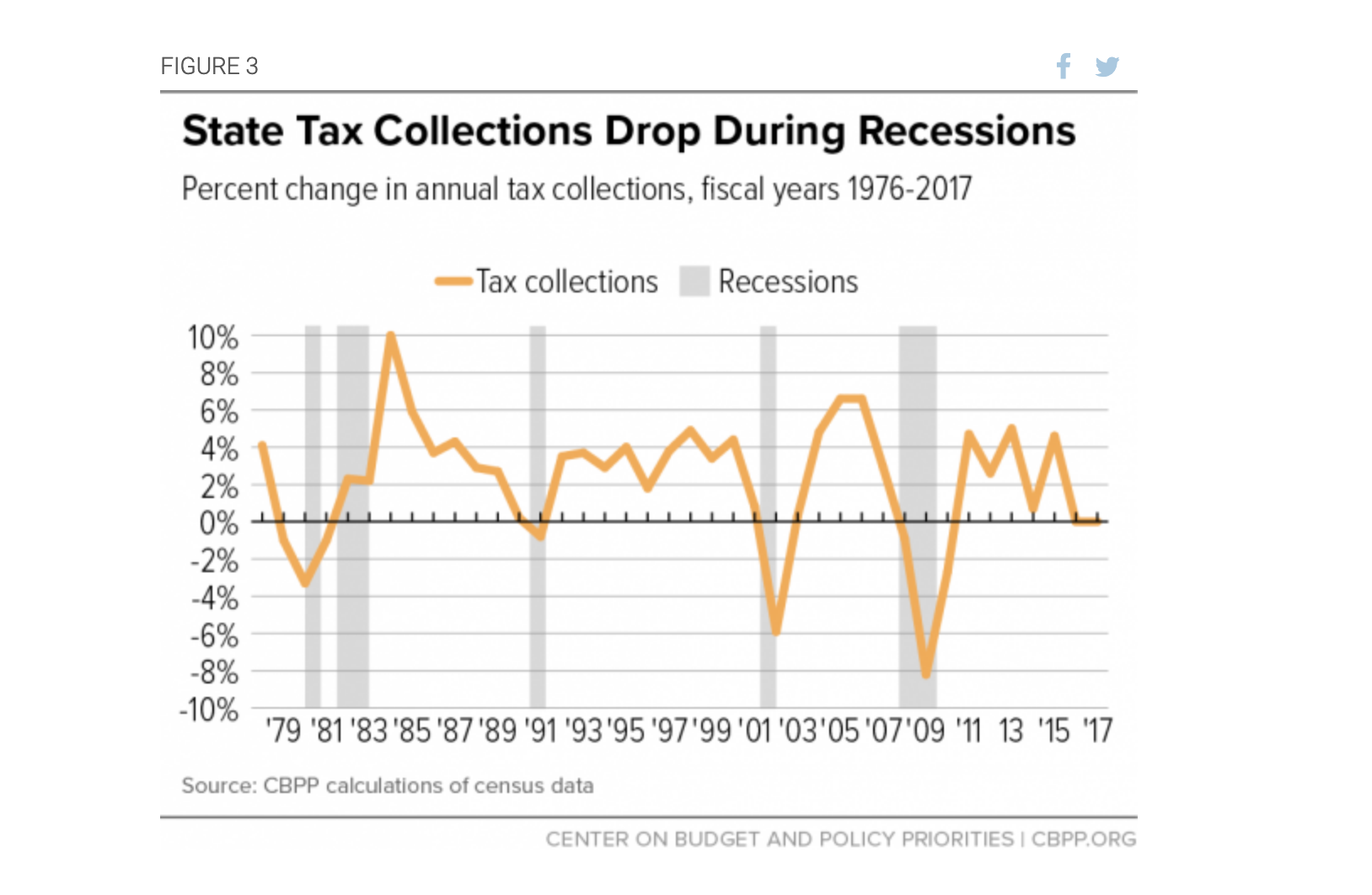
And now with the inevitable loss of taxes after shutting down the economy to save lives during the global Coronavirus outbreak, experts are expecting the deepest budget cuts to schools – well, ever.


Sixty two district superintendents from urban districts wrote to Congress in April warning of a 15-25% loss in revenues next fiscal year.


The school leaders from cities like New York City, Los Angeles, Chicago and Miami, say that a 20% loss in both state and local taxes, alone, would result in laying off about 275,000 teachers.


And this would come after students had already suffered significant academic losses during the current (2019-20) school year because of school closings and distance learning initiatives that could not possibly meet the needs of students as well as in-person learning.


Screen Shot 2020-05-02 at 10.14.42 AM


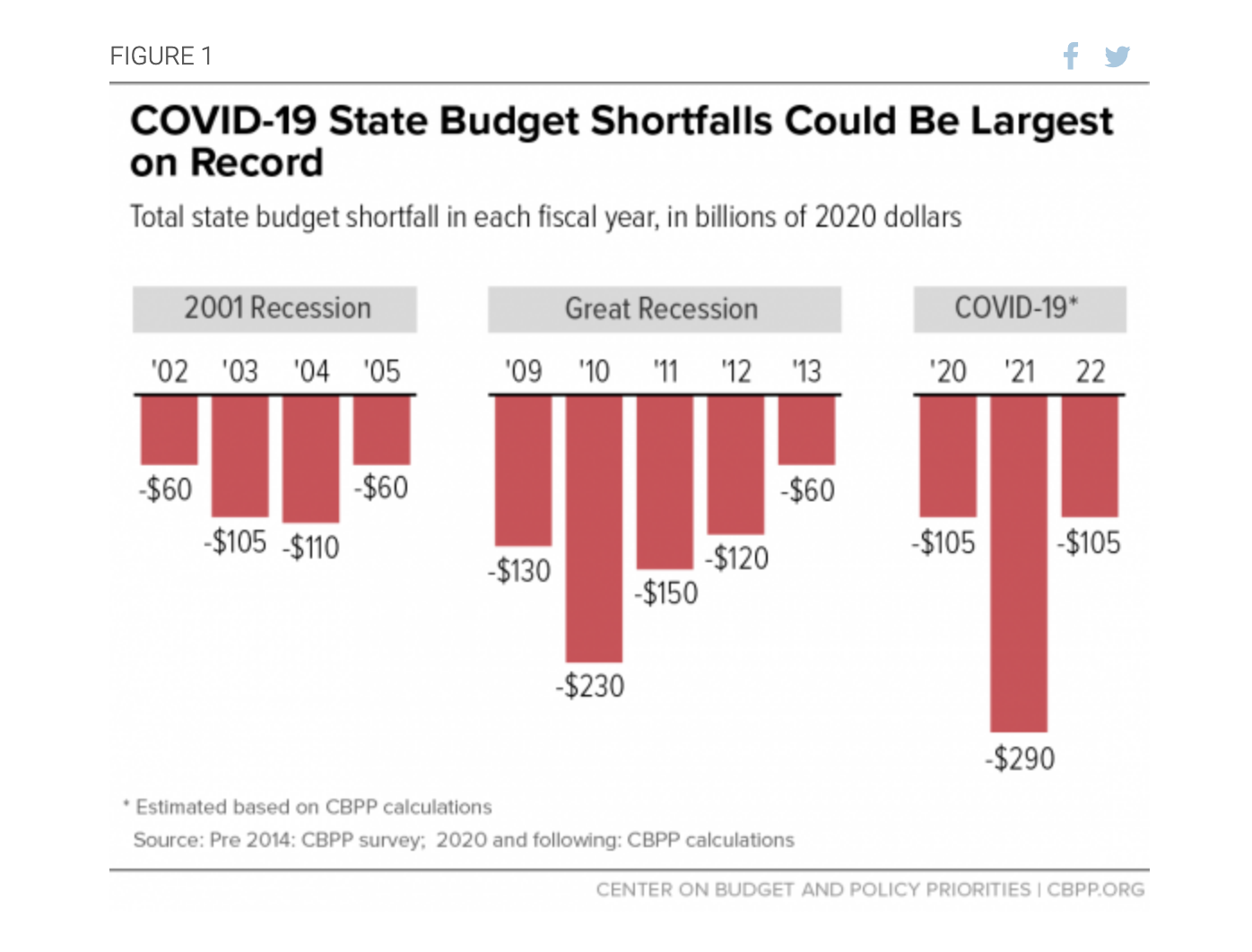
They ask legislators to enact a plan devised by the Albert Shanker Institute – a policy organization aligned with the American Federation for Teachers (AFT) – in which the federal government would give billions of dollars to districts in several phases to keep schools open. Then states would increase funding to levels before the Great Recession (2009-13), build up budget reserves and more equitably distribute capital.


How much money would be necessary?


It’s hard to say at this point.


Most districts get about 90% of their funding from state and local taxes and these haven’t been tallied yet for March, when social distancing began.


Some experts expect to have a better picture of the damage by the end of the first or second week of May.


There has been no mass evictions (though that may eventually happen), so property taxes are probably stable at this point. But it’s unclear how much shuttered storefronts and skyrocketing unemployment will affect the picture.


Screen Shot 2020-05-02 at 10.14.14 AM


The National Governors Association and non-partisan Center on Budget and Policy Priorities, though, are expecting the worst.


They estimate a possible $500 billion state shortfall mostly concentrated in the 2020-21 fiscal year.


Screen Shot 2020-05-02 at 10.12.29 AM


That’s less than three months away.


Even if you subtract fiscal aide already provided by Congress and state rainy day funds (if present), legislatures would still be at least $360 billion short.


The National Association of Teachers (NEA) is calling for an additional $175 billion just to stabilize the country’s schools.


“The seniors graduating this spring started kindergarten in the fall of 2007,” says Bruce Baker, professor at the Graduate School of Education at Rutgers University and co-author of the Shanker Institute report.


“Most of these students have spent almost their entire K-12 careers in schools with less funding than there was when they started. If this happens again, it will be because we let it happen.”


And that’s just it.


This Coronavirus crisis is a wake-up call for all of us about the elements of our society that had to fail for us to get to this point.


Everything from how we deal with climate change, to infrastructure, to healthcare, to economic inequality needs to be reconsidered if we are to survive.


Education is an essential piece of that puzzle.


We cannot continue to consume resources like there is no tomorrow – or there will be none.


We cannot continue to treat billionaires like the most vital part of our society when they are really nothing but parasites on it.


And we cannot continue to undercut our public education system and expect our next generation to be in a better position than we are today. In fact, doing so ensures that it won’t be.


Not only do we have to pay for our kids to be educated, we have to pay for ALL kids – black, white, brown, girls, boys, Christians, Jews, Muslims, immigrants, native born — all of them.


We have to integrate, educate and eliminate the school-to-prison pipeline.


And we have to stop wasting the money we do allocate on pointless profit-making endeavors for corporations that give little to nothing back to the children they are meant to be serving. That means no more privatized schools, no more high stakes standardized testing, no more shady ed tech, corporate written academic standards and union busting initiatives.


We have to ask ourselves – will we continue to support a culture of death where war and inequality are prioritized over nurturing and care? Or will we finally engage in a culture of life, where education and equity are the driving forces of society?


We can continue to be the laughing stocks of the world with our guns and superstitions, or we can get off our asses and start working toward a better world for all.


The old ways will not work in this new millennium.


It is entirely unclear whether we will heed the call from this crisis or hide our heads in the sand.


But the future of our nation and the well-being of our children are being decided right here, right now, this very minute.


Time to invest.


Email your members of Congress and tell them to keep students learning and educators working.


Like this post?  You might want to consider becoming a Patreon subscriber. This helps me continue to keep the blog going and get on with this difficult and challenging work.

Plus you get subscriber only extras!

Just CLICK HERE.

Patreon+Circle

I’ve also written a book, “Gadfly on the Wall: A Public School Teacher Speaks Out on Racism and Reform,” now available from Garn Press. Ten percent of the proceeds go to the Badass Teachers Association. Check it out!

book-2

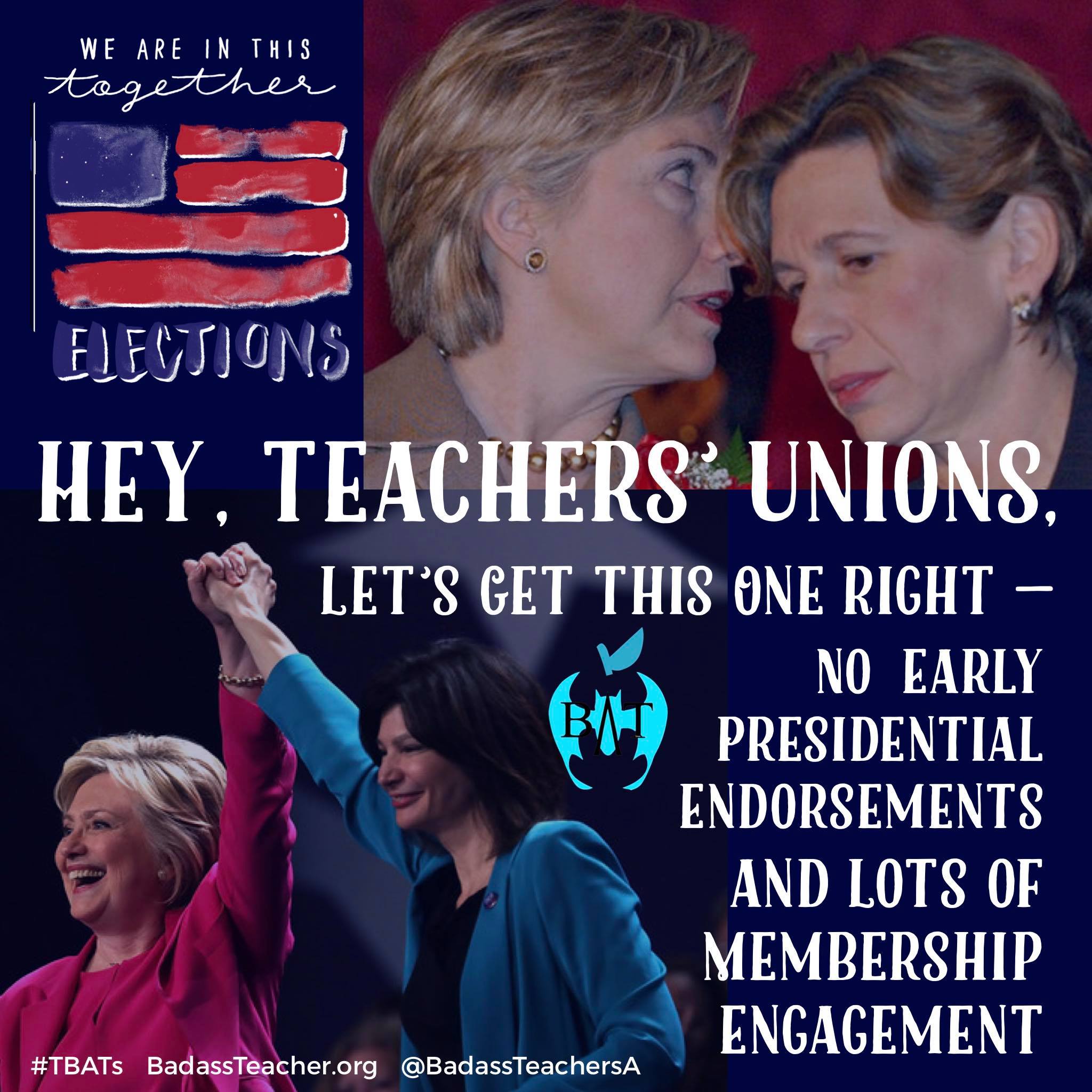
Hey, Teachers’ Unions, Let’s Get This One Right – No Early Presidential Endorsements & Lots of Membership Engagement

52448056_1332568296885727_443989310761336832_n
Let’s not mince words.


The last Presidential election was a cluster.


And we were at least partially to blame for it.


The Democratic primary process was a mess, the media gave free airtime to the most regressive candidate, and our national teachers unions – the National 
Education Association (NEA) and American Federation of Teachers (AFT) – endorsed a Democratic challenger too early and without getting membership support first.


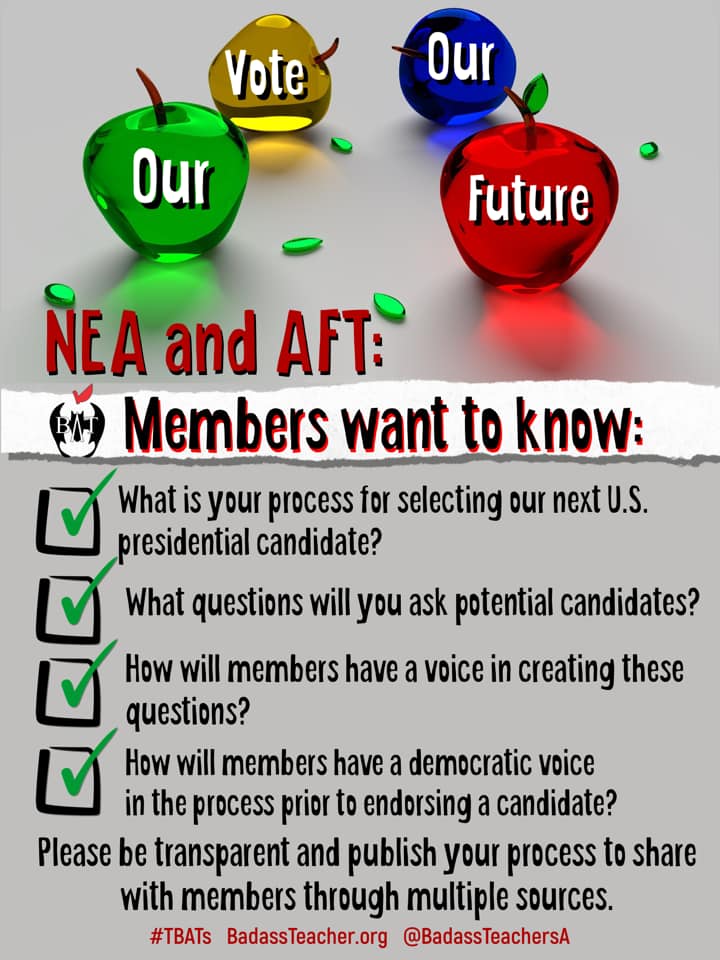
This time we have a chance to get it right.


Edu-blogger Peter Greene spoke my feelings when he took to Twitter:


“Just so we’re clear, and so we don’t screw it up again—- NEA and AFT, please wait at least a couple more weeks before endorsing a Democratic Presidential candidate for 2020.”


52059561_10218928805835758_8289688834384330752_n

 
He’s being snarky.

 
No one would endorse two years before people actually enter a voting booth.

 
But fairness. Evenhandedness. Moderation.

 
Let’s be honest. That didn’t happen in 2015.

 
So let’s take a brief trip down memory lane and review our history for just a moment in order to prevent these same mistakes.


The NEA represents 3 million educators. It is the largest labor union in the country. However only about 180 people made the decision to back Hillary Clinton last time around.


In October of 2015, the NEA Board of Directors voted 118 to 39 in favor of the endorsement with 8 abstentions and 5 absences.


The 74 member PAC Council voted to endorse Clinton with 82% in favor, 18% against and some of the largest delegations – California and New Jersey – abstaining.


Check my math here. So 61 PAC votes plus 118 Directors plus one President Lily Eskelsen Garcia equals 180 in favor.


That’s about .00006% of the membership.


We may call it such, but that is not an endorsement.


We need more than just the leadership to support a candidate. We need that to translate to actual votes.


When you circumvent membership, you see the result – Donald Trump.


To be fair, some NEA directors may have polled state union leaders. But according to NEA by-laws, the organization need go no further to obtain input from individual members for a primary endorsement. Even these straw polls are a formality.
The 8,000 strong Representative Assembly (RA) did not get a say. This larger body representing state and local affiliates did get to vote on an endorsement in the general election when the field was narrowed down to only two major candidates.


But anything like a poll of individual members was apparently not desired by leadership – now or later.


We can’t do that again.


The process at the AFT was likewise perplexing.

The AFT endorsed Clinton in July of 2015 – a half year before the primaries and more than a year before the general election.


This much seems certain:


1) The AFT executive board invited all of the candidates to meet with them and submit to an interview. No Republican candidates responded.


2) Democrats including Bernie Sanders, Martin O’Malley and Clinton were interviewed in private.


3) The executive committee voted to endorse Clinton.


4) THEN the interviews were released to the public.


How can the AFT claim its endorsement was a result of membership opinion when the organization didn’t even release the interviews to members until AFTER the endorsement?


Ostensibly, the executive council used these interviews to help make its decision. Shouldn’t that same information have been available to rank and file members of the union before an endorsement was made?


Which brings up another question: were AFT members asked AT ALL about who to endorse before the executive council made the final decision?


According to the AFT press release, they were:


“The AFT has conducted a long, deliberative process to assess which candidate would best champion the issues of importance to our members, their families and communities. Members have been engaged online, through the “You Decide” website, through several telephone town halls, and through multiple surveys—reaching more than 1 million members.

Additionally, over the past few weeks, the AFT has conducted a scientific poll of our membership on the candidates and key issues. The top issues members raised were jobs and the economy and public education. Seventy-nine percent of our members who vote in Democratic primaries said we should endorse a candidate. And by more than a 3-to-1 margin, these members said the AFT should endorse Clinton.”


So the AFT claims union members said to endorse Clinton on-line, on telephone town halls, surveys and a scientific poll of membership.


But did they really?


I’m not a member of the AFT but I know many teachers who are. Very few of them have ever been surveyed.


The press release says AFT members preferred Clinton 3-1. Yet to my knowledge they never released the raw data of any polls or surveys of membership.
This can’t happen again.

 
AFT President Randi Weingarten said something similar during an interview Friday on C-SPAN.


She said the executive council passed a four step process just last week to ensure members were behind whoever the union eventually endorsed this time around:


“Our Executive Council just passed a process last week which has four components. Number One is what do the members want? What are their aspirations? What are their needs in terms of Presidential candidates? And so we will be doing a lot of listening and engaging with members.


Number Two – There’s a lot of candidates that want access to our membership. What we would like them to spend a day with our members. We would like them to see the challenges in classrooms. The challenges that nurses have. [The AFT also represents nurses.] Listen to the challenges of adjunct professors who have student loan debt that is well beyond what salaries they get per month.


Number Three – People are really active these days. So we don’t want them to wait until there is a nationwide endorsement to involve or get engaged with candidates. So there’s going to be an ability to be involved or engaged as delegates to do these kinds of things.


Number Four – At one point or another we’ll get to an endorsement.”


Frankly, this seems kind of vague to me. I hope this new process gets better results than the last one.

 
We need to be able to trust our unions.

 
Don’t get me wrong. I love my union. I bleed collective bargaining and labor rights.

 
I teach in Homestead, Pennsylvania, just a few miles away from the site of the famous steel strike.

 
I want a union that represents me and my colleagues.

 
We must do better this time around.

 
We need a candidate that has broad popular support of members, not just leadership. Broad popular support will lead to engaged members at the polls and that engagement will translate into actual votes for our endorsed candidate.

 
So NEA and AFT leaders, your members want to know:
What is your process for selecting our next U.S. presidential candidate?

 
What questions will you ask potential candidates?

 
How will members have a democratic voice in the process?

 
Please be transparent and publish your process to share with members through multiple sources.

 
And my union brothers and sisters, get involved. Engage in the endorsement process now! Call on our NEA and AFT leadership to invite early and widespread, as well as transparent, involvement in the endorsement process.


52308654_10218930369994861_6486342344374222848_n
Do you know your NEA Board Members?

http://www.nea.org/home/1686.htm


NEA Leadership Contact INFO here:

http://www.nea.org/home/49809.htm


AFT Leadership:

https://www.aft.org/about/leadership


AFT Contact Info:

https://www.aft.org/contact

 
Let’s get it right this time.

 
Everything is riding on it.

 
Our vote is our future.


Special Thanks to Susan DuFresne for inspiring this article.


Still can’t get enough Gadfly? I’ve written a book, “Gadfly on the Wall: A Public School Teacher Speaks Out on Racism and Reform,” now available from Garn Press. Ten percent of the proceeds go to the Badass Teachers Association. Check it out!

book-3

Report: US Shortchanged Public Schools by Hundreds of Billions of Dollars Over Decades

taking-candy-from-a-baby


Fun Fact: Between 2005 and 2017, the federal government withheld $580 billion it had promised to spend on students from poor families and students with disabilities.


Fun Fact: Over that same period, the personal net worth of the nation’s 400 wealthiest people ballooned by $1.57 trillion.


So, rich people, consider this the bill.


A new report called “Confronting the Education Debt” commissioned by the Alliance to Reclaim Our Schools (AROS) details the shortfall in minute detail.


For instance:


  • $347 billion owed to educate low-income students most of whom are children of color.


  • $233 billion owed to provide services for students with disabilities.


And this is just the shortfall of the last dozen years! That’s just money due to children who recently graduated or are currently in the school system!


We’ve been cheating our children out of the money we owe them for more than half a century!


Federal education funding levels were first established in 1965 as part of Pres. Lyndon Johnson’s War on Poverty in the landmark education law, the Elementary and Secondary Education Act (ESEA).


That law, which has become little more than a boondoggle for the standardized testing and school privatization industries, originally was passed to address inequality in America’s education funding.


Now this report from a coalition of groups including the Education Justice Research and Organizing Center, the National Education Association, the American Federation of Teachers, Center for Popular Democracy and the Action Center on Race and the Economy points out the multifarious ways we have failed to live up to the standards we set in that original legislation and beyond.


One of the most glaring examples of neglect is Title I funding.


The Johnson administration admitted that schools with a high concentration of students living below the poverty line needed extra support to succeed at the same levels as students from middle class or more affluent backgrounds. So the law promised to provide an additional 40 percent for each poor child above what the state already spent per pupil.


And then it promptly failed to fund it. In 1965 and every year since!


These are not just numbers. With this money, high poverty schools could provide:


  • “health and mental health services for every student, including dental and vision services; and

  • a full-time nurse in every Title I school; and

  • a full-time librarian for every Title I school; and

  • a full-time additional counselor in every Title I school, or

  • a full-time teaching assistant in every Title I classroom.”


A decade later, in 1975, the same thing happened with The Individuals with Disabilities Education Act (IDEA).


Congress told local districts they’d have to do more to help disabled students succeed academically. However, doing so costs money. Lawmakers admitted that disabled students cost more to educate and that local districts often struggle to find the funding to help them succeed.


Once again, Congress pledged to pay up to 40 percent of that additional cost, with local and state funds covering the remainder.


Once again, Congress failed to fund it.


STATE AND LOCAL FAILURE


But it’s not just the federal government that has shirked its duties to school children.


State and local governments also stiffed generations of students out of the resources they deserved – especially if those students have black or brown skin.


Beside the federal government, public schools are funded by their local municipalities and the state. Local governments pay for about 45 percent of school budgets.


However, since most of this allotment is determined by property tax revenues, it ensures the poor get fewer resources than the rich. Kids from rich neighborhoods get lots of resources. Kids from poor areas get the scraps. Inequality is built into the funding formula to ensure that students don’t start out on an even playing field and that economic handicaps are passed on from one generation to the next.


State governments are no better. They provide about 47 percent of school budgets.


As such, they are in the position to right the wrongs of the local community by offsetting the inequality of local governments – but only 11 states do so. Twenty states close their eyes and provide the same funding to each school – rich and poor alike – regardless of need or what each community can afford to provide for its own children. But 17 states are even worse. They actually play Robin Hood in reverse – they funnel more money to wealthier districts than to poor ones.


As a result, schools nationwide serving mostly students of color and/or poor children spend less on each child than districts serving mostly white and/or affluent children.


TAX CUTS


And while our federal, state and local governments have failed to meet their responsibilities to students, they have required fewer taxes from business and industry.


In the late 1940s and 1950s, the top marginal tax rate was more than 90 percent. Today it is 37 percent.


Congress just passed a series of whooping tax cuts that go into effect in 2019. More than half of the benefit of these cuts will go to the richest five percent of taxpayers. The law is expected to cost the federal treasury as much as $1.5 trillion in lost revenues over the next decade.


Nearly every state levies a much greater share of taxes from low- and middle-income families than from the wealthy.


And that’s before we even start talking about corporations!


While the US federal corporate tax is 35 percent, the effective tax rate that corporations pay after loopholes and deductions is only about 14 percent. This costs the federal government at least $181 billion in annual revenue, based on 2013 estimates by the Government Accountability Office. Local and state corporate tax and abatement programs make it even worse.


This is a choice. We are not requiring the rich to pay their fair share.


SCHOOL-TO-PRISON


Instead of investing in ways to help educate children, one of the only areas we’ve increased funding is incarceration.


The private prison industry is booming, fueled in part by a lack of opportunities in schools.


According to the report:


“In 2017, the National Association of School Resource Officers claimed that school policing was the fastest-growing area of law enforcement. The school safety and security industry was reported to be a $2.7 billion market as of 2015. Most of that $2.7 billion is public money now enriching the private security industry instead of providing real supports to students.”


According to the US Department of Education, 1.6 million students go to a school that employs a law enforcement officer but not a guidance counselor.


That is not an unalterable economic reality. It is a failure of priorities. It is the mark of a society that is not willing to help children but will swoop in to punish them if they get out of line.


SCHOOL PRIVATIZATION


Finally, the report identifies school privatization as a contributing factor to this systemic neglect.


Charter schools are legal in 44 states plus Washington, D.C. and Puerto Rico. They have “systematically stripped public school budgets through the creation of parallel structures of privately-operated, publicly-funded schools.”


Cost studies in San Diego, Los Angeles, Nashville, Michigan, Pennsylvania, Durham and other localities have come to the same conclusion: “the privatization of schools has contributed to austerity conditions in traditional public schools.”


Yet Congress continues to appropriate millions of dollars to the Department of Education’s Charter Schools Program (CSP), which funds new charter start-ups and expansions. The program has a budget of $500 million this year, alone. It is the largest single backer of charter schools in the nation.


According to the report, “In other words, the U.S. Department of Education is operating a program that directly undermines public schools.”


SOLUTIONS


But the report isn’t just about what’s wrong. It outlines how we can make it right.


It outlines three policy initiatives:


1)      “Full funding of Title I and IDEA to target federal support to low-income children and students with disabilities.

2)      The creation of 25,000 Sustainable Community Schools by 2025.

3)      A new focus for the U.S. Department of Education, on ensuring and incentivizing equity in public schools across the country.”


And we can pay for it by:


A. “Make the wealthy pay their fair share of taxes.

  • Rescind the 2017 tax code changes, which overwhelmingly favor the top 1 percent of income earners.
  • Close the federal carried interest loophole, a step that could increase federal revenues by between $1.8 and $2 billion annually or, according to some researchers, by as much as $18 billion annually.
  • If the carried interest loophole is not closed at the federal level, states can impose a surcharge on carried interest income at the state level, raising millions for state budgets.
  • Enact so-called “millionaire’s taxes” that increase the tax rate on a state’s highest earners. New York and California have already passed such law.


B. Require wealthy corporations to pay their fair share.

  • End or reduce corporate tax breaks that cost the federal government at least $181 billion annually.

  • Reduce state and local subsidies to businesses for economic development projects and hold school funding immune from tax abatements.

  • Enforce and strengthen programs like Payment in Lieu of Taxes (PILOT) to ensure that wealthy institutions pay their fair share towards local budgets.


C. Divest from the school-to-prison pipeline.

  • School safety and security is now a $2.7 billion industry. Much of that money is public money, going to profitable corporations instead of schools.
  • Divest from expensive security systems, metal detectors and legions of school-based police officers and instead invest in counselors, health and mental-health providers and other supports that make schools safer.


D. Place a moratorium on new charter schools and voucher programs.

  • A moratorium on the federal Charter Schools Program would free up $500 million annually, which could be used to support the creation of Sustainable Community schools.”


The executive summary concludes with the following statistic.


Even a 10 percent increase in funding for each high poverty student maintained through 12 years of public school can dramatically change the likelihood of academic success. It can boost the chances that students will graduate high school, achieve 10 percent higher earnings as adults and a 6 percentage point reduction in the annual incidence of adult poverty, according to a 2015 report.

“Ten percent is pocket-change for a nation that has orchestrated the rise of an unmatched billionaire class. In the richest nation in the world, it is possible to fully fund all our public schools, and to provide Black, Brown and low-income children with the educational resources and additional supports and services they need to achieve at the highest levels.”


The facts are in, folks.


We can no longer gripe and complain about a public education system we fail to support without recognizing the cause. We have failed to meet our responsibilities to our children – especially our children of color.


The solution is simple – equity.


We need to demand the rich do the right thing.


We cannot achieve greatness as a nation when wealth and privilege continue to shirk their duties and our lawmakers do little more than enable greed and corruption.


The bill is here.


Time to settle up.


READ THE WHOLE REPORT.


Like this post? I’ve written a book, “Gadfly on the Wall: A Public School Teacher Speaks Out on Racism and Reform,” now available from Garn Press. Ten percent of the proceeds go to the Badass Teachers Association. Check it out!

WANT A SIGNED COPY?

Click here to order one directly from me to your door!

book-2

School Voucher Industry Strikes Back: We’re Segregated!? No, You’re Segregated!

144447167


In what must count as another new low in American discourse, the school voucher industry is striking back against claims that their products lead to greater segregation of students.


Randi Weingarten, President of the American Federation of Teachers (AFT), had the audacity to voice the truth:


“Make no mistake: This use of privatization, coupled with disinvestment are only slightly more polite cousins of segregation,” she said a week ago during a speech at the AFT’s yearly convention.


To which school privatization mouthpieces quickly countered with the truth:


“If vouchers are the polite cousins of segregation, then most urban school districts are segregation’s direct descendants. The vast majority of our urban public school districts are segregated because of white flight and neighborhood neglect.”


This was from a statement by Kevin Chavous, founding board member of the American Federation for Children, the school privatization advocacy group that Secretary of Education Betsy DeVos used to lead.


So there you have it.


A nation of more than 325 million people, with a more than 241-year history reduced to – I Know You Are But What Am I?


The sad fact is that they’re both right.


School vouchers do lead to increased segregation (and so do charter schools, by the way, the method preferred by corporate Democrats). But many traditional public schools are, in fact, deeply segregated both racially and economically.


Does that mean that both systems – privatized and public – are equally at fault? Does it mean that both somehow get a pass for reprehensible behavior?


No and no.


First, we must explain why segregation is bad.


Peter Cunningham, former assistant secretary for communications and outreach at the Education Department under Obama, wagged his finger at Weingarten on the privatization propaganda Website, the 74.


He called out Weingarten’s hypocrisy, which takes some cojones for a man who only last year pondered aloud and in public whether segregation was really such a bad thing.


He had this to say last September:


“Maybe the fight’s not worth it. It’s a good thing; we all think integration is good. But it’s been a long fight, we’ve had middling success. At the same time, we have lots and lots of schools filled with kids of one race, one background, that are doing great. It’s a good question.”


Funny, isn’t it?


He calls out Weingarten because of public school segregation but defends charter schools because their segregation is somehow just swell.


Keep in mind. Cunningham is the executive director of the Education Post, a well-funded charter school public relations firm that packages its advertisements, propaganda and apologias as journalism. And he’s not about to poop where he eats.


So, yes, Mr. Cunningham, segregation is worth fighting.


When you have schools made up mostly of minority and/or economically disadvantaged students, it makes it easier to provide fewer resources and less funding to those children while sending the lion’s share to the white and wealthy.


That’s why in Brown v. Board the U.S. Supreme Court struck down “Separate but Equal” – because when races are kept separate, their schools are rarely equal.


This game of excusing one system based on the deficiencies of the other is pure sophistry.


You can’t defend voucher and charter schools from being segregated by reference to public school segregation. Nor can you ignore public school segregation by reference to the same at privatized schools.


They’re both bad, and they both need fixing.


To be fair, Weingarten seems to tacitly admit this about public schools.


She acknowledges the disinvestment in public education, how public schools have been systemically undermined by politicians and lobbyists, many of them advocating for privatized schools, so that they could use this disinvestment as an excuse for their own for-profit education schemes.


“…no amount of facts or evidence will sway voucher proponents from their agenda to starve public schools to the breaking point, then criticize their deficiencies and let the market handle the rest, all in the name of choice,” she said in a statement.


The fact of the matter is this: public schools have become more segregated not because teachers or administrators want it, but because of local, state and federal law; a series of subsequent Supreme Court decisions allowing it within district boundaries; the continuation of racist redlining in the loan and insurance industry; and the xenophobia of wealthy and middle class whites who prefer their kids be educated separately from those they consider undesirable.


These policies could be changed. The system could be fixed. All it would take is the will to do it.


Charter and vouchers schools, on the other hand, will never solve the problem of segregation, because they have turned that problem into a “solution.”


Schools serving poor and minority students aren’t getting the proper resources. So they propose further segregating them.


That’s a terrible idea. It’s like escaping from a leaky cruise ship by jumping into a leaky lifeboat. You’ll sink in both, but the lifeboat will sink quicker.


Yes, our public schools are segregated by race and class and therefore poor and minority students receive inequitable funding and resources. Charters and vouchers cannot possibly remedy that. They will always make it worse. Only a robust and integrated public school system can be truly equitable. A system that deifies choice cannot combat racism if it is freely chosen.


What Weingarten is getting at is this: if we want to help the nation’s children – all of the nation’s children – we must support and reform public schools.


We must also acknowledge that many of the problems of systemic disinvestment are caused by those who want to privatize in the first place.


We have let the wolf write our education policy. It should be no shock that his solution isn’t to build more houses of bricks but to process our little piggies into bacon.


Full disclosure: I am no fan of Weingarten.


I recently called for both her and National Education Association (NEA) President Lily Eskelsen Garcia to voluntarily step down because of undemocratic practices and mismanagement in both teachers unions.


However, I’ll stand up for her when she’s right, and in this instance, she is.


If anything, maybe she should have included charter schools in her criticism. I laid into her in June for writing an op-ed with Jonah Edelman, an anti-union activist, specifically praising charter schools over vouchers.


But I get it. Now that some charter school teachers have unionized and joined the AFT, she’s stuck between a rock and a hard place.


Frankly, it makes her ineffective in speaking out on this matter. I have nothing against charter school teachers. I know, personally, several very good educators who work at charter schools. In this job market, sometimes you have to take what you can get. However, the sad fact of the matter is that by their very structure, charter schools are inferior to public schools. They are less democratic, less transparent, less accountable and more easily subject to fraud and abuse of children. That’s not to say all charters are guilty of this, but just by being a charter school and being subject to the deregulated rules governing them, they are more susceptible to these errors than their traditional public school brethren.


But, of course, the same can be said of voucher schools. It’s just that you can’t criticize one privatization scheme without also criticizing the other.


Perhaps the biggest mistake Weingarten made was in glossing over the worst abuses of public schools. If she was going to call out the segregation at voucher schools, she also should have explicitly called it out at public schools.


But that’s something even our first black President Barack Obama refused to do. You’d think he’d make that a priority for his administration, but instead he favored the same school privatization schemes that just made it worse.


Currently, you’ll find no political party that actively champions integration. Democrats will give it more lip service than Republicans, but both parties either ignore it in practice or actively work against it.


The only use they have for it is as a club with which to hit the other side when issues like this come up.


You’re segregated!


No, YOU’RE segregated!


And so we are all lead over the cliff by partisans and fools.