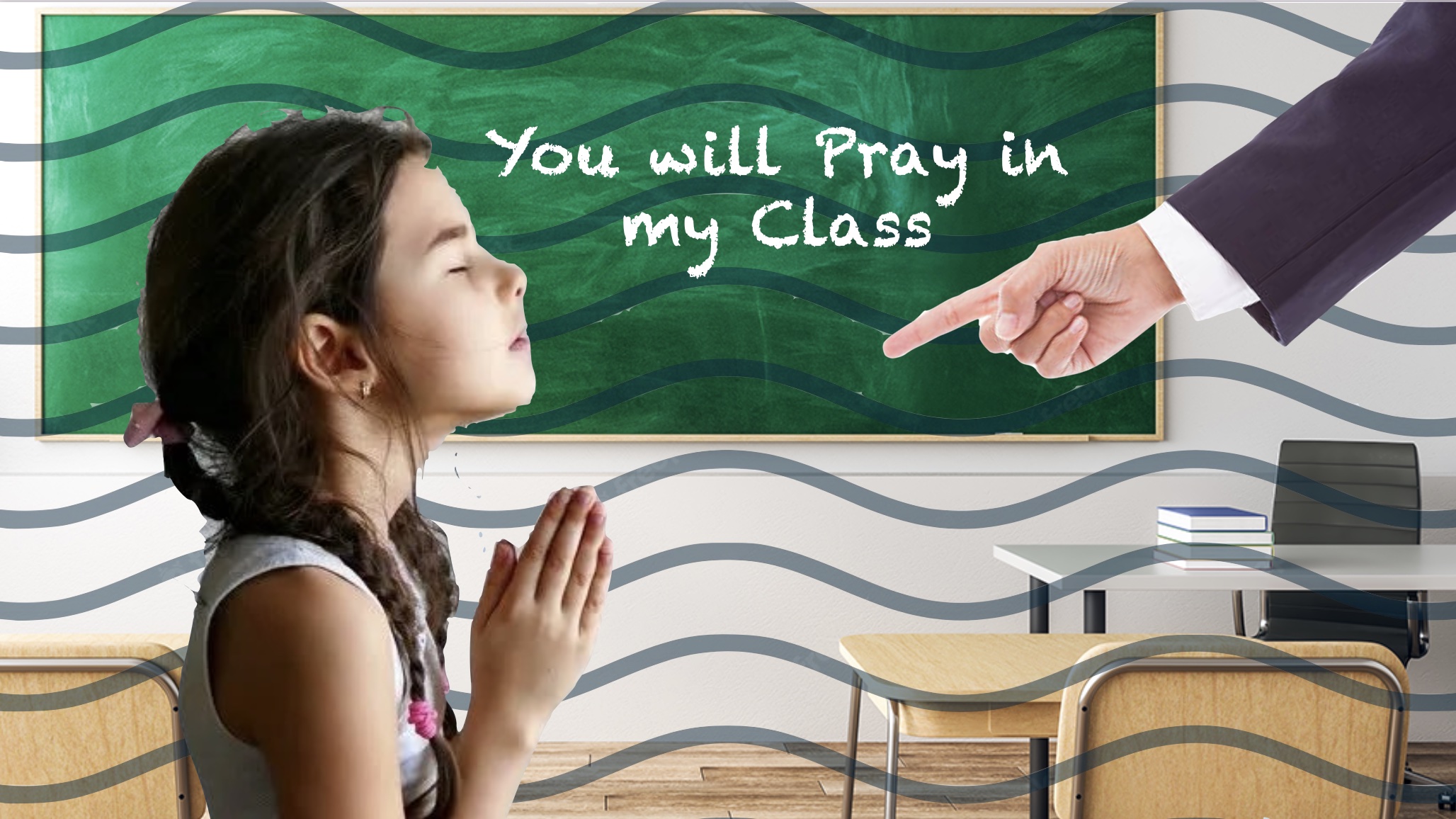
Anyone who has ever been in the minority knows that when an authority figure leads students in an activity, it is not optional – no matter what they say.
I know this from personal experience.
When I was in elementary school, I was one of a handful of Jewish kids in a building of mostly Catholics, Methodists, Presbyterians, etc.
In December, the kids were preparing for a choral concert where we’d sing a slew of holiday songs.
I loved to sing and enjoyed Frosty the Snowman, Jingle Bells and all the other classics…
I just didn’t feel right singing things like “Round yon virgin mother and child” and “Christ the savior is born.”
So when we practiced that song, I’d stop singing.
I’d enthusiastically belt out all the other tunes, but I just stood there when it was time for Silent Night.
I didn’t think it would make a difference. There were hundreds of others kids. No one would notice me.
But the choral teacher did.
She pulled me out of line and demanded to know why I wasn’t singing. I told her I was Jewish and didn’t want to sing that song.
She chided me for making everyone else look bad and told me to just move my mouth during the song so it looked like I was singing.
I didn’t want to do that. I didn’t want people to even THINK I was singing things I didn’t believe.
It’s not that I really accepted Santa and his reindeer, either, but this was somehow different. I didn’t want my parents to go to the concert and see me participating in this farce. I didn’t want to be forced to go onstage and before everyone profess the opposite of all I had been taught – to declare myself other than what I really was.
But the other kids were right there listening to this whole conversation and giggling. It was yet another way I was being marked as an outsider, as different – so I gave in and did what she demanded.
In retrospect, I now know I could have complained to my parents and gone to the principal and we could have even taken the matter to court like the aforementioned coach.
However, when you’re a little kid in elementary school you usually just listen to what the adults tell you to do. At least I did.
It took me decades to get over it. Really.
Whenever that song would come on the radio or I’d hear it in a department store, I’d get all tense and upset. Like something had been stolen from me.
So it was with some trepidation many years later that I attended my daughter’s first winter concert when she was in elementary school.
It was with some relief that I noticed no holiday songs like Silent Night. They were all pretty secular and even multicultural.
And my daughter goes to the same district I went to as a child.
When we discuss things – as you must in Language Arts – I encourage students to agree OR disagree with me or anyone else. Either option is okay so long as they try to explain why they think the way they do.
I tell my kids that they can say or think whatever they want about it. If they want to talk about God or religion, that is fine. It’s just me who is constrained. I am not allowed to give them my own opinion on these matters.
Often I tell them that this isn’t necessarily what I believe, but I’ll propose one idea or another to get them thinking.
I remember one year my students were particularly interested in religion, and they complained that they couldn’t pin me down on anything – they couldn’t tell if I was religious or an atheist.
Even if we CAN lead kids in prayer, that doesn’t mean we SHOULD.
I don’t plan on altering a single thing in my classroom, and I don’t think my colleagues should, either.
But there are 3.2 million teachers in public schools. There are bound to be some who will use this ruling as an excuse to give in to their worst tendencies.
So here’s what I suggest we do.
We should not coerce our students to do anything, but we damn well can and SHOULD pressure our colleagues not to indoctrinate their students.
Teachers should give them the cold shoulder in the faculty room and at the copier.
Want to borrow my grammar unit? Not if you’re going to subject your classes to your faith and encourage them to follow along.
Consenting adults can do what they like on their own time, but this is public school.
When it comes to undue influence, inculcation and alienation of kids who are different, we cannot be bystanders.
We may not have dark money and Christian Nationalists behind us, but until we have a rational Supreme Court to overturn this decision or a Congress with enough guts to codify freedom from religion into law, teachers still have some modicum of power.
We should use it to protect our children.
Like this post? You might want to consider becoming a Patreon subscriber. This helps me continue to keep the blog going and get on with this difficult and challenging work.
A teenage boy in a black trench coat walks down a school hallway.
A young girl abruptly turns a corner and is about to walk past when she stops and notices an oblong shape in his coat.
He pulls out an AR-15 and points it at her head.
She gasps. He smiles.
“Hold it right there, Patrick.” Says a voice behind him.
“Mr. Callahan?” The boy says starting to bring the barrel around.
‘Uh-uh. Stop right there,” says the voice shoving something in the boy’s back.
“I know what you’re thinking,” the teacher continues. “My homeroom teacher, Mr. Callahan, has a gun in his desk. Did he remember to bring it with him to hall duty? Well to tell you the truth in all this excitement I kinda lost track myself. But being it’s a 500 S&W Magnum, the most powerful handgun in the world and would blow your head clean off, you’ve gotta ask yourself one question: “Do I feel lucky?” Well, do ya, punk?”
Apparently this is how Doug Mastriano thinks school shootings can best be prevented.
Not gun control. Not stopping teens from buying assault weapons. Not keeping guns out of the hands of the mentally ill.
Instead, arm the teachers. Arm the principals. Put a piece in the hands of Lunch Lady Doris. Maybe even the custodians will be packing heat with a bucket and mop.
This is not the kind of serious proposal Commonwealth residents deserve from a representative of the legislature or executive branch. It’s not the kind of serious proposal you’d expect from a grown adult. Heck. It’s not what you’d expect from a small child still unable to tie his own shoes.
School shootings are not action movie scenarios. They’re not run-and-gun video games. They’re not cops and robbers. They’re real life.
Lest we forget, there were police officers on both the campuses of Robb Elementary School in Texas and Stoneman Douglas High School in Parkland, Florida, where shootings cumulatively took the lives of more than 30 students.
According to a 2021 JAMA Network study that looked at 133 school shootings from 1980 to 2019, armed guards did not significantly reduce injuries or deaths during school mass shootings.
In fact, when researchers controlled for location and school characteristic factors, “the rate of deaths was 2.83 times greater in schools with an armed guard present.”
Put simply, school shootings are not rational activities subject to cost benefit analysis from the people contemplating doing them. Would-be shooters do not expect to come out alive. They don’t care if there is armed resistance or not. In fact, the presence of armed resistance only encourages them to bring deadlier weaponry – especially semi-automatic guns.
And when trained police are afraid, Mastriano expects better from school staff – teachers, secretaries, aides, and nurses!!!?
A similar proposal permitting the arming of school employees passed the state Senate in June 2017 but it died in a House committee. In the district where I work as a middle school teacher, we talked about the issue at a staff meeting.
The few people who thought it was a good idea and said they would gladly bring a gun with them to school are nice people – but they’re the last ones you’d want armed.
Moreover, we have a school resource officer who said he was not in favor of the measure because it would make things tougher for law enforcement responding to a shooting. It would make it that much more unclear who the shooter was and increase the chances of friendly fire.
It’s hardly surprising Mastriano is making such boneheaded proposals.
Mastriano is either a fool who does not understand the issues or a patsy of the lunatic fringe of his party or both.
He wouldn’t arm teachers with books, funding or resources to teach – just guns.
He is an embarrassment to the people of Franklin County who elected him to the legislature and the Republican base who chose him to represent them in the governor’s race.
Fools like Mastriano are going to get innocent people and their children killed – not to mention the suffering thousands will have to endure if his policies ever see the light of day.
He thinks the answer to school shootings is to turn the school librarian into Yosemite Sam.
If you vote for him in the general election, you will reap what you sow – misery and death.
Like this post? You might want to consider becoming a Patreon subscriber. This helps me continue to keep the blog going and get on with this difficult and challenging work.
However, after months of controversy over the legality of the move, at last night’s special meeting, the board voted to let him go FOR REAL.
Holtzman has accepted a new position at Beaver Area School District, approximately 50 miles northwest of McKeesport.
His last day is June 30. Assistant Superintendent Dr. Tia Wanzo will serve as Acting Superintendent immediately upon his departure.
The controversy stems from a move last year by the outgoing board to retain Hotlzman in McKeesport when he had been poised to accept a new superintendents position at Kiski Area School District. He resigned and was rehired at MASD in order to secure him a new contract with a competitive salary and years of service.
But this didn’t sit well with three board members (Steven Kondrosky, James Brown and Mindy Sturgess) who walked out of the meeting before it was officially called to order.
Lawyer William C. Andrews wrote a letter stating that the measure could be viewed as circumventing the intent of the Pennsylvania school code. The law does not allow such contracts to be extended with more than a year left before they expire. Holtzman still had two years left on his contract.
Holtzman’s own legal council, Mark E. Scott, wrote that the move was, in fact, legal and that it was common practice at other districts.
At a February board meeting where letters from both lawyers were read into the record, Holtzman offered to resign, then and there:
“I will clearly state if they want me to move on, and I’ve said it to them in private, I want a year’s salary and benefits and I will resign tonight. This witch hunt and issue is over, overdone, overstated and we need to move on and once I’m compensated for my attorney fees.”
At the time, it was unclear whether the board could move forward with Holtzman at the head of the district or not.
Apparently Holtzman couldn’t continue to work with them.
A mere three months later, he put in his current resignation.
Holtzman’s tenure at McKeesport was fraught with controversy from the beginning.
Before this, he had been dean of discipline at McKeesport’s vocational department for two years before taking a similar role at West Mifflin Area High School. However, he was mostly known in MASD for his years on the high school football team when he had been a student there (he graduated in 1997) and then at Syracuse University.
His family also had a close relationship with one of the most controversial figures in the Mon-Valley, Pat Risha. The late Risha, who had been a superintendent, himself, at McKeesport, West Mifflin and South Allegheny districts, could have opened many doors, and was heralded as a “power broker” in his obituary.
The district offered a cyber option for students whose parents wanted to keep them safely at home during the worst of the pandemic. Many districts were able to provide live teachers from the child’s grade level to instruct through on-line services like Zoom. However, MASD used the corporate Edmentum program to provide academics. The problem is it wasn’t created for that purpose. It was created for credit recovery, not robust academics. As a result, the district cyber program was developmentally inappropriate, and full of typos and inaccuracies.
Holtzman blamed the problem on a contract with bus company, PA Coach Lines, which didn’t have enough drivers and would cancel the routes just hours before the buses were set to arrive.
The district had to go to court to break the contract and just entered into a new 6-year contract with Krise Transportation out of Penn Hills starting next year.
Holtzman’s controversies predate the pandemic.
In 2019, he refused to allow 11 high school students to create a Black Student Union. He claimed his objection wasn’t due to the organization’s content but the participation of one of the student’s mothers – Fawn Montgomery Walker who was running for McKeesport Mayor at the time and who is lead organizer of Take Action Mon Valley, a community action group.
Here’s hoping MASD has success with Dr. Wanzo or whoever eventually takes the Superintendent’s position on a permanent basis.
Like this post? You might want to consider becoming a Patreon subscriber. This helps me continue to keep the blog going and get on with this difficult and challenging work.
I wonder if the parents of the two adults killed in the shooting gave a thought to their grown children during what may have seemed like just another busy day at the end of the academic year.
We’re all so preoccupied. We tend to forget that every goodbye could be our last.
After all, they aren’t unpredictable. They aren’t inevitable. They’re man-made.
There have been 119 school shootings since 2018, according to Education Week, a publication that has been tracking such events for the last four years.
This only includes incidents that happen on K-12 school property or on a school bus or during a school sponsored event when classes are in session.
If we broaden our definition, there is much more gun violence in our communities every day.
According to The Gun Violence Archive, an independent data collection organization, there have been 212 mass shootings so far this year.
There were 693 mass shootings last year, 611 the year before and 417 the year before that.
In Australia, following a 1996 mass shooting in which 35 people were killed in Tasmania, Australian states and territories banned several types of firearms and bought back hundreds of thousands of banned weapons from their owners. Gun homicides, suicides, and mass shootings are now much less common in the country.
There have been 2,032 school shootings in the US since 1970, and these incidents are increasing. We’ve had 948 school shootings since the tragedy at Sandy Hook Elementary School in 2012.
We’re told that gun control is useless because new laws will just be pieces of paper that criminals will ignore. However, by the same logic, why have any laws at all? Congress should just pack it in, the courts should close up. Criminals will do what they please.
We may never be able to stop all gun violence, but we can take steps to make it more unlikely. We can at least make it more difficult for people to die by firearm. And this doesn’t have to mean getting rid of all guns. Just regulate them.
According to the Pew Research Center, when you ask people about specific firearm regulations, the majority is in favor of most of them – both Republicans and Democrats.
We don’t want the mentally ill to be able to buy guns. We don’t want suspected terrorists to be able to purchase guns. We don’t want convicted criminals to be able to buy guns. We want mandatory background checks for private sales at gun shows.
Yet our lawmakers stand by helpless whenever these tragedies occur because they are at the mercy of their donors. The gun industry owns too many elected officials.
In short, we need lawmakers willing to make laws. We need legislators who will represent the overwhelming majority of the public and take sensible action to protect the people of this country.
What we need is real gun control legislation. We need an assault weapons ban. We need to close the gun show loophole. We need buyback programs to get the mountains of firearms off the streets and out of the arsenals of a handful of paranoid “survivalists”.
We don’t need anyone’s thoughts and prayers.
We need action.
And we need it yesterday.
At this point there is simply no excuse.
If you don’t support gun control, you support school shootings.
Like this post? You might want to consider becoming a Patreon subscriber. This helps me continue to keep the blog going and get on with this difficult and challenging work.
Teachers instruct on proper behaviors and then reward students they see going above and beyond to achieve them.
Here’s another example.
A student at his lunch table is yelling and throwing food. Nearby another student is sitting quietly and reading a book.
Then a teacher walks over and gives the quiet child a yellow card which can be used to enter a raffle for a special prize. He might win an Oculus VR game system or tickets to a baseball game.
That’s social-emotion learning, too.
Instead of just cracking down on the negative behaviors, we try to reward the positive ones.
To be fair, it works to a degree.
But most of the time, it doesn’t.
The same kids end up with huge stacks of yellow cards and the rest get just one or two. Few students actually change their behavior. They just become virtue signalers whenever an adult is present.
Moreover, there’s an incredible amount of pressure on teachers to not just instruct but to closely observe every student’s behavior and constantly give positive reinforcement to those doing what should be the norm.
And that’s not even mentioning the frequent disruptions necessary to reward those children who can best navigate the system.
But that’s only one way of addressing the problem of bad behavior.
But it only goes so far in the halls, the cafeteria and during unstructured times.
Inside the classroom is another beast altogether – as it always has been.
Ever since I first started teaching more than two decades ago, it’s been necessary to work to achieve a classroom culture.
The teacher has to expend significant time and energy with the students as a whole and each student individually to set up a mini-society where each member gets respect by giving respect.
We try to set up the environment so everyone feels safe and involved, everyone is accepted for who they are, comfortable to be themselves and feels empowered to take the chances necessary to learn.
This means: (1) testing students’ abilities in SEL, (2) holding teachers accountable for student behaviors, and (3) pretending educators are developmental psychologists.
When it comes to the way students interact outside of the class, teachers should be part of the planning process but the main responsibility of conducting it should be with administrators.
And, finally, we mustn’t ignore the responsibility of parents and guardians.
We must free parents from overwork and professional pressures so they can do more to teach their children how to interact with others.
It takes a village to raise a child – a village that knows how to communicate with each other and respect each member’s role.
Like this post? You might want to consider becoming a Patreon subscriber. This helps me continue to keep the blog going and get on with this difficult and challenging work.
The Covid-19 pandemic on top of years of corporate sabotage and propaganda have obscured what public education really means and why it is absolutely necessary to the functioning of our society and any possibility of social, racial or economic justice.
Let’s begin by looking at how the current disaster exacerbated an already difficult situation and then consider why we should care enough to fix the mess.
The Pandemic Effect
Public schools got a bloody nose from the Coronavirus crisis.
Issues of masking, contact tracing, safety of immunocompromised students and staff, and when to open or close buildings (among other issues) lead to inevitable dissatisfaction from all fronts.
However, none of these issues should have been decided at the local level in the first place.
Instead, the CDC made conflicting decisions based more on the needs of the economy than public health (many of which were roundly ignored anyway). Then federal and state governments either refused to decide safety protocols leaving it up to individuals or municipalities, or when they did decide matters, they were embroiled in partisan battles over any kind of restrictions.
In fact, it was the failure of federal, state and even local municipal governments that often made public schools the de facto legislators of last resort. And this is something they were never meant to be.
According to the Bureau of Labor Statistics, there are 567,000 fewer educators in our public schools today than there were before the pandemic. And finding replacements has been difficult. Nationwide, an average of one educator is hired for every two jobs available.
This has left us with a weakened system suffering from more problems than before the pandemic hit.
Why Are Public Schools Important?
Because of what they are and what they represent.
We hear about public education so often – usually in deprecating terms – that we forget exactly what the term signifies.
It is a school where any child can go to get an education.
You don’t have to pay tuition. You don’t have to have a special ability or qualification. You don’t have to be neurotypical, a certain race, ethnicity, belong to a certain faith or socioeconomic status. If you’re living in the US – even if you’re here illegally – you get to go there.
That may seem simple, but it is vitally important and really quite special.
Not all nations have robust systems of public education like we do in the US.
This country has a commitment to every single child regardless of what their parents can afford to pay, regardless of their access to transportation, regardless of whether they can afford uniforms, lunch or even if they have a home.
We simply define education differently. We look at it as a right, not a privilege. And for a full 13 years (counting kindergarten) it’s a right for every child, not just some.
Perhaps even more significant is our commitment to children with special needs.
We have developed a special education system to help children at the edges that many other countries just can’t touch. In some nations these students are simply excluded. In others they are institutionalized. In some countries it’s up to parents to find ways to pay for special services. The United States is one of the only countries where these children are not only included and offered full and free access, but the schools go above and beyond to teach these children well beyond their 12th academic year.
In every authentic public school in the United States these students are included. In math, reading, science and social studies, they benefit from instruction with the rest of the class. And this, in turn, benefits even our neurotypical students who gain lessons in empathy and experience the full range of human abilities.
That isn’t to say the system has ever been perfect. Far from it.
But at least at the very outset what we were trying to do was better than what most of the world takes on. You can’t achieve equity if it isn’t even on the menu.
Without public schools, equity is definitely not on offer.
Public is Better Than Private
That’s really the point.
Charter, cyber and voucher schools are not set up around this ideal.
They are about who is sent away, not about letting everyone in.
The United States is a big country – the third most populous in the world. We have 332,630,000 people and growing. That’s about 50 million students in public schools.
No private system in the world has ever been able to work at that scale. If we lose our public schools, many kids will be left wanting.
It forces students to compete to get into schools and schools to compete for their very existence. Think of how that affects instruction. Schools have to spend a considerable amount of time and money attracting students to enroll. That’s time and money that doesn’t go to education. It goes to advertising.
Moreover, any school that attracts a surplus of students can choose which ones its wants to enroll. The choice becomes the school’s – not the parents’ or students’. In fact, administrators can turn away students for any reason – race, religion, behavior, special needs, how difficult it would be to teach him or her. This is much different from authentic public schools. There, any student who lives in the district may attend regardless of factors such as how easy or difficult he or she is to educate.
It’s a Darwinian model made to benefit the predators, not the prey. It’s a boon for any unselfconscious businessman who doesn’t mind getting rich stealing an education from children.
We Must Fight
That’s why we must fight to keep our public schools.
But you may luck out. Every privatized school isn’t a scam. Just most of them. So if you have found a charter, cyber or voucher school that is working for your child and doesn’t self-destruct in the time your child is enrolled, you may wonder why you should worry about the rest of us – the kids caught up in a web of privatized predation and neglect?
You have to live in this society. Do you really want to live in a country with a large population of undereducated citizens who cannot figure out how to vote in their own interests? Do you really want to live in a society where crime is a better career choice for those who were not properly educated?
That’s why we can’t let public education disappear.
I know it may sound like an insurmountable task, but saving our public schools can be done.
It will require collective action.
We will need to actively participate in our school board elections, go to school board meetings and possibly even run to serve on the board, ourselves.
Many people are upset with what local boards did during the pandemic, but the way to solve this isn’t to flee to schools without democratic principles. It is to seize those principles and make them work for you and your community.
And to do that, we need real political change at every level of government – local, municipal, state and federal.
None of this is easy. All of it takes work.
But it is the fight we must wage if we are ever to keep our democracy.
It is the fight we must win to create the better world our children deserve.
Public schools are worth saving, but it is up to you and me to do it.
Like this post? You might want to consider becoming a Patreon subscriber. This helps me continue to keep the blog going and get on with this difficult and challenging work.
“We also need conservative eyes and ears in the schools. If anyone can substitute even one day a week, the teachers who are activists and indoctrinating children can be revealed. Not all teachers are for [Critical Race Theory] CRT, etc. We need to identify the ones who are pushing the professional development they received over the summer. Are they putting black children’s tests in separate piles and grading them differently? Have they separated the classrooms? We won’t know these things until parents are allowed back into schools, so the best way is to sub.”
They certainly have the time! Legislators from the Keystone State make the third highest salary in the country, and they’re only in session a few weeks every month! They could easily spend a few days a week struggling with overstuffed classes, in-school suspension, hall duty and the like.
Districts that aren’t experiencing a shortage may require a teaching certificate as well, but beggars can’t be choosers. In districts where it is hard to get subs (i.e. those serving poor and minority kids) you can get emergency certified for a year.
But when I made such a suggestion, I naively thought lawmakers might see the problems schools actually have and start to support them.
Fat chance of that!
People with an agenda like Gleim would simply take the most innocent of interactions and pretend they were examples of indoctrination.
In Florida they banned 41% of the math books for being “woke” without a single concrete example and then patted themselves on the back for being transparent. It would be the same here. It would be like the Puritan girls in “The Crucible” finding witches in every classroom and hallway.
This state representative really thinks teachers are putting black children’s tests in separate piles and grading them differently!? As if we’re somehow changing their grades or assessing them more leniently?
NEWS FLASH: Children of color are not suddenly acing all their tests or rocketing to the head of the class. In fact, just the opposite. There has been a racial proficiency gap for decades based on segregation, lack of resources and punitive and biased standardized tests.
But back to her social media tirade. She wonders if there are separated classrooms – by which I assume she means classrooms segregated by race.
BINGO! She got that one right! But it’s not what she seems to think.
A majority of children of color are not getting privileged treatment. They’re being underprivileged. They’re in the lower academic tracks and a majority of the white kids are in the honors courses.
But back to her social media bubble. She wants parents to be allowed “back” into public schools!? Parents have never been excluded. As long as they can pass the background check, they can come in almost any time.
The books are riddled with counter factual claims and political bias in every subject imaginable such as abortion, gay rights and the Endangered Species Act, which one text labels a “radical social agenda.” They disparage religions other than Protestant Christianity and cultures other than those descended from white Europeans.
But that won’t happen because they’re terrified it might lose them a vote. They’re too afraid of being called partisan. Yet there is no middle ground with justice. You either have it or you don’t.
It would require a stance on principle.
So far, it hasn’t happened, and I doubt it will.
So Republicans will continue to take aim at all the usual scapegoats like teachers.
That’s the kind of thing that happened a few years ago at the Tree of Life Synagogue in Pittsburgh. A MAGA gunman was convinced by Trump that Jews were helping immigrants come into the country illegally. So he decided to kill as many Saturday worshipers as he could.
If we don’t stand up to this, it’s only a matter of time before it happens again.
Look. I don’t want to be at the center of this ridiculous culture war.
I just want to teach. I just want to do right by my students and their families.
But as our country burns to the ground, the school house often seems to be the center of the blaze.
I am sick of it.
I am sick of it.
I am just so sick of it.
Like this post? You might want to consider becoming a Patreon subscriber. This helps me continue to keep the blog going and get on with this difficult and challenging work.
If there’s one thing people love to argue about, it’s charter schools.
Go to any school board meeting, PTA forum or editorial page, and you’re bound to see folks from all different walks of life getting red in the face over these institutions.
But what are they anyway? And why do they generate so much passionate disagreement?
To answer these questions and many more, I’m going to examine five of the most pernicious myths about charter schools, debunk the fallacies and come to the simple truths.
1. Charter Schools are Public Schools
That’s what charter school supporters say, anyway. But it’s only partially true.
Charter schools were invented in 1991 and only exist in 43 states and the District of Columbia. They enroll about 6% of the students in the country – roughly three million children.
To be fair, some charter defenders will argue that since they are free from the same regulations as public schools, they can cut costs WITHIN their institutions and provide the same services for less. However, they never return that savings to the taxpayers. They simply cut services for their students and then pocket the savings. Lowering quality may be a way to cut costs, but it’s not exactly an innovation – and certainly not something to be envied.
This may be cost effective to the bureaucrats and profiteers running charter schools, but it is not a savings to you and me – to speak nothing of how it hurts the students hoping to receive a quality education.
So do charter schools save money?
QUICK ANSWER: NO!
3. Students do Better Academically in Charter Schools
This is what it says on all those charter school advertisements you see popping up everywhere. But is it true?
The problem with answering that is one of apples and oranges. How do you fairly compare charter and public school students when each group is so different?
Meanwhile, authentic public schools can’t do that. They take all comers.
As a result, charter schools can APPEAR to do better for their students but that appearance is due to privileged rules not better teaching or academic programs.
According to a 2010 Mathematica Policy Research study funded by the federal government, middle-school students who were selected by lottery to attend charter schools performed no better than their peers who lost out in the lottery and attended nearby public schools. This was the most rigorous and most expensive study of charter school performance commissioned by the US Department of Education, and it found no overall positive benefit for charter schools.
And there have been many others. A 2016 study found that Texas charter schools had no overall positive impact on test scores and, in fact, had a negative impact on students’ earnings later in life.
So, taken as a whole, do charter schools outperform authentic public schools?
QUICK ANSWER: NO!
4. Charter Schools are About Innovation
This was, in fact, one of the selling points of the charter school concept when it was first proposed. Being freed of the regulations that authentic public schools have to abide by would allow charter schools to be laboratories for innovation.
Moreover, those few charter schools that do engage in creative practices such as organizing the curriculum around a theme like creative arts or racial justice issues aren’t doing anything that isn’t already being done at authentic public schools – specifically magnet and lab schools.
The creativity and innovation you find at most charter schools is in the accounting department – finding new ways to reduce the services students would find at the neighborhood public school and redefining the savings as profit. That and circumventing conflict of interest regulations to allow the corporation that manages the charter school to buy properties from itself at a hefty mark up.
Is any of this innovation?
QUICK ANSWER: NO!
5. Charter Schools Improve Civil Rights
This is perhaps the most often cited benefit of charter schools. In fact, the impression has been that charters are the choice of people of color and serve them better than their neighborhood public school.
However, the facts show a somewhat different reality.
Are these schools doing a better job of meeting the needs of these children? A 2016 report from UCLA casts doubt on this idea.
Charter schools are notorious for suspending their black students at much higher rates than their white students. While suspensions for students of color are high at public schools as well, they are much more extreme at charter schools.
More than 500 charter schools suspended Black students 10 percent more often than white students. Moreover, the same figure holds for students with disabilities at 1,093 charter schools. In fact, 374 charter schools suspended 25% of their entire student bodies at least once.
However, this increased segregation isn’t just something that affects Black charter school students. It affects white charter school students, as well.
In the first case, the charter schools end up with a disproportionate percentage of Black students and the white students are left in the public schools. In the later case, the Black students are left in the authentic public schools and the white kids flee to the charter schools.
Both cases are not good for civil rights. They allow students of color to be targeted for disinvestment and reductive curriculum while further privileging the white students.
The idea that it is somehow in the best interest of children of color to be provided with schools containing fewer safety precautions is kind of insulting.
Far from improving civil rights, charter schools too often violate them.
“With the expansion of charter schools and their concentration in low-income communities, concerns have been raised within the African American community about the quality, accessibility and accountability of some charters, as well as their broader effects on the funding and management of school districts that serve most students of color.”
Black Lives Matter organizers also called for a charter school moratorium. Charters, they wrote, represent a shift of public funds and control to private entities. Along with “an end to the privatization of education,” the Movement for Black Lives organizers are demanding increased investments in traditional community schools and the health and social services they provide.
Moreover, the Journey for Justice Alliance – a coalition of grassroots community, youth, and parent-led organizations in over 30 cities – has gone even further calling for an end to all school privatization.
The organization posted on it’s Website:
“The evidence is clear and aligns with the lived experience of parents, students and community residents in America’s cities: school privatization has failed in improving the education outcomes for young people. There is no such thing as “school choice” in Black and Brown communities in this country. We want the choice of a world class neighborhood school within safe walking distance of our homes. We want an end to school closings, turnarounds, phase-outs, and charter expansion.”
So do charters improve civil rights?
QUICK ANSWER: NO!
There are a lot of myths spread about charter schools – many of them being propagated by the charter school industry, itself.
Most of these are not facts; they are marketing.
While there are some charter schools that do a decent job educating children, the charter school concept is deeply flawed.
Like this post? You might want to consider becoming a Patreon subscriber. This helps me continue to keep the blog going and get on with this difficult and challenging work.
We want our kids to grow up to be smart, charming and successful. We don’t want them to lose their tempers over a joke – no matter how tasteless – and resort to violence.
Maybe this comes off as just some white dude clutching his pearls.
So when a person like me (who lives this reality day-in, day-out) sees something like this on a nationally televised broadcast, it’s a bit more personal.
My students and I just read an article about Smith in class.
It went through his entire career from Philadelphia high school kid to popular rap star to television and movie fame. Then my students had to write about what attributes Smith had that helped him become successful.
We talked about Will in depth.
Just about everybody knew and loved him. We were all excited he was up for another Academy Award and hoped that this would finally be the year he won.
And he actually did win Best Actor for his performance in “King Richard.”
This was supposed to be a triumph, a moment of increased representation for people of color.
Instead, it was yet another example of toxic masculinity.
You can praise Smith for defending his wife, but he took a verbal situation and made it a physical confrontation.
What he did would get anyone else arrested.
I’m not saying I wish he had gone to jail. I’m not saying he should have been stripped of his award.
But there should have been a consequence – SOMETHING!
He should have been asked to leave the ceremony, at least. Someone could have accepted the Oscar on his behalf.
Yet since there was nothing – NOTHING – he even got to make a tearful acceptance speech – that sends a pretty clear message to kids.
It says that this kind of behavior is okay. Maybe even praiseworthy.
Every ill in our society comes back to our public schools.
Malnutrition, addiction, crumbling infrastructure, absent parents, lack of social safety net, racism, prejudice and toxic cultural norms.
This is one of the main reasons so many teachers are leaving the profession.
According to the Bureau of Labor Statistics, there are 567,000 fewer educators in our public schools today than there were before the pandemic. And finding replacements has been difficult. Nationwide, an average of one educator is hired for every two jobs available.
We need the rest of society to step up, not sink into the muck.
We had hoped for more from Will.
In the aftermath of all this, people have almost entirely forgotten what sparked the confrontation.
Chris Rock made a cheap joke about Jada Pinkett Smith, who was bald because she’s suffering from alopecia.
This is an illness I’ve suffered from myself – that my mother still suffers from.
Rock crossed a line not because he was making fun of Smith’s wife, but because he was ridiculing someone because of a medical condition.
If Smith hadn’t resorted to violence (perhaps if he had just said something instead), we’d be talking about Rock, not Smith.
But in crossing the line from words to fists, he obscured the point.
Violence is only justified in self defense – against in-coming violence.
Maybe you don’t want to admit it.
Maybe you love Will Smith so much you refuse to admit that he was wrong.
Like this post? You might want to consider becoming a Patreon subscriber. This helps me continue to keep the blog going and get on with this difficult and challenging work.
There are black kids and white kids, Muslim kids and Christian kids, Latinos and Lithuanians, Italians and Iranians, girls, boys and all genders in between.
There are tall kids and short kids. Fat kids and thin kids. And, yes, some kids who like other kids in ways which all adults might not approve.
However, some people are too juvenile to deal with it – they can’t even say the word or can’t even endure someone else saying it!
That’s not so bad when you’re 13 and terrified of your own sexuality, anxious that anyone might question your cis privilege.
You still have time to grow out of such sophomoric hijinks.
Silencing the grown-ups in school won’t change who the kids are. It will just forbid us from mentioning reality. It will permit us to recognize only the tiniest fraction of who our students are and leave a de facto shroud over the rest.
I refuse to turn my classroom into a closet.
It might make the most bigoted adults feel better. It might relieve grown-up fears that just talking about other ways to live is enough to mold someone into something against their nature.
As if such a thing were possible.
But it won’t help the kids.
People don’t become their sexuality. They discover who they were all along – and ultimately no piece of legislation can stop that. It can make that search more difficult, painful and riddled with guilt. But you are who you are.
It’s regressive shame-based norms like these that encourage little boys to bash those who are different.
That make them feel the only safety lies in violence against the other so no one questions who they are, themselves.
That scares them enough to giggle at a three-letter word embedded in a poem.
And speaking of my giggle goose, eventually he got himself under control.
Before the end of the period he came back to the table.
Silently, swiftly, and soberly, he sat down with the rest of us ready to continue discussing “Do Not Go Gentle Into That Goodnight.”
Not a titter or laugh.
It wasn’t until a week later that he turned to me with a smile and asked:
“Mr. Singer, did you have a gay weekend?”
I did, Buddy. I did.
Like this post? You might want to consider becoming a Patreon subscriber. This helps me continue to keep the blog going and get on with this difficult and challenging work.






 gadflyonthewallblog