I’m standing in front of my first period class after a long Thanksgiving break.
Papers are rustling.
Pencils are being sharpened.
Voices are lowering to a whisper.
And it occurs to me how glad I am to be here.
So I tell my students.
“We have a lot to go over today,” I begin and most of my middle school faces turn serious.
“But I just want to tell you all how happy I am to be here.”
Curiosity moves across those adolescent brows like a wave from one side of the room to the other.
Some even looked worried like they are afraid I am going to tell them I’m sick or dying.
“It’s true,” I continue. “I’m glad to be here this morning with all of you.
“I think teachers sometimes don’t say that enough.
“This is a great class. You’re all really good students, and I’ve watched you work hard and grow.
“For many of you this is the second year you’ve had me as your language arts teacher. For others, this is your first time with me. It doesn’t matter. I’m glad I can be with you and help get you ready for the challenges that you’ll face next year in high school.
“I’ve said this before and I’ll say it again – I am not just some guy who stands up here and gives you assignments. I’m your resource. If there’s anything I can do to make your year a better one, please ask.
“If you’re having trouble with the work or you’re confused about something, I’m here. If you need help with something – even if it’s not school related – I’m here. If you just want to talk or someone to listen – I’m here.”
I pause to see if there are any questions.
There aren’t, but neither is their any apparent doubt, bewilderment, perplexity.
The class looks back at me in silence with serene eyes and smiling lips.
I mess up all the time. But I feel like what I said this morning was right somehow.
It’s simple and easy and more of us should do it.
Kids can get the impression that teachers aren’t human. They’re these mysterious creatures who pass judgment on them — and where do they even go when class ends? Who knows?
I remember when I was a young educator one of my mentors told me the old chestnut “Don’t smile until Christmas.”
I saw where she was coming from. It’s easier to command firm discipline if students don’t think of you as anything but an educating machine. But I could never go through with it.
Discipline is a means to an end. You have to have some sort of order in your class so you can facilitate learning. But that doesn’t mean you should preside over prisoners locked in a penitentiary of their own education.
Learning should be about choice, fun and curiosity. It should be about expressing yourself as much as it is about finding details and forming grammatical sentences.
Everything we do should be in service to the student.
Reading comprehension is to help the student understand what is being said and then form an opinion about it.
Writing is to help the student express the maelstrom of their own thoughts in a way that can be understood by others.
When my classes are over, I always have several students gathering around my desk wanting to prolong our interaction even if it means they’ll be late to lunch or late going home.
Kids ask about my break and I ask about theirs. We talk about favorite TV shows, songs we like or even local news stories.
They share with me their middle school crushes and ask advice.
You have to draw a line between teacher and friend – and between teacher and parent. Because the kids are looking for you to be both.
But you can’t.
We walk a strange middle ground, but I think that’s necessary.
And it’s been like that for more than half a century.
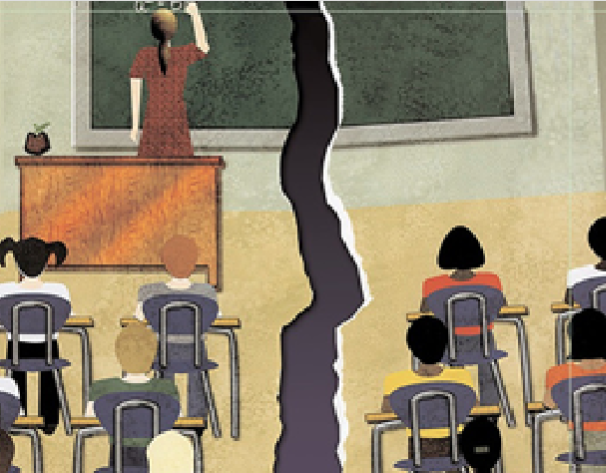
In 1964, a Department of Education report found that the average black high school senior scored below 87% of white seniors (in the 13 percentile). Fifty years later, the National Assessment of Educational Progress (NAEP) found that black seniors had narrowed the gap until they were merely behind 81% of white seniors (scoring in the 19th percentile).
So what does that mean?
It’s a question that has haunted our education system for more than a century.
And the various answers that have been offered to explain it often reveal more about our society than they do about black and Latino children.
CLAIM 1: People of color are just genetically inferior
I know. This sounds glaringly racist.
And it is.
Yet this was the favorite answer for the achievement gap at the start of the 20th Century (More on that later).
However, it has been espoused as recently as 1995 by Charles Murray and Richard Herrnstein in The Bell Curve where the authors attributed relative black failure and low socio-economic status to biological inadequacy.
Murray and Herrnstein sparked such an intense academic debate at the time that the American Psychological Association (APA) convened a Task Force on Intelligence. Instead of soundly disproving this theory, the resulting APA report could come to no definite conclusion: “At this time, no one knows what is responsible for the differential,” the authors wrote.
Today the idea that people of color are genetically inferior has been soundly defeated.
There is simply no evidence that racial characteristics are strongly correlated with intelligence.
In other words, it’s not genes, but pathological community values that keep many people of color at the bottom. Black and brown students would do better in school if their culture fostered hard work, determination, grit and valued learning. They’d learn more if their parents weren’t always in jail or having innumerable children to increase their food stamp benefits.
From a purely ideological standpoint, this is textbook racism – the belief that some racially defined groups are in some sense better or worse than others.
It’s the minstrel show as case study. It boils down the attributes of 40 million people to mere stereotypes and pretends that they’re real.
Furthermore, black crime rates, out-of-wedlock birthrates, and welfare dependence have gone down in recent years, while white rates have increased.
Such claims show more about those making them than the people the claims are supposed to be about. When a black person struggles, the cause is assumed to be a deeply ingrained cultural attribute. When the same happens to white people, it’s an anomaly.
For instance, in the 80’s and 90’s the media blamed black culture and black communities for the crack epidemic. But today those same talking heads excuse the mostly white and rural opioid crisis as an aberration. No one seems to claim that it is because the white family is breaking down or white culture is in decline.
Poor people achieve worse academic outcomes than wealthier people. And this is true across race and ethnicity.
It just makes sense. Living in poverty means less access to healthcare, neonatal care, pre-kindergarten, and fewer books in the home. It often means fewer educated family members to serve as a model. And it often means suffering from malnutrition and psychological trauma. Impoverished parents usually have to work multiple jobs just to make ends meet and thus have less time to help with homework or see to their children. All of this has a direct impact on education.
The fact that a larger percentage of people of color are poor, helps explain the disparity of achievement between races.
Achievement gaps are strongly correlated with racial gaps in income, poverty rates, unemployment rates, and educational attainment.
However, poverty, alone, does not explain away the problem.
Even when racial disparities are few and far between (typically in states with small black and/or Hispanic populations), the gap can persist.
We shouldn’t discount poverty. It goes a long way to explaining the problem. It just doesn’t go all the way.
CLAIM 4: Racist policies and bias widen the achievement gap
There are numerous factors that can adversely affect achievement for children of color above and beyond poverty. These include the availability and quality of early childhood education, the quality of public schools, patterns of residential and school segregation, and state educational and social policies.
According to a report from the U.S. Government Accountability Office, from 2000 to 2014, school segregation has more than doubled nationwide. That’s twice the number of schools comprised almost entirely of students living in high poverty and/or students of color.
A report by the Government Accountability Office (GAO) found that black students in K-12 schools are far more likely to be disciplined — whether through suspension or referral to law enforcement — than their racial counterparts.
A 2014 study found that people generally view black boys as older and less innocent starting at the age of 10. Another study released in 2017 produced similar results, finding that Americans overall view black girls as less innocent and more mature for their age, from ages 5 to 14.
These have real world consequences for children’s academic development. If even well-meaning (and mostly white) teachers are more likely to see children of color as potential trouble makers, that can be a self-fulfilling prophecy. And kids who are in trouble often have more difficulty making the grade.
Finally, there is the influence of charter and voucher schools, many of which target their enrollment at students of color.
They can cut services to students on a whim and if students struggle, they can give them the boot forcing them to try to catch up at the local public school.
If there is no evidence for genetic or social differences along racial lines, can we explain everything else by way of socioeconomics and racist policies?
Perhaps. But even more so, we need to question the mechanism that started this whole debate in the first place – standardized testing.
That is the primary mechanism used to determine if there is a racial achievement gap at all.
Standardized testing, as we know it, originates from the work of Francis Galton – Charles Darwin’s cousin and an English statistician. In 1869, he wrote in Hereditary Genius that “[t]he average intellectual standard of the negro race is some two grades below our own.” Galton nearly invented the western eugenics movement, but couldn’t find a method to test his theories.
Enter France’s Alfred Binet and Thodore Simon. In 1905 they developed an IQ test that 11 years later was revised by Stanford University psychologist Lewis Terman for use in America.
In his book, The Measurement of Intelligence, Terman wrote that these “experimental” tests will show “enormously significant racial differences in general intelligence, differences which cannot be wiped out by any scheme of mental culture.”
For Terman, the achievement gap wasn’t a problem. It was a feature he was actively trying to prove, and he thought he had done so with his experiments on 1.7 million U.S. servicemen in World War I.
His deeply biased work convinced a generation of scholars. Princeton University psychologist Carl C. Brigham presented the results as evidence of genetic racial hierarchy in A Study of American Intelligence – merely three years before he used these same ideas to craft the SAT test in 1926.
The ideals of the eugenicists lost popularity after World War II, but they were by no means finished. Famed physicist William Shockley and educational psychologist Arthur Jensen carried these concepts into the 1960s before they were revived again in The Bell Curve in the ‘90s.
These are not just bugs in the system. They are what the system was meant to prove in the first place.
By defining academic success or failure primarily as success or failure on standardized tests, we’ve effectively barred generations of children of color from the benefits of an education. And in using these same tests for “accountability” purposes to reward or punish their schools by granting or denying resources, high stakes testing has become the academic gatekeeper. Biased assessments have been used to grant real world opportunity.
How many opportunities have been denied because of them? How many black and brown children have been denied entry to college, professions, graduate schools, jobs, places at the highest ranked schools?
How many young black and brown children have been convinced of their own ignorance because of a test score of dubious quality?
CONCLUSIONS
So we return to the question with which we began this article:
Why is there a racial achievement gap?
The answer is NOT because of genetic or cultural deficiencies in children of color.
The gap stems from a combination of disproportionate levels of poverty among black and brown people, racist bias and policies embedded in our public school system and – more than anything else – reliance on a flawed assessment system.
Next, we must create a more just and equitable education system. This means fairly funding our schools. We must increase integration. We must halt the spread of charter and voucher schools. We need to make sure all our teachers and principals have cultural sensitivity training and increase the numbers of teachers of color in our school system.
And we must get rid of our system of standardized testing.
It’s a tall order, but that’s the only way to close an even more pressing gap – the gap between our reality and our ideals.
She’s not a know-nothing privatization flunky. She’s not a billionaire who thinks hording a bunch of money makes him an authority on every kind of human endeavor.
She’s a bona fide expert on teacher preparation and equity.
In fact, she was the reasons many educators thought Obama was going to be a breath of fresh air for our schools and students. Everyone thought she was a lock for Education Secretary should Hope and Change win the day. But when he won, he threw her aside for people like Arne Duncan and John King who favored school privatization and high stakes standardized testing.
It’s a “nonprofit” think tank whose self-described mission is “to conduct independent, high-quality research to improve education policy and practice.”
The report basically conflates all types of choice within the public school system.
On the one hand, it’s refreshing to have policy analysts admit that there ARE alternatives within the public school system above and beyond charter and voucher schools.
Hammond and her colleagues Peter Cookson, Bob Rothman and Patrick Shields talk about magnet and theme schools.
They talk about open enrollment schools – where districts in 25 states allow students who live outside their borders to apply.
They talk about math and science academies, schools focusing on careers in health sciences and the arts, schools centered on community service and social justice, international schools focused on global issues and world languages, and schools designed for new English language learners.
They talk about schools organized around pedagogical models like Montessori, Waldorf and International Baccalaureate programs.
And these are all options within the public school system, itself.
Though Hammond admits this model often runs into problems, she refuses to dismiss it based on the few instances where it seems to be working.
Despite concerns from education advocates, fiscal watchdogs and civil rights warrior across the country, Hammond and co. just can’t get up the nerve to take a stand.
She notes that 33% of all charters opened in 2000 were closed 10 years later. Moreover, by year 13, that number jumped to 40%. When it comes to stability, charter schools are often much worse than traditional public schools.
However, after noting these negatives, Hammond and co. go on to provide wiggle room for privatization. They discuss how state governments can do better making sure charter schools don’t go off the rails. They can provide more transparency and accountability. They can outlaw for-profit charters and put caps on the number of charters allowed in given districts and states, set rules on staffing and curriculum – all the kinds of measures already required at traditional public schools.
But the crux of their objection is here:
“In a recent commentary in this column, authors Diane Ravitch and Carol Burris erroneously asserted that our report aims to promote unbridled alternatives to publicly funded and publicly operated school districts. Quite the opposite is true.”
In other words, they continue to lump privatized schools like charters in with fully public schools.
They refuse to make the essential distinction between how a school is governed and what it does. So long as it is funded with public tax dollars, it is a public school.
That’s like refusing to admit there is any difference in the manner in which states are governed. Both democracies and tyrannies are funded by the people living in those societies. It does not then follow that both types of government are essentially the same.
But they go on:
“The report aims to help states and districts consider how to manage the broad tapestry of choices available in public schools in ways that create quality schools with equitable access and integrative outcomes.”
Most tellingly, the authors admonish us to, “Focus on educational opportunities for children, not governance structures for adults” (Emphasis mine).
The way a school is governed is not FOR ADULTS. It is FOR CHILDREN. That is how we do all the other things Hammond and co. suggest.
“Work to ensure equity and access for all.”
That doesn’t just happen. You have to MAKE it happen through laws and regulations. That’s called governance.
“Create transparency at every stage about outcomes, opportunities and resources.”
That’s governance. That’s bureaucracy. It’s hierarchy. It’s one system overlooking another system with a series of checks and balances.
“Build a system of schools that meets all students’ needs.”
Again, that doesn’t just happen. We have to write rules and systems to make it happen.
And even in the few cases where charter schools don’t give all the decisions to unelected boards or voluntarily agree to transparency, the charter laws still allow them to do this. They could change at any time.
It’s like building a school on a cliff. It may be fine today, but one day it will inevitably fall.
“A democratic education means that we educate people in a way that ensures they can think independently, that they can use information, knowledge, and technology, among other things, to draw their own conclusions.”
Now that’s a Linda Darling-Hammond who knows the manner in which something (a state) is governed matters. It’s not just funding. It’s democratic principles – principles that are absent at privatized schools.
“Bureaucratic solutions to problems of practice will always fail because effective teaching is not routine, students are not passive, and questions of practice are not simple, predictable, or standardized. Consequently, instructional decisions cannot be formulated on high then packaged and handed down to teachers.”
This Linda Darling-Hammond is a fighter for teacher autonomy – a practice you’ll find increasingly constrained at privatized schools. In fact, charter schools are infamous for scripted education, endless test prep and everything Hammond used to rail against.
“In 1970 the top three skills required by the Fortune 500 were the three Rs: reading, writing, and arithmetic. In 1999 the top three skills in demand were teamwork, problem-solving, and interpersonal skills. We need schools that are developing these skills.”
I wonder what this Linda Darling-Hammond would say to the present variety. Privatized schools are most often test prep factories. They do none of what Hammond used to advocate for. But today she’s emphatically arguing for exactly the kind of school she used to criticize.
“If we taught babies to talk as most skills are taught in school, they would memorize lists of sounds in a predetermined order and practice them alone in a closet.”
Isn’t this how they routinely teach at charter schools? Memorize this. Practice it only in relation to how it will appear on the standardized test. And somehow real life, authentic learning will follow.
“Students learn as much for a teacher as from a teacher.”
Too true, Linda Darling-Hammond. How much learning do you think there is at privatized schools with much higher turnover rates, schools that transform teachers into glorified Walmart greeters? How many interpersonal relationships at privatized institutions replacing teachers with iPads?
Yet today’s Linda Darling-Hammond is fighting for schools that work teachers to the bone for less pay and benefits and then fire them at the slightest pretense.
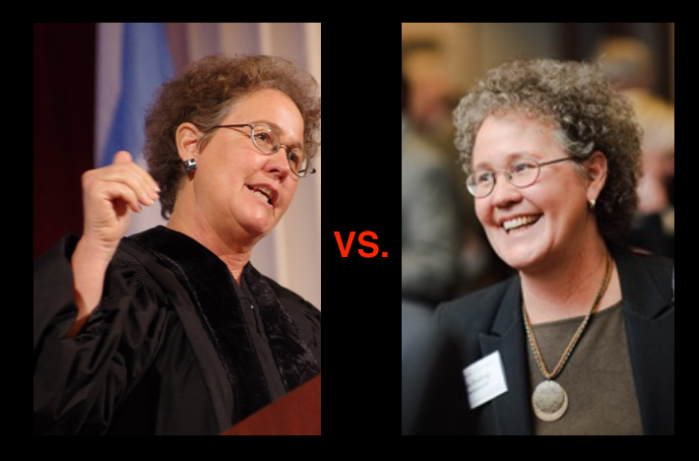
In short, I’m sick of this new Linda Darling-Hammond. And I miss the old Linda Darling-Hammond.
Perhaps she’s learned a political lesson from the Obama administration.
If she wants a place at the neoliberal table, it’s not enough to actually know stuff and have the respect of the people in her profession.
She needs to support the corporate policies of the day. She needs to give the moneymen what they want – and that’s school privatization.
This new approach allows her to have her cake and eat it, too.
She can criticize all the evils of actual charter schools while pretending that there is some middle ground that allows both the monied interests and the students to BOTH get what they want.
The idea and the euphemisms used to describe it were coined by Carol Dweck as early as 1999. It was subsequently popularized by seventh-grade math teacher and psychologist Angela Duckworth.
In the early 2000s, Duckworth realized that IQ wasn’t the only thing separating successful students from those who struggled. There was also the tendency to overcome adversity or not.
Hey, Angela. Darwin called. He wants his Theory of Natural Selection back.
You know Survival of the Fittest was never meant to be prescriptive. As human beings, we’re supposed to be better than mere animals that typically leave the pack’s sick and injured behind to get eaten by predators.
But whatever.
The term “grit,” is defined as a “passion and perseverance for long-term goals,” according to Frontiers in Psychology. And it’s become one of the buzziest of buzzwords in academia.
The agencies that administer the National Assessment of Education Progress (NAEP) and the Program for International Student Assessment (PISA) are close to including character assessments as a measure of student performance.
Yet when anyone suggests offering help to even the playing field – to make things more fair – a plethora of policy wonks wag their fingers and say, “No way! They did it to themselves.”
It’s typical “blame the victim” pathology to say that some kids get all the love, time and resources they need while others can do without — they just need more “grit” and a “growth mindset.”
So you forget all the ways society has helped you and yours. YOU deserve all the credit for your successes.
But for those people over there, let’s forget all the ways society has refused to help and instead blame THEM for not overcoming the obstacles (we put) in their path.
Don’t get me wrong. I’m not saying effort counts for nothing. But it’s part of a complicated matrix of nature and nurture.
Yet as a society, we can’t simply ignore our responsibilities toward others and throw it all on the individual.
Good teachers know how to get the best out of their students. We know that most kids – if given a safe, encouraging environment – can succeed.
The key often is to scaffold that success. Give them something to do that they can actually master. Then give them something slightly more challenging.
You teach them that they have the ability to succeed and success becomes a self-fulfilling prophecy – and not the opposite.
However, the teacher – and even the school, itself – can only do so much.
We need to fully fund our public schools to meet the needs of all students. That means more funding, services and opportunities for the underserved than for those who already have the best of everything and don’t need to rely as heavily on the school system for support.
We need wraparound services, counseling, tutoring, after school programs, community schools, jobs programs, continuing education for adults and other services to help heal the trauma of growing up poor in America.
Though the alleged culprit has been captured, details are still being uncovered. The death toll has yet to be tallied.
Unconfirmed reports state that he shouted “All Jews must die,” before opening fire.
But I don’t believe that the Jewish community was his only target.
Or more precisely – it wasn’t just the Jewish part – it was the community that had grown up around it.
I know Squirrel Hill well.
I live close by. I grew up on those streets. I’ve been to services at that synagogue. I have family who are members.
Thankfully it seems that no one related to me was there this morning. But when victims names are released, I probably will know who they are.
I know this community.
I am an extended part of it.
And that’s something of which I am proud.
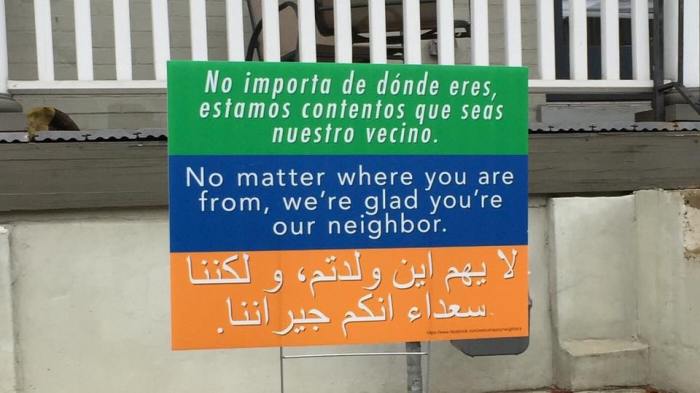
Just walk along Murray Avenue and you’ll see Indian, Italian, Jewish, African, Chinese – every nationality imaginable – offering the fruits of their culture for friendly commerce.
You’ll see Hasidic Jews in dark hats and flowing tzitzit walking next to women in colorful saris next to trans and lesbians, kids with every color skin playing together in harmony.
Whenever I want a good corned beef sandwich or a quality lox and bagel, I go there. Whenever I want a spicy curry or the freshest sushi or an authentic macaroon, that’s the place. If I want to hear a string quartet or a lecture from a visiting dignitary or even if I want to swim in a public pool, membership to the Jewish Community Center is open to all.
It’s like a few blocks of cosmopolitan life tucked away in a city more known for segregation. We have many ethnic neighborhoods but few where one culture flows so easily into another.
Heck. Even the Tree of Life Synagogue, itself, doesn’t serve one congregation. It serves three who all had services going on at different parts of the building this morning.
There’s just something very special about this place.
It’s where you can go to be yourself – in fact, you’re encouraged to be who you are and not conform to any particular norm. Yet in doing so, you’re somehow demonstrating unity.
Paradoxically, being you makes you one of us.
It’s weird.
I think it may have been that sense of community that made Squirrel Hill, in general, and the Tree of Life Synagogue, in particular, a target.
The hate-filled person who attacked us today was terrified of that unity.
He was so frightened of disillusion, of losing his sense of self, that he had to end the lives of those who could do what he couldn’t.
It’s pathetic, really.
If your sense of self is only a negative, only opposition to someone else’s otherness, you really don’t have much self to lose.
If you define yourself by your hate, what are you?
Do you even really exist?
Most of us are very different.
We are complex assortments of personality – a family identity, a cultural heritage, a work persona, a spirituality, a sense of justice.
Communities like Squirrel Hill nurture this multifarious nature.
They welcome and celebrate difference.
I wish America was more like Squirrel Hill and not the other way around.
If this community’s normal was our national ideal, think of the country we would be living in!
Being different wouldn’t be an obstacle, it would be cherished.
When meeting someone with an unfamiliar name, a heritage of which you were ignorant, a sexuality or gender identity of which you had little knowledge – your response wouldn’t be fear or discomfort. It would be a thrill of excitement that you are lucky enough to broaden your understanding of the many ways there are to be human.
It would be a country where no one grew up so stunted and afraid that the only solution they could imagine would be the death of others.
That’s the America I want to live in.
Squirrel Hill is stronger than this synagogue shooters hate.
What’s the most effective way to dumb down a nation?
Focus on How without Why.
That’s really the biggest problem with the pedagogical fad of STEM education.
There’s nothing objectively wrong with teaching science, technology, engineering and math – the disciplines that make up STEM.
In many cases, doing so is essential to a well-rounded education.
But therein lies the problem – you can’t have a well-rounded education if you purposely leave out some of the most vital aspects of knowledge.
Where’s the art? Where’s the literature? Where’s the social studies, government, citizenship, drawing, painting, music – heck! Where’s the philosophical understanding of life, itself?
STEM initiatives often involve creating two tiers of school subjects. You have the serious disciplines that will earn you respect and a job. And you have the soft, mamby pamby humanities that are no good to anyone.
The problem is one of focus not content.
Corporate-minded bureaucrats who know nothing of human psychology, child development or education look solely at standardized test scores and get hysterical.
The U.S. is falling behind other nations – especially in science and math, they say. So we must do whatever we can to bring those test scores up, Up, UP!
We started contrasting multiple choice assessment results for 13-year-olds in a dozen countries back in 1964. And ever since, America has always been right in the middle.
Yet for those five decades we’ve dominated the world in science, technology, research and innovation.
In that time we sent the first people to the moon, mapped the human genome, and invented the Internet – all while getting middling test scores.
Even reading and writing are only valuable if they let us guess what a normalized reader is supposed to comprehend from a given passage and if they allow us to express ourselves in the most rudimentary and generic ways.
This is exactly what they do in countries with the highest test scores – countries that are LESS innovative than the U.S.
Asian countries from Singapore to South Korea to India are not blind to this irony. While we are trying to imitate them, they are trying to imitate the kind of broad liberal arts education in which we used to pride ourselves.
“Many works of art and literature are the products of having fun. So, our entrepreneurs need to learn how to have fun, too.”
Ma worries that his country is not as innovative as those in the West because China’s educational system focuses too much on the basics and does not foster a student’s complete intelligence, allowing him or her to experiment and enjoy the learning process.
In other words, no matter how good you are at math and science, you still need to know how to learn, think and express yourself.
To be fair, these criticisms of STEM are not new.
Even global pundits like Fareed Zakaria have made similar arguments.
Most of the time, the arts component is either an after thought or merely a sweetener to get students interested in beginning the journey – a journey that is all STEM all the time.
There is still an education hierarchy with the sciences and math at the top and the humanities and social studies at the bottom.
This is extremely unfortunate and will cause long-term detrimental effects to our society.
For instance, we pride ourselves in being democratically ruled. Political power does not come from authority, it comes from the consent of the governed.
This requires a public that knows how to do more than just add and subtract. Voters need to understand the mechanisms of government so they grasp their rights. They need a knowledge of history so they don’t repeat the mistakes of the past. They need to grasp human psychology, anthropology, and sociology to understand how people work in groups and individually.
Moreover, as human beings, they need the humanities. People have thoughts and feelings. They need to know how to express those thoughts and feelings and not just by writing a five-paragraph essay. They need to be able to create works of art. They need to be able to write a story or poem. They need to be able to manipulate images. They need to understand and create music.
Without these things, it can be difficult to become fully actualized people.
That used to be the goal of education. Provide students with the tools to become the best version of themselves.
We have relinquished our commitment to students and replaced it with a commitment to business and industry.
The idea is that schools owe the job market workers. That could not be further from the truth. We owe our students the tools that will help them live the best lives. And employment is only one small facet of that goal.
I’m not saying we shouldn’t teach math and science. We should – we MUST. But those can’t be prioritized over and above other essential human endeavors.
We need to fund and encourage a broad liberal arts education for all students. As they get older and move on to post-secondary studies including industrial arts they will inevitably specialize in areas that they find most interesting.
But until then, it is our job to give them every opportunity to learn – not to mold them into future wage slaves or boost national pride with arbitrary and meaningless test scores.
Thomas Jefferson and James Madison preferred state power that would protect southern interests including slave-holding. George Washington, John Adams and Alexander Hamilton favored federal authority that would benefit the north and manufacturing.
But in taking sides to protect their own power, they split into the very factions they knew would poison the newborn Republic.
“However [political parties] may now and then answer popular ends, they are likely in the course of time and things, to become potent engines, by which cunning, ambitious, and unprincipled men will be enabled to subvert the power of the people and to usurp for themselves the reins of government, destroying afterwards the very engines which have lifted them to unjust dominion.”
“There is nothing which I dread so much as a division of the republic into two great parties, each arranged under its leader, and concerting measures in opposition to each other. This, in my humble apprehension, is to be dreaded as the greatest political evil under our Constitution.”
Political parties condense the world of advertising and commerce to that of government.
Political ideas are sorted and processed until they can become tasty sound bites – one accorded to one group and the corresponding response to another.
Federalism vs. States.
Taxation vs. Business
Guns vs. Regulations
It’s all bullshit.
No one really cares whether rules are made by an aggregation of the entire nation or merely an aggregation from each individual state. We only care that laws are fair and just.
No one really wants businesses to be taxed to death, nor do they want individuals to be unfairly burdened. They want a just system of taxation where everyone pays their fair share and supports an equitable distribution of the wealth.
No one really wants to unilaterally prohibit individual freedoms – including the freedom to own a gun. They want sane regulations so that killers and maniacs can’t as easily destroy innocent lives.
But political parties obscure these simple truths and sort us all into one of two teams. Yet both sides support the same unchangeable status quo.
“Officially we have two parties which are in fact wings of a common party of property with two right wings. Corporate wealth finances each. Since the property party controls every aspect of media they have had decades to create a false reality for a citizenry largely uneducated by public schools that teach conformity with an occasional advanced degree in consumerism.”
Part of this is due to our insistence that the party system be limited to two groups – Republicans and Democrats. We make it incredibly difficult – nearly impossible – for any third party candidate to appear on the ballot less than win a major election.
But increasing the party system would only minimize the damage. It wouldn’t stop it.
When issues are divided into political camps, they obscure basic similarities about voters.
Fairness and justice are not political. They are human.
By making them political, we obscure basic truths to convince subsections of the populace onto our side.
For instance, take trickle down economics. Either it is a fair and just distribution of wealth or it is not. Either it provides both rich and poor with a means of equitable economic advancement or it does not.
If there were no political parties, this would be self-evident. But the rich have used both parties to obscure this fact and make it a game of policy football. You support whichever team you’ve signed up for regardless of how doing so impacts you, personally.
It is the victory of tribalism over common sense.
The same goes for almost every issue facing the nation.
Should schools be public or private?
Should LGBT people be allowed the same rights as cis citizens?
Should we spend the majority of our federal budget on the military?
Should there be a path to citizenship for those wishing to immigrate?
Each and every one of these questions could be decided on facts. Instead evidence is hardly mentioned at all. We use the issues to elect the legislators who then can’t do anything about them for fear that action one way or another would upset the political power struggle against them.
Some economists suggest that the principle behind Democrats and Republicans, the principle behind liberals and conservatives, really comes down to economics.
In times of little food or resources, conservative tendencies are ascendant because they help us survive the lean times. However, in an era where there is enough for all, liberal tendencies flourish because they help the growing population thrive.
Even if this were true, it is a factual question of whether we live in times of abundance or scarcity.
In the 21st Century United States, we have more wealth than we have ever had. There is enough food for everyone. We grow more than we can eat and end up throwing much of it away. Yet a tremendous amount of us live in abject poverty. More than half of public school students live below the poverty line.
Until we remove the stranglehold of political parties, until we set up a government that makes factionalism difficult, until we establish a government that welcomes candidates regardless of party – our politics will be forever immobilized by wealth, sectarianism and voter apathy.
This could mean holding nonpartisan primaries where all candidates irrespective of party who meet a certain signature threshold are welcome, followed by a general election of the two highest vote-getters. Or it could mean something radically different like not voting at all but filling government with ordinary citizens randomly drafted into public service.
The point is that we can do better than party politics.
If we’re to survive as a nation, we’ll need to find a more just way.
Or as Hamilton put it:
“Nothing could be more ill-judged than that intolerant spirit which has, at all times, characterized political parties.”
This summer I sat down with my 9-year-old daughter and together we played the most popular Nintendo Switch game for hours, days, weeks.
And at the end of all that time, I came away victorious – something I wasn’t sure I’d be able to do when I started.
There are so many buttons to learn, two joy sticks, various info screens and menus.
But when it was all over, I had cleared all four divine beasts. I got all 18 captured memories. I completed about 80 shrines. I mastered about 45 side quests. I shredded guardians, lynols and bokoblins. And, yes, I opened a major can of whoop ass on Calamity Gannon.
As the kids say, I’m jelly.
My video game skills are lit.
You can’t handle me, bro.
And so on.
But I’m not a kid. I’m a grown man.
Didn’t I have anything better to do?
Couldn’t I have found a more productive use for all that time?
Maybe. Maybe not. However, beyond the sheer fun, I did learn something from the whole experience.
As a public school teacher, I learned about my students by following in their footsteps.
That’s really why I started playing in the first place – my middle school kids this year loved that game.
I got more Zelda doodles, more Hyrule poetry, more Link fan fiction than you might at first believe.
The world of the game was really important to my children and having even a passing knowledge of that world helped me relate to them.
I even asked for a few tips after class.
One of my best students took her Switch out of her backpack and showed me a prime location to pick hot peppers so I could withstand the cold of Mount Hyrule (Don’t ask).
It was worth doing just for that – I showed my willingness to be the student and for them to be the teachers. I showed them we were all a community of learners.
At least, that’s my hope.
But now that the dog days of summer are here and my video game victory is complete, I keep thinking of the implications of my experience in Hyrule on the world of education.
Specifically, I’m thinking about education technology or Ed Tech.
I’m thinking about how we use various software packages to try to teach students and how they invariably fail at the task.
Well-meaning administrators hear about this program or that classroom management system or an assessment app and they spend beaucoup bucks on it.
We’re instructed to give up valuable instruction time so our kids can sit in front of a computer while a digital avatar attempts to do our job.
Kids listen to a cartoon person instruct them in the rudiments of grammar or literacy, play loose skills exercises and earn digital badges.
Sure, there are lots of bells and whistles, but the kids catch on mighty quickly. There is no student as bored as a student forced to play an educational video game.
Or they could show why ed tech will never be as effective at teaching as flesh and blood instructors.
In any case, here is what I learned.
1) Focus on Fun
One of the biggest differences between ed tech and “Zelda” was the focus.
The games we make children play at school are designed to teach them something. That is their purpose. It is their raison d’être. The point behind the entire activity is to instruct, test and reward.
By contrast, the purpose of “Zelda” is fun.
Don’t get me wrong. “Zelda” can be very educational.
There are points where the game is actively trying to teach you how to do things usually associated with game play.
You have to learn how to make your character (Link) do what you want him to do. You have to learn how to manipulate him through the world. How to run, how to climb, how to heal, how to use weapons, how to cook and make elixirs, etc.
However, the point behind the entire game is not instructional. It’s fun – pure and simple.
If you have to learn something, it is all in service to that larger goal.
In the world of the game, learning is explicitly extrinsic. It helps you have more fun playing. Only the pursuit of winning is intrinsic or even conceptualized as being so.
In real life, this may not be the right approach to education, but it seems to be a rule of virtual experience. If it is superseded, the game becomes just another class assignment – lifeless, dead, boring.
If educational software is going to be effective in the classroom, it must find a way to bridge this divide. It must either put fun before pedagogy or trick the user into thinking it has done so.
I’m not sure this is possible or desirable. But there it is.
2) Logic and Problem Solving Work but not Curriculum
There are many aspects of “Zelda” one could consider educational.
However, when it comes to things that have importance outside of the game, the biggest would be problem solving and logic games.
A great deal of game play can be characterized under this umbrella.
The ostensible mission is to defeat the bad guy, Calamity Gannon. However, to do so you often have to solve various puzzles in order to have the strength and skills to take him down.
The most obvious of these puzzles are shrines. There are 120 special areas throughout Hyrule that Link needs to find and solve.
Each one involves a special skill and asks the gamer to decipher problems using that skill. For example, one asks you to manipulate fans so that the air flow makes windmills turn in a pattern. Another asks you to get a ball through an obstacle course.
In each case, the emphasis is on logic and critical thinking.
That has tremendous educational value. And it’s something I’ve seen done easily and well in many educational video games.
The problem is it doesn’t teach any particular curriculum. It doesn’t teach math, science, English or social studies – though it does help contribute to all of these pursuits.
Ed tech games are not nearly so coy. They often try to go right for the curriculum with disastrous results. Ed tech software, for instance, will have you find the grammatical error in a sentence or solve an equation in order to move on in the game.
That just doesn’t work. It feels false, extraneous and forced. It’s doesn’t seem like an organic part of the experience. It’s something contrived onto it from outside and reminds the gamer exactly why you’re playing – to learn.
3) Option to Seek Help
One of the most surprising things to me about playing “Zelda” on the Switch was how much of an on-line gaming community has formed around the whole experience.
If you get stuck in a particular area, you can find numerous sites on-line that will help you get passed it. You can even find gamer videos where YouTubers will show you exactly how they solved this or that problem. And they don’t all have the same solution. Some provide elegant, well-detailed advice, and others seem to stumble on it and offer you their videos as proof they could actually get the job done somehow.
It’s a lot different from when I was a kid playing video games. Back then (30 years ago) you had your friends but there were few other places to go for help. There were fan magazines and a few video game companies had tip hotlines. But other than that, you were on your own.
One of my favorite YouTubers this summer was Hyrule Dude. His videos were clear, informative and helpful. However, I didn’t always agree with his solutions. But they invariably helped me find things that would work for me.
It reminded me a bit of Khan Academy and other learning sites.
If kids really want to grasp something today, they have so many places they can go on-line. As educators, it’s hard to incorporate them into a classroom environment because there are certain things we want kids to find out for themselves.
For instance, as a language arts teacher, I want my students to do the assigned readings on their own. Yet I know some of them try to skip to the on-line summaries they can find and use that instead of reading the text. I have no problem if they access good summaries and analysis but I don’t want them to take the place of trying to comprehend the text on their own first.
I think there are ways to use this larger social media community to help support learning without spoiling the hard work kids need to put in on their own. But it’s something we need to think about more and find better ways to incorporate.
4) Open Ended
One of the most striking things about this new “Zelda” is how much choice the gamer has. In most games you have to complete the first board and then the second and so on until you win.
On the Switch, the world you’re thrust into is incredibly open ended. You can do pretty much what you want, when you want. Or at least you can try.
At first, your character is limited to one area of the world – a plateau. But once you complete a certain number of the challenges there, you get the paraglider which allows you to access most of the rest of the world.
It’s a huge area to explore – impossible to travel the entire length of it without spending hours of game play. And it’s entirely up to you where to go and what to do next.
The central mission of the game is to defeat Calamity Gannon in Hyrule Castle. However, that would be incredibly difficult early on. You’re advised to get the four Divine Beasts first. And you can do them in any order you want.
Moreover, I mentioned shrines earlier. When you complete four shrines, you can either increase your hearts (the amount you can be hurt without dying) or your stamina (how long your character can do something hard like climbing or swimming without having to rest). Technically, you don’t have to complete more than a few shrines, but doing so makes your character stronger and better able to get the Divine Beasts and defeat Gannon.
There are also side-quests (totally optional) that reward your character with money, items, etc.
Ed tech software is exactly the opposite. You must do section A before section B before section C. It’s little more than a multiple choice test with only limited possible answers of which only one is correct.
In “Zelda” there are often multiple ways to achieve the same end. For instance, I would assume the programmers wanted me to fight my way through every room of Hyrule Castle to get to Calamity Gannon. However, I simply climbed over the walls and swan through the moats – a much quicker and efficient method.
If we could recreate this freedom of movement and multifarious solutions within educational software, we might really be onto something. But, frankly, it’s something that even traditional video games have difficulty being able to recreate.
5) Choice to Play or Not
And speaking of choice, there is the choice whether to play or not.
Video games are one of the things kids choose for leisure. When we force kids to play them in school, that choice is gone.
They become a task, a trial, an assignment.
Moreover, not every child enjoys video games.
We can’t mandate kids learn from games – even the best of ed tech games. At best, they should be an option. They could be one tool in the toolbox.
In summary, I think the goal of the ed tech industry is deeply flawed.
At best, it could provide a tool to help kids learn.
To do so, games would have to primarily be focused on fun – not learning. They would have to be organized around critical thinking and logic – not curriculum. They would need to utilize the on-line community for help but not cheating. They would need to be open ended worlds and not simply repackaged standardized testing. And finally, students would need the choice whether to play them or not.
Cheaper commodities are better – especially when the consumer isn’t the student forced to play the game but the politician or administrator in charge of school policy.
Ed tech’s potential as a positive tool in a school’s toolbox has been smothered by the needs of business and industry. Until we recognize the harm corporations do in the school, we will be doomed to dehumanizing students, devaluing teachers and wasting our limited resources on already wealthy big business.
A yellow flag showing a coiled spring of a snake above the motto, “Don’t Tread on Me.”
In my usually well-manicured suburb, you’ll find it waving bravely over the garbage house.
There’s three broken down RVs sitting on the lawn, a busted sofa in the back yard, a rotten picnic bench and several rusted out vehicles in various states of disrepair.
I’m not sure why the owners think anyone would want to tread on them. We’d much rather walk quickly on by without being seen or commented on.
Because in my experience that’s the thing about most of the people who fly this flag.
They’re indignant about anyone stepping on their rights but all too ready to step all over yours.
I remember it wasn’t really too long ago that this flag had no such connotations.
It was simply the Gadsen flag, a relic of the American Revolution. It was nothing more than a reminder of a time when we cherished our national independence from Great Britain and wanted to make sure they knew we didn’t want the King to come back and start ordering us around.
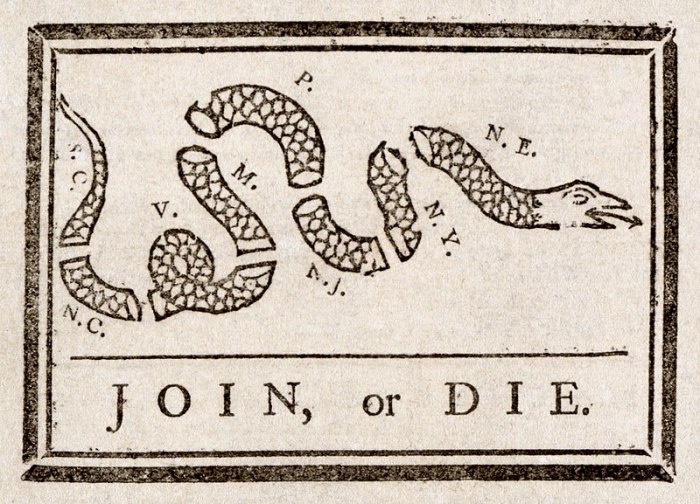
In fact, it was designed by American general and politician Christopher Gadsden in 1775. This “Sam Adams of South Carolina” modeled his patriotic statement first used by the Continental Marines on an earlier famous cartoon from Benjamin Franklin’s Pennsylvania Gazette.
You’ve probably seen it. A snake is cut into several pieces – each representing one of the colonies – with the motto, “Join or Die.”
So originally it was a call for unity, perhaps even federalism. It was a way of framing the argument that we’d be stronger as one nation than as a group of separate states.
Gadsen’s version was really a continuation of that same thought. It was as if he were saying, “Here we are, one unified nation ready to strike to protect itself from tyranny.”
It wasn’t until 2009 that Gadsen’s flag became associated with the radical right.
Like so many hitherto nonpartisan symbols, it was appropriated by the Tea Party movement, which tried to cast their libertarian extremism as somehow harkening back to the American Revolution.
Even the name Tea Party is a misnomer. The original Boston members of the Sons of Liberty who threw British tea into the harbor in 1773 were protesting taxation without representation. Modern day Tea Partiers were protesting the taxes levied by their own duly elected representatives.
They were poor people duped into thinking the rich paid too much despite the fact of gross income inequality and the wealthy not paying their fair share.
It’s this willful ignorance that typifies the contemporary right.
The truth doesn’t matter. It only matters what can be spun into a pithy sound bite that can be broadcast on Fox News or some other propaganda source and then repeated ad infinitum in place of any real debate or conversation.
To be fair, the left does it, too, but not nearly to the same degree.
When a topic makes the rounds of the 24-hour news cycle, you can hear the same canned responses from right and left on just about every channel regardless of who is speaking. The only difference is that the left usually makes at least passing reference to reality while the right closes its eyes and says whatever it believes to be true with perfect conviction.
The Gadsen flag is a perfect example of this hypocrisy.
The motto “Don’t Tread on Me” has come to mean radical individual freedom.
I can do whatever I like and there’s nothing you can do about it.
I can own as many guns as I like. I can teach my kids whatever facts I like. I can discriminate against anyone I like.
But there’s never a mention about other people except to limit what they can do in relation to the speaker.
In short, there’s nothing explicit about making this rule universal – I won’t tread on you if you won’t tread on me.
It’s just don’t tread on me and I’ll do whatever I like in relation to you.
After all, many of these personal freedoms the radical right cherishes actually do impact the rest of us.
This kind of sanctimonious duplicity has real world consequences.
Unarmed black people are shot and killed by police at a much higher rate than white people. Yet you won’t tolerate any protest, condemnation or protest. People can’t assemble in the streets, athletes can’t kneel during the national anthem, you won’t even allow the slogan “Black Lives Matter,” because you say, “All Lives Matter,” while in reality you mean “All Lives Except Black Ones.”
You oppose abortion but no one is forcing anyone to have abortions. In your headlong crusade for individual freedom you want to ensure that others don’t have this choice because they might choose differently than you. Or at least they might choose differently than you SAY you do, because when the light of day is cast upon you, we find an alarming number of hypocrites here, too.
You look to your self-interest, and I’ll look to mine, and that’s what’s best for everyone.
However, they forgot that everyone doesn’t have the same power – physical, social, financial or political. Some people are strong and some are weak. Some are rich and some are poor. If you pull the shortest straw at the lottery of birth, you won’t be able to get the same things for yourself as those who won it as soon as the doctor slapped their newborn bums.
So we have layers and layers of class and economics. We have social structures designed to keep black people here and Hispanics there and white people at the top. We have a society that worships the rich and bedevils the poor. We have belief systems that praise one kind of sexuality only and demonizes anything that diverges from that norm. And the most defining thing of any newborn baby is what you’ll find between its legs.
“Don’t Tread on Me” has become a farce.
It’s a maxim hoisted on those with very little individual power to convince them to join together and become powerful while guarding the door for the wealthy.
They sit atop their mountains of trash as if they were dragons on piles of gold.
And they point their pitchforks at the rest of us as if we wanted a piece of it.
In this way, they make themselves the willing patsies of the ruling class.
It’s a sad thing to behold.
Because if we all just stopped for a second and recognized our common humanity, we’d agree that the status quo is unacceptable.
If we were more concerned about the rights of all than just our own rights, we’d agree that the wealth of this great nation has not been fairly distributed.
The snake is coiled and ready to strike but it is pointed in the wrong direction.
It shouldn’t be pointed at 99% of us. And it shouldn’t be so solitary.
It should be a sea of snakes, a great slithering mass of humanity, hissing and spitting with venom, our reptilian eyes focused on the elites.
They’re mapping out a world where kids don’t even have to go to school to grasp the basics, where learning can be accomplished anywhere but instigated, tracked, and assessed on-line through various computer platforms.
Children would bounce from a few hours of Khan Academy videos here to a software package there and Voila! “Modern” education!
It’s a brave new world where investors hope to make a bundle by reducing the cost and pocketing the savings.
Since teachers are the biggest cost, they’re the first things to go.
Since their rights as workers and human beings are a roadblock on this learning superhighway, they’re the first to go.
And since they’re in a prime position to see exactly what’s going on and to object when this ed tech paradise exploits the students it ostensibly is being built for, they MUST go – now, as soon as possible.
The Supreme Court’s recent decision in Janus v AFSCME is part of that process. It’s another way to weaken labor and clear the path for business – the collusion of politics and corporations to steamroll the rest of us and swipe more of our money regardless of the children in the steamrollers way.
So when I ask “Are teachers necessary?” it’s not a purely philosophical question.
The answer will have a major impact on both the education of today and where we go in the future.
If teachers are not necessary, that removes one of the biggest obstacles to this frightening and uncertain future.
Unfortunately, no matter how much I want to answer in the affirmative that teachers are necessary, I can’t do so.
Even after thousands of years of recorded history, learning remains a mysterious process. Yet it doesn’t take much reflection to realize that it can take place without the presence of a teacher.
Estimates vary somewhat from study to study, but the basic structure holds. The vast majority of impact on learning comes from the home and out-of-school factors. Teachers are a small part of the picture. They are the largest single factor in the school building, but the school, itself, is only one of many components.
In short, teachers are not necessary to student learning.
But neither are doctors necessary to healing or lawyers necessary to acquittals.
Necessity is a very high bar.
To survive, you need food, shelter and clothing. However, having all three does not mean you have a good life. Slaves had all three – no free person would choose to trade places with someone in generational servitude simply because they had everything they needed to survive.
The same with medicine. If shot in the arm, you could provide me with all the medical equipment necessary to remove the bullet, but I would still have a difficult time doing it by myself. I COULD. A doctor is not NECESSARY for that operation. But without a doctor present, my chances of getting the best medical care drop dramatically.
Moreover, you could pop me in a courtroom without the benefit of legal counsel and it’s not impossible that I could argue my way to the dismissal of all charges against me. But the likelihood of doing so is infinitesimal – as undocumented youngsters are discovering when forced into the courtroom to defend against deportation without an attorney or even their parents present.
The same is true of education.
Though teachers are not necessary to learning, they are vital to it.
Having a teacher dramatically boosts a student’s chances, and the more disadvantaged that student is, the more he or she benefits from an educator.
The academic schemes of the corporate class amount to changing the field into the equivalent of an automated teller or a business robocall.
You can purchase your groceries through the self-checkout line. You can get your customer service from an automated list. But neither of these are the highest quality service.
They are cheap alternatives.
They are ways for the business to cut costs and boost profits. Neither have anything to do with making things better for the customer.
And when it comes to education, eliminating (or even drastically reducing access to) the teacher will decrease the quality of the service beyond recognition.
A 2009 report, Poverty and Potential: Out-of-School Factors and School Success, released by the Great Lakes Center for Education Research and Practice outlined several real world solutions to increase academic outcomes. None of them involve the elimination of teachers.
That’s how you cut class size down from the 20, 30, even 40 students packed into a room that you can routinely find in some districts today.
And if you want to improve the quality of the teachers in those classrooms, here’s an easy fix – pay them.
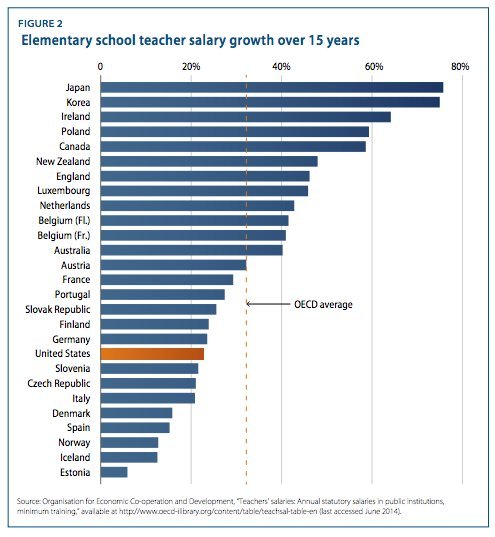
According to the Economic Policy Institute, teachers in the United States make 14 percent less than people from professions that require similar levels of education.
They can’t buy a home or even rent an apartment in most metropolitan areas. They can’t afford to marry, raise children, or eke out a middle class existence.
And finally, stop micromanaging everything teachers do and stomping on their rights. To do their job effectively teachers need autonomy. They need the ability to make decisions on the ground based on the empirical evidence gathered in the classroom.
To do that, they need their union protections. They need collective bargaining rights to give them the power to counterbalance the forces of greed and corruption that have always been at the schoolhouse door.
As a country we have taken our attention away from what’s really important. We’ve stopped focusing on how to make education better and instead equated it with how to make it more profitable for those who are already wealthy.
Teachers are vital to education. They are lifelines to struggling students. We should find ways to support them and not constantly undercutting their social standing, autonomy and rights.
The importance of teachers is beyond doubt. As is the importance of society in supporting them.













 gadflyonthewallblog