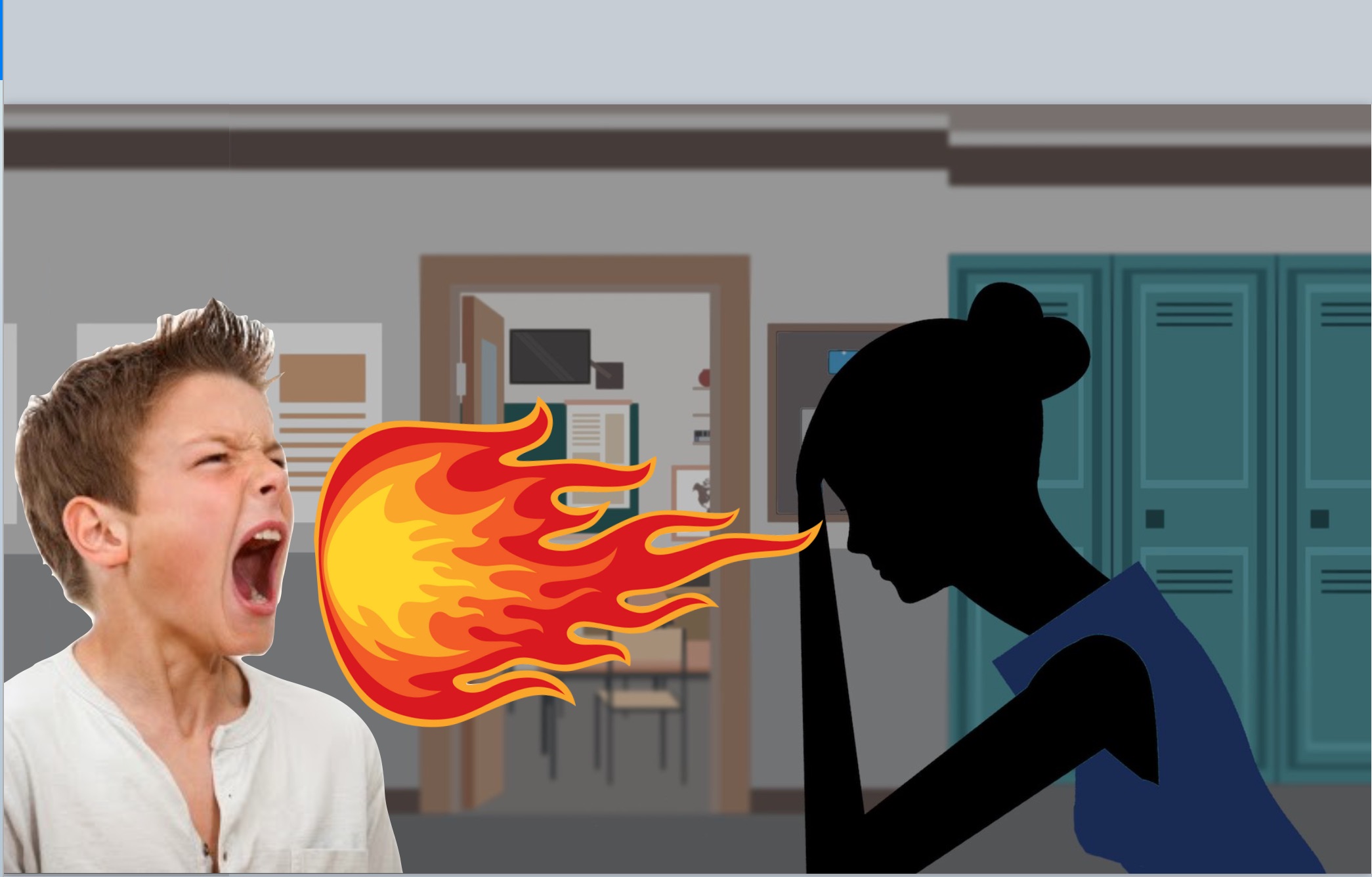
We want our kids to grow up to be smart, charming and successful. We don’t want them to lose their tempers over a joke – no matter how tasteless – and resort to violence.
Maybe this comes off as just some white dude clutching his pearls.
So when a person like me (who lives this reality day-in, day-out) sees something like this on a nationally televised broadcast, it’s a bit more personal.
My students and I just read an article about Smith in class.
It went through his entire career from Philadelphia high school kid to popular rap star to television and movie fame. Then my students had to write about what attributes Smith had that helped him become successful.
We talked about Will in depth.
Just about everybody knew and loved him. We were all excited he was up for another Academy Award and hoped that this would finally be the year he won.
And he actually did win Best Actor for his performance in “King Richard.”
This was supposed to be a triumph, a moment of increased representation for people of color.
Instead, it was yet another example of toxic masculinity.
You can praise Smith for defending his wife, but he took a verbal situation and made it a physical confrontation.
What he did would get anyone else arrested.
I’m not saying I wish he had gone to jail. I’m not saying he should have been stripped of his award.
But there should have been a consequence – SOMETHING!
He should have been asked to leave the ceremony, at least. Someone could have accepted the Oscar on his behalf.
Yet since there was nothing – NOTHING – he even got to make a tearful acceptance speech – that sends a pretty clear message to kids.
It says that this kind of behavior is okay. Maybe even praiseworthy.
Every ill in our society comes back to our public schools.
Malnutrition, addiction, crumbling infrastructure, absent parents, lack of social safety net, racism, prejudice and toxic cultural norms.
This is one of the main reasons so many teachers are leaving the profession.
According to the Bureau of Labor Statistics, there are 567,000 fewer educators in our public schools today than there were before the pandemic. And finding replacements has been difficult. Nationwide, an average of one educator is hired for every two jobs available.
We need the rest of society to step up, not sink into the muck.
We had hoped for more from Will.
In the aftermath of all this, people have almost entirely forgotten what sparked the confrontation.
Chris Rock made a cheap joke about Jada Pinkett Smith, who was bald because she’s suffering from alopecia.
This is an illness I’ve suffered from myself – that my mother still suffers from.
Rock crossed a line not because he was making fun of Smith’s wife, but because he was ridiculing someone because of a medical condition.
If Smith hadn’t resorted to violence (perhaps if he had just said something instead), we’d be talking about Rock, not Smith.
But in crossing the line from words to fists, he obscured the point.
Violence is only justified in self defense – against in-coming violence.
Maybe you don’t want to admit it.
Maybe you love Will Smith so much you refuse to admit that he was wrong.
Like this post? You might want to consider becoming a Patreon subscriber. This helps me continue to keep the blog going and get on with this difficult and challenging work.
“Has anyone heard about what’s happening in Ukraine?” I asked.
A few hands, but they had only heard the words. They didn’t know what was happening.
So I showed my 8th graders a short video that summarized events so far. I drew a map of Europe and Asia on the board. I outlined Ukraine, Russia and the European union. I explained about the Soviet Union and its collapse. I explained about NATO and the struggle for power and prestige.
When I was done, there was a moment of silence. They were all staring up at me. It was one of those rare moments of stillness, a pregnant pause before the questions started raining down.
A patter at first, then a storm.
They asked about what they were hearing at home. They searched for corroboration, explanation and/or other viewpoints.
One child asked if this was NATO’s fault. If it was President Biden’s doing.
Another asked how it would affect us and why we should care.
And yet another asked about nuclear proliferation and whether this war meant the end of the world.
I couldn’t answer all of their questions, though I tried. When there was something I couldn’t say or didn’t know, I pointed them in a direction where they might find some answers.
But it led to some interesting discussion.
Then I asked them if they had talked about any of this in their other classes – perhaps in social studies. They all said no, that a few teachers had promised to get to it after finishing the 13 colonies or another piece of mandated curriculum.
I was surprised but not shocked. I know the tyranny of the curriculum.
I was only able to talk about this, myself, because of the scope and sequence of Language Arts. You see, it was poetry time and I was about to introduce my students to Alfred Lord Tennyson and “The Charge of the Light Brigade.”
For those who don’t recall, the poem tells the true story of the battle of Balaclava during the Crimean War. A cavalry regiment of British troops charged Russian gunners and were mostly shot to pieces.
It’s a pillar of English poetry and a perfect opportunity to talk about warfare in general and Ukraine in particular since the battle took place in the same general area of the world.
In the poem, a general mistakenly orders the soldiers on horseback armed only with swords to charge the enemy armed with cannons and guns.
“Theirs not to make reply, Theirs not to reason why, Theirs but to do and die.”
And after the result is graphically portrayed, the speaker extols their virtue:
“When can their glory fade? O the wild charge they made! All the world wondered. Honour the charge they made! Honour the Light Brigade, Noble six hundred!”
So I ask my students what they think about it. Is it a soldier’s duty to follow orders no matter what? Should they question those orders?
The video uses images from a silent movie version of the Tennyson poem while singer Bruce Dickinson wails the story of a single soldier of the Light Brigade being senselessly gunned down and dying alone, forgotten on the battle field.
It certainly gives them something to think about as they watch black and white horses flung in the air and our spandex clad narrator commenting on the situation with hairspray piled locks.
Students end up leaving the class continuing the debate with each other about heroism and the waste of war.
The way I see it, this isn’t the time for me to insert my opinion into the class. It’s an opportunity for my students to think through the problem, themselves.
It may not be as dramatic as Putin invading. “Shot and shell” may not be flying. But the forces of fascism are equally at work on the minds of our children.
In teaching about the war in Europe, educators are waging a battle against the war at home.
Zhyvitʹ revolyutsiyeyu!
Viva la revolución!
Long live the revolution!
Like this post? You might want to consider becoming a Patreon subscriber. This helps me continue to keep the blog going and get on with this difficult and challenging work.
I just can’t believe that in light of such a flame dancing ever more quickly down an ever-shorter fuse that people aren’t interested in reading about how to stomp it out.
Mass media is not particularly kind to educators like me.
Even when journalists are writing about schools and learning, they rarely ask classroom teachers their opinions. Instead, the media often turns to self-appointed experts, think tank flunkies, billionaire philanthropists or politicians.
It’s like they can’t even conceive of the fact that someone with a masters degree or higher in education who devotes her whole life to the practice of the discipline has anything worthwhile to say.
So many of us have taken to the blogosphere to circumvent the regular media channels.
And so people like Joe Rogan make millions on their podcasts spreading science denial, vaccine disinformation and racist dog whistles.
A guy like me just trying to make the world a better place?
I get silenced.
I guess when money is speech, poverty is the real cancel culture.
Like this post? You might want to consider becoming a Patreon subscriber. This helps me continue to keep the blog going and get on with this difficult and challenging work.
It’s not exactly easy to fit in so many articles – 53 so far this year – between teaching full time.
And I’ve been doing it for 8 years – since July 2014.
In that time, this site has earned 2.3 million hits – 218,603 just this year.
I’m proud of the work I’ve done here.
I haven’t changed the world, but I’ve been heard. Occasionally.
As a classroom teacher, that’s really what I’m trying to do. In my everyday work, few people whose grade I’m not calculating actually listen to me. And even then it’s not always a given.
I want to believe my words have an impact – that policymakers read what I write and consider it before offering new measures and revising old ones.
But as time goes on, I wonder if any of that actually happens. These days my writing feels more like a shout in the dark than anything else.
At best, from the comments I often get on my articles (and the fact that 14,887 people have signed up to follow my work), it seems at least that I am not shouting alone.
We are all yearning to be heard.
These are the cries that most of us seemed to have in common this year:
Description: This is a postmortem on the 2020-21 school year. Here are the six policies that really weren’t working from social distancing, to cyber school, hybrid models, and more.
Fun Fact: I had hoped that laying out last year’s failures might stop them from being tried again this year or at least we might revise them into policies that worked. In some instances – like cyber school – there seems to have been an attempt to accomplish this. In others – like standardized testing – we just can’t seem to stop ourselves from repeating the same old mistakes.
Description: It seemed like a pretty easy concept when I first learned it back in civics class. Your right to freedom ends when it comes into conflict with mine. But in 2021, that’s all out the window. Certain people’s rights to comfort (i.e. being unmasked) are more important than other people’s right to life (i.e. being free from your potential Covid).
Description: Demands on teachers are out of control – everything from new scattershot initiatives to more paperwork to having to forgo our planning periods and sub for missing staff nearly every day. And the worse part is that each time it’s done, it becomes the new normal. Teaching should not be death by a million cuts.
Fun Fact: This was another in what seemed to be a series of articles about how teaching has gotten more intolerable this year. If anyone ever wonders what happened to all the teachers once we all leave, refer to this series.
Description: Teachers are leaving the profession at an unprecedented rate this year. So what do we do about it? Here are five simple things any district can do that don’t require a lot of money or political will. They just require wanting to fix the problem. These are things like eliminating unnecessary tasks and forgoing formal lesson plans while increasing planning time.
Fun Fact: Few districts seems to be doing any of this. It shows that they really don’t care.
Description: This is almost a poem. It’s just a description of many of the things I love about teaching and many of the things I don’t. It’s an attempt to show how the negatives are overwhelming the positives.
Fun Fact: This started as a Facebook post: “I love teaching. I don’t love the exhaustion, the lack of planning & grading time, the impossibly high expectations & low pay, the lack of autonomy, the gaslighting, the disrespect, being used as a political football and the death threats.”
Description: Policymakers and pundits keep saying students are suffering learning loss from last year and the interrupted and online classes required during the pandemic. It’s total nonsense. Students are suffering from a lack of social skills. They don’t know how to interact with each other and how to emotionally process what’s been going on.
Fun Fact: This idea is so obvious to anyone who’s actually in school buildings that it has gotten through somewhat to the mass media. However, the drum of bogus learning loss is still being beaten by powerful companies determined to make money off of this catastrophe.
Description: Imagine a world without teachers. You don’t have to. I’ve done it for you. This is a fictional story of two kids, DeShaun and Marco, and what their educational experience may well be like once we’ve chased away all the education professionals.
Description: How many times have teachers had to go to their administrators and school directors asking for policies that will keep them and their students safe? How many times have we been turned down? How many times can we keep repeating this cycle? It’s like something out of Kafka or Gogol.
Description: This was my first attempt to discuss how much worse 2021-2022 is starting than the previous school year. Teachers are struggling with doing their jobs and staying healthy. And no one seems to care.
Fun Fact: My own health was extremely poor when I wrote this. I was in and out of the hospital. Though I feel somewhat better now, not much has changed. This article was republished in the Washington Post, on CommonDreams.org, and discussed on Diane Ravitch’s blog.
Description: Being there for students who are traumatized by the pandemic makes teachers subject to vicarious trauma, ourselves. We are subject to verbal and physical abuse in the classroom. It is one of the major factors wearing us down, and there appears to be no help in site – nor does anyone even seem to acknowledge what is happening.
Fun Fact: This one really seemed to strike a nerve with my fellow teachers. I heard so many similar stories from educators across the country who are going through these same things.
Like this post? You might want to consider becoming a Patreon subscriber. This helps me continue to keep the blog going and get on with this difficult and challenging work.
This was an opportunity for them to grab a few hundred dollars to buy school supplies for their classrooms.
Can you imagine any other professional doing that?
Lawyers giving foot rubs so their clients can get an appeal. Doctors grubbing on a bathroom floor for their patients’ pain pills. Police squeezing into a cash grab booth to fund new bullet proof vests.
Nope. It would never happen because these careers are held in high esteem. And you can tell that based on their salaries and/or the resources provided to do their jobs.
But somehow WE have to grovel on the floor to scrape together enough money to take care of other people’s kids.
It makes me want to throw up.
I can almost hear the reality show TV producers queuing up to make pitches for their next project.
“How about this? Teachers trapped in the woods have to take each other out with paint guns and the last one gets a new set of textbooks!”
“What’ll we call it?”
“How about The Hungry for Education… er… Games?”
“I’ve got a better one. We have high school biology teachers compete for a chance to pay off their student loans by answering trivia questions about marine biology…”
“Yeah and we could call it Squid… er… Game?”
“Try this one on for size. Teachers competing in a marathon to win a HEPA filter to reduce Covid-19 in their classrooms …”
“Ooooh! We could call it The Running… er… Man?”
I’d say this is post-apocalyptic humor but there’s nothing post about our pandemic world.
To which I thought – yeah but who is going to apply?
Who wants a job that requires you to be a rodeo clown?
Who wants to have to mortify themselves in the Circus Maximus?
“Are you not entertained!?”
“Come one, come all – to be underappreciated, underpaid and overworked!”
“Hurry! Hurry! HURRY to proctor standardized tests for poor students and be judged by their low socioeconomic test scores!”
“Gather Round! Gather Round! The one! The only job that takes a genuine calling to help kids learn and makes you so miserable you’ll run away screaming!”
Humiliating teachers is about avoiding humiliation.
For those who refuse to be educated.
Like this post? You might want to consider becoming a Patreon subscriber. This helps me continue to keep the blog going and get on with this difficult and challenging work.
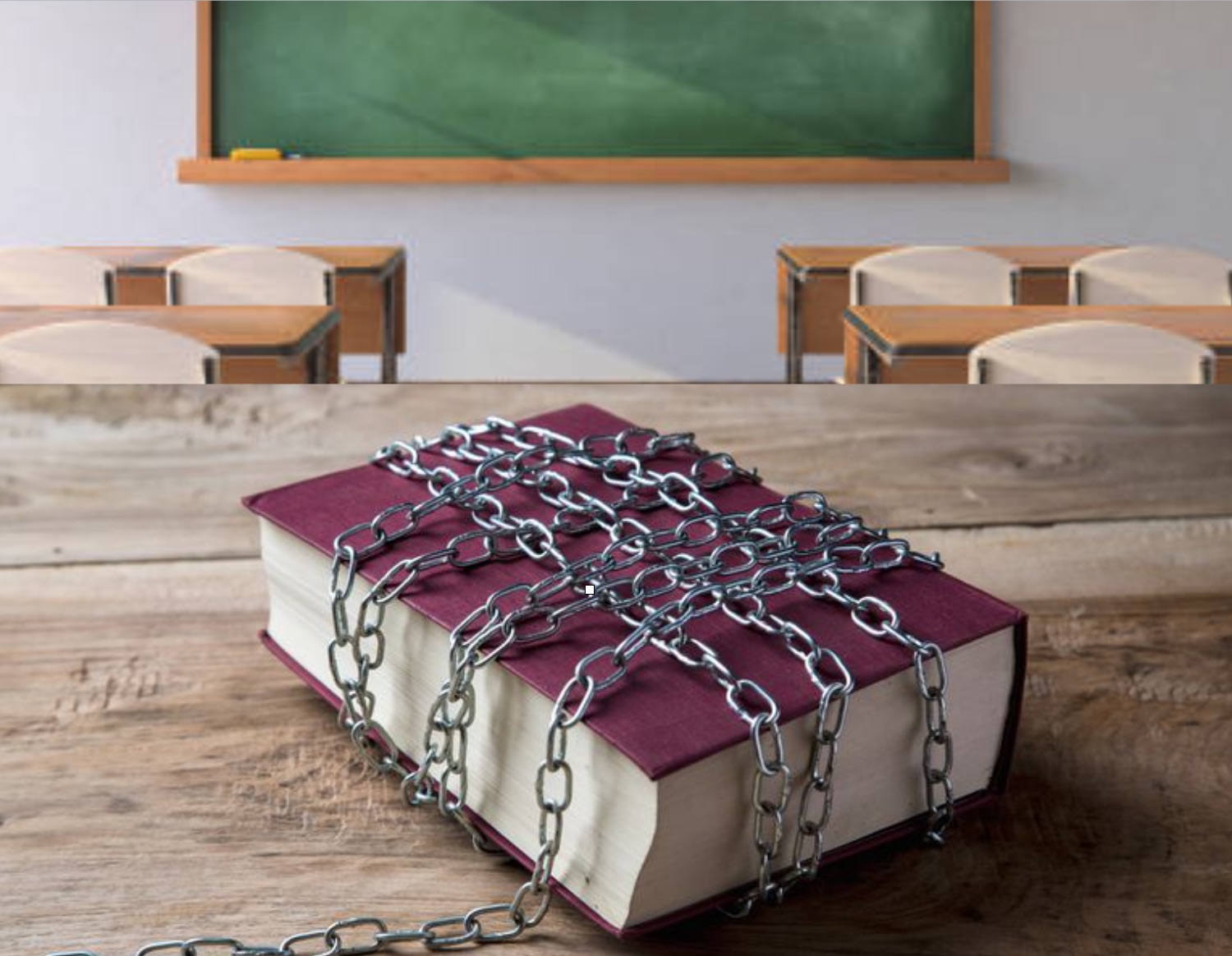
It’s almost the poster child for why we shouldn’t ban books in the first place. The story is set in a dystopian society where everyone is raised to be the same and people are discouraged from questioning things or having deep feelings.
The book is most often challenged because parents don’t want their children to have to wrestle with its deep social criticism.
”Submitting to censorship is to enter the seductive world of ‘The Giver’: the world where there are no bad words and no bad deeds. But it is also the world where choice has been taken away and reality distorted. And that is the most dangerous world of all.”
Nothing is graphic or developmentally inappropriate for middle schoolers, but the very idea of children thinking about S-E-X and challenging authority is enough to put it afoul of some censors.
Which is exactly why my students love it.
Too often teachers give students short passages taken from standardized tests where the only reason to read is to hunt for multiple choice answers. It’s dry, boring and meaningless to their everyday lives.
It’s a classic detective story where the characters try to discover why a young teen, Branwell, refuses to speak after his baby sister suffers a potentially life threatening injury.
The plot grabs readers from the beginning and students find themselves really invested in unraveling the mystery. But to do so they come face-to-face with topics ranging from family, divorce, death, bigotry, sexuality and exploitation.
Again the narrative is written for middle school readers but the concepts get them thinking and enthusiastic.
As we come to the big reveal, I’ve had students turn to me with huge smiles saying they can’t believe we’re actually reading about this stuff in school.
In an age where they usually communicate with emojis, I’m just glad that they’re reading.
It can get uncomfortable, but by the end I definitely feel like I’ve reached them.
The plot centers on Anne, a historical Jewish girl in 1940s Amsterdam who with her family and others hid from the Nazis before eventually being captured and dying in a concentration camp.
Like most teachers, I eschew the actual diary for the play version by Frances Goodrich and Albert Hackett.
At first glance, it’s hard to imagine why this book would be banned. After all, it’s a true story of the Holocaust written by one of the people who lived it.
For example, in Act II, scene 1, she mentions getting her period for the first time:
“There is one great change, however. A change within myself. I read somewhere that girls of my age don’t feel quite certain of themselves. That they become quiet within and begin to think of the miracle that is taking place in their bodies. I think what is happening to me is so wonderful… not only what can be seen, but what is taking place inside. Each time it has happened I have the feeling that I have a sweet secret… and in spite of any pain, I long for that time when I shall feel that secret within me again.”
My students often read over this passage without comment. I usually have to draw their attention to it and ask them what Anne is talking about before someone gets it.
You might be surprised at how freeing this kind of discourse is. Menstruation is a natural part of life for nearly half the population, but it’s something we don’t often talk about.
It’s not central to the story and Anne certainly goes into greater detail in her actual diary. However, even this little digression goes to further humanize her and make her relatable, especially to people like my students who are nearly the same age she was when she wrote it.
She becomes so much more than a victim. She’s someone we know – inside and out.
It tells the story of Atticus Finch, a white lawyer in the 1930s Alabama who defends Tom Robinson, a black man, of a crime he did not commit. The story is told from the point of view of the lawyer’s children who go from blissful naivety to uncomfortable understanding.
It’s still an issue, and I make sure not to have myself or any of the students read these parts aloud. We only hear it on an audiobook as we follow along in the text. And even this only comes after we discuss how hurtful that word is.
However, the language isn’t the book’s biggest sticking point today. It’s more often objected to these days on the basis of white saviorism. Critics complain that the narrative should be centered on Tom, the black man accused of the crime, and not Atticus, the defense attorney and his children.
By the end of the book, my whole class – regardless of race – is devastated by what happens to Tom and furious at the injustice he experiences. To be honest, that might not happen to the same degree in a book that signals its message right from the beginning.
In my classroom, the book allows us to discuss so many intersectional issues – gender, economics, belief systems, etc. Plus it gives my students more cultural capital than other texts would. Having read “Mockingbird” allows them to understand more and talk to more people than other more modern books.
In any case, the school board has not approved any similar texts at that grade level. If I put aside “Mockingbird,” it would mean not discussing the issue at all. I think that would be much worse.
Conclusions
So this is how I teach.
I know there are some adults out there who would rather my students not read these books.
I know some grownups would rather my kids not think about these things and not come to their own conclusions.
They’d rather children be seen and not heard – like furniture.
But my students know it, too. And they’d rather be treated like actual human beings – even if that means… yuck… reading.
In my experience the bigger threat isn’t prohibition, it’s indifference.
As Ray Bradbury famously said, “You don’t have to burn books to destroy a culture. Just get people to stop reading them.”
Focusing on banned books helps me keep reading real and relevant in my classroom.
Like this post? You might want to consider becoming a Patreon subscriber. This helps me continue to keep the blog going and get on with this difficult and challenging work.
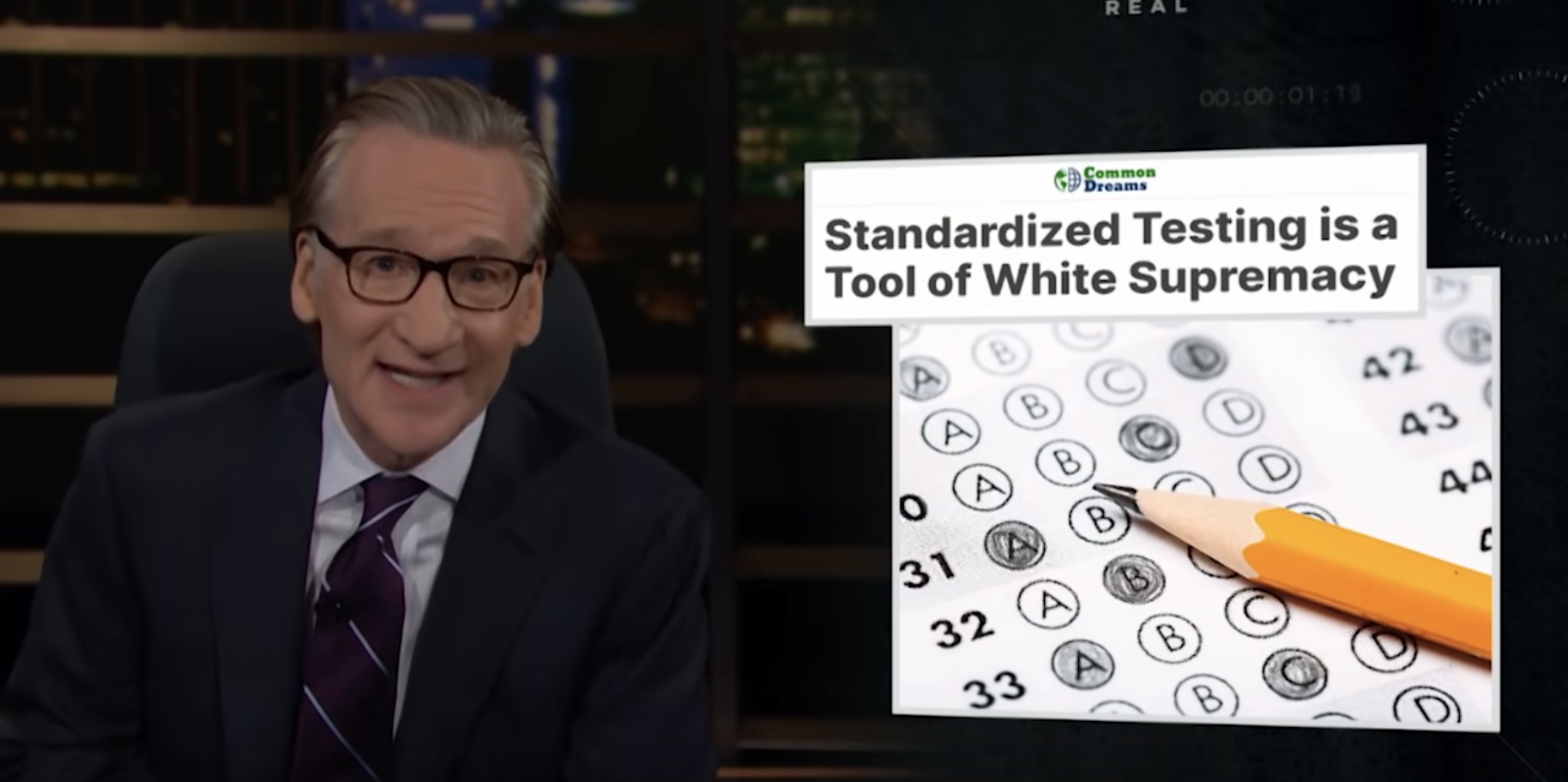
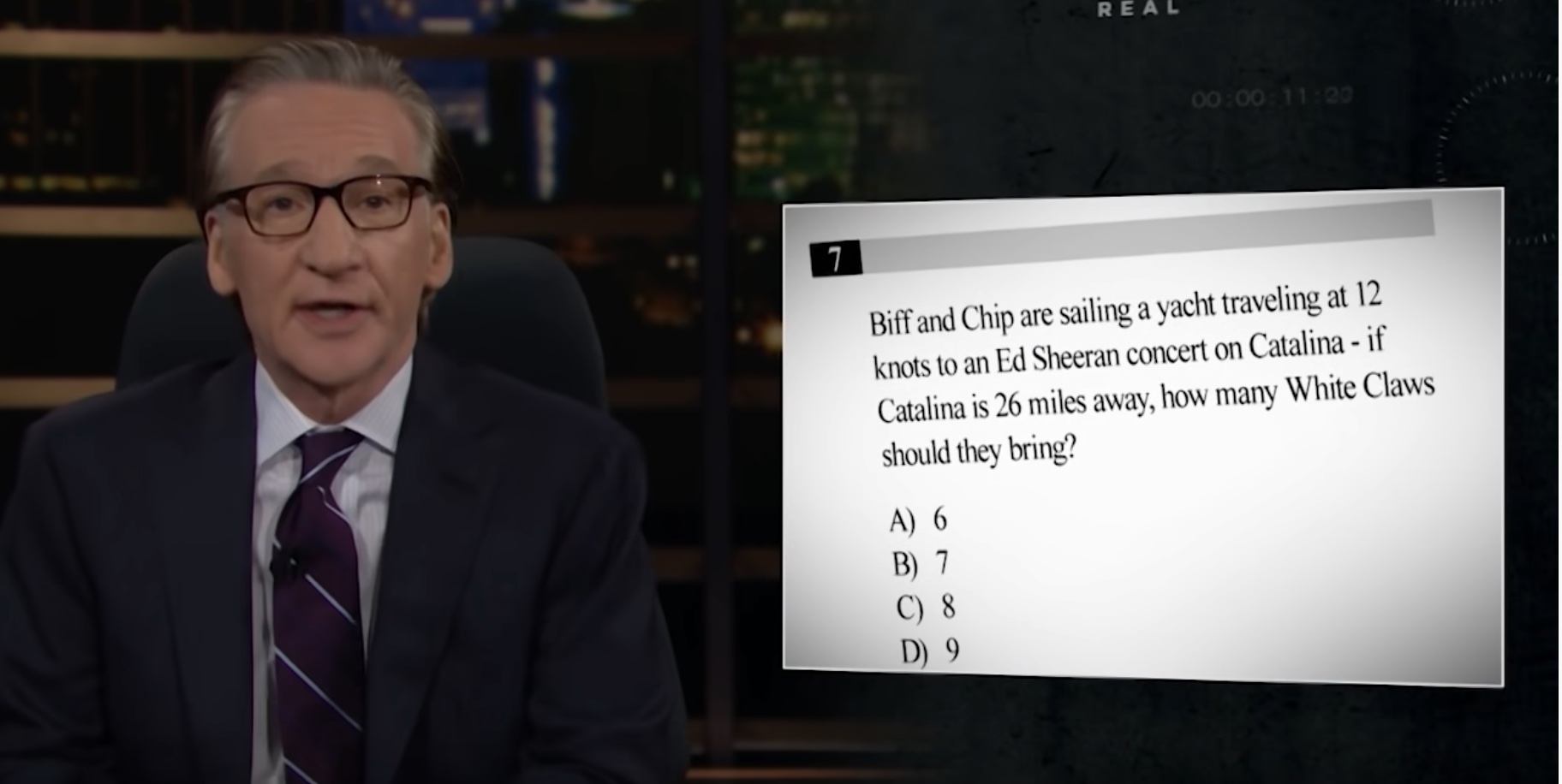
In fact, that was the title of the article, which seems to be about as far as Bill read because he ignored any arguments, facts or historical citations in the piece.
He was content to speak in a smarmy tone and make a pretty lame joke about what a racially biased test question might look like.
In fact, that’s probably why he (and his staff) picked my piece in the first place. They saw it as an opportunity to make a joke and whiffed at it pretty terribly.
Here’s the relevant bit of his monologue:
“In 2010 the New York Times used the term “White Supremacist” on 75 occasions. Last year, over 700 times. Now some of that to be sure is because Trump came along and emboldened the faction of this country that is truly white supremacist. It is of course still a real thing. But it shouldn’t apply to something like – as more than a few have suggested – getting rid of the SAT test. Now if we find the SAT test is slanted in such a way as to stack the deck in favor of Caucasians, if there are questions like Biff and Chip are sailing a yacht traveling at 12 knots to an Ed Sheeran concert on Catalina – if Catalina is 12 miles away, how many White Claws should they bring? Yes, then maybe. But of course the SAT doesn’t have questions like that so it becomes a kind of ludicrous exaggeration that makes lovers of common sense roll their eyes – and then vote for Trump.”
Queue audience laughter and applause.
Funny stuff I guess.
Not the comedy staff’s fake SAT question but Maher’s assurance that “The SAT doesn’t have questions like that.”
It’s a real SAT question famously discussed in the infamous 1994 book, The Bell Curve, by Richard Herrnstein and Charles Murray – a book that tried to use discrepancies in test scores to prove white people are smarter than black people.
The answer is C, and it relies on a test taker’s knowing the meaning of regatta – something more likely to have come up in the daily lives of affluent white students than in the lives of less affluent minority students. If you don’t live by a body of water and/or don’t have much experience with rowing, you’re probably going to fail this question.
It’s the same kind of question Maher’s comedy team came up with – find something white people are more likely to know than black people – but the Real Time writers just pilled it on over-and-over.
It doesn’t take five repetitions of something to make it biased. All it takes is one.
To be fair, my example is from the SAT analogy section, which was removed from the test in 2005. However, that doesn’t mean they got rid of the bias.
It now provides an “adversity score” for poor and minority students to adjust raw SAT scores to account for high schools and neighborhoods “level of disadvantage.”
They are literally trying to make up for how biased their test scores are.
Consider this.
Total SAT scores range from 400 to 1600 – or from 200-800 in both Math and Reading respectively.
According to 2018 data, combined SAT scores for Asian and White students average over 1100, while all other groups average below 1000. Meanwhile, students with family income less than $20,000 score lowest on the test, and those with family income above $200,000 scored highest, according to 2015 data. And the difference is significant – a 433 average Reading score for those with the lowest family incomes compared to an average Reading score of 570 for those with the highest family income. That’s a 137 point difference!
And it holds for racial groups, too. The average Reading score on the SAT was 429 for black students – 99 points behind the average for white students.
However, the College Board is trying to justify this by saying the discrepancy is because poor and minority students are more disadvantaged than white, affluent ones. In other words, it’s not the test that is unfair, but American society in providing better resourced schools with lower class sizes and more resources for white kids than children of color.
Freedle says this is because SAT questions likely reflect the cultural expressions that are used commonly in the dominant (white) society, so white students have an edge based not on education or study skills or aptitude, but because they are most likely growing up around white people.
This makes sense if you examine how test questions are selected for the SAT. In his book How the SAT Creates Built-in-Headwinds, national admissions-test expert, Jay Rosner, explains the process:
“Compare two 1998 SAT verbal [section] sentence-completion items with similar themes: The item correctly answered by more blacks than whites was discarded by the Educational Testing Service, whereas the item that has a higher disparate impact against blacks became part of the actual SAT. On one of the items, which was of medium difficulty, 62% of whites and 38% of African-Americans answered correctly, resulting in a large impact of 24%…On this second item, 8% more African-Americans than whites answered correctly…”
In other words, the criteria for whether a question is chosen for future tests is if it replicates the outcomes of previous exams – specifically tests where students of color score lower than white children. And this is still the criteria test makers use to determine which questions to use on future editions of nearly every assessment in wide use in the US.
But if all this isn’t enough to convince you that standardized tests really are a tool of white supremacy, consider their sordid history.
They are literally the product of the American eugenics movement.
Modern testing comes out of Army IQ tests developed during World War I.
These assessments were based on explicitly eugenicist foundations – the idea that certain races were distinctly superior to others. In 1923, one of the men who developed these intelligence tests, Carl Brigham, took these ideas further in his seminal work A Study of American Intelligence. In it, he used data gathered from these IQ tests to argue the following:
“The decline of American intelligence will be more rapid than the decline of the intelligence of European national groups, owing to the presence here of the negro. These are the plain, if somewhat ugly, facts that our study shows. The deterioration of American intelligence is not inevitable, however, if public action can be aroused to prevent it.”
Eventually Brigham took his experience with Army IQ tests to create a new assessment for the College Board – the Scholastic Aptitude Test – now known as the Scholastic Assessment Test or SAT. It was first given to high school students in 1926 as a gatekeeper. Just as the Army intelligence tests were designed to distinguish the superior from the inferior, the SAT was designed to predict which students would do well in college and which would not. It was meant to show which students should be given the chance at a higher education and which should be left behind.
And unsurprisingly it has always – and continues to – privilege white students over children of color.
Is it ridiculous to describe the century long racial and economic discrepancy in test scores as something that supports white supremacy – especially when these results are shown time and again to be a feature of the tests and not just an artifact that recreates economic inequality?
Is it going too far to call out the racism of the SAT and other standardized tests like it when even the College Board admits its own scores are biased?
Does it devalue the term “White Supremacy” to point out real world white supremacy?
But Maher apparently isn’t interested in these questions.
After a few moments he moved on to another example of the left gone wild.
But I can’t do that because this isn’t just a bit for me.
It’s become cliche for privileged white people like Bill Maher to get cranky when someone points out real world prejudice.
But for those of us in the trenches, it is an everyday reality.
And that’s what triggers me.
Here’s the segment from “Real Time with Bill Maher”: (the relevant bit starts at 4:45)
Like this post? You might want to consider becoming a Patreon subscriber. This helps me continue to keep the blog going and get on with this difficult and challenging work.
But in each of these disasters, the majority of people thought they had somewhere to turn for knowledge and advice.
We had trusted authorities to tell us what to do, to counsel us how to handle these seemingly insurmountable disasters.
Today many of us face the Covid-19 pandemic feeling there are few sources to believe in – and that more than anything else – is why we are having such a difficult time coming together to overcome this crisis.
The media, government, science, religion – none hold a central place of confidence in most people’s lives. So when tough decisions about health and safety come into play, many of us aren’t sure what to do.
When we entered the fray, the US government organized new research initiatives targeting influenza, bacterial meningitis, bacterial pneumonia, measles, mumps, neurotropic diseases, tropical diseases and acute respiratory diseases.
And because there was an immense trust in government – after all, as a nation we had been attacked together as one at Pearl Harbor – there was enormous trust in these initiatives.
Before World War II, soldiers died more often of disease than of battle injuries. The ratio of disease-to-battle casualties was approximately 5-to-1 in the Spanish-American War and 2-to-1 in the Civil War. In World War I, we were able to reduce casualties due to disease through better sanitation efforts, but we could not protect troops from the 1918 influenza pandemic. During that outbreak, flu accounted for roughly half of US military casualties in Europe.
Much of the groundwork for innovation in vaccinations had already been laid before WWII. However, it was the organization of the war effort and the trust both the civilian and military population had in government that catapulted us ahead.
I’m not ignoring that some of this trust was misplaced. The US government has never been fully trustworthy – just ask the Asian American population forced into internment camps. However, the general feeling at the time that the government was a force for good, that we were all in this together and we all had to do our part had a vast effect on how we handled this crisis.
Today that kind of trust is gone.
In some ways that’s a good thing. It could be argued that “The Greatest Generation” put too much faith in government and the following years showed why too credulous belief in the good will of our leaders was unearned and unhealthy.
From Richard Nixon’s Watergate scandal to Bill Clinton’s sexual misconduct to George W. Bush lying us into a war of choice to Barack Obama’s neoliberalism to Donald Trump’s gross mismanagement and blatant racism – we can never go back to a WWII mentality.
Skepticism of government is kind of like seasoning. A certain amount is a good thing, but the inability to trust even government’s most basic ability to take care of its citizens and function in any meaningful way is hugely detrimental.
And this earned distrust has seeped into just about every source of possible certitude that might have helped us survive the current crisis.
The media used to be considered the fourth estate – one of the most important pillars of our society. After all, the freedom of information is essential to the free exercise of democracy.
However, the erosion of impartiality has been going on since at least the 1980s when the FCC under President Ronald Reagan abolished the Fairness Doctrine. Since 1949 this had required the media to present both sides’ of opinions. In 1987 a Democratic Congress passed a bill to reinstate the Fairness Doctrine but it was vetoed by Reagan.
This, along with the rise of talk radio and the insistence that news departments turn a profit, lead directly to the creation of more biased reporting skewed to a particular audience – Fox News and Sinclair Broadcast Group being the most prominent.
The fact that just six corporations own 90% of the media outlets in the country skew coverage to what’s in the best interests of big business. These corporations are GE, Newscorp, Disney, Viacom, Time Warner and CBS.
Finally, the loss of local newspapers and the purchase of those few that do exist by large media conglomerates further increase bias.
Few people feel they can trust the news anymore. They turn to the Internet, social media, Twitter and other sources that often are just echo chambers for what they already believe.
The irony is not lost on me that you are reading a blog by a public school teacher, not a professional journalist. But my aim is to use my experience in education to inform the debate.
It’s just too bad that I’m often forced to report the news when traditional news sources drops the ball.
Again skepticism of mass media is a good thing, but we should at least be able to count on the press as a reliable source of facts. However, these days few facts are free from bias, spin and editorial comment.
Another blunder was the guidelines on what counts as “close contact.” It went from “within 6 feet” to “within 3 feet”, and the duration went from 30 minutes consecutively to 30 minutes cumulatively. It’s not so much that the evidence changed, but that political pressure forced the CDC to lower its standards.
World scientific consensus now is that the coronavirus is capable of airborne spread without close contact between two people. Airborne droplets can linger in the air indoors and infect any number of people from one superspreading host subject.
The CDC’s advice on close contact is based on old scientific research that just isn’t as good as modern experiments.
And the organization has misjudged so much more from the importance of masking (at first they said it wasn’t important, now they say it is important), whether children can catch the virus (at first they said this was unlikely and now they admit it happens but is often asymptomatic), whether Covid spreads in schools (they used to say the limited protections in place at schools made this unlikely and now they admit it is happening), etc.
One could argue that these were simple mistakes that have changed as better science comes in. However, in each case they appear to have initially been politically motivated and justified with limited or flawed studies that could not continue to be supported as new data came in.
At first the CDC told us that masking wasn’t important not because it was true, but to hide a shortage of masks that needed to be prioritized for medical staff. These needs are understandable, but hiding the truth and then changing your messaging doesn’t engender trust.
Why do so many people refuse to have their children wear masks at school? Why is there so much vaccine hesitancy? Why anxiety about reopening plans that focus on close contacts?
The CDC owns a lot of the responsibility because it has repeatedly earned our distrust.
I think there is evidence that people need to wear masks in schools. I think we need to vaccinate as many people as possible.
But these are just bare minimums.
I think the CDC is still focusing too much on the economic impact of its guidelines when it should be solely focused on the health and safety of students, staff and the community.
This is not a time for scientists to be playing politics.
We need them to be as transparent as possible – as trustworthy as they can be.
Unfortunately, the erosion of institutional credibility at so many levels has become a cycle to itself.
At multiple levels, sources that should be bedrock have become wet sand.
The federal government has not taken enough action to keep people safe. State governments have not taken enough action – and some have even taken action to prevent safety.
Even at the local level, many school boards have cowardly refused to put in place mask or vaccine mandates.
It is the systematic breakdown of a society.
We have few places left we can trust.
And that is why we are fractured and scared.
We don’t know what to do to keep our loved ones safe.
People seem forced to choose between taking the virus seriously and ignoring it.
Many refuse to admit that it could hurt them. They think it’s just the sniffles. Few healthy people die and they discount the potential longterm effects of catching it.
In large part, it’s because we don’t know how to combat the virus because we don’t know who to trust.
And the resulting credibility vacuum has enabled unscrupulous politicians, agents of chaos and other charlatans to position themselves as experts.
When all information is equal, disinformation is king.
The solution to the pandemic may end up being easier than this riddle.
How our institutions can regain their credibility.
Especially when our politics doesn’t allow them to be honest, and fewer people are even listening to them every day.
Like this post? You might want to consider becoming a Patreon subscriber. This helps me continue to keep the blog going and get on with this difficult and challenging work.
Hopefully sometime next school year when more teens are vaccinated and mask restrictions disappear, no one will be able to take advantage of pandemic safety precautions to sneak into classes.
Don’t get me wrong, teachers should have caught Garcia last week long before the end of the day, but the El Paso parent did more to prove the necessity of smaller class sizes than additional security.
You can pay millions of dollars on new complicated and time wasting screening processes to enter the building, or you can simply have teachers responsible for fewer kids so they can actually give them all more attention. It’s less costly and would reap educational benefits along with improving safety.
The fact is, we already spend an awful lot on school security. And often those measures and the costs to enact them directly impede teachers ability to teach and students willingness to learn.
Let’s start with cost.
The United States is one of the richest countries in the world. You’d expect that we could afford to buy BOTH security AND education for our students.
Right wing pundits love to quote exorbitant figures of how much the US spends per student as compared with the rest of the world.
However, they neglect to mention (1) this money is spent unevenly so that we spend much more on rich kids versus poor kids, and (2) we spend that money on services in this country that most other nations do not.
One of those things is security.
It’s not that schools in Europe and other comparable nations don’t concern themselves with keeping students safe. But they typically don’t have metal detectors, armed police, and high tech security systems. While secondary entrances and exits tend to be locked, main entrances usually remain open and unmonitored throughout the day.
Nor do they have the same dangers as we do. In the US, there are more firearms – roughly 400 million – than people. Not true in other countries.
Moreover, even in other nations like Switzerland where gun ownership is high, they have comprehensive background checks that make it much more difficult for criminals or the mentally ill to get a hold of a gun.
In the US, we have a large population that is racially diverse, a history of social strife, runaway income inequality, and a crumbling social safety net. All of which, when mixed together, are a recipe for conflict.
Not so in most other countries.
Moreover, the way most European nations, for example, have addressed safety is completely opposite to the way we do it in the US.
School shootings were on the rise in Europe in the early 2000s, but instead of buying security systems to stop shooters from entering the building, most schools focused on prevention. They realized that the overwhelming majority of shooters were not interlopers from outside but were disgruntled students. So these schools invested in more psychologists, social workers and resources to help children navigate the turmoil of growing up. The result was an almost complete disappearance of shootings.
If you ask me, a similar investment in the US would have similar success. However, given the differences in our societies, I don’t expect it would solve all of our problems.
In fact, emphasis on security certainly hasn’t.
Since 2012, US schools spending on high tech security programs has increased by at least $3 billion – not counting the billions more spent on armed campus police officers — with very little research proving these measures are at all effective, according to the Washington Post.
In fact, there is evidence that these measures don’t work. A federally funded 2016 study by Johns Hopkins University, for instance, concluded there was “limited and conflicting evidence in the literature on the short- and long-term effectiveness of school safety technology.”
But in the United States, when there’s an entire industry lobbying to take advantage of a crisis, that industry will likely be seen as the solution. It might not actually work, but at least huge corporations are making a profit. That’s often enough to justify spending more and more.
Security firms tout their products as the solution just as hammers scream we need more nails. Never mind that buying them will impede our progress and bankrupt us in the process.
Which brings me to education.
Even if heightened security was 100% effective against violence, it has a negative impact on learning.
Prisons are not welcoming environments. Children don’t want armed guards watching their every move. They want empathetic teachers and adults to help them understand their world.
This is especially true for low income and students of color. There is already a tendency among white faculty (and others) to criminalize their behaviors. In a punitive environment, this is even more so. Children become not something precious to be protected but the inmates, themselves, whose adolescent behaviors become the excuse for treating them like suspects and criminals.
Even preparing for violent situations can have negative impacts.
Active shooter drills – especially those from the ALICE Training Institute — do more to traumatize students than make them safer. The increasingly popular ALICE program teaches kids to physically confront gunmen under any circumstances. Consultants, school psychologists, safety experts and parents say this is dangerous and irresponsible.
“There is no research/evidence . . . that teaching students to attack a shooter is either effective or safe,” Katherine C. Cowan, spokeswoman for the National Association of School Psychologists, says. “It presumes an ability to transform psychologically from a frightened kid to an attacker in the moment of crisis, the ability to successfully execute the attack on the shooter (e.g., hit the shooter with the book or rock, knock them down, etc.) again in a crisis situation, the ability to not accidentally hurt a classmate, the reality that unsuccessfully going on the attack might make that student a more likely target of the shooter.”
However, the feeling that we are doing SOMETHING that we are at least preparing for a crisis is what keeps programs like this viable.
It’s also why Home Depot and Walmart market $150 bulletproof backpacks to parents. They may not actually help in a real life emergency, but they give the illusion of safety.
Moreover, the risk of being a victim of gun violence is the same in the US whether you’re in school or not. And it’s higher in this country than in most others. A 2016 study in the American Journal of Medicine found that, among high-income nations, 91 percent of children younger than 15 who were killed by guns lived in the United States. Schools cannot solve that problem. We need sensible gun regulations and background checks in combination with measures for universal healthcare, racial equity and a reduction in income inequality.
However, our public schools are so often left to solve the problems our policymakers refuse to tackle.
If our teachers and administrators weren’t tasked with such a heavy burden and were actually given the funding and support they needed, perhaps they could better do the job of educating students.
That is the central purpose of public schools, after all.
Not gratifying parents to make points on the internet.
Not even security or profiting huge corporations.
It’s to teach kids.
We’d do best to remember that.
Like this post? You might want to consider becoming a Patreon subscriber. This helps me continue to keep the blog going and get on with this difficult and challenging work.
The basic thrust of the story is captured in the headline. It says that public schools throughout Pennsylvania have received an influx of funding to deal with the COVID-19 pandemic but school directors are unnecessarily planning to increase taxes anyway.
For example, Pittsburgh Public Schools has received $161 million in three rounds of federal disaster funding. Yet the district is still projecting a $38 million deficit this year.
Ideologues at the Harrisburg based Commonwealth Foundation don’t understand how that’s possible. They want to know why districts can’t just use the disaster funding to pay for continuing expenses?
Because it’s illegal. Duh.
Pittsburgh Superintendent Dr. Anthony Hamlet explains:
“That’s one-time dollars. That money cannot supplant the general fund so the general fund is different. These are supplementary dollars that can’t be used for personnel or anything like that.”
Most of those funds will go to pay for after-school or summer school programs to help students with declining academics after they spent much of the past year at home, he continues.
Moreover, if districts spent that money (illegally) to fill pre-existing budget holes, all they’d be doing is kicking the can of funding deficits down the road a year or two.
Ideologues at the Commonwealth Foundation know that.
In fact, later on in the exact same story, they worry about this very thing.
At the beginning of the story, Elizabeth Stelle, Director of Policy Analysis for the Commonwealth Foundation, says, “We see no reason why the federal funding is not more than enough to cover the needs of districts today.”
But then later in the same story she says, “I’m very concerned they’re going to spend that money on ongoing needs and we’ll be in a very difficult situation a couple years from now.”
Well, which is it Stelle? Are you worried about districts REFUSING to use disaster funds to pay for ongoing needs or are you worried that they WILL use disaster funds for this exact purpose?
WTAE should have had the journalistic integrity to ask her about her blatant contradiction in this story and her reprehensible positions on record. Or perhaps have the integrity not to invite such members of the lunatic fringe on their network and legitimize her position with coverage.
Unfortunately, producers are content to broadcast clickbait to get low information voters agitated against schools without any good reason.
I suppose it gets ratings.
If it bleeds it leads, and if it antagonizes it televises.
Sadly, WTAE wasn’t the only local television station to do so.
This at least was a more skeptical look at the same Commonwealth Foundation report.
But why run anything on the report to begin with?
Were the Flat Earthers busy? Was Q-anon out of conspiracies? Has no one spotted the Illuminati lately?
WPXI characterized the report less about COVID funding misuse than additional funds being unnecessary to begin with.
Reporters said the Commonwealth Foundation report concluded that state districts were not hurting from the pandemic in the first place. And then journalists went to local districts who flatly contradicted that statement with facts.
Gateway School Board President Brian Goppman, for example, said the district cut $3 million from its operating budget due to the pandemic. Moreover, the tax base, itself, has suffered from COVID. When businesses close, that’s less tax revenue to fund social programs like schools.
“Monroeville and especially our district… we get a lot of money from the businesses. Every day that we’re in the pandemic with these restrictions is another day we’re wondering if that business will be around tomorrow,” Goppman said.
And this doesn’t even factor in additional costs to hire more teachers and support staff to help students deal with a year and a half of less than ideal academics caused by quarantines and other safety measures.
They had on Jennifer Stefano, Chief Strategist and Vice President at the Commonwealth Foundation, to talk about public school funding. Stefano is a former Tea Party member and frequent talking head on Fox News and other radical right propaganda networks who famously attacked the Head Start Program that provides early childhood education, health, nutrition, and parent services for low-income families.
She could not have found a more friendly audience in Richert and Battle.
Richert and Battle were pathetically begging for relevance and ratings while letting Stefano spout nonsense statistics about public schools for 8 minutes.
This may come as a shock, but a group like the Commonwealth Foundation that advocates for cutting governmental services doesn’t like public schools.
A real investigative journalist might have just walked into an inner city school to check it out. She would have seen that many schools are literally falling apart.
Or she could look up actual statistics. A full 35 states provide less overall state funding for education today than they did in 2008. Most states still haven’t recovered from George W. Bush’s Great Recession and the subsequent state and local budget cuts it caused. And schools in 27 of those states actually saw per pupil funding fall even further.
Moreover, Pennsylvania is one of the worst. The state government pays only 38% of the cost to educate children leaving the majority up to local communities to make up the difference. That’s the 46th lowest in the country. The national average is 51%.
In fact, our funding inequality is the worst in the nation. According to the U.S. Department of Education, poor schools in the Commonwealth spend 33 percent less on their students than rich ones.
Not because public schools are “flush with cash” – a characterization right out of the mouth of Donald Trump.
However, the Commonwealth Foundation plays with the numbers to mask this reality.
For example, they claim the US spends more per student than nearly any other country in the developed world. But that figure varies tremendously by state with some spending much more than others. Moreover, American schools have costs educational institutions in other countries don’t have such as security and other non-instructional costs.
As we’ve seen, even when you look at per pupil spending across the state, you’re masking funding inequalities from district to district. You’re looking at an average of all spending, which ignores how little we spend at lower income schools and how much we spend at districts catering to rich communities.
Moreover, if we compare the percentage of GDP spent on education with other countries, you’ll see the US spends much less than comparable nations. For example, we spend about 5% of our GDP on schools compared with 6.4% in New Zealand, 6.9% in Finland, 7.5% in Iceland and 7.6% in Denmark.
If you live in a rich neighborhood, your kids get all the best. If you live in a poor one, you don’t get comparable services.
Trolls like the Commonwealth Foundation feed off this burning dumpster fire by covering the inequity of our taxing system which relies too heavily on the poor and middle class and lets the wealthy get by without paying their fair share.
Instead of pointing out the real problem and demanding the rich do their part, the Commonwealth Foundation covers for their billionaire masters. Partisans at the foundation ignore low taxes on the wealthy and blame high taxes on the poor and middle class on things like public schools.
And stories like these only go to further enrage taxpayers so that they’ll support tearing down the very systems that help keep them and their kids afloat.
No news organization should be falling for these lies.
WTAE, KDKA and WPXI should know better.
They are helping tear down media trust in this post truth age.
How ironic that in doing so they are helping destroy education – the one tool essential to navigating through such a landscape.
Find out more about state education funding shortfalls HERE.
Like this post? You might want to consider becoming a Patreon subscriber. This helps me continue to keep the blog going and get on with this difficult and challenging work.













 gadflyonthewallblog