Busing and School Segregation Used for Politics not Policy

Screen Shot 2019-07-08 at 1.15.57 AM

 
If children of all races went to the same schools with each other, it would be harder to treat them unequally.


Moreover, it would be harder for them to grow up prejudiced because they would have learned what it’s like to have classmates who are different from them.


And though most people agree with these premises in principle, our laws still refuse to make them a reality in fact.


Perhaps that’s why it was so astounding when Kamala Harris brought up the issue of school segregation and busing at the first Democratic debates.

 
If you’re anything like me, for the first time these debates made Harris look like a viable contender for the party’s Presidential nomination to face Republican incumbent Donald Trump in 2020.


But then she immediately contradicted herself when people actually started to take her seriously.


During the debates, Harris called out front runner and former vice president Joe Biden for opposing court-ordered busing in the 1970s as a way of combating school segregation.


The California Democrat and former federal prosecutor rightly said that 40 years ago there was a “failure of states to integrate public schools in America,” so “that’s where the federal government must step in.”


But her star-making moment was when she made the whole matter extremely personal.


“There was a little girl in California who was part of the second class to integrate her public schools and she was bused to school every day,” Harris said. “That little girl was me.”

 
The tactic was so successful that Biden has been fumbling to apologize and explain away a history of obstructing desegregation ever since.


A Reuters/Ipsos poll conducted after the debate showed Biden had lost half of his support among black voters since earlier in June.


Meanwhile, the Harris campaign was quick to cash in on the political capital she earned by selling t-shirts with a picture of herself when she was in school with the emblem “That Little Girl Was Me.”


It could almost be a masterclass in how to make a political point to both boost your own campaign and change the narrative to improve national policy.


That is if Harris actually backed up her rhetoric with action.

 
Unfortunately, she has been tripping all over herself to keep this a criticism of Biden and not let it become a policy prescription for today.

 
While perfectly happy to support busing as a measure to stop segregation in the past, she seems much less comfortable using it to stop our current school segregation problems.


Because even though the landmark Supreme 
Court decision that found racial segregation to be unconstitutional – Brown v. Board of Education – is more than 60 years old, our nation’s schools are in many places even more segregated now than they were when this ruling was handed down.


So the question remains: in some areas should we bus kids from black neighborhoods to schools located in white ones and vice versa to ensure that our classrooms are integrated?


Since the debates, Harris has waffled saying busing should be “considered” by school districts but she would not support mandating it.


In subsequent comments, she said she’d support a federal mandate for busing in certain situations where other integration efforts have not been effective or when the courts have stepped in to provide the federal government that power. However, she does not believe that either of these conditions have been met.


Frankly, it sounds a whole lot more like someone desperately making things up as she goes along than someone with a true plan to fix a deep problem in our public education system.


She rightly attacked Biden on his record but then came up short trying to prove that she would be much different, herself, if elected.


However, that doesn’t mean all Democratic candidates are so unprepared. A handful have detailed integration policy proposals.


The most obvious is Bernie Sanders.


In fact, it is a cornerstone of his “Thurgood Marshall Plan for Education.” Not only would he repeal the existing ban on using federal transportation funding to promote school integration, he would put aside $1 billion to support magnet schools to entice more diverse students. However, the most ambitious part of his desegregation effort goes beyond legislation. Sanders promises to “execute and enforce desegregation orders and appoint federal judges who will enforce the 1964 Civil Rights Act in school systems.”


Sanders understands that the courts have largely sabotaged most desegregation efforts in the last 40 years.


At least two Supreme Court rulings have taken away the federal government’s power to enforce Brown v. Board. The first was 1974’s Milliken v. Bradley ruling which established that federal courts could not order desegregation busing across school district lines. They could only do so inside districts. So in big cities like Detroit – where the case originated – you have largely black city schools surrounded by mostly white suburban ones. The ruling forbids busing from city to suburban districts and vice-versa thereby destroying any kind of authentic desegregation efforts.


More recently, in 2007, the Supreme Court’s Parent’s Involved decision put even more constraints on voluntary busing programs.


Sanders is acknowledging these problems and promising to select judges to the bench who would work to overturn these wrongheaded decisions.


To my knowledge, no one has yet offered a more comprehensive plan.


However, former Housing and Urban Development Secretary and San Antonio Mayor Julián Castro comes in at a close second.


As you might expect, his school integration plan focuses on real estate and housing issues. According to his Website, Castro’s plan includes:


“Fulfill the promise of Brown v Board of Education through a progressive housing policy that includes affirmatively furthering fair housing, implementing zoning reform, and expanding affordable housing in high opportunity areas. These efforts will reduce racial segregation in classrooms.”


In other words, Castro hopes to work around the courts by incentivizing integration in neighborhoods which would also increase it in our schools.


It’s a good plan – though perhaps not enough in itself.


Unfortunately, there are reasons to doubt Castro’s sincerity here. Unlike Sanders’ plan, Castro’s education policy statement is littered with jargon right out of the school privatization, edtech and high stakes testing playbook. These are, after all, the same people who have worked to increase segregation with the promotion of charter and voucher schools.


For instance, the second point of his plan is called “Reimagining High School” – a monicker stolen from the XQ Superschools program, a philanthrocapitalist scheme to rebrand school privatization funded by Laurene Powell Jobs, the widow of Steve Jobs.


This shouldn’t be surprising coming from 
Castro. In 2013, the mayor went on a tour of cities sponsored by Education Reform Now – an arm of Democrats for Education Reform, a school privatization lobbying network. In the same year, he was also a featured guest at a ribbon cutting ceremony for IDEA charter schools. In 2010, he admitted he had no problem taking money with strings attached – a reference to the Obama administration’s chief education initiative of offering education grants if states increased reliance on high stakes testing and charter schools. In particular, Castro said: “I would have taken the Race to the Top money if I was mayor, dogcatcher, or whatever.”


And speaking of standardized testing and edtech, there are other telling hints that he’s on the neoliberal bandwagon in his current education plan:


“Provide educators and public schools flexibility in defining success, including competency-based assessments and support for transitions away from seat-time requirements. Provide maximum flexibility for school leaders, teachers, and students to work together to develop rigorous, competency-based pathways to a diploma and industry recognized credentials,” [Emphasis mine].


These terms “competency-based” and “rigorous” have strong associations with the privatization industry. “Competency-based” education programs usually mean making kids do daily mini-standardized tests on iPads or other devices and other untested cyber education programs. “Rigorous” has been associated with topdown academic standards like the Common Core that provide students with few resources or even taking them away and then blaming kids for not being able to meet arbitrary and developmentally inappropriate benchmarks.


Castro has some good ideas, but his troubling associations and language give any person familiar with these issues reason to pause.


Of course, Castro has not yet made a real mark among those Democrats seeking their party’s nomination.


Perhaps more important is the relative silence of a more popular candidate, Sen. Elizabeth Warren.


She hasn’t spoken much about integration efforts on the campaign trail. Along with Sanders, she is a co-sponsor of the Strength in Diversity Act, the leading congressional vehicle for school integration. However, that legislation is deeply flawed because it not only increases grant money for desegregation but also gives a big chunk of change away to charter schools.


In the past, Warren has supported a kind of school voucher program to separate where a student is enrolled in school from where they live entirely, but you can add it to the list of education issues she has not seen the need to clarify as yet.


It’s no surprise that so few Democratic hopefuls want to address the issue of desegregation – especially doing so through busing.


White middle class and wealthy people generally don’t support it.


They simply don’t want their kids going to schools with large numbers of black and brown students.


And this is a real moral weakness in white culture.


I went to an integrated school from Kindergarten to high school. My daughter goes to the same district. I teach at another integrated school.


The benefits of attending such a school far outweigh any negatives.


If students have to spend more time getting to and from school via buses to reach this goal, it wouldn’t matter if we valued the outcome.


In fact, many white parents don’t mind putting their kids on buses or driving them to get away from minority children.


Certainly we should try to minimize the time it takes to get to and from school but that shouldn’t be the only consideration.


They say we get the leaders we deserve.


If white people really want to defeat Trump, they may have to start by defeating the bigot inside themselves first.


Like this post? I’ve written a book, “Gadfly on the Wall: A Public School Teacher Speaks Out on Racism and Reform,” now available from Garn Press. Ten percent of the proceeds go to the Badass Teachers Association. Check it out!


thumbnail_IMG_8249

Top 10 Reasons Bernie Sanders’ Education Policies Are Light Years Ahead of Everyone Else’s

Screen Shot 2019-06-18 at 11.07.04 AM


For most of my life, the United States has been neglecting its public school children – especially the black and brown ones.


Since the mid 1970s, instead of integrating our schools, we’ve been slowly resegregating them on the basis of race and social class.


Since the 1980s, instead of measuring academic success by the satisfaction of an individuals curiosity and authentic learning, we’ve been slowly redefining it to mean nothing but achievement on standardized tests.


And since the 1990s, instead of making sure our schools meet the needs of all students, we’ve been slowly allowing charter schools to infect our system of authentic public education so that business interests are education’s organizing principle.


But now, for the first time in at least 60 years, a mainstream political candidate running for President has had the courage to go another way.


And that person is Bernie Sanders.


We didn’t see this with Barack Obama. We didn’t see it with Bill Clinton. We certainly didn’t see it with any Republican Presidents from Reagan to the Bushes to Trump.


Only Sanders in his 2020 campaign. Even among his Democratic rivals for the party’s nomination – Warren, Biden, Harris, Booker and a host of others – he stands apart and unique. Heck! He’s even more progressive today on this issue than he was when he ran in 2015.


It doesn’t take a deep dive into the mass media to find this out. You don’t have to parse disparate comments he made at this rally or in that interview. If you want to know what Bernie thinks about education policy, you can just go on his campaign Website and read all about it.


The other candidates barely address these issues at all. They may be open about one or even two of them, but to understand where they stand on education in total – especially K-12 schooling – you have to read the tea leaves of who they’ve selected as an education advisor or what they wrote in decades old books or what offhand comments they made in interviews.


In almost every regard, only Sanders has the guts to tell you straight out exactly what he thinks. And that’s clear right from the name of his proposal.


He calls it “A Thurgood Marshall Plan for Public Education.”


Why name his agenda after the first black Supreme Court justice? Because prior to accepting a nomination to the highest court in the land, Marshall argued several cases before that court including the landmark Brown v. Board of Education. He also founded the NAACP Legal Defense and Education Fund. Not only did Marshall successfully argue that school segregation violated the equal protection clause of the U.S. Constitution, but he spent his life fighting for civil rights.


Sanders is the only candidate out there today brave enough to connect those dots. The fight against segregation, high stakes testing and school privatization is a fight for civil rights.


That is clear in nearly every aspect of his plan.


I’m not saying it’s perfect. He doesn’t go as far as he might in some areas – especially against high stakes testing. But his plan is so far advanced of anything anyone else has even considered, it deserves recognition and strong consideration.


So without further ado, I give you the top 10 reasons Bernie Sanders’ education platform is the most progressive in modern American history:


1) He Proposes Fighting School Segregation and Racial Discrimination


Sanders understands that many of our public schools today are more segregated than they were 65 years ago when Brown v. Board was decided. Only 20 percent of our teachers are nonwhite – even in schools that serve a majority of black and brown children. Implicit racial bias puts these students at risk of higher suspensions, unfair discipline policies and an early introduction into the criminal justice system through the school-to-prison pipeline.


Bernie proposes we increase funding to integrate schools, enforce desegregation orders and appoint federal judges who will support these measures. He wants to triple Title I funding for schools serving poor and minority children and increase funding for English as a Second Language programs. He even suggests racial sensitivity training for teachers and better review of civil rights complaints and discipline policies.


This could have an amazingly positive impact on our schools. Imagine a school system where people of all different races, nationalities, sexualities and creeds could meet and get to know one another. It’s harder to be racist and prejudiced adults when as children you learned not to consider people different than you as an other. It’s also harder to withhold funding and opportunities to minority populations when you mix all children together in the same schools.


2) He Would Ban For-Profit Charter Schools


This is a case of Bernie just listening to what educators, school directors and civil rights organizations like the NAACP are already saying. Charter schools are publicly funded but privately operated. Though this differs somewhat from state to state, in general it means that charters don’t have to abide by the same rules as the authentic public schools in the same neighborhoods. They can run without an elected school board, have selective enrollment, don’t have to provide the same services for students especially those requiring special education, and they can even cut services for children and pocket the savings as profit.


Moreover, charters increase segregation – 17 percent of charter schools are 99 percent minority, compared to 4 percent of traditional public schools.
To reverse this trend, Bernie would ban for-profit charter schools and impose a moratorium on federal dollars for charter expansion until a national audit was conducted. That means no more federal funds for new charter schools.


Moving forward, charter schools would have to be more accountable for their actions. They would have to comply with the same rules as authentic public schools, open their records about what happens at these schools, have the same employment practices as at the neighborhood authentic public school, and abide by local union contracts.


I know. I know. I might have gone a bit further regulating charter schools, myself, especially since the real difference between a for-profit charter school and a non-profit one is often just its tax status. But let’s pause a moment here to consider what he’s actually proposing.


If all charter schools had to actually abide by all these rules, they would almost be the same as authentic public schools. This is almost tantamount to eliminating charter schools unless they can meet the same standards as authentic public schools.


I think we would find very few that could meet this standard – but those that did could – with financial help – be integrated into the community school system as a productive part of it and not – as too many are now – as parasites.


Could Bernie as President actually do all of this? Probably not considering that much of charter school law is controlled by the states. But holding the bully pulpit and (with the help of an ascendant Democratic legislature?) the federal purse strings, he could have a transformative impact on the industry. It would at least change the narrative and the direction these policies have been going. It would provide activists the impetus to make real change in their state legislatures supporting local politicians who likewise back the President’s agenda.


3) He’d Push for Equitable School Funding


Bernie understands that our public school funding system is a mess. Most schools rely on local property taxes to make up the majority of their funding. State legislatures and the federal government shoulder very little of the financial burden. As a result, schools in rich neighborhoods are well-funded and schools in poor neighborhoods go wanting. This means more opportunities for the already privileged and less for the needy.


Bernie proposes rethinking this ubiquitous connection between property taxes and education, establishing a nationwide minimum that must be allocated for every student, funding initiatives to decrease class size, and supporting the arts, foreign language acquisition and music education.


Once again, this isn’t something the President can do alone. He needs the support of Congress and state legislatures. But he could have tremendous influence from the Oval Office and even putting this issue on the map would be powerful. We can’t solve problems we don’t talk about – and no one else is really talking much about this. Imagine if the President was talking about it every day on the news.


4) He’d Provide More Funding for Special Education Students

Students with special needs cost more to educate than those without them. More than four decades ago, the federal government made a promise to school districts around the country to fund 40 percent of the cost of special education. It’s never happened. This chronic lack of funding translates to a shortage of special education teachers and physical and speech therapists. Moreover, the turnover rate for these specialists is incredibly high.


Bernie wants to not only fulfill the age old promise of special education funding but to go beyond it. He proposes the federal government meet half the cost for each special needs student. That, alone, would go a long way to providing financial help to districts and ensuring these children get the extra help they need.

5) He Wants to Give Teachers a Raise


Teachers are flooding out of the classroom because they often can’t survive on the salaries they’re being paid. Moreover, considering the amount of responsibilities heaped on their shoulders, such undervaluing is not only economically untenable, it is psychologically demoralizing and morally unfair. As a result, 20 percent of teachers leave the profession within five years – 40 percent more than the historical average.


Bernie suggests working with states to ensure a minimum starting salary of $60,000 tied to cost of living, years of service, etc. He also wants to protect and expand collective bargaining and tenure, allow teachers to write off at least $500 of expenses for supplies they buy for their classrooms, and end gender and racial discrepancies in teacher salaries.


It’s an ambitious project. I criticized Kamala Harris for proposing a more modest teacher pay raise because it wasn’t connected to a broad progressive education platform like Sanders. In short, we’ve heard neoliberal candidates make good suggestions in the past that quickly morphed into faustian bargains like merit pay programs – an initiative that would be entirely out of place among Sanders initiatives.


In Harris’ case, the devil is in the details. In Sanders, it’s a matter of the totality of the proposal.

6) He Wants to Expand Summer School and After School Programs


It’s no secret that while on summer break students forget some of what they’ve learned during the year and that summer programs can help reduce this learning loss. Moreover, after school programs provide a similar function throughout the year and help kids not just academically but socially. Children with a safe place to go before parents get home from work avoid risky behaviors and the temptations of the streets. Plus they tend to have better school attendance, better relationships with peers, better social and emotional skills, etc.


Under the guidance of Betsy Devos, the Trump administration has proposed cutting such programs by $2 billion. Bernie is suggesting to increase them by $5 billion. It’s as simple as that. Sanders wants to more than double our current investment in summer and after school programs. It’s emblematic of humane and rational treatment of children.


7) He Wants to Provide Free Meals for All Students Year-Round


One in six children go hungry in America today. Instead of shaming them with lunch debts and wondering why they have difficulty learning on an empty stomach, Bernie wants to feed them free breakfast, lunch and even snacks. In addition, he doesn’t want to shame them by having the needy be the only ones eligible for these free meals. This program would be open to every child, regardless of parental wealth.


It’s an initiative that already exists at many Title I schools like the one where I teach and the one where my daughter goes to school. I can say from experience that it is incredibly successful. This goes in the opposite direction of boot strapped conservatives like Paul Ryan who suggested a free meal gives kids an empty soul. Instead, it creates a community of children who know that their society cares about them and will ensure they don’t go hungry.


That may seem like a small thing to some, but to a hungry child it can make all the difference.


8) He Wants to Transform all Schools into Community Schools


This is a beautiful model of exactly what public education should be.


Schools shouldn’t be businesses run to make a profit for investors. They should be the beating heart of the communities they serve. Bernie thinks all schools should be made in this image and provide medical care, dental services, mental health resources, and substance abuse prevention. They should furnish programs for adults as well as students including job training, continuing education, art spaces, English language classes and places to get your GED.
Many schools already do this. Instead of eliminating funding for these types of schools as the Trump administration has suggested, Bernie proposes providing an additional $5 billion in annual funding for them.


9) He Would Fix Crumbling Schools


America’s schools, just like her roads and bridges, are falling into disrepair. A 2014 study found that at least 53 percent of the nation’s schools need immediate repair. At least 2.3 million students, mostly in rural communities, attend schools without high-speed internet access. Heating and cooling systems don’t work. 
Some schools have leaks in their roofs. This is just not acceptable.


Bernie wants to fix these infrastructure issues while modernizing and making our schools green and welcoming.


10) He Wants to Ensure All Students are Safe and Included


Our LGBTQ students are at increased risk of bullying, self harm and suicide. We need schools where everyone can be safe and accepted for who they are.


Bernie wants to pass legislation that would explicitly protect the rights of LGBTQ students and protect them from harassment, discrimination and violence. He is also calling for protection of immigrant students to ensure that they are not put under surveillance or harassed due to their immigration status. Finally, this project includes gun violence prevention to make school shootings increasingly unlikely.


There are a lot of issues that fall under this umbrella, but they are each essential to a 21st Century school. Solutions here are not easy, but it is telling that the Sanders campaign includes them as part of his platform.
So there you have it – a truly progressive series of policy proposals for our schools.
Not since Lyndon Johnson envisioned the Elementary and Secondary Education Act (ESEA) has there been a more far reaching and progressive set of education initiatives.


What About High Stakes Testing?


Unfortunately, that also highlights Sanders biggest weakness.


Johnson’s signature legislation which had been focused on addressing funding disparities in 1965 became under George W. Bush in the 2000s a way of punishing poor schools for low standardized test scores.


The glaring omission from Sanders plan is anything substantive to do with high stakes testing.


The Thurgood Marshall plan hardly mentions it at all. In fact, the only place you’ll find testing is in the introduction to illustrate how far American education has fallen behind other countries and in this somewhat vague condemnation:


“We must put an end to high-stakes testing and “teaching to the test” so that our students have a more fulfilling educational life and our teachers are afforded professional respect.”


However, it’s troubling that for once Bernie doesn’t tie a political position with a specific policy. If he wants to “end high-stakes testing,” what exactly is his plan to do so? Where does it fit within his education platform? And why wasn’t it a specific part of the overall plan?


Thankfully, it is addressed in more detail on FeelTheBern.org – a Website not officially affiliated with Sanders but created by volunteers to spread his policy positions.


After giving a fairly good explanation of the problems with high stakes testing, it references this quote from Sanders:


“I voted against No Child Left Behind in 2001, and continue to oppose the bill’s reliance on high-stakes standardized testing to direct draconian interventions. In my view, No Child Left Behind ignores several important factors in a student’s academic performance, specifically the impact of poverty, access to adequate health care, mental health, nutrition, and a wide variety of supports that children in poverty should have access to. By placing so much emphasis on standardized testing, No Child Left Behind ignores many of the skills and qualities that are vitally important in our 21st century economy, like problem solving, critical thinking, and teamwork, in favor of test preparation that provides no benefit to students after they leave school.”


The site suggests that Bernie supports more flexibility in how we determine academic success. It references Sanders 2015 vote for the Every Child Achieves Act which allows for states to create their own accountability systems to assess student performance.


However, the full impact of this bill has not been as far reaching as advocates claimed it would be. In retrospect, it seems to represent a missed opportunity to curtail high stakes testing more than a workaround of its faults.


In addition, the site notes the problems with Common Core and while citing Sanders reticence with certain aspects of the project admits that he voted in early 2015 against an anti-Common Core amendment thereby indicating opposition to its repeal.


I’ll admit this is disappointing. And perplexing in light of the rest of his education platform.


It’s like watching a vegan buy all of his veggies at Whole Foods and then start crunching on a slice of bacon, or like a gay rights activist who takes a lunch break at Chick-fil-a.


My guess is that Sanders hasn’t quite got up to speed on the issue of standardized testing yet. However, I can’t imagine him supporting it because, frankly, it doesn’t fit in with his platform at all.


One wonders what the purpose of high stakes testing could possibly be in a world where all of his other education goals were fulfilled.


If it were up to me, I’d scrap high stakes testing as a waste of education spending that did next to nothing to show how students or schools were doing. Real accountability would come from looking at the resources actually provided to schools and what schools did with them. It would result from observing teachers and principals to see what education they actually provided – not some second hand guessing game based on the whims of corporations making money on the tests, the grading of the tests and the subsequent remediation materials when students failed.


For me, the omission of high stakes testing from Sanders platform is acceptable only because of the degree of detail he has already provided in nearly every other aspect. There are few areas of uncertainty here. Unlike any other candidate, we know pretty well where Sanders is going.


It is way more likely that advocates could get Sanders to take a more progressive and substantial policy stand on this issue than that he would suddenly become a standardized testing champion while opposing everything else in the school privatization handbook.


Conclusion


So there it is.


Bernie Sanders has put forth the most progressive education plan in more than half a century.


It’s not perfect, but it’s orders of magnitude better than the plans of even his closest rival.


This isn’t to say that other candidates might not improve their education projects before the primary election. I hope that happens. Sanders has a knack for moving the conversation further left.


However, he is so far ahead, I seriously doubt that anyone else will be able to catch him here.


Who knows what the future will bring, but education advocates have a clear first choice in this race – Bernie Sanders.


He is the only one offering us a real future we can believe in.


Like this post? I’ve written a book, “Gadfly on the Wall: A Public School Teacher Speaks Out on Racism and Reform,” now available from Garn Press. Ten percent of the proceeds go to the Badass Teachers Association. Check it out!

book-4

Since School Vouchers Don’t Increase Test Scores, Racism is an Acceptable Reason for Privatization, Says Advocate

Screen Shot 2018-07-24 at 10.20.41 AM

For decades, school voucher advocates claimed that sending poor kids to private schools with public tax dollars was acceptable because doing so would raise students’ test scores.


However, in the few cases where voucher students are even required to take the same standardized tests as public school students, the results have been dismal.


In short, poor kids at private schools don’t get better test scores.


So why are we spending billions of public tax dollars to send kids to privately run schools?


A 2018 Department of Education evaluation of the Washington, D.C., voucher program found that public school students permitted to attend a private or parochial school at public expense ended up getting worse scores than they had at public school.


Their scores went down 10 points in math and stayed about the same in reading.


These are not the pie in the sky results we were promised when we poured our tax money into private hands.


However, corporate education propaganda site, The 74, published a defense of these results that – frankly – makes some pretty jaw dropping claims.


The article is “More Regulation of D.C. School Vouchers Won’t Help Students. It Will Just Give Families Fewer Choices for Their Kids” by far right Cato Institute think tanker Corey DeAngelis.


In his piece, not only does he call for less accountability for voucher schools, he downplays the importance of standardized test scores.


And he has a point. Test scores aren’t a valid reflection of student learning – but that’s something public school advocates have been saying for decades in response to charter and voucher school cheerleaders like DeAngelis.


Supply side lobbyists have been claiming we need school privatization BECAUSE it will increase test scores. Now that we find this claim is completely bogus, the privatizers are changing their tune.


But that’s not the most shocking irony in DeAngelis article.


Parents don’t really care about the scores, he says. Instead they send their children to voucher schools because… You know what? I’ll let him tell it.


“Families choose schools for their children based on several important factors, including culture, individual attention, and, of course, safety. Research tells us that parents — unsurprisingly — often value these things more than standardized test scores.”


Certainly parents prefer their children have more individual attention. But many private schools have larger class sizes than public schools.


Moreover, reducing class size at all schools would be a more equitable reform than letting some kids enjoy smaller classes if they can just get into the right school.


However, it is his other two claims that sent my racist dog whistle senses tingling.


So parents don’t like the CULTURE of public schools. And they’re afraid public schools aren’t as SAFE.


Hmm. I wonder what culture these parents are objecting to. I wonder why they would think public schools wouldn’t be as safe.


Could it perhaps be fear of black students!?


I don’t want my little Billy to be exposed to all that rap music and kids with sagging pants. I don’t want my little Susie to cower in a class full of thugs and gangstas.


This is racist, stereotypical and just plain wrong about what you’ll actually find in public schools.


But it’s also typical white flight – the impulse behind the charter and voucher school movement in the first place.


Where did the boom for privatized schools come from historically?


It was a reaction to Brown vs. Board. When the US Supreme Court ruled in 1954 that segregated schools were unconstitutional, many white parents rebelled. They didn’t want their kids to go to school with THOSE kids. Hence, Georgia Gov. Herman Talmadge’s aborted plan to close all state schools and issue vouchers to private schools instead.


Hence, the plan that actually did take place in Price Edward County, Virginia, in 1959 where the public schools were closed and all taxpayer money for education was funneled to segregated white academies that would not admit black students. Though the term had yet to be invented, these were proto-“charter schools.” They were publicly funded but privately run. They were housed in privately owned facilities such as churches and the local Moose Lodge.


Hence, various segregationist “freedom of choice” plans in several states that allowed white students to transfer out of desegregated schools. Black students could apply but because of various administrative hurdles were never admitted.


This is the history of so-called school choice. And it is a history that DeAngelis, the 74 and the Cato Institute are willing to bring full circle.


School privatization advocates pretend they’re defending choice, but what choice are they championing?


The choice to segregate?


Pardon me, but I don’t think we should be spending public tax dollars to enable bigots.


If you want to shield your children from the horrors of kids with darker skin, do so on your own dime.


Public money should only be spent on policies that are in the public good – and that’s not segregation. It’s the exact opposite – integration.


Learning how to get along with people who are different than you is an essential skill for good citizens. Understanding that people of different races, ethnicities, religions and cultures are also human is vital if our nation is to survive.


Being exposed to another culture isn’t a bad thing. It’s the definition of the American melting pot.


Our public schools are not perfect. They suffer from targeted disinvestment – especially those situated in urban neighborhoods and those serving larger populations of children of color.


But that is because of the same segregation school privatization lobbyists are empowering. If all students went to the same schools, parents wouldn’t allow this kind of inequity.


In protecting their own kids, parents with power and resources would be protecting all kids.


But this isn’t the goal of privatization promoters. They don’t care about what’s best for children. They’re looking out for what’s best for the businesses running the privatized schools.


So what have we learned?


School vouchers do not increase test scores.


And when that excuse behind the entire school privatization movement is exposed as nonsense, opportunists have no problem using racism and prejudice to defend their industry.


Like this post? I’ve written a book, “Gadfly on the Wall: A Public School Teacher Speaks Out on Racism and Reform,” now available from Garn Press. Ten percent of the proceeds go to the Badass Teachers Association. Check it out!

WANT A SIGNED COPY?

Click here to order one directly from me to your door!

book-4

The State Penalized My School Because We Tried to Integrate

Screen Shot 2018-05-11 at 3.05.22 PM


The original sin of American education is segregation.


Yet in Pennsylvania, taking steps to integrate can result in a penalty from the state legislature.


That’s what happened to my school this year.


After years of innovation and academic growth, my school added a new program to bring in struggling students from another institution – and the state rewarded us by putting us on a list of “failing” schools and forcing us into a voucher program.


I teach in a racially diverse, high poverty district in the western part of the state, just outside of Pittsburgh.


Charter schools have been leeching off us for years.


But today was the first day school vouchers sunk their teeth into us, too.


It’s called the Opportunity Scholarship Tax Credit Program (OSTCP) – a ridiculous bit of legislation that allows children in struggling public schools to use public tax dollars to pay for tuition at a private or parochial school.


I’d say they could use that money at a participating public school, too, but in Pennsylvania the public schools taking part in the program can be counted on one hand with fingers to spare.


And why does my school now qualify for this dubious distinction? Because of our standardized test scores.


Not our test scores from this year. They won’t be released until at least June – more likely August or September.


This is based on test scores from last year – 2016-17.


Moreover, it’s not district wide. It’s just the middle school and one elementary school.


In previous years, the middle school was the district powerhouse. We had the highest test scores and the most innovation. So what happened?


In short, we integrated.


From a state-wide standpoint, my district is hugely segregated.


About 60% of our students are poor and/or minorities. Yet if you go a few miles north, south, east or west, you’ll find schools serving every flavor of white privilege. Beautiful big buildings with the best of everything and a tax base to pay for it. My district, on the other hand, is made to do the best it can with what we’ve got, which isn’t much.


To make matters worse, the structure within our district, inherited from decades of unenlightened social planning, doubles down on that segregation.


Though we only have one middle school and one high school where all our students rub shoulders, we have two elementary schools – one for the middle class white kids and one for the poorer black ones.


This has dramatic academic consequences. Kids at the better-resourced white school flourish scholastically more than kids from the crumbling black school. So the racial and economic skills gap becomes entrenched by the time kids move to the middle school in 6th grade.


If only we could integrate the elementaries.


However, we can’t bus kids from one neighborhood to the other because we can’t afford it. We have a walking district. Moreover, parents would revolt at the idea of elementary kids having to trudge long distances or take a city bus to school.


The only long-term solution is to create a new, centrally located elementary center serving both populations. However, that takes money we don’t have.


So last year we tried a partial solution – move the 5th grade up to the middle school. That way, we can at least integrate our students a year earlier.


Of course, this means taking kids from the black school with terrible test scores up to the middle school. This means adding more struggling students from the school that already is on the state’s bottom 15% list and making them the middle school’s responsibility. It means a new program, new trials and challenges.


You’d think we’d get praise or at least understanding for tackling such a problem. But no.


Taking on the 5th grade tipped the middle school’s test scores over the edge.


Now we’re in the bottom 15%, too. Now we have to let our students go to a private or parochial school with public tax dollars.


Why? Because we tried to right a wrong. We tried to correct a social and academic injustice. And the result was a kick in the gut.


Thanks, Harrisburg legislators! Way to support students of color!


This is just another way that school vouchers support white supremacy. They make it harder to battle segregation.


Why would anyone integrate if doing so could mean losing funding and looking like a failure in the press?


Moreover, forget all the junk you hear from the state about growth.


This penalty is based on whether we hit testing benchmarks – what percentage of students we have earning proficient or advanced on the tests. It doesn’t matter how much they’ve improved. It doesn’t matter if they’ve gone from the lowest of the low to scratching at the ceiling of proficient.


My 8th graders last year (the year we’re being penalized for) experienced tremendous growth just like my students this year are doing. From where they came in to where they’re leaving, the difference is phenomenal!


But apparently that doesn’t count in Pennsylvania.


A poor school serving mostly underprivileged minorities needs to meet the same benchmarks as schools with Cadillac resources serving kids who have everything money can buy. There’s certainly no need for the state or federal government to do anything about equitable resources (At least, not until the result of a lawsuit is handed down where local districts are suing the state over just such strategic disinvestment).


Instead, we’ve got to offer our student the “opportunity” to go to a private school on the public dime.


And what an opportunity it is!


The chance to send your child to a cooperating private or parochial school at public expense.


The opportunity to lose your duly-elected school board. The opportunity for decisions about how your money is spent being made behind closed doors with little to no input from you. The opportunity to send your child to a school with fewer resources and fewer certified teachers. The opportunity to send your child to (an often) religious school on the public dime.


Wow! I can’t imagine why so few parents take advantage of that opportunity! My district has had a few schools on the OSTCP list before, and families overwhelmingly opt to stay put.


Let’s not forget the justification for this “opportunity” is low test scores.


Wait a minute. These cooperating private and parochial schools don’t even take the same standardized tests, if they take any at all.


In our community, there is only one cooperating private school – a catholic school located right next door.


Students enrolled there don’t take the PSSA or Keystone Exams. I believe they take the Terra Nova test. And the school must do a great job because its Website is three years out of date about the results of those tests.


What a great way to improve test scores for our students – comparing apples-to-pears or, to be honest, actually making no comparison at all.


This OSTCP law is based on an unjustified assumption that private schools are always better than public ones. The reality is that if the resources both schools receive are similar, the public school usually greatly outperforms the private or parochial one.


I’ve seen this first hand. I’ve toured our next door Catholic institution. A few years ago, we relocated our students there temporarily during an emergency drill.


It’s a quaint school. Cobblestones and a shaded green campus.


But the buildings are crumbling – especially on the inside. Watermarks on the walls and dirt collecting in the corners.


It’s also much smaller than my school. They only have less than 300 students from K-8. We have about 1,500 from K-12.


I can see why parents who graduated from that school and have a history with it might want to send their kids there to continue that legacy. But anyone else would be giving up much better facilities, a much wider curriculum, much better trained and experienced teachers and even smaller classes!


The OSTCP bill has nothing to do with providing better opportunities for children and families.


It’s a public tax giveaway to private businesses.


The private/religious schools benefit and so do the businesses who “donate” their taxes to these programs.


In 17 states you can get substantial tax credits for contributing to this scam.


Louisiana, Oklahoma, Pennsylvania, Rhode Island, and Virginia, for example, all provide tax credits worth between $65 and $95 on every $100 donated. Alabama, Arizona, Georgia, Montana, and South Carolina go even further by reimbursing 100% of the donation. You read that right. Donate $100, get $100 back.


Oh, but it gets much worse. Since these are considered donations, you can also claim them as charitable deductions and get an additional 35% off your taxes. So you donate $100 and get back $135! Yes. You actually make money off this deal!


In Pennsylvania, investors can even “triple dip” receiving a state tax credit, a reduction in their state taxable income, and a reduction in their federal taxable income. And, yes, that means they sometimes get back more in tax breaks than they provide in contributions.


Meanwhile all of these “savings” come from money stolen from local public schools like mine. Businesses and individual investors are profiting off the industrial testing complex.


In the Keystone state, we have the OSTCP and the Educational Improvement Tax Credit (EITC).


This blatant swindle is championed on both sides of the political aisle.


We already waste $200 million in business taxes to these programs in the Commonwealth, yet both Democrats and Republicans keep trying to pass another bill to increase that sum by another $50 million.


In Allegheny County, where I teach, that includes Democratic State Reps. Dom Costa, Daniel J. Deasy, William C. Kortz II (who represents part of my school district) and Harry Readshaw.


Because of this bogus philanthropy, there will always be a bottom 15% of state schools – approximately 400 “failing schools” – that are ripe for the picking from private and parochial school vultures.


I’m sorry, but this just isn’t right.


That money should be going to public schools not private or religious institutions many of which espouse fundamentalist or racist teachings.


There is a reason our founders legislated a separation of church and state. We’d do best to remember it.


We could be using our resources to help solve our problems, alleviate segregation and increase equity.


Instead our lawmakers are too interested in giveaways to business and corporations even if that means stealing the money from our children.

In Trump’s America, You No Longer Need to Pretend to be Against School Segregation

34f90d59-7c40-4530-84dc-bddbcc1c652d-9624969d


School segregation is kind of like war.


When asked point blank, no one wants to admit to liking it.


To paraphrase Motown singer songwriter Edwin Starr:


“Segregation. Huh, Good God.


What is it good for?


Absolutely nothing.”


However, when it comes to supporting actual integration programs or even just education policies that don’t make segregation worse, no one in politics really gives a crap.


Both Republicans and Democrats are heavily invested in ways to divide up school students along racial and economic lines – whether they be charter and voucher schools or strategic disinvestment in the public schools that serve the poor and minorities and hording resources for wealthy whites.


That’s why it’s somewhat shocking to hear the outrage over Trump judicial nominee Wendy Vitter.


Trump nominated the extremely partisan justice for a federal judgeship in Louisiana. Yet during a Senate hearing Wednesday, Vitter refused to answer a question from Sen. Richard Blumenthal (D-Conn.) about whether or not she believed the Supreme Court was right in its landmark 1954 decision, Brown v. Board of Education.


The decision overturned the excuse that we could educate white and black people in different facilities so long as they were “separate but equal.” In effect, it said that when we educate the races separately, their schools will never be equal.


And Vitter couldn’t bring herself to affirm this ruling.


“If I start commenting on ‘I agree with this case’ or don’t agree with this case,’ I think we get into a slippery slope,” she said.


“I don’t mean to be coy, but I think I get into a difficult area when I start commenting on Supreme Court decisions which are correctly decided and which I may disagree with,” Vitter said.


She added that the ruling was “binding” and that she would uphold it if confirmed as a judge.


And there we have it, people.


That’s where the bar is set during the Trump administration.


You no longer need to pretend to be against school segregation.


On the one hand, it’s more honest than most people in the political arena.


On the other, how far have we sunk when you don’t even need to feign decency in order to expect having a chance of Congress confirming you?


Let me be clear. Vitter’s nomination should not be approved.


Congress should draw a line in the sand and say that it cannot accept people who do not share bedrock American values on the bench.


If you aren’t in favor of integration, you have no place making decisions about race, class and education.


And that is the barest minimum.


That is merely decorum.


It’s like having the decency to condemn Nazis – something else Trump can’t bring himself to do.


What actually happens to Vitter will probably be determined by the degree of backlash against her.


As of Thursday afternoon, the video clip of Vitter’s comments about Brown V. Board had more than 1.7 million views, and was retweeted over 13,000 times.


A few months ago, another Trump judicial nominee, Matthew Petersen, withdrew from consideration after a video in which he couldn’t answer basic legal questions went viral.


But even if this reprehensible person who has no right sitting in judgement over anything more taxing than a checkbook gets turned away from the bench, we’ll still be far from where we need to be on school segregation.


Despite Brown vs. Board, many of our schools today are more segregated – not less – than they were in the 1960s.


And instead of putting on our big boy pants and tackling the issue, we’ve gone in the opposite direction.


On both sides of the aisle, lawmakers support charter schools. Republicans and a few Democrats support school vouchers. And just about everyone is fine with the fact that our public schools serve vastly disproportionate racial and economic populations yet rely on local tax revenues for funding and thus are inequitably resourced.


In every case, these policies make segregation worse. Yet hardly anyone in the halls of power or in the media even admits it is happening.


At most, you get a news story every anniversary of Brown v. Board about the increased segregation and a journalistic shrug. Well, we don’t know how to solve that one…


Yes, we do!


We need to integrate – not segregate.


We need to end school privatization.


We need to redraw district boundaries.


We need to audit school policies that keep the races apart within districts by building or by class.


And we need robust, equitable funding that can’t be manipulated to favor wealthy white kids.


That will take a lot more moral courage than partisan outrage against Vitter.


Oh, she deserves outrage, but because of her lack of morality, not her political party.


This can no longer be about if your political football team is in power or not.


It has to be about what’s right and wrong.


Caring about integration should be part of what it means to be an American – like freedom, justice and apple pie.


If it isn’t, we have a lot worse problems than one reprehensible would-be judge.


Like this post? I’ve written a book, “Gadfly on the Wall: A Public School Teacher Speaks Out on Racism and Reform,” now available from Garn Press. Ten percent of the proceeds go to the Badass Teachers Association. Check it out!

book-4

Gadfly on the Road – Reflections on My First Book Signing

28056398_10155659682963860_9112619102652029542_n


So there I was standing at a podium in Barnes and Noble before an audience of 25 people who had come to hear me talk about my book.


Speech uploaded to my iPad – check.


Cough drop – check.


Fear that no one would take me seriously – Oh, double, triple check!


Let me just say there is a big difference between sitting behind a keyboard pounding out your thoughts for consumption on the Internet, and being somewhere – anywhere – in person.


I’ve spoken at rallies. I’ve spoken at school board meetings. I’ve spoken in private with lawmakers and news people.


But none of that is quite like being the center of attention at your own invitation, asking people to take time out of their busy lives and drag their physical selves to some prearranged place at some prearranged time just to hear whatever it is you’ve got to say.


I had been practicing my remarks for weeks after school.


I had a 15-20 minute speech ready to go – a distillation of the main themes in my book, “Gadfly on the Wall: A Public School Teacher Speaks Out on Racism and Reform.”


Would people hear what I had to say?


I surveyed the audience. A few people I didn’t know. But there was my mom and dad, a bit more grey haired than I remembered yet doing their parental duty. There were a few colleagues from work – teachers, aides and substitutes. There were a few students standing in the back with their parents. One of my old high school buddies even showed up though he lived about a half hour away.


And there in the second row was my daughter.


For a moment, the whole world seemed to be nothing but her 9-year-old face – a mix of emotions – curiosity, nervousness, boredom.


In that moment, everything else disappeared. I had an audience of one.


I began.


It was surreal.


I spoke the words I had written weeks before, pausing to look up at the audience when I could.


Somehow I was both more and less nervous. I stumbled over parts that had caused no problems when alone. And I hit other points with more passion and purpose than ever before.


At certain points I found myself getting angry at the people behind the standardization and privatization of public education.


I rebuke these greedy saboteurs just about every week on my blog. But there was something different about putting the words on my tongue in public and letting the vibrations beat a rhythm on the ear drums of those assembled before me.


It was like reciting a spell, an incantation. And the effect was visible on the faces of those in front of me.


I glanced at my daughter, expecting her to be nagging her Pap to take her to the children’s section, but she was as entranced as the others.


And was I kidding myself or was there another emotion there? Pride?


I finished my remarks, getting a few laughs here and there. Anger and mirth in equal measure.


I thanked everyone for coming and took questions.


There were quite a bit.


Which aspect of corporate education reform was the worst?


Is there any way for parents to protect their children from standardized testing?


How has the gun debate impacted the move to privatization?


My mother even asked what alternative methods of assessment were preferable to standardized testing.


It went back and forth for a while.


When it seemed to die down, I thanked everyone for coming and said I would be there for as long as anyone would like to talk one-on-one and sign any books if people would like.


I had a line.


Thankfully, my wife brought me the nicest sharpie marker just before I got up there.


I tried to personalize as much as I could but everything seemed to be a variation on “Thanks for Coming.”


Students came up to me with huge grins. Parents asked more questions about their children. Lots of handshaking and hugs.


Teachers came up to tell me I had done a great job. Many introduced me to their kids – most itty bitty toddlers.


A former student who had already graduated got really serious and said, “It was about time someone said that.”


And it was over.


The store manager told me how many books we sold. I had no idea if that was good or bad, but he seemed well satisfied.


I packed everything up in my car and then went looking for my family.


I found them in the children’s section.


They had picked out a few books Mommy was purchasing. A really nice one about Harriet Tubman among them.


My daughter was sitting alone by a toy train set. She was worn out. It had been a long day.


“Daddy!” she said when she saw me. “You were amazing!”


And that was it.


That was all I’d needed.


She asked me about this or that from the speech. Obviously she didn’t understand the ins and outs of what I had said, but some of it had penetrated.


We talked about racism and why that was bad. We talked about what we could do to help stop it.


The rest of the time she held my hand and took me on a tour of the store.


I have hope for a better world, but if I’m honest, I’m not sure if writing this book or my activism or any of it will ever actually achieve its goal.


As ethicist Reinhold Niebuhr wrote, “Nothing that is worth doing can be achieved in our lifetime.”


But I’ve shown my daughter where I stand.


I’ve shown her where I think it’s appropriate to stand.


I’ve shown the same to my students, my family, my community.


They’ll do with that what they will.


I just hope that one day when I’m gone, my daughter will remember what I taught her.


She’ll remember and feel my presence though I’m long gone.


Photos:


Videos of the majority of my speech:

Part 1:

Part 2:

Part 3:


Nationwide Charter School Expansion Slowing Down

woman tired from running.jpg.838x0_q67_crop-smart


Charter schools used to be seen as the hot new concept in education.


But that fad seems to have jumped the shark.


For two decades since the first charter school law was passed in Minnesota, they’ve grown at about 6 to 7 percent nationally.


But for the last three years, that growth has dropped each year – from 7 to 5 to 2 percent.


170216-blog-chart-growth-declining


Even states that historically boasted the most growth are falling behind. Of charter powerhouses Texas, Florida, Ohio and California – only Texas has shown a significant upward trend.


170217-blog-graph-big-four


So what happened?


How did the hippest new thing to hit education since the chalk board suddenly hit such a wall? After all, it wasn’t so long ago that every celebrity from Magic Johnson to Andre Agassi to Deion Sanders to Sean “Puffy” Combs to Pitt Bull had their own charter school. Even Oprah Winfrey, the queen of multimedia, donated millions to charter networks in Louisiana, California, Pennsylvania, Colorado, Texas and her home state of Illinois.


How could something with so much high profile support be running out of gas?


The Center on Reinventing Public Education (CRPE) has a theory.


The charter school funded think tank (read: propaganda network) released a report boiling the issue down to three factors: real estate costs, a teacher shortage and political backlash.


Real estate costs? Yes, few public schools want to offer you public property to put your privately run school that will inevitably gobble up a good portion of its funding and turn a portion of that into profit for private investors.


Teacher shortage? Yes, when you pay your educators the least, don’t allow your employees to unionize, and demand high hours without remuneration, you tend to find it harder than most educational institutions to find people willing to work for you.


Political backlash? DING! DING! DING!


Of course, most people who aren’t paid by the charter school industry – as those working for CRPE are – would simply call this a charter school backlash – not political, at all.


This isn’t one political party seeking advantage over another. It’s concerned citizens from both sides of the aisle worried about the practices of the charter school industry.


The general public is starting to understand exactly what charter schools are and why they are a bad idea for children and society.


For instance:
-Charter schools are rarely controlled by elected school boards – they’re run by appointed bureaucrats.


-They are often run for profit –which means they can reduce services for students and pocket the savings.


-They cherry pick which students to enroll and how long to keep them enrolled – they only let in the easiest to teach and give the boot to any that are struggling before standardized testing time.


-And they very often close unexpectedly and/or are the site of monetary scandals where unscrupulous charter school operators take the money and run.


Moreover, it’s no accident that much of the criticism of charter schools comes from people of color. About one quarter of all charter school students are black, whereas black students make up only 15 percent of enrollment at traditional public schools.


To put that in perspective, approximately 837,000 black students were enrolled at charter schools during the 2016-17 school year. Yet civil rights organizations are concerned that this over-representation is having negative consequences on students of color.


The National Association for the Advancement of Colored People (NAACP) has issued numerous criticisms of charter schools most recently calling for a moratorium on them. So has the Movement for Black Lives and the Journey for Justice Alliance.


In addition to the concerns already mentioned, civil rights advocates are concerned with the tendency of charter schools to increase racial segregation.


Seventy percent of black charter school students have few white classmates, according to a study by the Civil Rights Project at UCLA.


But some charters are even worse. More than 1,000 of the nation’s 6,747 charter schools had student bodies made up of at least 99% minority students, according to an Associated Press analysis from three years ago. And it’s getting worse!


Certainly increasing segregation is a problem even at traditional public schools, but nothing like the numbers we’re seeing in the charter school sector.


Civil rights leaders know that “separate but equal” schools don’t work because when they’re separate, they’re rarely equal.


For instance, charter schools suspend students at a much higher rate than traditional public schools. Some charters suspend more than 70% of those enrolled, according to an analysis from the Center for Civil Rights Remedies at the University of California, Los Angeles.


Researchers found the situation is even more dire for minorities. Black students are four times more likely to be suspended than white students, and students with disabilities are twice as likely to be suspended as non-disabled students.


With all these problems dogging their heels, it’s no wonder that the charter school juggernaut is starting to lose momentum.


Instead of concentrating solely on why these schools are losing popularity, we should also ask what set them shooting off into the stratosphere in the first place.


After all, no one was really crying out for private schools run with public money.


No one, that is, except big business and greedy investors looking for a quick buck.


Since the Clinton administration, charter school investments get automatic tax credits that allow investors to double their money in as little as 7 years. Lobbying at the state and federal level by charter schools and their investors and contractors have enabled a monetary scam to enrich private industry at public expense.


Put simply, charters are not subject to the same instructional, operational, fiscal, accounting or conflict of interest rules as traditional public schools. Therefore, in most states it’s perfectly legal for a charter school operator to give his brother the instructional contract, his sister the maintenance contract and his uncle the textbook contract. He can replace the teachers with computer programs and apps, while his own privately held company rents and leases the school building at a hefty markup – all with public money.


And somehow that’s still called a “public” school.


We have to face this simple fact: Charters took off not because they were a good idea to help kids learn, but because they were an excellent way to make a lot of money off of the government. It was a way to steal money meant to help children.


What we’re seeing in terms of a backlash is just a more common realization of the motives behind charter schools echoed in the negative consequences these schools leave behind.


And in the Trump era, charter schools can’t hide behind a friendly face like Barack Obama.


The neoliberal agenda is as fervently being pushed by the right wing as the left – more so.


This slowdown may signal that people have gone beyond politics.


We don’t care what the left and the right wish to sell us. We’re not willing to buy the charter school boloney anymore. If our policymakers want to continue getting our votes, they may need to give in to what the people actually want and stop trying to lead us over the cliff and feed us to the sharks.

Funny How School Closings Are Merely Accidental Racism. Never Intentional.

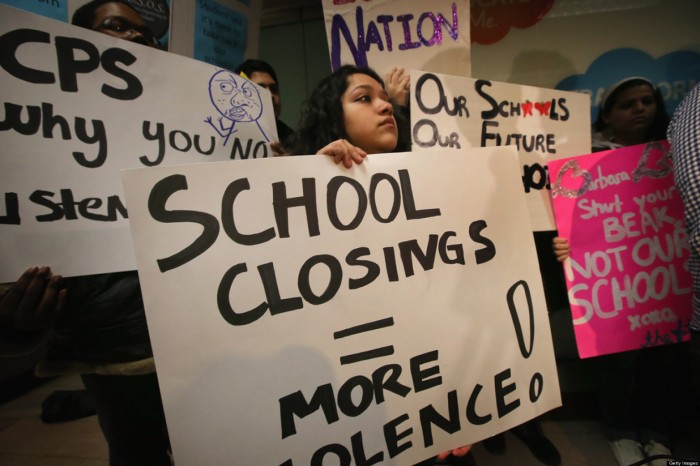
Students Protest School Closings At Chicago Public Schools Headquarters


It’s funny. When you close schools serving minority students, they tend to move away.


That’s what’s happening in Chicago.


In the last seven years, Mayor Rahm Emanuel closed 49 schools serving mostly students of color. And from 2015 to 2016, alone, the city lost 12,000 black residents.


Huh.


Who would have ever thought that cutting funding to services for minorities might make them get up and leave?


But God forbid you suggest this is intentional!


These are just disparate facts. There is no conceivable causal link between making life intolerable for people and their leaving.


When has that ever happened before?


The Great Migration (1919-1950) when hundreds of thousands of blacks moved from the deep south to the shores of Lake Michigan looking for better opportunities?


Well, sure, but when else has that ever happened?


You can’t connect one dot to another.


That would just be rude.


Yet that’s just what Chris Kennedy, a candidate vying to run against Illinois Governor Bruce Rauner on the Democratic ticket, did this week.


He said that Emanuel is running a “strategic gentrification plan” to intentionally push black residents out of the city.


“My belief is they’re being pushed out. This is involuntary. That we’re cutting off funding for schools, cutting off funding for police, allowing people to be forced to live in food deserts, closing hospitals, closing access to mental health facilities. What choice do people have but to move, to leave?” Kennedy said at a press conference.


“And I think that’s part of a strategic gentrification plan being implemented by the city of Chicago to push people of color out of the city. The city is becoming smaller and as it becomes smaller, it’s become whiter.”


The establishment immediately pushed back against him.


The Chicago Sun-Times couldn’t find any fault with Kennedy’s facts, but they called his interpretation “irresponsible.”


Emanuel’s office likewise issued a press release likening Kennedy’s claims with those of Republicans like Rauner and President Donald Trump, even though both of those individuals would be more likely to champion a plan to kick blacks out of Chicago than criticize it.


Kennedy’s remarks simply echo what black Chicagoans have been saying for years.


FACT: Since 2001, 72 Chicago schools have been closed or phased out. Ninety percent of the students affected are black.


And now Emanuel is suggesting closing four additional schools – all from the predominantly African American Englewood community.


Sure, eventually they’ll be replaced by one new school, but only after at least a year without any high school in the area.


When the new school finally opens, the neighborhood will be less black and better suited to what? Gentrification!


Jitu Brown, National Director for a broad based collective of civil rights organizations called Journey 4 Justice, estimates that more than 30,000 people of color have fled Chicago since Emanuel took office.


Brown led a group of community members to sit in at the Chicago Board of Education today to protest the proposed closings.


“Rahm wants to close successful black grammar school to make room for upper income families! We have proof! That’s why we sit-in,” he tweeted.


Back in 2013, Brown broke down his argument at a hearing before the US Department of Education:


“To deny us the right to improve our schools as community institutions is a violation of our human rights. To destabilize schools in our community is a violation of our human rights. To have communities with no neighborhood schools is a violation of our human rights.  . . . We are America’s mirror. Do you have the courage to accept what you see?”


Kennedy really isn’t saying anything different. He’s just echoing the concerns of the community he wants to represent.


“I don’t know what you can say when the strategic plan for Chicago Public Schools suggest that the entire community of Englewood can go an entire year without access to a high school,” Kennedy said this week.


“What are you saying to the people there? No one’s going to move there who’s got a high school kid. And anybody with a high school kid has to think about what they’re going to do. It’s just a device to empty out the community.”


The problem is not limited to Chicago. It’s emblematic of public school policy nationwide.


From 2003-2012, in New York City, 117 schools were closed. Sixty-three percent of the students affected were black.


In 2008, 23 schools were closed in Washington, DC. Ninety-nine percent of the students affected were black, Latino or Hispanic.


Since 2005, in Detroit, 130 schools have been closed. Ninety-three percent of the students affected were children of color.


And one and on.


We intentionally segregate students based on race and class, then allocate funds accordingly. Richer whiter students get all the resources they need. Poorer blacker students get crumbling schools, narrowed curriculum until their schools are shuttered and they’re forced to either move away or put up with fly by night charter schools.


Look at what happened in New Orleans.


After Hurricane Katrina in 2005, the state took over 107 of the city’s then-128 public schools, removing them from local control of the residents. The majority of these schools were turned into charters, closed or simply never reopened – a move affecting 90 percent of black students and only 1 percent of white students.


Karran Harper-Royal, a New Orleans parent and cofounder of the national group Parents Across America, argued at the same hearing in 2013 before the US Department of Education that the result was racist.


They call it school choice, but parents don’t have choice when 80 percent attend charter schools – some of which run a lottery enrollment process, she said. As a result, parents are forced to apply to multiple charter schools to ensure their children have somewhere to go to learn.


Your choice is between charter schools – 79 percent of which are rated “D” or “F” – and 15 state run public schools that are all rated “D” or “F,” she said.


“African-American students are more likely than their white counterparts to experience schools that are at risk of being closed down, phased-out, turned around or co-located,” Harper-Royal said. “To guarantee me a seat in a failing school system is not ‘choice.’ It’s racist is what it is.”


This is the reality for poor and minority students across the country.


It’s refreshing to hear a Democrat brave enough to actually speak the truth about it – especially since Democrats have been as apt to preside over these corporate education reform policies as Republicans.


Closing black schools and keeping white ones open is not an accident.


Neither is continuing school segregation, the proliferation of charter and voucher schools and the continued insistence that the only way to hold educators accountable for actually educating is high stakes standardized testing.


These are all choices that result in winners and losers.


It’s time we recognized that. If we really want to champion civil rights and equity for all, we need to stop promoting racism as school policy and pretending to be surprised at the results.

The Different Flavors of School Segregation

lollipop-flavor


The most salient feature of the United States Public School System – both yesterday and today – is naked, unapologetic segregation.


Whether it be in 1954 when the Supreme Court with Brown v. Board made it illegal in word or today when our schools have continued to practice it in deed. In many places, our schools at this very moment are more segregated than they were before the Civil Rights movement.


That’s just a fact.


But what’s worse is that we don’t seem to care.


And what’s worse than that is we just finished two terms under our first African American President – and HE didn’t care. Barack Obama didn’t make desegregation a priority. In fact, he supported legislation to make it worse.


Charter schools, voucher schools, high stakes standardized testing, strategic disinvestment – all go hand-in-hand to keep America Separate and Unequal.


In this article, I’m going to try to explain in the most simple terms I know the reality of segregation in our schools, how it got there and the various forms it takes.


I do this not because I am against public education. On the contrary, I am a public school teacher and consider myself a champion of what our system strives to be but has never yet realized. I do this because until we recognize what we are doing and what many in power are working hard to ensure we will continue doing and in fact exacerbate doing, we will never be able to rid ourselves of a racist, classist disease we are inflicting on ourselves and on our posterity.


America, the Segregated


It’s never been one monolithic program. It’s always been several co-existing parallel social structures functioning together in tandem that create the society in which we live.


Social segregation leads to institutional segregation which leads to generational, systematic white supremacy.


This is as true today as it was 50 years ago.


I’m reminded of possibly the best description of American segregation on record, the words of the late great African American author James Baldwin who said the following on the Dick Cavett Show in 1968:


“I don’t know what most white people in this country feel. But I can only conclude what they feel from the state of their institutions. I don’t know if white Christians hate Negroes or not, but I know we have a Christian church that is white and a Christian church that is black. I know, as Malcolm X once put it, the most segregated hour in American life is high noon on Sunday.


That says a great deal for me about a Christian nation. It means I can’t afford to trust most white Christians, and I certainly cannot trust the Christian church.


“I don’t know whether the labor unions and their bosses really hate me — that doesn’t matter — but I know I’m not in their union. I don’t know whether the real estate lobby has anything against black people, but I know the real estate lobby is keeping me in the ghetto. I don’t know if the board of education hates black people, but I know the textbooks they give my children to read and the schools we have to go to.


“Now this is the evidence. You want me to make an act of faith, risking myself, my wife, my woman, my sister, my children on some idealism which you assure me exists in America, which I have never seen.”


As Baldwin states, there are many different ways to keep black people segregated. There are many different flavors of the same dish, many different strains of the same disease.


We can say we’re against it, but what we say doesn’t matter unless it is tied to action.


You can say you’re in favor of equity between black and white people all day long, but if the policies you support don’t accomplish these things, you might as well wear a white hood and burn a cross on a black person’s lawn. It would at least be more honest.


Segregated Schools


In terms of public education, which is the area I know most about and am most concerned with here, our schools are indeed set up to be segregated.


If there is one unstated axiom of our American Public School System it is this: the worst thing in the world would be black and white children learning together side-by-side.


I’m not saying that anyone goes around saying this. As Baldwin might say, it doesn’t matter. What matters is how we act, and judging by our laws and practices, this is the evidence.


The sentiment seems to be: Black kids should learn here, white kids should learn there, and never the two should meet.


Our laws are explicitly structured to allow such practices. And that’s exactly what we do in almost every instance.


It’s just who we are.


So, you may ask, how can a public school teacher like myself support such a system.


The answer is that I don’t.


I support the ideals behind the system. I support the idea of a public system that treats everyone equitably.


That’s what it means to have a public system and not a private one. And that’s an ideal we would be wise to keep – even if we’ve never yet lived up to it.


Many people today are trying to destroy those ideals by attacking what exists. And they’re trying to do it, by acts of sabotage.


They point to inequalities they, themselves, helped create and use them to push for a system that would create even worse inequality. They point to the segregation that they, themselves, helped install and use it as an excuse to push even more segregation.


And they do so by controlling the media and the narrative. They call themselves reformers when they’re really vandals and obstructionists looking to subvert the best in our system in order to maximize the worst.


School Segregation Today


Sure we don’t have very many all white or all black schools like we did before Brown v. Board. Instead we have schools that are just predominantly one race or another.


ALL kids are not divided by race. Just MOST of them.


The reason?


Legally and morally absolute segregation has become repugnant and impracticable. We can’t say segregation is the law of the land and then segregate. But we can set up the dominoes that spell S-E-G-R-E-G-A-T-I-O-N and then shrug when that just happens to be the result.


Partially it has to do with housing.


White people and black people tend to live in different neighborhoods. Some of this is a choice. After a history of white oppression and racial strife, people on both sides of the divide would rather live among those with whom they identify.


Black people don’t want to deal with the possibility of further deprivations. White people fear retaliation.


However, white people generally enjoy a higher socio-economic status than black people, so there is some push back from black folks who can afford to live in whiter neighborhoods and thus enjoy the benefits of integration – bigger homes, less crowding, less crime, access to more green spaces, etc. But even when there is a desire, moving to a white neighborhood can be almost impossible.


State and federal laws, local ordinances, banking policies and persistent prejudice stand in the way.


In short, red lining still exists.


Real estate agents and landlords still divide up communities based on whom they’re willing to sell or rent to.


And this is just how white people want it.


They’re socialized to fear and despise blackness and to cherish a certain level of white privilege for themselves and their families.


And if we live apart, it follows that we learn apart.


The system is set up to make this easy. Yet it is not uncomplicated. There is more than one way to sort and separate children along racial and class lines in a school system.


There are several ways to accomplish school segregation. It comes in multiple varieties, a diversity of flavors, all of which achieve the same ends, just in different ways.


By my reckoning, there are at least three distinct paths to effectively segregate students. We shall look at each in turn:


1) Segregated Districts and Schools


When you draw district lines, you have the power to determine their racial makeup.


Put the white neighborhoods in District A and the black ones in District B. It’s kind of like gerrymandering, but instead of hording political power for partisan lawmakers, you’re putting your finger on the scale to enable academic inequality.


However, sometimes you can’t do that. Sometimes you don’t have the power to determine the makeup for entire districts. Instead, you can do almost the same thing for schools within a single district.


You just send most of the black kids to School A and most of the white kids to School B. This is easy to justify if they’re already stratified by neighborhood. In this way, geographical segregation becomes the determination for the academic variety.


In fact, this is what we usually think of when we think of school segregation. And it has certain benefits for white students and costs for black ones.


Foremost, it allows white students to horde resources.


In the first case where you have segregated districts, legislation including explicit funding formulas can be devised to make sure the whiter districts get more financial support than the blacker ones. The state provides more support and the higher socio-economics of the whiter neighborhoods provides a more robust tax base to meet the needs of white children.


That means the whiter districts get higher paid and more experienced teachers. It means they have broader curriculum, more extracurricular activities, a more robust library, more well-trained nursing staff, more advanced placement courses, etc.


And – this is important – the blacker districts don’t.


Fewer funds mean fewer resources, fewer opportunities, more challenges to achieve at the same level that white students take for granted. A budget is often the strongest support for white supremacy in a given community or society as a whole. In fact, if you want to know how racist your community is, read its school budget. You want accountability? Start there.


The same holds even when segregation is instituted not at the district level but at the level of the school building.


When the people making the decisions are mostly white, they tend to steer resources to their own kids at the expense of others. Appointed state recovery bureaucrats, school boards, and administrators can provide more resources to the white schools than the black ones.


It may sound ridiculous but this is exactly what happens much of the time. You have gorgeous new buildings with first class facilities in the suburban areas and run down crumbling facilities in the urban ones – even if the two are only separated geographically by a few miles.


This is not accidental. It’s by choice.


2) Charter and Voucher Schools


And speaking of choice, we come to one of the most pernicious euphemisms in the public school arena – school choice.


It’s not really about academics or options. It’s about permitting racism.


It’s funny. When schools are properly funded and include an overabundance of resources, few people want another alternative. But when schools are underfunded and there is a black majority, that’s when white parents look for an escape for their children.


Like any parasite, charter and voucher schools only survive in the proper environment. It usually looks like this.


Sometimes no matter how you draw the district lines or how you appropriate the buildings, you end up with a black majority and a white minority. That’s a situation white parents find simply intolerable.


White children must be kept separate and given all the best opportunities even if that means taking away the same for black children.


That’s where “school choice” comes in.


It’s not a pedagogical philosophy of how to best provide an education. It’s big business meeting the demand for parental prejudice and white supremacy.


In summary, charter and voucher schools are the mechanisms of white flight. Period.


This is why the National Association for the Advancement of Colored People (NAACP) and the Movement for Black Lives have condemned school privatization. It is racism as a business model. It increases segregation and destroys even the possibility of integration.


This works in two ways.


First, it allows white kids to enter new learning environments where they can be in the majority and get all the resources they need.


White parents look for any opportunity to remove their children from the black majority public school. This creates a market for charter or voucher schools to suck up the white kids and leave the black kids in their neighborhood schools.


Once again, this creates the opportunity for a resource gap. The charter and voucher schools suck away needed funds from the public schools and then are subsidized even further by white parents.


The quality of education provided at these institutions is sometimes better – it’s often worse. But that’s beside the point. It’s not about quality. It’s about kind. It’s about keeping the white kids separate and privileged. It’s about saving them from the taint of black culture and too close of an association with black people.


Second, the situation can work in reverse. Instead of dividing the whites from the blacks, it divides the blacks from the whites.


This happens most often in districts where the divide is closer to equal – let’s say 60% one race and 40% another. Charter and voucher schools often end up gobbling up the minority students and leaving the white ones in the public school. So instead of white privatized and black public schools, you get the opposite.


And make no mistake – this is a precarious position for minority students to be in. Well meaning black parents looking to escape an underfunded public school system jump to an even more underfunded privatized system that is just waiting to prey on their children.


Unlike public schools, charter and voucher institutions are allowed to pocket some of their funding as profit. That means they can reduce services and spending on children anytime they like and to any degree. Moreover, as businesses, their motives are not student centered but economically driven. They cherry pick only the best and brightest students because they cost less to educate. They often enact zero tolerance discipline policies and run themselves more like prisons than schools. And at any time unscrupulous administrators who are under much less scrutiny than those at public schools can more easily steal student funding, close the school and run, leaving children with no where to turn but the public school they fled from in the first place and weakened by letting privatized schools gobble up the money.


The result is a public school system unnaturally bleached of color and a privatized system where minority parents are tricked into putting their children at the mercy of big business.


3) Tracking


But that’s not all. There is still another way to racially segregate children. Instead of putting them in different districts or different schools, you can just ensure they’ll be in different classes in the same school.


It’s called tracking – a controversial pedagogical practice of separating the highest achieving students from the lowest so that teachers can better meet their needs.


However, it most often results in further stratifying students socially, economically and racially.


Here’s how it works.


Often times when you have a large enough black minority in your school or district, the white majority does things to further horde resources even within an individual school building or academic department.


In such cases, the majority of the white population is miraculously given a “gifted” designation and enrolled in the advanced placement classes while the black children are left in the academic or remedial track.


This is not because of any inherent academic deficit among black students, nor is it because of a racial intellectual superiority among white students. It’s because the game has been rigged to favor white students over black ones.


Often the excuse given is test scores. Standardized tests have always been biased assessments that tend to select white and affluent students over poor black ones. Using them as the basis for class placement increases segregation in school buildings.


It enables bleaching the advanced courses and melanin-izing the others. This means administration can justify giving more resources to white students than blacks – more field trips, more speakers, more STEAM programs, more extracurriculars, etc.


And if a white parent complains to the principal that her child has not been included in the gifted program, if her child has even a modicum of ability in the given subject, more often than not that white child is advanced forward to the preferential class.


CONCLUSIONS


Segregation is a deep problem in our public school system. But it cannot be solved by privatization.


In fact, privatization exacerbates it.


Nor is public education, itself, a panacea. Like any democratic practice, it requires participation and the economic and social mobility to be able to participate as equals.


Schools are the product of the societies that create them. An inequitable society will create inequitable schools.


Segregation has haunted us since before the foundation of our nation.


The only way to solve it is by first calling it out and recognizing it in all its forms. Then white people have to own their role in spreading it and take steps to end it.


Segregation doesn’t just happen. It exists because white people – especially white parents – want it to exist.


They don’t want their children to be educated among black students – maybe SOME black students, maybe the best of the best black students, but certainly not the average run of the mill brown-skinned child.


This has to stop.


There are plenty of benefits even for white students in an integrated education. It provides them a more accurate world-view and helps them become empathetic and prize difference.


Moreover, nothing helps inoculate a child against racism more than a truly integrated education.


If we want our children to be better people, we should provide them with this kind of school environment.


But instead, too many of us would rather give them an unfair edge so they can do better than those around them.


Racism is not just ideological; it is economic. In a dog-eat-dog-world, we want our kids to be the wolves with their teeth in the weaker pups necks.


We need to dispel this ideal.


Our society does not need to be a zero-sum game.


We can all flourish together. We can achieve a better world for all our children when we not only realize that but prize it.


As Baldwin put it in 1989’s “The Price of a Ticket”:


“It is not a romantic matter. It is the unutterable truth: all men are brothers. That’s the bottom line.”


When that becomes a shared vision of our best selves, only then will segregation be completely vanquished.

I Am Not A Hero Teacher

Screen Shot 2017-08-01 at 10.53.52 AM


I’m sorry.


I am not a hero teacher.


I am not stronger than a locomotive.


I cannot jump tall ignorance in a single bound.


I am not faster than a tax-cutting zealot.


Up in the air – it’s a bird, it’s a plane, but it’s certainly not a teacher because we can’t fly.


I am not bullet proof.


If a gunman storms the building and shoots me, I will be wounded and may die.


Giving me a gun doesn’t help, either, because I am not a marksman.


I am just a man.


I cannot stand in front of a class of thirty and give them each my undivided attention. Not all at once.


When students ask a question, I need time to answer it.


When students hand in a paper, I need time to grade it.


During the workday, I need time to plan my lessons. I need time to call parents. I need time to read all the individual education plans, fill out all the weekly monitoring forms, finish all the administrative paperwork.


At the end of a long day, I get tired and need rest.


At the end of a long week, I need time to spend with my family.


At the end of a long year, I need time to myself – to get a summer job, to take continuing education courses, to plan for next year, to heal.


I need a middle class income – not because I’m trying to get rich, but because I’m human. I need food and shelter. I have a family for whom I need to provide. If you can’t give me that, I’ll need to move on.


Sorry, but it’s true.


I’ll tell you one thing I don’t need. I don’t need the state, federal or local government telling me how to do my job. When I plan my lessons, I need the freedom to teach children in the way that seems most effective to me – the professional in the room.


I also don’t need some bureaucrat telling me how to assess my students. I don’t need some standardized test to tell me what kids have learned, if they can read or write. I’ve spent an average of 80 minutes a day with these children for five days a week. If I can’t tell, I don’t deserve to be in the classroom.


And I don’t need my principal or superintendent setting my colleagues and me against each other. We’re not competing to see who can do a better job. We should be collaborating to make sure everyone succeeds.


What do I need? My union, for one.


I need my right to collective bargaining. I need the power to gather with my colleagues and co-workers so we can create the best possible work environment for myself and my students. I need due process, tenure, so I can’t be fired at the whim of the school board or administrators without having them prove my inequities.


I need my work to be evaluated fairly. Judge me on what I do – not on what my students do with what I’ve given them.


And when it comes to the racial proficiency gap, don’t look to me to exert some kind of supernatural teacher magic. I am not a white savior who can make school segregation, racism and prejudice disappear. I try to treat every student fairly, but my actions can’t undo a system that’s set up to privilege some and disadvantage others.


I guess what I’m trying to say is that if you’re expecting a superhero, I’m bound to disappoint.


And that DOES seem to be what many of you expect us to be.


Seven years ago, Davis Guggenheim characterized the public schools as if we were Waiting for Superman.


Things are so screwed up, he alleged back then, that we need someone with superpowers to swoop in and fix it all.


But there is no superman. There’s just Clark Kent.


That’s me – a bespectacled shlub who shows up everyday in the naive hope that he can make a difference.


According to landmark research by Dan Goldhaber and James Coleman, only about 9 percent of student achievement is attributable to teachers.


That’s right – 9 percent.


If you add in everything in the entire school environment – class size, curriculum, instructional time, availability of specialists and tutors, and resources for learning (books, computers, science labs, etc.), all that only accounts for 20 percent.


There’s another 20 percent they can’t explain. But the largest variable by far is out of school factors. This means parents, home life, health, poverty, nutrition, geographic location, stress, etc. Researchers estimate those count for 60 percent of student success.


Yet we somehow expect teachers (9%) to do it all.


I’m sorry, America. I can’t.


More than half of all public school students live in poverty. No matter how hard I try, I cannot solve that all by myself.


I try to teach children how to read though many are hungry and traumatized by their home lives.


I try to teach children how to write though many haven’t slept the night before, haven’t taken their ADD medication and – to be honest – many haven’t even shown up to school yet.


I most certainly try to get them to pass culturally biased, developmentally inappropriate standardized tests without sucking away every bit of creativity from the classroom.


But much of this is beyond my control.


I can’t help that the federal, state and local government are cutting school funding. I can’t help that my impoverished district has few school supplies, the students enter the building without them because their parents are too poor to buy them. But I can – and do – spend out of my own pocket to make sure all of my students have pencil, paper, whatever they need.


I can’t help that officials at every step of the way want me to narrow my teaching to only things that will appear on the yearly standardized test, that they want me to present it as a multiple choice look-a-like item, that they want me to teach by pointing at a Common Core standard as if that held any meaning in a child’s life. But I can make the lesson as creative as possible and offer kids a chance to engage with the material in a way that connects to their real lives, desires and interests.


I can’t help that kids don’t read like they used to and instead experience the bulk of text on the Internet, Facebook or Twitter. I can’t help that most of their real world writing experience is limited to thumbing social media updates, comments on YouTube videos or communicating through a string of colorful emojis. But I can try to offer them meaningful journal topics that make them think and offer them the chance to share their thoughts in a public forum with their peers.


There’s nothing super about any of it.


But it’s the kind of things teachers do everyday without anyone noticing. It’s the kind of thing that rarely gets noted on an evaluation, rarely earns you a Thank You card or even an apple to put on your desk.


However, when the day is done, students often are reluctant to leave. They cluster about in the hall or linger in the classroom asking questions, voicing concerns, just relieved that there’s someone there they can talk to.


And that’s reason enough for me to stay.


The odds are stacked against me. Help isn’t coming from any corner of our society. But sometimes despite all of that, I’m actually able to get things done.


Everyday it seems I help students understand something they never knew before. I’ve become accustomed to that look of wonder, the aha moment. And I helped it happen!


I get to see students grow. I get to nurture that growth. I get to be there for young ones who have nobody else.


It’s a wonderful feeling.


I know I’m making a difference.


So, yes, I’m no superman.


I have no special powers, no superhuman abilities. I can’t fix all of our social problems all by myself.


But I help to make the future.


That’s why I do what I do.


Thank you for letting me do it.