Democrats for Education Reform Think Being Progressive Means Mirroring Betsy DeVos


 Screen Shot 2018-08-08 at 12.24.47 PM


Democrats for Education Reform (DFER) put out a new video about what they think it means to be an education progressive.


And by the political action committee’s definition, Betsy DeVos may be the most “progressive” education secretary ever.


She champions “public charter schools.” Just like them!


She is in favor of evaluating teachers on student test scores. Just like them!


She is a booster for “holding schools accountable” through the use of standardized tests. Just like them!


And she loves putting public tax dollars into private hands to run schools “more efficiently” by disbanding school boards, closing public debate and choosing exactly which students get to attend privatized schools. Just like… you get the idea.


But perhaps the most striking similarity between DeVos and DFER is their methodologies.


DFER announced it again was going to flood Democratic races with tons of campaign cash to bolster candidates who agreed with them. That’s exactly how DeVos gets things done, too!


She gives politicians bribes to do her bidding! The only difference is she pays her money mostly to Republicans while DFER pays off Democrats. But if both DeVos and DFER are paying to get would-be lawmakers to enact the same policies, what is the difference!?


Seriously, what is the difference between Betsy DeVos and Democrats for Education Reform?


Progressives in Colorado and California say it is only the word “Democrat.”


Democratic party conferences in both states passed resolutions asking DFER to stop using the name “Democrat” because the privatization lobbying firm does not represent party ideals or goals.


It is degrading what the party stands for and hurting the brand.


Why do some progressives vote third party? Because of groups like DFER.


Voters think something like – if this charter school advocacy group represents what Democrats are all about, I can’t vote Democrat. I need a new party. Hence the surge of Green and other third party votes that is blamed for hurting Democratic candidates.


The Democrats have always been a big tent party, but the canvas can’t shelter the most regressive far right bigotry without destroying the organization’s identity as an opposition party.


It is entirely incoherent to oppose Republicans by pushing for almost the same agenda.


The reason for the confusion is that DFER is not a grassroots organization. It is funded by Wall Street hedge fund managers.


It is not an authentic expression of the public’s wants and desires. It is another avenue for the mega-rich to use their power and influence to tell the rest of us what they want us to believe.


Yet DFER tries to hide this fact with various forms of propaganda. In effect, they’re trying to convince us that their ideas are what we actually believe.


For instance, the group is now offering a nationwide poll from Benson Strategy Group as proof that Democratic voters agree with DFER’s goals.


However, the questions asked to about 2,000 people on the phone are laughably biased:


“Do you believe we have a responsibility to do everything we can to give every child a great education, and does that mean we need faster change in our schools to prepare students for the future?”


Of course people are going to agree with that! It doesn’t mean people want to privatize public schools. We SHOULD do everything – including closing failing charter schools and boosting funding at struggling public schools!


“Do you agree that we can’t go back to the way things used to be in schools? Do you think we need to keep bringing in new ideas and finding new ways to improve schools?”


Of course we need new ideas, but charter schools and standardized tests aren’t new ideas! We’ve been doing that nonsense for decades and they haven’t helped a bit. In fact, they’ve made things worse!


“Do you think funding alone is enough to give our children the education they deserve? Do you also want to see new ideas and real changes to the way public schools operate?”


Of course schools need more than just additional funding. But let’s not minimize funding equity. Students of color will never get an equitable education until we pay for the resources they need to succeed. The poor will never catch up to the rich without money to provide the services they need to learn.


Moreover, blanket statements disparaging public schools before asking about school privatization invites bias against public schools and bias in favor of privatization.


When you couch privatization as “more options” and “choice,” who doesn’t want that? But it’s not what you’re offering.


Giving administrators the ability to accept or deny my child into their school is not “more options” for me. It is greater choice for them.


Slashing funding at the public school because its finances got gobbled up by the neighborhood charter is not “choice” for me. It is providing alternative revenue for the corporations that run the charter school while my only option is to accept fewer resources for my child.


None of this is progressive. None of this is truly supported by grassroots people or organizations.


Civil rights groups like Journey for Justice and even the National Association for the Advancement of Colored People (NAACP) oppose school privatization and high stakes testing.


This is the meat and potatoes of DFER.


The only difference between these alleged Democrats and DeVos is that the Trump administration also champions school vouchers.


But both charters and vouchers involve sending public tax dollars to schools that are privately run. Both involve stripping taxpayers of control over how that money is spent until all we have are parents moving their children from school-to-school in a desperate attempt to find one that does a good job and will also accept their child.


That is not the progressive ideal.


Progressives want to make every public school excellent. They want all children to have the resources they need to succeed. They want to assess students, teachers and the system fairly to clearly understand what children are learning, what educators are doing to help them learn and how administrators and school directors are enabling that success. They want innovation – not the same old corporate-minded top-down policy failures of the past decades. They want technology as a tool to bridge understanding and not as an end in itself to drive the curriculum. They want an end to the school-to-prison pipeline. They want truly integrated schools, not the current segregated system where Cadillac funding goes to rich white districts and the scraps are thrown to the poor brown ones.


Yet DFER, these so-called Democrats, support none of this.


And they’re spending millions of dollars to convince our lawmakers not to support it either.


Politicians can’t keep accepting their dirty money and expecting grassroots voters to continue to support them.


To paraphrase Matthew, no one can serve two masters. If lawmakers are taking sacks of cash from billionaire hedge fund mangers, they aren’t going to listen to you or me.


They can serve their constituents or mammon. Not both.


So if Democrats want strong support in the coming elections, they need to do the progressive thing.


Stop accepting bribes from dark money influence peddlers like DFER.


Like this post? I’ve written a book, “Gadfly on the Wall: A Public School Teacher Speaks Out on Racism and Reform,” now available from Garn Press. Ten percent of the proceeds go to the Badass Teachers Association. Check it out!

WANT A SIGNED COPY?

Click here to order one directly from me to your door!
book-2

Top 10 Reasons You Can’t Fairly Evaluate Teachers on Student Test Scores

Screen Shot 2018-08-02 at 12.49.24 AM


I’m a public school teacher.


Am I any good at my job?


There are many ways to find out. You could look at how hard I work, how many hours I put in. You could look at the kinds of things I do in my classroom and examine if I’m adhering to best practices. You could look at how well I know my students and their families, how well I’m attempting to meet their needs.


Or you could just look at my students’ test scores and give me a passing or failing grade based on whether they pass or fail their assessments.


It’s called Value-Added Measures (VAM) and at one time it was the coming fad in education. However, after numerous studies and lawsuits, the shine is fading from this particularly narrow-minded corporate policy.


Most states that evaluate their teachers using VAM do so because under President Barack Obama they were offered Race to the Top grants and/or waivers.


Now that the government isn’t offering cash incentives, seven states have stopped using VAM and many more have reduced the weight given to these assessments. The new federal K-12 education law – the Every Student Succeeds Act (ESSA) – does not require states to have educator evaluation systems at all. And if a state chooses to enact one, it does not have to use VAM.


That’s a good thing because the evidence is mounting against this controversial policy. An evaluation released in June of 2018 found that a $575 million push by the Bill and Melinda Gates Foundation to make teachers (and thereby students) better through the use of VAM was a complete waste of money.


Meanwhile a teacher fired from the Washington, DC, district because of low VAM scores just won a 9-year legal battle with the district and could be owed hundreds of thousands of dollars in back pay as well as getting his job back.


But putting aside the waste of public tax dollars and the threat of litigation, is VAM a good way to evaluate teachers?


Is it fair to judge educators on their students’ test scores?


Here are the top 10 reasons why the answer is unequivocally negative:


1) VAM was Invented to Assess Cows.

I’m not kidding. The process was created by William L. Sanders, a statistician in the college of business at the University of Knoxville, Tennessee. He thought the same kinds of statistics used to model genetic and reproductive trends among cattle could be used to measure growth among teachers and hold them accountable. You’ve heard of the Tennessee Value-Added Assessment System (TVAAS) or TxVAAS in Texas or PVAAS in Pennsylvania or more generically named EVAAS in states like Ohio, North Carolina, and South Carolina. That’s his work. The problem is that educating children is much more complex than feeding and growing cows. Not only is it insulting to assume otherwise, it’s incredibly naïve.


2) You can’t assess teachers on tests that were made to assess students.

This violates fundamental principles of both statistics and assessment. If you make a test to assess A, you can’t use it to assess B. That’s why many researchers have labeled the process “junk science” – most notably the American Statistical Association in 2014. Put simply, the standardized tests on which VAM estimates are based have always been, and continue to be, developed to assess student achievement and not growth in student achievement nor growth in teacher effectiveness. The tests on which VAM estimates are based were never designed to estimate teachers’ effects. Doing otherwise is like assuming all healthy people go to the best doctors and all sick people go to the bad ones. If I fail a dental screening because I have cavities, that doesn’t mean my dentist is bad at his job. It means I need to brush more and lay off the sugary snacks.


3) There’s No Consistency in the Scores.

Valid assessments produce consistent results. This is why doctors often run the same medical test more than once. If the first try comes up positive for cancer, let’s say, they’re hoping the second time will come up negative. However, if multiple runs of the same test produce the same result, that diagnosis gains credence. Unfortunately, VAM scores are notoriously inconsistent. When you evaluate teachers with the same test (but different students) over multiple years, you often get divergent results. And not just by a little. Teachers who do well one year may do terribly the next. This makes VAM estimates extremely unreliable. Teachers who should be (more or less) consistently effective are being classified in sometimes highly inconsistent ways over time. A teacher classified as “adding value” has a 25 to 50% chance of being classified as “subtracting value” the next year, and vice versa. This can make the probability of a teacher being identified as effective no different than the flip of a coin.


4) Changing the test can change the VAM score.

If you know how to add, it doesn’t matter if you’re asked to solve 2 +2 or 3+ 3. Changing the test shouldn’t have a major impact on the result. If both tests are evaluating the same learning and at the same level of difficulty, changing the test shouldn’t change the result. But when you change the tests used in VAM assessments, scores and rankings can change substantially. Using a different model or a different test often produces a different VAM score. This may indicate a problem with value added measures or with the standardized tests used in conjunction with it. Either way, it makes VAM scores invalid.


5) VAM measures correlation, not causation.

Sometimes A causes B. Sometimes A and B simply occur at the same time. For example, most people in wheelchairs have been in an accident. That doesn’t mean being in a wheelchair causes accidents. The same goes for education. Students who fail a test didn’t learn the material. But that doesn’t mean their teacher didn’t try to teach them. VAM does not measure teacher effectiveness. At best it measures student learning. Effects – positive or negative – attributed to a teacher may actually be caused by other factors that are not captured in the model. For instance, the student may have a learning disability, the student may have been chronically absent or the test, itself, may be an invalid measure of the learning that has taken place.


6) Vam Scores are Based on Flawed Standardized Tests.

When you base teacher evaluations on student tests, at very least the student tests have to be valid. Otherwise, you’ll have unfairly assessed BOTH students AND teachers. Unfortunately standardized tests are narrow, limited indicators of student learning. They leave out a wide range of important knowledge and skills leaving only the easiest-to-measure parts of math and English curriculum. Test scores are not universal, abstract measures of student learning. They greatly depend on a student’s class, race, disability status and knowledge of English. Researchers have been decrying this for decades – standardized tests often measure the life circumstances of the students not how well those students learn – and therefore by extension they cannot assess how well teachers teach.


7) VAM Ignores Too Many Factors.

When a student learns or fails to learn something, there is so much more going on than just a duality between student and teacher. Teachers cannot simply touch students’ heads and magically make learning take place. It is a complex process involving multiple factors some of which are poorly understood by human psychology and neuroscience. There are inordinate amounts of inaccurate or missing data that cannot be easily replaced or disregardedvariables that cannot be statistically controlled for such as: differential summer learning gains and losses, prior teachers’ residual effects, the impact of school policies such as grouping and tracking students, the impact of race and class segregation, etc. When so many variables cannot be accounted for, any measure returned by VAMs remains essentially incomplete.


8) VAM Has Never been Proven to Increase Student Learning or Produce Better Teachers.

That’s the whole purpose behind using VAM. It’s supposed to do these two things but there is zero research to suggest it can do them. You’d think we wouldn’t waste billions of dollars and generations of students on a policy that has never been proven effective. But there you have it. This is a faith-based initiative. It is the pet project of philanthrocapitalists, tech gurus and politicians. There is no research yet which suggests that VAM has ever improved teachers’ instruction or student learning and achievement. This means VAM estimates are typically of no informative, formative, or instructional value.


9) VAM Often Makes Things Worse.

Using these measures has many unintended consequences that adversely affect the learning environment. When you use VAMs for teacher evaluations, you often end up changing the way the tests are viewed and ultimately the school culture, itself. This is actually one of the intents of using VAMs. However, the changes are rarely positive. For example, this often leads to a greater emphasis on test preparation and specific tested content to the exclusion of content that may lead to better long-term learning gains or increasing student motivation. VAM incentivizes teachers to wish for the most advanced students in their classes and to push the struggling students onto someone else so as to maximize their own personal VAM score. Instead of a collaborative environment where everyone works together to help all students learn, VAM fosters a competitive environment where innovation is horded and not shared with the rest of the staff. It increases turnover and job dissatisfaction. Principals stack classes to make sure certain teachers are more likely to get better evaluations or vice versa. Finally, being unfairly evaluated disincentives new teachers to stay in the profession and it discourages the best and the brightest from ever entering the field in the first place. You’ve heard about that “teacher shortage” everyone’s talking about. VAM is a big part of it.


10) An emphasis on VAM overshadows real reforms that actually would help students learn.

Research shows the best way to improve education is system wide reforms – not targeting individual teachers. We need to equitably fund our schools. We can no longer segregate children by class and race and give the majority of the money to the rich white kids while withholding it from the poor brown ones. Students need help dealing with the effects of generational poverty – food security, psychological counseling, academic tutoring, safety initiatives, wide curriculum and anti-poverty programs. A narrow focus on teacher effectiveness dwarfs all these other factors and hides them under the rug. Researchers calculate teacher influence on student test scores at about 14%. Out-of-school factors are the most important. That doesn’t mean teachers are unimportant – they are the most important single factor inside the school building. But we need to realize that outside the school has a greater impact. We must learn to see the whole child and all her relationships –not just the student-teacher dynamic. Until we do so, we will continue to do these children a disservice with corporate privatization scams like VAM which demoralize and destroy the people who dedicate their lives to helping them learn – their teachers.


NOTE: Special thanks to the amazingly detailed research of Audrey Amrein-Beardsley whose Vamboozled Website is THE on-line resource for scholarship about VAM.


Like this post? I’ve written a book, “Gadfly on the Wall: A Public School Teacher Speaks Out on Racism and Reform,” now available from Garn Press. Ten percent of the proceeds go to the Badass Teachers Association. Check it out!

WANT A SIGNED COPY?

Click here to order one directly from me to your door!

book-1

Wannabe Terrorist Attempts to Flood Our Schools & Public Spaces With 3D Printed Guns to Make Common Sense Restrictions Moot

GettyImages_172545206.0


In the United States, we literally have more guns than people.


Yet we’re trying really hard to make even more available with the touch of a button.


It’s not enough that our right to kill is better protected than our right to live, we need to make it EASIER to commit murder. In the land of the drive-by shooting, slaughter needs to be as convenient as ordering a pizza.


Cody Wilson, a wannabe terrorist who apparently believes John Wayne westerns are documentaries, claims to have invented the first gun that can be made almost completely on a 3D printer. And he wants to post the plans on-line so anyone with access to the device can make one.


He was stopped by a U.S. District judge in Seattle who temporarily banned the plans from publication on the Internet this week following a last-minute lawsuit filed by seven state attorneys general.


They argued that 3D-printed firearms would be invisible to metal detectors and could bypass gun restrictions recently adopted after a string of school shootings in some states.


The issue will go back to court on August 10, when the sides will discuss whether a preliminary injunction is needed.


The whole matter was almost settled in 2013 when the Obama administration originally stopped Wilson from putting his plans online with a lawsuit. After years of back and forth, the federal case against the virtual arms merchant seemed like a slam dunk. Then Donald Trump came into office and not only stopped the suit but paid Wilson $40,000 in damages.


So the question remains – why would any sane human being want to post a do-it-yourself gun kit on the Internet where any criminal, psychotic or violent fanatic could easily access it?


Wilson says he’s not in it for financial gain. He wants to make a political point – to flood the world with so many cheap, untraceable guns that the idea of passing any kind of regulations on them would be impossible.


No, really.


As he told Wired:


“All this Parkland stuff, the students, all these dreams of ‘common sense gun reforms’? No. The Internet will serve guns, the gun is downloadable. No amount of petitions or die-ins or anything else can change that.”


Not only that, but the owner and founder of Defense Distributed, an Austin, Texas, based start up that pretends to be a nonprofit organization, says he is prepared to kill police and federal agents if the courts don’t continue seeing things his way.


In the same Wired interview, he says he wasn’t expecting support from the Trump administration. He expected Hillary Clinton would win the White House in 2016 and that she would continue to oppose his 3D printed firearms.


As Wired reported:


“If that happened, as Wilson tells it, he was ready to launch his [3D printed gun] repository, regardless of the outcome of his lawsuit, and then defend it in an armed standoff. “I’d call a militia out to defend the server, Bundy-style,” Wilson says calmly, in the first overt mention of planned armed violence I’ve ever heard him make. “Our only option was to build an infrastructure where we had one final suicidal mission, where we dumped everything into the Internet,” Wilson says.”


So let’s be clear about one thing – the guy pushing for 3D printed firearms is literally a terrorist imitator.


He is an American extremist. He is to us as Osama bin Laden is to mainstream Muslims.


Or at least he wants to be that.


While we’re rounding up brown people and separating them from their children without any workable plan to reunite them on this or that side of the border, we have a US citizen making terroristic threats with the means to carry them out and he’s walking around free.


Oh, but he’s a privileged white dude, so no harm no foul.


If Wilson’s little plastic death dealers do become widely available on-line, they won’t immediately make a huge difference.


It’s hard to make a 3D-printed gun. You need an expensive, top-of-the-line 3D printer and some knowledge of how to work it. And even then the result is a shoddy firearm at best. It may only fire a few bullets before falling apart.


A shooter would have to work extra hard to accomplish his goal with Wilson’s design. It would be much easier to use one of the billions of firearms already available – and much more deadly.


But it wouldn’t take much to make a 3D-printed gun more dangerous.


To comply with federal law, Wilson’s design requires a metal firing pin, which he claims would set off a metal detector. However, it may be relatively easy to bypass that metal part to make his design truly concealable from such devices.


Moreover, technology is always advancing – 3D printers will probably be able to create stronger and more deadly firearms in time. With these sorts of designs readily available, it is easy to imagine a school shooter accessing a device in a tech or computer lab and creating a weapon of mass destruction. He wouldn’t set off any alarms because he wouldn’t have the gun when he entered the building. He’d make it in school.


Some shrug at these dangers saying that they’re inevitable.


Even if we stop Wilson, these sorts of designs will eventually be available in some form on-line. That’s the double-edged sword of mass media – all information is available including easy ways to kill a large number of people.


However, I think this is a cop-out.


For instance, the Internet and computer technology make it fairly easy to mass produce currency as well as firearms. In fact, it’s theoretically much easier.


Yet we don’t see a major influx of counterfeit bills. The reason? Business and industry have collaborated with government to make sure this doesn’t happen.


Programs like Adobe Photoshop include software that restrict the printing of your own money. We could do the same with future 3D printers. We could recall those already in service and retrofit them with such code.


Oh, sure not everyone will comply. There will always be someone who breaks through the safety net. But if all we can do is greatly reduce the spread of 3D-printed firearms, that doesn’t make it futile.


There is a mountain of research proving that the more firearms you have in a country, the greater the number of firearm deaths.


We should be working to restrict guns to responsible people.


But the Wilson’s of the world don’t want to allow us that choice.


They want to force us all to live in a world where guns are even more pernicious than they are today.


Will we let them?


Human beings have such potential, but we seem determined to kill ourselves.


If intelligent aliens came to Earth today and landed in the USA, what would they think of us?


Would they see what we might become or would they only see a pitiful animal struggling to put itself out of its own misery?


Like this post? I’ve written a book, “Gadfly on the Wall: A Public School Teacher Speaks Out on Racism and Reform,” now available from Garn Press. Ten percent of the proceeds go to the Badass Teachers Association. Check it out!

WANT A SIGNED COPY?

Click here to order one directly from me to your door!
book-4

Resistance to High Stakes Testing Persists as Media Celebrates Its End

GettyImages-465529004.0.0


There has never been more opposition to high stakes standardized testing.


Yet the corporate controlled media is pretending that the resistance is over.


Parents are refusing to let their kids take these tests at the same or even greater numbers than ever.


Fewer states require high stakes tests as graduation exams and/or use them to evaluate their teachers. Across the nation, states are cutting the size of standardized tests or eliminating them altogether. And more state legislatures passed laws explicitly allowing parents to opt their children out of the tests.


Yet Education Week published an article a few days ago called “Anti-Test Movement Slows to a Crawl.”


I think we have different definitions of “Slows” and “Crawl.”


That may not be surprising since we also seem to have different definitions of “Anti-Test.”


The Opt Out Movement is not “Anti-Test.” It is anti-high stakes standardized test.


It is against the federal government forcing states to use corporate written, corporate graded and corporate remediated standardized assessments.


It is against the federal government requiring each state to participate in a corporate boondoggle that not only wastes billions of tax dollars that could be better spent to educate children but also unfairly assesses their academic progress and feeds the push to privatize public schools.


Most people against high stakes standardized testing, however, have no problem with authentic teacher-created assessments.


Calling these folks “Anti-Test” is like labeling those pushing for stricter gun regulations “Anti-Gun” or smearing those protesting government corruption as “Anti-Government.”


And that’s just the title!


The author Alyson Klein further misdirects readers by conflating opt out rates and test resistance.


She implied that the only measure of opposition was the percentage of students who opt out. However, as noted above, there are multiple measures of resistance.


Moreover, few states advertise their opt out rates. Especially after the movement began, states made that information harder to come by to dissuade more people from joining it.


Of those states where information is available, Klein puts the most negative possible spin on the facts in order to make her point – a point that it seems to me is not at all justified.


For instance, Klein writes:


“At least some of the steam has gone out of the opt-out movement in states such as New Jersey and New York, considered hotbeds of anti-testing fervor.”


Really?


In New York, Opt out numbers remained at approximately 20% – the same as they have for the past three years.


And New York is one of our most densely populated states. That percentage represents more than 225,000 parents across the Empire State who refused to let their children take the tests despite threats from many administrators and district officials for doing so.


In New Jersey, opt out rates were marginally lower this year than last year. They went from 7% to 5%. But once again New Jersey is a populous state. That percentage represents about 68,500 students.


In addition, this is after massive opt outs three years ago that forced the state to change its federally mandated assessment. Testing boycotts pushed the state education association to get rid of four PARCC assessments and allow students who fail the remaining two tests to take an alternative assessment. And this is in a state where there is no law explicitly allowing parents to opt out of the tests.


I don’t know if I’d call that running out of steam.


Moreover, opt out rates have increased in other states for which we have data. For instance, test refusal is on the rise in heartland states like Minnesota.


And it nearly doubled in Utah over the past two years to about 6%. In some schools in the Beehive State, rates are much higher. According to the Salt Lake Tribune, 1 in 5 students in the Park City school district refused to take the tests.


Though my own state of Pennsylvania has been mum on last year’s opt outs, from my own personal experience as a teacher in suburban Pittsburgh, I never had more students boycott our federally mandated standardized test than I did last year.


There were so many they had to be quarantined in a special room.


Moreover, an increasing number of parents ask me about the issue, express concern and wonder about their rights.


So even when examining just the rate of opt out, I don’t see any reason to assume the movement is slowing down.


On the contrary, it is picking up steam with multiple victories.


As recently as 2012, half of all U.S. states required high school exit exams in order for students to graduate. Today that number has dropped to 12. The reason? Exit exams don’t raise student achievement – they raise the dropout rate. At least that’s what The National Research Council of the National Academy of Sciences tells us.


Another positive sign – seven states have stopped using value added measures (VAM) to judge teachers. This is the highly controversial practice of assessing educators based on their students test scores – a practice that has never been proven fair to teachers or effective in helping students learn. Six states have dropped this requirement altogether: Alaska, Arkansas, Kansas, Kentucky, North Carolina and Oklahoma. Connecticut still gathers the information but cannot use it in the teacher’s “summative rating.” And other states like New Mexico still use value added measures but have reduced the weight given to student test scores.


Moreover, let’s not forget how many states have slashed the size of the high stakes tests they’re giving to students. After the recent wave of opt outs and public outcry, state education departments have ensured that testing at least takes up less time. This includes New York, Maryland, New Mexico, California, Minnesota, Kentucky, Tennessee, Florida, Washington, Illinois, West Virginia, Hawaii, Oklahoma, Ohio, South Carolina, Pennsylvania and Texas. Some of this is because the PARCC test used in 21 states was slashed by 90 minutes.


And when it comes to opt out, two more states – Idaho and North Dakota – now have explicit laws on the books allowing parents to refuse the test for their children – in whole or in part. That brings the total number of states up to 10. It would have been 11, but Georgia Governor Nathan Deal, a Republican, vetoed an opt-out bill. The federal government still wants us to penalize these districts for non-participation in flagrant violation of its authority. But as more states respect parents’ rights on this matter, it will be increasingly difficult for the U.S. Department of Education to continue trampling them.


And speaking of the federal government, some states are taking advantage of the wiggle room in the federal law that governs K-12 education – the newly passed Every Student Succeeds Act (ESSA) – to allow students to avoid standardized testing entirely. Some states are implementation performance assessments instead. Kids can use a portfolio of classwork to demonstrate learning instead of getting a grade on a corporate-written standardized test. New Hampshire, for instance, has pioneered this approach with a program that now involves half the state’s districts.


These are not the signs of a movement that is slowing to a crawl.


It just makes sense that some of the rhetoric of the movement may have become less forceful with the enactment of the federal ESSA.


Many had hoped for a better law – one that did away with federally mandated testing altogether.


And that could still happen sooner than many think. Next year it will be time to reauthorize the law again.


It took Congress six years to reauthorize the federal education law last time. Perhaps our duly elected representatives can be coaxed into doing their jobs a bit quicker this time.


There is already some proposed legislation to make positive changes. Sen. Jon Tester (D-Mont.) and Rep. Krysten Sinema (D-Ariz.) introduced legislation last year to replace annual assessments with grade-span tests. The United States is, after all, one of the only countries in the world – if not the only one – to require students be tested every year. These proposed changes are not nearly enough, but they’re a step in the right direction.


One of the biggest obstacles to abolishing federally mandated testing last time was that some of the oldest and most well funded civil rights organizations opposed it. Many of them get their money and support from the same billionaires who profit off of the standardized testing and privatization industries.


However, that support for testing was short lived. Already the National Association for the Advancement of Colored People (NAACP) has revoked it returning to a call for opposition to testing.


If our nation survives the many crises of the Donald Trump administration, there is no reason our future cannot be bright.


We have the support, we have the tools, we just need the chance to do right by our children.


And the pendulum is swinging back our way.


Like this post? I’ve written a book, “Gadfly on the Wall: A Public School Teacher Speaks Out on Racism and Reform,” now available from Garn Press. Ten percent of the proceeds go to the Badass Teachers Association. Check it out!

WANT A SIGNED COPY?

Click here to order one directly from me to your door!

book-3

Republicans, Democrats – Let’s Scrap Them Both!

abolish-political-parties-49312-560x315


Political parties are a huge mistake.


Our founding fathers knew this.


Though it was their constant squabbling and political power struggles that gave way to the party system in the first place, they also were incredibly vocal about the errors they, themselves, were committing.


Thomas Jefferson and James Madison preferred state power that would protect southern interests including slave-holding. George Washington, John Adams and Alexander Hamilton favored federal authority that would benefit the north and manufacturing.


But in taking sides to protect their own power, they split into the very factions they knew would poison the newborn Republic.


At his farewell address in 1796, Washington put it this way:


“However [political parties] may now and then answer popular ends, they are likely in the course of time and things, to become potent engines, by which cunning, ambitious, and unprincipled men will be enabled to subvert the power of the people and to usurp for themselves the reins of government, destroying afterwards the very engines which have lifted them to unjust dominion.”


His successor, Adams wrote:


“There is nothing which I dread so much as a division of the republic into two great parties, each arranged under its leader, and concerting measures in opposition to each other. This, in my humble apprehension, is to be dreaded as the greatest political evil under our Constitution.”


In 1789, Jefferson put it more succinctly:


“If I could not go to heaven but with a party, I would not go there at all.”


So why do we today enshrine political parties in our system of government?


In short, it keeps the wealthy in power.


Nothing robs democracy of its populism so much as the party system.


Backward legislation and regressive court decisions equating money with speech only make this worse. But they are simply exacerbating a sickness that’s already there.


Political parties condense the world of advertising and commerce to that of government.


Political ideas are sorted and processed until they can become tasty sound bites – one accorded to one group and the corresponding response to another.


Federalism vs. States.


Taxation vs. Business


Guns vs. Regulations


It’s all bullshit.


No one really cares whether rules are made by an aggregation of the entire nation or merely an aggregation from each individual state. We only care that laws are fair and just.


No one really wants businesses to be taxed to death, nor do they want individuals to be unfairly burdened. They want a just system of taxation where everyone pays their fair share and supports an equitable distribution of the wealth.


No one really wants to unilaterally prohibit individual freedoms – including the freedom to own a gun. They want sane regulations so that killers and maniacs can’t as easily destroy innocent lives.


But political parties obscure these simple truths and sort us all into one of two teams. Yet both sides support the same unchangeable status quo.


As writer Gore Vidal put it:


“Officially we have two parties which are in fact wings of a common party of property with two right wings. Corporate wealth finances each. Since the property party controls every aspect of media they have had decades to create a false reality for a citizenry largely uneducated by public schools that teach conformity with an occasional advanced degree in consumerism.”


Part of this is due to our insistence that the party system be limited to two groups – Republicans and Democrats. We make it incredibly difficult – nearly impossible – for any third party candidate to appear on the ballot less than win a major election.


But increasing the party system would only minimize the damage. It wouldn’t stop it.


When issues are divided into political camps, they obscure basic similarities about voters.


Fairness and justice are not political. They are human.


By making them political, we obscure basic truths to convince subsections of the populace onto our side.


And these are rarely legitimate differences of opinion. They are often a matter of truth or falsity.


For instance, take trickle down economics. Either it is a fair and just distribution of wealth or it is not. Either it provides both rich and poor with a means of equitable economic advancement or it does not.


We have tried this policy for decades. There is a plethora of evidence that this system does not work. It unjustly favors the rich and starves the poor.


To understand this, one need not have an advanced degree in political science. A simple understanding of mathematics will suffice.


If there were no political parties, this would be self-evident. But the rich have used both parties to obscure this fact and make it a game of policy football. You support whichever team you’ve signed up for regardless of how doing so impacts you, personally.


It is the victory of tribalism over common sense.


The same goes for almost every issue facing the nation.


Should schools be public or private?


Should LGBT people be allowed the same rights as cis citizens?


Should we spend the majority of our federal budget on the military?


Should there be a path to citizenship for those wishing to immigrate?


Each and every one of these questions could be decided on facts. Instead evidence is hardly mentioned at all. We use the issues to elect the legislators who then can’t do anything about them for fear that action one way or another would upset the political power struggle against them.


Some economists suggest that the principle behind Democrats and Republicans, the principle behind liberals and conservatives, really comes down to economics.


It is an innate psychological reaction to scarcity and abundance.


In times of little food or resources, conservative tendencies are ascendant because they help us survive the lean times. However, in an era where there is enough for all, liberal tendencies flourish because they help the growing population thrive.


Even if this were true, it is a factual question of whether we live in times of abundance or scarcity.


In the 21st Century United States, we have more wealth than we have ever had. There is enough food for everyone. We grow more than we can eat and end up throwing much of it away. Yet a tremendous amount of us live in abject poverty. More than half of public school students live below the poverty line.


This is not because we live in a time of scarcity. We live in a time of abundance where we keep much of that surplus away from the majority in order to create a false sense of scarcity so that the richest among us can horde as much as they possibly can.


That is the ugly truth hidden behind the party system.


It is a truth that could not be maintained without the easy marketing and tribalism of political parties – Republicans, Democrats, Whigs, the Judean Peoples Front or the People’s Front of Judea.


Until we remove the stranglehold of political parties, until we set up a government that makes factionalism difficult, until we establish a government that welcomes candidates regardless of party – our politics will be forever immobilized by wealth, sectarianism and voter apathy.


This could mean holding nonpartisan primaries where all candidates irrespective of party who meet a certain signature threshold are welcome, followed by a general election of the two highest vote-getters. Or it could mean something radically different like not voting at all but filling government with ordinary citizens randomly drafted into public service.


The point is that we can do better than party politics.


If we’re to survive as a nation, we’ll need to find a more just way.


Or as Hamilton put it:


“Nothing could be more ill-judged than that intolerant spirit which has, at all times, characterized political parties.”


Like this post? I’ve written a book, “Gadfly on the Wall: A Public School Teacher Speaks Out on Racism and Reform,” now available from Garn Press. Ten percent of the proceeds go to the Badass Teachers Association. Check it out!

WANT A SIGNED COPY?

Click here to order one directly from me to your door!
ebook-2 (1)

Since School Vouchers Don’t Increase Test Scores, Racism is an Acceptable Reason for Privatization, Says Advocate

Screen Shot 2018-07-24 at 10.20.41 AM

For decades, school voucher advocates claimed that sending poor kids to private schools with public tax dollars was acceptable because doing so would raise students’ test scores.


However, in the few cases where voucher students are even required to take the same standardized tests as public school students, the results have been dismal.


In short, poor kids at private schools don’t get better test scores.


So why are we spending billions of public tax dollars to send kids to privately run schools?


A 2018 Department of Education evaluation of the Washington, D.C., voucher program found that public school students permitted to attend a private or parochial school at public expense ended up getting worse scores than they had at public school.


Their scores went down 10 points in math and stayed about the same in reading.


These are not the pie in the sky results we were promised when we poured our tax money into private hands.


However, corporate education propaganda site, The 74, published a defense of these results that – frankly – makes some pretty jaw dropping claims.


The article is “More Regulation of D.C. School Vouchers Won’t Help Students. It Will Just Give Families Fewer Choices for Their Kids” by far right Cato Institute think tanker Corey DeAngelis.


In his piece, not only does he call for less accountability for voucher schools, he downplays the importance of standardized test scores.


And he has a point. Test scores aren’t a valid reflection of student learning – but that’s something public school advocates have been saying for decades in response to charter and voucher school cheerleaders like DeAngelis.


Supply side lobbyists have been claiming we need school privatization BECAUSE it will increase test scores. Now that we find this claim is completely bogus, the privatizers are changing their tune.


But that’s not the most shocking irony in DeAngelis article.


Parents don’t really care about the scores, he says. Instead they send their children to voucher schools because… You know what? I’ll let him tell it.


“Families choose schools for their children based on several important factors, including culture, individual attention, and, of course, safety. Research tells us that parents — unsurprisingly — often value these things more than standardized test scores.”


Certainly parents prefer their children have more individual attention. But many private schools have larger class sizes than public schools.


Moreover, reducing class size at all schools would be a more equitable reform than letting some kids enjoy smaller classes if they can just get into the right school.


However, it is his other two claims that sent my racist dog whistle senses tingling.


So parents don’t like the CULTURE of public schools. And they’re afraid public schools aren’t as SAFE.


Hmm. I wonder what culture these parents are objecting to. I wonder why they would think public schools wouldn’t be as safe.


Could it perhaps be fear of black students!?


I don’t want my little Billy to be exposed to all that rap music and kids with sagging pants. I don’t want my little Susie to cower in a class full of thugs and gangstas.


This is racist, stereotypical and just plain wrong about what you’ll actually find in public schools.


But it’s also typical white flight – the impulse behind the charter and voucher school movement in the first place.


Where did the boom for privatized schools come from historically?


It was a reaction to Brown vs. Board. When the US Supreme Court ruled in 1954 that segregated schools were unconstitutional, many white parents rebelled. They didn’t want their kids to go to school with THOSE kids. Hence, Georgia Gov. Herman Talmadge’s aborted plan to close all state schools and issue vouchers to private schools instead.


Hence, the plan that actually did take place in Price Edward County, Virginia, in 1959 where the public schools were closed and all taxpayer money for education was funneled to segregated white academies that would not admit black students. Though the term had yet to be invented, these were proto-“charter schools.” They were publicly funded but privately run. They were housed in privately owned facilities such as churches and the local Moose Lodge.


Hence, various segregationist “freedom of choice” plans in several states that allowed white students to transfer out of desegregated schools. Black students could apply but because of various administrative hurdles were never admitted.


This is the history of so-called school choice. And it is a history that DeAngelis, the 74 and the Cato Institute are willing to bring full circle.


School privatization advocates pretend they’re defending choice, but what choice are they championing?


The choice to segregate?


Pardon me, but I don’t think we should be spending public tax dollars to enable bigots.


If you want to shield your children from the horrors of kids with darker skin, do so on your own dime.


Public money should only be spent on policies that are in the public good – and that’s not segregation. It’s the exact opposite – integration.


Learning how to get along with people who are different than you is an essential skill for good citizens. Understanding that people of different races, ethnicities, religions and cultures are also human is vital if our nation is to survive.


Being exposed to another culture isn’t a bad thing. It’s the definition of the American melting pot.


Our public schools are not perfect. They suffer from targeted disinvestment – especially those situated in urban neighborhoods and those serving larger populations of children of color.


But that is because of the same segregation school privatization lobbyists are empowering. If all students went to the same schools, parents wouldn’t allow this kind of inequity.


In protecting their own kids, parents with power and resources would be protecting all kids.


But this isn’t the goal of privatization promoters. They don’t care about what’s best for children. They’re looking out for what’s best for the businesses running the privatized schools.


So what have we learned?


School vouchers do not increase test scores.


And when that excuse behind the entire school privatization movement is exposed as nonsense, opportunists have no problem using racism and prejudice to defend their industry.


Like this post? I’ve written a book, “Gadfly on the Wall: A Public School Teacher Speaks Out on Racism and Reform,” now available from Garn Press. Ten percent of the proceeds go to the Badass Teachers Association. Check it out!

WANT A SIGNED COPY?

Click here to order one directly from me to your door!
book-4

Wealth – Not Enrollment in Private School – Increases Student Achievement, According to New Study

pq2iPfteRemNHu7D5w9c_richkid


Students enrolled in private schools often get good grades and high test scores.


And there’s a reason for that – they’re from wealthier families.


A new peer-reviewed study from Professors Richard C. Pianta and Arya Ansari of the University of Virginia found that once you take family income out of the equation, there are absolutely zero benefits of going to a private school. The majority of the advantage comes from simply having money and all that comes with it – physical, emotional, and mental well-being, living in a stable and secure environment, knowing where your next meal will come from, etc.


The study published in July 2018 attempts to correct for selection bias – the factors that contribute to a student choosing private school rather than the benefits of the school, itself.


The study’s abstract puts it this way:


“Results from this investigation revealed that in unadjusted models, children with a history of enrollment in private schools performed better on nearly all outcomes assessed in adolescence. However, by simply controlling for the sociodemographic characteristics that selected children and families into these schools, all of the advantages of private school education were eliminated. There was also no evidence to suggest that low-income children or children enrolled in urban schools benefited more from private school enrollment.”


This has major policy implications.


Corporate school reformers from Barack Obama to Donald Trump, from Arne Duncan to Betsy DeVos, from Cory Booker to Charles and David Koch, have proposed increasing privatized school options to help students struggling in public schools.


Whether it be increasing charter schools or vouchers to attend private and parochial schools, the implication is the same – such measures will not help students achieve.


We need programs aimed at poverty, itself, not at replacing public schools with private alternatives.


According to the abstract:


“By and large, the evidence on the impact of school voucher programs casts doubt on any clear conclusion that private schools are superior in producing student performance…


“In sum, we find no evidence for policies that would support widespread enrollment in private schools, as a group, as a solution for achievement gaps associated with income or race. In most discussions of such gaps and educational opportunities, it is assumed that poor children attend poor quality schools and that their families, given resources and flexibility, could choose among the existing supply of private schools to select and then enroll their children in a school that is more effective and a better match for their student’s needs. It is not at all clear that this logic holds in the real world of a limited supply of effective schools (both private and public) and the indication that once one accounts for family background, the existing supply of heterogeneous private schools (from which parents select) does not result in a superior education (even for higher income students).”


Researchers repeatedly noted that this study was not simply a snapshot of student performance. It is unique because of how long and how in depth students were observed.


The study looks at student outcomes at multiple intervals giving it a much longer time frame and much greater detail than other similar investigations. Researchers examined wide ranging family backgrounds and contextual processes to reduce selection bias.


Participants were recruited in 1991 from ten different cities: Little Rock, Arkansas; Irvine, California; Lawrence, Kansas; Boston, Massachusetts; Philadelphia and Pittsburgh, Pennsylvania; Charlottesville, Virginia; Seattle, Washington; Hickory and Morganton, North Carolina; and Madison, Wisconsin. They were followed for 15 years and had to complete a month long home visit. In addition, they submitted to both annual interviews and home, school, and neighborhood observations.


The final analytic sample consisted of 1,097 children – 24% of whom were children of color, 15% had single mothers, and 10% had mothers without a high school diploma.


Moreover, student academic achievement wasn’t the only factor examined.


Researchers also assessed students social adjustment, attitudes, motivation, and risky behavior. This is significant because they noted that no other study of private schools to date has examined factors beyond academics. Also, there is a general assumption that private school has a positive effect on these nonacademic factors – an assumption for which the study could find no evidence.


From the abstract:


“In short, despite the frequent and pronounced arguments in favor of the use of vouchers or other mechanisms to support enrollment in private schools as a solution for vulnerable children and families attending local or neighborhood schools, the present study found no evidence that private schools, net of family background (particularly income), are more effective for promoting student success.”


One reason behind these results may be the startling variation in “the nature and quality of private school classrooms.” There is no consistency between what you’ll get from one private school to the next.


The x-factor appears to be family income and all that comes with it.


We see this again and again in education. For instance, standardized test scores, themselves, are highly correlated with parental wealth. Kids from wealthier families get better test scores than those from poorer families regardless of whether they attend public, charter or private schools.


It’s time our policymakers stop ignoring the effect of income inequality on our nations students.


If we really want to help our children, the solution is not increased privatization. It is increased funding and support for anti-poverty programs, teachers and a robust public school system.


Like this post? I’ve written a book, “Gadfly on the Wall: A Public School Teacher Speaks Out on Racism and Reform,” now available from Garn Press. Ten percent of the proceeds go to the Badass Teachers Association. Check it out!

WANT A SIGNED COPY?

Click here to order one directly from me to your door!

 

book-3

Don’t Tread on Me, But Let Me Tread All Over You: The Credo of Personal Freedom and Limitless Greed

AR-801253793 

Every neighborhood has one.


A yellow flag showing a coiled spring of a snake above the motto, “Don’t Tread on Me.”


In my usually well-manicured suburb, you’ll find it waving bravely over the garbage house.


There’s three broken down RVs sitting on the lawn, a busted sofa in the back yard, a rotten picnic bench and several rusted out vehicles in various states of disrepair.


I’m not sure why the owners think anyone would want to tread on them. We’d much rather walk quickly on by without being seen or commented on.


Because in my experience that’s the thing about most of the people who fly this flag.


They’re indignant about anyone stepping on their rights but all too ready to step all over yours.


I remember it wasn’t really too long ago that this flag had no such connotations.


It was simply the Gadsen flag, a relic of the American Revolution. It was nothing more than a reminder of a time when we cherished our national independence from Great Britain and wanted to make sure they knew we didn’t want the King to come back and start ordering us around.


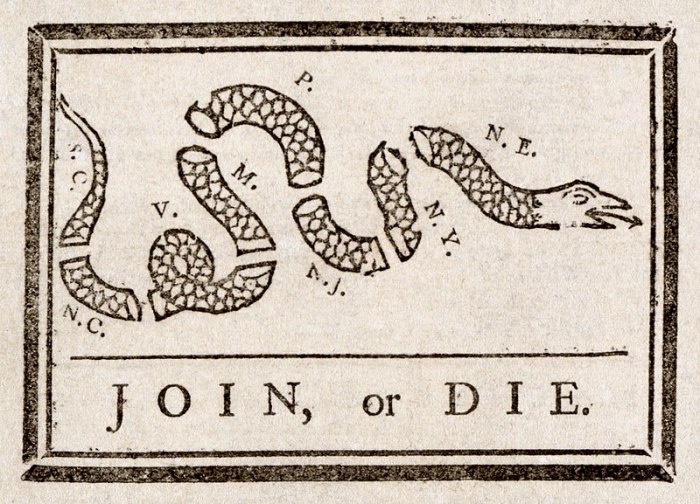
In fact, it was designed by American general and politician Christopher Gadsden in 1775. This “Sam Adams of South Carolina” modeled his patriotic statement first used by the Continental Marines on an earlier famous cartoon from Benjamin Franklin’s Pennsylvania Gazette.


800px-Benjamin_Franklin_-_Join_or_Die


You’ve probably seen it. A snake is cut into several pieces – each representing one of the colonies – with the motto, “Join or Die.”


So originally it was a call for unity, perhaps even federalism. It was a way of framing the argument that we’d be stronger as one nation than as a group of separate states.


Gadsen’s version was really a continuation of that same thought. It was as if he were saying, “Here we are, one unified nation ready to strike to protect itself from tyranny.”


It wasn’t until 2009 that Gadsen’s flag became associated with the radical right.


Like so many hitherto nonpartisan symbols, it was appropriated by the Tea Party movement, which tried to cast their libertarian extremism as somehow harkening back to the American Revolution.


Even the name Tea Party is a misnomer. The original Boston members of the Sons of Liberty who threw British tea into the harbor in 1773 were protesting taxation without representation. Modern day Tea Partiers were protesting the taxes levied by their own duly elected representatives.


They were poor people duped into thinking the rich paid too much despite the fact of gross income inequality and the wealthy not paying their fair share.


It’s this willful ignorance that typifies the contemporary right.


The truth doesn’t matter. It only matters what can be spun into a pithy sound bite that can be broadcast on Fox News or some other propaganda source and then repeated ad infinitum in place of any real debate or conversation.


To be fair, the left does it, too, but not nearly to the same degree.


When a topic makes the rounds of the 24-hour news cycle, you can hear the same canned responses from right and left on just about every channel regardless of who is speaking. The only difference is that the left usually makes at least passing reference to reality while the right closes its eyes and says whatever it believes to be true with perfect conviction.


The Gadsen flag is a perfect example of this hypocrisy.


The motto “Don’t Tread on Me” has come to mean radical individual freedom.


I can do whatever I like and there’s nothing you can do about it.


I can own as many guns as I like. I can teach my kids whatever facts I like. I can discriminate against anyone I like.


But there’s never a mention about other people except to limit what they can do in relation to the speaker.


In short, there’s nothing explicit about making this rule universal – I won’t tread on you if you won’t tread on me.


It’s just don’t tread on me and I’ll do whatever I like in relation to you.


After all, many of these personal freedoms the radical right cherishes actually do impact the rest of us.


Unregulated gun ownership means more shootings, more suicides, more deadly instances of domestic violence, more kids coming to school with semi-automatic guns in their book bags and more malls and theaters slick with bystander blood.


Moreover, if you teach your kids whatever facts you like, that means you indoctrinate them into your worldview. You don’t give them the chance to see the real world for what it is in case they may have different views on it than you do. This impacts both your children and the country, itself, which will have to somehow run with a greater portion of ignorant and close-minded citizens.


And don’t get me started on discrimination! You think you should be able to say whatever you like to whomever you like whenever you like. It’s fine to wear a t-shirt calling Hillary Clinton a “cunt” but when late night comedian Samantha Bee does the same to Ivanka Trump, you’re up in arms!


You think you can support laws that allow bakers to refuse to make wedding cakes for gay couples but are raving mad when a restaurateur refuses service to Sarah Huckabee Sanders!


This kind of sanctimonious duplicity has real world consequences.


Unarmed black people are shot and killed by police at a much higher rate than white people. Yet you won’t tolerate any protest, condemnation or protest. People can’t assemble in the streets, athletes can’t kneel during the national anthem, you won’t even allow the slogan “Black Lives Matter,” because you say, “All Lives Matter,” while in reality you mean “All Lives Except Black Ones.”


You oppose abortion but no one is forcing anyone to have abortions. In your headlong crusade for individual freedom you want to ensure that others don’t have this choice because they might choose differently than you. Or at least they might choose differently than you SAY you do, because when the light of day is cast upon you, we find an alarming number of hypocrites here, too.


There are too many far right politicians who campaign on overturning Roe v. Wade who pressure their mistresses to abort the unwanted issue of their indiscretion.


The underlying cause of such myopia is a perverse focus only on the self.


You look at what you want for you and pay no attention at all to what others should likewise be allowed.


It is the underlying selfishness of post Enlightenment Western thought come back to haunt us.


Hobbes and Locke and Smith told us that greed was good.


It’s what makes the world go round.


You look to your self-interest, and I’ll look to mine, and that’s what’s best for everyone.


However, they forgot that everyone doesn’t have the same power – physical, social, financial or political. Some people are strong and some are weak. Some are rich and some are poor. If you pull the shortest straw at the lottery of birth, you won’t be able to get the same things for yourself as those who won it as soon as the doctor slapped their newborn bums.


So we have layers and layers of class and economics. We have social structures designed to keep black people here and Hispanics there and white people at the top. We have a society that worships the rich and bedevils the poor. We have belief systems that praise one kind of sexuality only and demonizes anything that diverges from that norm. And the most defining thing of any newborn baby is what you’ll find between its legs.


“Don’t Tread on Me” has become a farce.


It’s a maxim hoisted on those with very little individual power to convince them to join together and become powerful while guarding the door for the wealthy.


They sit atop their mountains of trash as if they were dragons on piles of gold.


And they point their pitchforks at the rest of us as if we wanted a piece of it.


In this way, they make themselves the willing patsies of the ruling class.


It’s a sad thing to behold.


Because if we all just stopped for a second and recognized our common humanity, we’d agree that the status quo is unacceptable.


If we were more concerned about the rights of all than just our own rights, we’d agree that the wealth of this great nation has not been fairly distributed.


The snake is coiled and ready to strike but it is pointed in the wrong direction.


It shouldn’t be pointed at 99% of us. And it shouldn’t be so solitary.


It should be a sea of snakes, a great slithering mass of humanity, hissing and spitting with venom, our reptilian eyes focused on the elites.


Don’t tread on me?


Don’t tread on USSSSSSSSSSS!


Like this post? I’ve written a book, “Gadfly on the Wall: A Public School Teacher Speaks Out on Racism and Reform,” now available from Garn Press. Ten percent of the proceeds go to the Badass Teachers Association. Check it out!

WANT A SIGNED COPY?

Click here to order one directly from me to your door!

book-3

Why We Need a Department of Education

what-happens-to-your-body-when-you-fast


Let’s say you have a starving child.


You take out a knife, a fork and a spoon. You hand her a cup.


This isn’t what she needs.


She needs food. She needs water.


But the utensils seem a precursor to meeting those needs.


That’s what the Department of Education has always been – a tool and a promise.


But now the Trump administration wants to do away with even that polite fiction.


Two weeks ago, Secretary of Education Betsy DeVos announced the plan to merge the Education and Labor departments.


The reason you may not have heard much about it – beside the fact that bigger stories have overshadowed it like the forced separation of undocumented children and parents at the border, coercing kids into immigration court without parents or even legal counsel and then locking them up in cages in detention centers – is that the plan has about zero chance of coming to fruition.


Democrats oppose it and there don’t even seem to be enough Republicans in favor to get it through Congress. It may not even have enough support to get a vote.


Unless it’s a huge tax cut for the rich, no one seems able to get any actual laws through this GOP controlled legislature.


Moreover, the proposal is a definite step backward. The Department of Education was created in 1980 by splitting the Department of Health, Education, and Welfare into the Department of Education and the Department of Health and Human Services.


At that time, its purpose was clear. It was a tool to increase funding equity and transparency while protecting students.


After all, the department was an extension of the Elementary and Secondary Education Act (ESEA) of 1965, which tried to bring equity to America’s public schools.


As President Jimmy Carter said upon signing the bill into law:


“First, [the Department of Education] will increase the Nation’s attention to education. Instead of being buried in a $200 billion-a-year bureaucracy, educational issues will receive the top-level priority they deserve. For the first time, there will be a Cabinet-level leader in education, someone with the status and the resources to stir national discussion of critical education concerns.”


Unfortunately, those principles were never fully realized.


The Department did increase funding to public schools, but it didn’t end up dramatically increasing opportunities for the underprivileged.


Sure, it provided targeted grants like Pell Grants that did offer opportunities to select groups of students. But it didn’t radically alter our outdated (even then) funding system.


Our schools are segregated by race and class – worse now than they were then. Since they’re funded primarily by local property taxes, that means the poor and minorities get less funding than richer whiter kids.


And unless you’re willing to let your kids go to a school that receives less funding than others, don’t tell me it doesn’t matter. Rich white people have long complained about the money we spend on other people’s children while doing everything in their power to protect funding for their own.


In the late 1970’s, it was hoped the creation of the Department would be the first step to increasing federal funding of schools to one third of the total cost, thereby leveling the playing field somewhat.


But that never happened.


Now as then, the federal government only funds less than 10 percent of the cost.


To return to the metaphor with which this piece began, the creation of the department was like handing a starving child utensils without much actual food.


As the years have passed, we’ve used those tools for everything except nourishing students.


We’ve fed the child by guiding an empty fork into her cheek. We’ve poked and prodded her mouth with a knife.


The result hasn’t been for her benefit. Instead we’ve let special interests feed off of HERcharter schools, voucher schools, high stakes standardized testing corporations, the ed tech industry and even book and software publishers through the boondoggle of Common Core.


Many have insisted this misuse of the Department means we should do away with it entirely.


I disagree.


The child is still starving. It is still our responsibility to feed her.


You don’t do that by taking away her utensils.


Oh, you can feed her without them, but not very effectively. She can drink from the sink, but not as well as from a cup. She can eat with her hands, but not as easily as with utensils.


This latest proposed merger wouldn’t really satisfy anyone.


It wouldn’t do away with the department – it would hide it behind closed doors.


It would simply make it harder to see what was happening to it.


Moreover, it betrays an ideological bias against education for its own sake. Making the Department of Education part of the Department of Labor implies that the only reason one goes to school to learn job skills.


One can imagine a newly reorganized federal effort to cut anything from our schools that couldn’t be immediately connected with becoming a worker drone. And I don’t mean to imply this would be a new effort, because it’s already what President’s George W. Bush and Barack Obama were using the Department to achieve. But now it would be in the shadows and who knows what monstrosity could grow without the cleansing light of day?


This would help no one. It would be a continuation of the status quo (or possibly a doubling down on it) under a different name.


No one needs that.


What we need is to roll up our sleeves and meet students’ needs.


The child is hungry.


She has been sitting before us starving for decades and all we’ve done is give her the means to eat without the food.


Isn’t it time someone open the cupboard and get this kid something to eat!?


Like this post? I’ve written a book, “Gadfly on the Wall: A Public School Teacher Speaks Out on Racism and Reform,” now available from Garn Press. Ten percent of the proceeds go to the Badass Teachers Association. Check it out!

WANT A SIGNED COPY?

Click here to order one directly from me to your door!
 

book-4

Thank You, Wealthy Robber Barons, for the Freedom to be a Free Rider!


wealhty-myths-business-man_large


Wow! I now have a real choice when it comes to my union!


At least, that’s what the email I got from the Mackinac Center says!


Now that the Supreme Court ruled 5-4 in the Janus vs. AFSCME case, I don’t have to pay any of my hard earned cash to my union!


I can be a free rider! I can get all the advantages of belonging to a union – higher salary, better benefits, better safety precautions – and I can leave it to the rest of the membership to pay for me!


That’s amazing!


And what’s even more amazing is who is sending this email to me!


I mean the Mackinac Center is funded by Betsy DeVos and her family, the Koch Brothers, Eli Broad, the Scaifes, and the Walton family!


Who would have ever thought some of the richest people in the world would take an interest in my union membership!?


How nice of them!


I’m merely a public school teacher! In my more than a decade in the classroom, they’ve spent billions of dollars to weaken my profession!


They lobbied for education funding nationwide to be gutted so they could get another tax cut!


They invested in charter and voucher schools and then demanded we build more of these privatized institutions with little to no accountability so they could rake in record profits!


They’ve weakened education at schools serving the highest populations of students of color and then benefited when those same kids turned to crime and were incarcerated in their private prisons!


Instead of holding politicians accountable for inequitable funding and instead of supporting teacher autonomy, they forced high stakes standardized testing and Common Core on me and my students!


They demanded my administrators undervalue what I actually do in the classroom but instead evaluate me based on my student test scores – so being given struggling students means I’m somehow a worse teacher than the person across the hall with the honors class!


They did all that but suddenly they’re concerned about my freedom to withhold union dues!?


Well Golly!


Jeepers!


Gee Willikers!


Goodness gracious and bless my soul!


I must have been wrong about these fellers and these ladies all along!


They really DO care about little people like me!


Did you know that a 2011 study by researchers at Harvard and the University of Washington concluded that higher union membership encourages higher pay across the economy!?


It’s true!


They said the decline of unions accounts for as much as one-third of the increase in wage inequality since the 1970s!


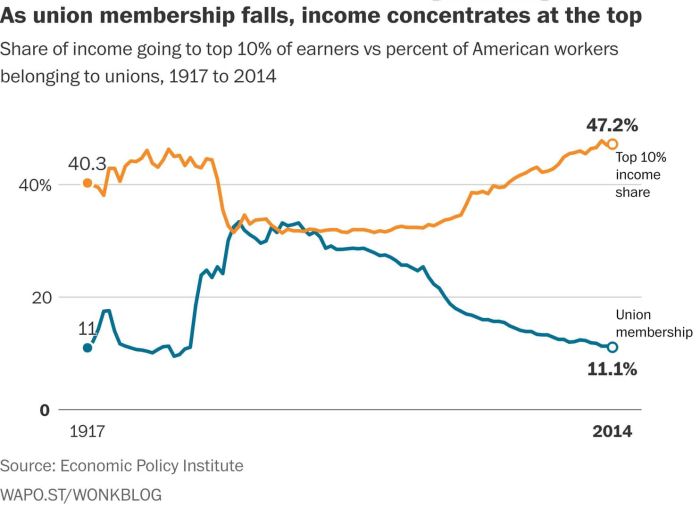
According to the Economic Policy Institute, when union membership goes down, the wealthy make more money! Conversely, the more union membership goes up, the less money goes to the wealthy!


6BILJESJ744BVLL2QVZYGJRNCM


And despite all that, the rich are concerned that I have the right to stop paying union dues!


I mean if I stop paying my dues and my fellow working stiffs stop paying their dues, then my union might just have to close up shop!


And that would mean my wages would go down!


But these same rich people who just sent me an email would see their investments go up!


They’d take home sacks of cash! So much money that they’d probably drop some and maybe I might be able to pick up a few pennies they leave on the curb!


Isn’t that great!?


You know public sector employees including firefighters and police, and teachers like me are the largest sector left of the workforce still represented by unions!


According to BLS statistics, 38 percent of public sector employees are represented by unions!


It’s true!


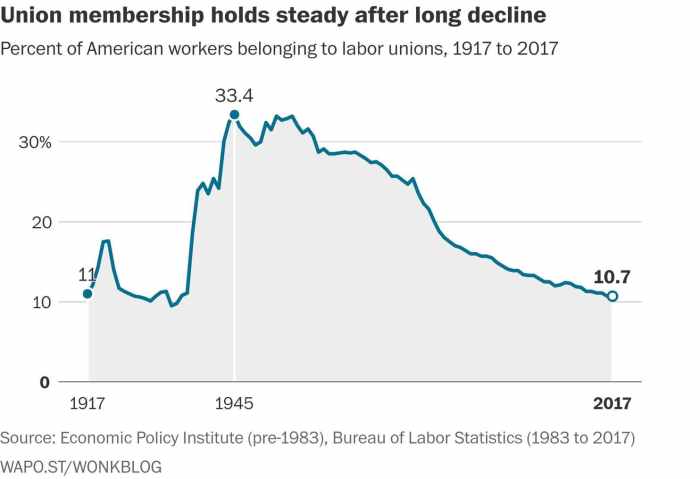
Back in 1945, union membership nationwide was at its highest rate of 33.4%! That means back then about a third of all American workers belonged to a union!


Last year it was down to 10.7 percent!


YC4GHPZ5MI5DHNQVM2TN4E4JZI


In the intervening years, manufacturing jobs have declined, blue collar jobs have been outsourced and both political parties have passed laws making it harder to unionize and collectively bargain!


But thank goodness I now have the right to get something for nothing from my union!


That’s going to perk things right up!


Sure, numerous studies have shown that declining union membership is one of the major causes why middle class wages have remained basically flat! But I get to keep a hundred bucks in my pocket so everything’s square!


One thing worries me, though!


I’m not sure many union workers are going to take advantage of this new freedom!


Don’t get me wrong – I don’t agree with everything my union does! No one could say that!


I don’t agree with everything my government does, either, but I still pay taxes!


And I wouldn’t stop paying taxes even if I could! I like being an American citizen, and I like much of what my government provides by way of our military, infrastructure and social programs!


It’s the same with my union!


I mean I LIKE earning higher wages! I LIKE getting better benefits! I LIKE knowing I work in a safe environment!


And when I have a better working environment, my students have a better learning environment!


I doubt many of my co-workers are going to stop paying their dues just because they can!


UWLMMCVEKY3ZFDE5K6LGDY42PE


We’re not stupid! We know that if you want union benefits, you have to pay union dues! The Supreme Court can say whatever it likes! It can’t legislate passed reality!


Moreover, who would want to associate with a co-worker who refuses to pull his or her own weight!?


If I found out one of my colleagues was leaving it to me to pay for both of us, I’d throw a fit! I wouldn’t associate with that person!


If he or she came to my room asking for advice, I’d tell them to get lost! I wouldn’t eat with them at lunch, I wouldn’t chat about their day, I’d give them their walking papers, myself!


Frankly, the social cost would be higher than just paying your union dues!


So thanks anyway, Mackinac Center! Thanks anyway, Charles and David Koch! Thanks anyway, Betsy DeVos!


I’m sticking with my union.


36468177_10156001729458860_2645036208874323968_n


Like this post? I’ve written a book, “Gadfly on the Wall: A Public School Teacher Speaks Out on Racism and Reform,” now available from Garn Press. Ten percent of the proceeds go to the Badass Teachers Association. Check it out!

WANT A SIGNED COPY?

Click here to order one directly from me to your door!


book-2