Your parents dress you in your best new outfit – maybe a nice pink jumper with a unicorn on it.
They help you tie your new sneakers – that’s right, two loops and a knot.
Then they put a surgical mask snugly over your mouth and nose, adhere a clear plastic face shield from your forehead down and snap some latex gloves on your hands.
“Off to school, Honey!”
“Don’t forget your antibacterial soap and Clorox wipes!”
What do you suppose would be going through your mind?
Would you feel safe? Would you feel loved? Would you feel valued?
Or maybe they do care enough but have no other choice. They’re “essential workers” and have to go to a series of minimum wage jobs to keep you fed, clothed and sheltered.
How would you feel about the people who own those jobs? The society that prioritizes keeping those jobs going instead of paying your parents to stay home with you?
Isn’t it just a big game of Monopoly? Players keep rolling the dice and landing on each others’ properties and having to pay rent. Hoping this turn you’ll make it past GO and collect $200.
With the exception of food, there’s nothing you really need outside of your home. If your parents didn’t have to worry about rent or utilities, they wouldn’t have to work. Yes, they’d need to go out to get food but the government could pay them to do that, too.
After all, it’s just Monopoly money. It’s just decorated pieces of paper. It has no inherent value… not like human lives.
I mean we’re living through a pandemic here. Leaving the house means exposure to the virus, and the longer you have to go out, the more people you’re exposed to, the greater the chances that you’ll get sick and/or bring the thing back home with you.
How would you feel about the school board members who compromise and say you only have to be put at risk for half the day or just so many days a week? Would that make it all better?
How would you feel when time-after-time the grown ups show you exactly how they feel about you, how little you actually matter, how much everything else is worth and how little they really care about you?
How would you feel if you were a little school kid getting ready for her first day of class this morning?
Would you feel safe, valued, loved?
What lesson would you take from everything happening all around you?
Some people are very worried that you won’t learn anything much this school year.
I’m afraid you’ll learn far too much.
Like this post? You might want to consider becoming a Patreon subscriber. This helps me continue to keep the blog going and get on with this difficult and challenging work.
On the other hand, they don’t want to be sued by children, families or staff who get sick or die as a result of reckless reopening plans.
The National School Boards Association (NSBA) is behind a push at both the state and federal level for temporary, limited liability protections in case students or staff become infected with Covid-19.
The organization is asking state legislatures and US Congress to pass bills including such protections.
At the same time, the organization is pushing state governors and the President to pass the plan through executive orders.
None of which should fill residents with confidence.
After all, would you want to eat at a restaurant where the chef refuses responsibility if diners get sick?
Would you want to fly on an airline that doesn’t guarantee you’ll make it to your destination in one piece?
In Pennsylvania, this has lead to discussions of the reopening guidelines issued by Gov. Wolf.
“I keep hearing the expression, ‘We are simply giving guidance or recommendations,” state Sen. Andy Dinniman, D-Chester, said. “In the end, is it not true that what you say is a recommendation, ends up being a mandate because school districts are afraid of being sued and taxpayers losing millions of dollars?”
Dinniman – who I often agree with – seems to be saying that districts should be free to ignore safety guidelines. And they are.
But doing so should come with a price.
The guidelines – which are too lenient in my opinion – at least set up some benchmarks.
However, these guidelines miss a vital component of epidemiology. One week’s worth of data is insufficient to get an accurate picture of viral spread. Covid-19 symptoms take up to two weeks to show up.
You could have low numbers this week and decide to reopen school buildings to a hybrid model, but then next week have a surge. And those people would have been sick when you reopened – you just didn’t know because it took another week for their symptoms to develop.
We are acting like spoiled children who want to do what they want and refuse to be held accountable for their actions.
Sadly it is our children who will most often pay the price for adult recklessness.
Like this post? You might want to consider becoming a Patreon subscriber. This helps me continue to keep the blog going and get on with this difficult and challenging work.
So it’s back to school time, and – let me tell you – am I ready to return to the classroom! Actually, I’m just bursting to pop onto campuses for the FIRSTtime this year.
When I came to these shores way back in March, some spoil sports decided to shut down the schools before I could really get in there.
You locked up your kids tight at home and did this distance learning thing online instead.
That really sucked. All I had was full grown bodies to infect.
I mean I wanted some nice young things to cuddle up to and bust my viral proteins through their ACE2 receptors. You know what I mean?
Kids are great! They’re not as fanatical about washing their hands as adults; if they get a runny nose, they wipe the mess on the back of their fingers; and they touch EVERYTHING!
Right now in most places I’m swirling around in aerosol plumes of nasal droplets in the occasional home, bar, and restaurant, but I’m kinda stuck.
There are only so many times I can infect the same people. And if they’re wearing masks properly and washing their hands, it’s just too much hassle.
If I really want to up my contagion game – and I do – I need someplace where I can mix with new hosts and then travel back to their cribs and just snuggle in.
No crowds at concerts or big sporting events – even the amusement parks and political rallies are drying up.
But now that you’re reopening schools, I can go exponential, baby!
Mark my words – September is going to be the season of the Coronavirus! We’re going to make the spring look like a mere dry run!
Second wave, third wave – and I have you to thank for it.
There are so many people out there I’m indebted to.
First of all, I’ve gotta acknowledge all the anti-science folks. If it weren’t for you guys, more playas might actually be taking precautions against me.
And the libertarian crowd! Wow! You guys are working overtime! No one can tell you to put human lives before a stunted adolescent definition of absolute freedom!
But of course, the first prize has to go to President Trump! He’s the trifecta! Science denial, me first, class warfare zealot! Not only did he disband the government’s pandemic task force, but he advised people to drink bleach – I mean BLEACH!– as a remedy to infection!
Sir, you truly deserve the title “honorary pathogen.” If we ever meet, I’m not sure if I’d infect you or you’d infect me.
Of course, it’s the everyday folks who really make the most difference.
The anti-maskers, the people holding house parties and cook outs, the families throwing care to the wind and going to amusement parks, the people who recklessly eat at crowded restaurants… and school board members opening up their buildings…
School directors, I would be no where without you.
Your steadfast determination to keep school buildings open despite any niggling facts or science or news… I just can’t tell you how much it means to me.
It doesn’t matter whether you’re opening up for full days or half days or alternate days. You’re giving me the chance to shine. I won’t forget it.
Where else in the animal kingdom would potential hosts try to shop their way out of an epidemic? I’ll tell ya, bats don’t act this way. Believe me. I know.
And, hey, that’s fine with me. If black lives don’t matter to you, I’ll take ‘em! I’ll burrow into the mucous membranes of anyone’s throat. It all kinda tastes like chicken.
Once your classrooms are splattered with respiratory droplets from ill-fitting, shared or discarded masks, once your hallways are infested with my slime and contagion, once your athletic fields and band rooms and teachers lounges are dripping with my love – just know this: I won’t ever forget you.
You have been truly great. Really.
Infectiously yours,
Coronavirus
Like this post? You might want to consider becoming a Patreon subscriber. This helps me continue to keep the blog going and get on with this difficult and challenging work.
At McKeesport Area School District (MASD), Dr. Mark Holtzman and administration propose unlocking the doors for half day in-person classes Mondays through Fridays.
Kids would be split into two groups – one attending in the mornings, the other in the afternoons. That way, with buildings at half capacity, there would be enough physical space for social distancing. The remainder of the time, kids would be learning online.
However, if you don’t approve, you can opt out.
Any parent who is uncomfortable with this plan could keep his or her children home and have them participate in the district’s existent cyber program.
The board hasn’t voted on the proposal yet. It won’t do so until Wednesday.
Which brings up the question – is parental choice enough?
Is the fact that I can choose for my daughter the only concern I should have?
Thankfully, no one is forcing me to subject my child to in-person classes. If I don’t think they’re safe, I can keep her away and still have access to an education for her through the Internet.
What else do I want?
Plenty.
First of all, the quality of education offered by the district cyber program is not the same as the district could provide if all students were enrolled in virtual classes.
Dr. Holtzman has outlined what that would look like if school buildings were shut down by the governor or the district were overcome with sick students, teachers and/or family.
Teachers would provide synchronous classes online through video platforms like Zoom. Students would get to interact virtually with each other and their teachers.
By contrast, the existent cyber program is asychronous. Students watch videos and do assignments at their own pace, but human contact and social interaction – even via the Internet – is much harder to come by.
Both cyber options are preferable because they avoid these problems. But one of them – the synchronous option with a dedicated class and a teacher behind the curriculum – is superior to the one being offered.
Is it selfish to want the better plan for my daughter?
Should I just be glad I have a choice at all? Should I put the individual good of my child aside for the good of others?
No. Because administration’s plan is not in the best interests of other children, either.
If we reopen schools to in-person classes, chances are good that kids will get sick.
Children typically had low infection rates because schools were closed in March and kids were quarantined before the virus had spread through most of the country.
If the virus is present in the community – as county health department data shows – opening the schools to students also opens them to Coronavirus.
But with the schools open, the virus will no longer be confined to just a few homes. It will come with kids to class and spread among students and staff before it’s brought to their homes as well.
That’s how epidemics work. Opening the schools will spread the virus throughout the entire community.
And that will affect me, too, regardless of whether I choose a cyber option for my daughter or not.
When I go to the local grocery store, gas up my car, even go for a walk – I will be more likely to come into contact with someone infected with the virus and get sick.
I can make the safe decision for my family but still suffer the consequences of the irresponsible decisions of others – especially school directors.
In fact, it doesn’t even have to be my own local school board. The decisions of school directors in neighboring districts affects me, too.
After all, in my part of the state, school districts are pretty small geographically – not nearly as large as most counties. There are 42 public districts in Allegheny County, alone. So it should be no surprise that I routinely travel through several different districts just running day-to-day errands.
MASD school directors can decide to keep buildings closed (and I hope they will) but if a district just one township or borough over decides differently, we will suffer the consequences in McKeesport, too.
Since I don’t live in more than one district, I don’t get a say in what school directors at neighboring districts decide. I just have a say in what happens in my tiny portion of the world. But the consequences are not nearly as respectful of our man-made borders.
For instance, I work as a teacher at a neighboring district. But since I do not live there, I am barred from speaking at the board meetings unless I am invited to speak as an employee of the district.
I can give a report as part of the safety commission if invited by administrators, but I can’t otherwise sign up to speak as an employee concerned about how district policies affects me, my students or their families.
I’m a believer in local control, but sometimes control can be too localized.
This is why you haven’t heard much from many educators. If they’re allowed to speak, they’re often afraid of how doing so will make them a target for reprisals. If they can get their union to back them, they can speak collectively that way, but otherwise, they have no pathway to being heard at all.
As a parent, I get a choice for my child in my district.
But what choice do teachers have – especially if they don’t live where they teach?
That concerns me even with my choices as a parent.
I’ve had some outstanding teachers. My daughter loves her teachers. Is it okay if I don’t want to see them get sick and their lives cut short? If I worry about my own chances of surviving the pandemic and the demands of my employer?
I think their lives matter. But as minorities and people subjected to systemic inequalities, they get less of a say in policy. Should decisions that disproportionately impact their health really be up to a committee? Doesn’t their right to life surpass the decisions making abilities of a handful of elected officials or even middle and upper class parents?
Don’t get me wrong. I’m thankful I have choices as a parent for how my daughter is educated.
School directors need to make reopening decisions that are in the best interests of everyone because we’re all in this together.
That’s what so many folks seem to be forgetting.
Yes, even from a completely selfish point of view, unsafe school reopening will affect each of us.
But epidemics spread through communities. Only communities can effectively combat them.
Dividing ourselves into smaller and smaller fiefdoms only empowers the virus. If we all try to fight Covid-19 individually, we will lose.
We have to understand that what’s good for our friends and neighbors is in our individual interest, too.
We have to care about our fellow human beings.
That’s why I will continue to fight these unsafe plans and ask school directors to reopen schools virtually.
That’s the path I’ve chosen.
Like this post? You might want to consider becoming a Patreon subscriber. This helps me continue to keep the blog going and get on with this difficult and challenging work.
So I gathered my thoughts, put on my mask and went to the work session meeting.
This is what I said:
“Thank you for allowing me to address you this evening. I appreciate all the time and effort you put forward to lead the McKeesport Area School District and do what’s best for students, staff, and families.
I am a life-long resident of this community. Most of my family graduated from this school as did my brother and I. Before I got a job as a teacher at a neighboring district, I subbed here in the high school for years. My daughter has attended the district for the past 6 years and has received a first rate education so far.
This is not a safe plan for students, staff and families. I ask you to reconsider and move to a reopening plan that begins with all students engaged in distance learning.
Safety has to be the primary consideration in reopening plans during a global pandemic. Maslow tells us kids cannot learn effectively unless their bedrock needs such as safety are met.
I appreciate Dr. Holtzman’s concerns about academic loss from distance learning – and under normal circumstances I would agree with him. However, these are not normal circumstances. The kind of academics he is proposing will not be as effective as he seems to believe.
Kids would have roughly 20 minute classes. As a classroom teacher, I know that little more will get done than taking role and getting kids ready to start. I am glad Dr. Holtzman reconsidered his original plan. which would have allowed students to forgo masks in the classroom and congregate only 3 feet apart. He is right to increase precautions with mandatory masks and 6 feet social distancing. But let’s be honest. If you think students will abide by them, you are engaged in magical thinking. Moreover, these precautions will inevitably have a negative effect on learning. Screen-to-screen instruction is less effective than face-to-face instruction, yes. But Mask-to-mask is NOT face-to-face. We may achieve more academically keeping kids online than trying to instruct through plague conditions.
But even if I’m wrong about that, it’s simply not worth it.
No academics is worth the death or debilitating illness of a child, family member or teacher.
Kids don’t learn well when their teachers are in quarantine. There are few accommodations made for special needs students on a ventilator. Childcare is the least of your worries if you survive the virus but are left with a lifelong disability as a result.
If we invite kids back into the classroom, we invite COVID-19 as well. If the virus is present in the community – as county data indicates – it will get into our schools where even the best precautions will not stop it from spreading and being brought home to families.
There is significant evidence that even the youngest kids can and do get sick. And those 10 or older are just as susceptible and can spread the disease at least as easily as adults.
Moreover, the CDC reports that African Americans and other people of color are hospitalized from COVID-19 four to five times more often than white people. What are we saying to our black and brown brothers and sisters if we value their health so cheaply. Don’t their lives matter?
And for those who respond that only a certain percentage of children and adults will die, which members of your family are you willing to sacrifice?
Whose lives are you willing to bet and do you really have the authority to play God?
We’re talking about human life here.
Speaking of which, let’s not forget our teachers and school staff.
Parents at least get a choice whether to send their kids to school in-person or opt for a cyber option. Dr. Holzman’s plan gives no such choice to staff. It does little to protect them from exposure to the virus. If you approve it, you are demanding staff decide between their employment and the possibility that they may take the Coronavirus home to their own children and families.
I have had some amazing teachers in this district who changed my life and made me the person I am today. My daughter loves her teachers. Approving this plan would be a slap in their faces.
Please do not approve Dr. Holtzman’s reopening plan. Instead have all remote instruction until there have been no new cases in the county for a full two weeks.
Only then will it be safe to reopen school buildings.
Thank you.”
Superintendent Dr. Mark Holtzman responded:
“I’d like to respond to a couple of those statements if you wouldn’t mind.
First of all, it’s not Mark Holtzman’s plan. It’s the McKeesport Area School District’s plan. I worked with my administration tirelessly to make those efforts happen. I’m very proud of the efforts that we made. The time and effort that our administration put in.
I think moving forward looking at the big picture there is a virtual option for families so you are welcome to utilize or exercise that opportunity.
Unfortunately we are commissioned to make a very difficult decision for what’s the betterment of all children and providing options for those families that choose to use virtual learning as a platform is available to yourself, your family and anybody else’s family that is interested.
To say that it’s not fair for one person such as yourself or myself to make a decision to totally not have school in-person, I don’t know is the right decision as well. So I think we’re in the middle of this discussion where I think the best decision is not always the easiest decision.
We’re very comfortable with the proposal that we’re making and we hope that you can find the decision that is within those couple options that is in the best interest of your family.”
(My comments begin at 16:27. The audio is a bit muffled because I kept my mask on while speaking.)
(Dr. Holtzman’s response begins at 23:13)
The school board is set to vote on the reopening plan next week at its meeting on Wednesday, Aug. 12, at 7:30 pm at the high school.
I still hope school directors vote to begin the year with virtual classes.
Like this post? You might want to consider becoming a Patreon subscriber. This helps me continue to keep the blog going and get on with this difficult and challenging work.
If we reopen schools, we invite COVID-19 into the classroom just as well as students.
So far as we know, the virus doesn’t care what your motivations are. It only infects as many people as it can leaving us to deal with the consequences.
Consider what the virus does to the human body.
According to the Center for Disease Control (CDC), exposure to the virus can result in mild symptoms to severe illness up to two weeks later. These include fever or chills, cough, shortness of breath or difficulty breathing, fatigue, muscle or body aches, loss of taste or smell, sore throat, nausea or vomiting and/or diarrhea.
People who are sick should stay home, monitor their symptoms and separate themselves from other members of the household.
You should seek immediate medical care if you experience trouble breathing, persistent pain or pressure in the chest, confusion, inability to stay awake and/or bluish lips or face.
Severe illness often requires hospitalization that attempts to relieve the most common complications. These are things like pneumonia, hypoxemic respiratory failure/ARDS, sepsis and septic shock, cardiomyopathy and arrhythmia, and acute kidney injury.
However, you also have to beware additional complications from prolonged hospitalization. These can include secondary bacterial infections, thromboembolism, gastrointestinal bleeding, and critical illness polyneuropathy/myopathy.
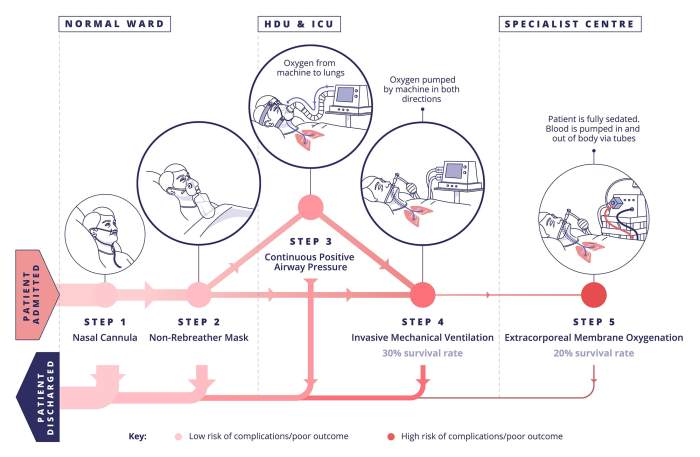
Managing blocked airways is a particular concern. This can be done in less severe cases with simple nasal cannula or oxygen rebreather masks. However, in more extreme cases, you may need continuous airway pressure provided through a machine or even invasive mechanical ventilation.
The chances of this happening to you or a loved one because your neighborhood school building was reopened and children were exposed to potentially sick classmates and staff is far from negligible.
These include inflammation of the heart, cardiovascular disease and strokes; lung inflammation including persistent shortness of breath; and neurological issues such as headaches, dizziness, trouble concentrating or recalling things and even hallucinations.
Teachers and classrooms provide necessary services way beyond simple education.
I’m talking about food, nutrition, healthcare, childcare, counseling, tutoring, socialization, self esteem, meeting special needs, protection from abuse and a whole lot more.
If we keep school buildings closed and go to distance learning as we did in March, many of these services will continue to be disrupted or completely severed.
While reopening school buildings is NOT a viable solution, there are other things we can do.
Food, nutrition and healthcare can all be met while conducting distance learning. In fact, most schools provided these services from March through June as classrooms across the country were closed.
Likewise, counseling, tutoring, socialization, and self esteem can be provided on-line. In most cases they won’t be as effective as they would be in a physical setting. However, given the precautions necessary to meet in-person – face masks, social distancing, etc. – they may be more effective screen-to-screen than they would be mask-to-mask.
Which brings me to the most difficult considerations – meeting special needs, protection from abuse, and childcare.
Special arrangements could be made for these students to come into the physical classroom on a part-time or full-time basis. This isn’t as safe as complete on-line learning, but if the numbers of students are small enough, precautions such a temperature screenings and social distancing were in place and exposure mitigated, this could be a viable option.
The same goes for protection from abuse. Some students live in unsafe home environments. It is observation by responsible adults who are mandated reporters like teachers that reduce the likelihood these children will be mistreated and provide a solution when abuse is reported. However, noticing the telltale signs of such mistreatment or even communicating with a teacher privately outside of the hearing of an adult in the home is more difficult on-line.
Special arrangements could be made for students who have already been identified as at risk. They could meet with counselors and psychologists in the school every week or so. Safety precautions would be necessary but the risk could be reduced enough to make it worth taking.
The biggest problem is probably the most widespread – childcare.
Having children at home to do their schoolwork on-line puts additional pressure on parents.
In short, the economy requires some kind of daycare for these children.
Many European countries that have best managed the Coronavirus have paid workers to stay home. This allows them to take care of their own children and reduce their own exposure to the virus.
However, our government has almost completely abrogated its responsibilities to working class people.
Parents with similar age children can create childcare networks where the same families take turns watching each others’ children. This reduces exposure to some degree.
Childcare centers also have been kept open in many communities to meet this need. However,there have been massive outbreaks at such centersacross the country that would only be worsened if we rely on them more. Any sane country would close them just as it closed schools.
Until our lawmakers get off their butts and do their jobs, we will have no good solution to this problem.
Reopening school buildings to serve as childcare centers certainly won’t solve anything except put a premium on respirators, coffins and graveyard plots.
We need to make it possible for parents to stay home with their children.
And we need to do it now.
Like this post? You might want to consider becoming a Patreon subscriber. This helps me continue to keep the blog going and get on with this difficult and challenging work.
(1) Open schools completely to in-person learning with safety precautions
(2) Keep classes entirely on-line as they were in April and May
(3) Offer some kind of hybrid of the two
Many schools are opting for this hybrid model.
This means reopening to in-person classes part of the time and on-line learning for the rest.
There are many ways to do this.
In my home district of McKeesport, this means having half of the students attend in the morning and the other half in the afternoon with the balance of their class work being done via the Internet.
In Steel Valley, the district where I work as a middle school teacher, this means half of the students attending full days on Mondays and Tuesdays, half on Thursdays and Fridays and the building is deep cleaned while students are taught completely on-line on Wednesdays.
In either case, parents can opt-in to an entirely virtual plan, but it’s expected that most adults would choose the hybrid model with its partial in-person classes for their children.
The hybrid model, then, is tantamount to putting children, teachers and families at risk for a reduced amount of time.
Why take the risk? On the premise that in-person instruction is more robust than on-line learning. Students learn more in the classroom from educators who are physically present than they do on the Internet.
There is significant evidence to back that up. However, this premise ignores the fact that invasive but necessary safety measures like wearing masks and practicing social distancing throughout the day will inevitably have negative effects on learning.
That is not an insignificant risk. We have an infection rate of nearly 10%. We have some of the highest numbers in the state.
I don’t know how anyone can look at those numbers and conclude anything except that the risk of infection is GREATER today than it was when we took more precautions against it.
Moreover, the situation is little better nationwide.
Moving into Phase 1 would require a “Downward trajectory or near-zero incidence of documented cases over a 14-day period.” Moving to Phase 2 would require a “Downward trajectory or near-zero incidence of documented cases for at least 14 days after entering Phase 1.”
No state has experienced a “downward trajectory” for COVID-19 cases for 28 straight days. In most states, cases are increasing.
That document suggested several expensive and difficult safety measures such as broad testing of students and faculty and contact tracing to find people exposed to an infected student or teacher – none of which is being done locally.
However, no matter how you look at it, reopening school buildings – even with a hybrid approach – increases risk significantly.
If school buildings are reopened with students and staff coming and going – even at a reduced rate through a hybrid plan – one would expect the virus already present in the community to gain access to our schools where it would be further spread to different segments of the community.
Schools are great meeting points. They are where local neighborhoods connect, learn, grow and share. Reopening them in a physical fashion allows for greater sharing of any easily communicable diseases in the area.
So exactly how communicable is COVID-19?
It’s often compared to influenza which infects millions of people every year yet these outbreaks rarely close schools.
Only about 0.1 percent of the people who got the flu in the US last year died of it, according to the CDC. Yet about 5.2 percent of those who came down with COVID-19 have died, based on the reported totals of cases and deaths.
During the 2018-19 flu season, about 34,000 people in the US died, according to the CDC. So far, 143,193 people have died of COVID-19 in the US, as of July 23.
Some say that even given such statistics, children are less susceptible than adults.
However, the virus was only discovered in 2019. So little is known about it – for instance, the low percentage of cases in children may be because schools were closed in April and May before many kids were exposed to it.
A recent South Korean study – the most in depth of its kind to examine how the virus affects children – found that it is especially active in older kids.
“For people who lived with parents between the ages of 10 and 19, 18.6% tested positive for the virus within about 10 days after the initial case was detected — the highest rate of transmission among the groups studied. Children younger than 10 spread the virus at the lowest rate, though researchers warned that could change when schools reopen,” wrote Stephen Stapczynski for Bloomberg News.
“So long as children are not just a complete dead end – incapable of passing the virus on, which does not seem to be the case – putting them together in schools, having them mix with teachers and other students will provide additional opportunities for the virus to move from person to person,” he said.
Do such facts represent an acceptable risk for opening schools – even with a hybrid model?
Education Secretary Betsy DeVos says it does.
She said, “there’s nothing in the data that suggests that kids being in school is in any way dangerous.”
However, if even .02% of public school students were likely to die if school buildings were reopened, that’s 11,320 children!
Are we willing to risk the lives of tens of thousands – perhaps more – children on the unproven promise of a slight improvement in academics?
And keep in mind that doesn’t even take into account the cost to adults.
According to a new report from the Kaiser Family Foundation (KFF), 1 in 4 teachers in the U.S. – roughly 1.5 million people – are at increased risk for complications if they become infected with the Coronavirus. This includes educators over the age of 65 and those – like myself – with a pre-existing health condition that makes them more vulnerable.
According to the CDC, death from COVID-19 is significantly more common in older adults. Though the median age of U.S. teachers is 42.4 years, nearly 19 percent of teachers are 55 and older, reports the National Center for Education Statistics.
Health conditions such as diabetes, cardiovascular disease and kidney disease also increase one’s risk for serious illness from the virus. The CDC warns that roughly 60 percent of American adults have at least one chronic medical condition, and about 40 percent have two or more.
The situation is even more dire when we look at parents and grandparents in students’ homes. The KFF issued a report in July concluding that 3.3 million adults 65 or older live in a household with school-age children.
And let’s not forget the racial component.
Most minorities are more susceptible to COVID-19 because of the higher rates of social inequality they are forced to live under.
According to the CDC, Native Americans and Black people are hospitalized from the Coronavirus five times more often than White people. Hispanic and Latino people are hospitalized four times more often than White people.
Physically reopening school buildings in communities that serve large populations of people of color, then, invites greater risk than in predominantly white communities.
In any case, though, reopening school buildings – even under a hybrid model – significantly increases the risk for all the people living there.
So in summary, it is clear that the three basic options for reopening schools each offer different levels of risk.
A full reopening of schools even with safety precautions brings the highest risk. However, the hybrid model also brings significant danger to students, teachers and families – even if somewhat less than full reopening.
Distance learning has the lowest risk of all. It keeps most children physically separate from each other and thus limits exposure to the virus to the greatest extent. Likewise, it limits jeopardy for educators and other adults because teachers would mostly come into contact with children through the internet and parents would not be further complicated through potential viral contacts of their children.
From an academic standpoint, distance learning certainly has its drawbacks compared with face-to-face learning. But compared with mask-to-mask learning, virtual instruction may actually be preferable.
In any case, increased risk of death or debilitating disease has a chilling effect on learning for all involved.
In most communities – perhaps all – a decision on school reopening that balances safety with academics would lean toward distance learning above anything else.
Even if on-line learning turns out to be less effective than that provided in the hybrid model, any deficiencies can be targeted and ameliorated once the pandemic ends.
As yet, death admits of no such remedies.
Like this post? You might want to consider becoming a Patreon subscriber. This helps me continue to keep the blog going and get on with this difficult and challenging work.
The $660 billion federal initiative was intended to help businesses keep employees on the payroll and off unemployment benefits during the COVID-19 pandemic. The loans will be forgiven if businesses meet certain conditions such as retaining or rehiring employees.
Pennsylvania got $523 million to distribute to both authentic public schools and charters. However, of the two, only charters were eligible for additional PPP funds.
Since Imagine writes the Environmental Charter’s operating budget, the management company ends up paying itself for a number of services.
After the school gets funding from state, federal and community taxes (this year including bailouts from PPP and the CARES act), it pays 12 percent back to Imagine. This came to $406,000 in 2009, according to an independent financial audit.
The school also pays Imagine on a $250,000 loan that the charter operating company took out to launch the program. Payments come out to about $2,500 per month over 20 years with an interest rate of 10.524 percent.
The charter also pays Imagine rent on its building which was purchased in 2006 by Schoolhouse Finance – Imagine’s real estate arm – for $3 million.
Like the Environmental Charter, this so-called nonprofit hires a management company. In this case, it’s the infamous K12 Incorporated – a nationwide cyber charter network with a record of academic failure and financial shenanigans.
In 2016, the company reached a $168.5 million settlement with the state of California. The state claimed K12 had reported incorrect student attendance records and otherwise lied about its academic programs. The company ended up settling with the state for $2.5 million with an additional $6 million to cover the state’s investigation and K12 voided $160 million in credits it had given to the affiliated schools to cover the cost of their contracts.
Hill House offers a blended model with in-person teachers and virtual classes somewhat different than most K12 schools.
Penn Hills School Board – a duly elected body, not government appointees – outlined criticisms of the charter that do not put the entrepreneurial venture in a positive light.
Penn Hills School Board said the charter had failed to produce current student rosters, failed in record management, failed to accurately maintain student tuition payments, improperly billed the school district for special education students, failed to maintain and develop Individual Education Plans (IEPs), had poor academic growth and is under a Department of Education Corrective Action Plan setting forth 31 areas of needed improvement.
Finally, the charter school sucks away necessary funding from the authentic public school. The Penn Hills School District paid Imagine about $3 million in 2014-15. Costs increased to $12 million a year and continue to rise.
Nina Rees, executive director of the National Alliance for Public Charter Schools (NAPCS) has spoken out of both sides of her mouth on the issue. She has insisted that charter schools be regarded as public schools and eligible for emergency aid – all the while advising charter schools also to apply for federal rescue funds for small businesses devastated by the pandemic.
Carol Burris, Executive Director of the Network for Public Education, did not mince words.
“Once again, the charter sector, through the lobbying efforts of Nina Rees…worked behind the scenes to gain fiscal advantage for the privately operated schools they claim are public schools.”
“Charters claim to be ‘public schools’ when that’s where the money is,” she said. “But when the money is available for small businesses, they claim to be small businesses.”
Charters go where the money is.
We get the privilege of paying the tab.
If it were up to U.S. Treasury Secretary Steve Mnuchin, we wouldn’t even know about it.
ProPublica has put all the information into an easy to use search engine. Just enter a zip code and it will display all the businesses located there that received PPP loans.
This includes high tuition private prep schools like Sewickley Academy and Shady Side Academy both of which got $2 – $5 million, Winchester Thurston School which got $1 million – $2 million, and the charter schools listed above.
Like this post? You might want to consider becoming a Patreon subscriber. This helps me continue to keep the blog going and get on with this difficult and challenging work.
“When an individual commits an act of gross recklessness without regard to the probability that death to another is likely to result, that individual exhibits the state of mind required to uphold a conviction of manslaughter even if the individual did not intend for death to ensue.”
Lawmakers and school administrators better pay heed to this and similar nationwide decisions.
Along with fellow Republican Senator John Cornyn, McConnell proposed new liability laws protecting schools and businesses from Coronavirus-related lawsuits.
“Can you image the nightmare that could unfold this fall when K-12 kids are still at home, when colleges and universities are still not open? That is a scenario that would only be further aggravated in the absence of some kind of liability protection that reassures school administrators that they can actually open up again… Without it, frankly that’s just not going to happen as soon as it should have.”
The Kentucky Senator went on Fox News in late April saying that such legal protections would be necessary for Republicans to even consider any new Coronavirus relief bills.
According to those who were either on the call or were knowledgeable about the conversation, the college presidents said they needed to know their institutions would not get sued if people got sick – which they thought was almost a certainty.
One way the federal government can help “is to have some kind of liability protection,” said University of Texas at El Paso president Heather Wilson, who was on the call. Wilson is a former Republican congresswoman from New Mexico.
Big business is also calling for liability protection. Groups like the U.S. Chamber of Commerce have been asking to be freed during the pandemic from being held liable if workers, customers or others get sick on their property. Notably, a lawyer for Texas Christian University told senators such a situation is “foreseeable, perhaps inevitable.”
Is it our responsibility to make sure customers, workers, students and teachers are safe from the virus? Or is it our responsibility to make sure businesses and schools aren’t sued for taking chances with our lives?
But that requires a vast expansion of our testing ability through coordinated federal action.
The problem is our lawmakers don’t care enough to do this.
Nor are they willing to provide us with federal relief checks, personal protective equipment (PPE), protection from evictions, and universal healthcare so that were can weather the storm.
Children, in particular, are less susceptible to COVID-19 than older people.
And while it’s true that young people have shown fewer symptoms and include the lowest numbers of deaths, this virus has been around barely more than a year. We simply don’t know much about it and its long term effects.
Researchers found few children 5-9 (the youngest included in the study) who had contracted the disease but those ages 10-19 were as likely to contract it as people ages 20-49 – and more likely than adults older than that.
And anyone who gambles with our lives needs to be held liable.
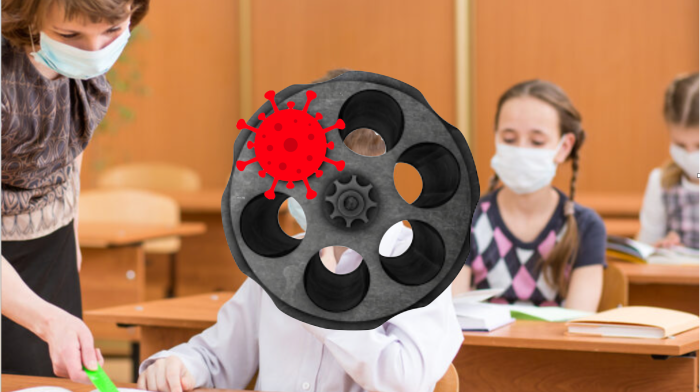
Anyone who demands we place our heads against the barrel of a loaded gun as a prerequisite to jump start the economy, needs to be held responsible for that decision.
In effect, we don’t know how many chambers are loaded, but we know there are bullets in the gun.
There are too many hidden factors to be able to say for sure what our chances are exactly. And in the presence of such ignorance, we should assume the worst.
That’s exactly what decision makers are doing by trying to protect themselves from responsibility.
We should take that as seriously as a loaded gun put to our temples.
Like this post? You might want to consider becoming a Patreon subscriber. This helps me continue to keep the blog going and get on with this difficult and challenging work.
“I’m not interested in anybody’s guilt. Guilt is a luxury that we can no longer afford. I know you didn’t do it, and I didn’t do it either, but I am responsible for it because I am a man and a citizen of this country and you are responsible for it, too, for the very same reason…”
I know everyone is different and some people know more about these things than others. However, you have to admit that just being a White person, you probably don’t know nearly as much about them as any random Black person.
After all, Black folks deal with this every day. You and I, we’re just visiting.
I’m not saying this like I know everything there is about the subject. I need to crack open some more books, watch some more movies and learn more, too.
Let’s say we had a ray gun that could eliminate racism. You shoot people with this zap gun and POOF they’re no longer racist.
So we take the gun to space and hit everyone in the US with it. All racist attitudes immediately disappear. Not a single person in the entire country is racist.
“I’m an American whether I like it or not and I’ve got to take responsibility for it, though it’s not my doing. What can you do about it except accept that, and then you protest it with all your strength. I’m not responsible for Vietnam, but I had to take responsibility for it, at least to the extent of opposing my government’s role in Vietnam.”
And most of the time we may not even be aware they’re there.
I know I’m not.
Let me give you an example.
Several years ago my wife and I won free tickets to an opera recital. We like that sort of thing so we dressed in our finest and went to the concert hall to enjoy some culture.
The soprano was a local girl I’d never heard of (I’m sorry. I can’t remember her name), but she was wonderful. She was also Black.
And the Black community was out in force to support her. The concert hall was filled with mostly Black faces above suits and Sunday dresses.
It was the first time I could remember not being in the majority, and it made me uncomfortable.
I knew it was stupid. The other people there at the concert were no danger. No one was going to take their suit jacket off to jump a couple of White people who came to hear Puccini and Verdi.
But I felt some fear in my gut.
It wasn’t rational. I guess all those nightly news reports disproportionately megaphoning Black crime while ignoring that committed by White folks had an effect on me. I didn’t ask to be taught that fear. I didn’t want it. I recognized it as dumb and bigoted.
I couldn’t control the way I felt. But I could control the way I reacted.
I made an effort to talk with those around us and be as friendly as possible. And for their part these folks were entirely warm, cordial and inviting.
That’s what I’m talking about.
We, White people, have to take a step beyond learning about racism and acting against it. We have to do some soul searching and locate it within ourselves.
It’s probably there.
You can’t grow up in America without having it grow inside you like an alien pathogen.
“We are very cruelly trapped between what we would like to be and what we actually are. And we cannot possibly become what we would like to be until we are willing to ask ourselves just why the lives we lead on this continent are mainly so empty, so tame, and so ugly.”
I bring this up not to judge you.
Brother, I’ve never met you. Sister, I don’t know you.
I’m on my own parallel journey.
There is only one person you have to be accountable to – and that is yourself.
Can you live with yourself if you have not taken these few steps?
If you believe in justice, don’t you have a responsibility to be so in all your dealings with other people?
Black people are people.
Black lives matter.
White people like us have responsibilities to our brothers and sisters of color.
Let’s meet them.
Like this post? You might want to consider becoming a Patreon subscriber. This helps me continue to keep the blog going and get on with this difficult and challenging work.











 gadflyonthewallblog