He is an incurious liar who constantly trolls the media and the public.
He is an admirer of dictators and fascists across the globe with no qualms about enriching himself and those like him at the expense of you and me.
Everyday he provides aide and comfort to anti-American regimes from Moscow to Riyadh by diminishing our international stature, withdrawing us from treaties and contracts, leaking sensitive information and otherwise pursuing foreign interests over those of American citizens.
A democratic republic is like any other machine – it only functions properly if all of its parts are working.
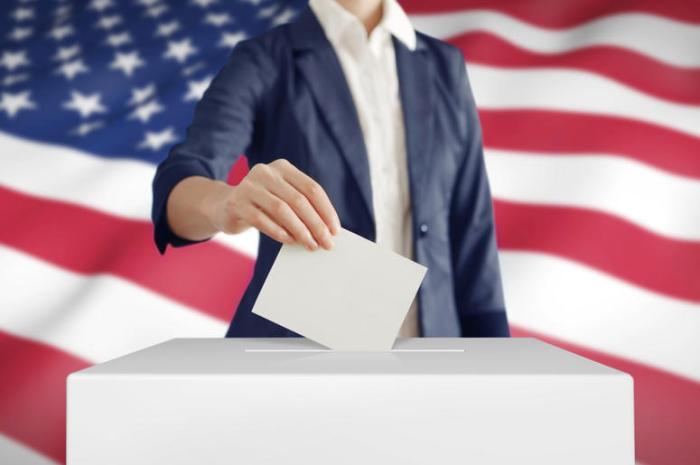
You can’t have majority rule when 40% of voters shirk their duty.
A study by the Pew Research Center found that not only were non-voters likely to be younger, less educated, less affluent, and nonwhite, but 55% of them were Democrats and Democratic-leaning independents.
If more non-voters under the age of 30 had gotten their acts together in just a few swing states, we wouldn’t all be living through this national nightmare.
So if you think voting doesn’t make a difference, look around.
“The most significant civil rights problem is voting. Each citizen’s right to vote is fundamental to all the other rights of citizenship and the Civil Rights Act of 1957 and 1960 make it the responsibility of the Department of Justice to protect that right.”
In Arkansas, thousands of voters were erroneously flagged in 2016 under the guise of removing people who had been convicted of felonies. In Virginia, voters were wrongly deleted from the rolls in 2013 under the excuse of removing people who allegedly had moved.
To make matters worse, the purge was overseen by Secretary of State Brian Kemp, a Republican candidate for governor. Since most of the people being removed from the polls are people of color, the poor and other Democrats or leaning Democrat voters, the move makes it harder for Democrat Stacey Abrams to challenge him.
Kemp and his Republican buddies wouldn’t be going through all this trouble if voting made no difference.
And people have died for the opportunity that millions of people decide not to exercise.
People like James Chaney, Andrew Goodman and Michael Schwerner, who were murdered in 1964 while trying to register black voters in Mississippi. People like Viola Liuzzo, who was murdered a year later by the Ku Klux Klan during the Selma march for voting rights.
When you willingly give up an opportunity that was purchased so dear, you disrespect the memories of the dead.
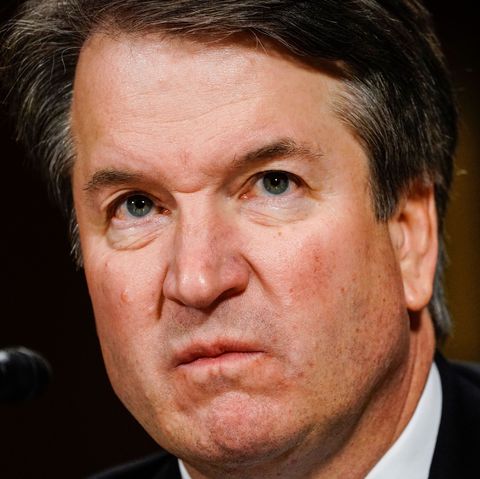
I think I will always associate Brett Kavanaugh with the taste of vomit in the back of my throat.
I couldn’t watch his sham of a confirmation hearing without my gag reflex going into overdrive.
Here was one of the most privileged of people on the planet alternatively weeping and raging that he was being denied his due.
Here was a man bemoaning that no matter what happened, his reputation forever would be ruined, but who likewise refused to call for an investigation to exonerate himself.
At least three separate women have accused him of sexual assault, yet Congressional Republicans are still planning to ram through his nomination to the Supreme Court – a lifetime appointment where he will almost certainly be the tie breaking vote to overturn Roe vs. Wade.
How fitting.
What perfect symmetry.
You couldn’t have planned it any more poetically.
A man accused of multiple attempted rapes who is doing everything in his power to make abortion illegal.
An overgrown frat boy crying into his beer that we can’t take away his God given right to take away women’s rights.
A confederacy of almost exclusively male lawmakers ready to discount women’s reports of violence so that they can limit women’s freedom to make decisions about their own bodies.
If there is one good thing to come from this farce, it is the spotlight it has shown on the relationship between rape and the movement to recriminalize abortion.
These two things are essentially intertwined.
On the one hand, we have sexual intercourse carried out under threat of violence, sex without consent or in direct violation of consent – a crime invariably perpetrated by men on women.
On the other hand, we have the removal of female consent from the birthing process.
They are almost the same thing, or at least two sides of the same coin.
In both cases, we’re removing or ignoring female permission, agreement, approval, agency. We’re saying it doesn’t matter what the woman wants. It only matters what men or a patriarchal society wants.
And the justification is an ancient text – the New Testament – that doesn’t mention abortion once. And the Old Testament actually gives instructions on how to conduct an abortion (Numbers 5:11-31).
Not that it really should matter. The United States is not a theocracy.
But it IS a patriarchy.
That’s what this is – an attempt by the most insecure, power hungry men to control women.
It is about keeping and strengthening a caste system where men are allowed to be fully realized people and women are allowed only secondary status.
It is about dehumanization clothed in piety and false morality.
All those people crying for the lost lives of a cluster of cells in female uteruses care not a wit about the thousands of women who will die from unsafe abortions once safe procedures become unlawful.
We’ve been here before. Abortion was illegal in the US from the early 1800s until 1973, and we know what will happen. There is actual history on this – back alley procedures conducted by quacks using sharp implements to pierce the womb – and there is no reason to think it won’t repeat itself.
Changing the law won’t stop abortions. It will just make them unsafe for everyone except rich women who can afford doctors willing to take a chance on going to jail for a big payday.
If these people really wanted to stop abortions, they’d support handing out free contraception. They’d turn every orphanage into a palace. They’d each adopt as many children as they could. They’d make neonatal care free, expand services to help women raise children, increase maternity leave, pay for free childcare, expand education funding.
But they don’t do any of that because despite their crocodile tears, their objection has nothing to do with unborn children.
It has to do with mature women making decisions for themselves. It has to do with conceptualizing them as people equal to men and with minds capable of consent.
It’s about allowing women the right to choose – choose whom to have sex with and what exactly the consequences of that sex will or will not be.
I am so thankful that Dr. Christine Blasey Ford came forward with her testimony. What bravery! What grace under pressure!
To be able to share with an entire nation her personal trauma at the hands of Kavanaugh. Such courage boggles the mind almost as much as those who refuse to accept her story as genuine.
They say that this is political. That it’s a hit job. Yet they pound their fists onto their ears to drown out Kavanaugh’s words in self-defense where he makes it entirely clear how partisan he is and will be once he takes the bench:
“This whole two-week effort has been a calculated and orchestrated political hit, fueled with apparent pent-up anger about President Trump and the 2016 election. Fear that has been unfairly stoked about my judicial record. Revenge on behalf of the Clintons. And millions of dollars in money from outside left-wing opposition groups.”
These are not the words of a fair arbitrator. They are the ravings of someone with an axe to grind.
But they do well to point out the elephant in the room – Donald Trump.
The man who nominated Kavanaugh has had at least 19 women accuse him of sexual assault. He even admitted to it on video in the infamous Access Hollywood tape.
Yet a minority of Americans elected him President through a legislative loophole kept open by centuries of neglect, apathy and moneyed interest.
I don’t know how this all will end. The FBI will conduct a limited investigation this week – probably stymied as much as possible by the Trump administration.
But the road that lead us here is achingly clear.
This is a tantrum of the patriarchy.
It is the weakest, most twisted men and their Stockholm syndrome suffering accomplices.
It is not about defining when life begins.
It’s about defining who gets to count as fully human – who gets the freedom to choose.
Fun Fact: Between 2005 and 2017, the federal government withheld $580 billion it had promised to spend on students from poor families and students with disabilities.
Fun Fact: Over that same period, the personal net worth of the nation’s 400 wealthiest people ballooned by $1.57 trillion.
$347 billion owed to educate low-income students most of whom are children of color.
$233 billion owed to provide services for students with disabilities.
And this is just the shortfall of the last dozen years! That’s just money due to children who recently graduated or are currently in the school system!
We’ve been cheating our children out of the money we owe them for more than half a century!
Federal education funding levels were first established in 1965 as part of Pres. Lyndon Johnson’s War on Poverty in the landmark education law, the Elementary and Secondary Education Act (ESEA).
One of the most glaring examples of neglect is Title I funding.
The Johnson administration admitted that schools with a high concentration of students living below the poverty line needed extra support to succeed at the same levels as students from middle class or more affluent backgrounds. So the law promised to provide an additional 40 percent for each poor child above what the state already spent per pupil.
And then it promptly failed to fund it. In 1965 and every year since!
These are not just numbers. With this money, high poverty schools could provide:
“health and mental health services for every student, including dental and vision services; and
a full-time nurse in every Title I school; and
a full-time librarian for every Title I school; and
a full-time additional counselor in every Title I school, or
a full-time teaching assistant in every Title I classroom.”
A decade later, in 1975, the same thing happened with The Individuals with Disabilities Education Act (IDEA).
Congress told local districts they’d have to do more to help disabled students succeed academically. However, doing so costs money. Lawmakers admitted that disabled students cost more to educate and that local districts often struggle to find the funding to help them succeed.
Once again, Congress pledged to pay up to 40 percent of that additional cost, with local and state funds covering the remainder.
Once again, Congress failed to fund it.
STATE AND LOCAL FAILURE
But it’s not just the federal government that has shirked its duties to school children.
Beside the federal government, public schools are funded by their local municipalities and the state. Local governments pay for about 45 percent of school budgets.
However, since most of this allotment is determined by property tax revenues, it ensures the poor get fewer resources than the rich. Kids from rich neighborhoods get lots of resources. Kids from poor areas get the scraps. Inequality is built into the funding formula to ensure that students don’t start out on an even playing field and that economic handicaps are passed on from one generation to the next.
As such, they are in the position to right the wrongs of the local community by offsetting the inequality of local governments – but only 11 states do so. Twenty states close their eyes and provide the same funding to each school – rich and poor alike – regardless of need or what each community can afford to provide for its own children. But 17 states are even worse. They actually play Robin Hood in reverse – they funnel more money to wealthier districts than to poor ones.
As a result, schools nationwide serving mostly students of color and/or poor children spend less on each child than districts serving mostly white and/or affluent children.
Nearly every state levies a much greater share of taxes from low- and middle-income families than from the wealthy.
And that’s before we even start talking about corporations!
While the US federal corporate tax is 35 percent, the effective tax rate that corporations pay after loopholes and deductions is only about 14 percent. This costs the federal government at least $181 billion in annual revenue, based on 2013 estimates by the Government Accountability Office. Local and state corporate tax and abatement programs make it even worse.
This is a choice. We are not requiring the rich to pay their fair share.
“In 2017, the National Association of School Resource Officers claimed that school policing was the fastest-growing area of law enforcement. The school safety and security industry was reported to be a $2.7 billion market as of 2015. Most of that $2.7 billion is public money now enriching the private security industry instead of providing real supports to students.”
According to the US Department of Education, 1.6 million students go to a school that employs a law enforcement officer but not a guidance counselor.
That is not an unalterable economic reality. It is a failure of priorities. It is the mark of a society that is not willing to help children but will swoop in to punish them if they get out of line.
Cost studies in San Diego, Los Angeles, Nashville, Michigan, Pennsylvania, Durham and other localities have come to the same conclusion: “the privatization of schools has contributed to austerity conditions in traditional public schools.”
Yet Congress continues to appropriate millions of dollars to the Department of Education’s Charter Schools Program (CSP), which funds new charter start-ups and expansions. The program has a budget of $500 million this year, alone. It is the largest single backer of charter schools in the nation.
According to the report, “In other words, the U.S. Department of Education is operating a program that directly undermines public schools.”
SOLUTIONS
But the report isn’t just about what’s wrong. It outlines how we can make it right.
A. “Make the wealthy pay their fair share of taxes.
Rescind the 2017 tax code changes, which overwhelmingly favor the top 1 percent of income earners.
Close the federal carried interest loophole, a step that could increase federal revenues by between $1.8 and $2 billion annually or, according to some researchers, by as much as $18 billion annually.
If the carried interest loophole is not closed at the federal level, states can impose a surcharge on carried interest income at the state level, raising millions for state budgets.
Enact so-called “millionaire’s taxes” that increase the tax rate on a state’s highest earners. New York and California have already passed such law.
B. Require wealthy corporations to pay their fair share.
End or reduce corporate tax breaks that cost the federal government at least $181 billion annually.
Reduce state and local subsidies to businesses for economic development projects and hold school funding immune from tax abatements.
Enforce and strengthen programs like Payment in Lieu of Taxes (PILOT) to ensure that wealthy institutions pay their fair share towards local budgets.
C. Divest from the school-to-prison pipeline.
School safety and security is now a $2.7 billion industry. Much of that money is public money, going to profitable corporations instead of schools.
Divest from expensive security systems, metal detectors and legions of school-based police officers and instead invest in counselors, health and mental-health providers and other supports that make schools safer.
D. Place a moratorium on new charter schools and voucher programs.
A moratorium on the federal Charter Schools Program would free up $500 million annually, which could be used to support the creation of Sustainable Community schools.”
The executive summary concludes with the following statistic.
Even a 10 percent increase in funding for each high poverty student maintained through 12 years of public school can dramatically change the likelihood of academic success. It can boost the chances that students will graduate high school, achieve 10 percent higher earnings as adults and a 6 percentage point reduction in the annual incidence of adult poverty, according to a 2015 report.
“Ten percent is pocket-change for a nation that has orchestrated the rise of an unmatched billionaire class. In the richest nation in the world, it is possible to fully fund all our public schools, and to provide Black, Brown and low-income children with the educational resources and additional supports and services they need to achieve at the highest levels.”
The facts are in, folks.
We can no longer gripe and complain about a public education system we fail to support without recognizing the cause. We have failed to meet our responsibilities to our children – especially our children of color.
The solution is simple – equity.
We need to demand the rich do the right thing.
We cannot achieve greatness as a nation when wealth and privilege continue to shirk their duties and our lawmakers do little more than enable greed and corruption.
A yellow flag showing a coiled spring of a snake above the motto, “Don’t Tread on Me.”
In my usually well-manicured suburb, you’ll find it waving bravely over the garbage house.
There’s three broken down RVs sitting on the lawn, a busted sofa in the back yard, a rotten picnic bench and several rusted out vehicles in various states of disrepair.
I’m not sure why the owners think anyone would want to tread on them. We’d much rather walk quickly on by without being seen or commented on.
Because in my experience that’s the thing about most of the people who fly this flag.
They’re indignant about anyone stepping on their rights but all too ready to step all over yours.
I remember it wasn’t really too long ago that this flag had no such connotations.
It was simply the Gadsen flag, a relic of the American Revolution. It was nothing more than a reminder of a time when we cherished our national independence from Great Britain and wanted to make sure they knew we didn’t want the King to come back and start ordering us around.
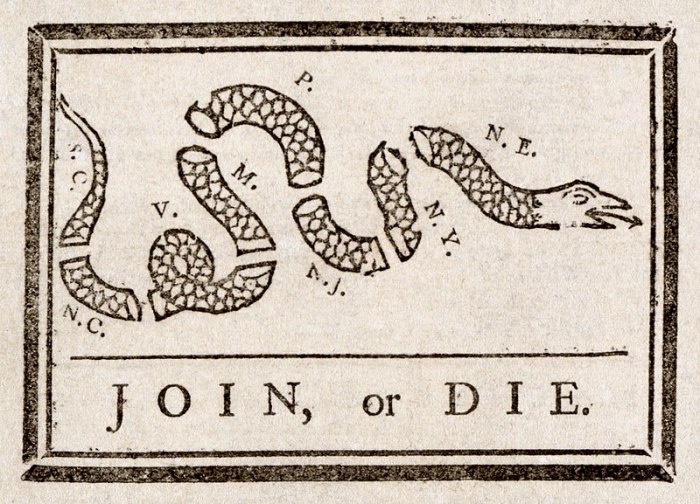
In fact, it was designed by American general and politician Christopher Gadsden in 1775. This “Sam Adams of South Carolina” modeled his patriotic statement first used by the Continental Marines on an earlier famous cartoon from Benjamin Franklin’s Pennsylvania Gazette.
You’ve probably seen it. A snake is cut into several pieces – each representing one of the colonies – with the motto, “Join or Die.”
So originally it was a call for unity, perhaps even federalism. It was a way of framing the argument that we’d be stronger as one nation than as a group of separate states.
Gadsen’s version was really a continuation of that same thought. It was as if he were saying, “Here we are, one unified nation ready to strike to protect itself from tyranny.”
It wasn’t until 2009 that Gadsen’s flag became associated with the radical right.
Like so many hitherto nonpartisan symbols, it was appropriated by the Tea Party movement, which tried to cast their libertarian extremism as somehow harkening back to the American Revolution.
Even the name Tea Party is a misnomer. The original Boston members of the Sons of Liberty who threw British tea into the harbor in 1773 were protesting taxation without representation. Modern day Tea Partiers were protesting the taxes levied by their own duly elected representatives.
They were poor people duped into thinking the rich paid too much despite the fact of gross income inequality and the wealthy not paying their fair share.
It’s this willful ignorance that typifies the contemporary right.
The truth doesn’t matter. It only matters what can be spun into a pithy sound bite that can be broadcast on Fox News or some other propaganda source and then repeated ad infinitum in place of any real debate or conversation.
To be fair, the left does it, too, but not nearly to the same degree.
When a topic makes the rounds of the 24-hour news cycle, you can hear the same canned responses from right and left on just about every channel regardless of who is speaking. The only difference is that the left usually makes at least passing reference to reality while the right closes its eyes and says whatever it believes to be true with perfect conviction.
The Gadsen flag is a perfect example of this hypocrisy.
The motto “Don’t Tread on Me” has come to mean radical individual freedom.
I can do whatever I like and there’s nothing you can do about it.
I can own as many guns as I like. I can teach my kids whatever facts I like. I can discriminate against anyone I like.
But there’s never a mention about other people except to limit what they can do in relation to the speaker.
In short, there’s nothing explicit about making this rule universal – I won’t tread on you if you won’t tread on me.
It’s just don’t tread on me and I’ll do whatever I like in relation to you.
After all, many of these personal freedoms the radical right cherishes actually do impact the rest of us.
This kind of sanctimonious duplicity has real world consequences.
Unarmed black people are shot and killed by police at a much higher rate than white people. Yet you won’t tolerate any protest, condemnation or protest. People can’t assemble in the streets, athletes can’t kneel during the national anthem, you won’t even allow the slogan “Black Lives Matter,” because you say, “All Lives Matter,” while in reality you mean “All Lives Except Black Ones.”
You oppose abortion but no one is forcing anyone to have abortions. In your headlong crusade for individual freedom you want to ensure that others don’t have this choice because they might choose differently than you. Or at least they might choose differently than you SAY you do, because when the light of day is cast upon you, we find an alarming number of hypocrites here, too.
You look to your self-interest, and I’ll look to mine, and that’s what’s best for everyone.
However, they forgot that everyone doesn’t have the same power – physical, social, financial or political. Some people are strong and some are weak. Some are rich and some are poor. If you pull the shortest straw at the lottery of birth, you won’t be able to get the same things for yourself as those who won it as soon as the doctor slapped their newborn bums.
So we have layers and layers of class and economics. We have social structures designed to keep black people here and Hispanics there and white people at the top. We have a society that worships the rich and bedevils the poor. We have belief systems that praise one kind of sexuality only and demonizes anything that diverges from that norm. And the most defining thing of any newborn baby is what you’ll find between its legs.
“Don’t Tread on Me” has become a farce.
It’s a maxim hoisted on those with very little individual power to convince them to join together and become powerful while guarding the door for the wealthy.
They sit atop their mountains of trash as if they were dragons on piles of gold.
And they point their pitchforks at the rest of us as if we wanted a piece of it.
In this way, they make themselves the willing patsies of the ruling class.
It’s a sad thing to behold.
Because if we all just stopped for a second and recognized our common humanity, we’d agree that the status quo is unacceptable.
If we were more concerned about the rights of all than just our own rights, we’d agree that the wealth of this great nation has not been fairly distributed.
The snake is coiled and ready to strike but it is pointed in the wrong direction.
It shouldn’t be pointed at 99% of us. And it shouldn’t be so solitary.
It should be a sea of snakes, a great slithering mass of humanity, hissing and spitting with venom, our reptilian eyes focused on the elites.
They’re mapping out a world where kids don’t even have to go to school to grasp the basics, where learning can be accomplished anywhere but instigated, tracked, and assessed on-line through various computer platforms.
Children would bounce from a few hours of Khan Academy videos here to a software package there and Voila! “Modern” education!
It’s a brave new world where investors hope to make a bundle by reducing the cost and pocketing the savings.
Since teachers are the biggest cost, they’re the first things to go.
Since their rights as workers and human beings are a roadblock on this learning superhighway, they’re the first to go.
And since they’re in a prime position to see exactly what’s going on and to object when this ed tech paradise exploits the students it ostensibly is being built for, they MUST go – now, as soon as possible.
The Supreme Court’s recent decision in Janus v AFSCME is part of that process. It’s another way to weaken labor and clear the path for business – the collusion of politics and corporations to steamroll the rest of us and swipe more of our money regardless of the children in the steamrollers way.
So when I ask “Are teachers necessary?” it’s not a purely philosophical question.
The answer will have a major impact on both the education of today and where we go in the future.
If teachers are not necessary, that removes one of the biggest obstacles to this frightening and uncertain future.
Unfortunately, no matter how much I want to answer in the affirmative that teachers are necessary, I can’t do so.
Even after thousands of years of recorded history, learning remains a mysterious process. Yet it doesn’t take much reflection to realize that it can take place without the presence of a teacher.
Estimates vary somewhat from study to study, but the basic structure holds. The vast majority of impact on learning comes from the home and out-of-school factors. Teachers are a small part of the picture. They are the largest single factor in the school building, but the school, itself, is only one of many components.
In short, teachers are not necessary to student learning.
But neither are doctors necessary to healing or lawyers necessary to acquittals.
Necessity is a very high bar.
To survive, you need food, shelter and clothing. However, having all three does not mean you have a good life. Slaves had all three – no free person would choose to trade places with someone in generational servitude simply because they had everything they needed to survive.
The same with medicine. If shot in the arm, you could provide me with all the medical equipment necessary to remove the bullet, but I would still have a difficult time doing it by myself. I COULD. A doctor is not NECESSARY for that operation. But without a doctor present, my chances of getting the best medical care drop dramatically.
Moreover, you could pop me in a courtroom without the benefit of legal counsel and it’s not impossible that I could argue my way to the dismissal of all charges against me. But the likelihood of doing so is infinitesimal – as undocumented youngsters are discovering when forced into the courtroom to defend against deportation without an attorney or even their parents present.
The same is true of education.
Though teachers are not necessary to learning, they are vital to it.
Having a teacher dramatically boosts a student’s chances, and the more disadvantaged that student is, the more he or she benefits from an educator.
The academic schemes of the corporate class amount to changing the field into the equivalent of an automated teller or a business robocall.
You can purchase your groceries through the self-checkout line. You can get your customer service from an automated list. But neither of these are the highest quality service.
They are cheap alternatives.
They are ways for the business to cut costs and boost profits. Neither have anything to do with making things better for the customer.
And when it comes to education, eliminating (or even drastically reducing access to) the teacher will decrease the quality of the service beyond recognition.
A 2009 report, Poverty and Potential: Out-of-School Factors and School Success, released by the Great Lakes Center for Education Research and Practice outlined several real world solutions to increase academic outcomes. None of them involve the elimination of teachers.
That’s how you cut class size down from the 20, 30, even 40 students packed into a room that you can routinely find in some districts today.
And if you want to improve the quality of the teachers in those classrooms, here’s an easy fix – pay them.
According to the Economic Policy Institute, teachers in the United States make 14 percent less than people from professions that require similar levels of education.
They can’t buy a home or even rent an apartment in most metropolitan areas. They can’t afford to marry, raise children, or eke out a middle class existence.
And finally, stop micromanaging everything teachers do and stomping on their rights. To do their job effectively teachers need autonomy. They need the ability to make decisions on the ground based on the empirical evidence gathered in the classroom.
To do that, they need their union protections. They need collective bargaining rights to give them the power to counterbalance the forces of greed and corruption that have always been at the schoolhouse door.
As a country we have taken our attention away from what’s really important. We’ve stopped focusing on how to make education better and instead equated it with how to make it more profitable for those who are already wealthy.
Teachers are vital to education. They are lifelines to struggling students. We should find ways to support them and not constantly undercutting their social standing, autonomy and rights.
The importance of teachers is beyond doubt. As is the importance of society in supporting them.
At least their editors haven’t or perhaps they just don’t care.
Otherwise, why would self-respecting hard news purveyors publish the results of a study by charter school cheerleaders that pretends to “prove” how public school teachers are worse than charter school teachers?
That’s like publishing a study denigrating apples written by the national pear council.
Breaking news: Pepsi says, “Coke sucks!”
In a related story McDonalds has startling evidence against the Burger King!
And I know what many journalists are thinking when they do it, because I used to be one:
I’ll publish the report and include dissenting opinions and that will be okay because I will have shown both sides and readers can make up their own minds.
But what’s the headline? What’s the spin? Who is David in this story and who is Goliath? When multiple stories like this appear all over the news cycle, what impression is made on your readers?
And here we get one biased neoliberal think tank vs. millions of public school teachers all across the country and since you’ve given us an equal number to represent each side, you pretend THAT’S fair and balanced.
The Fordham Institute wrote a report called “Teacher Absenteeism in Charter and Traditional Public Schools.” They concluded that 28.3 percent of teachers in traditional public schools miss eleven or more days of school versus 10.3 percent of teachers at charter schools.
Look how bad public school teachers are and how much more dedicated is the charter school variety! Look at how much money is being lost! Look at the damage to student academic outcomes!
Won’t someone think of the children!?
WHY WON’T SOMEONE PLEEEEAAASSSEEE THINK OF THE CHILDREN!!??
Second, look at all the important data Fordham conveniently leaves out.
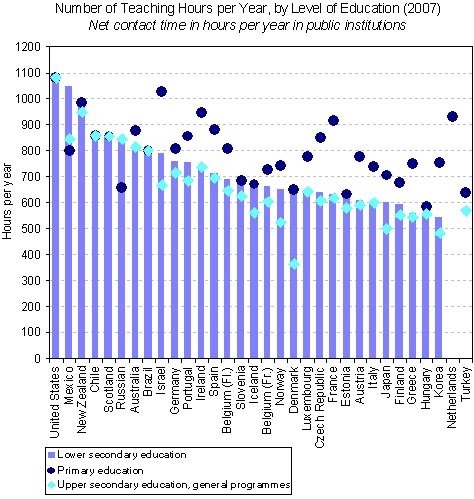
Look at the number of hours public school teachers work in the United States vs. those in other comparable countries, say those included in The Organization for Economic Cooperation and Development (OECD).
In fact, the OECD (which is not biased one way or another about American school privatization) released a mountain of statistics about how many hours teachers work in various countries.
American teachers spend on average 1,080 hours teaching each year. Across the O.E.C.D., the average for most countries is 794 hours on primary education, 709 hours on lower secondary education, and 653 hours on upper secondary education general programs.
Source: OECD
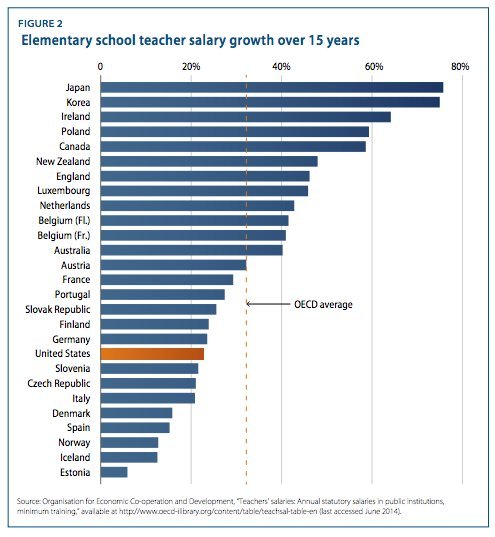
Yet American teachers start at lower salaries and even after 15 years in the profession, earn less money than their international counterparts.
So – assuming Fordham’s absenteeism statistics are accurate – why do public school teachers miss so much school? They’re exhausted from the hours we demand they keep!
But what about charter school teachers? Aren’t they exhausted, too?
Since they’re often not unionized, charter schools usually have younger, less experienced staff who don’t stay in the profession long. In fact, they rely on a constant turnover of staff. At many of the largest charter chains such as Success Academy and the Knowledge is Power Program (KIPP), teachers average only 4 years before moving on to another career, according to the New York Times. And this is typical of most charter chains.
So why don’t charter school teachers take as many sick days as traditional public school teachers? Maybe because when they check out, they often don’t check back in.
Moreover, there is a significant difference in the student population at both kinds of school – privatized vs. public.
As their marketing departments will tell you, the students in a charter school choose to be there. The charter schools often weed out the students with behavior problems, special needs or those who are otherwise more difficult to teach. As a result, the strain on teachers may not be as severe. When you’re only serving kids who want to be there and who are easy to teach, maybe you don’t need as much downtime.
According to a study by Scholastic (that actually goes counter to its pro-privatization bias), we work 53 hours a week on average. That comes out to 7.5 hours a day in the classroom teaching. In addition, we spend 90 minutes before and/or after school mentoring, tutoring, attending staff meetings and collaborating with peers. Plus 95 additional minutes at home grading papers, preparing classroom activities and other job-related tasks.
And for teachers who oversee extracurricular clubs, that’s even more work – 11-20 additional hours a week, on average.
Add to that the additional trauma public school children have experienced over the last decade. More than half of public school students now live below the poverty line. That means increased behavior issues, increased emotional disturbances, increased special needs, increased malnutrition, increased drug use – you name it.
Public school teachers deal with that every day. And you seriously wonder that some of us need some downtime during the year to deal with it.
Moreover, let’s not forget the issue of disease.
Working in a public school is to immerse yourself in a petri dish of bacteria and viruses. My first year teaching, I got so sick I was out for weeks until I developed immunities to strains of illnesses I had never been exposed to before.
So, yeah, sometimes I need to take a sick day. But if you ask most teachers, they’d rather stay in the class and work through it.
Having the day off is often more trouble than it’s worth. You have to plan an entire lesson that can be conducted in your absence, you have to give the students an assignment to do and you have to grade it. Even with the day off, you have a mountain of work waiting for you when you return.
So as a practicing public school teacher, I dispute the findings of the Fordham Institute.
They don’t know what they’re talking about.
They have focused in on data to make their chosen targets, public school teachers, look bad while extolling the virtues of those who work in privatized systems.
Is anyone else left? Am I the only one still employed here?
Somedays it feels like it.
Somedays teaching in a public school is kind of like trying to run a resort hotel – ALL BY YOURSELF.
You’ve got to teach the classes and watch the lunch periods and cover the absences and monitor the halls and buy the pencils and tissues and fill out the lesson plans and conduct the staff meetings and…
Wouldn’t it be better if there were more people here?
So why did we let this happen? Why do we continue to let this happen?
First, you have to understand that there are two very different kinds of public school experience. There is the kind provided by the rich schools where the local tax base has enough money to give kids everything they need including small class sizes and hiring enough teachers to get things done efficiently. And there’s the poor schools where the majority of our kids get educated by the most dedicated put upon teachers who give 110% everyday but somehow can’t manage to keep all those plates spinning in the air at the same time so the media swoops in, wags its finger and proclaims them a “failure.”
Bull.
It’s not teachers who are failing. It’s a system that stacks the deck against them and anxiously anticipates them being unable to meet unfair and impossible expectations.
This is a chance to open a new market and scoop up buckets of juicy profit all for themselves and their donors.
It’s called privatized education. You know – charter schools and vouchers schools. Educational institutions not run by the public, not beholden to elected officials, but instead by bureaucrats who have the freedom to act in the shadows, cut student services and pocket the savings.
Those are people they have to pay a living wage. Those are people who know a thing or two and might complain about how the corporate scheme adversely affects the children in their care.
And to do that, the powers that be need to get rid of professional teachers.
People like me – folks with national board certification and a masters degree – they need to go.
THAT’S why class sizes are so large. That’s why so few young people are picking teaching as a major in college.
It’s exactly what the super-rich want.
And it doesn’t have to be some half mad Mr. Burns who makes the decisions. In my own district, the school board just decided to save money by cutting middle school math and language arts teachers – the core educators who teach the most important subjects on the standardized tests they pretend to value so much!
So number crunching administrators had a choice – straighten their backbones and fight, or suggest cutting flesh and bone to make the budget.
They chose the easier path.
As a result, middle school classes are noticeably larger, teachers have been moved to areas where they aren’t necessarily most prepared to teach and administrators actually have the gall to hold out their clipboards, show us the state test scores and cluck their tongues.
I actually heard an administrator this week claim that my subject, language arts, counts for double points on the state achievement rubric. I responded that this information should be presented to the school board as a reason to hire another language arts teacher, reduce class sizes and increase the chances of boosting test scores!
That went over like a lead balloon.
But it demonstrates why we’ve lost so much ground.
Everyone knows larger class sizes are bad – especially in core subjects, especially for younger students, especially for struggling students. Yet no one wants to do anything to cut class sizes.
Instead we’re warned that if we don’t somehow pull ourselves up by our bootstraps, they’ll close our school and give it to a private company to run – as if there were any evidence at all that this would help.
It’s a scam, ladies and gentlemen! And anyone who looks can see it.
But when you bring this up to administrators, they usually just nod and say that there’s nothing we can do about it. All we can do is keep trying to win the game – a game that’s rigged against us.
That’s exactly the attitude that’s gotten us where we are.
We can’t just keep doing it, keep appeasing the testing and privatization industry and their patsies in the media and government.
We must fight the system, itself, not go along with it.
Republicans have been arguing for years that the federal government can’t tell the states what they should be teaching. That’s the crux of opposition, and the newly reauthorized federal law governing K-12 schools, the Every Student Succeeds Act (ESSA), underlines it.
The power is unequivocally in the hands of governors and state legislatures.
The states control which academic standards their public schools are supposed to subscribe to or not. And since the beginning of 2017, the states are overwhelmingly in Republican control.
There are 98 partisan state legislative chambers in the United States. Republicans dominate 67 of them. In fact, the GOP controls both legislative chambers in 32 states – the most it has in the party’s history! And in 24 of those states, Republicans also run the show in the Governor’s mansion – the trifecta!
In short, despite any limits on Presidential power, the GOP has never been in a better position to get rid of Common Core.
If Republicans truly wanted to repeal it, they could do so tomorrow, and there’s zero Democrats could do about it in almost half of the country.
Yet, Republicans don’t.
They haven’t.
And they don’t seem in any rush to put it on their agenda in the future.
Which brings me to a serious question any critic of Common Core has to answer: WHY!?
Republicans say they hate Common Core.
They have the power to get rid of it.
Why don’t they do it?
THE STATE OF COMMON CORE
Despite any comments to the contrary, any blathering talking head nonsense from media pundits, the facts remain the same.
Sure, some legislatures have changed the name and made nominal revisions (Hello, Pennsylvania!) but they’re still essentially the same standards applied in the same way. The Common Core’s own Website doesn’t distinguish between states that have the standards outright and those where they have been slightly revised or renamed.
Specifically, nine states have announced plans to rewrite or replace the standards, but in the majority of these cases, they have resulted merely in slight revisions. Only Missouri, Oklahoma, and Tennessee appear to have created significantly different standards, according to Education Week.
So what’s the hold up?
MAIN OBJECTIONS TO THE CORE
Full disclosure: I am not a Republican. I am the farthest thing you could find to a Republican. But on this one issue we agree.
No, I don’t think Common Core will make your child gay or indoctrinate kids into a far left worldview or any of a number of bizarre, crackpot criticisms you might hear from mentally ill pundits being exploited by far right media conglomerates. Nor am I opposed simply to undo any signature legislative achievements of our first black President.
Even if people like Glenn Beck and I disagree on the reasons why, we both agree on the course of action – repeal Common Core.
Yet the incumbent batch of GOP lawmakers across the country are letting us both down.
If one has to be beaten by Republicans, at least let them accomplish the things that have bipartisan support. That includes repealing Common Core.
Though the media likes to characterize this as a conservative issue, it’s not just Republicans who want to get rid of the Core. Regardless of politics, most people dislike the standards. They aren’t popular with adults. They aren’t popular with children. And most tellingly, they aren’t popular with classroom teachers.
According to the most recent Education Next poll, less than half of all Americans, 49%, favor the policy. In partisan terms, that’s 37% of Republicans and 57% of Democrats. And that support has been steadily dropping every year – by 20 points for Republicans and seven for Democrats since 2013.
And among teachers, the drop is even more dramatic. Only 40% now favor the Core. That’s a drop of 36 points among those who know the standards best!
POLITICAL PARALLELS
So let’s get rid of them.
For once I’m with Trump.
But the legislatures just won’t do it.
In some ways, this shares parallels with the healthcare debate.
Before going forward, let me just say that I am NOT in favor of repealing Obamacare and going back to the previous system. Nor am I in favor of repealing without a replacement or any of the so-called “skinny” plans put forth by the GOP.
All the legislatures would have to do is reinstate them.
Pennsylvania’s standards were particularly reasonable, flexible yet grade appropriate and comprehensive.
We could go back to them tomorrow.
But we don’t.
Why?
It’s that same question again.
What is holding us back?
STANDARDIZED TESTING
Here’s my theory: it’s the testing.
One of the most frustrating things for Common Core critics is when apologists say they hate standardized testing but love Common Core.
The two are inextricably interlinked. You can’t have Common Core without the testing. That is the whole point of the standards – to tell districts what to focus on because those things will be on the federally mandated high stakes standardized tests.
If states repeal Common Core, what happens to these tests?
Before adopting the Core, each state had a test aligned to its own specific standards. Even where some states had the same tests, their standards were significantly similar to allow this. In any case, most states that have adopted the Core have had to buy new, more difficult tests.
Sure, we could all go back to the tests we used to give, but this would present certain problems.
First, many states were taking tests that were already being aligned with Common Core before they officially adopted it. If they got rid of the standards, they couldn’t go back to the old tests because they’re already Common Core specific.
In theory, they could ask to reinstate older versions of the test that aren’t Common Core aligned. However, in practice for some states, this might necessitate the creation of yet another batch of new tests.
However, in many states like Pennsylvania, this wouldn’t be an issue. Before the Core, they had their own tests based on state specific standards. There’s really no reason why they couldn’t dust off these old tests and put them back into circulation.
The problem is that this would require politicians to justify the millions of dollars (at least $7 billion nationally) they wasted on the new tests, new workbooks, new textbooks, etc.
Lawmakers would have to own their mistakes.
They’d have to say, “My bad!”
And most of them aren’t about to do that.
Of course, there is a third option: they could undo the high stakes testing altogether. They could characterize this not as a misstep but a reform.
According to the ESSA, all states have to give federally mandated standardized tests from grades 3-8 and once in high school.
But what exactly those tests look like is debatable.
The federal government is supposed to give them leeway in this matter. What better way for the Trump administration and Betsy DeVos to demonstrate their commitment to local control than by approving accountability plans that don’t include standardized testing?
I’m sure if lawmakers were really serious about getting rid of Common Core, they could figure out a way to make this work. It would just require a commitment to patching up the massive hole in our school funding system where the standardized testing industry has been sucking away tax dollars that could be better used elsewhere – like in the actual act of teaching students!
THE CYNICAL INTERPRETATION
Which brings me to perhaps the most cynical interpretation of the data.
Republicans may be avoiding the Common Core issue because their opposition up to now was simply disingenuous partisan infighting. They could be craven servants to the testing industry. Or – and this is the worst case scenario – they could have another endgame in mind entirely.
For instance, here’s Trump adviser Kellyanne Conway during an interview with Jake Tapper on CNN.
Education Secretary Betsy DeVos “will get on with the business of executing on the president’s vision for education,” Conway said. “He’s made very clear all throughout the campaign and as president he wants to repeal Common Core, he doesn’t think that federal standards are better than local and parental control…And that children should not be restricted in terms of education opportunities just by their ZIP code, just by where they live. We’ve got to look at homeschooling, and charter schools, and school choice and other alternatives for certain students.”
It’s possible that today’s Republicans at both the state and federal level aren’t concerned with repealing Common Core because it’s irrelevant to their ultimate goal – repealing the very notion of public education.
If every school or almost every school was a charter, voucher or homeschool, Common Core would be a moot point.
After all, choice schools don’t have to follow most regulations. That could include using the Core.
On the other hand, charter schools often allegedly do use Common Core, but regulations are so lax with so few measures to hold them accountable for anything in most states that whether they’re actually using the standards and to what extent is anyone’s guess. Unscrupulous charter operators could conceivably forgo the standards regardless of state mandates with little fear of being found out or contradicted.
This may be the ultimate selling point for school choice. Almost anything goes. It could certainly allow schools to circumvent Common Core, just as it allows them to circumvent civil rights protections, fiscal responsibility, democratic local control – really any kind of protections to ensure taxpayer money is being spent responsibly and kids are actually being educated.
In short, it hammers a nail with a bazooka. Yet conservative lawmakers may only be concerned with who’s selling the bazooka and not who gets hit by the shrapnel.
It will become just another revenue stream in a multitudinous school system where education only has meaning in how much it can profitize students and enrich investors.
That may be the true endgame for policymakers.
Common Core is just one of a number of schemes they’re pushing to take advantage of the country’s fastest growing revenue stream: our children.
CONCLUSIONS
THIS is why lawmakers – both Republican and Democrat – won’t get rid of Common Core.
They are bought and sold employees of Wall Street and Corporate America.
Too many people are making a fortune off the backs of our children – charter and voucher school investors, book publishers, software companies, test manufacturers, private prison corporations! They aren’t about to let their profits take a nosedive by allowing their paid agents in the legislature to turn off the gravy train.
Here’s a high stakes testing statistic you won’t hear bandied about on the news.
The suicide rate among 10- to 14-year-olds doubled between 2007 and 2014 – the same period in which states have increasingly adopted Common Core standards and new, more rigorous high stakes tests.
To be fair, researchers, educators and psychologists say several factors are responsible for the spike, however, pressure from standardized testing is high on the list.
In fact, it is a hallmark of other nations where children perform better on these tests than our own.
According to the National Youth Policy Institute in Korea, one in four students considers committing suicide. In fact, Korea has the second highest youth suicide rate among contemporary nations.
For several years, the Korean school system has topped the roughly 70 member countries of the Organization for Economic Co-operation and Development (OECD) educational league, which measures 15-year-old students’ knowledge through the PISA test, an international student assessment exam within OECD member states.
However, the system is roundly criticized for its emphasis on memorization and test prep with little real-life application. In fact, 75 percent of South Korean children attend “cram schools” where they do little else than prepare for standardized assessments.
Likewise, Chinese students suffer similar curriculum and rates of child suicide. Though Shanghai students have some of the highest scores in OECD, abuse runs rampant.
According to the China Daily, teachers at Hubei Xiaogan No 1 High School in central Hubei province actually rigged their students up to IV drips in the classroom so they could continue studying after being physically exhausted.
Brook Larmer of the New York Times reports visiting student dormitories in Maotanchang, a secluded town in Anhui province, where the windows were covered in wire mesh to prevent students from jumping to their deaths.
In the United States, education “reform” hasn’t reached these depths, but we’re getting closer every year.
Efforts to increase test scores have changed U.S. schools to closer resemble those of Asia. Curriculum is being narrowed to only the tested subjects and instruction is being limited to testing scenarios, workbooks, computer simulations, practice and diagnostic tests.
A classroom where students aren’t allowed to pursue their natural curiosities and are instead directed to boring and abstract drills is not a place of joy and discovery. A school that does not allow children to express themselves but forces constant test prep is a lifeless environment devoid of hope.
But that’s not the worst of it.
American students are increasingly being sorted and evaluated by reference to their test score rather than their classroom grade or other academic indicators. Students are no longer 6th, 7th or 8th graders. They’re Below Basics, Basics, Proficents and Advanced. The classes they’re placed in, the style of teaching, even personal rewards and punishments are determined by a single score.
In some states, like Florida, performance on federally mandated tests actually determine if students can advance to the next grade. Some children pass their classes but don’t move on purely because of test scores well within the margin or error.
His mother explains that he had to take a summer remediation course and a retest, but still failed by one point. She couldn’t bear to tell him, but he insisted that he had failed and was utterly crushed.
After a brief period where he was silent, alone in his room, she became apprehensive:
“I … ran down the hall to [his] room, banged on the door and called his name. No response. I threw the door open. There was my perfect, nine- year-old freckled son with a belt around his neck hanging from a post on his bunk bed. His eyes were blank, his lips blue, his face emotionless. I don’t know how I had the strength to hoist him up and get the belt off but I did, then collapsed on the floor and held [him] as close to my heart as possible. There were no words. He didn’t speak and for the life of me I couldn’t either. I was physically unable to form words. I shook as I held him and felt his heart racing.
“I’d saved [him]! No, not really…I saved him physically, but mentally he was gone…The next 18 months were terrible. It took him six months to make eye contact with me. He secluded himself from friends and family. He didn’t laugh for almost a year…”
The boy had to repeat the third grade but is haunted by what had happened as is his mother.
And this is by no means an isolated incident.
According to U.S. Census Bureau statistics, the suicide rate for 5- to 14- year-olds jumped by 39.5 percent from 2000 to 2013. The rate for 15- to 24-year-olds, which was already 818% higher than for younger children, also increased during the same time period by 18.9 percent.
That’s more than 5,000 children and rising each year taking their own lives.
Again, high stakes testing isn’t responsible for all of it. But the dramatic increase along with a subsequent increase in high stakes testing is not unrelated.
The Alliance for Childhood, a nonpartisan, nonprofit organization that advises on early education, compiled a report from parents, teachers, school nurses, psychologists, and child psychiatrists noting that the stress of high-stakes testing was literally making children sick.
On testing days, school nurses report that their offices are filled with students complaining of headaches and stomachaches. There have even been reports of uncontrollable sobbing.
In 2013, eight prominent New York principals were so alarmed by this increasing student behavior that they wrote a letter to parents expressing their concerns:
“We know that many children cried during or after testing, and others vomited or lost control of their bowels or bladders. Others simply gave up. One teacher reported that a student kept banging his head on the desk, and wrote, ‘This is too hard,’ and ‘I can’t do this,’ throughout his test booklet.”
School counselors note increasing student anxiety levels, sleep problems, drug use, avoidance behaviors, attendance problems, acting out, etc. that increase around testing time and during test prep lessons. This is a major contributor, they say, to the unprecedented increase in the number of young children being labeled and treated for psychiatric illnesses ranging from learning disabilities and attention disorders to anxiety and depression.
And the psychological trauma isn’t limited to the students, alone. The adults also suffer from it.
In 2015, Jeanene Worrell-Breeden, a West Harlem elementary school principal, took her own life by jumping in front of a subway train to escape a standardized testing scandal. Under intense pressure from the federal and state government to improve academic achievement, she had allegedly instructed her staff to change students’ answers on a new Common Core aligned high stakes test.
But the trauma isn’t always so dramatic. Teachers and principals often suffer in silence. And when it affects the adults in the room, imagine what it does to the children.
This is why there is a growing grass roots movement against these sorts of assessments and other corporate school reforms.
It’s time the media connect the dots and report these sorts of stories in context.
Don’t just shrug when reporting on child suicide rates, if you report it at all. Give the microphone to experts who can point the finger where it belongs.
And the rest of us need to make sure our representatives at the state, local and federal level know where we stand.
High stakes testing is child abuse. We should not emulate other nations’ scores especially when they come at such a cost.
So I sit here stunned at the news on my computer feeling very much at a loss.
People have legitimate political differences, but this… it’s just beyond anything I’ve ever experienced personally.
There are people who count on me – my daughter, my wife, my students. I’m not so vain as to imagine that they can’t get along without me, but my loss will hurt them. I think at the very least they’ll miss me.
I’m 43-years-old. I’ve lived a good life. I just never expected to be abandoned in such a way by a society I’d always thought was more humane.
But if this legislation becomes the law of the land, what will I do?
I take six or seven pills a day to control my cholesterol, keep the stints in my heart clean, control my blood pressure, slow my heartbeat, etc. Without them, I almost certainly will have another heart attack. Yet I have no idea how I could possibly afford to take them without insurance.
And if I get sick, I won’t be able to work. I’ll bring in even less money. I won’t be able to help support my family. I’ll end up being a liability, a burden.
House Republicans have to know there are people out there like me. There have to be a lot of people in even worse shape than I am.
Are they really going to just let all of us die?
I had hoped to see my daughter grow up. She’s only 8-years-old, the most precious person in my life. No one is more full of energy, more vivacious and joyful. She loves to draw and write short stories. She pretends to be a teacher just like her father and gives her stuffed animals assignments.
I guess I’ll never get to see the person she becomes. I’ll never find out if she goes to college, if she finds love, if she has children of her own.
Can it really all come down to this?
My wife and I have been through a lot together. We met back in high school. Before I became a public school teacher, we worked together at various local newspapers. She supports me when I can’t go on. I hope I am able to give her back even a fraction of the strength she lends me.
Does this mean we’ll have to say goodbye, and so much sooner than I ever imagined?
My middle school students and I just finished reading “The Diary of Anne Frank.” When we closed the book, there were some tears shed. I passed around the tissues, and we discussed how we felt. Many of them expressed anger that some people could hold others’ lives so cheaply as the Nazis did Anne and her family. Are House Republicans guilty of a similar crime? They aren’t rounding anyone up to send to death camps, but they’re apparently content to let many of us just die.







 gadflyonthewallblog