STEM Education Severs the Arts from the Sciences

right-brain-left-brain


What’s the most effective way to dumb down a nation?


Focus on How without Why.


That’s really the biggest problem with the pedagogical fad of STEM education.


There’s nothing objectively wrong with teaching science, technology, engineering and math – the disciplines that make up STEM.


In many cases, doing so is essential to a well-rounded education.


But therein lies the problem – you can’t have a well-rounded education if you purposely leave out some of the most vital aspects of knowledge.


Where’s the art? Where’s the literature? Where’s the social studies, government, citizenship, drawing, painting, music – heck! Where’s the philosophical understanding of life, itself?


STEM initiatives often involve creating two tiers of school subjects. You have the serious disciplines that will earn you respect and a job. And you have the soft, mamby pamby humanities that are no good to anyone.


The problem is one of focus not content.


Corporate-minded bureaucrats who know nothing of human psychology, child development or education look solely at standardized test scores and get hysterical.


The U.S. is falling behind other nations – especially in science and math, they say. So we must do whatever we can to bring those test scores up, Up, UP!


Yet they have never bothered to see that our student test scores have never been at the top of the pack for all the decades we’ve been making international comparisons.


We started contrasting multiple choice assessment results for 13-year-olds in a dozen countries back in 1964. And ever since, America has always been right in the middle.


Yet for those five decades we’ve dominated the world in science, technology, research and innovation.


In that time we sent the first people to the moon, mapped the human genome, and invented the Internet – all while getting middling test scores.


In short, standardized assessments are a fantastically unreliable indicator of national success, just as they are poor indicators of individual learning.


We’ve never been a nation content with picking our answers from four options – A,B,C,D. We blaze new paths!


But number obsessed fools have convinced a public blinded by sports statistics that these tests mean our kids are deficient. And the only cure is to put on blinders and focus almost exclusively on those subjects most featured on the tests.


Even reading and writing are only valuable if they let us guess what a normalized reader is supposed to comprehend from a given passage and if they allow us to express ourselves in the most rudimentary and generic ways.


This is exactly what they do in countries with the highest test scores – countries that are LESS innovative than the U.S.


Asian countries from Singapore to South Korea to India are not blind to this irony. While we are trying to imitate them, they are trying to imitate the kind of broad liberal arts education in which we used to pride ourselves.


“Many painters learn by having fun,” said Jack Ma, founder of one of China’s biggest Internet companies Alibaba.


“Many works of art and literature are the products of having fun. So, our entrepreneurs need to learn how to have fun, too.”


Ma worries that his country is not as innovative as those in the West because China’s educational system focuses too much on the basics and does not foster a student’s complete intelligence, allowing him or her to experiment and enjoy the learning process.


In other words, no matter how good you are at math and science, you still need to know how to learn, think and express yourself.


To be fair, these criticisms of STEM are not new.


Even global pundits like Fareed Zakaria have made similar arguments.


The result has been a hasty addition – change STEM to STEAM by adding in the arts.


Unfortunately, this hasn’t always worked out for the best.


Most of the time, the arts component is either an after thought or merely a sweetener to get students interested in beginning the journey – a journey that is all STEM all the time.


There is still an education hierarchy with the sciences and math at the top and the humanities and social studies at the bottom.


This is extremely unfortunate and will cause long-term detrimental effects to our society.


For instance, we pride ourselves in being democratically ruled. Political power does not come from authority, it comes from the consent of the governed.


This requires a public that knows how to do more than just add and subtract. Voters need to understand the mechanisms of government so they grasp their rights. They need a knowledge of history so they don’t repeat the mistakes of the past. They need to grasp human psychology, anthropology, and sociology to understand how people work in groups and individually.


Moreover, as human beings, they need the humanities. People have thoughts and feelings. They need to know how to express those thoughts and feelings and not just by writing a five-paragraph essay. They need to be able to create works of art. They need to be able to write a story or poem. They need to be able to manipulate images. They need to understand and create music.


Without these things, it can be difficult to become fully actualized people.


That used to be the goal of education. Provide students with the tools to become the best version of themselves.


But this focus on STEM and STEAM only endeavors to make them the best cogs the workforce needs.


We have relinquished our commitment to students and replaced it with a commitment to business and industry.


The idea is that schools owe the job market workers. That could not be further from the truth. We owe our students the tools that will help them live the best lives. And employment is only one small facet of that goal.


I’m not saying we shouldn’t teach math and science. We should – we MUST. But those can’t be prioritized over and above other essential human endeavors.


We need to fund and encourage a broad liberal arts education for all students. As they get older and move on to post-secondary studies including industrial arts they will inevitably specialize in areas that they find most interesting.


But until then, it is our job to give them every opportunity to learn – not to mold them into future wage slaves or boost national pride with arbitrary and meaningless test scores.


Like this post? I’ve written a book, “Gadfly on the Wall: A Public School Teacher Speaks Out on Racism and Reform,” now available from Garn Press. Ten percent of the proceeds go to the Badass Teachers Association. Check it out!

WANT A SIGNED COPY?

Click here to order one directly from me to your door!
book-2

Wealth – Not Enrollment in Private School – Increases Student Achievement, According to New Study

pq2iPfteRemNHu7D5w9c_richkid


Students enrolled in private schools often get good grades and high test scores.


And there’s a reason for that – they’re from wealthier families.


A new peer-reviewed study from Professors Richard C. Pianta and Arya Ansari of the University of Virginia found that once you take family income out of the equation, there are absolutely zero benefits of going to a private school. The majority of the advantage comes from simply having money and all that comes with it – physical, emotional, and mental well-being, living in a stable and secure environment, knowing where your next meal will come from, etc.


The study published in July 2018 attempts to correct for selection bias – the factors that contribute to a student choosing private school rather than the benefits of the school, itself.


The study’s abstract puts it this way:


“Results from this investigation revealed that in unadjusted models, children with a history of enrollment in private schools performed better on nearly all outcomes assessed in adolescence. However, by simply controlling for the sociodemographic characteristics that selected children and families into these schools, all of the advantages of private school education were eliminated. There was also no evidence to suggest that low-income children or children enrolled in urban schools benefited more from private school enrollment.”


This has major policy implications.


Corporate school reformers from Barack Obama to Donald Trump, from Arne Duncan to Betsy DeVos, from Cory Booker to Charles and David Koch, have proposed increasing privatized school options to help students struggling in public schools.


Whether it be increasing charter schools or vouchers to attend private and parochial schools, the implication is the same – such measures will not help students achieve.


We need programs aimed at poverty, itself, not at replacing public schools with private alternatives.


According to the abstract:


“By and large, the evidence on the impact of school voucher programs casts doubt on any clear conclusion that private schools are superior in producing student performance…


“In sum, we find no evidence for policies that would support widespread enrollment in private schools, as a group, as a solution for achievement gaps associated with income or race. In most discussions of such gaps and educational opportunities, it is assumed that poor children attend poor quality schools and that their families, given resources and flexibility, could choose among the existing supply of private schools to select and then enroll their children in a school that is more effective and a better match for their student’s needs. It is not at all clear that this logic holds in the real world of a limited supply of effective schools (both private and public) and the indication that once one accounts for family background, the existing supply of heterogeneous private schools (from which parents select) does not result in a superior education (even for higher income students).”


Researchers repeatedly noted that this study was not simply a snapshot of student performance. It is unique because of how long and how in depth students were observed.


The study looks at student outcomes at multiple intervals giving it a much longer time frame and much greater detail than other similar investigations. Researchers examined wide ranging family backgrounds and contextual processes to reduce selection bias.


Participants were recruited in 1991 from ten different cities: Little Rock, Arkansas; Irvine, California; Lawrence, Kansas; Boston, Massachusetts; Philadelphia and Pittsburgh, Pennsylvania; Charlottesville, Virginia; Seattle, Washington; Hickory and Morganton, North Carolina; and Madison, Wisconsin. They were followed for 15 years and had to complete a month long home visit. In addition, they submitted to both annual interviews and home, school, and neighborhood observations.


The final analytic sample consisted of 1,097 children – 24% of whom were children of color, 15% had single mothers, and 10% had mothers without a high school diploma.


Moreover, student academic achievement wasn’t the only factor examined.


Researchers also assessed students social adjustment, attitudes, motivation, and risky behavior. This is significant because they noted that no other study of private schools to date has examined factors beyond academics. Also, there is a general assumption that private school has a positive effect on these nonacademic factors – an assumption for which the study could find no evidence.


From the abstract:


“In short, despite the frequent and pronounced arguments in favor of the use of vouchers or other mechanisms to support enrollment in private schools as a solution for vulnerable children and families attending local or neighborhood schools, the present study found no evidence that private schools, net of family background (particularly income), are more effective for promoting student success.”


One reason behind these results may be the startling variation in “the nature and quality of private school classrooms.” There is no consistency between what you’ll get from one private school to the next.


The x-factor appears to be family income and all that comes with it.


We see this again and again in education. For instance, standardized test scores, themselves, are highly correlated with parental wealth. Kids from wealthier families get better test scores than those from poorer families regardless of whether they attend public, charter or private schools.


It’s time our policymakers stop ignoring the effect of income inequality on our nations students.


If we really want to help our children, the solution is not increased privatization. It is increased funding and support for anti-poverty programs, teachers and a robust public school system.


Like this post? I’ve written a book, “Gadfly on the Wall: A Public School Teacher Speaks Out on Racism and Reform,” now available from Garn Press. Ten percent of the proceeds go to the Badass Teachers Association. Check it out!

WANT A SIGNED COPY?

Click here to order one directly from me to your door!


book-3

Thank You, Wealthy Robber Barons, for the Freedom to be a Free Rider!


wealhty-myths-business-man_large


Wow! I now have a real choice when it comes to my union!


At least, that’s what the email I got from the Mackinac Center says!


Now that the Supreme Court ruled 5-4 in the Janus vs. AFSCME case, I don’t have to pay any of my hard earned cash to my union!


I can be a free rider! I can get all the advantages of belonging to a union – higher salary, better benefits, better safety precautions – and I can leave it to the rest of the membership to pay for me!


That’s amazing!


And what’s even more amazing is who is sending this email to me!


I mean the Mackinac Center is funded by Betsy DeVos and her family, the Koch Brothers, Eli Broad, the Scaifes, and the Walton family!


Who would have ever thought some of the richest people in the world would take an interest in my union membership!?


How nice of them!


I’m merely a public school teacher! In my more than a decade in the classroom, they’ve spent billions of dollars to weaken my profession!


They lobbied for education funding nationwide to be gutted so they could get another tax cut!


They invested in charter and voucher schools and then demanded we build more of these privatized institutions with little to no accountability so they could rake in record profits!


They’ve weakened education at schools serving the highest populations of students of color and then benefited when those same kids turned to crime and were incarcerated in their private prisons!


Instead of holding politicians accountable for inequitable funding and instead of supporting teacher autonomy, they forced high stakes standardized testing and Common Core on me and my students!


They demanded my administrators undervalue what I actually do in the classroom but instead evaluate me based on my student test scores – so being given struggling students means I’m somehow a worse teacher than the person across the hall with the honors class!


They did all that but suddenly they’re concerned about my freedom to withhold union dues!?


Well Golly!


Jeepers!


Gee Willikers!


Goodness gracious and bless my soul!


I must have been wrong about these fellers and these ladies all along!


They really DO care about little people like me!


Did you know that a 2011 study by researchers at Harvard and the University of Washington concluded that higher union membership encourages higher pay across the economy!?


It’s true!


They said the decline of unions accounts for as much as one-third of the increase in wage inequality since the 1970s!


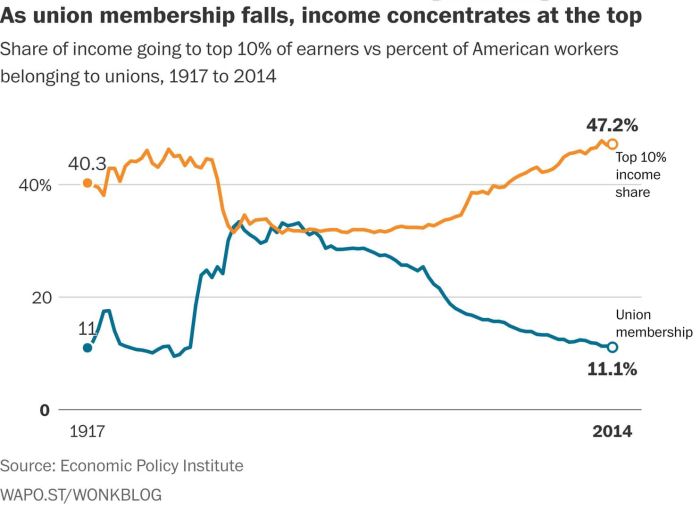
According to the Economic Policy Institute, when union membership goes down, the wealthy make more money! Conversely, the more union membership goes up, the less money goes to the wealthy!


6BILJESJ744BVLL2QVZYGJRNCM


And despite all that, the rich are concerned that I have the right to stop paying union dues!


I mean if I stop paying my dues and my fellow working stiffs stop paying their dues, then my union might just have to close up shop!


And that would mean my wages would go down!


But these same rich people who just sent me an email would see their investments go up!


They’d take home sacks of cash! So much money that they’d probably drop some and maybe I might be able to pick up a few pennies they leave on the curb!


Isn’t that great!?


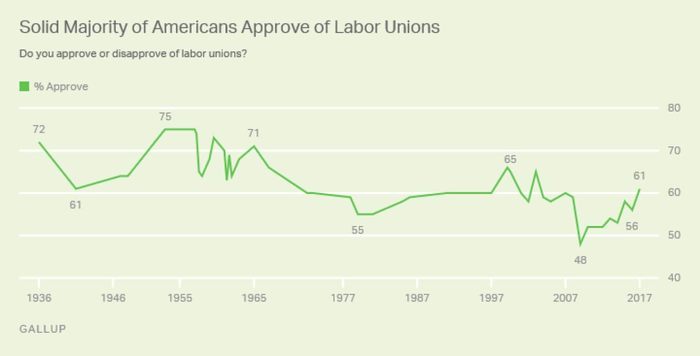
You know public sector employees including firefighters and police, and teachers like me are the largest sector left of the workforce still represented by unions!


According to BLS statistics, 38 percent of public sector employees are represented by unions!


It’s true!


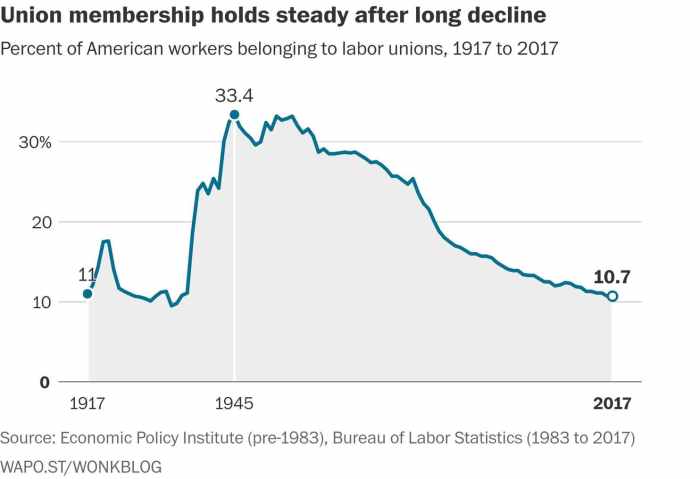
Back in 1945, union membership nationwide was at its highest rate of 33.4%! That means back then about a third of all American workers belonged to a union!


Last year it was down to 10.7 percent!


YC4GHPZ5MI5DHNQVM2TN4E4JZI


In the intervening years, manufacturing jobs have declined, blue collar jobs have been outsourced and both political parties have passed laws making it harder to unionize and collectively bargain!


But thank goodness I now have the right to get something for nothing from my union!


That’s going to perk things right up!


Sure, numerous studies have shown that declining union membership is one of the major causes why middle class wages have remained basically flat! But I get to keep a hundred bucks in my pocket so everything’s square!


One thing worries me, though!


I’m not sure many union workers are going to take advantage of this new freedom!


Don’t get me wrong – I don’t agree with everything my union does! No one could say that!


I don’t agree with everything my government does, either, but I still pay taxes!


And I wouldn’t stop paying taxes even if I could! I like being an American citizen, and I like much of what my government provides by way of our military, infrastructure and social programs!


It’s the same with my union!


I mean I LIKE earning higher wages! I LIKE getting better benefits! I LIKE knowing I work in a safe environment!


And when I have a better working environment, my students have a better learning environment!


I doubt many of my co-workers are going to stop paying their dues just because they can!


UWLMMCVEKY3ZFDE5K6LGDY42PE


We’re not stupid! We know that if you want union benefits, you have to pay union dues! The Supreme Court can say whatever it likes! It can’t legislate passed reality!


Moreover, who would want to associate with a co-worker who refuses to pull his or her own weight!?


If I found out one of my colleagues was leaving it to me to pay for both of us, I’d throw a fit! I wouldn’t associate with that person!


If he or she came to my room asking for advice, I’d tell them to get lost! I wouldn’t eat with them at lunch, I wouldn’t chat about their day, I’d give them their walking papers, myself!


Frankly, the social cost would be higher than just paying your union dues!


So thanks anyway, Mackinac Center! Thanks anyway, Charles and David Koch! Thanks anyway, Betsy DeVos!


I’m sticking with my union.


36468177_10156001729458860_2645036208874323968_n


Like this post? I’ve written a book, “Gadfly on the Wall: A Public School Teacher Speaks Out on Racism and Reform,” now available from Garn Press. Ten percent of the proceeds go to the Badass Teachers Association. Check it out!

WANT A SIGNED COPY?

Click here to order one directly from me to your door!
 

book-2


I Voted for Jill Stein. Was I Wrong?

jill-stein-green-placard


On November 8, 2016, I had a heart attack.


That’s not a metaphor.


I went to vote. I went to the doctor. I was sent to the hospital.


How much of that was a result of the Presidential election? I will never know.


But whenever I think back on that day, I am filled with a sense of bone-deep sadness.


After only a little more than a year in office, Donald Trump is already the worst President of my lifetime – and that’s saying something after the disaster that was George W. Bush.


Yet today our country is separating parents and children seeking asylum on the border and locking them away in detention centers. Nearly every cabinet secretary is an incompetent plutocrat put in office to dismantle the department in which they’re in charge. Meanwhile, Trump insults traditional allies and consorts with dictators all over the globe. And nationwide white supremacists of all stripes are emboldened, on the rise, and openly running for office.


I wish there is something I could do to go back in time and change the results of that day. I wish there was something I could do to stop Donald Trump from being elected President. And though I did not vote for her, I would do anything to have Hillary Clinton defeat him.


On that day, though, I voted for Jill Stein.


There’s nothing I can do about that now.


I imagine going back in time and telling myself not to do it. “Go vote for Hillary,” I imagine Future Me telling an ailing younger version.


Yet even now, I’m not sure if I’d say that to myself.


Go vote for Hillary? Would it have made a difference?


Factually, no. One more vote wouldn’t have put her over the top in my home state of Pennsylvania.


But I wrote articles advising readers to do like me and vote Jill Stein. Does that mean I’m responsible for every Stein vote cast in the Keystone state?


No, not really. I may have influenced some people. But I certainly didn’t influence them all.


I suppose the bigger question is this: did Stein spoil the 2016 election for Clinton?


Let’s look at some numbers.


In Pennsylvania, the results went like this:


Screen Shot 2018-06-20 at 10.21.41 AM
Source: New York Times.


Trump got 2,970,733 votes.


Clinton got 2,926,441 votes.


So he won the state by 44,292 votes.


Stein got 49,941 votes – 5,649 more than Trump’s margin of victory.


So if every Stein voter had cast a ballot for Clinton, she would have won the state – though she’d still lose the Presidency by 10 electoral votes.


But if the same process were repeated even in a few other swing states Clinton lost, the result would change. Clinton would have won and be sitting in the Oval Office right now.


Those are just facts. Or at least they’re facts manipulated in a game with counterfactuals.


If this had happened, then this other thing would have happened, too.


However, it is rarely so clear even with numbers.


For instance, Stein ran in 2012, too. She ran against Obama and Romney. She got 20,710 votes in Pennsylvania.


Screen Shot 2018-06-20 at 10.22.27 AM
Source: New York Times


That’s tens of thousands of Green voters who didn’t cast a ballot for centrist Obama. I don’t think it’s fair to assume they would have voted for centrist Clinton, either.


So if we subtract that 20,000 from Stein’s 2016 totals, (49,941 – 20,710) you get 29,231 new people who voted Green who didn’t do so in 2012.


That’s less than Trump’s margin of victory (44,292).


So even if every NEW Stein voter cast a ballot for Clinton, Trump still would have won the state.


The point?


I don’t think it’s factual or fair to assume Stein or Stein voters gave Trump the election.


If I had voted for Clinton, even if I had advised my readers to vote for her, the end result probably would have been the same.


These are the things I think about in the middle of the night when sleep won’t come.


Is there anything I could have done to change things? In trying to make things better, did I make things worse?


I don’t assume I have that much power – either way.


I’m just a school teacher with a blog.


And that’s why I voted for Stein.


Hillary Clinton made her name politically going against teachers unions. She and her husband have done quite a lot to weaken my profession and the school my daughter attends.


The national teachers unions may have supported her run for President, but they did so without fairly polling members. Her entire nomination process was marred by unfair and undemocratic practices by the Democratic Party that left many progressive voters who favored Bernie Sanders feeling left out and silenced.


I still think THAT more than any scribbling on my blog contributed to her loss.


Compared to Trump, Barack Obama was one of the best Presidents we’ve ever had. But compared to Trump, so was George W. Bush. So would be an inanimate carbon rod!


However, Obama was not particularly good for education. He and the corporate Democrats favored every anti-union, pro-privatization scheme they could. What a missed opportunity!


You’d think our first African American President might do something about school segregation – which has been on the rise in the last few decades. Instead, he helped make it worse by promoting charter schools. You’d think he might do something to stop the school-to-prison pipeline. Instead he helped lubricate it by championing high stakes standardized tests.


I think that’s another reason Clinton lost. Many of us were fed up with Obama’s neoliberal policies and wanted a candidate who might change course. Clinton promised only more of the same.


Don’t get me wrong. In retrospect, more of the same sounds lovely. Give me that old time Obama neoliberalism over Trump’s neo-fascism, any day!


But back in 2016 I thought we had a chance for something more – real hope and change. Was I wrong to vote for a candidate who promised to end high stakes testing and school privatization? Was I wrong to vote for a candidate who promised to fairly fund public schools, provide free college for all and end all student debt?


Maybe.


I suppose I should have been more frightened of Trump back then. But my anger at the Democrats who continually stabbed me and other progressives in the back outweighed my fear of this buffoon.


Perhaps I was wrong in that.


I don’t think it’s too much of an assumption to say we all underestimated Trump. We all underestimated how many people in this country would vote for him.


So was I wrong to vote for Jill Stein?


I still don’t know.


I’m sure many people will criticize me for this article. They’ll blame me for every horrible thing Trump does. If I have any point here, it’s that there’s plenty of blame to go around.


Perhaps we’d do better fighting against Trump than fighting amongst ourselves.


I still believe there is a silent majority of Americans for whom the status quo is unacceptable. Most of us don’t want a wall on our border – we want healthcare for all. Most of us don’t want families separated and undocumented immigrants scapegoated and rounded up – we want a path toward citizenship. Most of us don’t want our democracy subverted and the wealthy to have a greater say in our policies – we want freedom and justice for all.


We just need a way to find each other again. We need to find a way to look past any political, social, racial, gender or cultural differences and find a common humanity.


What better way to do that than in a common cause?


I hope you’ll join me by stopping the recriminations and take on the fight.


We may never fully solve the riddle that was the 2016 election.


There are political and social lessons to be had. But the most important thing is to remember the value of unity and to hold on to each other tight.


We’re all we’ve got.


Like this post? I’ve written a book, “Gadfly on the Wall: A Public School Teacher Speaks Out on Racism and Reform,” now available from Garn Press. Ten percent of the proceeds go to the Badass Teachers Association. Check it out!

WANT A SIGNED COPY?

Click here to order one directly from me to your door!

book-4

“He Was Kind” – My Students Describe What I’m Like as a Teacher

13-your-childs-teacher-stundet-hug


What’s the most important attribute of a good teacher?


Some might say intelligence.


You want a teacher who knows the subject matter and can convey it clearly to students.


Others might say classroom management.


You want a teacher who keeps things organized and gets kids to behave.


But for me the most important thing a teacher can be is kind.


I’m not saying intelligence, classroom management and a host of other qualities are unimportant, but if you approach your students with good will in your heart, the rest seems to fall into place.


This isn’t a long-held pedagogical belief I could have articulated for you at the beginning of the school year.


It came to me – as did so much else – from my students.


At the end of the year as my 7th graders are finishing up their final projects and we’re tidying up the room, I always give them a little survey about their experience in the class.


“I’ve been grading you all year,” I say. “Now’s your turn to grade me.”


The surveys can be anonymous – kids needn’t put down their names, and whatever they write has no impact on their grades.


Yet the results are always enlightening.


I wrote in detail two years ago about the survey and the kinds of responses I often get.


But this year it was one of the simplest comments that really got me thinking.


“He was kind.”


IMG_9669


That’s what one of my students told me that I had done especially well during the year.


“He was kind.” That’s all.


It was a response that was echoed by many of my students.


Another child wrote:


“He was kind (and awesome). One of the best teachers.”


IMG_9668


And another:


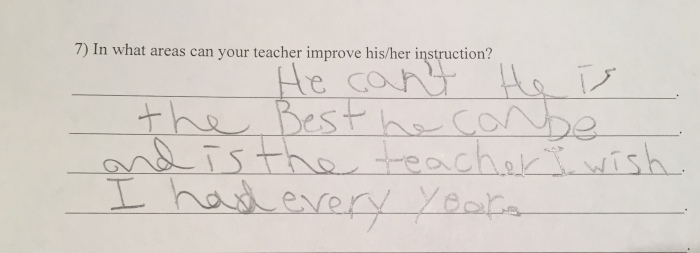
“He can’t [improve]. He is the best he can be and is the teacher I wish I had every year.”


IMG_9674


This is all very flattering, but what exactly did all this niceness mean?


How did being a kind teacher help me do my job? What did I do that helped students learn?


They had an answer for that, too:


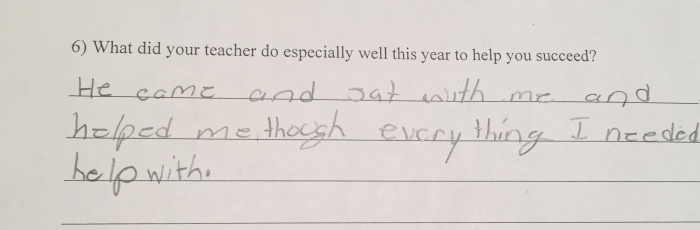
“He came and sat with me and helped me through everything I needed help with.”


IMG_9675


***


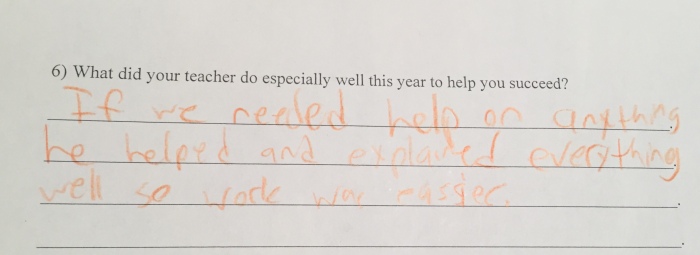
“If we needed help on anything he helped and explained everything well so work was easier.”


IMG_9662


***


“What my teacher did to help me succeed was that he made me feel motivated to do the work in class and not giving us so much work at once.”


IMG_9664


***


“[He] taught me how to write essays, indent on papers and showed me a lot of useful things.”


IMG_9677


Another particularly enlightening comment was this one:


“I don’t know [how he could improve], but in this class you grew with us. So uh yeah.”


IMG_9667


And I do try to change and grow with my students. When your mandate is to individualize instruction to fit each particular child, I don’t know how you can do otherwise.


This means opening yourself up and letting students know who you are and what you stand for.


I try not to inflict my political, religious or philosophical beliefs on my classes. However, I think some core values come through.


For instance, my students knew I was going to Connecticut to give a TED Talk on the current state of public schools.


They knew my thoughts on standardized testing and school privatization – perhaps not in detail but the general shape of them, certainly. They knew my firm conviction against racism, sexism and prejudice of any kind.


Perhaps that’s why one of them wrote this:


“You’re not only a good teacher. You’re a good friend, and man.”


IMG_9673


***


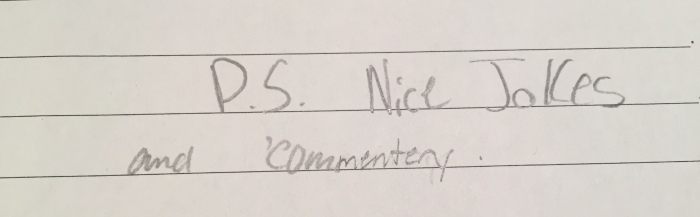
“P.S. – Nice jokes and commentary.”


IMG_9671


Of course there were dissenting opinions. One child thought I was too nice:


“He is way too nice for me and you give way too much essays for people to handle. But overall grade 94%. He doesn’t like Tom Brady so yeah. And he likes the Steelers.”


IMG_9679


I guess no one’s perfect. But how interesting she thought either she deserved a stronger hand or would have been more motivated by fear and consequences. Yet I have to take her with a few grains of salt because this student identified herself on her response and had a friendly rivalry with me about football. She said I was too nice but then referenced our interpersonal rapport.


Another student highlighted how I wasn’t excessively permissive:


[He was good at] “Helping me with instructions and keeping me on task.”


IMG_9670


Most comments were unbridled approbation:


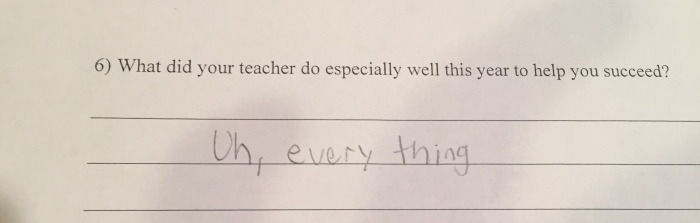
What did your teacher do especially well this year to help you succeed? – “Uh, everything.”


IMG_9666


***


In what areas can your teacher improve his/her instruction? – “I’m not sure. That’s how good a teacher he was.”


IMG_9676


***


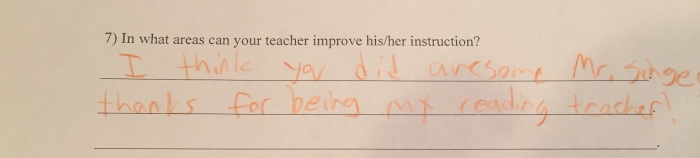
“I think you did awesome, Mr. Singer. Thanks for being my reading teacher!”


IMG_9663


***


“I don’t think my teacher needs to improve. He’s already a great teacher.”


IMG_9665


And so another school year comes to an end.


I’ll miss this class. It was the first year I taught exclusively 7th grade. I’d taught one or two sections of that grade before, but never only that grade.


I’m more used to 8th grade. You wouldn’t think there’d be a world of difference between the two. And who knows? Perhaps if I teach the same grade level next year things will be even more unexpected because the kids will be different.


But when that final bell chimed, I was surprised that so many kids came up to me with hugs and tears.


They really didn’t want to see me go, and, frankly, I don’t want to see them go, either.


If I could follow them next year, I would.


I gave them everything I had to give.


I gave them my heart. I shared with them my life.


And I got back so much more.


That’s what non-teachers don’t understand.


Education is created through often reciprocal relationships.


Learner and teacher are tied together in a positive feedback loop. Sometimes it’s hard to tell which is which and sometimes there is no difference at all.


Thank you so much, last year’s students.


Thank you for letting me be your teacher.


Thank you for bringing out the best in me as I tried to do the same for you.


Like this post? I’ve written a book, “Gadfly on the Wall: A Public School Teacher Speaks Out on Racism and Reform,” now available from Garn Press. Ten percent of the proceeds go to the Badass Teachers Association. Check it out!

WANT A SIGNED COPY?

Click here to order one directly from me to your door!
book-2

Don’t Worry About Grade Inflation. Worry About Grading Fairly.

your-childs-grades-go-down-1494627682


Hard work should be rewarded.


If you earn an A in a given class, you should get an A on your report card.


And this is true no matter how many of your classmates work just as hard as you do.


If everyone in class gives it their best shot, they should all get A’s. It is not the teacher’s job to split hairs and sort kids into arbitrary categories in order to preserve a monetary myth about grades’ value based on a model of scarcity.


Those who demand otherwise are under the spell of one of the oldest myths in academia – grade inflation.


It goes like this: You can’t give all your students excellent marks! That would devalue what it means to get an A!


To which I reply: Bullshit.


Almost every plane that leaves an airport lands safely. Does that devalue what it means to travel? When you arrive at your destination, are you upset that everyone else has arrived safely or would you feel better if some of the planes crashed?


According to the American Journal of Public Health, 93% of New York City restaurants earn an “A” from the health department. Does that shake your faith in the food service industry? Would you feel better if more restaurants were unsanitary? Would your food digest more efficiently if there were more people going home with stomach pain and food poisoning?


Of course not! In fact, these stats actually reassure us about both industries. We’re glad air travel and eating out is so safe. Why would we feel any different about academia?


The idea of grade inflation is a simple imposition of the concept of economic value onto learning. It has no meaning in the field of academics, psychology or ethics. It is just some fools who worship money imaging that the whole world works the same way – and if it doesn’t, it should.


It’s nothing new.


Conservatives have been whining about grade inflation for at least a century. It’s not that the quality of teachers has declined and they’re letting all their students pass without doing the work. It’s that certain types of curmudgeons want to justify their own intelligence by denying others the same privilege.


It’s the “I’ve Got Mine” philosophy.


We see the same thing with Baby Boomers who grew up in the counter culture and pushed for progressive values in their youth. Once they got everything they wanted for themselves, they became conservatives in their old age and worked to deny the same things for subsequent generations.


It’s the very definition of Age scoffing at Youth – a pathology that goes back at least to Hesiod if not further. (Golden age of man, my foot!)


Moreover, there is no authentic way to prove grade inflation is actually happening. Grades are a subjective measure of student learning. They are human beings’ attempt to gauge an invisible mental process. At best they are frail approximations of a complex neural process that is not even bounded temporally or causally. If a student doesn’t know something now, they may come to know it later even without further academic stimulus. Moreover, isolating the stimulus that produced the learning is also nearly impossible.


The important thing is not grade inflation. It is ensuring that grades are given fairly.


If students work hard, they should be rewarded.


I am very upfront with my students about this. And doing so seems to have a positive and motivating effect on them.


This year, I had students who told me they had never read a book from cover-to-cover before my class. I’ve had students look at their report cards in shock saying they’ve never received such high marks in Language Arts before. And doing so makes them want to try all the harder next year to repeat the results.


They leave me excited about learning. They feel empowered and ready to give academics their all. Because the greatest lesson a teacher can instill is that the student is capable of learning.


Don’t get me wrong. I don’t just hand out these grades. Students have to earn them. They have to demonstrate that they have actually learned something.


Everyone rarely measures up to the challenge. But that’s not the point. Everyone COULD. There is nothing in my design that prohibits that outcome. I don’t start with the assumption that I’ll only have 3 A’s, 4 B’s, 10 C’s, etc.


In fact, it is THAT scarcity model that dumbs down academics. If I grade on a curve like that, I have to give out a certain number of high marks regardless of achievement. I’m committed to giving out those 3 A’s regardless of whether that trio of students deserve it or not. However, in my abundance model, I give exactly the number of A’s that are deserved. If that’s zero, no one gets an A. If that’s everyone, then everyone gets an A. It all depends on what students actually deserve, not some preconceived notion about how the world works.


To do this, I give very few tests. I just don’t find them to be very helpful assessments.


A test is a snapshot of student learning. It has its place, but the information it gives you is very limited.


Most of my grades are based on projects, homework, essays, class discussion, creative writing, journaling, poetry, etc. Give me a string of data points from which I can extrapolate a fair grade – not just one high stakes data point.


This may work to some degree because of the subject I teach. Language arts is an exceptionally subjective subject, after all. It may be more challenging to do this in math or science. However, it is certainly attainable because it is not really that hard to determine whether students have given you their best work.


Good teaching practices lend themselves to good assessment.


You get to know your students. You watch them work. You help them when they struggle. By the time they hand in their final product, you barely need to read it. You know exactly what it says because you were there for its construction.


For me, this doesn’t mean I have no students who fail. Almost every year I have a few who don’t achieve. This is usually because of attendance issues, lack of sleep, lack of nutrition, home issues or simple laziness.


I only have control over what happens in the classroom, after all. I can call home and try to work with parents, but if those parents are – themselves – absent, unavailable or unwilling to work with me, there’s little I can do.


And before you start on about standardized testing and the utopia of “objectivity” it can bring, let me tell you about one such student I had who was not even trying in my class.


He never turned in homework, never tried his best on assignments, rarely attended and sleepwalked through the year. However, he knew his only chance was the state mandated reading test – so for three days he was present and awake. The resulting test score was the only reason he moved on to the next grade.


Was he smart? Yes. Did he deserve to go on to the next grade not having learned the important lessons of his classmates? No. But your so-called “objective” measure valued three days of effort over 180.


The problem is that we are in love with certain academic myths.


MYTH 1: Grading must be objective.


WRONG! Grading will never be objective because it is done by subjective humans. These standardized tests you’re so in love with are deeply biased on economic and racial lines. Whether you pass or fail is determined by a cut score and a grading curve that changes from year-to-year making them essentially useless for comparisons and as valid assessments. They’re just a tool for big business to make money off the academic process.


MYTH 2: Learning is Economics.


WRONG! Grades are not money. They don’t function in any way like currency or capital. They aren’t something to be bought and sold. They are an approximate indication of academic success. Treating them as a commodity only degrades their value and the value of students and learning, itself.


Treating grades economically actually represses the desire to learn, dispels curiosity and eliminates the intrinsic value of education.


So go ahead – inflate the “value” of your grades.


Give A’s to every student who deserves it.


That’s how you promote learning and fairly assess it.


Like this post? I’ve written a book, “Gadfly on the Wall: A Public School Teacher Speaks Out on Racism and Reform,” now available from Garn Press. Ten percent of the proceeds go to the Badass Teachers Association. Check it out!

WANT A SIGNED COPY?

Click here to order one directly from me to your door!
book-1

African Immigrants Excel Academically. Why Don’t African Americans?

static.politico.com


The presence of melanin in your skin shouldn’t affect your academics.

But in America, it does.

On average, black students achieve less academically than white students. They have worse grades, lower test scores, meager graduation rates and fewer achieve advanced degrees.

The question is – why?

Why does pigmentation matter so much in this country? What about it brings such negative academic consequences?

This is especially apt since it doesn’t apply to foreign born black students who come here to study or those who recently emigrated here.

In fact, they see just the opposite effect – they earn some of the best grades, have some of the highest test scores, and disproportionately graduate from high school and achieve advanced degrees.

This is something that distinguishes foreign-born Africans – especially those from Sub-Saharan Africa – even from other immigrants. African immigrants sit near the top of the scale of so-called model minorities.

According to a report by Christine Gambino and associates at the Census Bureau, 41% of the African-born immigrant population earned a bachelor degree compared with 28% of the overall foreign-born population in the US.

The four African birth countries with the highest percentages of bachelor and higher degrees among their expat populations in the US are Egypt at 64%, Nigeria at 61%, South Africa at 57% and Kenya at 47%.

So why the difference?

Obviously, it’s not skin color.

Part of it seems to be qualities selected for in the immigration process, itself.

We don’t let just anyone come to the U.S. We have rigorous qualifications and prerequisites that have to be met. For instance, students who want to study here must get high marks on the SAT, Act and/or the TOFFEL – the language proficiency test. To do that, they need the money and resources to study for these exams. They are already some of the best achievers in their native countries.

Moreover, there is a huge cultural difference coming from Africa as opposed to coming from the United States. Native-born Africans have to deal with the effects of post-colonialism. It wasn’t so long ago that European nations conquered and plundered the African continent for gold and resources. That era has mostly ended, but those living there still have to deal with lingering consequences. This has an effect on everything from gender, ethnicity, class, language, family relationships, professions, religions and nation states.

However, native-born Africans do not have to navigate the world of American white supremacy. The affects of being black in this country may be much more harmful than negotiating post-colonialism.

For instance, most mainland Africans enjoy intact cultures. They are not the product of families that were torn apart, religions that were displaced and entire belief systems, world views and genealogies that were stolen.

Nigerian cultures, in particular, highlight the importance of learning.

One typical Nigerian saying goes like this:

“The best inheritance that a parent can give you is not jewelry or cash or material things, it is a good education.”

This is why academics in Nigeria are widely supported, mandatory and free.

Meanwhile, in America native-born black students grow up in a much more stressful and unstable environment. This translates to academic struggles.

For one, they are the victims of educational apartheid. Brown v. Board is more than 60 years old, but American schools have become increasingly segregated by race and class. Black students receive fewer resources than whites and their schools struggle to provide the same quality of education. Moreover, they are the target – either directly or indirectly – of privatization schemes that result in less control over their own schools and the further reduction of resources through charter and voucher schools that can cut services and pocket the savings as profit.

However, the problem is not just systemic. I hate to say it, but sometimes even American teachers put up obstacles to black students success due to (often unconscious) bias.

Most teachers are white. They have certain societally reinforced expectations of black students. When these children struggle, they are more often put into special education and stigmatized for their differences.

It is no doubt that black students are more often disciplined and suspended than white students – numerous studies have shown this.

I think this is due at least partially to white teachers’ expectations. It is tempting to see black student behavior as negative in the default. We too often label them “bad kids” and then try to find evidence to support it instead of giving them the benefit of the doubt or assuming they’re smart and well-behaved until proven otherwise.

African immigrants don’t have to deal with these stigmas to nearly the same degree. They don’t get the same negative label. They have more support from close-knit families. They have more positive role models including more college graduates in the family.

Another obstacle for American born black students is a cultural imputation against academic achievement. Doing well in school can be seen as “acting white.” In order to maintain popularity and prestige, they are steered away from the exact things that immigrant Africans are steered toward.

The poverty of American blacks plays a huge factor, too. Even in moderately successful African American homes, parents or guardians are often working multiple jobs or long hours to make ends meet. This reduces their ability to oversee their children’s homework and monitor academic progress.

It seems then that the so-called proficiency gap between native-born black and white students in this country is due to generational poverty, white racism and coping mechanism in their own culture.

If we want to help American-born black students, we need to realize, first, that this problem is not due to inherent racial deficiencies. It is the product of class warfare and white supremacy.

As such, it can be cured through progressive economic policies and anti-racist efforts.

The strongest argument for reparations comes from a recognition of the lingering effects of our history of slavery, segregation, Jim Crow and the prison industrial complex.

These are daunting problems, but they can be solved.

It just takes an honest appraisal of the issues and the social will to make things right.


Like this post? I’ve written a book, “Gadfly on the Wall: A Public School Teacher Speaks Out on Racism and Reform,” now available from Garn Press. Ten percent of the proceeds go to the Badass Teachers Association. Check it out!

WANT A SIGNED COPY?

Click here to order one directly from me to your door!
book-4

School Vouchers and Runaway EdTech Pave the Way for the Destruction of the Very Concept of School

andres


School is where you learn to learn.


A teacher with an advanced degree and decades of experience devotes her time to figuring out what helps you comprehend the world around you.


And, if she’s good, she imparts that lesson to you as well.


Imagine if we took that away.


Imagine a world where there are no schools – just free range children plopped in front of a computer or an iPad and told to go learn something.


No schools, no teachers, just gangs of students walking the streets, stopping along the way to thumb messages to each other on social media, play a video game or take an on-line test.


That’s the world many EdTech entrepreneurs are trying to build.


And school vouchers are helping them do it.


Take Education Savings Accounts (ESAs) and other market based privatization schemes.


Normally, the federal, state and local government collect taxes to fund an individual child’s education, which is then spent at a public or charter school.


At a public school all that money must be spent on the student. At a charter school some of that money can be pocketed as profit by the private company who runs the school.


Public schools provide a better alternative because the funding must be dedicated to the student, living within a district’s coverage area guarantees enrollment, the school must be managed by an elected school board with open meetings and a plethora of other amenities you won’t find at a privatized institution. But at least the charter school is a school!


However, an ESA or other voucher would allow that money to go elsewhere. It could go to funding the tuition at a private or parochial school where organizers can use it however they like – pocketing some and using the rest to help the child as you’ll find in most charter schools.


But as bad as that is, vulture capitalists want to add another destination for that money – let it pile up in the bank where it can be used for discrete education services provided by the EdTech industry.


It’s almost like homeschooling – without the loving parent being in charge.


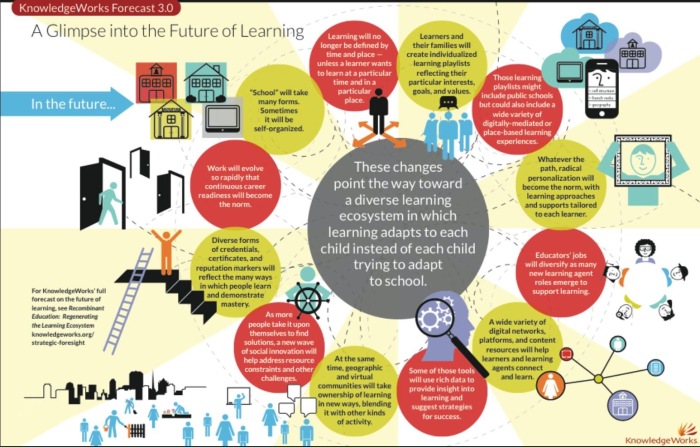
It goes by many names – a learning ecosystem, personalized learning, competency based or individualized education.


But it’s really a single person cyber school with little to no guiding principles, management or oversight.


Education is reduced to a series of badges students can earn by completing certain tasks.


Reading a book or an article gives you a badge. Answering a series of multiple-choice questions on a reading earns you more badges. And if you’ve completed a certain task satisfactorily, you can even earn a badge by teaching that same material to others.


It’s the low wage gig economy applied to education. We just transform a crappy job market where workers bounce from a few hours of minimum wage labor here to a few hours of minimum wage toil there – all without benefits or union protections – into learning. Children bouncing from a few hours of Khan Academy videos here to a software package there and Voila! “Modern” education!


In short, it’s school without the school or teachers.


And make no mistake, it’s not about improving the quality of education. It’s about providing the cheapest possible alternative and selling it to rubes as innovation.


The wealthy will still get institutions of learning. They will still be educated by the most qualified teachers in the world. They will still learn how to learn.


The best path to becoming a truly educated person involves human interaction and mentorship. You need experienced professional educators who use the empirical evidence they see in the classroom about your child to tailor lessons to their needs. The wealthy would never dream of making their children learn from the academic equivalent of an automated check out aisle or telemarketer robocall.


It is only the poor and middle class who will be released like chickens into the pasture of a learning ecosystem.


And as an added benefit, the badge structure creates a market where investors can bet and profit off of who gains badges and to what degree on the model of crypto-currencies like Bitcoin! So all the stability of the pre-crash housing market! What could possibly go wrong!?


Let me be clear – this is the ultimate goal of the school privatization movement.


Charter and voucher schools are only the tip of the iceberg. They still require real human beings to act as teachers (though they need not be as well educated or have as much experience as public school teachers). They still require buildings and grounds.


But this depersonalized learning approach allows them to do away with all of that. They can just provide students with an Internet accessible device and some dubious on-line tracking and management system.


Then they can pocket all the rest of the money taxpayers put aside to educate children and call it profit.


And they can use the programs students access to “learn” as a way to gather valuable marketing data about our kids. Everything students do on the device is free market research – every word they input, every keystroke, every site visited down to the slightest eye movement.


This is the logical conclusion of the monetization of education and an economy that only sees value in others as human capital that can be bought, sold and exploited.


This is where the privatization movement is going. And they’re laying the groundwork in legislation being proposed in our state capitals today.


In Pennsylvania, for instance, Senate Bill 2 proposes the creation of just such ESAs. If approved, the immediate result would be to boost private and parochial schools.


However, given a few years to strengthen the technologies and systems needed for a full learning ecosystem, the same law would allow taxpayer money to be used in this way.


And it’s something hardly anyone is talking about.


We’re fighting the privatization systems of today as the plutocrats set up the privatization systems of tomorrow.


Even if school vouchers never take off to the degree necessary to scaffold the most robust learning ecosystems, EdTech lobbyists are trying to install as much of this garbage as they can into our existing schools.


They are using one-to-one iPad initiatives and grants to fund up-to-date computers, Wi-Fi networks and software packages to pave the way for this brave new world of digital exploitation. They are selling our test score obsessed bureaucrats software like iStation and IXL that bridge the gap between test prep and learning ecosystems lite.


You can walk into many schools today where students spend hours on-line earning digital badges for watching videos and taking stealth assessments.


Few people are sounding the alarm because few people understand what’s going on.


This is not conjecture. This is not a conspiracy theory. This is the goal the edtech entrepreneurs will gladly tell you all about hoping you’ll invest.


There are hours of videos, pages of documents, mountains of graphs, charts and graphics about how this scheme will pay off for investment bankers and venture capitalists. (See below)


The only true way to win this battle is a cultural shift away from dehumanizing runaway capitalism.


We need to stop thinking that the private sector is always better than the public good. We need to stop allowing big business and corporations to get away without paying their fair share. We need to increase the voice of citizens and decrease the megaphone of money and privilege.


Otherwise, the science fiction dystopias of books like “Ready Player One” will no longer be fiction.


They will become the reality for every school child in this country.


A reality where school, itself, is a thing of the past.


And education is reduced to the mercenary collection of discrete skills that add up to nothing of value for the students except their own enslavement.


But don’t take my word for it. Here is the learning ecosystems model from the EdTech industry, itself, in corporate officers own words and graphics:

LEARNING IS EARNING – the scariest 6:58 video you’ll ever see.


KNOWLEDGEWORKS Vision for the Future of Education:

IMG_9654

Graphic as a PDF

More on KnowledgeWorks

Listing for PARENTS AS CONSUMERS Symposium

Read all about it here.


FIGHT BACK AGAINST SCHOOL PRIVATIZATION AND RUNAWAY EDTECH:

Like this post? I’ve written a book, “Gadfly on the Wall: A Public School Teacher Speaks Out on Racism and Reform,” now available from Garn Press. Ten percent of the proceeds go to the Badass Teachers Association. Check it out!

WANT A SIGNED COPY?

Click here to order one directly from me to your door!

book-2


Pennsylvania’s Broken Testing Promise – We Don’t Assess Students Less If We Demand Constant Diagnostic Tests

Jelani Guzman

Downcast faces, dropping eyes, desperate boredom.


That’s not what I’m used to seeing from my students.


But today they were all slumped over their iPads in misery taking their Classroom Diagnostics Tools (CDT) test.


It’s at times such as these that I’m reminded of the promise made by Pennsylvania’s Governor, Tom Wolf.


He pledged that this year we’d reduce the amount of time public school students spend taking standardized assessments.


“Students, parents, teachers and others have told us that too much time in the classroom is used for test taking,” he said.


“We want to put the focus back on learning in the classroom, not teaching to a test. Standardized testing can provide a useful data point for a student’s performance, but our focus should be on teaching students for future success, not just the test in front of them.”


So at his urging we made slight cuts to our Pennsylvania System of School Assessment (PSSA) tests – the assessment for grade 3-8 students.


We removed two sections of the PSSA – one in math, one in reading – and reduced the number of science questions.


This can cut testing by as much as 48 minutes in math, 45 minutes in reading, and 22 minutes in science.


And that’s good news.


But it’s not exactly the kind of sea change the state claims, given the Department of Education’s recommendations for additional tests on top of the PSSA.


That’s right. The state wants schools to give the CDT assessment an additional 3 to 5 times a year in reading, math and science.


Unlike the PSSA, this is a voluntary assessment. Districts can decide against it, but the department’s flunkies are crisscrossing the Commonwealth advising we all give the CDT as much as possible.


So that’s between 50-90 minutes for each assessment. A district that follows the state’s guidelines would be adding as much as 270 minutes of testing every seven weeks. In a given year, that’s 1,350 minutes (or 22.5 hours) of additional testing!


Pop quiz, Governor Wolf. Cutting testing by 115 minutes while adding 1,350 minutes results in a net loss or a net gain?


The answer is an increase of 1,235 minutes (or more than 20 hours) of standardized testing.


In my classroom, that means students coming in excited to learn, but being told to put away their books, pocket their pencils and put their curiosity on standby.


The folks who work at the Department of Education instead of in the classroom with living, breathing children, will tell you that these CDT tests are a vital tool to help students learn.


They provide detailed information about which skills individual students need remediation on.


But who teaches that way?


Billy, you are having trouble with this kind of multiple-choice question, so here are 100 of them.


We don’t do that. We read. We write. We think. We communicate.


And if somewhere along the way, we struggle, we work to improve that while involved in a larger project that has intrinsic value – such as a high interest book or a report on a hero of the civil rights movement.


When learning to walk, no one concentrates on just bending your knees. Even if you have stiff joints, you work them out while trying to get from point A to point B.


Otherwise, you reduce the exercise to boring tedium.


That’s what the state is suggesting we do.


Make something essentially interesting into humdrum monotony.


Teachers don’t need these diagnostics. We are deeply invested in the act of learning every day.


I know if my students can read by observing them in that act. I know if they can write by observing them doing it. I know if they can communicate by listening to them arguing in Socratic seminar. I read their poems, essays and short stories. I watch their iMovies and Keynote projects.


I’m a teacher. I am present in the classroom.


That tells me more than any standardized diagnostic test ever will.


It’s ironic that on a Department of Education “CDT Frequently Asked Questions” sheet, the assessment is described as “minimizing testing time.”


That’s just bad math.


And my student’s know it.


The district just sent out a letter telling parents and students they could take advantage of a school voucher to go to a local parochial school at public expense.


When presented with the prospect of another day of CDT testing in my room, one of my brightest students raised his hand and asked if kids in the local Catholic school took the test.


I told him I didn’t know – though I doubt it. They COULD take the test. It is available to nonpublic schools, but do you really think they’re going to waste that much instruction time?


Heck! They don’t even take the same MANDATORY standardized testing! Why would they bother with the optional kind!?


It is the public schools that are hopelessly tangled in the industrial testing complex. That’s how the moneyed interests “prove” the public schools are deficient and need to be replaced by privatized ones.


It’s an act of sabotage – and with the CDT it’s an act of self-sabotage.


School directors and administrators need to be smarter. The only way to beat a rigged game is not to play.


And the only way to reduce testing is to TAKE FEWER TESTS!


Like this post? I’ve written a book, “Gadfly on the Wall: A Public School Teacher Speaks Out on Racism and Reform,” now available from Garn Press. Ten percent of the proceeds go to the Badass Teachers Association. Check it out!

ebook-1

Facebook is Censoring Your Favorite Bloggers

finally-thumbs-down-things-you-dislike-facebook.1280x600-970x546

Have you seen me?


Probably not.


In fact, you’re probably not even seeing this right now.


Though you may have read and enjoyed my articles in the past, though you may still want to have the opportunity to see and enjoy my posts in the future, you probably aren’t seeing them anymore.


The reason? Facebook has employed a new algorithm to determine exactly what you’re allowed to see on your news feed.


Like a parent or a government censor, they are scanning your content for certain words, judging your posts based on interactions, and otherwise making choices on your behalf without your consent.


Unless someone pays them to do otherwise. Then they’ll spam you with nonsense – fake news, lies, propaganda: it doesn’t matter so long as money is changing hands.


So homegrown blogs like this one are left in the dust while corporations and lobbyists get a megaphone to shout their ideas across social media.


Look, I don’t mean to minimize what Facebook does. There’s a ton of information that comes through the network that COULD be displayed on your screen. The company uses an algorithm – a complex set of steps – to determine exactly what to show you and when. But instead of basing that solely on who you’ve friended and what you’re interested in, they’ve prioritized businesses and shut down the little guy.


Since Facebook made the change in January, my blog only gets about 40% of the hits it did in years passed. And I’m not alone. Other edu-bloggers and organizations dedicated to fighting school privatization and standardization are reporting the same problems – our voices are being silenced.


And all this is happening after a series of Facebook scandals.


After the whole Cambridge Analytica outrage where Facebook gave the data of 87 million users – without their consent – to a political analysis firm that used it to help elect Trump…


After Facebook sold more than $100,000 in advertisements to Russian bots in 2016 who used them to spread propaganda to help elect Trump…


After enabling the spread of hate speech in Myanmar which allowed the military to engage in “ethnic cleansing” of the Rohingya Muslim minority – which has forced 700,000 people from their homes and across the border into neighboring Bangladesh…


After all that, Facebook still pretends that changing its algorithm is simply a way to crack down on “fake news.”


It’s not.


They are controlling information.


They are policing free expression.


They are NOT cracking down on falsehoods and deception.


In fact, much of what they’re doing is completely devoid of ideology. It’s business – pure and simple.


They’re monetizing the platform. They’re finding new and creative ways to squeeze content providers to gain access to users’ news feeds.


This won’t stop propaganda and fabrications. It just charges a fee to propagate them.


It’s the same thing that allowed those Russian bots to spread Trump-friendly lies in 2016.


It’s pay-to-play. That’s all.


Founder and CEO Mark Zuckerberg characterized the change in January of 2018 as prioritizing content from “friends, family and groups.”


Zuckerberg admitted this means it will be harder for brands and publishers to reach an audience on the social media platform – unless they pay for the privilege. That’s significant because even though organic reach had been diminishing for some time, this is the first time the company admitted it.


Zuckerberg wrote:


“As we roll this out, you’ll see less public content like posts from businesses, brands, and media. And the public content you see more will be held to the same standard—it should encourage meaningful interactions between people.”


What are “meaningful interactions”?


Apparently, what the company calls active interactions are more important than passive ones. So commenting and sharing is more important than just liking something.


In practice that means if you comment on someone’s post, you’re more likely to see things by that person in the future. And if they respond to your comment, their post gets seen by even more people.


Reactions matter, too, as does the intensity of those reactions. If people take the time to hit “Love” for a post, it will be seen by more people than if they hit “Like.” But whatever you do, don’t give a negative reaction like “Sad” or “Angry.” That hurts a post’s chances of being seen again.


I know it’s weird. If someone shares a sad story about their mother with cancer, the appropriate response is a negative reaction. But doing so will increase the chances the post will be hidden from other viewers. Facebook wants only happy little lab rats.


Sharing a post helps it be seen, but sharing it over messenger is even better. And just sharing it is not enough. It also needs to be engaged in by others once you share it.


Video is also prioritized over text – especially live video. So pop out those cell phone cameras, Fellini, because no one wants to read your reasoned argument against school privatization. Or they may want to, but won’t be given a chance. Better to clutter up your news feed with auto-playing videos about your trip to Disneyworld. I suppose us, social justice activists, need to become more comfortable with reading our stuff on camera.


And if you do happen to write something, be careful of the words you use to describe it. The algorithm is looking for negative words and click bait. For example, if you ask readers to like your posts or comment, that increases the chances of Facebook hiding it from others. And God forbid you say something negative even about injustice or civil rights violations. The algorithm will hide that faster than you can say “Eric Garner.” So I guess try to be positive when writing about inequality?


Do you happen to know someone famous or someone who has a lot of Facebook followers? If they engage in your posts, your writing gets seen by even more folks. It’s just like high school! Being seen with the cool kids counts.


One of the best things readers can do to make sure they see your content is having them follow you or your page. But even better is to click the “Following” tab and then select “See First.” That will guarantee they see your posts and they aren’t hidden by the algorithm.


Facebook-News-Feed-update-620x570


I know. I know.


This is all kind of silly, but Facebook is a private corporation. It should be allowed to control speech however it likes. Right?


Wrong.


The social media giant collects a ton of data about its users and sells that to advertisers. As a user, you have to make that Faustian bargain in order to gain free access to the platform. However, as we’ve seen, that data can be used by political organizations for nefarious ends. Private business cannot be trusted with it.


Moreover, there is the echo chamber effect. Facebook controls what users see. As such, the company has tremendous power to shape public opinion and even our conception of reality. This used to be the province of a free and independent press, but after media conglomeratization and shrinking advertising revenues, our press has become a shadow of its former self.


In order to maintain a democratic system that is not under the sway of any one party, faction or special interest group, it is essential that social media providers like Facebook become public utilities.


It must be regulated and free from manipulation by those who would use it for their own ends.


The way things are going, this seems more unlikely than ever.


Our democracy is a fading dream. Fascism is on the rise.


But if we want even a chance of representative government, we need to reclaim social media for ourselves. We need control over what we get to see on Facebook – whether that be a school teacher’s blog or your cousin’s muffin recipe.


In the meantime, do what you can to take back your own news feed.


If you want to keep seeing this blog, follow me on Facebook and click “See First.” Hit “Love” on my content. Comment and share.


The only thing standing in our way right now is a brainless computer algorithm. We can outsmart it, if we work together.


Hope to be seeing you again real soon.