The Necessity and Importance of Teachers

teacher-elementary-Getty-blog


Are teachers necessary?


That’s the question big business is asking.


Well, “asking” isn’t really the right word. They’re implying an answer.


Hedge fund mangers and ed tech soothsayers are betting hundreds of millions of dollars that educators aren’t really all that important.


They’re planning a future where real live people play a much smaller role in student learning.


They’re mapping out a world where kids don’t even have to go to school to grasp the basics, where learning can be accomplished anywhere but instigated, tracked, and assessed on-line through various computer platforms.


It’s called a learning ecosystem, personalized learning, competency based or individualized education. With little to no guiding principles, management or oversight, kids would engage in educational tasks on various devices in order to earn digital badges.


Children would bounce from a few hours of Khan Academy videos here to a software package there and Voila! “Modern” education!


It’s a brave new world where investors hope to make a bundle by reducing the cost and pocketing the savings.


Since teachers are the biggest cost, they’re the first things to go.


Since their rights as workers and human beings are a roadblock on this learning superhighway, they’re the first to go.


And since they’re in a prime position to see exactly what’s going on and to object when this ed tech paradise exploits the students it ostensibly is being built for, they MUST go – now, as soon as possible.


The Supreme Court’s recent decision in Janus v AFSCME is part of that process. It’s another way to weaken labor and clear the path for business – the collusion of politics and corporations to steamroll the rest of us and swipe more of our money regardless of the children in the steamrollers way.


So when I ask “Are teachers necessary?” it’s not a purely philosophical question.


The answer will have a major impact on both the education of today and where we go in the future.


If teachers are not necessary, that removes one of the biggest obstacles to this frightening and uncertain future.


Unfortunately, no matter how much I want to answer in the affirmative that teachers are necessary, I can’t do so.


Even after thousands of years of recorded history, learning remains a mysterious process. Yet it doesn’t take much reflection to realize that it can take place without the presence of a teacher.


Some things can be figured out solely by the learner in the right circumstances.


In fact, many academic studies have shown that teachers are not even the most important factor in the process.


Roughly 60% of academic achievement can be explained by family background – things like income and poverty level. School factors only account for 20% – and of that, teachers account for 15%. (see Hanushek et al. 1998; Rockoff 2003; Goldhaber et al. 1999; Rowan et al. 2002; Nye et al. 2004).


Estimates vary somewhat from study to study, but the basic structure holds. The vast majority of impact on learning comes from the home and out-of-school factors. Teachers are a small part of the picture. They are the largest single factor in the school building, but the school, itself, is only one of many components.


In short, teachers are not necessary to student learning.


But neither are doctors necessary to healing or lawyers necessary to acquittals.


Necessity is a very high bar.


To survive, you need food, shelter and clothing. However, having all three does not mean you have a good life. Slaves had all three – no free person would choose to trade places with someone in generational servitude simply because they had everything they needed to survive.


The same with medicine. If shot in the arm, you could provide me with all the medical equipment necessary to remove the bullet, but I would still have a difficult time doing it by myself. I COULD. A doctor is not NECESSARY for that operation. But without a doctor present, my chances of getting the best medical care drop dramatically.


Moreover, you could pop me in a courtroom without the benefit of legal counsel and it’s not impossible that I could argue my way to the dismissal of all charges against me. But the likelihood of doing so is infinitesimal – as undocumented youngsters are discovering when forced into the courtroom to defend against deportation without an attorney or even their parents present.


The same is true of education.


Though teachers are not necessary to learning, they are vital to it.


Having a teacher dramatically boosts a student’s chances, and the more disadvantaged that student is, the more he or she benefits from an educator.


The academic schemes of the corporate class amount to changing the field into the equivalent of an automated teller or a business robocall.


You can purchase your groceries through the self-checkout line. You can get your customer service from an automated list. But neither of these are the highest quality service.


They are cheap alternatives.


They are ways for the business to cut costs and boost profits. Neither have anything to do with making things better for the customer.


And when it comes to education, eliminating (or even drastically reducing access to) the teacher will decrease the quality of the service beyond recognition.


A 2009 report, Poverty and Potential: Out-of-School Factors and School Success, released by the Great Lakes Center for Education Research and Practice outlined several real world solutions to increase academic outcomes. None of them involve the elimination of teachers.


They are:


1. Reduce the rate of low birth weight children among African Americans

2. Reduce drug and alcohol abuse

3. Reduce pollutants in U.S. cites and move people away from toxic sites

4. Provide universal and free medical care for all citizens

5. Insure that no one suffers from food insecurity

6. Reduce the rates of family violence in low-income households

7. Improve mental health services among the poor

8. More equitably distribute low-income housing throughout communities

9. Reduce both the mobility and absenteeism rates of children

10. Provide high-quality preschools for all children

11. Provide summer programs for students from low-income homes to reduce summer losses in their academic achievement.


These are ways you improve education FOR CHILDREN.


This is how you make things better FOR THE LEARNER and not necessarily for the investor class.


And when it comes to teachers, there are numerous ways you can help them provide support for students.


First of all, hire more of them!


Today’s public schools employ 250,000 fewer people than they did before the recession of 2008–09. Meanwhile enrollment has increased by 800,000 students.


So if we wanted our kids to have the same quality of service children received in this country only a decade ago, we’d need to hire almost 400,000 more teachers!


That’s how you cut class size down from the 20, 30, even 40 students packed into a room that you can routinely find in some districts today.


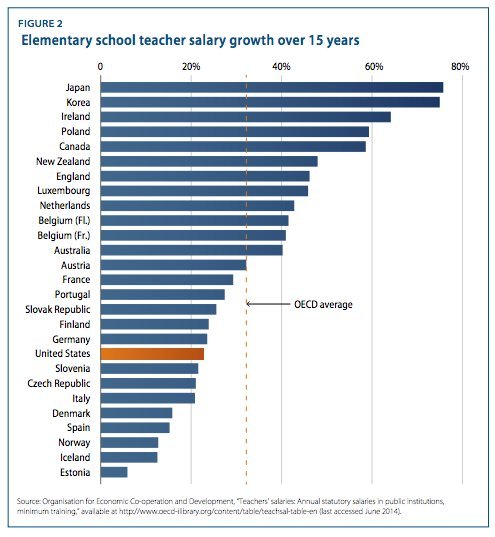
And if you want to improve the quality of the teachers in those classrooms, here’s an easy fix – pay them.


According to the Economic Policy Institute, teachers in the United States make 14 percent less than people from professions that require similar levels of education.


Sadly, it only gets worse as time goes on.


Teacher salary starts low, and grows even more slowly.
 

original


According to a report by the Center for American Progress, on average teachers with 10 years experience only get a roughly $800 raise per year. No wonder more than 16 percent of teachers have a second or third job outside of the school system. They simply can’t survive on the salary.


They can’t buy a home or even rent an apartment in most metropolitan areas. They can’t afford to marry, raise children, or eke out a middle class existence.


If you want to attract the best candidates to the profession, you need to make it more attractive. One way to do that is to increase the salary.


And finally, stop micromanaging everything teachers do and stomping on their rights. To do their job effectively teachers need autonomy. They need the ability to make decisions on the ground based on the empirical evidence gathered in the classroom.


Moreover, they need the freedom to speak out when something is going wrong in their buildings or districts. When software packages are purchased that spy on students for corporations, they need the ability to sound the alarm. When high stakes standardized testing is out of control, they need to be able to voice their objections. When shoddy, second-rate academic standards are forced onto them by politicians and business people, they need to be able to blow the whistle.


To do that, they need their union protections. They need collective bargaining rights to give them the power to counterbalance the forces of greed and corruption that have always been at the schoolhouse door.


As a country we have taken our attention away from what’s really important. We’ve stopped focusing on how to make education better and instead equated it with how to make it more profitable for those who are already wealthy.


Teachers are vital to education. They are lifelines to struggling students. We should find ways to support them and not constantly undercutting their social standing, autonomy and rights.


The importance of teachers is beyond doubt. As is the importance of society in supporting them.


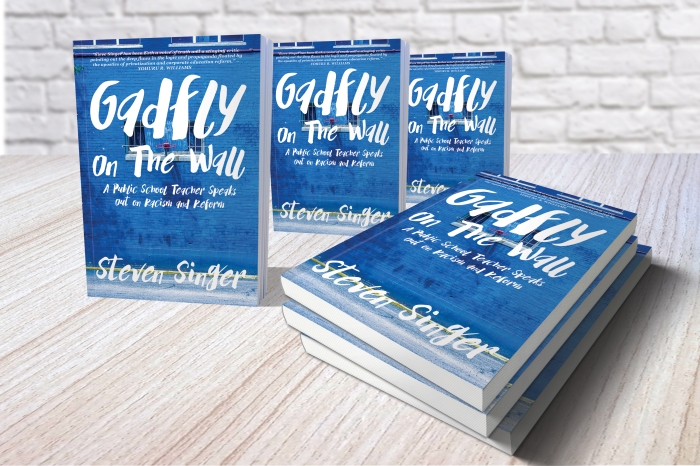
Like this post? I’ve written a book, “Gadfly on the Wall: A Public School Teacher Speaks Out on Racism and Reform,” now available from Garn Press. Ten percent of the proceeds go to the Badass Teachers Association. Check it out!

WANT A SIGNED COPY?

Click here to order one directly from me to your door!
 

book-1

I Voted for Jill Stein. Was I Wrong?

jill-stein-green-placard


On November 8, 2016, I had a heart attack.


That’s not a metaphor.


I went to vote. I went to the doctor. I was sent to the hospital.


How much of that was a result of the Presidential election? I will never know.


But whenever I think back on that day, I am filled with a sense of bone-deep sadness.


After only a little more than a year in office, Donald Trump is already the worst President of my lifetime – and that’s saying something after the disaster that was George W. Bush.


Yet today our country is separating parents and children seeking asylum on the border and locking them away in detention centers. Nearly every cabinet secretary is an incompetent plutocrat put in office to dismantle the department in which they’re in charge. Meanwhile, Trump insults traditional allies and consorts with dictators all over the globe. And nationwide white supremacists of all stripes are emboldened, on the rise, and openly running for office.


I wish there is something I could do to go back in time and change the results of that day. I wish there was something I could do to stop Donald Trump from being elected President. And though I did not vote for her, I would do anything to have Hillary Clinton defeat him.


On that day, though, I voted for Jill Stein.


There’s nothing I can do about that now.


I imagine going back in time and telling myself not to do it. “Go vote for Hillary,” I imagine Future Me telling an ailing younger version.


Yet even now, I’m not sure if I’d say that to myself.


Go vote for Hillary? Would it have made a difference?


Factually, no. One more vote wouldn’t have put her over the top in my home state of Pennsylvania.


But I wrote articles advising readers to do like me and vote Jill Stein. Does that mean I’m responsible for every Stein vote cast in the Keystone state?


No, not really. I may have influenced some people. But I certainly didn’t influence them all.


I suppose the bigger question is this: did Stein spoil the 2016 election for Clinton?


Let’s look at some numbers.


In Pennsylvania, the results went like this:


Screen Shot 2018-06-20 at 10.21.41 AM
Source: New York Times.


Trump got 2,970,733 votes.


Clinton got 2,926,441 votes.


So he won the state by 44,292 votes.


Stein got 49,941 votes – 5,649 more than Trump’s margin of victory.


So if every Stein voter had cast a ballot for Clinton, she would have won the state – though she’d still lose the Presidency by 10 electoral votes.


But if the same process were repeated even in a few other swing states Clinton lost, the result would change. Clinton would have won and be sitting in the Oval Office right now.


Those are just facts. Or at least they’re facts manipulated in a game with counterfactuals.


If this had happened, then this other thing would have happened, too.


However, it is rarely so clear even with numbers.


For instance, Stein ran in 2012, too. She ran against Obama and Romney. She got 20,710 votes in Pennsylvania.


Screen Shot 2018-06-20 at 10.22.27 AM
Source: New York Times


That’s tens of thousands of Green voters who didn’t cast a ballot for centrist Obama. I don’t think it’s fair to assume they would have voted for centrist Clinton, either.


So if we subtract that 20,000 from Stein’s 2016 totals, (49,941 – 20,710) you get 29,231 new people who voted Green who didn’t do so in 2012.


That’s less than Trump’s margin of victory (44,292).


So even if every NEW Stein voter cast a ballot for Clinton, Trump still would have won the state.


The point?


I don’t think it’s factual or fair to assume Stein or Stein voters gave Trump the election.


If I had voted for Clinton, even if I had advised my readers to vote for her, the end result probably would have been the same.


These are the things I think about in the middle of the night when sleep won’t come.


Is there anything I could have done to change things? In trying to make things better, did I make things worse?


I don’t assume I have that much power – either way.


I’m just a school teacher with a blog.


And that’s why I voted for Stein.


Hillary Clinton made her name politically going against teachers unions. She and her husband have done quite a lot to weaken my profession and the school my daughter attends.


The national teachers unions may have supported her run for President, but they did so without fairly polling members. Her entire nomination process was marred by unfair and undemocratic practices by the Democratic Party that left many progressive voters who favored Bernie Sanders feeling left out and silenced.


I still think THAT more than any scribbling on my blog contributed to her loss.


Compared to Trump, Barack Obama was one of the best Presidents we’ve ever had. But compared to Trump, so was George W. Bush. So would be an inanimate carbon rod!


However, Obama was not particularly good for education. He and the corporate Democrats favored every anti-union, pro-privatization scheme they could. What a missed opportunity!


You’d think our first African American President might do something about school segregation – which has been on the rise in the last few decades. Instead, he helped make it worse by promoting charter schools. You’d think he might do something to stop the school-to-prison pipeline. Instead he helped lubricate it by championing high stakes standardized tests.


I think that’s another reason Clinton lost. Many of us were fed up with Obama’s neoliberal policies and wanted a candidate who might change course. Clinton promised only more of the same.


Don’t get me wrong. In retrospect, more of the same sounds lovely. Give me that old time Obama neoliberalism over Trump’s neo-fascism, any day!


But back in 2016 I thought we had a chance for something more – real hope and change. Was I wrong to vote for a candidate who promised to end high stakes testing and school privatization? Was I wrong to vote for a candidate who promised to fairly fund public schools, provide free college for all and end all student debt?


Maybe.


I suppose I should have been more frightened of Trump back then. But my anger at the Democrats who continually stabbed me and other progressives in the back outweighed my fear of this buffoon.


Perhaps I was wrong in that.


I don’t think it’s too much of an assumption to say we all underestimated Trump. We all underestimated how many people in this country would vote for him.


So was I wrong to vote for Jill Stein?


I still don’t know.


I’m sure many people will criticize me for this article. They’ll blame me for every horrible thing Trump does. If I have any point here, it’s that there’s plenty of blame to go around.


Perhaps we’d do better fighting against Trump than fighting amongst ourselves.


I still believe there is a silent majority of Americans for whom the status quo is unacceptable. Most of us don’t want a wall on our border – we want healthcare for all. Most of us don’t want families separated and undocumented immigrants scapegoated and rounded up – we want a path toward citizenship. Most of us don’t want our democracy subverted and the wealthy to have a greater say in our policies – we want freedom and justice for all.


We just need a way to find each other again. We need to find a way to look past any political, social, racial, gender or cultural differences and find a common humanity.


What better way to do that than in a common cause?


I hope you’ll join me by stopping the recriminations and take on the fight.


We may never fully solve the riddle that was the 2016 election.


There are political and social lessons to be had. But the most important thing is to remember the value of unity and to hold on to each other tight.


We’re all we’ve got.


Like this post? I’ve written a book, “Gadfly on the Wall: A Public School Teacher Speaks Out on Racism and Reform,” now available from Garn Press. Ten percent of the proceeds go to the Badass Teachers Association. Check it out!

WANT A SIGNED COPY?

Click here to order one directly from me to your door!

book-4

This Fathers Day Let’s Be Worthy of Our Children

Fathers-Day-Gifts-for-Kids-to-Make


My daughter wrote me a card for Father’s Day.


It had a heart on the front and the following message on the back:


“Happy Fathers Day! Dad, you are my superstar. You help me when I’m sad. And I love everything you do for me. That is why I wish you a Happy Fathers Day.”


It was a sweet token of affection from a 9-year-old to her sleepy daddy sitting at the kitchen table.


But it got me thinking.


All over this country fathers are probably receiving something similar from their children.


Hawaiian shirts, blotchy neckties and more finger paintings than you could fit in the Louvre.


But the sentiment is probably the same.


Thank you for being there for me.


But are we there for America’s children?


We may be there for our own kids, but where genetics end, are we there for others?


Our government has separated approximately 2,000 children from their parents at the border, according to the Department of Homeland Security.


Two thousand children forcibly separated from their parents in our name and we dare to celebrate Father’s Day?


From April through May, the policy has separated 1,995 minors from 1,940 adults traveling with them who said they were the children’s guardians.


A country that doesn’t respect the rights of parents – even if those parents aren’t documented US citizens – has no right to pretend it values fatherhood or motherhood.


At best, we value WHITE parenthood, and that, my friends, is not good enough.


Look at what we subject our own children to in the public school system.


We segregate our schools by race and class so we can horde resources for wealthy and middle class white kids while providing the bare minimum to the poor and children of color.


In the name of accountability we bestow upon them high stakes standardized tests to “prove” even those meager funds are wasted – yet we ignore the financial disparity, the social problems, the health issues and a host of other obstacles the underprivileged face.


The only help we’re willing to offer is privatized schools that can pocket a portion of their funding and reduce resources for these kids. We demand local control and democratically elected school boards for rich white kids, but expect the poor brown ones at charter and voucher schools to get along with appointed boards where their parents have no choice except to take it or leave it.


Does a society that routinely treats its children this way deserve a thank you card? I think not.


Last month, the CDC released a report indicating that the U.S. birth rate ― the number of babies born nationwide ― is the lowest it’s been in 30 years and is below the “replacement” rate needed to sustain the population.


Various media sources were quick to blame women nationwide. Women put off having kids because they want to focus on careers. They aren’t sexy or submissive enough.


Yet few look at the responsibilities of men in this equation.


Who is it behind the salary gap between men and women? Who conflates women’s healthcare with abortion and communism? Who makes it easier to get a gun in this country than proper maternity leave, childcare or any adequate resources to make having a family sustainable?


Answer: men.


We’re grossly over-represented in government, business and management.


We don’t even support men who want to have families. Men make more money than women, but salaries are down for them as well. If there’s little support for pregnant women, there’s little support for the fathers who impregnated them.


We pretend family values are the bedrock of our society but we don’t do much to support families.


And when we look to the future, it doesn’t appear to be getting any better.


Big business and huge corporations are salivating all over the prospect of further monetizing our children.


They’re piloting scores of so-called personalized learning programs, apps and devices to spy on children and monitor every aspect of their learning.


Not only are they asking kids whether they feel excited or bored by canned test prep lessons provided on-line, they’re focusing cameras on children’s faces, monitoring their breathing and heart rate. They’re collecting mountains of data with little accountability, privacy or even the promise of these things.


Investment bankers and hedge fund managers are funding these programs and more to create a priceless database on each individual child that can be used for lifelong marketing, job placement, even profiling by law enforcement.


These are not practices that are done in the best interest of children. They are in the best interest of investors and free market privateers.


No wonder fewer people are having children! They don’t want their kids to become helpless victims to a society that cares less and less about our humanity and more and more about our marketability.


It is us vs. them – where the us is significantly limited by race, economics and class.


So this Fathers Day, we need to do more than accept a congratulatory pat on the back.


We need to accept our responsibility for the status quo.


If we don’t like the way things are, we need to commit ourselves to doing something about it.


Call and/or write your Senators and Representatives about the policy of separating undocumented parents and children. Visit your lawmakers’ offices and demand fair funding and an end to school segregation, high stakes testing and school privatization. Get active in your local school district going to meetings and making your voice heard. Do everything you can to educate the powers that be on the coming Ed Tech scandal and remove or block it from your district.


We’re not just fathers on Fathers Day.


We’re fathers all year long.


Let’s do something more to deserve it.


Like this post? I’ve written a book, “Gadfly on the Wall: A Public School Teacher Speaks Out on Racism and Reform,” now available from Garn Press. Ten percent of the proceeds go to the Badass Teachers Association. Check it out!

WANT A SIGNED COPY?

Click here to order one directly from me to your door!

book-3

“He Was Kind” – My Students Describe What I’m Like as a Teacher

13-your-childs-teacher-stundet-hug


What’s the most important attribute of a good teacher?


Some might say intelligence.


You want a teacher who knows the subject matter and can convey it clearly to students.


Others might say classroom management.


You want a teacher who keeps things organized and gets kids to behave.


But for me the most important thing a teacher can be is kind.


I’m not saying intelligence, classroom management and a host of other qualities are unimportant, but if you approach your students with good will in your heart, the rest seems to fall into place.


This isn’t a long-held pedagogical belief I could have articulated for you at the beginning of the school year.


It came to me – as did so much else – from my students.


At the end of the year as my 7th graders are finishing up their final projects and we’re tidying up the room, I always give them a little survey about their experience in the class.


“I’ve been grading you all year,” I say. “Now’s your turn to grade me.”


The surveys can be anonymous – kids needn’t put down their names, and whatever they write has no impact on their grades.


Yet the results are always enlightening.


I wrote in detail two years ago about the survey and the kinds of responses I often get.


But this year it was one of the simplest comments that really got me thinking.


“He was kind.”


IMG_9669


That’s what one of my students told me that I had done especially well during the year.


“He was kind.” That’s all.


It was a response that was echoed by many of my students.


Another child wrote:


“He was kind (and awesome). One of the best teachers.”


IMG_9668


And another:


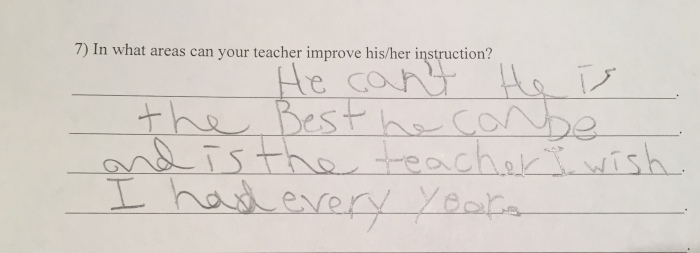
“He can’t [improve]. He is the best he can be and is the teacher I wish I had every year.”


IMG_9674


This is all very flattering, but what exactly did all this niceness mean?


How did being a kind teacher help me do my job? What did I do that helped students learn?


They had an answer for that, too:


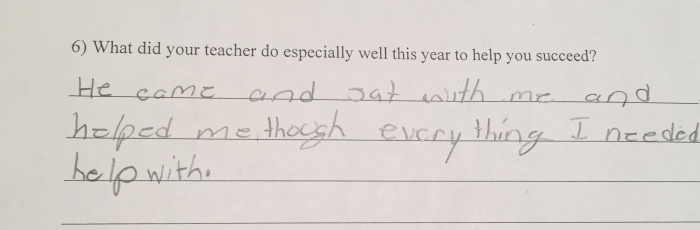
“He came and sat with me and helped me through everything I needed help with.”


IMG_9675


***


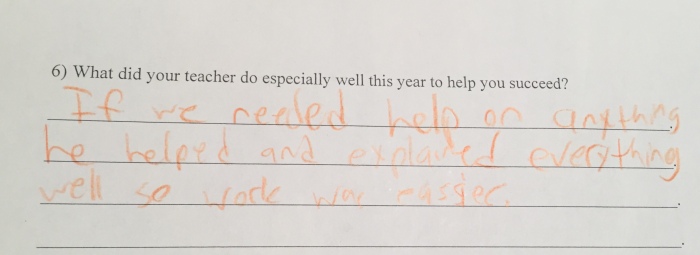
“If we needed help on anything he helped and explained everything well so work was easier.”


IMG_9662


***


“What my teacher did to help me succeed was that he made me feel motivated to do the work in class and not giving us so much work at once.”


IMG_9664


***


“[He] taught me how to write essays, indent on papers and showed me a lot of useful things.”


IMG_9677


Another particularly enlightening comment was this one:


“I don’t know [how he could improve], but in this class you grew with us. So uh yeah.”


IMG_9667


And I do try to change and grow with my students. When your mandate is to individualize instruction to fit each particular child, I don’t know how you can do otherwise.


This means opening yourself up and letting students know who you are and what you stand for.


I try not to inflict my political, religious or philosophical beliefs on my classes. However, I think some core values come through.


For instance, my students knew I was going to Connecticut to give a TED Talk on the current state of public schools.


They knew my thoughts on standardized testing and school privatization – perhaps not in detail but the general shape of them, certainly. They knew my firm conviction against racism, sexism and prejudice of any kind.


Perhaps that’s why one of them wrote this:


“You’re not only a good teacher. You’re a good friend, and man.”


IMG_9673


***


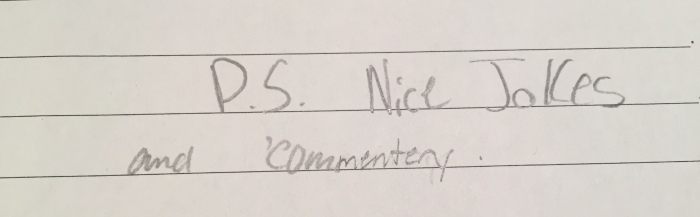
“P.S. – Nice jokes and commentary.”


IMG_9671


Of course there were dissenting opinions. One child thought I was too nice:


“He is way too nice for me and you give way too much essays for people to handle. But overall grade 94%. He doesn’t like Tom Brady so yeah. And he likes the Steelers.”


IMG_9679


I guess no one’s perfect. But how interesting she thought either she deserved a stronger hand or would have been more motivated by fear and consequences. Yet I have to take her with a few grains of salt because this student identified herself on her response and had a friendly rivalry with me about football. She said I was too nice but then referenced our interpersonal rapport.


Another student highlighted how I wasn’t excessively permissive:


[He was good at] “Helping me with instructions and keeping me on task.”


IMG_9670


Most comments were unbridled approbation:


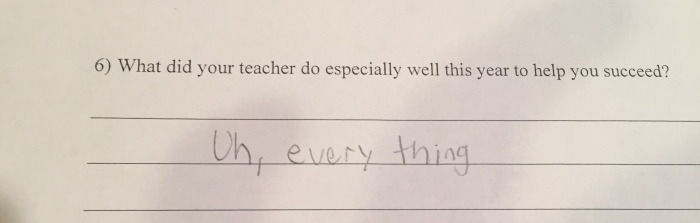
What did your teacher do especially well this year to help you succeed? – “Uh, everything.”


IMG_9666


***


In what areas can your teacher improve his/her instruction? – “I’m not sure. That’s how good a teacher he was.”


IMG_9676


***


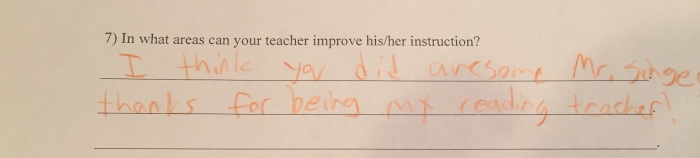
“I think you did awesome, Mr. Singer. Thanks for being my reading teacher!”


IMG_9663


***


“I don’t think my teacher needs to improve. He’s already a great teacher.”


IMG_9665


And so another school year comes to an end.


I’ll miss this class. It was the first year I taught exclusively 7th grade. I’d taught one or two sections of that grade before, but never only that grade.


I’m more used to 8th grade. You wouldn’t think there’d be a world of difference between the two. And who knows? Perhaps if I teach the same grade level next year things will be even more unexpected because the kids will be different.


But when that final bell chimed, I was surprised that so many kids came up to me with hugs and tears.


They really didn’t want to see me go, and, frankly, I don’t want to see them go, either.


If I could follow them next year, I would.


I gave them everything I had to give.


I gave them my heart. I shared with them my life.


And I got back so much more.


That’s what non-teachers don’t understand.


Education is created through often reciprocal relationships.


Learner and teacher are tied together in a positive feedback loop. Sometimes it’s hard to tell which is which and sometimes there is no difference at all.


Thank you so much, last year’s students.


Thank you for letting me be your teacher.


Thank you for bringing out the best in me as I tried to do the same for you.


Like this post? I’ve written a book, “Gadfly on the Wall: A Public School Teacher Speaks Out on Racism and Reform,” now available from Garn Press. Ten percent of the proceeds go to the Badass Teachers Association. Check it out!

WANT A SIGNED COPY?

Click here to order one directly from me to your door!

book-2

Don’t Worry About Grade Inflation. Worry About Grading Fairly.

your-childs-grades-go-down-1494627682


Hard work should be rewarded.


If you earn an A in a given class, you should get an A on your report card.


And this is true no matter how many of your classmates work just as hard as you do.


If everyone in class gives it their best shot, they should all get A’s. It is not the teacher’s job to split hairs and sort kids into arbitrary categories in order to preserve a monetary myth about grades’ value based on a model of scarcity.


Those who demand otherwise are under the spell of one of the oldest myths in academia – grade inflation.


It goes like this: You can’t give all your students excellent marks! That would devalue what it means to get an A!


To which I reply: Bullshit.


Almost every plane that leaves an airport lands safely. Does that devalue what it means to travel? When you arrive at your destination, are you upset that everyone else has arrived safely or would you feel better if some of the planes crashed?


According to the American Journal of Public Health, 93% of New York City restaurants earn an “A” from the health department. Does that shake your faith in the food service industry? Would you feel better if more restaurants were unsanitary? Would your food digest more efficiently if there were more people going home with stomach pain and food poisoning?


Of course not! In fact, these stats actually reassure us about both industries. We’re glad air travel and eating out is so safe. Why would we feel any different about academia?


The idea of grade inflation is a simple imposition of the concept of economic value onto learning. It has no meaning in the field of academics, psychology or ethics. It is just some fools who worship money imaging that the whole world works the same way – and if it doesn’t, it should.


It’s nothing new.


Conservatives have been whining about grade inflation for at least a century. It’s not that the quality of teachers has declined and they’re letting all their students pass without doing the work. It’s that certain types of curmudgeons want to justify their own intelligence by denying others the same privilege.


It’s the “I’ve Got Mine” philosophy.


We see the same thing with Baby Boomers who grew up in the counter culture and pushed for progressive values in their youth. Once they got everything they wanted for themselves, they became conservatives in their old age and worked to deny the same things for subsequent generations.


It’s the very definition of Age scoffing at Youth – a pathology that goes back at least to Hesiod if not further. (Golden age of man, my foot!)


Moreover, there is no authentic way to prove grade inflation is actually happening. Grades are a subjective measure of student learning. They are human beings’ attempt to gauge an invisible mental process. At best they are frail approximations of a complex neural process that is not even bounded temporally or causally. If a student doesn’t know something now, they may come to know it later even without further academic stimulus. Moreover, isolating the stimulus that produced the learning is also nearly impossible.


The important thing is not grade inflation. It is ensuring that grades are given fairly.


If students work hard, they should be rewarded.


I am very upfront with my students about this. And doing so seems to have a positive and motivating effect on them.


This year, I had students who told me they had never read a book from cover-to-cover before my class. I’ve had students look at their report cards in shock saying they’ve never received such high marks in Language Arts before. And doing so makes them want to try all the harder next year to repeat the results.


They leave me excited about learning. They feel empowered and ready to give academics their all. Because the greatest lesson a teacher can instill is that the student is capable of learning.


Don’t get me wrong. I don’t just hand out these grades. Students have to earn them. They have to demonstrate that they have actually learned something.


Everyone rarely measures up to the challenge. But that’s not the point. Everyone COULD. There is nothing in my design that prohibits that outcome. I don’t start with the assumption that I’ll only have 3 A’s, 4 B’s, 10 C’s, etc.


In fact, it is THAT scarcity model that dumbs down academics. If I grade on a curve like that, I have to give out a certain number of high marks regardless of achievement. I’m committed to giving out those 3 A’s regardless of whether that trio of students deserve it or not. However, in my abundance model, I give exactly the number of A’s that are deserved. If that’s zero, no one gets an A. If that’s everyone, then everyone gets an A. It all depends on what students actually deserve, not some preconceived notion about how the world works.


To do this, I give very few tests. I just don’t find them to be very helpful assessments.


A test is a snapshot of student learning. It has its place, but the information it gives you is very limited.


Most of my grades are based on projects, homework, essays, class discussion, creative writing, journaling, poetry, etc. Give me a string of data points from which I can extrapolate a fair grade – not just one high stakes data point.


This may work to some degree because of the subject I teach. Language arts is an exceptionally subjective subject, after all. It may be more challenging to do this in math or science. However, it is certainly attainable because it is not really that hard to determine whether students have given you their best work.


Good teaching practices lend themselves to good assessment.


You get to know your students. You watch them work. You help them when they struggle. By the time they hand in their final product, you barely need to read it. You know exactly what it says because you were there for its construction.


For me, this doesn’t mean I have no students who fail. Almost every year I have a few who don’t achieve. This is usually because of attendance issues, lack of sleep, lack of nutrition, home issues or simple laziness.


I only have control over what happens in the classroom, after all. I can call home and try to work with parents, but if those parents are – themselves – absent, unavailable or unwilling to work with me, there’s little I can do.


And before you start on about standardized testing and the utopia of “objectivity” it can bring, let me tell you about one such student I had who was not even trying in my class.


He never turned in homework, never tried his best on assignments, rarely attended and sleepwalked through the year. However, he knew his only chance was the state mandated reading test – so for three days he was present and awake. The resulting test score was the only reason he moved on to the next grade.


Was he smart? Yes. Did he deserve to go on to the next grade not having learned the important lessons of his classmates? No. But your so-called “objective” measure valued three days of effort over 180.


The problem is that we are in love with certain academic myths.


MYTH 1: Grading must be objective.


WRONG! Grading will never be objective because it is done by subjective humans. These standardized tests you’re so in love with are deeply biased on economic and racial lines. Whether you pass or fail is determined by a cut score and a grading curve that changes from year-to-year making them essentially useless for comparisons and as valid assessments. They’re just a tool for big business to make money off the academic process.


MYTH 2: Learning is Economics.


WRONG! Grades are not money. They don’t function in any way like currency or capital. They aren’t something to be bought and sold. They are an approximate indication of academic success. Treating them as a commodity only degrades their value and the value of students and learning, itself.


Treating grades economically actually represses the desire to learn, dispels curiosity and eliminates the intrinsic value of education.


So go ahead – inflate the “value” of your grades.


Give A’s to every student who deserves it.


That’s how you promote learning and fairly assess it.


Like this post? I’ve written a book, “Gadfly on the Wall: A Public School Teacher Speaks Out on Racism and Reform,” now available from Garn Press. Ten percent of the proceeds go to the Badass Teachers Association. Check it out!

WANT A SIGNED COPY?

Click here to order one directly from me to your door!

book-1

African Immigrants Excel Academically. Why Don’t African Americans?

static.politico.com


The presence of melanin in your skin shouldn’t affect your academics.

But in America, it does.

On average, black students achieve less academically than white students. They have worse grades, lower test scores, meager graduation rates and fewer achieve advanced degrees.

The question is – why?

Why does pigmentation matter so much in this country? What about it brings such negative academic consequences?

This is especially apt since it doesn’t apply to foreign born black students who come here to study or those who recently emigrated here.

In fact, they see just the opposite effect – they earn some of the best grades, have some of the highest test scores, and disproportionately graduate from high school and achieve advanced degrees.

This is something that distinguishes foreign-born Africans – especially those from Sub-Saharan Africa – even from other immigrants. African immigrants sit near the top of the scale of so-called model minorities.

According to a report by Christine Gambino and associates at the Census Bureau, 41% of the African-born immigrant population earned a bachelor degree compared with 28% of the overall foreign-born population in the US.

The four African birth countries with the highest percentages of bachelor and higher degrees among their expat populations in the US are Egypt at 64%, Nigeria at 61%, South Africa at 57% and Kenya at 47%.

So why the difference?

Obviously, it’s not skin color.

Part of it seems to be qualities selected for in the immigration process, itself.

We don’t let just anyone come to the U.S. We have rigorous qualifications and prerequisites that have to be met. For instance, students who want to study here must get high marks on the SAT, Act and/or the TOFFEL – the language proficiency test. To do that, they need the money and resources to study for these exams. They are already some of the best achievers in their native countries.

Moreover, there is a huge cultural difference coming from Africa as opposed to coming from the United States. Native-born Africans have to deal with the effects of post-colonialism. It wasn’t so long ago that European nations conquered and plundered the African continent for gold and resources. That era has mostly ended, but those living there still have to deal with lingering consequences. This has an effect on everything from gender, ethnicity, class, language, family relationships, professions, religions and nation states.

However, native-born Africans do not have to navigate the world of American white supremacy. The affects of being black in this country may be much more harmful than negotiating post-colonialism.

For instance, most mainland Africans enjoy intact cultures. They are not the product of families that were torn apart, religions that were displaced and entire belief systems, world views and genealogies that were stolen.

Nigerian cultures, in particular, highlight the importance of learning.

One typical Nigerian saying goes like this:

“The best inheritance that a parent can give you is not jewelry or cash or material things, it is a good education.”

This is why academics in Nigeria are widely supported, mandatory and free.

Meanwhile, in America native-born black students grow up in a much more stressful and unstable environment. This translates to academic struggles.

For one, they are the victims of educational apartheid. Brown v. Board is more than 60 years old, but American schools have become increasingly segregated by race and class. Black students receive fewer resources than whites and their schools struggle to provide the same quality of education. Moreover, they are the target – either directly or indirectly – of privatization schemes that result in less control over their own schools and the further reduction of resources through charter and voucher schools that can cut services and pocket the savings as profit.

However, the problem is not just systemic. I hate to say it, but sometimes even American teachers put up obstacles to black students success due to (often unconscious) bias.

Most teachers are white. They have certain societally reinforced expectations of black students. When these children struggle, they are more often put into special education and stigmatized for their differences.

It is no doubt that black students are more often disciplined and suspended than white students – numerous studies have shown this.

I think this is due at least partially to white teachers’ expectations. It is tempting to see black student behavior as negative in the default. We too often label them “bad kids” and then try to find evidence to support it instead of giving them the benefit of the doubt or assuming they’re smart and well-behaved until proven otherwise.

African immigrants don’t have to deal with these stigmas to nearly the same degree. They don’t get the same negative label. They have more support from close-knit families. They have more positive role models including more college graduates in the family.

Another obstacle for American born black students is a cultural imputation against academic achievement. Doing well in school can be seen as “acting white.” In order to maintain popularity and prestige, they are steered away from the exact things that immigrant Africans are steered toward.

The poverty of American blacks plays a huge factor, too. Even in moderately successful African American homes, parents or guardians are often working multiple jobs or long hours to make ends meet. This reduces their ability to oversee their children’s homework and monitor academic progress.

It seems then that the so-called proficiency gap between native-born black and white students in this country is due to generational poverty, white racism and coping mechanism in their own culture.

If we want to help American-born black students, we need to realize, first, that this problem is not due to inherent racial deficiencies. It is the product of class warfare and white supremacy.

As such, it can be cured through progressive economic policies and anti-racist efforts.

The strongest argument for reparations comes from a recognition of the lingering effects of our history of slavery, segregation, Jim Crow and the prison industrial complex.

These are daunting problems, but they can be solved.

It just takes an honest appraisal of the issues and the social will to make things right.


Like this post? I’ve written a book, “Gadfly on the Wall: A Public School Teacher Speaks Out on Racism and Reform,” now available from Garn Press. Ten percent of the proceeds go to the Badass Teachers Association. Check it out!

WANT A SIGNED COPY?

Click here to order one directly from me to your door!

book-4

School Vouchers and Runaway EdTech Pave the Way for the Destruction of the Very Concept of School

andres


School is where you learn to learn.


A teacher with an advanced degree and decades of experience devotes her time to figuring out what helps you comprehend the world around you.


And, if she’s good, she imparts that lesson to you as well.


Imagine if we took that away.


Imagine a world where there are no schools – just free range children plopped in front of a computer or an iPad and told to go learn something.


No schools, no teachers, just gangs of students walking the streets, stopping along the way to thumb messages to each other on social media, play a video game or take an on-line test.


That’s the world many EdTech entrepreneurs are trying to build.


And school vouchers are helping them do it.


Take Education Savings Accounts (ESAs) and other market based privatization schemes.


Normally, the federal, state and local government collect taxes to fund an individual child’s education, which is then spent at a public or charter school.


At a public school all that money must be spent on the student. At a charter school some of that money can be pocketed as profit by the private company who runs the school.


Public schools provide a better alternative because the funding must be dedicated to the student, living within a district’s coverage area guarantees enrollment, the school must be managed by an elected school board with open meetings and a plethora of other amenities you won’t find at a privatized institution. But at least the charter school is a school!


However, an ESA or other voucher would allow that money to go elsewhere. It could go to funding the tuition at a private or parochial school where organizers can use it however they like – pocketing some and using the rest to help the child as you’ll find in most charter schools.


But as bad as that is, vulture capitalists want to add another destination for that money – let it pile up in the bank where it can be used for discrete education services provided by the EdTech industry.


It’s almost like homeschooling – without the loving parent being in charge.


It goes by many names – a learning ecosystem, personalized learning, competency based or individualized education.


But it’s really a single person cyber school with little to no guiding principles, management or oversight.


Education is reduced to a series of badges students can earn by completing certain tasks.


Reading a book or an article gives you a badge. Answering a series of multiple-choice questions on a reading earns you more badges. And if you’ve completed a certain task satisfactorily, you can even earn a badge by teaching that same material to others.


It’s the low wage gig economy applied to education. We just transform a crappy job market where workers bounce from a few hours of minimum wage labor here to a few hours of minimum wage toil there – all without benefits or union protections – into learning. Children bouncing from a few hours of Khan Academy videos here to a software package there and Voila! “Modern” education!


In short, it’s school without the school or teachers.


And make no mistake, it’s not about improving the quality of education. It’s about providing the cheapest possible alternative and selling it to rubes as innovation.


The wealthy will still get institutions of learning. They will still be educated by the most qualified teachers in the world. They will still learn how to learn.


The best path to becoming a truly educated person involves human interaction and mentorship. You need experienced professional educators who use the empirical evidence they see in the classroom about your child to tailor lessons to their needs. The wealthy would never dream of making their children learn from the academic equivalent of an automated check out aisle or telemarketer robocall.


It is only the poor and middle class who will be released like chickens into the pasture of a learning ecosystem.


And as an added benefit, the badge structure creates a market where investors can bet and profit off of who gains badges and to what degree on the model of crypto-currencies like Bitcoin! So all the stability of the pre-crash housing market! What could possibly go wrong!?


Let me be clear – this is the ultimate goal of the school privatization movement.


Charter and voucher schools are only the tip of the iceberg. They still require real human beings to act as teachers (though they need not be as well educated or have as much experience as public school teachers). They still require buildings and grounds.


But this depersonalized learning approach allows them to do away with all of that. They can just provide students with an Internet accessible device and some dubious on-line tracking and management system.


Then they can pocket all the rest of the money taxpayers put aside to educate children and call it profit.


And they can use the programs students access to “learn” as a way to gather valuable marketing data about our kids. Everything students do on the device is free market research – every word they input, every keystroke, every site visited down to the slightest eye movement.


This is the logical conclusion of the monetization of education and an economy that only sees value in others as human capital that can be bought, sold and exploited.


This is where the privatization movement is going. And they’re laying the groundwork in legislation being proposed in our state capitals today.


In Pennsylvania, for instance, Senate Bill 2 proposes the creation of just such ESAs. If approved, the immediate result would be to boost private and parochial schools.


However, given a few years to strengthen the technologies and systems needed for a full learning ecosystem, the same law would allow taxpayer money to be used in this way.


And it’s something hardly anyone is talking about.


We’re fighting the privatization systems of today as the plutocrats set up the privatization systems of tomorrow.


Even if school vouchers never take off to the degree necessary to scaffold the most robust learning ecosystems, EdTech lobbyists are trying to install as much of this garbage as they can into our existing schools.


They are using one-to-one iPad initiatives and grants to fund up-to-date computers, Wi-Fi networks and software packages to pave the way for this brave new world of digital exploitation. They are selling our test score obsessed bureaucrats software like iStation and IXL that bridge the gap between test prep and learning ecosystems lite.


You can walk into many schools today where students spend hours on-line earning digital badges for watching videos and taking stealth assessments.


Few people are sounding the alarm because few people understand what’s going on.


This is not conjecture. This is not a conspiracy theory. This is the goal the edtech entrepreneurs will gladly tell you all about hoping you’ll invest.


There are hours of videos, pages of documents, mountains of graphs, charts and graphics about how this scheme will pay off for investment bankers and venture capitalists. (See below)


The only true way to win this battle is a cultural shift away from dehumanizing runaway capitalism.


We need to stop thinking that the private sector is always better than the public good. We need to stop allowing big business and corporations to get away without paying their fair share. We need to increase the voice of citizens and decrease the megaphone of money and privilege.


Otherwise, the science fiction dystopias of books like “Ready Player One” will no longer be fiction.


They will become the reality for every school child in this country.


A reality where school, itself, is a thing of the past.


And education is reduced to the mercenary collection of discrete skills that add up to nothing of value for the students except their own enslavement.


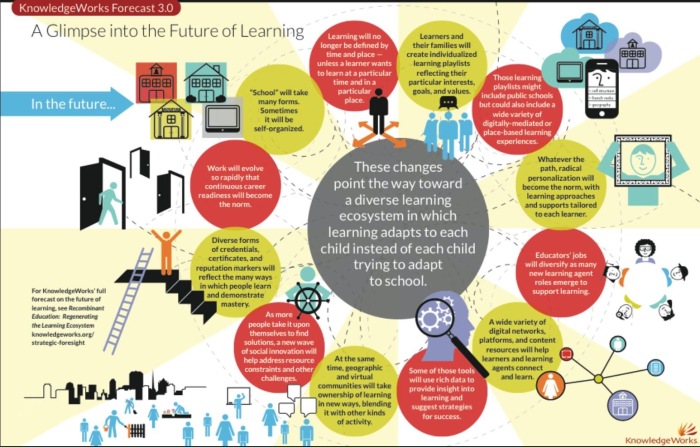
But don’t take my word for it. Here is the learning ecosystems model from the EdTech industry, itself, in corporate officers own words and graphics:

LEARNING IS EARNING – the scariest 6:58 video you’ll ever see.


KNOWLEDGEWORKS Vision for the Future of Education:

IMG_9654

Graphic as a PDF

More on KnowledgeWorks

Listing for PARENTS AS CONSUMERS Symposium

Read all about it here.


FIGHT BACK AGAINST SCHOOL PRIVATIZATION AND RUNAWAY EDTECH:

Like this post? I’ve written a book, “Gadfly on the Wall: A Public School Teacher Speaks Out on Racism and Reform,” now available from Garn Press. Ten percent of the proceeds go to the Badass Teachers Association. Check it out!

WANT A SIGNED COPY?

Click here to order one directly from me to your door!

book-2


The Best Charter School Cannot Hold a Candle to the Worst Public School

Screen Shot 2018-05-24 at 7.43.41 AM.png


There are good charter schools.


I admit that.


There are bad public schools.


I admit that, too.


But if one had to choose between the worst public school and the best charter school, you’d still be better off with the public school.


Does that sound crazy? Does it sound ideological, partisan, or close-minded.


I don’t think so.


Imagine if we said the same thing about tyrannies and democracies.


There are good tyrannies.


There are bad democracies.


Still, I’d prefer the worst democracy to the best tyranny.


Why?


Because even a badly run democracy is based on the principle of self rule. The government gets its right to make and enforce laws from the consent of the will of the governed.


Even if our representatives are corrupt and stupid, even if our federal, state and local agencies are mismanaged and disorganized – there is the potential for positive change.


In fact, the catalyst to that change is embedded in democracy, itself.  Egalitarian systems founded on the principle of one person, one vote tend toward fairness, equity and liberty much more than others.


Bad leaders will be replaced. Bad functionaries will be retrained or superseded. Bad agencies will be renovated, renewed, and made to serve the will of the people.


However, in a tyranny, none of this is true.


Even if you have a benevolent tyrant who does nothing all day but try to do whatever is best for his or her subjects, that is a worse state of affairs.


Eventually the tyrant will change. Absolute power will corrupt him or her absolutely. Or even if this bastion of human goodness is incorruptible, he or she will eventually be deposed, replaced or die.


And there is nothing – absolutely nothing – to ensure the next tyrant is likewise benevolent. In fact, the system is set up to increase the likelihood that the next ruler will be as selfish, greedy and malevolent as possible.


This is because it is the system of tyranny, itself, that is corrupt – even if those that fill its offices are not.


The same goes for good charter schools.


These are schools that are publicly funded but privately run.


As such, the overwhelming majority have no elected school board, their meetings are held in private, their documents are kept secret, they discriminate in enrollment and they take advantage of a plethora of legal loopholes and bad policy to embezzle funds, overcharge for nonexistent utilities and cut services for students while pocketing the “savings” as profit.


If you can find a charter school that does none of these things – congratulations! You have found a diamond in the rough! But it is a diamond that is more likely to turn to coal the second you turn away.


Let’s say you find the rare charter school run by an elected school board. THEY AREN’T REQUIRED TO DO THAT. Organizers could at any time revert to an appointed board. Community members could be making all the decisions when you send your child to school, but by dismissal time they could have all been replaced with flunkies appointed by the private business people who took out the charter from the state in the first place!


Let’s say your charter school has open meetings and public documents. They invite the public to their deliberations. They take public comment and share all their internal communications with taxpayers and the media.  THEY AREN’T REQUIRED TO DO THAT. They could close the doors any day they wanted. And there’s nothing you could do about it.


Why? Because that’s what a charter school is. Despite all the propaganda to the contrary, it is not fundamentally a public school. It is a private school at public expense.


All these things that are optional at a charter school are required at public schools. Not just some public schools – ALL OF THEM!


Public schools are required to have elected school boards (unless taken over by the state). They are required to have open meetings and public documents. They are essentially democratic, whereas even the best charter schools are only democracies because of someone’s goodwill. When the wind changes, so will their system of government.


But that’ not all.


Let’s say you find a charter school that has open enrollment. It accepts every student who applies from its coverage area. Or at least it does so until it runs out of room. If demand exceeds supply, it conducts a lottery to determine which students to let in and which it has to unfortunately turn away.


First of all, if the school doesn’t have open meetings and public documentation, you have no way of knowing whether these lotteries are fair and unbiased. Operators are often charged with cherry picking the best and brightest and denying students with disabilities or behavioral problems – they’ve even been known to discriminate based on race and class.


Second of all, even if your charter school is one of the magical few that just does the right thing with no oversight, THEY AREN’T REQUIRED TO DO THAT. Once they figure out how much money they can save by only accepting the cheapest students to educate, inclusive enrollment policies will be a thing of the past. And you’ll probably never even know the difference.


Public schools aren’t allowed to do that. They have to accept every student from their coverage area regardless of academic deficits, emotional needs, race, religion, class or creed. And if there isn’t enough space, they still can’t turn students away. They have to expand!


And what about the most salient feature of charter schools?


Unlike public schools where all the funding has to be spent on student services, most charter schools are run for profit. They are allowed to cut services for students and swipe the savings for their investors.


Some charter schools don’t do this. BUT THEY CAN! Any day now they could cut little Timmy’s gym class down to twice a week so a shady group of business people in a smoke filled room could stuff a bunch of bills in their own wallets.


Offering French AND Spanish? Adios muchachos. And bonjour to a fistful of dollars going directly into their bank accounts.


All of that is perfectly legal even though it’s your money they’re collecting – money you put aside to help your child learn – there’s not a thing you can do about it.


Sure, you can take your child out of the charter school. But the money funding the school isn’t just your child’s. You’re paying for every student enrolled there. Even if you don’t have kids, you’re footing the bill. And unlike the public school system where you get a voice in how that money is spent, here you don’t get to say a thing.


You just get to pay.


Call me crazy, but I think there’s something wrong with that.


I think that’s worse than even the most decrepit public school.


If a public school has a terrible school board, they can be replaced. In fact, they most certainly will be given time. With each bad policy and unpopular decision, bad school directors motivate taxpayers to vote them out.


This is the exact opposite of charter schools. There is more reason for a charter to replace an elected board with an appointed one so as to increase their autonomy and ability to make money.


Most of the problems with public schools aren’t located in the schools, themselves.


They are the result of strategic disinvestment – archaic funding formulas that allocate less to districts without a large tax base than those in richer neighborhoods. They are the result of segregation schemes that keep the poor and minorities in neighborhoods where they can be ignored and then blamed for their own underprivileged status. They are the result of national and state policies allowed to play the parasite on their budgets – high stakes testing, Common Core and – yes – charter schools.


So, no, I don’t think it’s unreasonable to be so positive about public schools and so negative about charter schools.


The problem with privatized education isn’t just specific to individual schools. It is a feature of the very kind of school we’re talking about in the first place.


Charter schools are at heart a less democratic system than public schools.


Therefore, public schools are always preferable.


I wouldn’t give up my country just because we have an idiot in the oval office. Nor would I give up my public school just because of inadequacies in my local district.


Democracy isn’t for wimps. You have to fight for it.


Those people who are telling you to switch teams are trying to pull the wool over your eyes.


Don’t fall for it.


Public school proud.


Today.


Tomorrow.


Always.


Like this post? I’ve written a book, “Gadfly on the Wall: A Public School Teacher Speaks Out on Racism and Reform,” now available from Garn Press. Ten percent of the proceeds go to the Badass Teachers Association. Check it out!

WANT A SIGNED COPY?

Click here to order one directly from me to your door!

book-4

Pennsylvania’s Zombie School Voucher Bill is Back! And It Wants Your Tax Dollars!

1526935669194

First, there was the horror of a School Voucher Bill.


No one wanted it.


It robbed kids of a quality education. It violated the Constitution. And raised taxes.


So it was soundly defeated.


Then there was Bride of the Voucher Bill.


And it likewise went down in flames.


This was soon followed by Son of the Voucher Bill.


Return of the Voucher Bill.


School Vouchers from the Black Lagoon.


Plan 9 from Voucher Space.


And a host of B-grade legislation straight from the desk of a billionaire think tank to Harrisburg.


All ended up in the same place – the legislative graveyard. Oooh! Scary!


Now we have the latest shambling zombie iteration of a voucher bill, called Senate Bill 2.


Yesterday, after years of false starts and political wheeling and dealing, it’s finally been voted out of the Education Committee.


Which means it will come to a vote by the state Senate and then the state House.


And who do we have to thank for yet another version of legislation billionaires insist we need but voters don’t want?
These guys:


  • Senator John Eichelberger, (R-Blair),
  • Senator Richard Alloway, (R-Franklin)
  • Senator Ryan Aument, (R-Lancaster),
  • Senator Pat Browne, (R-Lehigh),
  • Senator John DiSanto, (R-Dauphin)
  • Senator Mike Folmer, (R-Lebanon)
  • Senator Joe Scarnati, (R-Jefferson)


All Republicans. All bought and paid for by wealthy oligarchs. All convinced that we need to give School Vouchers yet another try in the Keystone state.


And who voted against letting the monster out once again? These guys:


  • Senator James Brewster (D-Allegheny)
  • Senator Andrew Dinniman (D-Chester)
  • Senator Daylin Leach (D-Montgomery)
  • Senator Robert Tomlinson (R-Bucks)
  • Senator Anthony Williams (D-Philadelphia)


This time the beast has a new look – something called Education Savings Accounts (ESAs).


It’s really just putting another horn on the same old rubber creature.


They say ESAs allow state money to pay for private school tuition of elementary and high school students in struggling public school districts.


Oh great. Another way to siphon off hundreds of millions of dollars in taxpayer money from the public schools serving 90% of the state’s students.


Just what we need. A boondoggle for private businesses and religious schools.


Will there be any way to make sure the money in these education savings accounts is going to the right place or is being used to help kids learn?


Nope.


These schools will be able to grab your tax money and use it just about however they please with little to no oversight.


Thanks a lot, so-called fiscal conservatives.


And guess who gets to pay the bill? YOU DO!


Watch property taxes increase to make up the shortfall in funding so your local public school can have the privilege of continuing to operate.


I wouldn’t mind more of my taxes going to public schools that are run democratically, are held accountable and teach things in the American mainstream.


But – call me crazy – I don’t want my money going to help indoctrinate the next generation of zealots who deny science, deny history, and deny the moral standards of our society.


When Evangelical Christians pretend the moral high ground by backing a President who pays off porn stars and belittles war heroes and the disabled, you can see why they need to demand government assistance to keep their pews filled.


Will not on my dime, Buster.


“Congress shall make no law respecting an establishment of religion, or prohibiting the free exercise thereof…”


Remember that?


It’s the establishment clause from the First Amendment. And if you need to wipe your ass with something, it certainly won’t be the U.S. Constitution!


Separation of church and state. Keep them separate.


This law would allow many of the rich kids who already attend private and religious schools to be subsidized by taxpayers.


It would rob us of hundreds of millions of dollars ($500 million at last estimate) that we need just to keep our public schools where they’re at!


Moreover, school vouchers are nothing new.


We’ve been trying this crap for years and they haven’t done a thing to help students learn.


Three out of the four most recent studies on voucher programs, which examined the nation’s largest and oldest voucher strategies in Washington DC, Indiana, Ohio and Louisiana, all show student performance getting worse or not improving at all with vouchers.


A 2017 report from the Economic Policy Institute concluded that extensive research on vouchers over the past quarter century demonstrates that gains in student achievement – if present at all – are at best small. Students show no significant improvement in reading or math. In addition, the report showed that the risks outweigh any insignificant gains in test scores.


Another report from June 2017 by the US Dept of ED found that students using a voucher had statistically significant lower performance in math compared to students who did not receive a voucher.


And THIS is what a gaggle of ideologues want to increase in the Commonwealth!?


Look. The problem with our public schools is poverty. Pure and simple.


Giving out vouchers to private and parochial schools won’t help. It just hides the problem and makes it worse.


Most of the lowest-performing schools are in high poverty districts that are already struggling financially and cannot afford even less funding.


Poverty has a significant impact in student achievement. The average acute poverty rate (% of children living in families with income less than 100% of federal poverty limits) in school districts with more than one low-achieving school was 33.3% – more than double the state average of 16.3%.


Higher poverty means lower standardized test scores.


On average, the proficiency rate for students in the highest poverty schools is 33% less than students in the wealthiest districts. Struggling schools need MORE resources – not less.


Yet, the highest poverty school districts receive more than $2,000 less per student than their wealthy counterparts. This means they are unable to make the investments necessary to overcome the barriers posed by being poor in America.


Diverting state subsidies from these school districts, to ESA vouchers reduce fair access to educational opportunities for these students.


Despite what voucher proponents think, this does not “Save Money.” It does not force struggling districts to do more with less. It forces them to do less – or get more.


Schools don’t budget or spend money on a per student basis. Fixed costs remain the same regardless of how many students are led away by the pied piper of school vouchers.


Costs such as building operations and maintenance, utilities, technology, food service, staff salaries and benefits, transportation including fuel and bus drivers, remain.


Vouchers result in no savings. They produce a greater financial burden for local taxpayers. With less in state funding to provide the same education, that money would have to be raised from other sources – namely, YOU and your local taxes!


I know this is all very tiresome.


It seems like any positive legislation is impossible to get through Harrisburg, but garbage like Senate Bill 2 is ubiquitous.


How many times have we defeated this voucher nonsense?


How many times have taxpayers made it clear they don’t want to fund this nonsense?


But it doesn’t matter. Like a spoiled child, ideologues keep bringing it up again and again in the hopes that this time they’ll wear us down and we’ll let this terrible legislation pass.


Vouchers can be defeated a hundred times. All it takes is one victory and it becomes law and much more difficult to expunge.


So please call, write and visit your state senator and representative.


Tell them you’re against the latest horror show voucher monstrosity.


And maybe when you’re at the polls remember the names of the tools who keep making you repeat yourself.


Give them an unequivocal answer by voting them out of office.


Only then do we stand a chance of nailing a stake through vouchers’ undead heart – for good.


Like this post? I’ve written a book, “Gadfly on the Wall: A Public School Teacher Speaks Out on Racism and Reform,” now available from Garn Press. Ten percent of the proceeds go to the Badass Teachers Association. Check it out!

WANT A SIGNED COPY?

Click here to order one directly from me to your door!

book-3

Modernizing Education Starts With Questioning Our Assumptions

iStock_000040220958_Small-685x485


When it comes to education, we take an awful lot for granted.


For example, we look at learning almost entirely from a behavioral standpoint.


Teachers provide inputs. Students give outputs. And those outputs demonstrate the intended learning.


Yet this framework was developed in the early 1900s. Using it today is to ignore a century of subsequent psychological advancements. It glosses over the impact of the unconscious, the social nature of understanding, physical differences, even the mediating thought processes between stimulus and response such as memory and problem solving.


Instead, we force students into inauthentic laboratory conditions (i.e. the classroom) upon which they are passive actors to be molded and shaped by expert educators.


Every time we post our learning objectives on the board or when we write our lesson plans beginning with the old chestnut – Students Will Be Able To (SWBAT) – we are hearkening back to early 20th Century thinking a hundred years out of date.


We are enshrining a host of assumptions long past their fresh by date:

-Learning is observable.


-It happens immediately.


-It is measurable.


-Once you learn something it never goes away.


-Most problems with learning are attributable to inputs provided by the teacher.


None of these assumptions have been proven.


In fact, there is considerable evidence against each and every one of these premises, yet our entire system of corporate education is based on them like a house built on a foundation.


If we are truly to create a 21st Century school system, the only place to begin is here. Recognize our bedrock beliefs are mere speculation and question whether we should really support everything else that’s been built on such shaky ground.


WHAT IS LEARNING?


It is an empirical fact that human beings are capable of learning. It’s something we do every day. But what exactly does it consist of? What happens when a person learns?


Perhaps it’s best to start with a definition. We generally characterize learning as the acquisition of knowledge; the possession of facts, information or skills.


But how does one gain knowledge? How does one possess the intangible?


It seems that learning always involves thoughts – usually conscious impressions but sometimes unconscious ones, as well. However, not all thoughts qualify, only thoughts of a certain kind.


The notion must be true of the world. And often it is an idea that has surfaced before but that now can be recalled at will and used to create new concepts.


Perhaps I’m wrong, but it seems that no matter how you flesh it out, we’re talking about internal mind states.


Learning takes place in and of the brain. And this has consequences for our education system – an apparatus designed to make these brain states more frequent along certain prescribed lines.


IS LEARNING OBSERVABLE?


That depends. Can we lop off the top of students’ heads and peer at the gelatinous mass inside?


Not really. And even if we could, we wouldn’t understand what we were seeing.


Even if learning may be reducible to a complex set of on-and-off switches among synapses, that does not make it generally observable – certainly not without greater knowledge of how the brain works and advanced neural imaging equipment.


As such, the idea that learning is directly perceptible is not necessarily true. It may be evident in some second hand manner, but this is not the same as first hand experience. At best, what we see is a pale shadow of what’s actually going on in students’ gray matter.


That alone should send shock waves through the edifice of modern corporate education. We’ve built an entire apparatus to label and sort kids based on observing students. If those observations are inadequate to give us the full picture of these internal learning states, our system is likewise inadequate.

WHAT IS THE ROLE OF TEACHER INPUT?


To answer this question we must start further back – when and why does learning takes place.


A student experiences a new neural state that constitutes the acquisition of knowledge. Why?


Does it happen because of the input made by a teacher? Is it the result of experience? Is it the result of some other input – reading, interacting, writing, doing something? Or is it the result of something even the student him- or herself cannot easily identify or explain?


All of these are possible. All of these (and more) are the catalyst to learning at various times.


Thus we lose another premise – that teacher input is the essential cause of inadequate learning. If we cannot place a primacy on the teacher, we cannot wholly place blame there either.


Certainly teachers are important. They can have a tremendous impact on their students. But they are not strictly necessary. They are not even the prime cause of learning. They facilitate learning in the way a doctor facilitates healing. The surgeon may set the broken bone, but it is the body that actually does the healing. And in the case of learning, the action is not entirely involuntary. It is much more active and intentional.


In short, teachers can call students attention to something that sparks learning. They can bring about optimal conditions for learning to take place. But they are not by themselves sufficient for that learning. They cannot make it happen. Insofar as it is voluntary at all, it is up to the student. To give teachers sole reward or blame for student learning is absurd.


IS LEARNING IMMEDIATE?


Learning may be a response to stimulus of some kind. But when does that response take place? Is it immediate?


There is no evidence that it must be so. Certainly there are times when one has learned something immediately. When a child first puts her finger in the flame, she quickly learns to remove it. However, there are some lessons that we don’t learn until many years after that stimulus. For instance, that our parents’ advice was often more sage than we initially gave it credit.


Thus, again it is inadequate to place reward or blame on teachers for their students’ learning. You can judge a teacher for what he or she did to help, but not what you take to be the result. Just because the teacher’s input may not have sparked learning in the student now, that doesn’t mean that the same input might not engender learning at a later date, given time.


IS LEARNING PERMANENT?


Which brings up another question – once you learn something, does it remain yours forever or is it susceptible to degradation?


If learning is an internal state – if it is the result of neural connections like any thought or memory – it is susceptible to fading. It can be lost or degraded.


Therefore, when students enter a class without prerequisite knowledge, it is not necessarily the fault of their previous teachers. Like any skill, memory or thought – recall is enhanced through repetition. Using the knowledge often results in greater retention.


If we want a more intellectual society, we should habitualize critical thinking and reward intelligence in our public interactions. Not the exact opposite.


CAN LEARNING BE MEASURED?


And finally, we are brought to perhaps the most vital question in the field of education – measurement.


What did students grasp and to what degree was it mastered?


There is an entire industry based on providing accurate accounting of learning.


There are corporations making billions of dollars based on providing this service. Moreover, the school privatization industry is almost completely predicated on the “failure” of public schools as shown by the measurements of these testing corporations.


As such, there is a tremendous amount of economic pressure to keep this premise that learning can be accurately measured. However, when looked at logically, it cannot be supported.


When we measure learning, what are we measuring? And how are we quantifying it?


If learning is an internal state, how do we calculate that? Possibly at some point in the future, we’ll be able to look at real time pictures of the brain and be able to tell which information has been learned and to what degree. But we are not at that point now. Perhaps we will never be.


Even if we were, what exactly would we be measuring? What units would we be using? Volts? Amps? Some new element susceptible to subdivision?


The fact that we can’t give a definitive answer to that simple question illustrates how vast our ignorance is of learning. We do not understand what goes on in our own heads that constitutes understanding expect in the broadest possible terms.


Yet how much importance we put on these crude attempts to measure the ineffable!


Grades and test scores are but the rudest approximations of the real phenomena hidden inside our skulls. Yet we sort and rank students on the pedagogical equivalent of cave paintings.


“It is easier to measure the number of semicolons used correctly in an essay than the wonderful ideas contained within it,” said Alfie Kohn. “The more focused you are on measurable outcomes, the more trivial your teaching tends to become.”


Or as Linda McNeil of Rice University famously observed, “Measurable outcomes may be the least significant results of learning.”


Kohn has repeatedly suggested that McNeil’s statement ought to be printed out in “36-point Helvetica, framed, and tacked to the wall of every school administrator’s office in the country” for these same reasons.


When we talk about knowledge and learning, we don’t know what we’re talking about.


CONSEQUENCES


That should make us reluctant to say anything definitive about learning beyond our own ignorance of it.


Yet, as in so much of human affairs, when has ignorance ever stopped us?


We have to go about the business of educating. We have a society to run, markets to establish and consumers to exploit.


Imagine if, instead, we approached learning like explorers or scientists, mapping the shores of our ignorance and determining what helps us comprehend more and better.


There are so many tantalizing clues about what helps students learn, ways to foster the spark of inspiration, creativity and critical thinking.


I wish we were invested in that activity instead of a capitalist sham of education. We talk much about the skills gap between white and black kids without doing anything constructive about it – a chasm predicated on the fact that one category is predominantly poor and the other privileged.


Perhaps we would do better to talk about the ignorance gap of our own understanding of what it means to understand.


Perhaps then we wouldn’t be so bold as to monetize that which is fallacious and foolhardy.


Perhaps then we would be more curious, thoughtful and kind.


Perhaps then we could build a truly modern system of education that values students and not just how they can be transformed into profit.


Like this post? I’ve written a book, “Gadfly on the Wall: A Public School Teacher Speaks Out on Racism and Reform,” now available from Garn Press. Ten percent of the proceeds go to the Badass Teachers Association. Check it out!

WANT A SIGNED COPY?

Click here to order one directly from me to your door!

book-2