For decades, school voucher advocates claimed that sending poor kids to private schools with public tax dollars was acceptable because doing so would raise students’ test scores.
However, in the few cases where voucher students are even required to take the same standardized tests as public school students, the results have been dismal.
Supply side lobbyists have been claiming we need school privatization BECAUSE it will increase test scores. Now that we find this claim is completely bogus, the privatizers are changing their tune.
But that’s not the most shocking irony in DeAngelis article.
Parents don’t really care about the scores, he says. Instead they send their children to voucher schools because… You know what? I’ll let him tell it.
“Families choose schools for their children based on several important factors, including culture, individual attention, and, of course, safety. Research tells us that parents — unsurprisingly — often value these things more than standardized test scores.”
Certainly parents prefer their children have more individual attention. But many private schools have larger class sizes than public schools.
However, it is his other two claims that sent my racist dog whistle senses tingling.
So parents don’t like the CULTURE of public schools. And they’re afraid public schools aren’t as SAFE.
Hmm. I wonder what culture these parents are objecting to. I wonder why they would think public schools wouldn’t be as safe.
Could it perhaps be fear of black students!?
I don’t want my little Billy to be exposed to all that rap music and kids with sagging pants. I don’t want my little Susie to cower in a class full of thugs and gangstas.
This is racist, stereotypical and just plain wrong about what you’ll actually find in public schools.
Hence, various segregationist “freedom of choice” plans in several states that allowed white students to transfer out of desegregated schools. Black students could apply but because of various administrative hurdles were never admitted.
This is the history of so-called school choice. And it is a history that DeAngelis, the 74 and the Cato Institute are willing to bring full circle.
School privatization advocates pretend they’re defending choice, but what choice are they championing?
Being exposed to another culture isn’t a bad thing. It’s the definition of the American melting pot.
Our public schools are not perfect. They suffer from targeted disinvestment – especially those situated in urban neighborhoods and those serving larger populations of children of color.
But this isn’t the goal of privatization promoters. They don’t care about what’s best for children. They’re looking out for what’s best for the businesses running the privatized schools.
So what have we learned?
School vouchers do not increase test scores.
And when that excuse behind the entire school privatization movement is exposed as nonsense, opportunists have no problem using racism and prejudice to defend their industry.
Students enrolled in private schools often get good grades and high test scores.
And there’s a reason for that – they’re from wealthier families.
A new peer-reviewed study from Professors Richard C. Pianta and Arya Ansari of the University of Virginia found that once you take family income out of the equation, there are absolutely zero benefits of going to a private school. The majority of the advantage comes from simply having money and all that comes with it – physical, emotional, and mental well-being, living in a stable and secure environment, knowing where your next meal will come from, etc.
The study published in July 2018 attempts to correct for selection bias – the factors that contribute to a student choosing private school rather than the benefits of the school, itself.
“Results from this investigation revealed that in unadjusted models, children with a history of enrollment in private schools performed better on nearly all outcomes assessed in adolescence. However, by simply controlling for the sociodemographic characteristics that selected children and families into these schools, all of the advantages of private school education were eliminated. There was also no evidence to suggest that low-income children or children enrolled in urban schools benefited more from private school enrollment.”
Whether it be increasing charter schools or vouchers to attend private and parochial schools, the implication is the same – such measures will not help students achieve.
We need programs aimed at poverty, itself, not at replacing public schools with private alternatives.
“By and large, the evidence on the impact of school voucher programs casts doubt on any clear conclusion that private schools are superior in producing student performance…
“In sum, we find no evidence for policies that would support widespread enrollment in private schools, as a group, as a solution for achievement gaps associated with income or race. In most discussions of such gaps and educational opportunities, it is assumed that poor children attend poor quality schools and that their families, given resources and flexibility, could choose among the existing supply of private schools to select and then enroll their children in a school that is more effective and a better match for their student’s needs. It is not at all clear that this logic holds in the real world of a limited supply of effective schools (both private and public) and the indication that once one accounts for family background, the existing supply of heterogeneous private schools (from which parents select) does not result in a superior education (even for higher income students).”
Researchers repeatedly noted that this study was not simply a snapshot of student performance. It is unique because of how long and how in depth students were observed.
The study looks at student outcomes at multiple intervals giving it a much longer time frame and much greater detail than other similar investigations. Researchers examined wide ranging family backgrounds and contextual processes to reduce selection bias.
Participants were recruited in 1991 from ten different cities: Little Rock, Arkansas; Irvine, California; Lawrence, Kansas; Boston, Massachusetts; Philadelphia and Pittsburgh, Pennsylvania; Charlottesville, Virginia; Seattle, Washington; Hickory and Morganton, North Carolina; and Madison, Wisconsin. They were followed for 15 years and had to complete a month long home visit. In addition, they submitted to both annual interviews and home, school, and neighborhood observations.
The final analytic sample consisted of 1,097 children – 24% of whom were children of color, 15% had single mothers, and 10% had mothers without a high school diploma.
Moreover, student academic achievement wasn’t the only factor examined.
Researchers also assessed students social adjustment, attitudes, motivation, and risky behavior. This is significant because they noted that no other study of private schools to date has examined factors beyond academics. Also, there is a general assumption that private school has a positive effect on these nonacademic factors – an assumption for which the study could find no evidence.
“In short, despite the frequent and pronounced arguments in favor of the use of vouchers or other mechanisms to support enrollment in private schools as a solution for vulnerable children and families attending local or neighborhood schools, the present study found no evidence that private schools, net of family background (particularly income), are more effective for promoting student success.”
One reason behind these results may be the startling variation in “the nature and quality of private school classrooms.” There is no consistency between what you’ll get from one private school to the next.
The x-factor appears to be family income and all that comes with it.
The nation’s oldest and largest civil rights organization has come out against high stakes standardized testing.
The National Association for the Advancement of Colored People (NAACP) distributed an issue brief yesterday at its national convention in San Antonio, Texas, titled “NAACP OPPOSES HIGH-STAKES EDUCATIONAL TESTING.”
The brief stated that the organization has concerns about using a single standardized test as a graduation requirement, as a prerequisite for advancement to the next grade or otherwise blocking students from receiving various educational opportunities. In its place, the organization favors the use of multiple measures, which may include standardized testing but should also include other assessments such as student grades and teacher evaluations.
In short, the brief concluded:
“Using a single standardized test as the sole determinant for promotion, tracking, ability grouping and graduation is not fair and does not foster equality or opportunity for students regardless of race, income, or gender.”
This is a huge policy shift from where the organization was just three years ago.
At the time, Congress was getting ready to pass a new education law, the Every Student Succeeds Act (ESSA). The civil rights organizations – many of whom had just asked Congress a year earlier to reduce standardized testing – suddenly demanded it be kept a federal accountability standard and that taking these tests was, itself, a civil right.
At the time, many education activists were shocked by the turnaround obviously coerced by the standardized testing and school privatization industry. For instance, see this email from Teach for America alum Liz King giving organizations an ultimatum to sign.
The new issue brief is more in-line with the NAACP’s history of opposition and activism against corporate education reform.
Once again we have the NAACP that advocated against standardized testing in the Debra P v. Turlington case (1981), where the Florida legislature made passing a single standardized test a graduation requirement. The NAACP supported black students who had a disproportionate failing rate on the test and claimed the Florida legislature was violating the Fourteenth Amendment. The courts eventually ruled against the plaintiffs but the issue has remained contentious to this day.
Of particular note in the new issue brief is the caution that, “…when standardized tests are used by schools and school districts, that the tests be valid and reliable, measure what the student was taught and provide appropriate accommodations for disabled children.”
Many would argue that the new batch of Common Core aligned tests being used by states do not meet this requirement. They do not test what students have been taught – they test students’ ability to spit back the same kind of thinking of the person who wrote the test. Moreover, special needs students are rarely afforded the same accommodations on federally mandated standardized test day that they are allowed during every other assessment they take during the school year.
The brief continues:
“Furthermore, the NAACP is opposed to individual students being unfairly denied critical educational opportunities because of their performance on a single, standardized test.”
Organizations like the Journey for Justice Alliance (JJA), a group made up of 38 organizations of Black and Brown parents and students in 23 states, have never wavered in their opposition to high stakes standardized testing. In 2015 while the NAACP and other well established groups defended testing, JJA was joined by 175 other national and local grassroots community, youth and civil rights organizations asking Congress to stop requiring standardized tests at all.
It is nice to see the NAACP returning to the activism on which it built its justly deserved reputation.
What follows is the full text of the new NAACP issue brief:
“ISSUE BRIEF
Date: Summer, 2018
To: Concerned Parties
From: Hilary O. Shelton, Director, Washington Bureau
NAACP OPPOSES HIGH-STAKES EDUCATIONAL TESTING
THE ISSUE
Many states are relying on a single examination to determine decisions (such as graduating from high school or promoting students to the next grade), despite the fact that leading education experts nationwide recommend multiple measures of student performance for such decisions. While these “high-stakes” tests serve an important role in education settings, they are not perfect and when used improperly can create real barriers to educational opportunity and progress. Furthermore, one-time, standardized tests may have a disparate impact on students of color, many of whom have not had the benefit of high quality teaching staff (urban school districts have the greatest challenge in attracting and keeping high qualified teachers), adequate classroom resources, or instruction on the content and skills being tested by the standardized tests. Considering additional measures of student achievement, such as grades and teacher evaluations, adds not only to the fairness of a decision with major consequences for students but also increases the validity of such high stakes decisions.
Due to our concerns about the fairness of such testing, as well as the potential impact these tests have on the lives of our children, the NAACP has supported legislation in the past that would require that States follow the recommendation of the National Academy of Sciences and the National Research Council of the National Academy of Sciences. Specifically, the bills require that High Stakes decisions be based upon multiple measures of student performance and, when standardized tests are used by schools and school districts, that the tests be valid and reliable, measure what the student was taught and provide appropriate accommodations for disabled children. Furthermore, the NAACP is opposed to individual students being unfairly denied critical educational opportunities because of their performance on a single, standardized test.
The NAACP will continue to promote the initiatives that ensure equal opportunity, fairness, and accuracy in education by coupling standardized tests with other measures of academic achievement. Using a single standardized test as the sole determinant for promotion, tracking, ability grouping and graduation is not fair and does not foster equality or opportunity for students regardless of race, income, or gender.”
Special thanks to Dr. Julian Vasquez Heilig who first released the issue brief on his education blog.
This summer I sat down with my 9-year-old daughter and together we played the most popular Nintendo Switch game for hours, days, weeks.
And at the end of all that time, I came away victorious – something I wasn’t sure I’d be able to do when I started.
There are so many buttons to learn, two joy sticks, various info screens and menus.
But when it was all over, I had cleared all four divine beasts. I got all 18 captured memories. I completed about 80 shrines. I mastered about 45 side quests. I shredded guardians, lynols and bokoblins. And, yes, I opened a major can of whoop ass on Calamity Gannon.
As the kids say, I’m jelly.
My video game skills are lit.
You can’t handle me, bro.
And so on.
But I’m not a kid. I’m a grown man.
Didn’t I have anything better to do?
Couldn’t I have found a more productive use for all that time?
Maybe. Maybe not. However, beyond the sheer fun, I did learn something from the whole experience.
As a public school teacher, I learned about my students by following in their footsteps.
That’s really why I started playing in the first place – my middle school kids this year loved that game.
I got more Zelda doodles, more Hyrule poetry, more Link fan fiction than you might at first believe.
The world of the game was really important to my children and having even a passing knowledge of that world helped me relate to them.
I even asked for a few tips after class.
One of my best students took her Switch out of her backpack and showed me a prime location to pick hot peppers so I could withstand the cold of Mount Hyrule (Don’t ask).
It was worth doing just for that – I showed my willingness to be the student and for them to be the teachers. I showed them we were all a community of learners.
At least, that’s my hope.
But now that the dog days of summer are here and my video game victory is complete, I keep thinking of the implications of my experience in Hyrule on the world of education.
Specifically, I’m thinking about education technology or Ed Tech.
I’m thinking about how we use various software packages to try to teach students and how they invariably fail at the task.
Well-meaning administrators hear about this program or that classroom management system or an assessment app and they spend beaucoup bucks on it.
We’re instructed to give up valuable instruction time so our kids can sit in front of a computer while a digital avatar attempts to do our job.
Kids listen to a cartoon person instruct them in the rudiments of grammar or literacy, play loose skills exercises and earn digital badges.
Sure, there are lots of bells and whistles, but the kids catch on mighty quickly. There is no student as bored as a student forced to play an educational video game.
Or they could show why ed tech will never be as effective at teaching as flesh and blood instructors.
In any case, here is what I learned.
1) Focus on Fun
One of the biggest differences between ed tech and “Zelda” was the focus.
The games we make children play at school are designed to teach them something. That is their purpose. It is their raison d’être. The point behind the entire activity is to instruct, test and reward.
By contrast, the purpose of “Zelda” is fun.
Don’t get me wrong. “Zelda” can be very educational.
There are points where the game is actively trying to teach you how to do things usually associated with game play.
You have to learn how to make your character (Link) do what you want him to do. You have to learn how to manipulate him through the world. How to run, how to climb, how to heal, how to use weapons, how to cook and make elixirs, etc.
However, the point behind the entire game is not instructional. It’s fun – pure and simple.
If you have to learn something, it is all in service to that larger goal.
In the world of the game, learning is explicitly extrinsic. It helps you have more fun playing. Only the pursuit of winning is intrinsic or even conceptualized as being so.
In real life, this may not be the right approach to education, but it seems to be a rule of virtual experience. If it is superseded, the game becomes just another class assignment – lifeless, dead, boring.
If educational software is going to be effective in the classroom, it must find a way to bridge this divide. It must either put fun before pedagogy or trick the user into thinking it has done so.
I’m not sure this is possible or desirable. But there it is.
2) Logic and Problem Solving Work but not Curriculum
There are many aspects of “Zelda” one could consider educational.
However, when it comes to things that have importance outside of the game, the biggest would be problem solving and logic games.
A great deal of game play can be characterized under this umbrella.
The ostensible mission is to defeat the bad guy, Calamity Gannon. However, to do so you often have to solve various puzzles in order to have the strength and skills to take him down.
The most obvious of these puzzles are shrines. There are 120 special areas throughout Hyrule that Link needs to find and solve.
Each one involves a special skill and asks the gamer to decipher problems using that skill. For example, one asks you to manipulate fans so that the air flow makes windmills turn in a pattern. Another asks you to get a ball through an obstacle course.
In each case, the emphasis is on logic and critical thinking.
That has tremendous educational value. And it’s something I’ve seen done easily and well in many educational video games.
The problem is it doesn’t teach any particular curriculum. It doesn’t teach math, science, English or social studies – though it does help contribute to all of these pursuits.
Ed tech games are not nearly so coy. They often try to go right for the curriculum with disastrous results. Ed tech software, for instance, will have you find the grammatical error in a sentence or solve an equation in order to move on in the game.
That just doesn’t work. It feels false, extraneous and forced. It’s doesn’t seem like an organic part of the experience. It’s something contrived onto it from outside and reminds the gamer exactly why you’re playing – to learn.
3) Option to Seek Help
One of the most surprising things to me about playing “Zelda” on the Switch was how much of an on-line gaming community has formed around the whole experience.
If you get stuck in a particular area, you can find numerous sites on-line that will help you get passed it. You can even find gamer videos where YouTubers will show you exactly how they solved this or that problem. And they don’t all have the same solution. Some provide elegant, well-detailed advice, and others seem to stumble on it and offer you their videos as proof they could actually get the job done somehow.
It’s a lot different from when I was a kid playing video games. Back then (30 years ago) you had your friends but there were few other places to go for help. There were fan magazines and a few video game companies had tip hotlines. But other than that, you were on your own.
One of my favorite YouTubers this summer was Hyrule Dude. His videos were clear, informative and helpful. However, I didn’t always agree with his solutions. But they invariably helped me find things that would work for me.
It reminded me a bit of Khan Academy and other learning sites.
If kids really want to grasp something today, they have so many places they can go on-line. As educators, it’s hard to incorporate them into a classroom environment because there are certain things we want kids to find out for themselves.
For instance, as a language arts teacher, I want my students to do the assigned readings on their own. Yet I know some of them try to skip to the on-line summaries they can find and use that instead of reading the text. I have no problem if they access good summaries and analysis but I don’t want them to take the place of trying to comprehend the text on their own first.
I think there are ways to use this larger social media community to help support learning without spoiling the hard work kids need to put in on their own. But it’s something we need to think about more and find better ways to incorporate.
4) Open Ended
One of the most striking things about this new “Zelda” is how much choice the gamer has. In most games you have to complete the first board and then the second and so on until you win.
On the Switch, the world you’re thrust into is incredibly open ended. You can do pretty much what you want, when you want. Or at least you can try.
At first, your character is limited to one area of the world – a plateau. But once you complete a certain number of the challenges there, you get the paraglider which allows you to access most of the rest of the world.
It’s a huge area to explore – impossible to travel the entire length of it without spending hours of game play. And it’s entirely up to you where to go and what to do next.
The central mission of the game is to defeat Calamity Gannon in Hyrule Castle. However, that would be incredibly difficult early on. You’re advised to get the four Divine Beasts first. And you can do them in any order you want.
Moreover, I mentioned shrines earlier. When you complete four shrines, you can either increase your hearts (the amount you can be hurt without dying) or your stamina (how long your character can do something hard like climbing or swimming without having to rest). Technically, you don’t have to complete more than a few shrines, but doing so makes your character stronger and better able to get the Divine Beasts and defeat Gannon.
There are also side-quests (totally optional) that reward your character with money, items, etc.
Ed tech software is exactly the opposite. You must do section A before section B before section C. It’s little more than a multiple choice test with only limited possible answers of which only one is correct.
In “Zelda” there are often multiple ways to achieve the same end. For instance, I would assume the programmers wanted me to fight my way through every room of Hyrule Castle to get to Calamity Gannon. However, I simply climbed over the walls and swan through the moats – a much quicker and efficient method.
If we could recreate this freedom of movement and multifarious solutions within educational software, we might really be onto something. But, frankly, it’s something that even traditional video games have difficulty being able to recreate.
5) Choice to Play or Not
And speaking of choice, there is the choice whether to play or not.
Video games are one of the things kids choose for leisure. When we force kids to play them in school, that choice is gone.
They become a task, a trial, an assignment.
Moreover, not every child enjoys video games.
We can’t mandate kids learn from games – even the best of ed tech games. At best, they should be an option. They could be one tool in the toolbox.
In summary, I think the goal of the ed tech industry is deeply flawed.
At best, it could provide a tool to help kids learn.
To do so, games would have to primarily be focused on fun – not learning. They would have to be organized around critical thinking and logic – not curriculum. They would need to utilize the on-line community for help but not cheating. They would need to be open ended worlds and not simply repackaged standardized testing. And finally, students would need the choice whether to play them or not.
Cheaper commodities are better – especially when the consumer isn’t the student forced to play the game but the politician or administrator in charge of school policy.
Ed tech’s potential as a positive tool in a school’s toolbox has been smothered by the needs of business and industry. Until we recognize the harm corporations do in the school, we will be doomed to dehumanizing students, devaluing teachers and wasting our limited resources on already wealthy big business.
Democrats oppose it and there don’t even seem to be enough Republicans in favor to get it through Congress. It may not even have enough support to get a vote.
Moreover, the proposal is a definite step backward. The Department of Education was created in 1980 by splitting the Department of Health, Education, and Welfare into the Department of Education and the Department of Health and Human Services.
At that time, its purpose was clear. It was a tool to increase funding equity and transparency while protecting students.
After all, the department was an extension of the Elementary and Secondary Education Act (ESEA) of 1965, which tried to bring equity to America’s public schools.
“First, [the Department of Education] will increase the Nation’s attention to education. Instead of being buried in a $200 billion-a-year bureaucracy, educational issues will receive the top-level priority they deserve. For the first time, there will be a Cabinet-level leader in education, someone with the status and the resources to stir national discussion of critical education concerns.”
Unfortunately, those principles were never fully realized.
Sure, it provided targeted grants like Pell Grants that did offer opportunities to select groups of students. But it didn’t radically alter our outdated (even then) funding system.
Our schools are segregated by race and class – worse now than they were then. Since they’re funded primarily by local property taxes, that means the poor and minorities get less funding than richer whiter kids.
In the late 1970’s, it was hoped the creation of the Department would be the first step to increasing federal funding of schools to one third of the total cost, thereby leveling the playing field somewhat.
To return to the metaphor with which this piece began, the creation of the department was like handing a starving child utensils without much actual food.
As the years have passed, we’ve used those tools for everything except nourishing students.
We’ve fed the child by guiding an empty fork into her cheek. We’ve poked and prodded her mouth with a knife.
The child is still starving. It is still our responsibility to feed her.
You don’t do that by taking away her utensils.
Oh, you can feed her without them, but not very effectively. She can drink from the sink, but not as well as from a cup. She can eat with her hands, but not as easily as with utensils.
This latest proposed merger wouldn’t really satisfy anyone.
It wouldn’t do away with the department – it would hide it behind closed doors.
It would simply make it harder to see what was happening to it.
One can imagine a newly reorganized federal effort to cut anything from our schools that couldn’t be immediately connected with becoming a worker drone. And I don’t mean to imply this would be a new effort, because it’s already what President’s George W. Bush and Barack Obama were using the Department to achieve. But now it would be in the shadows and who knows what monstrosity could grow without the cleansing light of day?
This would help no one. It would be a continuation of the status quo (or possibly a doubling down on it) under a different name.
No one needs that.
What we need is to roll up our sleeves and meet students’ needs.
The child is hungry.
She has been sitting before us starving for decades and all we’ve done is give her the means to eat without the food.
Isn’t it time someone open the cupboard and get this kid something to eat!?
They invested in charter and voucher schools and then demanded we build more of these privatized institutions with little to no accountability so they could rake in record profits!
They’ve weakened education at schools serving the highest populations of students of color and then benefited when those same kids turned to crime and were incarcerated in their private prisons!
They demanded my administrators undervalue what I actually do in the classroom but instead evaluate me based on my student test scores – so being given struggling students means I’m somehow a worse teacher than the person across the hall with the honors class!
They did all that but suddenly they’re concerned about my freedom to withhold union dues!?
Well Golly!
Jeepers!
Gee Willikers!
Goodness gracious and bless my soul!
I must have been wrong about these fellers and these ladies all along!
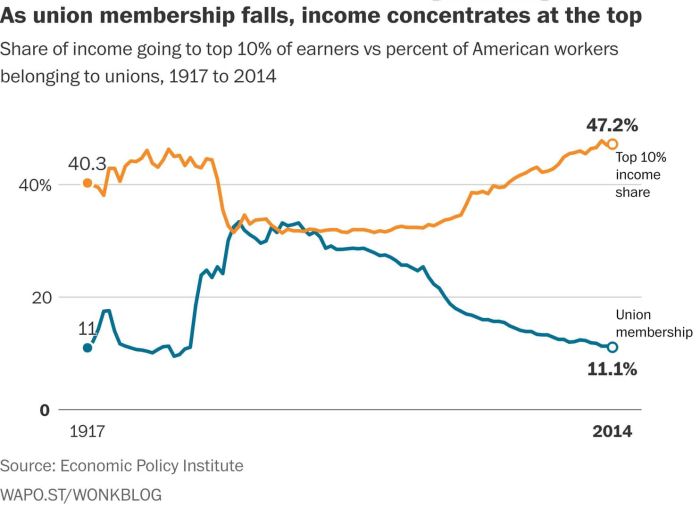
They said the decline of unions accounts for as much as one-third of the increase in wage inequality since the 1970s!
According to the Economic Policy Institute, when union membership goes down, the wealthy make more money! Conversely, the more union membership goes up, the less money goes to the wealthy!
And despite all that, the rich are concerned that I have the right to stop paying union dues!
I mean if I stop paying my dues and my fellow working stiffs stop paying their dues, then my union might just have to close up shop!
You know public sector employees including firefighters and police, and teachers like me are the largest sector left of the workforce still represented by unions!
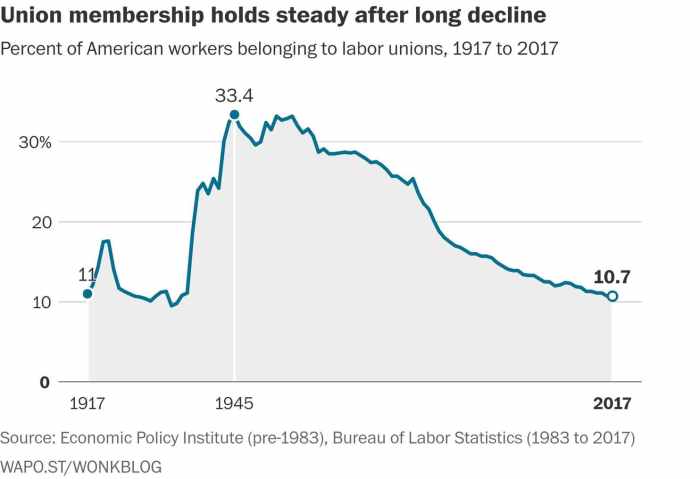
Back in 1945, union membership nationwide was at its highest rate of 33.4%! That means back then about a third of all American workers belonged to a union!
But thank goodness I now have the right to get something for nothing from my union!
That’s going to perk things right up!
Sure, numerous studies have shown that declining union membership is one of the major causes why middle class wages have remained basically flat! But I get to keep a hundred bucks in my pocket so everything’s square!
One thing worries me, though!
I’m not sure many union workers are going to take advantage of this new freedom!
And I wouldn’t stop paying taxes even if I could! I like being an American citizen, and I like much of what my government provides by way of our military, infrastructure and social programs!
It’s the same with my union!
I mean I LIKE earning higher wages! I LIKE getting better benefits! I LIKE knowing I work in a safe environment!
If he or she came to my room asking for advice, I’d tell them to get lost! I wouldn’t eat with them at lunch, I wouldn’t chat about their day, I’d give them their walking papers, myself!
Frankly, the social cost would be higher than just paying your union dues!
So thanks anyway, Mackinac Center! Thanks anyway, Charles and David Koch! Thanks anyway, Betsy DeVos!
They’re mapping out a world where kids don’t even have to go to school to grasp the basics, where learning can be accomplished anywhere but instigated, tracked, and assessed on-line through various computer platforms.
Children would bounce from a few hours of Khan Academy videos here to a software package there and Voila! “Modern” education!
It’s a brave new world where investors hope to make a bundle by reducing the cost and pocketing the savings.
Since teachers are the biggest cost, they’re the first things to go.
Since their rights as workers and human beings are a roadblock on this learning superhighway, they’re the first to go.
And since they’re in a prime position to see exactly what’s going on and to object when this ed tech paradise exploits the students it ostensibly is being built for, they MUST go – now, as soon as possible.
The Supreme Court’s recent decision in Janus v AFSCME is part of that process. It’s another way to weaken labor and clear the path for business – the collusion of politics and corporations to steamroll the rest of us and swipe more of our money regardless of the children in the steamrollers way.
So when I ask “Are teachers necessary?” it’s not a purely philosophical question.
The answer will have a major impact on both the education of today and where we go in the future.
If teachers are not necessary, that removes one of the biggest obstacles to this frightening and uncertain future.
Unfortunately, no matter how much I want to answer in the affirmative that teachers are necessary, I can’t do so.
Even after thousands of years of recorded history, learning remains a mysterious process. Yet it doesn’t take much reflection to realize that it can take place without the presence of a teacher.
Estimates vary somewhat from study to study, but the basic structure holds. The vast majority of impact on learning comes from the home and out-of-school factors. Teachers are a small part of the picture. They are the largest single factor in the school building, but the school, itself, is only one of many components.
In short, teachers are not necessary to student learning.
But neither are doctors necessary to healing or lawyers necessary to acquittals.
Necessity is a very high bar.
To survive, you need food, shelter and clothing. However, having all three does not mean you have a good life. Slaves had all three – no free person would choose to trade places with someone in generational servitude simply because they had everything they needed to survive.
The same with medicine. If shot in the arm, you could provide me with all the medical equipment necessary to remove the bullet, but I would still have a difficult time doing it by myself. I COULD. A doctor is not NECESSARY for that operation. But without a doctor present, my chances of getting the best medical care drop dramatically.
Moreover, you could pop me in a courtroom without the benefit of legal counsel and it’s not impossible that I could argue my way to the dismissal of all charges against me. But the likelihood of doing so is infinitesimal – as undocumented youngsters are discovering when forced into the courtroom to defend against deportation without an attorney or even their parents present.
The same is true of education.
Though teachers are not necessary to learning, they are vital to it.
Having a teacher dramatically boosts a student’s chances, and the more disadvantaged that student is, the more he or she benefits from an educator.
The academic schemes of the corporate class amount to changing the field into the equivalent of an automated teller or a business robocall.
You can purchase your groceries through the self-checkout line. You can get your customer service from an automated list. But neither of these are the highest quality service.
They are cheap alternatives.
They are ways for the business to cut costs and boost profits. Neither have anything to do with making things better for the customer.
And when it comes to education, eliminating (or even drastically reducing access to) the teacher will decrease the quality of the service beyond recognition.
A 2009 report, Poverty and Potential: Out-of-School Factors and School Success, released by the Great Lakes Center for Education Research and Practice outlined several real world solutions to increase academic outcomes. None of them involve the elimination of teachers.
That’s how you cut class size down from the 20, 30, even 40 students packed into a room that you can routinely find in some districts today.
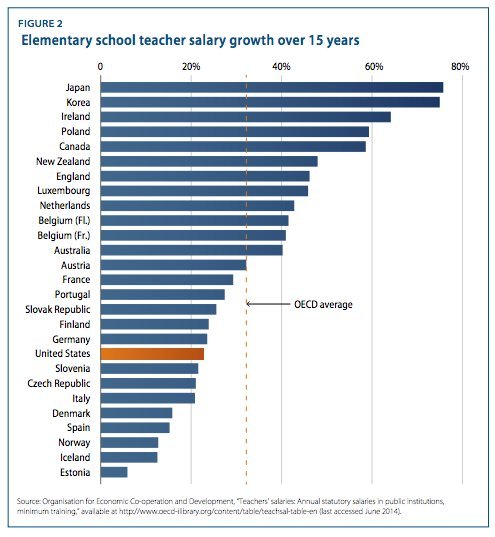
And if you want to improve the quality of the teachers in those classrooms, here’s an easy fix – pay them.
According to the Economic Policy Institute, teachers in the United States make 14 percent less than people from professions that require similar levels of education.
They can’t buy a home or even rent an apartment in most metropolitan areas. They can’t afford to marry, raise children, or eke out a middle class existence.
And finally, stop micromanaging everything teachers do and stomping on their rights. To do their job effectively teachers need autonomy. They need the ability to make decisions on the ground based on the empirical evidence gathered in the classroom.
To do that, they need their union protections. They need collective bargaining rights to give them the power to counterbalance the forces of greed and corruption that have always been at the schoolhouse door.
As a country we have taken our attention away from what’s really important. We’ve stopped focusing on how to make education better and instead equated it with how to make it more profitable for those who are already wealthy.
Teachers are vital to education. They are lifelines to struggling students. We should find ways to support them and not constantly undercutting their social standing, autonomy and rights.
The importance of teachers is beyond doubt. As is the importance of society in supporting them.
If Sanders thinks it’s a good thing for this baker to be able to deny service to someone because this potential customer’s lifestyle violates his moral convictions, then she should also support the owner of the Red Hen denying her service because her lifestyle violates the owner’s moral convictions.
And make no mistake – this isn’t a rebuke of Sanders. It’s a celebration.
Twice in the New Testament Jesus, himself, is quoted prescribing what has come to be called The Golden Rule.
What Sanders does everyday in the White House violates just about everyone’s moral code.
So how should we treat her?
I say, with the utmost respect and dignity.
And if we truly want to give Sander’s beliefs the reverence they deserve, we should deny her service. Reporters should stop attending her press conferences. Cable news programs should stop inviting her on the air. And, yes, no more food at chicken restaurants!
But we shouldn’t stop with her.
We should do the same for every member of the Trump administration. THEY believe this stuff. We should honor their convictions and treat them how they apparently want to be treated.
And why stop there? Every MAGA hat wearing Trumpster you see in your everyday life should likewise be denied service.
When they come into our places of business, our houses of worship, our homes, we should ask them politely to leave.
This isn’t punishment.
It’s the most deferential treatment imaginable.
We are showing them that we honor their moral code of reciprocity and individual freedom.
Those who are calling for “civility” don’t seem to understand that patronizing Trumpsters would be the true mark of disrespect.
If they think it is right to treat others like this, then we should treat them the same way.
That is how you show respect for someone’s beliefs – not by denying their code and treating them by your own.
Now I know what some of you are thinking – Didn’t Jesus also say, “If anyone slaps you on the right cheek, turn to him the other also” (Matthew 5:39)?
But don’t we owe it to these far rightsters to give them that choice?
If being ostracized from society makes them recant their views, then at that point we should stop excluding them. However, this may be exactly the test Trump-servatives are hoping for. Perhaps they want to see which they care more about – being part of a civil society or supporting neo-fascist politics.
The best course is to treat their conviction as serious and to give it the seriousness it deserves.
Doing so treats them as ends in themselves and not merely as a means to social lubrication.
East Pittsburgh, the neighborhood where his car was stopped and where he ran from officers before being shot three times in the back, is minutes from my house.
He went to Woodland Hills School District, minutes from my house.
If he hadn’t been in that car, he’d still be alive. If he hadn’t run from police, they wouldn’t have shot.
Maybe. Maybe not.
But being in the wrong place at the wrong time shouldn’t bring with it a death sentence. Running away shouldn’t bring with it the finality of the grave.
I wish there is something I could do to go back in time and change the results of that day. I wish there was something I could do to stop Donald Trump from being elected President. And though I did not vote for her, I would do anything to have Hillary Clinton defeat him.
On that day, though, I voted for Jill Stein.
There’s nothing I can do about that now.
I imagine going back in time and telling myself not to do it. “Go vote for Hillary,” I imagine Future Me telling an ailing younger version.
Yet even now, I’m not sure if I’d say that to myself.
Go vote for Hillary? Would it have made a difference?
Factually, no. One more vote wouldn’t have put her over the top in my home state of Pennsylvania.
Stein got 49,941 votes – 5,649 more than Trump’s margin of victory.
So if every Stein voter had cast a ballot for Clinton, she would have won the state – though she’d still lose the Presidency by 10 electoral votes.
But if the same process were repeated even in a few other swing states Clinton lost, the result would change. Clinton would have won and be sitting in the Oval Office right now.
Those are just facts. Or at least they’re facts manipulated in a game with counterfactuals.
If this had happened, then this other thing would have happened, too.
However, it is rarely so clear even with numbers.
For instance, Stein ran in 2012, too. She ran against Obama and Romney. She got 20,710 votes in Pennsylvania.
That’s tens of thousands of Green voters who didn’t cast a ballot for centrist Obama. I don’t think it’s fair to assume they would have voted for centrist Clinton, either.
So if we subtract that 20,000 from Stein’s 2016 totals, (49,941 – 20,710) you get 29,231 new people who voted Green who didn’t do so in 2012.
That’s less than Trump’s margin of victory (44,292).
So even if every NEW Stein voter cast a ballot for Clinton, Trump still would have won the state.
The point?
I don’t think it’s factual or fair to assume Stein or Stein voters gave Trump the election.
If I had voted for Clinton, even if I had advised my readers to vote for her, the end result probably would have been the same.
These are the things I think about in the middle of the night when sleep won’t come.
Is there anything I could have done to change things? In trying to make things better, did I make things worse?
I don’t assume I have that much power – either way.
I still think THAT more than any scribbling on my blog contributed to her loss.
Compared to Trump, Barack Obama was one of the best Presidents we’ve ever had. But compared to Trump, so was George W. Bush. So would be an inanimate carbon rod!
I suppose I should have been more frightened of Trump back then. But my anger at the Democrats who continually stabbed me and other progressives in the back outweighed my fear of this buffoon.
Perhaps I was wrong in that.
I don’t think it’s too much of an assumption to say we all underestimated Trump. We all underestimated how many people in this country would vote for him.
Perhaps we’d do better fighting against Trump than fighting amongst ourselves.
I still believe there is a silent majority of Americans for whom the status quo is unacceptable. Most of us don’t want a wall on our border – we want healthcare for all. Most of us don’t want families separated and undocumented immigrants scapegoated and rounded up – we want a path toward citizenship. Most of us don’t want our democracy subverted and the wealthy to have a greater say in our policies – we want freedom and justice for all.
We just need a way to find each other again. We need to find a way to look past any political, social, racial, gender or cultural differences and find a common humanity.
What better way to do that than in a common cause?
I hope you’ll join me by stopping the recriminations and take on the fight.
We may never fully solve the riddle that was the 2016 election.















 gadflyonthewallblog