“In the End, we will remember not the words of our enemies, but the silence of our friends.” -Martin Luther King Jr
Teachers want a safe place to work.
But in 2020 that is too much to ask.
As the global COVID-19 pandemic rages out of control throughout most parts of the United States, teachers all across the country want to be able to do their jobs in a way that won’t put themselves or their loved ones in danger.
However, numerous leaders and organizations that historically are supportive of teachers have refused to support them here.
The rush to keep classrooms open and thus keep the economy running has overtaken any respect for science, any concern for safety, and any appeal to compassion.
Affected teachers often wonder where their union is, where their progressive representative, where the grassroots activists who were willing to organize against charter schools and high stakes testing.
About 1 in 4 teachers – nearly 1.5 million – have conditions that raise their risk of getting seriously ill from the Coronavirus, according to the Kaiser Family Foundation.
Michael Mulgrew, president of the United Federation of Teachers (UFT) agreed.
He said:
“We are supportive of a phased reopening of schools in other neighborhoods as long as stringent testing is in place. This strategy – properly implemented – will allow us to offer safe in-person instruction to the maximum number of students until we beat the pandemic.”
The plan is predicated on a bogus statistic that kids aren’t getting sick at school or spreading the virus from there, that only 0.2% can be traced back to school buildings.
Why aren’t the unions standing up more for their employees here? Why is the request for a safe work environment too much?
Answer: politics.
With President-elect Joe Biden about to announce his pick for Secretary of Education, few union leaders have the courage to go against the party line and disqualify themselves from consideration.
But she was unafraid to contradict President Donald Trump before the election.
She appeared on CNN and challenged Trump to “sit in a class of 39 sixth graders and breathe that air without any preparation for how we’re going to bring our kids back safely.”
In late April, she took to Twitter saying the NEA is “listening to the health experts and educators on how and when to reopen schools — not the whims of Donald Trump, who boasts about trusting his gut to guide him. Bringing thousands of children together in school buildings without proper testing, tracing, and social isolation is dangerous and could cost lives.”
“The stakes of doing it wrong is that someone dies. It’s not just that someone doesn’t graduate or someone doesn’t learn their times tables — someone could die.”
I wonder what she would say today – and why she hasn’t spoken out as vocally.
“The health and safety of students, staff, and our families must be our top priority,” Askey said. “We call on all school district leaders to follow the state’s guidelines to protect the health and safety of everyone in our school communities.”
However, state guidelines are pretty weak. They suggest mask wearing and that districts close when community infection rates are high. But districts can choose to keep buildings open if they promise to follow safety guidelines to the best of their ability.
Gov. Tom Wolf originally issued an order for all schools to close and go to remote learning last March. However, state Republicans challenged his authority to do so and their position was upheld in court.
I assume Wolf would say he hasn’t done more because his hands are tied.
I assume Askey would say the same.
But such platitudes taste like ashes in your mouth when faced with the everyday reality that almost everyday the state is breaking its previous record for Coronavirus cases. Today we had nearly 13,000 new cases and 149 deaths! Yes, that’s just today!
Will their hands still be tied when daily cases reach 20,000? 50,000? 100,000?
They’re used to deciding whether to remodel the library, buy books from this or that vendor or declare Friday a holiday because the football team won the state championship.
I don’t mean to diminish what they do.
Some have been going above and beyond every day to ensure the health and safety of students, staff and the community.
And these are people from the community. How many times have teachers called them to let them know how their kids were doing in class? How many times have teachers gone with them and their kids on school field trips? How many times have teachers accepted invitations to graduation parties and school board meetings?
However, as much as the silence and disregard of lawmakers, union leaders and school directors hurts – it is the reaction from many education activists that stings the most.
However, instead of standing together and fighting these new challenges as they come (as we’ve always done) many of our activist allies have abandoned us.
One day – I hope it’s soon – it will be safe to return to the classroom and begin again.
But the wreckage of the virus will pale in comparison to the damage we have done to each other and our relationships.
Coalitions may crumble and fall.
Trust may disappear.
And the way forward – if any will be left – may be much different than it was only a year ago.
No one who refuses to defend your right to life is your true ally.
We won’t forget who spoke up and who remained silent.
Like this post? You might want to consider becoming a Patreon subscriber. This helps me continue to keep the blog going and get on with this difficult and challenging work.
Actually, that last email said the outbreak was limited to the Kindergarten class and teachers – that no close contacts were identified beyond its doors, in the building or the wider district as a whole.
However, considering that at least five more elementary teachers and another student tested positive later, I’m not sure I believe it.
All of which prompts the question – how accurate is contact tracing?
How Contact Tracing Works
Let’s say a little girl, Ava, gets COVID-19.
Where did she get it from?
Let’s do some contact tracing to find out.
We ask Ava to think back two days before she showed symptoms up until now. Who was she in close contact with (within six feet for at least 15 minutes)? She doesn’t remember much, but she gives us a list of two or three people who may fit the bill.
We call them, find that none of them are sick, none have been out of the state or country, ask them to quarantine and that’s it.
So where did Ava get the virus? Who did she get it from?
We don’t know.
And contact tracing rarely produces an answer to that question.
We already know Ava has the virus (or is suspected of having it). We’re trying to find out who she may have spread it to – as much as, if not more than – who she got it from.
In the process of doing that we may be able to trace the spread of the virus back to its source before Ava. But probably not.
Why Does Contract Tracing Often Fail to Lead Us Back to the Source of an Outbreak?
If we had rapid and ubiquitous COVID tests, perhaps we could achieve that goal. But we don’t.
At best, people are scared and not as specific as they might be. At worst, they refuse to participate at all.
Michael Huff, Pennsylvania’s director of testing and contact tracing efforts, said that more than 34,000 new cases were reported over the past week, but case investigators were only successful in reaching about 8,332.
And of those they did reach, ninety-six people refused to quarantine.
“Why? Because people don’t want to answer the phone. Because people do not realize how important it is to give the information we need to make certain we can control disease.”
So it is entirely disingenuous to claim contact tracing proves much of anything about how the virus is spread. It’s usefulness is in stopping COVID-19 from going any further.
How Contact Tracing is Used to Make Wild Claims
Students, teachers and other school staff have come down with the virus in significant numbers.
No such estimate exists for school staff, but about 1 in 4 teachers – nearly 1.5 million – have conditions that raise their risk of getting seriously ill from Coronavirus, according to the Kaiser Family Foundation.
And though many thousands of school staff have contracted the disease, more than 300 district employees have died nationwide from the virus according to the Associated Press.
Where did all these people get COVID-19?
Contact tracing provides no definitive answer, however, policymakers are pretending that means something.
Since contact tracing has rarely been able to identify the source of an outbreak to a particular person in school, they assume that means the virus isn’t spreading much in our schools.
Nonsense!
First of all, there have been significant contact tracing studies that have found these direct links.
However, many policymakers overlook this evidence as contrary or inconclusive.
They insist that contact tracing’s inability to consistently find the causal link is enough to disregard the existence of that link.
Balderdash!
That’s like sniffing the air and claiming with absolute certainty that there is no leak of carbon monoxide. The gas is odorless and colorless. A sniff test will never tell you if it’s present. You need special equipment.
The fact is Ava has only been to two places in the last two weeks – home and at school.
At home there’s just Ava, her three brothers and her parents.
At school, there are hundreds of students and 8-9 staff she comes into contact with every day.
She is probably in closer contact with the people at home than at school. But the sheer number of people she is in contact with at school multiplied by the number of hours and then days – is tremendous!
The likelihood that Ava caught the virus at school is quite high – no matter how good the precautions being taken.
Taking Advantage of Our Ignorance
It is ludicrous to assume that the lack of a direct causal link after only a few months of schools being open to reduced capacity means much of anything.
States don’t compile COVID cases at schools. The federal government doesn’t either. In fact, no one really does.
A few self-proclaimed experts have tried to put together what data they can – and used that data to make extreme claims.
Economist Emily Oster has used a mere two weeks worth of data in September to argue that the virus isn’t spreading much in schools.
And policymakers have jumped on that bandwagon all across the country including director of the CDC Dr. Robert Redfield.
Oster is now trying to have it both ways – defending her argument but chiding anyone for taking it too seriously.
Her Website incorporates data that school districts publish voluntarily, along with some data reported directly to the site. However, Oster says it’s far from complete, and she was surprised Dr. Redfield was citing it as fact.
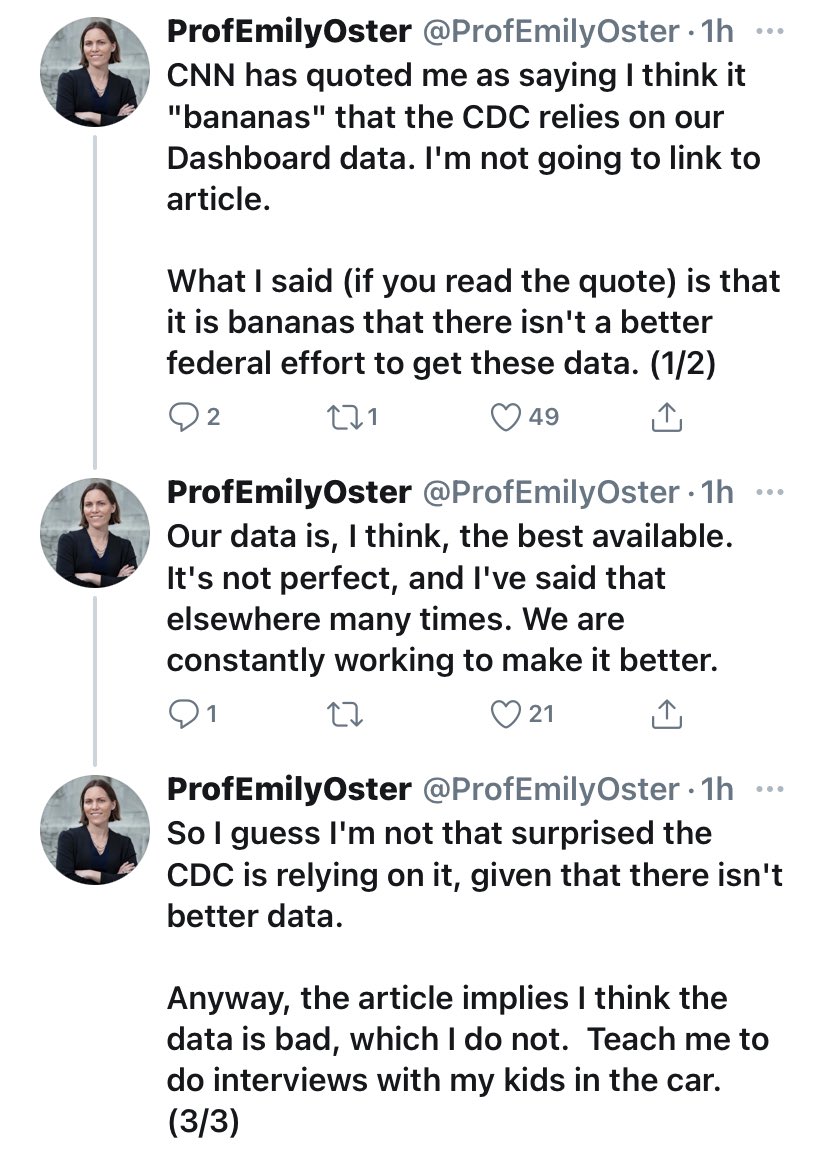
“It is totally bananas. I think we are doing as good a job as we can. This is not my field. It’s crazy.”
She later clarified in a series of Tweets, “…it is bananas that there isn’t a better federal effort to get these data….”
“Our data is, I think, the best available. It’s not perfect, and I’ve said that elsewhere many times…”
Besides the case of COVID-19 in schools, Oster is best known for making outrageous and often disproven claims such as that drinking alcoholic beverages during pregnancy is safe.
What About When Outbreaks Happen?
But it’s not just Oster who wants to have it both ways.
Policymakers say kids aren’t getting COVID at school and then walk back such claims when outbreaks happen in communities with high levels of infection.
Salt Lake City, Utah, had one of the biggest outbreaks in schools in the nation. However, that happened as infection rates reached more than double the level at which the state recommended distance learning.
“You can only open your school safely if you have COVID under control in your community,” said Benjamin Linas, an associate professor of medicine and epidemiology at Boston University School of Medicine who has advocated for opening schools under strict safety measures.
Which kind of disproves his position.
If COVID doesn’t spread much in schools, the infection rate in the community shouldn’t matter. If it does, then the virus can and does spread significantly in schools.
The situation in Utah has been partly attributed to community resistance to safety precautions like mask wearing and social distancing. When parents won’t take precautions, neither will children.
Keeping Schools Open During a Pandemic Increases Reckless Behavior
Even if viral spread was low in schools, keeping buildings open minimizes the danger of the pandemic.
If Ava can see her friends in school, why shouldn’t she get together with them after school, too?
In-person learning enables more in-person extra-curricular activities, sporting events, parties and other social gatherings outside of school.
Under normal circumstances, this would be great. When there’s a raging pandemic – not so much.
With kids, it’s not always what you say. It’s what you do. And if it’s safe enough to have in-person schooling, kids aren’t as likely to social distance outside of school.
Conclusions
The point isn’t that school cannot exist during a pandemic.
In communities where infection rates are low, even in-person classes can be conducted in relative safety with proper precautions and adequate funding.
However, if the community infection rate is moderate to high, classes should be conducted remotely.
Helen Bristow, MPH, program manager of Duke’s ABC Science Collaborative, which guides schools on COVID-19 safety, cautions:
“We’re nine to 10 months into a brand-new disease. We’re regularly learning something we didn’t know before.”
We have to stop pretending that the partial data we have is enough to make broad and reckless decisions about keeping students and staff safe during this crisis.
Decisions should be made with an abundance of caution.
For all its faults, remote learning is far preferable while the virus runs free.
Like this post? You might want to consider becoming a Patreon subscriber. This helps me continue to keep the blog going and get on with this difficult and challenging work.
State Governors must have a different definition of safety than the rest of us.
The message was signed by New Jersey Governor Phil Murphy, New York Governor Andrew Cuomo, Pennsylvania Governor Tom Wolf, Delaware Governor John Carney, Connecticut Governor Ned Lamont, Rhode Island Governor Gina Raimondo, and Massachusetts Governor Charlie Baker.
Only Baker is a Republican. The rest are all Democrats.
More than 11 million Americans have been diagnosed with the disease at an ever increasing rate. One million of those cases came about over just six days last week.
“Medical research as well as the data from Northeastern states, from across the country, and from around the world make clear that in-person learning is safe when the appropriate protections are in place, even in communities with high transmission rates.”
This is just not true.
It is based not on research by epidemiologists, not on studies conducted by doctors, scientists or pharmacologists.
It comes from the work of an economist – Emily Oster.
The Brown University professor analyzed data from all 50 states over a two week period in September and came to the conclusion that when students or teachers get Covid, they rarely catch it at school.
She wrote her dissertation explaining that there were less women in China not because of the one child policy and traditional attitudes toward girl children, but instead because Hepatitis B skewed sex ratios.
Oster is not a serious academic. She is someone who constantly says something controversial to court the media and public opinion.
She is a contrarian, an attention seeker, a celebutante – the economist version of someone who shouts “fire” in a crowded movie theater and then sells fire extinguishers to those rushing for the exits.
Since providing this cover story, various county departments of health have claimed that contact tracing rarely indicates students or teachers catch the virus at school. However, these conclusions are based on voluntary anecdotes, not hard data. At the local level, there is often a lot of pressure to find the cause of an outbreak somewhere else when childcare is at stake or administrative coercion involved.
A study of more than a half-million people who were exposed to Coronavirus suggests that the virus’ continued spread is driven by only a small percentage of those who become infected.
“In-person learning is the best possible scenario for children, especially those with special needs and from low-income families. There is also growing evidence that the more time children spend outside of school increases the risk of mental health harm and affects their ability to truly learn.”
Talk about overstating the issue!
So kids can’t learn if their instruction is interrupted? It’s a good thing we never take any time off school, say during the summer months.
But it’s the callousness with which these governors paper over health concerns that really sounds like Oster, herself.
“There are people who would say if even one teacher acquires COVID at a school and dies, then it would not have been worth it to open schools,” Oster said. “I think that argument is complicated because people are going to suffer tremendously from schools being closed, but that is a tricky calculus.”
What kind of mental health issues do children experience whose teachers die suddenly and preventably? How do kids suffer with the loss of a loved one knowing full well that they may have inadvertently been the cause of that person’s death?
What is the longterm cost to children or adults who have their lungs, digestive system or brains suffer irreparable damage as a result of Covid complications?
This disease was only discovered two years ago.
We cannot make bold statements of certainly about its effects without being deeply dishonest. There’s a lot we don’t know about it and how it affects people. And in light of that uncertainty it makes more sense to be extra cautious than reckless.
Administrators and academic coaches can be of more use helping struggling students stay on track than endlessly spinning their wheels about how best to reopen schools.
Bottom line: No one should have to go to school in an unsafe classroom.
Students shouldn’t feel like the only way to get a quality education is to risk their health and put their families in jeopardy.
It’s high time our government passed a new round of Covid relief. We need to pay people to stay home so they don’t spread the virus. We need mortgage protection, universal healthcare and a host of services to help people weather the storm.
It sad that so many Governors lack the courage to issue real Stay-at-Home orders, close schools, bars and restaurants, and issue stiff penalties for those who disobey them.
Until the danger has passed, we need quality remote learning conducted, planned and supported by educators.
And we need Governors with the guts to listen to science, not B.S. economists.
Like this post? You might want to consider becoming a Patreon subscriber. This helps me continue to keep the blog going and get on with this difficult and challenging work.
On Monday, the district will close for three days while all students learn on-line. Buildings will remain closed through Thanksgiving Break. Classes are scheduled to begin in-person again on Tuesday, Dec. 1.
Meanwhile, two staff members – one at the high school and one at Founders Hall – were reported having undergone tests for the virus this morning, according to a source close to the school board.
Allegheny County Health Department (ACHD) has not yet returned results for these two staff members.
This potentially brings the district total to 21 cases since September – 11 students and 10 staff.
Since then, one negative test result was returned for a Twin Rivers staff member and one remains pending.
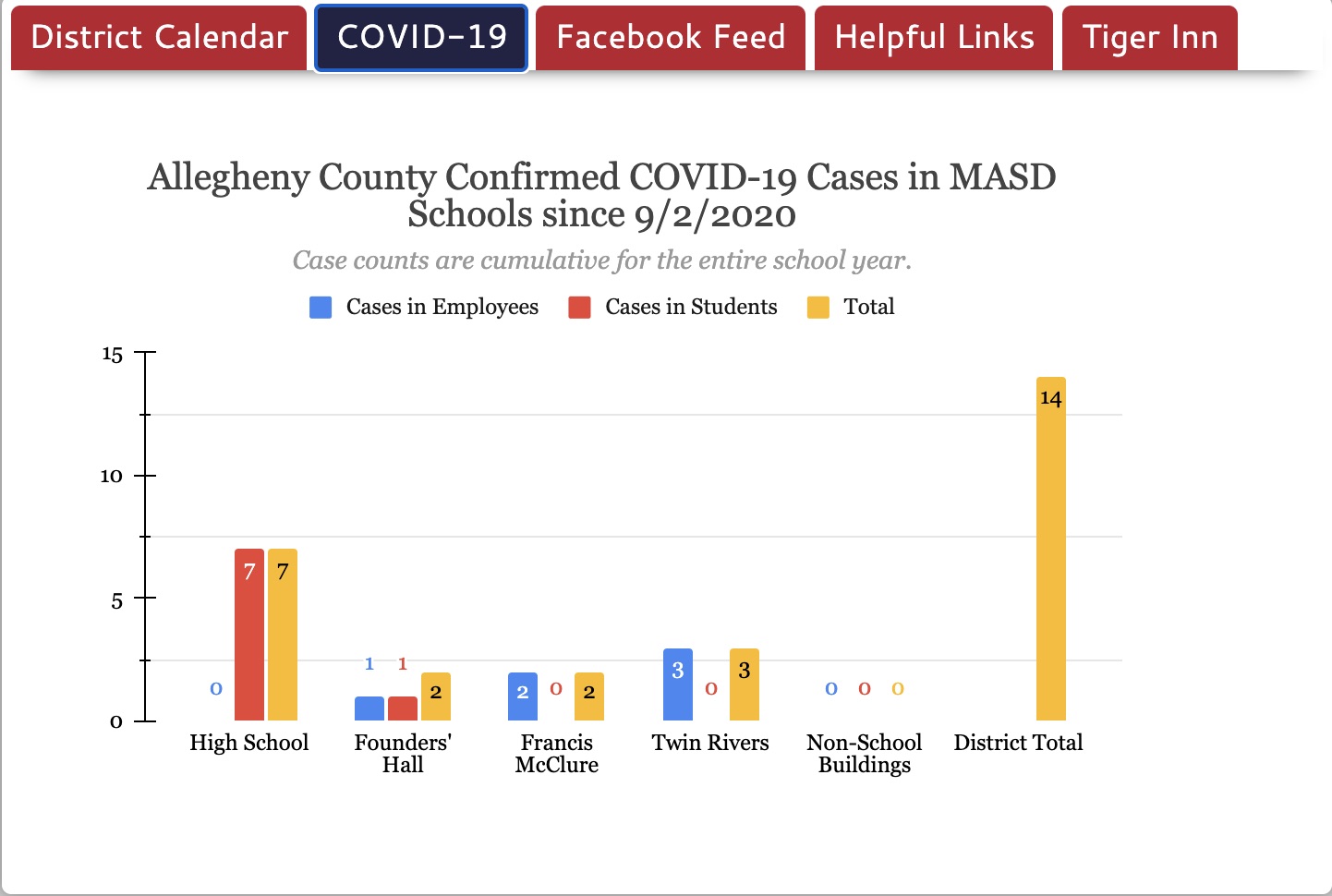
The district’s Covid Tracker on its Website has been updated to include one more case (bringing its total to 15) but district officials have not added the six additional cases reported on this blog over the last few days of which only three are pending test results.
“Our case tracker is live on our website. We receive documentation when a case is confirmed to us by the Allegheny County Health Department. Only after we receive that documentation can we update the tracker.”
However, the county health department does not limit itself so when reporting new Covid cases. It reports a total number and then differentiates between confirmed cases and those pending test results.
For instance, the ACHD reported today that there were 620 new COVID-19 cases in the county. Of those, 506 are confirmed and 114 are probable.
The district should do the same.
Parents cannot wait until cases are confirmed before making decisions about whether to send their children to school buildings or not. The mere fact that additional cases are suspected is enough for some parents to exercise caution.
After all, if your child is swimming in shark infested waters, the mere sight of a dorsal fin might be enough to call him or her back to shore. Cautious parents will not wait to see exactly what shark-like creature is gaining momentum swimming toward their child before removing him or her from danger.
Given such dangerous conditions, it is surprising the district has only committed to closing buildings for three school days.
The Thanksgiving holiday is unlikely to be a time when infections decrease. Family gatherings and holiday shopping are more likely to do just the opposite.
Many districts are closing through the end of the year or until the end of January – at least.
In any case, the district would better serve parents and the community at large if it were more transparent about exactly what is going on in its buildings.
Like this post? You might want to consider becoming a Patreon subscriber. This helps me continue to keep the blog going and get on with this difficult and challenging work.
At least six more cases of COVID-19 have been identified at McKeesport Area School District, but you wouldn’t know it from administrators.
The information at the Western Pennsylvania district is being kept quiet instead of being released to the public.
So at the high school, two students tested positive, and at Twin Rivers Elementary, three staff and one student were identified as having the virus last week, according to a reliable source close to the school board.
Of those, two of the three Twin Rivers staff are awaiting confirmation of their test results from Allegheny County Health Department. The rest have all been tested and their results confirmed.
However, there are a few additional potential cases that remain to be investigated, according to the same source.
The district used to send out telephone, email and conventional mail alerts when students or staff tested positive.
Though the tracker has not yet been updated to include this information, it is being considered as the sole source of information to the community about cases, according to the school board source.
As of Monday night, the tracker only lists 14 cases in the district since buildings reopened in September – seven students at the high school, a student and a staff member at Founders Hall, two staff at Francis McClure Elementary and three staff at Twin Rivers.
The new cases would bring the district total to 20 – nine at the high school, seven at Twin Rivers with the numbers at other buildings unchanged.
That’s 11 students and 9 staff total – not counting any additional cases that may be coming.
I still think the tracker is a good idea, but it shouldn’t be the sole source of this information.
And school directors should be using this data to determine if it is safe to keep buildings open at all.
Moreover, the tracker has its own glitches.
It does not come up when accessed through certain browsers like Firefox. Unless you use the most reliable browsers like Chrome, you can get nothing but an empty white screen.
With the county in the midst of a steadily increasing surge in Coronavirus cases, now is not the time to hold back on information.
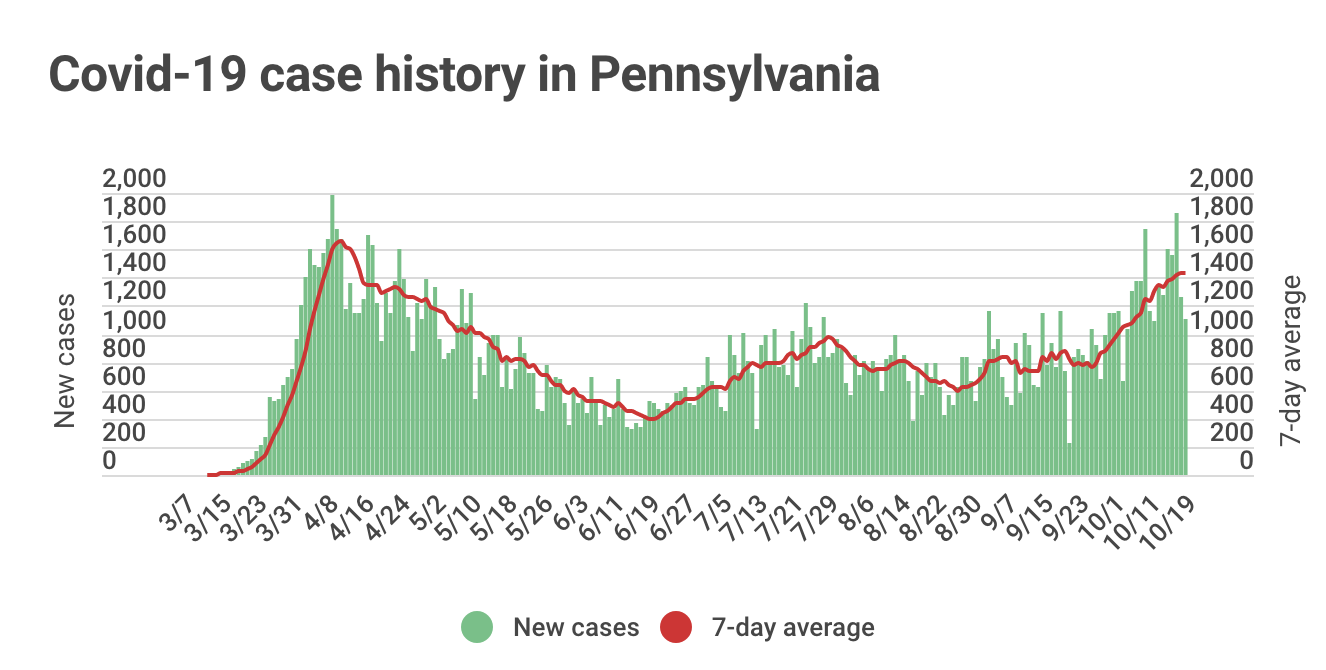
This followed a week of record-breaking reports from the Pennsylvania Department of Health, with an all-time high of 5,551 cases reported on Saturday throughout the state.
There have been 4,230 cases of COVID-19 in Allegheny County this month, alone.
Over the last week, the country has averaged more than 1,080 deaths a day – more than 30% higher than two weeks previous.
The McKeesport community deserves up-to-date information about viral spread in our schools.
Administrators need to step up the transparency.
Like this post? You might want to consider becoming a Patreon subscriber. This helps me continue to keep the blog going and get on with this difficult and challenging work.
But the idea that public schools are fundamentally better – that idea has suffered tremendously.
I used to believe that local control was something to cherish, that a board made up of neighbors duly elected by the community would more often than not have the best interests of that neighborhood at heart when making decisions.
Yes, the board decided to make students and teachers guinea pigs in an experiment to see if they could somehow avoid getting sick while cases surged throughout the country and state.
Will Western Pennsylvania schools do the right thing and go to remote learning? Will Steel Valley finally give up this in-person experiment? Will McKeesport?
They keep blaming everything on academics, saying they have provide what is best to help students learn – never mind the dangers to child, parent and teachers’ bodies. But even more hypocritically they ignore the well being of huge swaths of their students who refuse to take part in their in-person experiment.
In both districts, about 60% of parents favor in-person schooling and 40% prefer remote.
So the boards are doing what the majority wants, but it’s a slim majority.
There is a significant portion of parents who feel these in-person plans are unsafe and very little is being done to educate their children.
They are actually betting that the poor quality of the cyber program will increase the number of parents sending their kids to in-person instruction.
And I’ve heard similar comments among administration at Steel Valley.
There at least we don’t force kids into our (likewise crappy) cyber program. We just have classroom teachers post assignments on-line.
Remote students in K-5 get live teachers instructing on-line. But remote students in 6-12 only get one half day of synchronous instruction on-line a week. The rest is asynchronous worksheets, etc. And somehow that’s supposed to be enough.
We have enough teachers that we could provide more, but why encourage remote learning? Might as well let them eat asynchronous and hope their parents will lose hope and just make them come to school during a global pandemic.
I have zero respect for administrators who think this way. I have zero respect for school board members who vote for it.
So how do I keep my respect for local control and the school board system?
But my district has refused to allow me a safe work environment.
I am not allowed to teach remotely.
I have to burn my sick days so I can stay safe at home. But at the same time, I’m encouraged to take overtime hours to put up remote lessons, grade papers and contact parents.
I’m ready to do that as part of my job, but they won’t let me. They’d rather pay me and a sub who babysits my students in-person while I do what I’m allowed to do remotely at the same time.
So how do you look an administrator in the eye who refuses to lookout for his own employee’s safety?
Because the leadership is perfectly fine with agreeing for the staff to work in unsafe conditions and no special protections for those like me who are more likely to contract the disease.
Leaders throw up their hands and say “We’re an association not a union,” and “If the boss says you come back to work, you have to come back to work.”
And what is PSEA threatening if districts don’t comply?
Nothing…. So far.
But I guess saying something about it is better than what they were doing before.
The national unions – the National Education Association (NEA) and American Federation of Teachers (AFT) – certainly haven’t taken any hardline stances.
The technology should be merely a tool to connect students and teachers not as a provider of that learning.
The backlash against ed tech has been far greater than any embrace.
Yet some education activists decry how public schools going remote makes privatized schools who don’t look good.
That’s nonsense, too.
Teaching recklessly is bad – no matter who does it. If parents want to endanger their own kids, that’s their prerogative, but in the long run no one will earn brownie points for enabling such negligence.
However, where privatized schools will earn points with parents is for providing high quality remote learning when public schools refuse to do so.
I know all of them aren’t doing that. But some of them are.
And, frankly, they deserve any praise they get for it.
Look, I love public schools, too. But when public schools abandon their duties to their students as so many have done during this crisis, they deserve to have their students stolen. Even if these privatized schools often have more money to work with in the first place.
CONCLUSIONS
Bottom line: This is a crisis the school board system should have been able to overcome.
It’s a crisis the unions should have been able to battle.
It’s a crisis the activist community should have been able to see clearly.
That’s why the schools are open. School boards are afraid keeping them closed will hurt business in the community.
That’s why administrators make such reckless reopening plans. They’re afraid that if we stay on remote it will become obvious how irrelevant they are to the running of a virtual school.
That’s why union leaders put up next to no resistance. They’re more afraid of furloughs than death or lifelong health consequences.
That’s why some parents support reopening schools – so they have someone to watch their kids while they’re at work. They never spare a moment for how the government is cheating them out of stimulus checks, mortgage relief, rent forgiveness, free testing, hazard pay and healthcare so they don’t have to put their own lives on the line working during a pandemic.
In all honesty, we were a sick country long before COVID-19 hit our shores.
When you look across the ocean at the more socialist countries, you see much better plans to deal with the pandemic. Not perfect, but better.
When everything isn’t dependent on money changing hands, you can more easily prioritize human life.
So, yes, my faith has been shaken in our public schools.
I still think the idea of a public school is one to be cherished and fought to protect.
But the leaders we have – nearly all of them – should be rejected.
We need an army of citizen activists, parents and teachers to come forward at the first opportunity to replace them.
Anyone in a leadership role this year should have to explain themselves – what did you do to protect students and staff during the pandemic?
If they can’t prove they took real steps to keep people safe and not sacrifice the people they were charged to protect on the altar of capitalism – if they can’t do that they should step down.
They should step down with tears in their eyes and forever have their names sullied by their cowardice and stupidity.
They have failed us all.
Like this post? You might want to consider becoming a Patreon subscriber. This helps me continue to keep the blog going and get on with this difficult and challenging work.
My doctors tell me that I am more susceptible to contracting the virus because my medications suppress my immune system. And that also means that if I do contract the disease, I will be more likely to have severe, life-threatening complications from it.
However, starting Wednesday, about 60% of parents in my district have chosen to send their kids back to the buildings.
Of these, half the students will come in during the morning and half in the afternoon. Each will go through all their classes in 20 minute periods. On Fridays, the buildings will be closed and teachers will instruct virtually for half the day and plan during the other half.
The new reopening plan cuts instruction time by half and doesn’t meet parents need for childcare or certainly student safety. But it is better than being open 5-days a week and it provides the possibility of social distancing.
So I went to my principal asking if I could continue to teach online.
I documented my conditions, gave him doctors’ notes, and had my doctors fill out pages and pages of questions from the district’s lawyers.
In the end, my principal told me the district could not meet my request.
Administrators could provide some protections like a plexiglass barrier and take me off hall duty, but they couldn’t let me continue to teach remotely.
Certain teachers in grades K-5 have been given this option, but not secondary teachers like me. Elementary students whose parents don’t want them to return to the building will get full synchronous virtual instruction with a teacher through a video conferencing site like Zoom. Secondary students who do not return to the buildings will only get asynchronous assignments most of the week posted by their classroom teachers.
He suggested I look into taking a leave of absence.
And I guess I can see where he’s coming from.
If administrators let me teach remotely, it’s possible enough students would return to the classroom that the teachers willing to return wouldn’t be enough to meet the load. My absence from the building might necessitate a substitute teacher to be in the physical classroom with students.
Why pay for two teachers when you only need one?
Except…
…I’LL STILL BE PAID WHEN I’M ON LEAVE.
It’s just that then I’d have to sit at home instead of teach my students.
So benching me doesn’t save the district any money.
In fact, it will cost the district MORE money for me to stay home, because I could still do everything they expect of me and more for the sizable number of students whose parents say they aren’t returning.
So I brought this up to my principal figuring he must have overlooked it.
But no. He said he knew all about it.
He said this is what the district’s lawyers were telling him to do so that’s what he was going to do.
I couldn’t believe it.
I went to school board directors I had developed a relationship with teaching their children, going on field trips with them, working with their spouses.
I got the same answer.
So here I am – being asked to choose between my life and my livelihood.
Go to work and risk everything – or sit at home burning my sick days and still collecting a paycheck.
This is not what I want.
It’s not good for anyone.
I teach 8th grade Language Arts. Last year I also taught 7th grade.
So many of my students this year were in my class in the spring. We already know each other.
But more than that, I know what they like and dislike. I know their hopes and fears. I know what motivates them and what supports their individual learning.
I’ve seen tremendous growth the first 9-weeks of school and could really help them overcome the gargantuan hurdles that will be inevitable the rest of the year.
And that’s what I’d really like to do.
I don’t want to sit home collecting the taxpayer’s money when I could be making a difference in these young people’s lives. I don’t want to have to wait for an outbreak to allow me to continue my work.
Being benched like this makes me feel so worthless, and I’m not.
Wouldn’t everyone be better served with me instructing my students rather than being thrown to the side?
That can’t happen without help.
I’m just a human being like anyone else.
I have people who care about me and whom I care about.
I have a wife and daughter.
I can’t roll the dice with my life or chance taking an infection home to my loved ones.
Is a safe work environment really too much to ask?
I don’t want to sit at home.
I want to teach.
Like this post? You might want to consider becoming a Patreon subscriber. This helps me continue to keep the blog going and get on with this difficult and challenging work.
The school board will review the plan at its work session meeting on Monday in the high school auditorium at 7:30 pm. The meeting also will be live streamed on YouTube.
The board is expected to vote on the plan at its regularly scheduled meeting on Thursday, Oct. 29, at 7 pm.
I don’t want to have to contradict the school board and my administrators.
I don’t want to have to insert myself into this debate.
But I feel like I have no other choice.
Since I don’t live in the district, I can’t go to the school board meeting and speak.
And when I have expressed my concerns to those in charge, they have been repeatedly brushed aside.
So I am putting them out there in the public space.
This is what a Steel Valley teacher really thinks about this proposed plan.
This is what I feel I must say even at the risk of my job and future in this district – the proposed plan should not be adopted. We should continue with virtual instruction until infection rates in the county are extremely low.
The proposed plan would have students dividing into two groups – one would attend in the mornings and the other in the afternoons.
Both groups would have all of their classes for 20 minutes each for four days a week – Monday – Thursday. Friday would be a half day virtual learning day.
Consider that students currently have their full classes on-line for four days a week. Wednesday is an asynchronous learning day.
So the new plan would cut instruction time by half.
And this is true even for double period classes. Two 20 minute in-person classes is better than one, but not as good as two 40 minute virtual classes.
Just imagine it.
If this plan is approved, students and staff would be rushing here-and-there for the tiniest fraction of possible instruction in-person, and then rush home to do the mountains of classwork that would be necessary to move forward at all.
But parents will be given a choice whether to subject their children to this schedule or not.
Parents will have to decide whether they want their children to attend in-person or receive virtual instruction.
However, the virtual instruction being offered under this new model is not in many cases the same as what children receive now.
Remote students in K-5 would still meet with a classroom teacher on video platforms.
However, remote students in 6-12 would have to enroll in the district cyber program. This is a canned ed tech initiative modeled on credit recovery. They will have minimal to no interactions with classroom teachers or lessons taught by district educators.
This would replace an exemplary district-designed curriculum with a subpar service to parents and students in the hope that they will opt for in-person instruction instead.
No matter which option you choose for your child, from an academic standpoint, this new proposal is a step backward.
Most students would receive less instruction from classroom teachers – either half of what they’re receiving now (but in-person) or next to nothing on-line in grades 6-12.
And that will continue to happen until we work together to provide a coordinated defense against the pandemic.
You can’t have half of the schools close their doors and the other half keep them open and expect the virus to just stop. You can’t have some people wear facial masks in public and others go without and expect the virus to disappear.
We need to work together or else prepare ourselves to hunker down for a very long COVID season. Or – even worse – a very short one.
If you are a resident of Munhall, Homestead or West Homestead and you feel the same way I do, I am begging you to go to the school board meetings.
Please tell the board not to proceed with this plan.
It will result in many, many people getting sick.
Some may die. Others may have life-long debilitating complications as a result of the virus.
That’s just not worth it.
That’s just not worth a little more in-person instruction and a little less out-of-pocket childcare costs.
Healthcare, hospital stays and funeral preparations are much more expensive.
Thank you for hearing me out.
Like this post? You might want to consider becoming a Patreon subscriber. This helps me continue to keep the blog going and get on with this difficult and challenging work.
Superintendent Dr. Mark Holtzman says the district ignored these guidelines on the recommendation of the Allegheny County Health Department.
“The County Health Department is the local governmental agency responsible for the school districts in [the] County,” Holtzman said at last night’s school board open agenda meeting.
“So their determination of what next steps to take is their primary responsibility. So at this particular time, they have recommended to us that we not follow the CDC guidelines because those guidelines have been created before the start of school and are outdated. So they’re currently working on new guidelines to direct schools.”
The response was in answer to citizens comments.
‘
Greg Kristen and I went to the board meeting hoping to get answers – and we did.
“Those decisions that are being made by the McKeesport Area School District are recommendations by the County Health Department,” Holtzman said.
“They’re not our recommendations. They’re not anyone’s recommendations in this room. Now our school board does have the determination if they so choose to not follow those recommendations and close the McKeesport Area School District. Up until today at this particular time we’re not aware of any school district in Allegheny County being recommended to close no matter how many cases that are involved.”
“I am in a large public school system… I am hearing and seeing two different approaches. I am very appreciative of what the board’s efforts in Pittsburgh have been to keep us safe and keep our students safe. I just want to be an advocate that we are doing everything we can even if it’s erring on the side of caution.”
District Solicitor Gary Matta was concerned about the issue as well.
“We’re getting some mixed signals between the state and the county,” he said.
“The state is directing us to deal with the county health department if we have one.”
He suggested the district get recommendations in writing from the county health department before following any of its advice.
In addition to questions about whether it was safe to keep district buildings open during a COVID-19 outbreak, Holtzman addressed district transparency.
I asked him to compile a dashboard on the district Website with the following information:
“1) How many people have tested positive in total since the school year began?
2) How many are students? How many staff?
3) How many are located at each school building?
4) And please give us a timeline of when each positive test result was returned.”
He could not give me all I asked for at the meeting.
Holtzman said that 10 people have tested positive in the district since school opened – 9 of them recently. He said there have been cases at all four buildings – the high school, Founders Hall, Twin Rivers and Francis McClure elementary schools.
He was able to break down 8 of the 10 cases.
He said:
“In the last 7 days…. We’ve had 5 adults and 3 students. From Wednesday to Wednesday. Two employees (teachers) from Francis McClure, one teacher at Twin Rivers, 1 support staff at Founders Hall, 3 high school students, and one maintenance/support employee.”
Holtzman admitted that having a dashboard on the district Website was a good idea but fell short of committing to providing that ongoing data.
“A dashboard is a pretty good suggestion,” he said.
“It might help people have a better understanding this isn’t a secret – it’s a challenging situation… A lot of districts are considering it, but there are some drawbacks, too. But that’s something we’re going to take into consideration.”
Kristen brought up the issues of contact tracing and increasing class sizes at Twin Rivers that may make it difficult for students to engage in social distancing.
“Two days ago, my daughter told me she was getting six more kids in her class starting Nov. 2,” he said.
“They would be sharing desks. How is that possible during a pandemic? We’re just getting a spike in cases here and now we’re going to add more students to the schools in the classrooms? How is that safe? According to the guidelines, kids have to be AT LEAST 6 feet apart. That will not happen with more students.”
Holtzman said some students whose parents had chosen remote learning had decided to return them to the physical classroom at the start of the new grading period. However, others had decided to remove their children from the physical buildings and put them on remote.
“We will have students return to the classroom after the first 9-weeks. That’s inevitable. The numbers that we anticipate returning, we’re able to accommodate based on the space in those rooms. We do have some relatively low numbers – like less than 10 – in those classrooms.”
About a third of district students have been doing remote lessons since the year began.
Kristen said his daughter told him the new students added to her class would put the kids closer than 6 feet. Her teacher said they would be within 3 feet.
Holtzman disputed this:
“That’s a little difficult to determine. From the center of the child to the center of the child, there must be 6 feet. Six feet is a recommendation. Right? Just like the masking order and the gathering order is a mandate. So recommendations to space kids 6 feet apart is truly what it is – a recommendation. So we’re doing our very best.”
Kristen asked about contact tracing at Twin Rivers where teachers had tested positive.
He wanted to know if students had been tested, and Holtzman responded that they had not.
“Right now the McKeesport Area’s percentage is a little over 5% but it’s trending up as far as the rate of positivity. So people are concerned with watching that number.” He said.
“At this particular time, the Allegheny County Health Department is very satisfied with the contract tracing efforts they’ve made around our current cases. There is no longer any backlog, and there are none waiting to be addressed…
“When we do interviewing – when Allegheny County Health Department does interviewing – we ask them, ‘Where you in somebody’s personal space 6 feet apart for more than 15 minutes during your school day?’ If the answer is yes, Johnny, Susie, Mrs. So-and-So, then that information is provided to the health department and they’re asked to quarantine. If in fact that teacher says ‘I wear a mask every single day, all day, and I’ve never been in anybody’s personal space within 6 feet for 15 minutes consecutively, then the contact tracing ends at that point.”
He admitted that the effectiveness of this process depends on how honest and detailed those testing positive are when listing the people they have come into contact with while contagious.
Below is a transcript of our public comments and Dr. Holtzman’s responses:
Kristen:
“Dear school board members. Thank you for letting me speak here tonight. As a resident of this district for 15 years, as well as having a daughter a Twin Rivers Elementary School, I am deeply, deeply concerned with the lack of transparency about the Coronavirus infections. As of today, MASD has 9 positive cases… We have a right to know [who they are] not their names but their positions. According to CDC guidelines if there are two cases within a school, it is to be shut down for 5-7 days. For 5 or more cases, the building should be shut down for up to 14 days. Why is that not happening? Is the health and safety of the students, teachers, administrators, staff and maintenance not important to you? When positive cases happen in the building, who was in charge for contract tracing and notifying the Allegheny County Health Department? If they did not notify the health department, are they being held accountable? And I mean terminated. Were the parents of the students notified of the teachers and staff who were affected in the schools? Were the students tested? Is there any contract tracing with them? Also why is there not a healthcare professional a part of the Coronavirus task force?
Two days ago, my daughter told me she was getting six more kids in her class starting Nov.2. They would be sharing desks. How is that possible during a pandemic? We’re just getting a spike in cases here and now we’re going to add more students to the schools in the classrooms? How is that safe? According to the guidelines, kids have to be AT LEAST 6 feet apart. That will not happen with more students.
This Coronavirus is not a hoax. People are dying every day. As of today, 222,000 people have died, and people like myself who have an underlying health condition are concerned about people transferring the virus to me or to someone close to me. In this county alone there 14,396 cases and 416 deaths. On Oct 14 which was just a week ago Rachel Levine, the state health secretary announced a second wave of Coronavirus has arrived here. Now that the flu season has arrived, what is MASD doing? Does a student, teacher, administrator, staff or maintenance person have to die for someone to take this serious? Thank you very much.”
Dr. Mark Holtzman:
“Mr. Kristen, I’m happy to address a couple of your concerns. A few things.
We’ve had 8 positive tests in the last 7 days. So that is correct. The CDC guidelines are recommendations by the CDC and Pennsylvania Department of Education and state health department. (muffled) The Alleghney County Health Department is the local governmental agency responsible for the school districts in Allegheny County. So their determination of what next steps to take is their primary responsibility. So at this particular time, they have recommended to us that we not follow the CDC guidelines because those guidelines have been created before the start of school and are outdated. So they’re currently working on new guidelines to direct schools. I will ensure to tell you positively I have spoke to the Alleghney County Health Department probably just this week once a day. The head epidemeologisr Dr. Luann Brink and the director of the health department Dr. [Debra] Bogen and I have conference calls with her every Tuesday at 2 o’clock. Those decisions that are being made by the McKeesport Area School District are recommendations by the Allegheny County Health Department. They’re not our recommendations. They’re not anyone’s recommendations in this room. Now our school board does have the determination if they so choose to not follow those recommendations and close the McKeesport Area School District. Up until today at this particular time we’re not aware of any school district in Allegheny County being recommended to close no matter how many cases that are involved.
The concerns are the issues with Allegheny County Health Department are the rate of positivity here in the city of McKeesport and the surrounding communities. That’s number 1. Transmission is a huge piece of it. Is it being transmitted in the schools? Is it being brought into the schools from the outside? Contract tracing does occur on each and every case. All that information is submitted to the Allegheny County Health Department with details, time stamped, dates, everything we could possibly provide to those individuals. Fortunately or unfortunately we have to rely on that individual. For example, if you’re an employee that tests positive for COVID, we have to interview you. The information that you share with us, we have to then share with the Allegheny County Health Department. Whether you’re honest, dishonest , whether you’re detailed, whether you forgot someone, you didn’t include anyone as part of your contact tracing, that becomes your prerogative. We as a district just have to report that information to the health department and they make a final determination.
So at this particular time unfortunately we’re at the bottom of the document that’s been referenced many, many times, it states that when an entire school is recommended to be closed, closure time will vary depending on level of community transmission, and number of cases. Right now the McKeesport Area’s percentage is a little over 5% but it’s trending up as far as the rate of positivity. So people are concerned with watching that number. ‘This allows public health staff the necessary time to complete case investigation and contact tracing and to provide schools with other appropriate public health advice like cleaning and disinfecting.’ At this particular time, the Allegheny County Health Department is very satisfied with the contract tracing efforts they’ve made around our current cases. There is no longer any backlog, and there are none waiting to be addressed.
So at this particular time, I know there is frustration, I know there’s contradictory information out there, but we are working closely with the health department and they have done an outstanding job guiding us and every school district has a tough decision to make. So I appreciate you expressing your concerns this afternoon, this evening, later than it should be we appreciate it and if there’s anything we can do moving forward, we’d be happy to help.”
[Holtzamn said three teachers tested positive at Twin rivers Elementary. All students in those classes were not tested. Each student Is placed 6 feet apart. A close contact has to be within 6 feet for 15 consecutive minutes.]
Holtzman: “When we do interviewing, when Allegheny County Health Department does interviewing, we ask them ‘[Where you in somebody’s person space 6 feet apart for more than 15 minutes during your school day?’ If the answer is yes, Johnny, Susie, Mrs. so-and-so then that information is provided to the health department and they’re asked to quarantine. If in fact that teacher says ‘I wear a mask every single day, all day, and I’ve never been in anybody’s personal space within 6 feet for 15 minutes consecutively, then the contact tracing ends at that point.
Now we could absorb those things. As Superintendent I’m in the schools daily, and I’m able to see some of the teachers and [their actions]. The students are already placed 6 feet apart, so therefore they are already socially distanced. We will have students return to the classroom after the first 9-weeks. That’s inevitable. The numbers that we anticipate returning, we’re able to accommodate based on the space in those rooms. We do have some relatively low numbers – like less than 10 – in those classrooms.
[Kristen says his daughter told him the new students added to her class would put the kids closer than 6 feet. Her teacher said they would be 3 feet.]
Holtzman: “That’s a little difficult to determine. From the center of the child to the center of the child, there must be 6 feet. Six feet is a recommendation. Right? Just like the masking order and the gathering order is a mandate. So recommendations to space kids 6 feet apart is truly what it is – a recommendation. So we’re doing our very best and will hold all those expectations considering the fact that we have to educate the children that are interested in returning to school. We can’t just turn them away…. As many kids that are coming in, many are leaving for online learning for many reasons.”
MY COMMENTS:
“Thank you for letting me address the board this evening.
As a lifelong resident and the father of a child who attends the district, I am alarmed by news about an outbreak of COVID-19 at our school buildings, a lack of transparency about that information and a lack of proper safety response to the outbreak.
First, when I am finished with my comments, I ask that you clarify for me some facts about the outbreak.
1) How many people have tested positive in total since the school year began?
2) How many are students? How many staff?
3) How many are located at each school building?
4) And please give us a timeline of when each positive test result was returned.
That information should be constantly available on the district Website throughout the pandemic. It should not just be on alerts that come and go, robocalls or emails.
Every taxpayer has the right to that information – which is easy to compile – and necessary so parents and community members can make smart decisions about how to keep ourselves and our families safe in the McKeesport Area.
Next, I am concerned about the district’s blasé response to these life threatening conditions.
According to the state Department of Education Website, in a county like Allegheny where infection rates are designated as moderate, if 2-4 students or staff in the same building test positive, the school should be closed for 5-7 days.
Haven’t we met this threshold?
According to your recent alerts, at least 9 people have tested positive in the district in the last week – 3 students and 6 teachers. And this is spread throughout all district buildings.
There is no way to divide that up without at least one of our four buildings in the danger zone.
Doesn’t that mean that at least at some buildings – probably Twin Rivers, Francis McClure and/or the the High School – we have met this benchmark? Don’t each of those schools have two or more cases?
Why haven’t these buildings been closed?
Moreover, according to the PDE Website, if there are multiple cases at multiple schools where the infected are not household contacts, the schools are supposed to be closed not just for 5-7 days but a full two weeks.
Have we met that threshold? And if so, why are the buildings not closed?
I do not understand what precautions you are taking to keep students and staff safe.
I understand that PDE defines “Close Contact” as being within 6 feet for at least 15 consecutive minutes of a person who has tested positive. However, the Website cautions that this should not be taken as the ONLY definition of such contact: “In some school situations, it might be difficult to determine whether individuals are contacts or whether an entire cohort, classroom, or other group (extracurricular activity members) might need to be considered exposed, particularly if people have spent time together indoors.”
You say these cases have all been contained. But you have done very little to assure the public of this and could be taking much greater precautions on our behalf.
We’re talking about children here. We’re talking about our staff – people who have served generations of families and who often have families of their own.
Can’t you do better for the people in this district?
I would suggest that you at least follow PDE recommendations in the effected buildings.
Furthermore, I think you should cancel all in-person classes and go to a fully remote education plan until the infection rate in the county and the community is designated as low.
Have the classroom teachers make the online curriculum and let students and families choose whether they wish to go through that curriculum synchronously or asynchronously. And do not outsource the virtual program to ed tech companies looking to cash in on their credit recovery programs – as you are currently doing with Edmentum.
Going to a fully virtual plan would be in the best interests of students, families and the community.
Please do your duty.”
Holtzman:
“Mr. Singer, Thank you. I appreciate you spending some time with us again today. I don’t know, Dr. (muffled) do you have the numbers he’s requesting off hand? I only have the last seven days in front of me. If not, I’ll make sure you get them.
Voice: I don’t have them with me.
Holtzman: Prior to this situation we’ve had very few so… the difference between staff and students, we currently have in the last 7 days… we’ve had 5 adults and 3 students. From Wednesday to Wednesday. Two employees (teachers) from Francis McClure, one teacher at Twin Rivers, 1 support staff at Founders Hall, 3 high school students, and one mainatance/support employee. Furthermore, I feel that we’ll agree to disagree that instruction in person is the priority for engaging children. Our students have received progress reports. You as an educator I’m sure are quite aware that the online learning platform is not engaging all children. Many children are struggling and failing courses, here ate McKeesport and all over the Commonwealth. I think it’s a big issue for all school leadership trying to find new creative ways to engage children whether it’s synchronous or asynchronous. So for us here at McKeesport we’re very fortunate to have had this huge donation of devices. We are going to consider doing some flexible instruction in the very near future to kind of make sure we have all of the pieces in place to provide synchronous instruction affectively. But sadly a lot of our students have chosen either to not log in or not be consistent in the work they’re trying to perform online. So we’ll continue to encourage our children to be in schools, we’ll continue to do our very best
ME: Would you commit to putting the information I asked for before onto the district Website?
Holtzman: You bring a good point because you know there are some districts using… a ticker to keep track. To be honest I didn’t know it would be necessary so that’s something we need to consider. A dashboard is a better description. It might help people have a better understanding this isn’t a secret it’s a challenging situation… Also to answer your question, we’ve had a total of 10 cases since the start of the school year. We’re still waiting for confirmation on two of those but we’re pretty confident. A dashboard is a pretty good suggestion. A lot of districts are considering it, but there are some drawbacks, too. But that’something we’re going to take into consideration.
[Holtzman admitted there was at least one case at every building but not elementary students.]
Like this post? You might want to consider becoming a Patreon subscriber. This helps me continue to keep the blog going and get on with this difficult and challenging work.
The western Pennsylvania district located southeast of Pittsburgh reopened on a hybrid schedule on Sept. 2 with about a third of parents opting to keep their children out of the buildings and in the district-run cyber program.
Since then, finding concrete information about Coronavirus infections at our public schools – MASD or others – has not been an easy task.
MASD school district issues alerts on its Website, but they do not stay up for long.
On Sunday, the Website noted:
“Across two of our buildings, Twin Rivers Elementary and the High School, we have had three positive cases of COVID-19 in teachers, and two positive results in students.”
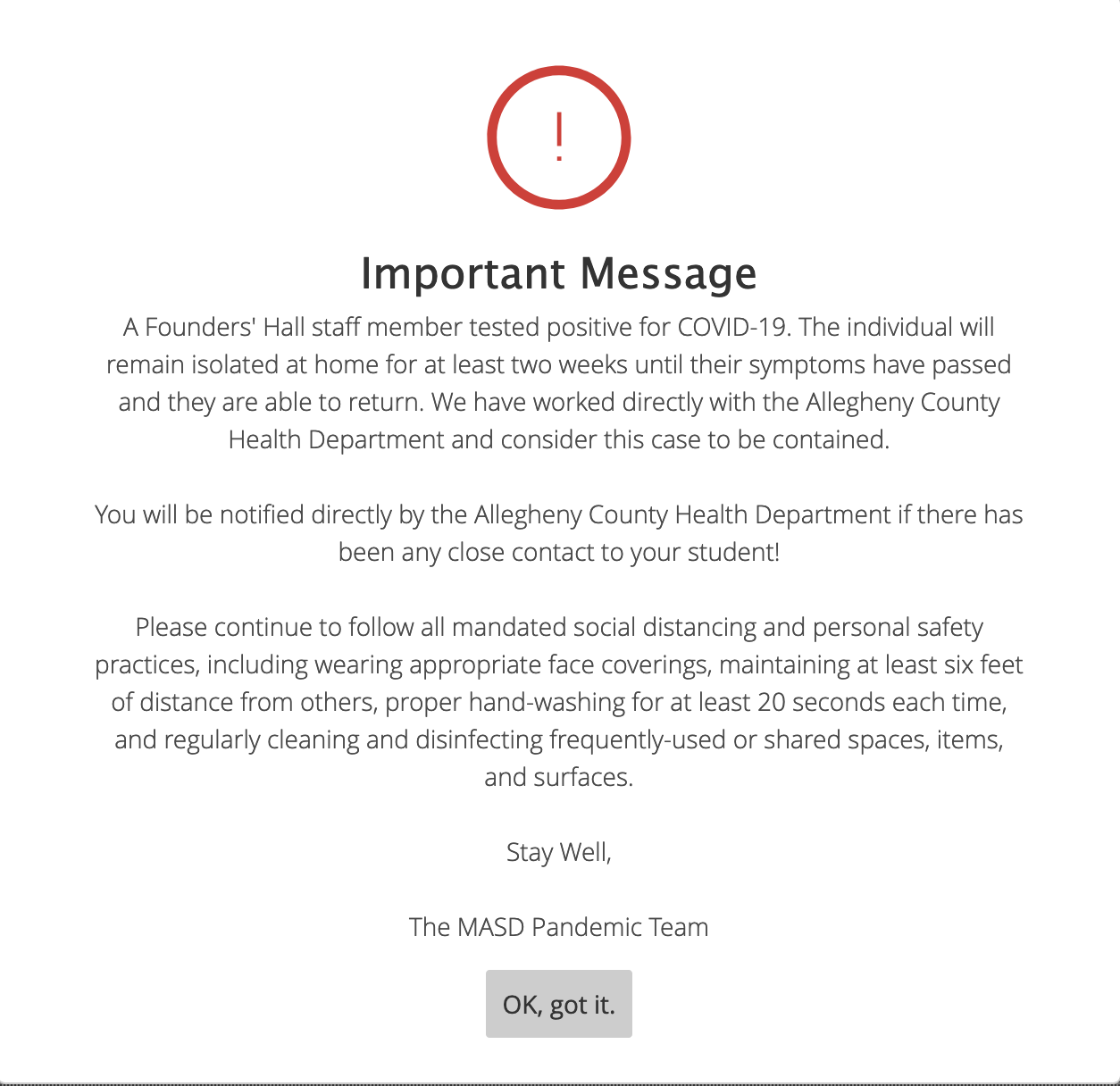
“A Founders’ Hall staff member tested positive for COVID-19.”
So that’s one case at Founders Hall and five spread out between the High School and Twin Rivers Elementary School.
Though in both cases, the district Website claimed, “We have worked directly with the Allegheny County Health Department and consider this case to be contained,” it is telling that the district obfuscated about exactly how many cases were from each building.
On September 15, a letter was sent home to parents saying that a Founders’ Hall Middle School student tested positive for COVID-19.
The letter further stated that the student would quarantine for two weeks.
District spokeswoman Kristen James said there would not be any closures of school facilities as a result of the incident.
“Our buildings are being deep cleaned each and every day and throughout each day,” she said.
COVID-19 has also plagued nearby Serra Catholic School.
The parochial school serving students from many of the same communities as MASD has suspended football practice and closed its doors twice before for COVID outbreaks.
On Oct. 12, a “person involved with the [football] team” tested positive, and 40 athletes and football staff were quarantined.
Just a month earlier, on Sept. 10, two Serra students tested positive, resulting in temporary suspension of the sports program and building closures.
However, buildings were opened just twice to students – both times for transition days. And both times, a staff member tested positive for COVID-19 soon after.
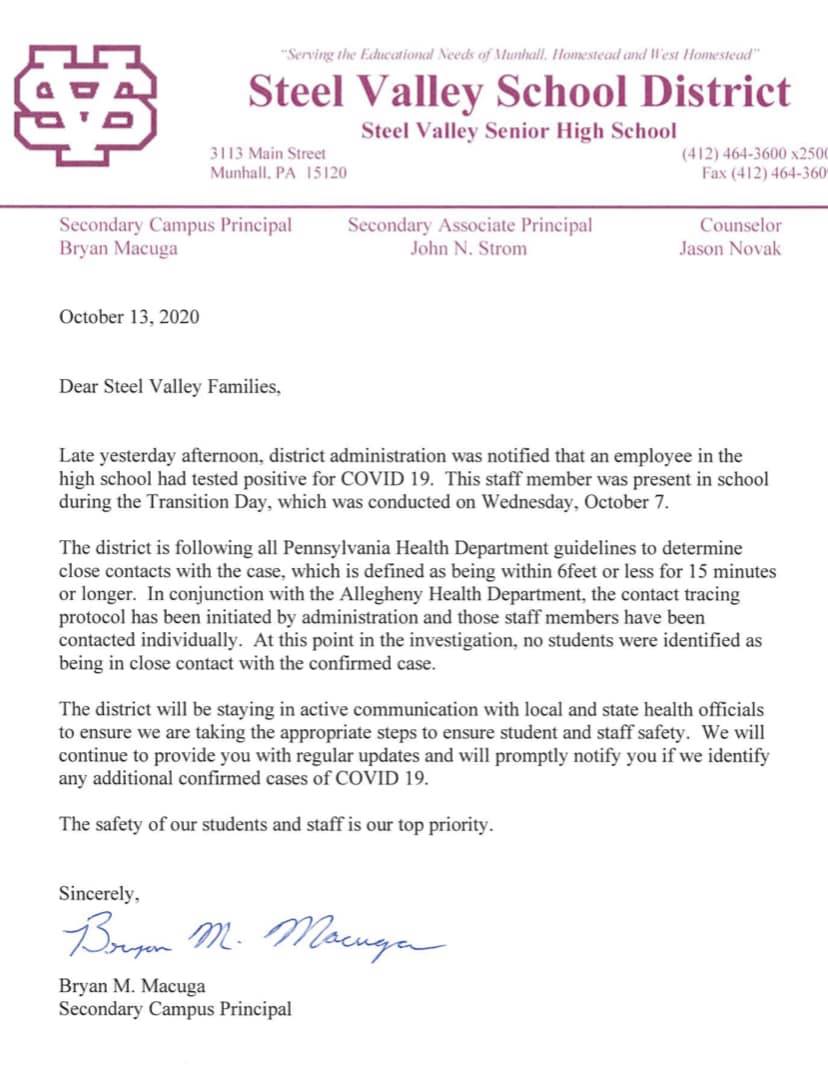
On Oct 7, a letter issued by Bryan Macuga, Secondary Campus Principal, said that a high school teacher tested positive. The day before, the district had students in grades 5 and 9 in the middle school-high school complex for a half day schedule to test the district’s wi-fi.
Though the teacher had participated in the program, he had not been within 6 feet of students for 15 minutes at a time – PDE’s definition of close contact.
On Sept 8, students in the same grades were in the same building for a half day transition program, and a middle school teacher who had participated in the program tested positive for COVID a day later.
School directors are actively considering moving from the virtual schedule – where no one has gotten sick – to a hybrid schedule in November.
But shouldn’t we be making decisions with a priority on student and staff safety?
If people die or contract lingering life-long complications as a result of COVID-19, they will not thank you for keeping buildings open longer than was advisable.
It’s time for decision makers to take off the rose colored glasses and make the tough decisions in everybody’s interests.
It’s something we can all accomplish if we and our representatives just have the courage to do it.
Like this post? You might want to consider becoming a Patreon subscriber. This helps me continue to keep the blog going and get on with this difficult and challenging work.












 gadflyonthewallblog