
Report: US Shortchanged Public Schools by Hundreds of Billions of Dollars Over Decades

taking-candy-from-a-baby


Fun Fact: Between 2005 and 2017, the federal government withheld $580 billion it had promised to spend on students from poor families and students with disabilities.


Fun Fact: Over that same period, the personal net worth of the nation’s 400 wealthiest people ballooned by $1.57 trillion.


So, rich people, consider this the bill.


A new report called “Confronting the Education Debt” commissioned by the Alliance to Reclaim Our Schools (AROS) details the shortfall in minute detail.


For instance:


  • $347 billion owed to educate low-income students most of whom are children of color.


  • $233 billion owed to provide services for students with disabilities.


And this is just the shortfall of the last dozen years! That’s just money due to children who recently graduated or are currently in the school system!


We’ve been cheating our children out of the money we owe them for more than half a century!


Federal education funding levels were first established in 1965 as part of Pres. Lyndon Johnson’s War on Poverty in the landmark education law, the Elementary and Secondary Education Act (ESEA).


That law, which has become little more than a boondoggle for the standardized testing and school privatization industries, originally was passed to address inequality in America’s education funding.


Now this report from a coalition of groups including the Education Justice Research and Organizing Center, the National Education Association, the American Federation of Teachers, Center for Popular Democracy and the Action Center on Race and the Economy points out the multifarious ways we have failed to live up to the standards we set in that original legislation and beyond.


One of the most glaring examples of neglect is Title I funding.


The Johnson administration admitted that schools with a high concentration of students living below the poverty line needed extra support to succeed at the same levels as students from middle class or more affluent backgrounds. So the law promised to provide an additional 40 percent for each poor child above what the state already spent per pupil.


And then it promptly failed to fund it. In 1965 and every year since!


These are not just numbers. With this money, high poverty schools could provide:


  • “health and mental health services for every student, including dental and vision services; and

  • a full-time nurse in every Title I school; and

  • a full-time librarian for every Title I school; and

  • a full-time additional counselor in every Title I school, or

  • a full-time teaching assistant in every Title I classroom.”


A decade later, in 1975, the same thing happened with The Individuals with Disabilities Education Act (IDEA).


Congress told local districts they’d have to do more to help disabled students succeed academically. However, doing so costs money. Lawmakers admitted that disabled students cost more to educate and that local districts often struggle to find the funding to help them succeed.


Once again, Congress pledged to pay up to 40 percent of that additional cost, with local and state funds covering the remainder.


Once again, Congress failed to fund it.


STATE AND LOCAL FAILURE


But it’s not just the federal government that has shirked its duties to school children.


State and local governments also stiffed generations of students out of the resources they deserved – especially if those students have black or brown skin.


Beside the federal government, public schools are funded by their local municipalities and the state. Local governments pay for about 45 percent of school budgets.


However, since most of this allotment is determined by property tax revenues, it ensures the poor get fewer resources than the rich. Kids from rich neighborhoods get lots of resources. Kids from poor areas get the scraps. Inequality is built into the funding formula to ensure that students don’t start out on an even playing field and that economic handicaps are passed on from one generation to the next.


State governments are no better. They provide about 47 percent of school budgets.


As such, they are in the position to right the wrongs of the local community by offsetting the inequality of local governments – but only 11 states do so. Twenty states close their eyes and provide the same funding to each school – rich and poor alike – regardless of need or what each community can afford to provide for its own children. But 17 states are even worse. They actually play Robin Hood in reverse – they funnel more money to wealthier districts than to poor ones.


As a result, schools nationwide serving mostly students of color and/or poor children spend less on each child than districts serving mostly white and/or affluent children.


TAX CUTS


And while our federal, state and local governments have failed to meet their responsibilities to students, they have required fewer taxes from business and industry.


In the late 1940s and 1950s, the top marginal tax rate was more than 90 percent. Today it is 37 percent.


Congress just passed a series of whooping tax cuts that go into effect in 2019. More than half of the benefit of these cuts will go to the richest five percent of taxpayers. The law is expected to cost the federal treasury as much as $1.5 trillion in lost revenues over the next decade.


Nearly every state levies a much greater share of taxes from low- and middle-income families than from the wealthy.


And that’s before we even start talking about corporations!


While the US federal corporate tax is 35 percent, the effective tax rate that corporations pay after loopholes and deductions is only about 14 percent. This costs the federal government at least $181 billion in annual revenue, based on 2013 estimates by the Government Accountability Office. Local and state corporate tax and abatement programs make it even worse.


This is a choice. We are not requiring the rich to pay their fair share.


SCHOOL-TO-PRISON


Instead of investing in ways to help educate children, one of the only areas we’ve increased funding is incarceration.


The private prison industry is booming, fueled in part by a lack of opportunities in schools.


According to the report:


“In 2017, the National Association of School Resource Officers claimed that school policing was the fastest-growing area of law enforcement. The school safety and security industry was reported to be a $2.7 billion market as of 2015. Most of that $2.7 billion is public money now enriching the private security industry instead of providing real supports to students.”


According to the US Department of Education, 1.6 million students go to a school that employs a law enforcement officer but not a guidance counselor.


That is not an unalterable economic reality. It is a failure of priorities. It is the mark of a society that is not willing to help children but will swoop in to punish them if they get out of line.


SCHOOL PRIVATIZATION


Finally, the report identifies school privatization as a contributing factor to this systemic neglect.


Charter schools are legal in 44 states plus Washington, D.C. and Puerto Rico. They have “systematically stripped public school budgets through the creation of parallel structures of privately-operated, publicly-funded schools.”


Cost studies in San Diego, Los Angeles, Nashville, Michigan, Pennsylvania, Durham and other localities have come to the same conclusion: “the privatization of schools has contributed to austerity conditions in traditional public schools.”


Yet Congress continues to appropriate millions of dollars to the Department of Education’s Charter Schools Program (CSP), which funds new charter start-ups and expansions. The program has a budget of $500 million this year, alone. It is the largest single backer of charter schools in the nation.


According to the report, “In other words, the U.S. Department of Education is operating a program that directly undermines public schools.”


SOLUTIONS


But the report isn’t just about what’s wrong. It outlines how we can make it right.


It outlines three policy initiatives:


1)      “Full funding of Title I and IDEA to target federal support to low-income children and students with disabilities.

2)      The creation of 25,000 Sustainable Community Schools by 2025.

3)      A new focus for the U.S. Department of Education, on ensuring and incentivizing equity in public schools across the country.”


And we can pay for it by:


A. “Make the wealthy pay their fair share of taxes.

  • Rescind the 2017 tax code changes, which overwhelmingly favor the top 1 percent of income earners.
  • Close the federal carried interest loophole, a step that could increase federal revenues by between $1.8 and $2 billion annually or, according to some researchers, by as much as $18 billion annually.
  • If the carried interest loophole is not closed at the federal level, states can impose a surcharge on carried interest income at the state level, raising millions for state budgets.
  • Enact so-called “millionaire’s taxes” that increase the tax rate on a state’s highest earners. New York and California have already passed such law.


B. Require wealthy corporations to pay their fair share.

  • End or reduce corporate tax breaks that cost the federal government at least $181 billion annually.

  • Reduce state and local subsidies to businesses for economic development projects and hold school funding immune from tax abatements.

  • Enforce and strengthen programs like Payment in Lieu of Taxes (PILOT) to ensure that wealthy institutions pay their fair share towards local budgets.


C. Divest from the school-to-prison pipeline.

  • School safety and security is now a $2.7 billion industry. Much of that money is public money, going to profitable corporations instead of schools.
  • Divest from expensive security systems, metal detectors and legions of school-based police officers and instead invest in counselors, health and mental-health providers and other supports that make schools safer.


D. Place a moratorium on new charter schools and voucher programs.

  • A moratorium on the federal Charter Schools Program would free up $500 million annually, which could be used to support the creation of Sustainable Community schools.”


The executive summary concludes with the following statistic.


Even a 10 percent increase in funding for each high poverty student maintained through 12 years of public school can dramatically change the likelihood of academic success. It can boost the chances that students will graduate high school, achieve 10 percent higher earnings as adults and a 6 percentage point reduction in the annual incidence of adult poverty, according to a 2015 report.

“Ten percent is pocket-change for a nation that has orchestrated the rise of an unmatched billionaire class. In the richest nation in the world, it is possible to fully fund all our public schools, and to provide Black, Brown and low-income children with the educational resources and additional supports and services they need to achieve at the highest levels.”


The facts are in, folks.


We can no longer gripe and complain about a public education system we fail to support without recognizing the cause. We have failed to meet our responsibilities to our children – especially our children of color.


The solution is simple – equity.


We need to demand the rich do the right thing.


We cannot achieve greatness as a nation when wealth and privilege continue to shirk their duties and our lawmakers do little more than enable greed and corruption.


The bill is here.


Time to settle up.


READ THE WHOLE REPORT.


Like this post? I’ve written a book, “Gadfly on the Wall: A Public School Teacher Speaks Out on Racism and Reform,” now available from Garn Press. Ten percent of the proceeds go to the Badass Teachers Association. Check it out!

WANT A SIGNED COPY?

Click here to order one directly from me to your door!
book-2

Meet the Test Before the Test – Pennsylvania’s Classroom Diagnostic Tools (CDT)

BoredStudentIPad_iStock_monkeybusinessimages


It’s test time.


My students are dutifully pecking answers onto their iPads before a hand goes up.


“Mr. Singer, I can’t log in to the server.”


Another hand.


“It keeps kicking me out.”


Another.


“Mr. Singer, what does this question mean?”


Then every single hand in the room pops up all at once.


“What’s the matter!?” I say, trying not to let the frustration into my voice.


A lone student in the front offers to speak for the group.


“The Website just kicked us all off.”


If that sounds like the optimum environment to assess student learning, then you must work for Data Recognition Corp (DRC).


It is typical of the company’s Classroom Diagnostic Tools (CDT) test in Pennsylvania.


The assessment, which cannot be taken with pencil and paper but must instead be taken on a computer or personal device, has always been glitchy.


You type in a response and what you typed only appears after a delay.


When moving from one screen to another, you have to wait through a seemingly endless interval until the next screen loads.


And during this year’s first sessions, multiple teachers told me of students whose tests cycled through all the questions without input from the students and then gave them an unalterable grade.


This is not the best way to diagnose students’ abilities in reading, math and science.


Yet that’s what the state Department of Education strongly encourages we use it for – three to five times a year!


This is not a mandatory test.


It’s strongly suggested by administrators in Harrisburg. And that’s enough to make some local principals march wherever they’re told.


Ironically, Gov. Tom Wolf proudly proclaimed that he was reducing the amount of time students in the Keystone state would take standardized tests. But he’s only talking about the federally mandated Pennsylvania System of School Assessment (PSSA) and Keystone Exams which he’s cut by a total of almost 2 hours a year.


There are still a battery of suggested pretests on the state’s wish list – tests that are supposed to predict success on the PSSA or Keystone Exams – tests used to show whether kids are getting the skills they need.


Do you understand it now?


No.


Do you understand it Now?


No.


Do you understand it NOW!!!!!!!?


Of these, the most common is the CDT.


If schools follow the state’s instructions and give students this exam in reading, math and science 3 to 5 times a year, that’s an additional 50-90 minutes per test. That comes to 22.5 hours of additional testing!


So 22.5 hours minus 2 hours equals… NOT A REDUCATION IN TESTING!


Moreover, the CDT test is cumbersome to proctor.


I’ve given my students this test for about seven years now and it never fails to be anywhere from tricky to an outright disaster.


This week, I had a class of students on their iPads unable to log on to their accounts at DRC headquarters. In another group, five students were dropped from the server without warning and couldn’t finish.


Defective software and having to repeatedly log back in to the system are hallmarks of even the most successful CDT session.
Even if you like standardized tests and think they are the best way to assess students, the product and service provided by DRC is extremely low quality.


But keep in mind – you’re paying for it, folks! In the last 8 years alone, taxpayers forked over more than $1 billion for this service and the PSSA and Keystone tests, which DRC also produces.


It’s incredibly frustrating, a waste of classroom time and taxpayer money.


No one does their best when they’re exasperated, and this test is almost designed to make students feel that way.


Yet some local administrators are trying to use the assessment as part of a high stakes matrix to determine classroom placement.


Whether your child is registered in the remedial, general or advanced class could be determined by this shoddy excuse for an assessment. Whether your son or daughter has the advantages and esteem of the advanced class could rest on a malfunctioning data system. Whether he or she has to settle for months of mind numbing test prep instead of authentic education could be decided by defective software.


No matter how you look at it, this doesn’t help the teacher diagnose academic deficiencies and remediate them. That is, unless your idea of remediation is printing out a worksheet of test look-a-like questions based on the ones the student got wrong on the CDT.


This is bad assessment supporting bad pedagogy forced on us by bad policy.


But that’s not even the worst part.


Why are we doing this in the first place?


Have standardized tests ever been proven accurate assessments of student learning? Moreover, has it ever been proven useful to give pre-test after pre-test before we even give the ultimate high-stakes test?


Answer: No.


Most countries don’t test their students nearly as much as we do in the United States. Finland, which has students who routinely return some of the highest scores among developed nations, only makes its children take one standardized test.


One test from K-12!


In addition, countries like those in Scandinavia don’t have nearly the child poverty rate we do. Nor do they fund their schools based on local property taxes. They provide more funding and resources for needy students than rich ones – we do just the opposite.


Numerous studies have shown a strong correlation between parental income and the test scores of their children. In short, kids from wealthy families who go to schools with the best of everything generally score very well on standardized tests. Students from poor homes who go to underprivileged schools do much worse.


So all this testing does nothing to help students learn. It simply reinforces the inequality already in place. And then it’s used as a justification for that same inequality.


High stakes standardized testing is not about increasing student outcomes. It’s about boosting corporate incomes – corporations like Data Recognition Corp.


Finally, there’s another danger we haven’t even hinted at involved with the CDT.


As an on-line test, it collects an awful lot of data about the children taking it. This information is kept in a database for students entire academic career so that it can be compared with subsequent results.


This is private student data in the hands of a private company.


The chances that this information and thus students’ privacy will be violated are extremely high.


We are putting our children’s futures in the hands of a for-profit company with little to no assurance that it is safe. There is little oversight, accountability or even awareness of the issue.


Therefore, any knowledgeable parent would be entirely within his or her rights by refusing to let their child take any of these tests.


Yes, you can refuse to let your child participate in test prep the same way you can opt out of the PSSA and Keystone Exams.


You need refer to the same part of the law:


“PA School Code Chapter 4.4(d)(1)(2)(3):

(d) School entities shall adopt policies to assure that parents or guardians have the following:

(1) Access to information about the curriculum, including academic standards to be achieved, instructional materials and assessment techniques.

(2) A process for the review of instructional materials.

(3) The right to have their children excused from specific instruction that conflicts with their religious beliefs, upon receipt by the school entity of a written request from the parent or guardians.”


That includes the CDT.


Opt Out PA has provided this helpful form letter you can use and modify to meet your needs before sending it to your local principal:


“Dear Principal/Teacher(s):

Pursuant to Pennsylvania Code Title 22 Chapter 4, section 4.4 (d)(1)(2)(3) I am hereby exercising my right as a parent to have my child, [NAME], excused from PSSA test prep, including (but not limited to) CDT’s and Study Island because of religious beliefs.

Sincerely,”


So while Pennsylvania’s lawmakers dither back and forth about the political realities of standardized testing as an accountability measure and as they blithely ignore the threat posed to student privacy by on-line testing, parents can take matters into their own hands.


Your child’s teacher would like nothing better!


Imagine being able to actually teach and not have to spend days of instruction time troubleshooting a Website while corporate lackies cash our check!


Imagine students in school to actually learn something – instead of testing them into oblivion.


Imagine a student raising her hand to ask a question about the curriculum and not the software!


Like this post? I’ve written a book, “Gadfly on the Wall: A Public School Teacher Speaks Out on Racism and Reform,” now available from Garn Press. Ten percent of the proceeds go to the Badass Teachers Association. Check it out!

WANT A SIGNED COPY?

Click here to order one directly from me to your door!

cropped-book-1.jpg

Scott Wagner Wants to be Pa.’s Anti-Education Governor. Will We Let Him?

39408873_306034386897393_1481697570328674304_n
Art by Sue Goncarovs


If there’s one thing Scott Wagner hates, it’s education.


He hates science. He hates schools. He hates teachers. And if students get in the way, he’ll hate them, too.


These are the qualities he thinks Pennsylvanians are looking for in their next governor.


The York Township Republican will challenge incumbent Democrat Tom Wolf on Nov. 6, 2018.


So who is this guy?


Wagner’s a college dropout who made a fortune starting a garbage hauling firm. He became a state senator four years ago after winning a write in campaign during a special election where only 17% of the electorate could be bothered to vote.


And ever since, he’s been consistent about one thing: he really, Really, REALLY hates teachers.


“We have 180,000 teachers in the state of Pennsylvania,” Wagner said in 2015. “If we laid off 10 percent of the teachers in the state of Pennsylvania, we’d never miss them.”


Let’s be clear.


Scott wouldn’t miss them. But the 1.75 million Commonwealth school children would.


Ever since the last Republican Governor, Tom Corbett, slashed funding by almost $1 billion a year to the poorest schools with the full help of a state legislature that is even now still under GOP control, our institutions of learning have been reeling.


We lost 27,000 education jobs, most of which were teaching positions.


That’s a deficit we still haven’t recovered from. Even today, state schools are staffed at a 10-year low. Class sizes are at an all time high.


Yet Wagner wants to fire even more teachers!?


That’s not the policy of a man who wants to help improve life throughout the state for all. That’s not the policy of a man who wants to help kids learn.


It’s the policy of a man who has a personal grudge against educators.


And his other legislative objectives?


Wagner wants to further slash education funding. He wants to spend whatever is left inequitably. And he really wants to help his heroes Donald Trump and Betsy DeVos enact school vouchers so business people like him can continue to cash in on children from Pittsburgh to Philadelphia and all places between.


By contrast, in his four years in office, Gov. Wolf has pushed to increase education funding, pushed to spend it more fairly, and even cut the time it takes for students to take high stakes standardized tests.


The good news: voters throughout the Commonwealth have never had a clearer choice for governor.


The bad news: when has that ever stopped them from getting it wrong?


Here’s a couple of Wagner’s other big ideas cribbed from the American Legislative Exchange Council (ALEC) and his buddies the Koch Brothers.


He Thinks Teachers Make Too Much Money


“We have created a special class in this state and the special class is the public sector union employee,” Wagner told Keystone Crossroads in a 2015 interview.


“Teachers are doing very well in this state,” he said. “People would be appalled if they knew what their teachers made, in certain areas.”


Unfortunately, Wagner has no idea, himself.


He keeps quoting a bogus salary figure that I’m not going to repeat. It’s not true statewide, it’s not an average, nor is it true in his home district.


In truth, the low end for teachers entering the field nationwide is around $30,000, according to the National Association of Colleges and Employers (NACE). So go to college, get a four – sometimes five – year degree including a rigorous internship of student teaching and you make a mere $10,000 above the most generous minimum wage!?


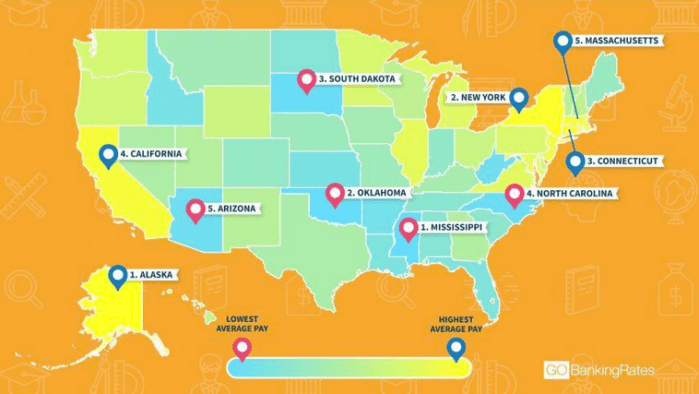
However, Pennsylvania pays its teachers better than average. We have the 12th highest pay in the country, according to financial services outlet GOBankingRates which compiled average teacher salaries by state using 2015 federal data.


According to that data, Pennsylvania teachers make on average $63,063 per year. Of neighboring states, teachers in Maryland ($65,247) and New Jersey ($71,687) make more. Teachers in Ohio (59,063) and Delaware ($59,853) make less.


Screen Shot 2018-08-16 at 2.11.40 PM
Highest and Lowest Teacher Salaries – Source: GoBankingRates


But those numbers are deceiving. They’re averages. Districts serving the wealthy pay their teachers much better than those serving the poor. Actual pay ranges from $99,253 in the affluent Philadelphia district of Lower Merion to $27,592 at Wonderland Charter School in Centre Country.


As everywhere else, many teachers struggle to make ends meet working multiple jobs while others are well compensated.


No matter how you slice it, nationwide teachers’ salaries are 14% less than those from professions that require similar levels of education, according to the Economic Policy Institute.


In other words, if prospective teachers want to make more money, all they have to do is switch majors.


That may be part of the reason for our national teachers shortage. Not only have states like ours laid off tens of thousands of educators, many don’t stay in the field if given the chance. Across the country , 46 percent of educators quit before reaching the five year mark. And it’s worse in urban districts, where 20 percent quit every single year!


We could take steps to ensure all teachers earned a living wage and even encouraged our best and brightest to enter the field. But, nah, Wagner thinks Pennsylvania already spends “enough” money on public schools.


As Governor, he would do whatever he could to win his personal crusade against teachers even if Pennsylvania’s school children were collateral damage.


He Wants to Eliminate Teachers Sick Days


Wagner has been vocal about eliminating benefits that educators earn, including sick days. He introduced a bill that’s still floating around in the state senate to strip sick days from the school code and make teachers bargain for them with their districts.


So forcing sick teachers to come to school and spread the germs to children is fine with Wagner as long as it hurts his nemesis – those evil teachers.


He Wants to Cut Teachers Pensions


He also plans to end pensions for working educators, and even wants retired educators to give back 10% of the retirement they earned.


He’s right to want reform to the state pension system but disingenuous or misinformed about the cause.


Pennsylvania pension costs have increased primarily because our legislature made bad plans and bad investments that were upended by the crash of 2008. You don’t fix that by stiffing your employees. If you do that, no one will believe any promises the state makes and no one of any substance will want to work for the state.


He Wants To Pay Teachers Based on Student Test Scores


No kidding:


“There are teachers that will exceed expectations while teaching a classroom of 100 of the toughest-to-teach students. There are also teachers that would struggle to teach just one student at a time. I want the first teacher to make a small fortune, and I want the second teacher to find a new career that is better suited for him or her.”


So if you teach the best students, you should make the most money? And if you teach struggling students, you should be fired?


But It’s Not Just Teachers. He Hates Other Working People, Too


If there is a corner to cut, he wants to take it – especially if it screws a working person. As a state senator, Wagner even introduced a bill that would exempt school districts from paying laborers the “prevailing wage” on construction projects.


Cheaper labor, shoddier work. That’s surely a recipe for success in buildings housing school children!


He Wants to Disband Unions


Oh, but he’s not done.


The man who once compared the tactics of public employee unions – including those representing teachers – to those of Adolf Hitler and Vladimir Putin also wants to end tenure end tenure, seniority, and disband unions.


I’m sure reducing teaching to a career without benefits, workers rights or protections will do wonders for the educational quality students receive.


Teachers working conditions are students learning conditions. Putting children in a building that has fewer safety precautions because there’s no union to collectively bargain for them is a great way to cut costs. But parents aren’t thrilled about having their kids try to learn in a sweat shop filled with Trump brand Russian asbestos.


He Loves School Vouchers and Charter Schools


Call them education saving accounts, education tax credits, personalized learning accounts or opportunity scholarships. It doesn’t matter. Wagner loves them all.


“I support all school choice,” he said in an interview.


Charter schools, funding private and parochial schools with public tax dollars. He’s in for all of it.


So long as it hurts public schools and enriches private businesses without helping students learn at all.


Go ahead! Take scarce funding from public schools and divert it to programs with little to no accountability. Let private school operators fraudulently misrepresent enrollment data. Let them fail to provide safe and academically appropriate learning environments. Let them game the system in any and every way.


That’s what Wagner calls fiscal accountability.


It doesn’t matter that these schools don’t improve student achievement. Evaluations of voucher programs in Milwaukee, Cleveland, and Washington, D.C., have all found no statistically significant differences in the academic achievement of voucher students compared to public school students. And recent evaluations of programs in Ohio, Indiana, and Louisiana revealed that voucher students scored lower than their peers attending public school.


But who cares about facts? This is all ideology for Wagner.


Vouchers have a record of undermining student’s civil rights – especially students with disabilities. Private school students give up due process and other rights guaranteed in public schools. Private schools are allowed to discriminate by denying admission based on religion, sexual orientation, citizenship status, English language proficiency and disability. Private schools that enroll students with disabilities may decide not to provide the services or accommodations guaranteed to such students in public schools. Or they may charge parents extra for them. Moreover, there is nothing to stop them from segregating these kids from other children. And, finally, private schools often suspend or expel students without due process.


This may be Trump and Wagner’s ideal. But it is certainly not what Commonwealth voters want for their children.


He Wants to Get Rid of Many State Colleges


Wagner caused an uproar when he said the state’s 14 state colleges will not be around in four years. “So, for those of you who think your school’s going to be around four years from now, it isn’t going to be around,” Wagner said.


Fewer institutions of higher learning. Fewer opportunities to get a college degree. That sounds like the policy of a college dropout.


He Wants to Slash School Funding


Wagner has made no bones about this from day one.


This is a guy who took a television reporter on a helicopter tour of schools in his district in 2015 to highlight the fact that “we spend a lot of money on schools.”


“They think the solution is more money,” he said of Wolf and the Democrats. “Every time you do that the money disappears and the problem is still there.”


It’s like taking a bath, Scott. You can’t just do it once and be clean for the rest of your life. You need to bathe every day. One-time funding windfalls don’t work. You need equitable and sustainable funding revenues.


But that’s either too complicated for Wagner or he just doesn’t care.


He supported Gov. Corbett’s plan to decimate Pennsylvania’s schools. And he doesn’t think the culling should be over.


When asked point blank about Corbett’s cuts in 2011, he said, “Yes, I believe that Governor Corbett needs to stick to his plan.”


He’s said repeatedly that we spend “enough money” on public schools, while stressing the need for frugality and fewer regulations.


He Wants to Play with How Schools Are Funded


He’s an advocate for legislation that would eliminate school property taxes and replace them with increased state sales and income taxes.


True we need a better funding mechanism than local property taxes. But you can bet Wagner’s plan is worse than the current system.


It would lock funding inequities among Pennsylvania’s 500 school districts into place.


He Thinks Global Warming is Caused by the Earth Getting Closer to the Sun


Wagner is an incredibly stupid man who thinks he’s rather intelligent.


But of all the dumb or evil things that come spewing out of his mouth, this one has to be my favorite.


When asked about global climate change, he didn’t simply deny that it was happening. He had an alternative theory to why it was taking place.


It’s not business and industry or fossil fuels that is causing global temperatures to rise. He actually said that it’s because the earth is getting closer to the sun every year. Another cause? Human bodies on the planet are giving off enough heat to raise the global temperature.


Perhaps it shouldn’t be surprising that a person who hates schools and teachers so much knows very little, himself.


These comments made him a national laughing stock.


His words were repeated on every late night comedy show across the country for giggles and guffaws.


The question is “Will the joke be on us come Election Day?”


It’s not “How dumb is Scott Wagner?”


It’s “Is Pennsylvania dumb enough to vote for him?”


NOTE: Special Thank you to Sue Goncarovs for the Wagner cartoon with which I began this piece. I love your work!


Like this post? I’ve written a book, “Gadfly on the Wall: A Public School Teacher Speaks Out on Racism and Reform,” now available from Garn Press. Ten percent of the proceeds go to the Badass Teachers Association. Check it out!

WANT A SIGNED COPY?

Click here to order one directly from me to your door!

book-1

Cyber School Kingpin Gets Slap on Wrist For Embezzling Millions from PA Students

nick-trombetta


Nick Trombetta stole millions of dollars from Pennsylvania’s children.


And he cheated the federal government out of hundreds of thousands in taxes.


Yet at Tuesday’s sentencing, he got little more than a slap on the wrist – a handful of years in jail and a few fines.


He’ll serve 20 months in prison, be on supervised release for three years, and payback the tax money he concealed.


As CEO and founder of PA Cyber, the biggest virtual charter school network in the state, he funneled $8 million into his own pocket.


Instead of that money going to educate kids, he used it to buy a Florida condominium, sprawling real estate and even a private jet.


He already took home between $127,000 and $141,000 a year in salary.


But it wasn’t enough.


He needed to support his extravagant lifestyle, buy a $933,000 condo in the Sunshine State, score a $300,000 twin jet plane, purchase $180,000 houses for his mother and girlfriend in Ohio, and horde a pile of cash.


What does a man like that deserve for stealing from the most vulnerable among us – kids just asking for an education?


At very least, you’d think the judge would throw the book at him.


But no.


Because he took a plea deal, he got a mere 20 months in federal prison.


That’s less than two years in jail for defrauding tens of thousands of students and multiple districts across the Commonwealth.


In addition, once he serves his time he’ll be on probation for 3 years.


And even though there is no mystery about the amount of money he defrauded from the Internal Revenue Service by shifting his income to the tax returns of others – $437,632, to be exact – the amount he’ll have to pay back in restitution is yet to be determined.


One would think that’s easy math. You stole $437,632, you need to pay back at least that amount – with interest!


And what of the $8 million? Though I can’t find a single explicit reference to what happened to it in the media, it is implied that the money was recovered and returned to Pa Cyber.


Yet there seems to be no discussion of a financial penalty for embezzling all that money. If my checking account dips below a certain balance, I’m penalized. If I don’t pay the minimum on my credit cards, I’m charged an additional fee. Yet this chucklehead pilfers $8 million and won’t be docked a dime!? Just paying it back is good enough!?


But what makes this sentence even more infuriating to me is the paltry jail time Trombetta will serve.


The judge actually gave him 17 months LESS than the minimum federal guidelines for this kind of case! He should at least be serving 37 to 46 months – 3 to 4 years!


Nonviolent drug charges often lead to sentences much longer than that!


For instance, in 2010, Kevin Smith was arrested for drug possession. He was locked up in a New Orleans jail for almost 8 years (2,832 days) without ever going to trial!


But then again, most of these nonviolent drug charges are against people of color. And Trombetta is white.


So is Neal Prence, a former certified accountant who pleaded guilty to helping Trombetta hide his ill-gotten gains.


Prence will serve a year and a day in prison and pay back $50,000 in restitution.


It’s a good thing he didn’t have any drugs on him.


And that he didn’t have a tan.


This is what we talk about when we talk about white privilege.


And speaking of that, compare this crime with the sentences given to the Atlanta teachers who were convicted of cheating on standardized tests a few years back.


These were mostly women and people of color.


Tamara Cotman, Sharon Davis-Williams and Michael Pitts received the harshest sentences.

They each got three years in prison, seven years probation, $10,000 in fines and 2,000 hours of community service.


So in America, cheating on standardized tests gets you a harder sentence than embezzling a fortune from school kids.


I’m not saying what the Atlanta teachers and administrators did was right, but their crime pales in comparison to Trombetta’s.


Think about it.


Atlanta city schools have suffered under decades of financial neglect. The kids – many of whom are students of color – receive fewer resources, have more narrowed curriculum and are forced to live under the yoke of generational poverty.


Yet their teachers were told to increase test scores with little to no help, and if they didn’t, they’d be fired.


I can’t imagine why they tried to cheat a system as fair as that.


It’s like being mugged at gunpoint and then the judge convicts you of giving your robber a wooden nickel.


The worst part of all of this is that we haven’t learned anything from either case.


High stakes standardized testing has become entrenched in our public schools by the newly passed federal law – the Every Student Succeeds Act (ESSA).


And though Trombetta resigned from his post as CEO of PA Cyber in September 2013, cyber charters are as popular as ever.


These are publicly funded but privately run schools that provide all or most instruction on-line. Think Trump University for tweens and teenagers.


You can’t turn on the TV without a commercial for a cyber charter school showing up. You can’t drive through a poor neighborhood without a billboard advertising a virtual charter. They even have ads on the buggies at the grocery store!


Yet these schools have a demonstrated track record of failure even when compared to  brick-and-mortar charter schools. And when you compare them to traditional public schools, it’s like comparing a piece of chewed up gum on the bottom of your shoe to a prime cut of filet mignon.


A 2016 study found that cyber charters provide 180 days less of math instruction than traditional public schools.


Keep in mind there are only 180 days of school in Pennsylvania!


That means cyber charters provide less math instruction than not going to school at all.


When it comes to reading, the same study found cyber charters provide 72 days less instruction than traditional public schools.


That’s like skipping 40% of the school year!


And this isn’t just at one or two cyber charters. Researchers noted that 88 percent of cyber charter schools produce weaker academic growth than similar brick and mortar schools.


They concluded that these schools have an “overwhelming negative impact” on students.


AND THAT’S ALL LEGAL!


In Pennsylvania, nearly 35,100 of the 1.7 million children attending public schools are enrolled in cyber-charter schools. With more than 11,000 students, PA Cyber is by far the largest of the state’s 16 such schools.


If Trombetta had just stiffed Pennsylvania’s students that much, he wouldn’t have been in any trouble with the law.


However, he got even greedier than that!


He needed more, More, MORE!


Justice – such as it is in this case – was a long time coming.


Trombetta was first indicted back in 2013 – five years ago.


He was facing 11 counts of mail fraud, theft or bribery, conspiracy and tax offenses related to his involvement in entities that did business with Pa. Cyber. He pleaded guilty to tax conspiracy almost two years ago, acknowledging that he siphoned off $8 million from The Pennsylvania Cyber Charter School.


He has been free on bond all this time.


His sister, Elaine Trombetta, agreed to cooperate with prosecution, according to federal court filings. She pleaded guilty in October 2013 to filing a false individual income tax return on her brother’s behalf and has yet to be sentenced.


It was only yesterday that her brother – the kingpin of this conspiracy – was ultimately sentenced.


Finally, he’ll have to face up to what he did.


Finally, he’ll have to pay for what he’s done.


Just don’t blink or you’ll miss it.


Like this post? I’ve written a book, “Gadfly on the Wall: A Public School Teacher Speaks Out on Racism and Reform,” now available from Garn Press. Ten percent of the proceeds go to the Badass Teachers Association. Check it out!

WANT A SIGNED COPY?

Click here to order one directly from me to your door!

book-2

Why We Need a Department of Education

what-happens-to-your-body-when-you-fast


Let’s say you have a starving child.


You take out a knife, a fork and a spoon. You hand her a cup.


This isn’t what she needs.


She needs food. She needs water.


But the utensils seem a precursor to meeting those needs.


That’s what the Department of Education has always been – a tool and a promise.


But now the Trump administration wants to do away with even that polite fiction.


Two weeks ago, Secretary of Education Betsy DeVos announced the plan to merge the Education and Labor departments.


The reason you may not have heard much about it – beside the fact that bigger stories have overshadowed it like the forced separation of undocumented children and parents at the border, coercing kids into immigration court without parents or even legal counsel and then locking them up in cages in detention centers – is that the plan has about zero chance of coming to fruition.


Democrats oppose it and there don’t even seem to be enough Republicans in favor to get it through Congress. It may not even have enough support to get a vote.


Unless it’s a huge tax cut for the rich, no one seems able to get any actual laws through this GOP controlled legislature.


Moreover, the proposal is a definite step backward. The Department of Education was created in 1980 by splitting the Department of Health, Education, and Welfare into the Department of Education and the Department of Health and Human Services.


At that time, its purpose was clear. It was a tool to increase funding equity and transparency while protecting students.


After all, the department was an extension of the Elementary and Secondary Education Act (ESEA) of 1965, which tried to bring equity to America’s public schools.


As President Jimmy Carter said upon signing the bill into law:


“First, [the Department of Education] will increase the Nation’s attention to education. Instead of being buried in a $200 billion-a-year bureaucracy, educational issues will receive the top-level priority they deserve. For the first time, there will be a Cabinet-level leader in education, someone with the status and the resources to stir national discussion of critical education concerns.”


Unfortunately, those principles were never fully realized.


The Department did increase funding to public schools, but it didn’t end up dramatically increasing opportunities for the underprivileged.


Sure, it provided targeted grants like Pell Grants that did offer opportunities to select groups of students. But it didn’t radically alter our outdated (even then) funding system.


Our schools are segregated by race and class – worse now than they were then. Since they’re funded primarily by local property taxes, that means the poor and minorities get less funding than richer whiter kids.


And unless you’re willing to let your kids go to a school that receives less funding than others, don’t tell me it doesn’t matter. Rich white people have long complained about the money we spend on other people’s children while doing everything in their power to protect funding for their own.


In the late 1970’s, it was hoped the creation of the Department would be the first step to increasing federal funding of schools to one third of the total cost, thereby leveling the playing field somewhat.


But that never happened.


Now as then, the federal government only funds less than 10 percent of the cost.


To return to the metaphor with which this piece began, the creation of the department was like handing a starving child utensils without much actual food.


As the years have passed, we’ve used those tools for everything except nourishing students.


We’ve fed the child by guiding an empty fork into her cheek. We’ve poked and prodded her mouth with a knife.


The result hasn’t been for her benefit. Instead we’ve let special interests feed off of HERcharter schools, voucher schools, high stakes standardized testing corporations, the ed tech industry and even book and software publishers through the boondoggle of Common Core.


Many have insisted this misuse of the Department means we should do away with it entirely.


I disagree.


The child is still starving. It is still our responsibility to feed her.


You don’t do that by taking away her utensils.


Oh, you can feed her without them, but not very effectively. She can drink from the sink, but not as well as from a cup. She can eat with her hands, but not as easily as with utensils.


This latest proposed merger wouldn’t really satisfy anyone.


It wouldn’t do away with the department – it would hide it behind closed doors.


It would simply make it harder to see what was happening to it.


Moreover, it betrays an ideological bias against education for its own sake. Making the Department of Education part of the Department of Labor implies that the only reason one goes to school to learn job skills.


One can imagine a newly reorganized federal effort to cut anything from our schools that couldn’t be immediately connected with becoming a worker drone. And I don’t mean to imply this would be a new effort, because it’s already what President’s George W. Bush and Barack Obama were using the Department to achieve. But now it would be in the shadows and who knows what monstrosity could grow without the cleansing light of day?


This would help no one. It would be a continuation of the status quo (or possibly a doubling down on it) under a different name.


No one needs that.


What we need is to roll up our sleeves and meet students’ needs.


The child is hungry.


She has been sitting before us starving for decades and all we’ve done is give her the means to eat without the food.


Isn’t it time someone open the cupboard and get this kid something to eat!?


Like this post? I’ve written a book, “Gadfly on the Wall: A Public School Teacher Speaks Out on Racism and Reform,” now available from Garn Press. Ten percent of the proceeds go to the Badass Teachers Association. Check it out!

WANT A SIGNED COPY?

Click here to order one directly from me to your door!
 

book-4

This Fathers Day Let’s Be Worthy of Our Children

Fathers-Day-Gifts-for-Kids-to-Make


My daughter wrote me a card for Father’s Day.


It had a heart on the front and the following message on the back:


“Happy Fathers Day! Dad, you are my superstar. You help me when I’m sad. And I love everything you do for me. That is why I wish you a Happy Fathers Day.”


It was a sweet token of affection from a 9-year-old to her sleepy daddy sitting at the kitchen table.


But it got me thinking.


All over this country fathers are probably receiving something similar from their children.


Hawaiian shirts, blotchy neckties and more finger paintings than you could fit in the Louvre.


But the sentiment is probably the same.


Thank you for being there for me.


But are we there for America’s children?


We may be there for our own kids, but where genetics end, are we there for others?


Our government has separated approximately 2,000 children from their parents at the border, according to the Department of Homeland Security.


Two thousand children forcibly separated from their parents in our name and we dare to celebrate Father’s Day?


From April through May, the policy has separated 1,995 minors from 1,940 adults traveling with them who said they were the children’s guardians.


A country that doesn’t respect the rights of parents – even if those parents aren’t documented US citizens – has no right to pretend it values fatherhood or motherhood.


At best, we value WHITE parenthood, and that, my friends, is not good enough.


Look at what we subject our own children to in the public school system.


We segregate our schools by race and class so we can horde resources for wealthy and middle class white kids while providing the bare minimum to the poor and children of color.


In the name of accountability we bestow upon them high stakes standardized tests to “prove” even those meager funds are wasted – yet we ignore the financial disparity, the social problems, the health issues and a host of other obstacles the underprivileged face.


The only help we’re willing to offer is privatized schools that can pocket a portion of their funding and reduce resources for these kids. We demand local control and democratically elected school boards for rich white kids, but expect the poor brown ones at charter and voucher schools to get along with appointed boards where their parents have no choice except to take it or leave it.


Does a society that routinely treats its children this way deserve a thank you card? I think not.


Last month, the CDC released a report indicating that the U.S. birth rate ― the number of babies born nationwide ― is the lowest it’s been in 30 years and is below the “replacement” rate needed to sustain the population.


Various media sources were quick to blame women nationwide. Women put off having kids because they want to focus on careers. They aren’t sexy or submissive enough.


Yet few look at the responsibilities of men in this equation.


Who is it behind the salary gap between men and women? Who conflates women’s healthcare with abortion and communism? Who makes it easier to get a gun in this country than proper maternity leave, childcare or any adequate resources to make having a family sustainable?


Answer: men.


We’re grossly over-represented in government, business and management.


We don’t even support men who want to have families. Men make more money than women, but salaries are down for them as well. If there’s little support for pregnant women, there’s little support for the fathers who impregnated them.


We pretend family values are the bedrock of our society but we don’t do much to support families.


And when we look to the future, it doesn’t appear to be getting any better.


Big business and huge corporations are salivating all over the prospect of further monetizing our children.


They’re piloting scores of so-called personalized learning programs, apps and devices to spy on children and monitor every aspect of their learning.


Not only are they asking kids whether they feel excited or bored by canned test prep lessons provided on-line, they’re focusing cameras on children’s faces, monitoring their breathing and heart rate. They’re collecting mountains of data with little accountability, privacy or even the promise of these things.


Investment bankers and hedge fund managers are funding these programs and more to create a priceless database on each individual child that can be used for lifelong marketing, job placement, even profiling by law enforcement.


These are not practices that are done in the best interest of children. They are in the best interest of investors and free market privateers.


No wonder fewer people are having children! They don’t want their kids to become helpless victims to a society that cares less and less about our humanity and more and more about our marketability.


It is us vs. them – where the us is significantly limited by race, economics and class.


So this Fathers Day, we need to do more than accept a congratulatory pat on the back.


We need to accept our responsibility for the status quo.


If we don’t like the way things are, we need to commit ourselves to doing something about it.


Call and/or write your Senators and Representatives about the policy of separating undocumented parents and children. Visit your lawmakers’ offices and demand fair funding and an end to school segregation, high stakes testing and school privatization. Get active in your local school district going to meetings and making your voice heard. Do everything you can to educate the powers that be on the coming Ed Tech scandal and remove or block it from your district.


We’re not just fathers on Fathers Day.


We’re fathers all year long.


Let’s do something more to deserve it.


Like this post? I’ve written a book, “Gadfly on the Wall: A Public School Teacher Speaks Out on Racism and Reform,” now available from Garn Press. Ten percent of the proceeds go to the Badass Teachers Association. Check it out!

WANT A SIGNED COPY?

Click here to order one directly from me to your door!
book-3

Dear Betsy DeVos, I Will NEVER Report My Students to ICE

4e78f0eb558f3.image 


Teachers fill a lot of roles in our public schools.


We’re mentors to kids in need.


We’re aides to students struggling with new concepts and skills.


We’re homework-givers, pencil-providers, idea-encouragers, lunch-buyers, scrape-bandagers, hand-holders, hug-givers, good listeners, counselors, caregivers and – yes – sometimes even butt-kickers.


It’s no wonder that we occasionally get mistaken for mothers and fathers.


But one thing we will never be is a snitch.


Secretary of Education Betsy DeVos recently intimated that principals and teachers could report their undocumented children to Immigration and Customs Enforcement (ICE).


She’s not going to say what we should do one way or another. She’s just saying that this is something we COULD do if we wanted.


If that results in those kids and their families being deported, well we are a nation of laws, after all.


It’s a remark that sounds so reasonable to some folks.


Luckily, I speak dog whistle.


So did the U.S. Supreme Court back in 1982 when justices ruled in Plyler v. Doe that schools cannot deny children their right to a free education based on immigration status.


When kids are afraid to learn because they or their parents or extended family may be undocumented, that has a smothering affect on the classroom.


When ICE raids a local business, we see a sudden drop in class attendance.


So if students thought their teachers or principals were scrutinizing them to determine their citizenship status, we’d be discouraging many with brown skin or extra-national credentials from ever coming back.


By suggesting that educators have a choice whether to obey established law or to become self-appointed border patrol officers, DeVos actually is prescribing how we should act.


Well, not this teacher, Betsy.


Not now. Not EVER.


No matter who you are – black, white or brown – a public school is a sanctuary. It is where kids of all different races and creeds come to escape from the ravages of poverty, violence and indifference.


Teachers are not the enforcers of our broken, bent and biased immigration policy. It is not our job to oblige xenophobia and bigotry.


It is our job to teach, to protect and inspire.


Sure, I’ve made my fair share of calls to parents, healthcare professionals and Child Protective Services.


I’ve reported abuse, addiction and mental illness.


But I did that to protect my kids. And I do think of them as my kids.


When these little people come toddling into my class, I take a kind of ownership of them.


For the time they’re here, we’re family. I take interest in their lives and they take interest in mine.


They know all about my wife and daughter, my parents and grandparents. And I know about theirs.


We don’t just learn grammar, reading and writing. We share our lives with each other.


We share a mutual trust and respect.


If I reported even a single student for a suspected immigration violation, I would lose that forever.


It’s sad how much things have changed in a little over year.


Hispanic names have become Anglicized. Angelo has becomes Angel. Julio has become Jules. Jorge is now George.


The dulcet melody of Spanish has been silenced. You’ll only hear it in muffled voices if you wander by a few lockers, but never in class.


My kids aren’t even 13 yet, but many of them have already learned to hide.


Don’t appear different. Don’t let anyone know your roots extend beyond national borders.


Be “normal.” Be homogenized, bland American.


That’s the world we’ve built and it’s the one that DeVos is encouraging with her tin pot nationalism.


Some things don’t change when you cross municipal lines – human decency is one of them.


So I won’t be reporting any of my students to ICE.


I won’t help the Gestapo separate parents and children based on citizenship status.


I won’t help set up ethnic checkpoints where armed guards get to ask “suspicious persons” for their papers.


White supremacy was bad enough before Trump was elected. I won’t help the unfortunately named Department of Homeland Security become the protector of a new white trash Fatherland.


I will defend my students. I will stand up for their safety and their rights.


That’s just what we do in public school. We look after our own.


Like this post? I’ve written a book, “Gadfly on the Wall: A Public School Teacher Speaks Out on Racism and Reform,” now available from Garn Press. Ten percent of the proceeds go to the Badass Teachers Association. Check it out!

WANT A SIGNED COPY?

Click here to order one directly from me to your door!

book-2

School Vouchers and Runaway EdTech Pave the Way for the Destruction of the Very Concept of School

andres


School is where you learn to learn.


A teacher with an advanced degree and decades of experience devotes her time to figuring out what helps you comprehend the world around you.


And, if she’s good, she imparts that lesson to you as well.


Imagine if we took that away.


Imagine a world where there are no schools – just free range children plopped in front of a computer or an iPad and told to go learn something.


No schools, no teachers, just gangs of students walking the streets, stopping along the way to thumb messages to each other on social media, play a video game or take an on-line test.


That’s the world many EdTech entrepreneurs are trying to build.


And school vouchers are helping them do it.


Take Education Savings Accounts (ESAs) and other market based privatization schemes.


Normally, the federal, state and local government collect taxes to fund an individual child’s education, which is then spent at a public or charter school.


At a public school all that money must be spent on the student. At a charter school some of that money can be pocketed as profit by the private company who runs the school.


Public schools provide a better alternative because the funding must be dedicated to the student, living within a district’s coverage area guarantees enrollment, the school must be managed by an elected school board with open meetings and a plethora of other amenities you won’t find at a privatized institution. But at least the charter school is a school!


However, an ESA or other voucher would allow that money to go elsewhere. It could go to funding the tuition at a private or parochial school where organizers can use it however they like – pocketing some and using the rest to help the child as you’ll find in most charter schools.


But as bad as that is, vulture capitalists want to add another destination for that money – let it pile up in the bank where it can be used for discrete education services provided by the EdTech industry.


It’s almost like homeschooling – without the loving parent being in charge.


It goes by many names – a learning ecosystem, personalized learning, competency based or individualized education.


But it’s really a single person cyber school with little to no guiding principles, management or oversight.


Education is reduced to a series of badges students can earn by completing certain tasks.


Reading a book or an article gives you a badge. Answering a series of multiple-choice questions on a reading earns you more badges. And if you’ve completed a certain task satisfactorily, you can even earn a badge by teaching that same material to others.


It’s the low wage gig economy applied to education. We just transform a crappy job market where workers bounce from a few hours of minimum wage labor here to a few hours of minimum wage toil there – all without benefits or union protections – into learning. Children bouncing from a few hours of Khan Academy videos here to a software package there and Voila! “Modern” education!


In short, it’s school without the school or teachers.


And make no mistake, it’s not about improving the quality of education. It’s about providing the cheapest possible alternative and selling it to rubes as innovation.


The wealthy will still get institutions of learning. They will still be educated by the most qualified teachers in the world. They will still learn how to learn.


The best path to becoming a truly educated person involves human interaction and mentorship. You need experienced professional educators who use the empirical evidence they see in the classroom about your child to tailor lessons to their needs. The wealthy would never dream of making their children learn from the academic equivalent of an automated check out aisle or telemarketer robocall.


It is only the poor and middle class who will be released like chickens into the pasture of a learning ecosystem.


And as an added benefit, the badge structure creates a market where investors can bet and profit off of who gains badges and to what degree on the model of crypto-currencies like Bitcoin! So all the stability of the pre-crash housing market! What could possibly go wrong!?


Let me be clear – this is the ultimate goal of the school privatization movement.


Charter and voucher schools are only the tip of the iceberg. They still require real human beings to act as teachers (though they need not be as well educated or have as much experience as public school teachers). They still require buildings and grounds.


But this depersonalized learning approach allows them to do away with all of that. They can just provide students with an Internet accessible device and some dubious on-line tracking and management system.


Then they can pocket all the rest of the money taxpayers put aside to educate children and call it profit.


And they can use the programs students access to “learn” as a way to gather valuable marketing data about our kids. Everything students do on the device is free market research – every word they input, every keystroke, every site visited down to the slightest eye movement.


This is the logical conclusion of the monetization of education and an economy that only sees value in others as human capital that can be bought, sold and exploited.


This is where the privatization movement is going. And they’re laying the groundwork in legislation being proposed in our state capitals today.


In Pennsylvania, for instance, Senate Bill 2 proposes the creation of just such ESAs. If approved, the immediate result would be to boost private and parochial schools.


However, given a few years to strengthen the technologies and systems needed for a full learning ecosystem, the same law would allow taxpayer money to be used in this way.


And it’s something hardly anyone is talking about.


We’re fighting the privatization systems of today as the plutocrats set up the privatization systems of tomorrow.


Even if school vouchers never take off to the degree necessary to scaffold the most robust learning ecosystems, EdTech lobbyists are trying to install as much of this garbage as they can into our existing schools.


They are using one-to-one iPad initiatives and grants to fund up-to-date computers, Wi-Fi networks and software packages to pave the way for this brave new world of digital exploitation. They are selling our test score obsessed bureaucrats software like iStation and IXL that bridge the gap between test prep and learning ecosystems lite.


You can walk into many schools today where students spend hours on-line earning digital badges for watching videos and taking stealth assessments.


Few people are sounding the alarm because few people understand what’s going on.


This is not conjecture. This is not a conspiracy theory. This is the goal the edtech entrepreneurs will gladly tell you all about hoping you’ll invest.


There are hours of videos, pages of documents, mountains of graphs, charts and graphics about how this scheme will pay off for investment bankers and venture capitalists. (See below)


The only true way to win this battle is a cultural shift away from dehumanizing runaway capitalism.


We need to stop thinking that the private sector is always better than the public good. We need to stop allowing big business and corporations to get away without paying their fair share. We need to increase the voice of citizens and decrease the megaphone of money and privilege.


Otherwise, the science fiction dystopias of books like “Ready Player One” will no longer be fiction.


They will become the reality for every school child in this country.


A reality where school, itself, is a thing of the past.


And education is reduced to the mercenary collection of discrete skills that add up to nothing of value for the students except their own enslavement.


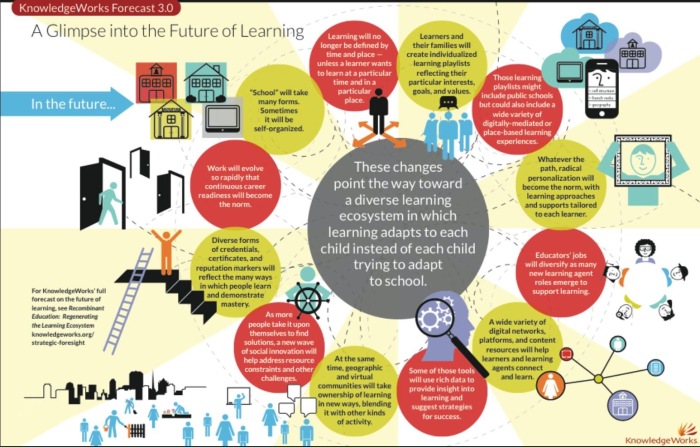
But don’t take my word for it. Here is the learning ecosystems model from the EdTech industry, itself, in corporate officers own words and graphics:

LEARNING IS EARNING – the scariest 6:58 video you’ll ever see.


KNOWLEDGEWORKS Vision for the Future of Education:

IMG_9654

Graphic as a PDF

More on KnowledgeWorks

Listing for PARENTS AS CONSUMERS Symposium

Read all about it here.


FIGHT BACK AGAINST SCHOOL PRIVATIZATION AND RUNAWAY EDTECH:

Like this post? I’ve written a book, “Gadfly on the Wall: A Public School Teacher Speaks Out on Racism and Reform,” now available from Garn Press. Ten percent of the proceeds go to the Badass Teachers Association. Check it out!

WANT A SIGNED COPY?

Click here to order one directly from me to your door!

book-2


It’s NOT Education Reform – It’s School Sabotage

sarah-ji_BOERallyMtg-7CROP-678x381


“Language is a weapon of politicians, but language is a weapon in much of human affairs.”

-Noam Chomsky


“Words are things. You must be careful, careful about calling people out of their names, using racial pejoratives and sexual pejoratives and all that ignorance. Don’t do that. Some day we’ll be able to measure the power of words. I think they are things. They get on the walls. They get in your wallpaper. They get in your rugs, in your upholstery, and your clothes, and finally in to you.”


Maya Angelou


Names matter.


What you call something becomes an intellectual shorthand.


Positive or negative connotations become baked in.


Hence the Colorado Democratic Party’s criticism of Democrats for Education Reform (DFER).


After impassioned debate, delegates demanded DFER remove “Democrat” from their name.


It just makes sense. DFER is a group of hedge fund managers pushing for school privatization – a policy the Colorado Democrats vocally oppose.


In fact, one of the organization’s key founders, hedge fund manager Whitney Tilson, was quoted in the film “A Right Denied,” thusly:

“The real problem, politically, was not the Republican party, it was the Democratic party. So it dawned on us, over the course of six months or a year, that it had to be an inside job. The main obstacle to education reform was moving the Democratic party, and it had to be Democrats who did it, it had to be an inside job. So that was the thesis behind the organization. And the name – and the name was critical – we get a lot of flack for the name. You know, “Why are you Democrats for education reform? That’s very exclusionary. I mean, certainly there are Republicans in favor of education reform.” And we said, “We agree.” In fact, our natural allies, in many cases, are Republicans on this crusade, but the problem is not Republicans. We don’t need to convert the Republican party to our point of view…”


So by a 2/3 vote, the Colorado Democrats passed a motion saying in part:


“We oppose making Colorado’s public schools private, or run by private corporations, or segregated again through lobbying and campaign efforts of the organization called Democrats for Education Reform and demand that they immediately stop using the Party’s name, I.e., “Democrat” in their name.”


To which I say “Hurrah!”


DFER definitely is a misnomer.


However, which is more inaccurate – the term “Democrat” or the word “Reform”?


Members of the nefarious school privatization propaganda squad are, in fact, Democrats.


They have registered as voting members of that political party.


However, they certainly aren’t progressives.


They don’t adhere to the traditional views normally associated with the party.


So the Colorado Dems motion is a positive move toward taking back what it means to be a Democrat. And in that spirit, it should be celebrated and emulated by every state and national party association.


The Democrats have always been a big tent party with lots of different ideas being accepted under that umbrella. But putting corporate profits over student needs does not belong there.


My point is that the larger verbal slight of hand isn’t with the organization’s party affiliation. It’s with the term “Reform,” itself.


DFER is not alone in calling what they advocate “Education Reform.”


My question is this – is what they’re proposing really reform at all?


And if so, what kind of reform is it? Who does it benefit? And what does it conceal?


The word “Reform” has positive associations. It’s always seen as a good.


We always want to be reforming something – turning it from bad to good. Or at very least improving it.


And when it comes to education, this is even more urgent.


No one really wants to be against education REFORM. The only reason to oppose it would be if you thought the way we teach was perfect. Then we would need no reform at all. But this is nearly impossible. Human society does not allow perfection because it is created by human beings, who are, in themselves, far from perfect.


However, the term “Education Reform” does not mean just any kind of change to improve teaching.


It has come to mean a very specific list of changes and policies.


It has come to mean standardization, privatization and profitization.


It means increasing the number, frequency and power of standardized assessments to drive curriculum and teaching – More high stakes tests, more teaching to the test, more evaluating teachers based on student test scores, more school closures based on low test scores.


It means reducing democratic local control of schools, reducing transparency of how public tax dollars are spent while increasing control by appointed boards, and increasing the autonomy of such boards at the expense of accountability to the community actually paying for their work.


It means transforming money that was put aside to educate children into potential profit for those in control. It means the freedom to reduce student services to save money that can then be pocketed by private individuals running the school.


If the goal of education is to teach students, “Education Reform” is not about reforming practices for their benefit. It is not, then, reform.


If the goal is to increase profits for private businesses and corporations, then it truly is reform. It will increase their market share and throw off any extraneous concerns about kids and the efficacy of teaching.


However, this is not the goal of education.


Education is not for the benefit of business. It is not corporate welfare.


Education is essentially about providing positive opportunities for students. It is about providing them with the best learning environment, about hiring the best teachers and empowering them with the skills, pay, protections and autonomy to do their jobs. It’s about providing adequate resources – books, computers, libraries, nurses, tutors, etc. – to learn. It’s about keeping kids safe and secure, well-nourished, and healthy.


In short, it’s about everything bogus “Education Reform” either perverts or ignores.


Calling the things advocated by groups like DFER “Education Reform” is pure propaganda.


We must stop doing that.


Even if we use the term to criticize the practice, we’re helping them do their work.


It’s just like the term “School Choice.”


Despite the name, the reality has nothing to do with providing alternatives to parents and students. It really means school privatization.


It’s about tricking parents and students into allowing businesses to swipe the money put aside to educate children while reducing services.


In short, it’s about increasing choices for charter and voucher school operators – not parents or students.


In that way, it is a more limited version of faux “Education Reform.”


So I propose we stop using these signifiers.


Henceforth, “Education Reform” shall be Education Sabotage – because that’s really what it is.


It is about deliberately obstructing goods and services that otherwise would help kids learn and repurposing them for corporate benefit.


Likewise, I propose we stop using the term “School choice.” Instead, call it what it is – School Privatization.


Anyone who uses the older terms is either misguided or an enemy of authentic education.


Perhaps this seems petty.


They’re only words, after all. What does it matter?


It matters a lot.


As Ludwig Wittgenstein wrote:


“The limits of my language mean the limits of my world.”


We cannot effectively fight the forces of segregation, standardization and privatization if we have to constantly define our terms.


We have to take back the meaning of our language, first. We have to stifle the unconscious propaganda that happens every time someone innocently uses these terms in ways that smuggle in positive connotations to corporatist ends.


To take back our schools, we must first take back our language.


To stop the sabotage, we must first stop repeating their lies.


Like this post? I’ve written a book, “Gadfly on the Wall: A Public School Teacher Speaks Out on Racism and Reform,” now available from Garn Press. Ten percent of the proceeds go to the Badass Teachers Association. Check it out!

book-2

When Students Stay Up All Night Playing Fortnite and You’ve got to Teach Them in the Morning

ne13feb40-ALL-addicted-to-video-games-L13FCA50-51A


There is something monstrously unfair about our teacher evaluation systems.


If your students fail because they were up all night playing video games, it’s your fault.


Seriously.


When students fail at academic tasks, there is no responsibility attributed to the students, no responsibility attributed to the parents and certainly no responsibility given to society.


It’s all just thrown on the teacher because, hey, someone’s got to be responsible. And it might as well be them.


I’ve written scores of articles about how standardized tests forced on students by the federal government are unfair.


They are developmentally inappropriate, culturally biased, and subject to a deep conflict of interest because the people making the tests get more money if test takers fail.


The tests drive the curriculum instead of the other way around. The scores needed to pass change from year-to-year invalidating annual comparisons. And many lawmakers pushing for these assessments are funded by the school privatization industry that uses failing test scores to sell its own fly-by-night brand of education.


These are real problems our education system faces every day.


But we mustn’t forget an even more fundamental one: we’re all responsible for student success or failure.


Not just teachers. EVERYONE.


Society, lawmakers, business people, parents – but those most responsible are the students, themselves.


Case and Point—


Over the last few months a word has entered my students’ vocabulary that hadn’t been there before: Fortnite.


It’s not that they’re so interested in an antiquated term for a two-week period. It’s the name of a popular multiplayer on-line shoot-em-up video game for PlayStation 4, Xbox One, Windows, and Mac. Players build forts with teammates to defend against other players or enemies.


Apparently, many of my students got it for Christmas. Or since there’s a free on-line version, they were turned on to it by others who had gotten the deluxe version as a present.


It started as an undercurrent of trash talk. “You suck at Fortnite.” “You can’t beat me on Fortnite.” “You just wish you could take me on Fortnite.”


And then it started to manifest physically.


Those same kids would come in to school with Fortnite Face – glassy red eyes, heads slumped on the table and the inability to stay awake for more than 10 minutes at a time.


It’s not all of my students, but it’s a significant percentage. Almost all boys. And almost all at a distinct learning disadvantage.


Teaching them is like teaching someone in a deep sea diver suit. They can’t really see or hear you very well. And any message you get back from them sounds like it’s coming from the bottom of the ocean.


When I noticed it, I cleared as much of my schedule as I could to call parents. It’s hard because administration decided not to fill positions in my department for teachers who retired last year – so all our classes are larger. And they gave me a new class I haven’t taught in years so the planning load is more cumbersome.


Plus I have as many special education students as legally allowed in every class, which requires mountains of extra paperwork and monitoring for each child.


And of course the phone in my room doesn’t call out and the cell reception is terrible, so I have to move to one of the few phones that will actually allow me to contact parents and try to communicate my concerns.


Most parents I talked to noticed the same things I had. Fortnite was taking over their children’s lives. Their kids were playing the game at every opportunity and ignoring most everything else.


However, most parents I couldn’t reach. Those cricket burner phones get disconnected quick. Others go straight to a voicemail box that’s so full it won’t accept new messages. Others allow me to leave a message that will never be returned.


But sometimes I did get through. And sometimes parents didn’t simply throw up their hands and say they don’t know what to do. Sometimes a parent actually laid down ground rules or took the game away.


However, if I’m being honest, contacting parents did not solve my problem.


I’m not blaming them. Most of my students live below the poverty line. That means their folks are working two or three jobs just to make ends meet. Or they’re grandparents raising their sons’ or daughters’ kids. Or they’re foster parents with a full house.


They’re doing the best they can. But it doesn’t end up stopping the addiction.


And – let’s be honest – it is an addiction.


For the first time in 2018, the World Health Organization recognized video game addiction as a real thing. Not every video game. Not every time someone sits down to play a video game. But video games can lead to addictive behavior.


That’s what I’m seeing in my students.


So after talking with as many parents as I could, I came to a mostly dead end.


My next step was to try to use student interests to influence instruction.


We were in the middle of a poetry writing unit. So I allowed students to write their poems about Fortnite.


That perked up a few heads.


Here’s a cinquain about Fortnite. Here’s an acrostic, a narrative, a concrete poem in the shape of a soldier or his gun.


To be honest, none of them were masterpieces.


They were just the normal trash talk and braggadocio written down in verse.


So I got an idea. Use the heightened competitive urge to push artistry.


We came to limericks – a difficult but fun type of poetry with five lines, a specific rhyme scheme and meter.


We read funny examples, we sang the rhythm together in chorus – da Dum da da Dum da da Dum – and then I set them the task of writing their own limericks.


With one twist. Whoever wrote the best limerick would get a homework pass.


That got them going like a shot.


All of my Fortniters perked up.


They wrote like I’d never seen.


Each wanted to one-up the others. And no one wrote about the game.


By the end of class, we had some pretty good poems. I wouldn’t say they are the best ever written, but they were miles better than where we were before.


So what does it all mean?


When we talk about video games these days, the conversation usually strays toward violence.


Pundits caution that video games will desensitize children and make them more prone to aggression and acting out. It might even contribute to the creation of school shooters.


Wrong.


In general, video games don’t make children more violent. Fortnite is a game where students shoot each other with guns all night long and it hasn’t made my students any more aggressive or violent than they already were.


Many cultures like the Japanese are much more into video games than ours and they have fewer violent incidents or school shootings.


However, video game addiction is a real thing and it impacts learning.


Some corporations want to try to harness this addiction to push learning. Hence the move to personalized or competency based education. That’s pure rubbish.


It’s a way to monetize education without paying attention to what’s best for kids. The same with gamification – using game theory to drive instruction.


And don’t think I’ve lost sight of my own use of competition in class. I haven’t.


Games and competition can be used to positive ends in moderation.


You can motivate reluctant kids to do things they wouldn’t normally do with competition. But it doesn’t work for everyone and it doesn’t work all the time.


It needs to be a novelty. Any tool can be overused.


Even video games aren’t bad in moderation. I used to be a gamer, myself.


The problem is when it becomes an addiction.


Our social structures can’t handle it.


Game corporations only care if it makes money. Parents are often stressed to the limit just to provide the basics.


The only group we require to be responsible is teachers.


And that’s just not going to work.


Video game addiction is another area where it becomes painfully clear how much work we all need to do to help our children succeed.