Top 10 Reasons You Can’t Fairly Evaluate Teachers on Student Test Scores

Screen Shot 2018-08-02 at 12.49.24 AM


I’m a public school teacher.


Am I any good at my job?


There are many ways to find out. You could look at how hard I work, how many hours I put in. You could look at the kinds of things I do in my classroom and examine if I’m adhering to best practices. You could look at how well I know my students and their families, how well I’m attempting to meet their needs.


Or you could just look at my students’ test scores and give me a passing or failing grade based on whether they pass or fail their assessments.


It’s called Value-Added Measures (VAM) and at one time it was the coming fad in education. However, after numerous studies and lawsuits, the shine is fading from this particularly narrow-minded corporate policy.


Most states that evaluate their teachers using VAM do so because under President Barack Obama they were offered Race to the Top grants and/or waivers.


Now that the government isn’t offering cash incentives, seven states have stopped using VAM and many more have reduced the weight given to these assessments. The new federal K-12 education law – the Every Student Succeeds Act (ESSA) – does not require states to have educator evaluation systems at all. And if a state chooses to enact one, it does not have to use VAM.


That’s a good thing because the evidence is mounting against this controversial policy. An evaluation released in June of 2018 found that a $575 million push by the Bill and Melinda Gates Foundation to make teachers (and thereby students) better through the use of VAM was a complete waste of money.


Meanwhile a teacher fired from the Washington, DC, district because of low VAM scores just won a 9-year legal battle with the district and could be owed hundreds of thousands of dollars in back pay as well as getting his job back.


But putting aside the waste of public tax dollars and the threat of litigation, is VAM a good way to evaluate teachers?


Is it fair to judge educators on their students’ test scores?


Here are the top 10 reasons why the answer is unequivocally negative:


1) VAM was Invented to Assess Cows.

I’m not kidding. The process was created by William L. Sanders, a statistician in the college of business at the University of Knoxville, Tennessee. He thought the same kinds of statistics used to model genetic and reproductive trends among cattle could be used to measure growth among teachers and hold them accountable. You’ve heard of the Tennessee Value-Added Assessment System (TVAAS) or TxVAAS in Texas or PVAAS in Pennsylvania or more generically named EVAAS in states like Ohio, North Carolina, and South Carolina. That’s his work. The problem is that educating children is much more complex than feeding and growing cows. Not only is it insulting to assume otherwise, it’s incredibly naïve.


2) You can’t assess teachers on tests that were made to assess students.

This violates fundamental principles of both statistics and assessment. If you make a test to assess A, you can’t use it to assess B. That’s why many researchers have labeled the process “junk science” – most notably the American Statistical Association in 2014. Put simply, the standardized tests on which VAM estimates are based have always been, and continue to be, developed to assess student achievement and not growth in student achievement nor growth in teacher effectiveness. The tests on which VAM estimates are based were never designed to estimate teachers’ effects. Doing otherwise is like assuming all healthy people go to the best doctors and all sick people go to the bad ones. If I fail a dental screening because I have cavities, that doesn’t mean my dentist is bad at his job. It means I need to brush more and lay off the sugary snacks.


3) There’s No Consistency in the Scores.

Valid assessments produce consistent results. This is why doctors often run the same medical test more than once. If the first try comes up positive for cancer, let’s say, they’re hoping the second time will come up negative. However, if multiple runs of the same test produce the same result, that diagnosis gains credence. Unfortunately, VAM scores are notoriously inconsistent. When you evaluate teachers with the same test (but different students) over multiple years, you often get divergent results. And not just by a little. Teachers who do well one year may do terribly the next. This makes VAM estimates extremely unreliable. Teachers who should be (more or less) consistently effective are being classified in sometimes highly inconsistent ways over time. A teacher classified as “adding value” has a 25 to 50% chance of being classified as “subtracting value” the next year, and vice versa. This can make the probability of a teacher being identified as effective no different than the flip of a coin.


4) Changing the test can change the VAM score.

If you know how to add, it doesn’t matter if you’re asked to solve 2 +2 or 3+ 3. Changing the test shouldn’t have a major impact on the result. If both tests are evaluating the same learning and at the same level of difficulty, changing the test shouldn’t change the result. But when you change the tests used in VAM assessments, scores and rankings can change substantially. Using a different model or a different test often produces a different VAM score. This may indicate a problem with value added measures or with the standardized tests used in conjunction with it. Either way, it makes VAM scores invalid.


5) VAM measures correlation, not causation.

Sometimes A causes B. Sometimes A and B simply occur at the same time. For example, most people in wheelchairs have been in an accident. That doesn’t mean being in a wheelchair causes accidents. The same goes for education. Students who fail a test didn’t learn the material. But that doesn’t mean their teacher didn’t try to teach them. VAM does not measure teacher effectiveness. At best it measures student learning. Effects – positive or negative – attributed to a teacher may actually be caused by other factors that are not captured in the model. For instance, the student may have a learning disability, the student may have been chronically absent or the test, itself, may be an invalid measure of the learning that has taken place.


6) Vam Scores are Based on Flawed Standardized Tests.

When you base teacher evaluations on student tests, at very least the student tests have to be valid. Otherwise, you’ll have unfairly assessed BOTH students AND teachers. Unfortunately standardized tests are narrow, limited indicators of student learning. They leave out a wide range of important knowledge and skills leaving only the easiest-to-measure parts of math and English curriculum. Test scores are not universal, abstract measures of student learning. They greatly depend on a student’s class, race, disability status and knowledge of English. Researchers have been decrying this for decades – standardized tests often measure the life circumstances of the students not how well those students learn – and therefore by extension they cannot assess how well teachers teach.


7) VAM Ignores Too Many Factors.

When a student learns or fails to learn something, there is so much more going on than just a duality between student and teacher. Teachers cannot simply touch students’ heads and magically make learning take place. It is a complex process involving multiple factors some of which are poorly understood by human psychology and neuroscience. There are inordinate amounts of inaccurate or missing data that cannot be easily replaced or disregardedvariables that cannot be statistically controlled for such as: differential summer learning gains and losses, prior teachers’ residual effects, the impact of school policies such as grouping and tracking students, the impact of race and class segregation, etc. When so many variables cannot be accounted for, any measure returned by VAMs remains essentially incomplete.


8) VAM Has Never been Proven to Increase Student Learning or Produce Better Teachers.

That’s the whole purpose behind using VAM. It’s supposed to do these two things but there is zero research to suggest it can do them. You’d think we wouldn’t waste billions of dollars and generations of students on a policy that has never been proven effective. But there you have it. This is a faith-based initiative. It is the pet project of philanthrocapitalists, tech gurus and politicians. There is no research yet which suggests that VAM has ever improved teachers’ instruction or student learning and achievement. This means VAM estimates are typically of no informative, formative, or instructional value.


9) VAM Often Makes Things Worse.

Using these measures has many unintended consequences that adversely affect the learning environment. When you use VAMs for teacher evaluations, you often end up changing the way the tests are viewed and ultimately the school culture, itself. This is actually one of the intents of using VAMs. However, the changes are rarely positive. For example, this often leads to a greater emphasis on test preparation and specific tested content to the exclusion of content that may lead to better long-term learning gains or increasing student motivation. VAM incentivizes teachers to wish for the most advanced students in their classes and to push the struggling students onto someone else so as to maximize their own personal VAM score. Instead of a collaborative environment where everyone works together to help all students learn, VAM fosters a competitive environment where innovation is horded and not shared with the rest of the staff. It increases turnover and job dissatisfaction. Principals stack classes to make sure certain teachers are more likely to get better evaluations or vice versa. Finally, being unfairly evaluated disincentives new teachers to stay in the profession and it discourages the best and the brightest from ever entering the field in the first place. You’ve heard about that “teacher shortage” everyone’s talking about. VAM is a big part of it.


10) An emphasis on VAM overshadows real reforms that actually would help students learn.

Research shows the best way to improve education is system wide reforms – not targeting individual teachers. We need to equitably fund our schools. We can no longer segregate children by class and race and give the majority of the money to the rich white kids while withholding it from the poor brown ones. Students need help dealing with the effects of generational poverty – food security, psychological counseling, academic tutoring, safety initiatives, wide curriculum and anti-poverty programs. A narrow focus on teacher effectiveness dwarfs all these other factors and hides them under the rug. Researchers calculate teacher influence on student test scores at about 14%. Out-of-school factors are the most important. That doesn’t mean teachers are unimportant – they are the most important single factor inside the school building. But we need to realize that outside the school has a greater impact. We must learn to see the whole child and all her relationships –not just the student-teacher dynamic. Until we do so, we will continue to do these children a disservice with corporate privatization scams like VAM which demoralize and destroy the people who dedicate their lives to helping them learn – their teachers.


NOTE: Special thanks to the amazingly detailed research of Audrey Amrein-Beardsley whose Vamboozled Website is THE on-line resource for scholarship about VAM.


Like this post? I’ve written a book, “Gadfly on the Wall: A Public School Teacher Speaks Out on Racism and Reform,” now available from Garn Press. Ten percent of the proceeds go to the Badass Teachers Association. Check it out!

WANT A SIGNED COPY?

Click here to order one directly from me to your door!
book-1

Resistance to High Stakes Testing Persists as Media Celebrates Its End

GettyImages-465529004.0.0


There has never been more opposition to high stakes standardized testing.


Yet the corporate controlled media is pretending that the resistance is over.


Parents are refusing to let their kids take these tests at the same or even greater numbers than ever.


Fewer states require high stakes tests as graduation exams and/or use them to evaluate their teachers. Across the nation, states are cutting the size of standardized tests or eliminating them altogether. And more state legislatures passed laws explicitly allowing parents to opt their children out of the tests.


Yet Education Week published an article a few days ago called “Anti-Test Movement Slows to a Crawl.”


I think we have different definitions of “Slows” and “Crawl.”


That may not be surprising since we also seem to have different definitions of “Anti-Test.”


The Opt Out Movement is not “Anti-Test.” It is anti-high stakes standardized test.


It is against the federal government forcing states to use corporate written, corporate graded and corporate remediated standardized assessments.


It is against the federal government requiring each state to participate in a corporate boondoggle that not only wastes billions of tax dollars that could be better spent to educate children but also unfairly assesses their academic progress and feeds the push to privatize public schools.


Most people against high stakes standardized testing, however, have no problem with authentic teacher-created assessments.


Calling these folks “Anti-Test” is like labeling those pushing for stricter gun regulations “Anti-Gun” or smearing those protesting government corruption as “Anti-Government.”


And that’s just the title!


The author Alyson Klein further misdirects readers by conflating opt out rates and test resistance.


She implied that the only measure of opposition was the percentage of students who opt out. However, as noted above, there are multiple measures of resistance.


Moreover, few states advertise their opt out rates. Especially after the movement began, states made that information harder to come by to dissuade more people from joining it.


Of those states where information is available, Klein puts the most negative possible spin on the facts in order to make her point – a point that it seems to me is not at all justified.


For instance, Klein writes:


“At least some of the steam has gone out of the opt-out movement in states such as New Jersey and New York, considered hotbeds of anti-testing fervor.”


Really?


In New York, Opt out numbers remained at approximately 20% – the same as they have for the past three years.


And New York is one of our most densely populated states. That percentage represents more than 225,000 parents across the Empire State who refused to let their children take the tests despite threats from many administrators and district officials for doing so.


In New Jersey, opt out rates were marginally lower this year than last year. They went from 7% to 5%. But once again New Jersey is a populous state. That percentage represents about 68,500 students.


In addition, this is after massive opt outs three years ago that forced the state to change its federally mandated assessment. Testing boycotts pushed the state education association to get rid of four PARCC assessments and allow students who fail the remaining two tests to take an alternative assessment. And this is in a state where there is no law explicitly allowing parents to opt out of the tests.


I don’t know if I’d call that running out of steam.


Moreover, opt out rates have increased in other states for which we have data. For instance, test refusal is on the rise in heartland states like Minnesota.


And it nearly doubled in Utah over the past two years to about 6%. In some schools in the Beehive State, rates are much higher. According to the Salt Lake Tribune, 1 in 5 students in the Park City school district refused to take the tests.


Though my own state of Pennsylvania has been mum on last year’s opt outs, from my own personal experience as a teacher in suburban Pittsburgh, I never had more students boycott our federally mandated standardized test than I did last year.


There were so many they had to be quarantined in a special room.


Moreover, an increasing number of parents ask me about the issue, express concern and wonder about their rights.


So even when examining just the rate of opt out, I don’t see any reason to assume the movement is slowing down.


On the contrary, it is picking up steam with multiple victories.


As recently as 2012, half of all U.S. states required high school exit exams in order for students to graduate. Today that number has dropped to 12. The reason? Exit exams don’t raise student achievement – they raise the dropout rate. At least that’s what The National Research Council of the National Academy of Sciences tells us.


Another positive sign – seven states have stopped using value added measures (VAM) to judge teachers. This is the highly controversial practice of assessing educators based on their students test scores – a practice that has never been proven fair to teachers or effective in helping students learn. Six states have dropped this requirement altogether: Alaska, Arkansas, Kansas, Kentucky, North Carolina and Oklahoma. Connecticut still gathers the information but cannot use it in the teacher’s “summative rating.” And other states like New Mexico still use value added measures but have reduced the weight given to student test scores.


Moreover, let’s not forget how many states have slashed the size of the high stakes tests they’re giving to students. After the recent wave of opt outs and public outcry, state education departments have ensured that testing at least takes up less time. This includes New York, Maryland, New Mexico, California, Minnesota, Kentucky, Tennessee, Florida, Washington, Illinois, West Virginia, Hawaii, Oklahoma, Ohio, South Carolina, Pennsylvania and Texas. Some of this is because the PARCC test used in 21 states was slashed by 90 minutes.


And when it comes to opt out, two more states – Idaho and North Dakota – now have explicit laws on the books allowing parents to refuse the test for their children – in whole or in part. That brings the total number of states up to 10. It would have been 11, but Georgia Governor Nathan Deal, a Republican, vetoed an opt-out bill. The federal government still wants us to penalize these districts for non-participation in flagrant violation of its authority. But as more states respect parents’ rights on this matter, it will be increasingly difficult for the U.S. Department of Education to continue trampling them.


And speaking of the federal government, some states are taking advantage of the wiggle room in the federal law that governs K-12 education – the newly passed Every Student Succeeds Act (ESSA) – to allow students to avoid standardized testing entirely. Some states are implementation performance assessments instead. Kids can use a portfolio of classwork to demonstrate learning instead of getting a grade on a corporate-written standardized test. New Hampshire, for instance, has pioneered this approach with a program that now involves half the state’s districts.


These are not the signs of a movement that is slowing to a crawl.


It just makes sense that some of the rhetoric of the movement may have become less forceful with the enactment of the federal ESSA.


Many had hoped for a better law – one that did away with federally mandated testing altogether.


And that could still happen sooner than many think. Next year it will be time to reauthorize the law again.


It took Congress six years to reauthorize the federal education law last time. Perhaps our duly elected representatives can be coaxed into doing their jobs a bit quicker this time.


There is already some proposed legislation to make positive changes. Sen. Jon Tester (D-Mont.) and Rep. Krysten Sinema (D-Ariz.) introduced legislation last year to replace annual assessments with grade-span tests. The United States is, after all, one of the only countries in the world – if not the only one – to require students be tested every year. These proposed changes are not nearly enough, but they’re a step in the right direction.


One of the biggest obstacles to abolishing federally mandated testing last time was that some of the oldest and most well funded civil rights organizations opposed it. Many of them get their money and support from the same billionaires who profit off of the standardized testing and privatization industries.


However, that support for testing was short lived. Already the National Association for the Advancement of Colored People (NAACP) has revoked it returning to a call for opposition to testing.


If our nation survives the many crises of the Donald Trump administration, there is no reason our future cannot be bright.


We have the support, we have the tools, we just need the chance to do right by our children.


And the pendulum is swinging back our way.


Like this post? I’ve written a book, “Gadfly on the Wall: A Public School Teacher Speaks Out on Racism and Reform,” now available from Garn Press. Ten percent of the proceeds go to the Badass Teachers Association. Check it out!

WANT A SIGNED COPY?

Click here to order one directly from me to your door!
book-3

Thank You, Wealthy Robber Barons, for the Freedom to be a Free Rider!


wealhty-myths-business-man_large


Wow! I now have a real choice when it comes to my union!


At least, that’s what the email I got from the Mackinac Center says!


Now that the Supreme Court ruled 5-4 in the Janus vs. AFSCME case, I don’t have to pay any of my hard earned cash to my union!


I can be a free rider! I can get all the advantages of belonging to a union – higher salary, better benefits, better safety precautions – and I can leave it to the rest of the membership to pay for me!


That’s amazing!


And what’s even more amazing is who is sending this email to me!


I mean the Mackinac Center is funded by Betsy DeVos and her family, the Koch Brothers, Eli Broad, the Scaifes, and the Walton family!


Who would have ever thought some of the richest people in the world would take an interest in my union membership!?


How nice of them!


I’m merely a public school teacher! In my more than a decade in the classroom, they’ve spent billions of dollars to weaken my profession!


They lobbied for education funding nationwide to be gutted so they could get another tax cut!


They invested in charter and voucher schools and then demanded we build more of these privatized institutions with little to no accountability so they could rake in record profits!


They’ve weakened education at schools serving the highest populations of students of color and then benefited when those same kids turned to crime and were incarcerated in their private prisons!


Instead of holding politicians accountable for inequitable funding and instead of supporting teacher autonomy, they forced high stakes standardized testing and Common Core on me and my students!


They demanded my administrators undervalue what I actually do in the classroom but instead evaluate me based on my student test scores – so being given struggling students means I’m somehow a worse teacher than the person across the hall with the honors class!


They did all that but suddenly they’re concerned about my freedom to withhold union dues!?


Well Golly!


Jeepers!


Gee Willikers!


Goodness gracious and bless my soul!


I must have been wrong about these fellers and these ladies all along!


They really DO care about little people like me!


Did you know that a 2011 study by researchers at Harvard and the University of Washington concluded that higher union membership encourages higher pay across the economy!?


It’s true!


They said the decline of unions accounts for as much as one-third of the increase in wage inequality since the 1970s!


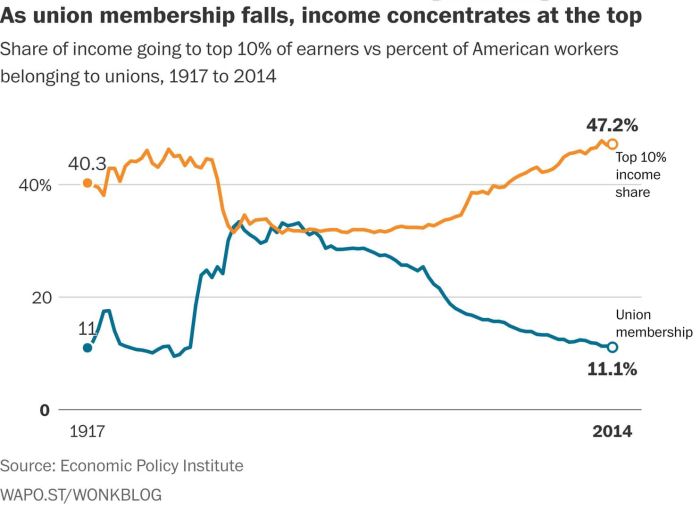
According to the Economic Policy Institute, when union membership goes down, the wealthy make more money! Conversely, the more union membership goes up, the less money goes to the wealthy!


6BILJESJ744BVLL2QVZYGJRNCM


And despite all that, the rich are concerned that I have the right to stop paying union dues!


I mean if I stop paying my dues and my fellow working stiffs stop paying their dues, then my union might just have to close up shop!


And that would mean my wages would go down!


But these same rich people who just sent me an email would see their investments go up!


They’d take home sacks of cash! So much money that they’d probably drop some and maybe I might be able to pick up a few pennies they leave on the curb!


Isn’t that great!?


You know public sector employees including firefighters and police, and teachers like me are the largest sector left of the workforce still represented by unions!


According to BLS statistics, 38 percent of public sector employees are represented by unions!


It’s true!


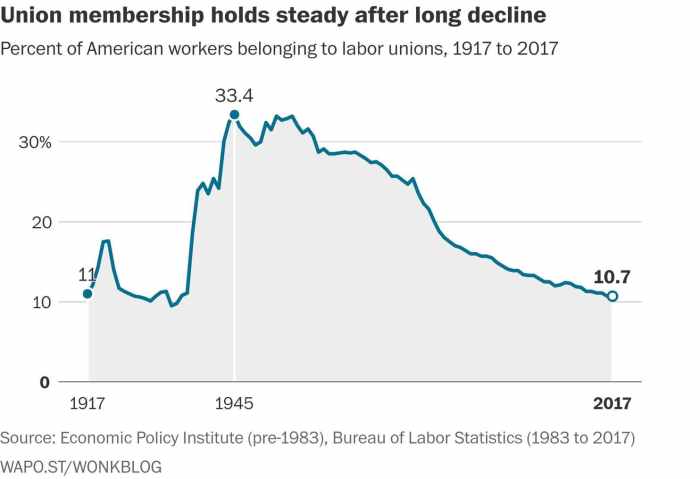
Back in 1945, union membership nationwide was at its highest rate of 33.4%! That means back then about a third of all American workers belonged to a union!


Last year it was down to 10.7 percent!


YC4GHPZ5MI5DHNQVM2TN4E4JZI


In the intervening years, manufacturing jobs have declined, blue collar jobs have been outsourced and both political parties have passed laws making it harder to unionize and collectively bargain!


But thank goodness I now have the right to get something for nothing from my union!


That’s going to perk things right up!


Sure, numerous studies have shown that declining union membership is one of the major causes why middle class wages have remained basically flat! But I get to keep a hundred bucks in my pocket so everything’s square!


One thing worries me, though!


I’m not sure many union workers are going to take advantage of this new freedom!


Don’t get me wrong – I don’t agree with everything my union does! No one could say that!


I don’t agree with everything my government does, either, but I still pay taxes!


And I wouldn’t stop paying taxes even if I could! I like being an American citizen, and I like much of what my government provides by way of our military, infrastructure and social programs!


It’s the same with my union!


I mean I LIKE earning higher wages! I LIKE getting better benefits! I LIKE knowing I work in a safe environment!


And when I have a better working environment, my students have a better learning environment!


I doubt many of my co-workers are going to stop paying their dues just because they can!


UWLMMCVEKY3ZFDE5K6LGDY42PE


We’re not stupid! We know that if you want union benefits, you have to pay union dues! The Supreme Court can say whatever it likes! It can’t legislate passed reality!


Moreover, who would want to associate with a co-worker who refuses to pull his or her own weight!?


If I found out one of my colleagues was leaving it to me to pay for both of us, I’d throw a fit! I wouldn’t associate with that person!


If he or she came to my room asking for advice, I’d tell them to get lost! I wouldn’t eat with them at lunch, I wouldn’t chat about their day, I’d give them their walking papers, myself!


Frankly, the social cost would be higher than just paying your union dues!


So thanks anyway, Mackinac Center! Thanks anyway, Charles and David Koch! Thanks anyway, Betsy DeVos!


I’m sticking with my union.


36468177_10156001729458860_2645036208874323968_n


Like this post? I’ve written a book, “Gadfly on the Wall: A Public School Teacher Speaks Out on Racism and Reform,” now available from Garn Press. Ten percent of the proceeds go to the Badass Teachers Association. Check it out!

WANT A SIGNED COPY?

Click here to order one directly from me to your door!

 

book-2


Modernizing Education Starts With Questioning Our Assumptions

iStock_000040220958_Small-685x485


When it comes to education, we take an awful lot for granted.


For example, we look at learning almost entirely from a behavioral standpoint.


Teachers provide inputs. Students give outputs. And those outputs demonstrate the intended learning.


Yet this framework was developed in the early 1900s. Using it today is to ignore a century of subsequent psychological advancements. It glosses over the impact of the unconscious, the social nature of understanding, physical differences, even the mediating thought processes between stimulus and response such as memory and problem solving.


Instead, we force students into inauthentic laboratory conditions (i.e. the classroom) upon which they are passive actors to be molded and shaped by expert educators.


Every time we post our learning objectives on the board or when we write our lesson plans beginning with the old chestnut – Students Will Be Able To (SWBAT) – we are hearkening back to early 20th Century thinking a hundred years out of date.


We are enshrining a host of assumptions long past their fresh by date:

-Learning is observable.


-It happens immediately.


-It is measurable.


-Once you learn something it never goes away.


-Most problems with learning are attributable to inputs provided by the teacher.


None of these assumptions have been proven.


In fact, there is considerable evidence against each and every one of these premises, yet our entire system of corporate education is based on them like a house built on a foundation.


If we are truly to create a 21st Century school system, the only place to begin is here. Recognize our bedrock beliefs are mere speculation and question whether we should really support everything else that’s been built on such shaky ground.


WHAT IS LEARNING?


It is an empirical fact that human beings are capable of learning. It’s something we do every day. But what exactly does it consist of? What happens when a person learns?


Perhaps it’s best to start with a definition. We generally characterize learning as the acquisition of knowledge; the possession of facts, information or skills.


But how does one gain knowledge? How does one possess the intangible?


It seems that learning always involves thoughts – usually conscious impressions but sometimes unconscious ones, as well. However, not all thoughts qualify, only thoughts of a certain kind.


The notion must be true of the world. And often it is an idea that has surfaced before but that now can be recalled at will and used to create new concepts.


Perhaps I’m wrong, but it seems that no matter how you flesh it out, we’re talking about internal mind states.


Learning takes place in and of the brain. And this has consequences for our education system – an apparatus designed to make these brain states more frequent along certain prescribed lines.


IS LEARNING OBSERVABLE?


That depends. Can we lop off the top of students’ heads and peer at the gelatinous mass inside?


Not really. And even if we could, we wouldn’t understand what we were seeing.


Even if learning may be reducible to a complex set of on-and-off switches among synapses, that does not make it generally observable – certainly not without greater knowledge of how the brain works and advanced neural imaging equipment.


As such, the idea that learning is directly perceptible is not necessarily true. It may be evident in some second hand manner, but this is not the same as first hand experience. At best, what we see is a pale shadow of what’s actually going on in students’ gray matter.


That alone should send shock waves through the edifice of modern corporate education. We’ve built an entire apparatus to label and sort kids based on observing students. If those observations are inadequate to give us the full picture of these internal learning states, our system is likewise inadequate.

WHAT IS THE ROLE OF TEACHER INPUT?


To answer this question we must start further back – when and why does learning takes place.


A student experiences a new neural state that constitutes the acquisition of knowledge. Why?


Does it happen because of the input made by a teacher? Is it the result of experience? Is it the result of some other input – reading, interacting, writing, doing something? Or is it the result of something even the student him- or herself cannot easily identify or explain?


All of these are possible. All of these (and more) are the catalyst to learning at various times.


Thus we lose another premise – that teacher input is the essential cause of inadequate learning. If we cannot place a primacy on the teacher, we cannot wholly place blame there either.


Certainly teachers are important. They can have a tremendous impact on their students. But they are not strictly necessary. They are not even the prime cause of learning. They facilitate learning in the way a doctor facilitates healing. The surgeon may set the broken bone, but it is the body that actually does the healing. And in the case of learning, the action is not entirely involuntary. It is much more active and intentional.


In short, teachers can call students attention to something that sparks learning. They can bring about optimal conditions for learning to take place. But they are not by themselves sufficient for that learning. They cannot make it happen. Insofar as it is voluntary at all, it is up to the student. To give teachers sole reward or blame for student learning is absurd.


IS LEARNING IMMEDIATE?


Learning may be a response to stimulus of some kind. But when does that response take place? Is it immediate?


There is no evidence that it must be so. Certainly there are times when one has learned something immediately. When a child first puts her finger in the flame, she quickly learns to remove it. However, there are some lessons that we don’t learn until many years after that stimulus. For instance, that our parents’ advice was often more sage than we initially gave it credit.


Thus, again it is inadequate to place reward or blame on teachers for their students’ learning. You can judge a teacher for what he or she did to help, but not what you take to be the result. Just because the teacher’s input may not have sparked learning in the student now, that doesn’t mean that the same input might not engender learning at a later date, given time.


IS LEARNING PERMANENT?


Which brings up another question – once you learn something, does it remain yours forever or is it susceptible to degradation?


If learning is an internal state – if it is the result of neural connections like any thought or memory – it is susceptible to fading. It can be lost or degraded.


Therefore, when students enter a class without prerequisite knowledge, it is not necessarily the fault of their previous teachers. Like any skill, memory or thought – recall is enhanced through repetition. Using the knowledge often results in greater retention.


If we want a more intellectual society, we should habitualize critical thinking and reward intelligence in our public interactions. Not the exact opposite.


CAN LEARNING BE MEASURED?


And finally, we are brought to perhaps the most vital question in the field of education – measurement.


What did students grasp and to what degree was it mastered?


There is an entire industry based on providing accurate accounting of learning.


There are corporations making billions of dollars based on providing this service. Moreover, the school privatization industry is almost completely predicated on the “failure” of public schools as shown by the measurements of these testing corporations.


As such, there is a tremendous amount of economic pressure to keep this premise that learning can be accurately measured. However, when looked at logically, it cannot be supported.


When we measure learning, what are we measuring? And how are we quantifying it?


If learning is an internal state, how do we calculate that? Possibly at some point in the future, we’ll be able to look at real time pictures of the brain and be able to tell which information has been learned and to what degree. But we are not at that point now. Perhaps we will never be.


Even if we were, what exactly would we be measuring? What units would we be using? Volts? Amps? Some new element susceptible to subdivision?


The fact that we can’t give a definitive answer to that simple question illustrates how vast our ignorance is of learning. We do not understand what goes on in our own heads that constitutes understanding expect in the broadest possible terms.


Yet how much importance we put on these crude attempts to measure the ineffable!


Grades and test scores are but the rudest approximations of the real phenomena hidden inside our skulls. Yet we sort and rank students on the pedagogical equivalent of cave paintings.


“It is easier to measure the number of semicolons used correctly in an essay than the wonderful ideas contained within it,” said Alfie Kohn. “The more focused you are on measurable outcomes, the more trivial your teaching tends to become.”


Or as Linda McNeil of Rice University famously observed, “Measurable outcomes may be the least significant results of learning.”


Kohn has repeatedly suggested that McNeil’s statement ought to be printed out in “36-point Helvetica, framed, and tacked to the wall of every school administrator’s office in the country” for these same reasons.


When we talk about knowledge and learning, we don’t know what we’re talking about.


CONSEQUENCES


That should make us reluctant to say anything definitive about learning beyond our own ignorance of it.


Yet, as in so much of human affairs, when has ignorance ever stopped us?


We have to go about the business of educating. We have a society to run, markets to establish and consumers to exploit.


Imagine if, instead, we approached learning like explorers or scientists, mapping the shores of our ignorance and determining what helps us comprehend more and better.


There are so many tantalizing clues about what helps students learn, ways to foster the spark of inspiration, creativity and critical thinking.


I wish we were invested in that activity instead of a capitalist sham of education. We talk much about the skills gap between white and black kids without doing anything constructive about it – a chasm predicated on the fact that one category is predominantly poor and the other privileged.


Perhaps we would do better to talk about the ignorance gap of our own understanding of what it means to understand.


Perhaps then we wouldn’t be so bold as to monetize that which is fallacious and foolhardy.


Perhaps then we would be more curious, thoughtful and kind.


Perhaps then we could build a truly modern system of education that values students and not just how they can be transformed into profit.


Like this post? I’ve written a book, “Gadfly on the Wall: A Public School Teacher Speaks Out on Racism and Reform,” now available from Garn Press. Ten percent of the proceeds go to the Badass Teachers Association. Check it out!

WANT A SIGNED COPY?

Click here to order one directly from me to your door!

book-2

It’s NOT Education Reform – It’s School Sabotage

sarah-ji_BOERallyMtg-7CROP-678x381


“Language is a weapon of politicians, but language is a weapon in much of human affairs.”

-Noam Chomsky


“Words are things. You must be careful, careful about calling people out of their names, using racial pejoratives and sexual pejoratives and all that ignorance. Don’t do that. Some day we’ll be able to measure the power of words. I think they are things. They get on the walls. They get in your wallpaper. They get in your rugs, in your upholstery, and your clothes, and finally in to you.”


Maya Angelou


Names matter.


What you call something becomes an intellectual shorthand.


Positive or negative connotations become baked in.


Hence the Colorado Democratic Party’s criticism of Democrats for Education Reform (DFER).


After impassioned debate, delegates demanded DFER remove “Democrat” from their name.


It just makes sense. DFER is a group of hedge fund managers pushing for school privatization – a policy the Colorado Democrats vocally oppose.


In fact, one of the organization’s key founders, hedge fund manager Whitney Tilson, was quoted in the film “A Right Denied,” thusly:

“The real problem, politically, was not the Republican party, it was the Democratic party. So it dawned on us, over the course of six months or a year, that it had to be an inside job. The main obstacle to education reform was moving the Democratic party, and it had to be Democrats who did it, it had to be an inside job. So that was the thesis behind the organization. And the name – and the name was critical – we get a lot of flack for the name. You know, “Why are you Democrats for education reform? That’s very exclusionary. I mean, certainly there are Republicans in favor of education reform.” And we said, “We agree.” In fact, our natural allies, in many cases, are Republicans on this crusade, but the problem is not Republicans. We don’t need to convert the Republican party to our point of view…”


So by a 2/3 vote, the Colorado Democrats passed a motion saying in part:


“We oppose making Colorado’s public schools private, or run by private corporations, or segregated again through lobbying and campaign efforts of the organization called Democrats for Education Reform and demand that they immediately stop using the Party’s name, I.e., “Democrat” in their name.”


To which I say “Hurrah!”


DFER definitely is a misnomer.


However, which is more inaccurate – the term “Democrat” or the word “Reform”?


Members of the nefarious school privatization propaganda squad are, in fact, Democrats.


They have registered as voting members of that political party.


However, they certainly aren’t progressives.


They don’t adhere to the traditional views normally associated with the party.


So the Colorado Dems motion is a positive move toward taking back what it means to be a Democrat. And in that spirit, it should be celebrated and emulated by every state and national party association.


The Democrats have always been a big tent party with lots of different ideas being accepted under that umbrella. But putting corporate profits over student needs does not belong there.


My point is that the larger verbal slight of hand isn’t with the organization’s party affiliation. It’s with the term “Reform,” itself.


DFER is not alone in calling what they advocate “Education Reform.”


My question is this – is what they’re proposing really reform at all?


And if so, what kind of reform is it? Who does it benefit? And what does it conceal?


The word “Reform” has positive associations. It’s always seen as a good.


We always want to be reforming something – turning it from bad to good. Or at very least improving it.


And when it comes to education, this is even more urgent.


No one really wants to be against education REFORM. The only reason to oppose it would be if you thought the way we teach was perfect. Then we would need no reform at all. But this is nearly impossible. Human society does not allow perfection because it is created by human beings, who are, in themselves, far from perfect.


However, the term “Education Reform” does not mean just any kind of change to improve teaching.


It has come to mean a very specific list of changes and policies.


It has come to mean standardization, privatization and profitization.


It means increasing the number, frequency and power of standardized assessments to drive curriculum and teaching – More high stakes tests, more teaching to the test, more evaluating teachers based on student test scores, more school closures based on low test scores.


It means reducing democratic local control of schools, reducing transparency of how public tax dollars are spent while increasing control by appointed boards, and increasing the autonomy of such boards at the expense of accountability to the community actually paying for their work.


It means transforming money that was put aside to educate children into potential profit for those in control. It means the freedom to reduce student services to save money that can then be pocketed by private individuals running the school.


If the goal of education is to teach students, “Education Reform” is not about reforming practices for their benefit. It is not, then, reform.


If the goal is to increase profits for private businesses and corporations, then it truly is reform. It will increase their market share and throw off any extraneous concerns about kids and the efficacy of teaching.


However, this is not the goal of education.


Education is not for the benefit of business. It is not corporate welfare.


Education is essentially about providing positive opportunities for students. It is about providing them with the best learning environment, about hiring the best teachers and empowering them with the skills, pay, protections and autonomy to do their jobs. It’s about providing adequate resources – books, computers, libraries, nurses, tutors, etc. – to learn. It’s about keeping kids safe and secure, well-nourished, and healthy.


In short, it’s about everything bogus “Education Reform” either perverts or ignores.


Calling the things advocated by groups like DFER “Education Reform” is pure propaganda.


We must stop doing that.


Even if we use the term to criticize the practice, we’re helping them do their work.


It’s just like the term “School Choice.”


Despite the name, the reality has nothing to do with providing alternatives to parents and students. It really means school privatization.


It’s about tricking parents and students into allowing businesses to swipe the money put aside to educate children while reducing services.


In short, it’s about increasing choices for charter and voucher school operators – not parents or students.


In that way, it is a more limited version of faux “Education Reform.”


So I propose we stop using these signifiers.


Henceforth, “Education Reform” shall be Education Sabotage – because that’s really what it is.


It is about deliberately obstructing goods and services that otherwise would help kids learn and repurposing them for corporate benefit.


Likewise, I propose we stop using the term “School choice.” Instead, call it what it is – School Privatization.


Anyone who uses the older terms is either misguided or an enemy of authentic education.


Perhaps this seems petty.


They’re only words, after all. What does it matter?


It matters a lot.


As Ludwig Wittgenstein wrote:


“The limits of my language mean the limits of my world.”


We cannot effectively fight the forces of segregation, standardization and privatization if we have to constantly define our terms.


We have to take back the meaning of our language, first. We have to stifle the unconscious propaganda that happens every time someone innocently uses these terms in ways that smuggle in positive connotations to corporatist ends.


To take back our schools, we must first take back our language.


To stop the sabotage, we must first stop repeating their lies.


Like this post? I’ve written a book, “Gadfly on the Wall: A Public School Teacher Speaks Out on Racism and Reform,” now available from Garn Press. Ten percent of the proceeds go to the Badass Teachers Association. Check it out!

book-2

Would Democrats Really Do Better Than Betsy DeVos on Education?

Screen Shot 2018-03-28 at 4.32.52 PM


Everybody hates Betsy DeVos.


As Donald Trump’s Secretary of Education, she’s ignorant, unqualified and insincere.


But would the Democrats really do much better if they had control of the Executive Branch?


The Center for American Progress (CAP), a left leaning think tank, wants you to believe that they would.


The organization founded by John Podesta and deeply tied to both the Clinton and Obama administrations has come out with a list of seven policy goals if Democrats take back the House and/or Senate in the midterm elections this November.


On the face of it, many of these goals are smart and worthy ends to pursue.


But this is the Center for American Progress, after all! These are the same people who pushed charter schools down our throats, the same people who never met a standardized test they didn’t love, the same people who think Teach for America temps are just as good – if not better – than fully licensed, fully trained teachers with 4 or 5 year education degrees.


Frankly, I don’t trust a thing they say.


The last two Democratic administrations pushed almost the same education policies as the last three Republican ones. They often use different rhetoric and pretend to dislike policies that BOTH parties have championed for decades.


So when an organization with a history like CAP offers school policy proposals – even if they’re innocuous on the surface – a closer look often reveals something disturbing hiding just under the skin.


In any case, it’s worth taking a look at this new report to examine what’s helpful in these think tank proposals and in what ways they might hide dangers for students, teachers, parents and society.


THE BAD


Screen Shot 2018-03-29 at 1.45.45 PM


CAP proposes we:


  1. Provide a tutor for all students who are below grade level:


This includes both academic and emotional support. And it sounds great! Imagine what struggling students could do with more one-on-one help!


However, according to the report, CAP’s major problem with previous tutoring initiatives like those provided under the No Child Left Behind Act was that they weren’t “high-quality.” Moreover, “tutoring could grow at the local level, helped along by things like an AmeriCorps expansion.”


Oh great! “high-quality” is often used by think tanks as a euphemism for standardized testing. And AmeriCorp has helped push more Teach for America temps into positions that should be held by teaching professionals.


I would love for struggling students to have extra help, but this sounds too much like sending Teach for America to give poor and minority students test prep and skill drills for hours and hours after school.


2) Go to a 9-to-5 school day:


Child psychologists have been suggesting we start school later in the day for at least a decade to better suit growing bodies and brains. Students would be able to get more sleep and come to school more rested and ready to learn. It would also help parents if students didn’t get out of school up to two hours before most adults are home.


In addition, CAP is cognizant that this would have to be a local decision – it couldn’t be handed down at the federal level. They suggest encouraging the move with more Title I funding and other sweeteners.


However, this ignores the fact that U.S. kids already spend more time in class than their international peers. Few countries make their children suffer through an 8-hour day. In Finland, for example, where kids start later and are released earlier than U.S. children, students get a 15-minute break for every 45 minutes of class work.


This suggestion, coming as it does from test-obsessed partisans, could be just another way to try to increase the amount of work piled on students in order to raise test scores. I advise caution.


3) Pay teachers more


I’m certainly not against this one. CAP notes that teachers only take home about 60 percent of the salaries that employees with similar levels of education earn. They suggest a base salary of $50,000 – up from the current average of $38,000 for incoming educators.


“More-experienced educators with a track record of success should make at least $100,000,” the report suggests (emphasis mine). And THAT’S where I start to feel queasy. What exactly do they mean “track record of success”? Well, this is CAP, so that probably means teachers whose students score well on standardized tests.


So I’m guessing it’s a back door merit pay policy. In other words, they want to offer more money to teachers who clobber their students with the test prep club so they’ll magically score Advanced on high stakes tests. This is yet another attempt to bribe educators to narrow the curriculum, avoid collaboration and sideline students who don’t traditionally score well on these kinds of assessments – the poor and minorities.


I want a raise, believe me. I DESERVE a raise! But not if you’re going to make me sign a Faustian bargain first.


THE GOOD


Screen Shot 2018-03-29 at 1.46.06 PM


CAP proposes we:


4) Offer free breakfast and lunch to all students, no matter what their parents income:


We have this at both my daughter’s school and the district where I teach in western Pennsylvania. It is a tremendous success. Making it a nationwide initiative is an excellent idea.


It’s hard to argue with this, even if the main justification is that better nutrition will lead to better academic outcomes (read: test scores). Plus this removes the stigma of a free meal because all students receive it, and once initiated it would be harder to take away.


5) Provide more opportunity for students going to college to get technical workplace experience:


Students should be able to get real world experience to help them decide if certain careers are for them. I’m struggling to see a downside.


6) Hire more social workers, counselors and school psychologists:


Heck to the yeah. I see no downside there.


 7) Initiate a national infrastructure program to fix crumbling school facilities:


It’s about time! Schools in impoverished neighborhoods are falling apart. We need to bring them up to the same level as those in the upper middle class and wealthy communities. Obviously, we’ll need to audit these programs and make sure money isn’t being wasted or embezzled, but this is a worthy goal well past due.


AND THE OTHER SHOE DROPS


shoe_drop_small


And that’s it.


Not a bad list, over all.


I do have some reservations as noted above. However, many of these proposals would be really positive…


…until the other shoe drops.


Queue Lisette Partelow, CAP’s director of K-12 Strategic Initiatives and the lead author of the report. Pay careful attention to her remarks about the report in Education Week.


The think tank doesn’t expect these policies to be introduced or enacted anytime soon, she says. And even if they were, Partelow understands they would probably go under significant legislative changes before becoming law.


“We’re really excited about this as a counter balance, as an answer to the ideas we’re seeing put forward by [U.S. Secretary of Education] Betsy DeVos and the Trump administration,” Partelow says.


So THAT’S their game!


CAP is playing the long con here. They are putting forward a bunch of puppy dog and teddy bear proposals to contrast with Trump and DeVos.


These aren’t policies as much as they are advertisements for the Democratic party. It’s the equivalent of saying, “We promise we’ll do good things like THESE if you elect Democrats – despite the fact that we mainly focused on standardization and privatization when we were in power.”


Look. Maybe I’m being too cynical.


Maybe the Democrats really, really are going to do a better job this time, cross their hearts and hope to die, if we give them just one more chance.


But words aren’t nearly enough.


I like many of these policy suggestions. But I just don’t trust the Democrats.


The brand has been tainted for me by the Clinton and Obama administrations – by leadership from the same people who are making these suggestions.


In short – I’ll believe it when I see it.


Perhaps the greatest lesson organizations like CAP have taught is not to trust organizations like CAP and the faux progressives they’re selling.

6a00d8341d368753ef01b8d2bc84a9970c

For more, Read CAP’s Full report: HERE.


Like this post? I’ve written a book, “Gadfly on the Wall: A Public School Teacher Speaks Out on Racism and Reform,” now available from Garn Press. Ten percent of the proceeds go to the Badass Teachers Association. Check it out!

book-3

When Students Stay Up All Night Playing Fortnite and You’ve got to Teach Them in the Morning

ne13feb40-ALL-addicted-to-video-games-L13FCA50-51A


There is something monstrously unfair about our teacher evaluation systems.


If your students fail because they were up all night playing video games, it’s your fault.


Seriously.


When students fail at academic tasks, there is no responsibility attributed to the students, no responsibility attributed to the parents and certainly no responsibility given to society.


It’s all just thrown on the teacher because, hey, someone’s got to be responsible. And it might as well be them.


I’ve written scores of articles about how standardized tests forced on students by the federal government are unfair.


They are developmentally inappropriate, culturally biased, and subject to a deep conflict of interest because the people making the tests get more money if test takers fail.


The tests drive the curriculum instead of the other way around. The scores needed to pass change from year-to-year invalidating annual comparisons. And many lawmakers pushing for these assessments are funded by the school privatization industry that uses failing test scores to sell its own fly-by-night brand of education.


These are real problems our education system faces every day.


But we mustn’t forget an even more fundamental one: we’re all responsible for student success or failure.


Not just teachers. EVERYONE.


Society, lawmakers, business people, parents – but those most responsible are the students, themselves.


Case and Point—


Over the last few months a word has entered my students’ vocabulary that hadn’t been there before: Fortnite.


It’s not that they’re so interested in an antiquated term for a two-week period. It’s the name of a popular multiplayer on-line shoot-em-up video game for PlayStation 4, Xbox One, Windows, and Mac. Players build forts with teammates to defend against other players or enemies.


Apparently, many of my students got it for Christmas. Or since there’s a free on-line version, they were turned on to it by others who had gotten the deluxe version as a present.


It started as an undercurrent of trash talk. “You suck at Fortnite.” “You can’t beat me on Fortnite.” “You just wish you could take me on Fortnite.”


And then it started to manifest physically.


Those same kids would come in to school with Fortnite Face – glassy red eyes, heads slumped on the table and the inability to stay awake for more than 10 minutes at a time.


It’s not all of my students, but it’s a significant percentage. Almost all boys. And almost all at a distinct learning disadvantage.


Teaching them is like teaching someone in a deep sea diver suit. They can’t really see or hear you very well. And any message you get back from them sounds like it’s coming from the bottom of the ocean.


When I noticed it, I cleared as much of my schedule as I could to call parents. It’s hard because administration decided not to fill positions in my department for teachers who retired last year – so all our classes are larger. And they gave me a new class I haven’t taught in years so the planning load is more cumbersome.


Plus I have as many special education students as legally allowed in every class, which requires mountains of extra paperwork and monitoring for each child.


And of course the phone in my room doesn’t call out and the cell reception is terrible, so I have to move to one of the few phones that will actually allow me to contact parents and try to communicate my concerns.


Most parents I talked to noticed the same things I had. Fortnite was taking over their children’s lives. Their kids were playing the game at every opportunity and ignoring most everything else.


However, most parents I couldn’t reach. Those cricket burner phones get disconnected quick. Others go straight to a voicemail box that’s so full it won’t accept new messages. Others allow me to leave a message that will never be returned.


But sometimes I did get through. And sometimes parents didn’t simply throw up their hands and say they don’t know what to do. Sometimes a parent actually laid down ground rules or took the game away.


However, if I’m being honest, contacting parents did not solve my problem.


I’m not blaming them. Most of my students live below the poverty line. That means their folks are working two or three jobs just to make ends meet. Or they’re grandparents raising their sons’ or daughters’ kids. Or they’re foster parents with a full house.


They’re doing the best they can. But it doesn’t end up stopping the addiction.


And – let’s be honest – it is an addiction.


For the first time in 2018, the World Health Organization recognized video game addiction as a real thing. Not every video game. Not every time someone sits down to play a video game. But video games can lead to addictive behavior.


That’s what I’m seeing in my students.


So after talking with as many parents as I could, I came to a mostly dead end.


My next step was to try to use student interests to influence instruction.


We were in the middle of a poetry writing unit. So I allowed students to write their poems about Fortnite.


That perked up a few heads.


Here’s a cinquain about Fortnite. Here’s an acrostic, a narrative, a concrete poem in the shape of a soldier or his gun.


To be honest, none of them were masterpieces.


They were just the normal trash talk and braggadocio written down in verse.


So I got an idea. Use the heightened competitive urge to push artistry.


We came to limericks – a difficult but fun type of poetry with five lines, a specific rhyme scheme and meter.


We read funny examples, we sang the rhythm together in chorus – da Dum da da Dum da da Dum – and then I set them the task of writing their own limericks.


With one twist. Whoever wrote the best limerick would get a homework pass.


That got them going like a shot.


All of my Fortniters perked up.


They wrote like I’d never seen.


Each wanted to one-up the others. And no one wrote about the game.


By the end of class, we had some pretty good poems. I wouldn’t say they are the best ever written, but they were miles better than where we were before.


So what does it all mean?


When we talk about video games these days, the conversation usually strays toward violence.


Pundits caution that video games will desensitize children and make them more prone to aggression and acting out. It might even contribute to the creation of school shooters.


Wrong.


In general, video games don’t make children more violent. Fortnite is a game where students shoot each other with guns all night long and it hasn’t made my students any more aggressive or violent than they already were.


Many cultures like the Japanese are much more into video games than ours and they have fewer violent incidents or school shootings.


However, video game addiction is a real thing and it impacts learning.


Some corporations want to try to harness this addiction to push learning. Hence the move to personalized or competency based education. That’s pure rubbish.


It’s a way to monetize education without paying attention to what’s best for kids. The same with gamification – using game theory to drive instruction.


And don’t think I’ve lost sight of my own use of competition in class. I haven’t.


Games and competition can be used to positive ends in moderation.


You can motivate reluctant kids to do things they wouldn’t normally do with competition. But it doesn’t work for everyone and it doesn’t work all the time.


It needs to be a novelty. Any tool can be overused.


Even video games aren’t bad in moderation. I used to be a gamer, myself.


The problem is when it becomes an addiction.


Our social structures can’t handle it.


Game corporations only care if it makes money. Parents are often stressed to the limit just to provide the basics.


The only group we require to be responsible is teachers.


And that’s just not going to work.


Video game addiction is another area where it becomes painfully clear how much work we all need to do to help our children succeed.

Economists Don’t Know Crap About Education

3c19197


I hate to be blunt here, but economists need to shut the heck up.


Never has there been a group more concerned about the value of everything that was more incapable of determining anything’s true worth.


They boil everything down to numbers and data and never realize that the essence has evaporated away.


I’m sorry but every human interaction isn’t reducible to a monetary transaction. Every relationship isn’t an equation.


Some things are just intrinsically valuable. And that’s not some mystical statement of faith – it’s just what it means to be human.


Take education.


Economists love to pontificate on every aspect of the student experience – what’s most effective – what kinds of schools, which methods of assessment, teaching, curriculum, technology, etc. Seen through that lens, every tiny aspect of schooling becomes a cost analysis.


And, stupid us, we listen to them as if they had some monopoly on truth.


But what do you expect from a society that worships wealth? Just as money is our god, the economists are our clergy.


How else can you explain something as monumentally stupid as Bryan Caplan’s article published in the LA Times “What Students Know That Experts Don’t: School is All About Signaling, Not Skill-Building”?


In it, Caplan, a professor of economics at George Mason University, theorizes why schooling is pointless and thus education spending is a waste of money.


It would be far better in Caplan’s view to use that money to buy things like… oh… his new book “The Case Against Education: Why the Education System Is a Waste of Time and Money.”


His argument goes something like this: the only value of an education is getting a job after graduation.


Businesses only care about school because they think it signifies whether prospective employees will be good or bad at their jobs. And students don’t care about learning – they only care about appearing to have learned something to lure prospective employers. Once you’re hired, if you don’t have the skills, employers have an incentive to give you on the job training. Getting an education is just about getting a foot in the door. It’s all just a charade.


Therefore, we should cut education funding and put kids to work in high school where they can learn how to do the jobs they’ll need to survive.


No wonder economics is sometimes called “The Dismal Science.” Can you imagine having such a dim view of the world where THAT load of crap makes sense?


We’re all just worker drones and education is the human equivalent of a mating dance or brilliant plumage – but instead of attracting the opposite sex, we’re attracting a new boss.


Bleh! I think I just threw up in my mouth a little bit.


This is what comes of listening to economists on a subject they know nothing about.


I’m a public school teacher. I am engaged in the act of learning on a daily basis. And let me tell you something – it’s not about merely signifying.


I teach 7th and 8th grade language arts. My students aren’t simply working to appear literate. They’re actually attempting to express themselves in words and language. Likewise, my students aren’t just working to appear as if they can comprehend written language. They’re actually trying to read and understand what the author is saying.


But that’s only the half of it.


Education isn’t even just the accumulation of skills. Students aren’t hard drives and we’re not simply downloading information and subroutines into their impressionable brains.


Students are engaged in the activity of becoming themselves.


Education isn’t a transaction – it’s a transformation.


When my students read “The Diary of Anne Frank” or To Kill a Mockingbird, for example, they become fundamentally different people. They gain deep understandings about what it means to be human, celebrating social differences and respecting human dignity.


When my students write poetry, short fiction and essays, they aren’t merely communicating. They’re compelled to think, to have an informed opinion, to become conscious citizens and fellow people.


They get grades – sure – but what we’re doing is about so much more than A-E, advanced, proficient, basic or below basic.


When the year is over, they KNOW they can read and understand complex novels, plays, essays and poems. The maelstrom of emotions swirling round in their heads has an outlet, can be shared, examined and changed.


Caplan is selling all of that short because he sees no value in it. He argues from the lowest common denominator – no, he argues from the lowest actions of the lowest common denominator to extrapolate a world where everything is neatly quantifiable.


It’s not hard to imagine why an economist would be seduced by such a vision. He’s turned the multi-color world into black and white hues that best suit his profession.


In a way, I can’t blame him for that. For a carpenter, I’m sure most problems look like a hammer and a nail. For a surgeon, everything looks like a scalpel and sutures.


But shame on us for letting one field’s myopia dominate the conversation.


No one seems all that interested in my economic theories about how to maximize gross domestic product. And why would they? I’m not an economist.


However, it’s just as absurd to privilege the ramblings of economists on education. They are just as ignorant – perhaps more so.


It is a symptom of our sick society.


We turn everything into numbers and pretend they can capture the reality around us.


This works great for measuring angles or determining the speed of a rocket. But it is laughably unequipped to measure interior states and statements of real human value.


That’s why standardized tests are inadequate.


It’s why value added teacher evaluations are absurd. It’s why Common Core is poppycock.


Use the right tool for the right job.


If you want to measure production and consumption or the transfer of wealth, call an economist.


If you want to understand education, call a teacher.

Two Theories Why Facebook Keeps Blocking Me When I Write About School Privatization

 AdobeStock_115924725-1080x675 

Facebook blocked me.


Again.


What did I do?


Did I post Russian-sponsored propaganda?


Nyet.


Did I post Nazi or racist memes?


Nein.


Did I post fraudulent or debunked accounts of factual events?


No.


So what did I do?


I had an opinion.


I took that opinion and wrote about it. I backed it up with facts, analogies, literary references and examples from my own experience as a classroom teacher in public school.


I took all that, wrote it up in a blog called “The False Paradise of School Privatization,” and posted it on Facebook.


It was the same kind of thing I do several times a week.


Write a blog. Post it on various Facebook pages and on Twitter.


And wait to see if anyone reads it.


But this time – BOOM!


I hadn’t even posted it to a handful of pages before the cyber arm of Mike Zuckerberg’s robo-security came down on me.


The same thing happened in October when I wrote an article called “School Choice is a Lie. It Does Not Mean More Options. It Means Less.”


I had hoped that that first time was just a fluke or that by now I had since sufficiently proven myself to be a human being and not some nefarious bot.


But no such luck.


After posting my latest article a few times on Monday, I got this message:


“ACTION BLOCKED


You have been temporarily blocked from performing this action.”


And I got a choice of clicking on:


“This is a mistake”


Or


“OK”

IMG_8706

So I clicked on “This is a mistake,” and got the following:


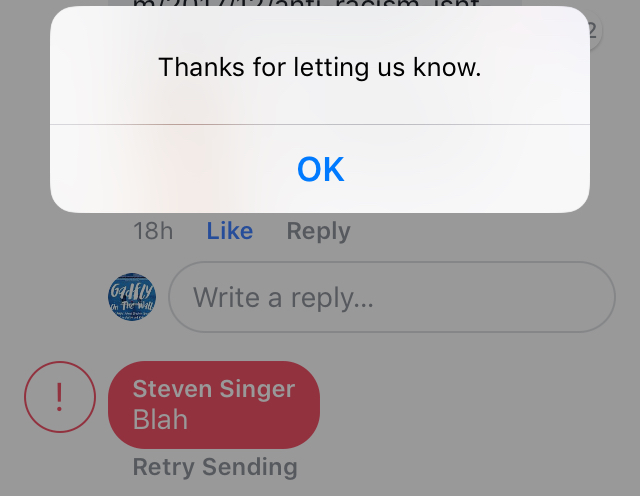
“Thanks for letting us know.”


My only choice was to click “OK.”

IMG_8707

At some point I got a message telling me that I was blocked until Dec. 11 – a full week from my offense.


And now I have limited use of the social media platform.


I can still see posts.


I can like posts.


For some reason, I can even post and comment on my own page. But I can’t comment or post on other pages without getting the same error message.


At least I can’t do it consistently.


I’ve experimented and found that sometimes I can share posts to different pages. Sometimes I can’t.


It’s a bizarre, wonky system.


And it gets in the way of my work as an education blogger.


Facebook has more than 1.5 billion accounts. That includes more than 80% of all Americans.


Sharing my blog on the site gets me more readers than anywhere else.


Twitter is great and certainly more free. But when you push out a tweet, no one sees it unless they’re looking at their feed at that exact moment. Unless it gets retweeted – or you’re a famous unhinged former reality TV star turned President, then people seek out your own personal brand of nuclear-apocalypse-threatening madness.


So why does this keep happening to me?


I have two theories.


1) I am being purposefully censored by Facebook.


2) Facebook algorithms are targeting me because of how I post.


Let’s look at the first theory.


Could someone be actively censoring me?


Yes.


The proposal has a certain plausibility because the powers that be at Facebook undoubtedly disagree with what I have to say.


Mark Zuckerberg, Facebook’s founder, is a huge supporter of edtech, standardized testing and school privatization. He’s spent hundreds of millions of dollars trying to make public schools rely more heavily on high stakes tests, evaluating teachers on their students’ scores and pushing Personalized Education software packages on public schools. And when that doesn’t pan out, he’s even backed his own charter schools to do the same.


But that’s not all.


Since early January of this year, he’s had Campbell Brown on the job as the arbiter of truth for his on-line platform.


That’s right.


Brown, a school privatization lobbyist and former NBC and CNN personality, heads Facebook’s News Partnership Team.


The newly created position was part of Zuckerberg’s attempt to limit fake news on his social media platform while prioritizing information in the mainstream media.


What exactly is fake news? Whatever Campbell Brown says it is.


This is quite a lot of power to give one person, especially someone who has a reputation for partisanship.


Brown, after all, co-founded a charter school propaganda network called The 74, funded – unsurprisingly – by Betsy DeVos, Republican mega-donor and current Secretary of Education.


After leaving the anchor’s desk, Brown has had a second career helping corporations destroy public schools and public school teachers.


And she does. Not. Like. Me.


Let’s just say we’ve gotten into a few Twitter skirmishes.


When she became the face of a New York lawsuit attacking teacher tenure in 2014, she received a tidal wave of public backlash. So she went on the Colbert Report to complain about how those fighting for workplace protections for themselves and their students were “silencing the debate” on how best to reform public education.


I responded with a blog called “Shhh! Who’s Silencing the Debate on Real Education Reform” claiming that Brown was actually doing the very thing she claimed to be decrying in shutting out teachers’ voices and rights.


She responded by cherry picking her rudest critics and tweeting “Sorry Steve but sadly this is not what I characterize as debate,” as if I had had anything to do with these comments.

IMG_8708

As if any movement should be judged by its most extreme elements.


As if attacking someone’s job, someone’s kids and their future was fine so long as you did so with a smile and a polite comeback.


I don’t condone personal attacks, but I certainly understand them. In any case, Brown used the extreme fringes of her critics to condemn us all and conveniently refused to engage us – even those who had been unceasingly polite.


That lawsuit eventually failed, but Brown somehow landed on her feet.


Now she’s the one who gets to choose truth and falsity on Facebook.


Could she be actively working against people like me?


Yes.


Could she be directing Facebook’s programmers to select against posts that are negative to her pet projects?


Yes.


But there’s no way to know if she’s actually doing it.


Which brings me to my second theory.


Perhaps mindless Facebook algorithms are targeting me because of how I post.


I do, after all, try to post my articles on as many pages as I can.


They’re mostly pages focused on education and education policy with a few political and anti-racism sites thrown in, too.


Maybe I’m posting too quickly.


I might be triggering one of Zuckerberg’s bots to think I’m a bot, too, spamming up the works with advertising.


However, there’s a few problems with this theory.


Let’s say it’s true.


Why would that, alone, be reason to block me?


I’m not posting advertisements. I’m not asking for money. My blog doesn’t sell adds other than those WordPress puts on there, itself, so I can keep the page for free.


If an algorithm is stopping me because it thinks I’m unfairly selling something, it’s the result of some badly written code, indeed.


When programmers write code, that’s not impartial. It betrays their values. It betrays certain decisions about what’s acceptable and what isn’t.


For instance, I keep getting advertisements from Facebook asking me to pay money to the social media network so that they’ll post my articles on other people’s site for me.


I get reminders like “Boost this post for $3 to reach up to 580 people.”

IMG_8712

Oh, really?


So I’m blocked because I posted my own writing to sites that have accepted me as a member and whose membership includes many I consider friends and colleagues. But for a fee, Facebook will post that same article to various sites filled with people I’d consider to be complete strangers.


Somehow that doesn’t “violate community standards” – the reason they said they blocked me in October.


This is very telling.


It seems to indicate that there is nothing wrong with what I’m doing, per se. It’s just that Facebook wants to encourage me to let them do it for me – so they can monetize my account.


They’re stopping me from doing this on my own, because they think I’m a sucker who should pay them for the right to communicate with others.


And that’s a very real possibility.


These blockages may not be political. They may be a simple marketing strategy.


So what can I do about it?


Well, first I need to wait a week until my account is unfrozen and I get back all the features Facebook users usually enjoy.


Then I can try to go back to the way things were posting my articles at all my favorite virtual watering holes.


Only slowly.


Much more slowly.


I figure if I only post once every five minutes or so, I can have my article at all the places that seem to like having them in about the course of an evening.


But I have a life, damn it!


I can’t spend the twilight hours posting and waiting and posting and waiting.


I guess another alternative is to rely on friends to post for me.


Spread the love.


Have others circulate my articles far and wide.


And that’s a great strategy. It’s very hard for Facebook to do anything about it.


But it requires me to impose on others. I don’t like doing it.


My readers, friends and supporters have lives, too.


They have more important things to do than post my writing all over the Internet.


So where does that leave me?


I’m not sure.


If I continue as I have, I’m bound to be blocked and thrown in Facebook Jail again.


Even if I don’t, I’m at the mercy of the wealthy elites who control the network.


And if the FCC does away with Net Neutrality, as they’re threatening to do in a matter of days, it may not even matter.


Regardless of where I post on Facebook, my blog site will probably be slow to the point of molasses and maybe even shut down entirely.


This is the brave new world of the plutocracy unrestrained.


This is American fascism triumphant.


I am only a single point of the resistance.


My voice is only as powerful as those who share it.


If Facebook, Twitter or WordPress somehow takes me down, I’ve written a book, “Gadfly on the Wall: A Public School Teacher Speaks Out on Racism and Reform,” now available from Garn Press. Ten percent of the proceeds go to the Badass Teachers Association. Check it out!

book-1

Teacher Seniority – the Seat Belts of the Education Profession

Lady-Seatbelt(1)

You wouldn’t travel a long distance in your car without strapping on a seatbelt.

So why do you think teachers should spend 30 plus years in the classroom without seniority?

Everywhere you look, billionaires are paying millionaires in government to pass laws to cut taxes, slash funding and find cheaper ways to run public schools for pleb kids like yours and mine. And that often means finding ways to weaken protections for teachers, fire those with the most experience and replace them with glorified WalMart greeters.

“Hello. Welcome to SchoolMart. Please plug into your iPad and begin today’s lesson.”

This is class warfare cloaked as a coupon. It’s sabotage described as savings.

And the only way they get away with it is because reasonable people buy the steaming load of manure they’re selling.

MYTH: Seniority with Tenure means a Job for Life

Tell that to the hundreds of thousands of teachers out of work.

Tell that to all the optimistic go getters who prance out of college ready to change the world as teachers and fizzle out during the first five years.

Tell it to the handful of truly terrible teachers who for reasons only they can explain stay in a job they hate through countless interventions and retrainings until the principal has no choice but to give them their walking papers.

Oh, yes. Teachers DO get fired. I’ve seen it with my own eyes numerous times. And in each case, they truly deserved it.

(Any “bad teachers” still on the job mean there’s a worse administrator somewhere neglecting to do his or her duty.)

So what does “Seniority” and “Tenure” even mean for teachers?

Basically, it means two things:

(1) If you want to fire a teacher, you have to prove he or she deserves it. That’s Tenure.

(2) When public school districts downsize, they can’t just lay off people based on their salaries. That’s Seniority.

If you think about it, both of these are good things.

It is not a good work environment for teachers or students when educators can be fired without cause at the whim of incoming administration or radical, newly-elected school board members. Teaching is one of the most political professions we have. Tenure shields educators from the winds of partisanship. It allows them to grade children fairly whose parents have connections on the school board, it allows them to speak honestly and openly about school policy, and it empowers them to act in the best interests of their students – all things that otherwise could jeopardize their jobs.

Likewise, seniority stops the budget butchers from making experience and stability a liability.

It stops number crunchers from saying:

Hey, Mrs. Wilson has been here for 25 years. She’s got a shelf full of teaching awards. Parents and students love her. But she’s at the top of the salary scale so she’s gotta’ go.

I know what you’re going to say: Aren’t there younger teachers who are also outstanding?

Yes. There are.

However, if you put all the best teachers in one group, most of them will be more experienced.

It just makes sense. You get better at something – anything – the more you do it. This could be baking pies, building houses or teaching children how to read and write.

So why don’t we keep the best teachers and get rid of those who aren’t up to their level?

Because determining who’s the best is subjective. And if you let the moneymen decide – POOF! – suddenly the teachers who make the most money will disappear and only the cheapest ones will be left.

Couldn’t you base it on something more universal like student test scores?

Yes, you could, but student test scores are a terrible way to evaluate teachers. If you wanted to get rid of the highest paid employees, all you’d have to do is give them the most struggling students. Suddenly, their students have the worst test scores, and they’re packing up their stuff in little cardboard boxes.

Almost any stat can be gamed.

The only one that is solidly unbiased? Seniority.

You’ve either been here 15 years or you haven’t. There’s not much anyone can do to change that fact.

That’s why it prevents the kind of creative accounting you see from penny pinching number crunchers.

Along with Tenure, Seniority is a safety net. Pure and simple. It helps keep the most qualified teachers in the room with kids. Period.

But look. It’s not perfect.

Neither are seat belts.

If you’re in a car crash on a bridge where it’s necessary to get out of your vehicle quickly before it plunges into the water below, it’s possible your seat belt may make it more difficult to reach safety. This is rather rare, and it doesn’t stop most people from buckling up.

I’ve known excellent teachers who were furloughed while less creative ones were kept on. It does happen.

But if we got rid of seniority, it would happen way more often.

That’s the bottom line.

Instead of finding more leeway to fire more teachers, we should be finding ways to increase school funding – especially at the most under-resourced schools – which, by the way, are the ones where lawmakers most want to eliminate seniority. We should be looking for ways to make downsizing unnecessary. We should be investing in our children and our future.

We’ll never improve the quality of the public school system by firing our way to the bottom. That’s like trying to lose weight by hacking at yourself with a straight razor. It just won’t work.

We need to commit to public schools. We need to commit to public school students. And the best way to do that is to support the teachers who devote their lives showing up every day to help them learn.