
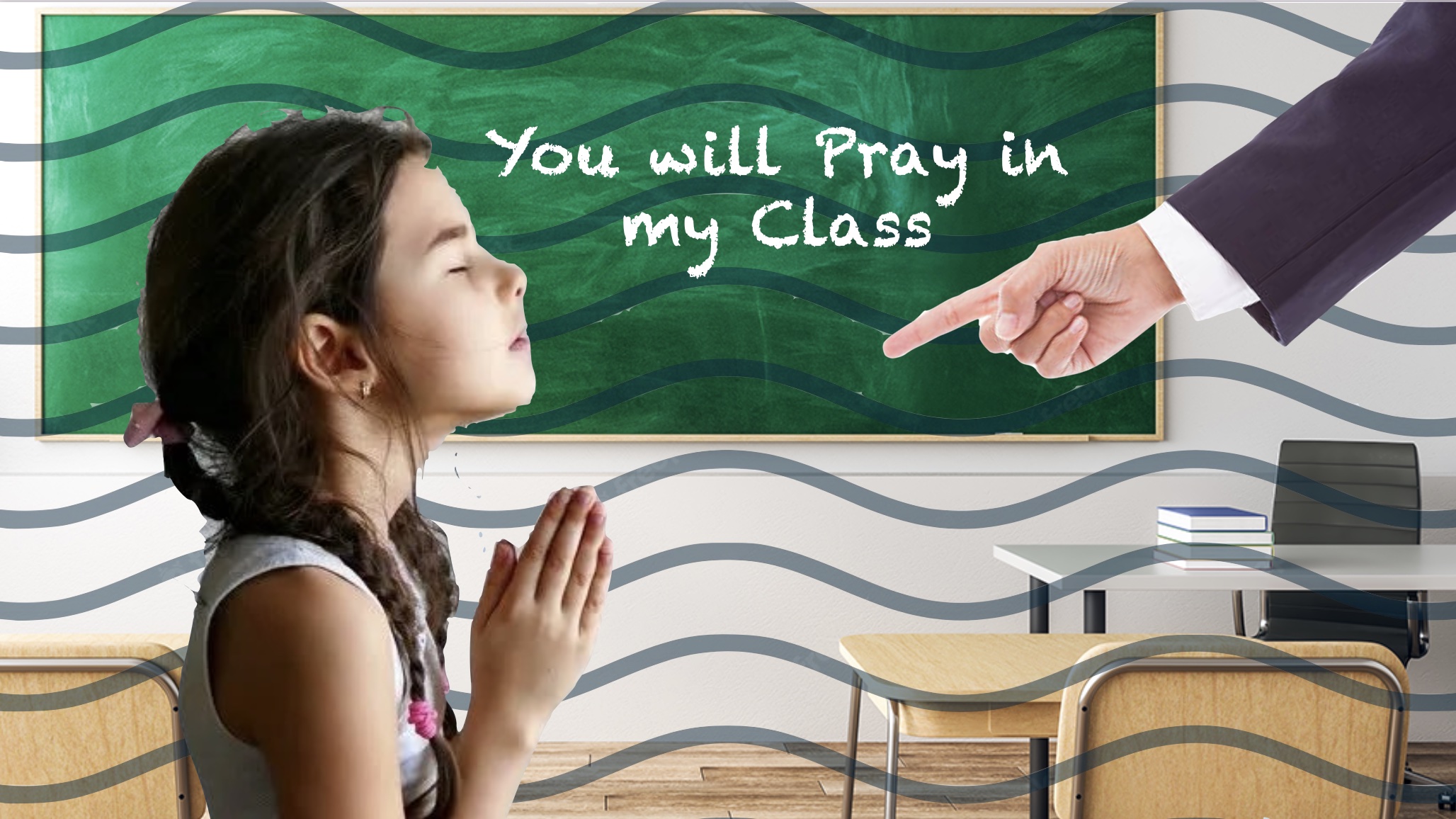
I Will NOT Lead My Students in Prayer and Neither Should You

As a public school teacher, I have a responsibility not to bully my students into believing as I do.

In fact, I go out of my way to respect their right to form their own opinions – to think, not just to accept what they’re told.

The US Supreme Court apparently has no idea how this works.

The six Republican members (I refuse to call them justices) paved the way for organized prayer in public schools by ruling this week in support of a high school football coach who lead his team in prayer on the field.

Anyone who has ever been in the minority knows that when an authority figure leads students in an activity, it is not optional – no matter what they say.

I know this from personal experience.

When I was in elementary school, I was one of a handful of Jewish kids in a building of mostly Catholics, Methodists, Presbyterians, etc.

In December, the kids were preparing for a choral concert where we’d sing a slew of holiday songs.

I loved to sing and enjoyed Frosty the Snowman, Jingle Bells and all the other classics…

Except one – Silent Night.

I just didn’t feel right singing things like “Round yon virgin mother and child” and “Christ the savior is born.”

So when we practiced that song, I’d stop singing.

I’d enthusiastically belt out all the other tunes, but I just stood there when it was time for Silent Night.

I didn’t think it would make a difference. There were hundreds of others kids. No one would notice me.

But the choral teacher did.

She pulled me out of line and demanded to know why I wasn’t singing. I told her I was Jewish and didn’t want to sing that song.

She chided me for making everyone else look bad and told me to just move my mouth during the song so it looked like I was singing.

I didn’t want to do that. I didn’t want people to even THINK I was singing things I didn’t believe.

It’s not that I really accepted Santa and his reindeer, either, but this was somehow different. I didn’t want my parents to go to the concert and see me participating in this farce. I didn’t want to be forced to go onstage and before everyone profess the opposite of all I had been taught – to declare myself other than what I really was.

But the other kids were right there listening to this whole conversation and giggling. It was yet another way I was being marked as an outsider, as different – so I gave in and did what she demanded.

In retrospect, I now know I could have complained to my parents and gone to the principal and we could have even taken the matter to court like the aforementioned coach.

However, when you’re a little kid in elementary school you usually just listen to what the adults tell you to do. At least I did.

It took me decades to get over it. Really.

Whenever that song would come on the radio or I’d hear it in a department store, I’d get all tense and upset. Like something had been stolen from me.

So it was with some trepidation many years later that I attended my daughter’s first winter concert when she was in elementary school.

It was with some relief that I noticed no holiday songs like Silent Night. They were all pretty secular and even multicultural.

And my daughter goes to the same district I went to as a child.

We’ve come a long way in the past three decades.

By and large, public school teachers today make an effort not to force their ways onto their students.

It’s a lesson I take to heart, myself, in my middle school classes.

When we discuss things – as you must in Language Arts – I encourage students to agree OR disagree with me or anyone else. Either option is okay so long as they try to explain why they think the way they do.

Moreover, I encourage them not to just speak but to also listen to what their classmates have to say and even be open to revising their original thoughts based on what they’ve heard.

And this includes discussions of religion.

When something Biblical or theological comes out of a book like “To Kill a Mockingbird” or “The Outsiders,” we give it our full attention.

I tell my kids that they can say or think whatever they want about it. If they want to talk about God or religion, that is fine. It’s just me who is constrained. I am not allowed to give them my own opinion on these matters.

Often I tell them that this isn’t necessarily what I believe, but I’ll propose one idea or another to get them thinking.

I remember one year my students were particularly interested in religion, and they complained that they couldn’t pin me down on anything – they couldn’t tell if I was religious or an atheist.

And that’s how it should be.

Kids have never been forbidden from talking about God or praying in school.

It’s just that teachers have been forbidden from telling them what to think or leading them in prayer.

Until now.

However just because an increasingly illegitimate Supreme Court makes a regressive ruling doesn’t mean teachers have to change.

Even if we CAN lead kids in prayer, that doesn’t mean we SHOULD.

I don’t plan on altering a single thing in my classroom, and I don’t think my colleagues should, either.

But there are 3.2 million teachers in public schools. There are bound to be some who will use this ruling as an excuse to give in to their worst tendencies.

So here’s what I suggest we do.

We should not coerce our students to do anything, but we damn well can and SHOULD pressure our colleagues not to indoctrinate their students.

Principals should give crappy assignments to teachers who break this taboo. Keep them away from students if at all possible. After all, they don’t belong in the classroom if they’re going to misuse the trust students have in them.

Teachers should give them the cold shoulder in the faculty room and at the copier.

Want to borrow my grammar unit? Not if you’re going to subject your classes to your faith and encourage them to follow along.

Consenting adults can do what they like on their own time, but this is public school.

When it comes to undue influence, inculcation and alienation of kids who are different, we cannot be bystanders.

We may not have dark money and Christian Nationalists behind us, but until we have a rational Supreme Court to overturn this decision or a Congress with enough guts to codify freedom from religion into law, teachers still have some modicum of power.

We should use it to protect our children.


Like this post?  You might want to consider becoming a Patreon subscriber. This helps me continue to keep the blog going and get on with this difficult and challenging work.

Plus you get subscriber only extras!

Just CLICK HERE.

Patreon+Circle

I’ve also written a book, “Gadfly on the Wall: A Public School Teacher Speaks Out on Racism and Reform,” now available from Garn Press. Ten percent of the proceeds go to the Badass Teachers Association. Check it out!

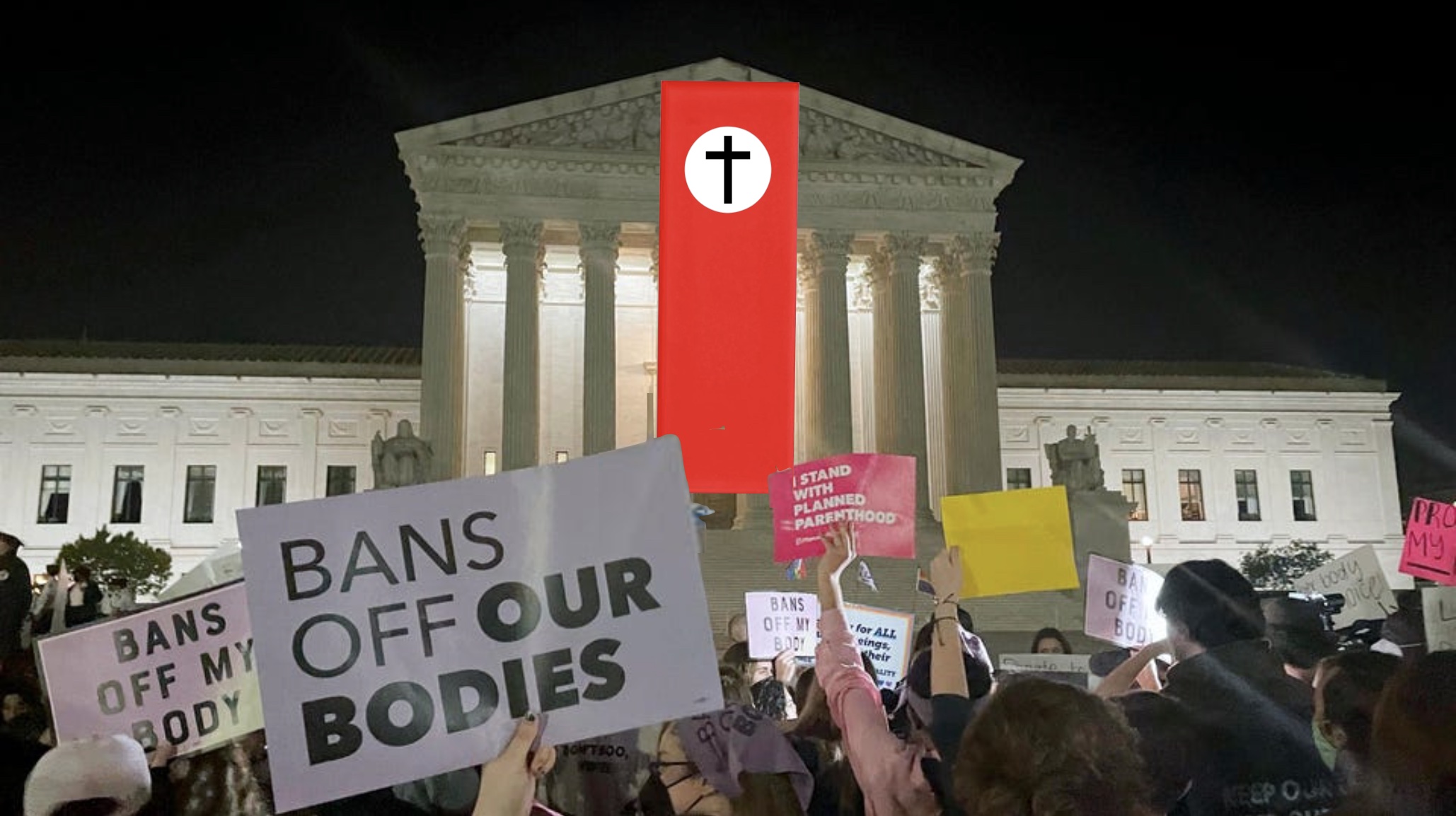
Overturning Abortion Rights is Fascism – Pure and Simple

The US Supreme Court is a fascist organization.

Let me cut right to the chase to explain why.

This week the conservative majority (I won’t call them justices) overturned Roe v. Wade – the landmark 1973 decision that expanded access to abortion nationwide.

This is on top of decisions deeply wounding state’s rights to make gun regulations, to hold police civilly accountable for reading suspects their Miranda rights, and even the separation of Church and State in regard to public funding of parochial schools.

Let me be very clear – this is not about consistency based on legal precedent or interpretation of the law. It is ideology – pure and simple.

In the case of abortion, these four men and one woman did it because they wanted to. That’s all.

And they wanted to for a while now. They each lied to Congress during their confirmation hearings.

Maybe money exchanged hands. Maybe they were influenced by powerful pundits, politicians and ideologues.

But their rulings were certainly not based on logic. After all, in the same week they decided states CAN’T regulate guns but states CAN regulate women’s bodies.

This is inconsistent and irrational.

The right to an abortion is one of the most fundamental rights a person can have.

It is central to the very idea of personal freedom and autonomy.

And no argument based on the rights of the unborn can support this travesty of justice.

Look at the facts.

At the beginning of pregnancy, a fetus is nothing but a cluster of cells.

This cluster is alive but so is cancer. So are insects. So are bacteria.

Being alive is not enough to give it rights over-and-above the person these cells are clustered inside.

Electrical impulses in these cells do not constitute a heartbeat. Nearly every cell has such electrical impulses – the brain, muscles, organs, etc. That doesn’t make them separate organisms.

Your belief that a cluster of cells is a person is not a compelling argument for anything.

There are no facts behind it.

It is purely a matter of a faith.

There is no way to prove either position right or wrong. It is definitional.

It is purely something you believe without any evidence.

It is religion, and in a free society one person’s religion cannot compel someone of another faith or someone of no faith whatsoever.

Catholics can’t make Jews attend midnight mass before Christmas. Jews can’t make Baptists refrain from eating pork. Muslims can’t stop atheists from drawing cartoons of religious figures.

Doing so would be theocracy.

So using your belief as a justification to force people who do not share it to take that cluster of cells to term is a textbook example of fascism.

It clearly violates the First Amendment establishment clause of the Constitution. It forces others to be compelled by your faith-based claims.

Moreover, it violates a person’s right to bodily autonomy.

If you have a right to anything, it is to do whatever you want with your own body. After all, that is you at its most essential.

Without this right, you are the same as livestock or an enslaved person.

No one should be able to force you to do anything with or to your body that you don’t want.

Obviously that right has limits – for example if you intend to use your body to hurt or kill someone else.

But we’ve already established that a fetus – a glob of cells – cannot be assumed to be someone else.

Doing otherwise would be absurd.

So someone has beliefs about what’s happening inside your body. So what?

Imagine if some cult thought your kidneys have souls and must be kept inside you at all costs. Should they be able to pass a law forbidding you from removing one if it gets infected? If you want to donate it to save another person’s life?

They’re your kidneys. And that fetus is your cluster of cells. You can do with it what you want.

Eventually, if you let that cluster of cells develop long enough, it may become something else. It may become viable to live on its own and what almost everyone would agree is a person. But it is not a given at all that this conglomeration of tissue is one yet.

And your insistence that your beliefs about it must compel my actions violates my rights.

Moreover, this argument has been predicated on the believer in the personhood of a clump of cells acting in good faith.

In point of practice, we do not even see that.

The same people in favor of repealing a person’s right to abortion may be in favor of the knot of tissue developing through birth, but they do not support doing anything to help it once it has unequivocally reached personhood.

No universal healthcare. No universal daycare. No neonatal care. No robust education funding. And no protection against gun violence.

This shows that most people professing this belief in the personhood of something inside your body is pure balderdash.

It’s not about that mass growing inside a woman. It’s about the woman, herself – controlling her actions, making her bend to your will, making it harder for her to exercise her autonomy and benefit from her own economic power.

It is about upholding patriarchy. It is about subjugating women – especially poor women and women of color who are more likely to be impacted.

Make no mistake.

This is fascism.

Our Supreme Court is fascist.

And whether you are likely to ever have an abortion or not is beside the point.

Every woman, every man, every person is impacted.

We must fight this kangaroo court and the political power behind it.

We must make them regret such blatant autocracy and totalitarianism.

This is everyone’s fight.

Every PERSON. Everywhere.


Like this post?  You might want to consider becoming a Patreon subscriber. This helps me continue to keep the blog going and get on with this difficult and challenging work.

Plus you get subscriber only extras!

Just CLICK HERE.

Patreon+Circle

I’ve also written a book, “Gadfly on the Wall: A Public School Teacher Speaks Out on Racism and Reform,” now available from Garn Press. Ten percent of the proceeds go to the Badass Teachers Association. Check it out!

How Teachers Like Me Can Renew Ourselves This Summer

This school year was perhaps the most difficult one I’ve experienced in two decades in the classroom.

From constantly having to cover for sick or otherwise absent staff, to absorbing student traumas suffered in years of a pandemic, to increased student fights, social awkwardness and administrators demanding more paperwork and untried initiatives that get dropped for another fad next week…

It’s been rough!

Now that most K-12 schools have begun or are about to begin summer break, it can be hard to rest and renew yourself for the coming year.

To be honest, many teachers have already decided to leave.

At my district, more teachers have retired this year than at any time since I was hired – about 10% of the staff.

And some even quit in the middle of the year – something that hardly ever happens.

If things don’t change this year, it will be worse next year.

But for those like me planning on returning in the Fall, congratulations. You made it through.

Now what?

I don’t know about you, but I often find myself nibbled by stress and anxiety.

I try to sleep, I try to rest, but worry and hopelessness settle down on me like a shroud.

If you’re like me, you may need some help getting through it all.

So here’s a list of five things we can do – not just you, but me, too – that hopefully will help us rejuvenate ourselves somewhat in the next few months and set us up for a successful year with our students.

1) Be Present with Friends and Family

Teachers often live in their heads.

We’re always planning a new lesson or thinking about how to help a student or improve something from the year before.

But this is summer break.

It’s time to tune out and turn off.

You’re home and hopefully you can find some time to spend with friends and family.

Just remember to try to be there. Actually be there.

Don’t live in your head. Live in the moment.

Let the present open up in front of you and actually enjoy the things you’re doing.

Our professional lives often demand we sacrifice so much time with our significant others, our kids, and the people we care about. Now is the time to balance the scales and enjoy their company. And nothing else.

This can be easier said than done, but it’s worth a try.

2) Don’t Focus on Things You Can’t Change

There is so much going on in the world, and we’re teachers. We’re problem solvers.

We want to fix broken things, and there is so much broken out there. The news is often not our friend.

I’m not saying to ignore what’s going on. We do so at our peril. But we have to try to put it all in context.

We’re just people – individuals caught in nets of complexity. We can’t solve all these problems ourselves.

A horrible regressive monster is running for Governor in the Fall who would destroy your profession and endanger your child’s future. Got it.

The government still hasn’t passed any meaningful measures to keep guns out of the hands of school shooters. Got it.

Politicians are still attacking your profession, history, science, math and enlightenment values. Argh!

And they’ll still be doing it at the end of August.

Take a break from it all.

Worrying will not change anything. And it will all be there for you later.

Just try to focus your mind elsewhere – for a little while.

3) Let Go of Resentments

This can be really hard but important.

There are a lot of people who have probably said or done things that made your life difficult this year.

It could be that parent who screamed at you on the phone over an assignment their child didn’t turn in.

It could be an administrator who made another stupid initiative that makes him/her look good while increasing your work load but does nothing to help the students.

It could be a sincerely stupid politician accused with pedophilia and insurrection who thinks taking pot shots at teachers will win him votes from the lowest common denominator.

It could be… so many people.

Take a deep breath and let it go.

You don’t need that baggage weighing you down.

As Nelson Mandela is supposed to have said:

“Having resentment against someone is like drinking poison and thinking it will kill your enemy.”

Leave that behind.

There will be plenty more next year.

4) Don’t Expect Too Much of Yourself

Often our harshest critic is ourselves.

We try so hard to be kind to everyone all year. This summer, be kind to yourself.

It’s break time. You don’t have to clean the whole house top to bottom. You don’t have to finally rearrange the utility drawer or any of a million other things that have been waiting around for you to get to them.

By all means, make those doctor’s appointments you’ve been waiting on. Buy a new pair of shoes. Cut the grass.

But if something doesn’t get done, don’t feel like it’s a failure.

You are allowed to simply do nothing.

Sometimes that’s the best thing we can do.

Be as productive as you want. Sometimes that helps alleviate stress, too – the satisfaction of getting things accomplished.

However, this break is not all about crossing things off your TO DO list.

It’s about rest and renewal.

Cut yourself some slack.

No one else will.

5) Remember Why You Got into Teaching

When you feel ready to turn your mind back to the job, try not to think of all the negative things waiting for you.

Don’t even let your mind rest on the uncertainties and anxieties ahead.

Focus on why you’re still a teacher.

You’re not chained to this profession. You probably had the chance to leave if you’d wanted.

Why did you get into education in the first place?

What are the things about it that you still love and enjoy?

For me, it’s nearly everything in the classroom, itself.

It’s interacting with students.

It’s helping them succeed and then seeing the look of joy on their faces when they do.

I love everything about my job – the subject I teach, the students, being there when there’s no one else.

It’s just all the stuff outside the classroom that I can’t stand.

I make a file during the year full of Christmas cards, goodbye messages from parents and students, positive emails, etc. During the summer is a perfect time to read through them and remember the good things.

At least, that’s what I try to do anyway.

So there’s my list. I hope you found it helpful.

Health, relaxation, calm. Be warned – I’m certainly no expert on the subject.

Remember the words of author Nakeia Homer:

“You are not lazy, unmotivated, or stuck. After years of living your life in survival mode, you are exhausted.”

Finding ways to recharge and renew is something I know I desperately need – maybe as you do, too.

Here’s hoping we can find the peace we need this summer.

The new academic year will be here before we know it.


Like this post?  You might want to consider becoming a Patreon subscriber. This helps me continue to keep the blog going and get on with this difficult and challenging work.

Plus you get subscriber only extras!

Just CLICK HERE.

Patreon+Circle

I’ve also written a book, “Gadfly on the Wall: A Public School Teacher Speaks Out on Racism and Reform,” now available from Garn Press. Ten percent of the proceeds go to the Badass Teachers Association. Check it out!

‘To Kill a Mockingbird’ is Still Relevant Because it Forces Us to Confront Ourselves 


Parris is peering into a crumpled paperback with a huge smile on his face. 


“Mr. Singer, I love this book…” he says.  


He stops, pauses and adds, “I hate what’s happening, but I love the book.” 


In my middle school classroom, that’s a pretty routine reaction to Harper Lee’s classic, “To Kill a Mockingbird.” 


My 8th grade students approach the climax and resolution with equal parts dread and delight.  


But it doesn’t always start that way. 


No book I teach has gone through a greater change in cultural opinion than “Mockingbird.” 


It used to be considered a bastion of anti-racism. Now some folks actually consider it to be racist. 


The story is about Scout and her brother Jem as they grow up in Alabama during the Great Depression. Most of the drama centers on their father, Atticus, who defends a black man, Tom Robinson, in court against trumped up charges of raping a white woman.  


Ever since its publication in 1960, people have tried to ban the book from school libraries and from school curriculum.  


And that’s still true today. However, this used to be the work of the far right. Today there are almost as many objections from the far left – though for very different reasons. 


For 50 years, the biggest complaints came from conservatives about the book’s strong language, discussion of sexuality, rape, and use of the n-word. Though today you’ll find almost as many on the left proclaiming that the book actually perpetuates the racial intolerance it purports to be against. 


Republicans have become more extreme than ever. They see any discussion of race as “Critical Race Theory” – a conflation of a legal framework not actually taught in K-12 schools with any substantive discussion of racial inequality. It’s really just a simple dog whistle to try and shut down any discussion of the racial status quo. 


Teachers have become accustomed to conservatives hyperventilating that discussing racism and prejudice might mean having to admit these things still exist and therefore requiring us to do something about them. They’re terrified their kids might come to different conclusions about the world than their parents, and instead of confronting their own views with the facts, they prefer to sweep reality under the rug to preserve the fictions underlying their ideologies. 


These sort of complaints are typified by the Biloxi Public School Board in Mississippi which in 2017 removed Lee’s Pulitzer Prize-winning novel from its curriculum because, “It makes people uncomfortable.” 


What they don’t seem to realize is that the discomfort is part of the point. 


On the other side of the coin are people on the other pole of the political spectrum. Writers like Kristian Wilson Colyard don’t object to a discussion of racism and prejudice. They think “Mockingbird” doesn’t go far enough – or at least that the discussion it has is framed incorrectly. 


Colyard doesn’t think the book should be banned or removed from libraries, but instead insists it isn’t a good teaching tool.  


She writes


“Lee’s is not the best book to teach white kids about racism, because it grounds its narrative in the experiences of a white narrator and presents her father as the white savior.” 


While I think Colyard has a fair point of literary analysis, I don’t agree with her conclusion.  


At first glance, there is something strange about approaching racism through the lens of white people, but that doesn’t make it invalid. In fact, racism is a product of whiteness. In this country, white people are the ones doing it. Therefore, it makes sense to speak directly to and from the experience of white people. 


 Oppression, after all, is relational. It takes both the experience of the oppressed and the oppressor to fully understand it. And if we want to help end the cycle, it makes sense to show the oppressor how to bring that about. 


Moreover, the book sneaks up on its themes. There’s very little about outright intolerance on the first page or even the first few chapters. The idea creeps up on you as the narrator slowly becomes aware of the prejudices around her and the trial comes deeper into focus. 


As to the question of white saviorism, I think this is more often a buzzword than a legitimate criticism. White people are not heroes for attempting to put right something they put wrong. It is their responsibility, and seeing someone do that in fiction is a really powerful thing.  


Atticus doesn’t think he’s saving his client Tom Robinson. He doesn’t think he’s special for doing so. He’s doing what he thinks is right. Now Scout certainly views this through rose-colored glasses and lionizes him for it, but that’s a character’s point of view. It’s up to the reader to look at all this critically and come to your own judgement about it.  


Frankly, I think that’s one of the real values of the book. It provides a deep narrative, well told, for readers to examine and discuss very complex issues.  


If you think Atticus is given too much credit for what he does, that’s something you can discuss with other readers. I don’t see how doing so cheapens or hurts the cause of antiracism.  


In addition, the problem of centering the story on the white people is rectified by reading more widely in the literature. “Mockingbird” shouldn’t be the only book on the topic you read. To be well-rounded, you should read more from the point of view of people of color subjected to white people’s intolerance. And there are so many wonderful books to choose from – Toni Morrison’s “Beloved,” Ralph Ellison’s “The Invisible Man,” Alice Walker’s “The Color Purple,” etc.  


However, teachers shouldn’t be made to feel like they’ve wasted an opportunity by using “Mockingbird” in the classroom – even if it’s the only book that year they read on this topic. There must be more opportunities in years to come. Racism and prejudice should not be a one-and-done topic in US schools. It is too important for that. 


In my classroom, this book is far from our first discussion of the issue.  


We talk about Fred Hampton and the Black Panther Party. We talk about the 1968 Olympics Black power fist. We talk about Black cowboys like Bass Reeves. We talk about Bessie Coleman, Angela Davis, James Baldwin, and so many others.  


When we read S.E. Hinton’s “The Outsiders,” – a book that almost entirely eschews the topic – I make sure to point out that the narrative takes place in and around Tulsa, Oklahoma, and we discuss Black Wall Street and the massacre of Black people perpetrated by their White neighbors.  


And so when we get to “Mockingbird,” the discussions we have of the text is rich and deep. Students of color feel seen because of the book’s portrayal of the kind of racial injustice they experience in their own lives. Likewise, white students feel empowered to join in the struggle against it. 


When the verdict of the trial comes down, there are real tears and stares of disbelief.  


One of my students this year, Mya said, “I shouldn’t be surprised, but I thought it was going to turn out differently.” 


Me, too. Every time I read it. 


The book confronts students with the world as it is and challenges them to do something about it.  


White or Black, it holds up the reality of injustice and demands we take a side.  


And that’s why this book remains relevant and just as important today as it ever was. 


Like this post?  You might want to consider becoming a Patreon subscriber. This helps me continue to keep the blog going and get on with this difficult and challenging work.

Plus you get subscriber only extras!

Just CLICK HERE.

Patreon+Circle

I’ve also written a book, “Gadfly on the Wall: A Public School Teacher Speaks Out on Racism and Reform,” now available from Garn Press. Ten percent of the proceeds go to the Badass Teachers Association. Check it out!

Social-Emotional Learning vs. Classroom Culture 


A student accidentally drops her books in the hall.  


Another student stops and helps her pick them up.  


Then a teacher homes in on the two and gives the helper a little yellow card which can be redeemed for candy.  


This is what social-emotional learning (SEL) looks like in my school. 


Teachers instruct on proper behaviors and then reward students they see going above and beyond to achieve them.  


Here’s another example. 


A student at his lunch table is yelling and throwing food. Nearby another student is sitting quietly and reading a book.  


Then a teacher walks over and gives the quiet child a yellow card which can be used to enter a raffle for a special prize. He might win an Oculus VR game system or tickets to a baseball game.  


That’s social-emotion learning, too.  


Instead of just cracking down on the negative behaviors, we try to reward the positive ones.  


To be fair, it works to a degree.  


But most of the time, it doesn’t. 


The same kids end up with huge stacks of yellow cards and the rest get just one or two. Few students actually change their behavior. They just become virtue signalers whenever an adult is present.  


Moreover, there’s an incredible amount of pressure on teachers to not just instruct but to closely observe every student’s behavior and constantly give positive reinforcement to those doing what should be the norm.  


And that’s not even mentioning the frequent disruptions necessary to reward those children who can best navigate the system. 


But that’s only one way of addressing the problem of bad behavior.  


Especially now (most student’s first full year of in-person classes after the worst of the Covid-19 pandemic), students don’t seem to know how to interact.  


Snubs, insults and instigation seem to be their defaults ways of relating to each other. Some definitely need explicit boundaries and reinforcement.  


But it only goes so far in the halls, the cafeteria and during unstructured times.  


Inside the classroom is another beast altogether – as it always has been. 


Ever since I first started teaching more than two decades ago, it’s been necessary to work to achieve a classroom culture. 


The teacher has to expend significant time and energy with the students as a whole and each student individually to set up a mini-society where each member gets respect by giving respect. 


We try to set up the environment so everyone feels safe and involved, everyone is accepted for who they are, comfortable to be themselves and feels empowered to take the chances necessary to learn. 


It’s not easy, but it’s more about relationships than behaviorism. The reward isn’t something extrinsic – it’s participation in the classroom culture, itself.  


Both approaches attempt to do the same thing – create an environment in which learning is possible.


It reminds me of the famous quote by conductor Leopold Stokowski


“A painter paints pictures on canvas. But musicians paint their pictures on silence.” 


In the same way, you might say that learning in a group requires a canvass of positive behaviors or beneficial social interaction.  


This has always been the case, though today the concept has become elevated to buzzword status – SEL. 


It’s not so much a single program but a loose conglomeration of ideas that have been around forever. 


However, like so much about school these days, the work of teachers and students has become both monetized and demonized. 


For those on the far right, SEL is code for teaching kids how to think and feel.  


They fear leftwing teachers will instill the values of accepting LGBTQ people, different races and cultures.  Why that’s something to be avoided, I don’t know. Perhaps if you want your child to share your own bigotries, public school isn’t for you, no matter what you call the offending programs.  


However, for me the worst part is monetization.  


An army of corporate education consultants are looking for ways to give shallow professional development to teachers (at a cost to the district) and then run complicated programs from afar.  


This means: (1) testing students’ abilities in SEL, (2) holding teachers accountable for student behaviors, and (3) pretending educators are developmental psychologists.  


The problem with testing is multifaceted. First, it almost always comes down to more standardized assessments. Nothing is easier to measure but less accurate than multiple choice assessment created by psychometricians far removed from the reality of the classroom. Kids hate it, this wastes class time and makes the entire educational experience sterile and bland. 


Holding teachers responsible for the way 20 or more kids act at one time is ridiculous. Even parents with one or two children can’t control how they act – nor should that be the ultimate goal. School isn’t the military. It shouldn’t be about obedience. It should be about critical thinking and cognitive growth.


Finally, there is something incredibly unfair about expecting teachers who are already overloaded with jobs and responsibilities to suddenly become psychologists, too. Sure, we have some training in childhood psychology as part of our coursework to get our degrees, but we aren’t experts. We’re practitioners. We’re like auto-mechanics at your local garage. We can fix your car if something’s busted, but we can’t rewire the whole thing for greater efficiency. 


So when it comes to SEL, educators role should be focused and limited.  


We should be fully engaged in the creation of classroom culture.  


That is where we can have the greatest impact in the construction of our own interpersonal relationships with classes and students.  


When it comes to the way students interact outside of the class, teachers should be part of the planning process but the main responsibility of conducting it should be with administrators.  


And, finally, we mustn’t ignore the responsibility of parents and guardians.  


Roughly 60% of academic achievement can be explained by family background – things like income and poverty level. School factors only account for 20% – and of that, teachers account for 15%.  


We must free parents from overwork and professional pressures so they can do more to teach their children how to interact with others.  


It takes a village to raise a child – a village that knows how to communicate with each other and respect each member’s role. 


Like this post?  You might want to consider becoming a Patreon subscriber. This helps me continue to keep the blog going and get on with this difficult and challenging work.

Plus you get subscriber only extras!

Just CLICK HERE.

Patreon+Circle

I’ve also written a book, “Gadfly on the Wall: A Public School Teacher Speaks Out on Racism and Reform,” now available from Garn Press. Ten percent of the proceeds go to the Badass Teachers Association. Check it out!

Will Smith’s Oscars Assault on Chris Rock May Inspire More School Violence 

My students admire Will Smith.  


Up until last night, I would have asked – why shouldn’t they?  


He’s a talented Black man who excels in multiple fields and became wealthy doing so.  


But after slapping comedian Chris Rock at the Oscars, his status as role model has become problematic.  


We want our kids to grow up to be smart, charming and successful. We don’t want them to lose their tempers over a joke – no matter how tasteless – and resort to violence.  

Maybe this comes off as just some white dude clutching his pearls.

But I work in our public schools.

I see violence of this sort almost every day.

Just last week a student was almost choked to death because he said the wrong thing to another student.

Pearl clutching white dudes like me had to break it up. We had to put our bodies in harms way and stop one child from killing another.

And this is far from the only time something like that has happened.

A while back I had to put myself in a doorway to stop two middle school kids from attacking another in the hall. And I was injured in the processes.

You think this is an exaggeration? Ask a special education teacher. They are hit and punched and cussed out every week.

And since the pandemic hit and students have just begun to relearn how to interact with each other, school violence is at an all-time high.

So when a person like me (who lives this reality day-in, day-out) sees something like this on a nationally televised broadcast, it’s a bit more personal.

My students and I just read an article about Smith in class.

It went through his entire career from Philadelphia high school kid to popular rap star to television and movie fame. Then my students had to write about what attributes Smith had that helped him become successful.

We talked about Will in depth.

Just about everybody knew and loved him. We were all excited he was up for another Academy Award and hoped that this would finally be the year he won.

And he actually did win Best Actor for his performance in “King Richard.”

This was supposed to be a triumph, a moment of increased representation for people of color.

Instead, it was yet another example of toxic masculinity.

You can praise Smith for defending his wife, but he took a verbal situation and made it a physical confrontation.

What he did would get anyone else arrested.

I’m not saying I wish he had gone to jail. I’m not saying he should have been stripped of his award.

But there should have been a consequence – SOMETHING!

He should have been asked to leave the ceremony, at least. Someone could have accepted the Oscar on his behalf.

Yet since there was nothing – NOTHING – he even got to make a tearful acceptance speech – that sends a pretty clear message to kids.

It says that this kind of behavior is okay. Maybe even praiseworthy.

We live in a violent world. Our children have grown accustomed to hurt following hurt. Their reality is paying forward the pain, an eye for an eye until the whole world is blind.

Often it is educators like me who have to teach them otherwise.

Every ill in our society comes back to our public schools.

Malnutrition, addiction, crumbling infrastructure, absent parents, lack of social safety net, racism, prejudice and toxic cultural norms.

This is one of the main reasons so many teachers are leaving the profession.

According to the Bureau of Labor Statistics, there are 567,000 fewer educators in our public schools today than there were before the pandemic. And finding replacements has been difficult. Nationwide, an average of one educator is hired for every two jobs available.

We need the rest of society to step up, not sink into the muck.

We had hoped for more from Will.

In the aftermath of all this, people have almost entirely forgotten what sparked the confrontation.

Chris Rock made a cheap joke about Jada Pinkett Smith, who was bald because she’s suffering from alopecia.

This is an illness I’ve suffered from myself – that my mother still suffers from.

Rock crossed a line not because he was making fun of Smith’s wife, but because he was ridiculing someone because of a medical condition.

If Smith hadn’t resorted to violence (perhaps if he had just said something instead), we’d be talking about Rock, not Smith.

But in crossing the line from words to fists, he obscured the point.

Violence is only justified in self defense – against in-coming violence.

Maybe you don’t want to admit it.

Maybe you love Will Smith so much you refuse to admit that he was wrong.

However, be careful what you say.

The kids are watching.

And teachers can’t raise them, ourselves.


Like this post?  You might want to consider becoming a Patreon subscriber. This helps me continue to keep the blog going and get on with this difficult and challenging work.

Plus you get subscriber only extras!

Just CLICK HERE.

Patreon+Circle

I’ve also written a book, “Gadfly on the Wall: A Public School Teacher Speaks Out on Racism and Reform,” now available from Garn Press. Ten percent of the proceeds go to the Badass Teachers Association. Check it out!

We Say “Gay” in My Classroom


There are some giggles you dread as a middle school teacher.  


Like when one of your students loses all control over a line of poetry. 


It happened most recently over these lines of Dylan Thomas


“Grave men, near death, who see with blinding sight

Blind eyes could blaze like meteors and be gay,

Rage, rage against the dying of the light.”


There it was. The G-A-Y word. The one thing with which adolescent boys and Florida Governors cannot contend. 

One of my 8th graders thought it was the height of hilarity. 


“You know that word here just means ‘Happy,” I said.  


And he lost it some more.  


I tried logic. 


“I’m gay. You’re gay. Sometimes we’re all gay.” 


A renewed outburst.  


“You’re probably the gayest student in my class.” 


And the laughter stopped.  


“No, you come in here laughing and gay just about every day,” I said.  


The frown on his face was serious.  


“Me, too. I’m hoping to have a really gay weekend.”  


Which seemed to break him. He got up, walked to the other side of the room and sat silently in the corner.  


Not exactly the reaction I was hoping for


Some people just can’t take the truth. 


Like the fact that there are gay kids in middle school.  


And, no, I don’t just mean “Happy.” 


There are gay kids. 


 And straight kids. 


 And trans kids


 And all kinds of kids.  


There are black kids and white kids, Muslim kids and Christian kids, Latinos and Lithuanians, Italians and Iranians, girls, boys and all genders in between.  


There are tall kids and short kids. Fat kids and thin kids. And, yes, some kids who like other kids in ways which all adults might not approve. 


However, some people are too juvenile to deal with it – they can’t even say the word or can’t even endure someone else saying it!  


That’s not so bad when you’re 13 and terrified of your own sexuality, anxious that anyone might question your cis privilege.  


 You still have time to grow out of such sophomoric hijinks.  


But it’s worse when you’re a counterfactual zealot like Ron DeSantis passing laws like the “Don’t Say Gay Bill.” 

I’m glad I don’t live in the Sunshine state, but you know ALEC will bring their own copycat version of this fascism to the rest of us sooner or later.


Forbid teachers from talking about gender identity and sexual orientation?  


Allow parents to sue schools for any comment they take offense to? 


Things are tough enough in middle school simply because we’re not such cowards. 


We say “gay” and embrace all its multiple meanings – often at once.  


 “We Don’t Talk About Bruno” but we talk about everything else.  


And we have to! 


It is incumbent on teachers to acknowledge the reality before them.  


We have to recognize our students for who they are.  


That doesn’t mean labeling them. It doesn’t mean trying to convince them of anything in particular about their identities.  


But it does mean admitting that identity exists. And it means refusing to accept the intolerance of those who refuse to accept others for who they are. 


When a student tells you their pronouns, you listen


When a student draws a pride flag on their notebook, you tell them it’s beautiful.

When a student tells you in confidence that they feel ugly, hurt or broken because of what their pastor or parent or classmate said, you tell them they’re marvelous and not to change a thing!

Because we don’t have the luxury to be judgmental. 

It’s not in our job description.

We teach our kids no matter who they are. We love them for who they are. And if DeSantis or any other adult has a problem with that, they can just fuck off! 


Silencing the grown-ups in school won’t change who the kids are. It will just forbid us from mentioning reality. It will permit us to recognize only the tiniest fraction of who our students are and leave a de facto shroud over the rest.   


I refuse to turn my classroom into a closet.  


It might make the most bigoted adults feel better. It might relieve grown-up fears that just talking about other ways to live is enough to mold someone into something against their nature.  


As if such a thing were possible.  

But it won’t help the kids.


People don’t become their sexuality. They discover who they were all along – and ultimately no piece of legislation can stop that. It can make that search more difficult, painful and riddled with guilt. But you are who you are.   


It’s regressive shame-based norms like these that encourage little boys to bash those who are different.


That make them feel the only safety lies in violence against the other so no one questions who they are, themselves.  


That scares them enough to giggle at a three-letter word embedded in a poem.


And speaking of my giggle goose, eventually he got himself under control.  


Before the end of the period he came back to the table.

Silently, swiftly, and soberly, he sat down with the rest of us ready to continue discussing “Do Not Go Gentle Into That Goodnight.” 

Not a titter or laugh. 


It wasn’t until a week later that he turned to me with a smile and asked: 


“Mr. Singer, did you have a gay weekend?” 


I did, Buddy. I did. 


Like this post?  You might want to consider becoming a Patreon subscriber. This helps me continue to keep the blog going and get on with this difficult and challenging work.

Plus you get subscriber only extras!

Just CLICK HERE.

Patreon+Circle

I’ve also written a book, “Gadfly on the Wall: A Public School Teacher Speaks Out on Racism and Reform,” now available from Garn Press. Ten percent of the proceeds go to the Badass Teachers Association. Check it out!

Every Teacher Knows

I tried to compile a list of things that every teacher knows. I thought it might be helpful to see what kinds of things all teachers understand but that the general public probably doesn’t grasp.

Here’s my list.

Every teacher knows:  

You can’t force students to learn.  

You can’t control what students learn or think. You can only encourage them to learn and think. 

All students can learn something. Most will not learn everything you’re trying to teach

Relationships are more important than curriculum. 

Race, ethnicity, gender, sexuality, identity all matter in the classroom.  

Students who feel safe and cared for engage more in the process of schooling than those who don’t. 

Home life affects academics – positively and negatively. 

Almost all parents want the best for their kids, but most are struggling to achieve it. 

The best teacher cannot make up for an absent or abusive parent. 

It is important to differentiate instruction but there is only so much differentiation a single person can do effectively. 

Special education is vitally important but it is an unfunded mandate that demands teachers and schools provide services without providing the funding or tools to get things done. 

Class size is important, and most classes would be better with fewer students. 

Education is more of an art than a science

Learning is not quantifiable. It cannot be measured like a physical quantity.  

Standardized tests are poor ways to assess learning. Teacher created tests are better ways to assess learning. Student projects are often the best way to assess learning. 

Student test scores are poor ways to assess teachers. The best way is peer observation of teachers in a classroom context with the nonpunitive goal of improving instruction. 

Per pupil spending has a positive impact on academic outcomes. And in general the more per pupil spending, the better. 

Teachers get no respect

Politicians are afraid of the power teachers have over the next generation. 

Education is a pawn in the culture war. Most things politicians and policymakers say about education are untrue. 

Decision makers rarely listen to teachers

There are very few bad teachers who last beyond 3-5 years in the classroom. There are many bad administrators who spent very little time in the classroom. 

Public school teachers with 4-year (or more) degrees are generally better at their jobs than teachers with emergency certifications, Teach for America temps and uncertified charter school teachers

Teachers’ working conditions are students’ learning conditions. 

Teachers absorb student trauma. Whether intentionally or not, students often hurt their teachers – emotionally and/or physically. Teachers sometimes hurt their students. 

Teachers’ safety, well-being and health are not valued by most school districts. 

Teachers are not paid a fair wage for the work they do, the amount of education required to get the job, and the impact they have on the lives of their students. 

Teachers are not able to use the bathroom during most of the school day

Teachers do not have enough time untethered to students to plan, collaborate and speak to parents effectively. 

Most paperwork teachers are required to complete, most meetings teachers are required to attend, and most professional development teachers are required to undergo is meaningless. 

Teachers are expected to put their students before their own children and families. 

Teachers are expected to take work home every day, and they often feel guilty if they don’t. 

Teachers are expected to correct the wrongs of every level of society – and accept all the blame. 

Teaching is one of the most important jobs in the world. 

Teachers make a difference every day. 

Many teachers who love their jobs are considering leaving at the first opportunity


Like this post?  You might want to consider becoming a Patreon subscriber. This helps me continue to keep the blog going and get on with this difficult and challenging work.

Plus you get subscriber only extras!

Just CLICK HERE.

Patreon+Circle

I’ve also written a book, “Gadfly on the Wall: A Public School Teacher Speaks Out on Racism and Reform,” now available from Garn Press. Ten percent of the proceeds go to the Badass Teachers Association. Check it out!

Teaching the War in Ukraine is Fighting the War at Home 


How does one teach about war?  


With pictures or words? 


With speeches or documentation? 


With prayers or curses? 


With laughter or tears? 


I began my class like I always do – with a question


“Has anyone heard about what’s happening in Ukraine?” I asked.  


A few hands, but they had only heard the words. They didn’t know what was happening.  


So I showed my 8th graders a short video that summarized events so far. I drew a map of Europe and Asia on the board. I outlined Ukraine, Russia and the European union. I explained about the Soviet Union and its collapse. I explained about NATO and the struggle for power and prestige.  


When I was done, there was a moment of silence. They were all staring up at me. It was one of those rare moments of stillness, a pregnant pause before the questions started raining down.  


A patter at first, then a storm. 


They asked about what they were hearing at home. They searched for corroboration, explanation and/or other viewpoints. 


One child asked if this was NATO’s fault. If it was President Biden’s doing. 


Another asked how it would affect us and why we should care. 


And yet another asked about nuclear proliferation and whether this war meant the end of the world.  


I couldn’t answer all of their questions, though I tried. When there was something I couldn’t say or didn’t know, I pointed them in a direction where they might find some answers.  


But it led to some interesting discussion.  


Then I asked them if they had talked about any of this in their other classes – perhaps in social studies. They all said no, that a few teachers had promised to get to it after finishing the 13 colonies or another piece of mandated curriculum.  


I was surprised but not shocked. I know the tyranny of the curriculum.  


I was only able to talk about this, myself, because of the scope and sequence of Language Arts. You see, it was poetry time and I was about to introduce my students to Alfred Lord Tennyson and “The Charge of the Light Brigade.” 


For those who don’t recall, the poem tells the true story of the battle of Balaclava during the Crimean War. A cavalry regiment of British troops charged Russian gunners and were mostly shot to pieces.  


It’s a pillar of English poetry and a perfect opportunity to talk about warfare in general and Ukraine in particular since the battle took place in the same general area of the world. 


In the poem, a general mistakenly orders the soldiers on horseback armed only with swords to charge the enemy armed with cannons and guns.  


Tennyson writes


“Theirs not to make reply, 
   Theirs not to reason why, 
   Theirs but to do and die.” 


And after the result is graphically portrayed, the speaker extols their virtue: 


“When can their glory fade? 
O the wild charge they made! 
   All the world wondered. 
Honour the charge they made! 
Honour the Light Brigade, 
   Noble six hundred!” 


So I ask my students what they think about it. Is it a soldier’s duty to follow orders no matter what? Should they question those orders?  


Typically, most of them back up Tennyson.  


And then I present them with an 80s heavy metal video by Iron Maiden of the song “The Trooper.”


The video uses images from a silent movie version of the Tennyson poem while singer Bruce Dickinson wails the story of a single soldier of the Light Brigade being senselessly gunned down and dying alone, forgotten on the battle field. 


It certainly gives them something to think about as they watch black and white horses flung in the air and our spandex clad narrator commenting on the situation with hairspray piled locks.  


Students end up leaving the class continuing the debate with each other about heroism and the waste of war.  


I certainly have my own opinions on the matter, but I keep them to myself.  


The way I see it, this isn’t the time for me to insert my opinion into the class. It’s an opportunity for my students to think through the problem, themselves.  


And, frankly, that’s really the point of most of school.  


It’s not the transmission of knowledge. Teachers can’t magic information into children’s heads.  


Instead, we provide opportunities to learn. We encourage students to think. We’re more like gardeners than anything else. We water, we weed, we make sure the soil is fertile. But it is up to the child to grow and in which direction to strive.  


That’s why far right scare mongers are so ignorant and absurd when they try to constrain teachers from teaching about history or racism.  


These campaigns are not aimed at educators. They are aimed at students.  


The goal is to offer children only one path in which to grow.  


They want to stifle thought, stifle free expression, stifle intellectual freedom by removing the option to think.  


They want to remove the opportunity.  


It may not be as dramatic as Putin invading. “Shot and shell” may not be flying. But the forces of fascism are equally at work on the minds of our children.  


In teaching about the war in Europe, educators are waging a battle against the war at home. 

Zhyvitʹ revolyutsiyeyu!

 
Viva la revolución! 

Long live the revolution!


Like this post?  You might want to consider becoming a Patreon subscriber. This helps me continue to keep the blog going and get on with this difficult and challenging work.

Plus you get subscriber only extras!

Just CLICK HERE.

Patreon+Circle

I’ve also written a book, “Gadfly on the Wall: A Public School Teacher Speaks Out on Racism and Reform,” now available from Garn Press. Ten percent of the proceeds go to the Badass Teachers Association. Check it out!

The Absurdity of PROTECTING Kids from the Holocaust Narrative ‘Maus’ 

 
Nudity and bad language.  


That’s a Tennessee school board’s excuse for banning Art Spiegelman’s graphic novel “Maus.”  


Not Holocaust denial.  


Not antisemitism. 

Not a hundred other things they don’t want to admit to themselves about themselves.


It was simply a dirty drawing and some curse words. 


The graphic novel focuses on the cartoonist and his estranged father. Spiegelman slowly unravels the true story of how his dad survived the Holocaust. All the while, the son draws the narrative portraying Jewish people as mice and Germans as cats. 

It’s a work of literature that looks directly into the unfathomable and recontextualizes it into something we can attempt to understand.

The committee at Columbia University awarded the story a Pulitzer Prize – the only graphic novel yet to win such a prestigious award.

But the Tennessee school board awarded it their walking papers.

And why?

Naughty words and risqué images.


In particular, the board objected to eight bad words and the drawing of a nude woman.  


On its Website, district administrators posted the following explanation of their action


“One of the most important roles of an elected board of education is to reflect the values of the community it serves. The McMinn County Board of Education voted to remove the graphic novel Maus from McMinn County Schools because of its unnecessary use of profanity and nudity and its depiction of violence and suicide. Taken as a whole the board felt this work was simply too adult-oriented for use in our schools.” 


Can you imagine living in a community that values refraining from swear words and covering up the human body more than telling the truth about genocide


Can you imagine putting a premium on decorum and propriety over an honest portrayal of events? 


And who are the McMinn County Board of Education to say these words and this image are “unnecessary” to tell the story!? 


It’s the Holocaust! It’s not a Disney theme park! 


If you’re talking about the systematic murder of 6 million Jewish people and 5 million non-Jewish people, wouldn’t it be appropriate to use some bad language!?  


To their credit, the image the school board objects to isn’t one of mice being tortured and murdered in a concentration camp. It’s not the genitals of naked mice – after all, aren’t mice always naked?  


It’s the drawing of the author’s mother who couldn’t live with the atrocities she endured and committed suicide. His father discovers her naked body in the bathtub.  


There’s nothing salacious about it.  


It’s shocking. It’s disturbing. It’s deeply sad.

But that’s exactly what it’s meant to be.

To react – as this board has – is the height of callousness.

Here we have the story of so many deaths, so many murders, and all they can do is decry the way it is told.

As a person of Jewish ancestry, it hits me hard.

Imagine being told that the story of your family’s murder is only acceptable if it isn’t upsetting.

It’s only acceptable if it doesn’t provoke a reaction in your heart – only if it keeps your eyes dry and your throat unstopped.

But that’s the point! It SHOULD be upsetting! It should hurt your heart! It should make your eyes leak and your throat close up.

However, school director Tony Allman said something that disproved the fiction that the board’s action was limited to pure decorum.

In the meeting minutes he was quoted as saying, “It shows people hanging, it shows them killing kids, why does the educational system promote this kind of stuff? It is not wise or healthy. Being in the schools, educators and stuff we don’t need to enable or somewhat promote this stuff.” 

You’re wrong, Sir.

You DO need to promote this stuff.

Not encourage people to engage in future Holocausts but to promote that it DID happen so that it will not happen again.

Because on Oct 27, 2018, it happened again at the Tree of Life synagogue in my hometown of Pittsburgh when a gunman killed 11 and wounded six.


In August 2017, it happened at the “Unite the Right” rally in Charlottesville, Virginia, when hundreds of marchers threw Nazi salutes and waved Swastika flags while shouting “Siege Heil” and “Jews will not replace us!”

The Anti-Defamation League (ADL) recorded more than 2,100 acts of assault, vandalism and harassment against Jewish people in 2021 – an increase of 12 percent over the previous year. This is the highest level of antisemitic incidents since ADL’s tracking began in 1979. This includes five fatalities directly linked to antisemitic violence and another 91 individuals targeted in physical assaults. 


Assault, harassment and vandalism against Jews remain at near-historic levels in the U.S.


The Federal Bureau of Investigation’s 2020 hate crime statistics showed not only that hate crimes were up for all minority groups, but crimes targeting Jewish people made up 54.9% of all religious bias crimes. 

According to the American Jewish Committee, nearly one out of every four Jews in the U.S. has been the subject of antisemitism over the past year.


Seventeen percent of respondents in the committee’s survey said they had been the subject of an antisemitic remark in person, while 12% said they were the victim of an antisemitic remark online. Three percent of Jews who responded to the poll said they were the target of an antisemitic physical attack. 

And this school board thinks the problem is a book that merely reports such events in the past.

Your children don’t need protection from the STORY of the Holocaust.

They need protection from the Holocaust, itself.

They need protection from it happening again – from the kind of violence and bigotry on the rise today.

They need protection from becoming the mice.

They need protection from becoming the cats.

They need adults brave enough to take a stand against these horrors.

It’s just too bad that you aren’t brave enough to do it, yourselves.


Like this post?  You might want to consider becoming a Patreon subscriber. This helps me continue to keep the blog going and get on with this difficult and challenging work.

Plus you get subscriber only extras!

Just CLICK HERE.

Patreon+Circle

I’ve also written a book, “Gadfly on the Wall: A Public School Teacher Speaks Out on Racism and Reform,” now available from Garn Press. Ten percent of the proceeds go to the Badass Teachers Association. Check it out!