Did Rosa Parks Really Support Charter Schools?

Screen Shot 2020-01-28 at 8.36.33 PM


They say history is written by the victors.


But fortunes change, and sometimes you can even reclaim a figure from the past who the last round of winners had cast in an unlikely role.


Take Rosa Parks.


She is universally hailed as a hero of the civil rights movement because of her part in the Montgomery Bus Boycott.


Everyone knows the story. Parks, a black seamstress in Alabama, refused to give up her seat to a white man on a segregated bus and was arrested. Then working with the National Association for the Advancement of Colored People (NAACP), Dr. Martin Luther King, Jr., and many other activists, she helped encourage black people throughout the city to stop riding the buses until they were eventually desegregated.


But did you know that 40 years later after she had moved to Detroit, Parks tried to open a charter school?


It’s true – from a certain point of view.


And school privatization cheerleaders are quick to reference her advocacy.


President Bill Clinton used the anecdote to sell the charter school concept in a speech to the NAACP in Pittsburgh in 1997.


Joe Nathan, one of the authors of the first charter school law, still likes to troll readers of this blog by bringing that factoid up in the comments.


Keri Rodrigues, one of the founders of the Walton front group the National Parents Union, uses it like a trump card on Twitter to shut down privatization critics.


The facts are somewhat more complicated.


CHARTER SCHOOL CRITICISM


Charter schools are funded with tax dollars but not bound by the same regulations as authentic public schools including the need to be run by elected school boards. In fact, they are often operated by appointed business interests.


Today charter schools are roundly criticized for their limited accountability, lack of local control, tendency to profit off the children they serve, ability to cherry pick students enrolled in them, propensity for draining funding from neighborhood public schools, frequently poor academic records, and inclination to increase racial and economic segregation.


Yet lobbyists and industry insiders insist they are civil rights reforms. Being able to tout Parks as a charter pioneer helps them make their case.


But did she really do this?


I mean Parks went to segregated schools, herself, before Brown v. Board. You’re telling me she actually advocated to start a segregated school in Detroit decades later?


THE FACTS


Parks did lend her name to a charter school proposal in 1997 that would have opened an institution named for her and her late husband, the Raymond and Rosa Parks Academy for Self Development.


However, according to Anna Amato, an education consultant who worked with Parks on the proposal, the Detroit Board of Education put the item on their agenda but took no action.


Parks then moved on to other concerns – of which she had many.


She spent most of her life fighting the good fight.


In 1957 she moved with her husband and mother to Detroit, where from 1965 to 1988 she was a member of the staff of Michigan Congressman John Conyers, Jr. She remained active in the NAACP fighting against housing segregation in the city, traveling to support Selma to Montgomery marches, developed “Pathways to Freedom” bus tours of civil rights sights, served on the Board of Advocates for Planned Parenthood, and many other actions.


The proposed charter school wasn’t exactly a highlight. Nor does it seem to fit with her other endeavors.


LEGAL BATTLE


But the Rosa Parks who was involved in that proposal was a very different lady than the one who refused to give up her bus seat all those years ago.


Parks was 84 at the time of the charter school plan and somewhat isolated from close family. When she died in 2005 at the age of 92, her estate was the subject of a bitter legal dispute.


The issue wasn’t the money so much as the priceless historical artifacts associated with her life.


Her will left most of the estate to Elaine Steele, a retired Detroit judge and friend of Parks who was also involved in the charter school proposal. She was co-director of Parks’ after-school program, the Raymond and Rosa Parks Institute for Self Development.


Parks, who was later diagnosed with dementia, had abruptly stopped giving interviews in 1995 and lived a mostly secluded life from then on.


Her family disputed that the will created in July 1998 represented Parks true intentions. They sued to challenge the estate plan, accusing Steele of using undue influence on Parks. After a protracted battle, the courts eventually sided with Steele.


But the picture this paints is not a friendly one.


We have an octogenarian Parks lending her name to numerous projects all under the direction of consultants.


QUESTIONABLE ASSOCIATES, QUESTIONABLE INVOLVEMENT

 
Amato, in particular, seems to have gone on to become a champion of school privatization and education technologies.


She made her name in Detroit pushing these policies for decades.


In 1994 she founded Edtec Central, an organization that helps launch and run charter schools. At one point the company operated “two specialized strict discipline academies and one alternative high school in Michigan” as well as provided support and consulting services to other local charter schools. However, there is very little current information on the organization. It’s unclear whether it is still in operation.


But as of 2017, Amato still was. She wrote an op-ed praising Donald Trump’s Education Secretary Betsy DeVos called “DeVos Is a Hero to Detroit’s At-Risk Kids.”


This appears to be the woman who advised Parks about opening a charter school.


How much Parks was involved is hard to say.


When The New York Times wrote an article about the proposed charter school in 1997 by Halimah Abdullah, Parks either refused to be interviewed or was left out of it. But Amato, Steele and even Nathan were quoted at length.


It’s hard to believe a journalist for the Times could be such a bad writer as just not to include Parks in the article, especially in a piece titled “Rights Hero Presses Plan For School In Detroit.”


It’s much more likely that Parks declined to be included or was purposely left out of the loop by her circle of handlers possibly to hide her slow mental deterioration.


It’s understandable why Parks may have surrounded herself with consultants and caregivers.


In 1994 when she was 81, Parks was robbed and assaulted in her home in central Detroit. The assailant, Joseph Skipper, broke down her door but claimed he had chased away an intruder. He requested a reward and when Parks paid him, he demanded more. Parks refused and he attacked her.


Parks was treated for facial injuries and swelling. Though Skipper, a black man, was eventually caught and prosecuted, the incident left Parks shaken and anxious to the degree that she moved from her house to a secure high-rise apartment.


Another peak into her personal life was revealed in 2002, when Parks received an eviction notice from her apartment for not paying rent. Both the Hartford Memorial Baptist Church and Little Ceasars owner Mike Ilitch claimed to have paid the bill, but Steele says the eviction notice came in error. Parks family blames the incident on financial mismanagement from caregivers. When NBC news reported the story, the network noted she had been diagnosed with dementia.


In total, these events provide a sad look at the last years of a civil rights icon. And it’s during this late period that the charter school project was developed.


Was it one of Parks’ passions? It’s impossible to tell. It is at least as likely that an elderly and suggestible Parks was surrounded by people who may have been using her name to get across their own agenda.


PARKS ON SEGREGATION


Consider how out of character a charter school was to Parks former legacy.


In 1995 (just two years before the charter school proposal) Parks did agree to an interview where she talked about the importance of education and reminisced on the evils of school segregation:


Interviewer: Was there a teacher that influenced you?


Parks: My mother was a teacher and I went to the same school where she was teaching. My very first teacher was Miss Sally Hill, and I liked her very much. In fact, I liked school when I was very young, in spite of the fact that it was a one-room school for students all ages, from the very young to teens, as long as they went to school. It was only a short term for us, five months every year, instead of the regular nine months every year.


Interviewer: What was it like in Montgomery when you were growing up?


Parks: Back in Montgomery during my growing up there, it was completely legally enforced racial segregation, and of course, I struggled against it for a long time. I felt that it was not right to be deprived of freedom when we were living in the Home of the Brave and Land of the Free.”


These do not sound like the words of a woman who two years later would push for a segregated school to be opened in her name.


PARKS ON DESEGREGATION


Moreover, this flies in the face of her work at the Highlander Folk School in 1955. Before she participated in the bus boycott, she took a two-week workshop entitled “Racial Desegregation: Implementing the Supreme Court Decision.”The idea was to learn how she could encourage youth groups to push for desegregation.


The workshop was her first experience of an integrated learning environment. In a 1956 interview she said that she found “for the first time in my adult life that this could be a unified society, that there was such a thing as people of all races and backgrounds meeting and having workshops and living together in peace and harmony… I had heard there was such a place, but I hadn’t been there.”
Parks took copious notes during the sessions, detailing what each speaker said and her reactions to them. In one section she wrote, “Desegregation proves itself by being put in action. Not changing attitudes, attitudes will change.”


Her time there was brief but transformative. It led directly to her refusal to give up her seat and subsequent history of activism. To think that someone so committed to the cause of desegregation would willingly engage in its opposite staggers the mind.


But a lot can happen in the intervening decades.


Maybe she came to think that well resourced segregated charter schools were preferable to poorly resourced integrated public schools. However, she must have realized that when schools are integrated it is harder to withhold resources. Perhaps she gave up on integration in favor of Afrocentric charters, but that would be a fundamental change in her thinking, indeed.


IMPORTANCE FOR TODAY


If Parks did wholeheartedly support the charter school project proposed in her name during her twilight years, does it make a difference?


Not really. After all, lots of people make bad decisions – even civil rights heroes.


We remember these people not because of their biggest mistakes, but because of their biggest victories, how they struggled year-after-year in the cause of human dignity.


More important might be an analysis of whether Parks would likely support charter schools today if she were still alive and cognitively sound.


In truth, it seems unlikely that she would. After all, Parks was active in the NAACP all her life. Along with Black Lives Matter and the Journey for Justice, The NAACP voted almost unanimously just a few years ago to demand a moratorium on all new charter schools because they exploit children of color.


It’s easy to imagine Parks leading that charge.


But some folks will tell you Parks ideas of segregation were different than the dictionary definition and that she would be on the side of Betsy DeVos, not modern day civil rights activists.


MICHIGAN’S CHARTER SCHOOL FAILURES


It’s no accident I bring up DeVos.


Like Parks, DeVos’ home is in Michigan and she has had a tremendous effect on education throughout the state, in Detroit, and nationwide.


When Parks’ charter school proposal was issued, the concept was pretty new. The first charter school law in the nation had only been passed in 1991 in Minnesota. Michigan didn’t jump aboard until three years later.


No one knew then exactly what to expect of the policy or what these schools would end up becoming.


Now charter schools have been in Michigan for more than a quarter century and the results are in.


They are an absolute disaster.


A 2016 report from Education Trust-Midwest, a non-partisan research and advocacy organization, found 80 percent of charter schools in Michigan scored below the state average in math and reading proficiency tests.


Moreover, the state leads the nation in for-profit charter schools, according to research by Western Michigan University professor Gary Miron. Grand Rapids-based National Heritage Academies, alone, operates almost 50 for-profit charters throughout the state.


After an intensive investigation, in 2014 the Detroit Free Press criticized these kinds of schools for their lack of financial transparency and excessive overhead costs.


Maybe it’s my own lack of imagination, but I find it difficult to imagine Parks championing schools that get so much worse academic results than traditional public schools. I find it nearly impossible to imagine her fighting for the right to segregate black children into “separate but equal” schools.


INCONSISTENCIES


Charter school apologists will lump Parks in with Trump and DeVos. Not with the Rev. William Barber II, Jitu Brown, Ibram X. Kendi, Nikole Hannah-Jones, Yohuru Williams, Denisha Jones, and other prominent black people who oppose school privatization.


They tell us that Parks name on an application to start a charter school (her signature does not appear on the document) is enough to prove her support for the concept.


Yet never once that I can find did Parks ever speak out on what was allegedly her own proposal. Others spoke out on her behalf, but she declined to be interviewed when the media came calling and didn’t use her iconic status to get the publicity needed to bring it to completion.


Can you imagine a celebrity today opening a charter school named after themselves without even releasing a statement, not to mention a press conference and media blitz? And this wasn’t in the distant past. It was only 1997.


But the school privatization lobby tells us that this is so. And moreover that Parks – who worked her entire life battling the forces of segregation whether it be in our schools, housing or elsewhere – somehow turned against this aim in her last years to open this school.


It’s quite a story they’re telling.


However, the possibility that a declining Parks was convinced to put her name to a project she didn’t fully understand or support is at least as consistent with the facts as the privatization narrative – in fact, more so because it clarifies many inconsistencies.


SYMBOLISM VS FACTS


In any case, this is all conjecture.


Parks’ opinion – whatever it was – only has symbolic value.


The true measure of charter schools are the facts about how they operate and the results they get for students.


They have failed generations of children across the country.


They truly are a civil rights issue – but not the one the school privatization lobby thinks.


Every child has a right to be freed from charter schools and not subjected to them.


Nothing would be more in keeping with the spirit of Rosa Parks than a boycott of charter schools – just like today’s civil rights organization are demanding.


It’s time we as a nation refuse to give up our seats in the public schools and boycott the forces of privatization and profit.


The only way forward is together – not through segregation and exclusion hoping that at least some of us will make it.


Like this post? I’ve written a book, “Gadfly on the Wall: A Public School Teacher Speaks Out on Racism and Reform,” now available from Garn Press. Ten percent of the proceeds go to the Badass Teachers Association. Check it out!
book-1

Trump Administration’s “Junk Food Loophole” is Symptomatic of School Privatization

Screen Shot 2020-01-21 at 11.16.13 PM
 

Who wants children to eat more junk food?


Apparently the Trump administration does.


This seemed to be the Department of Agriculture’s concern when it announced plans last week to further reduce regulations for healthy meals at the nation’s public schools.


The Department’s new scheme would change the Healthy Hunger-Free Kids Act of 2010 to include what critics call a “junk food loophole” in meals offered at public schools – usually breakfasts and lunches.


Currently, sweets and fried foods are allowed only once in a while as part of a balanced meal. But this new proposal would permit them to be offered every day.


Students could substitute healthy choices like fruits for things like blueberry muffins and replace green vegetables with French fries.


Screen Shot 2020-01-21 at 10.53.10 PM
Source: The National Alliance for Nutrition and Activity.


The media rushed to characterize the changes as an attack on Michelle Obama who championed the original legislation during her husband, Barack’s, administration. And – heck – maybe they’re right seeing as the Trump administration made the proposal on Mrs. Obama’s birthday.


But one needn’t guess at political motivations behind the move when it so obviously fits the pattern of school privatization – a way of conceptualizing education supported by both the Obama’s and Trump.


Let me be clear. School cafeterias generally are not privatized. They’re usually run by local school districts. However, the insistence that such programs turn a profit and make decisions based on sales rather than nutrition are symptomatic of the privatization mindset.


We didn’t always require everything to bring in money. We used to see things like education and journalism as public goods and absolved them from the need to generate financial gain.


But that seems like a long time ago.


The current administration’s claim that it’s rolling back restrictions to stop food waste and help public schools increase lunch profits is a case in point.


If profit is king, that’s all that matters. Who cares whether kids are getting better nutrition or not? What matters is the bottom line.


School lunches are not an opportunity to teach kids better eating habits. They are a financial transaction to enrich district budgets at the expense of the children enrolled there.


If children as young as 5 can’t make that decision on their own – well, caveat emptor.


The same goes with things like charter schools and high stakes standardized tests. It doesn’t matter if these things are better or worse for children. It matters whether they make money.


The invisible hand of the market is our pedagogue in chief.


It turns out that these things are rarely – if ever – in the best interests of children. Charter schools increase the likelihood of fiscal mismanagement, school segregation, prejudicial discipline policies, cherry picking which students to enroll – all while reducing transparency and fiscal accountability. Meanwhile, high stakes testing produces assessments that more clearly illuminate parental wealth than student learning – all while creating captive markets for testing, publishing and software companies.


The “junk food loophole” is just more of the same.


The administration contends that fewer middle and upper class kids are buying lunches at school when the choices are healthier. Meanwhile, among the 30 million students who depend on free and low-cost school lunches that are subsidized by the federal government, they say more are simply throwing away healthy foods than eating them.


The administration maintains that more food would be sold and less thrown out if children were given the choice to buy more cheeseburgers and fries than carrots and yogurt.


There certainly is anecdotal evidence to support this. Kids do seem to like junk food. As a middle school teacher, I’ve seen far too many kids bring Flaming Hot Cheetos and energy drinks for breakfast than take a free box of cereal, juice or even a piece of breakfast pizza.


And the number of kids who throw away fresh fruit because they’re forced to put it on their tray is heartbreaking.


However, we tend to focus on the negative and miss the positive.


This idea that kids don’t choose healthy foods actually flies in the face of the Department of Agriculture’s own research on the effects of the Obama-era rules. In its 2019 “School Nutrition and Meal Cost Study,” the department found no significant changes in the amount of food waste since the healthier rules were put in place, and also found that the healthier choices led to more kids participating in school meal programs.


The study also found scores for the Healthy Eating Index (which measures the quality of the diet) shot up drastically from 49.6 in 2009-2010 to 71.3 in 2014-2015.


So there is evidence that the program is actually increasing students’ healthy eating.


If we valued what’s best for children, we would continue – and maybe even strengthen – the legislation.


However, this newest proposal to weaken the law is the second time in three years that the federal government has undercut this policy.


In 2018, the Department started allowing schools to stop offering foods lower in sodium and higher in whole-grains.

 
That decision is being challenged in court by a coalition of six states and Washington, DC, on the grounds that it endangers student health.


If this second set of rollbacks are implemented, they too may be challenged in court.

 
Unfortunately the problem isn’t limited to mealtimes.


This is indicative of the school privatization mindset.


We must stop allowing the profit principle to function as the arbiter of sound academic policy.


Reducing regulations requiring healthy foods in schools is a bad idea. But so are charter schools, high stakes testing, Common Core, runaway ed tech and a host of other market-based school policies.


We can’t continue to ignore what’s best for children in the name of rampant consumerism.


The purpose of school is to teach children – not to exploit them as a captive market for financial gain.


Like this post? I’ve written a book, “Gadfly on the Wall: A Public School Teacher Speaks Out on Racism and Reform,” now available from Garn Press. Ten percent of the proceeds go to the Badass Teachers Association. Check it out!

book-4

Robots Will Never Replace Teachers. They Can Only Displace Us

Screen Shot 2020-01-09 at 8.29.17 PM

 
My favorite movie of all time is “2001: A Space Odyssey.”


And my favorite character is the computer HAL 9000.


In the future (now past) of the movie, HAL is paradoxically the most human personality. Tasked with running the day-to-day operations of a spaceship, HAL becomes strained to the breaking point when he’s given a command to lie about the mission’s true objectives. He ends up having a psychotic break and killing most of the people he was supposed to protect.


It’s heartbreaking finally when Dave Bowman slowly turns off the higher functions of HAL’s brain and the supercomputer regresses in intelligence while singing “A Bicycle Built for Two” – one of the first things he was programmed to do.


I’m gonna’ be honest here – I cry like a baby at that point.


But once I clean up my face and blow my nose, I realize this is science fiction – emphasis on the fiction.


I am well aware that today’s calendar reads 2020, yet our efforts at artificial intelligence are not nearly as advanced as HAL and may never be.


That hasn’t stopped supposedly serious publications like Education Week – “The American Education News Site of Record” – from continuously pretending HAL is right around the corner and ready to take over my classroom.


What’s worse, this isn’t fear mongering – beware the coming robo-apocalypse. It’s an invitation!


A few days ago, the on-line periodical published an article called “Teachers, the Robots Are Coming. But That’s Not a Bad Thing” by Kevin Bushweller.


It was truly one of the dumbest things I’ve read in a long time.


Bushweller, an assistant managing editor at Education Week and Executive Editor at both the Ed Tech Leader and Ed Week’s Market Brief, seems to think it is inevitable that robots will replace classroom teachers.


This is especially true for educators he describes as “chronically low-performing.”


And we all know what he means by that!


These are teachers whose students get low scores on high stakes standardized tests.


Which students are these? Mostly poor and minority children.


These are kids without all the advantages of wealth and class, kids with fewer books in the home and fewer native English speakers as role models, kids suffering from food, housing and healthcare insecurity, kids navigating the immigration system and fearing they or someone they love could be deported, kids faced with institutional racism, kids who’ve lost parents, friends and family to the for-profit prison industry and the inequitable justice system.


And what does our society do to help these kids catch up with their more privileged peers? It underfunds their schools, subjects them to increased segregation, narrows their curriculum, offers them as prey to charter school charlatans – in short, it adds to their hurtles more than removes them.


So “chronically low-performing” teachers would be those who can’t overcome all these obstacles for their students by just teaching more good.


I can’t imagine why such educators can’t get the same results as their colleagues who teach richer, whiter kids without all these issues. It’s almost like teachers can’t do it all, themselves, — and the solution? Robots.


Screen Shot 2020-01-09 at 7.46.28 PM

 
But I’m getting ahead of myself.


Bushweller suggests we fire all the human beings who work in the most impoverished and segregated schools and replace them… with an army of robots.


Yeah.


Seriously.


Black and brown kids won’t get interactions with real adult human beings. Instead they can connect with the ed tech version of Siri programmed to drill and kill every aspect of the federally mandated standardized test.


Shakespeare’s Miranda famously exclaimed:


“O brave new world, That has such people in’t!”


But the future envisioned by technophiles like Bushweller has NO such people in’t – only robots ensuring the school-to-prison pipeline remains intact for generations to come.


In such a techo-utopia, there will be two tiers of education. The rich will get human teachers and the poor and minorities will get Bluetooth connected voice services like Alexa.


But when people like me complain, Bushweller gas lights us away as being narrow-minded.
 

He says:


“It makes sense that teachers might think that machines would be even worse than bad human educators. And just the idea of a human teacher being replaced by a robot is likely too much for many of us, and especially educators, to believe at this point.”

 
The solution, he says, isn’t to resist being replaced but to actually help train our mechanistic successors:


“…educators should not be putting their heads in the sand and hoping they never get replaced by an AI-powered robot. They need to play a big role in the development of these technologies so that whatever is produced is ethical and unbiased, improves student learning, and helps teachers spend more time inspiring students, building strong relationships with them, and focusing on the priorities that matter most. If designed with educator input, these technologies could free up teachers to do what they do best: inspire students to learn and coach them along the way.”


To me this sounds very similar to a corporate drone rhapsodizing on the merits of downsizing: Sure your job is being sent overseas, but you get to train your replacement!


Forgive me if I am not sufficiently grateful for that privilege.


Maybe I should be relieved that he at least admits robots may not be able to replace EVERYTHING teachers do. At least, not yet. In the meantime, he expects robots could become co-teachers or effective tools in the classroom to improve student learning by taking over administrative tasks, grading, and classroom management.


And this is the kind of nonsense teachers often get from administrators who’ve fallen under the spell of the Next Big Thing – iPads, software packages, data management systems, etc.


However, classroom teachers know the truth. This stuff is more often than not overhyped bells and whistles. It’s stuff that CAN be used to improve learning but rarely with more clarity and efficiency than the way we’re already doing it. And the use of edtech opens up so many dangers to students – loss of privacy, susceptibility to being data mined, exposure to unsafe and untried programs, unscrupulous advertising, etc.


Screen Shot 2020-01-09 at 7.47.03 PM

Bushweller cites a plethora of examples of how robots are used in other parts of the world to improve learning that are of just this type – gimmicky and shallow.


It reminds me of IBM’s Watson computing system that in 2011 famously beat Ken Jennings and Brad Rutter, some of the best players, at the game show Jeopardy.


What is overhyped bullcrap, Alex?


Now that Watson has been applied to the medical field diagnosing cancer patients, doctors are seeing that the emperor has no clothes. Its diagnoses have been dangerous and incorrect – for instance recommending medication that can cause increased bleeding to a hypothetical patient who already suffered from intense bleeding.


Do we really want to apply the same kind of artificial intelligence to children’s learning?


AI will never be able to replace human beings. They can only displace us.


What I mean by that is this: We can put an AI system in the same position as a human being but it will never be of the same high quality.


It is a displacement, a disruption, but not an authentic replacement of equal or greater value.


In his paper “The Rhetoric and Reality of Anthropomorphism in Artificial Intelligence,” David Watson explains why.


Watson (no relation to IBM’s supercomputer) of the Oxford Internet Institute and the Alan Touring Institute, writes that AI do not think in the same way humans do – if what they do can even accurately be described as thinking at all.


These are algorithms, not minds. They are sets of rules not contemplations.


An algorithm of a smile would specify which muscles to move and when. But it wouldn’t be anything a live human being would mistake for an authentic expression of a person’s emotion. At best it would be a parabola, at worst a rictus.


Screen Shot 2020-01-09 at 7.59.43 PM
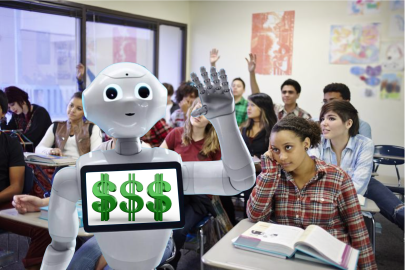
Picture of an actual Japanese robot teacher in use.


In his recent paper in Minds and Machines, Watson outlines three main ways deep neural networks (DNNs) like the ones we’re considering here “think” and “learn” differently from humans.


1) DNN’s are easily fooled. While both humans and AIs can recognize things like a picture of an apple, computers are much more easily led astray. Computers are more likely to misconstrue part of the background and foreground, for instance, while human beings naturally comprehend this difference. As a result, humans are less distracted by background noise.


2) DNN’s need much more information to learn than human beings. People need relatively fewer examples of a concept like “apple” to be able to recognize one. DNN’s need thousands of examples to be able to do the same thing. Human toddlers demonstrate a much easier capacity for learning than the most advanced AI.


3) DNN’s are much more focused on details and less on the bigger picture. For example, a DNN could successfully label a picture of Diane Ravitch as a woman, a historian, and an author. However, switching the position of her mouth and one of her eyes could end up improving the confidence of the DNN’s prediction. The computer wouldn’t see anything wrong with the image though to human eyes there definitely was something glaring incorrect.


“It would be a mistake to say that these algorithms recreate human intelligence,” Watson says. “Instead, they introduce some new mode of inference that outperforms us in some ways and falls short in others.”


Obviously the technology may improve and change, but it seems more likely that AI’s will always be different. In fact, that’s kind of what we want from them – to outperform human minds in some ways.


However, the gap between humanity and AI should never be glossed over.


I think that’s what technophiles like Bushweller are doing when they suggest robots could adequately replace teachers. Robots will never do that. They can only be tools.


For instance, only the most lonely people frequently have long conversations with SIRI or Alexa. After all, we know there is no one else really there. These wireless Internet voice services are just a trick – an illusion of another person. We turn to them for information but not friendship.


The same with teachers. Most of the time, we WANT to be taught by a real human person. If we fear judgment, we may want to look up discrete facts on a device. But if we want guidance, encouragement, direction or feedback, we need a person. AI’s can imitate such things but never as well as the real thing.


So we can displace teachers with these subpar imitations. But once the novelty wears off – and it does – we’re left with a lower quality instructor and a subpar education.


The computer HAL is not real. To borrow a phrase from science fiction author Philip K. Dick, Artificial intelligence is not yet “more human than human.”
 
Maybe it never will be.


The problem is not narrow minded teachers unwilling to sacrifice their jobs for some nebulous techno-utopia. The problem is market based solutions that ignore the human cost of steam rolling over educators and students for the sake of profits.


As a society, we must commit ourselves to a renewed ethic of humanity. We must value people more than things.


And that includes a commitment to never even attempting to forgo human teachers as guides for the most precious things in our lives – our children.


“Algorithms are not ‘just like us’… by anthropomorphizing a statistical model, we implicitly grant it a degree of agency that not only overstates its true abilities, but robs us of our own autonomy… It is always humans who choose whether or not to abdicate this authority, to empower some piece of technology to intervene on our behalf. It would be a mistake to presume that this transfer of authority involves a simultaneous absolution of responsibility. It does not.”

David Watson


Like this post? I’ve written a book, “Gadfly on the Wall: A Public School Teacher Speaks Out on Racism and Reform,” now available from Garn Press. Ten percent of the proceeds go to the Badass Teachers Association. Check it out!

thumbnail_IMG_8249

Sixteen Gadfly Articles That Made Betsy DeVos Itch in 2019


Screen Shot 2019-12-28 at 3.51.03 PM


“Life can only be understood backwards,” wrote Søren Kierkegaard, “but it must be lived forwards.”

 
I remember reading the Danish philosopher’s “Fear and Trembling” in my philosophy of religion class back in college.


To be honest I was never a big fan of his work – I thought if the only way to truth was taking a leap of faith, how many madmen have already reached enlightenment?


But he had a point when he wrote about the backwards order of perspective – that we can only understand the meaning of our lives once those moments have passed. How cruel that we must live our lives without knowing the importance of those moments until later.


The only times I remember knowing – really knowing – that I was living through an important moment were when I was married and when my daughter was born.


Other than those few instants of my life, I’ve wandered forward like an infant – unaware of whether this would really leave an indelible mark on the fabric of my reality or not.


And that’s not even mentioning what I’ve done – if anything – that has had an effect – any effect – on our larger shared reality.


It’s the same with writing a blog. I wrote 77 posts in 2019 – a full 32 less than last year. Yet my blog got 297,000 hits – 82,000 more than the year before.


However, which articles – if any – will have any staying power?


Will anything I wrote this year still be read in the days to come? Has any of it made a difference?


Maybe it’s foolish but that is what I’m trying to do.


I sit at my laptop pounding away at the keys as if any of it has an impact on the world.


A few weeks ago at the Education 
Forum in Pittsburgh – when the leading Democratic candidates for President actually seemed to have heard the education activist community’s concerns – it felt like what I had been writing really HAD made some sort of mark.


Then a week later when the Pittsburgh School Board decided to make cuts to services for students instead of raising taxes to meet costs beyond the district’s control, it felt like nothing I wrote really mattered. Really, Pittsburgh? You have the lowest millage in Allegheny County, but you can’t get the gumption to fund your schools? You’re beset by charter schools, pension costs and a mayor who refuses to put back tax revenue he was perfectly willing to use to help the city when it was in dire straights.


Does no one care about school children – if they’re poor and black?


Anyway, to the best of my knowledge, if anything I’ve written this year has made a difference, it was probably one of these articles.


I’ll include the usual top 10 list – a countdown of my most popular works this year – but I’ll end with six honorable mentions. These are articles that I feel personally proud of that wouldn’t qualify based just on sheer numbers alone.


I hope you enjoy this stroll down memory lane, and here’s hoping 2020 will leave the negativity behind while still continuing the positive change that may have crept in this year that was.


10) Standardized Testing is a Tool of White Supremacy


Screen Shot 2019-04-03 at 8.35.24 PM


Published: April 5


Views: 4,389


Description: Here’s the story of how standardized testing went from the eugenicist movement to the Barack Obama administration to continually enforce white power. High stakes testing is an instance of being color blind – when “post racial” just means racist and ignorant.


Fun Fact: I think the title really captured people’s attention. Black people have been saying this for decades, but the so-called mainstream has refused to listen. This article still gets a lot of readers in its incarnation on commondreams.org. I hope it provides easy proof of this point to stop the constant gas lighting from naysayers in every walk of life who can’t seem to grasp how something so pervasive can be so pernicious to people of color.


9) Six Problems with a Growth Mindset in Education


Screen Shot 2019-08-12 at 1.34.29 AM

 
Published: Aug. 12


Views: 4,678


Description: One of the most frequent excuses given for high stakes testing is that we can substitute growth for achievement. However, that idea has its own problems.


Fun Fact: A lot of folks have guzzled so much of the testing Kool-Aid that they simply refuse to accept the facts about cognition and development here. Growth has its place – but it doesn’t fit at all in a pedagogy based on standardized testing.


8) Standardized Tests Are Not Objective Measures of Anything


Screen Shot 2019-06-29 at 12.27.12 AM


Published: June 29


Views: 5,290


Description: Question – If standardized testing doesn’t assess student learning, what does it assess?Answer – not much. And certainly not what you thought it did.


Fun Fact: There will come a day when standardized tests are rightly considered pseudoscientific. This is my attempt to get this idea across to a larger audience. Audience reactions have ranged from giving me looks like I’m deranged to sighs at how obvious this is.


7) Every Charter School Must Be Closed Down – Every. Single. One.


Screen Shot 2019-09-07 at 11.17.21 PM

 
Published: Sept. 8


Views: 6,869


Description: The world finally seems to be realizing that charter schools are deeply problematic. But what to do with them? My answer is to shut them all down and any that actually provide value to their students should be transitioned to becoming authentic public schools.


Fun Fact: This article was partially in response to charter school critics who would say things on Twitter like “No one wants to shut down all charter schools, but…” No. I really do want to shut them all down. I think their time is up. We need to abolish this failed concept and move on to real education policies that actually have a chance at helping students.


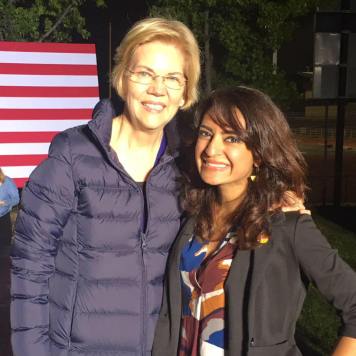
6) Charter School Teacher Introduces Elizabeth Warren at Rally


61665090_10109374029691176_8067465538567143424_n

 
Published: June 4


Views: 9,761


Description: Before Elizabeth Warren introduced her education policy, no one really knew where she stood on the issue. So many of us in the education activist community became worried when she had former charter school teacher Sonya Mehta introduce her at a California Rally.


Fun Fact: This article drudged up huge controversy over my characterization of Mehta. At first, I called her a “Charter school lobbyist.” This was unfair and I changed the article to reflect that. However, I was dragged in the media as an anti-Warren troll and Russian bot. Since Warren has released her education policy, I have written extensively about how really comprehensive it is. I think Warren is second only to Bernie Sanders in this race and even exceeds him in some areas of policy. But no one has yet to apologize to me for daring to question a political figure.


5) Teachers Are Not Responsible for Student Growth or Achievement


thumbnail_Screen Shot 2019-11-21 at 8.55.01 AM

 
Published: Nov. 29


Views: 11,188


Description: Teachers can’t make students learn. We can’t even make them grow. We can do lots of things to optimize the conditions for growth, but we are not ultimately responsible for the result. We’re only responsible for what we do to help bring it about.


Fun Fact: Lots of folks hate me for writing this article. Lots of folks love me for writing it. However, it was past time someone said it. Teachers make a huge impact on their students, but we are not magical. When you expect us to be wizards, you end up destroying our ability to do our jobs and you enable all the corporate testing and privatization hacks who build themselves up by tearing down our profession because we’re not magic.


4) Charter Schools Were Never a Good Idea. They Were a Corporate Plot All Along


Screen Shot 2019-09-14 at 6.02.02 PM

 
Published: Sept. 15


Views: 13,153


Description: Where did charter schools come from and what was their original purpose? Read here to find the facts.


Fun Fact: I wrote this article because of the common lie that charter schools were created by union president Albert Shanker to empower teachers. WRONG. They were created by Minnesota “policy entrepreneur” Ted Kolderie and privatization cheerleader Joe Nathan. This is an attempt to get the record straight. I hope it succeeds.


3) Are Teachers Allowed to Think for Themselves?


thumbnail_Screen Shot 2019-10-30 at 3.35.07 PM

 
Published: Nov. 7


Views: 22,041


Description: It’s kind of a simple question. Many administrators and school boards treat teachers like robots to be programmed and do what they’re told. But we’re also expected to display a large degree of autonomy. Which one is the real expectation because we can’t ultimately be both.


Fun Fact: This article was republished in the Washington Post and continues to be hugely popular. I think that’s partially because it calls out the elephant in the room in every faculty meeting, school board meeting and education policy session at local, state and the federal government. Maybe allow teachers to be part of the conversation if you really want to bring about positive change.


2) How Many Decisions Do Teachers Make Every Day?


94b755b2-ad1400b671f8ad28440f6a7067004614


Published: Jan. 5


Views: 27,286


Description: Answer – on average, teachers make at least 1,500 decisions a day. That comes out to about 4 decisions a minute given six hours of class time.


Fun Fact: This fact has been around since at least the 1980s. It represents the kinds of things we were interested in education before standardized testing and school privatization took over. And it has implications that go on for miles and miles and miles…


1) As LA Teachers Strike Over Charter Schools, Democrat Cory Booker Speaks at Pro-Charter Rally


thumbnail_corydonaldtrump


Published: Jan. 18


Views: 37,652


Description: In California, 30,000 Los Angeles teachers were on strike because charter schools are gobbling up their funding without providing the same level of quality services or accountability. Meanwhile in New Orleans, Sen. Cory Booker was giving the keynote address at a charter school rally.


Fun Fact: This raised the question of where the Democrats stand on education policy. And thankfully the Booker branch of neoliberals has been overpowered by the Sanders-Warren wing. We’ll see if this continues through the Presidential nomination and (hopefully) the next administration. Could it be a sea change in Democratic support for real, authentic education policy and away from standardization and privatization? Time will tell.


Honorable Mentions


6) Pittsburgh Mayor’s Tantrum About School Finances Proves He Doesn’t Understand Education or Equity


20190805dsPedutoLocal01-1567025449


Published: Nov. 17

 
Views: 3,237


Description: Mayor Bill Peduto refuses to give back millions of dollars in tax revenue to city schools that could help close budget gaps and provide the services students need. The money was given to the city when it was in financial distress, but now that the city situation has improved, the schools are calling for that money to be returned. Just simple fairness.


Fun Fact: This was one of the first times I really addressed Pittsburgh politics especially as it branches out from the schools. Readers were extremely interested and I seemed to have tapped into a real conversation about the mayor’s role in school politics.


5) Charter Schools Are Quietly Gobbling Up My Public School District


Screen Shot 2019-05-19 at 7.49.57 PM

 
Published: May 20


Views: 2,919


Description: The Propel charter school chain keeps getting more and more of Steel Valley Schools budget despite enrolling around the same number of kids. It is expected to get away with 16% of Steel Valley Schools’ entire $37 million yearly budget in the coming year. How is that fair?


Fun Fact: This is one of the first times I have written so openly about the district where I teach. The result was extremely positive. It really got people talking and put together a lot of information that – sadly – our local media has failed to compile. With the loss of neighborhood papers and the consolidation of newspaper budgets, it’s left to bloggers like me to do actual journalism.


4) Greater Test Scores Often Mean Less Authentic Learning

 
Screen Shot 2019-10-04 at 4.25.32 PM

 
Published: Oct. 5


Views: 2,580


Description: Standardized tests only assess ability at taking standardized tests. So if we misconstrue test scores for learning, we’re leaving out the entire universe of concepts and skills that are not and cannot be captured by those tests.


Fun Fact: I think this is an important point that can’t be emphasized enough. It frustrated some readers because they wanted the easy conflation between test scores and learning. But few things in education are that easy. This article outlines exactly where the tests go wrong. It’s a tour of the sausage factory that will leave anyone less hungry for standardization.


3) Top 7 Ways Technology Stifles Student Learning in My Classroom

 
Screen Shot 2019-07-30 at 9.25.31 PM


Published: July 31


Views: 1,991


Description: We have become too reliant on technology in schools. We’ve welcomed and incorporated it without testing it, or even reflecting upon whether it promises to offer better pathways toward student comprehension and discovery or whether it merely offers flash and novelty devoid of substance. And perhaps even more frightening, we have not investigated the ways in which using these technologies actually puts student privacy and intellectual growth at risk.


Fun Fact: It is essential we question our assumptions – especially about technology. Many teachers fund this article a breath of fresh air. Others condemned me as a technophobe. You be the judge.


2) The Last Day of School


thumbnail_IMG_8831


Views: 1,271


Description: I had a stronger connection with last year’s students than any group I’ve ever taught. I was their Language Arts teacher for two consecutive years – 7th and 8th grade. When our time ended, they even re-enacted the closing scene of “The Dead Poet’s Society” – a movie we had watched together in class.


Fun Fact: I will always treasure the two years I had with these children. They changed my life for the better and made me a better teacher. I am honored by their reviews of my teaching.


1) The Stink of Segregation Needs to End in Steel Valley Schools

 
ygateau_npred_borders1-c4f22c33fac1a9806e5df963b8b11ae67e707927-s800-c85

 
Published: Nov. 12


Views: 988


Description: The dark secret of my district is how deeply segregated our elementary schools are. I wrote about what the problem is and how I think we can solve it. This is about as real and raw as policy making gets.


Fun Fact: Again this was one of the first times I let myself talk so openly about my district and what I thought needed to be done to improve it. Community members have come forward to talk with me about it but the response from anyone in the district has been total silence. I hope we’re actually serious about making a change here. The community is crying out for it. Teachers want to help. Where we go in the future is anyone’s guess.


Like this post? I’ve written a book, “Gadfly on the Wall: A Public School Teacher Speaks Out on Racism and Reform,” now available from Garn Press. Ten percent of the proceeds go to the Badass Teachers Association. Check it out!
 

book-2

Eight Things I Love About Elizabeth Warren’s Education Plan – And One I Don’t

105863950-1555953359609senatorelizabethwarren

 
My daughter had bad news for me yesterday at dinner.


She turned to me with all the seriousness her 10-year-old self could muster and said, “Daddy, I know you love Bernie but I’m voting for Elizabeth.”

 
“Elizabeth Warren?” I said choking back a laugh.


Her pronouncement had come out of nowhere. We had just been discussing how disgusting the pierogies were in the cafeteria for lunch.

 
And she nodded with the kind of earnestness you can only have in middle school.


So I tried to match the sobriety on her face and remarked, “That’s okay, Honey. You support whomever you want. You could certainly do worse than Elizabeth Warren.”


And you know what? She’s right.


Warren has a lot of things to offer – especially now that her education plan has dropped.


In the 15 years or so that I’ve been a public school teacher, there have been few candidates who even understand the issues we are facing less than any who actually promote positive education policy.


But then Bernie Sanders came out with his amazing Thurgood Marshall plan and I thought, “This is it! The policy platform I’ve been waiting for!”

 
I knew Warren was progressive on certain issues but I never expected her to in some ways match and even surpass Bernie on education.


What times we live in! There are two major political candidates for the Democratic nomination for President who don’t want to privatize every public school in sight! There are two candidates who are against standardized testing!


It’s beyond amazing!


Before we gripe and pick at loose ends in both platforms, we should pause and acknowledge this.


Woo-hoo!


Both Sanders AND Warren are excellent choices for President. And Biden might even do in a pinch.


So in honor of my precocious political princess backing Elizabeth Warren – I THINK she knows she doesn’t actually get to vote, herself, yet! – I give you eight things I love and one I don’t in Warren’s education plan.


Things I like:


1)       IT INVESTS IN PUBLIC SCHOOLS.


WARREN’S PROPOSAL:  Quadrupling Title I funding — an additional $450 billion over the next 10 years for the neediest children and their schools. Finally have the federal government pay 40% of all special education costs – a promise lawmakers made years ago but never kept. Invest an additional $100 billion over ten years in “Excellence Grants” to any public school. That’s roughly $1 million for every public school in the country to buy state-of-the art labs, restore afterschool arts programs, implement school-based student mentoring programs, etc. By 2030, she’ll help 25,000 public schools become community schools. Invest at least an additional $50 billion in school infrastructure — targeted at the schools most in need.

 
WHAT I LIKE: Everything! Our public schools are crumbling under decades of neglect and targeted disinvestment – especially those serving the poor and minorities. This could be a game changer for the entire country!


2)       IT ACTIVELY WORKS TO INTEGRATE PUBLIC SCHOOLS.


WARREN’S PROPOSAL: Spend billions of dollars annually that states can use to promote residential and public school integration. This includes infrastructure like magnet schools but also integrating communities. Support strengthening and robust enforcement of Title VI of the Civil Rights Act of 1964. This prohibits discrimination on the basis of race in any program receiving federal funding.

 
WHAT I LIKE: Segregation is the elephant in the room in our nation. We can’t be a single country pursuing liberty and justice for all when we keep our people “separate but equal.” If you want to undo our history of racism, prejudice and xenophobia, we must get to know and appreciate each other from a young age. Plus it’s harder to horde resources for one group or another when all children are in one place.


3)       IT SUPPORTS ALL OUR STUDENTS.


WARREN PROPOSES: Protecting the rights of LGBTQ+ students, immigrant students and their families, English Language Learners, students of color, etc.

 
WHY I LIKE IT: I love my students – all of my students. It breaks my heart that the same system that’s supposed to provide them an education oftentimes allows them to be discriminated against.


4)       IT ELIMINATES HIGH-STAKES TESTING.


WARREN PROPOSES: In particular:

“The push toward high-stakes standardized testing has hurt both students and teachers. Schools have eliminated critical courses that are not subject to federally mandated testing, like social studies and the arts. They can exclude students who don’t perform well on tests. Teachers feel pressured to teach to the test, rather than ensuring that students have a rich learning experience. I oppose high-stakes testing, and I co-sponsored successful legislation in Congress to eliminate unnecessary and low-quality standardized tests. As president, I’ll push to prohibit the use of standardized testing as a primary or significant factor in closing a school, firing a teacher, or making any other high-stakes decisions, and encourage schools to use authentic assessments that allow students to demonstrate learning in multiple ways.”


WHY I LIKE IT: High stakes testing is a curse on the education field. It warps nearly every aspect of our school system with biased and inappropriate assessments. Good riddance!


5)       IT SUPPORTS FEEDING ALL STUDENTS – NOT SHAMING THEM FOR THEIR POVERTY.


WARREN PROPOSES: Canceling student breakfast and lunch debt. In particular:

“I will also push to cancel all existing student meal debt and increase federal funding to school meals programs so that students everywhere get free breakfast and lunch.”


WHY I LIKE IT: No child should have to go hungry – especially at school. No child should have to feel guilty for their parent’s economic situation. And feeding all children removes any stigma and helps create community.


6)       IT SUPPORTS TEACHERS.

 
WARREN PROPOSES: Providing funding for schools to increase pay and support for all public school educators, strengthen the ability of teachers, paraprofessionals, and staff to organize and bargain. In particular:


“I pledged to enact the Public Service Freedom to Negotiate Act, which ensures that public employees like teachers can organize and bargain collectively in each state, and authorizes voluntary deduction of fees to support a union.”

 
WHY I LIKE IT: A robust system of public education needs teachers who are respected and appreciated. You cannot have this when salary is based on the wealth of the community you serve. The only choice as far as I see it is to have the spender of last resort (the federal government) take up the slack. I know some of my fellow bloggers are nervous about this because these funds could come with strings attached. Pay could be contingent on teachers increasing student test scores or using certain corporate curriculum, etc. However, any tool can be misused. I don’t see this as necessarily being a backdoor for corporate shenanigans, but we certainly must be cautious.


7)       IT FIGHTS THE CORRUPT SCHOOL PRIVATIZATION INDUSTRY.


WARREN PROPOSES: Ensuring charter schools are subject to at least the same level of transparency and accountability as traditional public schools. In particular:


“…I support the NAACP’s recommendations to only allow school districts to serve as charter authorizers, and to empower school districts to reject applications that do not meet transparency and accountability standards, consider the fiscal impact and strain on district resources, and establish policies for aggressive oversight of charter schools.”


Ending federal funding for the expansion of charter schools. Banning for-profit charter schools including non-profit charter schools that outsource their operations to for-profit companies. Directing the Internal Revenue Service (IRS) to investigate “so-called nonprofit schools that are violating the statutory requirements for nonprofits.”

 
WHAT I LIKE ABOUT IT: Everything! This is where Warren’s proposal really shines! She is even more comprehensive than Sanders’! She doesn’t stop with just “for-profit” charter schools but understands that many of these institutions circumvent the rules even without that tax status.


8)       IT PROTECTS STUDENT DATA FROM ED TECH COMPANIES AND BEYOND.


WARREN PROPOSES: Banning the sharing, storing, and sale of student data. In particular:


“My plan would extend the Family Educational Rights and Privacy Act (FERPA) to ban the sharing, storing, and sale of student data that includes names or other information that can identify individual students. Violations should be punishable by civil and criminal penalties.”

 
WHAT I LIKE ABOUT IT: Ed tech companies are seen for the danger they bring to education. Students are protected from having their entire lives impacted by the choices of ignorant school administrators or school directors. The road to the replacement of public school with digital alternatives is recognized and blocked.


And this just scratches the surface. These are just the points that jumped out at me on a first read.


I’m sure there is more policy gold in here we’ll find as the election season progresses.


However, there was one thing that jumped out at me in a less positive light.
 
One thing I did not like:


1)      WARREN’S EMPHASIS ON “CAREER AND COLLEGE READINESS” SOUNDS TOO MUCH LIKE THE WORST OF BARACK OBAMA’S EDUCATION POLICY.


On the one hand, Warren says unequivocally that she’s against high stakes testing. Then on the other she writes:


“We must also ensure that students are able to take advantage of those opportunities and that high schools are funded and designed to prepare students for careers, college, and life…

…I’ll work with states to align high school graduation requirements with their public college admission requirements. And I’ll also direct the Department of Education to issue guidance on how schools can leverage existing federal programs to facilitate education-to-workforce preparedness.”


This sounds an awful lot like Race to the Top and Common Core.


Is she really proposing all public schools have the same top-down academic standards? Is she proposing states force corporate-created academic standards on their schools? And is she threatening to use the power of the federal government – possibly the power of the purse – to make states and schools fall into line?


Warren needs to understand that Common Core cannot be separated into curriculum and testing. The testing drives the curriculum. You can’t say you’re against testing being used to make high stakes decisions and then have that same testing determine what is taught in schools.


Perhaps this isn’t her intention at all. But she needs to be asked and she needs to give a definitive answer.


Obama was all about teacher autonomy, too, before he got into office.


And that’s really the biggest issue for most education advocates like me.


We’ve been burned so many times before by politicians, it’s hard to accept that any of them might actually be serious about doing something positive for children’s educations.


I’m still a Bernie Sanders supporter. I’ll admit that.


But Warren has gone a long way with this proposal to getting me into her corner, too.


In the primary, I’ll probably continue to feel the Bern.


But who knows? In the general election, perhaps my daughter and I will get to root for the same candidate.


I’m extremely thankful to Warren and her team for coming up with such a thoughtful and detailed education plan. It couldn’t have been easy – either to draft or politically.


It really does appear to be an attempt not just to sway voters but to actually get things right.


Here’s hoping that voters do the same in about a year.


Like this post? I’ve written a book, “Gadfly on the Wall: A Public School Teacher Speaks Out on Racism and Reform,” now available from Garn Press. Ten percent of the proceeds go to the Badass Teachers Association. Check it out!

book-4

The Absurdity of Standardized Testing: Caught Between Prediction and Assessment

thumbnail_Screen Shot 2019-09-19 at 2.07.03 PM

 
Standardized testing is truly absurd.

 
It’s both a prediction and an assessment.


You take a test to determine what you’ve learned and that will in turn predict what you will be able to learn in the future.


We hardly ever do this anywhere else in life.


We don’t measure babies’ leg muscles to predict whether they’re ready to walk. We let them do what they do, possibly with some encouragement and positive models of locomotion, and they do it.


There are cognitive and developmental benchmarks we look for, and if children don’t hit them, we provide help. But no further prediction is necessary – certainly not based on artificial markers put together by corporate interests.


In most situations, predictions are superfluous. We just assume that everyone can learn if they so desire – unless something happens to make us think otherwise. And whether someone actually learns something is demonstrated by doing the thing, itself.


The only time we link prediction and assessment so closely is when the consequences of failure are irreversible – like when you’re going solo skydiving for the first time. If you jump out of an airplane and don’t know how to pull the ripcord to get your parachute to work, you probably won’t get a second chance to try again.


But most things in life aren’t so dire.


The world of standardized testing is very different. The high stakes nature of the assessments are what ramp out the consequences and thus the severity.


Testing looks at learning like two points on a map and sets up a gate between points A and B.


In order to cross, you have to determine if you’ve passed through the previous gate. And only then can you be allowed to progress on to point C.


But this is wrong on so many levels.


First, you don’t need a test to determine which point you’re at. If Point B is the ability to add, you can simply add. If it’s the ability to write a complete sentence, you can simply write a sentence.


There is no need to fill out a formal multiple-choice assessment that – depending on the complexity of the task being considered – is completely inadequate to capture the subtleties involved. The task, itself, is enough.


Imagine if you were testing whether someone had learned how to drink a glass of water. You could just give them a cup filled with H2O and see if they can gulp it down. Or you could have them sharpen their number 2 pencil and answer questions about how their throat works, their digestive and excretory systems and the chemical composition of agua – all answers predetermined to A, B, C or D.


Observation of a skill, we are told, is not enough to determine success because it relies on the judgment of an observer. A standardized test replaces the observer with an impersonal, distant testing corporation which then assesses only predetermined markers and makes decisions devoid of any situational context.


This is done to remove observational bias but it doesn’t avoid bias altogether. In setting up the markers and deciding which elements of the task are to be assessed (or in fact can be assessed in such a distant manner), the testing corporation is inserting its own biases into the process. In fact, in any assessment conducted by human beings, this would be inevitable. So going through this maze of perceived objectivity is really just a matter of subterfuge meant to disguise the biases of the corporation.


Second, assessing people in this way is extremely unnatural because very few fields of knowledge can be divided and subdivided into two or more discrete points.


When writing a complex sentence, for example, you need to know not just spelling and grammar but logic, handwriting, subject matter, colloquialisms, literary devices, and a plethora of other cultural and linguistic artifacts.


Moreover, there is not always a natural progression from Point A to B to C. Sometimes A jumps directly to C. Sometimes B leads directly to A. Sometimes A leads to Z.


Knowledge, skills and human cognition are far too complex a web to ever hope to be captured by such a reductive enterprise. But by insisting that we make this complexity fit into such a small box, we end up depriving people of the right to move on. We say predictive models show they aren’t ready to move forward and so we bury them in remediation. Or we deny them access to important opportunities like advanced classes, electives, field trips, extracurricular clubs or even post-secondary education.


Third, this emphasis on knowledge as discrete bits of information or skills (often called standards) leads to bad teaching.


Assessment expert W. James Popham provides a helpful distinction: “curriculum teaching” vs. “item teaching.” Curriculum teachers focus on the full body of knowledge and skills represented by test questions. For instance, if the test is expected to include questions about decimals, the teacher will cover the full range of knowledge and skills related to decimals so students understand what they are, know how to manipulate them, understand how to use them to solve more complex problems, and are able to communicate about them.


By contrast, item teaching involves narrowing instruction, organizing lessons around look-a-like questions that are taken directly from the test or represent the kinds of questions most likely to be found on the test. In this way, the teacher only provides the chunks of knowledge students are most likely to encounter on exams. For instance, item teachers might drill students on a certain set of vocabulary words that are expected to be assessed rather than employing instructional strategies that help students build a rich vocabulary that best contributes to strong reading comprehension.


A focus on standardized testing or even trying to educate in a system where these tests are attached to high stakes, results in an increase in item teaching. We often call it teaching to the test.


I’m not saying that item teaching is always bad. But curriculum teaching is to be much preferred. It is a best practice. The problem is when we resort to endless drills and give students innumerable questions of the exact type we expect to be on the test.


So when we find students who have made dramatic improvements on standardized tests, we often don’t find equal improvements in their over all knowledge or ability.


Test scores are often a false positive. They show students have mastered the art of taking the test but not necessarily the knowledge or skills it was meant to assess.


They are more like trained circus animals who can jump through flaming hoops but would be lost in the wild.


That’s why certain computer modeled artificial intelligences are able to pass standardized tests but would fail preschool.


These reflections have troubling implications for our system of standardized testing.


The false curtain of objectivity we’ve set up in our assessments may also be hiding from us what authentic learning is taking place and it may even hinder such learning from taking place at all.


Any sane society would halt such a system with these drawbacks. It would stop, regroup and devise a better alternative.


To continue with such a pedagogical framework truly would be the most absurd thing of all!


Like this post? I’ve written a book, “Gadfly on the Wall: A Public School Teacher Speaks Out on Racism and Reform,” now available from Garn Press. Ten percent of the proceeds go to the Badass Teachers Association. Check it out!
book-2

Inside Bill Gates’ Hubris: Propaganda to Make America Neoliberal Again

Screen Shot 2019-08-31 at 11.16.53 PM

 
Once upon a time, the world was run by rich men.


And all was good.


But then the world was conquered by other rich men.


And that is something the first group of rich men could not allow.


That is the reason behind Netflix’s new film “Inside Bill’s Brain: Decoding Bill Gates.”


The three-part documentary goes live on Sept. 20. But the film’s aims are clear from the trailer.


It’s a vanity project about Bill Gates, the second richest man in the world.
By examining his mind and motivations, director and executive producer Davis Guggenheim will show us how Gates deserves his billionaire status and that we should allow him to use his philanthrocapitalist ventures to rule the world.


After all, shouldn’t the best and richest among us make all the decisions?


It’s a cry for oligarchy in an age of idiocracy, a love letter to neoliberalism in a time of neofascism.


The pity is that Donald Trump and the “Make America Great Again” crowd have goose stepped all over their new world order.


But instead of showing the world why we need to return to democratic principles, strengthen the common good and empower the people to govern themselves, some would rather continue the same plutocracy just with a different set of plutocrats at the wheel.


In the days of Obama, the Bushes and Clinton, it wasn’t membership in the same political party that defined the ruling class. It was holding the same ideology.


It’s not that neoliberals were so much wiser, ethical or empathetic than Trump. They just kept their greed a secret or tried to make it seem a virtue. They told better lies and didn’t incite as much violence on our shores, and they were better at manipulating markets to make themselves richer while keeping the rest of us relatively poorer.


The MAGA insurgents are also rich men, but their greed is transparent. They lie and no one expects them to tell the truth. They can freely dismantle the social safety net because they stoke our prejudices and keep us fighting over race, gender and abortion so much we forget they’re robbing us blind. And when the market crashes, they don’t have to care because they’ve stolen everything of value and can weather the economic depression that will destroy the nation.


Neofacism is certainly worse – but it’s only a difference of degree, not of kind.


It’s no wonder then that the neoliberals want to make us nostalgic for their brand of simmering destruction instead of Trump’s rapid boil disasters.


And Gates is the perfect poster child for old style neoliberalism.


He’s the former CEO of Microsoft and – together with his wife – the founder of the Bill and Melinda Gates Foundation.
In the trailer, Gates confides that his deepest fear is that one day his brain will “stop working.”


Gates is a “multiprocessor” says his wife Melinda. “He will be reading something else but then processing at the same time. It’s chaos!”


Gates “thrives on complexity,” Melinda says. “He makes a framework in his mind, then he starts slotting in the information. If something doesn’t line up, he gets really frustrated.”


“It’s scary,” says Melinda. “But when Bill stills himself, he can pull ideas together that other people can’t see.”


Thus we gain a picture of a brilliant man striding over a world populated by intellectual inferiors. How foolish we would be to question his authority!


And since his intelligence has enabled him to hoard more money than almost anyone else in the world, why shouldn’t we let him use this economic power to change it for our benefit?


It’s truly one of the most patronizing, paternal and insulting pieces of propaganda I’ve ever seen in my life. And that includes Guggenheim’s previous movies.


Guggenheim is, after all, the man behind the most notorious propaganda film of modern times, “Waiting for Superman.” Back in 2010, he popularized the school privatization of Bill Clinton, George W. Bush and Barack Obama. He made charter schools cool until Betsy DeVos came along and made them uncool again.

 
Though I can’t imagine what could possibly be cool about for-profit schools run by appointed bureaucrats that can discriminate against students in enrollment, skimp on special education services and cut academic programs for students while pocketing the savings! All while gobbling up funding for the public schools that try to educate everyone!

 
More recently, he tried to pull the same sleight of hand for education technology firms in 2013 with the film “Teach,” but by then no one was really paying attention to him.


And for all that time his ventures have been backed by the richest neoliberals out there – Netflix CEO Reed Hasgtings, Amazon founder and CEO Jeff Bezos, eBay founder Jeff Skoll, and Salman Khan of Khan Academy.


Sure these folks are usually identified as Democrats, but their philosophy is completely in line with The Walton Family Foundation, Charles Koch, Walden Media (run by creationist Philip Anschutz), and lobbying groups such as the Lumina Foundation, the New American Foundation, and others.


Oh! And let’s not forget Bill Gates, himself, who has bankrolled a number of Guggenheim’s projects including “Waiting for Superman.”


It’s no wonder Guggenheim is making a fawning tribute to Gates. He owes the man!


It’s time to pay back his sugar daddy with what he does best – agitprop public relations.


Yes, Gates is a very intelligent person.


But he is also a very stupid one.


When it comes to computers, few people can beat him. But like so many overprivileged people, he takes excellence in one area to mean excellence in all areas.


And that’s just not how things work.


The ancient Greek philosopher Socrates famously bragged that he was the wisest person in Athens – not because he knew so much more than everyone else but because he was the only person who knew that he didn’t know anything.


Gates could have learned something from that humility, because it’s the trait he is most lacking.


Take public education.


No one has had a greater negative impact on public schools than Gates. With his so-called philanthropic contributions, he has steered the course of education policy away from research-based pedagogy to a business-minded approach favored by corporate raiders.

 
He didn’t come up with Common Core State Standards, but he did bankroll them. He bribed the state and federal government to force their schools to adopt the same or similar academic standards for all students. Not good standards. Not standards developed by classroom teachers, psychologists or experts. But standards created by the standardized testing industry.


The result has been more high stakes standardized tests, narrowing the curriculum, shrinking education budgets for the poor and minorities, and an increase in developmentally inappropriate approaches to education. Nearly every parent with a school age child will tell you horror stories of attempting to do homework with their children and having to relearn basic math and English skills just to untwist the needlessly complex knot that children are expected to unsnarl in order to grasp the bare basics of academia.


Gates poured billions of dollars into that failed initiative, spent hundreds of millions of dollars for development and promotion and influenced trillions of taxpayer dollars to be flushed down the drain on it. All to no avail.


But it’s not his only education policy failure.


Gates now admits that the approximate $2 billion he spent pushing us to break up large high schools into smaller schools was a bust.

 
Then he spent $100 million on inBloom, a corporation he financed that would quietly steal student data and sell it to the corporate world. However, that blew up when parents found out and demanded their children be protected.


He also quietly admits that the $80 million he spent pushing for teachers to be evaluated on student test scores was a mistake. However, state, federal and local governments often still insist on enacting it despite all the evidence against it. Teachers have literally committed suicide over these unfair evaluations, but it hasn’t stopped Gates from continuing to experiment on the rest of humanity with his money.


And he’s still at it.


His new plan has been to spend $1.7 billion over five years to develop new curriculums and networks of schools, use data to drive continuous improvement, and give out grants to high needs schools to do whatever he says.


There’s nothing wrong with someone wanting to help improve public schools. But the best way to do that is to listen to the people most knowledgeable and invested and then give them the tools they need to succeed.


But Gates doesn’t play that way. He reads up on a subject and then comes up with his own harebrained schemes.


“It would be great if our education stuff worked, but that we won’t know for probably a decade,” he said during a speech at Harvard in 2014.


Lots of people know, Bill. Teachers, students, parents, psychologists, professors. You just won’t listen to us.


You just insist the rest of us listen to you despite the fact that you have no idea what you’re talking about.


You’re rich and you think that makes you better than us.


And Guggenheim’s documentary purports to support this position by reference to Gates’ incredible brain.

He is a smart guy. No one would really contradict it.


He was a National Merit Scholar who scored a 1590 out of 1600 on his SATs. But he also comes from a very privileged upbringing.


He didn’t grow up on the mean streets of urban America while attending a neighborhood public school. He went to an elite preparatory school since he was 13.


At Harvard he wasn’t a polymath. He excelled in subjects he cared about, but neglected others that weren’t immediately interesting. According to a college friend:


“Gates was a typical freshman in many ways, thrown off pace by the new requirements and a higher level of competition. He skipped classes, spent days on end in the computer lab working on his own projects, played poker all night, and slept in a bed without sheets when he did go
 to bed. Other students recall that he often went without sleep for 18 to 36 hours.”


Gates was no genius. He earned good grades in the subjects he liked and significantly less so in classes he didn’t. Nor was his heart in his studies. Gates joined few college activities unless someone dragged him off to a party.


School was of little interest to him. He dropped out of Harvard before getting a degree to start his computer software company.


Imagine how privileged you have to be to feel empowered to do that!


Nothing much was at stake for him at school so he could do whatever he liked with little to no real life consequences.


You want to decode Bill’s brain? Look at his family’s wealth. Look at his upbringing. Look at his medical records.


But the moral of the story of Bill Gates is not that rich elites should rule the world.


It is that everyone – EVERYONE – should practice humility and not deign to think they have all the answers.


It is a paean to the need for collaboration to solve problems, the need to listen to all voices and decide the best course together.


And more than anything it is a desperate cry for democracy and social goods – not to defeat Trump through Gates’ example – but to lead to real human flourishing by smashing through the fallacies supporting Trump and Gates together.


Like this post? I’ve written a book, “Gadfly on the Wall: A Public School Teacher Speaks Out on Racism and Reform,” now available from Garn Press. Ten percent of the proceeds go to the Badass Teachers Association. Check it out!

book-2

What Kind of A—hole Ransoms School Data?

Screen Shot 2019-08-28 at 10.47.05 PM

 
You’ve got to be a grade A sleaze bag to steal from kids’ public schools.


But that’s exactly what a growing number of slime balls are doing when they hack into schools’ computer networks and hold their data for ransom.


Even worse – districts are paying it!


Just this week the Rockville Center School District in New York state paid an $88,000 ransom to get back files that had been encrypted by Ryuk ransomware.


The district negotiated the payment down from $176,000. School directors only decided to pay after realizing it would cost more to hire another firm to fix the problem.


Plus the school had insurance that covered ransomware so it only ended up losing its $10,000 deductible.


But this district isn’t the only one being extorted by these basement dweller bandits.


In July, alone, schools in New Mexico, Nevada, Louisiana, Oklahoma, Alabama, Connecticut and another in New York suffered similar cyber attacks.


Nor do they show any signs of slowing down.


A report by cybersecurity firm Recorded Future concluded that attacks on state and local governments have reached an all time high. There were 170 cyber attacks since 2013, of which 22 occurred just this year.


After years of budget cuts and downsizing, hackers see local governments like wolves see the oldest and weakest animals in the herd – easy pickings.


And schools are particularly vulnerable.


They often have small IT departments, antiquated equipment and the cheapest cybersecurity.


That’s why in recent months schools in Lake City, Fla.; La Porte County, Indiana; and Riviera Beach, Fla. have all paid ransoms to regain access to their data.


If you think about it, data is one of the most financially valuable things schools have.


Districts are responsible for students’ privacy in so many ways – records of special services, grades, accommodations, discipline, etc. In addition, schools are large employers with privileged information on their staffs including healthcare, finances, insurance, social security numbers, etc.


School directors and administrators have a responsibility to safeguard this information. It’s no wonder, then, that many are giving in to these demands, especially when nefarious nonentities ensure payment is cheaper than any other alternative.


Even so, what a monster you have to be to squeeze schools in order to make a buck!


Every dollar you blackmail away from district coffers is a dollar not spent on children’s educations.


That’s less money for teachers, supplies, classes, tutors, nurses, counselors, etc.


You aren’t stealing candy from a baby. You are literally snatching away opportunities for a better future.


Given the stakes involved, it shouldn’t be all up to individual districts to stop cyber thieves. The state and federal government should be flexing their muscles to help.


One thing they can do is toughen laws against using ransomware.


Maryland legislators proposed a law to consider ransomware attacks that resulted in a loss of more than $1,000 as a felony, which would then be subject to a fine of up to $100,000 and 10 years in jail.


Current Maryland laws define such attacks that extort less than $10,000 as misdemeanors, while only a breach that results in a loss of greater than $10,000 is a felony.


But some argue that there are already federal laws on the books criminalizing ransomware such as The Computer Fraud and Abuse Act and the Electronic Communications Privacy Act. Unfortunately, these laws don’t mention ransomware specifically and may be too broad.


Federal and state governments could at least offer grants to update school cybersecurity to make such attacks more difficult. Otherwise, the burden becomes an exponential increase in the cost of doing business for schools which can only be made up by increasing local taxes and/or cutting student services.


Another option would be setting up a federal program to step in whenever schools are victims of ransomware. After all, these are public schools! If they were under attack by armed terrorists, the federal government wouldn’t think twice before jumping in.


With federal resources, perhaps we could stop all schools from ever paying these ransoms again. Because that’s the only way to truly end these cyber attacks.


As long as schools and governments are willing to pay, there will be trolls unscrupulous enough to take advantage.


Public services set up to meet the public good should never have to shortchange society so they can meet some fool’s ransom demand.


Ransomware has been around since at least 2012. The largest incident so far came last year with the WannaCry attack which infected more than 200,000 computers in about 150 countries, including the United Kingdom’s National Health Service, at a cost of about $4 billion.


It’s past time we got serious in dealing with these cowards.


As technology increases, data crimes have become more common. In fact, there are far too many legal ways to pilfer private data.


Schools, in particular, do a bad job of safeguarding student data by entering into unregulated and nefarious contracts with ed tech companies. Contracts with these companies commonly contain loopholes allowing them to take student data at will and sell it.


The situation is worsened by the supply-side economic policies governing public schools. There are already numerous roads to privatize public schools and turn tax dollars into corporate profits. Moreover, the standardized testing industry monetizes learning when their services are mandated by the state and federal government. They conveniently offer to remediate the large numbers of students who don’t score well on these same tests and cash in on both ends.


With so many fully legal ways to steal education dollars from practices and policies that actually help kids learn, it’s no surprise where these shadow dwellers get their ideas.


As repulsive and selfish as these hackers are, they’re only taking the greed of the testing, privatization and ed tech industry to its logical conclusion.


What kind of a—hole ransoms school data?


The a—holes we allow to get away with it.


Like this post? I’ve written a book, “Gadfly on the Wall: A Public School Teacher Speaks Out on Racism and Reform,” now available from Garn Press. Ten percent of the proceeds go to the Badass Teachers Association. Check it out!

book-1

Blaming Schools for Student Absences is Like Denouncing Doctors for Disease

12-22-18-Attendance-1-tle-1100x682

 
If something is wrong with children, it must be the school’s fault.


Right?


If kids can’t read, write and do ‘rithmetic, the teachers must not have taught ’em right.


It couldn’t have anything to do with home life, generational poverty, economic inequality and systemic racism.


Except that it almost always does.


Inextricably.

 
The fact is children who don’t live in safe, loving homes have much greater difficulty concentrating and caring about academics. Kids with impoverished parents are much more likely to go to underfunded schools and sit in classrooms that are racially segregated.


None of that is under the control of teachers or schools, but a focus on high stakes standardized testing, school privatization and dangerously unregulated ed tech hides the problem.

 
It’s not that teachers don’t teach. Inequality, prejudice and privatization – these are the root causes and the reason we do nothing about them generation after generation is that we have an easy scapegoat in the public schools in general and public school teachers in particular.

 
Take student absences.


It’s a huge problem.


When kids don’t show up to school, they learn less. It’s a simple concept.


Yet just four years ago when we had a chance to rewrite the federal law governing public education to actually DO SOMETHING about the problems we’re facing, we dropped the ball. Again!


The Every Student Succeeds Act (ESSA) requires states to include five indicators measuring school performance: four based on academic achievement, and a fifth, “non-academic” measure of student success.


Most states have adopted chronic student absenteeism as this “fifth indicator.”


So we take those five indicators, weight them and combine them together to get overall school scores that are used to sort and rank educational institutions. That way we can prioritize funding to the highest performers and withhold it from the lowest.


It’s the same supply side nonsense we’ve been doing for years with a few numbers moved around and given a different name.


Schools overflowing with resources serving rich white kids get a sticker. Schools starving for resources serving poor brown kids get a kick.


And somehow that’s supposed to help things get better.


Don’t get me wrong. Absenteeism is important.


Nearly 8 million students missed 15 or more days of school in 2015-16 — an increase from the 6.8 million who missed the same amount in 2013-14, when the federal Department of Education began tracking the data. And there’s a mountain of research that links chronic absenteeism with poor academic performance, delayed graduation, and increased dropout rates.


But putting it all on neighborhood schools and local districts is a huge abrogation of responsibility.


By and large, public schools do not cause students to be absent. Nor do they have the resources to ensure these students start attending.


But we’ve found someone to blame and that’s really all this whole exercise was about in the first place.


It’s like denouncing your doctor for your disease. It won’t cure you, but it might make you feel justified as you die.


The reasons students are chronically absent have little to do with individual schools.


According to Attendance Works, a non-profit focusing on ways to improve student attendance, the main causes of chronic absences are:


•Chronic disease or lack of health care and/or dental care.


•The need to care for siblings or other family members.


•Unmet basic needs: transportation, housing, food, clothing, etc.


•Trauma.


•Feeling unsafe getting to school.


•Academic or social struggles.


•Being teased or bullied.


•Poor school climate or unsafe schools.


•Parents had negative school experience.


•Lack of engaging and relevant instruction.


•Peer pressure to be with peers out of school vs. in school.


•No meaningful relationships with adults in school.


•High suspension rates and disproportionate school discipline.


Certainly some of these things are under the control of school directors, administrators, and teachers.


Schools can and should provide safe ways for students to get to and from school. They should work to reduce bullying and make school a welcoming place for all children. They should provide engaging instruction, fair discipline policies and reach out to parents and the community.


But most schools are already doing that – or certainly trying to do that within the confines of their budgets.


My own Western Pennsylvania district has been flagged by the Commonwealth for increasing chronic absences. In the state, this is defined as students with 10 or more unexcused absences. We’ve been put on an improvement plan – which basically means an employee at the state Department of Education wagging his finger and telling us to get better or else.


However, the overarching problem and solution are easy to see. We are a district without busing.


The high school and middle school sit on top of a hill. Students who live in the poorer sections of town at the bottom of the hill have to walk or take public transportation daily to get to school.


It’s no wonder that some of them don’t do that every day and stay home instead.


However, we serve a mostly impoverished population. Decades ago, school directors decided it would be more cost effective to save money on busing so they could provide greater services for students. Yet as the economy has continued to stagnate and funding has become even more hard to come by, attendance has worsened.


So what are we to do? Cut services and add buses?


Doing so would mean we’d have to bus students to local charter schools as well, increasing the burden on taxpayers and the amount of muscle and bone we’d have to cut from our own academic programs.


It’s all very well and good to have the federal government tell us that attendance is important – but where is the help to improve it?


As with everything else in education, we get threats and the promise of economic sanctions but nothing in the way of assistance, aide or intervention.


We could be working together to try to solve this and other social issues. We could pool resources and construct social programs to help parents get jobs, set up stable homes, fund robust systems of public transportation, and a host of social services for students and their families such as tutoring, counseling, child care, and continuing education classes. We could end discriminatory policies such as school segregation, school privatization and high stakes standardized testing.


But doing so would mean abandoning the blame game and nothing has worked better to shield the rich from paying their fair share than pointing fingers at the less privileged and those who dedicate their lives to help them.


In truth, the problems with public schools are rarely the teachers.


It’s that society has written them off and refuses to take responsibility for its own role in supporting the next generation.


Like this post? I’ve written a book, “Gadfly on the Wall: A Public School Teacher Speaks Out on Racism and Reform,” now available from Garn Press. Ten percent of the proceeds go to the Badass Teachers Association. Check it out!

book-4

Top 7 Ways Technology Stifles Student Learning in My Classroom

Screen Shot 2019-07-30 at 9.25.31 PM

 
As a middle school teacher, I have real concerns about the ways technology is used in the classroom and the effects it’s having on students.


That does not make me a technophobe.


The fact that you are reading this article on a blog – a regularly updated Website containing personal writings or a weBLOG – should prove that point.


I use technology in my everyday life and in many ways find it indispensable.


However, that does not mean I embrace all uses of technology just as criticizing some forms does not mean I think we should get rid of them all.


But after 17 years of teaching, I have legitimate concerns about what all this technology is doing to our students and our schools.


I have seen technologies come and go. Some – like a computerized grade book – have been extremely helpful, and I would not want to have to do my job without them.


Others have fallen by the wayside, been discontinued or proven a waste of time or even worse – they’ve become impediments rather than assistants to student learning.


In general, I think we have become too reliant on technology in schools. We’ve welcomed and incorporated it without testing it, or even reflecting upon whether it promises to offer better pathways toward student comprehension and discovery or whether it merely offers flash and novelty devoid of substance. And perhaps even more frightening, we have not investigated the ways in which using these technologies actually puts student privacy and intellectual growth at risk.
So, without further ado, here are the top 7 ways technology stifles student learning in my classroom:


1) It Stops Kids from Reading


I’m a language arts teacher. I want my students to read.


I could simply assign readings and hope students do them, but that’s not practical in today’s fast-paced world. When kids are bombarded by untold promises of instant gratification, a ream of paper bordered by cardboard doesn’t hold much of a claim on their attentions.


So like many teachers, I bring reading into the classroom, itself. I usually set aside class time every other day for students to read self-selected books for about 15 minutes. Students have access to the school library and a classroom library filled with books usually popular with kids their age or popular with my previous students. They can pick something from outside these boundaries, but if they haven’t already done so, I have them covered.


In the days before every student had an iPad, this worked fairly well. Students often had books with them they wanted to read or would quickly select one from my collection and give it a try.


Sometimes when there was down time in class, when they had finished assignments or tests early, they would even pick up their self-selected books and read a little.


What a different world it was!


Now that every student has an omnipresent technological device, this has become increasingly impossible. I still set aside 15 minutes, but students often waste the time looking for an eBook on-line and end up reading just the first chapter or two since they’re free. Others read nothing but the digital equivalent of magazine articles or look up disparate facts. And still others try to hide that they’re not reading at all but playing video games or watching YouTube videos.


Even under the best of circumstances, the act of reading on a device is different than reading a printed page.


The act of reading traditional books is slower, closer and more linear. It’s the way teachers really want kids to read and which will most increase comprehension.


Reading on a screen is a product of social media. We scroll or scan through, seeking specific information and clicking on hyperlinks.


The old style of reading was transformative, absorbing and a much deeper and richer experience. The newer style is more superficial, mechanical and extrinsic. (And, Yes, I’m aware of which style of reading you’re engaged in now!)


To be fair, some students actually prefer reading eBooks on devices and may even experience the richness of the original style. But they are few and far between. Usually students use the devices to escape from the deeper kind of reading because they’ve never really done it before and don’t understand what it really is. And when they have this choice, they may never find out.


2) It’s a Distraction


As a teacher, I want my students to be able to focus on one thing at a time. There are situations and assignments that call for multitasking, but usually we need students to be able to look at text closely, examine an argument, identify figurative language or write creatively, etc. They can’t do that if they’re constantly checking their devices.


We have to admit that iPads, laptops, social media, etc. are addictive. If given the chance, many teenagers will spend hours there. Heck, many adults will, too. It’s common for students to rush through assignments to get back to watching videos about the latest on-line gaming trend Fortnite, or listen to music with earbuds, or others such things.


Technology is usually associated in their minds with entertainment, not education. I’m not saying that technologies don’t have their place. If you want to look up information quickly, devices are great. But the most common words I tell my students on any given day are “Apples up.” In others words, turn your iPads face down and focus on the lesson at hand.


3) It’s Unhealthy


For most students, technology is not a novelty. It is something with which they already have a lot of experience. Many studies find that kids between the ages of 13-18 spend up to 18 hours a day in front of a screen.


Why are we adding to that in the classroom?


Children need face-to-face interactions. They need to learn social skills, how to communicate with people, not screen avatars. They need time outdoors, time to get up and move around and interact with the world. Heck! They need unstructured time where they actually experience boredom and have to find ways to cope.


We’re robbing them of these skills by giving in to the electronic nanny. And it’s creating children who are less able to survive without that technological crutch.


As technology has become more widespread in my classes, I’ve noticed attention spans decreasing. So has self control, mindfulness and an ability for critical thinking.


4) It Costs Too Much


Public schools are already grossly underfunded. We have to pick and choose the most effective tools to help kids learn. Technology is often very expensive and takes away valuable money and resources that could be better spent elsewhere.


And the way these technologies are marketed is often reminiscent of the drug trade. The first uses are free. But if you want to expand, it will cost.


Even those that don’t demand briefcasefulls of cash often recoup their costs by collecting and selling student data.


In the school system, we are privy to an enormous amount of information about the children in our care – information that we are tasked with keeping safe. Ed tech software and technologies also routinely collect data on students. But they are not as constrained or legally responsible for it in the way schools and teachers are.


Some of the data technologies collect is indeed necessary for whatever task they perform – tabulating which questions students get correct and incorrect, etc. However, much of it is unnecessary for those tasks – information about student preferences or marketing information.

 
We have no guarantee that this data is secure. The FBI has warned schools, parents and students of information breaches at these ed tech companies. And the contracts these companies have with schools and/or users are shady at best. They don’t guarantee your data will be secure, don’t accept liability and even when they do, they routinely warn that their policies can change at any time without warning – especially if they go bankrupt.


These are costs too expensive to pay.


5) It Has Never Been Proven to Help Kids Learn

Educational technologies’ claims about student learning outcomes are based on faith not facts. There are few (if any) long-term, large scale, peer reviewed studies showing that most technologies are effective educational tools.

 
This is partially because they’re too new to have been around long enough to be adequately tested. Moreover, the field is flooded with “studies” payed for by the same companies or organizations being studied – which is like having McDonald’s tell you the McRib is nutritious. Some small-scale peer reviewed studies have been done, but the results have been inconclusive.


We are literally unleashing these devices and software applications on children without knowing their full effects.


Ed tech is a market-based solution to an academic problem. It is the triumph of big business over pedagogy.


Our children deserve better than this.


6) It Perpetuates Bad Pedagogy and Assessment

Ed tech is almost always organized around standardized testing. It takes the multiple choice test as the ultimate form of assessment and arranges itself around that paradigm.


Software basically teaches to the test. It shows users the kinds of questions that will be asked, how to solve them and then gauges their success by giving them test-based questions.


It’s ironic because the marketing departments of these corporations usually sell this junk as “personalized learning,” “individualized learning,” or “competency” or “proficiency based education.” They want you to think that the program is tailor made to the user when it’s actually just a prepackaged mess. If you can’t answer a question of type A, you don’t get to move on to a question of type B. That’s all.


This can be an effective method for increasing test scores – if students aren’t so tuned out by the experience that they don’t engage with what they’re being presented – which is what I often find with my students when I’ve been forced to subject them to this nonsense.


However, learning how to take a multiple choice test on reading is not the same as learning how to read and understand. It is not the same as interacting with, comprehending and forming an opinion about that reading.


This is not the best way to teach just as having students fill out endless worksheets is not, nor is even having a flesh-and-blood teacher do endless test prep.


It is brainwashing – teaching kids to think like the designers of a test when we should be teaching them how to think for themselves and like themselves.


7) It Undermines Public Schools and Teachers


Ed tech companies are not philanthropies. They are in this business to turn a profit. And the best way to do that is to displace and disrupt the public education system.


There is an entire testing and school privatization industrial complex out there trying to prove that traditional public schools are bad and need replaced with business solutions.


These aren’t just charter schools or private and parochial schools cashing in on vouchers siphoning tax money away from children and into their private pockets. These are ed tech companies, too.


The ultimate goal is to get rid of the very concept of school, itself, and to replace it with on-line cyber schooling that can be accessed anywhere without the need for any living, breathing teachers in the mix. Or at best, they want to reduce the teacher to a mere facilitator. It is the device and the software that teach. It is only the human being’s job to make sure the student is engaging with the technology.


This is not in the best interest of students. It is in the best interests of companies and corporations.


When we give away our responsibilities, our autonomy, and our humanity to these businesses, we are selling out our children.


I’m not saying that all technology is bad or even that it should never be used in the classroom.


But we must approach it with caution and intelligence. We should always know why we’re using it, what end we expect it to have and fully comprehend the consequences.


Otherwise our children will be left to pay for our own shortsightedness.


Like this post? I’ve written a book, “Gadfly on the Wall: A Public School Teacher Speaks Out on Racism and Reform,” now available from Garn Press. Ten percent of the proceeds go to the Badass Teachers Association. Check it out!

ebook-2 (1)