
The One Reform We Never Try: Increase Teacher Salary


Screen Shot 2017-07-20 at 4.10.21 PM


There are many suggestions for improving America’s public schools:


More standardized tests.


New academic standards.


Increase charter schools and/or allow kids to attend private schools with public money.


But one reform you hardly ever hear about is this: pay teachers more.


Isn’t that funny?


We’re willing to try almost everything else but that.


Sure, some folks want to tie teachers’ salaries to test scores, but that’s not increasing pay. That’s just doubling down on standardized testing.


Isn’t it shocking that no one is willing to invest more money into the actual act of educating children?


Consider this: full-time employees making minimum wage earn between $15,000-$20,000 a year. (Some states have voluntarily raised the minimum wage above the federally mandated $7.25 to as much as $10 an hour.)


Compare that to a teacher’s starting salary.


According to the National Association of Colleges and Employers (NACE), the low end for teachers entering the field is around $30,000. That’s a mere $10,000 above the most generous minimum wage.


There are places in this country where going into debt earning a four year degree in education, serving an (often unpaid) internship in the classroom and agreeing to teach the next generation gets you a few notches above fry chefs and WalMart greeters.


This isn’t to disparage burger cooks or grocery clerks. I, too, love a crispy French fried potato and a sincere greeting. But which profession is more important to our future as a nation? The quality of our service industries or the education of every single child in the country – all our future doctors, lawyers, politicians and… well… EVERYTHING!


Average starting salary for teachers nationwide is only $37,000, according to NACE.


Compare that to other professions.


Computer programmers start at $65,000. Engineers start at $61,000. Accountants (mathematics and statistics majors) start at $54,000. Even philosophers and priests (philosophy and religious studies majors) start at $45,000.


Are they more important than teachers? Do they provide more value for society?


I humbly suggest that they do not.


Who taught the programmers how to program? Who taught the engineers and accountants how to add and subtract? Who taught the philosophers how to think logically? Who taught the priests how to write their sermons?


TEACHERS. That’s who.


Yet if we judge purely by starting salary, we certainly don’t value their services much.


To be specific, they make 14 percent less than those from professions that require similar levels of education, according to the Economic Policy Institute.


Sadly, it only gets worse as time goes on.


Teacher salary starts low, and grows even more slowly.
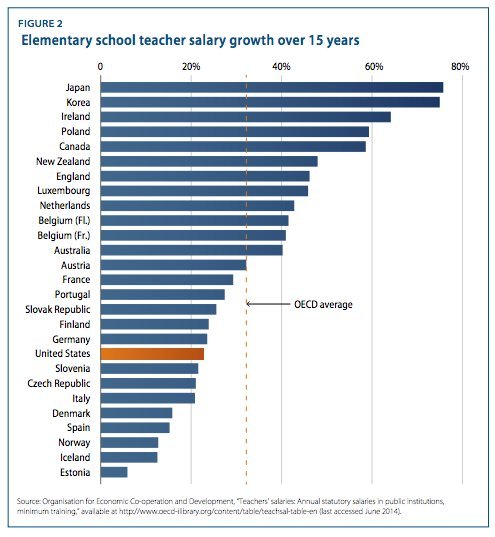
 

original


According to a report by the Center for American Progress, the average base salary for a teacher with 10 years of experience and a bachelor’s degree is $45,000. That’s a mere $800 annual raise. No wonder more than 16 percent of teachers have a second or third job outside of the school system. They simply can’t survive on the salary.


They can’t buy a home or even rent an apartment in most metropolitan areas. They can’t afford to marry, raise children, or eke out a middle class existence.


What effect does this have on students?


Well, for one, it often leaves them with inexperienced or exhausted teachers.


Nationwide, 46 percent of educators quit before reaching the five year mark. And it’s worse in urban districts, where 20 percent quit every single year!


That translates to more students learning from educators who are, themselves, just learning how to teach. If we took pains to keep them in the profession, think of what a positive impact that would have on the quality of education the nation’s students  receive – Teachers learning from experience and improving their practice every year instead of a continual flux of novices just trying to figure out the basics and survive!


But it’s not all intangibles. It costs bookoo bucks to constantly find and train new teachers – roughly $7.34 billion a year, to be exact. Imagine if we could invest that money into salaries instead.


This is exactly what they do in many other countries.


We’re always comparing ourselves with nations in Europe and Asia where students average higher standardized test scores. Yet we rarely enact the policies that got them these results.


Many of these countries recruit the top graduates to become teachers. How? By offering sweeteners and incentives to become a life-long educator.


In Singapore and Finland, for example, they actually cover the cost of the college coursework needed to become a teacher. And when it comes to salary, they leave us in the dust. In South Korea, they pay educators an average of 250 percent more than we do!


For many people, education is a calling. You feel drawn toward the job because it holds meaning to you. But how many people ignore that calling because of simple economics? There are plenty of things you can do with your life; If you can’t earn a living doing one thing, you may opt for something else.


How many more excellent teachers would we have in this country if we prized and rewarded those practitioners we already have?


It doesn’t take a deep dive into the news to see how teachers are treated in American society far beyond the low pay.


Everything that goes wrong in our public schools is laid at their feet whether they have any control over it or not. Child poverty, inequitable and inadequate resources, regressive and nepotistic policy, backward education legislation – it’s all somehow the teacher’s fault.


Imagine if we saw teachers as part of the solution! What effect would that have on teacher turnover?


Look no further than our foreign counterparts. In South Korea, turnover is only 1 percent per year. In Finland, it’s 2 percent. In Singapore, it’s 3 percent.


It’s certainly worth a try.


As reforms go, this is one with more evidence behind it than 90 percent of the garbage that comes floating out of partisan think tanks.


Pay teachers more.


Starting salary should be at least $65,000. End pay after 30 years should be at least $150,000.


THAT would boost educational outcomes.


And, please, don’t give me any nonsense about summer break, teacher tenure, the power of unions or whatever else you heard on talk radio or the corporate news media. Teachers average 53 hours a week August through June – making up for any downtime in the summer, tenure doesn’t mean a job for life – it means due process, and unions aren’t evil – they just ensure workers more rights than the bosses would like.


Moreover, don’t tell me we can’t afford it. We spend more on the military than the next 8 nations combined.


Imagine if we put a priority on raising our own children instead of guns and missiles. Imagine if we spent more on life than death.


Imagine if we tried the one reform left in the box – increase teacher pay.

 

Personalized Learning Without People – An Education Scam from the 1980s Returns

Screen Shot 2017-07-14 at 1.12.10 AM


Sometimes it seems that education policy is nothing but a series of scams and frauds that becomes untenable in one generation only to pop up again 10 or 20 years later with a new name.


Take Personalized Learning, the latest digital product from the ed-tech industry to invade your local public school.


It’s cutting edge stuff.


Except that it isn’t.


It’s just the same old correspondence school nonsense of the 1980s thrown onto an iPad or a laptop.


It was crap back then, and it’s crap today.


But it sounds nice.


Personalized Learning.


I like that.


That’s exactly the kind of educational experience I want for my own daughter.


I’d like her schooling to be tailor-made for her. Teach her in a way she can best understand and that will best engage her mind and build upon her competencies.


However, that’s not what Personalized Learning means.


It’s a euphemism for Competency Based Education or Outcome Based Education.


It means plopping a child in front of a computer screen for hours on end while she takes standardized tests and standardized test look-alikes on-line.


Cartoon avatars lecture students how to answer multiple-choice questions in mind numbing detail before making them go through endless drill-and-kill practice. If kids don’t get a question right, they do it again-and-again until they do.


And somehow this is personalized?


I’ll give you a little tip. You can’t have personal learning without people.


This is personalized the same way Angry Birds and Candy Crush is personalized. Except it’s way less fun – and much higher stakes.


Imagine if all of your classes were taught at the end of an automated help line. That’s really what this is:


“If you don’t understand because you need me to define a word, press 1.


If you don’t understand because you need me to explain punctuation, press 2.


If you don’t understand because you need the question repeated…”


What if your question isn’t on the menu? You have no recourse other than to just keep pushing buttons until you hit the one that’s supposedly “correct”.


Forget for a moment how ineffective that is. Just imagine how boring it is for a growing child.


Nothing stifles a young person’s natural curiosity more than being forced to suffer through hours of tedium.


And what’s worse, we already know this.


We’ve tried this kind of garbage before with similar results.


Back in the 1980s, the Reagan administration deregulated everything it could get its hands on, especially education.


This opened the floodgates to for-profit corporations to offer mail order correspondence courses with little to no accountability but funded by the federal government.

For nearly a decade, student aide systems were systemically pillaged and looted by unscrupulous vendors offering correspondence schools as a trendy alternative for trade schools and credit recovery programs. They charged hefty tuition and fees for nothing more than sending students boilerplate instructional materials, multiple choice tests, and worthless diplomas in the mail.


The blatant fraud was documented by the Senate Permanent Subcommittee on Investigations in the hearings held by then-Chairman Sam Nunn of Georgia. This lead to eliminating correspondence schools from participation in federal aide programs.


Congress realized that sending students a book wasn’t the same as actually teaching them.


But by the late 1990s and early 2000s, things began to change. With the popularization of the Internet, the defunct business model could rebrand itself simply by offering similar materials on-line. And after significant lobbying efforts over the subsequent decades, Congress conveniently forgot its objections to almost the same kind of fraud.


However, this kind of malfeasance was at first mostly confined to credit recovery programs and on-line colleges. In K-12 this was primarily a way for students who had already failed a grade to pass the required core courses over the summer on-line. It was a way to boost graduation rates or even provide resources for students to get a G.E.D.


The poor quality of these programs has been demonstrated time and again.


But instead of limiting, fixing or eliminating them, we’re pushing them into the public school system.


This is seen as a way to save money by teaching without teachers. Sure, you still need a certified educator in the class room (for now) but you can stuff even more children into the seats when the teacher is only a proctor and not responsible for actually presenting the material.


The teacher becomes more of a policeman. It’s his job to make sure students are dutifully pressing buttons, paying attention and not falling asleep.


Moreover, this is sold as a way to boost test scores and meet the requirements of the Common Core. You can easily point to exactly which standards are being assessed on a given day and then extrapolate to how much that will increase struggling students’ scores on the federally mandated standardized test when they take it later in the year.


In fact, students’ answers on these programs are kept and recorded. They are, in effect, stealth assessments that can be used to judge and sort students into remediation classes or academic tracks.


In effect, the year-end high stakes test can be entirely forgotten. Students are given a standardized test every day. Even those whose parents opt them out of the federal assessment have no escape because the tests have become the curriculum, itself.


And all the while tech companies are raking in the cash.


Education policy is not concerned with how best to teach children. It is about how best to open the trough of tax dollars to education corporations – book publishers, test manufacturers and now tech companies.


Meanwhile, the public has almost no idea what’s going on.


Educators are sounding the alarm, but well-paid corporate shills are trying to silence them as being anti-progress.


Calling out bad educational practices conducted on a computer is not Ludditism. Certainly there are better ways to use the technology to help students learn than THIS.


Moreover, there are plenty of things from the ‘80s that deserve being revisited – new wave music, romantic comedies, even the old Rubik’s cube.


But putting crappy correspondence colleges on-line!?


No, thank you.

Bring Your Gun to School – Courtesy of the Pennsylvania Senate


AB17380

Next school year, I may be able to bring my gun to class.


The Pennsylvania state Senate voted 28-22 today to allow school employees like me to start packing heat.


Hooray!


My class sizes will be larger because of almost $1 billion in budget cuts the legislature couldn’t be bothered to heal over the last seven years. I’ll have to teach more sections because my district is bleeding money from charter school vampires that the legislature couldn’t be bothered to regulate.


But now I can be fully armed.


Priorities.


Bullets over books, I guess.


As a more than 15 year veteran of the public school system, I can’t wait to get back in the classroom wondering which of my fellow teachers, principals, custodians or rent-a-cop security guards is fully locked and loaded. I can’t wait until my elementary school daughter is finally protected by being in an adult’s daily line of fire.


This is going to make us much safer.


At my school, we fired a security guard for slamming a student’s head into the table. I’m sure having these folks armed will have no negative effects at all.


And the extra stress from added responsibilities being piled on my back will just make me more vigilant in case I need to take out my piece in class and chase away Black Bart with my Red Ryder, carbine action, two-hundred shot range model… uh… rifle.


Maybe I can get one with a compass in the stock and a thingie that really tells time, too!


Seriously, it’s hard to believe that grown adults actually voted on this ridiculous farce of a law. The only positive thing is that it still needs to be passed by the House and signed by the Governor.


Bad news: state Representatives just might be as stupid as their Senate colleagues. Good news: the Governor isn’t. There is less than a snowball’s chance in Hell that Gov. Tom Wolf is going to sign this piece of crap.


This is what happens when you have a Republican-controlled legislature and a Democratic Governor. The kids say they want nothing but candy for dinner and Dad says “No.”


Now, with a reality TV star con man in our highest national office, GOP-controlled state legislatures like mine all over the country have become emboldened to pass even worse excrement knowing full well that it has zero chance of ever becoming law. But at least they’ll prove to their gerrymandered Republican voting districts not to primary them with even further right leaning Tea Party mental defectives.


It’s a game of chicken with our most vulnerable residents held hostage in the middle.


You know, if lawmakers think that guns are such a great idea in schools, why don’t they make them legal at the state capital?


You can’t go in that building without passing through a metal detector. If you try to bring a gun in there, the best thing you can hope for is to be refused entry.


The same thing at Commonwealth courts, military bases, mental hospitals, prisons and even the security checkpoint at the airport.


And it’s pretty similar in most states. Certainly at federal institutions. You can’t take a firearm with you to visit your Congressperson – or on a tour of the White House.


Heck! Guns aren’t even welcome at Donald Trump’s political rallies, or most of his hotels, golf courses or other properties. Same at conventions held by the National Rifle Association and the Conservative Political Action Conference.


Gee. Why are so-called conservatives so darn concerned with making sure teachers are armed, but they don’t want to offer the same “protection” to themselves in government, at their businesses, rallies and places of leisure?


Why? Because it’s bullshit.


That’s why.


Most of them don’t really want guns in schools. They know it’s a terrible idea. They just want to look like they support it. Their propaganda networks spew out all this nonsense that they have to pretend to believe.


When they let protesters enter the capital building open carrying automatic weapons, THEN I won’t doubt their sincerity.


When they let Black Lives Matter activists strapping rifles across their shoulders into their rallies among the angry and confused hillbillies, THEN I’ll know how serious they are.


And when the upper crust private and parochial schools where they send their own children start arming their teachers, THEN I’ll believe them.


Until that day, I call bullshit on this whole ridiculous endeavor.

Teachers Don’t Want All This Useless Data

26948475_l-too-much-data

One of the most frustrating things I’ve ever been forced to do as a teacher is to ignore my students and concentrate instead on the data.


I teach 8th grade Language Arts at a high poverty, mostly minority school in Western Pennsylvania. During my double period classes, I’m with these children for at least 80 minutes a day, five days a week.


During that time, we read together. We write together. We discuss important issues together. They take tests. They compose poems, stories and essays. They put on short skits, give presentations, draw pictures and even create iMovies.


I don’t need a spreadsheet to tell me whether these children can read, write or think. I know.


Anyone who had been in the room and had been paying attention would know.


But a week doesn’t go by without an administrator ambushing me at a staff meeting with a computer print out and a smile.


Look at this data set. See how your students are doing on this module. Look at the projected growth for this student during the first semester.


It’s enough to make you heave.


I always thought the purpose behind student data was to help the teacher teach. But it has become an end to itself.


It is the educational equivalent of navel gazing, of turning all your students into prospective students and trying to teach them from that remove – not as living, breathing beings, but as computer models.


It reminds me of this quote from Michael Lewis’ famous book Moneyball: The Art of Winning an Unfair Game:


“Intelligence about baseball statistics had become equated in the public mind with the ability to recite arcane baseball stats. What [Bill] James’s wider audience had failed to understand was that the statistics were beside the point. The point was understanding; the point was to make life on earth just a bit more intelligible; and that point, somehow, had been lost. ‘I wonder,’ James wrote, ‘if we haven’t become so numbed by all these numbers that we are no longer capable of truly assimilating any knowledge which might result from them.'”


The point is not the data. It is what the data reveals. However, some people have become so seduced by the cult of data that they’re blind to what’s right in front of their eyes.


You don’t need to give a child a standardized test to assess if he or she can read. You can just have them read. Nor does a child need to fill in multiple choice bubbles to indicate if he or she understands what’s been read. They can simply tell you. In fact, these would be better assessments. Doing otherwise, is like testing someone’s driving ability not by putting them behind the wheel but by making them play Mariocart.


The skill is no longer important. It is the assessment of the skill.


THAT’S what we use to measure success. It’s become the be-all, end-all. It’s the ultimate indicator of both student and teacher success. But it perverts authentic teaching. When the assessment is all that’s important, we lose sight of the actual skills we were supposed to be teaching in the first place.


The result is a never ending emphasis on test prep and poring over infinite pages of useless data and analytics.


As Scottish writer Andrew Lang put it, “He uses statistics as a drunken man uses lamp posts – for support rather than for illumination.”


Teachers like me have been pointing this out for years, but the only response we get from most lawmakers and administrators is to hysterically increase the sheer volume of data and use more sophisticated algorithms with which to interpret it.


Take the Pennsylvania Value Added Assessment System (PVAAS). This is the Commonwealth’s method of statistical analysis of students test scores on the Pennsylvania System of School Assessment (PSSA) and Keystone Exams, which students take in grades 3-8 and in high school, respectively.


It allows me to see:

  • Student scores on each test
  • Student scores broken down by subgroups (how many hit each 20 point marker)
  • Which subgroup is above, below or at the target for growth


But perhaps the most interesting piece of information is a prediction of where each student is expected to score next time they take the test.


How does it calculate this prediction? I have no idea.


That’s the kind of metric they don’t give to teachers. Or taxpayers, by the way. Pennsylvania has paid more than $1 billion for its standardized testing system in the last 8 years. You’d think lawmakers would have to justify that outlay of cash, especially when they’re cutting funding for just about everything else in our schools. But no. We’re supposed to just take that one on faith.


So much for empirical data.


Then we have the Classroom Diagnostic Tools (CDT). This is an optional computer-based test given three times a year in various core subjects.


If you’re lucky enough to have to give this to your students (and I am), you get a whole pile of data that’s supposed to be even more detailed than the PVAAS.


But it doesn’t really give you much more than the same information based on more data points.


I don’t gain much from looking at colorful graphs depicting where each of my students scored in various modules. Nor do I gain much by seeing this same material displayed for my entire class.


The biggest difference between the PVAAS and the CDT, though, is that it allows me to see examples of the kinds of questions individual students got wrong. So, in theory, I could print out a stack of look-a-like questions and have them practice endless skill and drills until they get them right.


And THAT’S education!


Imagine if a toddler stumbled walking down the hall, so you had her practice raising and lowering her left foot over-and-over again! I’m sure that would make her an expert walker in no time!


It’s ridiculous. This overreliance on data pretends that we’re engaged in programming robots and not teaching human beings.


Abstracted repetition is not generally the best tool to learning complex skills. If you’re teaching the times table, fine. But most concepts require us to engage students’ interests, to make something real, vital and important to them.


Otherwise, they’ll just go through the motions.


“If you torture the data long enough, it will confess,” wrote Economist Ronald Coase. That’s what we’re doing in our public schools. We’re prioritizing the data and making it say whatever we want.


The data justifies the use of data. And anyone who points out that circular logic is called a Luddite, a roadblock on the information superhighway.


Never mind that all this time I’m forced to pour over the scores and statistics is less time I have to actually teach the children.


Teachers don’t need more paperwork and schematics. We need those in power to actually listen to us. We need the respect and autonomy to be allowed to actually do our jobs.


Albert Einstein famously said, “Not everything that can be counted counts, and not everything that counts can be counted.”


Can we please put away the superfluous data and get back to teaching?

I May Have Just Been Murdered By House Republicans

couple


I may be dead already.


And House Republicans may be the ones who killed me.


With the passage of a healthcare bill they, themselves, haven’t read – haven’t studied – haven’t thoughtfully considered in any way – it seems they’ve opened the door for insurance companies to deny people coverage due to pre-existing conditions.


I have one.


I’ve had two small heart attacks this year.


So I sit here stunned at the news on my computer feeling very much at a loss.


People have legitimate political differences, but this… it’s just beyond anything I’ve ever experienced personally.


There are people who count on me – my daughter, my wife, my students. I’m not so vain as to imagine that they can’t get along without me, but my loss will hurt them. I think at the very least they’ll miss me.


I’m 43-years-old. I’ve lived a good life. I just never expected to be abandoned in such a way by a society I’d always thought was more humane.


But if this legislation becomes the law of the land, what will I do?


I take six or seven pills a day to control my cholesterol, keep the stints in my heart clean, control my blood pressure, slow my heartbeat, etc. Without them, I almost certainly will have another heart attack. Yet I have no idea how I could possibly afford to take them without insurance.


And if I get sick, I won’t be able to work. I’ll bring in even less money. I won’t be able to help support my family. I’ll end up being a liability, a burden.


House Republicans have to know there are people out there like me. There have to be a lot of people in even worse shape than I am.


Are they really going to just let all of us die?


I had hoped to see my daughter grow up. She’s only 8-years-old, the most precious person in my life. No one is more full of energy, more vivacious and joyful. She loves to draw and write short stories. She pretends to be a teacher just like her father and gives her stuffed animals assignments.


I guess I’ll never get to see the person she becomes. I’ll never find out if she goes to college, if she finds love, if she has children of her own.


Can it really all come down to this?


My wife and I have been through a lot together. We met back in high school. Before I became a public school teacher, we worked together at various local newspapers. She supports me when I can’t go on. I hope I am able to give her back even a fraction of the strength she lends me.


Does this mean we’ll have to say goodbye, and so much sooner than I ever imagined?


My middle school students and I just finished reading “The Diary of Anne Frank.” When we closed the book, there were some tears shed. I passed around the tissues, and we discussed how we felt. Many of them expressed anger that some people could hold others’ lives so cheaply as the Nazis did Anne and her family. Are House Republicans guilty of a similar crime? They aren’t rounding anyone up to send to death camps, but they’re apparently content to let many of us just die.


The pundits tell me I have nothing to worry about. The bill won’t pass the Senate, they say. And even if it does, the President would be breaking every campaign promise he ever made, if he signs it.


So what else is new?


This is the world we live in now.


It’s not the country I was born into. It’s a cold place. A heartless reality.


Perhaps tomorrow I’ll gather the strength to resist, to call my Congressperson again, to protest, to organize.


But as for today…


I can’t even.


So I’ll head home, and give my family a big hug, spend whatever time I can with them.


Because if my life now depends on the compassion of Republican lawmakers, I may not have much of it left.


Let’s Hear It For Black Girls!

Natural-Hair-600x398


“Sisters are more than the sum of their relative disadvantages: they are active agents who craft meaning out of their circumstances and do so in complicated and diverse ways.”

-Melissa Harris-Perry, Sister Citizen (2011)


Let’s hear it for black girls!


They are beautiful, bold, irrepressible and – above all – so incredibly strong.


Black girls will outlast any struggle, face down any adversary, and – more often than not – triumph in the face of adversity.


I know. I’m a public school teacher, and many of my best students are black and female.


That doesn’t necessarily mean they get the best grades. Some earn A’s and some don’t. But when it comes to pure willpower and the courage to stand up for themselves, no one beats a black girl.


Those are rare qualities nowadays. Sometimes it doesn’t make these girls easy to have in class. But think about how important they are.


As a teacher, it sure makes your life easier when students do whatever they’re told. But in life, we don’t want citizens who simply follow orders. We want people who think for themselves, people who question directives and do only what they think is right.


In short, we need people who act more like black girls.


As a white male, it’s taken me some time to come to an appreciation of black womanhood. But after about 15 years teaching in public schools serving mostly poor, minority students, appreciate them I do.


Think of the challenges they face and often overcome. Not only are they subject to the same racism as black males, they also have to function under the burden of male patriarchy and the quiet sexism that pervades American society.


According to a study entitled Unlocking Opportunity for African American Girls by the NAACP and the National Women’s Law Center, African-American girls suffer from higher rates of sexual violence and intimate partner violence than white women, high rates of sexual harassment in school, and they are more vulnerable to sex trafficking than any other group.


In addition, more than one-third of black female students did not graduate on time in 2010, compared to 19 percent of white female students. However, there has been progress. Despite a lingering graduation gap, black girls have actually increased their graduation rate by 63% in the past 50 years, according to the National Coalition on Black Civic Participation. Unfortunately, this hasn’t meant they’ve built up more wealth. In 2010, single black women’s median wealth was just $100 compared to single white women’s wealth, which was $41, 500.


And it only gets worse the closer we look at it. Black women are the only group whose unemployment rate remained stagnant at 10.6%, while the overall rate for workers in the United States dropped from 7.2% to 6.1% between August 2013 and August 2014, according to a National Women’s Law Center report on jobs data. More than a quarter of black women live in poverty, according to the Center for American Progress, despite making up a larger portion of the workforce than white and Latina women.


Despite such problems, black women start businesses at six times the national average, according to the Center for American Progress. And this is even more startling when you realize they are also more likely to be denied small business loans and federal contracts.


It’s one of the reasons black girls are so special. Those who somehow survive the incredible pressures society puts them under often become super achievers. They can do almost anything.


Perhaps it’s an internalization of the advice black women often get from their mothers. They’re frequently told they have to work harder and do more just to be noticed, and they often do. In my classes, I’ve had more black girls achieve grades over the 100% mark than any other group. And that’s not easy to do. But it’s typical black girl power – they try to be more than perfect.


However, it takes a toll.


They are more likely to die of breast cancer than any other racial group, according to the Centers for Disease Control and Prevention. The reasons are complex, but include the fact that black women experience delays in diagnosis and treatment. Like many oppressed people, they often internalize that oppression – they don’t take care of themselves and the stress can be a killer.


And for those who can’t overcome the unfair pressures we place them under, the results are even worse. In school, I’ve seen precious and valuable girls thrown into a sometimes cruel and uncaring disciplinary system – a system from which it can be hard to extract yourself.


Some teachers and schools when faced with the independence and forthrightness of black girls don’t know how to handle them. In such cases, these girls are often disciplined out of all proportion to their population size in school districts. For example, in New York City, black girls made up only 28% of the student body during the 2011-2012 school year, but were 90% of all girls expelled that year from the city’s schools, according to the “Black Girls Matter” report by the African American Policy Forum. Similarly, black girls made up only 35% of the Boston public school population that same year, but accounted for 63% of all girls expelled.


In short, we’ve got a lot of work to do to dismantle a national system of racism and white privilege. But even beyond that, as a society we need to recognize and appreciate black girls. A little bit would go a long way.


We need to acknowledge the unique talents and skills of these amazing young women. And so much of it starts with a matter of conceptualization in the white adult mind.


Instead of seeing them as defiant, we need to recognize their independence. Instead of seeing them as challenging your authority, you need to see them as asserting themselves and standing up for their beliefs.


Those are all such positive qualities. How many times do adults complain that kids today don’t care enough about things – their apathy, their entitlement, their indifference. As a group, black girls are nothing like that! They are exactly the opposite! But instead of praising them for it, instead of valuing them, white adults often feel threatened and respond by trying to crush what they perceive as a rebellious and disruptive element in their classrooms or in society.


That’s why I love the Black Girl Magic movement.


It was created by CaShawn Thompson to celebrate the beauty, power and resilience of black women. It started as a simple social media hashtag – #BlackGirlMagic.


It embodies a theme I’ve already touched on – the irrepressible spirit of black women, how they are faced with an overwhelming mountain of challenges but somehow manage to overcome them and become tremendous overachievers! It’s a celebration of everything good and positive about the black female experience.


I think it’s just wonderful.


How can you not look at someone like Misty Copeland and not appreciate her success? She’s the first ever black principal at the American Ballet Theatre. She has shot to the top of one of the whitest, wealthiest and most elitist arts you can pursue.


Or how about Gabby Douglas? You can’t watch videos of the amazing Olympic gymnast, who at only 17, absolutely wowed the world with gold medals despite internet trolls hating on her hair.


And if we’re talking undue hate and criticism, no woman in recent memory has suffered as much as Michelle Obama. Whatever you think of her husband’s Presidency, you have to admit Michelle was a model of grace under pressure. How many times did haters pick apart her appearance while she just got on with the business of making school lunches healthier and being a tremendous role model for children of color and women of all races and creeds.


Or Ava DuVernay, the amazing director snubbed at the Oscars for her film “Selma.” What did she do? She made another amazing film “13th” about how the 13th Amendment ended slavery but opened the door to the prison industrial complex.


That’s Black Girl Magic. And it’s actually pretty common.


So come on, fellow white people. Let’s celebrate black girls.


Stop trying to touch their hair or compare them with Eurocentric standards of beauty. Stop, pause and actually see them. See them for who and what they are.


Black girls are amazing and make the world a better place.


Here’s to all the incredible and irreplaceable black girls in my classes and in my life!


You go, girls!

The Corporate Coup Destroying Our Schools Has Finally Come For Our Government

Screen Shot 2017-03-28 at 4.09.34 PM


First they came for people of color and I said nothing.

Because I am not a person of color.


Then they came for the poor and I said nothing.

For I am not poor.


Then they came for our public schools and I said nothing.

Because I do not send my children to public schools.


Now they’ve come for our government and who is left to speak for me?


This is a paraphrase of Martin Niemöller’s famous lines about the cowardice of German intellectuals during Hitler’s rise to power.


The fascists purged group after group while those who could have stood against them did nothing – until it was too late.


That’s very nearly the position we find ourselves in today in relation to the Trump administration.


The neoliberal and neofascist façade has fallen away. And the naked greed of our runaway capitalist system has been exposed for what it is.


Just this week, Trump unveiled a new government office with sweeping authority to overhaul federal bureaucracy on the business model.


Led by the president’s son-in-law and senior advisor, Jared Kushner, The White House Office of American Innovation will be an autonomous entity enforcing the president’s will. Described as an internal “SWAT team” of strategic consultants, and staffed with former business executives, the office will cut down democratic rule in favor of top-down authoritarianism.


And the excuse is the same one used to deny equity for minorities, the same one used to dismantle protections for the poor and the same one used to unfairly label and close our public schools – we need to run government like a business.


But government is not a business.


The goal of a business is profit for the few. The goal of government is service to the many.


In a private business only the owner or the board of directors reaps the benefits. But our government is not supposed to be set up that way. It’s not supposed to benefit merely all the president’s men. It’s supposed to benefit all of us – the citizens, the taxpayers, the voters.


This is exactly the model that has been used against our public schools.


We have shifted our concern away from students and parents to investors and corporations. For almost two decades, our education policies have increasingly been to reduce local control – especially at schools serving the poor and minorities – and give that control to private charter school operators. We have removed the duly-elected school boards and replaced them with appointed boards of directors. We have removed or diminished democratic rule and replaced it with an autocracy. And all the while the middle class has cheered.


It was a coup in plain site, and no one but parents, students, teachers and intellectuals spoke up.


Our voices were undercut or ignored. When we demanded equal treatment for our children, we were labeled welfare queens wanting something for nothing. When we demanded fair treatment, a safe work environment and resources for our students, we were labeled union thugs standing in the way of progress. At every turn we were tone policed into silence and passed over for the voices of self-proclaimed experts who knew nothing but what they were paid to espouse.


We were told that the only measure of academic success was a standardized test score. But no mention of the white, middle class standard our non-white, impoverished students were being held to.


When our schools were increasingly segregated by race, class and income, we were told that it was only fair. After all, it was based on choice – the choice of the invisible hand of the free market. When our schools were starved of resources, we were told to do more with less. And when our students struggled to survive malnutrition, increased violence and the indentured servitude of their parents to an economic system that barely allowed them to sustain themselves, we blamed them. And their teachers, because how dare anyone actually try to help these untouchables!


We allowed this – all of it – perpetrated by Democrats and Republicans, Conservatives and Liberals, because they’re all really just different dogs to the same masters.


We justified it all in the name of the market, in the name of economics, in the name of business. Why should we care? It rarely affected us directly.


White, middle class folks could get by. It wasn’t OUR schools being given away to private equity firms. It wasn’t OUR children being educated by temporary employees on the model of the peace corps with little training and no experience.


Those were just someone else’s children. We weren’t even sure they were human. They certainly didn’t share the same portion of humanity as we did. They were unwashed and unfed. Even if you washed them, many of them would still have brown skin. We were happy to have them as an underclass, as a cushion to stop us from falling further down the social ladder.


Our kids went to either well resourced public schools with fully elected school boards and shiny new facilities or else we sent our children to pristine private schools that offered the best of everything for a price.


But now the chickens have come home to roost.


Because this same model is being applied to our government.


Now it is us who will lose our voices. It will be our services that are stripped away as an unnecessary cost savings. We will lose our healthcare. We will lose our environment. It will be our democracy suspended to make way for the more efficient means of government – fascism and autocracy.


Who has time to listen to the people? Much easier to just decide what should be done. And we can justify it with our business model. No more voters and representatives. Now we will be businessmen and consumers. Nothing will stand in the way of the corporate class enriching themselves at public expense. They will be merely providing the rest of us with the goods and services of government, the bits that trickle down on our heads like rain or urine.


That is what Trump is attempting. He is turning the United States into a banana republic – even installing his relatives and children in top leadership positions. Our government now resembles the corridors of power in Baghdad under Saddam Hussein with henchmen Uday and Qusay in tow.


The question is this: will we allow it?


Will we continue to allow it?


Will we stand for it as the administration installs Trump loyalty officers in every federal office?


Will we say nothing as nepotism and greed become the most prized attributes of governance?


Will we remain silent as our public schools continue to be raided, sacked and burned?


Because the answer to those questions is the answer to so much more.


Are we on the cusp of revolution or is history merely repeating itself?

Randi and Lily, For the Good of Our Unions, Please Step Down. You Are a Distraction

28f329e0b3df889bf4067c6e4c6beee2

Dear Randi Weingarten and Lily Eskelsen Garcia:

Unions are facing hard times.

We are under attack by the new fascist wing of the Republican party.

So-called “right to work” laws are being drafted at the national level to strip us of our rights and transform us into the factory slaves of The Gilded Age. New court challenges at the state and federal level could make it next to impossible to collect dues without allowing countless free riders. And in the mass media criticism of teacher tenure is mounting despite widespread ignorance of what it even means.

More than ever we need to be united in our efforts to fight the forces of regression and tyranny. We need each other to protect our public schools and our students from those who would do them harm. But the biggest obstacle to doing that isn’t Donald Trump. Nor is it Mike Pence, Steve Bannon or even Betsy DeVos.

It is you. Both of you.

Frankly, as Presidents of the American Federation of Teachers (AFT) and the National Education Association (NEA), you have become a distraction.

When DeVos was blocked by protesters from entering a Washington, D.C., school this week, Randi actually took her side. She tweeted:

screen-shot-2017-02-11-at-2-23-12-pm

“Just heard a protester blocked & almost knocked Secy @BetsyDeVos down at Jefferson.We don’t condone such acts.We want her to go to pub schls.”

How dare you dictate to protesters what “we” want!?

This action may not have been something you, personally, condone. But DeVos just got away with purchasing her position as U.S. Secretary of Education. She and her billionaire family paid off mostly Republican lawmakers to the tune of $200 million allowing her to become the titular head of our nation’s public schools. This despite having never attended a public school, refusing to protect special education students, refusing to hold charter and voucher schools to the same standards, even refusing to keep guns out of our children’s classrooms! Well, Betsy, your money may buy you the title, but it buys you zero respect!

Randi, your statement just goes to show how tone deaf you and Lily are to the spirit of the rank and file.

We are not somewhat distressed at what is happening to our schools and our profession. We are enraged! We are taking to the streets! We are occupying our lawmakers offices and marching through community thoroughfares! And we aren’t throwing shade on other protesters behind the safety of Twitter.

For many of us, you both represent everything wrong with unionism. We are a people powered movement. We get our strength from the grassroots up, but you both try to rule from the top down.

Nowhere was this more apparent than in the early endorsements by both unions of Democratic candidate Hillary Clinton.

Neither one of you made an honest effort to gauge member opinions on these endorsements before going ahead. You thought you knew better. You pushed through these endorsements despite a strong vein of support for Democratic candidate Bernie Sanders.

Sanders was much more in-line with our needs and values. And he had much more support among progressives and independents. He had a much better chance of winning! Meanwhile, Clinton was just another neoliberal in a long line of neoliberals like President Barack Obama who would offer us only the back of their hands.

You wanted a seat at the table, and you didn’t mind how much it would cost the rest of us.

Lily, when you took the reins of the NEA in 2014, you famously said “We are what Democracy looks like.” I was never more proud of my union than at that moment. But that pride has turned to ashes in my mouth.

Many of us will never forgive either of you for the results of this election. We blame you for Trump.

Had you not dictated to us that we must support Clinton, had you supported a candidate with a real chance of wining, there is little doubt that we could have defeated the clown currently in the Oval Office. Moreover, under a President Sanders we would have had a real chance at a progressive future that benefits everyone – $15 minimum wage, universal healthcare, sanctuary cities, justice reforms, fair trade, free college tuition.

Trump did not win alone. Unwittingly, you were his biggest supporters. It was your hubris – along with that of corporate Democrats deaf to the voices of their base – that gave us these next four years. And none of you have learned your lesson.

Lily, your three-year term is up this year. Randi, your two-year term is up in summer 2018.

We can wait you out if we must. But do what’s best for the people you claim to represent. Step down now.

Otherwise, you can look for opposition in our Representative Assemblies.

Let me be clear. I don’t think either of you have broken any by-laws. I don’t think there is evidence for impeachment (if our by-laws even allow it). But members could easily make a motion from the floor for a vote of no confidence.

Support may already be mounting for such positions at the Region level. It could go to the State House of Delegates as a New Business Item and get a majority vote from the floor. Or perhaps at our next Representative Assembly, someone will just make a motion.

I don’t know if it would pass. But I know that this division among us is holding us back from being the force we can be. I know that it has stopped many of us from talking about how we fight external forces, because we are instead focused on enemies from within.

We want to transform our unions. We no longer want to focus solely on collective bargaining. We want to focus on social justice and the needs of our students and communities. To be sure, our labor rights are essential to this fight, but they cannot be everything nor can we be willing to give up on the needs of our students if the powers that be will only leave our salaries and benefits intact.

We want a union that is more at home in the streets than in the boardroom. We want leaders who mobilize us to fight not tell us what to think. We need leaders that listen to us – not the other way around.

As a classroom teacher and education activist, I make this request in no official capacity for any of the various groups to which I belong. I ask as merely another member of the NEA. I have no affiliation with the AFT.

Moreover, I have nothing personal against either of you. We met briefly at the Network for Public Education conference in Chicago two years ago. You were both congenial and inspiring. It may not seem like it now, but I hold tremendous respect for both of you. I think in your own ways you have accomplished much that benefits our members.

But the time has come to step down. You believe in accountability. Hold yourselves accountable.

Put the strength of our unions first. Let it no longer be about you. Let it be about us.

Here’s hoping you’ll do the right thing.

Yours,

Steven Singer

NEA and PSEA member

P.S. – If any NEA or AFT member reads this open letter and agrees with the sentiments expressed here, please add your name and union affiliation in a comment on my blog.

What Diane Ravitch Means To Me

img_6050

Am I crazy?

That’s what many of us had been wondering before we read Diane Ravitch.

As teachers, parents and students, we noticed there was something terribly wrong with our national education policy. The Emperor has no clothes, but no one dared speak up.

Until Diane Ravitch.

We were told our public schools are failing – yet we could see they had never done better than they were doing now.

We were told we should individualize our lessons – but standardize our tests!? We were told teachers are the most important factor in a child’s education – so we need to fire more of them!? We were told the best way to save a struggling school – was to close it!? We were told every child has a right to a quality education – yet we should run our schools like businesses with winners and losers!?

It was absurd, and the first person to question it was Diane Ravitch.

In doing so, she saved many people’s sanity, she saved a generation of students and educators, gave parents clarity and direction, and she started a social movement fighting against the preposterous policies being handed down from clueless businessmen and bureaucrats.

This weekend the Network for Public Education will honor Dr. Ravitch at a dinner on Long Island for her tireless work fighting against this corporate school reform.

I wish I could be there in person to tell her what she means to me and others like me. Instead I offer this modest tribute to a person who changed my life and the lives of so many others.

I was a different person when I read “Life and Death of the American School System” back in 2010.

I had been in the classroom for about seven years, but I was just starting to feel like a real teacher.

I had just completed my National Boards Certification and felt like I wasn’t just surviving with my students anymore but could actually make intelligent decisions about how best to educate them.

And a big part of that was Dr. Ravitch’s book.

For a long time I had noticed that things weren’t as they should be in public schools.

I had put in a great deal of work to get my masters in teaching, to engage in hundreds of hours of professional development, not to mention three to four extra hours every day at the school passed dismissal time doing tutoring, leading extracurricular activities, grading and planning for the next day. I spent hundreds of dollars every month buying books, pencils, erasers, even snacks and meals for my students. Yet the school still treated me – it treated all of us – like greeters at WalMart.

We were highly educated, highly dedicated professionals but our opinions were rarely sought on policy matters. We were the experts in our fields and in our students who we saw everyday more than many of their own parents. Yet we were told where to be and when, what to teach and how long to teach it. We were told how to assess the success of our students and ourselves. And we were told how to best remediate and what else we should be doing that we never had time to do.

Was I really such a failure, I remember thinking. I work hard with my students everyday, see them make tremendous strides and still the standardized tests say it isn’t enough. What was I doing wrong?

Then I read Diane’s book and saw the whole thing from a different perspective.

It wasn’t me that was wrong. It was the system.

It wasn’t the students that were failing. It was the tests that didn’t assess fairly.

It wasn’t the schools that were deficient. It was the way they were resourced, valued and set up to fail by government and industry.

That book and its 2013 sequel, “Reign of Error,” really opened my eyes. They did for many people. Without them, I’m not sure I would still be a teacher today. I’m not sure I could have kept at it thinking that my best efforts could never be enough, that my exhaustion, my fire, my skills would never bridge the gap.

Diane Ravitch put it all in context of the social and historical struggle I had learned about, myself, in high school. I was engaged in the good fight for the civil rights of my students. Brown vs. Board wasn’t just a story in some textbook. I could see how the outmoded excuse of “separate but equal” was still being given today in my own increasingly segregated school and segregated workplace. Why was it that most of my academic students were poor and black? Why was it that the honors kids were mostly upper middle class and white? Why was it that my school situated in a poorer neighborhood was crumbling and the school a few blocks over in the richer neighborhood looked like the Taj Mahal by comparison? And why was it that teachers in my district got $10-20,000 less in their paychecks with the same experience than those in the wealthier community?

Dr. Ravitch made sense of all of that for me. And it made me very angry.

When colleagues came to me to discuss how they wished we had merit pay, I could turn to her books and see how it was a trap. When students came into my classroom after being kicked out of the local charter school, I had an explanation for why they were so academically behind their peers. And when contrarians complained about our union dues and wondered what they were getting in return for their money, I could give them an intelligent answer.

Diane Ravitch gave me the light that made sense of my whole professional world. I had been living and working in it for years, but I never really understood it before. And that gave me the courage to act.

When my state legislature cut almost $1 billion from K-12 education, armed with her books and blogs, I volunteered to lead educators in social actions against them. I sat down with legislators asking them to help. And when they refused, I knew we could protest outside their offices, make noise and the story would get to the media.

Ultimately it didn’t convince the legislature to heal all the cuts, but it helped minimize them, and when the next election cycle came around, we sent the governor packing.

I read Diane’s blog religiously and through her found so many other teachers, professors, parents, and students whose stories weren’t being told by the mainstream media. In fact, whenever so-called journalists deigned to talk about education at all, they rarely even included us in the conversation. So I started my own blog to give voice to what I was seeing.

Through Diane I found a community of likeminded people. I found other teachers on social media who were standing up for their students and communities. I found the Badass Teachers Association and joined and acted and was invited into leadership. We all loved Diane Ravitch and apparently she loved us, too. She became a member, herself, and encouraged us to keep fighting.

Then with Anthony Cody she started the Network for Public Education where even more educators from around the country joined forces. I went to the second annual conference in Chicago and got to meet her in person.

I’ll never forget it. There were hundreds of people gathered together, and she was just standing in the hall talking with a small group. I said to myself, “Oh my God! That’s Diane Ravitch! She’s right there! I could go up and talk to her!”

I looked around and everyone else standing with me had the same look like we’d all been thinking the same thing. Somehow I mustered the courage to walk up to her.

They say you should never meet your idols, but I’m infinitely thankful I didn’t listen to that advice. Diane was eminently approachable. Here I found that same voice I had read so many times, but also a generosity and a goodwill you couldn’t get from the page alone.

She knew who I was, had read my blog and asked me to send her more of my writing. I couldn’t believe it. I thought she was just being polite, but she gave me her email address. I sent her a few articles and she published them on her own site.

Since that day I’ve talked with Diane a few times and she’s always the same. Her intelligence is combined with a boundless empathy and insatiable curiosity about people and ideas. She really cares to know you, to hear your story and to help if she can.

When I had a heart attack about a month ago, she sent me an email telling me to take care of myself. She suggested I change my diet and exercise before confiding that she was having trouble doing this, herself.

Who does that? I’ve never experienced anything like it. I’ve read authors before and maybe written to them, maybe even had them write back. But I’ve never met someone like her who’s actually cared enough to relate to me as an equal, as someone who is important enough to be taken seriously.

In the media, talking heads will sometimes criticize her for changing her mind, because she did do an about face. She had once been Assistance Secretary of Education under President George H. W. Bush where she advocated for standardized testing and the corporate model in education. But when she saw what that really meant, she changed her mind.

To the media, that’s a defect, but to me, it’s a strength. It’s how we learn. We come up with a theory, we test it and if it doesn’t work, we come up with another one. Her philosophy of education is a response to the real world.

That’s what teachers do everyday. We try to reach our students one way and if that doesn’t work, we try something else.

Perhaps that’s really why so many educators have embraced her. She’s like us – a passionate, compassionate empiricist.

I can’t say enough good things about her. I can’t put into words how important Diane Ravitch is to my life. Her ideas changed me. Her ethics invigorated me. Her friendship humbles me.

I’d love to be there this weekend to say all this to her, but I really don’t need to make the trip. Diane Ravitch is always with me. She is in my heart every day.

I love you, Diane.

Former NFL Quarterback Supports Public Schools. That’s Right. PUBLIC Schools!

dictionary

So I’m in my classroom today, teaching, when I see something that stops me cold.

The door opens and in comes former Steelers backup quarterback Charlie Batch.

My mouth falls open. I don’t know what I was talking about. Vocabulary words or something.

The class of 8th graders falls silent, too. All eyes are on the two of us.

Batch looks me right in face with a big smile.

“Here you go,” he says and hands me a shopping bag full to bursting with school supplies and an extra-large tub of hand sanitizer.

By this time I’m probably blushing and grinning like my teeth are about to escape my face.

I hope I was able to mouth a “Thank you,” before he left, but I’m not really sure.

It all kind of happened in a daze.

He came. He gave me supplies. He left.

I guess I shouldn’t have been so taken by surprise.

Batch is a frequent face in my district. After all, he graduated from here, himself, before moving on to college and professional sports.

At the beginning of every year, Batch brings school supplies to every teacher in every building in the district. This was just the first time I was actually in the classroom when he dropped them off. Usually he sneaks in when I’m at lunch duty or in the computer lab. I find them in a neat pile on my desk with a note of thanks – to me!

It’s almost like he doesn’t want to draw attention to it. Almost like he doesn’t want to make us feel like we need to thank him.

It’s his quiet way of giving back to the community that made him.

In some ways it’s the most natural thing in the world. In others it’s truly amazing.

Lots of celebrities make charitable contributions to their communities. Many even put that money into their hometown. But how many invest in the public school system?

Most only seem to have eyes for charter schools. You know – those often cut rate, fly-by-night institutions that are privately managed and publicly funded. Schools that pop up in store fronts or in the mall with a celebrity name on the door and little else.

Rapper Pitbull has opened three of these dubious institutions. Pro-Football Hall-of-Famer Deion Sanders opened two – and closed them both last year. Tennis star Andre Agassi has founded a few and co-founded an organization that rents out properties to other charter schools at a profit. Former NBA players Jalen Rose and Kevin Johnson opened some, too, though Johnson is being investigated for misusing federal funds at his institutions. He likes the industry so much, he even married one of its chief advocates, former D.C. Schools chief Michelle Rhee.

But Charlie Batch? He hasn’t opened a single charter school.

There is no shiny building with his name on it. He hasn’t hired a corporate management team to increase his brand. He isn’t bragging in the newspaper about how he’s “Mr. Education” as Pitbull tried to rename himself.

No. He gives his money to the same public school from which he graduated. And then some!

He did start a charity called the Best of the Batch Foundation, which engages in several initiatives to help underprivileged children in the Pittsburgh region. The organization gives out free backpacks – or Batch Packs – to children in need. More than 7,500 have been distributed to date. About two thirds of my students have them. I can’t imagine what they’d do without them.

Batch also participates in Read Across America Day every March 2. The two-time Superbowl champ visits several western Pennsylvania schools to celebrate Dr. Seuss’ birthday while reading to children his favorite works by the author.

The project is sponsored by the National Education Association (NEA). That’s right. The largest teachers union in the nation. Batch isn’t throwing stones at teachers. He’s out there on the front lines helping us reach children.

In addition, every year Batch partners with the local Rotary Club to help promote literacy. He goes into the schools to read to third graders and give each one a free dictionary. Children also receive lessons how to use them and become word conscious. For some students, this is the only dictionary in their house, and it becomes a tool for all their brothers and sisters up through high school.

Batch also works with local business partners to provide 13 college scholarships to help defer the cost of higher education for needy children. Scholarships range from $1,000 to $8,000 per recipient.

Batch also knows the importance of pre-school. He works with local businesses to provide pre-kindergarten scholarships through the Educational Improvement Tax Credit (EITC) and Opportunity Scholarship Tax Credit (OSTC) programs.

And those bundles of school supplies that he hands out every year – each one contains more than $250 worth of pencils, paper, tissues, etc.

That’s not just a donation. It’s a pencil in the hand of a student who doesn’t have one. It’s notebook paper for a child whose parents are working three jobs just to make ends meet. It’s tissues and hand sanitizer so kids won’t get sick and miss class.

I can’t tell you how much it means to my students and me that Batch is there for us.

He knows what challenges we face because he’s there with us. He isn’t criticizing. He’s taking action.

If only more celebrities would value deeds more than words. If only more people would put themselves out there for our public schools.

If only more people were like Charlie Batch.


NOTE: Charlie Batch also donates school supplies to teachers at our local Propel Charter School. It’s a fact noted nowhere on the Batch Foundation Website. In fact, nowhere does he boast of all the schools he visits. In an age of philanthrocapitalists more concerned about controlling the fields where they donate, Batch is an anomaly. He is apolitical and pro-child.