Reckless School Reopenings Cause Long-Term Academic Deficits

The American education system is under attack.

And just like at the Jan. 6 assault on the U.S. Capitol, it’s an inside job.

At nearly every level of government – from Presidents to Congress to state legislatures all the way down to local school boards – decision makers have ignored science and sound policy to prioritize anything that will give the economy a quick boost.

It didn’t have to be this way. We could have put humanity first. We could have taken every step possible to protect our children from a deadly virus whose full effects on the human body are unknown. We could have protected their teachers and teachers families who by all accounts are even more susceptible.

But that would mean socialism – giving everyday people survival checks so they can stay home and not go into unsafe work environments. That would mean providing money to parents so they could stay home with their own kids and ensure they were doing their best academically in remote learning.

Unfortunately, we don’t live in that kind of country. We have no problem spending $1.8 trillion on tax breaks for the ultra rich, but $2,000 a month for the working class is too extravagant.

Better to make us unnecessarily congregate at non-essential jobs and spread Covid-19 all over the place. No wonder we only have 4% of the world’s population but 25% of the world’s Covid cases. No wonder we have about 20% of the world’s Covid fatalities.

Instead of acting like responsible adults, we’ve invariably reopened schools while infection rates are high in surrounding communities.

And efforts at mitigating spread of the disease have been inadequate to lax to nonexistent.

The main excuse for such irresponsible behavior has been that it is in the best interests of children’s academic success.

Kids learn better in-person. So we should reopen schools to in-person instruction.

However, this kind of thinking is hypothetical to a fault. It ignores the specific facts of the situation and pretends they don’t exist.

In-person learning IS better under normal circumstances. But a global pandemic is not normal circumstances.

At so many levels, rushed, unsafe reopenings have already caused long-term academic deficits that will haunt our school system for decades if not longer.

In the short term, most academic programs being practiced during the pandemic are not as effective as alternative plans that would also safeguard student health and safety.

In the long term, factors such as faith in the school system, devastation of the teaching profession and potential lingering health effects of the virus may spell absolute disaster in the coming years even if Covid, itself, becomes nothing but a bad memory.

SHORT TERM EFFECTS

The kind of academics parents are accepting from their duly elected school directors is a national embarrassment.
It’s not that too many schools are providing instruction remotely. It’s that not enough are.

Instead, about 47% of students attend schools providing some kind of in-person instruction, according to a poll by Education Next. That’s about 19% of the districts in the country providing some kind of substandard hybrid program and 28% trying to run blindly as if the pandemic wasn’t happening. Moreover, those open to in-person instruction are most often located in communities with the highest Covid infection rates!

Let’s start with hybrid models. Most involve some kind of in-person instruction combined with remote learning. Partial groups of students come to the buildings certain days and stay remote on others. Meanwhile, a significant percentage of the student body refuses to participate and remains remote entirely.

The result is inconsistent programs. Students switch from one method to another – either because of changes at home or schools rapidly going from one model to another. Kids get used to learning one way and then have to change to another. They have to keep track of elaborate schedules and often fall through the cracks.

No wonder grades are tanking. We’re asking students to do things that are simply too complicated for their ages. And parents who are struggling with their own Covid-inspired juggling acts are often just as confused.

As a parent, it’s hard to make sure your child attends in-person or remote learning sessions when you aren’t even sure when these sessions are. The result is a spike in student absences which can come as a surprise to both parents and students.

And since only a portion of students remain remote – even if that portion is half or more of the total student body – their needs are usually ignored in favor of those willing to attend in person. Time and resources are prioritized for in-person students and taken away from remote students. This should be no surprise since students who remain on remote are much more likely to be poor and/or minorities while those attending in person are more likely to be wealthier and white.

Critics of remote instruction complain that it exacerbates existent inequalities. However, the hybrid model does so to an even greater degree – all with the sanction of the school board. And once inequalities are no longer the result of federal or state legislators or lack of resources but come directly from decision makers in your hometown refusing to care about all students, you have a deep systemic problem that no amount of moving students around from place-to-place can fix.

Even when everyone is on the same page and in the school building for instruction, the normal benefits of having students in-person are outweighed by necessary mitigation factors in schools.

Teachers help students by observing their work and stepping in if students are making mistakes or need help. However, teachers who are attempting to stay outside of 6 feet of their students cannot help because they cannot adequately see what their students are doing.

Moreover, kids benefit by working with each other in small groups. But this cannot be easily accomplished when they have to stay 6 feet apart.

In fact, both situations are best remedied by some kind of remote instruction. Students can share work through devices with both teachers and other students. They can collaborate virtually and get help. Being in-person gives no benefit. In fact, it just obscures the real solution.

IN-PERSON AND REMOTE SIMULTANEOUSLY

Then we have the unreasonable demand that teachers attempt to instruct students in-person while also instructing those on-line at the same time.

This has been an absolute disaster.

Either teachers burn themselves out trying to address the needs of two different groups with two different styles of instruction simultaneously, or they teach the entire group as if it were meeting remotely.

This results in one of two possibilities. One, teachers pay more attention to those in-person and mostly ignore those on-line. Two, they have to spend so much time dealing with technological issues that crop up or that they didn’t have time or training to anticipate that they end up ignoring in-person students.

This is a method that looks good on paper. It makes school boards seem like they are trying to meet the needs of all learners. But what they’re really doing is meeting the needs of none.

And there’s the added benefit that some children and staff may get sick in the process.

BENEFITS OF REMOTE

In the time of high infections, it’s best to keep all students remote. Not only is this the safest option for the health of everyone involved, it provides the best available education.

Academics can be consistent and schedules predictable. Problems can be anticipated, planned for and best solved. And the needs of the most students can be met. Districts can ensure everyone has the necessary technology and wi-fi. They can make sure teachers are trained and have help.

But too many decision makers see this as a defeat. We’re giving in to the virus instead of molding it to our will.

The sad fact is, if we want to defeat Covid, we need to defeat THE VIRUS. Pretending it doesn’t exist will not help anyone.

LONG-TERM EFFECTS

The short-sightedness of current academic plans that try to circumvent remote learning when infections are high will have lasting consequences on American education for years to come.

When politicians and school boards promote reckless policies, it destroys public faith in self-governance. There are plenty of private corporations just chomping at the bit to take over our schools. How can we forestall them when our duly-elected representatives repeatedly show themselves to be unfit for the job? If parents lose their faith in school boards, the beneficiaries will most likely be private corporations.

The same goes for larger government institutions like the President, Congress, the CDC and state legislatures. The Trump administration was a never ending dumpster fire. The hope was that a new administration would be better – and the Biden administration has been more efficient in many ways.

However, it is nearly as pro-corporate as the previous regime. The CDC under Trump commonly rewrote scientific guidance to agree with whatever mad dictate the idiot in the Oval Office just tweeted. Under Biden, the CDC has been more constrained, but it still ignores the world consensus on school closings and countless scientific studies.

Biden needs to rebuild faith in government. That won’t happen when his CDC issues official policy stating that teacher vaccinations are not necessary to reopen schools.

TEACHERS

And that brings me to the teacher shortage.

First, it’s not a shortage. It’s an exodus. Highly trained professionals refuse to submit to ill treatment, loss of autonomy and lack of adequate wages and benefits.

This is not a new problem. Educators have been leaving the profession in droves long before Trump or Biden.

But the current situation is finishing the job.

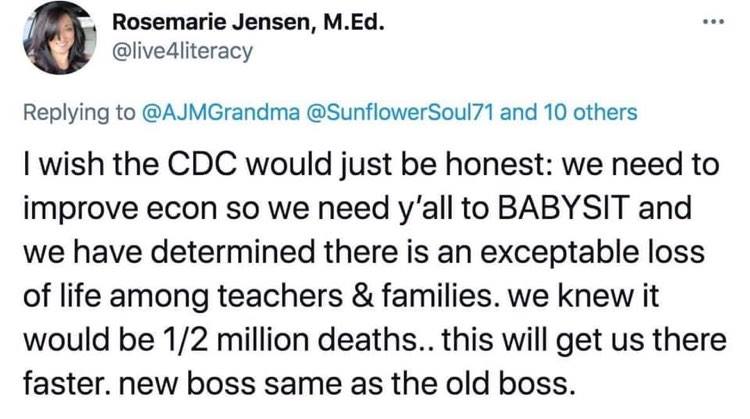
Few people are going to want to be teachers when they’re treated like this. Their health and safety is taken completely for granted. It isn’t even considered part of the equation or a certain amount of educator deaths are considered acceptable.

Teachers are expected to do multiple jobs at the same time in dangerous conditions at the drop of a hat and accept all the blame and none of the credit for what happens.

Ed tech companies have been waiting in the wings to take over the job of educating children. And the result will not be a superior education. It will be the complete dumbing down of American academics. Instruction will become a way corporations can sell products to students and families. It will not be centered on what is best for individual children.

As much as some people scream and foam at teachers who have the audacity to stand up for their own health and safety, they will miss us when we’re gone.

HEALTH ISSUES

And finally, there’s the lingering health issues caused by ignoring safety protocols for students and staff.

The problem with Covid isn’t just the possibility that you’ll die. Even if you survive, the most common long term effects are fatigue, shortness of breath, cough, joint pain, and chest pain.

However, other reported long-term symptoms include difficulty with thinking and concentration, depression, muscle pain, headache, intermittent fever and heart palpitations.

Long-term complications can include cardiovascular, respiratory, renal, dermatologic, neurological and/or psychiatric problems.

We don’t know how serious or widespread these issues will be. However, we could be dooming a generation of children to increased depression, anxiety, changes in mood, smell and taste problems, sleep issues, difficulty with concentration, or memory problems.

How will the job market be impacted by large numbers of young people on disability due to inflammation of the heart muscle, lung function abnormalities, acute kidney damage or even crippling rashes and hair loss?

There could be thousands of Covid’s Kids who have to pay the rest of their lives for the recklessness of adults today.

Not to mention adults suffering from these conditions and having to leave the workforce immediately.

So rushing to reopen schools is a bad idea.

It robs kids of the best possible education given pandemic conditions. It increases racial and economic inequality. It erodes faith in government at all levels. And it gambles with the health and safety of everyone – adults and children – caught in the middle.

The best way to promote student learning isn’t to attack the very system providing it. Nor is it to endanger the lives of those who do the work and provide instruction.

The current crisis can be a temporary situation to survive with a minimum of risk and a maximum of support and caution.

Or we can recklessly pretend it isn’t happening and put the future of our children and the nation at large in unnecessary jeopardy.


Like this post?  You might want to consider becoming a Patreon subscriber. This helps me continue to keep the blog going and get on with this difficult and challenging work.

Plus you get subscriber only extras!

Just CLICK HERE.

Patreon+Circle

I’ve also written a book, “Gadfly on the Wall: A Public School Teacher Speaks Out on Racism and Reform,” now available from Garn Press. Ten percent of the proceeds go to the Badass Teachers Association. Check it out!

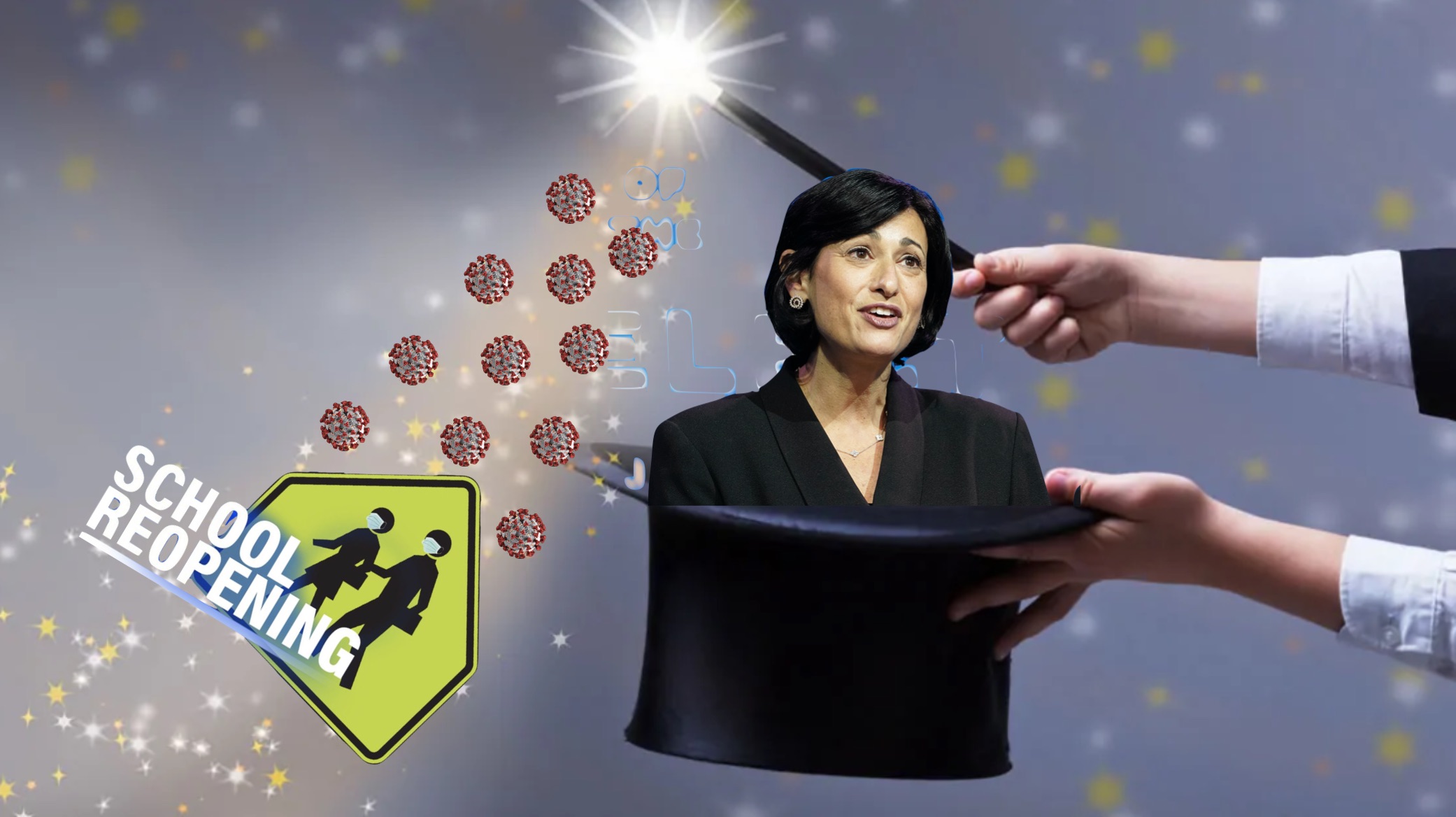
CDC Director Employing Magical Thinking About School Reopenings

Dr. Rochelle Walensky wants you to know it is not safe to go to any Super Bowl parties this weekend.

“We must take prevention and intervention seriously,” the Center for Disease Control (CDC) Director said at a White House briefing on the Covid-19 pandemic Wednesday.

“Whichever team you’re rooting for and whichever commercial is your favorite, please watch the Super Bowl safely, gathering only virtually or with the people you live with.”

However, on the same day at another Washington briefing she said we can reopen schools safely as infections soar without even waiting to vaccinate teachers first.

“There is increasing data to suggest that schools can safely reopen,” she said, and “safe reopening does not suggest that teachers need to be vaccinated in order to reopen safely.”

WHAT!?

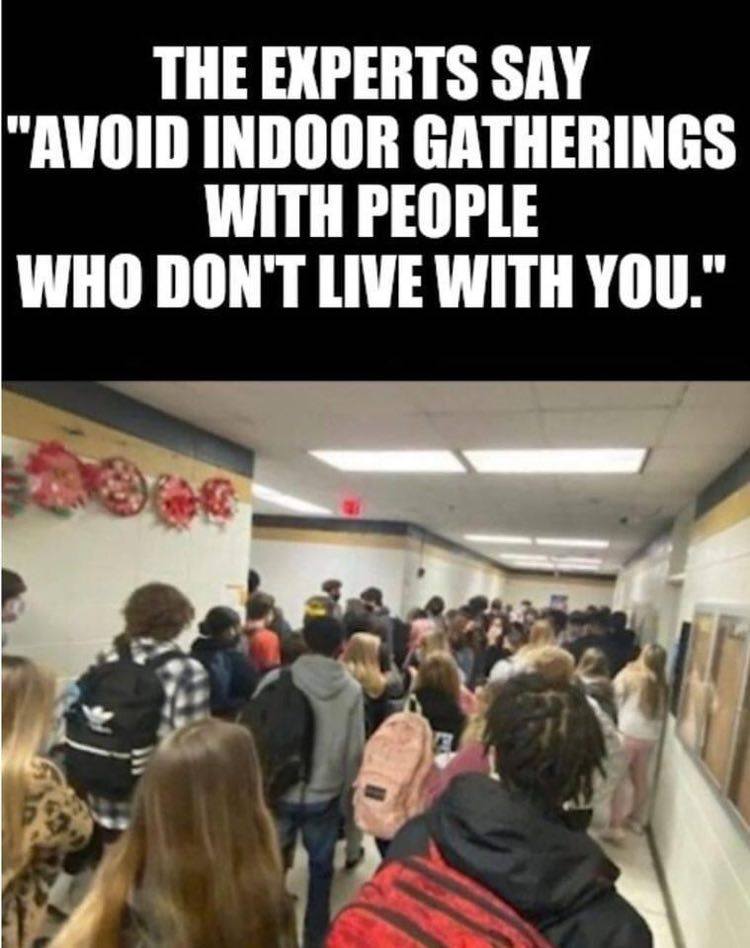
One doesn’t need to be an epidemiologist to know that these two statements are contradictory.

On the one hand, gathering in-person in a large group of people with whom you don’t live is a danger.

…If you’re watching a football game.

On the other, gathering in-person with an even larger group of people not in your personal pod and staying with them for an even longer period of time somehow IS safe. And in fact you don’t even need to be vaccinated against the virus before doing so.

…If you’re learning reading, writing and arithmetic.

What the heck is going on here!?

I thought the anti-science Trump CDC was a thing of the past.

Less than a month ago, health memos from the organization were being edited by Kellyanne Conway and Ivanka Trump. In September the White House blocked the agency from issuing a nationwide requirement that masks be worn on all public transportation.

Now with the Democrats in control of both houses of Congress and the Presidency, you’d expect something different.

In fact, Walensky claims her mandate is to remove politics from science.

“Political people cannot influence science,” she says. “If they do, I won’t be there.”

Then why are you promoting incoherent policies at the CDC? Why are you cherry picking data?

Why are you going on all the major news networks in transparent support of Biden’s proposal to reopen schools by April?

Why are you using your platform as head of the CDC to promote magical thinking?

Because that’s exactly what this is – magical thinking.

It’s not science.

Science doesn’t offer policy. It looks at very narrow questions and determines what may have caused what.

It works hand-in-hand with logic and reason. Otherwise, it’s invalid.

And the fact that your statements don’t add up disproves at least one of them.

Either large groups are a danger or they’re not.

If they’re not, then we can reopen schools AND go to Super Bowl parties.

If they are a danger (as a preponderance of evidence shows), then what is it about schools that makes them safer than Super Bowl parties?

Answer: Absolutely nothing!

In fact, schools are MORE dangerous for several reasons.

First, the average Super Bowl party only lasts a few hours. When not in remote or hybrid mode, schools typically are open 7-8 hours a day for five days a week, over 9 months.

You receive much more exposure to Covid-19 at school than at any Super Bowl party.

At both venues, people will be eating and drinking – the most dangerous time for infection. At parties, people may be snacking throughout the event. At school, students at least will eat lunch and probably breakfast not to mention possible snacks between meals. That’s approximately 180 breakfasts and lunches at which you are exposed to Covid compared with a few hours of nachos and pizza.

Moreover, the people attending these parties are mostly adults. Even with the likelihood that people will be drinking at these events, if you have responsible friends, these adults are much more likely to take precautions against infection than children. Kids are constantly fidgeting with their masks. Younger kids and some special needs students at many schools are even given mask breaks or excused from wearing them altogether. And that’s if the school in question has a mask mandate at all!

The idea that Covid doesn’t spread at school or is unlikely to spread is magical thinking.

Even if masks are worn more routinely at school because teachers enforce the rules, that doesn’t remove the danger. Few schools are large enough to socially distance children 6 feet apart. Many administrators don’t even try anymore – they simply promise to do the best they can. Add to that poor ventilation and inadequate cleaning of buildings and you have a recipe for disaster.

Pushback against the CDC has been huge, especially from teachers.

Things got so bad this week, that White House press secretary Jen Psaki distanced the Biden administration from Walensky’s remarks. Psaki said that Walensky had been speaking “in her personal capacity” and there would be “official guidance” and “final guidance” on the issue coming next week.

Walensky, herself, went on MSNBC’s Rachel Maddow show where she repeated her controversial statement but added that other steps need to be taken to lower risks for teachers and students, as well, including masking, social distancing and more viral testing.

“Schools should be the last places closed and the first places opened,” Walensky said.

Again, that is not a scientific statement. It’s a political one.

For someone who claims to be separating science and politics, she sounds much more like a Biden surrogate than a science advisor.

But it’s not just Walensky. The organization she oversees has made some huge missteps on this same issue since Biden’s inauguration – emphasizing some studies and completely ignoring others that don’t support the party line.

CDC scientists published an article last week in the journal of the American Medical Association (JAMA) that claimed some schools were able to reopen safely by following safety precautions. In fact, this one article is the cornerstone of Walensky’s assertion that “There is increasing data to suggest that schools can safely reopen.”

However, it was roundly criticized by the scientific community because the study was based on only 17 rural Wisconsin schools. Moreover, the data was based primarily on contact tracing. And considering that most children are asymptomatic even when infected with Covid-19, contact tracing is a poor method of determining how many people are infected in schools.

Heck! At the same time the CDC published another contact tracing study during the same week as the JAMA study which came to the opposite conclusion – that thousands of Covid cases were, in fact, linked to schools. I wonder why Walensky didn’t talk about that one at her White House briefing!

It’s not that the data is contradictory as much as the method the CDC is relying on is a poor indicator of infection.

Large-scale prevalence studies or antibody testing of students and teachers would much more accurately determine the relationship between educational settings and community transmission. But to date the CDC has not conducted any such studies.

In fact, despite such a full throated media blitz on the matter based on the JAMA article, the piece includes a rather telling disclaimer that its conclusions “do not necessarily represent the official position” of the CDC.

Walensky is right about one thing at least.

World scientific consensus is increasingly coming together around whether schools should be reopened in communities with high infections.

And it’s going in the exact opposite direction of Walensky and the CDC.

The European Centres for Disease Control and Prevention (ECDC) have acknowledged that children of all ages are susceptible to and can transmit Covid-19. Moreover, the organization admitted that school closures can contribute to a reduction in infections though by themselves such closures are not enough. It takes all of society working together to halt the spread of the virus.

In Europe, evidence obtained through antibody surveys conducted in various nations showed that the coronavirus equally infects school children, said Antoine Flahault, director of the University of Geneva’s Institute of Global Health. The results were repeated in Switzerland, Austria, and England.


Even England’s prime minister Boris Johnson conceded, “The problem is schools may nonetheless act as vectors for transmission, causing the virus to spread between households.”

But that’s not all. Take this study from southern India, published in the journal Science on November 6, which found children were spreading the virus among themselves and adults. Using both contact tracing and viral testing the study indicated that super-spreading events predominated, with approximately 5 percent of infected individuals accounting for 80 percent of secondary cases.

Dr. Ramanan Laxminarayan, member of the Center for Disease Dynamics, Economics and Policy in New Delhi, India, told NPR, “What we found in our study is that children were actually quite important. They were likely to get infected, particularly by young adults of the ages 20 to 40. They were likely to transmit the disease amongst themselves … and they also go out and infect people of all age groups, including the elderly. Many kids are silent spreaders in the sense that they don’t manifest the disease with symptoms. They happen to get infected as much as anyone else, and then they happen to spread it to other people.”

Why is none of this being considered by the CDC?

If the goal is to remove politics from science, shouldn’t the organization follow the evidence even if it goes against Biden’s school reopening policy?

Are these other studies invalidated because they were conducted in other parts of the world?

Okay. Here are a few others from the US:

● A JAMA study published July 29 concluded that statewide school closures in the first wave of the pandemic led to a 62 percent decline in the incidence of COVID-19 per week. Similarly, the death rate saw a 58 percent decrease. States that closed earlier saw the most significant weekly reductions.


● According to a study published in Science, the combination of the closure of schools and universities, limiting gatherings to 10 people or less, and closing most nonessential businesses reduced the reproductive number (R0) to below one. These efforts reduced the number of infections in the community. Among the interventions listed, school closures and limiting gatherings to 10 people had the highest impact on slowing the infections.


● A Nature study published in November ranked the effectiveness of worldwide COVID-19 interventions. It concluded that the cancellation of small gatherings, closure of educational institutions, border restrictions, increased availability of PPE and individual restrictions were statistically significant in reducing the reproductive number (R0).

Where are these studies in the CDC’s analysis?

Answer: nowhere.

Because this is not about science. It is still about politics.

After the criminal negligence of the Trump administration spreading lies and disinformation through government channels, what the Biden CDC is doing is beyond reckless.

We need to have facts. We need to be able to trust our scientific organizations again.

This kind of willful negligence won’t just result in more Covid deaths, it will enable the next Trump to do much worse behind a banner of fake news and science denial.

And how will science defenders fight back when both sides play with the data to make it say whatever they want?

Sadly, this new CDC is far too similar to the old CDC.

I had hopes Biden would be better than this.

He still has time to turn back from these games.

Next week’s new CDC guidelines will likely signal whether he is changing course or doubling down.

In the meantime, teachers, students and communities desperately in need of valid science and facts have to turn to the rest of the world for guidance.

Our lives are not expendable to ensure a robust economy.

That lesson will be a lot less expensive now than after the next neo-fascist coup.

We can’t afford magical thinking at the CDC.


Like this post?  You might want to consider becoming a Patreon subscriber. This helps me continue to keep the blog going and get on with this difficult and challenging work.

Plus you get subscriber only extras!

Just CLICK HERE.

Patreon+Circle

I’ve also written a book, “Gadfly on the Wall: A Public School Teacher Speaks Out on Racism and Reform,” now available from Garn Press. Ten percent of the proceeds go to the Badass Teachers Association. Check it out!
Want to Appreciate Teachers? Vaccinate Us Before Reopening Schools

This year I don’t need a free donut.

I don’t need a Buy One Get One coupon for school supplies.

I don’t need a novelty eraser or a mug with a happy saying on it.

I just need to be vaccinated against Covid-19 before being asked to teach in-person.

You want to say you appreciate teachers? Great! Then provide us with a minimally safe environment to work in.

That is LITERALLY the least you can do.

Not a banner or an advertisement or even a sentimental greeting card.

Give us the minimum protections so we can meet the demands of school directors, administrators and the community.

Not a cookie. A Covid vaccine.

Not a demand that we teach in an unsafe environment or go look for work elsewhere.

Give us the tools we need to meet your demands without putting our lives at unnecessary risk.

And we’re not even talking about ALL the tools necessary.

Minimum 6 feet social distancing? Ha! You know you can’t fit all the students in the building that way!

Low rate of infections throughout the community? Ha! You don’t have the patience to wait for that!

Equitable funding with schools in higher income communities? The freedom and autonomy to forgo high stakes standardized testing? Not having to compete with charter and voucher schools that get to play by different rules skewered in their favor?

Ha!

Ha!

And Ha!

No, if you’re going to do the least thing possible – the absolute slightest, minimal, tiniest thing you could possibly do – make sure your staff has the chance to be fully vaccinated before thrusting us back in the physical classroom.

Many of us have been teaching online for months now. We didn’t survive this long just to be kicked out of quarantine when protections exist but are not yet available.

However, in many districts that is exactly what’s being done.

Though vaccines are slowly being rolled out, few school boards are waiting for staff to be protected before throwing open the doors and restarting in-person instruction.

Some districts never stopped in the first place.

So why the discrepancy?

Why have some districts remained open and why are others refusing to wait before reopening?

It’s not because they’re in communities with lower infection rates. In fact, just the opposite.

In most parts of the country, Covid-19 is on a rampage through our communities making people sick, filling up ICUs and graveyards.

More than 400,000 people nationwide have died already from the disease and many health experts expect that number to reach 500,000 before the end of February.

That’s about 4,000 people a day.

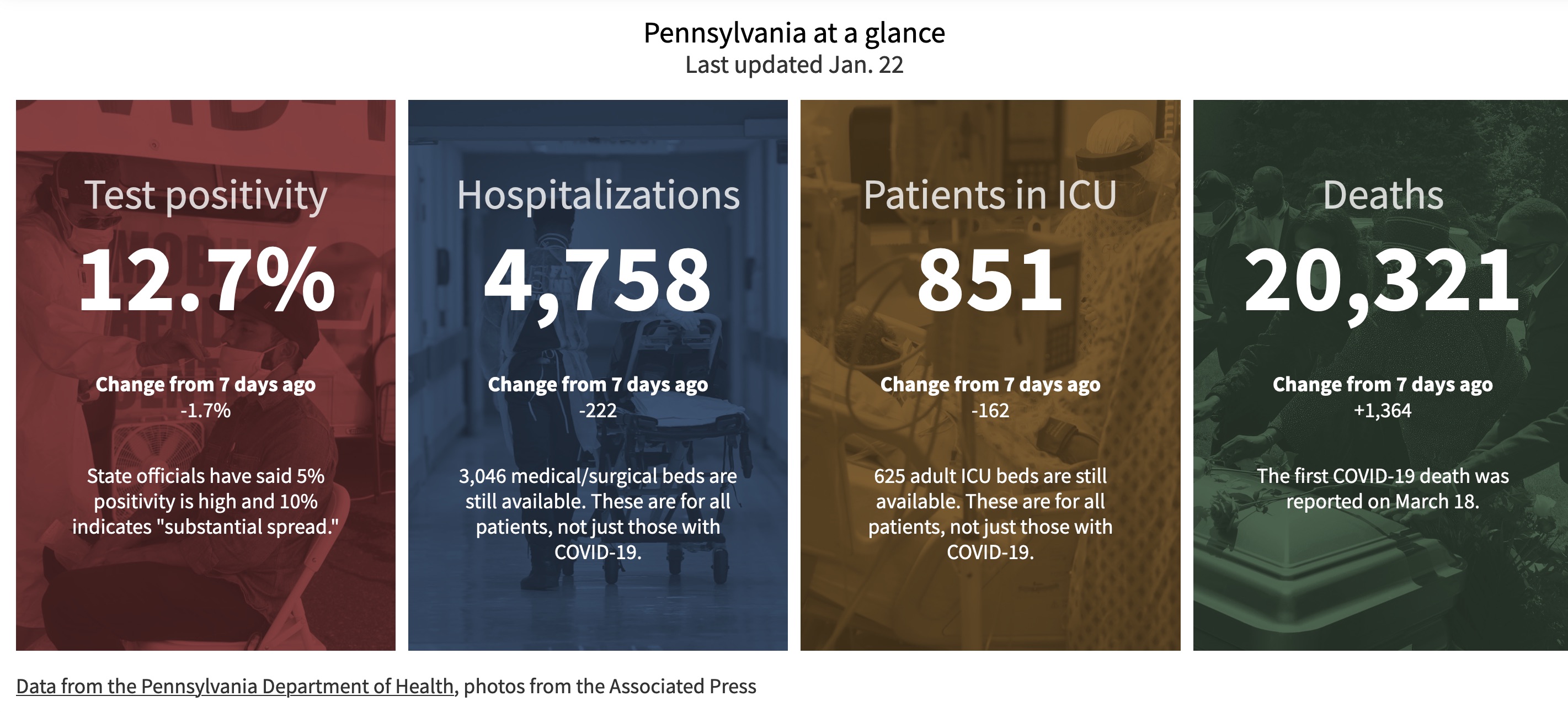
In my home state of Pennsylvania, infections are considered substantial if more than 10% of Covid tests in a county come back positive. As of today, that includes every county in the Commonwealth. In fact, our statewide average is 12.7%!

The danger is real and widespread. It’s just that some districts and communities care more than others for their teachers and the students they serve.

It’s not that districts that remain open to in-person instruction have avoided outbreaks.

My home district of McKeesport, located in western Pennsylvania near Pittsburgh, has been open on and off since September 2.

According to the district’s own Website, out of about 3,000 students and 200 teachers, there have been 106 cases of Covid – 61 among staff and 45 among students.

That’s roughly 21 cases a month.

Keep in mind these numbers don’t include people quarantined or those who get sick and either don’t report it or don’t know it because they’re contagious but asymptomatic. If we added all the people impacted by the decision to keep the district open, the numbers would be much higher.

In any case, decision makers at McKeesport apparently think there’s nothing wrong if every month at least 21 people (adults and children) get the virus, risk their health, and potentially suffer life long consequences.

They don’t mind if having the schools open drives up the infection rate in the community.

They don’t mind if moms and dads, grandmas and grandpas, even people with no kids in the district have a greater chance of getting sick because decision makers can’t be bothered to look out for the common good.

That’s not an example anyone should be emulating. It’s one we should be avoiding.

Don’t get me wrong.

It’s not that I don’t want to get back to the classroom. There are few things I’d rather do.

Teaching on-line is awkward and strange. Spending all day talking to blank boxes on your computer screen each one representing a child who may or may not be there at that particular moment in time.

Trying to find or recreate classroom materials and rethink how they can best be used in a virtual environment.

Troubleshooting technological issues, answering hundreds of emails and instant messages a day all while having to attend pop up virtual staff meetings that hardly ever deal with the problems of the day but are instead focused on how to return to an in-person method of instruction without ANY concern for the health and safety of the people who would have to enact it!

If people cared at all about teachers, they wouldn’t demand we do that.

They’d look out for us the same way we look out for their children every day in the classroom whether it be physical or virtual.

But where I live, teachers and other frontline workers aren’t even on the top of the list to be vaccinated. Even those at the top of the list can’t be seen because UPMC, the healthcare agency distributing the vaccine, is giving preference to its own office workers who do not come into contact with infected people.

You want to get kids back in school buildings? Talk to the people messing up the vaccination process. Don’t shrug and demand teachers take up the slack – AGAIN!

When I took this job it wasn’t to be a police officer or a soldier. I never volunteered to put my health on the line treating sick people in the hospitals.

I chose to be a public school teacher.

I mentor needy children. I inspire the dispirited, I stoke the curious, I enlighten the ignorant.

I don’t sacrifice my life because you can’t be bothered to provide the most basic resources possible I need to even attempt to do my job.

That’s not too much to ask.

In fact, it’s not much at all.

I’m not saying vaccines are a panacea.

Just because you take the vaccine doesn’t mean POOF you’re immune. It takes at least a month to reach full 90-95% immunity. Both the Pfizer and Moderna vaccines require you take two doses (at least 21 or 28 days apart, respectively). The level of protection increases dramatically – from 52% to 95% – but you need both doses to get there.

Moreover, there are other more virulent strains of Covid out there. Preliminary studies seem to suggest that these two vaccines are effective against them, but only time and further study will tell for sure.

In addition, being vaccinated protects you, but not your unvaccinated family. You can still be contagious and bring the virus home with you – though studies suggest any disease you spread after vaccination would be of a much weakened form.

Even if every teacher who wanted a vaccine got one, the pandemic would not be over.

According to some epidemiological estimates, as many as three-fourths of Americans must become immune to COVID-19 – either by recovering from the disease or by getting vaccinated – to halt the virus’s spread.

However, recent polls suggests that 29% to 37% of Americans plan to refuse a COVID-19 vaccine – even some teachers.

So we can’t just allow educators to be vaccinated. We need to encourage everyone to get one. Otherwise, it may protect individuals but not the community.

Education is vital to ensure that everyone knows the risks and benefits of taking the vaccine and how to protect themselves and their children.

And if you want people to be educated you’re going to need some teachers to do it.

We don’t need a pat on the back or even a “Thank You” to get the job done.

What we need are the basic protections necessary to both meet your expectations and survive the endeavor to teach another day.

So stop the badgering and bullying.

Make sure all teachers have the chance to be fully vaccinated before returning to the in-person classroom.

It is the least you can do.


Like this post?  You might want to consider becoming a Patreon subscriber. This helps me continue to keep the blog going and get on with this difficult and challenging work.

Plus you get subscriber only extras!

Just CLICK HERE.

Patreon+Circle

I’ve also written a book, “Gadfly on the Wall: A Public School Teacher Speaks Out on Racism and Reform,” now available from Garn Press. Ten percent of the proceeds go to the Badass Teachers Association. Check it out!
The Teacher Trauma of Repeatedly Justifying Your Right To Life During Covid

I am a public school teacher and my life has value.

That shouldn’t be controversial.

But every few weeks in 2020-21 as the global Covid-19 pandemic continues to spread unabated, I have to go to a staff meeting and justify my right to continue breathing.

Administration and the school board want to stop distance learning and reopen the school for in-person classes.

Yet the Pennsylvania Department of Health recommends all schools be fully remote in any county with a substantial level of community transmission of Covid-19. As of today, that’s every county in the whole state.

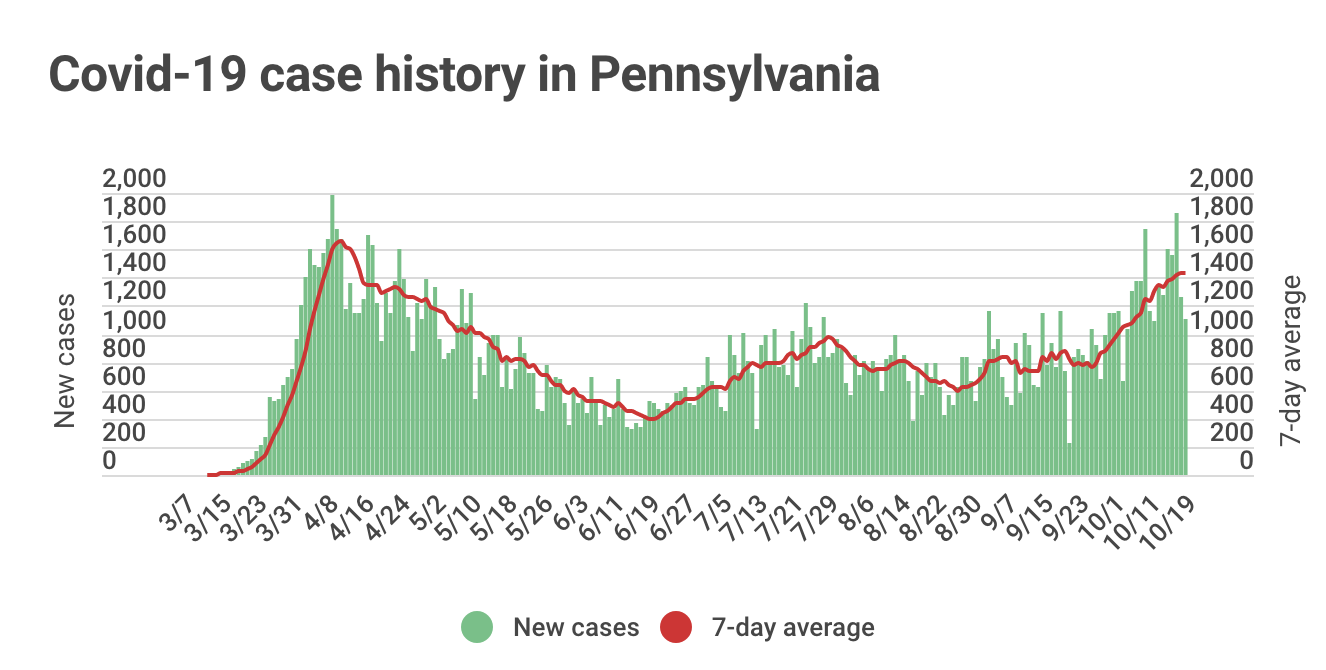
Allegheny County – the area near Pittsburgh where I live – has averaged about 600 new cases a day since the beginning of December. More than 1,100 people have died – 149 just in January, alone.

Meanwhile, teachers and other frontline workers have to wait to get vaccinated because UPMC, the healthcare agency distributing the vaccine, is giving preference to its own office workers who do not come into contact with infected people.

Meanwhile, hospital beds in local Intensive Care Units (ICUs) are filling up. On average in the state, ICUs are at 81% capacity, slightly higher than the national average of 79%. That means UPMC Presbyterian Shadyside is at 104% capacity, UPMC East is at 94% capacity, Allegheny General Hospital is at 92% capacity, West Penn Hospital is at 91% capacity – heck! Even Magee Women’s Hospital, which mostly focuses on births, is at 81% capacity.

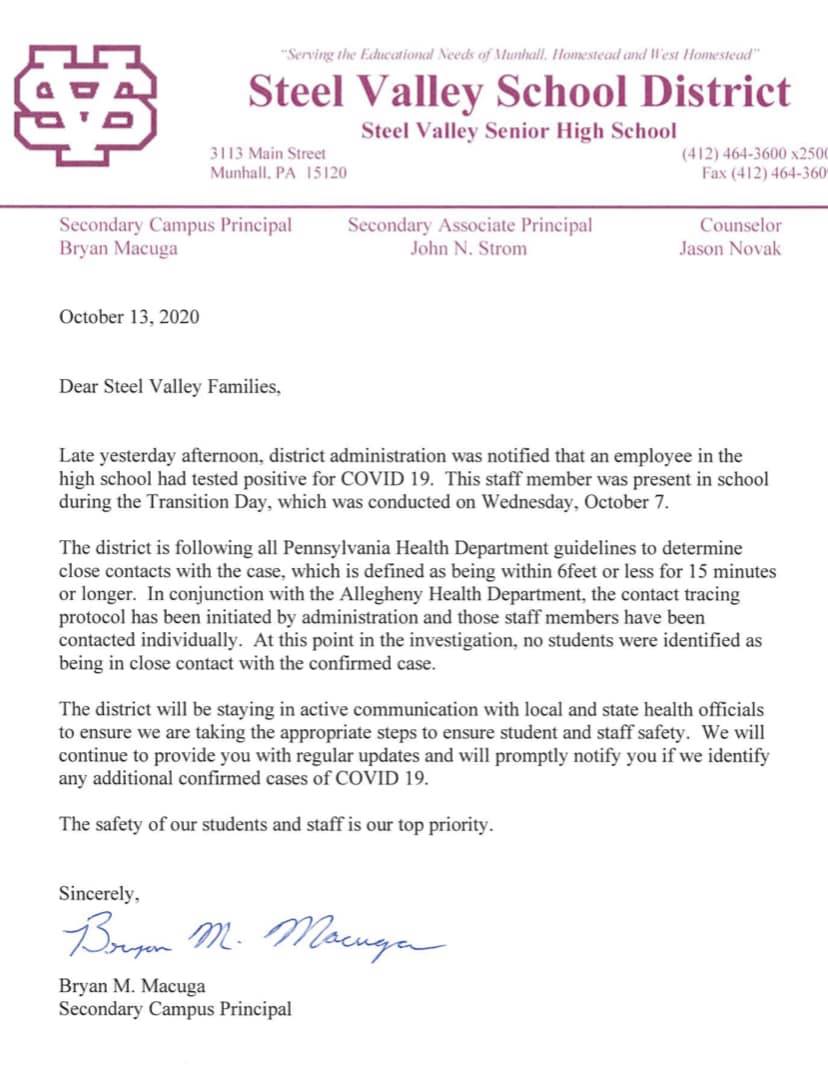
Meanwhile, the last time our district was open for in-person classes – a period which only lasted about 8 days – at least 30 people (both students and staff) were diagnosed with the virus and more than 70 had to quarantine. Covid-19 spread throughout our buildings like wildfire including an entire kindergarten class and almost every single adult in the high school office.

Yet it’s that time again!

Time to justify keeping things closed up tight!

It’s insane! They should have to justify opening things back up!

But, no, that’s not how things work in post-truth America.

So my life goes back on the scales with student learning, and I’m asked to explain why my employer and community should care more about me than their kids chances of increased educational outcomes.

It’s not even a valid dichotomy.

Risking teachers lives does not mean students will learn more.

People complain about student absences and disengagement online – issues that we can certainly improve if we focus on them with half the vigor of figuring out ways to reopen school buildings when it is not safe to do so. But swinging open the doors won’t solve these problems.

No matter what we do, these will not be optimal learning conditions. Even if students and teachers meet in-person, it will be in an environment of fear and menace – jury rigged safety measures against the backdrop of mass infections, economic instability and an ongoing political coup.

You may see it as a simple calculus – teacher vs. students – but the world doesn’t work that way.

You need teachers to teach students. If something is bad for teachers, it’s also bad for students.

Sick teachers don’t teach well. Dead teachers are even less effective.

But every few weeks, we’re back to square one. And nothing has changed to make in-person learning any safer.

In fact, scientific consensus has undergone a massive shift away from it.

A study released this week from the Université de Montréal concluded schools are spreading the virus in Canada and reopening would undermine any benefits from partial lockdowns.

We’re seeing the same thing in the US where Massachusetts schools reported 523 students and 407 staffers tested positive for COVID in just the last week.

We’ve seen similar outbreaks in Georgia and Mississippi, but the reason they have not been reported nationally is due to two factors. First, the Department of Education under Betsy DeVos refused to keep track of such data, though being a central repository for education statistics is one of the main functions of the job. Second, many students do not show symptoms of the virus even when infected. That means nearly all contact tracing studies show merely the tip of the iceberg and are potentially concealing massive infections.

And this is evident when we take a more national view of the facts. The Covid hospitalization rate for children has increased by 800 percent in the last six months.

More than 250,000 students and school staff contracted the disease between August 1 and the beginning of December, according to The COVID Monitor, a US News database that tracks Coronavirus cases in K-12 schools. That doesn’t even factor in the surge of cases since the Christmas holidays. Add to that the American Academy of Pediatrics report of more than 1 million child cases in the US.

The fact that the disease can go undetected but still be infectious is exactly the factor driving its spread according to a report from the beginning of January from The Guardian:

“A key factor in the spread of Covid-19 in schools is symptomless cases. Most scientists believe that between 30% and 40% of adults do not display any Covid symptoms on the day of testing, even if they have been infected. For children, however, this figure is higher. “It is probably more like 50% for those in secondary school while for boys and girls in primary school, around 70% may not be displaying symptoms even though they have picked up the virus,” says Professor Martin Hibberd of the London School of Hygiene and Tropical Medicine.”

However, the most comprehensive national study was done by US News and World Report. It concluded:

-The high school student case rate (13 per 1,000 students enrolled for in-person classes) is nearly three times that of elementary school students (4.4 per 1,000). 

-The higher the community case rate, the higher the school district case rate.

-Case rates for school districts are often much higher than case rates in the community. Meanwhile, these schools are often under reporting the cases of students and staff.

-The more students enrolled for in-person classes, the higher the case rate in the school district. Likewise, reducing in-person classes can reduce the case rate.

Despite all this evidence, many local districts act as if reopening is a fact free zone. Everyone has an opinion and each is equally as valid.

Wrong!

This time around, even some teachers have internalized the illogic.

We don’t have to behave like lemmings, all jumping off the cliff because the person in front of us jumped.

I understand that this is all being driven by economic factors.

The super rich want the economy to keep chugging along and taking the kind of precautions that would put the least lives in danger would hurt their bottom line. That’s why Congress has been unable to find the courage to pay people to stay home and weather the storm. It’s against the interests of the wealthy.

As usual, teachers are being forced to pay for all of Society’s ills. Schools aren’t adequately funded, so teachers are expected to pay for supplies out of pocket. Districts can’t afford to hire enough staff, so educators have to try to do their jobs in bloated classes and work ridiculous hours for no extra pay.

I knew all that coming into the job. But demanding I put my life and the lives of my family at risk because the government refuses to protect its citizens during a pandemic!? I didn’t sign up for that!

And the worse part is that it’s the same thing every few weeks.

We try to reopen, it’s a fabulous disaster, we close and then the clock starts over.

This isn’t good for the kids, the parents or the teachers.

How will I ever trust my administrators again when they force me to ride this merry-go-round?

How will I ever respect the school board when they can’t put petty politics aside for the good of their own kids?

How will I continue to serve the community when, as a whole, it can’t agree that my life matters?


Like this post?  You might want to consider becoming a Patreon subscriber. This helps me continue to keep the blog going and get on with this difficult and challenging work.

Plus you get subscriber only extras!

Just CLICK HERE.

Patreon+Circle

I’ve also written a book, “Gadfly on the Wall: A Public School Teacher Speaks Out on Racism and Reform,” now available from Garn Press. Ten percent of the proceeds go to the Badass Teachers Association. Check it out!

For Teachers, “Silence of Our Friends” May be Worst Part of Pandemic

“In the End, we will remember not the words of our enemies, but the silence of our friends.”
-Martin Luther King Jr

Teachers want a safe place to work.

But in 2020 that is too much to ask.

As the global COVID-19 pandemic rages out of control throughout most parts of the United States, teachers all across the country want to be able to do their jobs in a way that won’t put themselves or their loved ones in danger.

In most cases that means remote instruction – teaching students via the Internet through video conferencing software like Zoom.

However, numerous leaders and organizations that historically are supportive of teachers have refused to support them here.

The rush to keep classrooms open and thus keep the economy running has overtaken any respect for science, any concern for safety, and any appeal to compassion.

Many Democratic lawmakers, school directors, union leaders and even public school advocates have repeatedly turned away, remained silent or promoted policies that would continue to put educators in danger.

Thankfully, some districts have been accommodating, worrying about the safety of children as well as adults.

But many others have refused to go this route even demanding educators with compromised immune systems and other increased risk factors either get in the classroom and teach or seek some sort of financially burdensome leave.

Affected teachers often wonder where their union is, where their progressive representative, where the grassroots activists who were willing to organize against charter schools and high stakes testing.

Answer: crickets.

As a result, more than 300 U.S. teachers and other school employees have died from the virus, according to the Associated Press.

In New York City, alone, 72 school employees died of the virus, according to the city Department of Education.

And since Education Secretary Betsy DeVos has refused to collect data on how the pandemic is affecting schools and school employees, this count is probably woefully under-representative of the full tragedy.

About 1 in 4 teachers – nearly 1.5 million – have conditions that raise their risk of getting seriously ill from the Coronavirus, according to the Kaiser Family Foundation.

In my own Western Pennsylvania community in the last few weeks, we buried high school employee Terri Sherwin, 60, of Greater Latrobe School District and elementary school employee Dana Hall, 56, of Jeannette City School District.

The assertion that children cannot get the disease, which was popularized by the Trump administration, has been proven false.

More than 1 million kids nationwide have been diagnosed with COVID-19 according to a report by the American Academy of Pediatrics .

The Centers for Disease Control (CDC) says most children who get the disease (especially those younger than 10) are asymptomatic or have only mild symptoms but are still capable of transmitting the virus to others. This – along with the lack of a national database – makes it incredibly difficult to accurately trace the source of an outbreak through the schools.

However, in November the CDC quietly removed controversial guidelines from its website promoting in-person learning, and instead lists it as “high risk.”

“As new scientific information has emerged the site has been updated to reflect current knowledge about COVID-19 and schools,” a spokesperson said.

Yet there has been no subsequent change in the policy positions of most lawmakers, school directors, union leaders or education activists.

A prime example of this is New York City’s plan to reopen most schools to in-person learning at the beginning of this month despite rising infection rates and an average of more than 2,000 new cases a day.

The plan has the full support of most teachers unions.

Randi Weingarten, president of the American Federation of Teachers (AFT) said the plan “combines the best of what we have learned nationwide during COVID about how to keep staff and students safe and how to instruct young kids.”

Michael Mulgrew, president of the United Federation of Teachers (UFT) agreed.

He said:

“We are supportive of a phased reopening of schools in other neighborhoods as long as stringent testing is in place. This strategy – properly implemented – will allow us to offer safe in-person instruction to the maximum number of students until we beat the pandemic.”

The plan is predicated on a bogus statistic that kids aren’t getting sick at school or spreading the virus from there, that only 0.2% can be traced back to school buildings.

But we know that contract tracing is inadequate. We know people are getting sick. Hospitals are filling up. People are dying.

Why aren’t the unions standing up more for their employees here? Why is the request for a safe work environment too much?

Answer: politics.

With President-elect Joe Biden about to announce his pick for Secretary of Education, few union leaders have the courage to go against the party line and disqualify themselves from consideration.

Biden’s plan right now seems to be keeping the schools open with an influx of cash.

Former President of the National Education Association (NEA) Lily Eskelsen García hasn’t said much recently on the issue to my knowledge.

But she was unafraid to contradict President Donald Trump before the election.

She appeared on CNN and challenged Trump to “sit in a class of 39 sixth graders and breathe that air without any preparation for how we’re going to bring our kids back safely.”

In late April, she took to Twitter saying the NEA is “listening to the health experts and educators on how and when to reopen schools — not the whims of Donald Trump, who boasts about trusting his gut to guide him. Bringing thousands of children together in school buildings without proper testing, tracing, and social isolation is dangerous and could cost lives.”

In an interview in May she said:

“The stakes of doing it wrong is that someone dies. It’s not just that someone doesn’t graduate or someone doesn’t learn their times tables — someone could die.”

I wonder what she would say today – and why she hasn’t spoken out as vocally.

In my neighborhood, Pennsylvania State Education Association (PSEA) President Rich Askey has continually asked districts to follow state safety guidelines.

“The health and safety of students, staff, and our families must be our top priority,” Askey said. “We call on all school district leaders to follow the state’s guidelines to protect the health and safety of everyone in our school communities.”

However, state guidelines are pretty weak. They suggest mask wearing and that districts close when community infection rates are high. But districts can choose to keep buildings open if they promise to follow safety guidelines to the best of their ability.

Gov. Tom Wolf originally issued an order for all schools to close and go to remote learning last March. However, state Republicans challenged his authority to do so and their position was upheld in court.

Since then, Wolf has issued tons of guidance but not much else.

I assume Wolf would say he hasn’t done more because his hands are tied.

I assume Askey would say the same.

But such platitudes taste like ashes in your mouth when faced with the everyday reality that almost everyday the state is breaking its previous record for Coronavirus cases. Today we had nearly 13,000 new cases and 149 deaths! Yes, that’s just today!

Will their hands still be tied when daily cases reach 20,000? 50,000? 100,000?

The decision about whether to keep buildings open to in-person classes or go with remote instruction has mostly been left with school directors.

And their decisions have been all over the place.

These are not public health officials.

These are not people used to making life and death decisions.

They’re used to deciding whether to remodel the library, buy books from this or that vendor or declare Friday a holiday because the football team won the state championship.

I don’t mean to diminish what they do.

Some have been going above and beyond every day to ensure the health and safety of students, staff and the community.

But far too many pay lip service to that idea while making sure their local business gets to keep operating with employees who don’t have to sit home with their children.

And these are people from the community. How many times have teachers called them to let them know how their kids were doing in class? How many times have teachers gone with them and their kids on school field trips? How many times have teachers accepted invitations to graduation parties and school board meetings?

We should be on the same team, but too many school directors are far too willing to sacrifice our lives and safety to safeguard their own bank accounts.

When will school directors admit the cost is too high? How many staff have to get sick? 20? 50? 100? How many have to die?

However, as much as the silence and disregard of lawmakers, union leaders and school directors hurts – it is the reaction from many education activists that stings the most.

When our schools are attacked by charter schools and voucher schools, we organize and fight it together.

When high stakes testing unfairly labels our children and is used to defund and loot our budgets, we organize and fight together.

No matter what the issue – the school-to-prison pipeline, Common Core, racist discipline policies, value added teacher evaluations, runaway ed tech – we’ve come together to fight as one.

But suddenly when it’s an issue of teachers vs. the economy, our allies go silent.

They’re afraid remote learning will lead to more ed tech solutions, that it will embolden parents to enroll in charter or voucher schools, that it will hurt student learning. And to be fair there is reason to fear.

However, instead of standing together and fighting these new challenges as they come (as we’ve always done) many of our activist allies have abandoned us.

They champion articles about a non-existent consensus that it’s safe to reopen schools. They champion the work of a discredited economist over epidemiologists and virologists. They side with the same neoliberals and corporate education reformers we used to battle together.

Or they simply remain silent.

That’s the one that really hurts the most.

One day this pandemic will end.

One day – I hope it’s soon – it will be safe to return to the classroom and begin again.

But the wreckage of the virus will pale in comparison to the damage we have done to each other and our relationships.

Coalitions may crumble and fall.

Trust may disappear.

And the way forward – if any will be left – may be much different than it was only a year ago.

No one who refuses to defend your right to life is your true ally.

We won’t forget who spoke up and who remained silent.


Like this post?  You might want to consider becoming a Patreon subscriber. This helps me continue to keep the blog going and get on with this difficult and challenging work.

Plus you get subscriber only extras!

Just CLICK HERE.

Patreon+Circle

I’ve also written a book, “Gadfly on the Wall: A Public School Teacher Speaks Out on Racism and Reform,” now available from Garn Press. Ten percent of the proceeds go to the Badass Teachers Association. Check it out!

McKeesport Schools Are Hiding At Least Six More COVID Cases at the High School & Twin Rivers

At least six more cases of COVID-19 have been identified at McKeesport Area School District, but you wouldn’t know it from administrators.

The information at the Western Pennsylvania district is being kept quiet instead of being released to the public.

So at the high school, two students tested positive, and at Twin Rivers Elementary, three staff and one student were identified as having the virus last week, according to a reliable source close to the school board.

Of those, two of the three Twin Rivers staff are awaiting confirmation of their test results from Allegheny County Health Department. The rest have all been tested and their results confirmed.

However, there are a few additional potential cases that remain to be investigated, according to the same source.

The district used to send out telephone, email and conventional mail alerts when students or staff tested positive.

However, the district created a Covid Tracker on its Website in October after I suggested it at a school board meeting.

Though the tracker has not yet been updated to include this information, it is being considered as the sole source of information to the community about cases, according to the school board source.

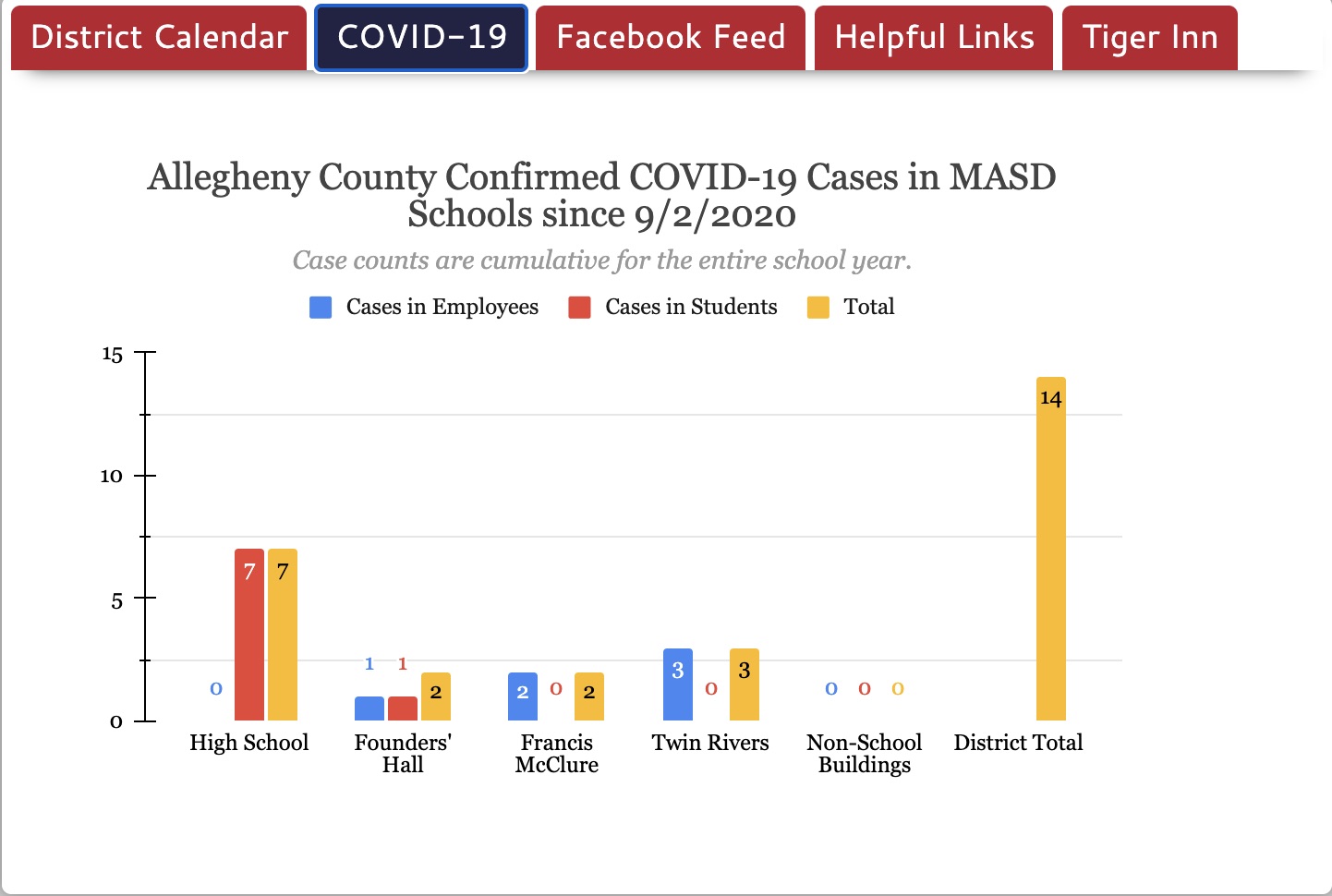
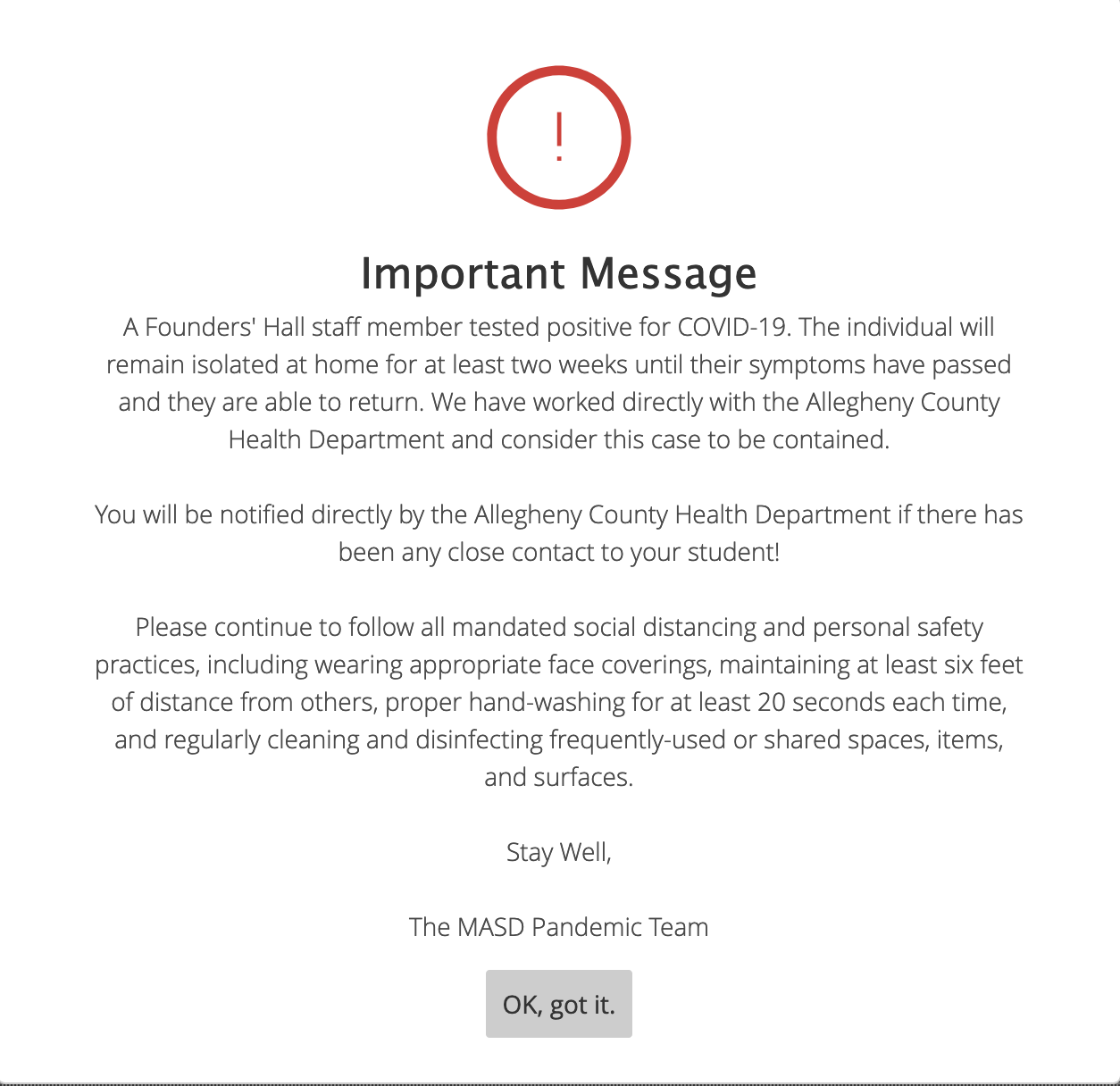
As of Monday night, the tracker only lists 14 cases in the district since buildings reopened in September – seven students at the high school, a student and a staff member at Founders Hall, two staff at Francis McClure Elementary and three staff at Twin Rivers.

The new cases would bring the district total to 20 – nine at the high school, seven at Twin Rivers with the numbers at other buildings unchanged.

That’s 11 students and 9 staff total – not counting any additional cases that may be coming.

I still think the tracker is a good idea, but it shouldn’t be the sole source of this information.

Parents should not have to check it every day to discover if an outbreak is underway. Administration should continue to provide this data with parents as things happen so parents can make informed decisions about continuing to send their children to in-person classes or not. (Many parents have their children enrolled in the district cyber program instead.)

And school directors should be using this data to determine if it is safe to keep buildings open at all.

Moreover, the tracker has its own glitches.

It does not come up when accessed through certain browsers like Firefox. Unless you use the most reliable browsers like Chrome, you can get nothing but an empty white screen.

With the county in the midst of a steadily increasing surge in Coronavirus cases, now is not the time to hold back on information.

On Sunday, the county broke precedent to report over the weekend an increase of 527 cases of COVID-19, the highest daily number reported since the pandemic began in March.

This followed a week of record-breaking reports from the Pennsylvania Department of Health, with an all-time high of 5,551 cases reported on Saturday throughout the state.

There have been 4,230 cases of COVID-19 in Allegheny County this month, alone.

Nationwide, it took the country 300 days to reach 11 million cases, but over just the last six days, that number increased by another million.

Over the last week, the country has averaged more than 1,080 deaths a day – more than 30% higher than two weeks previous.

The McKeesport community deserves up-to-date information about viral spread in our schools.

Administrators need to step up the transparency.


Like this post?  You might want to consider becoming a Patreon subscriber. This helps me continue to keep the blog going and get on with this difficult and challenging work.

Plus you get subscriber only extras!

Just CLICK HERE.

Patreon+Circle

I’ve also written a book, “Gadfly on the Wall: A Public School Teacher Speaks Out on Racism and Reform,” now available from Garn Press. Ten percent of the proceeds go to the Badass Teachers Association. Check it out!
Covid-19 Has Eroded My Faith in Public Schools

I am a public school advocate.

I teach at a public school.

My daughter goes to a public school.

I have spent most of my professional career fighting for public schools against every form of school privatization imaginable.

But since the beginning of this school year and the incredibly reckless way many public schools have dealt with reopening and keeping students and staff safe, I feel much of that enthusiasm drying up.

It’s not something I’m proud of feeling.

I’m actually kind of embarrassed about it.

But there are so many people I will never be able to look at the same way ever again.

There are so many organizations, unions, school boards, administrators, policy makers who have lost my trust – perhaps forever.

I’m not saying I love charter schools or private schools.

I don’t.

I still think they’re mostly scams bent on using the laws to cash in on kids while taking our tax money and running.

But the idea that public schools are fundamentally better – that idea has suffered tremendously.

I used to believe that local control was something to cherish, that a board made up of neighbors duly elected by the community would more often than not have the best interests of that neighborhood at heart when making decisions.

And, frankly, I just don’t feel that way anymore.

How can you preserve such an ideal in the face of so much evidence to the contrary – so many school boards who vote to open classrooms – and keep them open – despite raging infection rates? Despite students and teachers getting sick? Despite quarantines and warnings from epidemiologists?

SCHOOL BOARDS

McKeesport Area School District, where I live, has had more than 14 cases of Covid among students and staff since September and the school board isn’t even considering closing.

In fact, in October when most of these cases were coming to light and Center for Disease Control (CDC) guidelines suggested schools should temporarily close to ensure the virus wasn’t running out of control, administration chose to ignore the CDC on the basis of advice by the Allegheny County Health Department.

Seriously.

Administrators prioritized local officials telling them what they want to hear over national experts in infectious disease with hard truths. In short, keeping the doors open was considered more important than student safety.

Meanwhile, the district where I work, Steel Valley Schools, smartly decided to open with virtual learning in September. However, the board decided to change to a hybrid model in November to test the waters.

Yes, the board decided to make students and teachers guinea pigs in an experiment to see if they could somehow avoid getting sick while cases surged throughout the country and state.

And after only five days, a high school student tested positive and numerous kids and staff had to quarantine.

Yesterday the state Website announced that our county, Allegheny County, – which had been considered moderate in terms of infections – is now in the substantial category. The incidence rate is 138.7 per 100,000.

Also in the substantial category are nearby Armstrong, Butler, Beaver, Washington, and Westmoreland counties.

Will Western Pennsylvania schools do the right thing and go to remote learning? Will Steel Valley finally give up this in-person experiment? Will McKeesport?

Without a strong leader like a Governor or President to order a shut down and take the heat, I’m not sure local school directors will have the courage to act.

They keep blaming everything on academics, saying they have provide what is best to help students learn – never mind the dangers to child, parent and teachers’ bodies. But even more hypocritically they ignore the well being of huge swaths of their students who refuse to take part in their in-person experiment.

In both districts, about 60% of parents favor in-person schooling and 40% prefer remote.

So the boards are doing what the majority wants, but it’s a slim majority.

There is a significant portion of parents who feel these in-person plans are unsafe and very little is being done to educate their children.

At McKeesport, parents can enroll their kids in the district cyber program. No live teachers. No synchronous lessons on-line. Just a canned credit recovery program through the Edmentum company.

It’s terrible, and administration knows it’s terrible.

I’ve heard Superintendent Dr. Mark Holtzman say as much at school board meetings. But he and most of the board feel they have done all they need to do by providing this option.

They are actually betting that the poor quality of the cyber program will increase the number of parents sending their kids to in-person instruction.

And I’ve heard similar comments among administration at Steel Valley.

There at least we don’t force kids into our (likewise crappy) cyber program. We just have classroom teachers post assignments on-line.

Remote students in K-5 get live teachers instructing on-line. But remote students in 6-12 only get one half day of synchronous instruction on-line a week. The rest is asynchronous worksheets, etc. And somehow that’s supposed to be enough.

We have enough teachers that we could provide more, but why encourage remote learning? Might as well let them eat asynchronous and hope their parents will lose hope and just make them come to school during a global pandemic.

I have zero respect for administrators who think this way. I have zero respect for school board members who vote for it.

So how do I keep my respect for local control and the school board system?

This is very personal to me.

I have heart disease and Crohn’s Disease. My doctors tell me I can’t risk my life going into the school buildings to teach as infections run rampant through the state.

But my district has refused to allow me a safe work environment.

I am not allowed to teach remotely.

I have to burn my sick days so I can stay safe at home. But at the same time, I’m encouraged to take overtime hours to put up remote lessons, grade papers and contact parents.

I’m ready to do that as part of my job, but they won’t let me. They’d rather pay me and a sub who babysits my students in-person while I do what I’m allowed to do remotely at the same time.

So how do you look an administrator in the eye who refuses to lookout for his own employee’s safety?

Answer: you can’t. Ever, ever again.

UNIONS

And the same goes for many in my union.

Let me tell you, I love my union. I’m a union man. I believe in collective bargaining and worker solidarity.

I just wish my local did, too.

Because the leadership is perfectly fine with agreeing for the staff to work in unsafe conditions and no special protections for those like me who are more likely to contract the disease.

Leaders throw up their hands and say “We’re an association not a union,” and “If the boss says you come back to work, you have to come back to work.”

It’s even worse that I work in Homestead – the site of the historic strike.

So how do I look union leaders in the eye who have no problem throwing me to the wolves?

Answer: I can’t. Never, ever again.

And the state and national unions aren’t much better.

To be fair, I was pleasantly surprised when Pennsylvania State Education Association (PSEA) President Rich Askey called for schools in areas with substantial infection rates to follow state guidelines and go to remote learning.

This after months of…. Nothing.

And what is PSEA threatening if districts don’t comply?

Nothing…. So far.

But I guess saying something about it is better than what they were doing before.

The national unions – the National Education Association (NEA) and American Federation of Teachers (AFT) – certainly haven’t taken any hardline stances.

No one wants to rock the boat, but we’re talking about human life here.

There is no place further back to draw the line. We can compromise on salary and benefits but not on health and safety!

My God! That’s a human right!

We’re either unions in solidarity with our members – all our members – or we’re not.

And right now there is no solidarity, no leadership, nothing.

When I say things like this, people tell me I’m angry.

OF COURSE I’M ANGRY!

How many lives are we going to put at risk before it’s enough?

How many children? How many parents? How many staff?

Even if healthy people catch this thing, even if they get over it, they could have lifelong debilitating injuries from it.

That is not worth risking.

EDUCATION ACTIVISTS

And even the education activist community has been complicit in it.

When I tell some of my fellow grassroots organizers that schools should be open remotely, they complain about how that opens an opportunity for ed tech companies, charter and private schools.

They’re afraid teaching on-line will make ed tech companies an eternal part of school curriculum and replace real, live educators.

But that’s obviously false.

We’ve seen during lockdown periods that no one likes asynchronous teaching programs. No one likes these ed tech learning platforms. What works best in these times is curriculum created by classroom teachers taught by those classroom teachers to their students over online platforms like Zoom.

The technology should be merely a tool to connect students and teachers not as a provider of that learning.

The backlash against ed tech has been far greater than any embrace.

Yet some education activists decry how public schools going remote makes privatized schools who don’t look good.

That’s nonsense, too.

Teaching recklessly is bad – no matter who does it. If parents want to endanger their own kids, that’s their prerogative, but in the long run no one will earn brownie points for enabling such negligence.

However, where privatized schools will earn points with parents is for providing high quality remote learning when public schools refuse to do so.

I know all of them aren’t doing that. But some of them are.

And, frankly, they deserve any praise they get for it.

Look, I love public schools, too. But when public schools abandon their duties to their students as so many have done during this crisis, they deserve to have their students stolen. Even if these privatized schools often have more money to work with in the first place.

CONCLUSIONS

Bottom line: This is a crisis the school board system should have been able to overcome.

It’s a crisis the unions should have been able to battle.

It’s a crisis the activist community should have been able to see clearly.

But leadership has failed at every conceivable level. Time and again.

Strangely, that’s the only saving grace of the whole situation.

It isn’t the system that failed. It is the people in power in the system.

I know in my heart that the best way to run a school is still duly elected members of the community.

Just not THESE duly elected members.

I know that unions are vital to protecting workers rights. Just not unions lead by such wishy washy timid officers.

I know that education activism is necessary to keeping school privatization at bay. But activists can’t let their fears of what might be thwart people’s health and safety right now.

That’s the problem with Democracy. The leaders you get are representative of the community.

And our communities are perverted by one overwhelming belief – capitalism.

That’s why the schools are open. School boards are afraid keeping them closed will hurt business in the community.

That’s why administrators make such reckless reopening plans. They’re afraid that if we stay on remote it will become obvious how irrelevant they are to the running of a virtual school.

That’s why union leaders put up next to no resistance. They’re more afraid of furloughs than death or lifelong health consequences.

That’s why some parents support reopening schools – so they have someone to watch their kids while they’re at work. They never spare a moment for how the government is cheating them out of stimulus checks, mortgage relief, rent forgiveness, free testing, hazard pay and healthcare so they don’t have to put their own lives on the line working during a pandemic.

In all honesty, we were a sick country long before COVID-19 hit our shores.

We are sick with outdated and malicious economic ideas.

When you look across the ocean at the more socialist countries, you see much better plans to deal with the pandemic. Not perfect, but better.

When everything isn’t dependent on money changing hands, you can more easily prioritize human life.

So, yes, my faith has been shaken in our public schools.

I still think the idea of a public school is one to be cherished and fought to protect.

But the leaders we have – nearly all of them – should be rejected.

We need an army of citizen activists, parents and teachers to come forward at the first opportunity to replace them.

Anyone in a leadership role this year should have to explain themselves – what did you do to protect students and staff during the pandemic?

If they can’t prove they took real steps to keep people safe and not sacrifice the people they were charged to protect on the altar of capitalism – if they can’t do that they should step down.

They should step down with tears in their eyes and forever have their names sullied by their cowardice and stupidity.

They have failed us all.


Like this post?  You might want to consider becoming a Patreon subscriber. This helps me continue to keep the blog going and get on with this difficult and challenging work.

Plus you get subscriber only extras!

Just CLICK HERE.

Patreon+Circle

I’ve also written a book, “Gadfly on the Wall: A Public School Teacher Speaks Out on Racism and Reform,” now available from Garn Press. Ten percent of the proceeds go to the Badass Teachers Association. Check it out!

Now is Not the Time to Reopen Steel Valley Schools

On Friday, Johns Hopkins University reported the highest number of cases of COVID-19 since the pandemic began.

That’s 83,757 new cases and 943 new deaths.

Now is not the time to reopen schools.

This comes after 77,000 cases were reported the day before – which, itself, had been the record.

At this rate, the US will have 100,000 new cases and 1,000 new deaths a day very soon.

Now is not the time to reopen schools.

Allegheny County has 14,818 cases and 421 deaths.

Cases have increased by 8% this week.

Now is not the time to reopen schools.

I don’t know how to say it any other way.

You just have to look at the facts.

The second wave of COVID-19 is sweeping across the nation, Pennsylvania, and our communities of Munhall, Homestead and West Homestead.

Nearby district McKeesport had an outbreak of at least 9 cases in a little over a week. Baldwin-Whitehall and Hempfield schools closed just last week because of outbreaks.

Steel Valley Schools haven’t had to deal with such problems because the district has been closed to in-person classes since March.

The school board wisely decided to continue virtual instruction for all students at the beginning of the school year. Its plan has been a model other districts should follow – especially those with 1:1 devices like ours.

But now district decision makers are putting forward a new plan to bring students back in the building on a half day basis starting the first week of November.

The school board will review the plan at its work session meeting on Monday in the high school auditorium at 7:30 pm. The meeting also will be live streamed on YouTube.

The board is expected to vote on the plan at its regularly scheduled meeting on Thursday, Oct. 29, at 7 pm.

It’s a terrible plan.

I hate having to say it.

I’m a Steel Valley teacher.

I don’t want to have to contradict the school board and my administrators.

I don’t want to have to insert myself into this debate.

But I feel like I have no other choice.

Since I don’t live in the district, I can’t go to the school board meeting and speak.

And when I have expressed my concerns to those in charge, they have been repeatedly brushed aside.

So I am putting them out there in the public space.

This is what a Steel Valley teacher really thinks about this proposed plan.

This is what I feel I must say even at the risk of my job and future in this district – the proposed plan should not be adopted. We should continue with virtual instruction until infection rates in the county are extremely low.

The proposed plan would have students dividing into two groups – one would attend in the mornings and the other in the afternoons.

Both groups would have all of their classes for 20 minutes each for four days a week – Monday – Thursday. Friday would be a half day virtual learning day.

Consider that students currently have their full classes on-line for four days a week. Wednesday is an asynchronous learning day.

So the new plan would cut instruction time by half.

And this is true even for double period classes. Two 20 minute in-person classes is better than one, but not as good as two 40 minute virtual classes.

Just imagine it.

If this plan is approved, students and staff would be rushing here-and-there for the tiniest fraction of possible instruction in-person, and then rush home to do the mountains of classwork that would be necessary to move forward at all.

And the price for all this breathless activity will be increased risk of infection and bringing it home to family and friends. Not to mention the cost on teachers like me who will be exposed to hundreds of children in enclosed spaces with few windows and poor ventilation on a daily basis.

But parents will be given a choice whether to subject their children to this schedule or not.

Parents will have to decide whether they want their children to attend in-person or receive virtual instruction.

However, the virtual instruction being offered under this new model is not in many cases the same as what children receive now.

Remote students in K-5 would still meet with a classroom teacher on video platforms.

However, remote students in 6-12 would have to enroll in the district cyber program. This is a canned ed tech initiative modeled on credit recovery. They will have minimal to no interactions with classroom teachers or lessons taught by district educators.

This would replace an exemplary district-designed curriculum with a subpar service to parents and students in the hope that they will opt for in-person instruction instead.

No matter which option you choose for your child, from an academic standpoint, this new proposal is a step backward.

Most students would receive less instruction from classroom teachers – either half of what they’re receiving now (but in-person) or next to nothing on-line in grades 6-12.

This plan does not solve any academic problems. It only partially solves the problem of child care.

Let’s be honest. That’s what the priority is here.

With many parents having to leave the home to work, they need babysitting options for their kids.

With school buildings closed, this incurs an additional cost for parents.

Moreover, local business owners find it more difficult to justify keeping their own establishments open to the public – bars, restaurants, etc. – while schools are closed.

But we already know what the result of such a plan will be.

District buildings were open exactly two days to students since the pandemic began – Sept 8 and Oct 6.

These were transition days where only 5th and 9th grade students were in the buildings. Both instances resulted in a teacher testing positive for COVID-19.

Imagine this large scale.

I’m sorry, but there are things more important than childcare right now.

The reason we are experiencing a second wave of COVID is because of plans like this one.

You can’t have some schools and businesses doing the right thing and others doing whatever they want.

That’s not how you stem the spread of a deadly virus.

Sensible districts like ours put safety first. Others reopened their classrooms with hybrid or other models.

The result is an increase in infections.

And that will continue to happen until we work together to provide a coordinated defense against the pandemic.

You can’t have half of the schools close their doors and the other half keep them open and expect the virus to just stop. You can’t have some people wear facial masks in public and others go without and expect the virus to disappear.

We need to work together or else prepare ourselves to hunker down for a very long COVID season. Or – even worse – a very short one.

If you are a resident of Munhall, Homestead or West Homestead and you feel the same way I do, I am begging you to go to the school board meetings.

Please tell the board not to proceed with this plan.

It will result in many, many people getting sick.

Some may die. Others may have life-long debilitating complications as a result of the virus.

That’s just not worth it.

That’s just not worth a little more in-person instruction and a little less out-of-pocket childcare costs.

Healthcare, hospital stays and funeral preparations are much more expensive.

Thank you for hearing me out.


Like this post?  You might want to consider becoming a Patreon subscriber. This helps me continue to keep the blog going and get on with this difficult and challenging work.

Plus you get subscriber only extras!

Just CLICK HERE.

Patreon+Circle

I’ve also written a book, “Gadfly on the Wall: A Public School Teacher Speaks Out on Racism and Reform,” now available from Garn Press. Ten percent of the proceeds go to the Badass Teachers Association. Check it out!
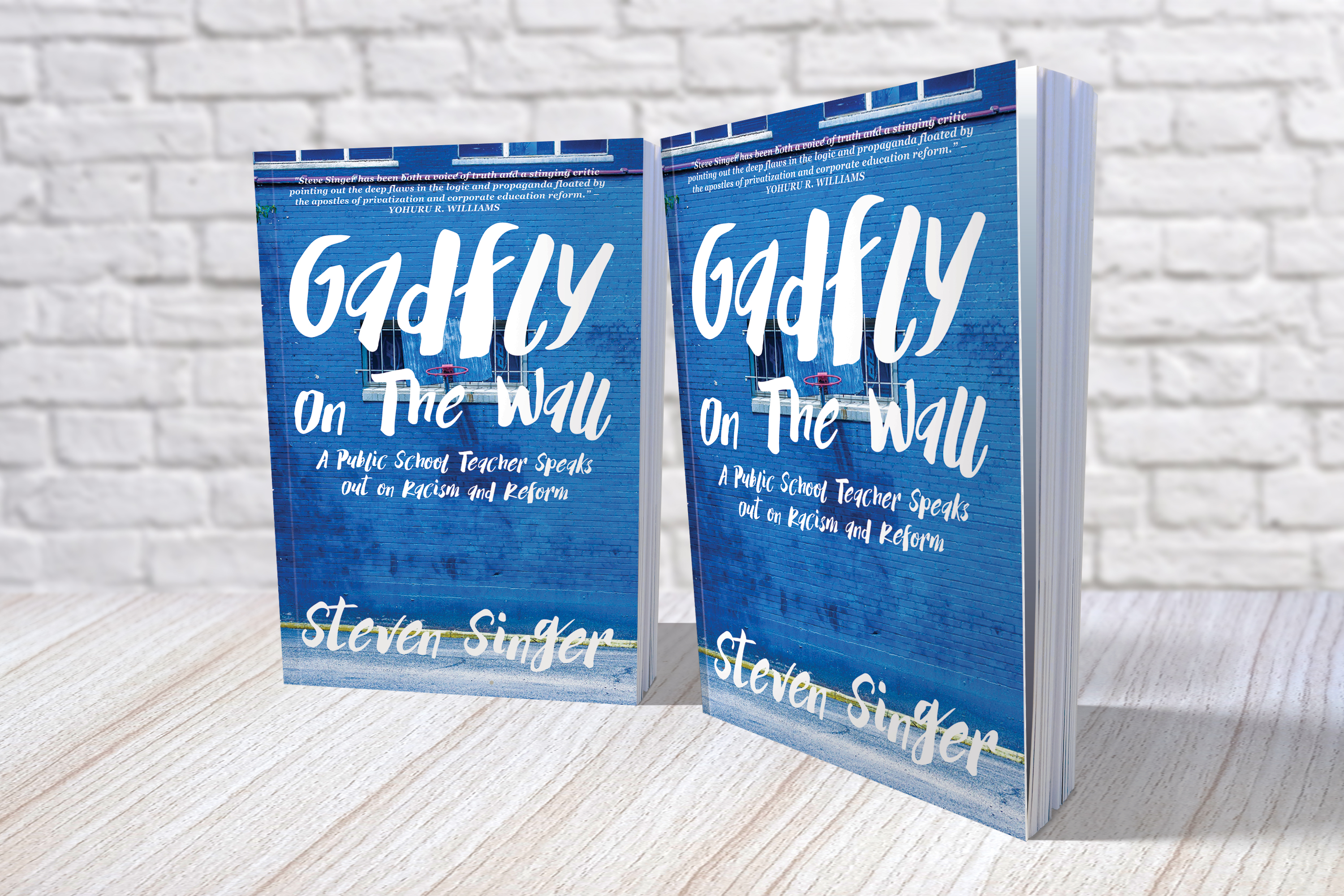
Why Is McKeesport Area School District Still Open After COVID-19 Outbreak?

At least six staff members and students at McKeesport Area School District (MASD) tested positive for COVID-19 in the last week alone.

According to the Pennsylvania Department of Education (PDE) Website, two or more cases in a school building within a 14-day period call for some sort of closure to ensure the safety of students and staff.

So why are none of the district buildings closed?

The western Pennsylvania district located southeast of Pittsburgh reopened on a hybrid schedule on Sept. 2 with about a third of parents opting to keep their children out of the buildings and in the district-run cyber program.

Since then, finding concrete information about Coronavirus infections at our public schools – MASD or others – has not been an easy task.

Local newspapers only occasionally report on them and rarely put single incidents in context. Nor is there any government or other comprehensive database that collects this information and disseminates it to the public.

MASD school district issues alerts on its Website, but they do not stay up for long.

On Sunday, the Website noted:

“Across two of our buildings, Twin Rivers Elementary and the High School, we have had three positive cases of COVID-19 in teachers, and two positive results in students.”

Today that message has been replaced by another:

“A Founders’ Hall staff member tested positive for COVID-19.”

So that’s one case at Founders Hall and five spread out between the High School and Twin Rivers Elementary School.

Though in both cases, the district Website claimed, “We have worked directly with the Allegheny County Health Department and consider this case to be contained,” it is telling that the district obfuscated about exactly how many cases were from each building.

According to PDE, this is a key factor in determining whether a building should remain open. In a county like Allegheny where infection rates are designated as moderate, if 2-4 students or staff in the same building test positive, the school should be closed for 5-7 days.

So either the high school, Twin Rivers or both should meet that criteria.

And if cases rise even slightly, the PDE Website recommends even longer closures – at least two weeks for five or more cases in a building.

Sunday’s alert noted: “You will be notified directly by the Allegheny County Health Department if there has been any close contact to your student!”

However, this is not even the first time district personnel have tested positive for the virus.

On September 15, a letter was sent home to parents saying that a Founders’ Hall Middle School student tested positive for COVID-19.

The letter further stated that the student would quarantine for two weeks.

District spokeswoman Kristen James said there would not be any closures of school facilities as a result of the incident.

“Our buildings are being deep cleaned each and every day and throughout each day,” she said.

COVID-19 has also plagued nearby Serra Catholic School.

The parochial school serving students from many of the same communities as MASD has suspended football practice and closed its doors twice before for COVID outbreaks.

On Oct. 12, a “person involved with the [football] team” tested positive, and 40 athletes and football staff were quarantined.

Just a month earlier, on Sept. 10, two Serra students tested positive, resulting in temporary suspension of the sports program and building closures.

McKeesport and Serra are far from unique in this.

Just last night, Baldwin-Whitehall school board voted to close three elementary schools for the rest of the week due to a substitute teacher who tested positive and worked in all the buildings.

“Over the last two weeks, we’ve reported 2,000 news cases of COVID-19 among school age children,” said Dr. Rachel Levine, state Department of Health secretary.

Gov. Tom Wolf cautioned, “The fall resurgence is here and now is really the time to double down.”

However, many decision makers don’t seem to be heeding these warnings.

And not just those in McKeesport.

At Steel Valley School District, buildings have been closed to students, and instruction has been 100% virtual.

However, buildings were opened just twice to students – both times for transition days. And both times, a staff member tested positive for COVID-19 soon after.

On Oct 7, a letter issued by Bryan Macuga, Secondary Campus Principal, said that a high school teacher tested positive. The day before, the district had students in grades 5 and 9 in the middle school-high school complex for a half day schedule to test the district’s wi-fi.

Though the teacher had participated in the program, he had not been within 6 feet of students for 15 minutes at a time – PDE’s definition of close contact.

On Sept 8, students in the same grades were in the same building for a half day transition program, and a middle school teacher who had participated in the program tested positive for COVID a day later.

School directors are actively considering moving from the virtual schedule – where no one has gotten sick – to a hybrid schedule in November.

No one said educating children during a global pandemic would be easy.

But shouldn’t we be making decisions with a priority on student and staff safety?

If people die or contract lingering life-long complications as a result of COVID-19, they will not thank you for keeping buildings open longer than was advisable.

It’s time for decision makers to take off the rose colored glasses and make the tough decisions in everybody’s interests.

While infection rates are moderate to high, school buildings should be closed and all instruction virtual but created by district teachers, not ed tech companies.

It’s something we can all accomplish if we and our representatives just have the courage to do it.


Like this post?  You might want to consider becoming a Patreon subscriber. This helps me continue to keep the blog going and get on with this difficult and challenging work.

Plus you get subscriber only extras!

Just CLICK HERE.

Patreon+Circle

I’ve also written a book, “Gadfly on the Wall: A Public School Teacher Speaks Out on Racism and Reform,” now available from Garn Press. Ten percent of the proceeds go to the Badass Teachers Association. Check it out!

Virtual Instruction: Top 5 Pros & Top 5 Cons

Teaching today is not the same as it was just a year ago.

The global Coronavirus pandemic has forced schools to change the way they do almost everything.

With infection rates moderate to high in most areas of the country, many schools have resorted to full virtual instruction while others have adopted a hybrid model incorporating a mix of cyber and in-person classes.

Only in the most sparsely populated, secluded or reckless areas have schools been allowed to reopen 100% without safety precautions.

For many districts trying to juggle both in-person and virtual classes, the online component has been left to ed tech companies like Edmentum often specializing in credit recovery.

These have been an absolute disaster.

Corporate America has no business educating our youth – and moreover they’re terribly bad at it.

However, in many districts, virtual instruction has come to mean something else entirely.

It has meant classroom teachers creating their own online instruction and assignments while teaching synchronously through applications like Zoom.

I want to be clear that I think this is the best possible model under current circumstances.

It is the best way to balance the needs of safety for students and staff with the needs of academics.

However, this isn’t to say it is trouble free or even preferable if the world were ever to snap back into the shape it was before the pandemic.

The people best situated to tell us this are classroom teachers.

Along with students whose input and experiences should not be ignored, it is our collective educator core who have been thrust into this strange experiment. But unlike children, they have the knowledge, maturity, skills and life experience to evaluate it best. And being one of those intrepid individuals, I here offer my thoughts.

After more than four months teaching this way, I’d say these are the top 5 pros and cons of virtual instruction:

Pros

1) There is Less Pressure Day-to-Day

Right off the bat there is something to be said for virtual instruction – it feels more low stakes.

You sleep longer, can more easily access amenities, the bathroom, food and drink.

For one, you sure can’t beat the commute.

Some students admit that they roll out of bed each morning and onto the computer. This is not always optimal for learning in that the mind needs time to wake up and focus itself. However, the fact that one has more choice over how to prepare for school, what to wear, more leeway about breaks and whether to eat or drink in class – all that leads to an increased casual feeling to the day.

And that’s not all bad.

As a teacher, I love being able to go to the restroom whenever I need – something that I cannot do in my school building. Back there, I have to literally train my bladder to be ready when I have breaks in my schedule.

Though I certainly don’t roll from my bed to class, the extra sleep I get from not having to drive to the building and the reduced stress of forgoing a commute, traffic, bad weather, etc. are extremely positive.

It helps me be more relaxed and ready to meet my students needs. It makes me a better teacher.

This doesn’t mean teachers aren’t incredibly stressed by the pressure to create new curriculum, using new technology and new district rules that are being rewritten by the hour. But at least the day-to-day instruction, itself, is more low key.

2) It is Harder for Students to Disrupt Class

We’ve all been there. An unruly student or two brings a dispute to class and picks on each other back and forth.

In the physical classroom, this can be a real problem requiring a lot of effort to resolve. You have to de-escalate the situation or else it could turn into an exchange of fists.

Online it’s a snap. You can simply mute the participants. The teacher has much more control over what communication enters the classroom space and physical violence is impossible.

True, a dedicated disruptor can find a way to cause a ruckus. He or she can try to use the chat or even the video camera. They may even have each others cell phone numbers and communicate back and forth that way.

However, few students are aggravated enough to take such measures. I haven’t noticed much beyond simple teasing.

Some of my students put pictures of each other as the backgrounds on their camera screens – but these have always been friends trying to get a laugh. A comment from me and it stops.

If worse comes to worse, I can still remove them from the Zoom meeting and alert the principal or dean of students for disciplinary action.

But I haven’t had to do that yet. I’ll bet disciplinary referrals have dropped to record lows. And without them, virtual learning may have all but dismantled the school-to-prison pipeline.

3) It’s Easier to Communicate with Parents and Students Individually

There are many reasons for this.

In the physical classroom, the most common form of communication is verbal. But digital spaces allow for several other methods.

You can email individual students messages, work, assignments, grades, etc. You can utilize the chat feature to send a private message. You can simply talk to them in the Zoom meeting. You can set up an individual Zoom meeting like office hours to answer questions. You can ask or answer questions about assignments in the stream function of Google Classroom.

All these options allow for students to talk with their teacher one-on-one more easily than in the physical classroom.

Consider this: let’s say a student has a question about the homework after class. In the physical classroom environment, there may be little they can do but wait until the next day. Before last March, I’d had students send me emails, but I never checked them as regularly as I need to now.

In the digital world, students can easily send a message through email or stream at any time. This certainly puts a strain on educators but most questions I receive are during school hours and easily answerable in a timely fashion.

When it comes to parents, just having the contact information at your fingertips is a plus. Also teachers have more time to communicate with them when you remove lunch duty, hall duty, in-school suspension and other necessities of the physical classroom. When teachers don’t have to function as security guards, we get more time to be teachers.

I find that in the virtual classroom, I have the time to communicate with every parent at least once a week – or at least I try. Even in the digital world, some parents are incommunicado.

4) It’s Easier to Read a Text Together


As a language arts teacher, this is really important to me.

For more than 15 years, I’ve read texts aloud with my students and asked them to follow along. I tell them to take their index fingers, put them in the text and move along with where we are in the passage.

Few actually do it, and there’s really nothing I can do to make them. Except beg.

In the virtual classroom, I can easily put the text on all their screens, place the cursor under the words and follow with the reader or the audio recording.

Students can try to ignore it, but that’s harder than just following along. It also allows me to point to specific parts of the text.

If a student is reading and struggling with a word, I can point to prefixes, suffixes, roots, etc. to help them. And I’ve honestly seen improvements in some struggling readers fluency.

5) It’s Easier for Students to Work at Their Own Pace

This isn’t really a core value of the physical classroom.

Teachers give assignments, set due dates and students have to get things done in the time frame.

Online it isn’t such a straight line.

Teachers instruct in a Zoom meeting, but students are not required to attend. They can catch up with a video of the meeting if they need or prefer.

And since we all anticipate students may have issues throughout the day with connectivity, the technology, home responsibilities, distractions, etc. teachers haven’t been so firm on those due dates.

I freely give extensions and tell my students that assignments can still be made up for full credit well past the deadline. It’s about getting the work done, not so much about when.

I find myself explaining assignments more often than usual, but it’s somehow not as annoying as it sometimes is in the physical classroom.

We’ve created a culture of care and understanding. I think that’s a positive thing even if it doesn’t emphasize due dates and time frames as much.

Cons

1) Student Absences

No matter how you look at it, there are an alarming number of students absent throughout the day.

For my own classes, this was much worse in the spring when we first went online. Starting in September, more students have been attending regularly.

However, there are two important points to be made.

First, there are some students who do not attend the live Zoom meetings but instead watch the videos and do the assignments. Their work is not worse than those who attend – in fact, it is sometimes much better.

I suppose it’s possible students in the Zoom meetings could feed information to those not attending, but with the videos and the ability to communicate with me at will, it’s almost more work to cheat.

Second, though some students have neither attended many (or any) Zoom meetings or handed in many (or any) assignments, this was true in the physical classroom, too.

Some parents do not provide the structure necessary to ensure their children are doing their school work. This is true no matter how that work is presented – physically or virtually.

In my classes, about 20% are regularly absent. Of those, 10-15% are not participating much at all.

That’s about the same as I would expect to see in the physical classroom.

We need to identify these students and provide them with the resources necessary to succeed. But that’s always been true.

2) The Camera Conundrum

To turn your camera off or not? That is the question.

Zoom meetings can be an awfully lonely place for teachers when every student has their camera off.

The general consensus is that we should allow them this freedom. It encourages them to attend the Zoom meetings on their own terms and avoid the stress of seeing themselves constantly on their own screens. It allows them to avoid the fear of being judged for their surroundings.

Allowing them this latitude certainly does increase attendance and create a more positive attitude. But the teacher is in a worse position to monitor student engagement.

Most days I feel like a medium at a seance asking if so-and-so is here. Give me a sign.

I try to pose questions to get students involved – even more than I would in the physical classroom – and sometimes it works and sometimes it doesn’t.

There are times when I yearn just to be able to look at my students again and see what they’re doing. Because I know some of them are not paying attention.

Some are texting on their cell phones. Some are playing video games on another screen. Some are talking with brothers, sisters, friends or parents in their house.

There’s not much I can do except try to keep my classes as engaging as possible. Most of the time, I think it works.

But not always.

3) It’s Harder to Monitor/Push Students with Special Needs

This is related to the previous point.

The problem of the camera is particularly pernicious for students with special needs. I can’t tell you how many IEPs and service plans want me to monitor students with ADHD and bring them back when they lose focus.

This is nearly impossible for a student with his or her camera off. I can try verbal queues, but students don’t always answer. I can ask them to turn on their cameras if that has been added to their IEPs, but they rarely comply. And if they do, they just point the camera at the ceiling or otherwise away from their faces.

The human contact of actually being present in a physical space has many advantages – especially for students with special needs.

I try my hardest and do everything I can to help them. But I feel that some of them are falling through the cracks – at least more than they would be in a physical classroom.

4) Technological Issues

Even under the best of circumstances, there are always technological issues.

Students do their assignments and their devices don’t save the work. Their batteries run low. They haven’t downloaded the proper apps. They’re using the wrong emails to access a google form.

The list is endless.

Thankfully, my district has a help desk students can access. But teachers need to be aware and permissive about technology issues. We have to air on the side of letting them get away with something rather than being too strict.

And the technology issues aren’t limited to the students.

One Friday I found the wi/fi in my home was down. I had class in 30 minutes and had to find someway to connect online to teach.

I still don’t quite understand what happened. The Today Show was in the neighborhood doing a live broadcast that morning. Perhaps that had an effect.

For whatever reason my Mac laptop could not connect to the Internet. I had a barely functional PC that for reasons I cannot explain was able to connect.

So that’s what I did. I connected with the PC and taught my classes. The connection was still spotty and I got kicked out of my own Zoom meeting once.

When I got back on moments later, the students were terrified. But we got on with it and managed.

I don’t know why, but the issue seemed to fix itself about 2 hours later and I was able to get onto my laptop and experienced no further problems.

I suppose the point is that we have to realize technology issues will crop up. We need contingency plans. Lots and lots of contingency plans. For ourselves, as teachers, and for our students.

5) Danger of a New Normal

This is particularly scary.

Ed tech companies have been trying to take over public education for years.
Unscrupulous business people have been trying successfully to privatize and profitize education.

The pandemic has made that possible to degrees never before imagined.

Charter and private schools are packed with students these days. This is partially because their smaller size and greater resources allows them to more easily meet in-person safety standards. Where public schools have recklessly reopened, cyber schools have swooped in to provide a safer option, too.

When even many public schools become less focused on doing the right thing than on doing the popular thing, they open the door to privatization.

It’s the wild west out there and no one can really tell how this will all affect what the future of education will be.

If the pandemic ended tomorrow, I would like to return to the physical classroom. But I can’t say I’d willingly leave every innovation of virtual instruction on the cutting room floor.

I like giving tests through Google Forms.

I like giving paperless assignments on Google Classroom.

I like being free to contact parents and students easily and not being tied to duties more suited to school security officers.

I like being able to pee whenever I need.

But I don’t want to lose the best aspects of the physical classroom.

I don’t want to lose autonomy and have everything micromanaged and predetermined by ed tech companies.

I don’t want ridiculously large class sizes justified by a digital space.

I don’t want to have to teach live on-line and in-person at the same time, curating and managing the virtual space and the physical classroom.

I don’t want to be under constant digital surveillance.

These are all dangers of the new normal.

I don’t know what the future will be, but I know it will not be what it was before all this started.

That’s equal parts scary and exciting.

But right now teachers really can’t afford to worry about it too much.

We’re too busy trying to get through the current crisis.


Like this post?  You might want to consider becoming a Patreon subscriber. This helps me continue to keep the blog going and get on with this difficult and challenging work.

Plus you get subscriber only extras!

Just CLICK HERE.

Patreon+Circle

I’ve also written a book, “Gadfly on the Wall: A Public School Teacher Speaks Out on Racism and Reform,” now available from Garn Press. Ten percent of the proceeds go to the Badass Teachers Association. Check it out!