Meet the Test Before the Test – Pennsylvania’s Classroom Diagnostic Tools (CDT)

BoredStudentIPad_iStock_monkeybusinessimages


It’s test time.


My students are dutifully pecking answers onto their iPads before a hand goes up.


“Mr. Singer, I can’t log in to the server.”


Another hand.


“It keeps kicking me out.”


Another.


“Mr. Singer, what does this question mean?”


Then every single hand in the room pops up all at once.


“What’s the matter!?” I say, trying not to let the frustration into my voice.


A lone student in the front offers to speak for the group.


“The Website just kicked us all off.”


If that sounds like the optimum environment to assess student learning, then you must work for Data Recognition Corp (DRC).


It is typical of the company’s Classroom Diagnostic Tools (CDT) test in Pennsylvania.


The assessment, which cannot be taken with pencil and paper but must instead be taken on a computer or personal device, has always been glitchy.


You type in a response and what you typed only appears after a delay.


When moving from one screen to another, you have to wait through a seemingly endless interval until the next screen loads.


And during this year’s first sessions, multiple teachers told me of students whose tests cycled through all the questions without input from the students and then gave them an unalterable grade.


This is not the best way to diagnose students’ abilities in reading, math and science.


Yet that’s what the state Department of Education strongly encourages we use it for – three to five times a year!


This is not a mandatory test.


It’s strongly suggested by administrators in Harrisburg. And that’s enough to make some local principals march wherever they’re told.


Ironically, Gov. Tom Wolf proudly proclaimed that he was reducing the amount of time students in the Keystone state would take standardized tests. But he’s only talking about the federally mandated Pennsylvania System of School Assessment (PSSA) and Keystone Exams which he’s cut by a total of almost 2 hours a year.


There are still a battery of suggested pretests on the state’s wish list – tests that are supposed to predict success on the PSSA or Keystone Exams – tests used to show whether kids are getting the skills they need.


Do you understand it now?


No.


Do you understand it Now?


No.


Do you understand it NOW!!!!!!!?


Of these, the most common is the CDT.


If schools follow the state’s instructions and give students this exam in reading, math and science 3 to 5 times a year, that’s an additional 50-90 minutes per test. That comes to 22.5 hours of additional testing!


So 22.5 hours minus 2 hours equals… NOT A REDUCATION IN TESTING!


Moreover, the CDT test is cumbersome to proctor.


I’ve given my students this test for about seven years now and it never fails to be anywhere from tricky to an outright disaster.


This week, I had a class of students on their iPads unable to log on to their accounts at DRC headquarters. In another group, five students were dropped from the server without warning and couldn’t finish.


Defective software and having to repeatedly log back in to the system are hallmarks of even the most successful CDT session.
Even if you like standardized tests and think they are the best way to assess students, the product and service provided by DRC is extremely low quality.


But keep in mind – you’re paying for it, folks! In the last 8 years alone, taxpayers forked over more than $1 billion for this service and the PSSA and Keystone tests, which DRC also produces.


It’s incredibly frustrating, a waste of classroom time and taxpayer money.


No one does their best when they’re exasperated, and this test is almost designed to make students feel that way.


Yet some local administrators are trying to use the assessment as part of a high stakes matrix to determine classroom placement.


Whether your child is registered in the remedial, general or advanced class could be determined by this shoddy excuse for an assessment. Whether your son or daughter has the advantages and esteem of the advanced class could rest on a malfunctioning data system. Whether he or she has to settle for months of mind numbing test prep instead of authentic education could be decided by defective software.


No matter how you look at it, this doesn’t help the teacher diagnose academic deficiencies and remediate them. That is, unless your idea of remediation is printing out a worksheet of test look-a-like questions based on the ones the student got wrong on the CDT.


This is bad assessment supporting bad pedagogy forced on us by bad policy.


But that’s not even the worst part.


Why are we doing this in the first place?


Have standardized tests ever been proven accurate assessments of student learning? Moreover, has it ever been proven useful to give pre-test after pre-test before we even give the ultimate high-stakes test?


Answer: No.


Most countries don’t test their students nearly as much as we do in the United States. Finland, which has students who routinely return some of the highest scores among developed nations, only makes its children take one standardized test.


One test from K-12!


In addition, countries like those in Scandinavia don’t have nearly the child poverty rate we do. Nor do they fund their schools based on local property taxes. They provide more funding and resources for needy students than rich ones – we do just the opposite.


Numerous studies have shown a strong correlation between parental income and the test scores of their children. In short, kids from wealthy families who go to schools with the best of everything generally score very well on standardized tests. Students from poor homes who go to underprivileged schools do much worse.


So all this testing does nothing to help students learn. It simply reinforces the inequality already in place. And then it’s used as a justification for that same inequality.


High stakes standardized testing is not about increasing student outcomes. It’s about boosting corporate incomes – corporations like Data Recognition Corp.


Finally, there’s another danger we haven’t even hinted at involved with the CDT.


As an on-line test, it collects an awful lot of data about the children taking it. This information is kept in a database for students entire academic career so that it can be compared with subsequent results.


This is private student data in the hands of a private company.


The chances that this information and thus students’ privacy will be violated are extremely high.


We are putting our children’s futures in the hands of a for-profit company with little to no assurance that it is safe. There is little oversight, accountability or even awareness of the issue.


Therefore, any knowledgeable parent would be entirely within his or her rights by refusing to let their child take any of these tests.


Yes, you can refuse to let your child participate in test prep the same way you can opt out of the PSSA and Keystone Exams.


You need refer to the same part of the law:


“PA School Code Chapter 4.4(d)(1)(2)(3):

(d) School entities shall adopt policies to assure that parents or guardians have the following:

(1) Access to information about the curriculum, including academic standards to be achieved, instructional materials and assessment techniques.

(2) A process for the review of instructional materials.

(3) The right to have their children excused from specific instruction that conflicts with their religious beliefs, upon receipt by the school entity of a written request from the parent or guardians.”


That includes the CDT.


Opt Out PA has provided this helpful form letter you can use and modify to meet your needs before sending it to your local principal:


“Dear Principal/Teacher(s):

Pursuant to Pennsylvania Code Title 22 Chapter 4, section 4.4 (d)(1)(2)(3) I am hereby exercising my right as a parent to have my child, [NAME], excused from PSSA test prep, including (but not limited to) CDT’s and Study Island because of religious beliefs.

Sincerely,”


So while Pennsylvania’s lawmakers dither back and forth about the political realities of standardized testing as an accountability measure and as they blithely ignore the threat posed to student privacy by on-line testing, parents can take matters into their own hands.


Your child’s teacher would like nothing better!


Imagine being able to actually teach and not have to spend days of instruction time troubleshooting a Website while corporate lackies cash our check!


Imagine students in school to actually learn something – instead of testing them into oblivion.


Imagine a student raising her hand to ask a question about the curriculum and not the software!


Like this post? I’ve written a book, “Gadfly on the Wall: A Public School Teacher Speaks Out on Racism and Reform,” now available from Garn Press. Ten percent of the proceeds go to the Badass Teachers Association. Check it out!

WANT A SIGNED COPY?

Click here to order one directly from me to your door!

cropped-book-1.jpg

Nationwide Poll Shows Overwhelming Support for Public Schools in All Areas Except One

5e6d4156-a078-4458-bdec-72746eca6e98


Waylon Jennings classic country hit advises Mama’s not to let their babies grow up to be cowboys.


Now, I guess we can add teachers to that list.


According to the 50th annual PDK Poll of attitudes about public schools, Americans trust and support teachers, but don’t want their own children to join a profession they see as underpaid and undervalued.


In almost every other way, they support public schools and the educators who work there.


When it comes to increasing school funding, increasing teacher salary, allowing teachers to strike, and an abundance of other issues, the poll found a majority of people unequivocally in favor of endeavors meant to bolster learning.


In fact, support for education and educators has never been so high in half a century.


“Two-thirds of Americans say teachers are underpaid, and an overwhelming 78% of public school parents say they would support teachers in their community if they went on strike for more pay,” according to PDK’s Website.


If true, this result illuminates an incredible tone deafness among politicians like Scott Wagner in Pennsylvania who is running for governor on the platform that teachers make too much money. According to the poll, only 6% of Americans agree with him.


Moreover, those who support teachers strikes include 6 in 10 Republicans.


“Those who would be most affected by a teacher walk-out — say they would support teachers in their community if they went on strike for more pay. Among the general public, 73% say they would support a job action for higher wages.”


These are record high results that are also reflected in respondents unwillingness to encourage their own children to become teachers in the current political landscape.


For the first time since the question was asked in 1969, a majority of 54% say they would not want their child to become a teacher.


The reason? Poor pay and benefits.


Moreover, a lack of adequate funding is cited as the most common problem facing public schools – a finding that’s held true since the early 2000s. In fact, for the 17th consecutive year, Americans have named the lack of funding as the biggest problem facing their local schools.


It seems that either or both major political parties could easily pick up broad popular support by doing an about face on education. Instead of backing standardization and privatization, they should get behind public education.


The topic has typically served as a wedge issue between progressives and corporate Democrats while Republicans have almost exclusively backed a strategy to “starve the beast” and promote privatization.


However, Democrats and/or Republicans who ran on respecting and remunerating teachers as well as increasing support for the public schools that employ them would find major support among voters.


The PDK poll is based on responses from 1,042 adults including 515 parents of school-age children. They were randomly and representatively sampled in May 2018 through on-line surveys.


The 2018 results include particular support for the public school system as opposed to charter and voucher schools.


Nearly 8 in 10 people said they prefer reforming the existing public school system rather than finding an alternative approach.


That’s a higher response than any year since the question was first asked 20 years ago. Moreover, it’s not just an opinion about nationwide schooling: 78% say they’d rather reform than replace the local school system, as well.


In addition, there is support among Americans to not only increase funding, but also spend it more equitably.


A majority (60%) support spending more on students who need extra help than spending the same amount on every child (39%).


Responds were more divided on where the influx of funding should come from.


Half of respondents favor raising taxes and half say the schools should spend less on students who require fewer resources.


This is related to public perception of exactly which students are receiving unfair funding. The poll revealed that most people recognize some resource inequality based on race and geographic region but they think most is based on parental wealth: 75% of respondent say public school students serving mostly poor students have fewer resources than those serving rich students.


One of the most interesting findings is always the public’s overall perception of schools.


And this poll – as in previous editions – found a sharp difference in respondents appraisal of schools nationwide vs. the schools in their own neighborhoods.


Fifty-five percent say that on a national scale students today get a worse education than those in previous generations.


However:


The public schools continue to suffer from an image deficit. Among those who know them best, parents of current students, 70% give their oldest child’s school an A or B grade. Among the public more broadly, by contrast, only four in 10 give their local schools an A or B. In results that are typical across the years, far fewer give top grades to the public schools nationally, just 19%.”


In other words, people seem to think that nationally our schools stink. But the schools in our own neighborhoods are pretty good.


The reason is simple. National perception is formed by the media. Local perception is formed by actual empirical evidence.


The forces of school privatization and their propaganda network has pushed the lie of “failing schools” for so long, that people believe it – except in their own neighborhoods where they see it to be false.


But the questions weren’t all about how schools should be run. They also asked about security – a hot topic when school shootings happen at least once a month.


“Parents lack strong confidence that schools can protect their children against a school shooting but favor armed police, mental health screenings, and metal detectors more than arming teachers to protect their children.”


This bodes badly for the Trump administrations plans to push guns on public school teachers instead of enacting common sense gun regulations.


As usual, policymakers are trying to herd Americans to their point of view instead of listening to their constituencies.


And that seems to be the big take away from this year’s poll.


Americans want and support public education.


It’s time our so-called leaders got with the program.


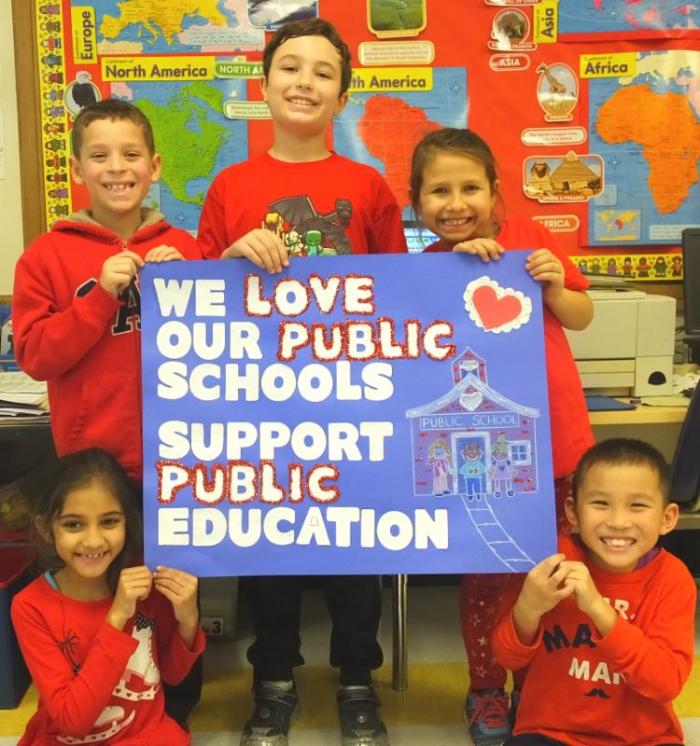
Like this post? I’ve written a book, “Gadfly on the Wall: A Public School Teacher Speaks Out on Racism and Reform,” now available from Garn Press. Ten percent of the proceeds go to the Badass Teachers Association. Check it out!

WANT A SIGNED COPY?

Click here to order one directly from me to your door!
book-2

Resistance to High Stakes Testing Persists as Media Celebrates Its End

GettyImages-465529004.0.0


There has never been more opposition to high stakes standardized testing.


Yet the corporate controlled media is pretending that the resistance is over.


Parents are refusing to let their kids take these tests at the same or even greater numbers than ever.


Fewer states require high stakes tests as graduation exams and/or use them to evaluate their teachers. Across the nation, states are cutting the size of standardized tests or eliminating them altogether. And more state legislatures passed laws explicitly allowing parents to opt their children out of the tests.


Yet Education Week published an article a few days ago called “Anti-Test Movement Slows to a Crawl.”


I think we have different definitions of “Slows” and “Crawl.”


That may not be surprising since we also seem to have different definitions of “Anti-Test.”


The Opt Out Movement is not “Anti-Test.” It is anti-high stakes standardized test.


It is against the federal government forcing states to use corporate written, corporate graded and corporate remediated standardized assessments.


It is against the federal government requiring each state to participate in a corporate boondoggle that not only wastes billions of tax dollars that could be better spent to educate children but also unfairly assesses their academic progress and feeds the push to privatize public schools.


Most people against high stakes standardized testing, however, have no problem with authentic teacher-created assessments.


Calling these folks “Anti-Test” is like labeling those pushing for stricter gun regulations “Anti-Gun” or smearing those protesting government corruption as “Anti-Government.”


And that’s just the title!


The author Alyson Klein further misdirects readers by conflating opt out rates and test resistance.


She implied that the only measure of opposition was the percentage of students who opt out. However, as noted above, there are multiple measures of resistance.


Moreover, few states advertise their opt out rates. Especially after the movement began, states made that information harder to come by to dissuade more people from joining it.


Of those states where information is available, Klein puts the most negative possible spin on the facts in order to make her point – a point that it seems to me is not at all justified.


For instance, Klein writes:


“At least some of the steam has gone out of the opt-out movement in states such as New Jersey and New York, considered hotbeds of anti-testing fervor.”


Really?


In New York, Opt out numbers remained at approximately 20% – the same as they have for the past three years.


And New York is one of our most densely populated states. That percentage represents more than 225,000 parents across the Empire State who refused to let their children take the tests despite threats from many administrators and district officials for doing so.


In New Jersey, opt out rates were marginally lower this year than last year. They went from 7% to 5%. But once again New Jersey is a populous state. That percentage represents about 68,500 students.


In addition, this is after massive opt outs three years ago that forced the state to change its federally mandated assessment. Testing boycotts pushed the state education association to get rid of four PARCC assessments and allow students who fail the remaining two tests to take an alternative assessment. And this is in a state where there is no law explicitly allowing parents to opt out of the tests.


I don’t know if I’d call that running out of steam.


Moreover, opt out rates have increased in other states for which we have data. For instance, test refusal is on the rise in heartland states like Minnesota.


And it nearly doubled in Utah over the past two years to about 6%. In some schools in the Beehive State, rates are much higher. According to the Salt Lake Tribune, 1 in 5 students in the Park City school district refused to take the tests.


Though my own state of Pennsylvania has been mum on last year’s opt outs, from my own personal experience as a teacher in suburban Pittsburgh, I never had more students boycott our federally mandated standardized test than I did last year.


There were so many they had to be quarantined in a special room.


Moreover, an increasing number of parents ask me about the issue, express concern and wonder about their rights.


So even when examining just the rate of opt out, I don’t see any reason to assume the movement is slowing down.


On the contrary, it is picking up steam with multiple victories.


As recently as 2012, half of all U.S. states required high school exit exams in order for students to graduate. Today that number has dropped to 12. The reason? Exit exams don’t raise student achievement – they raise the dropout rate. At least that’s what The National Research Council of the National Academy of Sciences tells us.


Another positive sign – seven states have stopped using value added measures (VAM) to judge teachers. This is the highly controversial practice of assessing educators based on their students test scores – a practice that has never been proven fair to teachers or effective in helping students learn. Six states have dropped this requirement altogether: Alaska, Arkansas, Kansas, Kentucky, North Carolina and Oklahoma. Connecticut still gathers the information but cannot use it in the teacher’s “summative rating.” And other states like New Mexico still use value added measures but have reduced the weight given to student test scores.


Moreover, let’s not forget how many states have slashed the size of the high stakes tests they’re giving to students. After the recent wave of opt outs and public outcry, state education departments have ensured that testing at least takes up less time. This includes New York, Maryland, New Mexico, California, Minnesota, Kentucky, Tennessee, Florida, Washington, Illinois, West Virginia, Hawaii, Oklahoma, Ohio, South Carolina, Pennsylvania and Texas. Some of this is because the PARCC test used in 21 states was slashed by 90 minutes.


And when it comes to opt out, two more states – Idaho and North Dakota – now have explicit laws on the books allowing parents to refuse the test for their children – in whole or in part. That brings the total number of states up to 10. It would have been 11, but Georgia Governor Nathan Deal, a Republican, vetoed an opt-out bill. The federal government still wants us to penalize these districts for non-participation in flagrant violation of its authority. But as more states respect parents’ rights on this matter, it will be increasingly difficult for the U.S. Department of Education to continue trampling them.


And speaking of the federal government, some states are taking advantage of the wiggle room in the federal law that governs K-12 education – the newly passed Every Student Succeeds Act (ESSA) – to allow students to avoid standardized testing entirely. Some states are implementation performance assessments instead. Kids can use a portfolio of classwork to demonstrate learning instead of getting a grade on a corporate-written standardized test. New Hampshire, for instance, has pioneered this approach with a program that now involves half the state’s districts.


These are not the signs of a movement that is slowing to a crawl.


It just makes sense that some of the rhetoric of the movement may have become less forceful with the enactment of the federal ESSA.


Many had hoped for a better law – one that did away with federally mandated testing altogether.


And that could still happen sooner than many think. Next year it will be time to reauthorize the law again.


It took Congress six years to reauthorize the federal education law last time. Perhaps our duly elected representatives can be coaxed into doing their jobs a bit quicker this time.


There is already some proposed legislation to make positive changes. Sen. Jon Tester (D-Mont.) and Rep. Krysten Sinema (D-Ariz.) introduced legislation last year to replace annual assessments with grade-span tests. The United States is, after all, one of the only countries in the world – if not the only one – to require students be tested every year. These proposed changes are not nearly enough, but they’re a step in the right direction.


One of the biggest obstacles to abolishing federally mandated testing last time was that some of the oldest and most well funded civil rights organizations opposed it. Many of them get their money and support from the same billionaires who profit off of the standardized testing and privatization industries.


However, that support for testing was short lived. Already the National Association for the Advancement of Colored People (NAACP) has revoked it returning to a call for opposition to testing.


If our nation survives the many crises of the Donald Trump administration, there is no reason our future cannot be bright.


We have the support, we have the tools, we just need the chance to do right by our children.


And the pendulum is swinging back our way.


Like this post? I’ve written a book, “Gadfly on the Wall: A Public School Teacher Speaks Out on Racism and Reform,” now available from Garn Press. Ten percent of the proceeds go to the Badass Teachers Association. Check it out!

WANT A SIGNED COPY?

Click here to order one directly from me to your door!

book-3

Cyber School Kingpin Gets Slap on Wrist For Embezzling Millions from PA Students

nick-trombetta


Nick Trombetta stole millions of dollars from Pennsylvania’s children.


And he cheated the federal government out of hundreds of thousands in taxes.


Yet at Tuesday’s sentencing, he got little more than a slap on the wrist – a handful of years in jail and a few fines.


He’ll serve 20 months in prison, be on supervised release for three years, and payback the tax money he concealed.


As CEO and founder of PA Cyber, the biggest virtual charter school network in the state, he funneled $8 million into his own pocket.


Instead of that money going to educate kids, he used it to buy a Florida condominium, sprawling real estate and even a private jet.


He already took home between $127,000 and $141,000 a year in salary.


But it wasn’t enough.


He needed to support his extravagant lifestyle, buy a $933,000 condo in the Sunshine State, score a $300,000 twin jet plane, purchase $180,000 houses for his mother and girlfriend in Ohio, and horde a pile of cash.


What does a man like that deserve for stealing from the most vulnerable among us – kids just asking for an education?


At very least, you’d think the judge would throw the book at him.


But no.


Because he took a plea deal, he got a mere 20 months in federal prison.


That’s less than two years in jail for defrauding tens of thousands of students and multiple districts across the Commonwealth.


In addition, once he serves his time he’ll be on probation for 3 years.


And even though there is no mystery about the amount of money he defrauded from the Internal Revenue Service by shifting his income to the tax returns of others – $437,632, to be exact – the amount he’ll have to pay back in restitution is yet to be determined.


One would think that’s easy math. You stole $437,632, you need to pay back at least that amount – with interest!


And what of the $8 million? Though I can’t find a single explicit reference to what happened to it in the media, it is implied that the money was recovered and returned to Pa Cyber.


Yet there seems to be no discussion of a financial penalty for embezzling all that money. If my checking account dips below a certain balance, I’m penalized. If I don’t pay the minimum on my credit cards, I’m charged an additional fee. Yet this chucklehead pilfers $8 million and won’t be docked a dime!? Just paying it back is good enough!?


But what makes this sentence even more infuriating to me is the paltry jail time Trombetta will serve.


The judge actually gave him 17 months LESS than the minimum federal guidelines for this kind of case! He should at least be serving 37 to 46 months – 3 to 4 years!


Nonviolent drug charges often lead to sentences much longer than that!


For instance, in 2010, Kevin Smith was arrested for drug possession. He was locked up in a New Orleans jail for almost 8 years (2,832 days) without ever going to trial!


But then again, most of these nonviolent drug charges are against people of color. And Trombetta is white.


So is Neal Prence, a former certified accountant who pleaded guilty to helping Trombetta hide his ill-gotten gains.


Prence will serve a year and a day in prison and pay back $50,000 in restitution.


It’s a good thing he didn’t have any drugs on him.


And that he didn’t have a tan.


This is what we talk about when we talk about white privilege.


And speaking of that, compare this crime with the sentences given to the Atlanta teachers who were convicted of cheating on standardized tests a few years back.


These were mostly women and people of color.


Tamara Cotman, Sharon Davis-Williams and Michael Pitts received the harshest sentences.

They each got three years in prison, seven years probation, $10,000 in fines and 2,000 hours of community service.


So in America, cheating on standardized tests gets you a harder sentence than embezzling a fortune from school kids.


I’m not saying what the Atlanta teachers and administrators did was right, but their crime pales in comparison to Trombetta’s.


Think about it.


Atlanta city schools have suffered under decades of financial neglect. The kids – many of whom are students of color – receive fewer resources, have more narrowed curriculum and are forced to live under the yoke of generational poverty.


Yet their teachers were told to increase test scores with little to no help, and if they didn’t, they’d be fired.


I can’t imagine why they tried to cheat a system as fair as that.


It’s like being mugged at gunpoint and then the judge convicts you of giving your robber a wooden nickel.


The worst part of all of this is that we haven’t learned anything from either case.


High stakes standardized testing has become entrenched in our public schools by the newly passed federal law – the Every Student Succeeds Act (ESSA).


And though Trombetta resigned from his post as CEO of PA Cyber in September 2013, cyber charters are as popular as ever.


These are publicly funded but privately run schools that provide all or most instruction on-line. Think Trump University for tweens and teenagers.


You can’t turn on the TV without a commercial for a cyber charter school showing up. You can’t drive through a poor neighborhood without a billboard advertising a virtual charter. They even have ads on the buggies at the grocery store!


Yet these schools have a demonstrated track record of failure even when compared to  brick-and-mortar charter schools. And when you compare them to traditional public schools, it’s like comparing a piece of chewed up gum on the bottom of your shoe to a prime cut of filet mignon.


A 2016 study found that cyber charters provide 180 days less of math instruction than traditional public schools.


Keep in mind there are only 180 days of school in Pennsylvania!


That means cyber charters provide less math instruction than not going to school at all.


When it comes to reading, the same study found cyber charters provide 72 days less instruction than traditional public schools.


That’s like skipping 40% of the school year!


And this isn’t just at one or two cyber charters. Researchers noted that 88 percent of cyber charter schools produce weaker academic growth than similar brick and mortar schools.


They concluded that these schools have an “overwhelming negative impact” on students.


AND THAT’S ALL LEGAL!


In Pennsylvania, nearly 35,100 of the 1.7 million children attending public schools are enrolled in cyber-charter schools. With more than 11,000 students, PA Cyber is by far the largest of the state’s 16 such schools.


If Trombetta had just stiffed Pennsylvania’s students that much, he wouldn’t have been in any trouble with the law.


However, he got even greedier than that!


He needed more, More, MORE!


Justice – such as it is in this case – was a long time coming.


Trombetta was first indicted back in 2013 – five years ago.


He was facing 11 counts of mail fraud, theft or bribery, conspiracy and tax offenses related to his involvement in entities that did business with Pa. Cyber. He pleaded guilty to tax conspiracy almost two years ago, acknowledging that he siphoned off $8 million from The Pennsylvania Cyber Charter School.


He has been free on bond all this time.


His sister, Elaine Trombetta, agreed to cooperate with prosecution, according to federal court filings. She pleaded guilty in October 2013 to filing a false individual income tax return on her brother’s behalf and has yet to be sentenced.


It was only yesterday that her brother – the kingpin of this conspiracy – was ultimately sentenced.


Finally, he’ll have to face up to what he did.


Finally, he’ll have to pay for what he’s done.


Just don’t blink or you’ll miss it.


Like this post? I’ve written a book, “Gadfly on the Wall: A Public School Teacher Speaks Out on Racism and Reform,” now available from Garn Press. Ten percent of the proceeds go to the Badass Teachers Association. Check it out!

WANT A SIGNED COPY?

Click here to order one directly from me to your door!
book-2

Since School Vouchers Don’t Increase Test Scores, Racism is an Acceptable Reason for Privatization, Says Advocate

Screen Shot 2018-07-24 at 10.20.41 AM

For decades, school voucher advocates claimed that sending poor kids to private schools with public tax dollars was acceptable because doing so would raise students’ test scores.


However, in the few cases where voucher students are even required to take the same standardized tests as public school students, the results have been dismal.


In short, poor kids at private schools don’t get better test scores.


So why are we spending billions of public tax dollars to send kids to privately run schools?


A 2018 Department of Education evaluation of the Washington, D.C., voucher program found that public school students permitted to attend a private or parochial school at public expense ended up getting worse scores than they had at public school.


Their scores went down 10 points in math and stayed about the same in reading.


These are not the pie in the sky results we were promised when we poured our tax money into private hands.


However, corporate education propaganda site, The 74, published a defense of these results that – frankly – makes some pretty jaw dropping claims.


The article is “More Regulation of D.C. School Vouchers Won’t Help Students. It Will Just Give Families Fewer Choices for Their Kids” by far right Cato Institute think tanker Corey DeAngelis.


In his piece, not only does he call for less accountability for voucher schools, he downplays the importance of standardized test scores.


And he has a point. Test scores aren’t a valid reflection of student learning – but that’s something public school advocates have been saying for decades in response to charter and voucher school cheerleaders like DeAngelis.


Supply side lobbyists have been claiming we need school privatization BECAUSE it will increase test scores. Now that we find this claim is completely bogus, the privatizers are changing their tune.


But that’s not the most shocking irony in DeAngelis article.


Parents don’t really care about the scores, he says. Instead they send their children to voucher schools because… You know what? I’ll let him tell it.


“Families choose schools for their children based on several important factors, including culture, individual attention, and, of course, safety. Research tells us that parents — unsurprisingly — often value these things more than standardized test scores.”


Certainly parents prefer their children have more individual attention. But many private schools have larger class sizes than public schools.


Moreover, reducing class size at all schools would be a more equitable reform than letting some kids enjoy smaller classes if they can just get into the right school.


However, it is his other two claims that sent my racist dog whistle senses tingling.


So parents don’t like the CULTURE of public schools. And they’re afraid public schools aren’t as SAFE.


Hmm. I wonder what culture these parents are objecting to. I wonder why they would think public schools wouldn’t be as safe.


Could it perhaps be fear of black students!?


I don’t want my little Billy to be exposed to all that rap music and kids with sagging pants. I don’t want my little Susie to cower in a class full of thugs and gangstas.


This is racist, stereotypical and just plain wrong about what you’ll actually find in public schools.


But it’s also typical white flight – the impulse behind the charter and voucher school movement in the first place.


Where did the boom for privatized schools come from historically?


It was a reaction to Brown vs. Board. When the US Supreme Court ruled in 1954 that segregated schools were unconstitutional, many white parents rebelled. They didn’t want their kids to go to school with THOSE kids. Hence, Georgia Gov. Herman Talmadge’s aborted plan to close all state schools and issue vouchers to private schools instead.


Hence, the plan that actually did take place in Price Edward County, Virginia, in 1959 where the public schools were closed and all taxpayer money for education was funneled to segregated white academies that would not admit black students. Though the term had yet to be invented, these were proto-“charter schools.” They were publicly funded but privately run. They were housed in privately owned facilities such as churches and the local Moose Lodge.


Hence, various segregationist “freedom of choice” plans in several states that allowed white students to transfer out of desegregated schools. Black students could apply but because of various administrative hurdles were never admitted.


This is the history of so-called school choice. And it is a history that DeAngelis, the 74 and the Cato Institute are willing to bring full circle.


School privatization advocates pretend they’re defending choice, but what choice are they championing?


The choice to segregate?


Pardon me, but I don’t think we should be spending public tax dollars to enable bigots.


If you want to shield your children from the horrors of kids with darker skin, do so on your own dime.


Public money should only be spent on policies that are in the public good – and that’s not segregation. It’s the exact opposite – integration.


Learning how to get along with people who are different than you is an essential skill for good citizens. Understanding that people of different races, ethnicities, religions and cultures are also human is vital if our nation is to survive.


Being exposed to another culture isn’t a bad thing. It’s the definition of the American melting pot.


Our public schools are not perfect. They suffer from targeted disinvestment – especially those situated in urban neighborhoods and those serving larger populations of children of color.


But that is because of the same segregation school privatization lobbyists are empowering. If all students went to the same schools, parents wouldn’t allow this kind of inequity.


In protecting their own kids, parents with power and resources would be protecting all kids.


But this isn’t the goal of privatization promoters. They don’t care about what’s best for children. They’re looking out for what’s best for the businesses running the privatized schools.


So what have we learned?


School vouchers do not increase test scores.


And when that excuse behind the entire school privatization movement is exposed as nonsense, opportunists have no problem using racism and prejudice to defend their industry.


Like this post? I’ve written a book, “Gadfly on the Wall: A Public School Teacher Speaks Out on Racism and Reform,” now available from Garn Press. Ten percent of the proceeds go to the Badass Teachers Association. Check it out!

WANT A SIGNED COPY?

Click here to order one directly from me to your door!

book-4

Wealth – Not Enrollment in Private School – Increases Student Achievement, According to New Study

pq2iPfteRemNHu7D5w9c_richkid


Students enrolled in private schools often get good grades and high test scores.


And there’s a reason for that – they’re from wealthier families.


A new peer-reviewed study from Professors Richard C. Pianta and Arya Ansari of the University of Virginia found that once you take family income out of the equation, there are absolutely zero benefits of going to a private school. The majority of the advantage comes from simply having money and all that comes with it – physical, emotional, and mental well-being, living in a stable and secure environment, knowing where your next meal will come from, etc.


The study published in July 2018 attempts to correct for selection bias – the factors that contribute to a student choosing private school rather than the benefits of the school, itself.


The study’s abstract puts it this way:


“Results from this investigation revealed that in unadjusted models, children with a history of enrollment in private schools performed better on nearly all outcomes assessed in adolescence. However, by simply controlling for the sociodemographic characteristics that selected children and families into these schools, all of the advantages of private school education were eliminated. There was also no evidence to suggest that low-income children or children enrolled in urban schools benefited more from private school enrollment.”


This has major policy implications.


Corporate school reformers from Barack Obama to Donald Trump, from Arne Duncan to Betsy DeVos, from Cory Booker to Charles and David Koch, have proposed increasing privatized school options to help students struggling in public schools.


Whether it be increasing charter schools or vouchers to attend private and parochial schools, the implication is the same – such measures will not help students achieve.


We need programs aimed at poverty, itself, not at replacing public schools with private alternatives.


According to the abstract:


“By and large, the evidence on the impact of school voucher programs casts doubt on any clear conclusion that private schools are superior in producing student performance…


“In sum, we find no evidence for policies that would support widespread enrollment in private schools, as a group, as a solution for achievement gaps associated with income or race. In most discussions of such gaps and educational opportunities, it is assumed that poor children attend poor quality schools and that their families, given resources and flexibility, could choose among the existing supply of private schools to select and then enroll their children in a school that is more effective and a better match for their student’s needs. It is not at all clear that this logic holds in the real world of a limited supply of effective schools (both private and public) and the indication that once one accounts for family background, the existing supply of heterogeneous private schools (from which parents select) does not result in a superior education (even for higher income students).”


Researchers repeatedly noted that this study was not simply a snapshot of student performance. It is unique because of how long and how in depth students were observed.


The study looks at student outcomes at multiple intervals giving it a much longer time frame and much greater detail than other similar investigations. Researchers examined wide ranging family backgrounds and contextual processes to reduce selection bias.


Participants were recruited in 1991 from ten different cities: Little Rock, Arkansas; Irvine, California; Lawrence, Kansas; Boston, Massachusetts; Philadelphia and Pittsburgh, Pennsylvania; Charlottesville, Virginia; Seattle, Washington; Hickory and Morganton, North Carolina; and Madison, Wisconsin. They were followed for 15 years and had to complete a month long home visit. In addition, they submitted to both annual interviews and home, school, and neighborhood observations.


The final analytic sample consisted of 1,097 children – 24% of whom were children of color, 15% had single mothers, and 10% had mothers without a high school diploma.


Moreover, student academic achievement wasn’t the only factor examined.


Researchers also assessed students social adjustment, attitudes, motivation, and risky behavior. This is significant because they noted that no other study of private schools to date has examined factors beyond academics. Also, there is a general assumption that private school has a positive effect on these nonacademic factors – an assumption for which the study could find no evidence.


From the abstract:


“In short, despite the frequent and pronounced arguments in favor of the use of vouchers or other mechanisms to support enrollment in private schools as a solution for vulnerable children and families attending local or neighborhood schools, the present study found no evidence that private schools, net of family background (particularly income), are more effective for promoting student success.”


One reason behind these results may be the startling variation in “the nature and quality of private school classrooms.” There is no consistency between what you’ll get from one private school to the next.


The x-factor appears to be family income and all that comes with it.


We see this again and again in education. For instance, standardized test scores, themselves, are highly correlated with parental wealth. Kids from wealthier families get better test scores than those from poorer families regardless of whether they attend public, charter or private schools.


It’s time our policymakers stop ignoring the effect of income inequality on our nations students.


If we really want to help our children, the solution is not increased privatization. It is increased funding and support for anti-poverty programs, teachers and a robust public school system.


Like this post? I’ve written a book, “Gadfly on the Wall: A Public School Teacher Speaks Out on Racism and Reform,” now available from Garn Press. Ten percent of the proceeds go to the Badass Teachers Association. Check it out!

WANT A SIGNED COPY?

Click here to order one directly from me to your door!


book-3

The NAACP Once Again Opposes High Stakes Standardized Testing!

cps_teaching_not_over_testing_sarah_ji


The nation’s oldest and largest civil rights organization has come out against high stakes standardized testing.


The National Association for the Advancement of Colored People (NAACP) distributed an issue brief yesterday at its national convention in San Antonio, Texas, titled “NAACP OPPOSES HIGH-STAKES EDUCATIONAL TESTING.”


The brief stated that the organization has concerns about using a single standardized test as a graduation requirement, as a prerequisite for advancement to the next grade or otherwise blocking students from receiving various educational opportunities. In its place, the organization favors the use of multiple measures, which may include standardized testing but should also include other assessments such as student grades and teacher evaluations.


In short, the brief concluded:


“Using a single standardized test as the sole determinant for promotion, tracking, ability grouping and graduation is not fair and does not foster equality or opportunity for students regardless of race, income, or gender.”


This is a huge policy shift from where the organization was just three years ago.


In 2015, the NAACP along with several other larger and older civil rights groups changed its position against testing to one in favor of it.


At the time, Congress was getting ready to pass a new education law, the Every Student Succeeds Act (ESSA). The civil rights organizations – many of whom had just asked Congress a year earlier to reduce standardized testing – suddenly demanded it be kept a federal accountability standard and that taking these tests was, itself, a civil right.


At the time, many education activists were shocked by the turnaround obviously coerced by the standardized testing and school privatization industry. For instance, see this email from Teach for America alum Liz King giving organizations an ultimatum to sign.


The new issue brief is more in-line with the NAACP’s history of opposition and activism against corporate education reform.


Once again we have the NAACP that advocated against standardized testing in the Debra P v. Turlington case (1981), where the Florida legislature made passing a single standardized test a graduation requirement. The NAACP supported black students who had a disproportionate failing rate on the test and claimed the Florida legislature was violating the Fourteenth Amendment. The courts eventually ruled against the plaintiffs but the issue has remained contentious to this day.


The new issue brief isn’t just a return to form. It builds on concerns that are still plaguing our schools.


Of particular note in the new issue brief is the caution that, “…when standardized tests are used by schools and school districts, that the tests be valid and reliable, measure what the student was taught and provide appropriate accommodations for disabled children.”


Many would argue that the new batch of Common Core aligned tests being used by states do not meet this requirement. They do not test what students have been taught – they test students’ ability to spit back the same kind of thinking of the person who wrote the test. Moreover, special needs students are rarely afforded the same accommodations on federally mandated standardized test day that they are allowed during every other assessment they take during the school year.


The brief continues:


“Furthermore, the NAACP is opposed to individual students being unfairly denied critical educational opportunities because of their performance on a single, standardized test.


This, itself, is a nationwide problem. Administrators are pressured to make district policies “data-driven” and thus deny students the chance to take advanced classes or go on special field trips because of performance on one multiple choice test.


The NAACP certainly could go farther in its criticism of high stakes testing.


Organizations like the Journey for Justice Alliance (JJA), a group made up of 38 organizations of Black and Brown parents and students in 23 states, have never wavered in their opposition to high stakes standardized testing. In 2015 while the NAACP and other well established groups defended testing, JJA was joined by 175 other national and local grassroots community, youth and civil rights organizations asking Congress to stop requiring standardized tests at all.


Standardized testing violates students civil rights – especially the poor and students of color.


It is nice to see the NAACP returning to the activism on which it built its justly deserved reputation.


What follows is the full text of the new NAACP issue brief:


“ISSUE BRIEF


Date: Summer, 2018


To: Concerned Parties


From: Hilary O. Shelton, Director, Washington Bureau


NAACP OPPOSES HIGH-STAKES EDUCATIONAL TESTING


THE ISSUE


Many states are relying on a single examination to determine decisions (such as graduating from high school or promoting students to the next grade), despite the fact that leading education experts nationwide recommend multiple measures of student performance for such decisions. While these “high-stakes” tests serve an important role in education settings, they are not perfect and when used improperly can create real barriers to educational opportunity and progress. Furthermore, one-time, standardized tests may have a disparate impact on students of color, many of whom have not had the benefit of high quality teaching staff (urban school districts have the greatest challenge in attracting and keeping high qualified teachers), adequate classroom resources, or instruction on the content and skills being tested by the standardized tests. Considering additional measures of student achievement, such as grades and teacher evaluations, adds not only to the fairness of a decision with major consequences for students but also increases the validity of such high stakes decisions.


Due to our concerns about the fairness of such testing, as well as the potential impact these tests have on the lives of our children, the NAACP has supported legislation in the past that would require that States follow the recommendation of the National Academy of Sciences and the National Research Council of the National Academy of Sciences. Specifically, the bills require that High Stakes decisions be based upon multiple measures of student performance and, when standardized tests are used by schools and school districts, that the tests be valid and reliable, measure what the student was taught and provide appropriate accommodations for disabled children. Furthermore, the NAACP is opposed to individual students being unfairly denied critical educational opportunities because of their performance on a single, standardized test.


The NAACP will continue to promote the initiatives that ensure equal opportunity, fairness, and accuracy in education by coupling standardized tests with other measures of academic achievement. Using a single standardized test as the sole determinant for promotion, tracking, ability grouping and graduation is not fair and does not foster equality or opportunity for students regardless of race, income, or gender.”


img_3315


Special thanks to Dr. Julian Vasquez Heilig who first released the issue brief on his education blog.


Like this post? I’ve written a book, “Gadfly on the Wall: A Public School Teacher Speaks Out on Racism and Reform,” now available from Garn Press. Ten percent of the proceeds go to the Badass Teachers Association. Check it out!

WANT A SIGNED COPY?

Click here to order one directly from me to your door!


book-2

Five Things I Learned About Ed Tech While Playing ‘Zelda: Breath of the Wild’

the-legend-of-zelda-breath-of-the-wild-guardian-e1489251354463 

I don’t mean to brag, but I just beat “Zelda: Breath of the Wild.”


This summer I sat down with my 9-year-old daughter and together we played the most popular Nintendo Switch game for hours, days, weeks.


And at the end of all that time, I came away victorious – something I wasn’t sure I’d be able to do when I started.


There are so many buttons to learn, two joy sticks, various info screens and menus.


But when it was all over, I had cleared all four divine beasts. I got all 18 captured memories. I completed about 80 shrines. I mastered about 45 side quests. I shredded guardians, lynols and bokoblins. And, yes, I opened a major can of whoop ass on Calamity Gannon.


As the kids say, I’m jelly.


My video game skills are lit.


You can’t handle me, bro.


And so on.


But I’m not a kid. I’m a grown man.


Didn’t I have anything better to do?


Couldn’t I have found a more productive use for all that time?


Maybe. Maybe not. However, beyond the sheer fun, I did learn something from the whole experience.


As a public school teacher, I learned about my students by following in their footsteps.


That’s really why I started playing in the first place – my middle school kids this year loved that game.


I got more Zelda doodles, more Hyrule poetry, more Link fan fiction than you might at first believe.


The world of the game was really important to my children and having even a passing knowledge of that world helped me relate to them.


I even asked for a few tips after class.


One of my best students took her Switch out of her backpack and showed me a prime location to pick hot peppers so I could withstand the cold of Mount Hyrule (Don’t ask).


It was worth doing just for that – I showed my willingness to be the student and for them to be the teachers. I showed them we were all a community of learners.


At least, that’s my hope.


But now that the dog days of summer are here and my video game victory is complete, I keep thinking of the implications of my experience in Hyrule on the world of education.


Specifically, I’m thinking about education technology or Ed Tech.


I’m thinking about how we use various software packages to try to teach students and how they invariably fail at the task.


Well-meaning administrators hear about this program or that classroom management system or an assessment app and they spend beaucoup bucks on it.


We’re instructed to give up valuable instruction time so our kids can sit in front of a computer while a digital avatar attempts to do our job.


Kids listen to a cartoon person instruct them in the rudiments of grammar or literacy, play loose skills exercises and earn digital badges.


It may sound like fun to us, but they hate it.


The reason: nine times out of ten it’s little more than a standardized test given on a computer.


Sure, there are lots of bells and whistles, but the kids catch on mighty quickly. There is no student as bored as a student forced to play an educational video game.


I have real concerns with issues of student privacy and how the data being collected by these apps is used. I have real problems with how this technology facilitates dumbing down the curriculum – narrowing it to only that which can be measured on a multiple choice assessment. I take umbrage that these programs are used by some as “evidence” that human educators and brick and mortar schools are unnecessary. And I shed real tears at the massive amounts of funding being funneled to corporations that could be better spent in our own districts.


But playing this game has given me hope.


In seeing how “Zelda” succeeds with kids – because it succeeded with me – I think we can illuminate some ways ed tech goes awry.


I found five distinct lessons from the game, five areas where “Zelda” succeeds where ed tech fails.


Perhaps these could be used to improve the quality of ed tech devices to make them better at teaching students.


Or they could show why ed tech will never be as effective at teaching as flesh and blood instructors.


In any case, here is what I learned.

1) Focus on Fun


One of the biggest differences between ed tech and “Zelda” was the focus.


The games we make children play at school are designed to teach them something. That is their purpose. It is their raison d’être. The point behind the entire activity is to instruct, test and reward.


By contrast, the purpose of “Zelda” is fun.


Don’t get me wrong. “Zelda” can be very educational.


There are points where the game is actively trying to teach you how to do things usually associated with game play.


You have to learn how to make your character (Link) do what you want him to do. You have to learn how to manipulate him through the world. How to run, how to climb, how to heal, how to use weapons, how to cook and make elixirs, etc.


However, the point behind the entire game is not instructional. It’s fun – pure and simple.


If you have to learn something, it is all in service to that larger goal.


In the world of the game, learning is explicitly extrinsic. It helps you have more fun playing. Only the pursuit of winning is intrinsic or even conceptualized as being so.


In real life, this may not be the right approach to education, but it seems to be a rule of virtual experience. If it is superseded, the game becomes just another class assignment – lifeless, dead, boring.


If educational software is going to be effective in the classroom, it must find a way to bridge this divide. It must either put fun before pedagogy or trick the user into thinking it has done so.


I’m not sure this is possible or desirable. But there it is.


2) Logic and Problem Solving Work but not Curriculum


There are many aspects of “Zelda” one could consider educational.


However, when it comes to things that have importance outside of the game, the biggest would be problem solving and logic games.


A great deal of game play can be characterized under this umbrella.


The ostensible mission is to defeat the bad guy, Calamity Gannon. However, to do so you often have to solve various puzzles in order to have the strength and skills to take him down.


The most obvious of these puzzles are shrines. There are 120 special areas throughout Hyrule that Link needs to find and solve.


Each one involves a special skill and asks the gamer to decipher problems using that skill. For example, one asks you to manipulate fans so that the air flow makes windmills turn in a pattern. Another asks you to get a ball through an obstacle course.


In each case, the emphasis is on logic and critical thinking.


That has tremendous educational value. And it’s something I’ve seen done easily and well in many educational video games.


The problem is it doesn’t teach any particular curriculum. It doesn’t teach math, science, English or social studies – though it does help contribute to all of these pursuits.


Ed tech games are not nearly so coy. They often try to go right for the curriculum with disastrous results. Ed tech software, for instance, will have you find the grammatical error in a sentence or solve an equation in order to move on in the game.


That just doesn’t work. It feels false, extraneous and forced. It’s doesn’t seem like an organic part of the experience. It’s something contrived onto it from outside and reminds the gamer exactly why you’re playing – to learn.


3) Option to Seek Help


One of the most surprising things to me about playing “Zelda” on the Switch was how much of an on-line gaming community has formed around the whole experience.


If you get stuck in a particular area, you can find numerous sites on-line that will help you get passed it. You can even find gamer videos where YouTubers will show you exactly how they solved this or that problem. And they don’t all have the same solution. Some provide elegant, well-detailed advice, and others seem to stumble on it and offer you their videos as proof they could actually get the job done somehow.


It’s a lot different from when I was a kid playing video games. Back then (30 years ago) you had your friends but there were few other places to go for help. There were fan magazines and a few video game companies had tip hotlines. But other than that, you were on your own.


One of my favorite YouTubers this summer was Hyrule Dude. His videos were clear, informative and helpful. However, I didn’t always agree with his solutions. But they invariably helped me find things that would work for me.


It reminded me a bit of Khan Academy and other learning sites.


If kids really want to grasp something today, they have so many places they can go on-line. As educators, it’s hard to incorporate them into a classroom environment because there are certain things we want kids to find out for themselves.


For instance, as a language arts teacher, I want my students to do the assigned readings on their own. Yet I know some of them try to skip to the on-line summaries they can find and use that instead of reading the text. I have no problem if they access good summaries and analysis but I don’t want them to take the place of trying to comprehend the text on their own first.


I think there are ways to use this larger social media community to help support learning without spoiling the hard work kids need to put in on their own. But it’s something we need to think about more and find better ways to incorporate.


4) Open Ended


One of the most striking things about this new “Zelda” is how much choice the gamer has. In most games you have to complete the first board and then the second and so on until you win.


On the Switch, the world you’re thrust into is incredibly open ended. You can do pretty much what you want, when you want. Or at least you can try.


At first, your character is limited to one area of the world – a plateau. But once you complete a certain number of the challenges there, you get the paraglider which allows you to access most of the rest of the world.


It’s a huge area to explore – impossible to travel the entire length of it without spending hours of game play. And it’s entirely up to you where to go and what to do next.


The central mission of the game is to defeat Calamity Gannon in Hyrule Castle. However, that would be incredibly difficult early on. You’re advised to get the four Divine Beasts first. And you can do them in any order you want.


Moreover, I mentioned shrines earlier. When you complete four shrines, you can either increase your hearts (the amount you can be hurt without dying) or your stamina (how long your character can do something hard like climbing or swimming without having to rest). Technically, you don’t have to complete more than a few shrines, but doing so makes your character stronger and better able to get the Divine Beasts and defeat Gannon.


There are also side-quests (totally optional) that reward your character with money, items, etc.


I think this is the secret to the game’s success. It’s why game play is so immersive and addictive.


Ed tech software is exactly the opposite. You must do section A before section B before section C. It’s little more than a multiple choice test with only limited possible answers of which only one is correct.


In “Zelda” there are often multiple ways to achieve the same end. For instance, I would assume the programmers wanted me to fight my way through every room of Hyrule Castle to get to Calamity Gannon. However, I simply climbed over the walls and swan through the moats – a much quicker and efficient method.


If we could recreate this freedom of movement and multifarious solutions within educational software, we might really be onto something. But, frankly, it’s something that even traditional video games have difficulty being able to recreate.


5) Choice to Play or Not


And speaking of choice, there is the choice whether to play or not.


Video games are one of the things kids choose for leisure. When we force kids to play them in school, that choice is gone.


They become a task, a trial, an assignment.


Moreover, not every child enjoys video games.


We can’t mandate kids learn from games – even the best of ed tech games. At best, they should be an option. They could be one tool in the toolbox.


In summary, I think the goal of the ed tech industry is deeply flawed.


Ed tech will never adequately replace brick-and-mortar schools and flesh and blood teachers.


At best, it could provide a tool to help kids learn.


To do so, games would have to primarily be focused on fun – not learning. They would have to be organized around critical thinking and logic – not curriculum. They would need to utilize the on-line community for help but not cheating. They would need to be open ended worlds and not simply repackaged standardized testing. And finally, students would need the choice whether to play them or not.


Unfortunately, I am skeptical that the ed tech industry would even attempt to incorporate these ideas in its products.


They are market driven and not student driven. The corporate creatures behind these products don’t care how well they work. They only want to increase profitability and boost market share.


Cheaper commodities are better – especially when the consumer isn’t the student forced to play the game but the politician or administrator in charge of school policy.


Ed tech’s potential as a positive tool in a school’s toolbox has been smothered by the needs of business and industry. Until we recognize the harm corporations do in the school, we will be doomed to dehumanizing students, devaluing teachers and wasting our limited resources on already wealthy big business.


Like this post? I’ve written a book, “Gadfly on the Wall: A Public School Teacher Speaks Out on Racism and Reform,” now available from Garn Press. Ten percent of the proceeds go to the Badass Teachers Association. Check it out!

WANT A SIGNED COPY?

Click here to order one directly from me to your door!

book-1

This Fathers Day Let’s Be Worthy of Our Children

Fathers-Day-Gifts-for-Kids-to-Make


My daughter wrote me a card for Father’s Day.


It had a heart on the front and the following message on the back:


“Happy Fathers Day! Dad, you are my superstar. You help me when I’m sad. And I love everything you do for me. That is why I wish you a Happy Fathers Day.”


It was a sweet token of affection from a 9-year-old to her sleepy daddy sitting at the kitchen table.


But it got me thinking.


All over this country fathers are probably receiving something similar from their children.


Hawaiian shirts, blotchy neckties and more finger paintings than you could fit in the Louvre.


But the sentiment is probably the same.


Thank you for being there for me.


But are we there for America’s children?


We may be there for our own kids, but where genetics end, are we there for others?


Our government has separated approximately 2,000 children from their parents at the border, according to the Department of Homeland Security.


Two thousand children forcibly separated from their parents in our name and we dare to celebrate Father’s Day?


From April through May, the policy has separated 1,995 minors from 1,940 adults traveling with them who said they were the children’s guardians.


A country that doesn’t respect the rights of parents – even if those parents aren’t documented US citizens – has no right to pretend it values fatherhood or motherhood.


At best, we value WHITE parenthood, and that, my friends, is not good enough.


Look at what we subject our own children to in the public school system.


We segregate our schools by race and class so we can horde resources for wealthy and middle class white kids while providing the bare minimum to the poor and children of color.


In the name of accountability we bestow upon them high stakes standardized tests to “prove” even those meager funds are wasted – yet we ignore the financial disparity, the social problems, the health issues and a host of other obstacles the underprivileged face.


The only help we’re willing to offer is privatized schools that can pocket a portion of their funding and reduce resources for these kids. We demand local control and democratically elected school boards for rich white kids, but expect the poor brown ones at charter and voucher schools to get along with appointed boards where their parents have no choice except to take it or leave it.


Does a society that routinely treats its children this way deserve a thank you card? I think not.


Last month, the CDC released a report indicating that the U.S. birth rate ― the number of babies born nationwide ― is the lowest it’s been in 30 years and is below the “replacement” rate needed to sustain the population.


Various media sources were quick to blame women nationwide. Women put off having kids because they want to focus on careers. They aren’t sexy or submissive enough.


Yet few look at the responsibilities of men in this equation.


Who is it behind the salary gap between men and women? Who conflates women’s healthcare with abortion and communism? Who makes it easier to get a gun in this country than proper maternity leave, childcare or any adequate resources to make having a family sustainable?


Answer: men.


We’re grossly over-represented in government, business and management.


We don’t even support men who want to have families. Men make more money than women, but salaries are down for them as well. If there’s little support for pregnant women, there’s little support for the fathers who impregnated them.


We pretend family values are the bedrock of our society but we don’t do much to support families.


And when we look to the future, it doesn’t appear to be getting any better.


Big business and huge corporations are salivating all over the prospect of further monetizing our children.


They’re piloting scores of so-called personalized learning programs, apps and devices to spy on children and monitor every aspect of their learning.


Not only are they asking kids whether they feel excited or bored by canned test prep lessons provided on-line, they’re focusing cameras on children’s faces, monitoring their breathing and heart rate. They’re collecting mountains of data with little accountability, privacy or even the promise of these things.


Investment bankers and hedge fund managers are funding these programs and more to create a priceless database on each individual child that can be used for lifelong marketing, job placement, even profiling by law enforcement.


These are not practices that are done in the best interest of children. They are in the best interest of investors and free market privateers.


No wonder fewer people are having children! They don’t want their kids to become helpless victims to a society that cares less and less about our humanity and more and more about our marketability.


It is us vs. them – where the us is significantly limited by race, economics and class.


So this Fathers Day, we need to do more than accept a congratulatory pat on the back.


We need to accept our responsibility for the status quo.


If we don’t like the way things are, we need to commit ourselves to doing something about it.


Call and/or write your Senators and Representatives about the policy of separating undocumented parents and children. Visit your lawmakers’ offices and demand fair funding and an end to school segregation, high stakes testing and school privatization. Get active in your local school district going to meetings and making your voice heard. Do everything you can to educate the powers that be on the coming Ed Tech scandal and remove or block it from your district.


We’re not just fathers on Fathers Day.


We’re fathers all year long.


Let’s do something more to deserve it.


Like this post? I’ve written a book, “Gadfly on the Wall: A Public School Teacher Speaks Out on Racism and Reform,” now available from Garn Press. Ten percent of the proceeds go to the Badass Teachers Association. Check it out!

WANT A SIGNED COPY?

Click here to order one directly from me to your door!

book-3

African Immigrants Excel Academically. Why Don’t African Americans?

static.politico.com


The presence of melanin in your skin shouldn’t affect your academics.

But in America, it does.

On average, black students achieve less academically than white students. They have worse grades, lower test scores, meager graduation rates and fewer achieve advanced degrees.

The question is – why?

Why does pigmentation matter so much in this country? What about it brings such negative academic consequences?

This is especially apt since it doesn’t apply to foreign born black students who come here to study or those who recently emigrated here.

In fact, they see just the opposite effect – they earn some of the best grades, have some of the highest test scores, and disproportionately graduate from high school and achieve advanced degrees.

This is something that distinguishes foreign-born Africans – especially those from Sub-Saharan Africa – even from other immigrants. African immigrants sit near the top of the scale of so-called model minorities.

According to a report by Christine Gambino and associates at the Census Bureau, 41% of the African-born immigrant population earned a bachelor degree compared with 28% of the overall foreign-born population in the US.

The four African birth countries with the highest percentages of bachelor and higher degrees among their expat populations in the US are Egypt at 64%, Nigeria at 61%, South Africa at 57% and Kenya at 47%.

So why the difference?

Obviously, it’s not skin color.

Part of it seems to be qualities selected for in the immigration process, itself.

We don’t let just anyone come to the U.S. We have rigorous qualifications and prerequisites that have to be met. For instance, students who want to study here must get high marks on the SAT, Act and/or the TOFFEL – the language proficiency test. To do that, they need the money and resources to study for these exams. They are already some of the best achievers in their native countries.

Moreover, there is a huge cultural difference coming from Africa as opposed to coming from the United States. Native-born Africans have to deal with the effects of post-colonialism. It wasn’t so long ago that European nations conquered and plundered the African continent for gold and resources. That era has mostly ended, but those living there still have to deal with lingering consequences. This has an effect on everything from gender, ethnicity, class, language, family relationships, professions, religions and nation states.

However, native-born Africans do not have to navigate the world of American white supremacy. The affects of being black in this country may be much more harmful than negotiating post-colonialism.

For instance, most mainland Africans enjoy intact cultures. They are not the product of families that were torn apart, religions that were displaced and entire belief systems, world views and genealogies that were stolen.

Nigerian cultures, in particular, highlight the importance of learning.

One typical Nigerian saying goes like this:

“The best inheritance that a parent can give you is not jewelry or cash or material things, it is a good education.”

This is why academics in Nigeria are widely supported, mandatory and free.

Meanwhile, in America native-born black students grow up in a much more stressful and unstable environment. This translates to academic struggles.

For one, they are the victims of educational apartheid. Brown v. Board is more than 60 years old, but American schools have become increasingly segregated by race and class. Black students receive fewer resources than whites and their schools struggle to provide the same quality of education. Moreover, they are the target – either directly or indirectly – of privatization schemes that result in less control over their own schools and the further reduction of resources through charter and voucher schools that can cut services and pocket the savings as profit.

However, the problem is not just systemic. I hate to say it, but sometimes even American teachers put up obstacles to black students success due to (often unconscious) bias.

Most teachers are white. They have certain societally reinforced expectations of black students. When these children struggle, they are more often put into special education and stigmatized for their differences.

It is no doubt that black students are more often disciplined and suspended than white students – numerous studies have shown this.

I think this is due at least partially to white teachers’ expectations. It is tempting to see black student behavior as negative in the default. We too often label them “bad kids” and then try to find evidence to support it instead of giving them the benefit of the doubt or assuming they’re smart and well-behaved until proven otherwise.

African immigrants don’t have to deal with these stigmas to nearly the same degree. They don’t get the same negative label. They have more support from close-knit families. They have more positive role models including more college graduates in the family.

Another obstacle for American born black students is a cultural imputation against academic achievement. Doing well in school can be seen as “acting white.” In order to maintain popularity and prestige, they are steered away from the exact things that immigrant Africans are steered toward.

The poverty of American blacks plays a huge factor, too. Even in moderately successful African American homes, parents or guardians are often working multiple jobs or long hours to make ends meet. This reduces their ability to oversee their children’s homework and monitor academic progress.

It seems then that the so-called proficiency gap between native-born black and white students in this country is due to generational poverty, white racism and coping mechanism in their own culture.

If we want to help American-born black students, we need to realize, first, that this problem is not due to inherent racial deficiencies. It is the product of class warfare and white supremacy.

As such, it can be cured through progressive economic policies and anti-racist efforts.

The strongest argument for reparations comes from a recognition of the lingering effects of our history of slavery, segregation, Jim Crow and the prison industrial complex.

These are daunting problems, but they can be solved.

It just takes an honest appraisal of the issues and the social will to make things right.


Like this post? I’ve written a book, “Gadfly on the Wall: A Public School Teacher Speaks Out on Racism and Reform,” now available from Garn Press. Ten percent of the proceeds go to the Badass Teachers Association. Check it out!

WANT A SIGNED COPY?

Click here to order one directly from me to your door!

book-4