I Teach Banned Books   


If you want people to do something, forbid them from doing it.  


As a middle school language arts teacher, that’s always worked for me.   


Many of my students are reluctant readers.  


If a text is longer than a Tweet or a YouTube description, most of them would rather skip it.  


And when it comes to books, many of them wouldn’t intentionally crack one open under any circumstances.  


Unless you tell them not to.   


Unless you point out a specific book on the shelf and say it’s off limits.   


Unless you open it up right in front of them before quickly snatching it away and saying, “Oops! I forgot! We can’t read that one!”  


So most of my curriculum is made up of banned books.  


The Giver, Silent to the Bone, The Diary of Anne Frank, To Kill a Mockingbird – all forbidden in one place or another.   


Just not in my district.   


In fact, my school board has included each of these books on the approved reading list.


That doesn’t mean I have to use them.  


Language Arts teachers like me have a few different options at each grade level. And some of us actively avoid the more controversial texts to keep out of trouble.   


But not me.   


I go right for these taboo, prohibited, and oh so naughty books – for very good reasons


The Giver

  
Take “The Giver” by Lois Lowry.  


It’s almost the poster child for why we shouldn’t ban books in the first place. The story is set in a dystopian society where everyone is raised to be the same and people are discouraged from questioning things or having deep feelings.  


The book is most often challenged because parents don’t want their children to have to wrestle with its deep social criticism.  


When it first came under fire, Lowry responded thusly


”Submitting to censorship is to enter the seductive world of ‘The Giver’: the world where there are no bad words and no bad deeds. But it is also the world where choice has been taken away and reality distorted. And that is the most dangerous world of all.”  


However, not everyone is willing to let children think through these issues themselves – and what a bundle of issues Lowry presents! 


In the plot, she mentions sex, infanticide, suicide, starvation, and euthanasia.   


Nothing is graphic or developmentally inappropriate for middle schoolers, but the very idea of children thinking about S-E-X and challenging authority is enough to put it afoul of some censors.  


Which is exactly why my students love it.   


Too often teachers give students short passages taken from standardized tests where the only reason to read is to hunt for multiple choice answers. It’s dry, boring and meaningless to their everyday lives. 


That’s why they enjoy books like “The Giver” so much. This isn’t just for a grade. It’s reading something worth taking the time to consider, something that gets under their skin and makes them want to think.  


They’re at an age (12-14) when they’re starting to find their own place in society and struggling to understand adult issues like reproduction and romantic attachment. Making these topics explicit and being able to talk through them in the safety of the classroom can be liberating – and worth the effort to decode.   


That is – if you accept that children are little human beings who deserve the chance to consider these things aloud.  

Silent to the Bone

  
And speaking of adult issues, there’s the other comprehensive novel I teach in 7th grade – “Silent to the Bone” by E. L. Konigsburg.  


It’s a classic detective story where the characters try to discover why a young teen, Branwell, refuses to speak after his baby sister suffers a potentially life threatening injury.   


The plot grabs readers from the beginning and students find themselves really invested in unraveling the mystery. But to do so they come face-to-face with topics ranging from family, divorce, death, bigotry, sexuality and exploitation.   


It’s not about finding textual details to satisfy the number crunchers at Data Recognition Corp. or NCS Pearson Inc. It’s about getting textual to better understand what happened in the plot and why. 


Again the narrative is written for middle school readers but the concepts get them thinking and enthusiastic.  


As we come to the big reveal, I’ve had students turn to me with huge smiles saying they can’t believe we’re actually reading about this stuff in school.  


In an age where they usually communicate with emojis, I’m just glad that they’re reading. 


It can get uncomfortable, but by the end I definitely feel like I’ve reached them.

The Diary of Anne Frank


Speaking of uncomfortable, one of the hardest books I teach in 8th grade is “The Diary of Anne Frank.”


It’s not that the text is so difficult, but as a person of Jewish ancestry, I find it personally harrowing to relive this story every year.  


The plot centers on Anne, a historical Jewish girl in 1940s Amsterdam who with her family and others hid from the Nazis before eventually being captured and dying in a concentration camp. 


Like most teachers, I eschew the actual diary for the play version by Frances Goodrich and Albert Hackett.  


At first glance, it’s hard to imagine why this book would be banned. After all, it’s a true story of the Holocaust written by one of the people who lived it.   


However, there are an increasing number of people in this country these days who want to deny that the Holocaust even happened or claim that it was exaggerated. It’s hard to do that with a witness staring you in the face – even if that witness is just the book she left behind.  


Usually the text is challenged not on the basis of its plot so much as its sexual frankness. Not that there is much sex going on with people hiding above a factory in WWII. But the character of Anne is so real, she writes about everything including what it’s like to become a mature woman.   


For example, in Act II, scene 1, she mentions getting her period for the first time:  


“There is one great change, however. A change within myself. I read somewhere that girls of my age don’t feel quite certain of themselves. That they become quiet within and begin to think of the miracle that is taking place in their bodies. I think what is happening to me is so wonderful… not only what can be seen, but what is taking place inside. Each time it has happened I have the feeling that I have a sweet secret… and in spite of any pain, I long for that time when I shall feel that secret within me again.” 


My students often read over this passage without comment. I usually have to draw their attention to it and ask them what Anne is talking about before someone gets it.   


You might be surprised at how freeing this kind of discourse is. Menstruation is a natural part of life for nearly half the population, but it’s something we don’t often talk about.   


It’s not central to the story and Anne certainly goes into greater detail in her actual diary. However, even this little digression goes to further humanize her and make her relatable, especially to people like my students who are nearly the same age she was when she wrote it. 


She becomes so much more than a victim. She’s someone we know – inside and out.


To Kill a Mockingbird

 
The most challenged book I teach is “To Kill a Mockingbird” by Harper Lee.  


It tells the story of Atticus Finch, a white lawyer in the 1930s Alabama who defends Tom Robinson, a black man, of a crime he did not commit. The story is told from the point of view of the lawyer’s children who go from blissful naivety to uncomfortable understanding. 


In the past, people used to object most often to the book’s language since it makes liberal use of the N-word.  


It’s still an issue, and I make sure not to have myself or any of the students read these parts aloud. We only hear it on an audiobook as we follow along in the text. And even this only comes after we discuss how hurtful that word is. 


However, the language isn’t the book’s biggest sticking point today. It’s more often objected to these days on the basis of white saviorism. Critics complain that the narrative should be centered on Tom, the black man accused of the crime, and not Atticus, the defense attorney and his children.  


What makes this particularly troubling is the critics have a point. If the story is about racism, wouldn’t it be better to focus on the target of that racism?  


They suggest the book be replaced by more modern novels that center such a narrative appropriately – something like “The Hate U Give” by Angie Thomas (itself, a frequently challenged book). 


However, in the final analysis, I disagree.  


As good a book as Thomas’s is, it just isn’t as well-written or multifarious as Lee’s.  


Thomas reveals a lot about racism and the fight against it in today’s world, and her book is certainly worth reading. But it is a mistake to think that racism is only about people of color. White people are the cause of racism. White people have a responsibility to tear down the systems of white supremacy.

By the end of the book, my whole class – regardless of race – is devastated by what happens to Tom and furious at the injustice he experiences. To be honest, that might not happen to the same degree in a book that signals its message right from the beginning.  


“Mockingbird” starts quietly. It doesn’t even appear to have anything to do with racism at the beginning. We slowly get acclimated to this world, this time and place before prejudice creeps into view and surprises us. 


In my classroom, the book allows us to discuss so many intersectional issues – gender, economics, belief systems, etc. Plus it gives my students more cultural capital than other texts would. Having read “Mockingbird” allows them to understand more and talk to more people than other more modern books. 


If they haven’t already, when they go to the high school, they’ll read novels centered on blackness. Their education and discussion of this issue would be incomplete without them. But I don’t think we need to stop reading such a classic as “Mockingbird” that was, itself, part of the civil rights movement.  


In any case, the school board has not approved any similar texts at that grade level. If I put aside “Mockingbird,” it would mean not discussing the issue at all. I think that would be much worse. 


Conclusions

So this is how I teach. 


I know there are some adults out there who would rather my students not read these books.  


I know some grownups would rather my kids not think about these things and not come to their own conclusions.  


They’d rather children be seen and not heard – like furniture.  


But my students know it, too. And they’d rather be treated like actual human beings – even if that means… yuck… reading.

Now don’t get me wrong. I’d much rather decision makers put no restrictions on which books students can and cannot read. Even trash like Hitler’s “Mein Kampf” shouldn’t be forbidden. I make sure to tell my students that it’s readily available in the library but not recommended.  

Children should not be restricted to only some ideas. They will come into contact with all kinds as they grow older. They need the skill to sort through them and decide for themselves their value.  

In my experience the bigger threat isn’t prohibition, it’s indifference. 

 
As Ray Bradbury famously said, “You don’t have to burn books to destroy a culture. Just get people to stop reading them.” 


Focusing on banned books helps me keep reading real and relevant in my classroom.  


Like this post?  You might want to consider becoming a Patreon subscriber. This helps me continue to keep the blog going and get on with this difficult and challenging work.

Plus you get subscriber only extras!

Just CLICK HERE.

Patreon+Circle

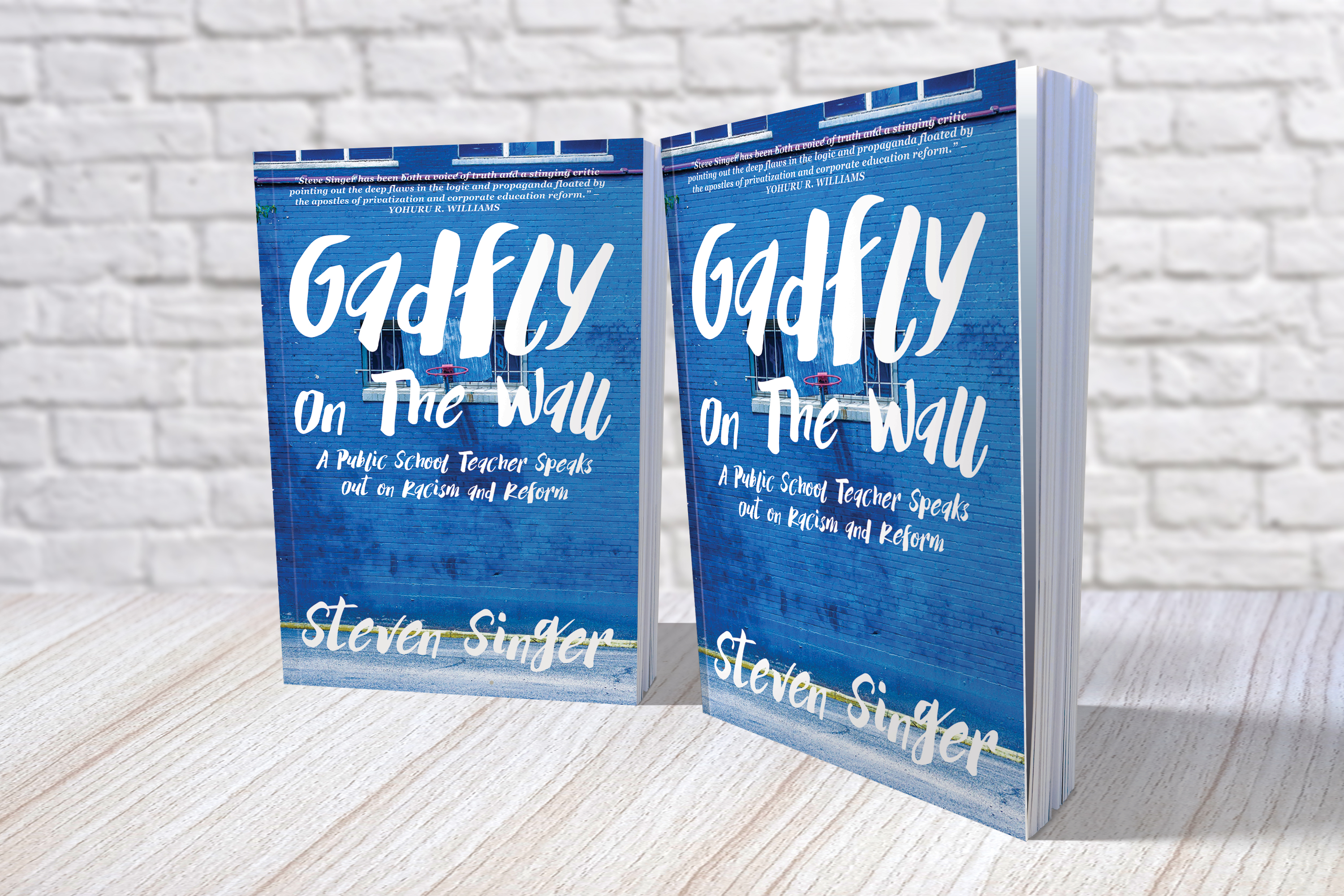
I’ve also written a book, “Gadfly on the Wall: A Public School Teacher Speaks Out on Racism and Reform,” now available from Garn Press. Ten percent of the proceeds go to the Badass Teachers Association. Check it out!

Reducing Students to Their Test Scores Will Only Increase Their Pandemic Wounds 


Read the following as quickly and accurately as you can:

‘I know I withought all by he middle on, ” said a between he name a buzzing, he for began open he the only reason for making.”

Very good, you’re told as your teacher clicks a stopwatch and writes on a piece of paper.

Now try this one:

“Twas brillig, and the slithy toves, Did gyre and gimble in the wabe:

All mimsy were the borogoves, And the mome raths outgrabe.”

The teacher frowns and writes for a minute straight without comment.

Okay. Give this one a shot:

“Lorem ipsum dolor sit amet, consectetur adipiscing elity, sed do eiusmod tempor incididunt ut labore et dolore magna aliqua.”

No, this isn’t a crash course in some foreign language.

It’s the DIBELS test.

Students as young as Kindergarten (and sometimes younger) are asked to read a text aloud in a given time and each mispronunciation is recorded and marked against them.

And, yes, the texts are often pure nonsense.


My first example was from a nonsense generator of Winnie the Pooh, the second was from “Jabberwocky” by Lewis Carroll and the last an example of Lorem ipsum, a placeholder text commonly used in the graphic, print, and publishing industries.

To my knowledge none are actually used on the DIBELS test but they give you an idea of what an adult version might be like if given to people our age and not just the littles.

Can you imagine being a child, feeling the pressure of a test and being presented with something that looked like those passages!?

The fear! The sense of urgency to say something before the time runs out! The feeling of inadequacy and confusion as you finished knowing you got it wrong!

And the assurance that this meant there was something wrong with YOU!

That’s reading assessment in the standardized testing age.

Decoding – or working out the actual pronunciation of words – is given primacy over actual comprehension.

Why? Because that way we can break reading down into simple, quantifiable tasks that can be used to sort and rank children.

You know. The goal of standardized testing.

It’s highly controversial among people who study reading acquisition, but extremely common in elementary and middle schools.

And extremely lucrative for the makers of the DIBELS test.

Today I was forced to leave my class of 8th grade students with a sub so an “expert”from the Allegheny Intermediate Unit could lecture me and the rest of my school’s English department in using DIBELS as a gatekeeper assessment for all students.

That way we can group the students more easily based on their reading deficiencies.

I literally had to stop teaching for THAT.

I was bopping around the classroom, reading students’ writing, helping them organize it, helping them fix their explanations and craft sophisticated essays on a short story.

But I had to STOP, so an outside contractor could explain to ME how to teach.

ME, a Nationally Board certified teacher with two decades of classroom experience.

And the rest of the department with similar experience and education. In the group was also the holder of a doctorate in education. Almost all of us at least held a masters degree.

It boggles the mind.

In this time of pandemic stress when just keeping enough teachers in the building to staff our classrooms is a challenge, administration is wasting our time with this.

Before Covid-19, I could almost imagine it.

We did a lot of stupid things back then. But now a deadly virus rages across the country. Several students and staff get sick every week.  


There is a shortage of teachers, aides, subs, bus drivers, and other staff. 


And even though most school buildings are open, most students are still suffering from the social and emotional effects of the never-ending disaster.  


Yet the people who set school policy refuse to see any of it.  


They’re like ostriches – in suits – with their heads planted firmly in the ground. 


Covid safety protocols, reducing teacher workload, providing counselors for students – none of that is even on their radar.  


All they want to do is reinstitute the policies that weren’t working well before the pandemic hit.  


The only difference is their sense of urgency.  


In fact, the only impact they even recognize of the last year and a half is the dreaded LEARNING LOSS.  


Kids weren’t in class consistently. They were in on-line classes, or hybrid classes or maybe they didn’t even show up to class at all.  


That means they don’t know as much today as they would have known had the pandemic not happened.  


So – we’re told – they’ve lost learning. 


Oh no!  


But what these decision makers don’t seem to understand is that this whole concept is kind of meaningless.  


All people learn at different rates. If you don’t know something today, that doesn’t mean you can’t learn it tomorrow.  


There’s no time table for understanding. It’s not a race. It doesn’t matter when you learn something only that you continue making progress. 


However, you’d need a classroom teacher to explain that to you. And these are more business types. Administrators and number crunchers who may have stood in front of a classroom a long time ago but escaped at the first opportunity. 


They look at a class full of students and don’t see human children. They see numbers, data.  


And they are just itching to get back to sorting and ranking students based on standardized test scores.  


After all – say it with me – LEARNING LOSS!!!! 


Unfortunately there’s a whole world of reality up here above ground that they’re ignoring. And up here continuing with their willful fantasy is doing real harm.  


When I look at my classes of students, I don’t see overwhelming academic deficiencies.  

Even their test scores don’t justify that myth.


According to the Pennsylvania System of School Assessments (PSSA), they’re pretty much where I’d expect them any other year.


But their behaviors are off the hook


They simply don’t know how to interact with each other without conflict.  


My students are desperate for attention – any kind of attention – and will do almost anything to get it.  


They’d prefer to be respected, but they don’t understand how to treat each other respectfully. So they aim for any kind of response.


To a large extent this is due to a disruption in the social and emotional development they would have received at school. But robbed of good role models and adequate consequences, they’re somewhat at sea.  


Moreover, the pandemic has had a devastating effect on their support systems at home. Parents, family members and guardians have lost jobs, become sick and some have even died.


They don’t know who to trust and who they can rely on.  


So when they get to school, we’re going to meet their needs with more standardized tests!?  


That’s one of the worst things we could do. 

Take a child who already has trust issues and force them to read nonsense sentences while we judge them with a stopwatch?


Erase their individual identities and try to see them primarily as their scores?


These are in the low group. These are in the middle group. These are in the high group.  


Instead of giving them robust pieces of literature to read, they’ll get nonfiction scraps devoid of any connection to their lives, interests or aptitudes.  


We’ll drill and kill them, make every day about teaching to the test instead of teaching to the student.  


We’ll let data drive the instruction instead driving it based on the actual living, breathing, human beings we’re supposed to be serving.  


And instead of relying on teachers – highly trained people with decades of experience in how children learn effectively – we’ll put our trust in mega corporations that make more money the less effective their materials are.  


Prepare for a test – they make money. 


Take a test – they make money. 


Fail the test and have to remediate – they make money.  


It’s a scam – an endless cycle – and administrators and policy makers keep falling for it.  


Will this help meet kids social needs?  


Absolutely not. They’ll be segregated by ability and forced to repeat confusing and mind numbing tasks as if that’s what education was.  


Will it help meet kids emotional needs?  


No way! Being forced to do the same thing over and over and continually told you’re a failure won’t teach anything except a kind of learned helplessness.  


Kids will learn “I’m bad at math” or “I’m bad at reading” rather than the joy that can be found in both activities.  


They’ll learn to give up.  


And they’ll take out the negative feelings all this generates on each other and their teachers.  


It doesn’t have to be this way.  


A new world is possible.  


The pandemic offers us a chance to stop repeating the same mistakes of the past.  


We can scrap standardized testing and focus on authentic assessments – teacher constructed assessments the are suited to the individual context, the individual students.  


We can focus on lessons that engage students and encourage them to learn intrinsically.


We can focus on what students know instead of what they don’t so they learn that they are capable, that they have the power to do the lesson.  


We could help students understand how to interact with each other and heal some of the social and emotional wounds of the past year and a half.  


But we can’t do that if we’re forced to continue with the same mistakes of the past. 

We have to recognize the reality teachers, students and parents are living through.

And we have to make decisions based on that reality, not the same old preconceptions that have never gotten us anywhere.


Like this post?  You might want to consider becoming a Patreon subscriber. This helps me continue to keep the blog going and get on with this difficult and challenging work.

Plus you get subscriber only extras!

Just CLICK HERE.

Patreon+Circle

I’ve also written a book, “Gadfly on the Wall: A Public School Teacher Speaks Out on Racism and Reform,” now available from Garn Press. Ten percent of the proceeds go to the Badass Teachers Association. Check it out!

My Students Haven’t Lost Learning. They’ve Lost Social and Emotional Development  


There is a student screaming across the hall.  
  
He is holding his gut and rocking back and forth in cries of wordless emotional pain as the rest of the class looks on in bewilderment.  
  
Students from other rooms start to cluster around the door until a security guard makes them go away.  
  
I close the door to my own classroom and try to settle my students down – but we can still hear him through the walls.   
  
And then:  
  
“Shut up!”  
  
“You’re stupid!”  
  
“Why don’t you make me!?” 
 
  
Believe it or not, this is not what teaching middle school used to be like.   
  
Eighth grade students were never perfect angels, but at least by then they used to know how to talk to one another. They could usually interact without constant sniping. They knew what was expected to get respect from each other and at least tried to do it.   
  
But things have changed.   
 
After 18 months of a pandemic, even when they aren’t infected with disease, children still are suffering tremendously from the effects of Covid-19. 
 
Adolescents are dealing with higher rates of anxiety, depression, stress, and addictive internet behaviors.   
 
The Centers for Disease Control (CDC) reports that children between the ages of 5 and 11 visiting an emergency department because of a mental health crisis increased 24 percent from April through October of 2020 compared to the previous year. Among 12- to 17-year-olds, the number increased by 31 percent.  
 
Suicide attempts among 12- to 17-year-old girls increased by about 50 percent over winter 2019, according to the CDC. 
 
And these numbers are probably under reported since these increases took place at the height of a pandemic when many people were hesitant to seek medical attention.  
 
As usual, the place where these issues are most visible is our public schools
 
When Covid-19 swept our shores last year, much of the benefit of formal education fell through the cracks.   
 
Consistency went out the window. Many schools went to on-line learning or a hybrid model of in-person and on-line offset with increasingly common periods of quarantine.  
 
These were often necessary to keep kids and their families safe – and in some cases still are. As a society, we could have done more to blunt the blow such as paying parents to stay safe at home as well as supervise their children, but economic concerns took precedence to human ones.  
 
And now we’re seeing the cost
  
Many students attended school haphazardly and their parents often weren’t around to give them the kind of stability, role models or attention they’d normally get at school.   
  
Today, as the pandemic still smolders on, and schools struggle to function as if the danger had passed, the result is classes of emotionally needy and socially awkward children.  
  
There were so many fights in the halls of my building last week, we’re now operating on a soft lockdown to decrease unstructured time between classes.   
  
And you know what – it’s not really kids’ fault.  
  
They’re just trying to live in the world we’ve built for them.   
 
More than 674,000 Americans have died from COVID
 
According to the CDC, more than 140,000 children in the U.S. lost a primary or secondary caregiver such as a live-in grandparent or another family member to the virus. 
 
Globally, that’s more than 1.5 million kids who have lost a parent, guardian or live-in relative to the pandemic, according to the Lancet
 
No wonder kids are having trouble dealing with their emotions! Their support systems are shot! 
  
My students are bright, caring, energetic and creative people. They have the same wants and needs as children always have. They just have fewer tools with which to meet them.   
  
Administrators often focus on academic deficits.   
  
They worry about learning loss and what the kids can’t do today versus students in the same grades before the pandemic. But I think this is a huge mistake.   
  
My students are not suffering from a lack of academics. They’re suffering from a lack of social and emotional development.   
  
I teach Language Arts and, sure, my kids may not have been exposed as deeply to certain concepts as those who came before them. They may not have written an acrostic poem or read Dickens or had as much experience writing. But that doesn’t mean they’re deficient.   
  
Every child – every PERSON – learns at an individual rate. Some take longer than others. Some take more exposure, experience and practice. But learning is never lost.   
  
Teachers know this. That’s why we scaffold our lessons. We get to know our kids and where they are before we can gauge what they still need to learn.  
  
My students may not have read the play they would have in 7th grade, but I can help them understand the components of drama when we read a play in the curriculum for 8th grade. They may not have written a particular type of poem last year, but we can still read one and understand it this year.   
  
Many students have difficulties with spelling and punctuation. That’s true this year as well as any other. That doesn’t mean they’ve lost anything. It means they need more instruction and practice.   
  
I’m not worried about that. It’s really pretty similar to any other year.   
  
What does concern me is the level of immaturity and social awkwardness I’m seeing.   
  
People aren’t machines. You can’t flip a switch and they just learn.  
  
You have to create an environment that is conducive to learning.  
  
Part of that is creating a class culture where everyone feels respected and safe. That’s difficult to do when kids don’t know how to communicate without conflict.   
  
That’s difficult when their sense of safety has been deeply impacted. Community members whining about security measures like wearing masks and getting vaccinated don’t help this – not at all.   
  
In schools, we’re trying to instill a sense of consistency and care. We’re trying to teach kids the basics of human interaction again – something even some adults are having to relearn.  
  
And let me tell you – it’s extremely hard in large, anxious groups dealing with the continuing uncertainty of our times.   
  
My own health has suffered under the pressures with which educators are forced to contend. Unnecessary paperwork, increased expectations, lack of respect and compensation have teachers stretched to a breaking point.   
  
I was in and out of the hospital all last week and the district had great difficulty finding an adult to sub for me.   
  
For two days they resorted to hiring parents from the community to watch my classes. I’m told that one of them reported to the office at the end of the day and promptly told the secretary not to call her tomorrow, that she was never coming back.   
 
It’s hard for professional educators, too. 
 
According to a 2020 survey by the New York Life Foundation and American Federation of Teachers, only 15% of teachers feel comfortable addressing grief or trauma tied to the pandemic. 
  
My kids are not demons.   
  
They are not monsters or evil or incorrigible.   
  
They’re just kids who really need our love and support.   
  
I feel for them. I really do.   
  
When I’m here, I do everything I can to help them feel safe, secure, respected and cared for.   
 
It’s certainly not easy. 
  
At lunch the other day, one student came to my door and scratched on the window. He was in tears.   
  
I let him in and asked what was wrong.   
  
He was at his wits end about his home life and felt lost. I sat with him, we talked it out and I asked if there was anything else I could do for him.  
  
He said, “Yes. Can I have a hug?”  
  
So even now, with COVID out there in the community and my mask securely fastened, I did it. I gave him a hug.   
  
That’s the need I’m seeing in schools right now.   
  
It’s not academics. That will be fine if we can take care of the emotional and social needs of our students.   
  
But this can’t be accomplished by teachers alone – nor even administrators, school boards and districts.   
  
We need to build a world that cares about children.   
  
We need to value their lives and needs.   
  
It’s not enough to care whether a child is born. We have to care whether a child is taken care of, healthy and loved.   
  
And that means looking out for their parents, too.   
  
If parents didn’t have to sacrifice themselves to their jobs, they could spend more time with their kids.   
  
When your job constantly demands more time, at all times of the day and night, you can’t be there effectively for the ones you love.   
  
We talk about family values, but we do little to value families. Only their credit score and earning power.   
  
This is a problem that won’t be solved overnight.   
  
It may far outlast the pandemic, itself.  
  
To heal our kids, we have to heal our society.  
  
In fact, we can’t do one without doing the other.  


Like this post?  You might want to consider becoming a Patreon subscriber. This helps me continue to keep the blog going and get on with this difficult and challenging work.

Plus you get subscriber only extras!

Just CLICK HERE.

Patreon+Circle

I’ve also written a book, “Gadfly on the Wall: A Public School Teacher Speaks Out on Racism and Reform,” now available from Garn Press. Ten percent of the proceeds go to the Badass Teachers Association. Check it out!
Muzzling America’s Teachers with a Ban on Critical Race Theory is What Orwell Warned Us About

I first read George Orwell’s dystopian novel “1984” while in high school almost a decade past its titular date.

At that time, it didn’t seem to be a prediction. It seemed to be a description of life in the Soviet Union.

I never would have guessed that it could be a warning of what the public school system could become in this country if Republican lawmakers have their way.

Far right legislators have proposed bans on so-called Critical Race Theory in at least 20 states that would muzzle classroom teachers from discussing racism and other “controversial” and “divisive” topics or risk being disciplined, fired or facing other legal consequences if they don’t obey.

It is an attempt to legislate history.

These lawmakers are working to control information and let politics – not facts – be the guiding principle of what gets accepted in our chronicle of the past.

Those of us who’ve read “1984” have seen this before.

The text is set in Oceania, a state where the government controls the media, education and even people’s thoughts.

The main character, Winston Smith, works at the Ministry of Truth where he rewrites history to match the party line – whatever it is this week.

For example, at a “Hate Week” demonstration near the beginning of the story, people are gathered to cheer their country’s alliance with Eastasia. However, when the speaker abruptly declares that Eastasia is the enemy, people quickly crumple up their banners and acknowledge that Eastasia was always the enemy and they must have been mistaken to think otherwise.

The prospective ban on Critical Race Theory is strikingly similar.

Politicos are trying to erase the United States’ troubled history of systemic racism, gas light any discussion of its current existence and otherwise stifle and control any topic that goes against their party line.

It’s a policy enshrined in page after page of the most famous description of totalitarianism in modern literature.

Let’s take a closer look at some key passages.

TRUTH

‘”There was truth and there was untruth, and if you clung to the truth even against the whole world, you were not mad.”‘

Central to the book is a belief in objective truth.

No matter what we think or say, there are facts out there in the world.

For example, throughout the 17th and 18th centuries, millions of people were kidnapped from Africa, forced into slavery in the American colonies and exploited in the production of tobacco and cotton. Any denial of that fact, any minimization of the degree of dehumanization in it, is a rejection of reality.

Sanity is our adherence to that reality. Psychological well being is the attempt to bring our thoughts and ideas about what was and what is in line with these facts.

Moreover, doing so is the definition of freedom, itself.

“Freedom is the freedom to say that two plus two make four. If that is granted, all else follows.”

If we take away an individual’s right to try and square the reality of the world with their internal ideas about it, we take away all of their freedoms.

One must come to an understanding of the world. It cannot be handed down. It must be the result of observation and understanding.

In short, it is a product of education. We’re taught the facts, but it is up to us to make sense of them.

If the facts are obscured from us or if they are misrepresented, our freedom is impinged.

REWRITING HISTORY

“Every record has been destroyed or falsified, every book rewritten, every picture has been repainted, every statue and street building has been renamed, every date has been altered. And the process is continuing day by day and minute by minute. History has stopped. Nothing exists except an endless present…”

In direct opposition to the idea of objective truth is the mutability of history.

To some extent it is completely natural. Over time we come to new understandings. We discover things that had been accepted as facts were misunderstood.

For example, it was long accepted as true that Christopher Columbus discovered America. Now we realize that not only wasn’t he the first European to come to these shores, the idea that he “discovered” anything is incoherent. You can’t “discover” lands where people are already living. More over, given the details of pillage, rape and violence in his own journals, Columbus’ accomplishment should be viewed in far less positive terms than it has been up to this point.

Ideas change and we must keep up with that changing understanding.

However, the danger is when that change is NOT the result of new information or recontextualizing what we already knew. It’s when we allow history to be dictated by politics.

“And if all others accepted the lie which the Party imposed – if all records told the same tale – then the lie passed into history and became truth. ‘Who controls the past’ ran the Party slogan, ‘controls the future: who controls the present controls the past.'”

This idea is essential to the work Winston does at the Ministry of Truth. By rewriting the events of the past and controlling the narrative of history, the Party maintains its authority.

This is the goal of the proposed bans on Critical Race Theory. One political party is attempting to stop the freedom of history based on facts and replace it with history based on whatever is in the best interests of that party maintaining power.

Whitewashing the history of slavery as less exploitative and more mutually beneficial to both the white owners and black enslaved peoples helps to reduce the impetus to contemporary reform in the systems of racism maintained in this country since our failed Reconstruction. Likewise, representing Columbus as a hero and adventurer instead of a murderer and tyrant helps justify similar actions today.

Or as Orwell puts it:

‘”The masses never revolt of their own accord, and they never revolt merely because they are oppressed. Indeed, so long as they are not permitted to have standards of comparison, they never even become aware they are oppressed.”‘

EDUCATION

Much of the book is focused on how fascist regimes control thought. And primarily this is done through education and the media.

“Power is in tearing human minds to pieces and putting them together again in new shapes of your own choosing.”

That’s a kind of education. Replacing what is known with whatever the Party wants to be known.

“Don’t you see that the whole aim of Newspeak is to narrow the range of thought? In the end we shall make thoughtcrime literally impossible, because there will be no words in which to express it.”

If you don’t have the words to express an idea, it’s incredibly difficult to have that idea. We do, after all, think in language.

For example, the definition of “Racism” has shifted over time to mean more than just prejudice or discrimination against a person or people based on their race or ethnicity.

It is now more commonly understood as prejudice plus power – racial prejudice, AND social power to codify and enforce this prejudice into an entire society.

This is what is meant by Systemic Racism, a concept at the core of this fight. Much of the battle against Critical Race Theory is really an attempt to stop this concept of racism from becoming widespread and codified through our school system.

It is an attempt to keep the original definition of racism, to stop people from seeing systemic racism by refusing to accept its reality through control over speech.

Yet the movement, itself, is based on redefinitions and insinuations.

Critical Race Theory is not a concept taught at public schools. It’s a decades old legal framework. It’s about how laws function to create and maintain social, economic, and political inequalities.

It’s as much a part of K-12 public schools curriculum as torts, contract law or civil forfeiture. Which is to say, not at all.

However, the GOP is using it because they think it sounds scary. It’s a self-created boogeyman to incite the Republican base against a nebulous and ever changing idea of what they take to be liberal indoctrination.

As Orwell wrote:

‘”It’s a beautiful thing, the destruction of words.”‘

And that’s what we have here. The destruction of words, the destruction of Critical Race Theory from its actual meaning into a trigger point.

It is about insinuation instead of talking about Republican grievances of what this so-called liberal indoctrination is head on. Because if they were to discuss the issue openly, it could never be proven. However, to imply, to hint, to whisper avoids the ability to disprove.

It is Newspeak, the fictional language of Oceania where simplified grammar and restricted vocabulary limit the individual’s ability to think and even articulate certain facts or concepts.

PURPOSE OF EDUCATION

But what is the difference between what Republicans are doing with these bans and the naturally evolving course of history? If education is the process of forming an individual’s ideas and thoughts, how is any of it ever free?

Consider this. Orwell describes the goal of education in Oceania:

‘”Doublethink means the power of holding two contradictory beliefs in one’s mind simultaneously, and accepting both of them.”‘

That is not the goal of our current education system.

We do not want students to be handed down information and simply accept it even if it doesn’t make sense.

Teachers strive to get their students to interact with information, to look at it critically.

And that is the important point – CRITICALLY.

At some point even in Oceania, everyone comes across different ideas, concepts that you may not have considered before or may have actively rejected.

What do you do when this happens?

Winston is expected to believe what the Party tells him to believe. And even in the USA we often act as if being confronted with this reality is the worst case scenario for students. It is the end of the world if they are confronted with a different point of view.

Nothing could be further from the truth.

It is essential that they be confronted with opposing views so that they can think critically.

That is the purpose of education.

Not to tell students what to think, but to give them the tools to think.

It is up to each and every student to come to their own conclusions.

Educators should give them the facts and even expose them to varying concepts about the facts.

But it is up to the individual student what to do with them.

This makes some parents and politicians uneasy because it treats students as human beings with freedom of choice.

Such freedom is not allowed in Oceania, and if Republicans have their way, it will not be allowed here, either.

We must preserve academic freedom for both students and their teachers.

It is absolutely essential.

Otherwise Orwell’s book will be less a warning than a guide.


Like this post?  You might want to consider becoming a Patreon subscriber. This helps me continue to keep the blog going and get on with this difficult and challenging work.

Plus you get subscriber only extras!

Just CLICK HERE.

Patreon+Circle

I’ve also written a book, “Gadfly on the Wall: A Public School Teacher Speaks Out on Racism and Reform,” now available from Garn Press. Ten percent of the proceeds go to the Badass Teachers Association. Check it out!

Why a Public School Teacher is Running for Allegheny County Council

People seem surprised when I knock on their doors.

Perhaps it’s the fact that they weren’t expecting anyone to drop by.

Perhaps it’s because we’re still in a global pandemic.

But when they peek through their screens or poke their heads out with a quizzical look, the one thing that seems to put them at ease is when I tell them I’m a public school teacher.

It’s certainly not that I’m running for Allegheny County Council near Pittsburgh, Pa.

A teacher, they know and understand. Their kids had teachers. They had teachers when they were young.

But County Council?

Many of them seem to struggle with what that governmental body even is.

Municipal council, they know. School board, magistrate, even their local dog catcher.

But County Council is the kind of thing that falls through the cracks between state and local.

So why is a public school teacher like me trying to get their support on May 18 and get elected?

In truth, it’s been a long time coming.

I teach at Steel Valley Middle School in Munhall, just outside of District 9 where I’m running for office.

Being an educator is the greatest job I’ve ever had.

It’s challenging, time consuming, exhausting, but at the end of every day I go home with the feeling that I really did something worthwhile.

I help kids learn to read and write. I open them up to new possibilities and give them opportunities to express themselves.

Sure, I teach grammar and vocabulary, but we also read “The Diary of Anne Frank.” We read “The Outsiders” and “To Kill a Mockingbird.” We read authors from Edgar Allan Poe to Charles Dickens to Langston Hughes, Toni Cade Bambera and Gwendolyn Brooks.

We have heated discussions about race, class, gender, punishment, justice.

For 17 years I’ve watched my students learn and grow as the resources available to them withered and died. Privatization expanded like a new frontier as constraints upon what counts as learning became more rigid and reductive.

Class sizes got larger every year. Electives, extra curricular activities, tutoring all disappeared.

They were replaced with standardized testing, test prep for the standardized testing, testing before the testing, and workbooks about how to do the testing right.

Every year it got a little harder.

Then came Covid-19 and the response to it.

In one year the system nearly collapsed.

The only thing that kept us going was the tenacity of teachers.

They closed our classrooms and we figured out how to do the job from home with our laptops and home computers. We became experts overnight in Zoom, Google Meets, Google Classroom and every other file sharing, digital conference software there is.

And that would have been okay I guess – if the rest of society had held up its side of the bargain.

Immunologists told us we had to shelter in place but our governments didn’t provide the means to do so.

The economy needed a kickstart. People just got a kick.

And schools were caught in the maelstrom.

Many schools reopened unsafely. Not only did people get sick, but the quality of education was subordinate to babysitting services so parents could get back to nonessential jobs that kept their bosses showered in profit.

Too many school directors became like the mayor in Jaws, proudly announcing the beaches were open, then trying desperately to find any excuse for the mangled bodies washing up on shore other than a hungry shark.

I will never forget the calm certainty with which policymakers announced schools were reopening without even mentioning the impact on the teachers who still had to staff these schools and put themselves and their families at increase risk of infection. Nor will I forget the CDC advising that vaccinating teachers first was nice but not necessary.

However, as bad as all of that was, it was the insurrection at the Capitol that pushed me over the edge.

Here we had a group of white terrorists dressed up for comic-con proudly rushing our highest legislative body to kill lawmakers who wouldn’t perform a coup.

I had had enough.

Somewhere inside myself – as I tried to calm my students and explain the significance of what was happening – I promised that I would try to make a change.

If so few people tasked with making the important decisions couldn’t do it, I would offer to do it, myself.

If so many easily corrupted fools could cheer the destruction of democracy, I would do what I could to defend it.

So when the opportunity arose to run for County Council, I took it.

Like I said, it’s a strange position.

Allegheny County is one of the biggest counties in Pennsylvania second only to Philadelphia. Being on council would allow me to have a say in everything from transportation to law enforcement to business to – yes – education.

First, the area where I live – the Mon Valley – is made up of former steel towns left behind by the rest of the county. In most parts of the city, if you need to get somewhere, you can just take a bus. Not in the Mon Valley.

So many Port Authority routes have been cut that getting in to the city on public transportation is nearly an all day affair – if possible at all. I should know. My wife used to ride to work on the bus, but after the latest round of cuts, that become too hard to fathom.

On County Council, I could do something about that.

Then there’s our air quality – some of the worst in the state.

When the steel mills closed, we lost most of the smog and haze, but it didn’t last. With the fracking boom and well-meaning efforts to keep as many mills open as possible, the air became a thick, rusty tasting mess.

On County Council, I could do something about that.

Well-paying union jobs are harder to come by these days, and those that do exist shouldn’t require us to poison the environment. We have all these rivers, all these corridors free from trees or phone lines. We could build wind turbines on the shores and generate more power than we’d know what to do with. We could checker the rooftops with solar panels and not have to worry about the latest thunderstorm knocking out our power.

And doing so would require hiring people to build, maintain and improve this green infrastructure. No more sewage overflowing into the river during flood times. No more pollution from industries not required to monitor and regulate their output. No more lead from flaking paint getting into our food and water.

On County Council, I could do something about that.

Let’s not forget law enforcement.

The County Jail is located right in the middle of Pittsburgh, and the way it’s run is a disgrace.

About 80% of the people incarcerated there have not been convicted of any crime. They simply can’t afford cash bail, failed a drug test (often for something like marijuana) or violated our county’s inordinately long parole period. It’s ridiculously expensive not to mention inhumane. It costs $100 a day to keep someone in lockup. That’s $100 million a year or 27 cents from every dollar of county taxes collected.

We need to stop this madness, get civilian oversight of police and cut out the military style policing.

On County Council, I could do something about that.

And of course there’s education.

According to state law, community colleges are supposed to be bankrolled completely by the state, the county and student tuition. However, the state and the county have always shortchanged the college, only paying about 20% instead of the 33% they owe. The result has been an increased burden on students and families with rising tuition and fewer services. That’s appalling, especially in a county where one third of all residents have taken at least one class through Community College of Allegheny County (CCAC). I, myself, took a math course there when I was preparing to become a teacher. And my father-in-law was a teacher there until they cut his job.

Moreover, County Council plays a role in appointing people to boards and authorities including those that administer CCAC. Yet council has rarely appointed any educators or people who understand the profession.

On County Council, I could do something about that.

Which brings me to my final point.

What about public schools?

Does the county have any role to play in what happens to them?

At present, the answer is mostly no. But it doesn’t have to be.

In Pennsylvania, as in most states, public schools are primarily funded by local property taxes. So rich communities spend a boatload per student and poor communities scrape together whatever they can afford.

It’s a problem only the state and federal government can truly solve, but that doesn’t mean we’re helpless at the county level.

We have a $2 billion budget. We have an awful lot of big corporations that hide behind a non-profit status but act a lot more like for-profit companies.

We wouldn’t have to scrape together much to make a real difference in the lives of underserved students.

We could help them get pre-kindergarten services, decrease class size, increase arts and humanities, get more after-school tutoring

On County Council, I could do something about that, too.

So that’s why I’m running for office.

That’s why I’m willing to trade in a few nights from the classroom to the council chambers.

I’d still be a teacher. I wouldn’t be giving up my day job.

But if people see fit to support my candidacy, I could get a seat at the table, a chance to form coalitions to bring real change for the people of my district and the county as a whole.

That’s why I’m going door-to-door, introducing myself and asking for support.

I want to make a difference.

I want to be able to look my students in the eye with the full knowledge that I’m doing everything I can to ensure they have a future.

But I can’t do it alone.

We can only do it together.


Like this post?  You might want to consider becoming a Patreon subscriber. This helps me continue to keep the blog going and get on with this difficult and challenging work.

Plus you get subscriber only extras!

Just CLICK HERE.

Patreon+Circle

I’ve also written a book, “Gadfly on the Wall: A Public School Teacher Speaks Out on Racism and Reform,” now available from Garn Press. Ten percent of the proceeds go to the Badass Teachers Association. Check it out!

You’re Going to Miss Us When We’re Gone – What School May Look Like Once All the Teachers Quit

The alarm buzzed at 4:30 am. Time to get up.

DeShaun and his little brother Marco got out of bed and threw on their clothes.

Mom was in the other room hastily getting her work bag together.

“Are you two ready yet? We’ve got to go in 20 minutes.”

Marco just yawned, but Deshaun dared to complain about the hour.

“We didn’t used to have to get up so early,” he said.

“That was when you still had school. Now I’ve got to get you all to the daycare by 5 or they’ll be full up.”

DeShaun frowned but got ready anyway. He didn’t want to have to sit outside all day again. There were older kids in the park who got kids like him to run drugs during the day. He could make some money that way, but the only kids he knew who did that got hooked on their own supply. That or arrested.

Heck! He’d been arrested for loitering twice this year already.

“Hurry! Let’s go!” Mom shouted as she handed each child a yogurt and a bag of chips.

The bus was full even at this hour.


DeShaun recognized a bunch of kids who usually went to the daycare.

His best friend, Paul, used to ride the bus, but then his mom got him into the private school in the city. She and his dad had to cash in his entire school voucher AND pay an additional $10,000 a year, but they said it was worth it. Still, DeShaun missed his friend.

Octavia was standing a bit further down the aisle though. She was usually good for a trade. He guessed she’d take his yogurt for some Hot Cheetos.

When they got to the right stop, Mom gave his shoulder a squeeze and told him to watch out for his brother. She’d see him at the end of the day.

He and Marco made it just in time.


He saw Octavia get turned away at the door.

“Dang!” He said. He really wanted those Hot Cheetos.

He and Marco took their seats in the back of the room and got out their iPads.

He wanted to play with the toys in the Reward Room, but no one got in there before lunch.

Marco was crying.

“What’s wrong?” He said.

“I can’t find my iPad.”

“Didn’t you pack it?”

“I think I left it on the charger.”

“You dummy!” DeShaun said and handed Marco his own iPad.

“Take this,” he said. “I can use my phone.”

It had a huge crack on the screen but he could probably read through the jagged edges if he tried hard enough. That probably meant no Reward Room though.

First, he clicked on Edu-Mental. It wanted him to read through some stuff about math and do some problems. He couldn’t really see them but he could hear about them through his earbuds.

Then he did Lang-izzy. There was a fun game where you had to shoot all the verbs in these sentences that scrolled across the screen faster and faster. But DeShaun’s timing was off and even though he knew the answers, he couldn’t get a high enough score to get a badge.

He skipped to Sky-ba-Bomb. It had a lot of videos but it was his least favorite. He couldn’t tell which ones were about history and which were advertisements. Plus he got so many pop ups after just a few minutes, he often had to disconnect from the wi-fi or restart his phone.

Oh, what now?

“Miss Lady,” Marco was saying.

The blonde haired new girl came over to him.

“What is it, Sweetie?”

“Can I go to the bathroom?”

She checked her iPad.

“Oh, I’m sorry, Honey. You’ve only been logged on for half an hour. Answer a few more questions and then you can go.”

DeShaun grabbed his shoulder and shook him.

“Why didn’t you go before we left home?”

“I didn’t have-ta go then. I have-ta go NOW!”

He could leave the daycare and go outside. There was even a filthy bathroom at the gas station a few blocks away. But if he left now someone outside was bound to take his spot. And Mom wouldn’t get a refund or nothing.

The blonde was about to walk away when DeShaun stopped her.

“He can take my pass. I’ve been on long enough.”

“That means you won’t get to go until after lunch,” she reminded him.

“I won’t drink anything,” he said.

She shrugged. That seemed to be her main way of communicating with people. She looked barely old enough to be out of daycare, herself.

DeShaun gave Marco his phone and sat there waiting for him to come back.

He remembered what it used to be like.

Back before the pandemic, they used to go to school.

Now that had been SOMETHING!

They had real teachers, not just minimum wage babysitters.

He remembered back in Mrs. Lemon’s class he could go to the bathroom anytime he wanted. In fact, he’d often wait until her period everyday to go to the bathroom. That way he’d have time to walk halfway around the building and look in all the open doorways and see what everyone was doing.

There were groups of kids huddled around desks working on projects together. Other times kids would be sitting in their rows of desks with their hands raised asking questions – and actually getting ANSWERS!


Teachers would stand at the front of the room and talk to them – actually talk and wait to hear their answers!

And if you finished your work, you could draw or read…. Reading…. Yeah they had real books made of paper and everything!

He remembered sitting in a circle in Mr. Sicely’s class and discussing the book they’d read. “The Diary of Anne Frank.” And people got really into it and excited.

We used to complain about the homework, he thought stifling a laugh. What he wouldn’t give for one more day of that homework!

He wondered why they no longer did stuff like that. Why DID the schools close after Covid?

He picked up his iPad that his brother had abandoned on the seat beside him and asked Siri.

He got a bunch of articles about teachers being asked to work in unsafe conditions, getting sick and some even died. He read about the CDC saying that schools could reopen “at any level of community transmission” and that vaccinating teachers wasn’t even necessary.

The government – under both Republicans and Democrats – wouldn’t pay people to stay home so they had to keep working even at nonessential jobs, and doing so just spread the disease. And instead of blaming lawmakers, lots of folks blamed teachers for refusing to risk their lives to teach kids in-person.

Wasn’t that like today, DeShaun thought. But, no, he answered himself. They still taught kids on-line back then. Now there are hardly ever any real people on-line. Kids like him just went from app to app earning various badges in different subjects until they had enough to take the test. Those horrible multiple choice standardized tests!

He could email a question to someone but rarely got an answer back.

When he first started going to daycare, he asked one of the workers a question. There used to be this nice lady, Miss Weathers. She would at least try to answer the kids questions but he thought she got in trouble for doing it and he hadn’t seen her here since.

Now there was rarely the same adult here for more than a week or two. And they kept getting younger. Maybe HE could get a job here if he was good.

Marco came back, snatched the iPad and said “Thanks.”

DeShaun just sat there looking at his cracked phone.

Was this really all he had to look forward to, he thought.

He missed school.

He missed teachers.

He missed everything that used to be.


Like this post?  You might want to consider becoming a Patreon subscriber. This helps me continue to keep the blog going and get on with this difficult and challenging work.

Plus you get subscriber only extras!

Just CLICK HERE.

Patreon+Circle

I’ve also written a book, “Gadfly on the Wall: A Public School Teacher Speaks Out on Racism and Reform,” now available from Garn Press. Ten percent of the proceeds go to the Badass Teachers Association. Check it out!
An Originalist Reading of Public Schools

Let’s say you went to a restaurant and ordered a big ol’ meat sandwich only to find nothing but straw between two pieces of bread.

“Waiter!” You say, calling over a server.

“What’s wrong, Sir?”

“There’s no meat in my sandwich.”

“Oh, Sir?” He says smiling, examining your plate. “Here at Scalia’s Bar and Grill we adhere to a strict originalist interpretation of language.”

“What does that have to do with my sandwich?”

“Well, Sir, in Old English ‘meat’ meant any solid food, anything other than drink. As in ‘A Journey to the Western Islands of Scotland’ (1775), Samuel Johnson noted, ‘Our guides told us, that the horses could not travel all day without rest or meat.’”

“But that’s not what I ordered!”

“Oh yes it is, Sir. You ordered the meat sandwich. Enjoy your fresh hay and oats.”

In everyday life, you wouldn’t put up with that kind of nonsense.

But for some reason, far right ideologues think it’s exactly the right way to interpret the U.S. Constitution.

The meanings of words change over time.

But ignoring that fact allows disingenuous crackpots to sweep over centuries of judicial precedent in favor of what they pretend to THINK the words meant at the time the law was written.

It’s not even about what the writers of the law SAID it meant. It’s about what today’s justices decide some hypothetical average Joe of the distant past would take certain words to mean.

The most obvious example, according to Pulitzer Prize winning historian Joseph Ellis, is District of Columbia v. Heller, 554 U.S. 570 (2008), which reversed 200 years of precedent on gun regulations.

Before this ruling, the Second Amendment was interpreted to be referring only to service in the militia. The Militia Act of 1792 required each able-bodied male citizen to obtain a firearm (“a good musket or firelock”) so he can participate in the “well regulated militia” the Amendment describes.

It was about the obligation to serve your country, not the right to own a gun. However, Supreme Court Justice Antonin Scalia – the most infamous proponent of judicial originalism – orchestrated the majority opinion in this case changing all that. By doing a thought experiment about what words might have meant in the 1700s, he papered over two centuries of established law. He was so proud of it that he even described it as “my masterpiece.”

THAT’S judicial originalism.

And now that Scalia fanboy and federal judge for not even three whole years, Amy Coney Barrett, is being rammed through Senate Confirmation Hearings, that preposterous ideology is about to have another proponent on the highest court in the land.

Just imagine if we interpreted everything like people living in the 18th Century!

Black people would lose any semblance of equal rights even being forced back into slavery.

Women couldn’t get checking accounts, their own healthcare, make decisions about their own bodies, even vote (least of all hold positions on the Supreme Court).

And our public schools wouldn’t even exist!

After all, there was no widespread, comprehensive system of public education in the country before John Dewey championed it in the 1930s.

Sure, Presidents Washington, Adams, Jefferson and Madison all spoke at length about the importance of education to a free and just democratic society.

But remember, originalists don’t care about the writer’s intent. They only care about what regular people would understand by the terms. And regular people wouldn’t even understand the words “public” and “school” used together as a single concept at the time.

The first school that opened in what would become the United States was The Boston Latin School in 1635.

Its mission, and that of other colonial schools, was not to teach academics like math and literacy. It taught religion, family values and community spirit kind of like many parochial schools today.

Moreover, most schools were for boys only. If they deigned to teach girls at all, they taught them how to read but not write. No reason to give people a voice who weren’t seen as worthy of being heard.

Academics didn’t become something schools were responsible for until the mid-1800s. And even then, how they went about achieving it differed greatly from region to region of the country.

In the South, education rarely had anything to do with anything we’d call a school today. Rich families paid private tutors for their children. Everyone else was expected to work as soon as they were able.

In fact, it wasn’t until the Civil War ended and the Reconstruction era began when public schooling really became a thing in the South.

And even when it did, it didn’t look much like our schools of today. These were often one-room schoolhouses where a single teacher tried to educate children of various ages, grades and abilities.

Moreover, these schools weren’t solely supported by taxes – if at all. These Common Schools were more like private or parochial schools of today. Parents paid tuition, provided housing for the teacher, or contributed other commodities in exchange for their children’s education.

Even then, the learning students received wasn’t nearly as comprehensive as our kids routinely expect in even the most under-funded urban public schools today. And special education services was non-existent. Kids with special needs were routinely left out of education altogether.

Only 31 states passed laws requiring children to go to school by 1900, and kids only went from age 8-14. It wasn’t until 1918 that every state even required elementary school.

But let’s not forget segregation.

It was the law of the land until Brown vs. Board in 1954, and even then it took until the late 1970s to become even moderately enforced.

Subsequent rulings have weakened school integration efforts to such a degree that today many districts are as segregated – if not even more – than they were in the 1950s.

Just imagine if Barrett gets together with the wingnut Republican majority on the court to reevaluate that ruling!

Imagine how many centuries of slow progress she could overturn by appealing to the common man – of 1776.

Imagine if she and the regressive right examined free speech cases! After all, many of these laws were written during the time of the Adams Administration’s Alien and Sedition Acts which radically cracked down on free expression.

We could expect a rush to return to the mire and muck that many of our enlightenment heroes were trying to escape in the first place.

But originalists like Barrett claim only they can interpret what the language in these laws originally meant. Yet their training is in law, not literacy or antiquity. They’re not linguists or historians. They don’t have some shortcut to what people used to mean by these words. They’re just playing with the language to make it mean what they want it to mean so they can rule however they so choose.

Even if they could figure out the original meaning of the words in these laws, that doesn’t guarantee it would make sense in today’s world. How, for example, do the founding fathers views on medicine have anything to do with today’s healthcare system that didn’t exist in the 1700s and that the founders couldn’t even comprehend? How do the founders views on gun rights relate to today’s firearms when they knew only of muskets and not automatic weapons?

Finally, why should we give preference to antiquated ideas over modern concepts? The laws of yesteryear may have been suited to the days in which they were written. However, if a law cannot grow to encompass the world as it exists, it has no right to continue to exist.

Judges are not supposed to overturn precedent based on lingual folderol. They’re supposed to uphold the law based on logic, reason and sound judgement.

Any judge that disagrees has no place in our courts.

It’s ironic that such degeneration would come from the Republican Party.

After all, the GOP platform is certainly different today than it was when Abraham Lincoln was sworn in as their first President.

They used to stand for abolitionism, immigrant rights and progressive values.

Now they’re the party of plutocrat neofascist Christian fundamentalism.

If anything were to revert back to its original meaning, I wish it were the Grand Old Party, which is now neither grand, barely a party and merely old.


Like this post?  You might want to consider becoming a Patreon subscriber. This helps me continue to keep the blog going and get on with this difficult and challenging work.

Plus you get subscriber only extras!

Just CLICK HERE.

Patreon+Circle

I’ve also written a book, “Gadfly on the Wall: A Public School Teacher Speaks Out on Racism and Reform,” now available from Garn Press. Ten percent of the proceeds go to the Badass Teachers Association. Check it out!

The Student-Teacher Relationship is One of the Most Misunderstood and Underrated Aspects of Education

thumbnail_IMG_9695


When I came back to school for the first time since the Coronavirus closed the building, there were a pile of letters waiting for me in my mailbox.


I took them to my empty classroom and read the first one:


“Hello Mr. Singer, I just thought you should know that you are the greatest teacher I’ve had since Kindergarten all the way to my freshman year of High School and probably will remain that way forever. You always helped me with my work when I was behind and gave me extra time to finish it. Your class was the class I looked forward to every day. You were always a nice and funny man. Thank you for being there for me and everyone else in your classes. I’ll be sure to visit you after school every now and then…”


I picked up another:


“You have no idea how much I miss you… I quite miss our talks after class about video games, movies and musicals. As cheesy as it sounds, I always looked forward to them; especially during the days I was having problems with other students, your wise words always helped…”


And another:


“…we had fun times in your class. There wasn’t one non-fun day that we had because if we was going to have a bad day you made it better and way more fun. You also helped us a lot even when we didn’t ask for it. When people didn’t want to do our work, you got them happy and got them to do their work. Thanks for everything and thanks for helping me be a smarter kid.”


I felt a lump forming in my throat.


My cheeks were hot.


And why was my face wet?


I hadn’t expected any of this.


After a semester of distance learning, I’d come back to school to return all the materials I had hastily marauded from my own filing cabinets and book shelves.


I had stopped in the office merely as a matter of course.


With the school year at a close, I had gathered the odds and ends in my mailbox including this bundle of correspondence.


Now as I sat at my desk smiling, laughing and crying – experiencing each letter like a warm hug on a winters day – I remembered something Ms. Williams had said in an email.


She had assigned a thank you letter to her high school business classes. Her students had to write a formal thank you to a previous teacher. But that was all that was required. Who they wrote to and what they said was entirely up to them.


She had written to me months ago to let me know these letters were coming.
It was just bad luck that the assignment was due just as the global pandemic closed everything down so I was only reading them now.


Kids usually spend about 1,000 hours with their teachers in a single year.


During that time we build strong relationships.


While just about everyone will tell you this is important, we’re often talking about different things.


Some policymakers will insist on limiting that relationship to connections that increase academic outcomes. Others advise a more holistic approach.


Both are backed by research.


A review of 46 educational studies concluded that strong student-teacher relationships are associated with positive outcomes in everything from higher student academic engagement, attendance and grades, better behavior and fewer suspensions to higher graduation rates. And this is true of both short term and long term effects and even after controlling for differences in student backgrounds.


However, many studies disregard everything but standardized test scores. That is the primary goal and arbiter of effectiveness. As such, in those cases the relationship they are looking for is much different than in those with broader aims.


A 2018 study from Arizona State University found a disparity in teacher-training programs that highlighted this difference.


Some programs prioritized an “instrumental focus” with students where teachers were encouraged to use personal information on students to get them to behave and do their work. The goal was compliance not autonomy or problem solving.


Other programs valued a more “reciprocal focus” where students and teachers exchanged information to come to a mutual understanding and shared knowledge. Here the goal was free thought, questioning, and engagement with authority figures.


Moreover, the study found that the differences in focus corresponded to where aspiring teachers were expected to get a job after the training was complete. The instrumental focused teacher prep programs invariably trained incoming educators for low-income and high-minority schools. The reciprocal approach was preferred for teachers preparing for wealthier and whiter students.


So once again the physical segregation of our children becomes “the soft bigotry of low expectations.” But while President George W. Bush used that famous phrase to demonize anyone who thought poverty and racism were barriers to achievement, it is actually a focus on test scores that is bigoted.


We expect teachers to care about their wealthy white students but merely manipulate their poor brown ones.

 
This just goes to justify my own reciprocal approach in the classroom.


Test-obsessed policy makers will tell educators to manage everything with a clipboard and a spreadsheet – for example, to increase the percentage of positive interactions vs negative ones in a given class period. But such a data-centric mindset dehumanizes both student and teacher.


The goal cannot be to maximize numbers whether they be test scores or some other metric. It has to be about the relationship, itself.


Teachers have to care about their students. All teachers. All students.


Or at least we have to try.


A little bit of empathy goes a long way. And not just to get students to jump through hoops.

You have to care about each student as a person.


The goal can never be a test score. It has to be self actualization.


Teachers have to help kids become their best selves. And the definition of what counts as your best self is largely defined by the student, his- or herself.


How telling that we implicitly understand this when it comes to high socioeconomic kids with lighter skin! How pathetic that we lower our sights when it comes to poor kids and children of color.


I teach mostly minority students in a low income school in Western Pennsylvania. Like many of my colleagues, I’ve always fought against this prescription to see student relationships as instrumental to their outcomes.


And the results are evident in what they wrote to me.


“…now that I’m no longer in your class I’ve decided it was about time that I give you a proper thank you for all you did, putting up with me and dealing with me in class… You helped me learn how to write essays. But most important of all, for two years you made school fun for me again, which was something I thought was impossible.”


***


“…Everyday I was always looking forward to having your class because I knew that having your class would be thrilling. I miss having your class because you made me laugh and in return I made you laugh a couple of times.”

***


“…Being in your class made me enjoy learning and reading more. It was almost always something I looked forward to throughout my day. We were always learning about interesting topics and I was never bored in your class… Thank you for being the greatest teacher ever and a cool dude.”


***


“…I’ll never forget you as long as I live.”


***


“You were my favorite teacher because your class was always fun and we were always doing fun things and fun projects in your class and your class was never boring. You also taught us a lot of useful things… we’ve been using them so far this year. You were also never in a bad mood and always were positive in the morning so you always brought my energy up… I never looked forward to a morning class besides your class because I knew that we were going to do something fun.”


***


“…Your class was the only class that I got excited for because we always read good stories and did fun things… I also wanted to say I’m sorry for talking and disrupting the classroom when I was carrying on. I should have been paying attention to what you had to say and what you were trying to teach me.”


***


“It was interesting to have a teacher that wrote a book because not a lot of teachers write books. It was also interesting [you had a] TED Talk…”


***


“You have had some pretty good accomplishments in your life if I may say so. Like your book “Gadfly on the Wall”, and I have to say it’s a pretty good book. I read some of it and I get what you’re saying.”


***


“…middle school was hard for me. I had difficult days with tons of IXLS piled [on from other classes] but instead of you giving them to me you actually taught me by yourself. Also we were able to joke around a lot about books and just random things in class.”


***


“…you taught me how to write and put punctuation in my sentences and in my paragraphs. Coming into your class in the beginning of 7th grade I didn’t know how to read that good or consistent… My vocabulary and speech increased in your class.”

 
***


“…You always had a way to make the class fun or easy. Also you always had a way to keep me on track and prepared… If I didn’t have you for 7th and 8th grade I don’t think I would be able to handle 9th grade… I’m glad to of had you for two years because I learned double the stuff and was double ready for 9th grade. I’m doing well [now] because of you…”

 
***


“I wanted to write to you because you’re honestly my favorite teacher and you kept my spirits up. I had your class for two years [7th and 8th grade]; the first year I wasn’t sure how I felt about you but overtime I realized you’re pretty cool. I loved Socratic Seminars . They were a way to voice your opinion and that’s always fun… You helped me find a few of my favorite books like “The Outsiders”, “To Kill a Mockingbird”, and “The Diary of Anne Frank” which my friends and I still mention to this day… I’m in the musical this year and… without you I don’t think I would have been able to build up the courage to try out… You made me the person I am today. You taught me to challenge things that are unfair and to treat people with respect.”

 
Those are just some of the highlights.


I think more than anything I could say, they prove the point.


But to put a cherry on top, I’ll add one last thing.


In my 8th grade poetry unit, we watch “Dead Poets Society.”


Last year my students threatened to reenact the ending of the film where the kids stand on their desks to honor Mr. Keating, their English teacher who taught them to think for themselves instead of being cogs in the machine.


On the last day of school, they did it, too.


I cautioned against it because I didn’t want anyone to fall and get hurt. But when the last bell rang and emotions ran high, I simply took the compliment.


A year later, they must have remembered the moment as much as I did because many, many of the letters weren’t addressed just to Mr. Singer.


They were addressed to “Oh Captain! My Captain!”


Screen Shot 2020-06-13 at 10.54.46 AM
I wrote each student a personal response and sent it to them via the US Post Office. For many this may be the first actual letter they’ve received.


Like this post?  You might want to consider becoming a Patreon subscriber. This helps me continue to keep the blog going and get on with this difficult and challenging work.

Plus you get subscriber only extras!

Just CLICK HERE.

Patreon+Circle

I’ve also written a book, “Gadfly on the Wall: A Public School Teacher Speaks Out on Racism and Reform,” now available from Garn Press. Ten percent of the proceeds go to the Badass Teachers Association. Check it out!

book-3


Adventures in Online Teaching: Reinventing the Wheel for a Handful of Students

Screen Shot 2020-04-24 at 8.28.00 PM

 
Today in our ZOOM meeting, one of my students tried to get one over on me.


I sat at the bureau in my guest bedroom, surveying a gallery of 7th grade faces lined up in little boxes on my laptop like the opening scene of the Brady Bunch.


Lilly was lying on her bed face up, almost definitely scrolling on her cell phone.


Pha’rrel was eating a cookie as he tried to fit his overgrown curls under a gray hoodie.


And Jimmy was smiling at me with the cheesiest close up you ever saw in your life.


The smile was so wide. The eyes were so glassy. The face was so still.


“Jimmy, did you put up a picture of yourself on your camera!?” I asked.


Somewhere miles away he laughed, apologized and took it down.


If we were back in the classroom, I probably would have come down on him.


He used to sit in the back of the room, face buried in his iPad, ear buds plugged into his brain and his work done in the most careless but high-speed fashion possible.


About once a week I had to take away some device just so his Internet-rattled mind could pay attention.


What am I to do now? Those apps and devices are the only thing connecting him to even the most rudimentary schooling.


He still wants to appear to be paying attention, appear to be done with whatever useless crap I am having him do so he can play Fortnite, watch YouTube videos or text – all behind a digital mask of innocent concentration.


So I moved on.


We read a passage together and I noticed Melanie had her eyes closed.


Not just that. She was in her comfy sweats, cuddled under the covers with a kitten curled under her elbow purring away.


“Melanie?” I say.


No response.


“Melanie, did you hear what we just read?”


Nothing.


She’d do that in class sometimes, too. She’d be zonked out, her head plastered to the desk in a puddle of quickly congealing drool. Sometimes it was pretty hard to wake her.


I remember conferencing with her and her mom trying to find out if there was anything wrong – but, no, she was simply misusing the privilege of picking her own bedtime.


How was I to keep her awake online? I couldn’t shake the desk, rattle her papers or even let my voice naturally get louder as it gained proximity.


I had to let her sleep.


Oh and what’s this? Was that Teddy finally joining the ZOOM Meeting 20 minutes in?


I clicked to let him join and immediately it was clear that he was missing something important.


“Teddy? Is that you?” I said.


“Yeah, hey, Mr. Singer.”


“Ted, you forget something?”


“Wha?”


“Ted, your shirt?”


He looks down at his naked torso.


“Oh, I haven’t gotten dressed yet.”


“Uh, we can see that, Buddy. Why don’t you turn your iPad around and put on a shirt and pants? Okay?”


These are just some of the hurdles you face as an online teacher.


Ever since the Coronavirus pandemic shuttered schools across the country, teachers like me have been asked to finish up the year with students via the Internet.


It’s not been exactly a smooth transition.


Getting kids attention is not an easy task under the best of circumstances. Online it’s nearly a Herculean labor.


Strangely the episodes related above aren’t even close to the worst of it.


More than students’ attempts to message each other through the lesson or the constant screaming in the background at some kids homes or the vacant stares of the child with ADHD whose IEP calls for teacher proximity and eye contact, but how do you do that from across town? – more than all of that is the silence.


The empty, deafening silence of the majority of kids who don’t even show up.


I’ve been doing this for three weeks now and I average about 40% participation.


Some days a class might be almost full. Another day there might be two kids.


I know it’s not necessarily the children or the parents’ fault.


We’re in the middle of a global catastrophe. Family members are sick, kids are scared, and many don’t have experience with Internet, the devices or certainly the learning platforms we’re using.


Districts can give out iPads and mobile hot spots, but not familiarity with technology, not a quiet place to work, not a safe and secure learning environment.


When a parent tells me her child is having trouble with something, I excuse him. I get it.


When a student tells me she doesn’t understand how to do something, I don’t penalize her. I try to fix the problem and ask her to give it another shot.


But when you’ve been tasked with creating almost entirely new curriculum on the fly for several different classes– and you do – it’s anticlimactic that so few kids show up to see it.


I almost don’t mind it when someone’s cat swaggers in front of the screen and flaunts its butthole for all to see.


That’s just life in the age of distance learning.


But when I design all these assignments and teach all these classes, I wish more students showed up.


My district doesn’t require me to do all this.


I could have just thrown a few worksheets up on Google Classroom and called it a day.


That’s kind of what administrators want, I think. Just review previously taught skills. Make it look like we’re doing something. And we’ll close the academic gaps next year.


But when the world shut down, my 8th graders were getting ready to read “The Diary of Anne Frank” and “To Kill a Mockingbird.” You don’t really expect me to skip over that, do you?


My 7th graders were getting ready to read a gripping mystery story, “Silent to the Bone” by E.L. Konigsburg. You don’t really think I’m going to substitute that with grammar and vocabulary worksheets? Huh?


So I narrowed it all down to essentials.


I could have assigned my students to read the texts on their own and then made them write reader response journals. But I don’t think any but my most self-motivated students would have done it and even they would have lost a lot without being able to discuss it.


So I put a few assignments on Google Classroom, but most are through live ZOOM Meetings where the students and I talk through the texts together.


The 8th graders read the play version of “Anne Frank” together with me, and it’s actually going pretty well.


I’m able to display the text on the screen and move the cursor under what they’re reading.


I’ve even seen some reluctant readers improve right before my eyes.


I’ve always suggested that students put their index fingers under the words as they read, but few do it. Using ZOOM like this forces them to follow my advice.


Of course, the class is a tiny fraction of what it would be in person.


If we were still in the school building, I’m positive they’d be learning more. We’d be able to discuss more. I’d have a better read of the room. They would be less capable of hiding behind the technology.


But there is real life-long learning taking place.


It’s my most successful group.


My 7th graders are a different story.


They are the kind of class you have to explode a stick of dynamite under to get them to notice what’s right before their eyes.


And more of them actually show up. Yet much of what we’re reading seems lost on them.


They are much more dedicated to being present in body if not in spirit – and barring an exorcism, I’m unsure how to reach many of them through fiber optic cables.


Then we have my Creative Writing class – basically a journaling course taught to a different group of students every few weeks.


It’s particularly challenging because I’ve met very few of them in person before the school closed.


However the course also lends itself best to this distance learning format.


Back in the school building, I used to give students a prompt every day, explain it and then have them write. I’d go from desk-to-desk as they worked and give feedback. Once they were all done, we’d share the writings aloud.


Now online, I just give the prompts via Google Classroom, provide instruction or attach video links and leave them to it. Then I comment on what they produce.


The problem is it’s my least attended class. I have a handful of students who do all the work, but most have done nothing. And this is a traditional work-at-your-own-pace cyber class.


I’ve had much more difficulty planning the other courses. Everything had to be reinvented. You want to read along with students, you need (1) a platform where you can all talk (2) an online text, (3) a way students can catch up, (4) a way to hand in written work, (5) a way to give tests without allowing students to cheat or do the work together.


It’s been challenging especially because sometimes one online solution will simply disappear.


For example, the e-text I was using for 7th grade was taken down overnight. One day it was available. The next it was gone. So I had to scramble to find a way to make it work.


That kind of thing happens all the time.


And speaking of time, when I’m not in a ZOOM Meeting with students or programming next week’s lessons, I have to wait for assignments to come in. Back in the classroom, they used to be handed in mostly all at the same time. I could grade them and move on.


In cyber-land, they trickle in piecemeal. I’m NEVER done teaching. It could be 1 am and my phone dings that an assignment, comment or question was turned in. I could wait until later, but usually I trudge over to the computer and see what needs my attention.


Which brings me to the final challenge – managing my home and teacher-life.


I’m not just an educator. I’m a parent.


I don’t teach my daughter. I don’t assign her lessons or work. But I have to oversee what her teacher wants her to do and make sure it gets done – and done correctly.


I’ll tell her to go in the dinning room and do three BrainPop assignments, or sign on to Edmentum and finish this diagnostic test, etc.


She’s generally pretty good about things, but if I don’t watch her, she’ll play Mario Party on her Nintendo all day long.


With the wife working from home, too, I usually give her the living room, my daughter is someplace else or her room, and I’m in the office.


On the one hand, it’s nice to be busy, and the good moments where I connect with students are just as magical as in person.


But most of the time, I feel lost at sea, depressed about the news and unable to concentrate or sleep the night through.


I’ve resigned myself to this life for the next six weeks when school will end for the academic year.


Perhaps the summer will be better. Maybe we’ll be able to go out and life will get somewhat back to normal.


However, I am not blind to the possibility that I’ll have to pick up again online in August and September.


School could start up with distance learning in 2020-21. Or we could have to quickly rush back to the Internet after a second wave of COVID-19 crashes upon us.


I keep thinking of the opening of Charles Dickens’ “A Tale of Two Cities”:


“It was the best of times, it was the worst of times, it was the age of wisdom, it was the age of foolishness, it was the epoch of belief, it was the epoch of incredulity, it was the season of light, it was the season of darkness, it was the spring of hope, it was the winter of despair.”

 
The fact that life and schooling will be different after this crisis ends is both encouraging and terrifying.


There’s so much we could fix and finally get right.


But from what I see us doing as the crisis unfolds, my hope dwindles with each passing day.


Stay safe and stay optimistic.


But let’s not stay cyber.


Like this post?  You might want to consider becoming a Patreon subscriber. This helps me continue to keep the blog going and get on with this difficult and challenging work.

Plus you get subscriber only extras!

Just CLICK HERE.

Patreon+Circle

I’ve also written a book, “Gadfly on the Wall: A Public School Teacher Speaks Out on Racism and Reform,” now available from Garn Press. Ten percent of the proceeds go to the Badass Teachers Association. Check it out!
thumbnail_IMG_8249

How Did America’s Schools Cope with Spanish Flu vs. Coronavirus?

Screen Shot 2020-03-30 at 10.23.47 AM


They say history repeats itself.


And if you’ve read any accounts of the bygone days of yesteryear, the current crisis certainly appears like a rerun.


Look at all the closed businesses, frightened people venturing out wearing face masks or self quarantined in their homes. It sure looks a lot like 1918.


The Spanish Flu epidemic that swept the nation a little more than a century ago bares more than a passing resemblance to COVID-19, the coronavirus. And the ways we are trying to cope with the situation are in many cases modeled on what worked a hundred years ago.


For instance, when our ancestors enacted social distancing policies to flatten the curve of infection, their infrastructures were better able to save lives. When they didn’t enact such policies, death tolls were greater.


That’s one of the major reasons many of us today are shut in our homes waiting this whole thing out. We want to give the hospitals a chance to deal with the cases that come in without people all getting sick at once and making a run on ventilators.


However, history has less to say about how we handle things like education.


After all, our forebears didn’t have as unified a response.


In general, closing schools was better to stop the spread of disease than keeping them open.


But what about actual academics? How did our progenitors make up missed work?


There-in lies a tale.


America’s school system seems to have met the crisis in three separate ways.


They either closed entirely, remained open or forced teachers to educate at a distance.


Wait. Educate at a distance? In 1918?


Yep.


But I’m getting ahead of myself.


PITTSBURGH

 
Let’s begin in my hometown of Pittsburgh, Pennsylvania.

 
City officials didn’t take the matter seriously enough and as a result, Pittsburgh ended up with the highest death rate of any major city in the country. The Spanish Flu killed at least 4,500 people – a smaller total than cities like Philadelphia, but it represented more than 1 in every 100 residents. Nearly 24,000 people sought treatment at local hospitals.


According to reports made to the city health department, things got so bad that at the epidemic’s worst, someone in Pittsburgh got the flu every 70 seconds and someone died from it every 10 minutes.


This resulted in a casket shortage across Western Pennsylvania as far away as Greensburg. Even in distant Ligonier, signs were posted along Lincoln Highway warning motorists, “You stop at your own peril.”


City officials were at least partly to blame.


Though local colleges and universities such as the University of Pittsburgh, Duquesne, and Carnegie Tech all closed their doors near the start of the outbreak, city public schools initially were kept open.


In early October, State Health Commissioner B. Franklin Royer made the decision not to close public schools, though Pittsburgh school administrators decided that anyone who was coughing or sneezing should be sent home.


However, as Kenneth White put it in his 1985 article “Pittsburgh in the Great Epidemic of 1918”:


“Enterprising students quickly discovered that a pinch of snuff or pepper, inhaled in school, provided a sure passport to freedom.”

 
By October 22, city council reviewed a report that 27,357 children – about one-third of the student body – were absent from school. Of this number, council knew of 6,070 students who had the flu and 53 who had died. In addition, many parents kept their children home for fear they’d get sick.


Only then were city schools closed – about three weeks after the epidemic took hold in the area.


Some surrounding districts like Ben Avon had closed schools as early as October 5. But many had followed the city’s example and suffered similar consequences.


Pittsburgh schools reopened on November 18. Though the Spanish Flu was not completely gone, it came back in two more waves through the area – however, neither was as devastating as the first crash.


I can find nothing specific about how surviving students made up missed academic work. Only that they missed 19 school days of class during the closure.


NEW YORK CITY


New York City reacted in a similar fashion as Pittsburgh but with different results.


While Pittsburgh’s mortality rate was nearly 1 in 100, New York’s was 4.7 per 1,000. City officials recorded approximately 30,000 deaths out of a population of roughly 5.6 million resulting from influenza or pneumonia.


However, just like Pittsburgh, New York kept its schools open.


In an October 5th New York Times article, Health Commissioner Royal S. Copeland explained his logic behind the controversial decision to keep students in class:


“New York is a great cosmopolitan city and in some homes there is careless disregard for modern sanitation… In schools the children are under the constant guardianship of the medical inspectors. This work is part of our system of disease control. If the schools were closed at least 1,000,000 would be sent to their homes and become 1,000,000 possibilities for the disease. Furthermore, there would be nobody to take special notice of their condition.”


In short, Copeland figured the schools could do a better job of ensuring children’s safety than their parents.


In class, teachers were expected to give each student a daily medical inspection and report the results to the school nurse and/or medical professionals.


According to Francesco Aimone in “The 1918 Influenza Epidemic in New York City: A Review of the Public Health Response”:


“School nurses and medical inspectors were instructed to follow up on teacher inspections and conduct home visits on absentee students to determine whether “… they or members of their family are sick, that physical examinations be carefully made, and that dry sweeping [in their home] be discontinued and ventilation sufficient.”

 
Many disagreed with Copeland’s decision including the Red Cross of Long Island.


Former Health Commissioner Dr. S.S. Goldwater put the blame squarely on the teachers who inspected students with “almost criminal laxity” and found the follow-up inspections “lamentably weak.”


CHICAGO


However, a similar strategy in Chicago didn’t repeat New York’s success.


Keeping schools open in the Windy City more closely emulated the situation in Pittsburgh.


According to a timeline of preventive measures published in the American Journal of Public Health by Chicago’s Health Commissioner Dr. John Dill Robertson, city schools weren’t closed because officials didn’t think children were getting sick more than adults. They thought it would be better to keep students indoors where they could be watched for symptoms.


However, children ended up dying from the flu in Chicago at a higher rate than their parents.


Like in Pittsburgh, any student who coughed or sneezed was immediately sent home – though eventually this also came with a mandatory home quarantine.


SMALLER TOWNS

 
Officials were more sensible in smaller towns like Adrian and Tecumseh, Michigan.


In both municipalities all schools were closed by the end of October when the epidemic began there.


By Dec. 12 there was a plan to reopen, however that was revised as the death toll continued to rise. Schools ultimately remained closed until January 1919.


Schools made up the missing days of class by extending the remaining year.
They stayed open for 30 minutes beyond their usual dismissal time and held half-day sessions on Saturdays.


Another small town that wasn’t taking chances was Pontiac, Illinois.


Not only did officials close the schools, they ended up using them as field hospitals for the sick.


Moreover, when classes were cancelled, school age children were forbidden from leaving their homes unless they had to run an errand. Anyone with the flu was immediately quarantined in his or her home.


Schools were closed on October 15 for what was originally supposed to be just five weeks. However, when the second wave of the flu hit, the closure was extended.


Things got so bad that from December 3rd through January 1st, school buildings were used as a hospital to treat those with the flu.


By early January, the worst had passed and schools were reopened. Beginning on January 10, 1919, the high school held an extra session on Saturday to help make up some of the missed class work.


This seems to be the general pattern. Larger cities tried to push on and keep things as normal as possible – with usually disastrous results. Smaller towns took more serious precautions and limited the death toll.


LAKELAND, FLORIDA


And then there’s Lakeland, Florida.

 
Leave it to this district in Polk County to be the oddball.


On Oct. 10, the schools were officially closed. But not really.


Superintendent of Lakeland Schools Charles Jones and Polk County Board of Public Instruction Superintendent John Moore ordered teachers to continue to report to work so they could help any students who needed remediation.
Jones wrote in the local Ledger newspaper:


“While the teachers will meet at the school building each day for the purpose of assisting any child who is deficient in certain subjects or all subjects, yet I want it understood that the pupils may see the teachers at their homes any time for instruction.”


Such instruction could be given over the telephone, if necessary, he added.


Moore took the matter a step further saying in a resolution published in the paper that teachers who failed to report to school or help students could have their pay docked.


Much of this proto-distance learning involved communication in the local paper.


Its pages included assignments from teachers to students and even teachers home phone numbers if students needed help.
 Examples of these assignments included reading passages from Shakespeare to drawing a map of North America.


IMPLICATIONS


The strangest thing about this incomplete survey of school responses is how much our current system is acting like Lakeland, Florida.


Almost all present day schools are closed with students supposedly self quarantined at home. This helps flatten the curve and minimize the chances of infection.


However, instead of waiting for the crisis to pass before addressing any academic deficiencies, many districts are requiring distance learning.


Teachers are being made to go in to school buildings or work from home creating online courses from scratch with little to no training.


True, this doesn’t expose educators to an added risk of catching the virus, themselves, but it does seem a bit mercenary.


We’re in a public health crisis where thousands of people are getting sick and dying. And the thing ourschool administrators are most concerned about is continued academic performance. They’d rather keep going with whatever quality of instruction can be provided in slapdash fashion than wait until it can be provided in the best possible circumstances.


They’d rather risk leaving behind those students without Internet access or whose special needs can’t be met online. Anything rather than extending the school year?


It’s interesting to compare today’s solutions to those of yesteryear.


Why didn’t more districts in 1918 try to make teachers instruct students through the newspaper and over the phone? Why didn’t more districts make teachers go to school buildings and even students homes during an epidemic?


Are we really doing the right thing by emulating those solutions?


Like this post?  You might want to consider becoming a Patreon subscriber. This helps me continue to keep the blog going and get on with this difficult and challenging work.

Plus you get subscriber only extras!

Just CLICK HERE.

Patreon+Circle

I’ve also written a book, “Gadfly on the Wall: A Public School Teacher Speaks Out on Racism and Reform,” now available from Garn Press. Ten percent of the proceeds go to the Badass Teachers Association. Check it out!

book-4