Here’s an Idea: Guarantee Every Child an Excellent Education

Little African Girl At Wooden Fence With Thumbs Up.

Let’s get one thing straight: there are plenty of things wrong with America’s school system. But they almost all stem from one major error.

We don’t guarantee every child an excellent education.

Instead, we strive to guarantee every child THE CHANCE at an excellent education. In other words, we’ll provide a bunch of different options that parents and children can choose from – public schools, charter schools, cyber schools, voucher schools, etc.

Some of these options will be great. Some will be terrible. It’s up to the consumer (i.e. parents and children) to decide which one to bet on.

In many places this results in children bouncing from school-to-school. One school is woefully deficient, they enroll in another one. One school closes suddenly, they start over again at another.

It’s terribly inefficient and does very little good for most children.

But that’s because it’s not designed with them in mind. It does not put the child first. It puts the education provider first.

It is a distinctly privatized system. As such, the most important element in this system is the corporation, business, administrator or entrepreneurial entity that provides an education.

We guarantee the businessperson a potential client. We guarantee the investor a market. We guarantee the hedge fund manager a path to increased equity. We guarantee the entrepreneur a chance to exploit the system for a profit.

What we do NOT guarantee is anything for the students. Caveat emptor – “Let the buyer beware.”

Imagine if, instead, we started from this proposition: every child in America will be provided with an excellent education.

Sound impossible? Maybe. But it’s certainly a better goal than the one we’re using.

And even if we somehow managed to do it – even if every school was excellent – that doesn’t mean every child would become a genius. You can only provide the basis for an excellent education; it is up to the individual learner – with help from parents, teachers, and other stakeholders – to take advantage of what is put before him or her.

That is not a crazy goal to have. Nor does it mean that education would necessarily become stagnated.

It doesn’t matter what kind of school students go to – it matters that each and every school that receives public funding must be excellent.

That doesn’t mean they each must be excellent in the same ways. One wouldn’t expect them to be carbon copies of each other. Students have different needs. One would expect each classroom and each teacher to be doing different things at different times.

However, there are some things that are universal. There are some principles that are just better than others. Here are four:

First, it is better for schools receiving public funding to have to spend that money openly. They shouldn’t be able to spend that money behind closed doors without any public scrutiny or accountability.

Second, it’s better that the majority of the decisions made about how the school is run are made in public by duly-elected school board members drawn from the community, itself. That is much more preferable to political appointees who are not accountable to the parents and community.

Third, it is better if a school cannot deny a student enrollment based on that student’s special needs, race, religion, creed, sexual orientation, academic record or other factors. If the school receives public funds, it should not be allowed to turn anyone away.

Finally, it is better if a school teaches material that is academically appropriate, generally accepted as mainstream core concepts of the subject and Constitutional. Schools funded with tax money should not teach religious concepts like Creationism. They should not teach history and science from a Biblical point of view. They should not teach racial, sexual and religious discrimination.

None of these four principles should really be controversial. But each of them is violated by our current education system.

Some voucher schools violate the latter proposition. The other three are often violated by charter, cyber and voucher schools.

The only type of school that does not routinely violate these propositions is traditional public schools. Yet that is also the type of school being consistently undermined by most of our current educational policies.

So if we start from the idea that every student should get an excellent education, we start with the proposition to support and renew our public schools.

In doing so, we would need a national commitment to bringing every public school up to snuff.

Many of them already are – Hint: they’re found in rich neighborhoods. The ones that struggle are almost always found in poorer neighborhoods, and that’s no accident. It’s the result of savage funding inequalities.

What we’d need to do is ensure schools serving impoverished students receive equitable funding compared with schools serving the middle class and wealthy kids. Impoverished students must by necessity receive as much funding as the privileged ones. In fact, given the deprivations and increased needs of impoverished students, they should actually receive more funding. Middle class and rich kids have academic advantages over poor kids before they even enter kindergarten. They have more books in the home, more educated parents, better nutrition, better neonatal care, and often more stable home environments. If we really committed ourselves to making sure even these kids got the best possible education, we’d need to start spending more money on them.

Next, we’d need to do something about school segregation. Our public school system is now almost as segregated – and in some places even more segregated – than it was before the landmark Brown vs. Board decision 50 years ago. The only way to guarantee everyone an excellent education is to make it increasingly difficult to hurt some students without hurting all. There is no separate but equal. When we keep students apart by race or class, we ensure inequality among them.

And perhaps most important is this: we must remove the profit principle from education. We cannot allow decisions to be made based on what is best for corporations. Academic decisions about how to teach, how to assess student learning and how to assess teaching should be made by professional classroom educators.

This means no more high stakes standardized testing. No more Common Core. No more depersonalized computer-based learning. No more value added measures used to evaluated teachers. No more union busting. No more Teach for America.

We need to start valuing teachers and teaching again. And we need to pay and treat them as one of the most valuable parts of our society.

These measures would not be easy to accomplish, but they would have an immense impact on our schools.

This would require a substantial outlay of additional funding. We could save money by discontinuing costly practices that don’t benefit children (i.e. testing, charter and voucher funding, etc.). But make no mistake, it would cost money. However, we’re one of the richest countries in the world. We spend a ridiculous amount already on the military. You’re telling me we can’t find the money to spend on our children? If we’re not willing to spend on our future, we don’t deserve to have one.

It requires only a change in focus, a reevaluation of our priorities and goals.

Education should not be market driven. It should be student driven.

We should no longer guarantee business a class of consumers.

Instead, every student in this country no matter if they are rich or poor, black or white, male or female, gay or straight, religious or not – every student should be guaranteed an excellent education.

It’s really that simple.

PA: Want to Get Rid of Keystone Exams? Then Let Us Evaluate Teachers More Unfairly

Screen Shot 2017-06-14 at 12.05.25 PM

It’s the classic Harrisburg switch.


Want something good passed by the legislature? Then let us pass something terrible – something you would never even consider unless something you cared about was on the table.


That appears to be the game being played by the Pennsylvania Senate Education Committee today as they consider SB 756.


On the one hand, the proposed bill would eliminate the state’s terrible Keystone Exams. On the other, it would force a new teacher evaluation system that is tremendously unfair.


Which one is more important?


The answer: both.


If lawmakers had any moral courage – and most don’t because they’re lawmakers after all – they would consider each of these measures one at a time on their own merits.


But if they did that, conservatives wouldn’t vote to help students by getting rid of unfair tests, and progressives wouldn’t vote to help corporations by installing unfair teacher evaluations. So they’ve apparently decided to compromise behind closed doors by putting both together in a huge omnibus bill.


Who knows what other treasures lurk in its pages!? Well if you have a limitless amount of time and energy, go ahead and read it!


THE GOOD


The bill would put an end to our costly, cruel and dishonest Keystone Exams. Not only would we no longer threaten to require these tests in Literature, Algebra and Biology as graduation requirements, but we would stop giving them altogether.


In their place to meet federal accountability regulations, the state would substitute the Scholastic Aptitude Tests (SAT), Preliminary Scholastic Aptitude Test (PSAT), armed forces exam, competency assessment or certificate for technical students, or Pennsylvania Alternative Assessment for students with special needs.


But perhaps the best part is that the bill makes explicit and generous provisions for parents to opt their children out of high school standardized tests altogether. In this case, students would NOT be required to take a substitute assessment.


Here is the exact language from the bill:


“A school entity’s governing board shall adopt a policy that provides that the parent or guardian of a student may request that the student be exempt from taking an assessment that is required for the purpose of Federal accountability as permitted under ESSA [Every Student Succeeds Act]. The policy shall provide that parents and guardians of students receive written notice of the option for a student to be exempt from taking the assessment and that the exemption shall be permitted upon the school entity’s receipt of a written request from the parent or guardian of the student. A substitute assessment or an alternative assessment, course or program may not be required of a student exempted under this section. Grounds for exemption in the school entity’s policy shall include, but not be limited to:
(1) Religious grounds.
(2) The basis of a strong moral or ethical conviction
similar to a religious belief.
(3) Philosophical grounds.
(4) Privacy concerns.
(5) Health concerns for the child, which may include stress and anxiety in preparation for the assessment.”


This is a huge improvement over our current opt out policy. At present, parents can opt out their children from the Keystone Exams but students must take an alternate assessment. This could include a project based assessment and not merely a standardized test. Also, it only allows these exemptions based on religious convictions. Parents needn’t explain these convictions in any detail, but this is the only option they are given with which to opt out.


The proposed legislation would go into effect during the 2018-19 school year, when the Keystone Exams would otherwise become a graduation requirement. Students would take the SAT or other assessment in 10th grade.


However, students in 3-8th grade would still be subjected to the Pennsylvania System of School Assessments (PSSA) tests. I assume parents could still opt out their children from these exams, but the wording is a bit murky there.


In addition, the law would require the state to establish a task force to reevaluate whether the Commonwealth should use the PSSA in the future and how to reduce the time it takes to give the assessment. If the task force concludes the PSSA is inappropriate, they must look for an alternative exam. They are required to issue a report in 6 months from passage of the bill.


This is particularly important since the PSSA has been rewritten to be closer to the Keystone Exam. It is Keystone Exam-lite. If the legislature is against the high school test, one would imagine they should be against a very similar test being given in elementary and middle school.


THE BAD


Despite all the good this proposed bill would do for our school children, it would drastically worsen the situation for our classroom teachers.


Half of a teacher’s current evaluation is based on classroom observations by district administrators. That just makes sense. The best way to tell if an educator is doing a good job is to observe what he/she is actually doing in the classroom.


This new system would reduce classroom observations to only 30% of a teacher’s annual score.


This would allow 10% to come from a “parental” score and 10% to come from “peer evaluation.” In a non-high stakes environment, input from both of these stakeholders is vital to a teacher’s success. But when you add that high stakes component, you pervert both relationships.


Having parents evaluate teachers puts them in kind of a touchy place. Teachers are required to push students to do their best. This requires them to often make calls home and ask for help from parents. If parents control a portion of a teacher’s evaluation, it incentivizes educators not to bother them with student misbehavior or failing grades. Instead teachers could be pressured to unfairly increase students grades or ignore misbehavior so as to better parental evaluations.


Moreover, peer observations can be extremely subjective when tied to teacher assessment. Administrators are discouraged from giving out distinguished evaluations to more than a handful of teachers. This incentivizes peers who are forced to compete for these few plum scores to unfairly suppress positive evaluations from their fellows.


But the worst is still to come.

The new evaluations require 50% of teachers’ evaluations to come from student growth and achievement measures. For math and English teachers, this largely means using standardized test scores to assess educators.


It’s a terrible practice that has been shown to be ineffective and downright damaging to student learning time and again. But it does help testing corporations by discouraging opt outs. Just imagine. If you have students who you think will score well on the tests but who may opt out, you are incentivized to discourage them from doing so. Otherwise, your teacher evaluation will drop.


This makes teachers the testing policemen. Learning doesn’t matter, only how well your students do on the tests. It dramatically tips the scale away from things the teacher has any control over. As such, it would cause serious harm to the quality of education students receive across the state.


CONCLUSION

We cannot support this bill in its present form. It should not go on to consideration by the full House and/or Senate. And if it somehow is passed by these Republican-controlled bodies, our Democratic Gov. Tom Wolf should not sign it.


This is unfortunate because there is much to like about it. However, you can’t save students from unfair assessments by forcing teachers to be evaluated by – drum roll please – unfair assessments.


This sets up an unsustainable and unfair relationship between students and teachers. It puts educators in the position of having to look out for their own interests and not those of their students. The interests of both should be interlinked, not separated. Teachers get into the profession to help kids learn – not to have to look out for an arbitrary score from their administrators that may require them to act against their students needs.


If legislators had any ethical fortitude, they would propose both of these measures in separate bills where they could be examined on merit. But I long ago gave up expecting such qualities from our politicians.


In my book, they almost all deserve a failing grade.

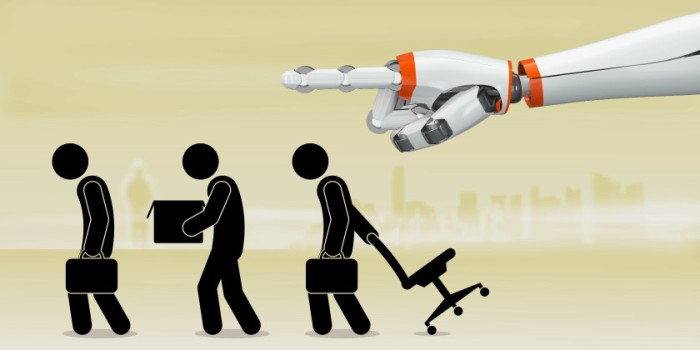
National Education Association Seems to Endorse Replacing Teachers With Computers

robots-replace-humans-840x420


When all the teachers are gone, will America’s iPads pay union dues?


It’s a question educators across the country are beginning to ask after yet another move by our national unions that seems to undercut the profession they’re supposed to be supporting.


The National Education Association (NEA), the largest labor union in the U.S., published a shortsighted puff piece on its Website that seemingly applauds doing away with human beings working as teachers.


In their place would be computers, iPads, Web applications and a host of “devices” that at best would need human beings to serve as merely lightly trained facilitators while children are placed in front of endless screens.


The article is called, “As More Schools Look to Personalized Learning, Teaching May Be About to Change,” by Tim Walker.


Teacher-blogger Emily Talmage led the charge with a counter article on her site called “Anatomy of a Betrayal.” She outlined the NEA’s change from being critical of such initiatives to joining with the likes of Jeb Bush and various foundations, tech firms and school voucher advocates in celebrating it.


Make no mistake.


This is not merely an examination of changing teaching practices. It is a movement by tech giants to further standardize and privatize America’s public schools.


This isn’t to say that technology can’t enhance learning. But classroom teachers with any kind of experience know that simply plopping a child in front of a computer screen is a terrible way to do it. It’s the equivalent of having all your questions answered by an automated voice on the telephone versus being able to ask questions of a living, breathing person.


And they have the gall to call it “personalized learning” as if it were meeting all the needs of students one-on-one. It isn’t.


It’s one-on-one, but it isn’t meeting anyone’s needs except bankers, hedge fund managers, charter school operators and tech investors.


It’s a way to drastically reduce the cost of education for poor and minority students by removing the need for a teacher. It’s the educational equivalent of an automated cashier in the grocery store, but unlike at Giant Eagle, it doesn’t just tally your bill, it pretends to teach.


This is the definition of a McEducation. It’s the logical extension of policymakers who think that 5-week trained Teach for America recruits are equivalent to education graduates with four-five year degrees and years of classroom experience. They’re just replacing TFA recruits with Apps.


Don’t get me wrong. America’s public schools have a lot of problems. They’re segregated by both economics and race. The poor and minority schools are inadequately funded and inequitably resourced. They are forced to compete for what little money remains with charter school vampires who are allowed to spend it however they like with little to no accountability or transparency. More money disappears down the gullets of voucher schools to subsidize the rich and indoctrinate Christian fundamentalists. And to top it all off, our public schools are forced to give scientifically invalid standardized assessments that are incentivized to fail as many students as possible so the same corporations that make the tests can sell districts remediation materials. Meanwhile, a large portion of these profits earned off public schools are reinvested in lawmakers reelection campaigns so they’ll pass legislation that continues to treat our children as golden geese for business and industry.


The NEA should know that. We have more than enough enemies to fight. But instead of taking arms, our national unions have been racing toward the bottom to compromise and keep that proverbial seat at the table. They’ll fight for teacher tenure. They’ll fight right-to-work legislation. But policies that undermine the very fabric of the profession? NAH.


We saw the same thing with Common Core. Educators knew you can’t teach higher order thinking skills to children without first doing the groundwork of process. But the book publishers had new textbooks to market so the NEA backed a horse they knew was dead at the starting gate.


And now we have the tech giants – the Zuckerbergs and Gates – slobbering over the profits they can make by callously removing teachers from the equation.


I’ve seen this first hand.


My district has a one-to-one iPad initiative. For two years, each of my students has had a device in every class. It hasn’t dramatically improved learning. At best, it’s increased students’ computer literacy. At worst, it’s a toy that actually distracts from authentic learning.


They allow me, the teacher, to give all assignments digitally. But that requires the network to function perfectly, the devices to be fully charged, the assignments to be entered precisely, the students to engage with them correctly and creatively – when handing students a paper and having them hand it back is actually much more efficient.


They allow students to look up unfamiliar vocabulary quickly, but they rob students of the context skills necessary to know which definition is appropriate, and experience using prefixes, suffixes and roots.


They allow students to easily access infinite information but without the skills to critically read it. More kids read the summary on the Internet than read the book – and even then, they don’t understand it.


They allow students to make colorful Keynote presentations and iMovies, but do nothing to prepare them how to intelligently organize the materials.


And – worst of all – they convince number crunching administrators that assignments, tests and lessons can be given digitally with hours of screen time. As if that was equivalent to authentic learning.


That is the end goal.


Everyone knows it. Isaac Asimov wrote about it in 1954 with his classic science fiction story “The Fun They Had” about a future where computerized home schooling was the norm. But even in his story, kids felt like they were being cheated out of something important that their ancestors had experienced in a traditional public school setting.


Instead of heeding his warning, our unions are rushing to make that world a reality.


You don’t strengthen unions by undercutting the professionals they’re supposed to represent.


Somebody needs to tell our union leaders – preferably by replacing them.

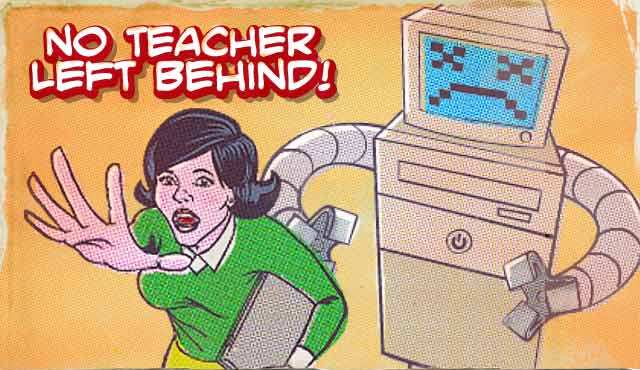
teacher-left-behind11

Tax Cuts Are Theft.

TAX


Ben Franklin famously said that nothing is certain in this world except death and taxes.


But in our modern age, that might have to be amended to read, “death and tax cuts.”


These days, lawmakers on both sides of the aisle can’t figure out how to govern without continually cutting taxes – and invariably the beneficiaries of such largess are the rich.


No one likes paying taxes.


You do a job, earn money and have to give a portion of it to the government.


But no one likes going to the dentist, either. Yet it’s something most adults do because we understand its necessity. We know that ignoring basic dental hygiene and avoiding regular dental check-ups will most likely result in halitosis, mouth pain and the eventual decay of our teeth.


There are similar societal problems with tax avoidance, but we’ve been tricked into willful ignorance.


The rich have paid for an army of economists, libertarians and other would-be thinkers to come up with justifications for avoiding taxation as much as possible.


It’s completely disingenuous. This is prostitution as philosophy. It’s whoring out one’s mental faculties to come up with a smoke screen behind which the wealthy can get away without paying their fair share.


The idea basically comes down to this: taxation is theft.


The government has no right to tax its citizens because it only gets rights from the consent of the governed. People can only give the government rights they already posses. Since they don’t already have the right to tax each other, they can’t give that right to the government.


It’s pure sophistry.


It imagines a mythical world without government and then tells a story about how that government got its power. But few of us have ever lived in a world without government. Neither did our parents or grandparents back through the mists of prehistory. In fact, it is hard to conceive of a time when people existed with no social structure at all from which individuals could then cede rights to a collective group.


And once government exists, each individual citizen owes it a debt. We owe it for all the public institutions from which we benefit. If we went to public school, for instance, we owe it for our education. Even if we were educated privately, we owe it for being able to live in a society where most people are educated since the great majority of those people received that education from public school.


It only takes a moment of reflection to see the complex web of benefits every person receives from society that come from some public services. Think of the inventions funded at least in part by government investment. Think of the safety we enjoy due to law enforcement and the military. Think of the roads and infrastructure that allow us to live at a high standard.


These are all provided by government, and no matter how rich or poor you are, you have benefited tremendously from being a part of it.


As such, you owe that society a certain portion of your income to help support this system.


It’s not exactly complicated. But certain economists make it complicated in a cynical shell game while their masters getaway without paying their debts.


And when they do, who has to make up the difference? You do!


It’s not taxation that’s theft. It’s tax avoidance and – often – tax cuts.


No one gets rich because they’re inherently better than others.


A person worth $500 million is not 500 million times better than a person worth $1. They are both people and equally as valuable. Nor does income equate to how hard someone works. Many billionaires spend their days lounging around the pool drinking piña coladas. Many poor people spend their days scrubbing floors and toilets. The biggest difference between the two is luck.


The wealthy most often are rich merely because they won the lottery of birth or their business ventures succeeded due to pure chance. And even in the rare instances when people made a lot of money because of their intelligence or savvy, that doesn’t justify them being so unequally rewarded by our society compared to those of us without such talents.


If you judge a person solely on his/her bank account, you misjudge the majority of the population.


Some policymakers will acknowledge these points but still insist on tax cuts based on misconceptions and/or lies about how economies work.


They’ll say the United States already has some of the highest taxes in the world. We need to cut taxes to be competitive.


However, this is not true.


In 2014, total US tax revenue equaled 26 percent of gross domestic product (GDP) – well below the 34 percent average for developed countries, according to the Organization for Economic Co-operation and Development (OECD).


Screen Shot 2017-05-12 at 10.08.40 AM


Of all OECD countries, only Korea, Chile and Mexico collected less than the United States as a percentage of GDP. In many European countries, taxes exceeded 40 percent of GDP. But those countries generally provide more extensive government services than the United States.


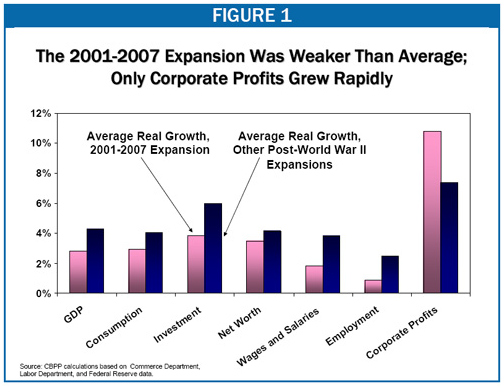
Some will argue that tax cuts are necessary to boost the economy. However, we have countless counterexamples to this popular fabrication. For instance, when President George W. Bush cut taxes from 2001 – 2007, the average annual growth rate was far below the average growth rate for any other period after World War II. In fact, only corporate profits experienced rapid growth. Over all, this expansion was among the weakest since World War II.


Screen Shot 2017-05-12 at 4.11.54 PM


In short, the US is doing a terrible job providing every citizen with the benefits of our society. We are disproportionately rewarding the rich while forcing the rest of us to pay for the services from which we all gain. Moreover, other countries provide even more bang for that buck.


Now this doesn’t mean that the government should tax us all into the ground.

Nor does it mean that the government should spend our tax dollars willy-nilly.


Taxation needs to be fair and spending needs to be regulated.


But constantly cutting rich people’s taxes is immoral. It is unfair to the majority of people making up the difference and struggling to survive when government services lag behind need.


Screen Shot 2017-05-12 at 10.34.01 AM


Our public schools are suffering under strategic disinvestment. Especially in poor neighborhoods that often disproportionately serve people of color, public schools cannot keep up with children’s needs. They aren’t providing an equitable level of service with those schools in richer, whiter neighborhoods.


Our policymakers try to solve the problem with charter schools, vouchers, standardized tests and Common Core. And the results have only been a worsening situation.


The real solution is simple – increased funding through fair increases in taxes on the wealthy.


Tax cuts are popular, but every time we let the rich get away with paying less, we have to either take more from the poor or take the knife to public services.


This affects the poor immediately in the form of reduced services, but it affects the rich, too. They have to live in a world where the majority has less – this means increased crime, increased drug abuse, increased ignorance, etc.


As a society, we must get beyond the selfish urge to look out only for what seems best for ourselves and our immediate friends and families. We must look out for our entire society. We must look out for the needs of everyone in it.


Otherwise, when we fall for these economic fallacies, we’re only stealing from ourselves.

Teacher Appreciation Week is a Pathetic Joke!

Screen Shot 2017-05-10 at 3.38.28 PM

It’s Teacher Appreciation Week, America!

All over the country, millions of educators can look forward to a free burrito. Or maybe an Arby’s sandwich. Or a complimentary donut.

Because we REALLY appreciate teachers here.

What a pathetic joke!

I don’t mean to seem ungrateful.

I’ll redeem my coupon at Chipotle. I’ll take that Roast Beef Classic. I’ll grab that Dunkin’ Cruller.

But let’s be honest. These cheesy buy-one-get-one coupons don’t demonstrate appreciation. They’re guilt.

They’re a manifestation of the feeling that we SHOULD appreciate teachers, but don’t. Not really.

Not for one week, not for one day!

Why else would we begrudge them a middle class income? Why else would we provide them with so few resources and so much responsibility? Why else would we bar them from making any meaningful decisions about how their students should be taught yet hold them accountable for everything their students do?

Appreciate teachers? We don’t LISTEN to them. We don’t RESPECT them. Many of us don’t even LIKE them.

The only time we value teachers is when a maniac enters a school with a gun. Then – when they protect our children with their very lives – then we praise them as heroes!

On that day and that day only. But every other day – not so much.

We won’t do anything to keep guns out of the hands of school shooters. At most we want to arm teachersGreat! Something else to be responsible for on top of education, counseling and children’s all around well-being. But otherwise, we won’t do anything to help teachers do their jobs. And we certainly won’t listen to their professional opinions on anything!

That would be living in a culture of life. But we live in a culture of death.

We do the barest minimum for children – especially poor and minority kids. Instead we invest in parasitic business interests that provide zero value for students and parents.

We’ve got nothing for teachers or proven educational practices but we throw public money at charter, private and parochial schools that only accept the cream of the crop and turn down everyone else – yet still rarely do better than inclusive public schools. We defund public schools until they can no longer operate – and then we close them as failures. We promote lightly trained Teach for America temps to the same status as authentic educators with a 4-5 year degree and decades of experience. And we do everything we can to bust their unions and take away collective bargaining rights.

Yet everywhere I look I see people congratulating themselves for donating to some teacher’s GoFundMe project. This may come as a shock to you, but we shouldn’t be resorting to charity to fund our public schools! That should be a given!

In almost every classroom in America, teachers reach into their own pockets to make up the difference when our federal, state and local governments come up short. When kids don’t have pencils, we provide them. When kids don’t have books, we buy them. When kids come to school hungry, we even feed them.

Yet you’re getting excited that anonymous folks on the Internet put a few virtual coins in the cup!

I’ve been a public school teacher for almost 15 years. Next year I can look forward to another increase in class size. And I’ll probably have to teach an additional grade level or two. No extra resources to help me do it. No extra salary. Just more of a drain on my time to get the job done. And if I somehow stumble and fall, it will be my fault.

It won’t be the federal government’s fault even though they keep providing less financial help and more standardized testing, Common Core, and so-called school choice policies that rob my district of necessary funding.

It won’t be the state’s fault as they refuse to heal years worth of budget cuts in order to lower taxes on the wealthy, a scheme that, by the way, did nothing to boost the economy – in fact, it actually stalled business development. Nor will it be the state’s fault as they continue to blame me for the high cost of pensions they forgot to pay years ago while both my district and I paid on time. Nor will it be the state’s fault as they try to strip me of sick days, preserve loopholes that benefit charter schools at my district’s expense and experiment with a new funding scheme that further drains my district’s coffers.

It won’t be my local school board or administration’s fault, either, as they make cuts to core educational resources so they can preserve the state champion football team and less vital faculty office and administrative staff who are only working there because of nepotism and/or politics.

It’ll be MY fault. Mine and mine alone. That’s how much we appreciate teachers.

And none of it is even close to changing. No one is even considering altering the tiniest fraction of it. Democrats, Republicans, Independents, men, women, black people, white people, gay people, straight people, the young, the old – no one is doing anything about it!

And why should we? We’ve already got a scapegoat. We’ve already got someone to blame.

Well, look in the mirror, America. Because you’re the one to blame – each and every star-spangled banner and amber wave of grain.

We’ve made it like this. All of us.

I don’t mean to be so negative, but all these Pollyanna platitudes about that one special teacher obscure a basic truth. As individuals, we sometimes appreciate teachers – often when we’re years beyond graduation, or sometimes only when we’re parents, ourselves, and see what they do for our children. But that’s personal. That’s individuals.

When we think about the nations teachers, when we think about the profession in general, we don’t appreciate them one bit.
Because if we did, we’d act much differently.

If we really appreciated teachers, we’d hire more of them. We wouldn’t demand they do more with less. When we were deciding school policy at any level – federal, state or local – we’d include them in the process – in fact, they’d be the deciding factor!

If we really appreciated teachers, we wouldn’t wait – as many folks do – until they call us to find out how our children are doing in school. We’d be proactive. And if our kids aren’t doing well, we wouldn’t blame the teacher. We’d hold our own kids responsible and look for solutions.

If we really appreciated teachers, we wouldn’t blame them for their summer breaks. We’d understand that they aren’t paid for this time yet they often take professional development courses on their own dime or work retail just to make ends meet.

If we really appreciated teachers, we’d respect them as professionals, and we’d pay them accordingly. We’d respect their rights to a positive working environment both for themselves and for our own children.

So seriously – you can stuff your ridiculous Teacher Appreciation Week.

A free cookie just isn’t going to do it.

Don’t Trash the Department of Education. Fix It.

thumbnail_Screen Shot 2017-04-26 at 2.52.28 PM

How do you get people to refuse a helping hand?

Answer: Prove to them that it’s not helping.

That’s the strategy of the Trump administration in regard to his cabinet of billionaires. The Reality TV star turned President has nominated a series of out-of-touch and unqualified one percenters to head various federal government agencies.

Rex Tillerson, Rick Perry, Ben Carson – Each of these silver spooned numbskulls was put in place to “prove” to the American public how inane and useless the federal government is – by making the federal government inane and useless.

Nowhere is this more obvious than the Department of Education with its Republican mega-donor turned Education Secretary, Betsy DeVos.

DeVos has spent her entire adult life buying off mostly Republican lawmakers throughout the country to destroy public schools and replace them with charter, private and parochial schools.

She is a self-inflicted cancer on the system, a know-nothing religious zealot who spouts more factually challenged whoopers than Sean Spicer and Donald Trump combined.

But the endgame for putting a person who barely ever walked into a public school in charge of nationwide public school policy is clear – she’s there to demonstrate why the department should be disbanded.

With every idiotic statement, every Unconstitutional policy suggestion – she’s a corporate sponsored demo of why we need to trash this cabinet position altogether.

This has been the conservative dream since President Ronald Reagan. How dare his Democratic predecessor Jimmy Carter create a Department of Education, in the first place! Not only did Ronnie, the B-movie actor turned chief executive, have to defeat Carter, he needed to erase all of his predecessor’s policies. (Sound familiar? [Cough!] [Obamacare!] [Cough!])

And with Betsy DeVos’ help, Trump may finally get to realize Reagan’s dream.

To be fair, President George W. Bush did his fair share to make the department unpalatable. And so did Barack Obama!

Under Carter, the department was an extension of the Elementary and Secondary Education Act (ESEA) of 1965, which tried to bring equity to America’s public schools. However, Bush transformed it into No Child Left Behind, a blatant federal power grab changing the focus to high stakes standardized testing and punishing schools that taught poor children.

Obama took this terrible legislation to its inevitable conclusion and transformed the Department of Education into a bribe factory, dangling federal help before impoverished schools only if these schools would spend it on test prep, edutech software and Common Core. Never mind that these “reforms” don’t actually help children. It was all about helping the corporations behind them.

Much of the modern zeitgeist behind the continued movement to disband the department comes from authentic bipartisan opposition to these changes. The modern Department of Education hasn’t been much of a helping hand for almost two decades. It’s been a cruel taskmaster and a money laundering service for the publishing and testing industry. And it’s overstepped its federal authority coercing states to do as Washington bureaucrats (or at least their wealthy donors) demand.

Add to that the new wrinkle of DeVos – a representative who is all of those things but also transparently self-serving and – frankly – stupid.

No wonder people want to disband the department!

It’s a rallying cry that’s not hard to get behind. Unless you think about it for two minutes.

Because it’s not the Department of Education that’s the problem. It’s what we’ve done to it.

The department has a vital and important role to play in making sure our system of public education serves everyone. Speaking in broad terms, the department should be dedicated to these three things: ensuring public schools are being properly funded, student and parent civil rights are not being violated and to be a repository for national data and research.

These are incredibly important. Right now we have one of the most inequitable school funding systems in the world. The majority of public education funding comes not from the federal government or the states, but from individual communities. If you live in a poor neighborhood, your kids get less education funding. If you live in a rich neighborhood, your kids get more. This is why the nearly 50% of all public school children living in poverty are struggling academically – we aren’t providing them with the resources to succeed.

The state and federal government could be doing something about that. At the federal level, the department of education oversees billions of dollars in grants to poor schools. Admittedly much of that money is tied to standardized testing and other corporate education reforms. We should cut those ties. We should provide help for proven, authentic education practices freely chosen by these districts. That’s something that could have a huge impact on student success. And it’s a project we should expand, not destroy under draconian budget cuts or the closure of the department.

Second, we have to admit that parents’ and students’ civil rights are often in jeopardy. This means special education students seeking an appropriate learning environment and modifications. This means students being discriminated against because of their religious beliefs or lack thereof. This means minority students facing disproportionate discipline policies, unfair grading and/or lack of opportunities offered to other racial or ethnic groups. This means women and transgender students suffering discriminatory dress codes or bathroom policies. In short, it means that someone needs to be the moderator and protector of student and parent rights.

And finally, there needs to be a repository of national student data. This has gotten a negative connotation lately because of Bush and Obama’s incredibly permissive policies allowing edutech companies to collect a horde of student data for economic purposes. Let me be clear: The department shouldn’t be doing that at all. Student privacy should be respected. Computer programs and apps should not collect sensitive information about individual students to be sold to advertisers or used to market products to them.

But there is an incredible amount of aggregate information about student groups collected by the federal government that could be used to help improve the lives of students. This includes information on the racial proficiency gap and the amount of resources provided by states and municipalities. Moreover, we need an impartial entity to fund educational research about which reforms actually help students learn. Relying on corporations to fund research that “proves” the efficacy of their own products is not good science.

In short, disbanding the Department of Education would be a disaster. What would happen to Pell Grants, for instance? What would happen to the bundles of federal money that boost our public schools? Who would make sure states are doing their jobs? Where could we go to find accurate data about how our schools are doing nationally and not just state-by-state?

If we got rid of the department, at best these jobs would fall back on other government agencies that haven’t the funding, staff or ability to accomplish them. More likely, it would result in the elimination of billions of education dollars that the states simply couldn’t (or wouldn’t) replace. Abuses against students on the grounds of civil rights, gender, special education, etc. would skyrocket with little to no recourse. And we would be in the dark about how well we were educating our nation’s children.

I sympathize with those who wish to make government more efficient, but the Department of Education is not a place to make cuts. If you really wanted to close an unnecessary federal department, start with the most recent one – the Department of Homeland Security. Nowhere else is there a more obvious duplication of services and waste of tax dollars to provide a service that was already being provided. But you never hear anyone suggest we close this department because (1) it was proposed by a Republican, and (2) as a nation, we have a broad, bipartisan priority on the safety of our citizens.

If only we had the same for public education!

But we don’t. In fact, many conservatives scoff at the very idea of public schools on the grounds that it’s “socialism” – as if social security, Medicare and a standing military were not!

Too many people have bought into the lie that there is something unAmerican about public school. On the contrary, our system is implicit in our very form of government and the flower of our founding fathers’ thoughts.

The rich and powerful don’t want a robust system of public education because it goes against their interests. An informed, thinking public is harder to control. They especially don’t want minorities or the poor to be well-educated because once people realize how much they’re being exploited, they won’t continue to submit to the status quo.

In short, the Department of Education needs to change. It needs to be revitalized from the ground up. And DeVos is not the person to do it.

However, we shouldn’t let her incompetence make us throw it all away. We need to find ways to agitate, resist and survive the Trump administration while preserving as much as we can of our Democracy – and our sanity – in the process. We need to find and support prospective lawmakers and public servants who will actually represent us, the people, instead of Trump’s billionaire buddies. We need a robust, grassroots movement to take back our government.

And then we can begin the hard work of making our government work for us again. Part of that will involve the Department of Education.

Trump Can’t Limit Federal Role in Public Schools AND Push School Vouchers

Trump-5-2

Donald Trump is talking out of both sides of his mouth.

Again.

This time he’s signing an executive order demanding the Department of Education study how the federal government oversteps its legal authority with regard to K-12 schools.

Yet he still proposes bribing states with $20 billion in federal funds to enact school vouchers.

Well which is it, Oh Orange One?

Are you for limiting the federal role in education or for coercing states to do your bidding?

Because you can’t be for both.

Either states and local districts determine the bulk of their school policies or not. You can’t barge into our state capitals promising billions of dollars in federal tax money if and only if we enact your chosen reforms.

That’s one of the primary reasons many conservatives (and even a sizable number of progressives) oppose Common Core. The Obama administration promised billions of dollars in Race to the Top grants if and only if states adopted these new, untried academic standards.

How is Trump’s voucher scheme any different?

In both cases, the proposed education reform has not been proven to work, and it’s not being requested by the education community or voters. In fact, when it comes to vouchers, voters have repeatedly turned them down in referendum after referendum.

So if Trump wants to investigate federal overreach, he should start with his own campaign speeches on vouchers.

So why is the former Realty TV star doing this?

Well, his first hundred days are almost up, and he has next to nothing to show for it. Other than uniting the American people against him, President Con Man hasn’t achieved much. One can imagine why he might want to hurry up and toss off yet another executive order so he could put something – anything – in the achievement column.
But there’s a more insidious reason why the founder of Trump University took out his signing pen.

His administration – especially his Department of Education – is particularly inimical to civil rights.

Just look at the brain trust he has running it.

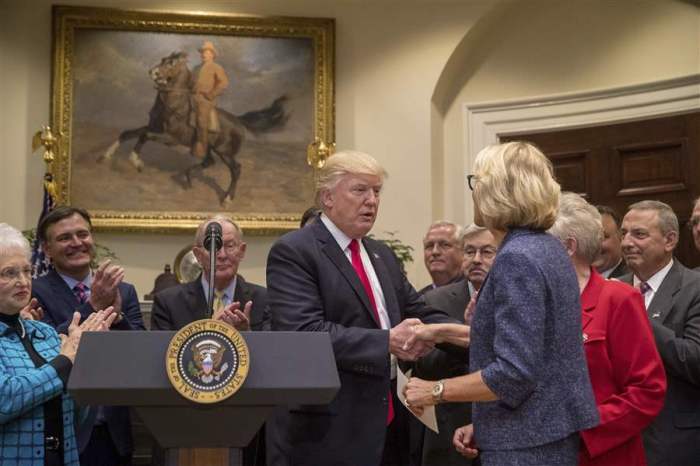
Secretary Betsy DeVos isn’t sure the department should be in the business of protecting special education students. Nor is she willing to take a stand to protect transgender kids.

Latest hire Deputy Assistant Secretary Candice Jackson has repeatedly expressed skepticism about the very existence of civil rights. The 39-year-old attorney is anti-women’s rights, anti-distributive justice and possibly even anti-compulsory education and anti-Civil Rights Act of 1964!

In college, she thought she, herself, was being persecuted because a tutoring group set up for minorities wouldn’t serve her as a white person – despite the fact that she could probably afford to pay for her own damn tutoring.

So this latest “study” into federal overreach is probably an attempt by the Trump administration to justify doing nothing to protect the civil rights of students across the country.

Under President Bad Hair Day, special education students can be denied services with impunity. It’s not the federal government’s job to step in. THAT would be overreach.

And if black and brown students don’t receive the same resources and opportunities as their white counterparts, there’s just nothing the Trump administration can do. They don’t want to step over the line.

It’s not that The Donald doesn’t sympathize with transgender students denied access to bathrooms that correspond with their gender. Ivanka even gave him a stern talking to. It’s just that his tiny little hands are tied. Thems the limits of federal authority, Son.

If you ask me, that’s truly the impetus behind this executive order.

He’s just setting up his next excuse for giving us, the American people, zero return on our tax dollars.

That way he can just shrug and offer more tax cuts to the rich.

Sadly, there is truth to the claim that the Department of Education has overstepped its authority. Both Presidents George W. Bush and Barack Obama frequently usurped states and communities local control. No one was crying out for high stakes testing, more test prep material, and unregulated charter expansion. But that’s what we got!

If you’re looking to Trump to balance the scales, look somewhere else!

He has given no indication that he will be any different. He’ll still push his own agenda on us, but he’ll pretend like we asked for it.

Now that’s the Donald Trump we know best!

Standardized Testing Creates Captive Markets

thumbnail_Screen Shot 2017-04-07 at 10.41.23 AM

It’s easy to do business when the customer is forced to buy.

But is it fair, is it just, or does it create a situation where people are coerced into purchases they wouldn’t make if they had a say in the matter?

For example, school children as young as 8-years-old are forced to take a battery of standardized tests in public schools. Would educators prescribe such assessments if it were up to them? Would parents demand children be treated this way if they were consulted? Or is this just a corporate scam perpetrated by our government for the sole benefit of a particular industry that funnels a portion of the profits to our lawmakers as political donations?

Let’s look at it economically.

Say you sold widgets – you know, those hypothetical doodads we use whenever we want to talk about selling something without importing the emotional baggage of a particular product.

You sell widgets. The best widgets. Grade A, primo, first class widgets.

Your goal in life is to sell the most widgets possible and thus generate the highest profit.

Unfortunately, the demand for widgets is fixed. Whatever they are, people only want so many of them. But if you could increase the demand and thus expand the market, you would likewise boost your profits and better meet your goals.

There are many ways you could do this. You could advertise and try to convince consumers that they need more widgets. You could encourage doctors and world health organizations to prescribe widgets as part of a healthy lifestyle. Or you could convince the government to mandate the market.

That’s right – force people to buy your products.

That doesn’t sound very American does it?

In a Democratic society, we generally don’t want the government telling us what to purchase. Recall the hysteria around the Obamacare individual mandate requiring people who could afford to buy healthcare coverage to do so or else face a financial tax penalty. In this case, one might argue that it was justified because everyone wants healthcare. No one wants to let themselves die from a preventable disease or allow free riders to bump up the cost for everyone else.

However, it’s still a captive market though perhaps an innocuous one. Most are far more pernicious.

According to dictionary.com, a captive market is “a group of consumers who are obliged… to buy a particular product, thus giving the supplier a monopoly” or oligopoly. This could be because of lack of competition, shortages, or other factors.

In the case of government mandating consumers to buy a particular product, it’s perhaps the strongest case of a captive market. Consumers have no choice but to comply and thus have little to no protection from abuse. They are at the mercy of the supplier.

It’s a terrible position to be in for consumers, but a powerful one for businesspeople. And it’s exactly the situation for public schools and the standardized testing industry.

Let’s break it down.

These huge corporations don’t sell widgets, they sell tests. In fact, they sell more than just that, but let’s focus right now on just that – the multiple choice, fill-in-the-bubble assessments.

Why do our public schools give these tests? Because peer-reviewed research shows they fairly and accurately demonstrate student learning? Because they’ve been proven by independent observers to be an invaluable part of the learning process and help students continue to learn new things?

No and no.

The reason public schools give these tests is because the government forces them. The Elementary and Secondary Education Act (ESEA) requires that all students in grades 3-8 and once in high school take certain approved standardized assessments. Parents are allowed to refuse the tests for their children, but otherwise they have to take them.

It wasn’t always this way. When the act was first passed in 1965, it focused almost entirely on providing students with equitable resources. That all changed in 2001, with the passage of No Child Left Behind, a reauthorization of this original bill. And ever since, through every subsequent reauthorization and name change, the federal law governing K-12 schools has required the same standardized testing.

The testing corporations don’t have to prove their products. Those products are required by law.

It’s one of the largest captive markets in existence. That’s some 50.4 million children forced to take standardized assessments. The largest such corporation, Pearson, boasts profits of $9 billion annually. It’s largest competitor, CBT/ McGraw-Hill, makes $2 billion annually. Others include Education Testing Services and Riverside Publishing better known through its parent company Houghton Mifflin Harcourt.

If many of these companies sound like book publishers, that’s because they are or their parent companies are. And that’s no coincidence. It’s another way they bolster their own market.

Not only do many of these testing corporations make, provide and score standardized assessments, they make and provide the remedial resources used to help students pass.

So if your students are having difficulty passing the state test, often the same company has a series of workbooks or a software package to help remediate them. It’s a good business model. Cash in before kids take the test. Cash in when they take it. And if kids fail, cash in again to remediate them.

Ever wonder why our test scores are so low? Because it’s profitable! The money is all on the side of failure, not success. In fact, from an economic point of view, there is a disincentive to succeed. Not for teachers and students, but for the people who make and grade the tests.

But that’s not all.

Once you have a system in place, things can become static. Once districts already have the books and resources to pass the tests, the testing corporation has less to sell them, the market stagnates and thus their profits go down or at least stop growing.

The solution once again is to create yet another captive market. That’s why Common Core was created.

These are new academic standards written almost exclusively by the testing corporations and forced on districts by federal and state governments. Under President Barack Obama’s Race to the Top initiative, $500 million in federal education grants were tied to adopting these new standards. States were coerced to push Common Core on their districts or else lose out on much needed funding.

This resulted in the need for districts to buy all new materials – new text books, new workbooks, new software, etc. It also required the states to order brand new standardized tests. So once again the testing industry cashed in at both ends.

And these tests were more needlessly difficult so more children would fail and need costly remediation.

Was there a pressing academic need for these new standards? Was there any evidence that these standards would increase student learning? Were there even any independent studies conducted to attempt to prove a need?

No. This was a total money grab. It was naked greed from one industry completely enabled by our lawmakers at the federal and state levels.

Republicans made noises against it, and some still do. But consider this – the overwhelming majority of state houses are controlled by the GOP. They have the power to repeal Common Core at any time. Yet almost none of them did or do.

Ask yourself why. It has nothing to do with the Democrats. Republicans are owned by the same masters as the so-called liberals – these same test corporations.

You have to understand that our government is no longer ruled by the principle of one person, one vote. Money has become speech so wealthy corporations get a huge say in what our government does.

If an industry gets big enough and makes enough donations to enough lawmakers, they get the legislation they want. In many cases, the corporations write the legislation and then tell lawmakers to pass it. And this is true for lawmakers on both sides of the aisle.

Standardized testing and Common Core are one pernicious example of our new captive market capitalism collapsing into plutocracy.

Our tax dollars are given away to big business and our voices are silenced.

Forget selling widgets. Our children have BECOME widgets, hostage consumers, and access to them is being bought and sold.

We are all slaves to this new runaway capitalism that has freed itself from the burden of self-rule.

How long will we continue to put up with it?

How long will we continue to be hostages to these captive markets?

Decolonizing Through Dialogue: Authentic Teaching in the Age of Testing and Common Core

waitingsuperman3023


If you’re not careful, being a public school teacher can become an act of colonization.


This is especially true if you’re a white teacher like me with classes of mostly black students. But it’s not the only case. As an educator, no matter who you are or whom you teach, you’re a symbol of authority and you get that power from the dominant structures in our society.


Believe it or not, our schools are social institutions, so one of their chief functions is to help recreate the social order. Students enter as malleable lumps of clay and exit mainly in the shapes we decide upon. Therefore, as an educator, it’s hard not to fall into the habit of molding young minds into the shapes society has decided are appropriate.


In some ways this is inevitable. In others, it’s even desirable. But it also runs against the best potential of education.


In short, this isn’t what a teacher should be. My job in front of the classroom isn’t to make my students into anything. It’s to give them the opportunity, to generate the spark that turns them into their best selves. And the people who ultimately should be the most empowered in this process are the students, themselves.


But it’s easier said than done.


The danger is best expressed in that essential book for any teacher, “Pedagogy of the Oppressed,” where Paulo Freire writes:


“Worse yet, it turns them (the students) into ‘containers,’ into ‘receptacles’ to be filed by the teacher. The more completely she fills the receptacles, the better a teacher she is. The more meekly the receptacles permit themselves to be filled, the better students they are.”


In most cases this means Eurocentrism – a kind of worship of all things white and denigration of all things black, brown and all pigments between.


We take the status quo and find every blind justification for it. In fact, this can become the curriculum, itself. Every counter-narrative, every criticism of the power structure then naturally becomes a danger. Revisionist history becomes history. European philosophy becomes the only accepted definition of rationality. Ideologies of empire become obvious and inescapable. White becomes the norm and racism, misogyny, homophobia, xenophobia all become hidden and internalized.


You’ve heard the criticism of curriculums focusing exclusively on dead white males. This is why.


And not only does it silence minority voices, it reinforces a false view of the world. Folk singer Tom Paxton made that clear in this classic song:

What Did You Learn In School Today?”

What did you learn in school today,
Dear little boy of mine?
What did you learn in school today,
Dear little boy of mine?

I learned that Washington never told a lie,
I learned that soldiers seldom die,
I learned that everybody’s free,
And that’s what the teacher said to me,
And that’s what I learned in school today,
that’s what I learned in school.

What did you learn in school today,
Dear little boy of mine?
What did you learn in school today,
Dear little boy of mine?

I learned the policemen are my friends,
I learned that justice never ends,
I learned that murderers pay for their crimes,
Even if we make a mistake sometimes,
And that’s what I learned in school today,
That’s what I learned in school

What did you learn in school today,
Dear little boy of mine?
What did you learn in school today,
Dear little boy of mine?

I learned that war is not so bad,
I learned about the great ones we’ve had.
We fought in Germany and in France
And some day I might get my chance.
And that’s what I learned in school today,
That’s what I learned in school

What did you learn in school today,
Dear little boy of mine?
What did you learn in school today,
Dear little boy of mine?

I learned our government must be strong;
It’s always right and never wrong!
Our leaders are the finest men
And we elect them again and again,
And that’s what I learned in school today,
That’s what I learned in school


We can see why this kind of teaching is valued. It reinforces the status quo. But at its core education is essentially subversive. It supports new ways of thinking. It is by definition revolutionary. When you encourage students to think for themselves, some may come to conclusions that differ from the norm. This is entirely healthy and the only way societies can grow and change. But it’s inimical to the people in power who often are in charge of the educational system. They don’t want new ideas if those ideas will challenge their hold on the reigns of power. Socrates wasn’t forced to drink hemlock, after all, because his lessons supported the Athenian elite.


So we’re left with a real quandary. How do teachers remain free to inspire while being a part of a system that doesn’t value inspiration?


The natural forces of society work against authentic teaching like gravity pulling at a rocket. Unless you’re actively pushing against the ground, the most natural thing in the world is to just go with the flow. The textbook says this is the way. Teacher training programs often agree. Cooperating teachers who have been in the classroom for decades back it up. This is the best method. Just keep it up.


But it’s not. And you shouldn’t. There is another way even though it’s hard to see. And THAT’S often what you need to be doing for your students.


Let me pause at this point to make one thing clear: I don’t have all the answers.


I am no expert in how to do this. I have fallen victim to it, myself, more often than I’d like to admit. It may be next to impossible to avoid the accepted route much of the time. But if we want to be good teachers, we need to try.


If we really want to provide the best service to our students, their parents and the community, we have to break out of the mold. We have to allow our students the chance of seeing the world and not just our version of it.


The best ways I’ve found to do this are through selection of texts, use of Socratic Seminars and allowing as much choice as possible in assignments.


When selecting texts, you want to be as inclusive as possible. Provide students with the widest possible range of authors and opinions. In Language Arts, this means purposeful multiculturalism. It means authors of color being prized equally with the European cannon. It means women and transgender authors. It means authors subscribing to a wide range of beliefs and skepticisms. And it means accepting genres and forms that are often devalued like song lyrics, rap, Manga, graphic novels and anything that can be considered deep, substantial texts.


Finding such sources can be exhausting, but it’s also exhilarating. Unfortunately, not all schools permit teachers to do this to the same degree. Some districts mandate teachers only use certain texts already approved by the school board. Others provide a list of approved texts from which teachers can pick.


Each educator will have to find ways to navigate the system. It’s best if you can find support from administrators and in the community for what you want to do and go from there. But this can be a challenging road especially in our era of high stakes testing and Common Core which values authentic teaching not at all.


Another essential tool is class discussion. You may or may not be able to broaden the texts being discussed, but you can usually provide space for students to discuss those texts in class.


My 8th graders and I use the Socratic Seminar method of discussion extensively.


With almost every piece of literature, I write guided open-ended questions for the students to consider. The questions come out of the text, but I try to focus on queries that will get students thinking about how the text relates to their lives, gender and economic issues, questions of theme, race and opportunities to make connections of every type. Eventually, I even allow students to begin writing these questions, themselves.


The way I see it, my role is essentially an opportunity maker. It isn’t about finding an answer that will please me, the teacher. It’s about exploring the subject. It’s not about what I think. It’s about what students think. And that makes all the difference.


Finally, I’ve found it beneficial to allow students choice in their assignments.


There are many ways for students to demonstrate knowledge. They can write essays, take a test, create a collage, design a power point presentation, make an iMovie, act out a scene, etc. I try to expose students to multiple formats the first half of the year and then give them increased choice in how they’d like to express themselves in the second half.


Not only does this free students to think, it encourages the deepest kind of learning. It makes the lesson vital, important and intrinsic.


All of these approaches share a common feature: dialogue. They put the student, teacher and the author in a vital relationship. They take steps to equalize that relationship so that one isn’t more important than the others. It’s not just what the author, teacher or student thinks – it’s the interrelationship of the three.


Ultimately, it’s up to the student to decide the relative value of the results. Sure, they get grades. Sure, the system will judge students based on those grades. But the value of those grades isn’t as important as the resultant learning and the value students place on the experience.


To me, that’s the best kind of learning. And it’s the result of authentic teaching and dialogue.


It is the most inimical thing to colonization. Students are not enslaved to a system. They aren’t in servitude to a prepackaged group of ideas and norms.


They are valued and empowered.


Isn’t that what we’re supposed to be doing for them?

The Joy of Opting Out of Standardized Testing

o-KIDS-ARTS-facebook

Testing season is a gray period in my classroom.


But it’s a joy in my house.


As a classroom teacher with a daughter in the public school system, I’m always struck by the difference.


In school I have to proctor the federally mandated standardized tests. But I’ve opted my own daughter out. She doesn’t take them.


So at home, I get to see all the imaginative projects she’s created in her class while the other kids had to trudge away at the exam.


“Daddy, daddy, look!” she squeals.


And I’m bombarded by an entire Picasso blue period.


Or “Daddy, will you staple these?”


And I’m besieged by a series of her creative writing.


My daughter is only in second grade and she loves standardized test time.


It’s when she gets to engage in whatever self-directed study strikes her fancy.


Back in kindergarten I missed the boat.


Even as an educator, myself, I had no idea the district would be subjecting her to standardized tests at an age when she should be doing nothing more strenuous than learning how to share and stack blocks.


But when I found out she had taken the GRADE Test, a Pearson assessment not mandated by the state but required by my home district in order the receive state grant funding, I hit the roof.


I know the GRADE test. I’m forced to give a version of it to my own 8th grade students at a nearby district where I work. It stinks.


Ask any classroom teacher and they’ll tell you how useless it is. Giving it is at best a waste of class time. At worst it demoralizes children and teaches them that the right answer is arbitrary – like trying to guess what the teacher is thinking.


Then I found out my daughter was also taking the DIBELS, a test where she reads a passage aloud and is given a score based on how quickly she reads without regard to its meaning. In fact, some of the passages test takers are forced to read are pure nonsense. It’s all about how readers pronounce words and whether they persevere through the passage. It’s not so much about reading. It’s about grit.


No. My precious little one won’t be doing that.


I talked candidly to her kindergarten teacher about it. I trust her judgment, so I wanted to know what she thought. And she agreed that these tests were far from necessary. So I set up a meeting with the principal.


The meeting lasted about an hour. Sure, it was a little scary. No one wants to rock the boat. But even he agreed with most of what I had to say. He didn’t feel as strongly about it as I did, but he respected my wishes and that was that.


Ever since, my daughter hasn’t taken a single standardized test.


For me, it was a political statement as well as a parental one. I wanted to do my part to chip away at the corporate school reform movement. I know how much they rely on these test scores to justify closing poor schools like mine. I don’t want to give them a chance.


But little did I know what bliss I would be providing for my little one.


Beyond politics, I thought I was just protecting her from a prolonged period of boredom, unfair assessments and cognitively invalid measurements.


I wanted to shield her from adult woes. What I didn’t realize was I was opening a door for her creativity.


It’s amazing. All the other poor children sit there dutifully filling in bubbles while she pours her heart out onto the page.


She loves creating these illustrated books telling the wildest narratives: Colorful superheroes blast bad guys into oblivion. Game show hosts get lost in other dimensions. Even her Mommy and Daddy get in on the action riding Yoshi through Super Mario land.


Often she adds text to these adventures. Her spelling could use some work, but I’m impressed that an 8-year-old even attempts some of these words. Sometimes she writes more in her adventure books than my 8th graders do on their assigned homework.


I’ve even noticed a marked improvement in her abilities during this time. Her handwriting, sentence construction, word choice and spelling have taken a leap to the next level. While her classmates are wasting time on the assessments, she’s actually learning something!


I wish I could provide the same opportunities for my students that I have for my daughter.


It’s strange.


As a parent, I have the power to make educational decisions on behalf of my child. But as a trained education professional, I’m not allowed the same privilege.


Don’t teachers stand in loco parentis? Well this is loco, so let me parent this. Let me at least talk to their parents about it – but if I do that on school time, in my professional capacity, I’m liable to be reprimanded.


I have studied standardized testing. It was part of my training to become a teacher. And the evidence is in. The academic world knows all this stuff is bunk, but the huge corporations that profit off of these tests and the associated test-prep material have silenced them.


I have a masters in my field. I’m a nationally board certified teacher. I have more than a decade of successful experience in the classroom. But I am not trusted enough to decide whether my students should take these tests.


It’s not like we’re even asking the parents. We start from the assumption that children will take the tests, but if the parents complain about it, we’ll give in to their wishes.


It’s insanity.


We should start from the assumption the kids won’t take the test. If parents want their kids to be cogs in the corporate machine, they should have to opt IN.


As a teacher, I can try to inform my students’ parents about all this, but at my own peril. If the administration found me talking about this with parents, I could be subject to a reprimand. Giving my honest educational opinion could result in me losing my job.


As you can see, it hasn’t stopped me. But I teach in a high poverty, mostly minority district. My kids’ parents often don’t have the time to come up to the school or even return phone calls. They’re working two or three jobs. They’re struggling just to put food on the table. They don’t have time for standardized tests!


So every test season I sadly watch my students trudge away at their federally mandated bubbles. I see their anxiety, their frustration, their sad, sad faces.


And it breaks my heart.


But then I come home to my daughter’s exuberant creations!


You would not believe the joy of opting out!