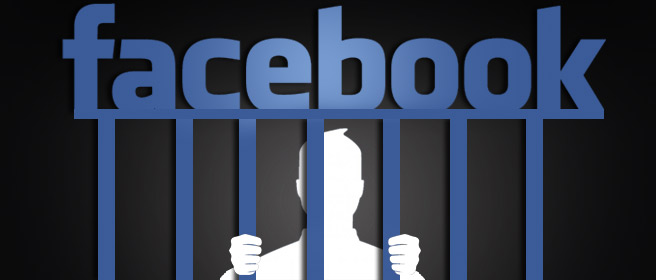
I Was Blocked From Facebook for Criticizing School Privatization

facebook


“Journalism is printing what someone else does not want printed: everything else is public relations.”
-George Orwell


I have had many strange experiences as an education blogger.

People have adapted my writing into a play.

People have written to express a sincere desire for my death.

I’ve had a teacher send me pictures of essays his composition students wrote in response to one of my articles.

 
And I’ve had people email my workplace demanding I be fired.

I guess Internet fame is a mixed bag.

But after more than three years of blogging about education and social justice issues while teaching in the public school system, there’s one thing I’ve never experienced before: censorship.

This is social media, after all.

I’ve got no advertisers to please, no editor breathing down my neck. I can write whatever I want.

That’s the benefit of being a blogger. No one can stop you from telling the truth.

Well, no one except Facebook, apparently.

For the first time in my blogging career, I was blocked from Mark Zuckerberg’s social networking platform because I had the audacity to post my blog to it.

Now keep in mind I’ve been doing just that every week since July, 2014.

Moreover, the article I posted was in no way different from my previous work.

The article is called “School Choice is a Lie. It Does Not Mean More Options. It Means Less.” You can read it HERE

But almost as soon as I posted it to the Facebook page I keep for my blog, Gadfly on the Wall, I got a message saying I was blocked for a week for “violating community standards.”

What community, exactly, is that?

My article contains no hate speech. For once I even managed to control my own potty mouth.

This is just an examination of why charter and voucher schools reduce options for parents and students – not increase them.

It’s an argument. I lay out my reasons with reference to facts and make numerous connections to other people’s work and articles.

I don’t understand how that “violates community standards.”

A blogger friend of mine tells me that someone probably saw my article and reported it to Facebook as spam. That’s happened to him multiple times, he says, especially when he criticizes groups like Teach for America.

Perhaps that’s what’s happened here.

Some folks get so furious when I criticize their charter and voucher schools.

Maybe they saw my latest piece and just wanted to silence me.

I don’t know.

I suppose another option is that it came from Zuckerberg, himself.

He’s a big fan of school privatization. Perhaps he changed Facebook guidelines to crack down on people like me who throw shade on his pet school reforms.
Or maybe my work was targeted because I’m critical of President Donald Trump. I did, after all, write an article this week called “Donald Trump is a Pathetic Excuse For a Human Being” that includes a picture of the chief executive as a poop emoji.


Or maybe it was the National Rifle Association (NRA). The article before the school privatization piece was called “Guns and Profit – Why We’ll Do Absolutely Nothing New After This Las Vegas Shooting.” It was picked up by Commondreams.org, the LA Progressive and other left-leaning sites. Perhaps the firearms lobby had had enough.

Who knows? I’ve pissed off a lot of people in three years.

But I find it hard to believe I was actively targeted. I mean, this is still America, right?

Right?

Another option might be a rogue algorithm.

Facebook is known to use various processes or sets of rules to govern calculations about what should and should not be allowed on the site. After all, they can’t leave all these decisions to living, breathing, human beings. That would cost too much money. Better to leave it to bots and computers.

Perhaps something in my article tripped their robotic alarm bells. (ROBOT VOICE: He’s against Competency Based Education! EXTERMINATE!)

I guess I’ll probably never know.

In the meantime, Twitter is still open for my business. I can still share links in 140 characters or less – with hastags. And, the best part is that Trump might see it!

But what about friends not on the Twitterverse?

How do I even let people know what happened to me? Send a million separate emails!? Pick up the phone and – yuck – talk to people!?

I sent a note to friends through Facebook Messenger about what happened, but that soon stopped working on me. I can’t message anyone else now. Still, the story seems to have leaked.

People who know what’s happened have been kind enough to share the article. It’s being read and appreciated.

I don’t know if my Facebook imprisonment has had a major effect on its distribution. But it’s probably had some dampening effect.

I have to admit, it’s kind of frustrating.

After all this time, many of us rely on Facebook for so much. I’m a member of the Badass Teachers Association, a group of more than 64,000 members who use the social media platform to discuss, plan and engage in various actions against corporate school reform. I’m also in United Opt Out National. It’s increasingly difficult for me to help plan our protest in Washington, DC, without Facebook.

It never really hit me before how much of our lives flow through this one network.

If someone wanted to disrupt political organizations dedicated to reforming the status quo, censoring people and posts on Facebook could be very effective.

I haven’t been silenced, but I’ve been effectively muted. Most of my readers see my work through Facebook. Without it, my writing is out there, but much fewer people probably are in contact with it.

So I suppose that brings me to you, intrepid reader.

Somehow you found this article.

Assuming Zuckerberg and his bots don’t change their minds, I probably won’t be able to post this article to Facebook. So if you saw it, you found it somewhere else. Or perhaps a friendly radical took a chance and posted it on Facebook, themselves, defiant in the possibility that the social media gestapo might crash down on them.

Will you please do the same?

Share my story.

Let the world know what happened to me today.

It’s not the most important thing that’s happened this week. And hopefully it will all be settled in seven interminable days. 168 hours. 10,080 minutes. But who’s counting?

Or – who knows – perhaps I’ll be cleared of all charges, write a new article and the same thing will happen when I try to post it.

I don’t know.

In the meantime, I’m going to spend some time off the computer.

Maybe I’ll open the doors and windows, let in some natural light and see what this “outside world” is like that people used to talk about.

See you in a week.

Live from Facebook Jail,

The Gadfly on the Wall

#FreeGadfly

School Choice is a Lie. It Does Not Mean More Options. It Means Less.

fake1


“A lie told once remains a lie but a lie told a thousand times becomes the truth.”

-Joseph Goebbels


Neoliberals and right-wingers are very good at naming things.


Doing so allows them to frame the narrative, and control the debate.


Nowhere is this more obvious than with “school choice” – a term that has nothing to do with choice and everything to do with privatization.


It literally means taking public educational institutions and turning them over to private companies for management and profit.


A FAKE DIFFERENCE AND A BIG DIFFERENCE


There are two main types: charter and voucher schools.

 
Charter schools are run by private interests but paid for exclusively by tax dollars. Voucher schools are run by private businesses and paid for at least in part by tax dollars.


Certainly each state has different laws and different legal definitions of these terms so there is some variability of what these schools are in practice. However, the general description holds in most cases. Voucher schools are privately run at (at least partial) public expense. Charter schools are privately run but pretend to be public. In both cases, they’re private – no matter what their lobbyists or marketing campaigns say to the contrary.


For instance, some charter schools claim to be run by duly elected school boards just like public schools. Yet the elected body is a proxy that gives over all management decisions to an appointed private board of company officers and a CEO. That’s not really the same thing as what you get at public schools. It’s a way of claiming that you’re the same without actually being it.


Likewise, voucher schools are subject to almost no regulations on how they spend their money – even the portion made up by tax dollars – but charter schools are subject to more state and federal oversight. This is why voucher schools can violate the separation of church and state – teaching creationism as fact – while charter schools cannot.


Yet, in practice, state and federal laws often allow charters much more flexibility than public schools and the state and federal government rarely checks up on them to see if they’re following the regulations. In fact, in many states, auditors are not even allowed to check up on charter school compliance unless specific complaints have been filed or long intervals of leaving them to their own devices have passed. So charters can also teach things like creationism as fact only more clandestinely.


In short, the differences between public and privatized schools is significant. Yet the difference between the two types of privatized education is more political and rhetorical than practical.


Despite these facts, when we talk about privatized schools, we ignore the real distinctions and focus on the fake ones. We overlook the salient features and instead describe privatized schools as vehicles for choice.


They’re not.


FAKE CHOICE


School choice.


Got choice?


Parents should have the freedom to choose the school their children attend.


But using “choice” as the ultimate descriptor of what privatized schools are and what they offer is at best misleading and at worst an outright lie.


They are essentially private businesses existing for the sole purpose of making a profit.


Yes, parents choose if they want their children to enroll in these schools. But they also choose if their children enroll in the neighborhood public school.


Critics say the public school option is not a choice because there is only one public school district in a given neighborhood. Yet isn’t it the parents who decide the neighborhood where they live? In most cases, even the wealthiest district has rental properties where people can move to take advantage of an exceptional school system.


Certainly the quality of a school shouldn’t be determined by a zip code. But this is an argument for funding equity, for providing each district with the resources necessary to educate the children in their charge, not an argument for privatization.


In BOTH cases, public and privatized schools, parents exercise choice. But the propagandists choose to call only one of them by that name.

And it is a misnomer.


Privatized schools – both charters and voucher schools – are under no obligation to accept all students who seek enrollment. Public schools are.


If a student lives in a public school’s service area, the district must accept that student. It doesn’t matter if educating that child will cost more than the average per pupil expenditure. It doesn’t matter if she is easy or difficult to educate, if she has a record of behavior or discipline problems, if she has special needs, if she has low test scores. The public school must accept her and give her the best education possible.


Privatized schools are legally allowed to be selective. They can deny enrollment based on whatever reasons they choose. Charter schools may have to be more careful about their explicit reasoning than voucher schools, but that’s just a restriction on what they say, not on what they do. The results are the same. If they want to deny your child entry because of her race, ethnicity, religion, sexual orientation, whatever – they can. They just have to put something more creative down as the reason why.


Vouchers schools don’t even have to give you a reason at all.


And charters have a multitude of ways to avoid accountability. They can simply pretend to have conducted a lottery. Or they can include an onerous series of demands for enrollment such as expensive uniforms, school supplies and parental volunteering at the school, to discourage difficult students from applying.


Moreover, even if they let your child enroll, they can kick her out at any time if she proves to be too expensive or it appears she’ll make the school look bad. This is why every year charter schools send a stream of struggling students back to the public schools just before standardized test time – they don’t want the students low test scores to reflect badly on the school – yet they’ll use the fact that they enrolled difficult students at the beginning of the school year to “prove” they aren’t selective!


That’s not choice. It’s marketing.


At best, it’s not choice for the parents or students. It’s choice for the operators of privatized schools.


WALMARTIZATION OF SCHOOLS


Critics will argue that these problems are a feature of the limited scope of so-called school choice programs. If there were more of them, the market would self-correct and many of these irresponsible practices would disappear.


Yet such a belief shows a complete ignorance of how business works in America.


The free market has not lead to more choice. It has led to consolidation.


When WalMart moves into an area, it doesn’t help boost the local mom and pop stores. It devours them. It’s a principle best described as the bigger fish eat the little ones.


Our system is designed to hide this fact by preserving separate companies with individual names and brands but that are all owned and operated by huge conglomerates. For instance, there are multiple newspapers and TV stations across the country all owned by a handful of huge corporations. The same with airlines, banks, pharmaceuticals, you name it.


That’s not choice. It’s the illusion of choice. And if privatization were given free reign over our public schools, we should expect nothing less.


If all or most of our public schools became privatized, after a short time we would have a handful of huge corporations dominating the field with near monopolies. Schools would be large charter and voucher chains, possibly with a variety of names and brands marketed differently, but providing pretty much the same generic services. It would be the WalMartiztion of education.


That goal is not the expansion of choice. It is the reduction of it.


MUSICAL CHAIRS


And what of those critics who claim school choice isn’t about privatization but about allowing students to attend even neighboring public districts?


First, this is rarely what so-called “school choice” programs do. And there is a very good reason for that.


It’s a terrible idea.


Let’s say you have three districts in your part of the state, one of which is exceptional and the other two struggle. If we allow students at the struggling districts to attend the exceptional one, what happens? You have a mass exodus to the exceptional district while the other two close due to lack of funding.


Now what? The one exceptional district has to somehow service more students than it can house and somehow create an instant infrastructure to meet their needs. Even under the best of circumstances, this is impossible. It would take years to do so, and in the meantime all students – even those who originally lived in the exceptional school’s immediate coverage area – will suffer.


Moreover, it ignores the realities on the ground. Why were there two struggling districts and one exceptional one? Almost always this is because of the wealth disparity between the three districts. The exceptional district probably serviced wealthier children. They have fewer needs than poor children. They have books in the home, less food uncertainty, less exposure to violence, racism and trauma.


Yet the rich district has an overabundance of resources to meet whatever needs its students have. It can levy higher taxes and thus spend more per pupil than the other struggling districts.


So when you combine the three districts, you end up being unable to continue spending the same amount per pupil. You probably have to decrease that spending and thus all students receive fewer services. However, at the same time, student needs for services increase because now you’re also trying to educate the more impoverished and racially diverse students from the two previously struggling districts.


No, even this kind of school choice doesn’t improve the quality of education. It degrades it.


The only solution is to provide each district with the funding necessary to meet students’ needs – whatever they are. That is the only way to increase the quality of education – not playing musical chairs with where students physically go to school.


SCHOOL CHOICE IS A LIE


At every level, so-called “school choice” is a lie.


It’s about preserving the status quo for the wealthy while providing substandard services for the poor and middle class.


It’s a power grab by the business community to profitize public funds set aside to educate children.


And perhaps the easiest way to combat it is the simplest: stop calling it school choice.


Call it what it is – school privatization.

Donald Trump is a Pathetic Excuse For a Human Being

5873c1771b00002c006e6638


I’m not going to pull any punches here.

Donald Trump is not just a bad President.

He’s a bad person.

No. That doesn’t go far enough.

He’s one of the worst people ever to hold public office in this country.

He’s a pathetic excuse for a person. A narcissistic and incurious fool.

Donald Trump is what happens when you spoil a child and he never has to prove his own worth.

He is the fruit of our worship of wealth and the ruling class. He is the lie of trickledown economics. He is what happens when you give someone all the rewards our society has to offer – just for showing up.

But he’s not a racist.

Not really. Not in the strictest sense. That would require some kind of commitment.

Nor is he a sexist. That would require ideology.

Trump doesn’t hate anyone. He doesn’t divide people up into categories. He just loves himself so much that his regard for anyone else seems lacking.

In Trumpland, there are only two personas – himself and everyone else.

And make no mistake – he sees the world as containing only one important personality – Donald J. Trump. Everyone else is subordinate. Even his own family is important only in so much as they reflect him and meet his expectations. (Tiffany Trump, anyone?)

Trump is the sole practitioner of a solitary religion where one individual can serve as both penitent and deity. He writes his own hymns and sings them to himself every morning during golden thrown Twitter church services.

And anyone who dares to deny the fact of his own exceptionality is not good. They’re Bad. Sad.

They get low ratings. Such low ratings. Fake news. Or whatever other nearly monosyllabic criticism his atrophied brain can defecate out of his sloppy mouth.

Other people’s suffering just doesn’t matter. Puerto Rico, NFL players, people of color unjustly targeted by police, the middle class – none of us matter to him.

 
Not black people.

Not Hispanics.

Not women.

No one. Literally no lives matter to Trump.

This is a fact borne out by his actions over decades in public life.

It’s no accident that Bret Easton Ellis made Trump the role model of Patrick Bateman, his fictional unhinged everyman businessman protagonist in “American Psycho.”

Trump may not be psychopathic, but he is clearly a solipsist, a sociopath. The outside world is not real to him, and we are not ends in ourselves. We are illusions who only merit if we increase his own self-worth.

Even from a conservative heteronormative viewpoint, men do not represent the possibility of friendship or camaraderie to Trump. They are pawns to be used or adversaries to be avoided.

Women do not represent the possibility of intimacy or understanding. They are pure shape, status and physicality – objects to be ordered, groped, controlled and tabulated.

Likewise, his constituents are important only to the degree that they support him. He has no reciprocal responsibilities toward them. He may have promised to “Make America Great Again,” but to this stunted individual, America, itself, is best represented by one thing – Trump.

He is the poster boy for all that is wrong with our society.

He is petty, unintelligent, and mean. Everything he has was handed to him. In fact, he’d have more if he just held onto it, but he had to try to prove he deserved this stuff so he lost more than what he was given.

And he doesn’t even know how to enjoy what he has.

His wife is a product he bought and modified to his liking. His children are indentured servants made to reflect his brand. He doesn’t even understand how to extract the best flavors from the expensive foods he eats.

He spends most of his time obsessively playing a game that requires wealth as a prerequisite, that isn’t particularly athletic but bestows a certain image on its practitioners. And somehow he must think hitting a little ball with a hooked stick proves – what? Something about him? Maybe it proves his physical prowess, his identity as a man of wealth and privilege?

He is the illusion Gatsby tried to portray to win Daisy – but the only love Trump covets is his own.

He both demonstrates the lie at the heart of the American Dream – that it is possible anymore for any of us to achieve – and that the dream has any inherent value.

Wealth does not make one happy. Look at Trump. He is a miserable son of a bitch. And he would be the first to tell you so if he had even a smidgen of self-reflection.

You can see it on his face in those candid moments when he isn’t talking and talking and talking.

This is a man begging to be told he is doing a good job, but the only opinion he trusts is his own, and that one not even so much.

He is a lost soul telling himself lies he only half believes. He’s an apparition, a ghost, a zombie that never was really alive in the first place.

And we, the people of the United States of America, are gathered here around him in an ever closing circle watching this tin pot dictator getting ever smaller by the hour.

One fine day he will simply disappear. And we’ll all be left staring at the space he left behind.

Perhaps this vanishing act will be accompanied by a “pop,” a “hiss” or just a silence deeper than background static.

And the only question that will remain will be if we’ll all be sucked into the maelstrom of his leaving.

Or if we’ll all shake our heads and wonder…

What the Hell had we just been looking at?

Anti Donald Trump Paiting Appears In Manhattan

‘Schools of the Future’ And Other Scams to Monetize Your Child

1963-jetsons-school


Do you feel it?

The future is coming.

There it is hovering just over the horizon.

You squint your eyes trying to get a quick peak before it arrives. But that rarely works. By the time it’s here, it’s never quite in the shape you expected.

Yet we always stop and listen to the prophets and prognosticators. Those google eyed figures, wearing trench coats and sandwich boards standing proudly on milk crates and cracking open their mouths to vociferously voice their “visions.”

They smell like B.O. There are insects in their hair. And their mouths spray halitosis as much as haloes.

Under normal circumstances, we wouldn’t trust them to park our cars, to give us directions, to do just about anything. But when it comes to “The Future” somehow we swallow their swill with conviction.

Through sheer force of charisma they convince us that their predictions will come to pass and if we’re smart we’ll invest in their brand of patented polished snake oil.

So we’ll be ready.

Just once I wish people would heed the skepticisms of the doubting Cassandras. But so it goes.

This week it’s “Schools of the Future.”

Everywhere you look it seems you’ll find some slickly produced inducement to “Rethink schools.” Some admonition to completely change public schools. Some empty promise in naked technology to save us all.

They’ll tell you that our public schools haven’t changed in a century. They’re set up for the agricultural past. Or schools are great for creating assembly line workers for the industrial revolution, but times have changed. And education needs to change with them.

Never mind that schools were never designed to supply any workforce. Their goal was – and is – to help the next generation become citizens capable of free thought.

But whatever.

This sales pitch about outmoded schools sounds really nice.

It resonates.

It makes us feel good.

Yes, I KNEW there was something wrong with my public school. That explains my own failures. I mean, I went through 12 plus years of public schooling and look at me! I’m not one of the handful of billionaires who own the world. It MUST have been the school’s fault!

Forget economic inequality, money in politics or any of that progressive crap! I could be sitting on top of the world with my boot firmly planted on the neck of everyone else – if only the public school had taught me right.

PLEASE!

But this is the comforting lie many folks tell themselves and one of the major reasons corporate school reformers get away with raiding public education. Their lies flatter white people’s vanity.

So billionaire Laurene Powell Jobs’ bought a four-network propaganda hour telling us to “rethink” high school while Education Secretary Betsy DeVos’ began her “Rethink Schools” publicity tour days later.

As if the thought never occurred to anyone else.

Rethink schools? What do you think classroom teachers do? We rethink every lesson every day!

It’s standard practice. We call it reflection. Some of us even keep reflection journals where we jot down things that worked and things that didn’t.

Haven’t these privileged fools ever logged on to the blogosphere? The Internet is fit to bursting with teacher blogs overflowing with ideas about how to change things up. This very blog has been pushing authentic reform after authentic reform – but the powers that be – people like DeVos and her billionaire philanthrocapitalist peers – aren’t listening.

You want to rethink schools? How about sitting down and shutting up?

Seriously.

Let the experts have a say for once.

Classroom teachers have much more experience than you do. We’re there every single day engaged in the actual practice of teaching children. You learn something about it by doing it for at least 180 days a year, for decades. And that’s not even counting the years of college preparation before even entering the classroom, the pedagogy, debate, and hard won wisdom of generations of teachers before us.

Meanwhile, all you have is a bank account.

You’ve hardly stepped foot in a public school to do more than spit on it. Nor did you likely experience it as a student or parent of students who go there.

You know nothing. And that’s no sin in itself.

Many people are ignorant of a great many things. I, for one, am completely ignorant of how to fly an airplane. That’s why I’d never dream of busting open the cockpit and preceding to tell the captain how to land the plane!

But you are not humble enough to admit your own ignorance. You think your money gives you the ability to do anything. After all, you DESERVE all those billions. It’s not an accident of birth or circumstances. You’re just that good, that special, that much better than the rest of us.

And what kind of brilliance do we get from these pampered prophets?

Here’s DeVos remarks to faculty and students at Woods Learning Center in Casper, Wyoming, from Sept. 12:

“…I’m issuing a bold challenge this week: it’s time to rethink school.

For far too many kids, this year’s first day back to school looks and feels a lot like last year’s first day back to school. And the year before that. And the generation before that. And the generation before that!

That means your parent’s parent’s parents!

Most students are starting a new school year that is all too familiar. Desks lined up in rows. Their teacher standing in front of the room, framed by a blackboard. They dive into a curriculum written for the “average” student. They follow the same schedule, the same routine—just waiting to be saved by the bell.”

All that money and the best you can come up with are that we should rearrange the desks!?

It just goes to show that you don’t know what goes on in real public schools.

My middle school classroom doesn’t have desks. We have tables that seat four.

Yes, those seats typically begin the day with students facing the teacher and the board. But you could say the same of seats at any auditorium since Plato’s day. I don’t hear anyone talking about rethinking that!

In any case, seats are mobile. I direct my students to move their seats all around the room. Just yesterday we had them in a circle. The day before, they were in small groups. And many days my students aren’t even in their seats – they’re wandering around the room doing some sort of task or project.

None of this is that revolutionary. Most middle school teachers do the same thing. You have to. Kids that age don’t have the attention span to sit in their seats in the same position for 40 plus minutes at a time.

Seats are often more stationary at the high school level, and they’re probably even less fixed at the elementary.

You would know this if you ever talked to a public school teacher. But, no. You know best because of your net worth.

Let me tell you something. Public schools today are much different than they were in the past.

For example, the way we teach special needs children is light years away from what it was just a few decades ago. We used to send these children to specialized facilities or classrooms in the basement well away from other students. Now, they’re mainstreamed and their educations are dramatically tailored to meet each student’s individual needs.

Schools used to just be about the three R’s – reading, writing and ‘rtithmetic. Today at wealthier districts, students have a wide range of courses to choose from. They have arts, music, foreign languages, vo-tech, extra-curriculars, computer science, robotics, drama, almost anything you can think of! I wish this were true at all schools, but that’s a funding issue, not a lack of innovation.

Many schools are less segregated today than they were before Brown v. Board. The courts have let us down in supporting this Supreme Court decision, instead permitting an awful lot of regression in some districts. But even at the most resegregated schools, they are rarely100% one race or another. We should do something to increase integration, but don’t tell me we haven’t made progress.

Let’s get one thing straight.

People like DeVos and Jobs only care about “rethinking” schools because they have a product to sell.

They’re promoting a problem so they can sell us the solution. They want us to buy more charter and voucher schools, more edutech competency based education B.S., more testing, more publisher and computer boondoggles.

You want real innovative reforms in our public schools?

Here’s what you do.

First step, give the reigns to public school teachers. We’ll tell you what needs to be done.

Here’s a short list:

-Stop privatizing and start supporting public schools.

-Give us equitable funding so that poor and minority students have the funding they need to learn.

Integrate schools again – both racially and economically – no more schools for rich white kids and schools for poor black kids.

Get rid of high stakes testing use funding allocation, spending decisions, principal classroom observations and student projects for accountability purposes, not scores on a limited and biased multiple choice test.

Repeal Common Core and let teachers write their own academic standards instead of being beholden to goals written by corporations to sell their own products and tests.

-Make a national commitment to reducing class size across the board, hire more teachers, increase their autonomy and salary.

Examine very closely every use of technology in the classroom to make sure student data isn’t being stolen by corporations, devices aren’t used for test prep or babysitting, and beware Trojan horse edutech applications like so-called personalized learning and competency based education.

Those are the kinds of reforms that would actually help improve our public schools.

But you can only learn that if you have the humility to listen to the experts – classroom teachers.

And people like DeVos and Jobs have proven they don’t have an ounce of humility.

Perhaps we don’t need to rethink schools. We just need to rethink our standards of expertise.

Small Class Size – A Reform We’re Just Too Cheap To Try

dreamstime_xl_38917155

Taken as a whole, the American people are an awfully cheap bunch.

We’ll spend trillions of dollars on guns and tanks to fight an overseas war, but if someone suggest we build a bridge or conduct a social program or anything that would help people actually live longer, happier lives, well, F- ‘em.

Tax cuts for the rich – WONDERFUL!

Feed the hungry – NOT ON MY DIME!

And it’s true even of our attitude toward little children.

Don’t believe me? Just look at our public schools.

Pristine Taj Mahal-like buildings for rich kids with broad curriculums and plenty of teachers to instruct privileged progeny one-on-one, and then across town on the other side of the tracks you’ll find dilapidated shacks for the poor forced to put up with narrow curriculums focused on standardized test prep and as many underprivileged children as they can fit in the room with one beleaguered teacher.

It doesn’t have to be this way.

We’re one of the richest countries in the world, yet we treat our own children – especially if they’re poor and brown – as if they were refugees from the third world.

Well, perhaps marginally better. To my knowledge no one is suggesting we send the unwashed masses back to Africa, Europe or wherever else they originally came from – at least those who can prove they were born here.

But we certainly aren’t bothering ourselves too much about taking care of them.

What would that look like? Nothing all that radical.

Imagine a classroom where students have the space to be individuals and not nameless cogs in the system.

Imagine ensuring students get consistent, individual feedback from the teacher on a minute-by-minute basis.

Imagine increasing the ability for the teacher to focus on learning and not on policing behaviors.

Imagine allowing students to concentrate on education and not various adolescent social issues?

All of these things are accomplished through reducing class size.

In education circles, small class size is the one universal constant. There is some debate about exactly how small classes should be (at least less than 20, maybe even closer to 10 or 15 students) and for which student groups it is most important, but the consensus in favor of small class size is overwhelming.

Study after study concludes that small class size increases academic performance. When compared with peers in larger classes, those in small settings end up being months ahead. They cover more material, with greater depth and achieve better comprehension in less time.

This is partly due to increased student engagement. Children are more interested in what’s being taught when they have a more personal relationship to it. In smaller classes, students are able to express themselves and participate more. Even children who don’t normally engage in such activities find themselves forced to do so. They can no longer hide behind the greater numbers of their peers. Everyone is visible, seen and heard.

As a result, students have better relationships with their peers and teachers. These better social interactions and trust often results in academic gains. This also can lead to less disruptive behaviors – even for students who typically act out in larger classroom environments. Previously troubled students end up spending less time in detention or suspension and more time in class learning.

As such, teachers are better able to see students as individuals and determine how best to differentiate instruction to meet every child’s needs.

The benefits go far beyond the classroom. Numerous studies concluded that reducing class size has long lasting effects on students throughout their lives. It increases earning potential, and citizenship while decreasing the likelihood students will need welfare assistance as adults or enter the criminal justice system. In short, cutting class size puts a stop to the school-to-prison pipeline.

It shouldn’t be surprising, then, that those students who benefit the most from this reform are the young, the poor and minorities.

Small class sizes in the elementary grades have long lasting effects even if class sizes increase in middle and high school. However, minority and impoverished students (child groups often experiencing significant overlap) benefit regardless of age. Small class sizes help combat the trauma and deprivations of living below the poverty line. Moreover, while small class size has a varying effect on different disciplines, it invariably helps increase writing instruction – even up to the college level. Schools that put a premium on writing would do best to reduce class sizes in all language arts classes, for instance.

However, students aren’t the only ones positively affected by small class size.

This also has an impact on teachers. Reducing class size increases teacher job satisfaction and retention. This is pretty important in a profession bleeding away practitioners. Fewer college students are entering education programs every year. Salaries are falling even as responsibilities and paperwork are increasing. A reform that helps counteract that while also helping students would appear to be just what the doctor ordered.

Unfortunately, administrators don’t seem to be getting the message. Instead of reducing class size for the most effective teachers, they often increase it. The main reason – test scores. Number crunching administrators think giving the best teachers more students means helping the most students. However, they aren’t taking into account the law of diminishing returns.

The biggest obstacle to reducing class size is financial.

Cutting class size often means hiring more staff. In the absence of state and federal legislators offering to fund such initiatives, district school directors invariably think it’s beyond them. They don’t want to do anything that might result in a tax increase.

However, in today’s dog-eat-dog public school environment, you either pay a little now or a lot later. Right or wrong, competition is our overarching education policy. Public schools have to fight for education dollars with charter and voucher schools. And smaller class size is the number one selling point for so-called choice schools over their traditional public school counterparts.

Sure, it’s expensive to cut class size, but it’s also expensive to continue funding the district when students leave due to smaller classes at the local charter school. Though the media over-reports the value of high test scores, parents rarely decide where to send their children on that basis. Class size is often their number one consideration. They don’t want their children to be lost in the crowd. They want their children to be valued as individuals and their education to be properly personalized.

According to “More Than Scores: An Analysis of How and Why Parents Choose Schools,” two of the top five reasons parents who choose private schools over public institutions specifically reference class size – 48.9% cite class size out right and 39.3% cite “more individual attention for my child.” And the other three reasons – better student discipline, better learning environment, and improved student safety – are all dramatically influenced by class size.

If public schools want to continue to compete, school directors may have to commit to investing in class size reduction.

Yet the trend of the last decade has been in exactly the opposite direction.

Today public schools employ 250,000 fewer people than before the recession of 2008–09. Meanwhile enrollment has increased by 800,000 students. Unsurprisingly, class sizes in many schools are at record highs.

Is this something we could really change?

Of course! It really wouldn’t be that hard.

We’ve accomplished much more difficult tasks as a nation. We beat back Hitler, became a global superpower and even put people on the moon!

After all that, we can’t find the will to hire more teachers and properly educate all of our native sons and daughters?

Yes, there are plenty of competing ideas for how to improve our schools. And most of them come from corporate think tanks and big business lobbyists more interested in enriching themselves on the public dime than helping students.
Corporate education reformers want us to pay private companies to educate the poor. They want us to invest in privatized schools and standardized test conglomerates. They want us to subsidize publishers and tech corporations with new, untried, unnecessary academic standards that require us to buy boatloads of crap that don’t help and we don’t need.

But the answer isn’t to hand over boatloads of additional monies to private industry. In large part it’s to hire an increased workforce to actually get in there and do the job of educating.

And before you cry about the cost, imagine the savings of cutting all the corporate education reform garbage! If we weren’t committed to corporate handouts as education reform, we might be able to increase the quality of our public education system and still save some money!

You see the answer to improving education for the poor isn’t corporate welfare. It starts with equitably funding schools dedicated to the poor and minorities. It starts with providing them with the money required to meet student needs. And a large part of that includes cutting class size.

There is a significant consensus behind it. Moreover, it has parental, student and teacher support.

It’s a no brainer.

All it takes is a change in priorities and the will to actually get up off our collective asses and do something to help America’s children.

Let’s cut the crap. Cut class size.

Dear Teachers, Don’t Be Good Soldiers for the EdTech Industry

FullSizeRender

Dear fellow teachers,

Thank you for coming to this meeting on such short notice.

I know you have plenty more important matters to attend to this morning. I, myself, left a pile of ungraded papers on my desk so I could get here. Not to mention I urgently need to fix my seating charts now that I’ve finally met my students and know who can sit with whom. And I’ve got to track down phone numbers for my kids’ parents and go through a  mountain of Individual Education Plans, and… Well, I just want you to know that I get it.

There are a lot of seemingly more pressing concerns than listening to a teacher-blogger jabber about the intersection of politics and our profession.

Is that all of us? Okay, would someone please close the door?

Good. No administrators in here, right? Just classroom teachers? Excellent.

Let’s speak openly. There’s something very important we need to talk about.

There is a force out there that’s working to destroy our profession.

Yes, ANOTHER one!

We’ve got lawmakers beholden to the corporate education reform industry on the right and media pundits spewing Wall Street propaganda on the left. The last thing we need is yet another group dedicated to tearing down our public schools.

But there is. And it is us.

You heard me right.

It’s us.

There is an entire parasitic industry making billions of dollars selling us things we don’t need – standardized tests, Common Core workbook drivel, software test prep THIS, and computer test crap THAT.

We didn’t decide to use it. We didn’t buy it. But who is it who actually introduces most of this garbage in the classroom?

That’s right. US.

We do it. Often willingly.

We need to stop.

And before someone calls me a luddite, let me explain. I’m not saying technology is bad. It’s a tool like anything else. There are plenty of ways to use it to advance student learning. But the things we’re being asked to do… You know in your heart that they aren’t in the best interests of children.

I know. Some of you have no choice. You live in a state or district where teacher autonomy is a pathetic joke. There are ways to fight that, but they’re probably not in the classroom.

It’s not you who I’m talking to. I’m addressing everyone else. I’m talking to all the teachers out there who DO have some modicum of control over their own classrooms and who are told by their administrators to do things that they honestly disagree with – but they do it anyway.

We’ve got to stop doing it.

Corporations want to replace us with software packages. They want to create a world where kids sit in front of computers or iPads or some other devices for hours at a time doing endless test prep. You know it’s true because your administrator probably is telling you to proctor such rubbish in your own classroom so many hours a week. I know MINE is.

Listen, there are several reasons why we should refuse.

First, there’s simple job security. If your principal brought in a Teach for America temp and told you this lightly trained fresh from college kid was going to take over your classes, would you really sit down and instruct her how to do your job!?

I wouldn’t.

That’s the entire point behind this tech industry garbage. You are piloting a program that means your own redundancy.

You are engaged in an effort to prove that they don’t need a fully trained, experienced, 4-year degree professional to do this job. They just need a glorified WalMart greeter to watch the kids as they push buttons and stare at a screen. They just need a minimum wage drone to take up space while the children bask in the warm glow of the program, while it maps their eye movements, catalogues how long it takes them to answer, records their commercial preferences and sells all this data to other companies so they can better market products – educational and otherwise – back to these kids, their school and their parents.

This isn’t about improving educational outcomes. It’s about bringing the cost down and pocketing the savings as profit.

It’s about replacing the end-of-the-year standardized test with daily mini stealth assessments that are just as high stakes and just as effective at providing an excuse for the state or the feds to swoop in and steal control, disband the school board and give the whole shebang to the charter school operator who gives them the most generous campaign donations.

Do NOT be a good soldier here. Do not just follow orders. Doing so is weakening our entire profession. It is putting our jobs in jeopardy. And it’s about time our national teachers unions figured this out instead of conceding the point so their leaders can keep a seat at the table. Someone needs to tell them they shouldn’t be sitting inside the building. They should be with us, outside surrounding it with signs and pitchforks.

The EdTech shell game is not about improving student learning. It’s a commercial coup, not a progressive renaissance.

Think about it.

They call this trash “personalized learning.” How can it really be personalized if kids do the same exercises just at different rates? How is it personalized if it’s standardized? How is it personalized if it omits the presence of actual people in the education process?

It’s teach-by-numbers, correspondence school guano with graphics and a high speed Internet connection.

But we give in. We don’t want to rock the boat. We’re rule followers, most of us. We do what we’re told.

Most teachers were good students, and obedience is too often a defining quality of those who succeed in our education system.

I get it. You don’t want to be a fly in the ointment. You don’t want to make yourself a target.

Me, too.

How dearly I would love to be able to just comply. But I can’t simply go along with something I know in my heart to be wrong. And this is wrong on so many levels.

I sat through a meeting much like this one earlier this year where I was told exactly which programs to force on my students. All the while good teachers whom I respect went through the motions as if nothing was wrong. They talked about how to organize our classes in the system, how to assign test prep and how often, and how to access the data.

But we never discussed why.

We never discussed if doing so was a good idea. That was all taken for granted. It was a decision reserved for someone else, someone from a higher pay grade.

Yet classroom experience is rarely commensurate with salary scale especially once you cross the line into management. Nor is the experience of a handful of administrators equal to that of a plentitude of staff!

No. I’m sorry. At very least that is a discussion WE should be having.

It is the TEACHER’S job to determine what is educationally appropriate. Not the administrators. At most, the building principal should be part of that discussion in her role as lead teacher. But the resolution to go ahead or not should be made together as a staff.

And if an individual teacher thinks based on their own experience with their own students that they should go in a different direction, they should be respected enough as a professional to have the autonomy to do so.

Teachers have to abide by best practices, but test prep in any form is NOT a best practice.

It’s time we stood up en masse and made that clear.

We are our own worst enemy in this regard.

We are too submissive. Too meek.

This world requires teachers to be revolutionaries, to be radicals.

And that doesn’t end in the classroom.

We need to educate parents and the community about what’s happening. The classroom doors are too often closed to the public. The only information they get is from anemic administrators and a mass media that invariably just reports whatever propaganda the corporation puts on the press releases.

We are responsible for our students. We must protect them from the vultures out there trying to water down their educations and reduce the quality of their learning.

We are not the only ones who can take a stand. In fact, IF we are the only ones who do it, we will certainly fail.

But, along with parents, students and concerned citizens, we MUST be part of that resistance.

We MUST take a stand for our children and our profession.

Because without us, there is no hope of success.

So we can no longer afford to be good soldiers in someone else’s army.

It’s time to have the courage of our convictions.

It’s time to rise up, walk hand-in-hand to the front of the staff meeting and tell our administrators:

NO.

Because if we don’t, no one else will.

Study: Closing Schools Doesn’t Increase Test Scores

*Jan 26 - 00:05*


You might be tempted to file this under ‘No Shit, Sherlock.’

But a new study found that closing schools where students achieve low test scores doesn’t end up helping them learn. Moreover, such closures disproportionately affect students of color.

What’s surprising, however, is who conducted the study – corporate education reform cheerleaders, the Center for Research on EDucation Outcomes (CREDO).

Like their 2013 study that found little evidence charter schools outperform traditional public schools, this year’s research found little evidence for another key plank in the school privatization platform.

These are the same folks who have suggested for at least a decade that THE solution to low test scores was to simply close struggling public schools, replace them with charter schools and voilà.

But now their own research says “no voilà.” Not to the charter part. Not to the school closing part. Not to any single part of their own backward agenda.

Stanford-based CREDO is funded by the Hoover Institution, the Walton Foundation and testing giant Pearson, among others. They have close ties to the KIPP charter school network and privatization propaganda organizations like the Center for Education Reform.

If THEY can’t find evidence to support these policies, no one can!

After funding one of the largest studies of school closures ever conducted, looking at data from 26 states from 2003 to 2013, they could find zero support that closing struggling schools increases student test scores.

The best they could do was find no evidence that it hurt.

But this is because they defined student achievement solely by raw standardized scores. No other measure – not student grades, not graduation rates, attendance, support networks, community involvement, not even improvement on those same assessments – nothing else was even considered.

Perhaps this is due to the plethora of studies showing that school closures negatively impact students in these ways. Closing schools crushes the entire community economically and socially. It affects students well beyond academic achievement.

The CREDO study did, however, find that where displaced students enrolled after their original school was closed made a difference.

If Sally moves to School B after School A is closed, her success is significantly affected by the quality of her new educational institution. Students who moved to schools that suffered from the same structural deficiencies and chronic underfunding as did their original alma mater, did not improve. But students who moved to schools that were overflowing with resources, smaller class sizes, etc. did better. However, the latter rarely happened. Displaced students almost always ended up at schools that were just about as neglected as their original institution.

Even in the fleeting instances where students traded up, researchers noted that the difference between School A and B had to be massive for students to experience positive results.

Does that mean school closures can be a constructive  reform strategy?

No. It only supports the obvious fact that increasing resources and providing equitable funding can help improve student achievement. It doesn’t justify killing struggling schools. It justifies saving them.

Another finding of the CREDO study was the racial component of school closings.

Schools with higher populations of blacks and Hispanics were more likely to be shuttered than institutions serving mostly white students. In addition, schools with higher poverty populations were also more likely to be closed than those serving middle class or rich children.

Yet you really don’t need an academic study to know that. All you have to do is read the news. Read about the closings in Chicago, New Orleans, Detroit – really any major metropolitan area.

The fact that CREDO admits it, only adds credence to arguments by critics like myself.

It is no accident that poor black schools get closed more than rich white ones. Poor students of color are targeted for this exact treatment.

Corporate education reform is not just bad policy; it is racist and classist as well.

Greg Richmond, President of the National Association of Charter School Authorizers, was shocked by these findings.

“We are especially troubled by the report’s observation of different school closure patterns based on race, ethnicity, and poverty,” he said in a statement. “These differences were present among both charter schools and traditional public schools and serve as a wake-up call to examine our practices to ensure all schools and students are being treated equitably.”

But his industry benefits from these practices. Just as CREDO’s backers do.

Never has our country been less prepared to deal with the real problems besieging it. But if the time ever comes when sanity returns, we cannot simply go back to familiar habits.

School closures and charter school proliferation are bad no matter who proposes it – Republicans or Democrats.

Regardless of who sits in the Oval Office, regardless of who represents us in federal, state and local government, we have to make sure they do the right things for our children.

That means learning from our mistakes. Beyond partisanship. Beyond economics.

It’s the only way to build a better world.

CREDO’s study just adds fuel to the fire surrounding the regressive education policies of the last decade.

If we’re ever in the position to hold a match, will we have the courage to strike it?

Who is Responsible for Student Achievement?

achievementseries


Billy is an average middle school student.


He sits down and takes a test.


The grade comes back.


Who is responsible for that grade?


This should be the dumbest question you can ask in the field of education.


The answer should be obvious.


Billy is responsible.


Billy did the work, he took the test, he earned the grade.


But all across this great country of ours we’re giving the wrong answer.


We’re saying teachers are responsible for that grade.


This is ridiculous. Teachers could not do the work for the student. Teachers could not take the test for the student. How can you possibly assume the teacher is responsible for the grade?


In fact, if the teacher really were responsible – if she did all the work and took the test – how could you rationally say this grade belonged to the student? No, it wouldn’t be Billy’s, it would be his teacher’s.


The truth goes something like this: You are responsible only for things within your control. The greater your degree of control, the greater your degree of responsibility.


This is not complicated.


It is simple logic. Cause and effect.


But ignoring it is perhaps the most virulent, incorrigible, fact-resistant mistake in the entire field of public education.


Lawmakers are getting it wrong. The media is getting it wrong. Superintendents, principals – even teachers are getting it wrong.


And the reason is somewhat pernicious.


We’ve been sold a lie.


We’ve been told for so long that educators are responsible for their students’ work that we’ve begun to accept it without question.


Just today at a training in my district, I was shown a spreadsheet of student test scores and told in no uncertain terms that this was something I have control over.


I DON’T.


I don’t have control over the raw scores. I don’t even have control over how much a student improves from one year to another.


The student does.


HE controls how hard he works on assignments. HE exhibits the most control over the results of his assessments.


This doesn’t mean I’m completely helpless.


I do have control over certain aspects of students’ academic experience.


I control what work is assigned, when it is assigned and to whom.


I control whether there is extra credit, what counts as homework, who gets extra help, etc.


In many cases, I even get to decide whether students have completed their work and if assessments have been completed successfully.


As long as I am exhibiting best practices, giving age-appropriate work and evaluating it fairly, I’m doing my part.


It is not then justified to assume I am solely responsible for the end result.


I raise the hurdles, but the student actually goes through the obstacle course.


The teacher is a factor, but not the largest one. That is the student, Billy.


Yet he is not alone here. Besides, me, his teacher, there is also the principal, the student’s parents, his friends and even society as a whole.


All of these and more contribute to student success.


The principal controls school policy. He determines what discipline the student receives, the clarity of school rules, etc.


Likewise, students’ friends are part of their social network. They can help with homework, form a study group, or distract from school work, denigrate work ethic, etc.


Society also plays a role. If a student is part of a community that values education and work ethic, that student will more likely put forth more effort. If the student lives in a community where school is seen as unimportant and teachers are not respected, that will have a negative impact, etc.


And the number one factor other than the student, himself, that contributes to his success is parents. They control home life, emotional support, tutoring, nutrition, etc.


All of these complex factors combine to add up to an individual student’s success. However, at the end of the day, it is the student, himself, that bears the brunt of the responsibility for what he does.


That’s why we call it HIS grade and not someone else’s.


This is the most obvious thing in the world, but it has certain consequences for education policy.


For instance, it immediately invalidates the majority of teacher evaluations given throughout the country. The reason? Most evaluations are based at least in part on student test scores.


As we’ve seen, this misrepresents the student-teacher relationship. It blames the teacher for things well beyond his or her control.


It turns students into passive objects acted on by magical super teachers who can somehow make them learn simply by – what – endless repetition of test prep materials?


Why would students put forth their best in this scenario? If they’re failing, it’s somehow not their fault. It’s their teachers!


But even worse than this misrepresentation, it completely ignores a plethora of vital factors in the education process.


Parents, for instance, are crucially important, but we’re leaving them completely out of the loop.


When parents struggle to fulfill their responsibilities, why is there little to no help? The answer: because we’ve hidden the fact that such responsibilities even exist. We’ve thrown it all on the teacher and the school.


All these out-of-school factors are obscured, yet taken together they are almost determinate. After all, this is why poor and minority students disproportionately struggle academically.


You can demand every student jump six feet straight up, but those with the best resources will meet this goal much more frequently than those without.


And who is in control of those resources? Who decides which children get the smallest class sizes, the best home environments, the most conducive social networks, etc.?


The myth of teacher accountability is what stops such resources from being sent.


We’re told all you need is a good teacher.


But this is not true.


You need much more.


The ultimate responsibility may rest with the student, but until we all realize and acknowledge our collective responsibilities to all students, success will always be out of reach for far too many of them.


Billy may take the test, but it is society that is failing to meet its responsibilities.

Pennsylvania Proposes Smaller Tests, Same High Stakes

Screen Shot 2017-08-14 at 4.04.51 PM


It’s not the size of the tests, it’s how you use them.


And that’s kind of the problem with Gov. Tom Wolf’s new proposal for Pennsylvania public schools.


Wolf wants to reduce the amount of time students are taking standardized tests, but he seems to have little problem using those tests to hold schools accountable for all kinds of things that are beyond their control.


The proposal released today applies only to the Pennsylvania System of School Assessment (PSSA) tests – those taken by students in grades 3-8. Keystone Exams taken by high school students are unaffected.


It would cut one of three reading sections and one of three math sections – two total. Wolf also wants to cut some questions from one of the science sections.


Such a move is estimated to eliminate 48 minutes from the math test, 45 minutes from the reading test and 22 minutes from the science test. However, judging from my own students, these times vary considerably depending on the individual taking the tests. I’ve had 8th grade students finish a PSSA section in as little as 5 minutes or as much as two hours.


Most schools give either a section a day or two in one day. Therefore, this proposal probably translates to 1 to 2 fewer days testing in most districts.


Um. Thanks?


Look I don’t want to seem ungrateful here, but these suggested modifications are little more than fiddling around the edges of a massive problem.


Yes, it will be helpful to reduce testing times, but this does very little to address the fundamental problems with test-based accountability in the Commonwealth.


At best, this proposal will allow students to spend two more days a year learning. Assuming most districts don’t use that extra time for test prep, that IS a good thing.


But tacitly committing students throughout the state to taking these tests almost guarantees that test prep is exactly how these additional days will be used.


The problem with standardized testing isn’t just the number of raw days it takes students to complete the tests. It is how the tests deform the entire year-long curriculum. Students don’t just learn anymore. They learn what’s on the test – and anything else is purely optional.


Regardless of the size of the assessments, they are still being used to sort and judge students, teachers and schools. Shortening their length does nothing to address the fundamental unfairness of the evaluations. Rich white kids still tend to have high scores and poor minority kids still tend to have low ones.


At best, they reveal structural funding disparities between poor and wealthy districts. At worst, the cultural bias inherent in the questions favor those from dominant, privileged ethnicities while punishing those who don’t fit the standard.


That’s what “standardized test” means after all – defining normal and punishing those who don’t fit the definition. Most questions don’t assess universals like the value of 2 and 2. They evaluate cultural and social norms required to understand the questions and easily find an answer that another “normal” student would choose. (Don’t believe me? Watch “Black Jeopardy” on Saturday Night Live.)


This is true whether the test takes one day or 100 days.


We should not be using standardized testing to meet federal accountability standards. Period.


The federal Every Student Succeeds Act (ESSA) contains provisions to circumvent them. States are supposed to be given leeway about testing. They may even be able to replace them with projects or other non-standardized assessments. THAT’S what Wolf and the Pennsylvania Department of Education should be exploring – not half measures.


To be fair, the state Department of Education is attempting reform based on the ESSA. This year, the department introduced Future Ready PA, a new way of using test scores and other measures to assess school success. To its credit, The Index does place additional emphasis on academic growth, evaluation of school climate, attendance, graduation rates, etc. However, for my money it still gives far too much importance to standardized testing and test prep.


Like reducing the size of the PSSAs, it’s a positive step but won’t do much to get us to our destination.


Neither measure will have much impact on the day-to-day operations of our public schools. Districts will still be pressured to emphasize test prep, test taking strategies, approaches to answering multiple choice questions, etc. Meanwhile, critical thinking, problem solving, and creativity will still be pushed to the side.


Moreover, since schools and teachers will be assessed as successful or not based largely on these test scores, districts will be under tremendous pressure to give countless practice tests throughout the year to gauge how well students are prepared for the PSSAs. The state will still be providing and encouraging the optional Classroom Diagnostics Tools (CDT) tests be taken several times in reading and math throughout the year. Trimming off two days from the PSSA will affect that not at all.


In addition, today’s proposal only applies to the PSSA. While that assessment is important, the Keystone Exams given to high school students are even more so. According to existing state law, passing the Keystones in Algebra I, Literature and Biology are required in order to qualify for a diploma. However, that condition has yet to go live. So far the legislature has continuously pushed back the date when passing scores become graduation requirements. The Governor and Department of Education should be proposing the elimination of this prerequisite before anything else. Other than education funding and perhaps charter school accountability, it is the most important education issue before Commonwealth lawmakers today.


Don’t get me wrong. The Democratic Governor is somewhat hamstrung by the Republican-controlled legislature. Partisan politics has stopped lawmakers from accepting Wolf’s more progressive education measures.


Though Wolf has gotten Republicans to increase education funding by hundreds of millions of dollars during his term, K-12 schools still receive less than they did before the previous GOP governor’s administration. Moreover, there have been absolutely zero inflationary increases to keep up with the rising cost of doing business. Pennsylvania schools receive less funding – whether you adjust for inflation or not – than they should, and that has a real world impact on our public schools. Moreover, how that money has been allocated by the legislature still – even with our new better funding formula in place – benefits wealthy districts more than poor ones.


If you want to talk about accountability, that’s where the majority of the issue belongs.


And primarily it’s out of Wolf’s hands. One can understand why he is proposing changes where he can and trying to do whatever good is possible given the political climate.


Shortening the PSSA tests would benefit our students. It is a step in a positive direction.


However, it is far from solving our many education problems.


The biggest roadblock to authentic school reform is a legislature that refuses to do anything but the absolute minimum for our neediest students.

Dear White Supremacists: There Will Be No Race War

a51c6a1d-da93-4129-9050-431ae50718b9


This one goes out to all the white boys.


No.


Not ALL the white boys.


Just the ones who think being “white” and being a “boy” means the world owes them something.


Cause I’m white, too, and I know it doesn’t make me any better than anyone else.


But not you.


You think your lack of pigmentation is a special sign of your supremacy. As if being pale was synonymous for God’s chosen.


Well let me tell you something, white boy. God didn’t choose you. You did.


What you take for superiority is just a misguided attempt at self-esteem.


I’m a snowflake? YOU’RE the snowflake. Same color. Same consistency. In the first warm breeze, you’ll melt.


I’m talking to YOU, white boy. All of you.


All those melanin-starved faces wearing matching eggshell t-shirts and fat-ass khakis.


All those brave, young men holding Tiki torches and an inflated sense of self worth.


All the protesters in Charlottesville, Virginia, so fearless they can spray mace on those they disagree with, so bold they can throw punches so long as they know the police won’t hold them accountable, so courageous they can drive a car into unarmed counter-protestors, so brave that they can’t even call themselves what they are: Nazis, the Klan, white supremacists.


You hide behind “Alt Right” as if the rest of us can’t figure out who you really are.


Surprise! We see you!


We see your twisted lips, scrunched eyes and flaring nostrils. Your hood-starved heads and sweat-gelled haircuts. Your hate warped faces spouting reheated leftovers from WWII.


My grandparents fought people like you.


They dressed in army green and hopped the ocean to pound people like you into the ground.


They took your goose-stepping forebears and blasted them into bits. They buried your intellectual precursors under the ashes of their eternal Reich.


And for my grandfathers’ sacrifice, I rarely had to deal with people like you, myself. Not outright.


It’s not that people like you didn’t exist. Your attitudes and beliefs still percolated just beneath the surface of so many frustrated white boys.


The difference was that they were too smart to actually give voice to the darkness in their hearts.


It didn’t stop them from acting on it. They just wouldn’t admit why.


Segregation, red lining, broken windows policing, and a plethora of others. It was all polite, all deniable, all just the colorblind way we do things around here.


But that doesn’t really work anymore, does it?


Times are changing.


The face of America is changing. And it’s increasingly brown.


It’s got curly hair and unexpected features. It’s fed by different foods and nourished by different beliefs and customs. And it’s often called by a name that doesn’t derive from Europe.


People are starting to speak up. They’re starting to call you out.


And you don’t like it.


More than that you’re scared. Terrified.


It’s all going to end. The lie you told yourself about being special.


So you huddle together with others just like you, shivering and crying and blowing snot onto each others shoulders pretending that it’s a rally for white pride. It’s really just the world’s biggest pity party for boys too scared to be men and own up.


You’re brave when you’re in numbers, aren’t you? With numbers or with a gun.


Then you can say whatever you want. You can pretend whatever racial fantasy will protect your fragile little egos.


You’ll whine and boast and imagine you’re winning some kind of war for survival. But we know what you’re really doing.


You’re on your knees. You’re begging for a confrontation.


You’ll do anything to provoke it.


It’s your only hope.


Push them. Prod them. Insult them until they fight.


Bring them down to your level.


Prove your moral superiority by stoking a race war.


Because you can battle human bodies, but you can’t stop ideas.


You can’t triumph over equality, empathy and love.


You can’t stop the tick of time. You can just hope to reset the clock.


Well, I’ve got bad news for you.


There will be no race war.


Not now. Not ever.


Oh, there may be fighting.


You’ll try to make it happen. But it won’t be white vs. black.


It won’t be race vs. race.


It will be your minority of cowards and fools vs. the majority of the rest of us.


Do you really think people like me will fight on your side?


Do you think I’ll stand by you just because the shade of my epidermis matches yours?


Hell No!


I’ll fight with my black brothers and sisters if it comes to it.


I’ll fight on the side of equality, fairness and love.


I’ll do like my grandfathers and smash you into the ground. We all will.


But I’d rather not fight at all.


There need be no violence.


And there won’t be.


Unless you force it.


You see, you can’t make a race war happen.


All you can do is unite the rest of us against you.