Anti-Racism Isn’t About Making White People Feel Better

Shocked-student


Racism is pretty strong stuff.


It’s a debilitating disease that every white American (even me) suffers from to some degree.


There is no cure.


But it can be treated.


That treatment? Anti-racism.


You don’t want to be racist? Do something to fight the system of oppression. Do something to dismantle white supremacy.


Yet too many white people – well-meaning white people – seem to think that fighting racism is really just about making themselves feel good.


Don’t get me wrong – anti-racism can exhilarate you.


Anytime you do the right thing, your body can reward you with a burst of positive feelings.


And there’s nothing wrong with that.


In fact, it’s nature’s way of positively reinforcing being true to yourself.


However, don’t for one minute conflate this good feeling into an end in itself.


Fighting racism isn’t about you or your feelings.


It’s about ending the systematic oppression of people of color.


It’s about ensuring equal rights and protections under the law.


It’s about fostering understanding and harmony between all peoples.


If that makes you feel good? Great! But that’s not why you should do it.


Some may suggest motivations don’t matter. But they do.


Our reasons for acting in certain ways have subtle effects on what we do and how we do them.


For example, a well-meaning white person might want to engage in a multi-racial discussion group on the issues of racism and prejudice.


Good idea.


But that same well-meaning white person might think a proper topic of conversation in such a group might be how difficult it is for white people to find an acceptable descriptor for black people.


Should I call them black? African American? People of color? What’s correct? No matter what I do I might get called racist. Yet black people can call each other the N-word and no one says anything.


Um. Okay. I can see how this causes confusion. Sometimes I’m uncertain if a certain descriptor will cause offense, too. But my struggle with finding the right word isn’t equivalent to black people calling each other the N-word. Nor is it an occasion to denigrate black folks for coopting a term historically used as a put down and turning it into something altogether positive and new.


The point of communication between racial groups isn’t to throw shade on their cultural norms or even to find an acceptable term with which to label each other. It’s to find ways to work together to equalize everyone’s rights.


Unarmed black folks are killed by the police at a higher rate than white folks. Black people get more severe sentences from the criminal justice system than white people for the same crimes. Children of color are more likely to go to an underfunded school than white kids.


THESE are topics worthy of discussion. These are topics around which you can organize and take action.


What would black folks like us to call them? Jeez. Just ask if you’re uncomfortable, and, white folks, don’t use the N-word. Ever.


In my experience, when you’re in the trenches together fighting racial oppression, few people question your descriptors.


And another thing. When engaged in anti-racism, don’t elevate yourself to a privileged position.


Want to have a multi-racial discussion on racism? Great. But don’t set yourself up as the moderator.


As a white person, you will never know what it’s like to be black. You may have black friends or even relatives. You may – like me – have students who you care about who suffer the effects of racial oppression right before your eyes.


But that doesn’t mean you know from the inside what it’s like.


Even if you’ve been the object of hate because of your religion, nationality, sexuality, social class or any other reason, you don’t quite know what it’s like in this context.


You can and should sympathize. You can and should feel empathy. But you are not the expert here, and you shouldn’t set yourself up as one.


Which brings me to a criticism I sometimes hear about myself: what business do white people have being engaged in this fight at all?


I’m white, after all. What gives me the right to talk about racism?


Well, first of all, it depends on who I’m talking to – who’s my audience.


I never deign to speak down to people of color about the system they live under. I’m not trying to explain oppression to the oppressed.


I’m trying to explain oppression to the oppressor.


I’m talking to white people.


And, for better or for worse, white people tend to have more of an open mind to behavioral criticism coming from another white person than if it comes from a black person.


White supremacy needs to go. White privilege needs to go. But before we can dismantle them, we can use them to aide in their own destruction.


As white allies, we can use the same system that keeps our black and brown brothers and sisters down to help raise them up.


So it’s not only acceptable for white people to address and confront other whites about racism, it is our duty to do so.


That is where we belong in this fight.


It’s not black people’s job to explain racism to white folks. It’s our job.


We must open other white people’s eyes. We must force them to confront a system in which we’re comfortable and privileged.


We must show how our comfort and privilege is unfairly hurting those who are just like us but with an abundance of melanin.


To do so requires recognition of the problem and an honest desire to help.


It requires us to be unselfish.


It requires us to be selfless.


Fighting racism may make us feel like better people, but that is not the reason we do it.


We do it because it’s the right thing to do.


We do it because we want our society to change.


We do it because we honestly care about people of color.

The Completely Avoidable Teacher Shortage and What To Do About It

teachers-wanted_slide-f490f6ba4043bb11d14c641c5fd6a253f638a74b-s900-c85

Hello?

Lo-lo-lo-lo…

Is anybody here?

Ere-ere-ere-ere…

Is anyone else left? Am I the only one still employed here?

Somedays it feels like it.

Somedays teaching in a public school is kind of like trying to run a resort hotel – ALL BY YOURSELF.

 
You’ve got to teach the classes and watch the lunch periods and cover the absences and monitor the halls and buy the pencils and tissues and fill out the lesson plans and conduct the staff meetings and…

Wouldn’t it be better if there were more people here?

I mean seriously. Why do we put the entire responsibility for everything – almost everything – involved in public education and put it all on the shoulders of school teachers?

And since we’re asking questions, why do we ALSO challenge their right to a fair wage, decent healthcare, benefits, reasonable hours, overtime, sick leave, training, collective bargaining… just about ANYTHING to encourage them to stay in the profession and to get the next generation interested in replacing them when they retire?

Why?

Well, that’s part of the design.

You see today’s public schools employ 250,000 fewer people than they did before the recession of 2008–09. Meanwhile enrollment has increased by 800,000 students.

So if we wanted today’s children to have the same quality of service kids received in this country only a decade ago, we’d need to hire almost 400,000 more teachers!

Instead, our children are packed into classes of 25, 30 even 40 students!

There’s no way a single teacher can give all those children her undivided attention at all times. There’s no way she can provide them with the kind of individualized instruction we know kids need in order to fulfill their potentials.

So why did we let this happen? Why do we continue to let this happen?

First, you have to understand that there are two very different kinds of public school experience. There is the kind provided by the rich schools where the local tax base has enough money to give kids everything they need including small class sizes and hiring enough teachers to get things done efficiently. And there’s the poor schools where the majority of our kids get educated by the most dedicated put upon teachers who give 110% everyday but somehow can’t manage to keep all those plates spinning in the air at the same time so the media swoops in, wags its finger and proclaims them a “failure.”

Bull.

It’s not teachers who are failing. It’s a system that stacks the deck against them and anxiously anticipates them being unable to meet unfair and impossible expectations.

Why do we let THAT happen?

Mainly because the people with money don’t care about poor and middle class children.

But also because they see the supposed failure of public schools as a business opportunity.

This is a chance to open a new market and scoop up buckets of juicy profit all for themselves and their donors.

It’s called privatized education. You know – charter schools and vouchers schools. Educational institutions not run by the public, not beholden to elected officials, but instead by bureaucrats who have the freedom to act in the shadows, cut student services and pocket the savings.

THAT’S why there’s a teacher shortage.

They want to deprofessionalize the job of teaching.

They don’t want it to be a lifelong career for highly trained, creative and caring individuals.

Why?

Those are people they have to pay a living wage. Those are people who know a thing or two and might complain about how the corporate scheme adversely affects the children in their care.

That’s why!

So these business people would rather teaching become a minimum wage stepping stone for young adults before they move on to something that pays them enough to actually support themselves and their families.

And to do that, the powers that be need to get rid of professional teachers.

People like me – folks with national board certification and a masters degree – they need to go.

THAT’S why class sizes are so large. That’s why so few young people are picking teaching as a major in college.

It’s exactly what the super-rich want.

And it doesn’t have to be some half mad Mr. Burns who makes the decisions. In my own district, the school board just decided to save money by cutting middle school math and language arts teachers – the core educators who teach the most important subjects on the standardized tests they pretend to value so much!

I’m under no illusions that my neighborhood school directors are in bed with the privatization industry. Some are clueless and some know the score. But the decision was prompted mostly by need. We’re losing too many kids to the local charter school despite its terrible academic track record, despite that an army of kids slowly trickle back to us each year after they get the boot from the privatizers, our district coffers are suffering because marketing is winning over common sense.

So number crunching administrators had a choice – straighten their backbones and fight, or suggest cutting flesh and bone to make the budget.

They chose the easier path.

As a result, middle school classes are noticeably larger, teachers have been moved to areas where they aren’t necessarily most prepared to teach and administrators actually have the gall to hold out their clipboards, show us the state test scores and cluck their tongues.

I actually heard an administrator this week claim that my subject, language arts, counts for double points on the state achievement rubric. I responded that this information should be presented to the school board as a reason to hire another language arts teacher, reduce class sizes and increase the chances of boosting test scores!

That went over like a lead balloon.

But it demonstrates why we’ve lost so much ground.

Everyone knows larger class sizes are bad – especially in core subjects, especially for younger students, especially for struggling students. Yet no one wants to do anything to cut class sizes.

If the state and federal government were really committed to increasing test scores, that’s the reform they would mandate when scores drop. Your kids aren’t doing as well in math and reading. Here’s some money to hire more teachers.

But NO.

Instead we’re warned that if we don’t somehow pull ourselves up by our bootstraps, they’ll close our school and give it to a private company to run – as if there were any evidence at all that this would help.

But, the school privatization cheerleader rebuts, why should we reward failing schools with more money?

The same reason you reward a starving stomach with more food. So the hungry person will survive!

Right now you’re doing the same thing with the testing corporations. They make the tests and grade the tests. So if students fail, the testing corporations get more money because then students have to take — MORE TESTS! And they are forced to take testing remediation classes that have to buy testing remediation materials produced by – wait for it – the same companies that make and grade the tests!

It’s a scam, ladies and gentlemen! And anyone who looks can see it.

But when you bring this up to administrators, they usually just nod and say that there’s nothing we can do about it. All we can do is keep trying to win the game – a game that’s rigged against us.

That’s exactly the attitude that’s gotten us where we are.

We can’t just keep doing it, keep appeasing the testing and privatization industry and their patsies in the media and government.

We must fight the system, itself, not go along with it.

We need to get on a bus and go to the state capital and Washington, DC, as a staff and protest. We need our school boards to pass resolutions against the unfair system. We need class action lawsuits. We need to tell everyone in the media what we know and repeat it again and again until it becomes a refrain.

And when we get these unfair evaluations of our under-resourced impoverished and multicultural districts, we need to cry foul. “Oh look! Pearson’s tests failed another group of mostly brown and black kids! I wonder what they have against children of color!”

Force them to change. Provide adequate, equitable and sustainable funding so we can hire the number of teachers necessary to actually get the job done. Make the profession attractive to the next generation by increasing teacher pay, autonomy, resources and respect. And stop evaluating educators with unproven, disproven and debunked evaluation schemes like value-added measures and standardized test scores. Judge them on what they do and not a trussed up series of expected outcomes designed by people who either have no idea what they’re talking about or actively work to stack the deck against students and teachers.

But most of all — No more going along.

No more taking the path most traveled.

Because we’ve seen where it leads.

It leads to our destruction.

Black Progress Does Not Come At White Expense

People of different races hold hands as they gather on the Arthur Ravenel Jr. bridge in Charleston


Relax, white people.


Take a breath.


It’s okay.


America survived its first black President.


You didn’t have to freak out and elect a neo-authoritarian-pseudo-populist!


Holy Crap!


Donald Fucking Trump!


Talk about an over-reaction!


But I get it.


You’re scared.


You’re used to the faces of authority being white and male. Yet for eight whole years you had to endure Barack Obama – a far from perfect neoliberal politician, who none-the-less gave the U.S. the most stable two terms in decades.


And then you were asked to vote for a white face (sigh!) that unfortunately was attached to breasts and a vagina! Oh the horror!


Seriously, white people. Sit the fuck down and listen to some sense.


You don’t need white supremacy.


You don’t need male supremacy.


You can function just fine in a world where people of color and women have the same rights as you and yours.


I know. Sounds crazy! But it’s true.


Think about it.


Let’s say unarmed black people were no longer killed by police at a higher rate than white people.


Would that hurt you?


I don’t think so. In fact, it might actually help, because then we could focus on the fact that police in this country kill far too many unarmed people – of any race – than they should. In most countries, they make lots of arrests but kill almost no one. Here, they kill hundreds – thousands!


We need to demilitarize law enforcement. We need new training programs that emphasize de-escalation of violence – not a shoot-first-ask questions-later mentality.


And it’s hard to focus on that when racism and prejudice get in the way. We need to fix racism first. Only then can we address the root issue.


Here’s another example.


Let’s say we had truly integrated public schools.


No run down under-resourced schools that just happen to serve mostly students of color and yet across town we’ve got the Taj Mahal with marble columns and a broad curriculum that just happens to serve the best and whitest.


Instead we’d have schools that serve everyone – a broad mix of cultures, races and ethnicities all properly resourced and offering a broad range of curriculum and extra-curricular activities.


Would that hurt you?


I don’t think so. In fact, it would actually help because every child would get what he or she needs to succeed. Crime would drop, and even prejudiced and racist attitudes would begin to disappear because it’s harder to hold xenophobic views about people who you actually know because you’ve learned everything with them since you were in kindergarten.


There’s one thing you have to understand. Racism isn’t an ideology. It’s a sickness. It’s a virus that blinds people to real truths about the world and makes them more prone to holding views that are just plain wrong.


The same with sexism, anti-Semitism, homophobia and a plethora of modern day maladies that should have gone the way of small pox and polio.


Inoculating yourself against prejudice will not hurt you. Living in a society where everyone has the same rights doesn’t impinge on those you already have.


Yes, it will mean dismantling white supremacy. But that’s a good thing. You don’t really want the world to prize you just because of the color of your skin.


Do you?


Do you want to get into college just because you’re white?


Do you want to get a job just because of the hue of your epidermis?


Do you want the sum total of your value as a human being to be dependent on the way light reflects off your skin?


I don’t.


I’m white, and I don’t want that for me or my posterity.


I want people to judge me for me – not some preconceived notion of who I am based on culturally received generalities and the amount of melanin in my outermost cells.


Fuck that shit.


I’m me. And if that’s not good enough for anyone they can just go and jump in the river.


I don’t need white supremacy. And I don’t want it.


I refuse to sit back and accept things I don’t deserve while others are denied what they do deserve just so I can get some free stuff.


I refuse to let my society continue to be built on a foundation of prejudice and cruelty.


We’re all human beings. It’s time we treated everyone as such.


That means everyone gets the same human rights.


To paraphrase Oprah – YOU get human rights, and YOU get human rights and EVERYONE gets human rights!


For white people that means losing a certain sense of normativity.


White will no longer be considered normal. Neither will male.


It’s just another way to be – no better or worse than any other.


That doesn’t mean being ashamed of your whiteness. Hell. We can revel in it.


Imagine reconnecting with all the messy ethnicities we’ve plastered over to claim this homogenous white overclass! Imagine being Polish again, and Czech and German and Scandinavian and so many other nationalities that we barely connect with because we don’t want to draw attention to ourselves as anything other than white — That’s me. Just white. Plain white. Nothing to see here. White.


We’ve had to sacrifice a whole lot to get that status. But we don’t have to keep sacrificing. We can be who we are, too.


The Alt-Right Nazis are out there in the streets chanting, “You will not replace us.”


How about we replace ourselves.


Why don’t we redefine who we are as – who we are.


Not homogenous. Not white. But specific human beings belonging to various cultural, ethnic and religious groups and societies.


Human beings all taking part in the symphony of homo sapia, engaged in a robust love of all things people and a recognition that all people are human.


Think for a moment what that truly means.


Take a deep breath.


Let it in. Let it out.


It means letting go of this irrational fear that anti-racism is anti-white.


So, let me say it again – no. Black progress will not come at white expense. Nor will female progress or anyone’s progress.


Because we go through this life together.


We are one race. We are one people – though we are also many – and we will survive or perish together.


Take my hand and let’s build a better world for all of us.


Let us all benefit.


Let us all progress.


Together.

I Wrote a Book! Yeah. I Can’t Believe It Either.

book-4


How did this happen?

It was only three and a half years ago that I sat down at my computer and decided to write my first blog.

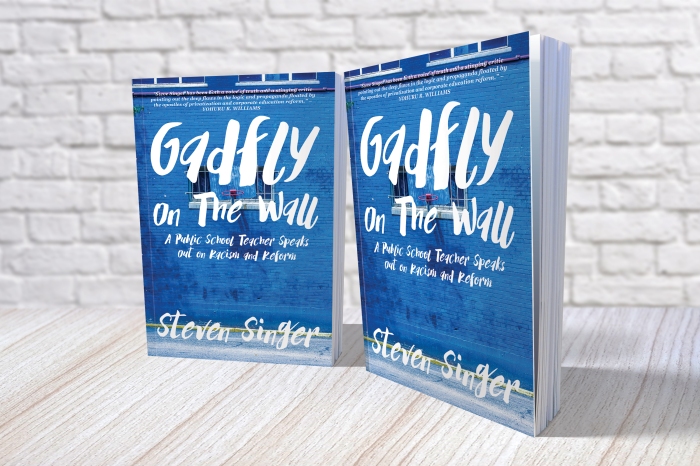
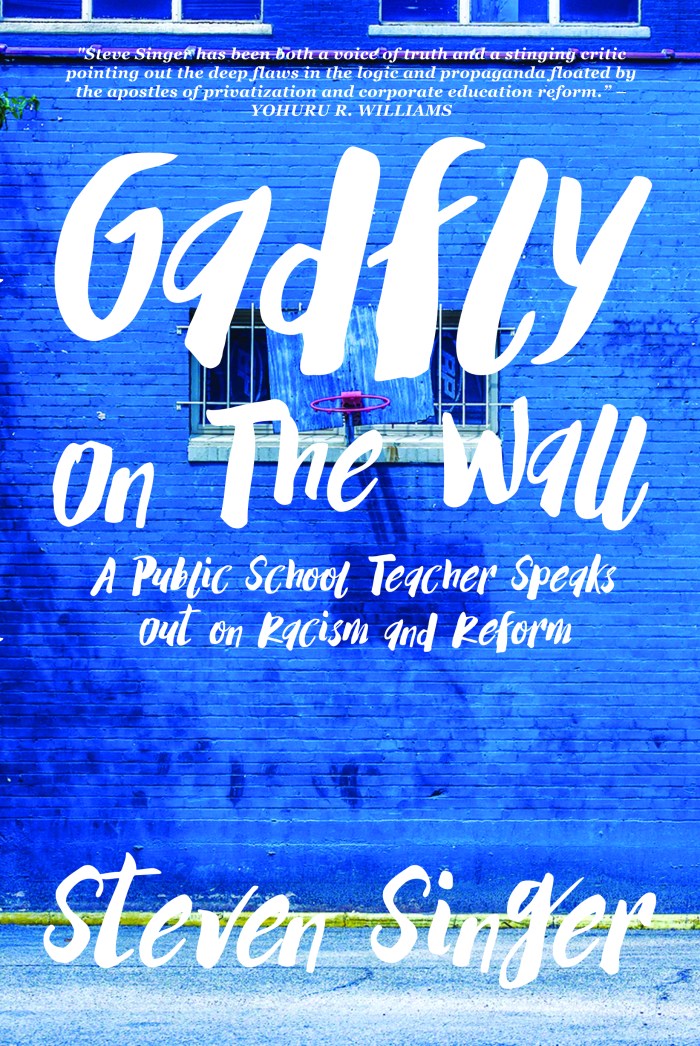
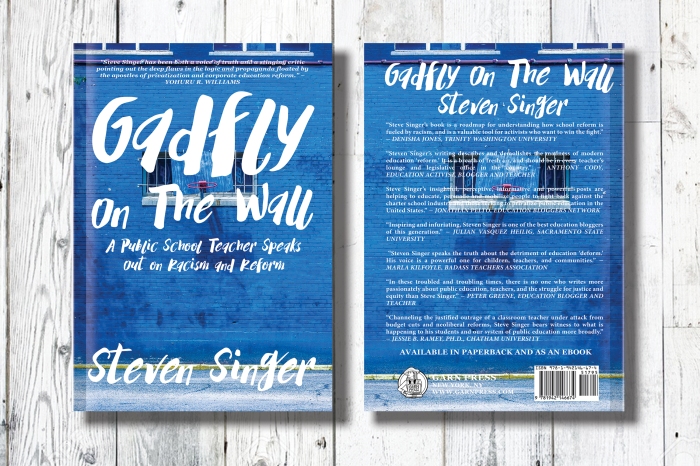
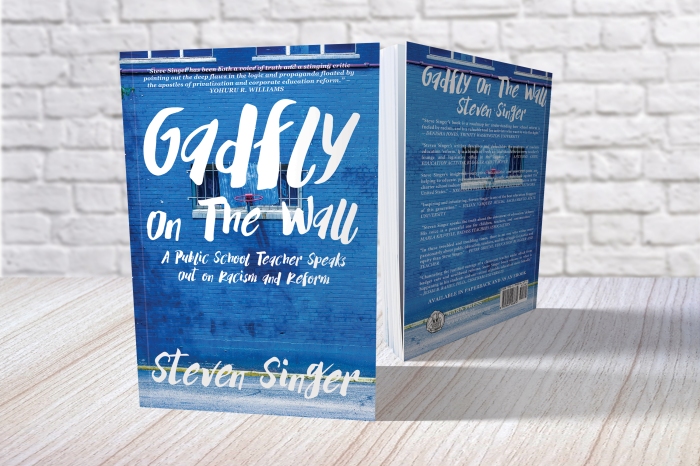
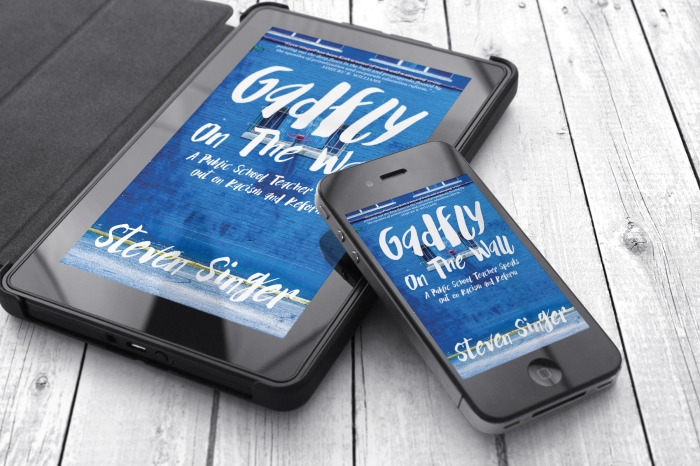
And now I’ve got a book coming out from Garn Press “Gadfly on the Wall: A Public School Teacher Speaks Out on Racism and Reform.”

Like the title says, I’m just a public school teacher. I’m not important enough to write a book.

A blog? Sure. That could disappear any day now.

All it would take is WordPress deleting the site or maybe the power goes out and never comes back or a zombie apocalypse or who knows…

But a book. That’s kinda’ permanent.

It has mass and takes up space.


front-cover


That won’t just poof out of existence if someone unplugs the wrong server.

It would take some sort of conscious effort for a book to go away. People would have to actively work to destroy it. They’d have to pile those rectangular paper bundles in a fire pit, douse them in gasoline and light a match.

Otherwise, they’d just maybe sit in a basement somewhere in boxes, unopened and collecting dust.

Or could it really be that people might actually crack the spine and read the things?

It’s a strange sort of birth this transition from cyberspace to 3-dimensional reality.

And it’s about to transpire with selected bits of my writing.

I am flabbergasted. Shocked. Almost in denial that this is really happening.


ebook-1


Did I mention that I’m a public school teacher? No one is supposed to listen to us.

School policy is made without us. Decisions impacting our kids and our careers are made by people who haven’t seen the classroom in years – if ever. And when we politely raise our hands to let people know that something isn’t working, the best we can hope for is to be ignored; the worst is to be bullied into silence.

Yet my blog has 1,184,000 hits. I’ve got 12,545 followers on Twitter and via email. And now – a book.

So, let me propose a theory: the people at Garn Press are just incredibly nice.

Denny, David and Benjamin Taylor are just fulfilling one of those Make a Wish thingies for a downtrodden soul like me.

Maybe I’ve got some sort of debilitating disease and no one’s told me yet.


book-2


The book officially comes out on Nov. 28. So when I’m handed my first actual copy, I’d say it’s even money that the next thing I’ll be handed is some medical document showing I only have moments left to live.

But whatever.

I’ll die with a smile on my face.

It reminds me of a few lines from Ray Bradbury’s Fahrenheit 451:

Everyone must leave something behind when he dies, my grandfather said. A child or a book or a painting or a house or a wall built or a pair of shoes made. Or a garden planted. Something your hand touched some way so your soul has somewhere to go when you die, and when people look at that tree or that flower you planted, you’re there.

In my 40-some years, I’ve tried to do that. I’ve tried to make some lasting mark on the world. Tried to leave it a better place than I found it.


book-1


I started as a journalist.

It was great! I could shake up a whole community just by writing something, uncovering some hidden truth, asking a tough question.

But I needed to eat, too, and you can’t do that when you’re on call 24-hours a day for nearly minimum wage under the constant threat of downsizing and meddling by the publisher and advertisers.

So I got my masters degree and became a school teacher.

And it’s been great! I can alter the course of a child’s entire life by helping her learn to read, encouraging her to write and getting her to think and ask questions.

But I’m under constant threat by bureaucrats who know nothing about pedagogy and child psychology trying to force me to do things in ways I know are wrong, detrimental or prejudicial.

So I became an activist, too.

And it’s been great. I joined groups of likeminded individuals and we took to the streets and the legislature and lawmakers offices and parent meetings and teachers conferences and just about anywhere you could stir things up and get people to start asking the right questions.

That led directly to the blog and now the book.


book-3


So what’s in it?

In short, it’s my hand-selected favorite articles. These are the ones that either got the most readers or that have a special place in my heart or both.

And this summer I sat at my kitchen table and intensively revised almost all of them. Even if you’ve read them before, these are definitive versions. In some cases, they’re considerably different than the versions you might still find up on-line.

Who did I write it for?

You, I hope.

But, if I’m honest, the people I most had in mind reading it were my daughter and my students.

One day my little girl will grow up and she may wonder what her old man thought about X, Y and Z.

What did Daddy think about racism? What did he think a good teacher did? What were his thoughts about politics, prejudice and reform?

I can see some of my students doing the same.

Perhaps I flatter myself that they may dimly remember me – their crazy 7th or 8th grade Language Arts teacher. I wonder what Mr. Singer would have said about… whatever.

I guess this is my way of telling them.

It’s a time capsule of my present day thoughts. And a guide for how to get to a better future.

You’re cordially invited to read it.

If you’re a longtime follower of this blog, let me just say – thank you from the bottom of my heart.

I never would have had the courage to continue without you.

If you’re new to my writing, welcome aboard. I hope I’ve given you reason to keep reading.

And I hope that one or two of you will be inspired to seek out a certain oblong bundle of papers wrapped in a blue and white cover proclaiming my undying, self-chosen, provocative descriptor:

Gadfly on the Wall.

ebook-2 (1)

(Oh! And a special shout out to Denisha Jones and Yohuru Williams for writing incredible introductions to the book! I am beyond honored!)


UPDATE:

The book is now available for purchase at Amazon.com. Just click here!

I am also donating 10% of all proceeds to the Badass Teachers Association. 

Do We Still Have a Functioning Democracy?

banana-republic-american-flag

Do we still have a functioning democracy?

Really.

Do we?

Because when I look around at the mess we’ve got here today, I honestly don’t know.

I went to my polling place to vote, and it was nearly deserted.

The candidates’ signs were still there, stuck in the ground like some kind of seasonal weed in need of a gardener.

But there were no people.

Well there was one nice lady sitting on a bench who smiled and handed me a flier from the county Democratic committee.

When I got inside, the poll workers were as cheerful and friendly as ever. I’ve known these ladies since I was a little kid. They remember when I worked at the local newspaper and could probably recite some elements of my resume better than I can.

They made polite conversation asking about my parents and grandparents as they looked up my information and geared up the machine to take my ballot.

There was something almost frightening about the whole thing. It was both familiar and tainted – kind of like returning to the scene of some grisly murder.

Just a year ago, this was where we knowingly voted for Donald J. Trump to be President of the United States.

When I say “we” I don’t mean me.

I didn’t vote for that tiny-handed racist asshole. But I didn’t vote for Hillary Clinton, either.

And when the whole thing was done last year, I had terrible chest pains that sent me to my doctor and then the hospital with my first-ever heart attack.

That election literally sent me to the ICU.

And yet today here I was standing on my own two feet getting ready to do it all over again.

I stood there staring at the choices on the machine, looking at my helpful Democratic flier and even referring to an email on my phone from my union.

“Why is the union recommending a bunch of Republicans?” I thought.

“Their chosen candidates want to dismantle the very institution recommending I vote for them!”

And then I looked at the list of Democrats. I didn’t know any of them.

Some of their names were familiar from hastily aired campaign ads that told me a folksy story about their families or education or how they’d never called off a day in their lives – but nothing about their beliefs, their values, even their politics.

How am I supposed to choose between these people?

I thought about just voting for the Green candidates but there was a whole one to choose from in only one race.

So I ended up voting for the Democrats. At least I have some nominal idea where they stand.

And I have to admit when it was all over and I pressed “VOTE,” I felt really good.

The machine made that metallic buzz like it was tabulating my ballot, and I felt like I had really accomplished something.

Then I went out into the nearly deserted parking lot and got hit by a wave of depression.

“What the fuck just happened?” I asked myself.

And I answered, “You got played, son.”

“Again.”

Trump is still President. And he’ll be President tomorrow and probably tomorrow and tomorrow.

And even if he was magically ushered from the scene, there’s another nearly identical Republican ideologue waiting to take his place. And another to take his. And another…

Meanwhile, the Democrats are little more than a steaming crater in the ground. They hold fewer political offices than they have at any point in my lifetime. And it doesn’t appear like that will change anytime soon.

We just had a grassroots, people-powered revolution demanding American politics move back to the left. We had a popular progressive candidate overflowing huge stadiums, an influx of young people committed to fighting against intersectional issues like racism, sexism and class warfare. And it was crushed by the Democratic nominee who coopted the process and the party with big money.

Maybe we were all just incredibly naive. I mean how can you get money out of politics when the system is already corrupted by money?

Laws aren’t made by consensus anymore. They’re made because lawmakers get paid.

And lawmakers aren’t elected because people vote for them. They’re elected because they have big money behind them – because these are the people the donors want to offer the rest of us as a choice. And no one else. Republicans and Democrats picked by the same oligarchs to make it look like us, plebeians, have a choice.

Occasionally an outlier sneaks in, but that’s rare, and the plutocrats – the real owners of this country – spend hundreds of millions of dollars to stop them.

So what do we do? Strengthen a weak and disorganized third party? Even under the best of circumstances, that would take decades. In the meantime, the environment would be destroyed, millions would have died in unnecessary wars and what little majority rule we have would have inevitably been repealed long ago.

I wish I had some more optimistic note on which to end. But I don’t.

All I have is this question: Do we still have a functioning Democracy?

And I put it out there in the real hope that readers will consider it deeply.

No kneejerk reactions. No received wisdom from this pundit or that anchor or that party hack.

It’s a question we all have to answer – and soon.

Because if the answer is “no,” what the heck can we even do about it?

Mr. and Mrs. Public School Sabotage


Screen Shot 2017-10-27 at 1.35.14 PM


America’s public schools are in crisis.


Because people make money when America’s public schools are in crisis.


And who sits atop this mountain of bribery and malfeasance?


Who gives the money that buys the politicians who make the laws that hurt the kids and profits the donors?


It’s none other than Mr. and Mrs. Public School Sabotage!


Systemic underfunding, laissez-faire segregation and privileging privatization – this is what our children face every day.


It’s time we as a nation stop, take a moment – and offer our hearty congratulations to this years most pernicious saboteurs.


And what a year it was for disrupting education!


Charter schools, voucher schools – no one has benefited more from chucking the public school model in the trash in favor of control by corporations and bureaucrats than Betsy DeVos.


Because she’s both a dark money influence peddler AND a government flunky!


A two-for!


She turned complete ignorance and animosity toward public schools into the highest federal government job overseeing education! Her only qualification? CA-CHING!


But coming up right behind Ms. DeVos is this year’s crowned king.


He certainly knows a thing or two about CA-CHING!


It’s Bill Gates!


Progressive philanthropist by day, by night he transforms into the largest single purveyor of palm grease in the nation. No one has turned tax avoidance into influence more than Gates, the money behind the Common Core, evaluating teachers on student test scores and a plethora of irrational, untested ideas that are only considered mainstream because they have literally trillions of dollars behind them.


So there you have it, America! Your Mr. and Mrs. Public School Sabotage!


Let’s take a closer look at these… winners.


DEVOS


As U.S. Secretary of Education, she’s proposed cutting $10 billion in public school funding, announced changes to make it harder for college students to report sexual assaults, and put struggling university students at risk of higher debt payments with changes to student loans.


But that’s child’s play for the billionaire heiress who married into even more money.


Now she’s planning to weaken the rights of students with disabilities.


That’s right – Jason Vorhees, Michael Myers, Freddy Kruger, they all went after those pesky post-graduate teenagers. But none of them had the audacity to go after kids with learning disabilities!


It’s not that DeVos is undoing any laws. She’s erasing decades of government guidance about how the laws are to be interpreted. And though she claims these 72 directives are simply “outdated unnecessary or ineffective,” she’s not replacing them with anything else. They’re just – gone.


Of the 72 guidelines, 63 affect special education and 9 affect student rehabilitation. And these aren’t simply undoing the work of the Obama administration. Some of these regulations have been in place since the 1980s.


The rescinded policies include “Satellite Centers for Independent Living,” “Nondiscrimination on the Basis of Handicap in Programs and Activities Receiving or Benefiting From Federal Financial Assistance,” and “Information on the Provision of Vocational Rehabilitation Services to Individuals With Hearing Loss (Deaf and Hard of Hearing).”


Bah! Who needs all this paperwork?


Parents and students. That’s who.


These guidelines have helped parents of disabled and special education children advocate for their young ones’ rights. Without them, it may be more difficult for parents and teachers to ensure all children are receiving a free and appropriate education.


That’s some seriously stone cold sabotage, Ms. DeVos!


But at least her motivation is obvious to anyone with eyes.


She’s not purposefully making the lives of K-12, special education and college kids more difficult. Well, she is, but she’s not doing it out of spite. She’s doing it because it helps her investment portfolio.


How can she continue to promote charter and voucher schools that don’t provide the same kinds of quality services for special education and disable students as public schools do? She needs to degrade what the public schools provide, thereby making the privatized alternatives more marketable.


How can she keep making money off predatory lenders unless she loosens the rules to allow them more freedom to gorge on student debt? And how can she keep her lucrative job bending the rules in her favor unless she throws some red meat to the racists, misogynists and anti-Semites who helped elect her boss into the Oval Office?


And if kids get hurt, well those aren’t the people she’s looking out for, are they?


She’s only out for the other rich elites like herself making a mint off of our public tax dollars!


It’s almost enough to make you miss Arne Duncan.


Almost…


(Nah. Not really.)


GATES


Bill Gates, on the other hand, is more contrite.


His Common Core initiative has kind of exploded in his face.


No one likes it. NO ONE.


In fact, it was one of the key talking points President Trump used to garner support. The public’s hatred of Democratic plutocracy made them suckers for the Republican variety.


The problem isn’t so much political. It’s economic.


It’s rich people who think they can do whatever they want with the rest of us and our children.


More than anyone else, Gates is guilty of that kind of unexamined, unrepentant hubris.


Yet to hear him talk, after a string of education policy disasters, he’s learned his lesson.


He’s sorry – like a crack addict is after hitting rock bottom. But he’ll somehow find the courage to light up again.


Gates now admits that the approximate $2 billion he spent pushing us to break up large high schools into smaller schools was a bust.


Then he spent $100 million on inBloom, a corporation he financed that would quietly steal student data and sell it to the corporate world. However, that blew up when parents found out and demanded their children be protected.


Oops. His bad?


He also quietly admits that the $80 million he spent pushing for teachers to be evaluated on student test scores was a mistake. However, state, federal and local governments often still insist on enacting it despite all the evidence against it. Teachers have literally committed suicide over these unfair evaluations, but whatever. Bill learned a lesson.


When it comes to Common Core, though, Bill refuses to take his medicine – even to mouth the words.


By any metric, these poor quality uniform academic standards are an abject failure. He spent hundreds of millions of dollars for development and promotion. He influenced trillions of taxpayer dollars to be poured down the drain on it. All to no avail.


Instead, he’s quietly backing away. No explanation. No apology. Just on to something new.


Kind of like: “That didn’t work. Let’s try something else!”


His new plan – spend $1.7 billion over five years to develop new curriculums and networks of schools, use data to drive continuous improvement, and give out grants to high needs schools to do whatever he says.


What’s so frustrating is that Gates shows glimmers of self-awareness.


“It would be great if our education stuff worked, but that we won’t know for probably a decade,” he said during a speech at Harvard in 2014.


But then when he sees it isn’t working, he just doubles down on the same crap.


While he may not be committed to any one policy, Gates is committed to the idea that he knows best. Whatever nonsense bull crap that floats through his mind deserves to be tried out on a national scale.


No asking experts. No asking teachers, parents or students. Just listen to me, Bill Gates, because I’m rich and that makes me better than you.


No, it doesn’t Bill. It makes you just like Betsy DeVos.


So there they are. Mr. and Mrs. Public School Sabotage.


Short may their reign be.


“They were careless people, Tom and Daisy – they smashed up things and creatures and then retreated back into their money or their vast carelessness or whatever it was that kept them together, and let other people clean up the mess they made.”

-F. Scott Fitzgerald, The Great Gatsby

Donald Trump is a Pathetic Excuse For a Human Being

5873c1771b00002c006e6638


I’m not going to pull any punches here.

Donald Trump is not just a bad President.

He’s a bad person.

No. That doesn’t go far enough.

He’s one of the worst people ever to hold public office in this country.

He’s a pathetic excuse for a person. A narcissistic and incurious fool.

Donald Trump is what happens when you spoil a child and he never has to prove his own worth.

He is the fruit of our worship of wealth and the ruling class. He is the lie of trickledown economics. He is what happens when you give someone all the rewards our society has to offer – just for showing up.

But he’s not a racist.

Not really. Not in the strictest sense. That would require some kind of commitment.

Nor is he a sexist. That would require ideology.

Trump doesn’t hate anyone. He doesn’t divide people up into categories. He just loves himself so much that his regard for anyone else seems lacking.

In Trumpland, there are only two personas – himself and everyone else.

And make no mistake – he sees the world as containing only one important personality – Donald J. Trump. Everyone else is subordinate. Even his own family is important only in so much as they reflect him and meet his expectations. (Tiffany Trump, anyone?)

Trump is the sole practitioner of a solitary religion where one individual can serve as both penitent and deity. He writes his own hymns and sings them to himself every morning during golden thrown Twitter church services.

And anyone who dares to deny the fact of his own exceptionality is not good. They’re Bad. Sad.

They get low ratings. Such low ratings. Fake news. Or whatever other nearly monosyllabic criticism his atrophied brain can defecate out of his sloppy mouth.

Other people’s suffering just doesn’t matter. Puerto Rico, NFL players, people of color unjustly targeted by police, the middle class – none of us matter to him.

 
Not black people.

Not Hispanics.

Not women.

No one. Literally no lives matter to Trump.

This is a fact borne out by his actions over decades in public life.

It’s no accident that Bret Easton Ellis made Trump the role model of Patrick Bateman, his fictional unhinged everyman businessman protagonist in “American Psycho.”

Trump may not be psychopathic, but he is clearly a solipsist, a sociopath. The outside world is not real to him, and we are not ends in ourselves. We are illusions who only merit if we increase his own self-worth.

Even from a conservative heteronormative viewpoint, men do not represent the possibility of friendship or camaraderie to Trump. They are pawns to be used or adversaries to be avoided.

Women do not represent the possibility of intimacy or understanding. They are pure shape, status and physicality – objects to be ordered, groped, controlled and tabulated.

Likewise, his constituents are important only to the degree that they support him. He has no reciprocal responsibilities toward them. He may have promised to “Make America Great Again,” but to this stunted individual, America, itself, is best represented by one thing – Trump.

He is the poster boy for all that is wrong with our society.

He is petty, unintelligent, and mean. Everything he has was handed to him. In fact, he’d have more if he just held onto it, but he had to try to prove he deserved this stuff so he lost more than what he was given.

And he doesn’t even know how to enjoy what he has.

His wife is a product he bought and modified to his liking. His children are indentured servants made to reflect his brand. He doesn’t even understand how to extract the best flavors from the expensive foods he eats.

He spends most of his time obsessively playing a game that requires wealth as a prerequisite, that isn’t particularly athletic but bestows a certain image on its practitioners. And somehow he must think hitting a little ball with a hooked stick proves – what? Something about him? Maybe it proves his physical prowess, his identity as a man of wealth and privilege?

He is the illusion Gatsby tried to portray to win Daisy – but the only love Trump covets is his own.

He both demonstrates the lie at the heart of the American Dream – that it is possible anymore for any of us to achieve – and that the dream has any inherent value.

Wealth does not make one happy. Look at Trump. He is a miserable son of a bitch. And he would be the first to tell you so if he had even a smidgen of self-reflection.

You can see it on his face in those candid moments when he isn’t talking and talking and talking.

This is a man begging to be told he is doing a good job, but the only opinion he trusts is his own, and that one not even so much.

He is a lost soul telling himself lies he only half believes. He’s an apparition, a ghost, a zombie that never was really alive in the first place.

And we, the people of the United States of America, are gathered here around him in an ever closing circle watching this tin pot dictator getting ever smaller by the hour.

One fine day he will simply disappear. And we’ll all be left staring at the space he left behind.

Perhaps this vanishing act will be accompanied by a “pop,” a “hiss” or just a silence deeper than background static.

And the only question that will remain will be if we’ll all be sucked into the maelstrom of his leaving.

Or if we’ll all shake our heads and wonder…

What the Hell had we just been looking at?

Anti Donald Trump Paiting Appears In Manhattan

PA High Court Says, “Yes, Schools CAN Sue State Over Unfair Funding, After All!”

rrxfund14-d


It’s back on!

Two years ago a group of plucky Pennsylvania public schools took the state legislature to court because the body wasn’t allocating funding to all districts fairly – some got too much, many got too little.

A lower court threw the challenge out saying it wasn’t the court’s job to tell the legislature how to legislate. But now the state Supreme Court has overturned that lower court decision.

In effect, justices are sayingHell, yes, that is the court’s job! That’s why it’s called a system of checks and balances, Baby!

Or something like that.

Before going any further, there are a few pertinent facts you have to understand about the Commonwealth.

1) No other state in the country has a bigger gap between what it spends on rich vs. poor students than Pennsylvania, according to the U.S. Department of Education.

untitled

2) The Pennsylvania legislature has been paying less and less of public schools’ budgets over the last four decades. The state used to contribute 54% of all public school costs in the early 1970s. Today it pays only 35% of the costs, leaving local taxpayers to take up the slack. Since districts are not equally wealthy, that increases the disparity of resources between rich and poor districts.


3) The state has only had a funding formula specifically legislating how to allocate money to its more than 500 districts for two years. Two years! For more than 15 years previous, the legislature just handed out money willy nilly based on political backroom deals that favored already rich districts and hurt the most impoverished ones.

4) The new funding formula still is not fair. Though it does take into account the poverty of a district, it doesn’t account for the years of systematic disinvestment the district suffered through previously. That’s like giving new sneakers to a racer who hasn’t been able to get out of the starting gate while others are already halfway to the finish line.

5) The legislature STILL hasn’t healed almost $1 billion in education cuts made under previous Republican Gov. Tom Corbett. Instead, under current Democratic Gov. Tom Wolf, it has reluctantly increased funding a bit at a time but failed to bring spending up to what it was four years ago. And even once the cuts are healed, spending will be behind inflationary and cost of business increases. Meanwhile the Republican controlled legislature plays games approving the state budget separately from allocating money to the programs – including schools – that it already approved!


6) Pennsylvania is one of seven states with a Constitution that specifically requires the state provide a “thorough and efficient” system of education. Some of these other states – like New Jersey – have used similar Constitutional requirements to force their legislatures to increase state funding to public schools.

So there you are.

Pennsylvania’s legislature is an absolute mess.

Hopelessly gerrymandered, controlled by the radical right, and opposed by a Democratic party nearly as beholden to big donors as their GOP counterparts and desperate for any area of bipartisanship so as to be able to claim they got anything done other than stop Republicans from burning the whole place to the ground.

That’s why today’s 5-2 Supreme Court ruling is a breath of fresh air.

It’s like someone finally called Mom and Dad to tell our bratty lawmakers to get back to work.

The case will now go back to Commonwealth Court.

Supreme Court Justice David Wecht wrote that the courts do have a responsibility to check the power of the legislature – both in regard to the requirements of the state Constitution and that poorer districts are being discriminated against.

“It remains for (the) petitioners to substantiate and elucidate the classification at issue and to establish the nature of the right to education, if any, to determine what standard of review the lower court must employ to evaluate their challenge,” Wecht wrote. “But (the) petitioners are entitled to do so.”

This may be a Herculean task for those suing the state. And it seems unlikely that Commonwealth Court will hear their arguments favorably.

Justices rarely have the courage to challenge other branches, and the history of Pennsylvania’s courts shows multiple times when the courts have simply refused to assert such power.

This is what happened back in the 1990s when the Philadelphia School District sued the state over the same issue – unfair funding.

Time and again, poor districts have asked for help from the courts when the legislature refused to do its job. And time and again the courts have refused.

But at least this ruling gets things moving again. It’s like a dose of Kaopectate for a constipated political system.

Another possible bit of good news comes from Common Core and high stakes standardized testing. Yes, that crap!

When Philadelphia sued the state, the courts refused to rule in the schools favor because it had no way of proving the state was hurting the quality of education students were receiving there through lack of funding. But that was before Pennsylvania adopted its new Common Core look-a-like standards, PA Core, and initiated aligned tests including the souped up Pennsylvania System of School Assessments (PSSA) and Keystone Exams.

Ironically, the same “accountability” measures used to “demonstrate” poor schools are failing could be used to prove the common sense notion that unfairly funding schools leads to poor academic results.

In any case, far right demagogues like House Speaker Mike Turzai, R-Allegheny, are already whining that the Supreme Court is legislating from the bench. However, as a defendant in the case, and one of the most partisan hacks in Harrisburg, that’s exactly what the Koch Brothers probably told him to say.

Unfortunately, Gov. Wolf seems to kinda agree with him. Though he has yet to make a statement about today’s ruling, he was against the suit when it was originally brought up in 2015. Though he supports increasing education funding and has consistently pushed for it with every budget proposal, he is leery of the courts butting in.

Sadly, his strategy of incremental education budget increases has been failing. Or, to be fair, it’s succeeding at such a slow rate that it would take decades for it to catch up.

The fact of the matter is that it is patently unfair for rich districts to spend $10,000 to $20,000 on each student, while poorer districts can barely pull together $5,000-$6,000.

In addition, impoverished students have greater needs than rich ones. They often don’t have books in the home or access to Pre-kindergarten. Poor students often suffer from food insecurity, malnutrition, a lack of neonatal care, worse attendance, are less well rested and have greater special needs and suffer greater traumas than wealthier students. Moreover, it is no accident that the group being privileged here is made up mostly of white students and those being underprivileged are mostly students of color.

The time is here when Pennsylvanians have to decide where they stand. Are they for a state that offers all children an equal start or do they prefer one where poor brown kids suffer so rich white ones can get ahead?

Today, the matter is in the court’s hands.

‘Schools of the Future’ And Other Scams to Monetize Your Child

1963-jetsons-school


Do you feel it?

The future is coming.

There it is hovering just over the horizon.

You squint your eyes trying to get a quick peak before it arrives. But that rarely works. By the time it’s here, it’s never quite in the shape you expected.

Yet we always stop and listen to the prophets and prognosticators. Those google eyed figures, wearing trench coats and sandwich boards standing proudly on milk crates and cracking open their mouths to vociferously voice their “visions.”

They smell like B.O. There are insects in their hair. And their mouths spray halitosis as much as haloes.

Under normal circumstances, we wouldn’t trust them to park our cars, to give us directions, to do just about anything. But when it comes to “The Future” somehow we swallow their swill with conviction.

Through sheer force of charisma they convince us that their predictions will come to pass and if we’re smart we’ll invest in their brand of patented polished snake oil.

So we’ll be ready.

Just once I wish people would heed the skepticisms of the doubting Cassandras. But so it goes.

This week it’s “Schools of the Future.”

Everywhere you look it seems you’ll find some slickly produced inducement to “Rethink schools.” Some admonition to completely change public schools. Some empty promise in naked technology to save us all.

They’ll tell you that our public schools haven’t changed in a century. They’re set up for the agricultural past. Or schools are great for creating assembly line workers for the industrial revolution, but times have changed. And education needs to change with them.

Never mind that schools were never designed to supply any workforce. Their goal was – and is – to help the next generation become citizens capable of free thought.

But whatever.

This sales pitch about outmoded schools sounds really nice.

It resonates.

It makes us feel good.

Yes, I KNEW there was something wrong with my public school. That explains my own failures. I mean, I went through 12 plus years of public schooling and look at me! I’m not one of the handful of billionaires who own the world. It MUST have been the school’s fault!

Forget economic inequality, money in politics or any of that progressive crap! I could be sitting on top of the world with my boot firmly planted on the neck of everyone else – if only the public school had taught me right.

PLEASE!

But this is the comforting lie many folks tell themselves and one of the major reasons corporate school reformers get away with raiding public education. Their lies flatter white people’s vanity.

So billionaire Laurene Powell Jobs’ bought a four-network propaganda hour telling us to “rethink” high school while Education Secretary Betsy DeVos’ began her “Rethink Schools” publicity tour days later.

As if the thought never occurred to anyone else.

Rethink schools? What do you think classroom teachers do? We rethink every lesson every day!

It’s standard practice. We call it reflection. Some of us even keep reflection journals where we jot down things that worked and things that didn’t.

Haven’t these privileged fools ever logged on to the blogosphere? The Internet is fit to bursting with teacher blogs overflowing with ideas about how to change things up. This very blog has been pushing authentic reform after authentic reform – but the powers that be – people like DeVos and her billionaire philanthrocapitalist peers – aren’t listening.

You want to rethink schools? How about sitting down and shutting up?

Seriously.

Let the experts have a say for once.

Classroom teachers have much more experience than you do. We’re there every single day engaged in the actual practice of teaching children. You learn something about it by doing it for at least 180 days a year, for decades. And that’s not even counting the years of college preparation before even entering the classroom, the pedagogy, debate, and hard won wisdom of generations of teachers before us.

Meanwhile, all you have is a bank account.

You’ve hardly stepped foot in a public school to do more than spit on it. Nor did you likely experience it as a student or parent of students who go there.

You know nothing. And that’s no sin in itself.

Many people are ignorant of a great many things. I, for one, am completely ignorant of how to fly an airplane. That’s why I’d never dream of busting open the cockpit and preceding to tell the captain how to land the plane!

But you are not humble enough to admit your own ignorance. You think your money gives you the ability to do anything. After all, you DESERVE all those billions. It’s not an accident of birth or circumstances. You’re just that good, that special, that much better than the rest of us.

And what kind of brilliance do we get from these pampered prophets?

Here’s DeVos remarks to faculty and students at Woods Learning Center in Casper, Wyoming, from Sept. 12:

“…I’m issuing a bold challenge this week: it’s time to rethink school.

For far too many kids, this year’s first day back to school looks and feels a lot like last year’s first day back to school. And the year before that. And the generation before that. And the generation before that!

That means your parent’s parent’s parents!

Most students are starting a new school year that is all too familiar. Desks lined up in rows. Their teacher standing in front of the room, framed by a blackboard. They dive into a curriculum written for the “average” student. They follow the same schedule, the same routine—just waiting to be saved by the bell.”

All that money and the best you can come up with are that we should rearrange the desks!?

It just goes to show that you don’t know what goes on in real public schools.

My middle school classroom doesn’t have desks. We have tables that seat four.

Yes, those seats typically begin the day with students facing the teacher and the board. But you could say the same of seats at any auditorium since Plato’s day. I don’t hear anyone talking about rethinking that!

In any case, seats are mobile. I direct my students to move their seats all around the room. Just yesterday we had them in a circle. The day before, they were in small groups. And many days my students aren’t even in their seats – they’re wandering around the room doing some sort of task or project.

None of this is that revolutionary. Most middle school teachers do the same thing. You have to. Kids that age don’t have the attention span to sit in their seats in the same position for 40 plus minutes at a time.

Seats are often more stationary at the high school level, and they’re probably even less fixed at the elementary.

You would know this if you ever talked to a public school teacher. But, no. You know best because of your net worth.

Let me tell you something. Public schools today are much different than they were in the past.

For example, the way we teach special needs children is light years away from what it was just a few decades ago. We used to send these children to specialized facilities or classrooms in the basement well away from other students. Now, they’re mainstreamed and their educations are dramatically tailored to meet each student’s individual needs.

Schools used to just be about the three R’s – reading, writing and ‘rtithmetic. Today at wealthier districts, students have a wide range of courses to choose from. They have arts, music, foreign languages, vo-tech, extra-curriculars, computer science, robotics, drama, almost anything you can think of! I wish this were true at all schools, but that’s a funding issue, not a lack of innovation.

Many schools are less segregated today than they were before Brown v. Board. The courts have let us down in supporting this Supreme Court decision, instead permitting an awful lot of regression in some districts. But even at the most resegregated schools, they are rarely100% one race or another. We should do something to increase integration, but don’t tell me we haven’t made progress.

Let’s get one thing straight.

People like DeVos and Jobs only care about “rethinking” schools because they have a product to sell.

They’re promoting a problem so they can sell us the solution. They want us to buy more charter and voucher schools, more edutech competency based education B.S., more testing, more publisher and computer boondoggles.

You want real innovative reforms in our public schools?

Here’s what you do.

First step, give the reigns to public school teachers. We’ll tell you what needs to be done.

Here’s a short list:

-Stop privatizing and start supporting public schools.

-Give us equitable funding so that poor and minority students have the funding they need to learn.

Integrate schools again – both racially and economically – no more schools for rich white kids and schools for poor black kids.

Get rid of high stakes testing use funding allocation, spending decisions, principal classroom observations and student projects for accountability purposes, not scores on a limited and biased multiple choice test.

Repeal Common Core and let teachers write their own academic standards instead of being beholden to goals written by corporations to sell their own products and tests.

-Make a national commitment to reducing class size across the board, hire more teachers, increase their autonomy and salary.

Examine very closely every use of technology in the classroom to make sure student data isn’t being stolen by corporations, devices aren’t used for test prep or babysitting, and beware Trojan horse edutech applications like so-called personalized learning and competency based education.

Those are the kinds of reforms that would actually help improve our public schools.

But you can only learn that if you have the humility to listen to the experts – classroom teachers.

And people like DeVos and Jobs have proven they don’t have an ounce of humility.

Perhaps we don’t need to rethink schools. We just need to rethink our standards of expertise.

Top 10 Reasons Public Schools are the BEST Choice for Children, Parents & Communities

thumbsup


Everywhere you look today you’ll find profits prophets of doom bemoaning the quality of our public school system.


We’ve got too many failing schools, they say. The only thing to do is to invest in private and privatized institutions vouchers, charters, ANYTHING but public.


But as education professors Christopher and Sarah Lubienski wrote in their landmark book “The Public School Advantage: Why Public Schools Outperform Private Schoolsthere’s little evidence behind the hype. Public schools are far from perfect, but even given their deficiencies, they have benefits that far outweigh those of privatized schools. Indeed, market-based educational reform, wrote the Lubienskis, is “increasingly a belief system rather than a policy theory.”


Privatized schools are sometimes great at boosting standardized test scores, but when it comes to authentic indicators of student learning, they often fall well behind their traditional public school counterparts.


And when you stop to consider things like finances, accountability, self-governance, social justice and life-long learning, then public schools prove themselves to be a much better choice than any privatized system.


Clearly we’re speaking in generalities here. Every school – public or privatized – is different. But there is enough commonality to identify certain trends between each type of school to make general conclusions about each category. In short, despite any media or political propaganda to the contrary, public schools come out on top.


Here are the top 10 reasons public schools are the best choice for children, families and communities


1) Public Schools Attract the Best Teachers


When choosing a school for your children, you want them to have the best teachers possible. You want life-long, committed educators – people who entered the profession as a calling, who dedicate their lives to young people.


This is not the case at many charter or private schools. Their teachers often don’t have the same high level of education, experience, or commitment. In many states, they aren’t required to earn a 4-year degree from an accredited college, they routinely have less experience and higher turnover.


Compare that with public schools. With rare exceptions, teachers must have at least one bachelors degree in a specialized education field, and many have masters degrees or more. In addition, teacher turnover is much lower. This is partly because public school teachers usually earn a higher salary than those at privatized schools. (It’s still not comparable with professionals in other fields with similar levels of education, but it’s better than they get at privatized schools.) In addition they have higher job satisfaction because of increased union membership, which enables greater stability and helps create a safer workplace for teachers and their students.


Think about it. If you were one of the best teachers in the country, wouldn’t you want to work where you get the highest salary and benefits? Of course!


2) Public Schools Have a Greater Sense of Community


Most public schools have been around for a long time. They are the heart of the communities they serve. They do so much more than just teach children. They host continuing education courses for adults, extracurricular activities, sporting events, academic clubs, public swimming pools, open libraries, and invite the community for local events, concerts, seminars, etc.


This is rarely the case at privatized schools. Charters and private institutions are often fledgling startups. They’re located in rented office spaces, renovated store fronts and other locations chosen more for their cost benefits to investors and not for their efficacy as places of education or community outreach.


Public schools have histories that go back generations. Everyone in the community knows the teachers who work there. Parents often send their kids to the same educators who taught them when they were young. Sometimes this goes back to grandparents and even great grandparents. Older brothers can advise younger sisters what it was like to have this teacher or that principal. The kinds of relationships you get at public school just aren’t there at institutions that model themselves on big box stores like WalMart and Target.


3) Public Schools Increase Educational Choice


Privatizers often talk about charters and voucher schools as if they are the only places that offer parents and students choice. It’s simply untrue. Many public school districts offer a tremendous amount of alternatives for students living in their neighborhoods. Larger urban districts often have magnet or theme schools. But even beyond that, most schools offer a wide variety of classes and curriculum. Students can take foreign languages, vo-tech, arts and humanities, independent studies, and advanced placement or college credit courses. Students can take advantage of a plethora of services designed to personalize their academic experience to meet their individual needs with special and gifted education, even choosing which teachers are the best fit for their learning styles.

Obviously, these options increase with the degree of wealth in a community, but they prove that increasing choice doesn’t have to mean privatization. It means equitable funding.


4) Public Schools Have Greater Diversity


Students learn a lot more than reading, writing and arithmetic in school. They also learn how to deal with different kinds of people – they learn to share this world with other humans from various racial, ethnic, religious, and sexual backgrounds. The more diverse an environment they grow up in, the more well-adjusted they will be for the adult world, and the less racist, sexist and prejudiced they’ll probably become.


Public schools are often a sea of diversity. They are the best place to meet the entire spectrum of humanity. On the other hand, charter and voucher schools are routinely segregated and homogenous. Sometimes privatized schools make efforts to fight against this, but you can’t make much headway when your entire system is based on sorting out the underprivileged in favor of white, affluent children whose parents can afford tuition (private schools) or poor black but high achieving children (charter schools).


5) Public Schools Are More Fiscally Responsible


Public schools spend their money more wisely than privatized schools. They have to! Their records are an open book. All the spending decisions happen in public view. And the law requires that all expenses must relate to educating children.


Privatized schools rarely do this, and if they do, it’s by choice not necessity. They could close their books any day, make whatever decisions they like behind closed doors and layout bundles of cash for their CEOs or investors. Privatized schools are for-profit. Even when they aren’t explicitly labeled as such, they usually operate in the same way – cut student services to increase the bottom line. Their explicit goal is to make money off your child – not simply earn a middle class income like public schools. No, they want to get rich off of your dime.


Privatizers buy mansions and yachts with your money. Public school teachers pay off their mortgages. And in the rare instances where public school employees break the law and try to embezzle funds, they are much more likely to be caught because the books are right there for all to see.


6) Public Schools Are More Reliable


When you send your child to most privatized schools, you never really know if it’s going to be there tomorrow. Charter schools often close without a moments notice. Private schools declare bankruptcy.


If there’s one thing you can be reasonably sure of, it’s that your neighborhood public school will still be there. It’s been there for decades, sometimes hundreds of years. Charter and voucher schools are often fly-by-night affairs. Public schools are solid bedrock. If public schools close, it’s only after considerable public comment and a protracted political process. No one ever shows up to find the local public school chained shut. Not the same at charters or private schools.


7) Public Schools Have Greater Commitment to Students


Charter and vouchers schools don’t have to accept your child. Public schools do.


When you enroll in a privatized school, the choice is all up to administrators. Is your child a safe bet? Can they let your little one in without breaking the bank? Will he or she make the school look good with better test scores? Will he or she be easy to educate?


Public schools, on the other hand, have a commitment to educating every child who lives in the district. They even take homeless children. Only under the most extreme circumstances would they expel a young person. No matter who your offspring is, no matter how good or bad a student, public school operators have faith they can help the youngster succeed.


8) You Have Ownership of Public Schools


With privatized schools, you’re paying for a business to provide services. Public schools belong to you. In fact, you’re the boss.


Public schools are run by your friends, neighbors and co-workers. Privatized schools are most often run by appointed boards of directors who are not beholden to you but to the investors. As education blogger Peter Greene puts it, “The charter is a business, run by people who don’t ever have to let you into their board room.”


In addition, many public schools go beyond even this level of parental involvement. They more often have PTAs or PTOs. They have advisory councils where elected parents, teachers and community members can work together to advise the school board on important maters like hiring superintendents. If parents and the community want a voice, the public school system is overflowing with options. Ironically, the community rarely has any say over privatized schools and parents can only vote with their feet.


9) Public Schools Provide More Amenities


Public schools routinely offer so much more than privatized schools. At many charter and voucher schools, parents are required to buy supplies for the whole institution. Public schools accept donations and sometimes teachers ask for help, but if parents can’t (or won’t) send in pencils or tissues, the school provides it gratis. And even when the district is cheap in this regard, teachers often make up the difference from their own pockets. It’s not right that they have to do so, but they constantly step up for your children.

Moreover, public schools offer a much expanded range of services for your children than privatized schools. Special education and gifted programs are first rate at public schools while often intermittent or nonexistent at privatized schools. And the requirements put on parents at public schools are much lower – less restrictive dress codes, fewer demands on parents’ time and they take a greater responsibility for your children.

Heck, private schools rarely even pay for transportation. Public schools offer a free ride via the school bus from home and back again.


10) Public Schools Match or Outperform Privatized Schools


When it comes to academic performance, comparisons all come down to what data you think is indicative of student learning and which factors you exclude. You can find plenty of studies funded by privatizers that unsurprisingly conclude their backers business model is the best. However, when you look at peer reviewed and nonpartisan studies, the story changes.

The Lubienskis, in particular, paint an extremely compelling picture of public school superiority based on numerous complex statistical models including hierarchical linear modeling and multivariate regression. In short, the authors conclude that after accounting for the demographic differences among various school sector populations, traditional public school students outperform those at private schools over time. Students typically enter public schools with much greater degrees of poverty than those entering private schools. As such, public school students start with greater academic deficiencies. Even so, public schools are able to make up for these deficiencies over time more easily than privatized schools. And by fourth grade, public school students actually have greater academic success than their demographically similar peers at private or charter schools. The Lubienskis call it “The Public School Effect.”


With all these benefits, you’d think we’d be cheering on our public school system, not denigrating it. However, the failing schools narrative sells a lot of people on privatized alternatives. But it’s not fact. It’s marketing.


It’s time someone explicitly outlined the benefits of our public schools. We could be doing a lot more to help make them even better. But the first step is recognizing what an asset these schools already are.


Public schools, they’re what happens when we value children over profit.