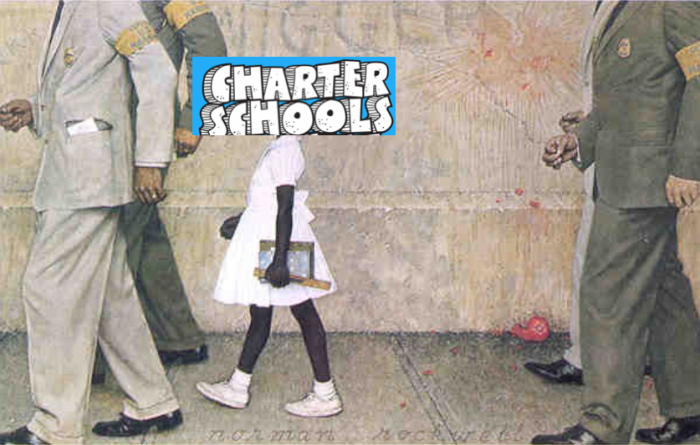
What’s More Important – Fighting School Segregation or Protecting Charter School Profits?

Screen Shot 2016-08-31 at 4.12.13 PM


No one wants school segregation.


At least, no one champions it publicly.


As a matter of policy, it would be political suicide to say we need to divide up our school children by race and socio-economics.


But when you look at our public school system, this is exactly what you see. After the triumphs of the Civil Rights movement, we’ve let our schools fall back into old habits that shouldn’t be acceptable in the post-Jim Crow era.


When we elected Barack Obama, our first President of color, many observers thought he’d address the issue. Instead we got continued silence from the Oval Office coupled with an education policy that frankly made matters worse.


So one wonders if people still care.


Is educational apartheid really acceptable in this day and age? Is it still important to fight against school segregation?


Peter Cunningham isn’t so sure.


The former assistant Secretary of Education under Obama and prominent Democrat worries that fighting segregation may hurt an initiative he holds even more dear – charter schools.


Cunningham is executive director of the Education Post, a well-funded charter school public relations firm that packages its advertisements, propaganda and apologias as journalism.


Everywhere you look Democrats and Republicans are engaged in promoting various school choice schemes at the expense of the traditional public school system. Taxpayer money is funneled to private or religious schools, on the one hand, or privatized (and often for-profit) charter schools on the other.


One of the most heated debates about these schemes is whether dividing students up in this way – especially between privately run charter schools – makes them more segregated by race and socio-economic status.


Put simply – does it make segregation worse?


Civil Rights organizations like the NAACP and Black Lives Matter say it does. And there’s plenty of research to back them up.


But until recently, charter school apologists have contested these findings.


Cunningham breaks this mold by tacitly admitting that charter schools DO, in fact, increase segregation, but he questions whether that matters.


He says:


“Maybe the fight’s not worth it. It’s a good thing; we all think integration is good. But it’s been a long fight, we’ve had middling success. At the same time, we have lots and lots of schools filled with kids of one race, one background, that are doing great. It’s a good question.”


The schools he’s referring to are charter schools like the Knowledge is Power Program (KIPP) where mostly minority students are selected, but only those with the best grades and hardest work ethic. The children who are more difficult to teach are booted back to traditional public schools.


It’s a highly controversial model.


KIPP is famous for two things: draconian discipline and high attrition rates. Even those kids who do well there often don’t go on to graduate from college. Two thirds of KIPP students who passed the 8th grade still haven’t achieved a bachelor’s degree 10 years later.


Moreover, its methods aren’t reproducible elsewhere. The one time KIPP tried to take over an existing public school district and apply its approach without skimming the best and brightest off the top, it failed miserably – so much so that KIPP isn’t in the school turnaround business anymore.


These are the “lots and lots of schools” Cunningham is worried about disturbing if we tackle school segregation.


He first voiced this concern at a meeting with Democrats for Education Reform – a well-funded neoliberal organization bent on spreading school privatization. Even at such a gathering of like minds, some people might be embarrassed for saying such a thing. Is integration worth it? It sounds like something you’d expect to come out of Donald Trump’s mouth, not a supposedly prominent Democrat.


But Cunningham isn’t backing away from his remarks. He’s doubling down on them.


He even wrote an article published in US News and World Report called “Is Integration Necessary?”


Here’s the issue.


Segregation is bad.


But charter schools increase segregation.


So the obvious conclusion is that charter schools are bad.


BUT WE CAN’T DO THAT!


It would forever crash the gravy train that transforms public school budgets into private profits. It would forever kill the goose that turns Johnny’s school money into fancy trips, expense accounts and yachts for people like Cunningham.


This industry pays his salary. Of course he chooses it over the damage done by school segregation.


But the rest of us aren’t burdened by his bias.


His claims go counter to the entire history of the Civil Rights movement, the more than hundred year struggle for people of color to be treated equitably. That’s hard to ignore.


People didn’t march in the streets and submit to violent recriminations to gain something that just isn’t necessary. They weren’t sprayed by hoses and attacked by police dogs so they could gain an advantage for their children that isn’t essential to their rights. They weren’t beaten and murdered for an amenity at which their posterity should gaze with indifference and shrug.


We used to understand this. We used to know that allowing all the black kids to go to one school and all the white kids to go to another would also allow all the money to go to the white kids and the crumbs to fall to the black kids.


We knew it because that’s what happened. Before the landmark Brown vs. Board of Education, it’s a matter of historical fact. And today it’s an empirical one. As our schools have been allowed to fall back into segregation, resources have been allocated in increasingly unfair ways.


We have rich schools and poor schools. We have predominantly black schools and predominantly white schools. Where do you think the money goes?


But somehow Cunningham thinks charter schools will magically fix this problem.


Charters are so powerful they will somehow equalize school funding. Or maybe they’re so amazing they’ll make funding disparities irrelevant.


For believers, charter pedagogy wields just that kind of sorcery. Hocus Pocus and it won’t matter that black kids don’t have the books or extra-curriculars or arts and humanities or lower class sizes.


Unfortunately for Cunningham, the effects of school segregation have been studied for decades.


“Today, we know integration has a positive effect on almost every aspect of schooling that matters, and segregation the inverse,” says Derek Black, a professor of law at the University of South Carolina School of Law.


“We also know integration matters for all students. Both minorities and whites are disadvantaged by attending racially isolated schools, although in somewhat different ways.”


Minorities are harmed academically by being in segregated schools. Whites are harmed socially.


At predominantly minority schools, less money means less educational opportunities and less ability to maximize the opportunities that do exist. Likewise, at predominantly white schools, less exposure to minorities tends to make students more insular, xenophobic and, well, racist. If you don’t want little Billy and Sally to maybe one day become closeted Klan members, you may need to give them the opportunity to make some black friends. At very least they need to see black and brown people as people – not media stereotypes.


Even Richard D. Kahlenberg, a proponent of some types of charter schools and a senior fellow at the Century Foundation, thinks integration is vital to a successful school system.


“To my mind, it’s hugely significant,” says Kahlenberg, who has studied the impact of school segregation.


“If you think about the two fundamental purposes of public education, it’s to promote social mobility so that a child, no matter her circumstances, can, through a good education, go where her God-given talents would take her.  The second purpose is to strengthen our democracy by creating intelligent and open-minded citizens, and related to that, to build social cohesion.


Because we’re a nation where people come from all corners of the world, it’s important that the public schools be a place where children learn what it means to be an American, and learn the values of a democracy, one of which is that we’re all social equals. Segregation by race and by socioeconomic status significantly undercuts both of those goals.”


We used to know that public education wasn’t just about providing what’s best for one student. It was about providing the best for all students.


Public schools build the society of tomorrow. What kind of future are we trying to create? One where everyone looks out just for themselves or one where we succeed together as a single country, a unified people?


A system where everyone pays their own way through school and gets the best education they can afford works great for the rich. But it leaves the masses of humanity behind. It entrenches class and racial divides. In short, it’s not the kind of world where the majority of people would want their children to grow up.


More than half of public school students today live in poverty. Imagine if we could tap into that ever-expanding pool of humanity. How many more scientific breakthroughs, how many works of art, how much prosperity could we engender for everyone!?


That is the goal of integration – a better world.


But people like Cunningham only can see how it cuts into their individual bank accounts.


So is it important to fight school segregation?


That we’re even seriously asking the question tells more about the kind of society we live in today than anything else.


We Are All Chicago Schools – More Layoffs, Less Help for Other People’s Kids

ct-rahm-emanuel-forrest-claypool-private-schools-20160505


“Fuck those kids.”


Mayor Rahm Emanuel couldn’t have been clearer if he’d said the above.


Chicago Schools Chief Executive Forrest Claypool couldn’t have made his priorities clearer if he’d given Chicago’s parents the bird and told them to “Kiss my ass.”


The Chicago Board of Education – made up of members all of whom are appointed by the mayor – decided to layoff 1,000 teachers and staff at the city’s public schools just a month before opening day. Sure, some may keep their jobs through reassignment, but hundreds will be unemployed.


This after a recent history of closing more than 80 schools and slashing thousands of jobs. Just last February, the district laid off 62 employees, including 17 teachers. In January, it laid off 227 staff members.


This begs several questions: How many teachers and support staff can Chicago Public Schools afford to lose? What exactly is this doing to its students? How is it affecting their future prospects to be taught by a skeleton crew?


The city’s leaders don’t give a shit.


And why should they? These aren’t their kids!


Emanuel’s children attend University of Chicago’s Laboratory Schools, a private institution. Claypool’s kids go to Francis W. Parker, a private school in Lincoln Park. Even Gov. Bruce Rauner’s six kids don’t go to public school. They’re all grown.


So this doesn’t affect them. Nor does it affect any charter school kids. Not a single one of these 1,000 cuts will occur at a city charter school.


It’s just the traditional public schools, those schools where approximately 85% of students are Latino or African-American. Just those schools where 87% of the children come from low-income homes. Just those schools where 12% of kids are reported to have limited English proficiency.


Yeah. Fuck those kids.


And the worst part is that it’s not necessary. Chicago doesn’t have to continue to abandon its neediest children.


When you’re in a family, you make sacrifices for your kids. If funds are tight, you make cuts elsewhere or maybe you even take another job. Anything to make sure you’re providing your children with the best.


But Chicago’s leaders aren’t interested in doing any of that for these kids because they just don’t care.


Otherwise they could find the money. The teachers union suggests declaring a TIF surplus and reinstating a corporate head tax. The city isn’t exactly a wasteland. Wealthy developers are looking to build yet Emanuel has no intention of inconveniencing them by making them pay a fair share of taxes. Instead, the full burden falls on the city’s working families. And he calls himself a Democrat!


There’s always enough money for projects leaders care about. For instance, there was no problem finding $250,000 to pay a law firm where Claypool and his handpicked general counsel, Ron Marmer, both formerly worked. Marmer still has financial ties to the firm! So cut a check to Jenner & Block LLP? YES! Ensure kids have all the teachers they need? HECK NO!


Strangely there’s $27 million hiding in the seat cushions to open a new charter school for the University of Chicago. The Woodlawn Campus of the University of Chicago Charter School will be part of the development around the newly-planned Obama Library. It’s a fitting symbol of the President’s legacy – a brand new privatized educational facility while a few blocks away traditional public schools molder in ruin.


Meanwhile, Gov. Rauner holds the state education budget hostage. Illinois lawmakers could only agree on a 6-month state budget in June. Republicans expressed concern about the state being responsible for bailing out Chicago Schools. It’s not our problem, they seem to think. Well of course not. These aren’t your kids.


It’s the same swindle we see throughout the country. Refuse to pay for public schools – especially the schools serving poor brown kids, and then shrug. “Look at the impasse,” they shout, hoping voters are too stupid to realize it’s an impasse created by these lawmakers, themselves! It’s a textbook disaster capitalism move, approved by the American Legislative Exchange Council (ALEC) and other conservative think tanks. But Rauner can at least be forgiven for being a proud Republican. This is, after all, the behavior progressives expect from GOP lawmakers.


What about Democrats like Emanuel? This isn’t the way progressives are supposed to act. They aren’t supposed to favor privatization over public schools. They aren’t supposed to fawn on big business and promise tax cuts, tax shelters, and every other kind of tax avoidance.


Some might say it’s just Emanuel. After all, for a Democrat he sure pals around with a lot of conservatives. He and Rauner are best buddies. When Emanuel earned his fortune, he was an investment banker, and one of his best clients was Rauner. They go out to dinner and even spend vacations together. Sure they occasionally criticize each other in public, but behind closed doors the ideological differences just melt away.


What about the rest of the Democrats? Surely they don’t agree with Emanuel’s tactics. They made sure to keep him away from the Democratic National Convention – out of sight, out of mind.


But if the party is really so opposed to these policies, where is the condemnation from party leaders?


I haven’t heard a peep from the Democratic nominee for President, Hillary Clinton, about these layoffs. Have you? She’s the de facto leader of the party and she’s got nothing to say about this. What does that tell you about her priorities?


Sure she’s cozied up to the two biggest national teachers unions who liked her so much they didn’t even need to consult the rank and file before endorsing her in the primary. Ronald Reagan had the support of the Professional Air Traffic Controllers Organization (PATCO) right up until he declared their strike illegal and demanded they return to work. Will Clinton, too, turn against union teachers once she’s used them for their vote in November?


But you know what? Forget Hillary. Where’s Bill? Where’s Tim Kaine? Where’s Barack and Michelle Obama? Where’s Joe Biden? Where’s Al Franken? Where’s Cory Booker?


We have to get beyond labels like Republicans and Democrats, liberals and conservatives. Almost all of them are neoliberals. They all believe essentially the same things.


And as proof I offer the deafening silence offered against Emanuel in Chicago.


He’s hurting school children.


But no one in power gives a fuck.

No New Charter Schools – NAACP Draws Line in the Sand

Line in sand


In the education market, charter schools are often sold as a way to help black and brown children.


But The National Association for the Advancement of Colored People (NAACP) isn’t buying it.


In fact, the organization is calling for a halt on any new charter schools across the nation.


Delegates from across the country passed a resolution at the NAACP’s national convention in Cincinnati last week calling for a moratorium on new charters schools. Approval of the new resolution will not be official until the national board meeting later this year.


This resolution isn’t a change in policy. But it strengthens the organization’s stance from 2010 and 2014 against charters.


Specifically, the resolution states:


“…the NAACP opposes the privatization of public schools and/or public subsidizing or funding of for-profit or charter schools…”


“…the NAACP calls for full funding and support of high quality free public education for all children…”


The resolution goes on to oppose tax breaks to support charter schools and calls for new legislation to increase charter school transparency. Moreover, charters should not be allowed to kick students out for disciplinary reasons.


This goes against the well-funded narrative of charter schools as vehicles to ensure civil rights.


The pro-charter story has been told by deep pocketed investors such as the Koch Brothers and the Walton Family Foundation. But the idea that a separate parallel school system would somehow benefit black and brown children goes against history and common sense.


The Supreme Court, after all, ruled separate but equal to be Unconstitutional in Brown vs. Board of Education. Yet somehow these wealthy “philanthropists” know better.


People of color know that when your children are separated from the white and rich kids, they often don’t get the same resources, funding and proper education. You want your children to be integrated not segregated. You want them to be where the rich white kids are. That way it’s harder for them to be excluded from the excellent education being provided to their lighter skinned and more economically advantaged peers.


Julian Vasquez Heilig, education chair of the California and Hawaiian NAACP chapter which proposed the new resolution, says its ironic charter schools are marketed as school choice.


The endgame, says Heilig, is to replace the current public schools with privatized charter schools. This is exactly what’s been proposed in the US territory of Puerto Rico.


It’s not about giving parents more choices. It’s about eliminating one option and replacing it with another. It’s about reducing the cost to educate poor and minority children while also reducing the quality of services provided. Meanwhile, public tax dollars earmarked to help students learn become profit for wealthy corporations running charter schools.


As the Presidential election heats up, it will be interesting to see how Hillary Clinton and Donald Trump address the issue. Already school choice policies have been wholeheartedly embraced by the Republican nominee. Not only does he favor charter schools, he also supports school vouchers and other schemes to privatize public tax money. This shouldn’t be a surprise since he ran his own private education scam – Trump University.


Clinton, on the other hand, has been more measured in her support, even criticizing some aspects of charter schools. However, her campaign has issued statements saying she supports only “high quality charter schools” – whatever those are.


Moreover, just this week at the Democratic National Convention, Clinton staffers met with hedge fund mangers from Democrats for Education Reform (DFER).


According to Molly Knefel who covered the meeting for Truthout, the mood was not positive toward ending corporate education reform strategies.


She reported that moderator Jonathan Alter worried about the argument becoming based on social justice.


“If it becomes a social justice movement, doesn’t that in some ways let, for lack of a better word or expression, Diane Ravitch’s argument win?” asked Alter. “Which is, ‘don’t blame any of us, don’t focus on schools; if we don’t solve poverty, nothing is going to get better.’ Isn’t there a danger of falling away from the focus on at least some responsibility on schools?”


Apparently Alter is falling back on the old chestnut that under-funded schools should be blamed and shut down if they can’t help the neediest children to the same degree as well-resourced schools. And any attempt to focus on underlying inequalities would somehow give teachers a free pass? I suppose Alter believes a fire company that can’t afford a fire truck should be just as effective as one with three new ones.


Meanwhile, longtime corporate education reformer Peter Cunningham was asked specifically if school integration was important. He responded tellingly:


“Maybe the fight’s not worth it. It’s a good thing; we all think integration is good. But it’s been a long fight, we’ve had middling success. At the same time, we have lots and lots of schools filled with kids of one race, one background, that are doing great. It’s a good question.”


The number of segregated schools where students “are doing great” is certainly in question. Perhaps he’s referring to well-resourced all-white private schools for the children of the rich and powerful. Or maybe he means the all-black charter schools where administrators handpick the best and brightest students and refuse to educate those most in need.


One hopes Clinton will continue to fight alongside the NAACP and other civil rights organizations like Journey for Justice and the Rev. William Barber’s Moral Mondays to defend public schools against the failed education policies of the George W. Bush and Barack Obama administrations.


Two weeks ago DFER President Shavar Jeffries criticized the finalized Democratic education platform for turning against corporate education reform. This transformation away from school privatization and standardized testing was the result of education activists Chuck Pascal of Pittsburgh, Troy LaRaviere of Chicago and Christine Kramar of Nevada who worked hard to ensure the platform – though non-binding – would at least set forth a positive vision of what our public schools should look like.


Make no mistake, the tide is turning. It is becoming increasingly difficult for charter supporters to claim their products boost minority children’s civil rights.


Too many people have seen how they actually violate them.

Corporate School Reform for Rich Kids: A Modest Proposal

Screen shot 2016-07-19 at 8.37.14 PM

America’s wealthy children are in a crisis.

Every year they score better than most of their foreign counterparts on international tests.

They’re better in math. They’re better in reading. They’re better in science. Heck! American students just won the International Math Olympiad for the second year in a row! They beat heavy hitters like Korea, China, Singapore, Taiwan, North Korea, Russia, the UK, Hong Kong, Japan and 90 other countries!

Yet our media still refuses to acknowledge their accomplishments by lumping our wealthiest students in with the middle class and poor. They say American students are failing when it’s just the poor kids. And even when you add them all together, we’re in the middle, and we’ve always been in the middle since these international tests began.

It’s just not fair that our wealthy students don’t get recognized for their accomplishments. The media takes their exceptional scores and mixes them in with those of children living in broken homes going to under-funded schools in high crime neighborhoods. Obviously those kids are struggling. It’s not fair to make the wealthy look bad by mixing their scores in with these “ghetto” kids.

But that’s not the worst part. All this negative publicity is actually starting to force lawmakers to do something about it. There is a policy movement in our country that’s been around for nearly 20 years made to combat this exact problem. It’s called corporate education reform, and the rich kids are being left out!

Just look at all the programs being aimed at improving education for poor kids. I mean, sure, more than half of public school children live in poverty these days. But why should they get all these innovations?

If things keep up this way, the rich kids will get totally left behind. In the interests of fairness, we must make some of these same reforms available for the wealthy.

For instance, why is it only the poor kids who get the benefit of being taught by Teach for America recruits? These are idealistic youngsters who have a college degree – but not a degree in teaching – who get to come into an underprivileged environment and educate the masses. What about those from privileged upbringings? Shouldn’t they get the benefit of this program, too?

Think about it! These are young adults with lots of knowledge about the world and a real desire to help kids learn! Sure they don’t have enough desire to go out there and learn how to actually teach, but that’s just liberal indoctrination. You don’t need a degree to do that. A six weeks training program is fine!

Their enthusiasm makes up for any shortcomings in pedagogy. It’s like someone who loves medical dramas volunteering to do your surgery. Or maybe someone who watched every season of Law and Order volunteering to defend you in court. The attention to detail of a Trekkie at a Star Trek convention tops the knowledge of an astrophysicist any day!

Why is it only the poor kids that get that!? Rich children are being robbed of this opportunity. It’s time we furlough all their fancy teachers with their PhDs and Masters degrees and replace them with Teach for America.

But of course that won’t be enough.

The poor kids also have a huge leg up when it comes to academic standards.

Many wealthy families send their children to private schools with the best of everything. They have a wide curriculum, extracurricular activities, arts and music – everything impoverished public schools lack. But what they don’t have are universal standards.

That’s right. In most states, only our public schools have been forced to enact Common Core State Standards. These are a set of academic standards for all school children to ensure every student will be ready for college and/or a career by graduation.

Where are these standards for our rich kids? They’re being left behind! We let their private school teachers make up their own standards! How can we trust them with that? Despite their manners and good breeding, these are just teachers we’re talking about! What do they know about education?

Common Core standards were created with hardly any input from classroom teachers or child psychologists. Instead we relied upon self-appointed experts from the standardized testing industry. They decided what should be taught so it will line up exactly with their state-mandated tests.

Just imagine! Rich kids don’t get that benefit! No one teaches them to the test! Their teachers just guess and – still they get good grades – but imagine how well they’d do if they had the same benefits of the poor kids! If impoverished children fail, these same test corporations provide the remedial material! What better way to improve?

And that’s another thing! Why are the wealthiest kids who go to exclusive private schools exempt from taking state-mandated tests? How do we know they’re getting the best education possible if they haven’t demonstrated it on a multiple choice exam? These private schools could be totally faking it! We don’t know they’re providing a world class education without the proof standardized testing affords. Rich parents need to demand their kids be tested just like the poor kids.

One way they could do that while still reaping all the benefits of private schools is by enrolling in charter schools.

Rich parents rarely take advantage of that if they can afford the prestigious preparatory academies. But why? Choice is great and even more choice is greater!

Charter schools are really just private schools paid for with taxpayer money. They’re often run by private companies or unelected boards and in many cases expected to turn a profit. This also means they don’t have to do the same things as traditional public schools though for the most part they are subject to giving state-mandated tests.

In fact, they have very loose transparency requirements. We don’t really know much of what they do. But everywhere they’re touted as a massive improvement to the public school system.

They’re so good we don’t even demand that they prove how good they are. It’s just that obvious! (Pay no attention to peer reviewed studies that show them to be no better and often much worse than traditional pubic schools. That’s just scientific method mysticism.)

So why can’t there be more charter schools just for rich kids? Administrators get to pick which kids attend these schools anyway. Why not select just the upper crust, the crème de la crème, a better class of students? In fact, in many cases they already do. They select the students who already do the best academically and boot those with sub par skills or who are in need of special education. That’s how they inflate their test scores. But they also could select for economic factors instead of just academic ones.

Now you have to be careful. There have been a couple charter schools (actually quite a lot of them) that have been found to be scamming the public. Think Trump University for K-12. These schools steal taxpayer money, cut services, increase profits, disband and sneak away in the night. But there are many… well… a few high quality ones out there. And since choice is always good, shouldn’t rich families roll the dice on these institutions just like poor families?

Yes, there’s a chance rich kids educations will be ruined at charters – a big chance – but shouldn’t the wealthy have the same opportunity to gamble on their children’s futures that the poor do?

The point is this: there are plenty of shiny corporate education reforms out there aimed almost exclusively at the poor. If these reforms are so great, shouldn’t the rich get them, too?

Otherwise, these reforms are just opportunities for private industry to get rich quick off the backs of impoverished children! That can’t be right, can it?

The fact that the rich almost never take advantage of these reforms has to be a coincidence, right? Maybe they just don’t know how great these corporate school reforms are. I just can’t understand why no one is telling them, selling it to them.

After all, many of the people who create and propose these reforms have children who go to educational institutions that don’t use them. Arne Duncan was U.S. Secretary of Education, and his kids don’t experience the very policies he imposed on impoverished youngsters. Neither do Bill Gates’ and President Barack Obama’s kids. It’s just so unfair to them.

So I’m asking, please, let the children of the rich and powerful experience these same corporate educate reforms. Every child deserves the right to be taught by an untrained instructor. Every child should have an education devised by non-experts making huge profits off the results. Every child’s success should be determined through mass marketed, standardized, A,B,C exams. Every child should get to go to a school where the administration can reduce services and maximize profit.

Only then can we finally compare test scores between rich and poor. Only then will be one America!

Only then will no rich child be left behind.

(Or we could just give the poor kids all the benefits of the rich ones and throw away this corporate education crap, but no. That’s too radical. This is only a modest proposal.)

Why the Rich Need Racists: Prejudice as Social Control

Screen Shot 2016-07-17 at 1.55.00 AM

HELP WANTED: RACISTS
Anywhere, USA

-Must have an irrational fear and hatred of all things African American.

-Must honestly believe black people get all the breaks, have it easier than whites.

-Must believe black people are naturally inferior to whites, lazy, prone to criminality, less intelligent, etc.

-Must believe racism ended with either (1) the civil rights movement or (2) slavery.

But must hide these beliefs under a thin veneer of civility. For instance:

-must never use the N-word (in public)

-must never beat or kill a black person (unless on the police force)

-must never light a burning cross on a black person’s lawn (and get caught)

-must never tweet or express these views publicly in a way that can be traced back to you.

Enjoyment of rap music, black culture or black sexual partners optional. Fox News viewership preferred.

Bonus pay if racism is unrecognized by the applicant.

No experience necessary. Apply within.”


If you saw an advertisement like the above posted in your local shop window, it really wouldn’t be so surprising. Would it?


Well maybe because of its bluntness. But it’s not really that different from campaign fliers for Republican Presidential candidate Donald Trump vowing to “Make America Great Again!”


Throughout its history, when exactly was America great for black and brown people who have been denied equal rights? When was it great for women or LGBTs or a host of other non-cis/non-male/non-white people?


A pledge to make America great again is just a pledge to make America white again – or at least to propel male whiteness back to the center of normativity.


(In fact, much of what I’m going to say about racism here could also be said of all kinds of prejudice. But for the interest of clarity, I’ll try to contain myself to focusing on racism, though I acknowledge the high degree of intersectionality of the phenomena.)


Yep. A lot of folks are riled up because the flower of white male privilege is wilting, and they think too many are suggesting we let it die.


What can they do? White people’s only remaining claim on supremacy is based on a fleeting numerical majority that is fast coming to an end. Soon they’ll be outnumbered.


They’re so mad about even an incremental loss of white power, they’re willing to blind themselves to obvious injustices against people of color.


For instance, black people are killed by the police at twice the rate of white people. Unarmed black people are killed at five times the rate. Yet somehow it’s black folk’s own doggone fault.


What if he has a legal weapon, but it’s not anywhere in use? HIS FAULT.


What if he has no weapon? HIS FAULT.


What if he’s just a child? HIS FAULT.


What if it’s a woman mysteriously found hanged in her prison cell with no possible motive for suicide? HER FAULT.


What if he’s screaming in pain from an injury sustained in the police encounter? HIS FAULT.


What if he’s complaining on video that police are choking him and he dies as a result of those injuries? HIS FAULT.


I mean come on, people! How does a brotha’ got to die before white folks will admit to some culpability by police?

 
And that’s just one type of example. Consider: There are more black people in prison today than were slaves before the Emancipation Proclamation. Black people get harsher prison sentences than whites for the exact same crimes. Black people are segregated into poor communities with underfunded schools. People with black-sounding names are less likely to get a job than white counterparts with the same experience.


And on-and-on-and-on.


Yet you’ll find white apologists everywhere who will see no evil, hear no evil, and speak no evil of the racial caste system under which their black brothers and sisters are forced to live. They refuse to acknowledge it, get angry when you bring it up and will actively support it at the polls.


That’s racism, people.


It’s 2016. Legal slavery ended more than 150 years ago in this country. The civil rights movement ended more than 60 years ago. Why do we still have systematic racism baked into the fabric of America?


In 1963, the African American writer James Baldwin asked the same question. He said:


“The future of the Negro in this country is precisely as bright or as dark as the future of the country. It is entirely up to the American people, and our representatives, it is entirely up to the American people whether or not they’re going to face and deal with and embrace the stranger who they’ve maligned for so long. What white people have to do is try to find out in their own hearts why it was necessary to have the n****r in the first place. I am not a n****r. I am a man. But if you think I’m a n****r, it means you need it… You, the white people, invented him, and you have to find out why. And the future of the country depends on that.”


Why do white people need racism?


Today we have an answer. The short version would be this: because it’s useful.


It serves a function in society.


When people conceptualize each other into these highly dubious and unjustifiable categories of black and white, it provides a valuable service to the status quo. In fact, we couldn’t have the status quo without it.


When historians look back at the ancient Spartan empire of 900 -192 BC, there is little confusion why their society was so highly militarized. Few historians wonder why such a small population organized themselves into a military state. They needed to control the vast network of slaves dispersed throughout their community. The conquerors were massively outnumbered by the conquered so they resorted to militarized fear to keep their social structure intact. They weren’t afraid of invaders from without. They were afraid of invaders from within.


Likewise, if humanity survives our current moment in time, historians of the future will undoubtedly be in agreement about the reasons for American racism. It’s the same reason found in ancient Sparta. We need it to keep our society together.

 
In America today, the top one percent own more than the bottom 90 percent. The richest 85 people have as much wealth as the bottom half of the country. And it’s only getting worse.


A country with such vast wealth inequality cannot survive without a scapegoat – black people. The majority of the population would not let the top one percent gorge themselves on our riches unless they had distracted us with something.


Don’t pay any attention to the Wall Street bailout. Look at those welfare queens, which is code for black people sucking away our wealth.


Don’t pay attention to the overt militarization of the police force. Look at those violent black criminals they have to deal with by pulling their service pistols and shooting them into submission.


Don’t pay attention to the inequitable distribution of education funding to your public schools. Look at how these black kids don’t pull up their pants, and if they manage to graduate, they’re given undeserved preference over more qualified white people through affirmative action.


Think about it. Why do we have a sizable black population in the first place?


Slavery. The very presence of a substantial black population is attributable to market forces. We needed a cheap workforce for our agricultural industry – especially tobacco and cotton. It was a labor intensive process and the only way to make a substantial profit at it was immoral thrift. And you can’t get much cheaper than forced, generational servitude.


Why weren’t black people treated equally after the Civil War?


We still needed that cheap workforce. The wealth of our nation depended on it. We needed legal ways to keep them subjugated. We needed to keep them on the farm or in prison so the economic engine of agriculture could continue unabated. If they all had the right to vote or could protest their conditions, that would hurt the bottom line. They’d gain freedom, but we’d lose money. Not gonna’ happen.


Why didn’t equality come after the civil rights movement?


Agricultural mechanization had decreased the need for cheap labor, but having an underclass is profitable for whoever can take advantage of them. The invisible hand of the market will preserve human subjugation for as long as it can and as long as it turns a profit.


Moreover, throughout the entire history of this country, the rich have needed something to keep white labor in check, too. Fair wages, overtime pay, child labor laws, vacation pay, workplace safety – all of these rights had to be fought for tooth and nail – usually by the most demonized of social institutions, the labor unions. We needed something to stop the rising tide of economic fairness. Giving white workers someone to kick around made them more satisfied with their own lot in life and less willing to fight for a larger share of the pie.


It went something like this: You may have to work in the factory all day, but at least you aren’t one of THEM. You might be bone tired while the bosses get rich off of your labor, but at least you can feel proud of your race.


What an amazing swindle! The rich have actually convinced many hard-working white people to feel proud of the pigmentation of their skin! No. Not their cultural heritage. Not the struggle of their moms and dads, their ties to a homeland across the sea, their religion or ethnicity. No. The color of their skins!


If intelligent aliens ever crossed light years of space and time to investigate the intellect of human beings, that one fact would have them rushing back home shaking their tentacles and multiple heads in disbelief!


Just look at how racism has been used to justify the actions of the wealthy throughout history!


Europeans discover a New World in 1492 full of riches to plunder and exploit. But how do you justify doing that when it’s already populated? How can you do that morally? After all, doesn’t our God command we love our neighbors as ourselves? Isn’t murder and theft a… gulp… sin?


Well obviously the indigenous peoples don’t count. They’re not like us. They’re not Christians. They’re heathens.


But wait a minute! The church is forcing them to adopt our religion. This justification has a sell-by date. It won’t last long enough for us to suck every drop of wealth out of the Americas.


So we came up with a new way to dehumanize people – racism. It’s not just that they’re heathens. They’re subhuman, too. FWEW! Problem solved.


Then comes 1776. The American colonies revolt and write up some high minded language about all men being equal. If we actually believed that, it would necessitate a new social order. Much easier to find new justifications for the old one.


Well we already agreed the Native Americans are naturally inferior. These African slaves we stole are likewise beneath our high ideals. The same with women. And the poor. And immigrants. And homosexuals. And whoever else we need to subjugate. They just don’t count.


When idealism and capitalism have come into conflict, the rich have invariably chosen capitalism. And when the rest of us choose racism, prejudice, sexism, xenophobia and homophobia, we’re doing them a favor. We’re backing up their interests.


Stop being such chumps, white people!


A racist is invariably a traitor to his own class. A sexist is a sycophant to the smart set. A xenophobe is a diversion to the hands buried in your pocket robbing you blind.
Your interests have much more in common with all those people you’ve been taught to hate. You could be coming together in common cause with all those black and brown people. You could be rising up and demanding your due. We could join together and demand a fair shake, an equitable piece of our gross national product.


But instead we are content to protect an ever shrinking share of our national wealth if we can just keep that ridiculous and childish pride in our lack of melanin.


During the same interview, Baldwin was asked if he thought there was any hope America would change it’s ways. He said:


“I can’t be a pessimist because I’m alive. To be a pessimist means that you have agreed that human life is an academic matter, so I’m forced to be an optimist. I’m forced to believe that we can survive whatever we must survive.”


I agree.


It’s all up to us, white people.


Racism doesn’t serve us. It subjugates us just like it does everyone else.


They throw us a bone and we jealously guard it like its a prime cut of steak.


When are we going to wake up? When are we going to put away hate and choose love?


When are we going to join our brothers and sisters in the struggle and demand what’s ours?


The rich may need racists, but we don’t.

Paying Back School Kids on the Installment Plan – PA Budget Shenanigans

allowance2

Hey, Kids!


We’re your Pennsylvania Legislature, and we’re here to help!


We just passed a new state budget that puts $200 million more in your classrooms! Isn’t that great!?


Yeah. We know. Your public schools are crumbling to dust, and your school books are falling apart, and you’re stuffed into overcrowded classrooms, and…


But here’s some more money so it’s all better now!


Um. No. It actually doesn’t heal that huge chunk of cash we slashed from public schools six years ago. We’ve been giving you back about $100-200 million a year for a while now, so with this new budget… uh… We’re actually about $150 million short. But we’re good for it!


No, that doesn’t take into account inflation. Or compounding costs. Or the billions you should have had but did without in the intervening years. Or the loans you had to take out to stay operational while we argued over all this.


Jeez. I guess that means your schools are still deep in the hole, huh?


Well, don’t you worry. Next year we’re bound to give you just a little bit more. At this rate, we should have paid you back all that money we took in about 20 years!


You’re welcome!


The 2016-17 budget was passed in two motions. A spending plan was ratified at the end of June, and a revenue package to pay for it was passed on Wednesday. That’s only 13 days beyond the state-mandated deadline for doing so. It’s a huge improvement over last year’s budget, which was 9 months late!


One of the largest sticking points was an initiative to allow charter schools to proliferate exponentially without oversight or state control. It was tabled until a later date. Legislators now go on summer break.


What’s that, sonny boy?


You wonder how Pennsylvania stacks up to other states in terms of education funding? Well according to federal education data, we’re number one!


No. Not number one as in the best. Number one as in the worst. Our state has the worst funding inequality in the nation!


You see, even though we’ve been adding more money into classrooms, it hasn’t been done equitably.


When our previous Governor, Corbett, and the Republican-controlled legislature slashed almost $1 billion annually in education funding back in 2011, we didn’t take it away from all schools equally. We took the lion’s share from the poorest schools. But when we started putting it back piece-by-piece, we didn’t give it all back to those impoverished districts.


It’s all kind of complicated, but since you asked…


We used to do something called the charter school reimbursement.


This was money set aside to help schools deal with the extra cost of having a charter school pop up in their neighborhood. Charter schools siphon off loads of funding so they can operate without actually reducing the operating expenses of traditional public schools all that much. So when a charter school opens, it usually means kids left in the traditional public school suffer.


When the Corbett cuts went through, we got rid of that charter school reimbursement all together. Now those schools – most of them in impoverished areas – have to make up that money some other way.


The funding formula? Yes, the legislature did create a new funding formula – a more fair way to distribute education monies across the Commonwealth. However, it’s got some kinks in it.


First, we didn’t want to take away any extra money rich schools were getting that they don’t need, so we made sure to grandfather that money in. I know it means less for schools that really need it, but… you know… rich people.


Second, the funding formula only adds $150 million for the poorest districts. Our current Governor, the guy who was elected after Corbett was kicked out of Harrisburg for shortchanging school children, Gov. Wolf, he wanted to include more. But the Republican controlled legislature wouldn’t allow it. They said it would send too much money to Philadelphia and Pittsburgh and you know what kind of kids go there? Right? Blac… I mean, poor ones.


You know, the only way we get away with this is because Pennsylvanians aren’t very good at math.


You see, we’ve been playing a shell game with numbers. We add fixed costs like pensions into the mix to make it look like we’re spending more than ever on public schools. But when it comes to money that actually goes to the classroom, nope!


It’s like replacing your tires and wondering why you have no money for gas.


Specifically, you kids lost $841 million for your classrooms between 2010-11 and 2011-12. That’s why you lost 30,000 teachers, guidance counselors, nurses and other school staff. That’s why you lost extra-curriculars, arts and music, foreign language, field trips and why class size exploded. Heck! Several kids died for lack of having a full-time school nurse!


By the time voters booted Corbett, he and the Republican legislature were spending $579 million less in 2014-15 as opposed to 2010-11. And now with Gov. Wolf and the threat of voters booting lawmakers who thought they were safe even in their highly gerrymandered districts, we’ve got that gap down to about $150 million.


How are we paying for this? Uh. We’re taxing the poor and using one-time funding streams.


We’ve raised a $1 per pack tax on cigarettes. We’ve got liquor privatization, internet gaming, a licensing fee for a second Philadelphia casino, and a tax amnesty program.


More than half is made up of one-time sources. That means next year we’re going to have another budget deficit to fix just like we did this year. But our fiscal conservatives will just do the same thing and put it on the credit card. That’s what it means right? Fiscal conservative?


The good news is we didn’t have to raise taxes on rich people. We’re one of the “terrible ten” states that relies on the poor to pay a larger percentage of the tax burden than the rich, and we’re darn proud of it!


Sure we could have instituting a severance tax on natural gas; closed the Delaware tax loophole; and slightly increased taxes on those who are making bank, but those are our real constituents. Those are the ones who pay us the big bucks. You expect us to inconvenience them for you poor people!?


Ha!


Consider that a lesson, kiddos. We aren’t here for you or your parents. Now take this measly bit of education funding we owe you and be happy with it. If you’re lucky, next year we might give you back the last few hundred million we took. Then you’ll only be down due to rising costs, inflation and seven years of neglect!


What My Black Student Taught Me, His White Teacher, About Black Lives

student_081910-thumb-640xauto-704

I can’t tell you how many times Darnell was in detention.

After a while, it didn’t feel right if he wasn’t staying at least an hour after school.

Darnell was late to class.

Darnell swore at another student.

Darnell copied someone’s paper.

Darnell did just about everything and anything that came to his mind. And it earned him time after school with me, his newly-minted 8th grade language arts teacher.

In a class full of mostly brown and black students, many living in an impoverished high crime Pittsburgh suburb, Darnell was the standout. Or at least his misbehavior was.

At first, he complained, but I had his mom on speed dial, and she fully supported my holding him accountable.

He wanted to do his homework during this time, but I made him do busy work instead. The way I looked at it as a young teacher just starting out, if I gave him time to do his school work, it would be a reward, not a punishment.

So I made him copy down dictionary definitions, clean the tables or put up the chairs.

And once he realized there was no way out, he did it all uncomplainingly.

But an hour is a long time, so after a while I let him work on his homework, too.

I had an awful lot of work to do, myself, during these times – piles of papers to grade and lessons to plan – so whatever would keep him quiet would be okay with me.

Unfortunately, Darnell didn’t work that way. He had questions. So many questions.

I had no time, but what else was I gonna’ do?

I answered him. With frustration at first while sitting at my desk.

Then I found myself walking over to him and standing at his table. Then I sat down next to him. And pretty soon we were doing the homework together.

But an hour is a long time, so sometimes he’d finish early. I offered to let him go.

He didn’t want to.

He’d stay and talk: “Did you see the football game, Mr. Singer?”

Or “Did you hear the new Beyoncé album, Mr. Singer?”

Or “How many kids do you have at home, Mr. Singer?”

One day I remember the last bell ringing and looking up to see Darnell at his desk doing homework. I looked back at my stack of papers before I realized – Darnell didn’t have detention today.

I laughed. “You can go home, Buddy,” I said.

“I know,” he replied. “Is it okay if I stay and get this done?”

I shouldn’t have been so surprised. But I was.

I nodded, and he stayed.

I won’t say Darnell ever became a perfect student. He just didn’t have the patience for detailed work. He was more of a big picture guy.

But after months of never turning in homework – years, really – he began to turn all of it in. And I mean all of it!

He wasn’t a great speller, but he started ending all of his sentences with punctuation. And he started all of his sentences with a capitalized word.

He wasn’t a great reader, but he did crack open a few books. Nothing too difficult or complex, but it was more than any teacher I talked to had ever seen him read previously.

At the end of the year, I remember pausing by his desk and praising him.

“Darnell, that’s some mighty fine work you did in here this year,” I said.

And he got this big ol’ grin on his face like he used to get before he was about to engage in some random act of mischief.

“Thanks, Mr. Singer. You’re a really good teacher.”

I smiled and said, “No, Darnell. You’re a good student.”

I remember looking him in the eye to emphasize it. This was a kid with a reputation. I’ll bet few teachers had ever commended him on his school work before.

Then the year ended, and he was gone.

He went on to 9th grade and did even better than in my class. The same in 10th, 11th and 12th.

Oh, sure. He was still a handful and got himself in trouble lots of times. But he did his work and didn’t fail his classes.

I kept an eye on him like I do all my students when they leave me. I try to keep tabs, but there’s always a new bunch just waiting for you at the beginning of the year.

You remember anytime you think about it, which isn’t much.

So it was years later when I heard the news.

Teachers were shaking their heads in the faculty room. The principal held a meeting to tell us about it in case any of our current students were upset, in case any of us had Darnell’s cousins, brothers, sisters, or friends.

He was only 18 when he was murdered.

Shot down in the streets from a passing car.

Police still don’t know whether he was the shooter’s target or if he was just at the wrong place at the wrong time.

The high school teachers, who knew Darnell best, said he had really straightened up his act. He had gotten into community college, wanted to be an engineer.

And they shook their heads. What else was there to say?

I walked back to my classroom and opened a file cabinet.

Inside was a bunch of dusty manila folders – one for each child I had ever made serve a detention.

It didn’t take long to spot Darnell’s. It was one of the thickest.

I opened it up and took out the stack of papers inside.

There were doodles of monsters and basketball players. There were lists of badly spelled vocabulary words in his adolescent handwriting. And there were these halting paragraphs about what he’d done to get detention and how he’d never do it again.

“I’m sorry I wuz late 2 class. I will ask to use bathrom before going.”

“i will not copy LaRonns paper. i will do it myself.”

I read through them all. Every one. I read them again and again until long after everyone else but the janitors had left the building.

I had spent so much time with Darnell.

I had poured my soul into that kid.

But what had it truly accomplished?

He is dead. A victim of his environment. Nothing but a number, a statistic, a footnote.

Just not to me.

By all accounts he had been trying to do good, trying to make something of himself. But it wasn’t enough. Bullets don’t discriminate between the hardworking and the lazy. They just do what they do.

In my mind I tried to see him walking home, a stack of books weighing him down, making him slow. I saw him walking past those ramshackle apartments and slums, that shady park with the broken benches, the street corners where you could buy heroin or pills or weed.

If he was white, would it have been different? If he was white and didn’t live in the “bad neighborhood,” would it have mattered?

If his mom didn’t have to work two or three jobs, would it have helped? If he had someone at home to watch him instead of a bunch of younger siblings and cousins to watch, would things be different?

I don’t know.

But I DO know that there is a list of dead children in my community – some of them my former students – and almost all of them are black.

Darnell wasn’t killed by a policeman, but I’m sure they knew his name. He used to tell me how the cops would often follow him and his friends into the grocery store. “Why they always be doin’ that?” he’d ask me. And I’d just shrug thinking about all the times he’d wait until I wasn’t looking before slapping another child on the neck.

But if Darnell had been white, would we have had different expectations of him? Would we have given him the benefit of the doubt to begin with – like we do white kids?

I wasn’t a very good teacher to Darnell. Every scrap of respect I gave him he had to earn. Why didn’t I give him that respect at the start? Why didn’t I expect the best and then change my expectations as the situation dictated? Why did I instead expect the worst and alter my expectations from there?

I never questioned if or why Darnell was seeking my attention. I just thought of his bad behavior. It was something I wanted to change, so here’s a punishment.

I never offered Darnell my help. I offered help to the class as a whole but not to Darnell individually. Not until he wore me down. Not until helping him was easier than arguing with him.

I never thought about Darnell’s needs. I thought about MY needs of Darnell. I need him to behave so I can teach. Never Darnell’s needs to behave so he can learn.

And there are so many other kids out there like him. I’ve taught so many other little Darnells.

I approach them differently now. It’s a lesson he taught me.

I may have bestowed upon him some spelling and grammar. He taught me humanity. Who is the better teacher?

He taught me to look at black children in a different way.

He taught me to come to them on their terms. To begin anew with an expectation that they will do well no matter what they’ve done in the past. He taught me to look beyond their behaviors and see them as little people. It’s a lesson I’ve never forgotten, and it informs my teaching to this day.

As I sat there with that stack of dusty folders, I realized it doesn’t end at the classroom door.

I used to think being a parent, myself, I had an interest in the future. But that’s not entirely true. Being a parent is one of the most rewarding things you can do, but it isn’t selfless. It only means you care about your child. Not all children.

And that’s where being a teacher is different. After a while, you can’t be selfish anymore. You can’t care for only some people’s futures. You are essentially invested in a future for all, for everyone.

You can try to draw a line in the sand and say “I only care about THESE kids,” but it doesn’t work. You find yourself caring about all of them, all of the children who will become our world when we crumble to dust.

That’s how it should be for everyone.

As a human being, it is my responsibility to fight to make this world a better place for people like Darnell. It’s my responsibility to make sure they all have a future.

But it goes beyond even that. I’m not just any person. I’m a white person.

All the things stacked against a kid like Darnell were stacked in my favor. I lived in a good neighborhood. Police never followed me anywhere. No matter how much I misbehaved, it was always expected I wouldn’t cause any trouble – unless I did.

So it’s my responsibility as a white person to fight my privileged place in society. It’s my responsibility to ensure that black people aren’t held back by entitlements I have not earned and handicaps they do not deserve.

As a white teacher, it is my responsibility to see the best in my children – in ALL of my children. It is my responsibility to meet them where they are and give them support and nurturing and love.

To do so I must see beyond the walls of invisible prejudice. I must see the hurdles, the traps, the maze so I can help them overcome it.

Because Darnell never got to go to college. He never got to become an engineer.

But his life mattered.

Big Money Fails to Oust In-Coming Pittsburgh Schools Superintendent

DSC-4973-1

Democracy 1, Oligarchy 0.

That might be the score in the latest contest between corporate education reformers and the Pittsburgh Public School Board.

Special interest groups and the media had stirred up controversy for months over one line in newly hired superintendent Anthony Hamlet’s resume.

Last night the board voted to let the 46-year-old African American start his job as planned Friday morning.

The board voted 7-2 not to cancel his contract. He will be sworn in tomorrow to start a 5-year commitment in the city.

He had been unanimously hired May 18 from the Palm Beach County district in Florida where he had distinguished himself with an excellent record of leadership and enacting authentic reforms.

Though critics cited one line in his resume as too similar to a statement in a Washington Post article, the real reasons for the dispute are ideological.

Put simply, Hamlet favors reforms that have nothing to do with teaching to the test, charter school expansion, closing schools and other market driven policies.

This put him at odds with the usual gang of corporate sycophants:

1) The Campaign for Quality Schools Pittsburgh – a PAC recently formed to Make City Schools Great Again by promoting charter schools and other failed neoliberal reforms.

2) A+ Schools, an advocacy organization that used to champion the same kinds of authentic reforms school directors are trying to enact with Dr. Hamlet’s help. However, after getting a fat check from the Gates Foundation, the group has became a cheerleader for privatization and disaster capitalism.

3) Various foundations who immediately offered to pay for a new superintendent search if the district dismissed Dr. Hamlet – a measure that probably would have meant paying him at least a year’s salary to sit at home.

Why?

In short, they want a superintendent who thinks like them who they can control. They want to undermine our elected school board and community input process. They want to further THEIR agenda – not the education of our children.

Pittsburgh school directors are to be congratulated for not giving in to the monied interests.

Even the two directors who voted to remove Hamlet did so for good reasons. Though I thoroughly disagree with them, I think Terry Kennedy and Lynda Wrenn truly have the best interests of students at heart. They have always voted that way before.

It’s easy to write a blog about a district where you don’t live, as I do. They, however, are accountable to their constituents. I’m just a doofus with a WordPress account. They had a lot of information to process and made a tough decision. Thankfully, the other seven board members didn’t see it their way.

But that’s the beauty of it. This was democracy at work! At so many other urban districts throughout the country – even in similarly troubled Philadelphia – decision making “by and for the people” has become disbarred.

Many schools like Pittsburgh’s with a shrinking tax base, large pockets of crippling poverty and a history of state disinvestment are taken over by the state. Bureaucrats and flunkies make these decisions not members of a duly elected school board held accountable by the voters.

In fact, many calling for Hamlet’s dismissal were surely cheerleading just such a move in Pittsburgh. They were hoping to show that democracy doesn’t work in the Three Rivers community and must be replaced with … THEMSELVES.

The defeat of that position is the biggest victory here.

Now Hamlet and the board will get a chance to enact authentic reforms to help the children of Pittsburgh get the best possible education.

Now Hamlet will get to strengthen the restorative justice project already under way at 20 city schools. Instead of simply assigning detention or suspension for student misbehavior, administrators are encouraged to make students set things right after doing wrong.

In Florida Hamlet made a name for himself partnering with the criminology department at Florida Atlantic University on this same project.

It’s widely acknowledged in education circles that suspensions can have lasting impacts especially on black students making them more likely to enter the school-to-prison pipeline. Finding an approach to increase discipline without adversely affecting students’ prospects is imperative. This is especially true since Pittsburgh Public Schools have been known to suspend black students at a rate four times higher than white students.

Hamlet also will get to enact measures to transform Pittsburgh’s schools into a central part of the community and not apart from it. Like many on the board, he is an advocate for community schools. That means pushing for social services to help students and the community to make the schools the center of the neighborhood.

Hamlet has received support from all over the city including from the Pittsburgh Federation of Teachers.

However, in an unexpected move, some educators came out individually in favor of Dr. Hamlet even though doing so might mean putting targets of their backs from corporate forces.

High School teacher Jon Parker even wrote a blog about the issue where he pulled no punches:

“While the [Pittsburgh] Post-Gazette is complicit in this scheme to defame and destroy Dr. Hamlet, the real enemy here, as always, is A+ Schools. They simply cannot pursue their Gatesian agenda with a superintendent who believes in community schools. They need one who believes in firing teachers. They can’t pursue their agenda if the superintendent believes in collaboration rather than stacked ranking. And they can’t pursue their agenda of closing schools and turning them into charter profit factories if the narrative in our schools shifts away from “achievement” being measured by high stakes tests. Simply put, Anthony Hamlet is not their style, and they can’t stand that Pittsburgh’s community, through real grassroots activism and real community empowerment, elected a school board which genuinely engaged its community in a selection process that produced a once-in-a-lifetime superintendent selection.”


Erin P. Breault, a district teacher with three children who graduated from Pittsburgh Public, wrote to the Post Gazette to praise Dr. Hamlet:

“First, he will be a fine superintendent who will work to foster community schools, increase student learning outcomes and graduation rates. He will be an especially welcome breath of fresh air, not beholden to corporate “reformers” agenda. Second, I am especially alarmed about growing calls for his contract to be dissolved and if it is not, that our democratically elected school board be replaced by an appointed system.

This is outrageous. These attacks on Mr. Hamlet and on the process of the search need to be viewed in context. There are powerful interests including the Pittsburgh foundations, A+ Schools and Students First who are upset that their vision of privatization of our public schools has been challenged by our school district.

They have leapt into action, using their money, and political clout to engage into what amounts to character assassination.”


Kathy M. Newman, an associate professor of English at Carnegie Mellon University, wrote to the Post Gazette to school them on the definition of plagiarism:

“Mr. Hamlet’s resume is not a copyrighted work of art or nonfiction, such as a novel or a work of history. Nor is it a work of journalism. He was not trying to “pass off” (a legal term) the work of another artist or historian or journalist as his own.

…the outrage over Mr. Hamlet’s resume doesn’t acknowledge why it is that we demand citations from students and historians, or why artists might sue those who have appropriated their work. As the scholar Steven Dutch has argued, in an article called “Sense and Nonsense about Plagiarism,” citations “allow readers to check the accuracy of facts, gauge the credibility of the ideas being presented, know whether an idea is solidly established, controversial or hypothetical, and find further information.” When Mr. Hamlet borrowed a sentence from a Washington Post editorial to express his educational philosophy he did not, to use another phrase from Mr. Dutch, diminish the “credibility of the ideas being presented.”

Finally, the furor over Mr. Hamlet’s resume has had a tone of moral outrage so hysterical that I have been concerned about the toxic mixture of sanctimony and glee expressed by many people I otherwise like and respect. Again, according to Mr. Dutch, “the institutional hysteria over plagiarism [can become] a ‘witch-hunt.’ … Charges of plagiarism are fast becoming the blood sport of choice among academic bottom-feeders.”

Ouch. But perhaps the most incendiary remarks came from Churchill resident Lorraine Turner. In the Post Gazette, she accused the paper of outright racism in its criticism of Dr. Hamlet:

“As an African-American, we are taught this particular lesson many moons ago (along with the talk about police) growing up in, “Pittsburgh, Mississippi.” That lesson is: Black people must run twice as fast and jump twice as high as their white competitors. Black people must be exceptional with every “i” dotted and every “t” crossed. The comparison of President Barack Obama and Donald Trump will highlight this lesson…

…The editorial goes on using language to highlight nearly every antiquated, racist stereotype referencing black men: Mr. Hamlet made a “perfunctory apology” (he didn’t bow his head and say, “I’se so sorry), Mr. Hamlet “sounded like a nervous student” (just call him boy), then “a bad superintendent” (black is bad), “a good superintendent” (one approved by someone white), Mr. Hamlet “prefers recalcitrance to transparency’ (recalcitrance is when one is stubbornly resistant to authority or guidance — he thinks he’s actually going to have the power of the superintendent!)…

… I hope the board quotes a line from “The Wizard of Oz,” and tells your good ol’ boy editorial staff what the Good Witch of the East told the Bad Witch of West: “Go away, you have no power here!”

In the end, the power of the monied elites evaporated against the power of good ol’ fashioned democracy.

Because the fight against corporate education reform is a fight for representative government.

And the winners of today’s battle are as always our children, our grandchildren, our posterity.

Killed for Being a Teacher – Mexico’s Corporate Education Reform

mexico-protests

In Mexico, you can be killed for being a teacher.

Correction: you can be killed for being a teacher who opens her mouth and speaks her mind.

You can be killed, kidnapped, imprisoned – disappeared.

That’s what happened to approximately six people a week ago at a protest conducted by a teachers union in the southern state of Oaxaca.

The six (some of whom were teachers) were gunned down by police and as many as 100 more people were injured near the town of Nochixtlan, about 50 miles northwest of Oaxaca City.

Conflict between teachers and governments has become commonplace across the globe as austerity and neoliberalism have become the policies du jour. Tax cuts for the rich lead to shrinking public services. And investment in the next generation through public education becomes a thing of the past.

Even here in the United States, educators are taking to the streets to protest a system that refuses to help students – especially poor and minority students – while blaming all deficiencies on one of the only groups that actually show up to help: teachers.

Though in America educators have been ignored, unjustly fired and even arrested for such protests, the Mexican government has resorted to all out murder.

How did it come to this? Follow the trail backwards to its source.

The activists in Oaxaca were protesting because several union officials had been kidnapped by the government and unjustly imprisoned the previous weekend.

Those union officials were asking questions about the 2014 disappearance and alleged murder of 43 protesting student teachers by agents of the government.

These student teachers, in turn, were fighting incoming President Enrique Peña Nieto’s education reforms.

Specifically, Nieto threatened to fire tens of thousands of teachers by using their impoverished, neglected and under-resourced students’ test scores against them.

The government provides next to nothing to educate these kids. And just like officials in the U.S., Nieto wants to blame a situation he created on the people who volunteered to help fix it. It’s like an arsonist blaming a blaze on the fire department.

Why’s he doing it? Power. Pure power.

Poverty in Mexico is more widespread than it is even in its northern neighbor. This is because the most populace Spanish-speaking country in the world also has one of the most corrupt governments on the face of the Earth: A government in bed with the drug cartels. A government that has no interest in serving the people whom it pretends are its constituents.

Since before the Mexican Revolution in 1810, teachers have been the center of communities in impoverished neighborhoods empowering citizens to fight for their rights. These teachers learned how to fight for social justice at national teacher training schools, which Nieto proposes to shut down and allow anyone with a college degree in any subject to be a teacher.

Not only would this drastically reduce the quality of the nation’s educators, it would effectively silence the single largest political force against the President.

In short, this has nothing to do with fixing Mexico’s defunct public education system. It’s all about destroying a political foe.

The government does not have the best interests of the citizens at heart – especially the poor. The teachers do.

Though more violent than the conflict in the United States, the battle in Mexico is emblematic of the same fight teachers face here.

It remains to be seen how this southern conflict will affect us up north.

People have died – literally died – fighting against standardized testing, value added measures, school privatization and the deprofessionalization of teaching. Will this make Bill Gates, John King, Campbell Brown and other U.S. corporate education reformers more squeamish about pushing their own education agenda? After all, they are trying to sell stratagems that look almost exactly alike to Nieto’s. How long can they advocate for clearly fascist practices without acknowledging the blood on their own hands, too?

For our part, U.S. teachers, parents, students, and activists see the similarities. We see them here, in Puerto Rico, in Britain, in much of Europe, in Africa and throughout the world.

We see the violence in Mexico, and we stand with you. From sea to shinning sea, we’re calling for an end to the bloodshed.

The Network for Public Education has issued an urgent appeal to the Mexican government to stop the violence. Members of the Chicago Teachers Union have taken to the streets to protest in solidarity with their brothers and sisters south of the border.

https://www.facebook.com/plugins/video.php?href=https%3A%2F%2Fwww.facebook.com%2Ftelesurenglish%2Fvideos%2F864024527074284%2F&show_text=0&width=560


We stand with you, Mexico.

We fight with you.

We bleed with you.

We are the same.

Peace and solidarity.

PA House: Online Courses for the Poor. Teachers for the Rich.

Screen shot 2016-06-22 at 3.51.56 PM

Pennsylvania has a long history of under-resourcing its public schools.

State Rep. Jason Ortitay has a solution.

The Republican representing Washington and Allegheny Counties envisions a world where poor kids learn from computers and rich kids learn from flesh-and-blood teachers.

It’s all in his proposed legislation, H.B. 1915, passed by the state House on Monday. It now moves on to the Senate.

The legislation would assign the Department of Education the task of organizing a collection of online courses for use by students in grades 6-12. Some classes might be created by the state and others would be made by third parties with approval for state use. If anyone so desired, the courses could be utilized by anyone in public school, private school, homeschool and beyond. The online learning clearinghouse thus created would be called the “Supplemental Online Course Initiative.”

But what does this have to do with impoverished schools?

According to the bill, itself, state education officials would:

“Upon request, provide assistance to school districts which have been declared to be in financial recovery status or identified for financial watch status under Article VI-A by facilitating the school districts’ search for low-cost or no-cost online course options.”

In other words, this bill provides an alternative for schools where the local tax base isn’t enough to fund traditional classes presided over by living, breathing teachers.

In the distant past, the state used to made up some of the slack to level the playing field for students born into poverty. However, for the last five years, the legislature has forced the poor to make due with almost $1 billion less in annual state education funds. This has resulted in narrowing the curriculum, the loss of extra-curriculars, increased class size, and plummeting academic achievement.

While the majority of voters are crying out for the legislature to fix this blatant inequality and disregard for students’ civil rights, Ortitay’s proposed bill lets lawmakers off the hook. It allows legislators to provide a low quality alternative for the poor without necessitating any substantial influx of funds.

Here, Jaquan and Carlos. You can learn from this YouTube video. Billy and Betty will be in the classroom learning from a trained professional with an advanced degree in the subject.

None of this bodes well for state budget negotiations going on right now to finalize a Commonwealth spending plan by the end of June. Those expecting a proposal to heal the funding cuts most likely will be disappointed – AGAIN.

Nevertheless, the bill still needs to clear the Senate and a signature from Gov. Tom Wolf before it can become law.

In the House, the bill passed 128-66 with 8 abstentions. Though lawmakers on both sides of the aisle supported the measure, it was opposed only by Democrats.

If the clearinghouse becomes a reality, it would be implemented in two phases. In the 2017-18 school year, it would only offer courses on subjects tested by state Keystone Exams at no cost to local districts. Then in the following year, it would expand to include courses not tested on state mandated exams that can be purchased by local districts.

If the Keystone-aligned courses are free to local districts, who pays for them? Certainly these online classes aren’t being constructed, monitored and graded as a public charity.

According to the bill, the Department of Education should:

“Explore the possibility for Federal and private funding to support the clearinghouse.”

However, if the state can’t find someone else to foot the bill, the cost will be born by Pennsylvania taxpayers.

Specifically:

“There is hereby established a restricted revenue account in the General Fund to be known as the Online Course Clearinghouse Restricted Account…”

“The funds in the account are hereby appropriated to the department on a continuing basis for the purposes of paying expenses incurred by the department in carrying out its duties relating to the administration of the clearinghouse under this article.”

How much taxpayer money will be allocated to this initiative? It doesn’t say. Will this money come from an increase in education spending or will it cannibalize other education line items? Again, it doesn’t say. Apparently such decisions would be made while drafting the state budget – presumably not the one being hashed out now, but the 2017-18 spending plan.

“This initiative will give public schools, which might not otherwise be able to afford similar educational opportunities, the flexibility and ability to make use of online learning [for] the betterment of their students,” Ortitay said in a press release.

However, online courses have an infamous history throughout the Commonwealth, and, indeed, the nation.

All courses collected in the clearinghouse would be subject to approval by the state Department of Education. But cyber charter schools fall under the same jurisdiction often with disastrous results.

Internet-based classwork – like that which would be collected in the clearinghouse – makes up the curriculum at cyber charter schools. Moreover, these online schools have a proven track record of failure and fraud.

A recent nationwide study found that cyber charters provide 180 days less of math instruction than traditional public schools and 72 days less of reading instruction.

In addition, researchers found that 88 percent of cyber charter schools have weaker academic growth than similar brick and mortar schools.

They have an “overwhelming negative impact” on students, according to researchers.

And THAT kind of curriculum is what the state House voted to increase using public money!

One of the biggest problem with online courses is the low quality of what’s being offered. Here’s how a cyber charter teacher describes the reading curriculum at his school:

“Most cyber schools get their curriculum from K12, a company started by William Bennett, a former federal Secretary of Education. My school gets the majority of its high school material from a mail order company called Aventa.

When Aventa creates a course it is fairly bare bones. They choose a textbook from one of the major textbook companies, and cut it up into lessons. The lesson will contain a few paragraphs introducing the topic, they will have the students read a section of a chapter, they will ask the student to do a few problems from the book, and lastly, there will be some form of graded assessment, taken from textbook review problems. That is all.”

This is like giving out nothing but worksheets and expecting high academic performance. Here. Read the book, answer the questions at the back, and call it a day.

Another problem is high turnover for students taking online classes. Though learning exclusively through the Internet seems novel at first, few students continue taking these courses more than a year or two.

This is especially true for younger students. It’s hard to imagine many 6th graders with the tenacity to persevere without anything but the most limited human interaction and adult supervision.

Advocates claim this is healthy experimentation. Students are trying out different means to accommodate their learning styles.

However, when students invariably fail at online education and return to their traditional public school hopelessly behind their peers, taxpayers bear the cost of remediating them. And their low academic performance becomes a reflection on the public school system where it is used as an excuse to denigrate teachers and close more brick and mortar buildings.

The online educational clearinghouse is supposed to be monitored and regulated by the state Department of Education – just as it does for state cyber schools.

Unfortunately, state budget cuts in K-12 education have left the department seriously understaffed and unable to do this job effectively.
Just look at the almost weekly news reports of fraud at state cyber schools.

For instance, PA Cyber Charter founder Nicholas Trombetta allegedly stole at least $8 million in public dollars only a few years ago. Federal investigators filed 11 fraud and tax conspiracy charges against him and indicted others in the case.

Another cyber charter founder, June Brown, was also indicted for theft of $6.5 million. Brown and her executives were indicted on 62 counts of wire fraud, obstruction of justice and witness tampering. She ran the Agora Cyber Charter School, which was part of the K12 Inc. empire of virtual charters.

Why would we want to increase the opportunities for such fraud by encouraging students to take more online classes?

This bill is at best a distraction.

It’s a Band Aid for the fiscal irresponsibility of our lawmakers toward our public schools. It’s an excuse so that we’ll let them continue short changing our children for at least another year with yet another budget lacking in education funding.

This does not compute.