Fighting for Public Schools Means Fighting Against Systemic Racism – United Opt Out Education and Civil Rights Summit

14725673_10107838928072169_5986293484745396608_n

What do you do when you hold a civil rights summit and none of the big names show up?

That’s what happened last weekend when United Opt Out (UOO) held its Education and Civil Rights Summit in Houston, Texas.

We invited everybody.

We invited the National Association for the Advancement of Colored People (NAACP). We invited the National Council of La Raza “The People,” the League of United Latin American Citizens (LULAC), the Urban League and several others.

None came.

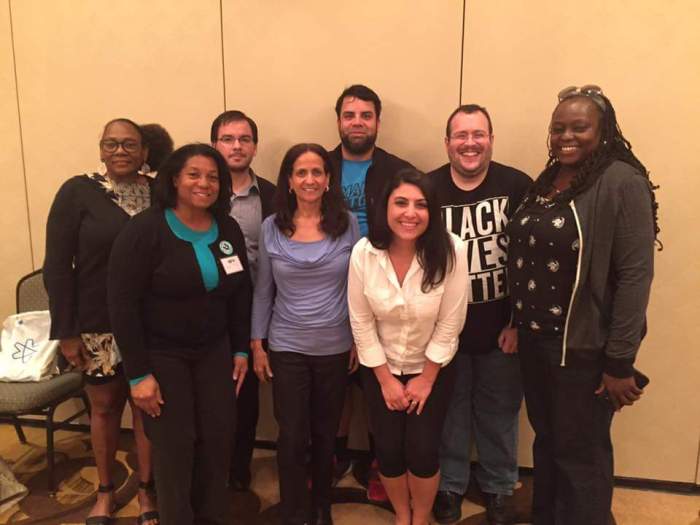
But instead we were host to many of these organizations individual members.
Just how many people came to the Lone Star State for the summit? Thousands? Hundreds?

More like dozens.

Not only did the major civil rights groups neglect to send their leadership, but the bulk of our nation’s education activists also stayed away.

United Opt Out had just gone through a major reorganization on philosophical grounds. Only three of its long-time board members remain – Denisha Jones, Ruth Rodriguez and Ceresta Smith. They have since been joined by five new directors – Gus Morales, Zakary Rodriguez, Erika Strauss Chavarria, Deborah Anderson and Steven Singer (me).

The directors that left the group did so for various reasons, but some of them split along ideological lines. Some thought United Opt Out shouldn’t work with labor leaders or civil rights groups that weren’t perfectly aligned with all of UOO’s goals. So they left. Those who stayed are committed to working with almost anyone to push forward the cause, piece-by-piece if necessary.

As a result, this organization that had been growing by leaps and bounds, finds itself starting afresh. While last year’s conference in Philadelphia drew progressive luminaries like Chris Hedges, Jill Stein and Bill Ayers, this year’s gathering was more low key.

But it was far from somber. In fact, the board’s vision was vindicated in the most amazing way during the summit.

As Jesse “The Walking Man” Turner discussed the importance of reframing school policy to include students basic humanity, Gus looked up from his phone and announced, “The NAACP just ratified its moratorium on charter schools!”

We all stopped what we were doing and went to our phones and computers for verification. Denisha found it first and read the resolution in full.

We cheered, laughed and hugged each other.

This was exactly the kind of change we’ve been talking about! In fact, Julian Vasquez Heilig, education chair of the California and Hawaiian NAACP chapter, had originally been scheduled at the summit as a keynote speaker. When the resolution that he had been instrumental in crafting came up for a vote at the national NAACP meeting, he understandably had to cancel with us. Clearly he was needed elsewhere.

And now one of the largest civil rights organizations in the country has taken a strong stance on charter schools. Not only does the NAACP oppose charters as a solution to inequities experienced by children of color, they’ve now gone beyond mere ideology. They’re calling for action – no new charter schools.

It is a tremendous victory for parents, children and teachers everywhere. And a much needed win for civil rights and education activists. The civil rights community (including the Black Lives Matter movement) is starting to acknowledge that Brown vs. Board is right – we cannot have “separate but equal” school systems because when they’re separate, they’re rarely equal.

Let me be clear – UOO did not achieve this triumph alone. It took many people, some of whom probably have never heard of us. However, activists supporting our movement such as Julian were strongly involved.

And if we had listened to the naysayers who proposed only working with perfectly like-minded groups, this might never have happened.

As a national organization, the NAACP still supports standardized testing as necessary to hold schools accountable for teaching all students. But this was not always the case.

In October of 2014, there were 11 civil rights groups including the NAACP Legal Defense and Educational Fund (LDF) who wrote a letter to President Barack Obama asking him to reduce standardized testing.

Then in January of 2015, a full 19 Civil Rights organizations including the NAACP wrote to Congress asking lawmakers to preserve annual testing.

What changed in those three months?

All of these organizations accept huge donations from the corporate education reform industry including some of the richest people in the world like Bill Gates. While none of us were present at these decision making sessions, it seems clear that fear of losing their funding may have forced them to make hard compromises.

Should we then as education activists wipe our hands of them? Should we refuse to work with them on some issues because we disagree on others?

United Opt Out says no. We’ll work with almost anyone where we can, when we can. And the results were on display with the NAACP resolution calling for a charter school moratorium.

Perhaps now that we’ve found that common ground on school privatization, we can do the same with standardized testing. Perhaps we can help educate them about the history of this practice, how it was a product of the eugenics movement and has always been used to support white supremacy and keep people of color and the poor in their place.

If we can make that argument, think of the potential. Perhaps leadership at these big civil rights groups would be less willing to compromise if they understood that standardized testing was used to justify mass sterilizations of American citizens and it was greatly admired by the Nazis. Perhaps if they understood that our modern standardized assessments are little better and create a racial proficiency gap by their very design – maybe then threats from rich white philanthropists won’t seem as important. Perhaps if they understood that schools can best be held accountable by reference to the adequacy of the funding they receive and a detailed accounting of what they do with it, these organizations might be less inclined to rely on multiple choice testing.

In fact, this is why we were there together in Houston in the first place. We wanted to make our case to these same civil rights organizations.

They may not have sent their leaders, but their members were already here. And we spent the time working together to find ways to make our case.

It was really quite amazing.

Audrey Amerin-Breadsley, professor and author of the blog Vamboolzed, gave us an incredibly accessible and informative keynote on value-added measures (VAM), the practice of using students test scores as a way to evaluate their teachers. For instance, did you know this common practice was originally based on a model for the cattle industry? It’s junk science and has little relation to education, teachers and students. All it does is pit students and teachers against each other creating a culture of fear where educators can be unfairly fired at any time – not the best environment for learning. Yet ignorant, lazy and/or corrupt bureaucrats still champion it across the country as a solution to improving schools.

Sam Abrams, Director of the National Center for the Study of Privatization in Education (NCSPE) and an instructor at Columbia University, explained in minute detail how corporate education reform relies on bad statistics and is bad business. He explained how academics blinded by economics and unencumbered by any real-life experience of public schools came up with this scheme, which has been disproven by the facts again-and-again. Not only do the highest achieving countries such as Finland go a different route, but those that follow this market driven model find student achievement suffering. In short, our current education policies are really faith-based initiatives, a faith in the invisible hand of the market, and an ignorance of reality.

But perhaps most heartening was the series of talks given by the locals. Houston Federation of Teachers is one of the few labor unions to pass a resolution supporting parents rights to opt their children out of standardized testing. In fact, teachers and parents even run a free Opt Out Academy for children not taking the tests so that their education continues while their peers suffer through these useless assessments. We got to meet parent zero, the first parent to refuse testing in the district. We heard the community’s painstaking process of spreading the movement one family at a time. This was in effect an opt out cookbook, a how-to for anyone wishing to bring this social justice action to their own neighborhoods.

It was a weekend to give anyone hope.

We were small but we were powerful. Given a few years to rebuild, UOO could well be much stronger than we once were. Meanwhile parents across the country continue to refuse these tests for their children at an exponential rate.

There are many struggles ahead. But we have made real progress toward our goal of providing an excellent education for all children.

No longer can our governments be allowed to keep discriminating against them based on the color of their skin, their parents bank accounts and other factors. We’re standing for all students, because we don’t see them as consumers or data points. We see them as children, as human beings. And we stand together to protect and preserve that shared humanity.

What better way to spend a weekend?

What If Clinton and Trump Debated Education Policy?

bbxdrs0-img

The second Presidential debate was a bust for the millions of Americans who care about public schools.


Instead, we got Donald Trump mansplaining away his vagina-grabbing days. We got Hillary Clinton blaming Machiavellian duplicity on a movie about Abraham Lincoln. But not a word about K-12 education.


After all these debates in the primary and only one more debate left in the general, it seems a pattern is emerging. The media just doesn’t ask the kind of questions parents, teachers and students really care about. After all, there is no defined position staked out by each political party on schools and schooling. Both sides are kind of the same. Asking about it wouldn’t support the usual narratives about so-called “conservatives” and “liberals.”


So once again I appeal to the power of education bloggery to give you what I imagine a debate on this subject might sound like from Clinton and Trump.


Hold on to your pussies. Here goes…


Me: Thank you, Secretary Clinton and Mr. Trump, for being here today to talk about education issues.


Clinton: You’re very welcome.


Trump: (sniff) Yes. I am very glad to be here. No one cares more about education than me. Okay?


Clinton: Well, hold on there, Donald. I’ve spent my entire career fighting for kids and families…


Trump: (sniff. sniff.) What about the kids and families of Benghazi?


Me: O-kay! Let’s begin. Shall we? This question is for both of you. How would you describe your education vision? Mr. Trump, you won the coin toss, so you go first.


Trump: Thank you, Steven. And let me just say I have lots of education vision. My education vision is just tremendous. I think public schools are the most important thing in our country. The taxes we pay for them are just incredibly high. No one pays more taxes for schools than we do. Not the French. Not the Chinese. Not the Russians. And as President I would make America great again by cutting taxes on schools. The business community doesn’t need this. It hurts competition and that hurts education. And there are too many taxes for you regular people out there, too. Unlike my opponent, she’s just terrible. Isn’t she, folks? I’d cut taxes while she would raise them.


Me: Your time is up, Mr. Trump.


Trump: …and I just want to say this one last thing, Steven. Hillary Clinton is a liar. And I would never lie like her. Ask Bernie Sanders about that.


Me: Thank you, Mr. Trump. Secretary Clinton? Same question.


Clinton: Thank you, Steven. I want to take this opportunity to thank you, personally, for being here. As a country, we don’t appreciate teachers enough. You are our number one resource. And a renewable resource. Right? You can clap here, People. Ha! Ha! But seriously my vision for education is a strong one. I’ve fought for children and families all my life as First lady of Arkansas, as First Lady of the United States, as a U.S. Senator and as Secretary of State. You might say that I am the most qualified candidate for President in U.S. history.


Me: Thank you. Madame Secretary. Though I wish you had answered the question.


Clinton: Oh I will answer the question. That’s why I have been endorsed by the largest teachers unions in the country…


Me: Next question. Secretary Clinton, you mention your experience. Some have criticized you for putting the needs of Wall Street ahead of working families. How would you prioritize the needs of students and parents over the corporations and edu-tech industry?


Clinton: As you said, Steven, I’ve been around a long time. I’ve seen a thing or two. Like you, I’ve raised a daughter and know how to navigate the pitfalls of our education system. And, honestly, I don’t think we have to have a conflict of interests between business and education.


Trump: Crazy Bernie says differently.


Clinton: …I see our public schools and public charter schools working together hand-in-hand to provide our children with a world class education. You know my husband and I have long supported…


Trump: You should be in jail.


Clinton: Donald, I think this is my time. Is this my time, Steven?


Me: Yes, Mr. Trump. Please stop interrupting. You’ll have a chance to respond.


Trump: Sorry, Steven. I’m just not used to a woman talking for so long. It’s exhausting.


Clinton: Anyway, I’ve always been a booster for higher academic standards. And as President I would do everything I can to make sure our students get the best education possible.


Me: Mr. Trump. Same question.


Trump: What was that question again, Steven? I kind of forgot while I was listening to that long speech she just gave. Talk. Talk. Talk. This isn’t the Bengazhi commission, Hillary, but I wish it was. Trey Gowdy…


Me: Mr. Trump. The question was “How would you prioritize the needs of students and parents over the corporations and edu-tech industry?”


Trump: Students and parents? They’re just wonderful. We need more students, but I guess that’s where parents come in. That’s why I had so many kids, and they’re all so successful. We didn’t stop with just one. We raised one, two, three… a whole bunch of them. And they’re just tremendous. So I would definitely make sure their needs were being met. Their needs are my needs and so, of course, I would make sure they were being met. You know, perhaps she should have spent more time meeting her husbands needs. Do you know what I mean?


Me: Mr. Trump, the question was about corporations servicing public schools.


Trump: (sniff.) In that case, I’d service corporations. I believe in business. I’ve been a businessman all my life. Very successful. No one knows success like Trump. And I’ve just got to say we all might have been better off in the ‘90s if she had serviced her husband more. I have to tell you.


Me: You are disgusting.


Trump: (shrugs) This debate is rigged.


Me: The next question is for you, Mr. Trump. Whenever you’ve spoken out on education issues, you’ve consistently criticized Common Core. As President, what would you do about Common Core and what role do you think is appropriate for a President in setting national education policy?


Trump: Common Core? I’m against it. It’s no secret. I think it’s been just terrible. It’s been a disaster. A national disaster. And one of the first things I’d do – well the first thing I’d do is throw you in jail…


Clinton: Donald, I…


Trump: But after that I’d get rid of Common Core. There would be no more Common Core. Our kids don’t need Fed Ed. Period. They need more choice. Parents should get to pick the schools they send their kids to. We should stand back and let the parents choose. That’s what I did for Ivanka and my other children and they turned out just fine. Don’t you think they turned out fine, folks? You all saw them on my hit TV shows ‘The Apprentice’ and ‘Celebrity Apprentice.’ Those were great shows. Award-winning TV. Must See Television. Those were good days.


Me: Secretary Clinton. Same question.


Clinton: Thank you, Steven. I appreciate the quality of your questions. It’s clear that this debate has been put together by educators and not representatives of the media. Though I thoroughly support the field of journalism as a profession and a calling.


Trump: You never had a TV show.


Clinton: As to Common Core, I just want to ask Donald something.


Trump: (pops a Tic Tac) It’s surprising you’re going to give up your time to let me talk. I have to say. This is the first time you’ve let somebody else talk…


Clinton: How do you propose to get rid of Common Core when the Every Student Succeeds Act (ESSA) gives that power back to the states?


Trump: (sniff.) E-S-S-A? Never heard of it. I’ll have to ask Mike Pence about it. But the President can do what he wants. You know the old saying, folks: it’s good to be the king.


Clinton: You talk a good game about states rights, Donald, but when you propose getting rid of Common Core, you’re proposing a federal policy that takes away states rights. Every state legislature has the power to change academic standards or retain…


Me: Secretary Clinton, that may be true, but the question was meant for you. What would YOU do about Common Core as President?


Clinton: Nothing. I would respect the law.


Trump: THAT’S a first!


Clinton: I would encourage states to adopt high academic standards and if those standards were the same as Common Core then so be it.


Me: How would you encourage them? By withholding federal grant money like the Obama administration did?


Clinton: I… I think the federal government has a strong role to play in the education of our children. But I would not violate the spirit of the ESSA, unlike Donald. He says he’s for states rights but he calls for a bigger federal power grab than anything my party has ever participated in.


Trump: (sniff.) Wrong.


Me: Okay. Next question. Since we’re talking about the federal role in education, let me ask you both what role you see for the U.S. Department of Education under your administration and whom would you nominate as Education Secretary? Secretary Clinton. You go first.


Clinton: Thank you, Steven. As I said, I believe in the Department of Education. I believe in the Secretary of Education. I believe in teachers. And if we’re going to give our students a leg up – all of our students – then we need to strengthen our public schools and public charter schools. That’s where the Department of Education comes in. Not to enforce education policy but to set the agenda. It helps the states get things done through competitive grants, research and data collection.


Me: So whom would you nominate to head the department?


Clinton: I would have to talk about that with my advisors…


Me: Give us the shortlist.


Clinton: Perhaps someone like John King.


Me: John King!?


Clinton: He’s already there and as my daddy said, if it ain’t broke do not fix it.


Me: Mr. Trump. Same question. What in your opinion is the federal role in national education policy?


Trump: Well, Steven, I don’t think there is one. You know the government that governs best governs least. I learned that from my good friend, Gary Busey. You know? Come to think of it, he’d make a pretty good Secretary of Education, but no. One of the first things I would do is completely disband the Department of Education. On day one. Gone.


Me: So what would happen to Pell Grants, for example, and all the federal money that helps buoy our public schools?


Trump: Do we need it? I was able to raise my family without any help from the federal government.


Clinton: Unless you count your nine bankruptcies, and using loopholes to avoid paying any federal income taxes for over a decade at least.


Trump: I did it all on my own. My father gave me a loan but I made it pay out for me so I could build the Trump empire.


Me: Didn’t you inherit most of your money?


Trump: I’m surprised at you, Steven. I expect something like that from her. She’s bleeding from her… whatever. But you should know better. You think Americans are stupid. And I just think they are strong enough to do it on their own. They don’t need the government to help. We don’t need the regulation, the taxation. Parents can use state money to choose and that will be good enough. Let the free market decide.


Me: Okay. Next question. Standardized testing has come under fire for assessing children’s economic situation more than what they’ve learned. Would you continue to mandate annual testing for all public schools? Mr. Trump?


Trump: I dunno. I’ll have to ask Pence on this one.


Me: You have to ask your vice president what to think on standardized testing!?


Trump: Yes. I mean no. I’m not really sure. Could you make this one multiple choice?


Me: Secretary Clinton? Same question.


Clinton: Standardized testing has been an important part of how we hold school districts accountable. While I understand the concern about over-testing, I think it is important we keep testing our children in grades 3-8 and once in high school. It helps us make sure our schools are meeting all our students’ needs and not violating their civil rights. Many of my former colleagues in the Senate expressed the same concern you mention, Steven, but changed their minds when they were approached by various civil rights organizations…


Me: Many prominent civil rights organizations such as Journey for Justice and various chapters of the NAACP still oppose testing. Why do you chose to side with the organizations who are beholden to the testing industry for their funding?


Clinton: I think… maybe we can give the situation more study and find solutions that would satisfy both the civil rights organizations and testing critics. But it is imperative that schools are held accountable…


Me: What about politicians? Shouldn’t they be held accountable for adequately funding our public schools? That’s why schools struggle. They serve poor populations and don’t have the resources to help their kids excel.


Clinton: This is something you’re obviously passionate about. I have always listened to teachers and with the NEA and AFT would strive to work together to find a solution that’s mutually beneficial to everyone.


Me: Okay. Last question. Since you brought up civil rights, Secretary Clinton, one of the biggest issues facing our schools today is segregation. Many modern schools are as segregated or more segregated by race and socio-economic status than they were before Brown vs. Board. What would you do about that?


Clinton: That is a problem. We must make sure that all our students needs are being met. We cannot let our schools revert to old bad habits. We cannot have schools for blacks and schools for whites. Black lives matter – even when they’re in school. As President, I would make sure everyone had the opportunity to go to the best schools possible. Students who don’t get what they need at school end up on the streets. They feed the school-to-prison pipeline. They end up lost, and many of them become super-predators.


Trump: (laughs)


Me: Isn’t that the term you used as First Lady to describe black youth when your husband’s mandatory sentencing policies expanded our prison population exponentially?


Clinton: Yes and I stand by that statement. We need to help minorities rise above their circumstances. We need to give them a helping hand. They deserve all the same amenities my daughter had, because all lives matter…. Oh shit.


Me: Mr. Trump? Your response?


Trump: Do I have to?


Me: Yes.


Trump: Okay then. Let me just say that segregation is a bad thing. It’s terrible. I’m not exactly sure why but that’s what I’m hearing. We need to make sure only the best students get to go to the best schools and the worst students get their own schools, schools that are right for them. That’s why we need school choice to weed out the worst kids and let them go to the schools that are right for them.


Me: Isn’t that just segregation?


Trump: N…No. That was a really stupid thing to say. Too many people are just stupid today. That’s why I’m going to make America great again. We’re going to have the best schools. You won’t even believe it. They’ll be just the best anyone has ever seen. Okay?


Me: But they’ll be separate schools for blacks and whites? Rich and poor?


Trump: I’d like to pass, Steven.


Me: Okay. That’s all the time we have for today. I’d like to thank both candidates for coming…


Trump: Steven, I just want to say one last thing.


Me: O-kay.


Trump: I… uh… I never grabbed anyone’s pussy. That was just locker room talk.


Clinton: Oh please! It’s just that kind of talk that empowers rapists…


Me: Thank you both for coming…


Trump: Your husband certainly understands this, Hillary. Men like us with such big hands, we’ve never had any complaints. You know? Here let me show you. (reaches into pants.)


Me: Cut their microphones please. Call security on, Mr. Trump. Thank you, everyone, for coming. We’ll see you at the polls in November. Just remember, you picked these two assholes. We could have had Bernie Sanders but we’re left with these two tools. This is your democracy at work. We should have let Jill Stein in here to class up the joint. Oh well. Goodnight and good luck.

You Can’t Be Anti-Opt Out and Pro-Democracy

20130220-michels-edy-chamness-sign

Our lawmakers have a problem.

This summer they doubled down on one of the most anti-democratic mandates in the federal repertoire yet they claim they did so to protect states rights.

Here’s the problem.

Every year, hundreds of thousands of public school parents across the country opt their children out of standardized testing.

But Congress voted to keep mandating that 95% of students take the tests.

It all happened with the much celebrated bipartisan passage of the Every Student Succeeds Act (ESSA), the federal law that governs K-12 schools.

While lawmakers made changes here and there to let the states decide various education issues, they kept the mandate that students participate in annual testing.

They didn’t leave that to the states. Whether they were Republican or Democrat, almost all lawmakers thought it was just fine for the federal government to force our children to take standardized tests at least every year in 3-8th grades and once in high school.

If any school district, has more than 5% of students that don’t take the tests – for whatever reason – the federal government can deny that district funding.

Think about that for a moment.

Our lawmakers are supposedly acting in our interests. They’re our representatives. We’re their constituents. They get their power to pass laws because of our consent as the governed. Yet in this instance they chose to put their own judgement ahead of ours.

They could have made an exception for parents refusing the tests on behalf of their children. They just didn’t see the need to do so.

Why? Because they were worried about minority students.

It’s a laughable claim in so many ways.

It goes something like this – without standardized testing, we’ll have no way of knowing if public schools are educating students of color.

Let’s say for a moment that this were true. In that case, we can expect no parent of color would ever refuse standardized testing for his/her child.

First, this is demonstrably untrue. Black and brown parents may not be the most numerous in the opt out movement, but they do take part in it.

Second, in the majority of cases where white parents refuse testing, that would have no bearing on whether testing helps or hurts students of color. If the point is the data testing gives us on black kids, what white kids do on the test is irrelevant.

Third, even if opting out hurt students of color, one would assume that it is the parents prerogative whether they want to take part. If a black parent doesn’t want her black son to take a multiple choice exam, she should have the right to waive that exam and the responsibility would be on her head.

So there is absolutely no reason why lawmakers should have overstepped their bounds in this way and blocked all parents rights about what the schools do to their children.

It is a clear case of governmental overreach. And there are plenty of parents just waiting to bring it to the U.S. Supreme Court for the ultimate Constitutional test.

However, that probably won’t happen for the same reason it never happened through the 15 years of No Child Left Behind (NCLB) which also contained the annual testing rule.

The federal government has never withheld tax dollars based on students not taking standardized tests. officials at the U.S. Department of Education have made threats, but they have never devolved into action.

The bottom line is this: they know how Unconstitutional this mandate is, and they aren’t itching to have it tested in the highest court in the land.

It would open a whole can of worms about standardized testing. What is the federal government allowed to do and not allowed to do about education policy?

The ESSA is an attempt to reduce the federal role, but keeping the annual testing mandate was either a grievous mistake or the last vestiges of federal hubris.

But let’s return to the reasoning behind it – so-called civil rights fears.

Various groups including the NAACP asked for it to be included to protect minority students. Annual testing is the only way, they claimed, to make sure schools are teaching students of color.

It’s nonsense.

There are plenty of ways to determine if schools are meeting the needs of minority students – especially since most students of color go to segregated schools.

Even after Brown v. Board, we have schools that cater to black kids and schools that cater to white kids. We have schools for poor kids and rich kids.

It is obvious which schools get the most resources. Why isn’t that part of this “accountability” scheme? We can audit districts to see how much is spent per pupil on poor black kids vs rich white kids. We can determine which groups go to schools with larger class sizes, which groups have more access to tutoring and social services, which groups have expanded or narrowed curriculums, which groups have access to robust extra-curricular activities, which groups have the most highly trained and experienced teachers, etc.

In fact, THAT would tell us much more about how these two groups are being served by our public schools than standardized test scores. We’ve known for almost a century that these test scores are more highly correlated with parental income than academic knowledge. They’re culturally biased, subjectively scored and poorly put together. But they support a multibillion dollar industry. If we allow a back door for all that money to dry up, it will hurt lawmakers REAL constituents – big business.

So why were civil rights groups asking the testing mandate be kept in the bill? Because the testing industry is comprised of big donors.

Only a few months before passage of the ESSA, many of these same civil rights groups had signed declarations against standardized testing. Then suddenly they saw the light as their biggest donors threatened to drop out.

Make no mistake. Standardized testing doesn’t help poor minority children. It does them real harm. But the testing industry wrapped themselves up in this convenient excuse to give lawmakers a reason to stomp all over parental rights.

The conflict wasn’t between civil rights and parental rights. It was between parental rights and corporate rights. And our lawmakers sided with the corporations.

Let me be clear: legislators cannot be against opt out and in favor of individual rights.

The two are intimately connected.

Our schools have no business telling parents how to raise their kids. But our parents DO have a right to do the opposite. In fact, that’s how the system is supposed to work.

We, parents and citizens, control our schools – not you, our representatives. The principal can’t say you haven’t a right to opt out your kid. He’s just your representative. So is the teacher.

Everyone who works in the school is there to do what you want them to do for your child. Yes, they are well trained and have a world of knowledge and experience that we should draw on. And in most cases, they’re being forced to confront us by lawmakers who are tying their hands and directing them to do the dirty work.

We have common cause. We need to stand with our teachers and principals, our school boards and education professors. We need to stand together against lawmakers who think they know better.

In short, we don’t need lawmakers consent to opt out. They need our consent to stop us.

They get their power from us. They work for us.

And it’s time they get to work and rescind the annual testing mandate.

The Child Predator We Invite into Our Schools

th

There is a good chance a predator is in the classroom with your child right now.

He is reading her homework assignments, quizzes and emails. He is timing how long it takes her to answer questions, noting her right and wrong answers. He’s even watching her body language to determine if she’s engaged in the lesson.

He has given her a full battery of psychological assessments, and she doesn’t even notice. He knows her academic strengths and weaknesses, when she’ll give up, when she’ll preserver, how she thinks.

And he’s not a teacher, counselor or even another student. In fact, your child can’t even see him – he’s on her computer or hand-held device.

It’s called data mining, and it’s one of the major revenue sources of ed-tech companies. These are for-profit business ventures that produce education software: programs to organize student information and help them learn. They make databases and classroom management tools as well as educational video games and test prep software.

As schools have relied more heavily on technology to enhance lessons, they’ve invited big business into a space that is supposed to be private.

The Family Educational Rights and Privacy Act (FERPA) protects student privacy, but it also gives school districts the right to share students’ personal information with private companies for educational reasons.

Companies are supposed to keep test scores, disciplinary history and other official records confidential. They’re not supposed to use them for their own ends. But the law was written in 1974 before the Internet went mainstream or many of these technologies were even conceived.

It’s unclear exactly who owns this data or whether FERPA protects it.

For every child utilizing these programs, there’s a good chance their data has been put into a portfolio with their name on it. That portfolio could be sold to advertisers and other business interests so they can better market their products to young consumers. With this information, these companies are turning children into guinea pigs so they can improve the profitability of their products.

Let me be clear. It’s not that technology is essentially evil. There are many ways in which it can be used to enhance student learning when provided under the supervision of a trained educator. But the current laws offer little protection for children and parents from rampant abuse by the ed-tech industry.

In most cases no one explicitly gives permission for student data to be shared. No one knew it was even happening.

This is an area that is almost completely unregulated. Hardly anyone is investigating it. After all, why should they? It’s just harmless big business. It’s just corporations we invited to the party; we may even have paid them to be there.

Individual school districts could write privacy protections into their contracts with ed-tech corporations, but few do.

According to a nationwide study by the Center on Law and Information Policy at Fordham University, just 7 percent of the contracts between districts and ed-tech corporations barred the companies from selling student data for profit.

Few contracts require companies to delete sensitive data when they are done with it. And just a quarter of companies clearly explain why they need personal student information in the first place, according to the same study.

To make matters worse, the publicly stated privacy policies of these corporations can be extremely dense and full of provisos. You may need a lawyer specializing in this field to truly understand what they’re promising to keep private and what might fall under a loophole.

For instance, even if a company promises not to share student information for nonacademic reasons, it can farm out some of its services to third party companies that have no such compunction about student privacy. These third party vendors or even the primary ed-tech company can put cookies on your child’s computer or device that continue to gather data on her and report back on it indefinitely. Moreover, even if the ed-tech company is diligent about protecting student privacy, that policy can change without notice and without parents being notified. For instance, many of these ed-tech companies are rag tag start-ups that are just hoping to be purchased by a bigger organization. In that case the privacy policy will almost certainly alter, possibly without notice.

Data mining isn’t exclusive to education software applications. If you’ve ever passed up a product on-line and then immediately saw an advertisement for that product on a different Website – congratulations – You’ve been data mined. Many of the applications adults use every day in their virtual lives practice this to some extent – Facebook, Google, Netflix, etc. However, there’s a difference between an adult user who enters into virtual relationships with eyes wide open and a child just completing the classwork her teacher assigned in school.

But even beyond the philosophical difference is the extent to which our children are being data mined. No where is it more pervasive than in our schools.

A really efficient ed-tech firm can collect as much as 10 million unique data points on each child, every day. That’s exponentially more than Facebook, Google or Netflix collect on their users.

Moreover, the ed-tech industry hungers for even more data on our children.

The Bill & Melinda Gates Foundation funded a $1.4 million research project to provide middle-school students with biometric sensors designed to detect how kids responded on a subconscious level to each minute of each lesson. Like Common Core State Standards – Gates’ attempt to force uniform academic standards on the nation’s public schools – data mining is all about turning real children into information. Intelligence and knowledge are reduced to numbers. Biological functions, heat indexes, even eye movements are tabulated as a function of a salable commodity – your child.

In the not too distant future, ed-tech companies could sell information about which prospective job applicants or college students have the proper aptitude to be successful. In some ways, this is just an extension of the ways standardized tests like the Scholastic Aptitude Test (SAT) are used to unfairly label students worthy or not of a post-secondary education. However, those tests are taken by high school juniors and seniors. The coming data mining boom would judge children based on their performance all the way back to kindergarten or even pre-kindergarten.

As usual the American Legislative Exchange Council (ALEC) is already planning for this dystopian nightmare. The conservative lobbying organization has drafted a model bill to make this a reality.  If picked up and offered in any state legislature, the bill would set up a central database for student records and allow colleges or businesses to browse them in search of potential recruits.

In addition, these student portfolios could allow corporate vultures to prey on customers vulnerable to particular sales pitches. For instance, young adults who had struggled at math in high school would make dandy targets for high-priced payday loans.

In the meantime, hedge fund managers and other investors are pouring money into the ed-tech market. More than $650 million flowed into technology firms serving K-12 and higher education each year for the past three years. That’s nearly double the $331 million invested in these markets in 2009. The national market for education software and digital content is nearly $8 billion, according to the Software & Information Industry Association.

Yet there is little evidence these applications are truly helpful in educating children. Even the technology-loving Gates Foundation, found in a national survey that only 54 percent of teachers thought the digital tools used most frequently by their students were effective.

Let’s get something straight: the reason most of these firms exist is not education. It is spying on children. It is stealing their valuable data for corporations’ own ends.

The ed-tech market is intimately entwined with the latest fad in education policy – Competency Based Education (CBE).

This has come to mean teaching and assessment conducted online, where students’ learning is continuously monitored, measured, and analyzed.

However, the goal seems to be replacing big end of the year standardized tests with daily stealth assessments. In this way, it would be more difficult for parents to refuse testing for their children. It would hide the ways in which a standardized curriculum narrowed student learning to the very basics. It would hide how children’s every tiniest action is being used to judge and evaluate their schools and teachers. And this information of dubious validity could be used to close public schools and replace them with shoddy but more profitable charter schools.

Education historian Diane Ravitch talks about a meeting in August of 2015 with The State Commissioner of Education in New York, Mary Ellen Elia, and several board members of New York State Allies for Public Education (NYSAPE), a highly successful state opt out organization.

She says:


“At one point, Commissioner Elia said that the annual tests would eventually be phased out and replaced by embedded assessment. When asked to explain, she said that students would do their school work online, and they would be continuously assessed. The computer could tell teachers what the students were able to do, minute by minute.”

The plan has been laid bare. Our students privacy has been compromised and is being used against them. If big business has its say, our children will be forever pawns in a system that reduces them to data and profit.

That’s not what public school should be about.

It should be a place centered on learning not earning.

It should be a place that values the student and not her data.

It should be a place of creativity, imagination and wonder.

But as long as we allow ed-tech companies to run unregulated in the shadows, it will always be susceptible to these dangers.

The only one who can stop these predators in your child’s classroom is you.

State Senator: Get Ready to Sue the PA Department of Education Over Common Core Testing

20110831_inq_rrxsrc31z-a

Pennsylvania State Sen. Andrew Dinniman is mad as Hell and he’s not going to take it anymore.

The West Chester Democrat is furious at the state Department of Education (PDE) over the Keystone Exams.

In February, the legislature unanimously passed a law to delay for two years using the Keystones as a graduation requirement for public school students. The exams will still be given to high school students in Algebra I, Biology and English, but passing them is not necessary to receive a diploma. During this time, the legislature is supposed to investigate alternate assessments above and beyond standardized testing.

However, Dinniman sent out an email to supporters this week claiming PDE is “blatantly ignoring the law and issuing directives to local school districts to use the exam if they want to for graduation.”

This goes against the delay, says Dinniman. The legislature is unsure requiring the Keystone Exam is a good idea, yet the state Senator contends the current administration is advising districts to move forward anyway.

Under the old law that was put on hold by the delay, if parents decided to opt their children out of standardized testing, students had to complete a Project Based Assessment. However, even though there is no test-based graduation requirement for current seniors, Dinniman says PDE still is forcing these children to complete Project Based Assessments.

“It appears that PDE is forcing the children of parents who opted out to take the Project Based Assessment, whose use is currently suspended by the legislature,” he says.

“There seems to be no respect by PDE for the rights of parents concerning their own children.”

Dinniman, who also serves as minority chair of the Senate Education Committee, has long been a critic of the Keystone Exams. He lead the charge to delay their implementation.

Now that PDE seems committed to the project despite concerns by legislators, he is asking for parents and other concerned citizens to contact him about suing the organization.

“If you know parents or organizations who might want to take PDE to court or file amicus briefs, let me know…  This is a matter of great importance. A number of us have been working for years against excessive testing and have serious concerns about Common Core.”

He will hold an open meeting for those concerned about the issue on Monday, Sept. 12, at 7:30 pm in his district office along One North Church Street in West Chester.

One of the issues at stake is the exorbitant costs of the Keystone and Pennsylvania System of School Assessment (PSSA) tests. With education budgets shrinking at the federal, state and local level, this money diverted to huge testing corporations could be better spent elsewhere.

Since 2008, the Commonwealth has spent $1 billion to proctor, grade and create new versions of the PSSA and the new Common Core-aligned Keystone Exams. Of that figure, $741 million went to Data Recognition Corporation.

Dinniman included in his email an explanation of the Commonwealth’s contract with Data Recognition Corp., a chart showing how much has been paid to the company, a list of materials PDE requested from the company but that has not yet been provided and an article written by education historian Diane Ravitch published in the New York Times explaining why these tests are troublesome.

In 2013, the state Conference of NAACP Branches issued a statement condemning the Keystone graduation requirement in extremely strong terms.

The organization called it a “present day form of Eugenics”, “a human rights violation”, “a clandestine social movement that strips children of their dignity and self worth” and that it would deprive impoverished and minority students  “of decent income, decent food, decent homes, and hopeful prospects as well as the security of justice.”

The statement can be read in full here.

In the halls of state government, Dinniman has been one of the most vocal critics of high stakes testing and national academic standards.

“I have been fighting against the use of these standardized tests as the sole determinants of high school graduation since they were first proposed by the previous [Corbett] administration in 2012.”

“Strong standards and effective assessments are needed in our schools, but they must come with the necessary resources and support to be implemented in a way that does not negatively impact both students and taxpayers,” he says.

Chester County, where Dinniman is from, has been a hotbed of testing criticism. Located in the southeastern most part of the state, parents, teachers and students publicly spoke out against the exams. Almost all school boards in the county passed resolutions opposing the Keystones and 58 superintendents and Intermediate Unit Directors up through the Philadelphia suburbs also expressed opposition.

If the delay had not been approved, this year’s seniors would have been required to pass all three Keystone Exams in order to graduate. Now the exams won’t be a graduation requirement until the 2018-19 school year.

The federal government still requires the exams be given for evaluative purposes, but it was the Republican dominated Tom Corbett administration that went the extra step of making the exams necessary to receive a diploma.

The delay is supposed to provide additional time to resolve consequences of implementing the exams. This means investigating and reporting on the following:

    • Alternative methods for students to demonstrate proficiency for graduation in addition to the Keystone Exams and project-based assessments.
    • Improving and expediting the evaluation of the project-based assessments.
    • Ensuring that students are not prohibited from participating in vocational-technical education or elective courses or programs as a requirement of supplemental instruction.

Moreover, the newly passed federal K-12 education legislation, the Every Student Succeeds Act (ESSA), allows the Commonwealth even more leeway to implement fairer and more affective means of assessment, Dinniman says.

“Until now, education policy has been largely dominated by regulations implemented by the State Board of Education in accordance with the federal government. Some of these regulations seemed to be enacted with little to no consideration of fiscal impacts or educational value,” Dinniman said.

“However, the state legislature has a Constitutional duty and responsibility to oversee and provide for ‘a thorough and efficient system of public education.’ Going forward, I believe the legislature will be more aggressive in reasserting its role in the process.”

Dinniman can be reached by phone at 610-692-2112 (District Office) and 717-787-5709 (Harrisburg Office).

He can be reached by email here.

He is on Facebook and Twitter.

Below is the full text of Dinniman’s Email:


(Source: optoutpa.blogspot.com)


To Supporters of Ending Common Core Exams in Pennsylvania:

Despite Act 1 of 2016, which suspended any use of the Keystone exams or the Project Based Assessments for graduation purposes during the two year period of 2016-18, the Pennsylvania Department of Education (PDE) is blatantly ignoring the law and issuing directives to local school districts to use the exam if they want to for graduation.

It certainly appears that PDE has shown their solid commitment to the Common Core testing process and the continued collection of data.  They don’t seem to care about or respect the law.  This is not government by the elected legislature but government by the bureaucracy.

You will be interested to learn the taxpayers of Pennsylvania, since 2008, spent $1.1 billion on these Common Core tests, with $741 million of that going to one testing company, Data Recognition Corporation (DRC).

Please view the supporting material at the following links:
1. An explanation of the Data Recognition Corp. (DRC) contracts.

2. A chart showing the DRC contracts, which come to $741,158,039.60, and the total paid to date of $440,512,625.69.

3. A listing of material requested from PDE but, as of this date, not provided.
4. A column from the July 23, 2016 New York Times providing background on these Common Core Exams, which in Pennsylvania are the Pennsylvania System of School Assessment (PSSA) and Keystone Exams.

Additionally, it appears that PDE is forcing the children of parents who opted out to take the Project Based Assessment, whose use is currently suspended by the legislature.  There seems to be no respect by PDE for the rights of parents concerning their own children.

So the question now is “what will we do about this situation?”  If you know parents or organizations who might want to take PDE to court or file amicus briefs, let me know.

In the meantime, I am having a meeting for those concerned about PDE’s actions in my district office, One North Church Street, West Chester, on Monday, September 12th, 2016 at 7:30 p.m.

This is a matter of great importance.  A number of us have been working for years against excessive testing and have serious concerns about Common Core.  Please invite your friends to join in the September 12th meeting.

Respectfully,

Andrew E. Dinniman

State Senator, 19th District

Common Core’s New New Math has the Same Problem as the Old New Math

little tired boy sitting at a desk and holding hands to head


Bad ideas are like unlucky pennies – they keep coming back again.

Take the New Math. Or maybe I should say the New New Math.

Common Core State Standards suggests we teach children a new way to do arithmetic. We should focus on multiple ways to reach an answer with an emphasis on understanding the concept behind the problem rather than just manipulating numbers.

It sounds fine in theory – until you think about it for five minutes.

When learning a new skill, it’s best to master a single, simple approach before being exposed to other more complex methods. Otherwise, you run the risk of confusion, frustration and ultimately not learning how to solve the problem.

Take directions.

If you’re lost and you ask for directions, you don’t want someone to tell you five ways to reach your destination. You want one, relatively simple way to get there – preferably with the least amount of turns and the highest number of landmarks.

Maybe later if you’re going to be traveling to this place frequently, you may want to learn alternate routes. But the first time, you’re more concerned about finding the destination (i.e. getting the answer) than understanding how the landscape would appear on a map.

This is the problem with Common Core math. It doesn’t merely ALLOW students to pursue alternate methods of solving problems. It REQUIRES them to know all the ways the problem can be solved and to be able to explain each method. Otherwise, it presumes to evaluate the student’s understanding as insufficient.

This is highly unfair to students. No wonder so many are failing.

Sadly there’s some history here that should have warned us about the perils of this approach.

Common Core isn’t the first new math approach to come along. In the 1960s we had a method actually called “The New Math.” And like Common Core, it was a dismal failure.

Like the Core, it proposed to focus more on conceptual understanding, but to do so it needlessly complicated matters at the grade school level.

It introduced set theory, forcing students to think of numbers as groups of objects rather than abstractions to be manipulated. In an advanced undergraduate mathematics course, this makes perfect sense. In first grade, it muddles the learning tremendously.

To make matters even more perplexing, it mandates students look at numbers with bases other than 10. This is incredibly confounding for elementary students who often resort to their fingers to help them understand early math.

Tom Lehrer wrote a very funny song about the new math which shows how confusing it can be. The methods used to solve the problem can be helpful but an emphasis on the conceptual underpinning at early ages perplexes more than it helps:

Popular culture is full of sly references to this old New Math. Charles Schultz wrote about it in several Peanuts comic strips in 1965. In one such strip, kindergartener Sally gets so frustrated trying to solve a New Math problem she cries, “All I want to know is, how much is two and two?” New Math even made an appearance in the 1973 movie “There’s No Time for Love, Charlie Brown,” in which the titular Brown asks “How do you do New Math problems with an old Math mind?”

Screen shot 2016-08-27 at 3.10.40 PM

In the 1992 episode of the Simpsons, “Dog of Death,” Principal Skinner is elated that an influx of school funding will allow him to purchase school improvements. In particular he wants to buy history books that reveal how the Korean War ended and “math books that don’t have that base six crap in them!”

So where did this idea for New Math come from?

In 1957, the Soviets launched Sputnik sending Americans into a panic that they were being left behind by these Communist supermen. As a result in 1958, President Dwight D. Eisenhower passed the National Defense Education Act which dramatically increased school budgets and sent academics racing for ways to reform old practices. One product of this burst of activity was the New Math.
A decade later, it was mostly gone from our public schools. Parents complained they couldn’t help their children with homework. Teachers complained they didn’t understand it and that it needlessly confused their students.

Fast forward to 1983 and President Ronald Reagan’s National Commission on Excellence in Education. The organization released a report called “A Nation at Risk” that purported to show that public schools were failing. As a result, numerous reforms were recommended such as increased standardization, privatization and competition.

It is hard to overemphasize how influential this report was in education circles. Even today after its claims have systematically and thoroughly been debunked by statisticians like those at Sandia National Laboratories, politicians, pundits and the media persist with this myth of failing public schools.

“A Nation at Risk” birthed our modern era of high stakes testing and, in 2009, Common Core.

In theory, each state would adopt the same set of academic standards thereby improving education nationally. However, they were written by the standardized testing corporations – not working educators and experts in childhood development. So they ignore key factors about how children learn – just like the New Math of old.

In short, we repeated the same mistake – or a very similar one.

Children are not computers. You can’t program their minds like you would a MacBook or iPhone. In many ways, including math instruction, Common Core ignores these facts.

And so we have the same result as the old New Math. Parents all over the country are complaining that they can’t help their children with their homework. Teachers are complaining that the Core unnecessarily confuses students.

In some ways, the Core is worse than the old New Math because of its close connection with high stakes testing. In the ‘60s if a child didn’t understand how to add, he failed math. Today, if a child does that, he fails the standardized test and if that happens to enough students, his school loses funding, his teacher may be fired and his school may be closed. As such, the pressure today’s children undergo is tremendous. They aren’t just responsible for their own learning. They’re responsible for the entire school community.

Those are unfair burdens for school children – especially when the decisions that make it easy or hard for him to learn are not made by the student but by politicians, pundits and policymakers.

But perhaps most telling is this: it doesn’t help children learn.

Isn’t that what this was all supposed to be about in the first place?

Perhaps we don’t need a new math. Perhaps we simply need policymakers willing to listen to education and childhood experts instead of business interests poised to profit off new reforms regardless of whether they actually work.

Do Unions Belong in the Fight Against Corporate School Reform?

ct-chicago-teachers-rally-met-0610-20150609


In the fight for public education, the forces of standardization and privatization are running scared.


They’ve faced more pushback in the last few years – especially in the last few months – than in a decade.


The Opt Out movement increases exponentially every year. Teach for America is having trouble getting recruits. Pearson’s stock is plummeting. The NAACP and Black Lives Matter have both come out strongly against increasing charter schools.


So what’s a corporate education reformer to do?


Answer: Change the narrative.


They can’t control the facts, so instead they try to control the story being told about the facts.


It’s a classic propaganda technique. As Malcolm X put it:


“If you’re not careful, the newspapers will have you hating the people who are being oppressed, and loving the people who are doing the oppressing.”


Their story goes like this – yes, there is a battle going on over public education. But the two sides fighting aren’t who you think they are.


The fight for public schools isn’t between grassroots communities and well-funded AstroTurf organizations, they say. Despite the evidence of your eyes, the fight isn’t between charter school sycophants and standardized test companies, on the one hand, and parents, students and teachers on the other.


No. It’s actually between people who really care about children and those nasty, yucky unions.


It’s nonsense, of course. Pure spin.


They want you to believe that the corporate vultures preying on our public schools are really just misunderstood philanthropists. And those demanding a fair shake for their own children and communities are really just paid shills from a monolithic and uncaring bureaucracy.


In essence, they want you to believe two things:


1) Despite profiting off the system and zero evidence supporting the efficacy of corporate school policies, they’re motivated purely by empathy.


2) Unions are evil by definition and they pervert everything they touch.


I’m not going to bother with the first claim here. There is an inherent bias from those who wish to change the laws so they can more easily profit off of schools without actually helping students learn and in fact exist at the expense of that learning. If you can’t see through the propaganda wing of the Walmart corporation, the Broad Foundation and Big Daddy Bill Gates, you probably won’t be very receptive to anything else I have to say.


Instead I will focus on the second claim, because it is the more pernicious of the two.


Put simply, unions are not perfect, but they are not evil. In fact, they are essential to the health of public education.


Many progressives are upset with teachers unions because of the current Presidential election. Both the National Education Association (NEA) and the American Federation of Teachers (AFT) endorsed Hillary Clinton in the primary election without what many would consider adequately polling rank and file members. For better or worse, the endorsements were top-down affairs reflecting the preference of union leaders.


That’s not how unions are supposed to work. And it’s having consequences for the way both members and non-members view teachers unions.


Critics infer from this that unions don’t represent membership. They are de facto arms of the waiting Clinton administration and the neoliberal agenda.


There may be some truth to this, but it does not represent the whole picture. Not nearly.


Unions are like any other democratic organization. The larger the association, the further from the grassroots the decision making body.


In the mammoth national unions, decisions are made by representatives most removed from our schools. They probably were teachers or support staff at some point in the past, but that may be ancient history. Now they are professional leaders and therefore at a remove from the grassroots.


By contrast, in our local chapters, leaders are most often working classroom teachers. Decisions are made by those still meeting students’ needs on a day-to-day basis. As such, they retain an authenticity and expertise that may be more cloudy in the large bureaucracies.


This isn’t to say the national unions are by definition unconcerned with the needs of teachers and students. I’m sure that most of the NEA and AFT leadership who decided to endorse Clinton did it because they honestly believe doing so will help public education. And – who knows – they may be right. But what they forgot in this case was the democratic process they were tasked with preserving. As such, they may have to pay a price for their hubris when their terms are up.


In most cases, the leaders of national teachers unions are at too much of a remove to see what is best for our schools. And they usually know that. It is up to the rank and file to tell them what to do, and that’s what happens every year at representative assemblies through various caucuses made up of work-a-day members. And if leaders overstep their authority it is members’ duty to hold them accountable at election time.


So even though the national organizations are most likely to go astray, they often don’t. Usually even these giants are trying to improve the situation in our public schools.


However, it can’t be denied that the most intense and passionate activism happens a bit closer to where the rubber hits the road. It’s those local chapters that are there everyday and make the most difference. They are the heart and soul of unionism.


So when corporate education reformers sneeringly deprecate their opponents as mere unions, they’re glossing over an important distinction. Opposition to privatization and standardization policies doesn’t come from the leadership of the NEA and AFT. It comes from the grassroots. This is not a top down initiative. It is bottom up.


This is how it’s always been. There is no political organization directing the fight to save public education. The Democrats certainly aren’t overly concerned with reigning in charter schools. It was grassroots Democrats – some of whom are also union members – who worked to rewrite the party platform to do so. The Clinton campaign is not directing anyone to opt out of standardized testing. However, voters are demanding that Clinton be receptive to their needs – and some of them are union members.


There is no great union conspiracy to fight these policies. It’s called public opinion, and it’s changing.


That’s what scares the standardizers and privatizers. They’ve had free run of the store for almost two decades and now the public is waking up.


They’re desperately trying to paint this as a union movement when it’s not. Unions are involved, but they aren’t alone. And moreover, their involvement is not necessarily an impediment.


The needs of the community and the needs of teachers are the same.


Both want excellent public schools.


Both want the best for our students.


Both want academic policies that will help students learn – not help corporations cash in.


And both groups want good teachers in the classroom – not bad ones!


The biggest lie to have resonated with the public is this notion that teachers unions are only concerned with shielding bad teachers from justice. This is demonstrably untrue.


Unions fight to make sure teachers get due process, but they also fight to make sure bad teachers are shown the door.


In fact, in districts with strong unions, MORE bad teachers are fired – not less, according to a new study by economics Prof. Eunice Han from the University of Utah.


The study entitled The Myth of Unions’ Overprotection of Bad Teachers concludes that when unions are strong and successfully bargain for higher salaries, they have an incentive to help ensure ineffective teachers don’t receive tenure. In short, it costs too much to keep bad teachers on staff. It is in the interests of the collective bargaining unit to ensure those unfit to teach move along.


Moreover, Han also concludes that strong unions actually help reduce the dropout rate. It just makes sense. When you treat people like the professionals they are, when you give them autonomy and respect, they’re free to concentrate more energy into their jobs than fighting to keep those jobs.


But unions stand in direct opposition to the efforts of corporate vultures trying to swoop in and profit off of public education. Teachers provide a valuable service to students. If your goal is to reduce the cost of that service no matter how much that reduces its value to students, you need a weak labor force. You need the ability to reduce salary so you can claim the savings as profit.


THAT’S why corporate education reformers hate teachers and their unions. We make it nearly impossible to swipe school budgets into their own pockets.


So do unions belong in the fight against corporate education reform?


Answer: Heck yeah! In fact, they are essential to it.


What Real School Choice Would Look Like – And Why What They’re Selling Isn’t It

pathdoc_Shuttertock_decision - Edited 

I can’t hear the words “School Choice” without thinking of Inigo Montoya from the classic film “The Princess Bride.”


I hear Mandy Patinkin’s voice saying, “You keep using that word. I do not think it means what you think it means.”


Because just like the constant cries of “Inconceivable!” from Sicilian boss Vizzini (portrayed by the inimitable Wallace Shawn), policymakers seem a bit confused.


You would expect School Choice to mean that parents would get to choose the school their children attend. However, the policy being pushed by corporate education reformers has nothing to do with that.


It’s about allowing schools to choose students, not the other way around.


Want your child to attend a charter school? Great! In many cases he needs to meet the requirements of admission – good grades, well behaved, no learning disabilities – otherwise they boot him back to the traditional public school he came from.


Want your child to use a voucher to attend a private school? Fine! The voucher will pay for some of her tuition, but you’d better be able to make up the rest AND she needs to meet the criteria for admission.


If administrators don’t want to accept your child, they don’t have to, nor do they ever have to explain why, nor do you get a public forum where you can question them, nor do you have any power to vote them out.


They could decide to turn you down because your child is a minority, disabled, gay, has a belief system of which they do not approve, anything really! And they will never have to explain themselves to anyone.


To me, that’s not school choice. But that’s what they’re selling and some folks are buying it all up like an email sent to you by an inconvenienced Nigerian Prince who just needs your help with a funds transfer.


However, this isn’t to say that the idea of School Choice – REAL School Choice – is inconceivable. (Forgive me, Vizzini.)


You could devise a system of School Choice that actually involved parents being able to choose the school their children attend.


I wouldn’t suggest it. I’m opposed to all forms of School Choice for reasons I’ll make clear later. But I would certainly be more amenable to a plan that actually did what it seems to promise.


So what would real educational choice look like? What would we need to achieve this goal?


First, it would require a massive increase in school funding.


Think about it. You’re asking the government to pay for several separate, parallel systems of education. Students won’t just have School A to choose from. They’ll have School A, B and C.


So we need to construct more schools. We need to staff them. We need to provide each one with books, computers, equipment, etc. That’s going to cost an incredible amount of money.


We’re talking about at least doubling the amount of money we pay for public schools – more likely tripling or quadrupling it.


This is certainly possible. Maybe it’s even preferable. But it won’t be politically acceptable for many people. The push has been to downsize government, do things on the cheap, lower taxes, etc.


Strangely, School Choice cheerleaders often push their agenda as a way to save money. That’s because they don’t care about the quality of the choices they’re offering. They’re not providing enough money for several excellent schools that parents can pick from. They’re taking the money we already spend on one school and having multiple schools fight for it.


It’s like a dogfight for schools. They’ll rip and tear at each other, and the winner gets to take away the most funding. It’s a bad model for animals and an even worse one for schools because everyone loses. No one walks away with enough money to get the job done. You end up with several choices but none of them can really provide the best academic experience. None of them can even provide the kind of education that would come from having just one well-funded choice.


What’s worse, in most states even before you start adding parallel schools, the current funding system is broken. We simply don’t provide enough funding for the schools we already have without adding even more choices.


All public schools don’t get the same amount of money per pupil. That’s true even when you adjust for costs.


Under the current system, schools with a rich tax base provide Cadillac resources for their children. Meanwhile, schools with a poor tax base can’t provide everything that is needed so their kids have to do with less. That means fewer resources, fewer teachers, larger classes, etc.


So-called School Choice policies only make this worse. Schools that already don’t have enough funding to meet their students needs have to give larger portions of their shrinking budgets to charter schools. So instead of one school without enough funding, we have two. That doesn’t fix anything.


However, both of these problems are solvable and the solution is the same in both cases – money.


If you want real choice, you need to do two things: (1) discontinue funding schools based on local property taxes and (2) dramatically increase school funding. Both the state and federal government would have to kick in much more. Local taxes could still be collected to pay a portion for public schools – this could even be collected based on how much each community can afford – but no longer could we allow poor students to get less funding than rich kids. No matter where you lived – in the slums or in a gated community – you’d get whatever funding your school deemed necessary.


This would probably be paid for with a substantial tax increase, though you could also make cuts in other places in local, state, and federal budgets. For most people, I think this would be unacceptable, but it is certainly conceivable.


Second, you need the same rules governing these separate systems – especially when it comes to admissions.


This would be especially hard on charter school and private school administrators.


There could be no more picking and choosing which students get to attend your school. If an emotionally disturbed student with bad grades and an even worse record of behavior wants to attend your charter school, you’ve got to accept him. If a poor student whose parents don’t have the money for tuition (even with the voucher in hand) want to attend your private school, you’ve got to accept her.


This shouldn’t be such a burden. It’s what traditional public schools do now. They take everyone regardless of grades, ability, behavior or poverty.


Third, all schools would have to be transparent and democratically controlled. Their budgets and internal documents would have to be open to public record. Moreover, decisions about how to run the school could not be made behind closed doors – they would have to be made in public. And school directors would have to be subject to democratic control. Decision-makers could no longer be appointed by boards of investors, the mayor or any other bureaucrat. They’d be selected by voters. These would all be public schools, after all, and as such would be subject to rule by the public.


Think about what that means. If your child attends a school, you should get a say in what happens at that school. Even if your child doesn’t attend the school, even if you have no children, you should have a say simply because you pay taxes.


This has been the practice at traditional public schools since forever. In fact, unless the school has been taken over by the state, it’s required by law. But at charters and private schools, it’s not always the case.


It’s funny. In many ways under our current system, the public gets much more input, much more choice at traditional public schools than at so-called School Choice institutions.


Many charters and private schools would balk at this. They are not run democratically and are not beholden to the public.


That’s just the way they like it. Their business model requires it. If they had to be fully transparent and accountable to taxpayers, what would happen to those schools organized for-profit?


I would assume that they would disappear. I think very few parents and taxpayers would allow a fully transparent school to pocket a large chunk of its budget like that. I can’t imagine the public approving a decision to cut student services to boost the bottom line – but this is exactly what happens at certain charter schools every day. Only the protection of current School Choice policies that shield investors from taxpayers allows this kind of malfeasance.


But it doesn’t have to be this way.


We can have real School Choice without all the drawbacks of charters and voucher schools. We can have a system where parents get to pick their children’s schools, where the public is in control, where every child gets an excellent education.


To do so, we’d need a series of fully funded, fully transparent, democratically run schools subject to the same rules and expectations.


Hmm. But that’s not so different than the traditional public school system we have now. Perhaps doing so would give all schools the latitude to experiment that is usually given to charter schools. But for the most part, we’ve equalized our school system and simply eliminated the worst abuses of charter and voucher schools.


We’ve also radically increased the raw number of schools in the system. And we’ve allowed students to attend schools where they don’t necessarily live, but ensured they get adequate funding no matter where they attend.


The result is real Student Choice. Parents get to decide where their children attend, and – at least in theory – all choices would be excellent.


I’ve got to admit – from a certain vantage point – it doesn’t look so bad. Sure it’s going to cost a lot of money, but maybe it’s worth it.


However, finding the cash isn’t the only obstacle. For instance, how do you adequately administrate such a system?


I cannot imagine how administrators could decide how much money their school needs from year to year if the student population can change so dramatically in that time period. How would administrators know how many teachers they need and in which subjects? How would they be able to determine the number of classrooms, how many school lunches are necessary and a host of other things? Wouldn’t it be terribly disruptive to have teachers moving from school-to-school every year following student mobility?


Additionally, how do we provide transportation with students traveling hither and thither? It would be difficult just to organize buses to get kids to school. Older students could be given bus passes, but that wouldn’t be safe for elementary and middle school kids to be traveling this way unaccompanied by adults.


I’m not saying it’s impossible, but it would be very difficult. Perhaps someone could find a system that works. However, I fear this kind of institutional instability would result in some schools being woefully understaffed and underprepared while others have too much.


Moreover, such a situation would be extremely wasteful. We’d be spending much more than we need to provide children with an excellent education. We’d be duplicating services unnecessarily. Personally, I can deal with that much more than its opposite. However, flushing tax dollars down the toilet is a bad practice.


Is there a middle ground that provides parents and students choice without wasting so much money?


Yes.


Instead of providing a series of parallel education systems, supply one system that is able to deliver multiple services.


First, you’d need to fix the funding inequities mentioned above. You don’t have to double or triple what we spend, but you’d probably have to increase support somewhat. And it would have to be distributed fairly.


Then once every school has the funding necessary to give every student what he/she needs, we can work on individualizing that experience. This is exactly the opposite of current education policies from the Bush and Obama administrations.


I’m not talking about Competency Based Education, either, the latest scam to make standardization look like a student centered model. I mean no more high stakes standardized tests, no more Common Core, no more corporate education reform.


Imagine if every district allowed parents and students to choose what kind of education they got within the system. Your child wants to study music? We’ve got an excellent music program. You want your child to study a foreign language? We have plenty of award-winning programs to choose from.


Schools would be able to meet the needs of all students because they would be fully funded. No more poor schools and rich schools – just schools.


To meet this ideal, we need to forgo the fake School Choice being offered at present. We need to stop having schools fight over dwindling resources like pit bulls.


THAT would be a choice worth making.


It would be the best kind of school choice.

Pittsburgh School Director Donates Kidney to 7-Year-Old Student

Screen Shot 2016-08-06 at 12.13.07 AM


Moira Kaleida represents the best of public service.


Some people would give you the shirt off their backs.


She gave a sick child a kidney out of her body.


The Pittsburgh School Board Director isn’t related to the 7-year-old student. She is barely an acquaintance. She doesn’t even represent the ward in which he and his family live. But when she read a Facebook request asking for donors, she says it was a “no-brainer.”


“I thought if it were my kid, I’d want to know someone was out there trying,” Kaleida says.


“It really doesn’t affect my everyday life beyond the couple of weeks of recovery. But for him, it’s something that changes his life drastically.”


The child, Laith Dougherty, had already undergone two heart transplants, one when he was 3 months old and another when he was 3 years old. But in 2012, a test showed his kidneys were working at only 35 percent capacity. After a series of illnesses in the fall, they were down to 6 percent and he was on dialysis.


None of his immediate family was a match and his B blood type made finding one difficult. He was looking at a wait of between 6 months and two years before a donor could be found.


That’s when the family reached out to Facebook. Kaleida saw it, privately investigated to see if she was a match and when she was, she contacted Ghadah Makoshi, the child’s mother.


“It’s shocking to me because I had only met her once or twice,” Makoshi says. “It’s sacrifice to say, ‘I’m going to go through surgery and pain to make sure your kid survives.’ Most people wouldn’t do that.”


The surgery was done in June and the kidney began working immediately. Laith is expected to make a full recovery.


Kaleida is a woman of high ideals.


The 32-year-old mother of two doesn’t just talk the talk. She walks the walk.


Though she’s only been on the board since November, she has been on the right side of just about every issue.


She was the impetus behind the district’s newly approved transgender student policy. After principals and legal experts alerted her to the need for procedures to protect students’ rights and provide supports, she successfully lobbied her fellow school directors to take action.


“We’re moving forward on the right side of law and history,” she said at the time.


She’s also an advocate for community schools and the restorative justice discipline policies currently being enacted district-wide. She supports the idea that Pittsburgh schools should be at the center of the community providing medical care, wraparound services, before- and after-school programs, etc. to help keep children in the classroom. She favors a discipline policy not focused on punishing students but ensuring they make things right for their misbehavior.


To that end, she is a firm supporter of new Superintendent Dr. Anthony Hamlet. When Hamlet was attacked by corporate education reformers and big money interests earlier this summer, she stood by him.


She may be one of the most progressive members of a very high-minded board.


Though city schools struggle to keep afloat because of underfunding from the state and federal government plus an increasingly impoverished local tax base, the district has one of the best boards in the state.


In fact, in many similar urban districts like Philadelphia City Schools, there is no elected school board.


If a Political Action Committee (PAC) has its way, the same thing will happen here. Deep-pocketed investors are gathering funds to unseat as many Pittsburgh School Directors as possible and – if possible – push for the district to be run by government appointees, not duly elected representatives.


Kaleida’s story shows exactly why this would be a mistake.


Corporate cronies would never look out for the needs of the community the way actual residents do. People who live in the community, know the community and relate to the families and children living there are far superior to anyone making decisions based on a spreadsheet.


Kaleida is a lifelong resident and graduate of the district. When she ran for office, even the privatization-loving Pittsburgh Post Gazette couldn’t help but endorse her due to “her superior detailed knowledge of the city schools and their challenges.”


Kaleida dedicates herself to raising her children and volunteering for various organizations. She has given time to the International Cesarean Awareness Network (ICAN); NurturePA, which supports new mothers; and various neighborhood efforts. She also tries to find more funding for the district’s Pre-K initiative so it can provide services to even more children.


She represent District 6 neighborhoods including all or parts of Brookline, Beechview, Banksville, Mount Washington and Duquesne Heights.


Laith is lucky his school is represented by a woman like Kaleida. So are all the parents and children of Pittsburgh.


We need more school directors like her and her colleagues. And more than anything we need more local control of public education.

Why is Common Core Still Here?

oh-dear

Common Core has become a national joke.


In fact, the set of academic standards has inspired a new genre of grade school humor – Common Core comedy.


For instance:


One student turns to another and says, “Common Core is about making us college and career ready.”


The other student replies, “It’s working. It’s making me drink more everyday.”


Here’s another one:


Question: Why can’t mommy help you with your Common Core math homework?


Answer: She only has a four-year degree.


And finally:


Question: How many whiteboards does it take to show you how to screw in a light bulb?


Answer: One, but it takes dozens to explain 1+4 in Common Core.


Parents nationwide know the pain of Common Core by the looks on their children’s faces.


They see bright, curious youngsters go to school and come back hating education and thinking they’re stupid.


Parents get the same feeling trying to decipher their children’s homework.


Meanwhile the majority of teachers hate the standards – and as they become more familiar with it, that number grows every year.


So why do we keep using Common Core? Why haven’t our schools thrown this bad idea on the trash heap of failed education policies?


In short – because industry is making a lot of money off it.


Common Core was created by private industry.


It was not made by the states, nor was it written by the federal government.


It was created to sell a new generation of standardized tests and textbooks.


It’s raison d’etre is profit not education.


School children didn’t need a unified set of academic standards. Big business needed them to sell more books and tests.


The standards were written by Achieve, Inc., a Washington, D.C., organization formed in 1996 by corporate leaders and six state governors. The endeavor was funded by Bill Gates and other corporate interests. It was reviewed by individuals and organizations also funded by Gates.


Then the federal government stepped in to strongly encourage states to adopt the standards. Not because anyone actually thought they were necessary. They did it because that was what wealthy donors wanted.


Eventually the standards were adopted in 42 states, but not because legislatures voted on them. The standards were quietly approved by state boards of education, unelected state education chiefs and boards of education. Many lawmakers didn’t even know what Common Core was or that their state had implemented it until voters started calling and asking questions.


Moreover, at the time of their adoption, the standards weren’t even completed. They were enacted in many cases sight unseen.


How did the federal government get state officials to do this? Money and threats.


Public schools were strapped because of the great recession. So the Obama administration swooped in to help – on the condition that states enact a series of reforms including Common Core.


The Obama administration did not write Common Core, but it did everything it could to make sure states enacted these standards. In the 2009 stimulus package, there was $4.35 billion in discretionary funds given to the U.S. Department of Education to hand out as state grants. But in order to qualify for these grants, states had to adopt the Common Core. With education funding at a premium, bureaucrats were only too willing to bend over backwards to keep their state’s schools running.


And when the carrot wasn’t enough, the federal government used the stick.


Many states were applying to the federal government for waivers to the disastrous No Child Left Behind legislation. Adopting Common Core and several other corporate education reforms was made a pre-condition. If states didn’t adopt these standards, their schools would be labeled “failing” and lose even more federal funding.


Despite all this, the media still often misrepresents the facts.


It is an objective fact that the Core was written by private industry. So the media never asks that question. It asks if the Core was “state led.” That way there is room for spin.


Who led the effort to enact these standards? Since a handful of governors and other government officials were involved in their creation, media patsies are able to pretend the initiative started with the states. But don’t believe it. It started with private interests – people like David Coleman and Bill Gates – trying to influence government to do what they wanted for their own ends. As President of the College Board, Coleman stood to profit off new books and tests. As co-founder of Microsoft, Gates stood to profit from the new technology needed to run many of these new tests and materials. They led the initiative, not the states.


No government official was ever given a mandate by the voters or their empowered representatives to create or enact Common Core. Those that did so acted in their private capacities. Bribing a handful of governors doesn’t make something a state initiative.


Just because a government official does something doesn’t make it policy. When Chris Christie orders a footlong hoagie for lunch, it isn’t the start of a government program to feed people at Subway. He’s just ordering lunch.


Moreover, when government officials are coerced into adopting a policy because otherwise they won’t be able to fulfill their obligation to voters, that isn’t an endorsement of those policies. You can’t offer a starving child a sandwich on the condition that he shouts a swear word and then pretend it was all his idea. You can’t offer a glass of water to a man dying of thirst on the condition that he shave his head and then pretend that he likes being bald.


Common Core was not adopted by states because they liked it. It was adopted to keep schools running.


Special interests used the federal government’s power over the states to circumvent the legislative process.


The result is a set of poor quality standards that are developmentally inappropriate and don’t help students learn. This should be no surprise since they were written with minimal input from classroom teachers or child psychologists. Instead they were created by standardized test authors. But even if the standards had been good, the process of their adoption was highly undemocratic.


Sadly, this is how government works now.


Charter schools, Teach for America, standardized testing – Public education has been high jacked by business interests.


Once upon a time, the goal was to help students learn. Now the main objective is to help big business profit off students.


If you can make a buck off something – even if it doesn’t help or actually hurts school kids – do it.


Nowhere is this clearer than with the Common Core.


Unfortunately, our 2016 Presidential candidates don’t seem to get it.


Neither Hillary Clinton nor Donald Trump seems to understand the problems with Common Core.


Clinton thinks the only issue is the way the Core was implemented in schools – not federal coercion, not poor quality standards, etc. Schools didn’t implement them too quickly. The standards are badly written, unproven to help and increasingly shown to hurt.


Trump, on the other hand, thinks it’s all wrong, but he has no idea why or what he can do about it. Like too many Republicans, he acts as if the only problem with the standards is Obama’s participation. He ignores or omits the one-time advocacy of prominent members of his own party for the Core like Jeb Bush, Chris Christie, Bobby Jindal, and Mike Huckabee.


Neither candidate seems to understand that the new federal education law, the Every Student Succeeds Act (ESSA) bans the federal government from doing anything to promote Common Core, or any other set of education standards. This does not, unfortunately, repeal the standards. It emphasizes the states’ power to choose their own academic standards.


Each state legislature can keep, revise, or repeal Common Core. And in some cases, this has already begun. In Oklahoma, for example, Common Core was repealed entirely. In other states, like New Jersey, Common Core has been revised but largely left in place. In other states, the standards remain untouched.


Why hasn’t Common Core gone away? State legislatures haven’t acted.


No matter who wins the presidential race, whether it’s a candidate in favor or against Common Core, he or she has zero power to do anything about it. Hopefully, no one tries to exceed that authority by coercing states one way or another.


Meanwhile, state legislatures need to pay attention to the wishes of voters. If Common Core is repealed – and that’s what the majority of taxpayers want – we can only hope it’s done so in a more democratic fashion than it was approved. We can only hope it isn’t replaced with something worse.


Whatever happens it should be to benefit students, not corporations.


Or to put it another way:


Question: What if Common Core was created just to drive parents crazy?


Answer: Somebody must be making a fortune on crazy meds!!