Why a Public School Teacher is Running for Allegheny County Council

People seem surprised when I knock on their doors.

Perhaps it’s the fact that they weren’t expecting anyone to drop by.

Perhaps it’s because we’re still in a global pandemic.

But when they peek through their screens or poke their heads out with a quizzical look, the one thing that seems to put them at ease is when I tell them I’m a public school teacher.

It’s certainly not that I’m running for Allegheny County Council near Pittsburgh, Pa.

A teacher, they know and understand. Their kids had teachers. They had teachers when they were young.

But County Council?

Many of them seem to struggle with what that governmental body even is.

Municipal council, they know. School board, magistrate, even their local dog catcher.

But County Council is the kind of thing that falls through the cracks between state and local.

So why is a public school teacher like me trying to get their support on May 18 and get elected?

In truth, it’s been a long time coming.

I teach at Steel Valley Middle School in Munhall, just outside of District 9 where I’m running for office.

Being an educator is the greatest job I’ve ever had.

It’s challenging, time consuming, exhausting, but at the end of every day I go home with the feeling that I really did something worthwhile.

I help kids learn to read and write. I open them up to new possibilities and give them opportunities to express themselves.

Sure, I teach grammar and vocabulary, but we also read “The Diary of Anne Frank.” We read “The Outsiders” and “To Kill a Mockingbird.” We read authors from Edgar Allan Poe to Charles Dickens to Langston Hughes, Toni Cade Bambera and Gwendolyn Brooks.

We have heated discussions about race, class, gender, punishment, justice.

For 17 years I’ve watched my students learn and grow as the resources available to them withered and died. Privatization expanded like a new frontier as constraints upon what counts as learning became more rigid and reductive.

Class sizes got larger every year. Electives, extra curricular activities, tutoring all disappeared.

They were replaced with standardized testing, test prep for the standardized testing, testing before the testing, and workbooks about how to do the testing right.

Every year it got a little harder.

Then came Covid-19 and the response to it.

In one year the system nearly collapsed.

The only thing that kept us going was the tenacity of teachers.

They closed our classrooms and we figured out how to do the job from home with our laptops and home computers. We became experts overnight in Zoom, Google Meets, Google Classroom and every other file sharing, digital conference software there is.

And that would have been okay I guess – if the rest of society had held up its side of the bargain.

Immunologists told us we had to shelter in place but our governments didn’t provide the means to do so.

The economy needed a kickstart. People just got a kick.

And schools were caught in the maelstrom.

Many schools reopened unsafely. Not only did people get sick, but the quality of education was subordinate to babysitting services so parents could get back to nonessential jobs that kept their bosses showered in profit.

Too many school directors became like the mayor in Jaws, proudly announcing the beaches were open, then trying desperately to find any excuse for the mangled bodies washing up on shore other than a hungry shark.

I will never forget the calm certainty with which policymakers announced schools were reopening without even mentioning the impact on the teachers who still had to staff these schools and put themselves and their families at increase risk of infection. Nor will I forget the CDC advising that vaccinating teachers first was nice but not necessary.

However, as bad as all of that was, it was the insurrection at the Capitol that pushed me over the edge.

Here we had a group of white terrorists dressed up for comic-con proudly rushing our highest legislative body to kill lawmakers who wouldn’t perform a coup.

I had had enough.

Somewhere inside myself – as I tried to calm my students and explain the significance of what was happening – I promised that I would try to make a change.

If so few people tasked with making the important decisions couldn’t do it, I would offer to do it, myself.

If so many easily corrupted fools could cheer the destruction of democracy, I would do what I could to defend it.

So when the opportunity arose to run for County Council, I took it.

Like I said, it’s a strange position.

Allegheny County is one of the biggest counties in Pennsylvania second only to Philadelphia. Being on council would allow me to have a say in everything from transportation to law enforcement to business to – yes – education.

First, the area where I live – the Mon Valley – is made up of former steel towns left behind by the rest of the county. In most parts of the city, if you need to get somewhere, you can just take a bus. Not in the Mon Valley.

So many Port Authority routes have been cut that getting in to the city on public transportation is nearly an all day affair – if possible at all. I should know. My wife used to ride to work on the bus, but after the latest round of cuts, that become too hard to fathom.

On County Council, I could do something about that.

Then there’s our air quality – some of the worst in the state.

When the steel mills closed, we lost most of the smog and haze, but it didn’t last. With the fracking boom and well-meaning efforts to keep as many mills open as possible, the air became a thick, rusty tasting mess.

On County Council, I could do something about that.

Well-paying union jobs are harder to come by these days, and those that do exist shouldn’t require us to poison the environment. We have all these rivers, all these corridors free from trees or phone lines. We could build wind turbines on the shores and generate more power than we’d know what to do with. We could checker the rooftops with solar panels and not have to worry about the latest thunderstorm knocking out our power.

And doing so would require hiring people to build, maintain and improve this green infrastructure. No more sewage overflowing into the river during flood times. No more pollution from industries not required to monitor and regulate their output. No more lead from flaking paint getting into our food and water.

On County Council, I could do something about that.

Let’s not forget law enforcement.

The County Jail is located right in the middle of Pittsburgh, and the way it’s run is a disgrace.

About 80% of the people incarcerated there have not been convicted of any crime. They simply can’t afford cash bail, failed a drug test (often for something like marijuana) or violated our county’s inordinately long parole period. It’s ridiculously expensive not to mention inhumane. It costs $100 a day to keep someone in lockup. That’s $100 million a year or 27 cents from every dollar of county taxes collected.

We need to stop this madness, get civilian oversight of police and cut out the military style policing.

On County Council, I could do something about that.

And of course there’s education.

According to state law, community colleges are supposed to be bankrolled completely by the state, the county and student tuition. However, the state and the county have always shortchanged the college, only paying about 20% instead of the 33% they owe. The result has been an increased burden on students and families with rising tuition and fewer services. That’s appalling, especially in a county where one third of all residents have taken at least one class through Community College of Allegheny County (CCAC). I, myself, took a math course there when I was preparing to become a teacher. And my father-in-law was a teacher there until they cut his job.

Moreover, County Council plays a role in appointing people to boards and authorities including those that administer CCAC. Yet council has rarely appointed any educators or people who understand the profession.

On County Council, I could do something about that.

Which brings me to my final point.

What about public schools?

Does the county have any role to play in what happens to them?

At present, the answer is mostly no. But it doesn’t have to be.

In Pennsylvania, as in most states, public schools are primarily funded by local property taxes. So rich communities spend a boatload per student and poor communities scrape together whatever they can afford.

It’s a problem only the state and federal government can truly solve, but that doesn’t mean we’re helpless at the county level.

We have a $2 billion budget. We have an awful lot of big corporations that hide behind a non-profit status but act a lot more like for-profit companies.

We wouldn’t have to scrape together much to make a real difference in the lives of underserved students.

We could help them get pre-kindergarten services, decrease class size, increase arts and humanities, get more after-school tutoring

On County Council, I could do something about that, too.

So that’s why I’m running for office.

That’s why I’m willing to trade in a few nights from the classroom to the council chambers.

I’d still be a teacher. I wouldn’t be giving up my day job.

But if people see fit to support my candidacy, I could get a seat at the table, a chance to form coalitions to bring real change for the people of my district and the county as a whole.

That’s why I’m going door-to-door, introducing myself and asking for support.

I want to make a difference.

I want to be able to look my students in the eye with the full knowledge that I’m doing everything I can to ensure they have a future.

But I can’t do it alone.

We can only do it together.


Like this post?  You might want to consider becoming a Patreon subscriber. This helps me continue to keep the blog going and get on with this difficult and challenging work.

Plus you get subscriber only extras!

Just CLICK HERE.

Patreon+Circle

I’ve also written a book, “Gadfly on the Wall: A Public School Teacher Speaks Out on Racism and Reform,” now available from Garn Press. Ten percent of the proceeds go to the Badass Teachers Association. Check it out!

Hope During a Pandemic is Both Hard and Inescapable

I cried when I got my second Covid-19 shot.

Not a lot.

Just a few drops.

But the flood of emotions I felt that accompanied that tiny pinch in my arm was totally unexpected.

It was like I gasped for breath and hadn’t realized until then that I was suffocating.

I looked up at the volunteer who had injected me to see if she’d noticed, but it’s hard to read someone’s expression under a mask.

So I found myself shrugging the feeling off, giving her a brisk “Thank you” and heading off to file my paperwork, get another stamp on my vaccination card and plopping in a chair for 15 minutes of observation before heading on my way.

As I sat there, I started to feel this growing sense of excitement in my chest.

Two weeks, I thought.

In two weeks I will be fully vaccinated.

Moderna is 94.1% effective at preventing infection. That means I should be able to return to school and teach my students in-person. Safely.

Some of them have been back in the classroom for weeks now, but I’ve had to stay remote putting up assignments in Google Classroom for the sub to teach.

My pre-existing health conditions make me too susceptible to the virus to take chances with stuffy classrooms and interacting with tens of students for prolonged periods every day.

So instead I spend my daylight hours grading virtual papers and writing digital comments, but I only get to hear student voices on Fridays when all classes are conducted remotely.

Rarely do I get to see a face in one of those austere Zoom boxes.

It’s a lonely life being sidelined this way.

But there seems to be an end in sight.

I can actually plot it on the calendar.

THAT day I can return.

And I wonder, is this hope?

I haven’t really felt anything like it in quite a while.

The world has been such a mess for so long.

A global pandemic that’s infected nearly 29 million Americans and killed 523,000 is bad enough. But it’s the constant bungling of local, state and federal governments response to the virus that has been absolutely demoralizing.

In fact, my second shot was delayed a week because health officials accidentally gave out the dose that had been set aside for me to someone else.

Thankfully waiting an extra 7 days isn’t supposed to have any ill effects. But that’s a week more I have to be out of the classroom and burning my sick days, trying to do 40 hours worth of work in the handful of hours the district allows me.

It’s just that this isn’t an anomaly. All through this process those in charge have dropped the ball.

At every step – bungled, mismanaged, and carelessly misjudged.

The school board refused to value my health and reopened recklessly even putting the community’s own children in danger. The state refused to mandate almost anything to keep people safe, instead offering a truckload of take-it-or-leave-it suggestions.

Hope, I thought. Is it possible to believe in hope anymore?

Barack Obama made it a campaign slogan. Hope and change.

His book was “The Audacity of Hope.”

He wrote:

“Hope is not blind optimism. It’s not ignoring the enormity of the task ahead or the roadblocks that stand in our path. It’s not sitting on the sidelines or shirking from a fight. Hope is that thing inside us that insists, despite all evidence to the contrary, that something better awaits us if we have the courage to reach for it, and to work for it, and to fight for it. Hope is the belief that destiny will not be written for us, but by us, by the men and women who are not content to settle for the world as it is, who have the courage to remake the world as it should be.”

These words ring so empty today after a presidency full of promises and very little else.

True, much of his domestic agenda was blocked by Republicans. But even when they couldn’t stop him from getting things done, the results were often disappointing. His foreign policy was hawkish full of drone strikes, his immigration policy unduly cruel and his education programs were the fever dreams of Milton Friedman made real – charter schools, high stakes testing and ed tech handouts.

You think Trump was bad!? He was the logical consequence of dashed hopes and neoliberal triumphs. You can’t run, as Obama did, as a once-in-a-lifetime transformational candidate and then legislate to support a status quo that is destroying the majority of Americans.

If you do, you get Trump.

At least now the pendulum has swung back the other way. We’ve got Biden.

Cool, smooth, dependable Biden.

He’s slowly reversing the catastrophes of Trump while quietly committing a few of his own along the way. (Reopening school buildings without mandating the opportunity for teachers to be vaccinated first!? Requiring standardized testing to tell if students have been affected by the pandemic!?)

How does one continue to hope in the wake of such disappointment?

The fabric of our society and our governmental institutions are frayed to the breaking point. They could fall apart any day now.

How does one continue to hope in light of all this?

My phone buzzes. I shake my head to dispel all these gloomy thoughts.

Well! Here’s some good news. Apparently there are no ill effects from the shot. Time to go.

I stand up and look around at the busy vaccination center.

Volunteers continue to welcome patients. They’re much more organized than when I got my first shot only weeks earlier.

Everyone is friendly and there’s even a sparkle in their eyes.

What is that sparkle?

Why does everyone smile?


Why did I cry?

There’s only one possibility.

It’s hope.

Goddamit.

It’s hope.

The teardrop that escaped my eye wasn’t a response to any pain from the injection. It was pain at the possibility that all this would end.

It was the feeling – the certainty – that the pandemic was only temporary and that I would come out the other side. We all would.

Because in the part of our hearts where hope grows, the past doesn’t matter.

What’s happened is always past.

The only thing that counts is the future.

And when you have a future you have to hope.

It’s simply built in. There’s no way around it.

It would be easier not to hope. But the only way to do that is to die, and apparently I’m going to live.

So you pick yourself up, you dust off your knees and you get to the work ahead.

Because no matter how disappointing the past, how demoralizing the events you’ve lived through, there is always the possibility that things will be better tomorrow.

If only you work to make it so.


Like this post?  You might want to consider becoming a Patreon subscriber. This helps me continue to keep the blog going and get on with this difficult and challenging work.

Plus you get subscriber only extras!

Just CLICK HERE.

Patreon+Circle

I’ve also written a book, “Gadfly on the Wall: A Public School Teacher Speaks Out on Racism and Reform,” now available from Garn Press. Ten percent of the proceeds go to the Badass Teachers Association. Check it out!

Standardized Testing During a Pandemic is Stupid. And Cruel.

When the Biden administration announced that schools across the nation would have to give standardized tests during the global Coronavirus pandemic this year, America’s teachers let out a collective sigh of disgust.

If it had to be put into words, it might be this:

“I can’t even.”

Imagine a marine biologist being told she had to determine if the water in the dolphin tank is wet.

That’s kind of what the demand to test is like.

Determine if the water is wet and THEN you can feed the dolphin.

Imagine a person on fire being told to measure the temperature of the flames before you could put them out.

Imagine a person staving in the desert being required to take a blood test to determine previous caloric intake before anyone would offer food or water.

It’s literally that dumb.

No, it’s worse.

The reason the Biden administration gave for requiring testing this year was to determine the amount of learning loss students had suffered during the pandemic.

I wrote that in one sentence but it will take several to show how dumb that idea is.

First, there’s the idea of learning loss.

What does it mean?

It’s based on the idea that kids learn on a schedule.

You need to know A, B and C when you’re in 3rd Grade. You need to learn D, E, F in 4th grade. And so on.

And if you miss one of the letters somewhere in there, you’re learning will be disrupted forever.

The Biden administration seems to be worried that kids are not intellectually where they SHOULD be because of the pandemic and that if we don’t do something about it now, they will be irreparably harmed.

It is pure fantasy.

There is no developmental, psychological or neurological basis to it.

Some fool at a standardized testing company just made it up to sell more product.

And it doesn’t take much to prove it wrong.

Do a thought experiment with me.

Imagine you needed directions to the store.

You didn’t get them yesterday. You got them today.

Was your brain irreparably harmed?

You were still able to learn how to get to the store, weren’t you? You just did it one day later. No problem.

It might have stopped you from getting your groceries yesterday, but you can certainly go shopping today.

Now imagine we weren’t talking about directions. Imagine we were talking about addition and subtraction.

Some kids are ready to learn these concepts earlier than others. Does that mean there’s something wrong with them?

No. Absolutely not. It’s just that people’s brains develop at different rates.

And if you don’t learn something one year, that doesn’t mean you can’t learn it a year or two later.

There may be issues with core concepts like language acquisition being delayed too long over larger amounts of time, but these are extreme cases.

Delaying one or two years of school curriculum won’t make or break you.

For most of us, not learning something now doesn’t preclude learning it later.

So learning loss is nonsense.

No child has lost the ability to learn because of the pandemic – except any who died as a result of catching Covid.

That’s perhaps the biggest way the Biden administration’s testing requirement is dumb. It’s justified on assessing something that doesn’t exist.

But if we redefine learning loss into the next best thing that DOES exist – learning – it at least makes sense.

So maybe Joe meant that we need standardized tests to find out how much kids have learned (not what learning they’ve lost).

It’s still deeply stupid, but at least it’s coherent.

Here’s the problem. Standardized tests are completely unnecessary to assess learning. In fact, they’re notoriously terrible at measuring this.


Under normal circumstances, standardized tests don’t show how much a child has learned. They show how well the child can take the test. They show how well the test taker can play the game of test taking.

Most questions on these tests are multiple choice. They limit the possible answers to 4 or 5 choices.

If you’re asking something extremely simple and clear, this is achievable. However, the more complex you get – and by necessity the more subjective the question gets – the more the test taker has to think like the person who wrote the question.

That’s why it’s a standardized test. That’s what it means – conforming to a standard.

Out of all the possible ways to answer the question, the standard test taker will answer like THIS. And whatever that is becomes the correct answer.

The test makers get to decide what kind of person to set the standard as, and most of the time it’s white, male, Eurocentric kids.

This doesn’t matter so much when you’re asking them to calculate 2+2. But when you’re asking them to determine the meaning behind a literary passage or the importance of a historical event or the cultural significance of a scientific invention – it matters.

As a result, kids from richer, whiter homes tend to score better on these tests than those from poorer, browner homes.

And that doesn’t mean poor, brown kids aren’t intelligent. It just means they don’t necessarily think like the standard rich, white kids.

We don’t need to give standardized tests to tell us who gets low scores during a pandemic. It will be the poor minority kids. During a pandemic, during a recession, during a stock market boom, during a revolution, during anything.

Moreover, the idea that the amount of learning children have done in school is a mystery is, itself, a farce.

Of course, most kids have learned less during the pandemic than under normal years.

Schools have been disrupted. Classes have been given remotely, in-person and/or in some hybrid mix of the two. Parents, families, friends have gotten sick, jobs have been lost or put in jeopardy, social interactions have been limited.

You really need a standardized test to tell you that affected learning?

You might as well ask if water’s wet. Or fire’s hot? Or if a starving person is hungry?

But let’s say you needed some independent variable.

Okay. How about looking at the classroom grades students have earned? Look at the amount of learning the teacher has calculated for each student.

After all, most of these kids have been in school to some degree. They have attended some kind of classes. Teachers have done their best to assess what has been learned and to what degree.

Look at teachers’ grades. They will give you 180-some days worth of data.

Look at student attendance. See how often children have been in class. I’m not saying that there aren’t justifiable reasons for missing instruction – there are. But attendance will tell you as lot about how much students have learned.

Ask the parents about their kids. Ask how they think their children are doing. Ask what kind of struggles they’ve gone through this year and how resilient or not their children have been. Ask about the traumas the children have experienced and what solutions they have tried and what kind of help they think they need.

And while you’re at it, make sure to ask the students, themselves. I’m sure they have stories to tell about this year. In fact, many teachers have suggested students keep Covid diaries of what they’ve been going through.

Finally, take a look at the resources each school has. How much do they spend per pupil and how does that compare with surrounding districts? Look at how segregated the school is both in comparison to other districts, other schools in the district and class-by-class within the school. Look at class size, how wide or narrow the curriculum is, how robust the extra curricular activities offered, what kind of counseling and tutoring each school offers. That will tell you a lot about how much learning students have achieved – not just during Covid times but ANYTIME!

If that’s not enough data, I don’t know what to tell you.

There are plenty of measures of student learning this year. Standardized testing is completely unnecessary.

But unfortunately that doesn’t end the stupid.

Now we come to the rationale behind assessing learning in the first place.

The Biden administration says we have to give standardized tests to tell how much students have learned SO THAT WE CAN PROVIDE RESOURCES TO HELP KIDS CATCH UP!

Are you freaking kidding me!?

That’s the reason behind this fool’s errand?

You need something to tell you where to direct the resources?

Let me give you a little advice. If you’ve got a hungry dolphin, stop worrying about the wetness of the water. Feed the dang thing!

If someone’s on fire, put away the thermometer and take out the hose.

If someone’s starving, put away the needle and take out a glass of water and a sandwich.

Because that’s the ultimate problem with test-based accountability.

It purports to offer resources to students in need but never really does so.

There is no additional funding coming to help kids overcome the hurdles of Covid. Just as there were no additional resources to help children of color after many failed standardized assessments.

There’s just a boondoggle to be given to the testing companies on the dubious promise that the next time kids take the tests, they’ll do better.

There’s no money for tutoring or counselors or extra curricular activities or reducing class size. But there’s a treasure chest full of gold doubloons (i.e. tax dollars) for testing companies to give us test prep materials.

Common Core workbooks, standardized test prep software, test look-a-like apps – they’re all there.

It’s all just corporate welfare for the standardized testing industry. It’s not about helping kids learn.

In any normal year, that would be bad enough.

But this year it’s even worse.

Not only will the tests fail to bring any relief to children struggling to learn in a pandemic, they will actually stop them from learning.

Because, after all, one of the most precious resources this year is time. And that’s exactly what these tests will gobble up.

Wasting time on testing is bad in any year, but in a year when school buildings have been closed and learning has been conducted remotely, when we’ve struggled with new technologies and safety precautions, when we’ve seen our friends and neighbors get sick, quarantine and hospitalize… Every second learning is that much more valuable.

Instead of using what few days remain of the academic year to reinforce skills, discuss new concepts or practice problems, the Biden administration insists teachers proctor standardized tests.

That takes time. A lot if it.

Yes, Biden is allowing all kinds of leniency in HOW we take the tests. They can be shortened, taken in school, taken remotely, even taken at a later date – but they must be taken.

So goodbye, time that could have been spent on authentic learning. Hello, hours, days and weeks of test-taking drudgery.

That’s not a trade off many teachers, parents or students think is fair.

So President Biden can stop the charade.

America’s teachers aren’t buying it.

We know how deeply stupid this testing mandate is.

Stupid and cruel.

Paging, Dr. Jill Biden. Paging, Dr. Jill Biden. Where you at?

Like this post?  You might want to consider becoming a Patreon subscriber. This helps me continue to keep the blog going and get on with this difficult and challenging work.

Plus you get subscriber only extras!

Just CLICK HERE.

Patreon+Circle

I’ve also written a book, “Gadfly on the Wall: A Public School Teacher Speaks Out on Racism and Reform,” now available from Garn Press. Ten percent of the proceeds go to the Badass Teachers Association. Check it out!
Standardized Testing During the Pandemic is Corporate Welfare Not Student Equity

We’ve got to be able to tell how badly the pandemic is affecting student learning.

So let’s give standardized tests.

That’s the rationale behind the Biden administration’s mandate that schools across the country still struggling just to keep buildings open somehow manage to proctor standardized assessments.

Nearly 29 million people have contracted Covid-19 in the United States. More than 514,000 people have died from the virus.

Only about half of the nation’s schools are open for in-person learning, and many of those are operating on a hybrid basis. The rest are completely virtual.

Children have lost parents, siblings, family members, friends, teachers. Families are struggling just to survive with some members still recovering from the longterm health consequences of contracting Covid.

It is absurd to claim that only standardized tests can show whether the pandemic has impacted student learning.

It has. Nearly everywhere.

Insisting on testing is like bringing a thermometer into a burning building to tell firefighters where to spray the hose.

But pay attention to the messenger.

In this case, it’s acting education secretary Ian Rosenblum, former executive director of pro-testing organization, the Education Trust.

He sent the letter to state superintendents on behalf of the Biden administration telling them that blanket waivers of the federal testing mandate would not be considered this year as they were in 2019-20.

Let’s be honest. Rosenblum is not an educator.

He is a corporate lobbyist given a government job where he has continued to lobby for his industry.

This has nothing to do with helping students overcome the problems of a pandemic.

It is corporate welfare. Plain and simple.

Standardized testing is a multi-million dollar business.

States spend more than $1.7 billion every year on testing. In 45 states, assessments at the primary level alone cost taxpayers $669 million.

This money isn’t going to mom and pop organizations. The four major testing companies are Wall Street heavy hitters – Harcourt Educational Measurement, CTB McGraw-Hill, Riverside Publishing (a Houghton Mifflin company), and NCS Pearson.

In 2001 the first three agencies accounted for 96% of the tests administered, while Pearson was the leading scoring agency of those tests. And since then the market has exploded.

In 1955 the industry was valued at only $7 million. By 1997 it had ballooned to $263 million. This is a 3ooo% increase. Today the estimated worth of the industry is $700 million.

However, that only takes into account actual assessment.

When you consider that many of these companies (or their parent conglomerates) also provide remedial materials for students who fail the tests, the profits really start rolling in. It’s no coincidence that McGraw-Hill, for example, also publishes books and other materials many of which are used by schools to remediate the same students who fail the company’s tests.

It’s a captive market. The testing company makes and distributes the test (for a fee), scores the test so that a majority fail (for another fee), and then sells schools the materials it claims will help students pass next time (for an even further fee).

However, for the first time in two decades, the pandemic threw a monkey wrench into the machine.

Last year, the Trump administration cancelled all standardized tests as schools were closed to protect students from Covid-19.

Former Education Secretary Betsy DeVos had already signaled that she would not cancel them again this year, but when Trump lost the election, many educators and families had hoped in-coming President Joe Biden would think differently.

He had, in fact, promised that if he were elected he would not continue forcing states to give standardized testing.

I was there at the Education Forum in Pittsburgh in 2020 when my friend Dr. Denisha Jones asked him about it point blank.

You can watch his full answer here, but the crux of it was “Teaching to a standardized test makes no sense.”

Unfortunately, caving to a powerful corporate lobby does. And that’s exactly what Biden has done here.

In fact, it goes a long way to explaining his perplexing rush to reopen schools in his first 100 days regardless of the level of community infection.

Biden, who ran on being friendly to teachers and that his wife Dr. Jill Biden was an educator, has pushed some extremely absurd education policies in his short time in office.

Not only has his administration decided to ignore community infections, he has insisted that schools can be opened safely if districts follow certain safety precautions like universal masking, contact tracing and social distancing.

However, many schools are not following these protocols and even more simply cannot because doing so would be exorbitantly expensive. For example, you can’t have all students return to a cramped school building AND have them be 6 feet apart. There simply isn’t the available space. Moreover, contact tracing doesn’t effectively track Covid cases since most students who contract the virus are asymptomatic.

Then there is the absurd prescription that schools don’t even have to prioritize teachers for the Covid vaccine before reopening. In many states educators aren’t even eligible yet to receive the vaccine. Yet the Biden administration expects them to enter the classroom without necessary protections to keep them, their families and students safe.

These are all perplexing policies until one looks at it from an economic vantage.

Waiting for all teachers to have the opportunity to take a two dose vaccine would take at least a month and a half – that’s if every teacher could start the process today.

In addition, if we wait for community infections of the virus to dissipate, testing season will be far from over. In fact, it’s likely the rest of the school year would be gone.

So if the Biden administration had prioritized safety, it would have been forced to cancel standardized tests again this year.

Instead, it has prioritized the testing-industrial complex.

The economy is more important to the powers that be once again.

As a compromise measure, Biden is allowing flexibility in just about every way the tests are given. They can be shortened. They can be given remotely. They don’t have to be given now – they can be given in the fall.

However, this completely erases any measure of standardization in the processes.

Standardization means conforming to a standard. It means sameness. A test taken by a student at home is not the same as one taken by a student in school. A short version of a test is not the same as a long one. A test taken with 180 days to prepare is not the same as one taken with 250.

And if standardization is not NECESSARY in this case, why can’t we rely on non-standardized assessments teachers are already giving to their students? For example, nearly every teacher gives her students a grade based on the work the child has done. Why isn’t that a good enough measure of student learning?

It’s based on a year’s worth of work, not just a snapshot. It’s in context. And it’s actually more standardized than the hodge podge of assessments the Biden administration is allowing this year.

Why isn’t that allowed?

Because the testing companies won’t make any money.

Moreover, it could ruin their future profits.

If student grades are enough to demonstrate student learning during a pandemic, why aren’t they enough at other times?

The very project of high stakes standardized testing is thrown into question – as it should be.

Educators across the country will tell you how worthless standardized tests are. They’ve been telling people that for decades but policymakers from Republicans to Democrats refuse to listen. It’s almost as if they’re distracted by another sound – the jingle of money perhaps?

Those who claim standardized testing is necessary to determine where students are struggling have the weight of history to overcome.

Standardized assessments were created as a justification of racism and eugenics. They have never shown learning gaps that couldn’t be explained by socio-economics. Impoverished and minority students score poorly on the tests while privileged and white students score well.

If one really wanted to invest more resources where these alleged deficiencies exist, one wouldn’t need standardized assessments. You could just look at the poverty level of the community and the percentage of minority students.

But even more telling is the fact that this has never happened. Testing has never resulted in more resources being provided to needy children other than providing more remedial test prep material purchased from – you guessed it – the testing industry.

Under normal circumstances standardized testing is a scam.

During a pandemic, it’s the most perverse kind of corruption imaginable.


Like this post?  You might want to consider becoming a Patreon subscriber. This helps me continue to keep the blog going and get on with this difficult and challenging work.

Plus you get subscriber only extras!

Just CLICK HERE.

Patreon+Circle

I’ve also written a book, “Gadfly on the Wall: A Public School Teacher Speaks Out on Racism and Reform,” now available from Garn Press. Ten percent of the proceeds go to the Badass Teachers Association. Check it out!
You’re Going to Miss Us When We’re Gone – What School May Look Like Once All the Teachers Quit

The alarm buzzed at 4:30 am. Time to get up.

DeShaun and his little brother Marco got out of bed and threw on their clothes.

Mom was in the other room hastily getting her work bag together.

“Are you two ready yet? We’ve got to go in 20 minutes.”

Marco just yawned, but Deshaun dared to complain about the hour.

“We didn’t used to have to get up so early,” he said.

“That was when you still had school. Now I’ve got to get you all to the daycare by 5 or they’ll be full up.”

DeShaun frowned but got ready anyway. He didn’t want to have to sit outside all day again. There were older kids in the park who got kids like him to run drugs during the day. He could make some money that way, but the only kids he knew who did that got hooked on their own supply. That or arrested.

Heck! He’d been arrested for loitering twice this year already.

“Hurry! Let’s go!” Mom shouted as she handed each child a yogurt and a bag of chips.

The bus was full even at this hour.


DeShaun recognized a bunch of kids who usually went to the daycare.

His best friend, Paul, used to ride the bus, but then his mom got him into the private school in the city. She and his dad had to cash in his entire school voucher AND pay an additional $10,000 a year, but they said it was worth it. Still, DeShaun missed his friend.

Octavia was standing a bit further down the aisle though. She was usually good for a trade. He guessed she’d take his yogurt for some Hot Cheetos.

When they got to the right stop, Mom gave his shoulder a squeeze and told him to watch out for his brother. She’d see him at the end of the day.

He and Marco made it just in time.


He saw Octavia get turned away at the door.

“Dang!” He said. He really wanted those Hot Cheetos.

He and Marco took their seats in the back of the room and got out their iPads.

He wanted to play with the toys in the Reward Room, but no one got in there before lunch.

Marco was crying.

“What’s wrong?” He said.

“I can’t find my iPad.”

“Didn’t you pack it?”

“I think I left it on the charger.”

“You dummy!” DeShaun said and handed Marco his own iPad.

“Take this,” he said. “I can use my phone.”

It had a huge crack on the screen but he could probably read through the jagged edges if he tried hard enough. That probably meant no Reward Room though.

First, he clicked on Edu-Mental. It wanted him to read through some stuff about math and do some problems. He couldn’t really see them but he could hear about them through his earbuds.

Then he did Lang-izzy. There was a fun game where you had to shoot all the verbs in these sentences that scrolled across the screen faster and faster. But DeShaun’s timing was off and even though he knew the answers, he couldn’t get a high enough score to get a badge.

He skipped to Sky-ba-Bomb. It had a lot of videos but it was his least favorite. He couldn’t tell which ones were about history and which were advertisements. Plus he got so many pop ups after just a few minutes, he often had to disconnect from the wi-fi or restart his phone.

Oh, what now?

“Miss Lady,” Marco was saying.

The blonde haired new girl came over to him.

“What is it, Sweetie?”

“Can I go to the bathroom?”

She checked her iPad.

“Oh, I’m sorry, Honey. You’ve only been logged on for half an hour. Answer a few more questions and then you can go.”

DeShaun grabbed his shoulder and shook him.

“Why didn’t you go before we left home?”

“I didn’t have-ta go then. I have-ta go NOW!”

He could leave the daycare and go outside. There was even a filthy bathroom at the gas station a few blocks away. But if he left now someone outside was bound to take his spot. And Mom wouldn’t get a refund or nothing.

The blonde was about to walk away when DeShaun stopped her.

“He can take my pass. I’ve been on long enough.”

“That means you won’t get to go until after lunch,” she reminded him.

“I won’t drink anything,” he said.

She shrugged. That seemed to be her main way of communicating with people. She looked barely old enough to be out of daycare, herself.

DeShaun gave Marco his phone and sat there waiting for him to come back.

He remembered what it used to be like.

Back before the pandemic, they used to go to school.

Now that had been SOMETHING!

They had real teachers, not just minimum wage babysitters.

He remembered back in Mrs. Lemon’s class he could go to the bathroom anytime he wanted. In fact, he’d often wait until her period everyday to go to the bathroom. That way he’d have time to walk halfway around the building and look in all the open doorways and see what everyone was doing.

There were groups of kids huddled around desks working on projects together. Other times kids would be sitting in their rows of desks with their hands raised asking questions – and actually getting ANSWERS!


Teachers would stand at the front of the room and talk to them – actually talk and wait to hear their answers!

And if you finished your work, you could draw or read…. Reading…. Yeah they had real books made of paper and everything!

He remembered sitting in a circle in Mr. Sicely’s class and discussing the book they’d read. “The Diary of Anne Frank.” And people got really into it and excited.

We used to complain about the homework, he thought stifling a laugh. What he wouldn’t give for one more day of that homework!

He wondered why they no longer did stuff like that. Why DID the schools close after Covid?

He picked up his iPad that his brother had abandoned on the seat beside him and asked Siri.

He got a bunch of articles about teachers being asked to work in unsafe conditions, getting sick and some even died. He read about the CDC saying that schools could reopen “at any level of community transmission” and that vaccinating teachers wasn’t even necessary.

The government – under both Republicans and Democrats – wouldn’t pay people to stay home so they had to keep working even at nonessential jobs, and doing so just spread the disease. And instead of blaming lawmakers, lots of folks blamed teachers for refusing to risk their lives to teach kids in-person.

Wasn’t that like today, DeShaun thought. But, no, he answered himself. They still taught kids on-line back then. Now there are hardly ever any real people on-line. Kids like him just went from app to app earning various badges in different subjects until they had enough to take the test. Those horrible multiple choice standardized tests!

He could email a question to someone but rarely got an answer back.

When he first started going to daycare, he asked one of the workers a question. There used to be this nice lady, Miss Weathers. She would at least try to answer the kids questions but he thought she got in trouble for doing it and he hadn’t seen her here since.

Now there was rarely the same adult here for more than a week or two. And they kept getting younger. Maybe HE could get a job here if he was good.

Marco came back, snatched the iPad and said “Thanks.”

DeShaun just sat there looking at his cracked phone.

Was this really all he had to look forward to, he thought.

He missed school.

He missed teachers.

He missed everything that used to be.


Like this post?  You might want to consider becoming a Patreon subscriber. This helps me continue to keep the blog going and get on with this difficult and challenging work.

Plus you get subscriber only extras!

Just CLICK HERE.

Patreon+Circle

I’ve also written a book, “Gadfly on the Wall: A Public School Teacher Speaks Out on Racism and Reform,” now available from Garn Press. Ten percent of the proceeds go to the Badass Teachers Association. Check it out!
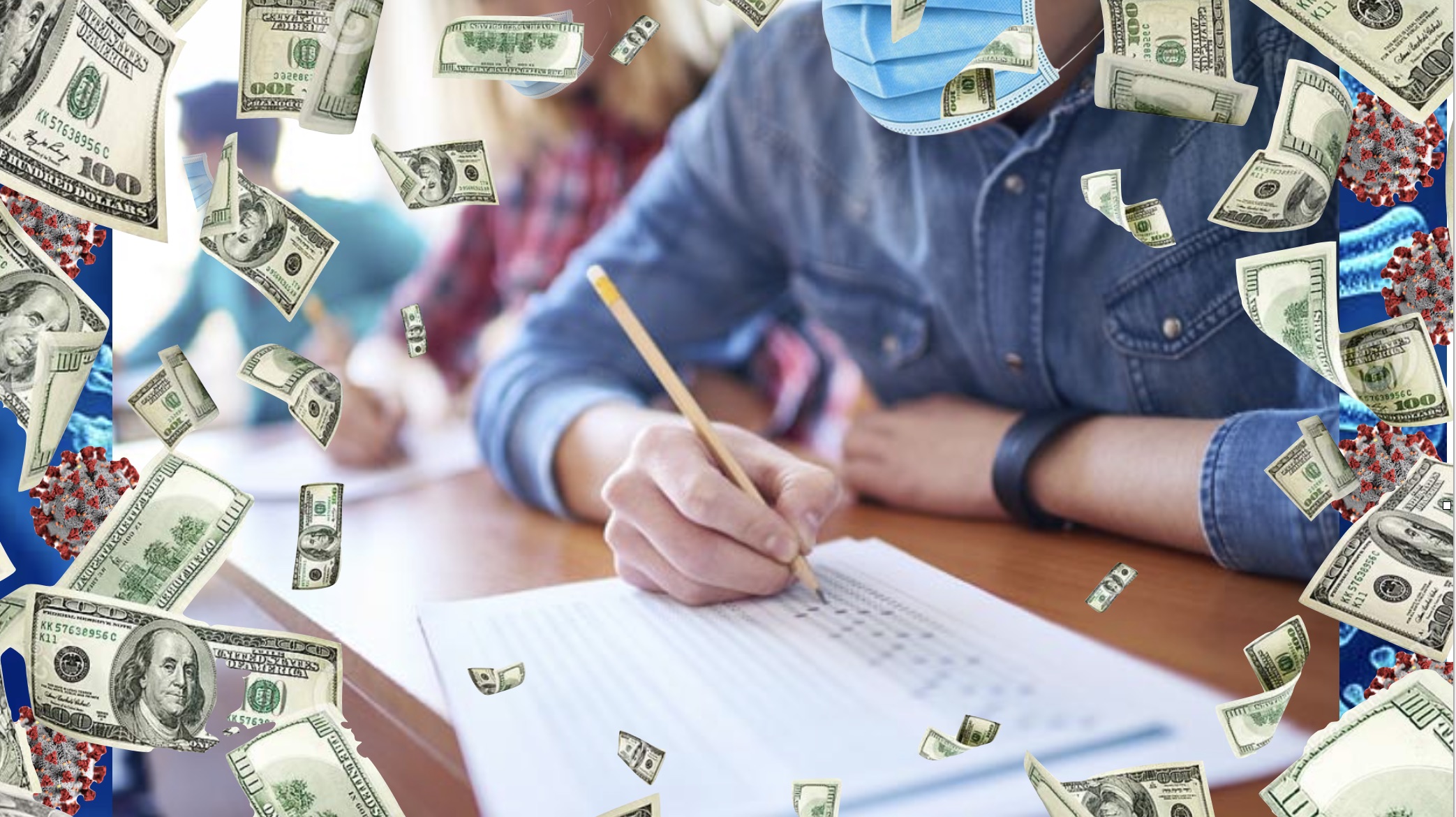
Reckless School Reopenings Cause Long-Term Academic Deficits

The American education system is under attack.

And just like at the Jan. 6 assault on the U.S. Capitol, it’s an inside job.

At nearly every level of government – from Presidents to Congress to state legislatures all the way down to local school boards – decision makers have ignored science and sound policy to prioritize anything that will give the economy a quick boost.

It didn’t have to be this way. We could have put humanity first. We could have taken every step possible to protect our children from a deadly virus whose full effects on the human body are unknown. We could have protected their teachers and teachers families who by all accounts are even more susceptible.

But that would mean socialism – giving everyday people survival checks so they can stay home and not go into unsafe work environments. That would mean providing money to parents so they could stay home with their own kids and ensure they were doing their best academically in remote learning.

Unfortunately, we don’t live in that kind of country. We have no problem spending $1.8 trillion on tax breaks for the ultra rich, but $2,000 a month for the working class is too extravagant.

Better to make us unnecessarily congregate at non-essential jobs and spread Covid-19 all over the place. No wonder we only have 4% of the world’s population but 25% of the world’s Covid cases. No wonder we have about 20% of the world’s Covid fatalities.

Instead of acting like responsible adults, we’ve invariably reopened schools while infection rates are high in surrounding communities.

And efforts at mitigating spread of the disease have been inadequate to lax to nonexistent.

The main excuse for such irresponsible behavior has been that it is in the best interests of children’s academic success.

Kids learn better in-person. So we should reopen schools to in-person instruction.

However, this kind of thinking is hypothetical to a fault. It ignores the specific facts of the situation and pretends they don’t exist.

In-person learning IS better under normal circumstances. But a global pandemic is not normal circumstances.

At so many levels, rushed, unsafe reopenings have already caused long-term academic deficits that will haunt our school system for decades if not longer.

In the short term, most academic programs being practiced during the pandemic are not as effective as alternative plans that would also safeguard student health and safety.

In the long term, factors such as faith in the school system, devastation of the teaching profession and potential lingering health effects of the virus may spell absolute disaster in the coming years even if Covid, itself, becomes nothing but a bad memory.

SHORT TERM EFFECTS

The kind of academics parents are accepting from their duly elected school directors is a national embarrassment.
It’s not that too many schools are providing instruction remotely. It’s that not enough are.

Instead, about 47% of students attend schools providing some kind of in-person instruction, according to a poll by Education Next. That’s about 19% of the districts in the country providing some kind of substandard hybrid program and 28% trying to run blindly as if the pandemic wasn’t happening. Moreover, those open to in-person instruction are most often located in communities with the highest Covid infection rates!

Let’s start with hybrid models. Most involve some kind of in-person instruction combined with remote learning. Partial groups of students come to the buildings certain days and stay remote on others. Meanwhile, a significant percentage of the student body refuses to participate and remains remote entirely.

The result is inconsistent programs. Students switch from one method to another – either because of changes at home or schools rapidly going from one model to another. Kids get used to learning one way and then have to change to another. They have to keep track of elaborate schedules and often fall through the cracks.

No wonder grades are tanking. We’re asking students to do things that are simply too complicated for their ages. And parents who are struggling with their own Covid-inspired juggling acts are often just as confused.

As a parent, it’s hard to make sure your child attends in-person or remote learning sessions when you aren’t even sure when these sessions are. The result is a spike in student absences which can come as a surprise to both parents and students.

And since only a portion of students remain remote – even if that portion is half or more of the total student body – their needs are usually ignored in favor of those willing to attend in person. Time and resources are prioritized for in-person students and taken away from remote students. This should be no surprise since students who remain on remote are much more likely to be poor and/or minorities while those attending in person are more likely to be wealthier and white.

Critics of remote instruction complain that it exacerbates existent inequalities. However, the hybrid model does so to an even greater degree – all with the sanction of the school board. And once inequalities are no longer the result of federal or state legislators or lack of resources but come directly from decision makers in your hometown refusing to care about all students, you have a deep systemic problem that no amount of moving students around from place-to-place can fix.

Even when everyone is on the same page and in the school building for instruction, the normal benefits of having students in-person are outweighed by necessary mitigation factors in schools.

Teachers help students by observing their work and stepping in if students are making mistakes or need help. However, teachers who are attempting to stay outside of 6 feet of their students cannot help because they cannot adequately see what their students are doing.

Moreover, kids benefit by working with each other in small groups. But this cannot be easily accomplished when they have to stay 6 feet apart.

In fact, both situations are best remedied by some kind of remote instruction. Students can share work through devices with both teachers and other students. They can collaborate virtually and get help. Being in-person gives no benefit. In fact, it just obscures the real solution.

IN-PERSON AND REMOTE SIMULTANEOUSLY

Then we have the unreasonable demand that teachers attempt to instruct students in-person while also instructing those on-line at the same time.

This has been an absolute disaster.

Either teachers burn themselves out trying to address the needs of two different groups with two different styles of instruction simultaneously, or they teach the entire group as if it were meeting remotely.

This results in one of two possibilities. One, teachers pay more attention to those in-person and mostly ignore those on-line. Two, they have to spend so much time dealing with technological issues that crop up or that they didn’t have time or training to anticipate that they end up ignoring in-person students.

This is a method that looks good on paper. It makes school boards seem like they are trying to meet the needs of all learners. But what they’re really doing is meeting the needs of none.

And there’s the added benefit that some children and staff may get sick in the process.

BENEFITS OF REMOTE

In the time of high infections, it’s best to keep all students remote. Not only is this the safest option for the health of everyone involved, it provides the best available education.

Academics can be consistent and schedules predictable. Problems can be anticipated, planned for and best solved. And the needs of the most students can be met. Districts can ensure everyone has the necessary technology and wi-fi. They can make sure teachers are trained and have help.

But too many decision makers see this as a defeat. We’re giving in to the virus instead of molding it to our will.

The sad fact is, if we want to defeat Covid, we need to defeat THE VIRUS. Pretending it doesn’t exist will not help anyone.

LONG-TERM EFFECTS

The short-sightedness of current academic plans that try to circumvent remote learning when infections are high will have lasting consequences on American education for years to come.

When politicians and school boards promote reckless policies, it destroys public faith in self-governance. There are plenty of private corporations just chomping at the bit to take over our schools. How can we forestall them when our duly-elected representatives repeatedly show themselves to be unfit for the job? If parents lose their faith in school boards, the beneficiaries will most likely be private corporations.

The same goes for larger government institutions like the President, Congress, the CDC and state legislatures. The Trump administration was a never ending dumpster fire. The hope was that a new administration would be better – and the Biden administration has been more efficient in many ways.

However, it is nearly as pro-corporate as the previous regime. The CDC under Trump commonly rewrote scientific guidance to agree with whatever mad dictate the idiot in the Oval Office just tweeted. Under Biden, the CDC has been more constrained, but it still ignores the world consensus on school closings and countless scientific studies.

Biden needs to rebuild faith in government. That won’t happen when his CDC issues official policy stating that teacher vaccinations are not necessary to reopen schools.

TEACHERS

And that brings me to the teacher shortage.

First, it’s not a shortage. It’s an exodus. Highly trained professionals refuse to submit to ill treatment, loss of autonomy and lack of adequate wages and benefits.

This is not a new problem. Educators have been leaving the profession in droves long before Trump or Biden.

But the current situation is finishing the job.

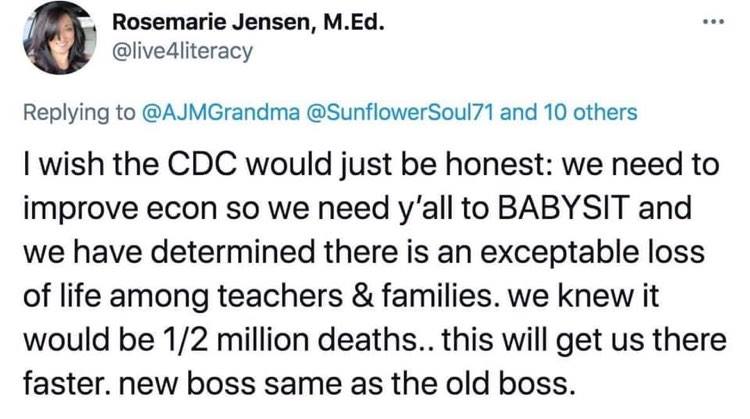
Few people are going to want to be teachers when they’re treated like this. Their health and safety is taken completely for granted. It isn’t even considered part of the equation or a certain amount of educator deaths are considered acceptable.

Teachers are expected to do multiple jobs at the same time in dangerous conditions at the drop of a hat and accept all the blame and none of the credit for what happens.

Ed tech companies have been waiting in the wings to take over the job of educating children. And the result will not be a superior education. It will be the complete dumbing down of American academics. Instruction will become a way corporations can sell products to students and families. It will not be centered on what is best for individual children.

As much as some people scream and foam at teachers who have the audacity to stand up for their own health and safety, they will miss us when we’re gone.

HEALTH ISSUES

And finally, there’s the lingering health issues caused by ignoring safety protocols for students and staff.

The problem with Covid isn’t just the possibility that you’ll die. Even if you survive, the most common long term effects are fatigue, shortness of breath, cough, joint pain, and chest pain.

However, other reported long-term symptoms include difficulty with thinking and concentration, depression, muscle pain, headache, intermittent fever and heart palpitations.

Long-term complications can include cardiovascular, respiratory, renal, dermatologic, neurological and/or psychiatric problems.

We don’t know how serious or widespread these issues will be. However, we could be dooming a generation of children to increased depression, anxiety, changes in mood, smell and taste problems, sleep issues, difficulty with concentration, or memory problems.

How will the job market be impacted by large numbers of young people on disability due to inflammation of the heart muscle, lung function abnormalities, acute kidney damage or even crippling rashes and hair loss?

There could be thousands of Covid’s Kids who have to pay the rest of their lives for the recklessness of adults today.

Not to mention adults suffering from these conditions and having to leave the workforce immediately.

So rushing to reopen schools is a bad idea.

It robs kids of the best possible education given pandemic conditions. It increases racial and economic inequality. It erodes faith in government at all levels. And it gambles with the health and safety of everyone – adults and children – caught in the middle.

The best way to promote student learning isn’t to attack the very system providing it. Nor is it to endanger the lives of those who do the work and provide instruction.

The current crisis can be a temporary situation to survive with a minimum of risk and a maximum of support and caution.

Or we can recklessly pretend it isn’t happening and put the future of our children and the nation at large in unnecessary jeopardy.


Like this post?  You might want to consider becoming a Patreon subscriber. This helps me continue to keep the blog going and get on with this difficult and challenging work.

Plus you get subscriber only extras!

Just CLICK HERE.

Patreon+Circle

I’ve also written a book, “Gadfly on the Wall: A Public School Teacher Speaks Out on Racism and Reform,” now available from Garn Press. Ten percent of the proceeds go to the Badass Teachers Association. Check it out!
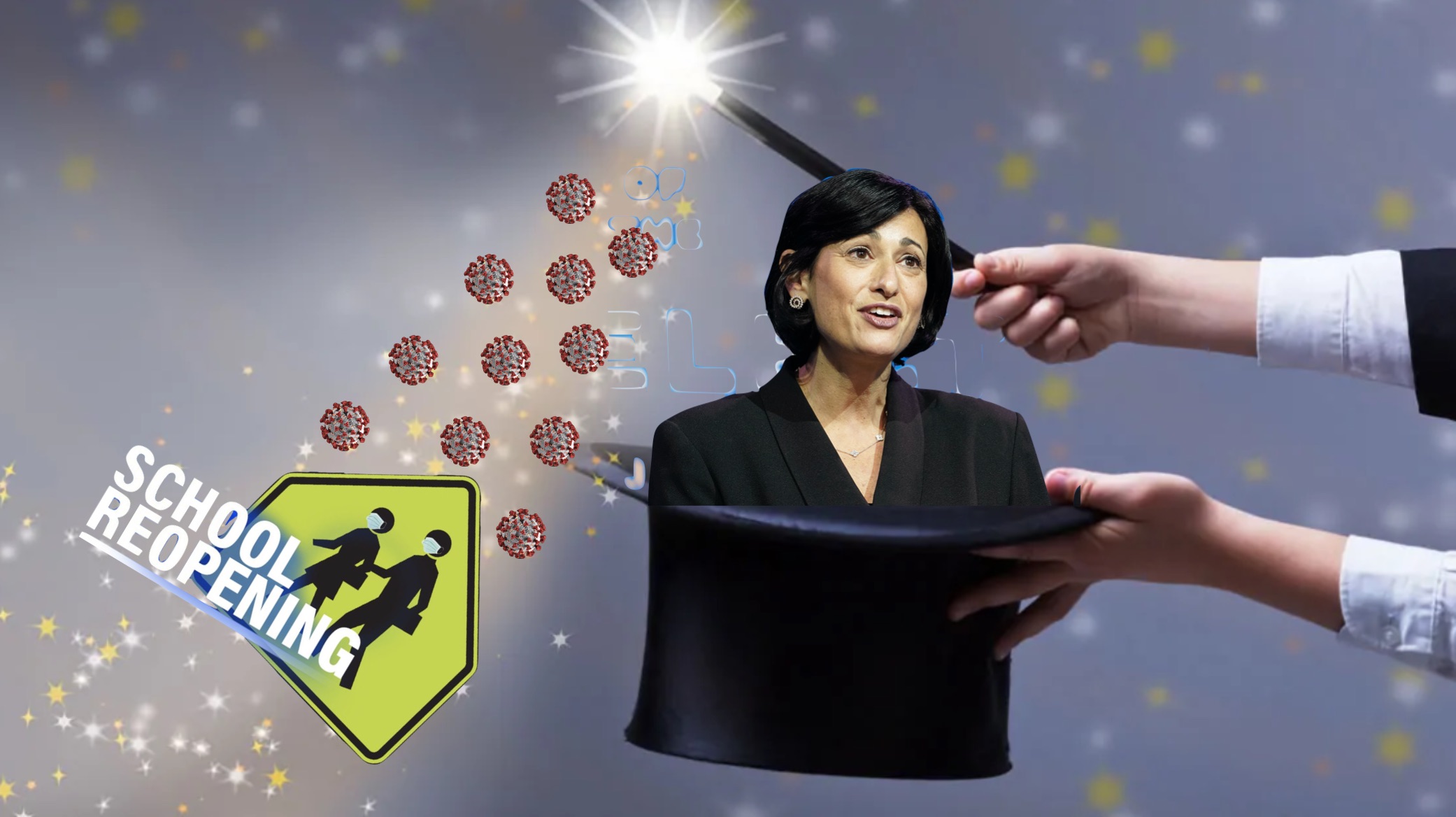
CDC Director Employing Magical Thinking About School Reopenings

Dr. Rochelle Walensky wants you to know it is not safe to go to any Super Bowl parties this weekend.

“We must take prevention and intervention seriously,” the Center for Disease Control (CDC) Director said at a White House briefing on the Covid-19 pandemic Wednesday.

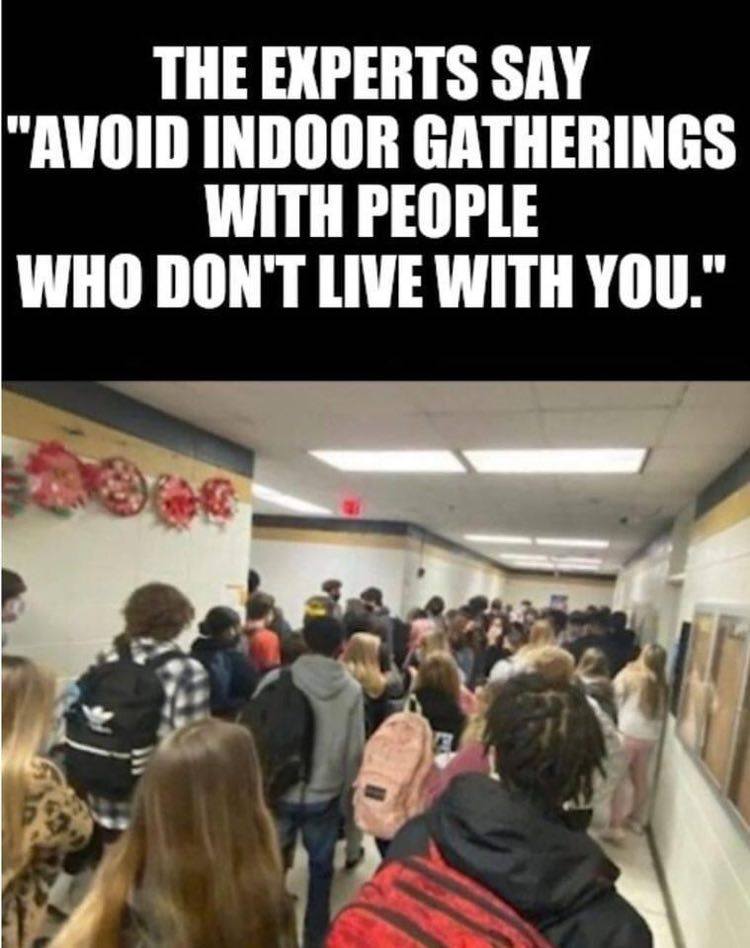
“Whichever team you’re rooting for and whichever commercial is your favorite, please watch the Super Bowl safely, gathering only virtually or with the people you live with.”

However, on the same day at another Washington briefing she said we can reopen schools safely as infections soar without even waiting to vaccinate teachers first.

“There is increasing data to suggest that schools can safely reopen,” she said, and “safe reopening does not suggest that teachers need to be vaccinated in order to reopen safely.”

WHAT!?

One doesn’t need to be an epidemiologist to know that these two statements are contradictory.

On the one hand, gathering in-person in a large group of people with whom you don’t live is a danger.

…If you’re watching a football game.

On the other, gathering in-person with an even larger group of people not in your personal pod and staying with them for an even longer period of time somehow IS safe. And in fact you don’t even need to be vaccinated against the virus before doing so.

…If you’re learning reading, writing and arithmetic.

What the heck is going on here!?

I thought the anti-science Trump CDC was a thing of the past.

Less than a month ago, health memos from the organization were being edited by Kellyanne Conway and Ivanka Trump. In September the White House blocked the agency from issuing a nationwide requirement that masks be worn on all public transportation.

Now with the Democrats in control of both houses of Congress and the Presidency, you’d expect something different.

In fact, Walensky claims her mandate is to remove politics from science.

“Political people cannot influence science,” she says. “If they do, I won’t be there.”

Then why are you promoting incoherent policies at the CDC? Why are you cherry picking data?

Why are you going on all the major news networks in transparent support of Biden’s proposal to reopen schools by April?

Why are you using your platform as head of the CDC to promote magical thinking?

Because that’s exactly what this is – magical thinking.

It’s not science.

Science doesn’t offer policy. It looks at very narrow questions and determines what may have caused what.

It works hand-in-hand with logic and reason. Otherwise, it’s invalid.

And the fact that your statements don’t add up disproves at least one of them.

Either large groups are a danger or they’re not.

If they’re not, then we can reopen schools AND go to Super Bowl parties.

If they are a danger (as a preponderance of evidence shows), then what is it about schools that makes them safer than Super Bowl parties?

Answer: Absolutely nothing!

In fact, schools are MORE dangerous for several reasons.

First, the average Super Bowl party only lasts a few hours. When not in remote or hybrid mode, schools typically are open 7-8 hours a day for five days a week, over 9 months.

You receive much more exposure to Covid-19 at school than at any Super Bowl party.

At both venues, people will be eating and drinking – the most dangerous time for infection. At parties, people may be snacking throughout the event. At school, students at least will eat lunch and probably breakfast not to mention possible snacks between meals. That’s approximately 180 breakfasts and lunches at which you are exposed to Covid compared with a few hours of nachos and pizza.

Moreover, the people attending these parties are mostly adults. Even with the likelihood that people will be drinking at these events, if you have responsible friends, these adults are much more likely to take precautions against infection than children. Kids are constantly fidgeting with their masks. Younger kids and some special needs students at many schools are even given mask breaks or excused from wearing them altogether. And that’s if the school in question has a mask mandate at all!

The idea that Covid doesn’t spread at school or is unlikely to spread is magical thinking.

Even if masks are worn more routinely at school because teachers enforce the rules, that doesn’t remove the danger. Few schools are large enough to socially distance children 6 feet apart. Many administrators don’t even try anymore – they simply promise to do the best they can. Add to that poor ventilation and inadequate cleaning of buildings and you have a recipe for disaster.

Pushback against the CDC has been huge, especially from teachers.

Things got so bad this week, that White House press secretary Jen Psaki distanced the Biden administration from Walensky’s remarks. Psaki said that Walensky had been speaking “in her personal capacity” and there would be “official guidance” and “final guidance” on the issue coming next week.

Walensky, herself, went on MSNBC’s Rachel Maddow show where she repeated her controversial statement but added that other steps need to be taken to lower risks for teachers and students, as well, including masking, social distancing and more viral testing.

“Schools should be the last places closed and the first places opened,” Walensky said.

Again, that is not a scientific statement. It’s a political one.

For someone who claims to be separating science and politics, she sounds much more like a Biden surrogate than a science advisor.

But it’s not just Walensky. The organization she oversees has made some huge missteps on this same issue since Biden’s inauguration – emphasizing some studies and completely ignoring others that don’t support the party line.

CDC scientists published an article last week in the journal of the American Medical Association (JAMA) that claimed some schools were able to reopen safely by following safety precautions. In fact, this one article is the cornerstone of Walensky’s assertion that “There is increasing data to suggest that schools can safely reopen.”

However, it was roundly criticized by the scientific community because the study was based on only 17 rural Wisconsin schools. Moreover, the data was based primarily on contact tracing. And considering that most children are asymptomatic even when infected with Covid-19, contact tracing is a poor method of determining how many people are infected in schools.

Heck! At the same time the CDC published another contact tracing study during the same week as the JAMA study which came to the opposite conclusion – that thousands of Covid cases were, in fact, linked to schools. I wonder why Walensky didn’t talk about that one at her White House briefing!

It’s not that the data is contradictory as much as the method the CDC is relying on is a poor indicator of infection.

Large-scale prevalence studies or antibody testing of students and teachers would much more accurately determine the relationship between educational settings and community transmission. But to date the CDC has not conducted any such studies.

In fact, despite such a full throated media blitz on the matter based on the JAMA article, the piece includes a rather telling disclaimer that its conclusions “do not necessarily represent the official position” of the CDC.

Walensky is right about one thing at least.

World scientific consensus is increasingly coming together around whether schools should be reopened in communities with high infections.

And it’s going in the exact opposite direction of Walensky and the CDC.

The European Centres for Disease Control and Prevention (ECDC) have acknowledged that children of all ages are susceptible to and can transmit Covid-19. Moreover, the organization admitted that school closures can contribute to a reduction in infections though by themselves such closures are not enough. It takes all of society working together to halt the spread of the virus.

In Europe, evidence obtained through antibody surveys conducted in various nations showed that the coronavirus equally infects school children, said Antoine Flahault, director of the University of Geneva’s Institute of Global Health. The results were repeated in Switzerland, Austria, and England.


Even England’s prime minister Boris Johnson conceded, “The problem is schools may nonetheless act as vectors for transmission, causing the virus to spread between households.”

But that’s not all. Take this study from southern India, published in the journal Science on November 6, which found children were spreading the virus among themselves and adults. Using both contact tracing and viral testing the study indicated that super-spreading events predominated, with approximately 5 percent of infected individuals accounting for 80 percent of secondary cases.

Dr. Ramanan Laxminarayan, member of the Center for Disease Dynamics, Economics and Policy in New Delhi, India, told NPR, “What we found in our study is that children were actually quite important. They were likely to get infected, particularly by young adults of the ages 20 to 40. They were likely to transmit the disease amongst themselves … and they also go out and infect people of all age groups, including the elderly. Many kids are silent spreaders in the sense that they don’t manifest the disease with symptoms. They happen to get infected as much as anyone else, and then they happen to spread it to other people.”

Why is none of this being considered by the CDC?

If the goal is to remove politics from science, shouldn’t the organization follow the evidence even if it goes against Biden’s school reopening policy?

Are these other studies invalidated because they were conducted in other parts of the world?

Okay. Here are a few others from the US:

● A JAMA study published July 29 concluded that statewide school closures in the first wave of the pandemic led to a 62 percent decline in the incidence of COVID-19 per week. Similarly, the death rate saw a 58 percent decrease. States that closed earlier saw the most significant weekly reductions.


● According to a study published in Science, the combination of the closure of schools and universities, limiting gatherings to 10 people or less, and closing most nonessential businesses reduced the reproductive number (R0) to below one. These efforts reduced the number of infections in the community. Among the interventions listed, school closures and limiting gatherings to 10 people had the highest impact on slowing the infections.


● A Nature study published in November ranked the effectiveness of worldwide COVID-19 interventions. It concluded that the cancellation of small gatherings, closure of educational institutions, border restrictions, increased availability of PPE and individual restrictions were statistically significant in reducing the reproductive number (R0).

Where are these studies in the CDC’s analysis?

Answer: nowhere.

Because this is not about science. It is still about politics.

After the criminal negligence of the Trump administration spreading lies and disinformation through government channels, what the Biden CDC is doing is beyond reckless.

We need to have facts. We need to be able to trust our scientific organizations again.

This kind of willful negligence won’t just result in more Covid deaths, it will enable the next Trump to do much worse behind a banner of fake news and science denial.

And how will science defenders fight back when both sides play with the data to make it say whatever they want?

Sadly, this new CDC is far too similar to the old CDC.

I had hopes Biden would be better than this.

He still has time to turn back from these games.

Next week’s new CDC guidelines will likely signal whether he is changing course or doubling down.

In the meantime, teachers, students and communities desperately in need of valid science and facts have to turn to the rest of the world for guidance.

Our lives are not expendable to ensure a robust economy.

That lesson will be a lot less expensive now than after the next neo-fascist coup.

We can’t afford magical thinking at the CDC.


Like this post?  You might want to consider becoming a Patreon subscriber. This helps me continue to keep the blog going and get on with this difficult and challenging work.

Plus you get subscriber only extras!

Just CLICK HERE.

Patreon+Circle

I’ve also written a book, “Gadfly on the Wall: A Public School Teacher Speaks Out on Racism and Reform,” now available from Garn Press. Ten percent of the proceeds go to the Badass Teachers Association. Check it out!

Want to Appreciate Teachers? Vaccinate Us Before Reopening Schools

This year I don’t need a free donut.

I don’t need a Buy One Get One coupon for school supplies.

I don’t need a novelty eraser or a mug with a happy saying on it.

I just need to be vaccinated against Covid-19 before being asked to teach in-person.

You want to say you appreciate teachers? Great! Then provide us with a minimally safe environment to work in.

That is LITERALLY the least you can do.

Not a banner or an advertisement or even a sentimental greeting card.

Give us the minimum protections so we can meet the demands of school directors, administrators and the community.

Not a cookie. A Covid vaccine.

Not a demand that we teach in an unsafe environment or go look for work elsewhere.

Give us the tools we need to meet your demands without putting our lives at unnecessary risk.

And we’re not even talking about ALL the tools necessary.

Minimum 6 feet social distancing? Ha! You know you can’t fit all the students in the building that way!

Low rate of infections throughout the community? Ha! You don’t have the patience to wait for that!

Equitable funding with schools in higher income communities? The freedom and autonomy to forgo high stakes standardized testing? Not having to compete with charter and voucher schools that get to play by different rules skewered in their favor?

Ha!

Ha!

And Ha!

No, if you’re going to do the least thing possible – the absolute slightest, minimal, tiniest thing you could possibly do – make sure your staff has the chance to be fully vaccinated before thrusting us back in the physical classroom.

Many of us have been teaching online for months now. We didn’t survive this long just to be kicked out of quarantine when protections exist but are not yet available.

However, in many districts that is exactly what’s being done.

Though vaccines are slowly being rolled out, few school boards are waiting for staff to be protected before throwing open the doors and restarting in-person instruction.

Some districts never stopped in the first place.

So why the discrepancy?

Why have some districts remained open and why are others refusing to wait before reopening?

It’s not because they’re in communities with lower infection rates. In fact, just the opposite.

In most parts of the country, Covid-19 is on a rampage through our communities making people sick, filling up ICUs and graveyards.

More than 400,000 people nationwide have died already from the disease and many health experts expect that number to reach 500,000 before the end of February.

That’s about 4,000 people a day.

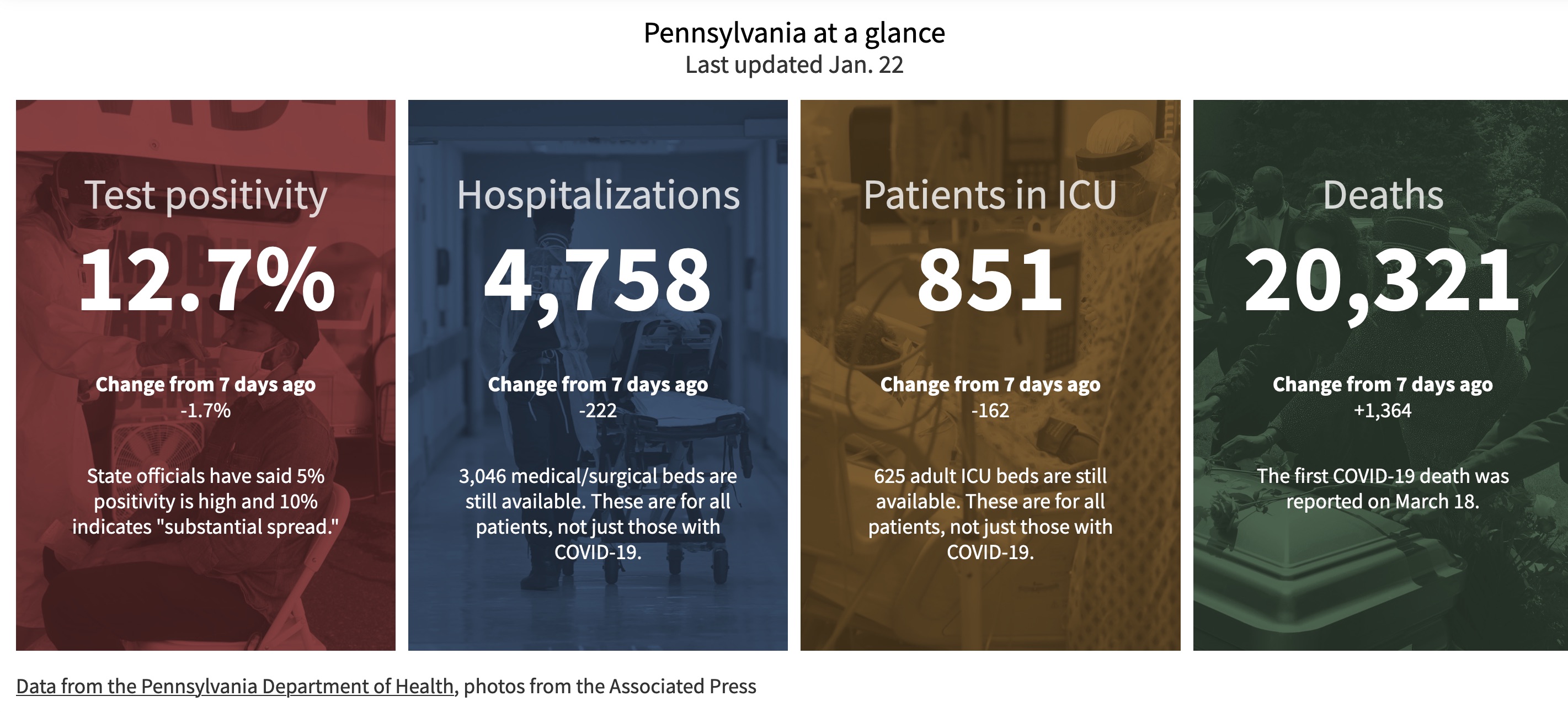
In my home state of Pennsylvania, infections are considered substantial if more than 10% of Covid tests in a county come back positive. As of today, that includes every county in the Commonwealth. In fact, our statewide average is 12.7%!

The danger is real and widespread. It’s just that some districts and communities care more than others for their teachers and the students they serve.

It’s not that districts that remain open to in-person instruction have avoided outbreaks.

My home district of McKeesport, located in western Pennsylvania near Pittsburgh, has been open on and off since September 2.

According to the district’s own Website, out of about 3,000 students and 200 teachers, there have been 106 cases of Covid – 61 among staff and 45 among students.

That’s roughly 21 cases a month.

Keep in mind these numbers don’t include people quarantined or those who get sick and either don’t report it or don’t know it because they’re contagious but asymptomatic. If we added all the people impacted by the decision to keep the district open, the numbers would be much higher.

In any case, decision makers at McKeesport apparently think there’s nothing wrong if every month at least 21 people (adults and children) get the virus, risk their health, and potentially suffer life long consequences.

They don’t mind if having the schools open drives up the infection rate in the community.

They don’t mind if moms and dads, grandmas and grandpas, even people with no kids in the district have a greater chance of getting sick because decision makers can’t be bothered to look out for the common good.

That’s not an example anyone should be emulating. It’s one we should be avoiding.

Don’t get me wrong.

It’s not that I don’t want to get back to the classroom. There are few things I’d rather do.

Teaching on-line is awkward and strange. Spending all day talking to blank boxes on your computer screen each one representing a child who may or may not be there at that particular moment in time.

Trying to find or recreate classroom materials and rethink how they can best be used in a virtual environment.

Troubleshooting technological issues, answering hundreds of emails and instant messages a day all while having to attend pop up virtual staff meetings that hardly ever deal with the problems of the day but are instead focused on how to return to an in-person method of instruction without ANY concern for the health and safety of the people who would have to enact it!

If people cared at all about teachers, they wouldn’t demand we do that.

They’d look out for us the same way we look out for their children every day in the classroom whether it be physical or virtual.

But where I live, teachers and other frontline workers aren’t even on the top of the list to be vaccinated. Even those at the top of the list can’t be seen because UPMC, the healthcare agency distributing the vaccine, is giving preference to its own office workers who do not come into contact with infected people.

You want to get kids back in school buildings? Talk to the people messing up the vaccination process. Don’t shrug and demand teachers take up the slack – AGAIN!

When I took this job it wasn’t to be a police officer or a soldier. I never volunteered to put my health on the line treating sick people in the hospitals.

I chose to be a public school teacher.

I mentor needy children. I inspire the dispirited, I stoke the curious, I enlighten the ignorant.

I don’t sacrifice my life because you can’t be bothered to provide the most basic resources possible I need to even attempt to do my job.

That’s not too much to ask.

In fact, it’s not much at all.

I’m not saying vaccines are a panacea.

Just because you take the vaccine doesn’t mean POOF you’re immune. It takes at least a month to reach full 90-95% immunity. Both the Pfizer and Moderna vaccines require you take two doses (at least 21 or 28 days apart, respectively). The level of protection increases dramatically – from 52% to 95% – but you need both doses to get there.

Moreover, there are other more virulent strains of Covid out there. Preliminary studies seem to suggest that these two vaccines are effective against them, but only time and further study will tell for sure.

In addition, being vaccinated protects you, but not your unvaccinated family. You can still be contagious and bring the virus home with you – though studies suggest any disease you spread after vaccination would be of a much weakened form.

Even if every teacher who wanted a vaccine got one, the pandemic would not be over.

According to some epidemiological estimates, as many as three-fourths of Americans must become immune to COVID-19 – either by recovering from the disease or by getting vaccinated – to halt the virus’s spread.

However, recent polls suggests that 29% to 37% of Americans plan to refuse a COVID-19 vaccine – even some teachers.

So we can’t just allow educators to be vaccinated. We need to encourage everyone to get one. Otherwise, it may protect individuals but not the community.

Education is vital to ensure that everyone knows the risks and benefits of taking the vaccine and how to protect themselves and their children.

And if you want people to be educated you’re going to need some teachers to do it.

We don’t need a pat on the back or even a “Thank You” to get the job done.

What we need are the basic protections necessary to both meet your expectations and survive the endeavor to teach another day.

So stop the badgering and bullying.

Make sure all teachers have the chance to be fully vaccinated before returning to the in-person classroom.

It is the least you can do.


Like this post?  You might want to consider becoming a Patreon subscriber. This helps me continue to keep the blog going and get on with this difficult and challenging work.

Plus you get subscriber only extras!

Just CLICK HERE.

Patreon+Circle

I’ve also written a book, “Gadfly on the Wall: A Public School Teacher Speaks Out on Racism and Reform,” now available from Garn Press. Ten percent of the proceeds go to the Badass Teachers Association. Check it out!
The Teacher Trauma of Repeatedly Justifying Your Right To Life During Covid

I am a public school teacher and my life has value.

That shouldn’t be controversial.

But every few weeks in 2020-21 as the global Covid-19 pandemic continues to spread unabated, I have to go to a staff meeting and justify my right to continue breathing.

Administration and the school board want to stop distance learning and reopen the school for in-person classes.

Yet the Pennsylvania Department of Health recommends all schools be fully remote in any county with a substantial level of community transmission of Covid-19. As of today, that’s every county in the whole state.

Allegheny County – the area near Pittsburgh where I live – has averaged about 600 new cases a day since the beginning of December. More than 1,100 people have died – 149 just in January, alone.

Meanwhile, teachers and other frontline workers have to wait to get vaccinated because UPMC, the healthcare agency distributing the vaccine, is giving preference to its own office workers who do not come into contact with infected people.

Meanwhile, hospital beds in local Intensive Care Units (ICUs) are filling up. On average in the state, ICUs are at 81% capacity, slightly higher than the national average of 79%. That means UPMC Presbyterian Shadyside is at 104% capacity, UPMC East is at 94% capacity, Allegheny General Hospital is at 92% capacity, West Penn Hospital is at 91% capacity – heck! Even Magee Women’s Hospital, which mostly focuses on births, is at 81% capacity.

Meanwhile, the last time our district was open for in-person classes – a period which only lasted about 8 days – at least 30 people (both students and staff) were diagnosed with the virus and more than 70 had to quarantine. Covid-19 spread throughout our buildings like wildfire including an entire kindergarten class and almost every single adult in the high school office.

Yet it’s that time again!

Time to justify keeping things closed up tight!

It’s insane! They should have to justify opening things back up!

But, no, that’s not how things work in post-truth America.

So my life goes back on the scales with student learning, and I’m asked to explain why my employer and community should care more about me than their kids chances of increased educational outcomes.

It’s not even a valid dichotomy.

Risking teachers lives does not mean students will learn more.

People complain about student absences and disengagement online – issues that we can certainly improve if we focus on them with half the vigor of figuring out ways to reopen school buildings when it is not safe to do so. But swinging open the doors won’t solve these problems.

No matter what we do, these will not be optimal learning conditions. Even if students and teachers meet in-person, it will be in an environment of fear and menace – jury rigged safety measures against the backdrop of mass infections, economic instability and an ongoing political coup.

You may see it as a simple calculus – teacher vs. students – but the world doesn’t work that way.

You need teachers to teach students. If something is bad for teachers, it’s also bad for students.

Sick teachers don’t teach well. Dead teachers are even less effective.

But every few weeks, we’re back to square one. And nothing has changed to make in-person learning any safer.

In fact, scientific consensus has undergone a massive shift away from it.

A study released this week from the Université de Montréal concluded schools are spreading the virus in Canada and reopening would undermine any benefits from partial lockdowns.

We’re seeing the same thing in the US where Massachusetts schools reported 523 students and 407 staffers tested positive for COVID in just the last week.

We’ve seen similar outbreaks in Georgia and Mississippi, but the reason they have not been reported nationally is due to two factors. First, the Department of Education under Betsy DeVos refused to keep track of such data, though being a central repository for education statistics is one of the main functions of the job. Second, many students do not show symptoms of the virus even when infected. That means nearly all contact tracing studies show merely the tip of the iceberg and are potentially concealing massive infections.

And this is evident when we take a more national view of the facts. The Covid hospitalization rate for children has increased by 800 percent in the last six months.

More than 250,000 students and school staff contracted the disease between August 1 and the beginning of December, according to The COVID Monitor, a US News database that tracks Coronavirus cases in K-12 schools. That doesn’t even factor in the surge of cases since the Christmas holidays. Add to that the American Academy of Pediatrics report of more than 1 million child cases in the US.

The fact that the disease can go undetected but still be infectious is exactly the factor driving its spread according to a report from the beginning of January from The Guardian:

“A key factor in the spread of Covid-19 in schools is symptomless cases. Most scientists believe that between 30% and 40% of adults do not display any Covid symptoms on the day of testing, even if they have been infected. For children, however, this figure is higher. “It is probably more like 50% for those in secondary school while for boys and girls in primary school, around 70% may not be displaying symptoms even though they have picked up the virus,” says Professor Martin Hibberd of the London School of Hygiene and Tropical Medicine.”

However, the most comprehensive national study was done by US News and World Report. It concluded:

-The high school student case rate (13 per 1,000 students enrolled for in-person classes) is nearly three times that of elementary school students (4.4 per 1,000). 

-The higher the community case rate, the higher the school district case rate.

-Case rates for school districts are often much higher than case rates in the community. Meanwhile, these schools are often under reporting the cases of students and staff.

-The more students enrolled for in-person classes, the higher the case rate in the school district. Likewise, reducing in-person classes can reduce the case rate.

Despite all this evidence, many local districts act as if reopening is a fact free zone. Everyone has an opinion and each is equally as valid.

Wrong!

This time around, even some teachers have internalized the illogic.

We don’t have to behave like lemmings, all jumping off the cliff because the person in front of us jumped.

I understand that this is all being driven by economic factors.

The super rich want the economy to keep chugging along and taking the kind of precautions that would put the least lives in danger would hurt their bottom line. That’s why Congress has been unable to find the courage to pay people to stay home and weather the storm. It’s against the interests of the wealthy.

As usual, teachers are being forced to pay for all of Society’s ills. Schools aren’t adequately funded, so teachers are expected to pay for supplies out of pocket. Districts can’t afford to hire enough staff, so educators have to try to do their jobs in bloated classes and work ridiculous hours for no extra pay.

I knew all that coming into the job. But demanding I put my life and the lives of my family at risk because the government refuses to protect its citizens during a pandemic!? I didn’t sign up for that!

And the worse part is that it’s the same thing every few weeks.

We try to reopen, it’s a fabulous disaster, we close and then the clock starts over.

This isn’t good for the kids, the parents or the teachers.

How will I ever trust my administrators again when they force me to ride this merry-go-round?

How will I ever respect the school board when they can’t put petty politics aside for the good of their own kids?

How will I continue to serve the community when, as a whole, it can’t agree that my life matters?


Like this post?  You might want to consider becoming a Patreon subscriber. This helps me continue to keep the blog going and get on with this difficult and challenging work.

Plus you get subscriber only extras!

Just CLICK HERE.

Patreon+Circle

I’ve also written a book, “Gadfly on the Wall: A Public School Teacher Speaks Out on Racism and Reform,” now available from Garn Press. Ten percent of the proceeds go to the Badass Teachers Association. Check it out!

What I Told My Students About Yesterday’s Attempted Trump Coup

The moment I had been dreading happened.

Student names started popping up on my screen waiting to be admitted into this morning’s first Zoom meeting.

What was I going to say to them?

Yesterday in Washington, DC, thousands of Trump supporters charged into the Capitol Building at his urging in an attempt to stop Congress from certifying his Presidential defeat.

What would I tell my middle schoolers?

What COULD I say?

We can’t offer you equitable resources. We can’t stop judging you with biased standardized tests. We can’t desegregate your schools. We can’t protect you from gun violence. We can’t even give you in-person classes because of a global pandemic the government has given up even trying to control!

And now I’m supposed to say that even the semblance of our democracy is up for grabs?

I started clicking on their names.

I only had a few moments before I had to speak.

I cleared my throat and began welcoming them, one-by-one as always.

And then it was time.

I stared at all these empty black boxes, and began.

“We’ve got to talk about yesterday,” I said.

“Not yesterday in class. That was fine. Everyone did an outstanding job on yesterday’s assignment.

“We have to talk about what happened yesterday in Washington, DC. Does anyone know what that was?”

And I waited.

Eventually I saw a few messages that individuals had their hands raised.

A few kids said that people had charged the Capitol. But that they didn’t know why.

So I explained it to them.

I told them how Trump was refusing to accept the results of the election. That he had lost, but continued to challenge it in the courts. Both Republican and Democratic judges had turned him down saying that he had no proof. So Trump spoke outside of the White House yesterday telling his followers to march on the Capitol, which they did.

At this point I noticed something strange on my screen.

The rows of empty boxes had turned into windows. No more memes or messages or generic names. Most of my kids had turned on their cameras and were meeting my eyes – in some cases – for the first time.

So that’s what Kelsey looks like, I thought. Wow! Marquis is really built. Is that little kid in the grey hoodie really Caulin?

I got flustered and stopped talking, but the students took up the narrative for me.

Some of them mentioned watching videos on-line of the riot. They saw a guy with horns in the President’s chair?

“No, I said. “That was the Vice-President’s chair in the Senate.”

“Wasn’t there someone at someone’s desk?”

“Yes, that was Nancy Pelosi’s desk,” I said. “A rioter broke into her office and put his feet up. She’s the Speaker of the House.”

And so it went on for a few minutes. They brought up things they had seen and I either clarified or supported them.

As a whole, they were wealthy in details but poor in meaning.

Most of the white kids seemed to be taking it ironically. The black and brown kids were more quiet and subdued.

A white boy wrote in the chat that it was “Civil War 2: electric bugaloo.”

I said, “Yes, you’ve hit on an important point. Some of these folks may have been trying to start a new Civil War.”

I tried to put the event in historical context.

I told them how nothing like this had ever happened in my lifetime. That the last time people broke into the Capitol Building like this was during the War of 1812 when the British tried to force the US to become a colony again. However, that was a foreign power invading our country. Wednesday was our own citizens seeking to overturn the results of an election, trying to overwrite the will of the people.

That’s when the first black student spoke up.

“Mr. Singer, why were they waving Confederate flags?”

“Yes! That’s true, Jamal. Many of them DID have Confederate flags and that’s really important.”

Before I could say more I got a series of rapid-fire questions from the same group who had been silent up to this point.

“Why didn’t the police stop them?”

“Why’d they steal stuff? I saw some guy walking away with a podium.”

“Why they so mad?”

I smiled and said that these were all excellent questions.


I asked if any of them knew who George Floyd was.

No one responded.

I told them he was a black guy who was murdered by police when an officer knelt on his neck.

After that happened, there were protests by Black Lives Matter activists and others in several cities including Pittsburgh. The police showed up in riot gear. As these protestors demonstrated almost entirely peacefully – certainly more peacefully than what we saw in DC yesterday – more than 14,000 people were arrested.

“How many people do you think were arrested yesterday?” I asked.

“Didn’t someone die?”

“Yes, a woman was shot in the Capitol and three others died of medical emergencies. How many people were arrested?”

“None,” said a student of color who hadn’t participated before.

“Why none?” I asked.

“Because they was white.”

I told him that he right and wrong. Out of thousands of rioters who broke into the Capitol, thirteen people were arrested. And the reason there were only 13 was because they were white.

I told them that this whole affair needed to be investigated. That we needed to know how and why the police responded the way they did. That we needed to hold the rioters accountable. That we needed to make sure those who instigated this violence were made to pay for it, too.

“Is Trump still President?” Someone asked.

“Yes,” I said. “For about two more weeks. But there are a lot of people who think he should have to step down sooner.”

So we talked about how he could be removed from office. We talked about impeachment and the 25th Amendment. We even talked about how Trump was banned from Twitter and Facebook – how he couldn’t post or tweet but still could send a nuclear missile anywhere he wanted.

And then it quieted down.

I asked them if there was anything more they wanted to know or if there was anything else they wanted to say.

They were still.

A few cameras clicked off.

I told them that I was there if anyone needed anything, that their teachers were here if they were feeling anything and wanted someone to talk to.

And then that was it.

I made one of the most abrupt and inelegant transitions in my career and we returned to our normally scheduled lesson.

Did it help any?

I don’t know, but I told them what I could. I told them the truth as I saw it.

There was a time when I would have been more reticent about it.

But the day after domestic terrorists try to steal our system of government isn’t the time to hold back.

As a teacher, sometimes I feel so helpless.

There’s so much I’d like to do for my students.

I want them to get the resources they need. I want to stop the unfair testing, integrate their schools, keep them safe from gun violence and control Covid-19 so we can return to the classroom.

I want to live in a country where majority rule is cherished and protected, where no one thinks the collective will should be trumped by white privilege.

But when all those things are out of reach, I still have one thing left to give.

The truth.


Like this post?  You might want to consider becoming a Patreon subscriber. This helps me continue to keep the blog going and get on with this difficult and challenging work.

Plus you get subscriber only extras!

Just CLICK HERE.

Patreon+Circle

I’ve also written a book, “Gadfly on the Wall: A Public School Teacher Speaks Out on Racism and Reform,” now available from Garn Press. Ten percent of the proceeds go to the Badass Teachers Association. Check it out!