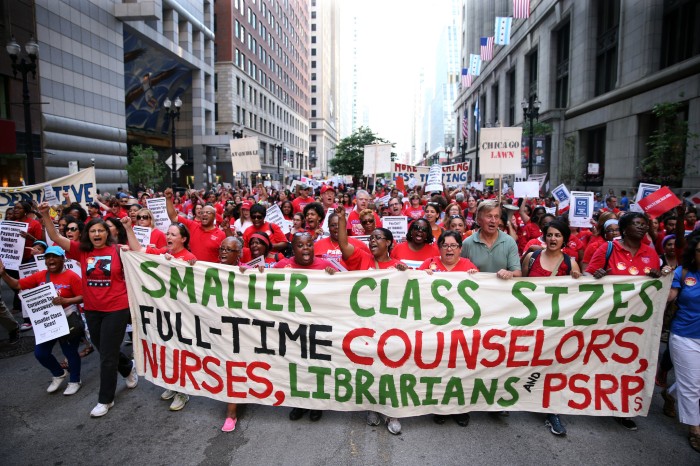
Do Unions Belong in the Fight Against Corporate School Reform?

ct-chicago-teachers-rally-met-0610-20150609


In the fight for public education, the forces of standardization and privatization are running scared.


They’ve faced more pushback in the last few years – especially in the last few months – than in a decade.


The Opt Out movement increases exponentially every year. Teach for America is having trouble getting recruits. Pearson’s stock is plummeting. The NAACP and Black Lives Matter have both come out strongly against increasing charter schools.


So what’s a corporate education reformer to do?


Answer: Change the narrative.


They can’t control the facts, so instead they try to control the story being told about the facts.


It’s a classic propaganda technique. As Malcolm X put it:


“If you’re not careful, the newspapers will have you hating the people who are being oppressed, and loving the people who are doing the oppressing.”


Their story goes like this – yes, there is a battle going on over public education. But the two sides fighting aren’t who you think they are.


The fight for public schools isn’t between grassroots communities and well-funded AstroTurf organizations, they say. Despite the evidence of your eyes, the fight isn’t between charter school sycophants and standardized test companies, on the one hand, and parents, students and teachers on the other.


No. It’s actually between people who really care about children and those nasty, yucky unions.


It’s nonsense, of course. Pure spin.


They want you to believe that the corporate vultures preying on our public schools are really just misunderstood philanthropists. And those demanding a fair shake for their own children and communities are really just paid shills from a monolithic and uncaring bureaucracy.


In essence, they want you to believe two things:


1) Despite profiting off the system and zero evidence supporting the efficacy of corporate school policies, they’re motivated purely by empathy.


2) Unions are evil by definition and they pervert everything they touch.


I’m not going to bother with the first claim here. There is an inherent bias from those who wish to change the laws so they can more easily profit off of schools without actually helping students learn and in fact exist at the expense of that learning. If you can’t see through the propaganda wing of the Walmart corporation, the Broad Foundation and Big Daddy Bill Gates, you probably won’t be very receptive to anything else I have to say.


Instead I will focus on the second claim, because it is the more pernicious of the two.


Put simply, unions are not perfect, but they are not evil. In fact, they are essential to the health of public education.


Many progressives are upset with teachers unions because of the current Presidential election. Both the National Education Association (NEA) and the American Federation of Teachers (AFT) endorsed Hillary Clinton in the primary election without what many would consider adequately polling rank and file members. For better or worse, the endorsements were top-down affairs reflecting the preference of union leaders.


That’s not how unions are supposed to work. And it’s having consequences for the way both members and non-members view teachers unions.


Critics infer from this that unions don’t represent membership. They are de facto arms of the waiting Clinton administration and the neoliberal agenda.


There may be some truth to this, but it does not represent the whole picture. Not nearly.


Unions are like any other democratic organization. The larger the association, the further from the grassroots the decision making body.


In the mammoth national unions, decisions are made by representatives most removed from our schools. They probably were teachers or support staff at some point in the past, but that may be ancient history. Now they are professional leaders and therefore at a remove from the grassroots.


By contrast, in our local chapters, leaders are most often working classroom teachers. Decisions are made by those still meeting students’ needs on a day-to-day basis. As such, they retain an authenticity and expertise that may be more cloudy in the large bureaucracies.


This isn’t to say the national unions are by definition unconcerned with the needs of teachers and students. I’m sure that most of the NEA and AFT leadership who decided to endorse Clinton did it because they honestly believe doing so will help public education. And – who knows – they may be right. But what they forgot in this case was the democratic process they were tasked with preserving. As such, they may have to pay a price for their hubris when their terms are up.


In most cases, the leaders of national teachers unions are at too much of a remove to see what is best for our schools. And they usually know that. It is up to the rank and file to tell them what to do, and that’s what happens every year at representative assemblies through various caucuses made up of work-a-day members. And if leaders overstep their authority it is members’ duty to hold them accountable at election time.


So even though the national organizations are most likely to go astray, they often don’t. Usually even these giants are trying to improve the situation in our public schools.


However, it can’t be denied that the most intense and passionate activism happens a bit closer to where the rubber hits the road. It’s those local chapters that are there everyday and make the most difference. They are the heart and soul of unionism.


So when corporate education reformers sneeringly deprecate their opponents as mere unions, they’re glossing over an important distinction. Opposition to privatization and standardization policies doesn’t come from the leadership of the NEA and AFT. It comes from the grassroots. This is not a top down initiative. It is bottom up.


This is how it’s always been. There is no political organization directing the fight to save public education. The Democrats certainly aren’t overly concerned with reigning in charter schools. It was grassroots Democrats – some of whom are also union members – who worked to rewrite the party platform to do so. The Clinton campaign is not directing anyone to opt out of standardized testing. However, voters are demanding that Clinton be receptive to their needs – and some of them are union members.


There is no great union conspiracy to fight these policies. It’s called public opinion, and it’s changing.


That’s what scares the standardizers and privatizers. They’ve had free run of the store for almost two decades and now the public is waking up.


They’re desperately trying to paint this as a union movement when it’s not. Unions are involved, but they aren’t alone. And moreover, their involvement is not necessarily an impediment.


The needs of the community and the needs of teachers are the same.


Both want excellent public schools.


Both want the best for our students.


Both want academic policies that will help students learn – not help corporations cash in.


And both groups want good teachers in the classroom – not bad ones!


The biggest lie to have resonated with the public is this notion that teachers unions are only concerned with shielding bad teachers from justice. This is demonstrably untrue.


Unions fight to make sure teachers get due process, but they also fight to make sure bad teachers are shown the door.


In fact, in districts with strong unions, MORE bad teachers are fired – not less, according to a new study by economics Prof. Eunice Han from the University of Utah.


The study entitled The Myth of Unions’ Overprotection of Bad Teachers concludes that when unions are strong and successfully bargain for higher salaries, they have an incentive to help ensure ineffective teachers don’t receive tenure. In short, it costs too much to keep bad teachers on staff. It is in the interests of the collective bargaining unit to ensure those unfit to teach move along.


Moreover, Han also concludes that strong unions actually help reduce the dropout rate. It just makes sense. When you treat people like the professionals they are, when you give them autonomy and respect, they’re free to concentrate more energy into their jobs than fighting to keep those jobs.


But unions stand in direct opposition to the efforts of corporate vultures trying to swoop in and profit off of public education. Teachers provide a valuable service to students. If your goal is to reduce the cost of that service no matter how much that reduces its value to students, you need a weak labor force. You need the ability to reduce salary so you can claim the savings as profit.


THAT’S why corporate education reformers hate teachers and their unions. We make it nearly impossible to swipe school budgets into their own pockets.


So do unions belong in the fight against corporate education reform?


Answer: Heck yeah! In fact, they are essential to it.

 

I Teach The Toughest Kids, and I Love It

Screen Shot 2016-08-18 at 2.29.55 PM

It was rarely a good thing when LaRon smiled in school.

It usually meant he was up to something.

He was late to class and wanted to see if I’d notice. He just copied another student’s homework and wondered if he’d get away with it. He was talking crap and hoped someone would take it to the next level.

As his teacher, I became rather familiar with that smile, and it sent shivers down my spine.

But on the last day of school, I couldn’t help but give him a smile back.

A few minutes before the last bell of the year, I stood before my class of 8th graders and gave them each a shout out.

“I just want to say what an honor it’s been to be your teacher,” I said.

They shifted in their seats, immediately silent. They wanted to hear this.

“Some of you have been a huge pain in my butt,” I conceded.

And almost all heads in the room turned to LaRon.

And he smiled.

Not a mischievous smile. Not a warning of wrongdoing yet to come.

He was slightly embarrassed.

So I went on:

“But I’m proud of what you’ve accomplished this year. Each and every one of you. It has been my privilege to be here for you,” and I nodded at LaRon to make sure he knew I included him in what I was saying.

Because I do mean him.

Students like LaRon keep an old man like me on my toes. No doubt. But look at all he did – all he overcame this year.

His writing improved exponentially.

Back in September, he thought a paragraph was a sentence or two loosely connected, badly spelled full of double negatives and verbs badly conjugated. Now he could write a full five-paragraph essay that completely explained his position with a minimum of grammatical errors.

Back in September, the most complex book he had read was “The Diary of a Wimpy Kid.” Now he had read “The Diary of Anne Frank” and “To Kill a Mockingbird.” How did I know? Because I had read it with him. We had all read these books together and stopped frequently to talk about them.

Back in September, if he raised his hand to ask a question, it was usually no more complex than “Can I go to the bathroom?” Now he was asking questions about where the Nazis came from, what happened to Mr. Frank after the war, did Harper Lee ever write any other books, and is the fight for civil rights over.

The last day of school is one of the hardest for me, because my classes are doubled. I don’t just have my students – I also have the ghosts of who they were at the beginning of the year.

They all change so much. They’re like different people at the end, people I helped guide into being.

And I must say I absolutely love it!

As hard as it is being a teacher, as much as you’re attacked in the media and the government, as much as you’re expected to do, the supplies and books you buy with your own money, the hours after school while your own children sit at home without you, the late nights grading and the mountains of paperwork you have to fill out to justify being kept on another year – even with all that – I love being a teacher.

And my greatest joy is the tough kids.

Every year that’s usually who I get.

When I started teaching I expected to be more of an advanced placement educator. I have several degrees, experience as a working journalist… I’m really a rather bookish guy, myself. But when I got in the classroom, it was the troubled ones, the ones in trouble whom I really excelled at teaching.

I had only been in the profession for a few years when I stopped my car in a really bad neighborhood. I was looking for an address for a homebound student and couldn’t find it. Up walked a group of tough looking kids that could have been extras from “Boyz N the Hood.” I thought my life was over until I heard, “Mr. Singer! What you doing here?”
“Andre!?” I said incredulously. “Little Andre!?


“Not so little anymore,” he smiled.


He dapped me up and gave me directions.
I see former students everywhere. Or more accurately, they see me.

The other day I was at the movies with my daughter, when a grown man walks up to me and says, “Hey, Mr. Singer. Hey, little Singer. What movie are you going to see?”

I didn’t recognize him at first because he had a smile on his face. When I taught him more than a decade ago he never smiled. He had serious health issues and always seemed miserable.

But here he was. He had made it. And though it took a while for his name to reach my lips, he knew me like I was a member of his family.

That’s the kind of relationship you get as a teacher. You’re there for the hard times. You’re there for the bad. But you help each other through it.

That’s something non-teachers don’t understand. My students help me as much as I help them.

Sometimes I got to school worried or upset about various concerns in my personal life, but as soon as those kids file into the room, all that noise is gone. In a split second, it’s forgotten. I get a burst of energy, because I’m needed. I’m there for them.

If you’ve never taught, you have no idea how good that feels.

One evening I was sitting at my desk at school, a stack of papers in front of me, feeling frustrated. I wanted to go home but there was so much work left to do. (I don’t like taking work home. When I’m there I’m a full-time husband and dad.)

So I sat in class debating what to do when three huge high school football players appeared in the doorway and came running at me.

I cringed, cowering in my seat about to be tackled.

“Mr. Singer!” they screamed, stopping in unison and giving me, their former teacher, a bear hug.

Moments like that make it all worth it.

The kids know you care. I’ve heard some folks say that none of that matters. You don’t have to care about your students. You don’t have to like them. You just have to teach them.

Nonsense.

I couldn’t do it any other way.

So on that last day when LaRon looked up and smiled, I smiled back.

There was so much meaning in his smile. So much joy behind his eyes.

More than any report card, he knew what I knew.

He knew that despite a challenging home life, despite the call of the streets, and tremendous difficulty of concentrating and believing in himself, he had really achieved something this year.

He knew because I knew. And he smiled because I smiled.

And when that last bell finally rang, he took all of that with him.

I can’t believe I get to do all of that again this year with a new group of children!

Damn! I really love this job!

What Real School Choice Would Look Like – And Why What They’re Selling Isn’t It

pathdoc_Shuttertock_decision - Edited 

I can’t hear the words “School Choice” without thinking of Inigo Montoya from the classic film “The Princess Bride.”


I hear Mandy Patinkin’s voice saying, “You keep using that word. I do not think it means what you think it means.”


Because just like the constant cries of “Inconceivable!” from Sicilian boss Vizzini (portrayed by the inimitable Wallace Shawn), policymakers seem a bit confused.


You would expect School Choice to mean that parents would get to choose the school their children attend. However, the policy being pushed by corporate education reformers has nothing to do with that.


It’s about allowing schools to choose students, not the other way around.


Want your child to attend a charter school? Great! In many cases he needs to meet the requirements of admission – good grades, well behaved, no learning disabilities – otherwise they boot him back to the traditional public school he came from.


Want your child to use a voucher to attend a private school? Fine! The voucher will pay for some of her tuition, but you’d better be able to make up the rest AND she needs to meet the criteria for admission.


If administrators don’t want to accept your child, they don’t have to, nor do they ever have to explain why, nor do you get a public forum where you can question them, nor do you have any power to vote them out.


They could decide to turn you down because your child is a minority, disabled, gay, has a belief system of which they do not approve, anything really! And they will never have to explain themselves to anyone.


To me, that’s not school choice. But that’s what they’re selling and some folks are buying it all up like an email sent to you by an inconvenienced Nigerian Prince who just needs your help with a funds transfer.


However, this isn’t to say that the idea of School Choice – REAL School Choice – is inconceivable. (Forgive me, Vizzini.)


You could devise a system of School Choice that actually involved parents being able to choose the school their children attend.


I wouldn’t suggest it. I’m opposed to all forms of School Choice for reasons I’ll make clear later. But I would certainly be more amenable to a plan that actually did what it seems to promise.


So what would real educational choice look like? What would we need to achieve this goal?


First, it would require a massive increase in school funding.


Think about it. You’re asking the government to pay for several separate, parallel systems of education. Students won’t just have School A to choose from. They’ll have School A, B and C.


So we need to construct more schools. We need to staff them. We need to provide each one with books, computers, equipment, etc. That’s going to cost an incredible amount of money.


We’re talking about at least doubling the amount of money we pay for public schools – more likely tripling or quadrupling it.


This is certainly possible. Maybe it’s even preferable. But it won’t be politically acceptable for many people. The push has been to downsize government, do things on the cheap, lower taxes, etc.


Strangely, School Choice cheerleaders often push their agenda as a way to save money. That’s because they don’t care about the quality of the choices they’re offering. They’re not providing enough money for several excellent schools that parents can pick from. They’re taking the money we already spend on one school and having multiple schools fight for it.


It’s like a dogfight for schools. They’ll rip and tear at each other, and the winner gets to take away the most funding. It’s a bad model for animals and an even worse one for schools because everyone loses. No one walks away with enough money to get the job done. You end up with several choices but none of them can really provide the best academic experience. None of them can even provide the kind of education that would come from having just one well-funded choice.


What’s worse, in most states even before you start adding parallel schools, the current funding system is broken. We simply don’t provide enough funding for the schools we already have without adding even more choices.


All public schools don’t get the same amount of money per pupil. That’s true even when you adjust for costs.


Under the current system, schools with a rich tax base provide Cadillac resources for their children. Meanwhile, schools with a poor tax base can’t provide everything that is needed so their kids have to do with less. That means fewer resources, fewer teachers, larger classes, etc.


So-called School Choice policies only make this worse. Schools that already don’t have enough funding to meet their students needs have to give larger portions of their shrinking budgets to charter schools. So instead of one school without enough funding, we have two. That doesn’t fix anything.


However, both of these problems are solvable and the solution is the same in both cases – money.


If you want real choice, you need to do two things: (1) discontinue funding schools based on local property taxes and (2) dramatically increase school funding. Both the state and federal government would have to kick in much more. Local taxes could still be collected to pay a portion for public schools – this could even be collected based on how much each community can afford – but no longer could we allow poor students to get less funding than rich kids. No matter where you lived – in the slums or in a gated community – you’d get whatever funding your school deemed necessary.


This would probably be paid for with a substantial tax increase, though you could also make cuts in other places in local, state, and federal budgets. For most people, I think this would be unacceptable, but it is certainly conceivable.


Second, you need the same rules governing these separate systems – especially when it comes to admissions.


This would be especially hard on charter school and private school administrators.


There could be no more picking and choosing which students get to attend your school. If an emotionally disturbed student with bad grades and an even worse record of behavior wants to attend your charter school, you’ve got to accept him. If a poor student whose parents don’t have the money for tuition (even with the voucher in hand) want to attend your private school, you’ve got to accept her.


This shouldn’t be such a burden. It’s what traditional public schools do now. They take everyone regardless of grades, ability, behavior or poverty.


Third, all schools would have to be transparent and democratically controlled. Their budgets and internal documents would have to be open to public record. Moreover, decisions about how to run the school could not be made behind closed doors – they would have to be made in public. And school directors would have to be subject to democratic control. Decision-makers could no longer be appointed by boards of investors, the mayor or any other bureaucrat. They’d be selected by voters. These would all be public schools, after all, and as such would be subject to rule by the public.


Think about what that means. If your child attends a school, you should get a say in what happens at that school. Even if your child doesn’t attend the school, even if you have no children, you should have a say simply because you pay taxes.


This has been the practice at traditional public schools since forever. In fact, unless the school has been taken over by the state, it’s required by law. But at charters and private schools, it’s not always the case.


It’s funny. In many ways under our current system, the public gets much more input, much more choice at traditional public schools than at so-called School Choice institutions.


Many charters and private schools would balk at this. They are not run democratically and are not beholden to the public.


That’s just the way they like it. Their business model requires it. If they had to be fully transparent and accountable to taxpayers, what would happen to those schools organized for-profit?


I would assume that they would disappear. I think very few parents and taxpayers would allow a fully transparent school to pocket a large chunk of its budget like that. I can’t imagine the public approving a decision to cut student services to boost the bottom line – but this is exactly what happens at certain charter schools every day. Only the protection of current School Choice policies that shield investors from taxpayers allows this kind of malfeasance.


But it doesn’t have to be this way.


We can have real School Choice without all the drawbacks of charters and voucher schools. We can have a system where parents get to pick their children’s schools, where the public is in control, where every child gets an excellent education.


To do so, we’d need a series of fully funded, fully transparent, democratically run schools subject to the same rules and expectations.


Hmm. But that’s not so different than the traditional public school system we have now. Perhaps doing so would give all schools the latitude to experiment that is usually given to charter schools. But for the most part, we’ve equalized our school system and simply eliminated the worst abuses of charter and voucher schools.


We’ve also radically increased the raw number of schools in the system. And we’ve allowed students to attend schools where they don’t necessarily live, but ensured they get adequate funding no matter where they attend.


The result is real Student Choice. Parents get to decide where their children attend, and – at least in theory – all choices would be excellent.


I’ve got to admit – from a certain vantage point – it doesn’t look so bad. Sure it’s going to cost a lot of money, but maybe it’s worth it.


However, finding the cash isn’t the only obstacle. For instance, how do you adequately administrate such a system?


I cannot imagine how administrators could decide how much money their school needs from year to year if the student population can change so dramatically in that time period. How would administrators know how many teachers they need and in which subjects? How would they be able to determine the number of classrooms, how many school lunches are necessary and a host of other things? Wouldn’t it be terribly disruptive to have teachers moving from school-to-school every year following student mobility?


Additionally, how do we provide transportation with students traveling hither and thither? It would be difficult just to organize buses to get kids to school. Older students could be given bus passes, but that wouldn’t be safe for elementary and middle school kids to be traveling this way unaccompanied by adults.


I’m not saying it’s impossible, but it would be very difficult. Perhaps someone could find a system that works. However, I fear this kind of institutional instability would result in some schools being woefully understaffed and underprepared while others have too much.


Moreover, such a situation would be extremely wasteful. We’d be spending much more than we need to provide children with an excellent education. We’d be duplicating services unnecessarily. Personally, I can deal with that much more than its opposite. However, flushing tax dollars down the toilet is a bad practice.


Is there a middle ground that provides parents and students choice without wasting so much money?


Yes.


Instead of providing a series of parallel education systems, supply one system that is able to deliver multiple services.


First, you’d need to fix the funding inequities mentioned above. You don’t have to double or triple what we spend, but you’d probably have to increase support somewhat. And it would have to be distributed fairly.


Then once every school has the funding necessary to give every student what he/she needs, we can work on individualizing that experience. This is exactly the opposite of current education policies from the Bush and Obama administrations.


I’m not talking about Competency Based Education, either, the latest scam to make standardization look like a student centered model. I mean no more high stakes standardized tests, no more Common Core, no more corporate education reform.


Imagine if every district allowed parents and students to choose what kind of education they got within the system. Your child wants to study music? We’ve got an excellent music program. You want your child to study a foreign language? We have plenty of award-winning programs to choose from.


Schools would be able to meet the needs of all students because they would be fully funded. No more poor schools and rich schools – just schools.


To meet this ideal, we need to forgo the fake School Choice being offered at present. We need to stop having schools fight over dwindling resources like pit bulls.


THAT would be a choice worth making.


It would be the best kind of school choice.

We Are All Chicago Schools – More Layoffs, Less Help for Other People’s Kids

ct-rahm-emanuel-forrest-claypool-private-schools-20160505


“Fuck those kids.”


Mayor Rahm Emanuel couldn’t have been clearer if he’d said the above.


Chicago Schools Chief Executive Forrest Claypool couldn’t have made his priorities clearer if he’d given Chicago’s parents the bird and told them to “Kiss my ass.”


The Chicago Board of Education – made up of members all of whom are appointed by the mayor – decided to layoff 1,000 teachers and staff at the city’s public schools just a month before opening day. Sure, some may keep their jobs through reassignment, but hundreds will be unemployed.


This after a recent history of closing more than 80 schools and slashing thousands of jobs. Just last February, the district laid off 62 employees, including 17 teachers. In January, it laid off 227 staff members.


This begs several questions: How many teachers and support staff can Chicago Public Schools afford to lose? What exactly is this doing to its students? How is it affecting their future prospects to be taught by a skeleton crew?


The city’s leaders don’t give a shit.


And why should they? These aren’t their kids!


Emanuel’s children attend University of Chicago’s Laboratory Schools, a private institution. Claypool’s kids go to Francis W. Parker, a private school in Lincoln Park. Even Gov. Bruce Rauner’s six kids don’t go to public school. They’re all grown.


So this doesn’t affect them. Nor does it affect any charter school kids. Not a single one of these 1,000 cuts will occur at a city charter school.


It’s just the traditional public schools, those schools where approximately 85% of students are Latino or African-American. Just those schools where 87% of the children come from low-income homes. Just those schools where 12% of kids are reported to have limited English proficiency.


Yeah. Fuck those kids.


And the worst part is that it’s not necessary. Chicago doesn’t have to continue to abandon its neediest children.


When you’re in a family, you make sacrifices for your kids. If funds are tight, you make cuts elsewhere or maybe you even take another job. Anything to make sure you’re providing your children with the best.


But Chicago’s leaders aren’t interested in doing any of that for these kids because they just don’t care.


Otherwise they could find the money. The teachers union suggests declaring a TIF surplus and reinstating a corporate head tax. The city isn’t exactly a wasteland. Wealthy developers are looking to build yet Emanuel has no intention of inconveniencing them by making them pay a fair share of taxes. Instead, the full burden falls on the city’s working families. And he calls himself a Democrat!


There’s always enough money for projects leaders care about. For instance, there was no problem finding $250,000 to pay a law firm where Claypool and his handpicked general counsel, Ron Marmer, both formerly worked. Marmer still has financial ties to the firm! So cut a check to Jenner & Block LLP? YES! Ensure kids have all the teachers they need? HECK NO!


Strangely there’s $27 million hiding in the seat cushions to open a new charter school for the University of Chicago. The Woodlawn Campus of the University of Chicago Charter School will be part of the development around the newly-planned Obama Library. It’s a fitting symbol of the President’s legacy – a brand new privatized educational facility while a few blocks away traditional public schools molder in ruin.


Meanwhile, Gov. Rauner holds the state education budget hostage. Illinois lawmakers could only agree on a 6-month state budget in June. Republicans expressed concern about the state being responsible for bailing out Chicago Schools. It’s not our problem, they seem to think. Well of course not. These aren’t your kids.


It’s the same swindle we see throughout the country. Refuse to pay for public schools – especially the schools serving poor brown kids, and then shrug. “Look at the impasse,” they shout, hoping voters are too stupid to realize it’s an impasse created by these lawmakers, themselves! It’s a textbook disaster capitalism move, approved by the American Legislative Exchange Council (ALEC) and other conservative think tanks. But Rauner can at least be forgiven for being a proud Republican. This is, after all, the behavior progressives expect from GOP lawmakers.


What about Democrats like Emanuel? This isn’t the way progressives are supposed to act. They aren’t supposed to favor privatization over public schools. They aren’t supposed to fawn on big business and promise tax cuts, tax shelters, and every other kind of tax avoidance.


Some might say it’s just Emanuel. After all, for a Democrat he sure pals around with a lot of conservatives. He and Rauner are best buddies. When Emanuel earned his fortune, he was an investment banker, and one of his best clients was Rauner. They go out to dinner and even spend vacations together. Sure they occasionally criticize each other in public, but behind closed doors the ideological differences just melt away.


What about the rest of the Democrats? Surely they don’t agree with Emanuel’s tactics. They made sure to keep him away from the Democratic National Convention – out of sight, out of mind.


But if the party is really so opposed to these policies, where is the condemnation from party leaders?


I haven’t heard a peep from the Democratic nominee for President, Hillary Clinton, about these layoffs. Have you? She’s the de facto leader of the party and she’s got nothing to say about this. What does that tell you about her priorities?


Sure she’s cozied up to the two biggest national teachers unions who liked her so much they didn’t even need to consult the rank and file before endorsing her in the primary. Ronald Reagan had the support of the Professional Air Traffic Controllers Organization (PATCO) right up until he declared their strike illegal and demanded they return to work. Will Clinton, too, turn against union teachers once she’s used them for their vote in November?


But you know what? Forget Hillary. Where’s Bill? Where’s Tim Kaine? Where’s Barack and Michelle Obama? Where’s Joe Biden? Where’s Al Franken? Where’s Cory Booker?


We have to get beyond labels like Republicans and Democrats, liberals and conservatives. Almost all of them are neoliberals. They all believe essentially the same things.


And as proof I offer the deafening silence offered against Emanuel in Chicago.


He’s hurting school children.


But no one in power gives a fuck.

Why is Common Core Still Here?

oh-dear

Common Core has become a national joke.


In fact, the set of academic standards has inspired a new genre of grade school humor – Common Core comedy.


For instance:


One student turns to another and says, “Common Core is about making us college and career ready.”


The other student replies, “It’s working. It’s making me drink more everyday.”


Here’s another one:


Question: Why can’t mommy help you with your Common Core math homework?


Answer: She only has a four-year degree.


And finally:


Question: How many whiteboards does it take to show you how to screw in a light bulb?


Answer: One, but it takes dozens to explain 1+4 in Common Core.


Parents nationwide know the pain of Common Core by the looks on their children’s faces.


They see bright, curious youngsters go to school and come back hating education and thinking they’re stupid.


Parents get the same feeling trying to decipher their children’s homework.


Meanwhile the majority of teachers hate the standards – and as they become more familiar with it, that number grows every year.


So why do we keep using Common Core? Why haven’t our schools thrown this bad idea on the trash heap of failed education policies?


In short – because industry is making a lot of money off it.


Common Core was created by private industry.


It was not made by the states, nor was it written by the federal government.


It was created to sell a new generation of standardized tests and textbooks.


It’s raison d’etre is profit not education.


School children didn’t need a unified set of academic standards. Big business needed them to sell more books and tests.


The standards were written by Achieve, Inc., a Washington, D.C., organization formed in 1996 by corporate leaders and six state governors. The endeavor was funded by Bill Gates and other corporate interests. It was reviewed by individuals and organizations also funded by Gates.


Then the federal government stepped in to strongly encourage states to adopt the standards. Not because anyone actually thought they were necessary. They did it because that was what wealthy donors wanted.


Eventually the standards were adopted in 42 states, but not because legislatures voted on them. The standards were quietly approved by state boards of education, unelected state education chiefs and boards of education. Many lawmakers didn’t even know what Common Core was or that their state had implemented it until voters started calling and asking questions.


Moreover, at the time of their adoption, the standards weren’t even completed. They were enacted in many cases sight unseen.


How did the federal government get state officials to do this? Money and threats.


Public schools were strapped because of the great recession. So the Obama administration swooped in to help – on the condition that states enact a series of reforms including Common Core.


The Obama administration did not write Common Core, but it did everything it could to make sure states enacted these standards. In the 2009 stimulus package, there was $4.35 billion in discretionary funds given to the U.S. Department of Education to hand out as state grants. But in order to qualify for these grants, states had to adopt the Common Core. With education funding at a premium, bureaucrats were only too willing to bend over backwards to keep their state’s schools running.


And when the carrot wasn’t enough, the federal government used the stick.


Many states were applying to the federal government for waivers to the disastrous No Child Left Behind legislation. Adopting Common Core and several other corporate education reforms was made a pre-condition. If states didn’t adopt these standards, their schools would be labeled “failing” and lose even more federal funding.


Despite all this, the media still often misrepresents the facts.


It is an objective fact that the Core was written by private industry. So the media never asks that question. It asks if the Core was “state led.” That way there is room for spin.


Who led the effort to enact these standards? Since a handful of governors and other government officials were involved in their creation, media patsies are able to pretend the initiative started with the states. But don’t believe it. It started with private interests – people like David Coleman and Bill Gates – trying to influence government to do what they wanted for their own ends. As President of the College Board, Coleman stood to profit off new books and tests. As co-founder of Microsoft, Gates stood to profit from the new technology needed to run many of these new tests and materials. They led the initiative, not the states.


No government official was ever given a mandate by the voters or their empowered representatives to create or enact Common Core. Those that did so acted in their private capacities. Bribing a handful of governors doesn’t make something a state initiative.


Just because a government official does something doesn’t make it policy. When Chris Christie orders a footlong hoagie for lunch, it isn’t the start of a government program to feed people at Subway. He’s just ordering lunch.


Moreover, when government officials are coerced into adopting a policy because otherwise they won’t be able to fulfill their obligation to voters, that isn’t an endorsement of those policies. You can’t offer a starving child a sandwich on the condition that he shouts a swear word and then pretend it was all his idea. You can’t offer a glass of water to a man dying of thirst on the condition that he shave his head and then pretend that he likes being bald.


Common Core was not adopted by states because they liked it. It was adopted to keep schools running.


Special interests used the federal government’s power over the states to circumvent the legislative process.


The result is a set of poor quality standards that are developmentally inappropriate and don’t help students learn. This should be no surprise since they were written with minimal input from classroom teachers or child psychologists. Instead they were created by standardized test authors. But even if the standards had been good, the process of their adoption was highly undemocratic.


Sadly, this is how government works now.


Charter schools, Teach for America, standardized testing – Public education has been high jacked by business interests.


Once upon a time, the goal was to help students learn. Now the main objective is to help big business profit off students.


If you can make a buck off something – even if it doesn’t help or actually hurts school kids – do it.


Nowhere is this clearer than with the Common Core.


Unfortunately, our 2016 Presidential candidates don’t seem to get it.


Neither Hillary Clinton nor Donald Trump seems to understand the problems with Common Core.


Clinton thinks the only issue is the way the Core was implemented in schools – not federal coercion, not poor quality standards, etc. Schools didn’t implement them too quickly. The standards are badly written, unproven to help and increasingly shown to hurt.


Trump, on the other hand, thinks it’s all wrong, but he has no idea why or what he can do about it. Like too many Republicans, he acts as if the only problem with the standards is Obama’s participation. He ignores or omits the one-time advocacy of prominent members of his own party for the Core like Jeb Bush, Chris Christie, Bobby Jindal, and Mike Huckabee.


Neither candidate seems to understand that the new federal education law, the Every Student Succeeds Act (ESSA) bans the federal government from doing anything to promote Common Core, or any other set of education standards. This does not, unfortunately, repeal the standards. It emphasizes the states’ power to choose their own academic standards.


Each state legislature can keep, revise, or repeal Common Core. And in some cases, this has already begun. In Oklahoma, for example, Common Core was repealed entirely. In other states, like New Jersey, Common Core has been revised but largely left in place. In other states, the standards remain untouched.


Why hasn’t Common Core gone away? State legislatures haven’t acted.


No matter who wins the presidential race, whether it’s a candidate in favor or against Common Core, he or she has zero power to do anything about it. Hopefully, no one tries to exceed that authority by coercing states one way or another.


Meanwhile, state legislatures need to pay attention to the wishes of voters. If Common Core is repealed – and that’s what the majority of taxpayers want – we can only hope it’s done so in a more democratic fashion than it was approved. We can only hope it isn’t replaced with something worse.


Whatever happens it should be to benefit students, not corporations.


Or to put it another way:


Question: What if Common Core was created just to drive parents crazy?


Answer: Somebody must be making a fortune on crazy meds!!

No New Charter Schools – NAACP Draws Line in the Sand

Line in sand


In the education market, charter schools are often sold as a way to help black and brown children.


But The National Association for the Advancement of Colored People (NAACP) isn’t buying it.


In fact, the organization is calling for a halt on any new charter schools across the nation.


Delegates from across the country passed a resolution at the NAACP’s national convention in Cincinnati last week calling for a moratorium on new charters schools. Approval of the new resolution will not be official until the national board meeting later this year.


This resolution isn’t a change in policy. But it strengthens the organization’s stance from 2010 and 2014 against charters.


Specifically, the resolution states:


“…the NAACP opposes the privatization of public schools and/or public subsidizing or funding of for-profit or charter schools…”


“…the NAACP calls for full funding and support of high quality free public education for all children…”


The resolution goes on to oppose tax breaks to support charter schools and calls for new legislation to increase charter school transparency. Moreover, charters should not be allowed to kick students out for disciplinary reasons.


This goes against the well-funded narrative of charter schools as vehicles to ensure civil rights.


The pro-charter story has been told by deep pocketed investors such as the Koch Brothers and the Walton Family Foundation. But the idea that a separate parallel school system would somehow benefit black and brown children goes against history and common sense.


The Supreme Court, after all, ruled separate but equal to be Unconstitutional in Brown vs. Board of Education. Yet somehow these wealthy “philanthropists” know better.


People of color know that when your children are separated from the white and rich kids, they often don’t get the same resources, funding and proper education. You want your children to be integrated not segregated. You want them to be where the rich white kids are. That way it’s harder for them to be excluded from the excellent education being provided to their lighter skinned and more economically advantaged peers.


Julian Vasquez Heilig, education chair of the California and Hawaiian NAACP chapter which proposed the new resolution, says its ironic charter schools are marketed as school choice.


The endgame, says Heilig, is to replace the current public schools with privatized charter schools. This is exactly what’s been proposed in the US territory of Puerto Rico.


It’s not about giving parents more choices. It’s about eliminating one option and replacing it with another. It’s about reducing the cost to educate poor and minority children while also reducing the quality of services provided. Meanwhile, public tax dollars earmarked to help students learn become profit for wealthy corporations running charter schools.


As the Presidential election heats up, it will be interesting to see how Hillary Clinton and Donald Trump address the issue. Already school choice policies have been wholeheartedly embraced by the Republican nominee. Not only does he favor charter schools, he also supports school vouchers and other schemes to privatize public tax money. This shouldn’t be a surprise since he ran his own private education scam – Trump University.


Clinton, on the other hand, has been more measured in her support, even criticizing some aspects of charter schools. However, her campaign has issued statements saying she supports only “high quality charter schools” – whatever those are.


Moreover, just this week at the Democratic National Convention, Clinton staffers met with hedge fund mangers from Democrats for Education Reform (DFER).


According to Molly Knefel who covered the meeting for Truthout, the mood was not positive toward ending corporate education reform strategies.


She reported that moderator Jonathan Alter worried about the argument becoming based on social justice.


“If it becomes a social justice movement, doesn’t that in some ways let, for lack of a better word or expression, Diane Ravitch’s argument win?” asked Alter. “Which is, ‘don’t blame any of us, don’t focus on schools; if we don’t solve poverty, nothing is going to get better.’ Isn’t there a danger of falling away from the focus on at least some responsibility on schools?”


Apparently Alter is falling back on the old chestnut that under-funded schools should be blamed and shut down if they can’t help the neediest children to the same degree as well-resourced schools. And any attempt to focus on underlying inequalities would somehow give teachers a free pass? I suppose Alter believes a fire company that can’t afford a fire truck should be just as effective as one with three new ones.


Meanwhile, longtime corporate education reformer Peter Cunningham was asked specifically if school integration was important. He responded tellingly:


“Maybe the fight’s not worth it. It’s a good thing; we all think integration is good. But it’s been a long fight, we’ve had middling success. At the same time, we have lots and lots of schools filled with kids of one race, one background, that are doing great. It’s a good question.”


The number of segregated schools where students “are doing great” is certainly in question. Perhaps he’s referring to well-resourced all-white private schools for the children of the rich and powerful. Or maybe he means the all-black charter schools where administrators handpick the best and brightest students and refuse to educate those most in need.


One hopes Clinton will continue to fight alongside the NAACP and other civil rights organizations like Journey for Justice and the Rev. William Barber’s Moral Mondays to defend public schools against the failed education policies of the George W. Bush and Barack Obama administrations.


Two weeks ago DFER President Shavar Jeffries criticized the finalized Democratic education platform for turning against corporate education reform. This transformation away from school privatization and standardized testing was the result of education activists Chuck Pascal of Pittsburgh, Troy LaRaviere of Chicago and Christine Kramar of Nevada who worked hard to ensure the platform – though non-binding – would at least set forth a positive vision of what our public schools should look like.


Make no mistake, the tide is turning. It is becoming increasingly difficult for charter supporters to claim their products boost minority children’s civil rights.


Too many people have seen how they actually violate them.

Irony Alert: The Founder of Trump University Is Selling School Choice

Donald-Trump-Donkey-Hotey

Donald Trump is in favor of school choice.

Well of course he is! After all, he made a lot of money scamming poor suckers out of their hard-earned cash with Trump University.

He knows how privatized education benefits the corporations who run the school and not the poor schmucks who want to learn.

If he gets his way, our national education motto will be caveat emptor.

He is betting the American public is so stupid they’ll give a man caught in a scandal for cheating people out of an education the power to set all education policy for our nation’s children.

And it’s all right there before the public.

In fact, the parallels between Trump University and school choice policies are apparent to anyone who looks. Here are just a few of the similarities:


1) False advertising

First of all, Trump University was never an actual university!

The New York State Education Department warned administrators when the institution was founded in 2005 that it was operating without a license. So what did the “school” do? It changed its legal name to The Trump Entrepreneur Initiative.

See? We’re not saying it’s a university anymore. I mean we still call it Trump University colloquially and in advertising brochures and so on. But on legal documents we never make that claim.

It’s a classic bait and switch scheme.

But the same could be said of many charter schools.

They don’t claim to be private schools. They claim to be public schools. However, they aren’t subjected to nearly the same transparency and accountability standards.

Public schools are run by an elected school board. Most charters are run by appointed boards.

Public school board meetings are held in public. Any taxpayer can attend, comment on the proceedings and demand access to public records such as its budget. Many charter school meetings are held behind closed doors. Taxpayers have no access or input in the decision-making process nor access to records that should by all accounts be public record.

Charter schools are public schools just like Trump University was a university.


2) Choosing Students

So who could attend Trump University?

Not just anyone. According to the “Private and confidential” playbook obtained by The Atlantic, the one essential qualification listed all in caps was “ALL PAYMENTS MUST BE RECEIVED IN FULL.” In other words, Trump’s school would accept anyone who could pay the entrance fee.

That same playbook, by the way, admonished staffers not to talk with reporters and “If a district attorney arrives on the scene, contact the appropriate media spokesperson immediately.”

Similarly, charter and voucher schools get to choose their students, too.

Advocates pretend school choice means parents get to choose where their kids go to school. Wrong! It means school administrators get to choose who they’ll accept.

At private schools that accept vouchers, the amount of taxpayer money spent at a traditional public school and given to the private school in the form of the voucher is rarely enough to pay for the full tuition. So voucher programs often make it impossible for poor kids to attend private schools. They just reduce the cost for rich kids whose parents can afford to pay the difference.

At charter schools, administrators are infamous for picking students based on the ease with which they can be taught. Sometimes they don’t accept students having academic difficulties or who are in special education programs. Other times they kick them out before state-mandated standardized tests. That way they can falsely inflate their own test scores and pretend like they’re doing a great job teaching all students when they’re not.


3) Quality of Services:

Former Trump University students are suing the reality TV star and Presidential candidate because they claim they paid tens of thousands of dollars for nothing.

You got a free 90-minute seminar that promised enrolling in the school would teach you everything you need to know about real estate investment. Then you were told to enroll in a $1,495 three-day seminar where you were told to enroll in increasingly more expensive additional seminars even up to an Elite Gold package costing $35,000.

However, very little attention was spent to actually teaching students much of anything. Each seminar was basically an advertisement for the next seminar.

Prospective students were told they would be “mentored” by “handpicked” real estate experts showing them Trump’s own real estate strategies.

But no one has yet been able to produce a single instructor handpicked by Trump. Moreover, many of these instructors didn’t even have any knowledge of real estate, They came from other academic fields.

Trump never reviewed the school’s curricula. It was developed by a third party for motivational speakers and timeshare rental companies.

Moreover, Trump never attended any of these seminars personally. Attendees were often told that he was in the building or on his way, but he never showed up. At one seminar, attendees were told they’d get to take their pictures with Trump but ended up getting pictures with his cardboard cutout!

Similarly, many of our nations charter schools provide a substandard education.

When compared with traditional public schools, no evidence has been found that they do a better job. In fact, the evidence says charter do no better and often much worse than traditional public schools.

One reason is that many charters don’t require their teachers to be of the same quality as traditional public schools. Charter often skimp by hiring uncertified teachers or Teach for America trainees who have no degree in education and have only passed a six weeks course.

Also, cyber charter schools, in particular, often use third party companies to create their entire curriculum. This is usually just taking a text book in a given subject, digitizing it and having students answer the questions that used to be in the back of the book.


The parallels are clear. Perhaps that’s why Trump feels comfortable championing choice in education.

He is, after all, an expert on how it works and how it cheats the public.

Creating one excellent education system for everyone is both cheaper and more efficient than dividing children up so they can be monetized. But such a system doesn’t allow corporations and investors to turn a profit. Let’s be real – that’s why Trump is advocating for it.

Several lawsuits have been filed about the Trump University scam and will continue haunting Trump well past the November election.

However, he still maintains it was “a terrific school that did a fantastic job”.

His son, Donald J. Trump, Jr., even gave a speech touching upon school choice at the Republican National Convention this week.

Young Trump never attended public school, but he knows his dad’s business model.

His comments came under fire largely because he repeated several passages written by conservative writer and law professor F. H. Buckley. However, the campaign defended the move saying Buckley helped write Junior’s speech.

It may not be outright plagiarism, but it shows the thinking of the Trump campaign. Rehash old ideas that have failed in the past and hope the voting public buys it.

And maybe they’ve got a point. As H. L. Menken wrote -“Nobody every went broke underestimating the intelligence of the American public.”

That’s what the Trumps are doing. And if their education policy becomes a reality at our nations schools, they’re going to do everything they can to ensure that stupidity continues for generations to come.

For them education isn’t about making America great again. It’s about providing an endless stream of suckers to be taken advantage of by the predators of big business.

Corporate School Reform for Rich Kids: A Modest Proposal

Screen shot 2016-07-19 at 8.37.14 PM

America’s wealthy children are in a crisis.

Every year they score better than most of their foreign counterparts on international tests.

They’re better in math. They’re better in reading. They’re better in science. Heck! American students just won the International Math Olympiad for the second year in a row! They beat heavy hitters like Korea, China, Singapore, Taiwan, North Korea, Russia, the UK, Hong Kong, Japan and 90 other countries!

Yet our media still refuses to acknowledge their accomplishments by lumping our wealthiest students in with the middle class and poor. They say American students are failing when it’s just the poor kids. And even when you add them all together, we’re in the middle, and we’ve always been in the middle since these international tests began.

It’s just not fair that our wealthy students don’t get recognized for their accomplishments. The media takes their exceptional scores and mixes them in with those of children living in broken homes going to under-funded schools in high crime neighborhoods. Obviously those kids are struggling. It’s not fair to make the wealthy look bad by mixing their scores in with these “ghetto” kids.

But that’s not the worst part. All this negative publicity is actually starting to force lawmakers to do something about it. There is a policy movement in our country that’s been around for nearly 20 years made to combat this exact problem. It’s called corporate education reform, and the rich kids are being left out!

Just look at all the programs being aimed at improving education for poor kids. I mean, sure, more than half of public school children live in poverty these days. But why should they get all these innovations?

If things keep up this way, the rich kids will get totally left behind. In the interests of fairness, we must make some of these same reforms available for the wealthy.

For instance, why is it only the poor kids who get the benefit of being taught by Teach for America recruits? These are idealistic youngsters who have a college degree – but not a degree in teaching – who get to come into an underprivileged environment and educate the masses. What about those from privileged upbringings? Shouldn’t they get the benefit of this program, too?

Think about it! These are young adults with lots of knowledge about the world and a real desire to help kids learn! Sure they don’t have enough desire to go out there and learn how to actually teach, but that’s just liberal indoctrination. You don’t need a degree to do that. A six weeks training program is fine!

Their enthusiasm makes up for any shortcomings in pedagogy. It’s like someone who loves medical dramas volunteering to do your surgery. Or maybe someone who watched every season of Law and Order volunteering to defend you in court. The attention to detail of a Trekkie at a Star Trek convention tops the knowledge of an astrophysicist any day!

Why is it only the poor kids that get that!? Rich children are being robbed of this opportunity. It’s time we furlough all their fancy teachers with their PhDs and Masters degrees and replace them with Teach for America.

But of course that won’t be enough.

The poor kids also have a huge leg up when it comes to academic standards.

Many wealthy families send their children to private schools with the best of everything. They have a wide curriculum, extracurricular activities, arts and music – everything impoverished public schools lack. But what they don’t have are universal standards.

That’s right. In most states, only our public schools have been forced to enact Common Core State Standards. These are a set of academic standards for all school children to ensure every student will be ready for college and/or a career by graduation.

Where are these standards for our rich kids? They’re being left behind! We let their private school teachers make up their own standards! How can we trust them with that? Despite their manners and good breeding, these are just teachers we’re talking about! What do they know about education?

Common Core standards were created with hardly any input from classroom teachers or child psychologists. Instead we relied upon self-appointed experts from the standardized testing industry. They decided what should be taught so it will line up exactly with their state-mandated tests.

Just imagine! Rich kids don’t get that benefit! No one teaches them to the test! Their teachers just guess and – still they get good grades – but imagine how well they’d do if they had the same benefits of the poor kids! If impoverished children fail, these same test corporations provide the remedial material! What better way to improve?

And that’s another thing! Why are the wealthiest kids who go to exclusive private schools exempt from taking state-mandated tests? How do we know they’re getting the best education possible if they haven’t demonstrated it on a multiple choice exam? These private schools could be totally faking it! We don’t know they’re providing a world class education without the proof standardized testing affords. Rich parents need to demand their kids be tested just like the poor kids.

One way they could do that while still reaping all the benefits of private schools is by enrolling in charter schools.

Rich parents rarely take advantage of that if they can afford the prestigious preparatory academies. But why? Choice is great and even more choice is greater!

Charter schools are really just private schools paid for with taxpayer money. They’re often run by private companies or unelected boards and in many cases expected to turn a profit. This also means they don’t have to do the same things as traditional public schools though for the most part they are subject to giving state-mandated tests.

In fact, they have very loose transparency requirements. We don’t really know much of what they do. But everywhere they’re touted as a massive improvement to the public school system.

They’re so good we don’t even demand that they prove how good they are. It’s just that obvious! (Pay no attention to peer reviewed studies that show them to be no better and often much worse than traditional pubic schools. That’s just scientific method mysticism.)

So why can’t there be more charter schools just for rich kids? Administrators get to pick which kids attend these schools anyway. Why not select just the upper crust, the crème de la crème, a better class of students? In fact, in many cases they already do. They select the students who already do the best academically and boot those with sub par skills or who are in need of special education. That’s how they inflate their test scores. But they also could select for economic factors instead of just academic ones.

Now you have to be careful. There have been a couple charter schools (actually quite a lot of them) that have been found to be scamming the public. Think Trump University for K-12. These schools steal taxpayer money, cut services, increase profits, disband and sneak away in the night. But there are many… well… a few high quality ones out there. And since choice is always good, shouldn’t rich families roll the dice on these institutions just like poor families?

Yes, there’s a chance rich kids educations will be ruined at charters – a big chance – but shouldn’t the wealthy have the same opportunity to gamble on their children’s futures that the poor do?

The point is this: there are plenty of shiny corporate education reforms out there aimed almost exclusively at the poor. If these reforms are so great, shouldn’t the rich get them, too?

Otherwise, these reforms are just opportunities for private industry to get rich quick off the backs of impoverished children! That can’t be right, can it?

The fact that the rich almost never take advantage of these reforms has to be a coincidence, right? Maybe they just don’t know how great these corporate school reforms are. I just can’t understand why no one is telling them, selling it to them.

After all, many of the people who create and propose these reforms have children who go to educational institutions that don’t use them. Arne Duncan was U.S. Secretary of Education, and his kids don’t experience the very policies he imposed on impoverished youngsters. Neither do Bill Gates’ and President Barack Obama’s kids. It’s just so unfair to them.

So I’m asking, please, let the children of the rich and powerful experience these same corporate educate reforms. Every child deserves the right to be taught by an untrained instructor. Every child should have an education devised by non-experts making huge profits off the results. Every child’s success should be determined through mass marketed, standardized, A,B,C exams. Every child should get to go to a school where the administration can reduce services and maximize profit.

Only then can we finally compare test scores between rich and poor. Only then will be one America!

Only then will no rich child be left behind.

(Or we could just give the poor kids all the benefits of the rich ones and throw away this corporate education crap, but no. That’s too radical. This is only a modest proposal.)

Paying Back School Kids on the Installment Plan – PA Budget Shenanigans

allowance2

Hey, Kids!


We’re your Pennsylvania Legislature, and we’re here to help!


We just passed a new state budget that puts $200 million more in your classrooms! Isn’t that great!?


Yeah. We know. Your public schools are crumbling to dust, and your school books are falling apart, and you’re stuffed into overcrowded classrooms, and…


But here’s some more money so it’s all better now!


Um. No. It actually doesn’t heal that huge chunk of cash we slashed from public schools six years ago. We’ve been giving you back about $100-200 million a year for a while now, so with this new budget… uh… We’re actually about $150 million short. But we’re good for it!


No, that doesn’t take into account inflation. Or compounding costs. Or the billions you should have had but did without in the intervening years. Or the loans you had to take out to stay operational while we argued over all this.


Jeez. I guess that means your schools are still deep in the hole, huh?


Well, don’t you worry. Next year we’re bound to give you just a little bit more. At this rate, we should have paid you back all that money we took in about 20 years!


You’re welcome!


The 2016-17 budget was passed in two motions. A spending plan was ratified at the end of June, and a revenue package to pay for it was passed on Wednesday. That’s only 13 days beyond the state-mandated deadline for doing so. It’s a huge improvement over last year’s budget, which was 9 months late!


One of the largest sticking points was an initiative to allow charter schools to proliferate exponentially without oversight or state control. It was tabled until a later date. Legislators now go on summer break.


What’s that, sonny boy?


You wonder how Pennsylvania stacks up to other states in terms of education funding? Well according to federal education data, we’re number one!


No. Not number one as in the best. Number one as in the worst. Our state has the worst funding inequality in the nation!


You see, even though we’ve been adding more money into classrooms, it hasn’t been done equitably.


When our previous Governor, Corbett, and the Republican-controlled legislature slashed almost $1 billion annually in education funding back in 2011, we didn’t take it away from all schools equally. We took the lion’s share from the poorest schools. But when we started putting it back piece-by-piece, we didn’t give it all back to those impoverished districts.


It’s all kind of complicated, but since you asked…


We used to do something called the charter school reimbursement.


This was money set aside to help schools deal with the extra cost of having a charter school pop up in their neighborhood. Charter schools siphon off loads of funding so they can operate without actually reducing the operating expenses of traditional public schools all that much. So when a charter school opens, it usually means kids left in the traditional public school suffer.


When the Corbett cuts went through, we got rid of that charter school reimbursement all together. Now those schools – most of them in impoverished areas – have to make up that money some other way.


The funding formula? Yes, the legislature did create a new funding formula – a more fair way to distribute education monies across the Commonwealth. However, it’s got some kinks in it.


First, we didn’t want to take away any extra money rich schools were getting that they don’t need, so we made sure to grandfather that money in. I know it means less for schools that really need it, but… you know… rich people.


Second, the funding formula only adds $150 million for the poorest districts. Our current Governor, the guy who was elected after Corbett was kicked out of Harrisburg for shortchanging school children, Gov. Wolf, he wanted to include more. But the Republican controlled legislature wouldn’t allow it. They said it would send too much money to Philadelphia and Pittsburgh and you know what kind of kids go there? Right? Blac… I mean, poor ones.


You know, the only way we get away with this is because Pennsylvanians aren’t very good at math.


You see, we’ve been playing a shell game with numbers. We add fixed costs like pensions into the mix to make it look like we’re spending more than ever on public schools. But when it comes to money that actually goes to the classroom, nope!


It’s like replacing your tires and wondering why you have no money for gas.


Specifically, you kids lost $841 million for your classrooms between 2010-11 and 2011-12. That’s why you lost 30,000 teachers, guidance counselors, nurses and other school staff. That’s why you lost extra-curriculars, arts and music, foreign language, field trips and why class size exploded. Heck! Several kids died for lack of having a full-time school nurse!


By the time voters booted Corbett, he and the Republican legislature were spending $579 million less in 2014-15 as opposed to 2010-11. And now with Gov. Wolf and the threat of voters booting lawmakers who thought they were safe even in their highly gerrymandered districts, we’ve got that gap down to about $150 million.


How are we paying for this? Uh. We’re taxing the poor and using one-time funding streams.


We’ve raised a $1 per pack tax on cigarettes. We’ve got liquor privatization, internet gaming, a licensing fee for a second Philadelphia casino, and a tax amnesty program.


More than half is made up of one-time sources. That means next year we’re going to have another budget deficit to fix just like we did this year. But our fiscal conservatives will just do the same thing and put it on the credit card. That’s what it means right? Fiscal conservative?


The good news is we didn’t have to raise taxes on rich people. We’re one of the “terrible ten” states that relies on the poor to pay a larger percentage of the tax burden than the rich, and we’re darn proud of it!


Sure we could have instituting a severance tax on natural gas; closed the Delaware tax loophole; and slightly increased taxes on those who are making bank, but those are our real constituents. Those are the ones who pay us the big bucks. You expect us to inconvenience them for you poor people!?


Ha!


Consider that a lesson, kiddos. We aren’t here for you or your parents. Now take this measly bit of education funding we owe you and be happy with it. If you’re lucky, next year we might give you back the last few hundred million we took. Then you’ll only be down due to rising costs, inflation and seven years of neglect!


What My Black Student Taught Me, His White Teacher, About Black Lives

student_081910-thumb-640xauto-704

I can’t tell you how many times Darnell was in detention.

After a while, it didn’t feel right if he wasn’t staying at least an hour after school.

Darnell was late to class.

Darnell swore at another student.

Darnell copied someone’s paper.

Darnell did just about everything and anything that came to his mind. And it earned him time after school with me, his newly-minted 8th grade language arts teacher.

In a class full of mostly brown and black students, many living in an impoverished high crime Pittsburgh suburb, Darnell was the standout. Or at least his misbehavior was.

At first, he complained, but I had his mom on speed dial, and she fully supported my holding him accountable.

He wanted to do his homework during this time, but I made him do busy work instead. The way I looked at it as a young teacher just starting out, if I gave him time to do his school work, it would be a reward, not a punishment.

So I made him copy down dictionary definitions, clean the tables or put up the chairs.

And once he realized there was no way out, he did it all uncomplainingly.

But an hour is a long time, so after a while I let him work on his homework, too.

I had an awful lot of work to do, myself, during these times – piles of papers to grade and lessons to plan – so whatever would keep him quiet would be okay with me.

Unfortunately, Darnell didn’t work that way. He had questions. So many questions.

I had no time, but what else was I gonna’ do?

I answered him. With frustration at first while sitting at my desk.

Then I found myself walking over to him and standing at his table. Then I sat down next to him. And pretty soon we were doing the homework together.

But an hour is a long time, so sometimes he’d finish early. I offered to let him go.

He didn’t want to.

He’d stay and talk: “Did you see the football game, Mr. Singer?”

Or “Did you hear the new Beyoncé album, Mr. Singer?”

Or “How many kids do you have at home, Mr. Singer?”

One day I remember the last bell ringing and looking up to see Darnell at his desk doing homework. I looked back at my stack of papers before I realized – Darnell didn’t have detention today.

I laughed. “You can go home, Buddy,” I said.

“I know,” he replied. “Is it okay if I stay and get this done?”

I shouldn’t have been so surprised. But I was.

I nodded, and he stayed.

I won’t say Darnell ever became a perfect student. He just didn’t have the patience for detailed work. He was more of a big picture guy.

But after months of never turning in homework – years, really – he began to turn all of it in. And I mean all of it!

He wasn’t a great speller, but he started ending all of his sentences with punctuation. And he started all of his sentences with a capitalized word.

He wasn’t a great reader, but he did crack open a few books. Nothing too difficult or complex, but it was more than any teacher I talked to had ever seen him read previously.

At the end of the year, I remember pausing by his desk and praising him.

“Darnell, that’s some mighty fine work you did in here this year,” I said.

And he got this big ol’ grin on his face like he used to get before he was about to engage in some random act of mischief.

“Thanks, Mr. Singer. You’re a really good teacher.”

I smiled and said, “No, Darnell. You’re a good student.”

I remember looking him in the eye to emphasize it. This was a kid with a reputation. I’ll bet few teachers had ever commended him on his school work before.

Then the year ended, and he was gone.

He went on to 9th grade and did even better than in my class. The same in 10th, 11th and 12th.

Oh, sure. He was still a handful and got himself in trouble lots of times. But he did his work and didn’t fail his classes.

I kept an eye on him like I do all my students when they leave me. I try to keep tabs, but there’s always a new bunch just waiting for you at the beginning of the year.

You remember anytime you think about it, which isn’t much.

So it was years later when I heard the news.

Teachers were shaking their heads in the faculty room. The principal held a meeting to tell us about it in case any of our current students were upset, in case any of us had Darnell’s cousins, brothers, sisters, or friends.

He was only 18 when he was murdered.

Shot down in the streets from a passing car.

Police still don’t know whether he was the shooter’s target or if he was just at the wrong place at the wrong time.

The high school teachers, who knew Darnell best, said he had really straightened up his act. He had gotten into community college, wanted to be an engineer.

And they shook their heads. What else was there to say?

I walked back to my classroom and opened a file cabinet.

Inside was a bunch of dusty manila folders – one for each child I had ever made serve a detention.

It didn’t take long to spot Darnell’s. It was one of the thickest.

I opened it up and took out the stack of papers inside.

There were doodles of monsters and basketball players. There were lists of badly spelled vocabulary words in his adolescent handwriting. And there were these halting paragraphs about what he’d done to get detention and how he’d never do it again.

“I’m sorry I wuz late 2 class. I will ask to use bathrom before going.”

“i will not copy LaRonns paper. i will do it myself.”

I read through them all. Every one. I read them again and again until long after everyone else but the janitors had left the building.

I had spent so much time with Darnell.

I had poured my soul into that kid.

But what had it truly accomplished?

He is dead. A victim of his environment. Nothing but a number, a statistic, a footnote.

Just not to me.

By all accounts he had been trying to do good, trying to make something of himself. But it wasn’t enough. Bullets don’t discriminate between the hardworking and the lazy. They just do what they do.

In my mind I tried to see him walking home, a stack of books weighing him down, making him slow. I saw him walking past those ramshackle apartments and slums, that shady park with the broken benches, the street corners where you could buy heroin or pills or weed.

If he was white, would it have been different? If he was white and didn’t live in the “bad neighborhood,” would it have mattered?

If his mom didn’t have to work two or three jobs, would it have helped? If he had someone at home to watch him instead of a bunch of younger siblings and cousins to watch, would things be different?

I don’t know.

But I DO know that there is a list of dead children in my community – some of them my former students – and almost all of them are black.

Darnell wasn’t killed by a policeman, but I’m sure they knew his name. He used to tell me how the cops would often follow him and his friends into the grocery store. “Why they always be doin’ that?” he’d ask me. And I’d just shrug thinking about all the times he’d wait until I wasn’t looking before slapping another child on the neck.

But if Darnell had been white, would we have had different expectations of him? Would we have given him the benefit of the doubt to begin with – like we do white kids?

I wasn’t a very good teacher to Darnell. Every scrap of respect I gave him he had to earn. Why didn’t I give him that respect at the start? Why didn’t I expect the best and then change my expectations as the situation dictated? Why did I instead expect the worst and alter my expectations from there?

I never questioned if or why Darnell was seeking my attention. I just thought of his bad behavior. It was something I wanted to change, so here’s a punishment.

I never offered Darnell my help. I offered help to the class as a whole but not to Darnell individually. Not until he wore me down. Not until helping him was easier than arguing with him.

I never thought about Darnell’s needs. I thought about MY needs of Darnell. I need him to behave so I can teach. Never Darnell’s needs to behave so he can learn.

And there are so many other kids out there like him. I’ve taught so many other little Darnells.

I approach them differently now. It’s a lesson he taught me.

I may have bestowed upon him some spelling and grammar. He taught me humanity. Who is the better teacher?

He taught me to look at black children in a different way.

He taught me to come to them on their terms. To begin anew with an expectation that they will do well no matter what they’ve done in the past. He taught me to look beyond their behaviors and see them as little people. It’s a lesson I’ve never forgotten, and it informs my teaching to this day.

As I sat there with that stack of dusty folders, I realized it doesn’t end at the classroom door.

I used to think being a parent, myself, I had an interest in the future. But that’s not entirely true. Being a parent is one of the most rewarding things you can do, but it isn’t selfless. It only means you care about your child. Not all children.

And that’s where being a teacher is different. After a while, you can’t be selfish anymore. You can’t care for only some people’s futures. You are essentially invested in a future for all, for everyone.

You can try to draw a line in the sand and say “I only care about THESE kids,” but it doesn’t work. You find yourself caring about all of them, all of the children who will become our world when we crumble to dust.

That’s how it should be for everyone.

As a human being, it is my responsibility to fight to make this world a better place for people like Darnell. It’s my responsibility to make sure they all have a future.

But it goes beyond even that. I’m not just any person. I’m a white person.

All the things stacked against a kid like Darnell were stacked in my favor. I lived in a good neighborhood. Police never followed me anywhere. No matter how much I misbehaved, it was always expected I wouldn’t cause any trouble – unless I did.

So it’s my responsibility as a white person to fight my privileged place in society. It’s my responsibility to ensure that black people aren’t held back by entitlements I have not earned and handicaps they do not deserve.

As a white teacher, it is my responsibility to see the best in my children – in ALL of my children. It is my responsibility to meet them where they are and give them support and nurturing and love.

To do so I must see beyond the walls of invisible prejudice. I must see the hurdles, the traps, the maze so I can help them overcome it.

Because Darnell never got to go to college. He never got to become an engineer.

But his life mattered.