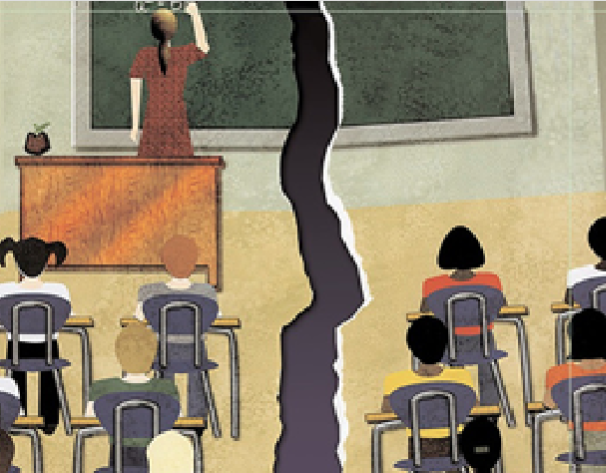
Why is There a Racial Achievement Gap?

Screen Shot 2018-11-16 at 12.15.01 PM


Sometimes the most racist aspects of a society are right there in front of you, but no one seems to notice.


Take the racial achievement gap.


It’s a term used to describe the fact that black and Latino students don’t do as well academically as white students.


Why does it even exist?


Why do students of color in the United States achieve less than their white peers?


They have worse grades, lower test scores, meager graduation rates and fewer achieve advanced degrees.


As of 2018, they had the lowest mean score of any racial group on the Scholastic Aptitude Test (SAT).


And it’s been like that for more than half a century.


In 1964, a Department of Education report found that the average black high school senior scored below 87% of white seniors (in the 13 percentile). Fifty years later, the National Assessment of Educational Progress (NAEP) found that black seniors had narrowed the gap until they were merely behind 81% of white seniors (scoring in the 19th percentile).


So what does that mean?


It’s a question that has haunted our education system for more than a century.


And the various answers that have been offered to explain it often reveal more about our society than they do about black and Latino children.


CLAIM 1: People of color are just genetically inferior


I know. This sounds glaringly racist.


And it is.


Yet this was the favorite answer for the achievement gap at the start of the 20th Century (More on that later).


However, it has been espoused as recently as 1995 by Charles Murray and Richard Herrnstein in The Bell Curve where the authors attributed relative black failure and low socio-economic status to biological inadequacy.


Murray and Herrnstein sparked such an intense academic debate at the time that the American Psychological Association (APA) convened a Task Force on Intelligence. Instead of soundly disproving this theory, the resulting APA report could come to no definite conclusion: “At this time, no one knows what is responsible for the differential,” the authors wrote.


Today the idea that people of color are genetically inferior has been soundly defeated.


There is simply no evidence that racial characteristics are strongly correlated with intelligence.


If it were true, for example, you’d expect to see the same achievement gap from native born Africans immigrating to this country as those who are born in the US. But that is not the case. In fact, we see just the opposite effect – a sizable percentage of African immigrants earn some of the best grades, have some of the highest test scores, and disproportionately graduate from high school and achieve advanced degrees.


This is something that distinguishes foreign-born Africans – especially those from Sub-Saharan Africa – even from other immigrants. African immigrants sit near the top of the scale of so-called model minorities.


If the problem was mere genes, this wouldn’t be so.


CLAIM 2: America’s people of color are culturally inferior


You’d think it would be obvious how racist such a claim is, but it is an increasingly popular explanation of the achievement gap.


In The End of Racism, popular conservative writer Dinesh D’Souza blamed the racial accomplishment gap on black cultural defects. “[T]he old discrimination” has declined and been replaced by “rational discrimination” based “on accurate group generalizations,” wrote D’Souza.


In other words, it’s not genes, but pathological community values that keep many people of color at the bottom. Black and brown students would do better in school if their culture fostered hard work, determination, grit and valued learning. They’d learn more if their parents weren’t always in jail or having innumerable children to increase their food stamp benefits.


From a purely ideological standpoint, this is textbook racism – the belief that some racially defined groups are in some sense better or worse than others.


It’s the minstrel show as case study. It boils down the attributes of 40 million people to mere stereotypes and pretends that they’re real.


The truth is most people of color don’t fit the corny clichés. In the real world, most black folks do not commit crime, only about 6 percent of unmarried black women give birth each year, and most black people are not recipients of welfare benefits. Indeed, fewer than 200,000 black adults in the entire US currently receive cash welfare benefits from the government. That’s out of about 30 million black adults in all. So these are not cultural norms.


Furthermore, black crime rates, out-of-wedlock birthrates, and welfare dependence have gone down in recent years, while white rates have increased.


Such claims show more about those making them than the people the claims are supposed to be about. When a black person struggles, the cause is assumed to be a deeply ingrained cultural attribute. When the same happens to white people, it’s an anomaly.


For instance, in the 80’s and 90’s the media blamed black culture and black communities for the crack epidemic. But today those same talking heads excuse the mostly white and rural opioid crisis as an aberration. No one seems to claim that it is because the white family is breaking down or white culture is in decline.


Black families are disproportionately poor and thus suffer higher rates of everything that comes with it.


But this is not an artifact of their culture anymore than it is for poor whites.


CLAIM 3: People of color experience higher rates of poverty and thus struggle more academically.


Finally we have a claim based in fact and not racial stereotypes!


When we look at test scores, like those on the NAEP, we see that state racial achievement gaps are strongly correlated with state racial socioeconomic disparities.


Poor people achieve worse academic outcomes than wealthier people. And this is true across race and ethnicity.


It just makes sense. Living in poverty means less access to healthcare, neonatal care, pre-kindergarten, and fewer books in the home. It often means fewer educated family members to serve as a model. And it often means suffering from malnutrition and psychological trauma. Impoverished parents usually have to work multiple jobs just to make ends meet and thus have less time to help with homework or see to their children. All of this has a direct impact on education.


The fact that a larger percentage of people of color are poor, helps explain the disparity of achievement between races.


The fact that achievement gaps tend to be largest in places where racial socioeconomic disparities are largest, supports this theory. Moreover, in neighborhoods with greater socioeconomic equality, the racial achievement gap is likewise smaller or nonexistent.


Achievement gaps are strongly correlated with racial gaps in income, poverty rates, unemployment rates, and educational attainment.


However, poverty, alone, does not explain away the problem.


Even when racial disparities are few and far between (typically in states with small black and/or Hispanic populations), the gap can persist.


We shouldn’t discount poverty. It goes a long way to explaining the problem. It just doesn’t go all the way.


CLAIM 4: Racist policies and bias widen the achievement gap


There are numerous factors that can adversely affect achievement for children of color above and beyond poverty. These include the availability and quality of early childhood education, the quality of public schools, patterns of residential and school segregation, and state educational and social policies.


For example, more than 60 years after Brown v. Board, school segregation is still a problem. In fact, in many parts of the country, they are actually more segregated today than they were at the height of the civil rights movement in the 1960s.


According to a report from the U.S. Government Accountability Office, from 2000 to 2014, school segregation has more than doubled nationwide. That’s twice the number of schools comprised almost entirely of students living in high poverty and/or students of color.


The number went from 7,009 to 15,089 schools. And that’s just the worst offenders – schools with more than three quarters of students from only one race or class. Throughout the country there are thousands more schools not as extreme but still serving mostly poor and/or minority students, and thus receiving fewer resources, more teacher layoffs, dealing with larger classes and crumbling infrastructure.


Even where segregation isn’t a problem, racist policies can creep into the academic culture.


A report by the Government Accountability Office (GAO) found that black students in K-12 schools are far more likely to be disciplined — whether through suspension or referral to law enforcement — than their racial counterparts.


A 2014 study found that people generally view black boys as older and less innocent starting at the age of 10. Another study released in 2017 produced similar results, finding that Americans overall view black girls as less innocent and more mature for their age, from ages 5 to 14.


These have real world consequences for children’s academic development. If even well-meaning (and mostly white) teachers are more likely to see children of color as potential trouble makers, that can be a self-fulfilling prophecy. And kids who are in trouble often have more difficulty making the grade.


Finally, there is the influence of charter and voucher schools, many of which target their enrollment at students of color.


These are schools that are (at least in part) publicly funded but privately managed. They are not required to have nearly the same transparency as traditional public schools, don’t have to be democratically controlled and can often be run for a profit.


They can cut services to students on a whim and if students struggle, they can give them the boot forcing them to try to catch up at the local public school.


These practices are so worrying that the National Association for the Advancement of Colored People (NAACP) and Black Lives Matter have both called for a moratorium on all new charter schools. Journey for Justice has gone even further with a call for more community schools.


Bias and policies like these can have a big impact on students, but we haven’t even discussed the largest culprit.


CLAIM 5: The standardized testing industry is essentially biased


We’ve talked a lot about why there’s a racial achievement gap.


We haven’t talked that much about if.


You have to admit, it’s counterintuitive to think that there should be academic hierarchies based on race. One race is better than others at school? Really? Isn’t that, itself, a racist assumption?


If there is no evidence for genetic or social differences along racial lines, can we explain everything else by way of socioeconomics and racist policies?


Perhaps. But even more so, we need to question the mechanism that started this whole debate in the first place – standardized testing.


That is the primary mechanism used to determine if there is a racial achievement gap at all.


If that mechanism is biased, so is the result.


This is particularly troubling for an industry that was built on the eugenicist premises with which we started this article.


Standardized testing, as we know it, originates from the work of Francis Galton – Charles Darwin’s cousin and an English statistician. In 1869, he wrote in Hereditary Genius that “[t]he average intellectual standard of the negro race is some two grades below our own.” Galton nearly invented the western eugenics movement, but couldn’t find a method to test his theories.


Enter France’s Alfred Binet and Thodore Simon. In 1905 they developed an IQ test that 11 years later was revised by Stanford University psychologist Lewis Terman for use in America.


In his book, The Measurement of Intelligence, Terman wrote that these “experimental” tests will show “enormously significant racial differences in general intelligence, differences which cannot be wiped out by any scheme of mental culture.”


For Terman, the achievement gap wasn’t a problem. It was a feature he was actively trying to prove, and he thought he had done so with his experiments on 1.7 million U.S. servicemen in World War I.


His deeply biased work convinced a generation of scholars. Princeton University psychologist Carl C. Brigham presented the results as evidence of genetic racial hierarchy in A Study of American Intelligence – merely three years before he used these same ideas to craft the SAT test in 1926.


Though that same SAT test has been revised since Brigham’s time, the fundamental principals behind it remain the same. Along with the PSAT, it was taken by more than 6.7 million students in the 2015-16 school year.


The ideals of the eugenicists lost popularity after World War II, but they were by no means finished. Famed physicist William Shockley and educational psychologist Arthur Jensen carried these concepts into the 1960s before they were revived again in The Bell Curve in the ‘90s.


These are not just bugs in the system. They are what the system was meant to prove in the first place.


Our worship of the data has made us all unwitting accomplices of an ideal that is prejudiced in its axioms.


By defining academic success or failure primarily as success or failure on standardized tests, we’ve effectively barred generations of children of color from the benefits of an education. And in using these same tests for “accountability” purposes to reward or punish their schools by granting or denying resources, high stakes testing has become the academic gatekeeper. Biased assessments have been used to grant real world opportunity.


How many opportunities have been denied because of them? How many black and brown children have been denied entry to college, professions, graduate schools, jobs, places at the highest ranked schools?


How many young black and brown children have been convinced of their own ignorance because of a test score of dubious quality?


CONCLUSIONS


So we return to the question with which we began this article:


Why is there a racial achievement gap?


The answer is NOT because of genetic or cultural deficiencies in children of color.


The gap stems from a combination of disproportionate levels of poverty among black and brown people, racist bias and policies embedded in our public school system and – more than anything else – reliance on a flawed assessment system.


If we want to really close the achievement gap, we must do several things. First, we must continually discredit and criticize the genetic and social critique of racial minorities at the heart of the conservative movement.


Next, we must create a more just and equitable education system. This means fairly funding our schools. We must increase integration. We must halt the spread of charter and voucher schools. We need to make sure all our teachers and principals have cultural sensitivity training and increase the numbers of teachers of color in our school system.


And we must get rid of our system of standardized testing.


It’s a tall order, but that’s the only way to close an even more pressing gap – the gap between our reality and our ideals.


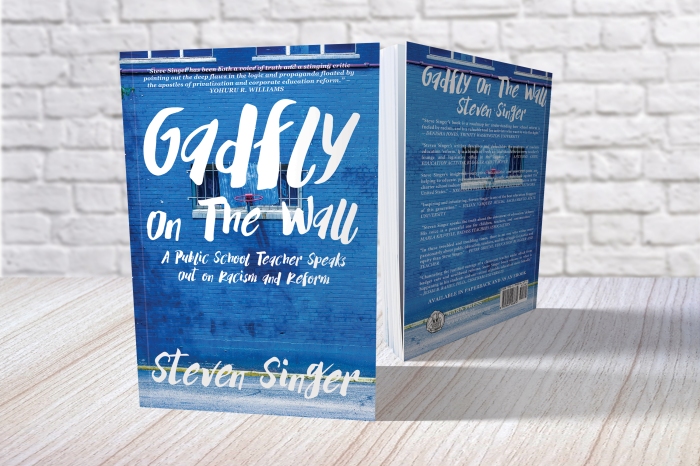
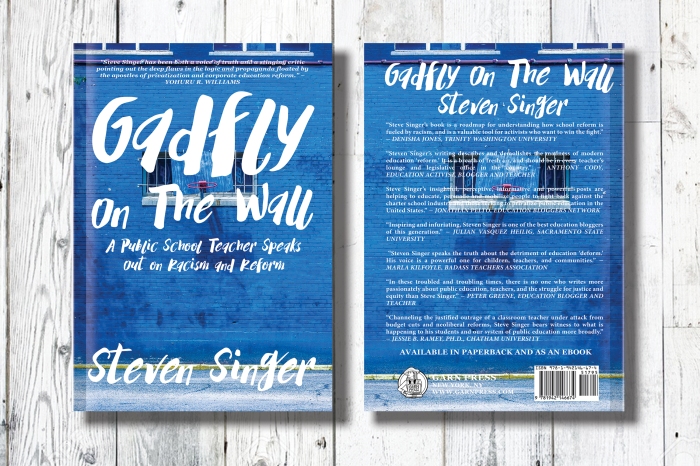
Like this post? I’ve written a book, “Gadfly on the Wall: A Public School Teacher Speaks Out on Racism and Reform,” now available from Garn Press. Ten percent of the proceeds go to the Badass Teachers Association. Check it out!
book-4

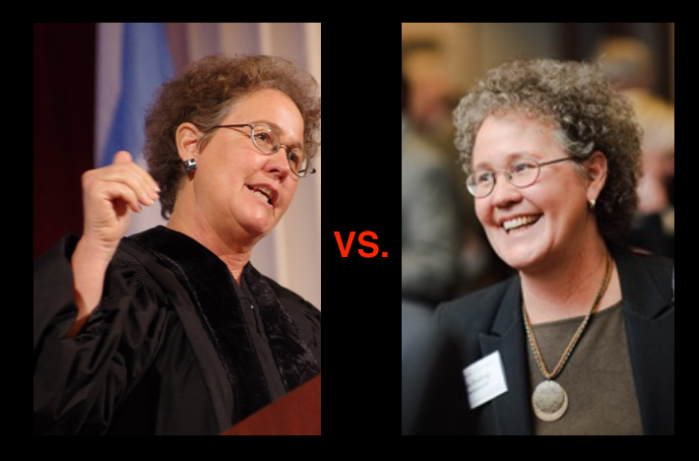
Linda Darling-Hammond vs. Linda-Darling Hammond – How a Once Great Educator Got Lost Among the Corporate Stooges

Screen Shot 2018-11-12 at 7.31.40 AM


Linda Darling-Hammond is one of my education heroes.


Perhaps that’s why her recent article in the Washington Post hurts so much.


In it, she and her think tank buddies slam education advocates Diane Ravitch and Carrol Burris for worrying about who governs schools – as if governance had nothing to do with quality education for children.


I’d expect something like that from Bill Gates.


Or Campbell Brown.


Or Peter Cunningham.


But not Hammond!


She’s not a know-nothing privatization flunky. She’s not a billionaire who thinks hording a bunch of money makes him an authority on every kind of human endeavor.


She’s a bona fide expert on teacher preparation and equity.


She founded the Center for Opportunity Policy in Education at Stanford University, where she is professor emeritus.


And she was the head of Barrack Obama’s education policy working group in 2008 when he was running for President.


In fact, she was the reasons many educators thought Obama was going to be a breath of fresh air for our schools and students. Everyone thought she was a lock for Education Secretary should Hope and Change win the day. But when he won, he threw her aside for people like Arne Duncan and John King who favored school privatization and high stakes standardized testing.


These days she spends most of her time as founder and president of the California-based Learning Policy Institute.


It’s a “nonprofit” think tank whose self-described mission is “to conduct independent, high-quality research to improve education policy and practice.”


The Learning Policy Institute published a report called “The Tapestry of American Public Education: How Can We Create a System of Schools Worth Choosing for All?


The report basically conflates all types of choice within the public school system.


On the one hand, it’s refreshing to have policy analysts admit that there ARE alternatives within the public school system above and beyond charter and voucher schools.


On the other, it’s frustrating that they can’t see any fundamental differences between those that are publicly managed and those outsourced to private equity boards and appointed corporate officers.


Hammond and her colleagues Peter Cookson, Bob Rothman and Patrick Shields talk about magnet and theme schools.


They talk about open enrollment schools – where districts in 25 states allow students who live outside their borders to apply.


They talk about math and science academies, schools focusing on careers in health sciences and the arts, schools centered on community service and social justice, international schools focused on global issues and world languages, and schools designed for new English language learners.


They talk about schools organized around pedagogical models like Montessori, Waldorf and International Baccalaureate programs.


And these are all options within the public school system, itself.


In fact, the report notes that the overwhelming majority of parents – three quarters – select their neighborhood public school as their first choice.


However, Hammond and co. refuse to draw any distinction between these fully public schools and charter schools.


Unlike the other educational institutions mentioned above, charter schools are publicly funded but privately run.


They take our tax dollars and give them to private equity managers and corporate appointees to make all the decisions.


Though Hammond admits this model often runs into problems, she refuses to dismiss it based on the few instances where it seems to be working.


Despite concerns from education advocates, fiscal watchdogs and civil rights warrior across the country, Hammond and co. just can’t get up the nerve to take a stand.


The NAACP and Black Lives Matter have called for a moratorium on all new charter schools in the country. Journey for Justice has requested a focus on community schools over privatization. But Hammond – a once great advocate for equity – can’t get up the moral courage to stand with these real agents of school reform.


She stands with the corporate school reformers – the agents of privatization and profit.


“School choice is a means that can lead to different ends depending on how it is designed and managed…” write Hammond and her colleagues.


In other words, if charters result in greater quality and access for all students, they are preferable to traditional public schools.


However, she admits that charters usually fail, that many provide worse academic outcomes than traditional public schools serving similar students.


She notes that 33% of all charters opened in 2000 were closed 10 years later. Moreover, by year 13, that number jumped to 40%. When it comes to stability, charter schools are often much worse than traditional public schools.


And virtual charter schools – most of which are for-profit – are even worse. They “…have strong negative effects on achievement almost everywhere and graduate fewer than half as many of their students as public schools generally.”


However, after noting these negatives, Hammond and co. go on to provide wiggle room for privatization. They discuss how state governments can do better making sure charter schools don’t go off the rails. They can provide more transparency and accountability. They can outlaw for-profit charters and put caps on the number of charters allowed in given districts and states, set rules on staffing and curriculum – all the kinds of measures already required at traditional public schools.


But the crux of their objection is here:


“In a recent commentary in this column, authors Diane Ravitch and Carol Burris erroneously asserted that our report aims to promote unbridled alternatives to publicly funded and publicly operated school districts. Quite the opposite is true.”


In other words, they continue to lump privatized schools like charters in with fully public schools.


They refuse to make the essential distinction between how a school is governed and what it does. So long as it is funded with public tax dollars, it is a public school.


That’s like refusing to admit there is any difference in the manner in which states are governed. Both democracies and tyrannies are funded by the people living in those societies. It does not then follow that both types of government are essentially the same.


But they go on:


“The report aims to help states and districts consider how to manage the broad tapestry of choices available in public schools in ways that create quality schools with equitable access and integrative outcomes.”


Most tellingly, the authors admonish us to, “Focus on educational opportunities for children, not governance structures for adults” (Emphasis mine).


The way a school is governed is not FOR ADULTS. It is FOR CHILDREN. That is how we do all the other things Hammond and co. suggest.


“Work to ensure equity and access for all.”


That doesn’t just happen. You have to MAKE it happen through laws and regulations. That’s called governance.


“Create transparency at every stage about outcomes, opportunities and resources.”


That’s governance. That’s bureaucracy. It’s hierarchy. It’s one system overlooking another system with a series of checks and balances.


“Build a system of schools that meets all students’ needs.”


Again, that doesn’t just happen. We have to write rules and systems to make it happen.


Allowing private individuals to make decisions on behalf of private organizations for their own benefit is not going to achieve any of these goals.


And even in the few cases where charter schools don’t give all the decisions to unelected boards or voluntarily agree to transparency, the charter laws still allow them to do this. They could change at any time.


It’s like building a school on a cliff. It may be fine today, but one day it will inevitably fall.


I wrote about this in detail in my article “The Best Charter School Cannot Hold a Candle to the Worst Public School.”


It’s sad that Hammond refuses to understand this.


I say “refuse” because there’s no way she doesn’t get it. This is a conscious – perhaps political – decision on her part.


Consider how it stacks up against some of the most salient points she written previously.


For instance:


“A democratic education means that we educate people in a way that ensures they can think independently, that they can use information, knowledge, and technology, among other things, to draw their own conclusions.”


Now that’s a Linda Darling-Hammond who knows the manner in which something (a state) is governed matters. It’s not just funding. It’s democratic principles – principles that are absent at privatized schools.


“Bureaucratic solutions to problems of practice will always fail because effective teaching is not routine, students are not passive, and questions of practice are not simple, predictable, or standardized. Consequently, instructional decisions cannot be formulated on high then packaged and handed down to teachers.”


This Linda Darling-Hammond is a fighter for teacher autonomy – a practice you’ll find increasingly constrained at privatized schools. In fact, charter schools are infamous for scripted education, endless test prep and everything Hammond used to rail against.


“In 1970 the top three skills required by the Fortune 500 were the three Rs: reading, writing, and arithmetic. In 1999 the top three skills in demand were teamwork, problem-solving, and interpersonal skills. We need schools that are developing these skills.”


I wonder what this Linda Darling-Hammond would say to the present variety. Privatized schools are most often test prep factories. They do none of what Hammond used to advocate for. But today she’s emphatically arguing for exactly the kind of school she used to criticize.


“If we taught babies to talk as most skills are taught in school, they would memorize lists of sounds in a predetermined order and practice them alone in a closet.”


Isn’t this how they routinely teach at charter schools? Memorize this. Practice it only in relation to how it will appear on the standardized test. And somehow real life, authentic learning will follow.


“Students learn as much for a teacher as from a teacher.”


Too true, Linda Darling-Hammond. How much learning do you think there is at privatized schools with much higher turnover rates, schools that transform teachers into glorified Walmart greeters? How many interpersonal relationships at privatized institutions replacing teachers with iPads?


“Life doesn’t come with four choices.”


Yes, but the schools today’s Linda Darling-Hammond are advocating for will boil learning down to just that – A,B,C or D.


“We can’t fire our way to Finland.”


Yet today’s Linda Darling-Hammond is fighting for schools that work teachers to the bone for less pay and benefits and then fire them at the slightest pretense.


In short, I’m sick of this new Linda Darling-Hammond. And I miss the old Linda Darling-Hammond.


Perhaps she’s learned a political lesson from the Obama administration.


If she wants a place at the neoliberal table, it’s not enough to actually know stuff and have the respect of the people in her profession.


She needs to support the corporate policies of the day. She needs to give the moneymen what they want – and that’s school privatization.


This new approach allows her to have her cake and eat it, too.


She can criticize all the evils of actual charter schools while pretending that there is some middle ground that allows both the monied interests and the students to BOTH get what they want.


It’s shrewd political gamesmanship perhaps.


But it’s bad for children, parents and teachers.


Like this post? I’ve written a book, “Gadfly on the Wall: A Public School Teacher Speaks Out on Racism and Reform,” now available from Garn Press. Ten percent of the proceeds go to the Badass Teachers Association. Check it out!

cropped-book-1.jpg

Grit is Sh!t – It’s Just an Excuse to do Nothing for Struggling Students

 Screen Shot 2018-11-08 at 3.29.01 PM


Let’s say you’re out in public and you see a crying child alone in the street.


What would you do?


Would you run up to her and help? Or would you just shrug, mutter some derisive comment about the brat and walk on?


Our public school policymakers want us to do the later. In fact, they have a whole pedagogical justification for ignoring the needs of children.


It’s called “academic tenacity,” a “growth mindset” or “grit.”


And it goes something like this:


That child isn’t learning? If she just worked harder, she would.


It’s the political equivalent of “pull yourself up by your own bootstraps” applied to the classroom.


And it’s super helpful for politicians reluctant to allocate tax dollars to actually help kids succeed.


The idea and the euphemisms used to describe it were coined by Carol Dweck as early as 1999. It was subsequently popularized by seventh-grade math teacher and psychologist Angela Duckworth.


In the early 2000s, Duckworth realized that IQ wasn’t the only thing separating successful students from those who struggled. There was also the tendency to overcome adversity or not.


Hey, Angela. Darwin called. He wants his Theory of Natural Selection back.


You know Survival of the Fittest was never meant to be prescriptive. As human beings, we’re supposed to be better than mere animals that typically leave the pack’s sick and injured behind to get eaten by predators.


But whatever.


The term “grit,” is defined as a “passion and perseverance for long-term goals,” according to Frontiers in Psychology. And it’s become one of the buzziest of buzzwords in academia.


So much so, that as you’re reading this, standardized test manufacturers are working to develop an assessment to find it in students.


The agencies that administer the National Assessment of Education Progress (NAEP) and the Program for International Student Assessment (PISA) are close to including character assessments as a measure of student performance.


Oh goody!


They foresee a brave new world where multiple-choice tests will determine not just the entire scope of human knowledge but character as well!


But what no one wants to admit is that grit is… well… shit.


It’s just an excuse for a society that refuses to help those most in need.


In our world, there are haves and have-nots. But if we stop there, we ignore how and why this situation came to be.


Who places kids into segregated schools? WE DO.


Who allocates funding based largely on parental income? US.


We set kids up to succeed or fail before they even enter the school system with an economy that rewards the already rich and punishes generational poverty.


Yet when anyone suggests offering help to even the playing field – to make things more fair – a plethora of policy wonks wag their fingers and say, “No way! They did it to themselves.”


It’s typical “blame the victim” pathology to say that some kids get all the love, time and resources they need while others can do without — they just need more “grit” and a “growth mindset.”


Life’s tough. Get over it.


That’s easy for YOU to say! Because it’s the have’s who make the rules, it’s the people at the top who are telling the people at the bottom they’re to blame for their own suffering.


So you forget all the ways society has helped you and yours. YOU deserve all the credit for your successes.


But for those people over there, let’s forget all the ways society has refused to help and instead blame THEM for not overcoming the obstacles (we put) in their path.


Don’t get me wrong. I’m not saying effort counts for nothing. But it’s part of a complicated matrix of nature and nurture.


Our environments shape us, but we have some control over what we do with what we’re given.


Yet as a society, we can’t simply ignore our responsibilities toward others and throw it all on the individual.


Good teachers know how to get the best out of their students. We know that most kids – if given a safe, encouraging environment – can succeed.


The key often is to scaffold that success. Give them something to do that they can actually master. Then give them something slightly more challenging.


You teach them that they have the ability to succeed and success becomes a self-fulfilling prophecy – and not the opposite.


However, the teacher – and even the school, itself – can only do so much.


As a society, we need to change the environment in which these kids grow up.


We need to fully fund our public schools to meet the needs of all students. That means more funding, services and opportunities for the underserved than for those who already have the best of everything and don’t need to rely as heavily on the school system for support.


We need wraparound services, counseling, tutoring, after school programs, community schools, jobs programs, continuing education for adults and other services to help heal the trauma of growing up poor in America.


But leaving it all to this magical thing called “grit” is just ignoring our responsibilities to our fellow human beings.


When you see someone suffering, you need to help them – not comfort yourself with excuses for ignoring them.


Like this post? I’ve written a book, “Gadfly on the Wall: A Public School Teacher Speaks Out on Racism and Reform,” now available from Garn Press. Ten percent of the proceeds go to the Badass Teachers Association. Check it out!

book-2

The World Mourns for Jews After Pittsburgh’s Synagogue Shooting. What About Other Targets of Hate?

Chin110118RallyAgainstAntisemitismMet5


When a white supremacist killed 11 people and wounded 6 others at a Pittsburgh synagogue last weekend, the world took notice.


Lights dimmed at the Eiffel Tower and Empire State building.


Candlelight vigils were held nationwide – including in Boston, Houston, Washington D.C., Philadelphia, New Orleans, Atlanta, Chicago, New York City and Los Angeles.


A host of international leaders from the Pope to Canadian Prime Minister Justin Trudeau to German Chancellor Angela Merkel expressed outrage, sadness and solidarity.


I’ll admit that as a native Pittsburgher and person of Jewish descent, it touched me deeply.


For a moment, it seemed like the whole world had stopped spinning and from every corner of the globe people were with us in our tragedy.


But at the same time, it was troubling.


After all, there were at least two other major hate crimes in the U.S. perpetrated within 72 hours of the shooting.


In Kentucky, a white man shot and killed two African-Americans at a Kroger grocery store following a failed attempt to break into a black church.


Only two days later, a deranged man who had railed against Democrats and minorities with hate-filled messages online was arrested for allegedly sending mail bombs to people who’d been criticized by President Donald Trump.


IMG_8311


Where were the candlelight vigils for those atrocities?


Where were the international landmarks going dark?


Where was the worldwide condemnation?


In the wake of Pittsburgh’s tragedy, these other violent acts have been almost forgotten.


Yet they’re all symptoms of the same disease – hate and bigotry.


Don’t get me wrong.


What happened in Pittsburgh was terrible.


The Anti-Defamation League estimates that the shooting at the Tree of Life Synagogue may be the most deadly attack on Jews on American Soil in our history.


694940094001_5854810496001_5854807723001-vs


But me and mine do not have a monopoly on sorrow.


We suffer, but we are not the only ones hurting.


This all happened not far from my home.


I’ll admit that I am having a really hard time dealing with it.


I am not sleeping well.


I find myself zoning out in the middle of everyday activities.


And I feel this constant anxiety like part of me is expecting to hear a gunshot ringing down the hall at any time.


When the alleged shooter entered the sanctuary armed to the teeth and shouted “All Jews must die!” before carrying out his plan, he included me in his declaration.


All Jews.


That’s me.


That’s my daughter. My parents. My family.


It means something to me that so many people have come together to repudiate this crime.


The Islamic Center of Pittsburgh and other U.S. based Muslim groups donated more than $200,000 for funeral expenses. An Iranian refugee (who hadn’t even been to the three rivers) started a GoFundMe that brought in $1 million for the victims and their families.


You can’t go anywhere in Pittsburgh without a memorial, a moment of silence, a shared statement of solidarity and love.


At the symphony, musicians read two statements from the stage against hate before playing a Hebrew melody with string quartet.


At my school – I’m a teacher – the union decided to collect money for the victims.


I saw a barge floating down one of the rivers that had the message “Stronger Than Hate” on the side next to the modified Steelers logo where the top star had been replaced by a Star of David.


IMG_8309


I even saw a similar message on a Wendy’s sign: “PittsburghStrong/ Stronger/ Than Hate”.


IMG_8312


The community has come together in a way I’ve never seen before.


But I can’t help wondering why.


Even after Richard Baumhammers went on a racially motivated killing spree in 2000 murdering five people including two Jews, the response wasn’t this overwhelming.


Perhaps it’s just that this latest shooting is the final straw.


Perhaps it is the moment when our nation finally pulls together and says that enough is enough – We won’t tolerate this kind of hate and violence.


I hope that’s it.


However, in the shadows of my mind I wonder if it might not be a reflection of the same beast that struck us last weekend.


Could it be that we’re willing to put up with violence against brown people, but only draw the line when those targeted have lighter skin?


I guess my point – if I have one – is this: Thank you, But.


On behalf of Pittsburgh’s Jews, thank you for having our back.


If we’re going to survive this, we’re going to need your continued support and solidarity.


But it’s not just us.


Hate crimes have jumped from about 70 incidents a year in the 1990s to more than 300 a year since 2001. And after Trump was elected, 900 bias-related incidents were reported against minorities within the first 10 days.


Our country was built on the genocide of over 110 million indigenous Americans and the enslavement of 30 million Africans.


The idea of concentration camps didn’t originate with the Nazis. Hitler got the idea from U.S. treatment of Native Americans.


Racism didn’t end with the Civil Rights Movement. It just changed shape and is hidden in the way we practice health care, education, and policing all the way to mass incarceration.


The shock and solidarity in the wake of the synagogue shooting is appreciated, but it’s not enough to mourn only when 11 Jews are murdered in cold blood.


It’s not enough to take a stand against anti-Semitism.


We need to join together to fight all of it.


We need to be unified against school segregation, police brutality, xenophobia and prejudice in all of its forms.


The white supremacist who killed my friends and neighbors targeted us because he thought we were helping brown-skinned immigrants into the country.


We can’t just stand for the helpers. We need to stand for those in need of that help.


It just won’t work any other way.


We can’t just be against violence to light skinned minorities. We have to empathize and protect our brown skinned brothers and sisters, too. We have to love and cherish our LGBTQ neighbors, as well.


IMG_8310


We have to realize that our freedom, our safety, our very lives depend not just on what rights we have – but on what rights we give to all.


That is the only way any of us will ever feel safe again.


Through love and solidarity for every. Single. Human. Being.


AR-181029559.jpg&MaxH=500&MaxW=900


Like this post? I’ve written a book, “Gadfly on the Wall: A Public School Teacher Speaks Out on Racism and Reform,” now available from Garn Press. Ten percent of the proceeds go to the Badass Teachers Association. Check it out!
book-3

The Pittsburgh Community is Stronger Than the Synagogue Shooter’s Hate

43579727_10156281113318860_8423220729121603584_n


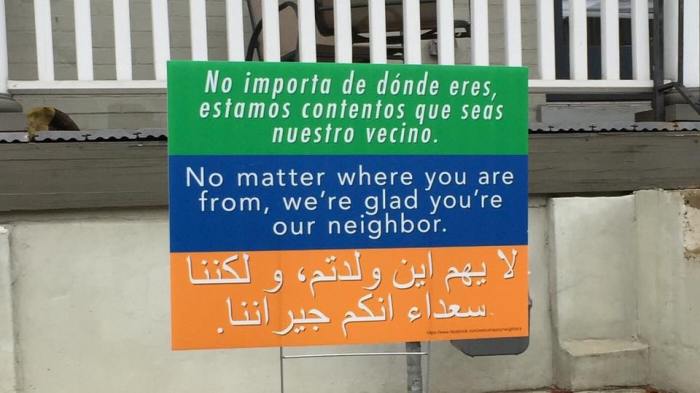
There’s a popular yard sign in the Squirrel Hill neighborhood of Pittsburgh.


In bands of green and blue and yellow, it projects the same message in Spanish, English and Arabic:


“No matter where you are from, we’re glad you’re our neighbor.”


If the community had a motto, I think that might be it.


Though known for its high concentration of Jewish residents, the Pennsylvania locale is a multicultural crossroads.


That may have made it a target today when a shooter entered the Tree of Life Synagogue.


Though the alleged culprit has been captured, details are still being uncovered. The death toll has yet to be tallied.


Unconfirmed reports state that he shouted “All Jews must die,” before opening fire.


But I don’t believe that the Jewish community was his only target.


Or more precisely – it wasn’t just the Jewish part – it was the community that had grown up around it.


I know Squirrel Hill well.


I live close by. I grew up on those streets. I’ve been to services at that synagogue. I have family who are members.


Thankfully it seems that no one related to me was there this morning. But when victims names are released, I probably will know who they are.


I know this community.


I am an extended part of it.


And that’s something of which I am proud.


Just walk along Murray Avenue and you’ll see Indian, Italian, Jewish, African, Chinese – every nationality imaginable – offering the fruits of their culture for friendly commerce.


You’ll see Hasidic Jews in dark hats and flowing tzitzit walking next to women in colorful saris next to trans and lesbians, kids with every color skin playing together in harmony.


Whenever I want a good corned beef sandwich or a quality lox and bagel, I go there. Whenever I want a spicy curry or the freshest sushi or an authentic macaroon, that’s the place. If I want to hear a string quartet or a lecture from a visiting dignitary or even if I want to swim in a public pool, membership to the Jewish Community Center is open to all.


It’s like a few blocks of cosmopolitan life tucked away in a city more known for segregation. We have many ethnic neighborhoods but few where one culture flows so easily into another.


Heck. Even the Tree of Life Synagogue, itself, doesn’t serve one congregation. It serves three who all had services going on at different parts of the building this morning.


There’s just something very special about this place.


It’s where you can go to be yourself – in fact, you’re encouraged to be who you are and not conform to any particular norm. Yet in doing so, you’re somehow demonstrating unity.


Paradoxically, being you makes you one of us.


It’s weird.


I think it may have been that sense of community that made Squirrel Hill, in general, and the Tree of Life Synagogue, in particular, a target.


The hate-filled person who attacked us today was terrified of that unity.


He was so frightened of disillusion, of losing his sense of self, that he had to end the lives of those who could do what he couldn’t.


It’s pathetic, really.


If your sense of self is only a negative, only opposition to someone else’s otherness, you really don’t have much self to lose.


If you define yourself by your hate, what are you?


Do you even really exist?


Most of us are very different.


We are complex assortments of personality – a family identity, a cultural heritage, a work persona, a spirituality, a sense of justice.


Communities like Squirrel Hill nurture this multifarious nature.


They welcome and celebrate difference.


I wish America was more like Squirrel Hill and not the other way around.


If this community’s normal was our national ideal, think of the country we would be living in!


Being different wouldn’t be an obstacle, it would be cherished.


When meeting someone with an unfamiliar name, a heritage of which you were ignorant, a sexuality or gender identity of which you had little knowledge – your response wouldn’t be fear or discomfort. It would be a thrill of excitement that you are lucky enough to broaden your understanding of the many ways there are to be human.


It would be a country where no one grew up so stunted and afraid that the only solution they could imagine would be the death of others.


That’s the America I want to live in.


Squirrel Hill is stronger than this synagogue shooters hate.


I hope our country is, too.


Like this post? I’ve written a book, “Gadfly on the Wall: A Public School Teacher Speaks Out on Racism and Reform,” now available from Garn Press. Ten percent of the proceeds go to the Badass Teachers Association. Check it out!

book-1

Dear Non-Voters, Your Country Needs You

Voting.


Four in 10 Americans who were eligible to vote in 2016 didn’t do so.


That’s some 92 million U.S. Citizens.


These people weren’t purged from the polls.


They weren’t barred from voting.


They just didn’t bother.


So, the way I see it, the responsibility for President Donald Trump rests with you.


The United States has a Reality TV Show clown in the oval office.


He is a dimwitted narcissist who panders to racists, sexists and xenophobes to stay in power.


He is an incurious liar who constantly trolls the media and the public.


He is an admirer of dictators and fascists across the globe with no qualms about enriching himself and those like him at the expense of you and me.


Everyday he provides aide and comfort to anti-American regimes from Moscow to Riyadh by diminishing our international stature, withdrawing us from treaties and contracts, leaking sensitive information and otherwise pursuing foreign interests over those of American citizens.


And that’s before we even begin to examine his colossal impact on human rights – emboldening terrorists and white supremacists while his own administration throws children in cages and forcibly separates them from their families.


This is on you, non-voters.


You did this.


A democratic republic is like any other machine – it only functions properly if all of its parts are working.


You can’t have majority rule when 40% of voters shirk their duty.


A study by the Pew Research Center found that not only were non-voters likely to be younger, less educated, less affluent, and nonwhite, but 55% of them were Democrats and Democratic-leaning independents.


Screen Shot 2018-10-26 at 3.23.58 PM


If more non-voters under the age of 30 had gotten their acts together in just a few swing states, we wouldn’t all be living through this national nightmare.


So if you think voting doesn’t make a difference, look around.


Look at your bank account for instance.


Wonder why your wages continue to stagnate while the rich pocket more and more of the economy?


Look at your neighborhood. Wonder why our schools, roads, bridges and other public services are crumbling into disrepair?


It’s because you didn’t vote.


I’m not saying everything would have been great under President Hillary Clinton. But Trump sets an awfully low bar for competency.


You think your vote doesn’t matter?


Republicans disagree with you.


They aren’t working overtime to stop people like you from voting because it makes no difference.


Robert Kennedy put it this way:


“The most significant civil rights problem is voting. Each citizen’s right to vote is fundamental to all the other rights of citizenship and the Civil Rights Act of 1957 and 1960 make it the responsibility of the Department of Justice to protect that right.”


Our courts have given up that responsibility.


Since 2013 when the Supreme Court invalidated a key part of the Voting Rights Act, millions of people have been barred from casting a ballot.


The federal government used to require nine states with a history of racial discrimination to obtain federal approval before making such changes. Now that they no longer need to do so, between 2014 and 2016 there’s been a 33% increase in voter purges in these states.


This isn’t just cleaning the polls of the names of people who’ve died. It’s actively preventing people – especially the poor and people of color – from having their voices heard.


In Arkansas, thousands of voters were erroneously flagged in 2016 under the guise of removing people who had been convicted of felonies. In Virginia, voters were wrongly deleted from the rolls in 2013 under the excuse of removing people who allegedly had moved.


And this election cycle more than one hundred thousand Georgia voters were removed because they didn’t respond to a mailer or there was a typo on their registration form.


To make matters worse, the purge was overseen by Secretary of State Brian Kemp, a Republican candidate for governor. Since most of the people being removed from the polls are people of color, the poor and other Democrats or leaning Democrat voters, the move makes it harder for Democrat Stacey Abrams to challenge him.


Kemp and his Republican buddies wouldn’t be going through all this trouble if voting made no difference.


“Too many people struggled, suffered, and died to make it possible for every American to exercise their right to vote,” said civil rights icon and U.S. Senator John Lewis.


And people have died for the opportunity that millions of people decide not to exercise.


People like James Chaney, Andrew Goodman and Michael Schwerner, who were murdered in 1964 while trying to register black voters in Mississippi. People like Viola Liuzzo, who was murdered a year later by the Ku Klux Klan during the Selma march for voting rights.


When you willingly give up an opportunity that was purchased so dear, you disrespect the memories of the dead.


President Franklin D. Roosevelt put it like this:


“Nobody will ever deprive the American people of the right to vote except themselves and the only way they could do this is by not voting.”


Our country is under attack. Our very freedoms are on the line.


Will you be a willing accomplice by standing idly by and allowing these miscreants to defecate all over the flag?


Or will you take a stand, do your duty and vote!?


“Bad politicians are sent to Washington by good people who don’t vote.”

-William E. Simon


Like this post? I’ve written a book, “Gadfly on the Wall: A Public School Teacher Speaks Out on Racism and Reform,” now available from Garn Press. Ten percent of the proceeds go to the Badass Teachers Association. Check it out!
thumbnail_IMG_8249

Kavanaugh Confirmation Begs the Question – Does Truth Matter?

bs-ed-0711-brett-kavanaugh-confirmation-20180710


“The very concept of objective truth is fading out of the world. Lies will pass into history.”

-George Orwell


Does the truth matter?


It seems to be one of the central questions of our age.


We just held a Senate confirmation hearing for Brett Kavanaugh’s lifetime appointment to the Supreme Court.


And despite multiple women making credible allegations of sexual misconduct against him…


Despite an FBI investigation so grossly limited in scope that investigators couldn’t even interview either the accusers or the accused…


Despite the withdrawal of support from some of the most conservative organizations including the National Council of Churches representing more than 100,000 congregations, the magazine of the Jesuit religious order, and even former Supreme Court Justice John Paul Stevens…


Despite all that, the Republican majority gave their wholehearted approval.


Only Alaska Senator Lisa Murkowski bucked her party and voted against him – while Senator Joe Manchin of West Virginia was the only Democrat to vote for him.


The result was a forgone conclusion – a Republican majority who blatantly ignored any evidence and made a decision based purely on party politics.


Dr. Christine Blasey Ford testified in front of these people only a week earlier about a drunk Kavanaugh’s attempted rape when they were both in school.


She put her life, her security and her family’s happiness on the line to come forward. She still can’t return to her home after multiple death threats.


Yet those in power chose to ignore her.


They looked at the facts presented to them and chose to interpret them in a way that allowed them to do what they wanted to do in the first place.


Many said that they believed Ford was accosted but not by Kavanaugh.


Yet they refused to allow the kind of investigation that might have gotten at the truth.


These are not the actions of lawmakers interested in what happened all those years ago between Kavanaugh and Ford – or between Kavanaugh and multiple other women who they didn’t even give a hearing.


These are not the actions of lawmakers concerned about picking the best person for the job.


Instead, they are the actions of partisans who put power over objective reality.


They’d rather craft a story that fits their desires than the other way around.


It is craven, cowardly and disrespectful to their office and their charge.


This article began with a quote from George Orwell, author of 1984. Let me offer another:


“Totalitarianism, however, does not so much promise an age of faith as an age of schizophrenia. A society becomes totalitarian when its structure becomes flagrantly artificial: that is, when its ruling class has lost its function but succeeds in clinging to power by force or fraud. Such a society, no matter how long it persists, can never afford to become tolerant or intellectually stable.”


That is what happened here. A ruling class resorting to force and fraud to broaden its power.


Republicans already have control of two branches of government. Now they have stolen a third – a power grab that will echo down the halls of history for decades to come.


This is a senate majority representing fewer people than the so-called minority, lead by a President who lost the popular vote.


It is not democracy or a just republic. It is a coup.


As Orwell warns, when we ignore an inconvenient reality, we are on the road to totalitarianism.


It didn’t matter to those senators whether Kavanaugh was a blackout drunk, whether he still drinks to excess, whether he engaged in sexual harassment or attempted rape.


Heck. He could have attacked Ford on the floor of the Senate, itself, on live TV.


None of it would have mattered.


He was simply a means to an end – the increased power of the Republican Party and the donor class it represents.


GOP senators (and even Kavanaugh, himself) complained about dark money influencing the nomination process, yet the overwhelming majority of that money came from conservative backers!


They raved and foamed at Democrats for stalling the nomination yet refused to take responsibility for sabotaging Barack Obama’s nomination of Merrick Garland.


Instead they offered bad faith distinctions between what you can do during an election year vs. a presidential election year – as if it made any difference.


It is not just the spirit of the Constitution that lay in tatters on the Senate floor – but the fabric of reality, itself.


Thankfully, voters have an opportunity to have their voices heard in a few weeks.


We can take to the polls and let these people know how we feel about it.


Honestly, this may be our last chance.


I am absolutely devastated by these events.


I find myself at the ripe old age of 44 chiding myself for being naïve.


I watched the hearing as if it were a TV show or a Frank Capra movie. At the last minute, goodness will prevail.


That didn’t happen.


I, too, was blind to reality.


Well, the blinders are off.


Like so many of you, I am in mourning for a country that never really existed.


But the wake is in November.


Let’s hope it will be the start of a rebirth.


Click here to find ways to get involved in the November 6 midterm election.


Like this post? I’ve written a book, “Gadfly on the Wall: A Public School Teacher Speaks Out on Racism and Reform,” now available from Garn Press. Ten percent of the proceeds go to the Badass Teachers Association. Check it out!

WANT A SIGNED COPY?

Click here to order one directly from me to your door!

book-4

Brett Kavanaugh is the Link Between Rape and Abortion

brett-kavanaugh-blasey-ford-1538096510


I think I will always associate Brett Kavanaugh with the taste of vomit in the back of my throat.


I couldn’t watch his sham of a confirmation hearing without my gag reflex going into overdrive.


Here was one of the most privileged of people on the planet alternatively weeping and raging that he was being denied his due.


Here was a man bemoaning that no matter what happened, his reputation forever would be ruined, but who likewise refused to call for an investigation to exonerate himself.


At least three separate women have accused him of sexual assault, yet Congressional Republicans are still planning to ram through his nomination to the Supreme Court – a lifetime appointment where he will almost certainly be the tie breaking vote to overturn Roe vs. Wade.


How fitting.


What perfect symmetry.


You couldn’t have planned it any more poetically.


A man accused of multiple attempted rapes who is doing everything in his power to make abortion illegal.


An overgrown frat boy crying into his beer that we can’t take away his God given right to take away women’s rights.


A confederacy of almost exclusively male lawmakers ready to discount women’s reports of violence so that they can limit women’s freedom to make decisions about their own bodies.


If there is one good thing to come from this farce, it is the spotlight it has shown on the relationship between rape and the movement to recriminalize abortion.


These two things are essentially intertwined.


On the one hand, we have sexual intercourse carried out under threat of violence, sex without consent or in direct violation of consent – a crime invariably perpetrated by men on women.


On the other hand, we have the removal of female consent from the birthing process.


They are almost the same thing, or at least two sides of the same coin.


In both cases, we’re removing or ignoring female permission, agreement, approval, agency. We’re saying it doesn’t matter what the woman wants. It only matters what men or a patriarchal society wants.


And the justification is an ancient text – the New Testament – that doesn’t mention abortion once. And the Old Testament actually gives instructions on how to conduct an abortion (Numbers 5:11-31).


Not that it really should matter. The United States is not a theocracy.


But it IS a patriarchy.


That’s what this is – an attempt by the most insecure, power hungry men to control women.


It is about keeping and strengthening a caste system where men are allowed to be fully realized people and women are allowed only secondary status.


It is about dehumanization clothed in piety and false morality.


All those people crying for the lost lives of a cluster of cells in female uteruses care not a wit about the thousands of women who will die from unsafe abortions once safe procedures become unlawful.


We’ve been here before. Abortion was illegal in the US from the early 1800s until 1973, and we know what will happen. There is actual history on this – back alley procedures conducted by quacks using sharp implements to pierce the womb – and there is no reason to think it won’t repeat itself.


Changing the law won’t stop abortions. It will just make them unsafe for everyone except rich women who can afford doctors willing to take a chance on going to jail for a big payday.


If these people really wanted to stop abortions, they’d support handing out free contraception. They’d turn every orphanage into a palace. They’d each adopt as many children as they could. They’d make neonatal care free, expand services to help women raise children, increase maternity leave, pay for free childcare, expand education funding.


But they don’t do any of that because despite their crocodile tears, their objection has nothing to do with unborn children.


It has to do with mature women making decisions for themselves. It has to do with conceptualizing them as people equal to men and with minds capable of consent.


It’s about allowing women the right to choose – choose whom to have sex with and what exactly the consequences of that sex will or will not be.


I am so thankful that Dr. Christine Blasey Ford came forward with her testimony. What bravery! What grace under pressure!


To be able to share with an entire nation her personal trauma at the hands of Kavanaugh. Such courage boggles the mind almost as much as those who refuse to accept her story as genuine.


They say that this is political. That it’s a hit job. Yet they pound their fists onto their ears to drown out Kavanaugh’s words in self-defense where he makes it entirely clear how partisan he is and will be once he takes the bench:


“This whole two-week effort has been a calculated and orchestrated political hit, fueled with apparent pent-up anger about President Trump and the 2016 election. Fear that has been unfairly stoked about my judicial record. Revenge on behalf of the Clintons. And millions of dollars in money from outside left-wing opposition groups.”


These are not the words of a fair arbitrator. They are the ravings of someone with an axe to grind.


But they do well to point out the elephant in the room – Donald Trump.


The man who nominated Kavanaugh has had at least 19 women accuse him of sexual assault. He even admitted to it on video in the infamous Access Hollywood tape.


Yet a minority of Americans elected him President through a legislative loophole kept open by centuries of neglect, apathy and moneyed interest.


I don’t know how this all will end. The FBI will conduct a limited investigation this week – probably stymied as much as possible by the Trump administration.


But the road that lead us here is achingly clear.


This is a tantrum of the patriarchy.


It is the weakest, most twisted men and their Stockholm syndrome suffering accomplices.


It is not about defining when life begins.


It’s about defining who gets to count as fully human – who gets the freedom to choose.


Like this post? I’ve written a book, “Gadfly on the Wall: A Public School Teacher Speaks Out on Racism and Reform,” now available from Garn Press. Ten percent of the proceeds go to the Badass Teachers Association. Check it out!

WANT A SIGNED COPY?

Click here to order one directly from me to your door!

book-4

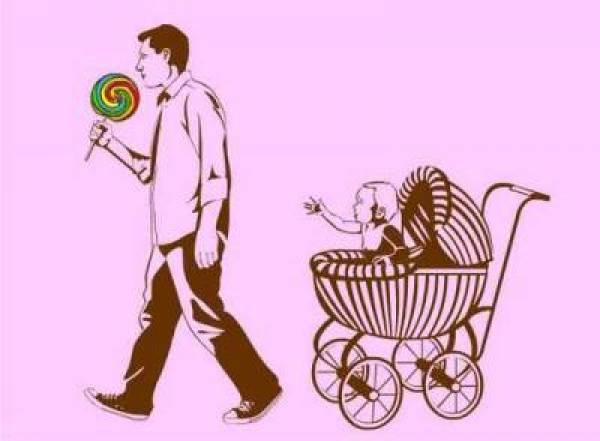
Report: US Shortchanged Public Schools by Hundreds of Billions of Dollars Over Decades

taking-candy-from-a-baby


Fun Fact: Between 2005 and 2017, the federal government withheld $580 billion it had promised to spend on students from poor families and students with disabilities.


Fun Fact: Over that same period, the personal net worth of the nation’s 400 wealthiest people ballooned by $1.57 trillion.


So, rich people, consider this the bill.


A new report called “Confronting the Education Debt” commissioned by the Alliance to Reclaim Our Schools (AROS) details the shortfall in minute detail.


For instance:


  • $347 billion owed to educate low-income students most of whom are children of color.


  • $233 billion owed to provide services for students with disabilities.


And this is just the shortfall of the last dozen years! That’s just money due to children who recently graduated or are currently in the school system!


We’ve been cheating our children out of the money we owe them for more than half a century!


Federal education funding levels were first established in 1965 as part of Pres. Lyndon Johnson’s War on Poverty in the landmark education law, the Elementary and Secondary Education Act (ESEA).


That law, which has become little more than a boondoggle for the standardized testing and school privatization industries, originally was passed to address inequality in America’s education funding.


Now this report from a coalition of groups including the Education Justice Research and Organizing Center, the National Education Association, the American Federation of Teachers, Center for Popular Democracy and the Action Center on Race and the Economy points out the multifarious ways we have failed to live up to the standards we set in that original legislation and beyond.


One of the most glaring examples of neglect is Title I funding.


The Johnson administration admitted that schools with a high concentration of students living below the poverty line needed extra support to succeed at the same levels as students from middle class or more affluent backgrounds. So the law promised to provide an additional 40 percent for each poor child above what the state already spent per pupil.


And then it promptly failed to fund it. In 1965 and every year since!


These are not just numbers. With this money, high poverty schools could provide:


  • “health and mental health services for every student, including dental and vision services; and

  • a full-time nurse in every Title I school; and

  • a full-time librarian for every Title I school; and

  • a full-time additional counselor in every Title I school, or

  • a full-time teaching assistant in every Title I classroom.”


A decade later, in 1975, the same thing happened with The Individuals with Disabilities Education Act (IDEA).


Congress told local districts they’d have to do more to help disabled students succeed academically. However, doing so costs money. Lawmakers admitted that disabled students cost more to educate and that local districts often struggle to find the funding to help them succeed.


Once again, Congress pledged to pay up to 40 percent of that additional cost, with local and state funds covering the remainder.


Once again, Congress failed to fund it.


STATE AND LOCAL FAILURE


But it’s not just the federal government that has shirked its duties to school children.


State and local governments also stiffed generations of students out of the resources they deserved – especially if those students have black or brown skin.


Beside the federal government, public schools are funded by their local municipalities and the state. Local governments pay for about 45 percent of school budgets.


However, since most of this allotment is determined by property tax revenues, it ensures the poor get fewer resources than the rich. Kids from rich neighborhoods get lots of resources. Kids from poor areas get the scraps. Inequality is built into the funding formula to ensure that students don’t start out on an even playing field and that economic handicaps are passed on from one generation to the next.


State governments are no better. They provide about 47 percent of school budgets.


As such, they are in the position to right the wrongs of the local community by offsetting the inequality of local governments – but only 11 states do so. Twenty states close their eyes and provide the same funding to each school – rich and poor alike – regardless of need or what each community can afford to provide for its own children. But 17 states are even worse. They actually play Robin Hood in reverse – they funnel more money to wealthier districts than to poor ones.


As a result, schools nationwide serving mostly students of color and/or poor children spend less on each child than districts serving mostly white and/or affluent children.


TAX CUTS


And while our federal, state and local governments have failed to meet their responsibilities to students, they have required fewer taxes from business and industry.


In the late 1940s and 1950s, the top marginal tax rate was more than 90 percent. Today it is 37 percent.


Congress just passed a series of whooping tax cuts that go into effect in 2019. More than half of the benefit of these cuts will go to the richest five percent of taxpayers. The law is expected to cost the federal treasury as much as $1.5 trillion in lost revenues over the next decade.


Nearly every state levies a much greater share of taxes from low- and middle-income families than from the wealthy.


And that’s before we even start talking about corporations!


While the US federal corporate tax is 35 percent, the effective tax rate that corporations pay after loopholes and deductions is only about 14 percent. This costs the federal government at least $181 billion in annual revenue, based on 2013 estimates by the Government Accountability Office. Local and state corporate tax and abatement programs make it even worse.


This is a choice. We are not requiring the rich to pay their fair share.


SCHOOL-TO-PRISON


Instead of investing in ways to help educate children, one of the only areas we’ve increased funding is incarceration.


The private prison industry is booming, fueled in part by a lack of opportunities in schools.


According to the report:


“In 2017, the National Association of School Resource Officers claimed that school policing was the fastest-growing area of law enforcement. The school safety and security industry was reported to be a $2.7 billion market as of 2015. Most of that $2.7 billion is public money now enriching the private security industry instead of providing real supports to students.”


According to the US Department of Education, 1.6 million students go to a school that employs a law enforcement officer but not a guidance counselor.


That is not an unalterable economic reality. It is a failure of priorities. It is the mark of a society that is not willing to help children but will swoop in to punish them if they get out of line.


SCHOOL PRIVATIZATION


Finally, the report identifies school privatization as a contributing factor to this systemic neglect.


Charter schools are legal in 44 states plus Washington, D.C. and Puerto Rico. They have “systematically stripped public school budgets through the creation of parallel structures of privately-operated, publicly-funded schools.”


Cost studies in San Diego, Los Angeles, Nashville, Michigan, Pennsylvania, Durham and other localities have come to the same conclusion: “the privatization of schools has contributed to austerity conditions in traditional public schools.”


Yet Congress continues to appropriate millions of dollars to the Department of Education’s Charter Schools Program (CSP), which funds new charter start-ups and expansions. The program has a budget of $500 million this year, alone. It is the largest single backer of charter schools in the nation.


According to the report, “In other words, the U.S. Department of Education is operating a program that directly undermines public schools.”


SOLUTIONS


But the report isn’t just about what’s wrong. It outlines how we can make it right.


It outlines three policy initiatives:


1)      “Full funding of Title I and IDEA to target federal support to low-income children and students with disabilities.

2)      The creation of 25,000 Sustainable Community Schools by 2025.

3)      A new focus for the U.S. Department of Education, on ensuring and incentivizing equity in public schools across the country.”


And we can pay for it by:


A. “Make the wealthy pay their fair share of taxes.

  • Rescind the 2017 tax code changes, which overwhelmingly favor the top 1 percent of income earners.
  • Close the federal carried interest loophole, a step that could increase federal revenues by between $1.8 and $2 billion annually or, according to some researchers, by as much as $18 billion annually.
  • If the carried interest loophole is not closed at the federal level, states can impose a surcharge on carried interest income at the state level, raising millions for state budgets.
  • Enact so-called “millionaire’s taxes” that increase the tax rate on a state’s highest earners. New York and California have already passed such law.


B. Require wealthy corporations to pay their fair share.

  • End or reduce corporate tax breaks that cost the federal government at least $181 billion annually.

  • Reduce state and local subsidies to businesses for economic development projects and hold school funding immune from tax abatements.

  • Enforce and strengthen programs like Payment in Lieu of Taxes (PILOT) to ensure that wealthy institutions pay their fair share towards local budgets.


C. Divest from the school-to-prison pipeline.

  • School safety and security is now a $2.7 billion industry. Much of that money is public money, going to profitable corporations instead of schools.
  • Divest from expensive security systems, metal detectors and legions of school-based police officers and instead invest in counselors, health and mental-health providers and other supports that make schools safer.


D. Place a moratorium on new charter schools and voucher programs.

  • A moratorium on the federal Charter Schools Program would free up $500 million annually, which could be used to support the creation of Sustainable Community schools.”


The executive summary concludes with the following statistic.


Even a 10 percent increase in funding for each high poverty student maintained through 12 years of public school can dramatically change the likelihood of academic success. It can boost the chances that students will graduate high school, achieve 10 percent higher earnings as adults and a 6 percentage point reduction in the annual incidence of adult poverty, according to a 2015 report.

“Ten percent is pocket-change for a nation that has orchestrated the rise of an unmatched billionaire class. In the richest nation in the world, it is possible to fully fund all our public schools, and to provide Black, Brown and low-income children with the educational resources and additional supports and services they need to achieve at the highest levels.”


The facts are in, folks.


We can no longer gripe and complain about a public education system we fail to support without recognizing the cause. We have failed to meet our responsibilities to our children – especially our children of color.


The solution is simple – equity.


We need to demand the rich do the right thing.


We cannot achieve greatness as a nation when wealth and privilege continue to shirk their duties and our lawmakers do little more than enable greed and corruption.


The bill is here.


Time to settle up.


READ THE WHOLE REPORT.


Like this post? I’ve written a book, “Gadfly on the Wall: A Public School Teacher Speaks Out on Racism and Reform,” now available from Garn Press. Ten percent of the proceeds go to the Badass Teachers Association. Check it out!

WANT A SIGNED COPY?

Click here to order one directly from me to your door!

book-2

Disowning the Lie of Whiteness

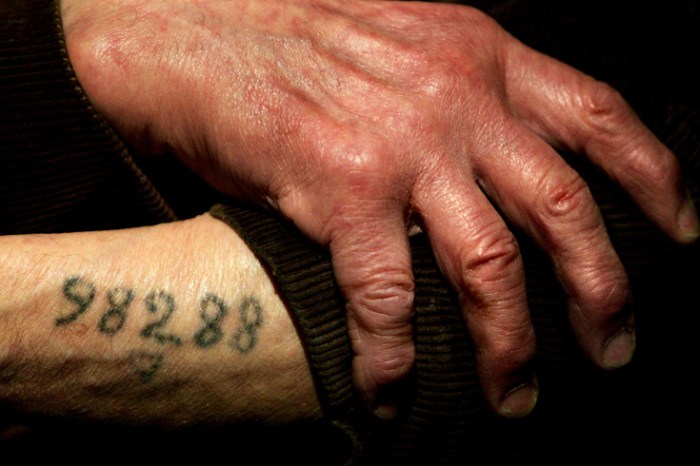
auschwtiztattoo 

The most vivid memory I have of my great-grandfather is the tattoo on his arm.


It wasn’t an anchor or a sweetheart’s name or even the old faithful, “Mom.”


It was just a series of digits scrawled across his withered tan flesh like someone had written a note they didn’t want to forget.


Beneath the copious salt and pepper hairs was a stark number, the darkest stain on his skin.


Gramps is a kindly figure in my mind.


He died before I was even 10-years-old. All I really remember about him are wisps of impressions – his constant smile, a whiff of mothballs, how he always seemed to have butterscotch candies.


And that tattoo.


I think it was my father who told me what it meant.


When he was just a young man, Gramps escaped from Auschwitz. A guard took pity on him and smuggled him out.


His big European family didn’t make it.


My scattered relatives in the United States are all that are left of us.


Those are the only details that have come down to me. And Gramps isn’t here to add anything further.


But his tattoo has never left me.


It’s become a pillar of my subconscious.


The fact that someone could look at my kindly Gramps and still see fit to tattoo a numeric signifier on him as if he were an animal.


A little reminder that he wasn’t human, that he shouldn’t be treated like a person, that he was marked for erasure.


If I look at my own arm, there is no tell-tale integer peeking through the skin. But I am keenly aware of its presence.


I know that it’s there in a very real sense.


It is only the American dream that hides it.


Coming to this country, my family has made a deal, something of a Faustian bargain, but it’s one that most of us have accepted as the price of admission.


It’s called whiteness.


I am white.


Or I get to be white. So long as I suppress any differences to the contrary.


I agree to homogenize myself as much as possible and define myself purely by that signifier.


White. American. No hyphen necessary.


Anything else is secondary. I don’t have to deny it, but I have to keep it hidden until the right context comes to bring it out.


During Octoberfest I have license to be German. When at international village I can root for Poland. And on Saturdays I can wear a Kippah and be Jewish.


But in the normal flow of life, don’t draw attention to my differences. Don’t show everyone the number on my arm.


Because America is a great place, but people here – as in many other places – are drawn to those sorts of symbols and will do what they can to stamp them out.


I learned that in school when I was younger.


There weren’t a lot of Jewish kids where I grew up. I remember lots of cracks about “Jewing” people down, fighting against a common assumption that I would be greedy, etc. I remember one girl I had a crush on actually asked to see my horns.


And of course there were the kids who chased me home from the bus stop. The scratched graffiti on my locker: “Yid.”


The message was clear – “You’re different. We’ll put up with you, but don’t ever forget you are NOT one of us.”


There were a lot more black kids. They didn’t get it any easier but at least they could join together.


It seemed I had one choice – assimilate or face it alone.


So I did. I became white.


I played up my similarities, never talked about my differences except to close friends.


And America worked her magic.


So I’ve always been aware that whiteness is the biggest delusion in the world.


It’s not a result of the color wheel. Look at your skin. You’re not white. You’re peach or pink or salmon or rose or coral or olive or any of a million other shades.


Whiteness has as much to do with color as Red has to do with Communism or Green has to do with environmental protection.


It is the way a lose confederacy of nationalities and ethnicities have banded together to form a fake majority and lord power over all those they’ve excluded.


It’s social protection for wealth – a kind of firewall against the underclass built, manned and protected by those who are also being exploited.


It’s like a circle around the wealthy protecting them from everyone outside its borders. Yet if everyone banded together against the few rich and powerful, we could all have a more equitable share.


But in America, social class has been weaponized and racialized.


You’ll see some media outlets talking about demographics as if white people were in danger of losing their numerical majority in this country in the next few decades. But there’s no way it’s ever going to happen.


Today’s xenophobia is a direct response to this challenge. Some are trying to deport, displace and murder as many black and brown people as possible to preserve the status quo.


But even if that doesn’t work, whiteness will not become a minority. It will do what it has always done – incorporate some of those whom it had previously excluded to keep its position.


Certain groups of Hispanics and Latinos probably will find themselves allowed to identify as white, thereby solidifying the majority.


Because the only thing that matters is that there are some people who are “white” and the rest who are not.


Long ago, my family experienced this.


Before I was born, we got our provisional white card. And if I want, I can use it to hide behind.


I’ve been doing it most of my life.


Every white person does it.


It’s almost impossible not to do it.


How do you deny being white?


At this point, I could throw back my head and shout to the heavens, “I’M NOT WHITE!” and it wouldn’t matter.


Only in a closed environment like a school or a job or in a social media circle can you retain the stigma of appearing pale but still being other.


In everyday life, it doesn’t matter what you say, only how you appear.


I can’t shout my difference all the time. Every moment I’m quiet, I’ll still be seen as white.


It’s not personal. It’s social. It’s not something that happens among individuals. It’s a way of being seen.


The best I can do is try to use my whiteness as a tool. I can speak out against the illusion. I can stand up when people of color are being victimized. I can vote for leaders who will do something to dismantle white supremacy.


Not because I am some kind of savior, but because I know that my own freedom is tied to the freedom of those being oppressed by a system that provides me certain privileges.


But let me be clear: doing so is not the safe way to go.


In defending others you make yourself a target.


I get threats all the time from racists and Nazis of all sorts. They say they can tell just by looking at me that I’m not white at all.


The worst part is I’m not sure what I am anymore.


I don’t go to synagogue. I don’t even believe in God. But I’m Jewish enough to have been rounded up like Gramps was, so I won’t deny that identity. It’s just that I’m more than one thing.


That’s what whiteness tries to reduce you to – one thing.


I don’t want it anymore.


I’m not saying I don’t like the protection, the ability to be anonymous, the easy out.


But it’s not worth it if it has to come with the creation of an other.


I don’t want to live in a world where people of color are considered less than me and mine.


I don’t want to live in a world where they can be treated unfairly, beaten and brutalized so that I can get some special advantage.


I don’t want to live in a world where human beings are tattooed and numbered and sent to their deaths.


Because the Holocaust is not over.


American slavery is not over.


Neither is Jim Crow or lynching or a thousand other marks of hatred and bigotry.


Nazis march unmasked in our streets. Our prisons are the new plantation. And too many of our police use murder and atrocity to ensure the social order.


As long as we allow ourselves to be white, there will be no justice for both ourselves and others.


So consider this my renunciation of whiteness – and I make it here in public.


I know that no matter what I say, I will still be seen as part of the problem. And I will still reap the rewards.


But I will use what power is given me to tear it down.


I’m burning my white card.


I know it’s a symbolic gesture. But I invite my white brothers and sisters to add theirs to the flames.


Let us make a conflagration, a pillar of fire into the sky.


Let whiteness evaporate as the smoke it is.


Let us revel in the natural hues of our faces as we watch it burn.


Like this post? I’ve written a book, “Gadfly on the Wall: A Public School Teacher Speaks Out on Racism and Reform,” now available from Garn Press. Ten percent of the proceeds go to the Badass Teachers Association. Check it out!

WANT A SIGNED COPY?

Click here to order one directly from me to your door!

book-4