If I Were Secretary of Education – A Classroom Teacher’s Fantasy

thumbnail_fullsizerender

I will never be Secretary of Education.

Frankly, I’m just not qualified.

I’m only a classroom teacher. The powers that be don’t trust someone like me with that kind of responsibility. It’s okay to give me a roomful of impressionable children everyday, but there’s no confidence I can make sound policy decisions. For that we need someone with experience in management – not schools, pedagogy, children or psychology.

The presiding incumbent in this prestigious position, John King, somehow overcame that handicap. He had taught for three whole years at a charter school, but the bulk of his experience is in administration – administrating a Boston charter school with high suspension and attrition rates. He also was New York State Education Commissioner, where he single-handedly dismantled the state system of education and sparked one of the largest parental revolts in the nation in the state’s opt out movement.

The previous Secretary of Education, Arne Duncan, was much more qualified, having never taught a day in his life. Before getting Congressional approval, he was appointed to run a charter school and later was entrusted as CEO of Chicago City Schools where he likewise blundered his way to the top with policy decisions that devastated a great system of public education.

What do I have to offer compared to all that? I only have more than a decade’s worth of experience helping kids learn. I’m only one of 3% of teachers nationwide who are Nationally Board Certified. I’ve only earned a Masters degree in Education. I only help run a more than 56,000 member national education advocacy group, the Badass Teachers Association, and write a popular blog dedicated to education and civil rights.


I’ve never sunk a major metropolitan school. I’ve never been run out of a populous state chased by citizens armed with torches and pitchforks.

But let’s close our eyes and imagine that somehow through the magic of education bloggery I was whisked into office at the U.S. Department of Education.

What would a person like me do as Secretary?


1) Respect the Limits of the Job

Though George W. Bush and Barack Obama come from opposite ends of the political spectrum, these two Presidents did more to increase the powers of the Department of Education than any chief executives before them. They turned it into – as former Education Secretary Lamar Alexander puts it – a national school board with the Secretary was the national superintendent.

The department forced test and punishment policies on the states, cudgeled and bribed state officials to enact lousy Common Core Standards, and held federal grants hostage unless states accepted every corporate education reform scheme big business could think up.

Don’t get me wrong. I’m a New Deal Franklin D. Roosevelt Democrat, but even I think these two administrations blatantly abused their power and overstepped their Constitutional authority.

So the first thing I would do is take a step back and follow the law. The recently enacted Every Student Succeeds Act (ESSA) sets explicit limits on federal power over education policy returning much of it to the states. As Education Secretary, I would respect the power of the states to control public education. It is the state’s job to set policy. It is the federal government’s job to provide support, encouragement and oversight.

Therefore, the role of the Department of Education is to ensure public schools are being properly funded, civil rights are not being violated and to be a repository for national data and research. I’d dedicate myself to that – not some corporate fueled power trip that both parties condemn except when they’re practicing it.


2) Push for More Federal Funding for Public Schools

Therefore, the first thing I would do is use the full power of the office to ensure the federal government is giving its utmost to help state public schools. I would use whatever grants were available to increase federal funding to the most impoverished schools. I would fully fund Title I. I would increase the federal share of Special Education – (Under Part B of the Individuals with Disabilities Education Act (IDEA) the federal government is supposed to fund 40% of the per pupil cost of all special education students but has never met this obligation. I would seek to rectify that if possible.) I would enact a national after school tutoring initiative. I would provide funding to hire additional teachers to reduce class size.  And as far as is possible, I would forgive college students loan debt so they can begin their lives with a clean slate.

This is something that those who seek to disband the U.S. Department of Education never seem to understand. The federal government has an important role to play in our school systems. It’s not the unfounded power grab of the last few decades, but we need another robust player on the field to help the states achieve their goals and also to keep the states honest.

If we disbanded the Department of Education, as some conservatives from Reagan to Paul to Cruz to Trump suggest, what would happen to Pell Grants, for instance? What would happen to the bundles of federal money that boost our public schools? Who would make sure states are doing their jobs? Where could we go to find accurate data about how our schools are doing nationally and not just state-by-state?

If we got rid of the department, at best these jobs would fall back on other government agencies that haven’t the funding, staff or ability to accomplish them. More likely, it would result in the elimination of billions of education dollars that the states simply couldn’t (or wouldn’t) replace. Abuses against students on the grounds of civil rights, gender, special education, etc. would skyrocket with little to no recourse. And we would be in the dark about how well we were educating our nation’s children.


3) Encourage States to Enact Accountability Measures that Don’t Include Standardized Testing

Accountability has become a dirty word in many education circles because of the way the Bush and Obama administrations have perverted it to mean test and punish. It has become a boondoggle for the standardized testing industry, an excuse to close poorly funded and often urban public schools to be replaced by unaccountable charter schools. While this is a terrible misuse of federal power, states must be responsible for the education they provide their children. And contrary to popular belief, this can be accomplished without resorting to the usual corporate reform measures.

As Secretary, I would put an immediate stop to the era of test and punish at the federal level. As it stands, the ESSA allows states to determine what they will use to demonstrate their educational progress for students. This is a state decision, but I would encourage states not to use standardized testing. I would offer to help any state interested to find new ways to show accountability. For instance, districts could submit to a simple audit showing student-teacher ratios, per pupil funding, discipline data broken out by race, degree of segregation, richness of the curriculum, etc.

Let me be clear: it is up to states to make these decisions. As Secretary, I would have no power to force legislatures or departments of education to do any of this. However, I’m willing to bet that many states would be excited by these possibilities and jump at the opportunity. Helping them achieve this would be my job.


4) Stop Federal Funding to Charter Schools, Teach for America and Common Core

Speaking of encouragement, I would stop all federal help for corporate education reform policies. That means turning off the money faucet for programs that enrich corporations and big business at the expense of school children.

This means not one more federal dollar to help private companies open new charter schools. Teach for America would have to rely on its corporate donors, not the taxpayers. And the Common Core gravy train would come to a screeching halt. No more money to help states enact the standards, no more bags of cash for book publishers and test manufacturers.

If states that had enacted the Core wanted to keep it, fine. If not, fine. But they would be on their own.

(In a sad aside, opposition to Common Core is most virulent from conservatives, yet there are an awful lot of state legislatures completely in GOP control that could get rid of Common Core tomorrow but which have done – and continue to do – nothing about it. No matter who the next Education Secretary is, the fate of Common Core is in the hands of state legislatures across the country – not the President, not Congress and not the Education Secretary. There’s far too much rhetoric and not nearly enough action.)


5) Do Everything I Can to Increase Teacher Autonomy, Respect, Pay and Training

Finally, I would use my position as Education Secretary to boost the greatest resource we have to help students learn – teachers. I would speak out on the need for educators to have autonomy in the classroom so they are empowered to meet student needs. I would work to increase public perception and respect for the profession. We simply can’t afford teacher bashing, because when you disrespect educators, you reduce their power to help kids. I would boost teachers pay through matching state grants. If you want the best possible teachers, you have to pay for them. If you want to attract the best people to the field, you need to ensure they will have a reliable middle class income and not have to work a second job or use their own money to buy school supplies. I would invest federal funds in training programs so the newest crop of teachers are up to date with the latest pedagogy and techniques. I would encourage more people of color to enter the field. And I would partner with teachers unions to strengthen protections for teachers while educating the public on the meaning of due process and the reality that strong unions mean fewer bad teachers in the classroom.


Are there more things we need to do to help improve our national system of public education? Certainly.


We need to start integrating schools again and stop the constant push to segregate through charter schools and white flight. We need to ensure every student receives adequate, equitable, sustainable funding. We need to change charter school laws so that they can’t cherry pick students and are as transparent and accountable as traditional public schools. We need to stop closing struggling schools and address root causes. We need to stop state takeovers except under the most dire of circumstances and set limits on how long states can stay in control. And we need to pass strong student privacy laws – even updating the Family Education Privacy Act (FERPA) to protect our children from predatory ed-tech companies that constantly data mine students and sell millions of data points on our children to the highest bidder.

There are a whole host of things needing done. However, most of these things go beyond the powers of the Department of Education and its cabinet level Secretary. They can only be addressed by the President, Congress, state legislatures and/or the court system. The Education Department can help steer that agenda, it can be an ally to real positive change, but it can’t go it alone.

Unfortunately, no matter who wins the Presidency in November – Clinton or Trump – neither seems likely to nominate an Education Secretary who would do any of the things I’ve outlined.


For all his talk of reducing the size of the government, Trump proposes increasing the federal footprint with school choice initiatives turning the Department of Education into a wheelbarrow marked “free money” for big business and parochial schools while forcing states to accept his school policies. Meanwhile, Clinton is likely to continue the course set by Bush and Obama of embracing every corporate school reform package from which Wall Street benefits.

It’s a crazy time full of crazy candidates and crazy solutions, but of this we can be sure – no one is crazy enough to let a teacher make decisions about public education policy.
You Can’t Be Anti-Opt Out and Pro-Democracy

20130220-michels-edy-chamness-sign

Our lawmakers have a problem.

This summer they doubled down on one of the most anti-democratic mandates in the federal repertoire yet they claim they did so to protect states rights.

Here’s the problem.

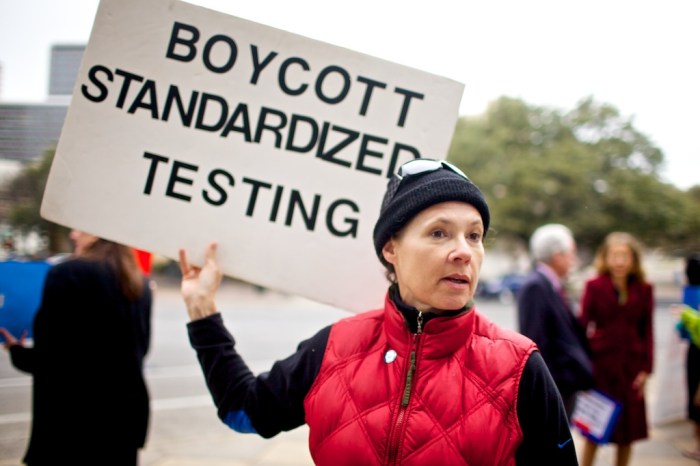
Every year, hundreds of thousands of public school parents across the country opt their children out of standardized testing.

But Congress voted to keep mandating that 95% of students take the tests.

It all happened with the much celebrated bipartisan passage of the Every Student Succeeds Act (ESSA), the federal law that governs K-12 schools.

While lawmakers made changes here and there to let the states decide various education issues, they kept the mandate that students participate in annual testing.

They didn’t leave that to the states. Whether they were Republican or Democrat, almost all lawmakers thought it was just fine for the federal government to force our children to take standardized tests at least every year in 3-8th grades and once in high school.

If any school district, has more than 5% of students that don’t take the tests – for whatever reason – the federal government can deny that district funding.

Think about that for a moment.

Our lawmakers are supposedly acting in our interests. They’re our representatives. We’re their constituents. They get their power to pass laws because of our consent as the governed. Yet in this instance they chose to put their own judgement ahead of ours.

They could have made an exception for parents refusing the tests on behalf of their children. They just didn’t see the need to do so.

Why? Because they were worried about minority students.

It’s a laughable claim in so many ways.

It goes something like this – without standardized testing, we’ll have no way of knowing if public schools are educating students of color.

Let’s say for a moment that this were true. In that case, we can expect no parent of color would ever refuse standardized testing for his/her child.

First, this is demonstrably untrue. Black and brown parents may not be the most numerous in the opt out movement, but they do take part in it.

Second, in the majority of cases where white parents refuse testing, that would have no bearing on whether testing helps or hurts students of color. If the point is the data testing gives us on black kids, what white kids do on the test is irrelevant.

Third, even if opting out hurt students of color, one would assume that it is the parents prerogative whether they want to take part. If a black parent doesn’t want her black son to take a multiple choice exam, she should have the right to waive that exam and the responsibility would be on her head.

So there is absolutely no reason why lawmakers should have overstepped their bounds in this way and blocked all parents rights about what the schools do to their children.

It is a clear case of governmental overreach. And there are plenty of parents just waiting to bring it to the U.S. Supreme Court for the ultimate Constitutional test.

However, that probably won’t happen for the same reason it never happened through the 15 years of No Child Left Behind (NCLB) which also contained the annual testing rule.

The federal government has never withheld tax dollars based on students not taking standardized tests. officials at the U.S. Department of Education have made threats, but they have never devolved into action.

The bottom line is this: they know how Unconstitutional this mandate is, and they aren’t itching to have it tested in the highest court in the land.

It would open a whole can of worms about standardized testing. What is the federal government allowed to do and not allowed to do about education policy?

The ESSA is an attempt to reduce the federal role, but keeping the annual testing mandate was either a grievous mistake or the last vestiges of federal hubris.

But let’s return to the reasoning behind it – so-called civil rights fears.

Various groups including the NAACP asked for it to be included to protect minority students. Annual testing is the only way, they claimed, to make sure schools are teaching students of color.

It’s nonsense.

There are plenty of ways to determine if schools are meeting the needs of minority students – especially since most students of color go to segregated schools.

Even after Brown v. Board, we have schools that cater to black kids and schools that cater to white kids. We have schools for poor kids and rich kids.

It is obvious which schools get the most resources. Why isn’t that part of this “accountability” scheme? We can audit districts to see how much is spent per pupil on poor black kids vs rich white kids. We can determine which groups go to schools with larger class sizes, which groups have more access to tutoring and social services, which groups have expanded or narrowed curriculums, which groups have access to robust extra-curricular activities, which groups have the most highly trained and experienced teachers, etc.

In fact, THAT would tell us much more about how these two groups are being served by our public schools than standardized test scores. We’ve known for almost a century that these test scores are more highly correlated with parental income than academic knowledge. They’re culturally biased, subjectively scored and poorly put together. But they support a multibillion dollar industry. If we allow a back door for all that money to dry up, it will hurt lawmakers REAL constituents – big business.

So why were civil rights groups asking the testing mandate be kept in the bill? Because the testing industry is comprised of big donors.

Only a few months before passage of the ESSA, many of these same civil rights groups had signed declarations against standardized testing. Then suddenly they saw the light as their biggest donors threatened to drop out.

Make no mistake. Standardized testing doesn’t help poor minority children. It does them real harm. But the testing industry wrapped themselves up in this convenient excuse to give lawmakers a reason to stomp all over parental rights.

The conflict wasn’t between civil rights and parental rights. It was between parental rights and corporate rights. And our lawmakers sided with the corporations.

Let me be clear: legislators cannot be against opt out and in favor of individual rights.

The two are intimately connected.

Our schools have no business telling parents how to raise their kids. But our parents DO have a right to do the opposite. In fact, that’s how the system is supposed to work.

We, parents and citizens, control our schools – not you, our representatives. The principal can’t say you haven’t a right to opt out your kid. He’s just your representative. So is the teacher.

Everyone who works in the school is there to do what you want them to do for your child. Yes, they are well trained and have a world of knowledge and experience that we should draw on. And in most cases, they’re being forced to confront us by lawmakers who are tying their hands and directing them to do the dirty work.

We have common cause. We need to stand with our teachers and principals, our school boards and education professors. We need to stand together against lawmakers who think they know better.

In short, we don’t need lawmakers consent to opt out. They need our consent to stop us.

They get their power from us. They work for us.

And it’s time they get to work and rescind the annual testing mandate.

What’s More Important – Fighting School Segregation or Protecting Charter School Profits?

Screen Shot 2016-08-31 at 4.12.13 PM


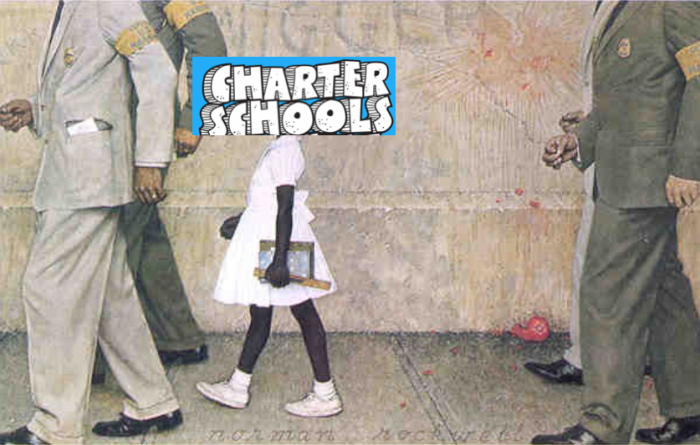
No one wants school segregation.


At least, no one champions it publicly.


As a matter of policy, it would be political suicide to say we need to divide up our school children by race and socio-economics.


But when you look at our public school system, this is exactly what you see. After the triumphs of the Civil Rights movement, we’ve let our schools fall back into old habits that shouldn’t be acceptable in the post-Jim Crow era.


When we elected Barack Obama, our first President of color, many observers thought he’d address the issue. Instead we got continued silence from the Oval Office coupled with an education policy that frankly made matters worse.


So one wonders if people still care.


Is educational apartheid really acceptable in this day and age? Is it still important to fight against school segregation?


Peter Cunningham isn’t so sure.


The former assistant Secretary of Education under Obama and prominent Democrat worries that fighting segregation may hurt an initiative he holds even more dear – charter schools.


Cunningham is executive director of the Education Post, a well-funded charter school public relations firm that packages its advertisements, propaganda and apologias as journalism.


Everywhere you look Democrats and Republicans are engaged in promoting various school choice schemes at the expense of the traditional public school system. Taxpayer money is funneled to private or religious schools, on the one hand, or privatized (and often for-profit) charter schools on the other.


One of the most heated debates about these schemes is whether dividing students up in this way – especially between privately run charter schools – makes them more segregated by race and socio-economic status.


Put simply – does it make segregation worse?


Civil Rights organizations like the NAACP and Black Lives Matter say it does. And there’s plenty of research to back them up.


But until recently, charter school apologists have contested these findings.


Cunningham breaks this mold by tacitly admitting that charter schools DO, in fact, increase segregation, but he questions whether that matters.


He says:


“Maybe the fight’s not worth it. It’s a good thing; we all think integration is good. But it’s been a long fight, we’ve had middling success. At the same time, we have lots and lots of schools filled with kids of one race, one background, that are doing great. It’s a good question.”


The schools he’s referring to are charter schools like the Knowledge is Power Program (KIPP) where mostly minority students are selected, but only those with the best grades and hardest work ethic. The children who are more difficult to teach are booted back to traditional public schools.


It’s a highly controversial model.


KIPP is famous for two things: draconian discipline and high attrition rates. Even those kids who do well there often don’t go on to graduate from college. Two thirds of KIPP students who passed the 8th grade still haven’t achieved a bachelor’s degree 10 years later.


Moreover, its methods aren’t reproducible elsewhere. The one time KIPP tried to take over an existing public school district and apply its approach without skimming the best and brightest off the top, it failed miserably – so much so that KIPP isn’t in the school turnaround business anymore.


These are the “lots and lots of schools” Cunningham is worried about disturbing if we tackle school segregation.


He first voiced this concern at a meeting with Democrats for Education Reform – a well-funded neoliberal organization bent on spreading school privatization. Even at such a gathering of like minds, some people might be embarrassed for saying such a thing. Is integration worth it? It sounds like something you’d expect to come out of Donald Trump’s mouth, not a supposedly prominent Democrat.


But Cunningham isn’t backing away from his remarks. He’s doubling down on them.


He even wrote an article published in US News and World Report called “Is Integration Necessary?”


Here’s the issue.


Segregation is bad.


But charter schools increase segregation.


So the obvious conclusion is that charter schools are bad.


BUT WE CAN’T DO THAT!


It would forever crash the gravy train that transforms public school budgets into private profits. It would forever kill the goose that turns Johnny’s school money into fancy trips, expense accounts and yachts for people like Cunningham.


This industry pays his salary. Of course he chooses it over the damage done by school segregation.


But the rest of us aren’t burdened by his bias.


His claims go counter to the entire history of the Civil Rights movement, the more than hundred year struggle for people of color to be treated equitably. That’s hard to ignore.


People didn’t march in the streets and submit to violent recriminations to gain something that just isn’t necessary. They weren’t sprayed by hoses and attacked by police dogs so they could gain an advantage for their children that isn’t essential to their rights. They weren’t beaten and murdered for an amenity at which their posterity should gaze with indifference and shrug.


We used to understand this. We used to know that allowing all the black kids to go to one school and all the white kids to go to another would also allow all the money to go to the white kids and the crumbs to fall to the black kids.


We knew it because that’s what happened. Before the landmark Brown vs. Board of Education, it’s a matter of historical fact. And today it’s an empirical one. As our schools have been allowed to fall back into segregation, resources have been allocated in increasingly unfair ways.


We have rich schools and poor schools. We have predominantly black schools and predominantly white schools. Where do you think the money goes?


But somehow Cunningham thinks charter schools will magically fix this problem.


Charters are so powerful they will somehow equalize school funding. Or maybe they’re so amazing they’ll make funding disparities irrelevant.


For believers, charter pedagogy wields just that kind of sorcery. Hocus Pocus and it won’t matter that black kids don’t have the books or extra-curriculars or arts and humanities or lower class sizes.


Unfortunately for Cunningham, the effects of school segregation have been studied for decades.


“Today, we know integration has a positive effect on almost every aspect of schooling that matters, and segregation the inverse,” says Derek Black, a professor of law at the University of South Carolina School of Law.


“We also know integration matters for all students. Both minorities and whites are disadvantaged by attending racially isolated schools, although in somewhat different ways.”


Minorities are harmed academically by being in segregated schools. Whites are harmed socially.


At predominantly minority schools, less money means less educational opportunities and less ability to maximize the opportunities that do exist. Likewise, at predominantly white schools, less exposure to minorities tends to make students more insular, xenophobic and, well, racist. If you don’t want little Billy and Sally to maybe one day become closeted Klan members, you may need to give them the opportunity to make some black friends. At very least they need to see black and brown people as people – not media stereotypes.


Even Richard D. Kahlenberg, a proponent of some types of charter schools and a senior fellow at the Century Foundation, thinks integration is vital to a successful school system.


“To my mind, it’s hugely significant,” says Kahlenberg, who has studied the impact of school segregation.


“If you think about the two fundamental purposes of public education, it’s to promote social mobility so that a child, no matter her circumstances, can, through a good education, go where her God-given talents would take her.  The second purpose is to strengthen our democracy by creating intelligent and open-minded citizens, and related to that, to build social cohesion.


Because we’re a nation where people come from all corners of the world, it’s important that the public schools be a place where children learn what it means to be an American, and learn the values of a democracy, one of which is that we’re all social equals. Segregation by race and by socioeconomic status significantly undercuts both of those goals.”


We used to know that public education wasn’t just about providing what’s best for one student. It was about providing the best for all students.


Public schools build the society of tomorrow. What kind of future are we trying to create? One where everyone looks out just for themselves or one where we succeed together as a single country, a unified people?


A system where everyone pays their own way through school and gets the best education they can afford works great for the rich. But it leaves the masses of humanity behind. It entrenches class and racial divides. In short, it’s not the kind of world where the majority of people would want their children to grow up.


More than half of public school students today live in poverty. Imagine if we could tap into that ever-expanding pool of humanity. How many more scientific breakthroughs, how many works of art, how much prosperity could we engender for everyone!?


That is the goal of integration – a better world.


But people like Cunningham only can see how it cuts into their individual bank accounts.


So is it important to fight school segregation?


That we’re even seriously asking the question tells more about the kind of society we live in today than anything else.

We Are All Chicago Schools – More Layoffs, Less Help for Other People’s Kids

ct-rahm-emanuel-forrest-claypool-private-schools-20160505


“Fuck those kids.”


Mayor Rahm Emanuel couldn’t have been clearer if he’d said the above.


Chicago Schools Chief Executive Forrest Claypool couldn’t have made his priorities clearer if he’d given Chicago’s parents the bird and told them to “Kiss my ass.”


The Chicago Board of Education – made up of members all of whom are appointed by the mayor – decided to layoff 1,000 teachers and staff at the city’s public schools just a month before opening day. Sure, some may keep their jobs through reassignment, but hundreds will be unemployed.


This after a recent history of closing more than 80 schools and slashing thousands of jobs. Just last February, the district laid off 62 employees, including 17 teachers. In January, it laid off 227 staff members.


This begs several questions: How many teachers and support staff can Chicago Public Schools afford to lose? What exactly is this doing to its students? How is it affecting their future prospects to be taught by a skeleton crew?


The city’s leaders don’t give a shit.


And why should they? These aren’t their kids!


Emanuel’s children attend University of Chicago’s Laboratory Schools, a private institution. Claypool’s kids go to Francis W. Parker, a private school in Lincoln Park. Even Gov. Bruce Rauner’s six kids don’t go to public school. They’re all grown.


So this doesn’t affect them. Nor does it affect any charter school kids. Not a single one of these 1,000 cuts will occur at a city charter school.


It’s just the traditional public schools, those schools where approximately 85% of students are Latino or African-American. Just those schools where 87% of the children come from low-income homes. Just those schools where 12% of kids are reported to have limited English proficiency.


Yeah. Fuck those kids.


And the worst part is that it’s not necessary. Chicago doesn’t have to continue to abandon its neediest children.


When you’re in a family, you make sacrifices for your kids. If funds are tight, you make cuts elsewhere or maybe you even take another job. Anything to make sure you’re providing your children with the best.


But Chicago’s leaders aren’t interested in doing any of that for these kids because they just don’t care.


Otherwise they could find the money. The teachers union suggests declaring a TIF surplus and reinstating a corporate head tax. The city isn’t exactly a wasteland. Wealthy developers are looking to build yet Emanuel has no intention of inconveniencing them by making them pay a fair share of taxes. Instead, the full burden falls on the city’s working families. And he calls himself a Democrat!


There’s always enough money for projects leaders care about. For instance, there was no problem finding $250,000 to pay a law firm where Claypool and his handpicked general counsel, Ron Marmer, both formerly worked. Marmer still has financial ties to the firm! So cut a check to Jenner & Block LLP? YES! Ensure kids have all the teachers they need? HECK NO!


Strangely there’s $27 million hiding in the seat cushions to open a new charter school for the University of Chicago. The Woodlawn Campus of the University of Chicago Charter School will be part of the development around the newly-planned Obama Library. It’s a fitting symbol of the President’s legacy – a brand new privatized educational facility while a few blocks away traditional public schools molder in ruin.


Meanwhile, Gov. Rauner holds the state education budget hostage. Illinois lawmakers could only agree on a 6-month state budget in June. Republicans expressed concern about the state being responsible for bailing out Chicago Schools. It’s not our problem, they seem to think. Well of course not. These aren’t your kids.


It’s the same swindle we see throughout the country. Refuse to pay for public schools – especially the schools serving poor brown kids, and then shrug. “Look at the impasse,” they shout, hoping voters are too stupid to realize it’s an impasse created by these lawmakers, themselves! It’s a textbook disaster capitalism move, approved by the American Legislative Exchange Council (ALEC) and other conservative think tanks. But Rauner can at least be forgiven for being a proud Republican. This is, after all, the behavior progressives expect from GOP lawmakers.


What about Democrats like Emanuel? This isn’t the way progressives are supposed to act. They aren’t supposed to favor privatization over public schools. They aren’t supposed to fawn on big business and promise tax cuts, tax shelters, and every other kind of tax avoidance.


Some might say it’s just Emanuel. After all, for a Democrat he sure pals around with a lot of conservatives. He and Rauner are best buddies. When Emanuel earned his fortune, he was an investment banker, and one of his best clients was Rauner. They go out to dinner and even spend vacations together. Sure they occasionally criticize each other in public, but behind closed doors the ideological differences just melt away.


What about the rest of the Democrats? Surely they don’t agree with Emanuel’s tactics. They made sure to keep him away from the Democratic National Convention – out of sight, out of mind.


But if the party is really so opposed to these policies, where is the condemnation from party leaders?


I haven’t heard a peep from the Democratic nominee for President, Hillary Clinton, about these layoffs. Have you? She’s the de facto leader of the party and she’s got nothing to say about this. What does that tell you about her priorities?


Sure she’s cozied up to the two biggest national teachers unions who liked her so much they didn’t even need to consult the rank and file before endorsing her in the primary. Ronald Reagan had the support of the Professional Air Traffic Controllers Organization (PATCO) right up until he declared their strike illegal and demanded they return to work. Will Clinton, too, turn against union teachers once she’s used them for their vote in November?


But you know what? Forget Hillary. Where’s Bill? Where’s Tim Kaine? Where’s Barack and Michelle Obama? Where’s Joe Biden? Where’s Al Franken? Where’s Cory Booker?


We have to get beyond labels like Republicans and Democrats, liberals and conservatives. Almost all of them are neoliberals. They all believe essentially the same things.


And as proof I offer the deafening silence offered against Emanuel in Chicago.


He’s hurting school children.


But no one in power gives a fuck.

No New Charter Schools – NAACP Draws Line in the Sand

Line in sand


In the education market, charter schools are often sold as a way to help black and brown children.


But The National Association for the Advancement of Colored People (NAACP) isn’t buying it.


In fact, the organization is calling for a halt on any new charter schools across the nation.


Delegates from across the country passed a resolution at the NAACP’s national convention in Cincinnati last week calling for a moratorium on new charters schools. Approval of the new resolution will not be official until the national board meeting later this year.


This resolution isn’t a change in policy. But it strengthens the organization’s stance from 2010 and 2014 against charters.


Specifically, the resolution states:


“…the NAACP opposes the privatization of public schools and/or public subsidizing or funding of for-profit or charter schools…”


“…the NAACP calls for full funding and support of high quality free public education for all children…”


The resolution goes on to oppose tax breaks to support charter schools and calls for new legislation to increase charter school transparency. Moreover, charters should not be allowed to kick students out for disciplinary reasons.


This goes against the well-funded narrative of charter schools as vehicles to ensure civil rights.


The pro-charter story has been told by deep pocketed investors such as the Koch Brothers and the Walton Family Foundation. But the idea that a separate parallel school system would somehow benefit black and brown children goes against history and common sense.


The Supreme Court, after all, ruled separate but equal to be Unconstitutional in Brown vs. Board of Education. Yet somehow these wealthy “philanthropists” know better.


People of color know that when your children are separated from the white and rich kids, they often don’t get the same resources, funding and proper education. You want your children to be integrated not segregated. You want them to be where the rich white kids are. That way it’s harder for them to be excluded from the excellent education being provided to their lighter skinned and more economically advantaged peers.


Julian Vasquez Heilig, education chair of the California and Hawaiian NAACP chapter which proposed the new resolution, says its ironic charter schools are marketed as school choice.


The endgame, says Heilig, is to replace the current public schools with privatized charter schools. This is exactly what’s been proposed in the US territory of Puerto Rico.


It’s not about giving parents more choices. It’s about eliminating one option and replacing it with another. It’s about reducing the cost to educate poor and minority children while also reducing the quality of services provided. Meanwhile, public tax dollars earmarked to help students learn become profit for wealthy corporations running charter schools.


As the Presidential election heats up, it will be interesting to see how Hillary Clinton and Donald Trump address the issue. Already school choice policies have been wholeheartedly embraced by the Republican nominee. Not only does he favor charter schools, he also supports school vouchers and other schemes to privatize public tax money. This shouldn’t be a surprise since he ran his own private education scam – Trump University.


Clinton, on the other hand, has been more measured in her support, even criticizing some aspects of charter schools. However, her campaign has issued statements saying she supports only “high quality charter schools” – whatever those are.


Moreover, just this week at the Democratic National Convention, Clinton staffers met with hedge fund mangers from Democrats for Education Reform (DFER).


According to Molly Knefel who covered the meeting for Truthout, the mood was not positive toward ending corporate education reform strategies.


She reported that moderator Jonathan Alter worried about the argument becoming based on social justice.


“If it becomes a social justice movement, doesn’t that in some ways let, for lack of a better word or expression, Diane Ravitch’s argument win?” asked Alter. “Which is, ‘don’t blame any of us, don’t focus on schools; if we don’t solve poverty, nothing is going to get better.’ Isn’t there a danger of falling away from the focus on at least some responsibility on schools?”


Apparently Alter is falling back on the old chestnut that under-funded schools should be blamed and shut down if they can’t help the neediest children to the same degree as well-resourced schools. And any attempt to focus on underlying inequalities would somehow give teachers a free pass? I suppose Alter believes a fire company that can’t afford a fire truck should be just as effective as one with three new ones.


Meanwhile, longtime corporate education reformer Peter Cunningham was asked specifically if school integration was important. He responded tellingly:


“Maybe the fight’s not worth it. It’s a good thing; we all think integration is good. But it’s been a long fight, we’ve had middling success. At the same time, we have lots and lots of schools filled with kids of one race, one background, that are doing great. It’s a good question.”


The number of segregated schools where students “are doing great” is certainly in question. Perhaps he’s referring to well-resourced all-white private schools for the children of the rich and powerful. Or maybe he means the all-black charter schools where administrators handpick the best and brightest students and refuse to educate those most in need.


One hopes Clinton will continue to fight alongside the NAACP and other civil rights organizations like Journey for Justice and the Rev. William Barber’s Moral Mondays to defend public schools against the failed education policies of the George W. Bush and Barack Obama administrations.


Two weeks ago DFER President Shavar Jeffries criticized the finalized Democratic education platform for turning against corporate education reform. This transformation away from school privatization and standardized testing was the result of education activists Chuck Pascal of Pittsburgh, Troy LaRaviere of Chicago and Christine Kramar of Nevada who worked hard to ensure the platform – though non-binding – would at least set forth a positive vision of what our public schools should look like.


Make no mistake, the tide is turning. It is becoming increasingly difficult for charter supporters to claim their products boost minority children’s civil rights.


Too many people have seen how they actually violate them.

Why the Rich Need Racists: Prejudice as Social Control

Screen Shot 2016-07-17 at 1.55.00 AM

HELP WANTED: RACISTS
Anywhere, USA

-Must have an irrational fear and hatred of all things African American.

-Must honestly believe black people get all the breaks, have it easier than whites.

-Must believe black people are naturally inferior to whites, lazy, prone to criminality, less intelligent, etc.

-Must believe racism ended with either (1) the civil rights movement or (2) slavery.

But must hide these beliefs under a thin veneer of civility. For instance:

-must never use the N-word (in public)

-must never beat or kill a black person (unless on the police force)

-must never light a burning cross on a black person’s lawn (and get caught)

-must never tweet or express these views publicly in a way that can be traced back to you.

Enjoyment of rap music, black culture or black sexual partners optional. Fox News viewership preferred.

Bonus pay if racism is unrecognized by the applicant.

No experience necessary. Apply within.”


If you saw an advertisement like the above posted in your local shop window, it really wouldn’t be so surprising. Would it?


Well maybe because of its bluntness. But it’s not really that different from campaign fliers for Republican Presidential candidate Donald Trump vowing to “Make America Great Again!”


Throughout its history, when exactly was America great for black and brown people who have been denied equal rights? When was it great for women or LGBTs or a host of other non-cis/non-male/non-white people?


A pledge to make America great again is just a pledge to make America white again – or at least to propel male whiteness back to the center of normativity.


(In fact, much of what I’m going to say about racism here could also be said of all kinds of prejudice. But for the interest of clarity, I’ll try to contain myself to focusing on racism, though I acknowledge the high degree of intersectionality of the phenomena.)


Yep. A lot of folks are riled up because the flower of white male privilege is wilting, and they think too many are suggesting we let it die.


What can they do? White people’s only remaining claim on supremacy is based on a fleeting numerical majority that is fast coming to an end. Soon they’ll be outnumbered.


They’re so mad about even an incremental loss of white power, they’re willing to blind themselves to obvious injustices against people of color.


For instance, black people are killed by the police at twice the rate of white people. Unarmed black people are killed at five times the rate. Yet somehow it’s black folk’s own doggone fault.


What if he has a legal weapon, but it’s not anywhere in use? HIS FAULT.


What if he has no weapon? HIS FAULT.


What if he’s just a child? HIS FAULT.


What if it’s a woman mysteriously found hanged in her prison cell with no possible motive for suicide? HER FAULT.


What if he’s screaming in pain from an injury sustained in the police encounter? HIS FAULT.


What if he’s complaining on video that police are choking him and he dies as a result of those injuries? HIS FAULT.


I mean come on, people! How does a brotha’ got to die before white folks will admit to some culpability by police?

 
And that’s just one type of example. Consider: There are more black people in prison today than were slaves before the Emancipation Proclamation. Black people get harsher prison sentences than whites for the exact same crimes. Black people are segregated into poor communities with underfunded schools. People with black-sounding names are less likely to get a job than white counterparts with the same experience.


And on-and-on-and-on.


Yet you’ll find white apologists everywhere who will see no evil, hear no evil, and speak no evil of the racial caste system under which their black brothers and sisters are forced to live. They refuse to acknowledge it, get angry when you bring it up and will actively support it at the polls.


That’s racism, people.


It’s 2016. Legal slavery ended more than 150 years ago in this country. The civil rights movement ended more than 60 years ago. Why do we still have systematic racism baked into the fabric of America?


In 1963, the African American writer James Baldwin asked the same question. He said:


“The future of the Negro in this country is precisely as bright or as dark as the future of the country. It is entirely up to the American people, and our representatives, it is entirely up to the American people whether or not they’re going to face and deal with and embrace the stranger who they’ve maligned for so long. What white people have to do is try to find out in their own hearts why it was necessary to have the n****r in the first place. I am not a n****r. I am a man. But if you think I’m a n****r, it means you need it… You, the white people, invented him, and you have to find out why. And the future of the country depends on that.”


Why do white people need racism?


Today we have an answer. The short version would be this: because it’s useful.


It serves a function in society.


When people conceptualize each other into these highly dubious and unjustifiable categories of black and white, it provides a valuable service to the status quo. In fact, we couldn’t have the status quo without it.


When historians look back at the ancient Spartan empire of 900 -192 BC, there is little confusion why their society was so highly militarized. Few historians wonder why such a small population organized themselves into a military state. They needed to control the vast network of slaves dispersed throughout their community. The conquerors were massively outnumbered by the conquered so they resorted to militarized fear to keep their social structure intact. They weren’t afraid of invaders from without. They were afraid of invaders from within.


Likewise, if humanity survives our current moment in time, historians of the future will undoubtedly be in agreement about the reasons for American racism. It’s the same reason found in ancient Sparta. We need it to keep our society together.

 
In America today, the top one percent own more than the bottom 90 percent. The richest 85 people have as much wealth as the bottom half of the country. And it’s only getting worse.


A country with such vast wealth inequality cannot survive without a scapegoat – black people. The majority of the population would not let the top one percent gorge themselves on our riches unless they had distracted us with something.


Don’t pay any attention to the Wall Street bailout. Look at those welfare queens, which is code for black people sucking away our wealth.


Don’t pay attention to the overt militarization of the police force. Look at those violent black criminals they have to deal with by pulling their service pistols and shooting them into submission.


Don’t pay attention to the inequitable distribution of education funding to your public schools. Look at how these black kids don’t pull up their pants, and if they manage to graduate, they’re given undeserved preference over more qualified white people through affirmative action.


Think about it. Why do we have a sizable black population in the first place?


Slavery. The very presence of a substantial black population is attributable to market forces. We needed a cheap workforce for our agricultural industry – especially tobacco and cotton. It was a labor intensive process and the only way to make a substantial profit at it was immoral thrift. And you can’t get much cheaper than forced, generational servitude.


Why weren’t black people treated equally after the Civil War?


We still needed that cheap workforce. The wealth of our nation depended on it. We needed legal ways to keep them subjugated. We needed to keep them on the farm or in prison so the economic engine of agriculture could continue unabated. If they all had the right to vote or could protest their conditions, that would hurt the bottom line. They’d gain freedom, but we’d lose money. Not gonna’ happen.


Why didn’t equality come after the civil rights movement?


Agricultural mechanization had decreased the need for cheap labor, but having an underclass is profitable for whoever can take advantage of them. The invisible hand of the market will preserve human subjugation for as long as it can and as long as it turns a profit.


Moreover, throughout the entire history of this country, the rich have needed something to keep white labor in check, too. Fair wages, overtime pay, child labor laws, vacation pay, workplace safety – all of these rights had to be fought for tooth and nail – usually by the most demonized of social institutions, the labor unions. We needed something to stop the rising tide of economic fairness. Giving white workers someone to kick around made them more satisfied with their own lot in life and less willing to fight for a larger share of the pie.


It went something like this: You may have to work in the factory all day, but at least you aren’t one of THEM. You might be bone tired while the bosses get rich off of your labor, but at least you can feel proud of your race.


What an amazing swindle! The rich have actually convinced many hard-working white people to feel proud of the pigmentation of their skin! No. Not their cultural heritage. Not the struggle of their moms and dads, their ties to a homeland across the sea, their religion or ethnicity. No. The color of their skins!


If intelligent aliens ever crossed light years of space and time to investigate the intellect of human beings, that one fact would have them rushing back home shaking their tentacles and multiple heads in disbelief!


Just look at how racism has been used to justify the actions of the wealthy throughout history!


Europeans discover a New World in 1492 full of riches to plunder and exploit. But how do you justify doing that when it’s already populated? How can you do that morally? After all, doesn’t our God command we love our neighbors as ourselves? Isn’t murder and theft a… gulp… sin?


Well obviously the indigenous peoples don’t count. They’re not like us. They’re not Christians. They’re heathens.


But wait a minute! The church is forcing them to adopt our religion. This justification has a sell-by date. It won’t last long enough for us to suck every drop of wealth out of the Americas.


So we came up with a new way to dehumanize people – racism. It’s not just that they’re heathens. They’re subhuman, too. FWEW! Problem solved.


Then comes 1776. The American colonies revolt and write up some high minded language about all men being equal. If we actually believed that, it would necessitate a new social order. Much easier to find new justifications for the old one.


Well we already agreed the Native Americans are naturally inferior. These African slaves we stole are likewise beneath our high ideals. The same with women. And the poor. And immigrants. And homosexuals. And whoever else we need to subjugate. They just don’t count.


When idealism and capitalism have come into conflict, the rich have invariably chosen capitalism. And when the rest of us choose racism, prejudice, sexism, xenophobia and homophobia, we’re doing them a favor. We’re backing up their interests.


Stop being such chumps, white people!


A racist is invariably a traitor to his own class. A sexist is a sycophant to the smart set. A xenophobe is a diversion to the hands buried in your pocket robbing you blind.
Your interests have much more in common with all those people you’ve been taught to hate. You could be coming together in common cause with all those black and brown people. You could be rising up and demanding your due. We could join together and demand a fair shake, an equitable piece of our gross national product.


But instead we are content to protect an ever shrinking share of our national wealth if we can just keep that ridiculous and childish pride in our lack of melanin.


During the same interview, Baldwin was asked if he thought there was any hope America would change it’s ways. He said:


“I can’t be a pessimist because I’m alive. To be a pessimist means that you have agreed that human life is an academic matter, so I’m forced to be an optimist. I’m forced to believe that we can survive whatever we must survive.”


I agree.


It’s all up to us, white people.


Racism doesn’t serve us. It subjugates us just like it does everyone else.


They throw us a bone and we jealously guard it like its a prime cut of steak.


When are we going to wake up? When are we going to put away hate and choose love?


When are we going to join our brothers and sisters in the struggle and demand what’s ours?


The rich may need racists, but we don’t.

Stop Treating Public Schools as Society’s Whipping Boy

Screen shot 2016-06-14 at 11.28.03 PM


The United States is no stranger to stupidity and ignorance.

A significant portion of the population doesn’t know basic science facts like that the Earth revolves around the sun.

We only learn history and geography by going to war or drone striking countries usually  filled with brown people.

And when it comes to basic math and English, just read the poorly spelled placards at our political conventions calling for more trickle down economics.

Heck! We’re the country that elected C-student George W. Bush President!

Twice!

And lest you think that was a fluke, Donald Trump, a xenophobic reality TV star with zero political experience, is the presumptive Republican candidate for the same office RIGHT NOW!

Yet whenever so-called intelligent people bring up these and countless other examples of American idiocy, they invariably simplify the blame.

We’re a country of more than 320 million people made up of various cultures, nationalities, ideologies, economic brackets and living in a wide range of geographic areas and circumstances. Yet we think the cause of our national ignorance somehow isn’t complex and multifaceted.

No. That would be too much for us to understand. Instead, we take the easy way out and put the blame squarely in one solitary place – public schools.

It’s always the school’s fault. That and those lazy, complacent teachers.

Some folks think the moon landing was a hoax. So apparently the schools aren’t doing their jobs.

Other people can’t tell you the month and year of the 9-11 terrorist attacks. Therefore, bad teachers.

Everything from believing you can catch AIDS from a toilet seat to thinking President Barack Obama is a secret Muslim – it all could have been rectified if the schools had just taught us better.

Nonsense.

If you need a legal warning that your McDonald’s coffee is hot, there’s not much your third grade teacher could have done to help.

If you think the solution to gun violence is strapping bullet proof backpacks to kindergarten children while arming their teachers, there’s little that could have been accomplished by further academic study.

Anti-intellectualism is in the very air we breathe in this country.

No one wants to appear smart. We want to be the jocks, not the nerds. But when we feel guilty for our ignorance who do we attack? The smart people! The teachers! The schools!

Sadly, it’s often really intelligent people doing it.

A few weeks ago, famed astrophysicist Neil DeGrasse Tyson got into a Twitter battle with rapper B. o. B. over whether the Earth is flat.

Yes, in America that is somehow still debatable.

And Dr. Tyson was understandably upset. “I don’t mind that people don’t know things,” he said in a Huffington Post interview. “But if you don’t know and you have the power of influence over others, that’s dangerous.”

Agreed, but then he became guilty of his own criticism by pointing his finger solely at the schools. “I blame the education system that can graduate someone into adulthood who cannot tell the difference between what is and is not true about this world,” he said.

Maybe this would be a more effective criticism if B. o. B. were an actual high school graduate and hadn’t, in fact, dropped out in 9th grade. Tyson has a masters in astronomy and a doctorate in astrophysics, but he couldn’t tell what is true about this world in relation to one rather famous rapper’s education. Therefore his alma maters of Princeton and Columbia must be pretty shitty schools?

Perhaps the problem isn’t that B. o. B. is ignorant, but that too many people are willing to accept him as an expert on the shape of the Earth instead of someone like Dr. Tyson. But that’s not a fault of the public school system. It’s because of our attitude toward schooling, knowledge and expertise. An attitude that Dr. Tyson perhaps unconsciously helped foster.

I don’t mean to pile on Dr. Tyson. He’s one of my heroes. I’m just disappointed that in this case he’s being so intellectually lazy.

He’s not the only one.

Unfairly blaming schools also came from columnist Andy Borowitz when describing the dangers of Trump’s candidacy.

“Stopping Trump is a short term solution,” he said. “The long term solution, and it will be more difficult, is fixing the education system that has created so many people ignorant enough to vote for Trump.”

To be fair, almost everything Borowitz says publicly is satirical, uttered with tongue buried deeply in cheek. But it still feeds into this scapegoating of public schools. The public schools didn’t create ignorance. They fight it and in some cases fail. I wonder why?

Whatever the reason, Trump, himself, isn’t decrying it. He’s celebrating it.

When he won the Nevada GOP primary, he made a point to thank all the dumb people who voted for him. “We won with poorly educated. I love the poorly educated,” Trump told a crowd to huge cheers.

Strangely he didn’t then go on to laud what a great job public schools are doing by providing him with so many brain dead supporters.

So what exactly is the problem? Isn’t it troubling that so many American’s hold stupid beliefs? And isn’t this at least partially the fault of our public schools?

The answer is yes and yes.

We live in an anti-intellectual age. And that is troublesome.

And yes, our public schools are struggling to adequately educate everyone.

But when you blame everything on public schools you (1) obscure other factors like our piss poor media, and (2) you aren’t helping improve our schools.

First of all, much of our modern ignorance is fueled by toxic mass media. Most of us aren’t in school anymore. Unless you’re younger than 21 or 18, you probably get most of your facts from the news, TV, movies, video games and/or the Internet – not textbooks or school teachers.

We used to have an independent press that could investigate stories and report the truth. Now almost all of our major news sources are owned by a handful of giant corporations.

We don’t get news anymore. We get corporate public relations. The reason most people believe this crap is because it’s reported as if it were truth.

The rise of Fox News has a lot to do with it, but that is not the only culprit. Even traditionally revered sources such as the Associated Press are guilty of corporate collusion and bad, bad reporting.

They have no problem conflating an anonymous poll of superdelegates with actual votes as if they were the same thing even if doing so unduly influences the election in favor of one candidate. They have no problem broadcasting a Playboy Playmate’s vaccination advice every day of the week while mostly ignoring what research scientists have to say on the subject.

Second, constantly ragging on public schools doesn’t help make them better.

It’s not as if doing so actually resulted in addressing the real problems we have with our school system. Instead it reinforces the idea that they can’t be saved. We should just give up on public schools.

If we actually focused on the real problems with schools instead of constant innuendo, defamation and vitriol, we might be able to enact real solutions. For instance, more than half of our public school students live below the poverty line. They go to schools that aren’t funded adequately. We’ve allowed them to be resegregated based on class so its easier to ensure rich kids get a Cadillac education and poor kids get the scraps.

Moreover, we’ve let corporate interest take precedence over the needs of children. Instead of letting the experts in the field make education policy, we’ve left that up to the businesses that profit off of it. Instead of letting teachers and professors decide what are best academic standards, we’ve let think tanks create and impose shoddy, untested and developmentally inappropriate Common Core Standards. Instead of letting students be evaluated based on data gathered in the classroom by teachers who are there day-in, day-out, we’ve insisted schools be judged based on crappy high-stakes standardized tests. Instead of giving educators respect for the difficulty of their jobs and providing them with the autonomy necessary to help kids, we’ve denigrated the profession and chipped away at union protections, pay and benefits.

These are some of the real problems with public schools. When people throw shade at our education system, they are never so specific. It’s the schools that are “failing.” It’s never that they’re under-resourced. It’s the teachers who aren’t doing their jobs. It’s never that they’re being forced to teach to the tests. In fact, the people responsible for eroding our public schools often do so with the same rallying cry – our public schools are failing so let us enact these terrible policies that will actually make them worse!

It’s time we stop the lazy practice of criticizing public schools without also educating ourselves about what’s actually wrong with them.

Dr. Tyson, I love you, but don’t just blame schools. Blame Common Core and toxic testing. Andy, it’s not our schools that produce ignorant citizens. It’s the unfair funding formulas that don’t provide poor children with new books and a broad curriculum.

Public schools in general – and public school teachers specifically – have become our easy scapegoats, our whipping boys.

It’s about time we realized that such criticisms aren’t helping. In fact, they’re being used by the same people who are destroying our schools as an excuse to destroy them further.

The so-called failure of public schools has been used to justify massive school closures especially in neighborhoods of color. It’s been used to create more privately run charter schools. It’s been used to excuse cutting school funding, and making it even less palatable to be a teacher.

Too many of us believe these are good ideas.

Americans believe a lot of stupid things, but perhaps THESE are the dumbest of them all!

The Charter School Swindle – Selling Segregation to Blacks and Latinos

Screen Shot 2016-05-31 at 4.22.46 PM


Segregation now!


Higher suspension rates for black students!


Lower quality schools for Latinos!


These may sound like the campaign cries of George Wallace or Ross Barnett. But this isn’t the 1960s and it isn’t Alabama or Mississippi.


These are the cries of modern day charter school advocates – or they could be.


School choice boosters rarely if ever couch their support in these terms, but when touting charter schools over traditional public schools, this is exactly what they’re advocating.


According to the Civil Right Project at UCLA, “The charter school movement has been a major political success, but it has been a civil rights failure.”


It’s choice over equity.


Advocates have become so blinded by the idea of choice that they can’t see the poor quality of what’s being offered.


Because charter schools DO increase segregation. They DO suspend children of color at higher rates than traditional public schools. And they DO achieve academic outcomes for their students that are generally either comparable to traditional public schools or – in many cases – much worse.


In Brown vs. Board of Education, the U.S. Supreme Court ruled that it is Unconstitutional to have “separate but equal” schools because when they’re separate, they’re rarely equal. Having two parallel systems of education makes it too easy to provide more resources to some kids and less to others.


Who would have ever thought that some minority parents would actually choose this outcome, themselves, for their own children!?


After Bloody Sunday, Freedom Rides, bus boycotts and countless other battles, a portion of minority people today somehow want more segregation!?


It’s hard to determine the extent of this odd phenomena. Charter advocates flood money into traditional civil rights organizations that until yesterday opposed school privatization. Meanwhile they hold up any examples of minority support as if it were the whole story. However, it is undeniable that large minority populations still oppose their school systems being charterized.


It’s especially troubling for civil rights advocates because black and brown charter supporters have been sold on an idea that could accurately be labeled Jim Crow. And they don’t even seem to know it.


The reason is two-fold: (1) the success of privatization propaganda and (2) the erosion of our public school system.


Charter schools are big business. Many of them are managed by huge corporations for a profit. They are run at taxpayer expense with little to no oversight. As you might expect, this often results in multi-million dollar financial scandals and worse outcomes for students. But these facts have not fazed some of the public. Propagandists know how to sell people on things that are bad for them: Fast food, miracle cures and charter schools.


They’ve marketed corporate McSchools as if these were mostly charitable institutions founded for the sole purpose of making children’s lives better. Meanwhile, funds that might actually help kids learn are funneled to hedge fund mangers and investors: Schools don’t open yet tax money disappears. Student services are reduced below that offered at comparable neighborhood public schools. Charter students are expelled for low test scores or special needs. Yet the public still buys the glossy full-color advertisement without bothering about the small print.


One thing corporate education reformers have over advocates of traditional public schools is their willingness to talk about race. They clothe their arguments in the terms of the Civil Rights movement. They talk about having high expectations for children of color. They talk about closing the achievement gap. They talk about understanding the needs of minority children.


It’s all bullshit.


Their “high expectations” are really just an excuse for treating brown and black kids as if they weren’t human. They put these children under intense pressure, berating them for wrong answers and kicking them out if they don’t perform.


Yet the academic results produced at charter schools are often less than stellar. Sometimes they’re downright abysmal. Instead of addressing the fundamental inequalities inherent in the achievement gap – economically and culturally biased high stakes testing, shoddy and developmentally inappropriate academic standards, etc. – they reinforce that status quo. It’s like instead of fighting a prohibition against sitting in the back of the bus, they berate black folks for not enjoying the ride.


I’m sorry. But when it comes to understanding the needs of black and Latino kids, I refuse to believe children of color need a second-class education system. (Just as I refuse to believe Teach for America’s claim that all black kids really need are less experienced, less educated and less committed teacher trainees.)


Perhaps if traditional public schools actually addressed these issues head on, privatizers wouldn’t appear to be saviors. There are real problems faced by children of color in our school systems. They have real needs that most of our schools – charter, traditional, private or parochial – just are not meeting. But while charter schools pay lip service to the problems without fixing them and in fact often making them worse, public schools pretend these problems don’t exist in the first place.


No wonder some minority parents choose charter schools. At least there they get the illusion that someone cares about their needs.


In fact, privatizers couldn’t sell their substandard products if it weren’t for what we’ve allowed to happen to our traditional public schools. Segregation is made worse in charter schools, but it is also prevalent at our traditional public schools – though often to a lesser degree.


We have allowed traditional public schools to be largely segregated based on parental income. We have schools for poor kids and schools for rich kids. Thus, we have schools for black kids and schools for white kids. And guess which ones are well-funded and which go lacking?


This is what people are really talking about when they mention “failing schools.” They pretend as if the teachers are failing, the principals are failing, the democratic process, itself, is failing. In reality, it is our state and federal lawmakers who are failing. They have failed to provide equitable resources that our nation’s children need.


Schools cost money. If you don’t provide the funding necessary to properly educate children, you will get an inferior result. Meanwhile, pundits play with numbers and make false comparisons to hide this basic fact – we aren’t providing all kids with the resources they need to succeed. Rich kids have enough. Poor kids don’t. But we look at national averages, add in unfunded legal mandates and pretend that tells the whole story.


How does this happen? Segregation. In fact, we’re allowing segregation of place to determine segregation of school. Instead of counteracting an unfair status quo, we’re letting the way things are today determine how things will be tomorrow.


Fact: people of different ethnicities tend to cluster together, like with like. Part of this is because people tend to self-segregate with people around whom they feel most comfortable. However, this is also a function of social planning. Banks tend to shy away from giving loans to families of color who want to move into white neighborhoods. Moreover, white homeowners are often reluctant to sell to families of color. The result is an America made up of black neighborhoods and white neighborhoods.


In organizing our public schools we could try to overcome these differences, but instead we amplify them. In many states we insist that schools be funded based on local property taxes. So poor brown and black people who happen to live clustered together get poorly funded schools for their kids. And rich white folks who live together in their gated communities get well-funded schools for their progeny.


Is it any wonder then that some people of color buy into the charter school lie? They’re offered the choice between an obviously under-resourced public school or a glossy new charter school that actually offers them less. But they don’t see that far. They’re tired of the indifference behind traditional public school funding and opt to try something different. Unfortunately, it’s just another lie and a more pernicious one for several reasons.


First, charter schools take an already segregated population and make it worse. Second, they weaken the already stumbling traditional public schools by siphoning off their dwindling funding. And finally, they obscure the fact that it’s often the same policymakers who champion charters that are responsible for eroding public schools in the first place.


People of color would be much better served by sticking with their traditional public schools and fighting to make them better. For all their faults, traditional public schools often provide a better quality education. They have more resources and less flexibility to take away those resources. They have more well-trained and experienced staff. And since they serve a more diverse population, they offer the chance for people of similar economic backgrounds but diverse cultures to join together in common cause.


Dividing people makes them weaker politically. When people band together, they have power. They can fight more effectively for what they deserve. Perhaps this is the greatest problem with charter schools – they destroy communities and rob neighborhoods of the collective power that is their due.


In many areas of the country, communities of color know this. Ask them in New Orleans what they think of their all-charter school district. Ask them in Chicago what they think of the city’s plan to close public schools and turn them into charters. Ask them in Philadelphia or any urban district taken over by the state.


They’ll tell you straight out how privatized education is cultural sabotage. They’ll tell you how it’s the new colonialism, another element of the new Jim Crow. They’ll tell you how important it is to fight for our system of public schools.


And when privatizers and propagandists try to paint all communities of color as if they support charter schools, these folks will loudly cry foul.


They aren’t buying the snake oil. The rest of us need to step up and help those who have been swindled to see the truth. Likewise we need to recognize their truth – that the struggle for civil rights is ongoing.


Because we can’t win the fight against privatization without them. And they can’t win the fight for equality without us.


We need each other.


Public school advocates need to recognize it’s not all about testing, Common Core and privatization. We can’t be so afraid to talk about race. We need to recognize that racism is not an unnecessary distraction, it’s at the center of our struggle.


We need communities of color.


We need our black and brown brothers and sisters.


Because only together shall we all overcome this madness.

White Teacher: We Need More Teachers of Color in Public Schools

BlackMaleTeacher

Black students relate to black teachers.

White students relate to white teachers.

It’s just human nature. We identify most with people like us.

It doesn’t mean kids can only be taught by teachers of their own race. That’s silly.

But it’s just as ridiculous to pretend like this doesn’t matter at all.

Fact: Roughly 48% of our nation’s public school children are children of color.

Fact: Only 18% of our nation’s teachers are persons of color.

We’re missing a tremendous opportunity!

I am a white teacher with classes made up mostly of African Americans. The suburban Western Pennsylvania district where I teach has a smattering of Hispanics, Asians and other nationalities, but most of the students are white, black or multiracial.

I love all of my kids and try to relate to them. But I’d be fooling myself if I thought my culture and complexion didn’t sometimes stand between us.

When I walk down the halls of my school, I see the African American principal fist bumping kids and talking to them in ways I never could.

It doesn’t mean he’s a better educator then I am. It just means he’s different.

When I give a fist bump, it’s funny. We he does, it’s authentic. It’s not that I haven’t tried to bridge the divide. Kids understand and appreciate the effort. But there is a divide.

For example, I saw him collar a black student the other day and ask about the child’s misbehavior in class.

“What’s up with Mrs. Johnson’s class?” he asked.

And the student looked down at the ground embarrassed that he had let the principal down. He’d let down a strong black man in a bow tie and ascot cap, someone from his own community, someone who might look like his dad, grandpap or uncle.

They have a relationship, a connection that – as a white teacher – I’ll never have. Sometimes black kids want to impress me, too, but as you’d impress an outsider, as you’d make inroads into a world outside your comfort zone.

That doesn’t threaten me.

In fact, it makes me feel good. They have the option to seek role models both within and without their usual frame of reference.

Black children in our district have a role model in our principal. These kids see him as a possibility. Yes, black people can be authority figures. Yes, our school is the kind of place that includes African Americans in the way it functions. And, yes, blackness is a part of the school community and not something apart from it.

Moreover, I can serve as a positive example of a white authority figure. In the very act of trying to understand my students and attempting to be a fair educator, I’m demonstrating one way in which different people can relate with each other. And I offer them a safe opportunity to relate to someone with a host of different experiences and backgrounds.

That’s the benefit of having racially diverse teachers in any school. It isn’t just good for the black kids. It’s good for all of them – even the white children.

One of the biggest obstacles to racial harmony is segregation. So often we don’t know each other personally. All we know is second hand. Many white people get their knowledge about black folks from the police blotter, rap lyrics, and racially tinged anecdotes.

If that’s all white folks know about black people, it’s no wonder our conceptions of them can be skewed. Even the brief personal interactions we have can become somehow emblematic of our prejudicesTHAT black person was loudly singing on the subway so all black people must be annoying. THAT black person hit me with her shopping cart, therefore all black people are absentminded or mean.

But if we get to know all kinds of different people as children in school, we become less prone to this kind of prejudice. We get to see people for who they really are instead of as mere representatives of their entire race. So for students – of any race – to experience black teachers and administrators has tremendous benefits for everyone.

I’d be lying if I said it was easy.

There are roadblocks at every step of the way.

In my district, even with our new black principal, people of color make up less than 10% of the staff. There are no other black teachers in the middle school, two black teachers in the high school and maybe as many in our two elementary schools. Yet about half of our students are African American.

People of color often don’t go into teaching. In fact, there is a nationwide teacher shortage irrespective of race. Constant attacks by lawmakers and media pundits and reductions in benefits and pay have made the profession increasingly unattractive to college students looking for a career.

This is even more so for people of color. Why would individuals from a group that is already marginalized and scapegoated want a job where they can be doubly marginalized and scapegoated?

Even when racially diverse people become teachers, they face more obstacles than the rest of us. The same expectations and prejudices outside the school walls are present in the faculty room, conference center, office and classrooms.

I’ve seen it, myself, multiple times: black teachers getting the worst schedules with the most difficult children and the least time to prepare; black teachers being questioned more frequently about their use of technology, pedagogy and rationale; black teachers snickered about behind closed doors because they aren’t perfect and white staff unwilling to give them the benefit of the doubt.

I don’t think the white folks I’ve observed doing these things are purposefully trying to be racist. But the results are the same. Schools can be as unwelcoming a place for black staff as they can be for black students.

That’s why it’s imperative that we take steps to change.

If we want to improve public schools for all our students – including our students of color – we need to encourage more adults of color to take charge. We need to have incentives at the college level to increase the number of black and brown education majors. (And white ones, too, for that matter.) When positions open up, school directors and administrators need to prioritize filling them with people of color whenever possible. Administrators need to be more cognizant of treating black educators fairly, not assuming they’re only suited to the lowest academic tracks, etc. And white staff needs to be more understanding, less hyper critical of everything black teachers do.

There are a lot of white educators out there who really care about their minority students and colleagues. I’m one of them. But I know there’s more we can do.

We can demand more cultural competence training. If I were asked to teach a class full of Syrian refugees, I’d want extra training. If one of my co-workers only spoke sign language, I’d want help to communicate with her. White teachers need to admit that we could use that, too, when teaching children of color.

That’s one of the drawbacks of having so few black colleagues. Where do we turn for help in understanding our African American students? Who is there to point out potential hazards and help us better meet our minority students’ needs?

But the biggest challenge will be the first one – admitting that we have a problem in the first place.

Admitting that when we look around at all the white faces at the staff meeting and the faculty room, there is something missing.

Admitting that our black and brown students deserve to have teachers who look like them whom they can turn to from time-to-time.

Admitting the absence of our black brothers and sisters – and welcoming them to join us.

Whiteness: The Lie Made True

a456ccf8db4592c7a80552986d7ac86d

“The discovery of a personal whiteness among the world’s peoples is a very modern thing,—a nineteenth and twentieth century matter, indeed.” – W. E. B. Du Bois


What color is your skin?


You don’t have to look. You know. It’s a bedrock fact of your existence like your name, religion or nationality.


But go ahead and take a look. Hold out your hand and take a good, long stare.


What do you see?


White? Black? Brown?


More than likely, you don’t see any of those colors.


You see some gradation, a hue somewhere in the middle, but in the back of your mind you label it black, white, brown, etc.


When I look, I see light peach with splotches of pink. But I know that I’m white, White, WHITE.


So where did this idea come from? If my skin isn’t actually white – it’s not the same white I’d find in a tube of paint, or on a piece of paper – why am I labeled white?


The answer isn’t scientific, cultural or economic.


It’s legal.


Yes, here in America we have a legal definition of whiteness.


It developed over time, but the earliest mention in our laws comes from the Naturalization Act of 1790.


Only 14 years after our Declaration of Independence proclaimed all people were created equal, we passed this law to define who exactly has the right to call him-or-herself an American citizen. It restricted citizenship to persons who resided in the United States for two years, who could establish their good character in court, and who were white – whatever that meant.


In 1896 this idea gained even more strength in the infamous U.S. Supreme Court decision Plessy v Ferguson. The case is known for setting the legal precedent justifying segregation as “separate but equal.” However, the particulars of the case revolve around the definition of whiteness.


Homer Plessy was kicked off the white section of a train car, and he sued – not because he thought there was anything wrong with segregation, but because he claimed he was actually white. The U.S. Supreme Court was asked to define what that means.


Notably the court took this charge very seriously, admitting how important it is to be able to distinguish between white and non-white. Justices claimed whiteness as a kind of property – very valuable property – the denial of which could incur legal sanction.


In it’s decision, the court said, “if he be a white man, and be assigned to the color coach, he may have his action for damages from the company, for being deprived of his so-called property. If he be a colored man and be so assigned, he has been deprived of no property, since he is not lawfully entitled to the reputation of being a white man.”


Plessy wasn’t the only one to seek legal action over this. Native Americans were going to court claiming that they, too, were white and should be treated as such. Much has been written about the struggle of various ethnic groups – Irish, Slovak, Polish, etc. – to be accepted under this term. No matter how you define it, most groups wanted it to include them and theirs.


However, it wasn’t until 1921 when a strong definition of white was written in the “Emergency Quota and Immigration Acts.” It states:


“A White person has been held to include an Armenian born in Asiatic Turkey, a person of but one-sixteenth Indian blood, and a Syrian, but not to include Afghans, American Indians, Chinese, Filipinos, Hawaiians, Hindus, Japanese, Koreans, negroes; nor does white person include a person having one fourth of African blood, a person in whom Malay blood predominates, a person whose father was a German and whose mother was a Japanese, a person whose father was a white Canadian and whose mother was an Indian woman, or a person whose mother was a Chinese and whose father was the son of a Portuguese father and a Chinese mother.”


So there you have it – whiteness – legally defined and enforceable as a property value.


It’s not a character trait. It’s certainly not a product of the color wheel. It’s a legal definition, something we made up. THIS is the norm. THAT is not.


Admitting that leads to the temptation to disregard whiteness, to deny its hold on society. But doing so would be to ignore an important facet of the social order. As Brian Jones writes, the artificiality of whiteness doesn’t make it any less real:


“It’s very real. It’s real in the same way that Wednesday is real. But it’s also made up in the same way that Wednesday is made up.”


You couldn’t go around saying, “I don’t believe in Wednesdays.” You wouldn’t be able to function in society. You could try to change the name, you could try to change the way we conceptualize the week, but you couldn’t ignore the way it is now.


And whiteness is still a prominent feature of America’s social structure.


Think about it. A range of skin colors have become the dominant identifier here in America. We don’t like to talk about it, but the shade of your epidermis still means an awful lot.


It often determines the ease with which you can get a good job, a bank loan or buy a house in a prosperous neighborhood. It determines the ease with which you can go to a well-resourced school, a district democratically controlled by the community and your access to advanced placement classes. And it determines the degree of safety you have when being confronted by the police.


But to have whiteness as a signifier of the good, the privileged, we must imply an opposite. It’s not a term disassociated from others. Whiteness implies blackness.


It’s no accident. Just as the concept of whiteness was invented to give certain people an advantage, the concept of blackness was invented to subjugate others. However, this idea goes back a bit further. We had a delineated idea of blackness long before we legalized its opposite.


The concept of blackness began in the Virginia colonies in the 1600s. European settlers were looking to get rich quick through growing tobacco. But that’s a labor-intensive process and before mechanization it frankly cost too much in salaries for landowners to make enough of a profit to ensure great wealth. Moreover, settlers weren’t looking to grow a modest amount of tobacco for use only in the colonies. They wanted to produce enough to supply the global market. That required mass production and a disregard for humanity.


So tobacco planters decided to reduce labor costs through slavery. They tried enslaving the indigenous population, but Native Americans knew the land too well and would escape quicker than they could be replaced.


Planters also tried using indentured servants – people who defaulted on their debts and had to sell themselves into slavery for a limited time. However, this caused a lot of bad feeling in communities. When husbands, sons and relations were forced into servitude while their friends and neighbors remained free, bosses faced social and economic recriminations from the general population. Moreover, when an indentured servant’s time was up, if he could raise the capital, he now had all the knowledge and experience to start his own tobacco plantation and compete with his former boss.


No. planters needed a more permanent solution. That’s where the idea came from to kidnap Africans and bring them to Virginia as slaves. This was generational servitude, no time limits, no competition, low cost.


It’s important to note that it took time for this kind of slavery to take root in the colonies. Part of this is due to various ideas about the nature of Africans. People at the time didn’t all have our modern prejudices. Also it took time for the price of importing human beings from another continent to became less than that of buying indentured servants.


The turning point was Bacon’s Rebellion in 1676. Hundreds of slaves and indentured servants came together and deposed the governor of Virginia, burned down plantations and defended themselves against planter militias for months afterwards. The significance of this event was not lost on the landowners of the time. What we now call “white” people and “black” people had banded together against the landowners. If things like this were to become more frequent, the tobacco industry would be ruined, or at very least much less profitable for the planters.


After the rebellion was put down, the landed gentry had to find a way to stop such large groups of people from ever joining in common cause again. The answer was the racial caste system we experience today.


The exact meaning of “white” and “black” (or “colored”) was mostly implied, but each group’s social mobility was rigidly defined for the first time. Laws were put in place to categorize people and provide benefits for some and deprivations for others. So white people were then allowed to own property, own guns, participate in juries, serve on militias, and do all kinds of things that were to be forever off-limits to black people. It’s important to understand that black people were not systematically barred from these things before.


Just imagine how effective this arrangement was. It gave white people a permanent, unearned social position above black people. No matter how hard things could get for impoverished whites, they could never sink below this level. They would always enjoy these privileges and by extension enjoy the deprivation of blacks as proof of their own white superiority. Not only did it stop whites from joining together with blacks in common cause, it gave whites a reason to support the status quo. Sound familiar? It should.


However, for black people the arrangement was devastating.


As Brian Jones puts it:


“For the first time in human history, the color of one’s skin had a political significance. It never had a political significance before. Now there was a reason to assign a political significance to dark skin — it’s an ingenious way to brand someone as a slave. It’s a brand that they can never wash off, that they can never erase, that they can never run away from. There’s no way out. That’s the ingeniousness of using skin color as a mark of degradation, as a mark of slavery.”


All that based on pigmentation.


Our political and social institutions have made this difference in appearance paramount in the social structure, but what causes it? What is the essential difference between white people and black people and can it in any way justify these social distinctions, privileges and deprivations?


Science tells us why human skin comes in different shades. It’s based on the amount of melanin we possess, a pigment that not only gives color but blocks the body from absorbing harmful ultraviolet radiation from the sun. Everyone has some melanin. Fair skinned people can even temporarily increase the amount they have by additional solar exposure – tanning.


If the body absorbs too many UV rays, it can cause cancers or produce birth defects in the next generation. That’s why groups of people who historically lived closer to the equator possess more melanin than those further from it. This provided an evolutionary advantage.


However, the human body needs vitamin D, which often comes from sunlight. Having a greater degree of melanin can stop the body from absorbing the necessary Vitamin D and – if another source isn’t found -health problems like Sickle-cell anemia can occur.


That’s why people living further from the equator developed lighter skin over time. Humanity originated in Africa, but as peoples migrated north they didn’t need the extra melanin since they received less direct sunlight. Likewise, they benefited from less melanin and therefore easier absorption of Vitamin D from the sunlight they did receive.


Map_of_Indigenous_Skin_Colors


That’s the major difference between people of different colors.


Contrary to the persistent beliefs of many Americans, skin color doesn’t determine work ethic, intelligence, honesty, strength, or any other character trait.

In the 19th through the 20th Centuries, we created a whole field of science called eugenics to prove otherwise. We tried to show that each race had dominant traits and some races were better than others.


However, modern science has disproven every scrap of it. Eugenics is now considered a pseudoscience. Everywhere in public we loudly proclaim that judgments like these based on race are unacceptable. Yet the pattern of positive consequences for light skinned people and negative consequences for dark skinned people persists. And few of us want to identify, discuss or – God forbid – confront it.


And that’s where we are today.


We in America live in a society that still subscribes to the essentially nonsensical definitions of the past. Both white and black people have been kept in their place because of them.


In each socio-economic bracket people have common cause that goes beyond skin color. But the ruling class has used a racial caste system to stop us from joining together against them.


This is obvious to most black people because they deal with the negative consequences of it every day. White people, however, are constantly bombarded by tiny benefits without noticing they’re present at all. White people take it as their due – this is what all people deserve. And, yes, it IS what all people deserve, but it is not what all people are receiving!


We are faced with a difficult task. We must somehow both understand that our ideas about race are man-made while taking arms against them. We must accept that whiteness and blackness are bogus terms and yet they dramatically affect our lives. We must preserve all that makes us who we are while fighting for the common humanity of all.


And we can’t do that by simply ignoring skin color. That kind of colorblindness only helps perpetuate the status quo. Instead, we must pay attention to inequalities based on the racial divide and actively work to counteract them.


In short, there are no white people and black people. There are only racists and anti-racists.


Which will you be?