Wagner Spouts Trumpian Lie About Education at Gubernatorial Debate

Wolf_vs__Wagner_debate_highlights_0_57652044_ver1.0_1280_720


The defining moment of Pennsylvania’s one and only gubernatorial debate wasn’t made by incumbent Tom Wolf or his challenger Scott Wagner.


It was made by former Republican Gov. Tom Corbett.


At least it was made by him seven years ago.


Before voters overwhelmingly choose the Democratic Wolf to replace him, Corbett told a whooper about his administration and education funding – namely that he DIDN’T cut almost $1 billion from the poorest schools in the Commonwealth.


Yes,  ten thousand teachers were furloughed. Class sizes ballooned. Children literally died for lack of nurses.


But Corbett wanted us all to believe it wasn’t him or his administration that took that money away.


It was untrue then, and it’s untrue now.


Yet that didn’t stop Wagner from dusting it off before 1,700 people and moderator Alex Trebek at the annual Pennsylvania Chamber of Business and Industry dinner in Hershey:


Trebek: What you have not mentioned is education suffered immensely about seven years ago when Gov. Corbett knocked off about a billion dollars. And…


Wagner: That’s totally false.


Trebek: Oh, it’s false.


Wagner: That’s totally false. Those were federal stimulus dollars. Gov. Wolf went around and told that. It was a lie. Gov. Corbett … (Clapping)… And the stimulus money came in during Gov. Rendell’s administration. And so Gov. Corbett’s here tonight. People need to know that Gov. Corbett did as much for education as really any governor. (Clapping) And he needs to be remembered for that. He didn’t cut the billion dollars. It was a billion dollars of stimulus money that came in and they were told – the education system – I wasn’t there – Don’t hire teachers, don’t… They did all that. Guess what? Here’s the problem with the system, Alex. The billion dollars. It’s gone. We have nothing to show for it.”


Here’s the crux of the bedtime story he’s telling.


The big bad federal government gave us money, and when that money was spent, we didn’t have it anymore. So what mean ol’ Gov Wolf calls a budget cut was no one’s fault.


The problem is it’s baloney.


The federal government DID give Pennsylvania stimulus dollars for its schools for one-time infrastructure improvements. However, the state legislature reacted by reducing the amount of state money it used to fund schools at the same time forcing districts to use the stimulus for operating costs.


It’s as if someone gives you a couple hundred dollars for your birthday and then your boss stops paying you your salary. That may work this week, but next week you need your paycheck. Otherwise you don’t have money to pay the bills.


Your boss can’t say to you: I’m not cutting your wages. Look I gave you just as much money this week as last week.


That won’t fly. But it’s exactly what Corbett tried to sell voters almost four years ago and they weren’t buying it.


And now Wagner is pulling out the same moldy lie, brushing off the flies and trying to pass it off as the truth.


screen-shot-2015-07-20-at-11-08-50-pm


This is troubling for two reasons.


First, it shows Wagner is as deceitful as his heroes Corbett and Donald Trump.


Second, it shows he’s playing from the same morally bankrupt playbook.


Corbett didn’t stop at saying he never cut the money he cut. He went so far as to say he actually RAISED school funding!


That’s like urinating on someone and telling them it’s raining.


And he did it with dishonest accounting – lumping pension funds for teachers in with classroom funding and pretending they were all the same.


He took a bill that was already due (pension costs) and pretended like that money was paying to run the state’s classrooms.


It wasn’t.


So children throughout the keystone state suffered and some even died.


Apply that to Wagner’s rapidly changing position on education funding.


He has long been an advocate for slashing school budgets. In fact, he was a popular surrogate for Corbett when this whole catastrophe was going down.


But now that his campaign has seen how unpopular that position is, very recently he’s changed his tune.


Suddenly he says we should increase education funding.


And good for him.


However, if he’s using the Corbett playbook, it seems that “increase” really won’t be anything of the sort.


It will just be more creative accounting and fantasy storytelling. He’ll pay for pensions and say he’s increasing school funding. Or maybe he’ll fudge something else from column A and pretend it’s funding column B.


It’s disingenuous, dishonest and Pennsylvanians aren’t going to put up with it.


Perhaps that’s why Wolf is leading in the polls.


Wagner may have found a way to get his supporters into the debate hall – they certainly clapped loud at his points – but they are a minority among voters.


I wish Trebek had called him out on it.


I wish Gov. Wolf had challenged him.


But time was running short and Wagner still had to complain about a college swimming coach with too high a pension, and he had to whine about mean old Wolf demanding the Marcellus Shale industry pay its fair share of taxes.


There were plenty of other sparks at the debate.


Wagner raged about this and lied about that. He thinks running a state like Pennsylvania is like managing his $75 million garbage hauling company. But if given the chance, it will be our children’s future’s that are left in the trash.


Meanwhile, Gov. Wolf looked like the adult in the room, soberly explaining the improvements he’d overseen in his term in office (a balanced budget, healing some of the Corbett education cuts, etc.) and outlining where we need to go in the future.


Every time Wagner slammed him for taking support from unions, I wished he’d spoken up. But he just let it pass like Casey at Bat looking for a perfect pitch.


“You keep talking trash on unions,” he’d say. “Yeah, many of my supporters are union workers, union teachers, nurses, letter carriers, construction workers. Yes, I’m supported by working people and I support them in turn. Labor is the backbone of this nation and that’s true here in Pennsylvania as it’s true everywhere.”


But, no. He didn’t say that.


Don’t get me wrong. I think Pennsylvania voters have a clear choice here – the sane, sensible Wolf vs. the blowhard and capricious Wagner. But how I wish Wolf had shown more fight!


The only thing the media seemed moved to report, though, were the antics of Trebek.


Twitter squeaky wheels thought the Jeopardy host’s moderation was weird. I’ll admit a tangent into the Catholic church and pedophile priests may not have been necessary. But he made the entire event more watchable and he called out Wagner’s lies more often than not.


The question is: What will voters do in November?


Watch the whole debate HERE.


Here’s a video I made about Corbett’s budget cuts – a story so simple even Wagner and Corbett could understand it:


Like this post? I’ve written a book, “Gadfly on the Wall: A Public School Teacher Speaks Out on Racism and Reform,” now available from Garn Press. Ten percent of the proceeds go to the Badass Teachers Association. Check it out!
Screen shot 2018-01-07 at 1.14.14 AM

Scott Wagner Wants to be Pa.’s Anti-Education Governor. Will We Let Him?

39408873_306034386897393_1481697570328674304_n
Art by Sue Goncarovs


If there’s one thing Scott Wagner hates, it’s education.


He hates science. He hates schools. He hates teachers. And if students get in the way, he’ll hate them, too.


These are the qualities he thinks Pennsylvanians are looking for in their next governor.


The York Township Republican will challenge incumbent Democrat Tom Wolf on Nov. 6, 2018.


So who is this guy?


Wagner’s a college dropout who made a fortune starting a garbage hauling firm. He became a state senator four years ago after winning a write in campaign during a special election where only 17% of the electorate could be bothered to vote.


And ever since, he’s been consistent about one thing: he really, Really, REALLY hates teachers.


“We have 180,000 teachers in the state of Pennsylvania,” Wagner said in 2015. “If we laid off 10 percent of the teachers in the state of Pennsylvania, we’d never miss them.”


Let’s be clear.


Scott wouldn’t miss them. But the 1.75 million Commonwealth school children would.


Ever since the last Republican Governor, Tom Corbett, slashed funding by almost $1 billion a year to the poorest schools with the full help of a state legislature that is even now still under GOP control, our institutions of learning have been reeling.


We lost 27,000 education jobs, most of which were teaching positions.


That’s a deficit we still haven’t recovered from. Even today, state schools are staffed at a 10-year low. Class sizes are at an all time high.


Yet Wagner wants to fire even more teachers!?


That’s not the policy of a man who wants to help improve life throughout the state for all. That’s not the policy of a man who wants to help kids learn.


It’s the policy of a man who has a personal grudge against educators.


And his other legislative objectives?


Wagner wants to further slash education funding. He wants to spend whatever is left inequitably. And he really wants to help his heroes Donald Trump and Betsy DeVos enact school vouchers so business people like him can continue to cash in on children from Pittsburgh to Philadelphia and all places between.


By contrast, in his four years in office, Gov. Wolf has pushed to increase education funding, pushed to spend it more fairly, and even cut the time it takes for students to take high stakes standardized tests.


The good news: voters throughout the Commonwealth have never had a clearer choice for governor.


The bad news: when has that ever stopped them from getting it wrong?


Here’s a couple of Wagner’s other big ideas cribbed from the American Legislative Exchange Council (ALEC) and his buddies the Koch Brothers.


He Thinks Teachers Make Too Much Money


“We have created a special class in this state and the special class is the public sector union employee,” Wagner told Keystone Crossroads in a 2015 interview.


“Teachers are doing very well in this state,” he said. “People would be appalled if they knew what their teachers made, in certain areas.”


Unfortunately, Wagner has no idea, himself.


He keeps quoting a bogus salary figure that I’m not going to repeat. It’s not true statewide, it’s not an average, nor is it true in his home district.


In truth, the low end for teachers entering the field nationwide is around $30,000, according to the National Association of Colleges and Employers (NACE). So go to college, get a four – sometimes five – year degree including a rigorous internship of student teaching and you make a mere $10,000 above the most generous minimum wage!?


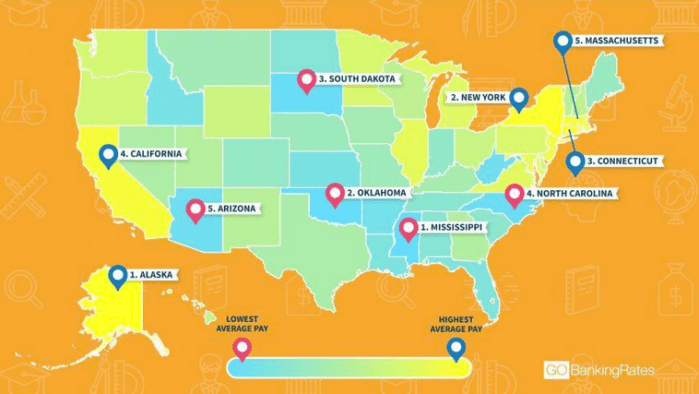
However, Pennsylvania pays its teachers better than average. We have the 12th highest pay in the country, according to financial services outlet GOBankingRates which compiled average teacher salaries by state using 2015 federal data.


According to that data, Pennsylvania teachers make on average $63,063 per year. Of neighboring states, teachers in Maryland ($65,247) and New Jersey ($71,687) make more. Teachers in Ohio (59,063) and Delaware ($59,853) make less.


Screen Shot 2018-08-16 at 2.11.40 PM
Highest and Lowest Teacher Salaries – Source: GoBankingRates


But those numbers are deceiving. They’re averages. Districts serving the wealthy pay their teachers much better than those serving the poor. Actual pay ranges from $99,253 in the affluent Philadelphia district of Lower Merion to $27,592 at Wonderland Charter School in Centre Country.


As everywhere else, many teachers struggle to make ends meet working multiple jobs while others are well compensated.


No matter how you slice it, nationwide teachers’ salaries are 14% less than those from professions that require similar levels of education, according to the Economic Policy Institute.


In other words, if prospective teachers want to make more money, all they have to do is switch majors.


That may be part of the reason for our national teachers shortage. Not only have states like ours laid off tens of thousands of educators, many don’t stay in the field if given the chance. Across the country , 46 percent of educators quit before reaching the five year mark. And it’s worse in urban districts, where 20 percent quit every single year!


We could take steps to ensure all teachers earned a living wage and even encouraged our best and brightest to enter the field. But, nah, Wagner thinks Pennsylvania already spends “enough” money on public schools.


As Governor, he would do whatever he could to win his personal crusade against teachers even if Pennsylvania’s school children were collateral damage.


He Wants to Eliminate Teachers Sick Days


Wagner has been vocal about eliminating benefits that educators earn, including sick days. He introduced a bill that’s still floating around in the state senate to strip sick days from the school code and make teachers bargain for them with their districts.


So forcing sick teachers to come to school and spread the germs to children is fine with Wagner as long as it hurts his nemesis – those evil teachers.


He Wants to Cut Teachers Pensions


He also plans to end pensions for working educators, and even wants retired educators to give back 10% of the retirement they earned.


He’s right to want reform to the state pension system but disingenuous or misinformed about the cause.


Pennsylvania pension costs have increased primarily because our legislature made bad plans and bad investments that were upended by the crash of 2008. You don’t fix that by stiffing your employees. If you do that, no one will believe any promises the state makes and no one of any substance will want to work for the state.


He Wants To Pay Teachers Based on Student Test Scores


No kidding:


“There are teachers that will exceed expectations while teaching a classroom of 100 of the toughest-to-teach students. There are also teachers that would struggle to teach just one student at a time. I want the first teacher to make a small fortune, and I want the second teacher to find a new career that is better suited for him or her.”


So if you teach the best students, you should make the most money? And if you teach struggling students, you should be fired?


But It’s Not Just Teachers. He Hates Other Working People, Too


If there is a corner to cut, he wants to take it – especially if it screws a working person. As a state senator, Wagner even introduced a bill that would exempt school districts from paying laborers the “prevailing wage” on construction projects.


Cheaper labor, shoddier work. That’s surely a recipe for success in buildings housing school children!


He Wants to Disband Unions


Oh, but he’s not done.


The man who once compared the tactics of public employee unions – including those representing teachers – to those of Adolf Hitler and Vladimir Putin also wants to end tenure end tenure, seniority, and disband unions.


I’m sure reducing teaching to a career without benefits, workers rights or protections will do wonders for the educational quality students receive.


Teachers working conditions are students learning conditions. Putting children in a building that has fewer safety precautions because there’s no union to collectively bargain for them is a great way to cut costs. But parents aren’t thrilled about having their kids try to learn in a sweat shop filled with Trump brand Russian asbestos.


He Loves School Vouchers and Charter Schools


Call them education saving accounts, education tax credits, personalized learning accounts or opportunity scholarships. It doesn’t matter. Wagner loves them all.


“I support all school choice,” he said in an interview.


Charter schools, funding private and parochial schools with public tax dollars. He’s in for all of it.


So long as it hurts public schools and enriches private businesses without helping students learn at all.


Go ahead! Take scarce funding from public schools and divert it to programs with little to no accountability. Let private school operators fraudulently misrepresent enrollment data. Let them fail to provide safe and academically appropriate learning environments. Let them game the system in any and every way.


That’s what Wagner calls fiscal accountability.


It doesn’t matter that these schools don’t improve student achievement. Evaluations of voucher programs in Milwaukee, Cleveland, and Washington, D.C., have all found no statistically significant differences in the academic achievement of voucher students compared to public school students. And recent evaluations of programs in Ohio, Indiana, and Louisiana revealed that voucher students scored lower than their peers attending public school.


But who cares about facts? This is all ideology for Wagner.


Vouchers have a record of undermining student’s civil rights – especially students with disabilities. Private school students give up due process and other rights guaranteed in public schools. Private schools are allowed to discriminate by denying admission based on religion, sexual orientation, citizenship status, English language proficiency and disability. Private schools that enroll students with disabilities may decide not to provide the services or accommodations guaranteed to such students in public schools. Or they may charge parents extra for them. Moreover, there is nothing to stop them from segregating these kids from other children. And, finally, private schools often suspend or expel students without due process.


This may be Trump and Wagner’s ideal. But it is certainly not what Commonwealth voters want for their children.


He Wants to Get Rid of Many State Colleges


Wagner caused an uproar when he said the state’s 14 state colleges will not be around in four years. “So, for those of you who think your school’s going to be around four years from now, it isn’t going to be around,” Wagner said.


Fewer institutions of higher learning. Fewer opportunities to get a college degree. That sounds like the policy of a college dropout.


He Wants to Slash School Funding


Wagner has made no bones about this from day one.


This is a guy who took a television reporter on a helicopter tour of schools in his district in 2015 to highlight the fact that “we spend a lot of money on schools.”


“They think the solution is more money,” he said of Wolf and the Democrats. “Every time you do that the money disappears and the problem is still there.”


It’s like taking a bath, Scott. You can’t just do it once and be clean for the rest of your life. You need to bathe every day. One-time funding windfalls don’t work. You need equitable and sustainable funding revenues.


But that’s either too complicated for Wagner or he just doesn’t care.


He supported Gov. Corbett’s plan to decimate Pennsylvania’s schools. And he doesn’t think the culling should be over.


When asked point blank about Corbett’s cuts in 2011, he said, “Yes, I believe that Governor Corbett needs to stick to his plan.”


He’s said repeatedly that we spend “enough money” on public schools, while stressing the need for frugality and fewer regulations.


He Wants to Play with How Schools Are Funded


He’s an advocate for legislation that would eliminate school property taxes and replace them with increased state sales and income taxes.


True we need a better funding mechanism than local property taxes. But you can bet Wagner’s plan is worse than the current system.


It would lock funding inequities among Pennsylvania’s 500 school districts into place.


He Thinks Global Warming is Caused by the Earth Getting Closer to the Sun


Wagner is an incredibly stupid man who thinks he’s rather intelligent.


But of all the dumb or evil things that come spewing out of his mouth, this one has to be my favorite.


When asked about global climate change, he didn’t simply deny that it was happening. He had an alternative theory to why it was taking place.


It’s not business and industry or fossil fuels that is causing global temperatures to rise. He actually said that it’s because the earth is getting closer to the sun every year. Another cause? Human bodies on the planet are giving off enough heat to raise the global temperature.


Perhaps it shouldn’t be surprising that a person who hates schools and teachers so much knows very little, himself.


These comments made him a national laughing stock.


His words were repeated on every late night comedy show across the country for giggles and guffaws.


The question is “Will the joke be on us come Election Day?”


It’s not “How dumb is Scott Wagner?”


It’s “Is Pennsylvania dumb enough to vote for him?”


NOTE: Special Thank you to Sue Goncarovs for the Wagner cartoon with which I began this piece. I love your work!


Like this post? I’ve written a book, “Gadfly on the Wall: A Public School Teacher Speaks Out on Racism and Reform,” now available from Garn Press. Ten percent of the proceeds go to the Badass Teachers Association. Check it out!
WANT A SIGNED COPY?

Click here to order one directly from me to your door!

book-1

Stupid Ass School Voucher Bill Back for Pennsylvania Vote Tomorrow

Shake the world to make money


Close your eyes and imagine a school like the one where I teach.


The public middle school is right next door to a Catholic middle school.


Some of the wealthiest families send their kids to the religious school. The rest send their kids to the public school.


Now imagine that the state passes a school voucher bill.


Those wealthy families can now use public tax dollars to help fund their kids’ Catholic school tuition.


A truckload of taxpayer wealth would be redistributed away from the public school and into the religious one.


And this is for children who weren’t attending public school in the first place.


Imagine what an impact that would have on the two schools. At the Catholic middle school, not much would change. At most a few more kids might enroll. And wealthy parents would get to pay less in tuition.


At the public middle school, however, the results would be disastrous. It would have to survive on much less funding than it was already receiving. Services for the majority of students in the district would be degraded. Class sizes would balloon. Educational quality would take a nose dive.


So why wouldn’t more kids from the public school move to the Catholic one?


Well, first of all, few kids in the district are Catholic. Should they be forced to be indoctrinated in a faith in which they don’t believe?


Second, tuition at the Catholic school costs more than the price of the voucher. Parents would have to pay above and beyond what they’re paying now to make tuition at the Catholic school. And this is a mostly poor neighborhood. Parents simply can’t afford it.


THIS is the situation the Pennsylvania Education Committee will vote on tomorrow.


The committee will decide whether State Sen. John DiSanto’s school voucher bill should be voted on by the state Senate and House.


School vouchers are not popular at both the national and state level.


Around 70% of people across the country oppose school vouchers, according to the PDK-Gallup public opinion poll about U.S. education.


Moreover, Harrisburg wastepaper baskets are lined with school voucher bills that fail to pass despite being introduced every few years.


DiSanto’s bill is called Education Savings Accounts for Students in Underperforming Schools or SB 2.


And guess what!?


It’s almost exactly the same as a pile of similar bills offered by the American Legislative Exchange Council (ALEC).


The Special Needs Scholarship Program Act, The Foster Child Scholarship Program Act, “Opportunity Scholarships,” The Smart Start Scholarship Program – all ALEC bills that do almost the same thing.


They designate some group of at risk students and say, “Hey, you know what they need? School vouchers!”


Well, my goodness. I’m sure glad DiSanto didn’t stress himself out writing something new. I’m certain his constituents wanted him to plagiarize someone else’s bill and pretend like it was his own.


And how exactly will spending public tax dollars on non-public schools help these kids succeed? That’s never explained.


Fools like DiSanto just pretend that it will help as a matter of faith. And since the overwhelming majority of school vouchers go to religious school coffers, this makes sense.


It is a blatant violation of the separation of church and state. But privatization supporters don’t give a crap about that. They don’t care about the values on which this country where founded. Their only concern is doing what their rich donors demand.


SB 2 would target students living in districts with the most underfunded schools serving the most impoverished populations. You know – “failing schools.”


If passed, kids living in these neighborhoods would have whatever the district sets aside for each student put in a savings account to be spent in almost any way parents see fit so long as they could somehow justify it as educational.


Send your kids to a private or parochial school?


Sure!


Homeschool your child?


Yep!


Go on a trip to the life-sized replica of Noah’s Ark in Williamstown, Kentucky?


You betcha!


And the best part is there is hardly any accountability built in to the law, so we probably wouldn’t even know how this money was spent.


Your tax dollars at work. Somehow. Somewhere. Out of sight.


I guess that’s what Pennsylvania Republicans like DiSanto call fiscal conservatism.


If passed, the bill would affect 800 schools – the 15% lowest performing in the state – including mine.


Take a look at the list.


Every school serves mostly poor students. Every school is severely underfunded.


Pennsylvania ranks 45th out of 50 for school funding. There are only five states in the country where the state government pays less of the cost of educating students. The Commonwealth relies on local municipalities to make up the difference. That means local property taxes, so the richer an area you live in, the more money it can afford to pay to educate children. The poorer an area where you live, the less it can pay.


This is why Pennsylvania has the widest disparity between how much it spends on rich kids vs. poor ones. Wealthy children are cherished and coddled. Poor ones are left to fend for themselves.


This voucher bill would only exacerbate the situation.


It’s a giveaway to those who don’t need it at the expense of those who can least afford to pay.


If you live in the Commonwealth, please call and/or write your state Senator and Representative and ask them to oppose this bill.

PA High Court Says, “Yes, Schools CAN Sue State Over Unfair Funding, After All!”

rrxfund14-d


It’s back on!

Two years ago a group of plucky Pennsylvania public schools took the state legislature to court because the body wasn’t allocating funding to all districts fairly – some got too much, many got too little.

A lower court threw the challenge out saying it wasn’t the court’s job to tell the legislature how to legislate. But now the state Supreme Court has overturned that lower court decision.

In effect, justices are sayingHell, yes, that is the court’s job! That’s why it’s called a system of checks and balances, Baby!

Or something like that.

Before going any further, there are a few pertinent facts you have to understand about the Commonwealth.

1) No other state in the country has a bigger gap between what it spends on rich vs. poor students than Pennsylvania, according to the U.S. Department of Education.

untitled

2) The Pennsylvania legislature has been paying less and less of public schools’ budgets over the last four decades. The state used to contribute 54% of all public school costs in the early 1970s. Today it pays only 35% of the costs, leaving local taxpayers to take up the slack. Since districts are not equally wealthy, that increases the disparity of resources between rich and poor districts.


3) The state has only had a funding formula specifically legislating how to allocate money to its more than 500 districts for two years. Two years! For more than 15 years previous, the legislature just handed out money willy nilly based on political backroom deals that favored already rich districts and hurt the most impoverished ones.

4) The new funding formula still is not fair. Though it does take into account the poverty of a district, it doesn’t account for the years of systematic disinvestment the district suffered through previously. That’s like giving new sneakers to a racer who hasn’t been able to get out of the starting gate while others are already halfway to the finish line.

5) The legislature STILL hasn’t healed almost $1 billion in education cuts made under previous Republican Gov. Tom Corbett. Instead, under current Democratic Gov. Tom Wolf, it has reluctantly increased funding a bit at a time but failed to bring spending up to what it was four years ago. And even once the cuts are healed, spending will be behind inflationary and cost of business increases. Meanwhile the Republican controlled legislature plays games approving the state budget separately from allocating money to the programs – including schools – that it already approved!


6) Pennsylvania is one of seven states with a Constitution that specifically requires the state provide a “thorough and efficient” system of education. Some of these other states – like New Jersey – have used similar Constitutional requirements to force their legislatures to increase state funding to public schools.

So there you are.

Pennsylvania’s legislature is an absolute mess.

Hopelessly gerrymandered, controlled by the radical right, and opposed by a Democratic party nearly as beholden to big donors as their GOP counterparts and desperate for any area of bipartisanship so as to be able to claim they got anything done other than stop Republicans from burning the whole place to the ground.

That’s why today’s 5-2 Supreme Court ruling is a breath of fresh air.

It’s like someone finally called Mom and Dad to tell our bratty lawmakers to get back to work.

The case will now go back to Commonwealth Court.

Supreme Court Justice David Wecht wrote that the courts do have a responsibility to check the power of the legislature – both in regard to the requirements of the state Constitution and that poorer districts are being discriminated against.

“It remains for (the) petitioners to substantiate and elucidate the classification at issue and to establish the nature of the right to education, if any, to determine what standard of review the lower court must employ to evaluate their challenge,” Wecht wrote. “But (the) petitioners are entitled to do so.”

This may be a Herculean task for those suing the state. And it seems unlikely that Commonwealth Court will hear their arguments favorably.

Justices rarely have the courage to challenge other branches, and the history of Pennsylvania’s courts shows multiple times when the courts have simply refused to assert such power.

This is what happened back in the 1990s when the Philadelphia School District sued the state over the same issue – unfair funding.

Time and again, poor districts have asked for help from the courts when the legislature refused to do its job. And time and again the courts have refused.

But at least this ruling gets things moving again. It’s like a dose of Kaopectate for a constipated political system.

Another possible bit of good news comes from Common Core and high stakes standardized testing. Yes, that crap!

When Philadelphia sued the state, the courts refused to rule in the schools favor because it had no way of proving the state was hurting the quality of education students were receiving there through lack of funding. But that was before Pennsylvania adopted its new Common Core look-a-like standards, PA Core, and initiated aligned tests including the souped up Pennsylvania System of School Assessments (PSSA) and Keystone Exams.

Ironically, the same “accountability” measures used to “demonstrate” poor schools are failing could be used to prove the common sense notion that unfairly funding schools leads to poor academic results.

In any case, far right demagogues like House Speaker Mike Turzai, R-Allegheny, are already whining that the Supreme Court is legislating from the bench. However, as a defendant in the case, and one of the most partisan hacks in Harrisburg, that’s exactly what the Koch Brothers probably told him to say.

Unfortunately, Gov. Wolf seems to kinda agree with him. Though he has yet to make a statement about today’s ruling, he was against the suit when it was originally brought up in 2015. Though he supports increasing education funding and has consistently pushed for it with every budget proposal, he is leery of the courts butting in.

Sadly, his strategy of incremental education budget increases has been failing. Or, to be fair, it’s succeeding at such a slow rate that it would take decades for it to catch up.

The fact of the matter is that it is patently unfair for rich districts to spend $10,000 to $20,000 on each student, while poorer districts can barely pull together $5,000-$6,000.

In addition, impoverished students have greater needs than rich ones. They often don’t have books in the home or access to Pre-kindergarten. Poor students often suffer from food insecurity, malnutrition, a lack of neonatal care, worse attendance, are less well rested and have greater special needs and suffer greater traumas than wealthier students. Moreover, it is no accident that the group being privileged here is made up mostly of white students and those being underprivileged are mostly students of color.

The time is here when Pennsylvanians have to decide where they stand. Are they for a state that offers all children an equal start or do they prefer one where poor brown kids suffer so rich white ones can get ahead?

Today, the matter is in the court’s hands.

Pennsylvania Proposes Smaller Tests, Same High Stakes

Screen Shot 2017-08-14 at 4.04.51 PM


It’s not the size of the tests, it’s how you use them.


And that’s kind of the problem with Gov. Tom Wolf’s new proposal for Pennsylvania public schools.


Wolf wants to reduce the amount of time students are taking standardized tests, but he seems to have little problem using those tests to hold schools accountable for all kinds of things that are beyond their control.


The proposal released today applies only to the Pennsylvania System of School Assessment (PSSA) tests – those taken by students in grades 3-8. Keystone Exams taken by high school students are unaffected.


It would cut one of three reading sections and one of three math sections – two total. Wolf also wants to cut some questions from one of the science sections.


Such a move is estimated to eliminate 48 minutes from the math test, 45 minutes from the reading test and 22 minutes from the science test. However, judging from my own students, these times vary considerably depending on the individual taking the tests. I’ve had 8th grade students finish a PSSA section in as little as 5 minutes or as much as two hours.


Most schools give either a section a day or two in one day. Therefore, this proposal probably translates to 1 to 2 fewer days testing in most districts.


Um. Thanks?


Look I don’t want to seem ungrateful here, but these suggested modifications are little more than fiddling around the edges of a massive problem.


Yes, it will be helpful to reduce testing times, but this does very little to address the fundamental problems with test-based accountability in the Commonwealth.


At best, this proposal will allow students to spend two more days a year learning. Assuming most districts don’t use that extra time for test prep, that IS a good thing.


But tacitly committing students throughout the state to taking these tests almost guarantees that test prep is exactly how these additional days will be used.


The problem with standardized testing isn’t just the number of raw days it takes students to complete the tests. It is how the tests deform the entire year-long curriculum. Students don’t just learn anymore. They learn what’s on the test – and anything else is purely optional.


Regardless of the size of the assessments, they are still being used to sort and judge students, teachers and schools. Shortening their length does nothing to address the fundamental unfairness of the evaluations. Rich white kids still tend to have high scores and poor minority kids still tend to have low ones.


At best, they reveal structural funding disparities between poor and wealthy districts. At worst, the cultural bias inherent in the questions favor those from dominant, privileged ethnicities while punishing those who don’t fit the standard.


That’s what “standardized test” means after all – defining normal and punishing those who don’t fit the definition. Most questions don’t assess universals like the value of 2 and 2. They evaluate cultural and social norms required to understand the questions and easily find an answer that another “normal” student would choose. (Don’t believe me? Watch “Black Jeopardy” on Saturday Night Live.)


This is true whether the test takes one day or 100 days.


We should not be using standardized testing to meet federal accountability standards. Period.


The federal Every Student Succeeds Act (ESSA) contains provisions to circumvent them. States are supposed to be given leeway about testing. They may even be able to replace them with projects or other non-standardized assessments. THAT’S what Wolf and the Pennsylvania Department of Education should be exploring – not half measures.


To be fair, the state Department of Education is attempting reform based on the ESSA. This year, the department introduced Future Ready PA, a new way of using test scores and other measures to assess school success. To its credit, The Index does place additional emphasis on academic growth, evaluation of school climate, attendance, graduation rates, etc. However, for my money it still gives far too much importance to standardized testing and test prep.


Like reducing the size of the PSSAs, it’s a positive step but won’t do much to get us to our destination.


Neither measure will have much impact on the day-to-day operations of our public schools. Districts will still be pressured to emphasize test prep, test taking strategies, approaches to answering multiple choice questions, etc. Meanwhile, critical thinking, problem solving, and creativity will still be pushed to the side.


Moreover, since schools and teachers will be assessed as successful or not based largely on these test scores, districts will be under tremendous pressure to give countless practice tests throughout the year to gauge how well students are prepared for the PSSAs. The state will still be providing and encouraging the optional Classroom Diagnostics Tools (CDT) tests be taken several times in reading and math throughout the year. Trimming off two days from the PSSA will affect that not at all.


In addition, today’s proposal only applies to the PSSA. While that assessment is important, the Keystone Exams given to high school students are even more so. According to existing state law, passing the Keystones in Algebra I, Literature and Biology are required in order to qualify for a diploma. However, that condition has yet to go live. So far the legislature has continuously pushed back the date when passing scores become graduation requirements. The Governor and Department of Education should be proposing the elimination of this prerequisite before anything else. Other than education funding and perhaps charter school accountability, it is the most important education issue before Commonwealth lawmakers today.


Don’t get me wrong. The Democratic Governor is somewhat hamstrung by the Republican-controlled legislature. Partisan politics has stopped lawmakers from accepting Wolf’s more progressive education measures.


Though Wolf has gotten Republicans to increase education funding by hundreds of millions of dollars during his term, K-12 schools still receive less than they did before the previous GOP governor’s administration. Moreover, there have been absolutely zero inflationary increases to keep up with the rising cost of doing business. Pennsylvania schools receive less funding – whether you adjust for inflation or not – than they should, and that has a real world impact on our public schools. Moreover, how that money has been allocated by the legislature still – even with our new better funding formula in place – benefits wealthy districts more than poor ones.


If you want to talk about accountability, that’s where the majority of the issue belongs.


And primarily it’s out of Wolf’s hands. One can understand why he is proposing changes where he can and trying to do whatever good is possible given the political climate.


Shortening the PSSA tests would benefit our students. It is a step in a positive direction.


However, it is far from solving our many education problems.


The biggest roadblock to authentic school reform is a legislature that refuses to do anything but the absolute minimum for our neediest students.

PA: Want to Get Rid of Keystone Exams? Then Let Us Evaluate Teachers More Unfairly

Screen Shot 2017-06-14 at 12.05.25 PM

It’s the classic Harrisburg switch.


Want something good passed by the legislature? Then let us pass something terrible – something you would never even consider unless something you cared about was on the table.


That appears to be the game being played by the Pennsylvania Senate Education Committee today as they consider SB 756.


On the one hand, the proposed bill would eliminate the state’s terrible Keystone Exams. On the other, it would force a new teacher evaluation system that is tremendously unfair.


Which one is more important?


The answer: both.


If lawmakers had any moral courage – and most don’t because they’re lawmakers after all – they would consider each of these measures one at a time on their own merits.


But if they did that, conservatives wouldn’t vote to help students by getting rid of unfair tests, and progressives wouldn’t vote to help corporations by installing unfair teacher evaluations. So they’ve apparently decided to compromise behind closed doors by putting both together in a huge omnibus bill.


Who knows what other treasures lurk in its pages!? Well if you have a limitless amount of time and energy, go ahead and read it!


THE GOOD


The bill would put an end to our costly, cruel and dishonest Keystone Exams. Not only would we no longer threaten to require these tests in Literature, Algebra and Biology as graduation requirements, but we would stop giving them altogether.


In their place to meet federal accountability regulations, the state would substitute the Scholastic Aptitude Tests (SAT), Preliminary Scholastic Aptitude Test (PSAT), armed forces exam, competency assessment or certificate for technical students, or Pennsylvania Alternative Assessment for students with special needs.


But perhaps the best part is that the bill makes explicit and generous provisions for parents to opt their children out of high school standardized tests altogether. In this case, students would NOT be required to take a substitute assessment.


Here is the exact language from the bill:


“A school entity’s governing board shall adopt a policy that provides that the parent or guardian of a student may request that the student be exempt from taking an assessment that is required for the purpose of Federal accountability as permitted under ESSA [Every Student Succeeds Act]. The policy shall provide that parents and guardians of students receive written notice of the option for a student to be exempt from taking the assessment and that the exemption shall be permitted upon the school entity’s receipt of a written request from the parent or guardian of the student. A substitute assessment or an alternative assessment, course or program may not be required of a student exempted under this section. Grounds for exemption in the school entity’s policy shall include, but not be limited to:
(1) Religious grounds.
(2) The basis of a strong moral or ethical conviction
similar to a religious belief.
(3) Philosophical grounds.
(4) Privacy concerns.
(5) Health concerns for the child, which may include stress and anxiety in preparation for the assessment.”


This is a huge improvement over our current opt out policy. At present, parents can opt out their children from the Keystone Exams but students must take an alternate assessment. This could include a project based assessment and not merely a standardized test. Also, it only allows these exemptions based on religious convictions. Parents needn’t explain these convictions in any detail, but this is the only option they are given with which to opt out.


The proposed legislation would go into effect during the 2018-19 school year, when the Keystone Exams would otherwise become a graduation requirement. Students would take the SAT or other assessment in 10th grade.


However, students in 3-8th grade would still be subjected to the Pennsylvania System of School Assessments (PSSA) tests. I assume parents could still opt out their children from these exams, but the wording is a bit murky there.


In addition, the law would require the state to establish a task force to reevaluate whether the Commonwealth should use the PSSA in the future and how to reduce the time it takes to give the assessment. If the task force concludes the PSSA is inappropriate, they must look for an alternative exam. They are required to issue a report in 6 months from passage of the bill.


This is particularly important since the PSSA has been rewritten to be closer to the Keystone Exam. It is Keystone Exam-lite. If the legislature is against the high school test, one would imagine they should be against a very similar test being given in elementary and middle school.


THE BAD


Despite all the good this proposed bill would do for our school children, it would drastically worsen the situation for our classroom teachers.


Half of a teacher’s current evaluation is based on classroom observations by district administrators. That just makes sense. The best way to tell if an educator is doing a good job is to observe what he/she is actually doing in the classroom.


This new system would reduce classroom observations to only 30% of a teacher’s annual score.


This would allow 10% to come from a “parental” score and 10% to come from “peer evaluation.” In a non-high stakes environment, input from both of these stakeholders is vital to a teacher’s success. But when you add that high stakes component, you pervert both relationships.


Having parents evaluate teachers puts them in kind of a touchy place. Teachers are required to push students to do their best. This requires them to often make calls home and ask for help from parents. If parents control a portion of a teacher’s evaluation, it incentivizes educators not to bother them with student misbehavior or failing grades. Instead teachers could be pressured to unfairly increase students grades or ignore misbehavior so as to better parental evaluations.


Moreover, peer observations can be extremely subjective when tied to teacher assessment. Administrators are discouraged from giving out distinguished evaluations to more than a handful of teachers. This incentivizes peers who are forced to compete for these few plum scores to unfairly suppress positive evaluations from their fellows.


But the worst is still to come.

The new evaluations require 50% of teachers’ evaluations to come from student growth and achievement measures. For math and English teachers, this largely means using standardized test scores to assess educators.


It’s a terrible practice that has been shown to be ineffective and downright damaging to student learning time and again. But it does help testing corporations by discouraging opt outs. Just imagine. If you have students who you think will score well on the tests but who may opt out, you are incentivized to discourage them from doing so. Otherwise, your teacher evaluation will drop.


This makes teachers the testing policemen. Learning doesn’t matter, only how well your students do on the tests. It dramatically tips the scale away from things the teacher has any control over. As such, it would cause serious harm to the quality of education students receive across the state.


CONCLUSION

We cannot support this bill in its present form. It should not go on to consideration by the full House and/or Senate. And if it somehow is passed by these Republican-controlled bodies, our Democratic Gov. Tom Wolf should not sign it.


This is unfortunate because there is much to like about it. However, you can’t save students from unfair assessments by forcing teachers to be evaluated by – drum roll please – unfair assessments.


This sets up an unsustainable and unfair relationship between students and teachers. It puts educators in the position of having to look out for their own interests and not those of their students. The interests of both should be interlinked, not separated. Teachers get into the profession to help kids learn – not to have to look out for an arbitrary score from their administrators that may require them to act against their students needs.


If legislators had any ethical fortitude, they would propose both of these measures in separate bills where they could be examined on merit. But I long ago gave up expecting such qualities from our politicians.


In my book, they almost all deserve a failing grade.

Report: Charter School Vampires Drain Traditional PA Districts Dry

o-VAMPIRE-FANGS-facebook

If you ever needed proof that charter schools harm traditional public school districts, look no further.

A new report by Pennsylvania’s Legislative Budget and Finance Committee concludes that these privately run but publicly financed schools often drain traditional public districts of funding.

The report conducted at the behest of the state House and Senate found that charter schools have attached themselves in some way to almost every district in the Commonwealth, but not equally. Half of the state’s traditional public schools suffer from 80% of the state’s charter parasites.

Moreover, 40% of traditional districts with “significant” charter enrollment are struggling to make ends meet. The reason: unfair state mandates about how traditional districts must pay their charter school hangers-on.

The report is based on interviews with 36 superintendents. A total of 29 of these leaders said charter schools hurt their districts. Only four superintendents mentioned any positive impacts at all.

Much of the damage comes from Pennsylvania’s insistence on funding charter schools out of traditional public school budgets. Instead of charter school money coming directly from the state, much of it comes from the traditional district where it has set up shop.

In effect, it’s like a leach sucking away money that could be going to traditional public school students. We’re one of only 13 states that does this.

It leads to many problems.

Chief among them are the state’s special education laws. Local districts are required to pay their charters extra money for special education students. But this additional funding isn’t based on the number of special needs students actually present in the charter school. It’s based on an arbitrary 16%. Local districts pay charters as if these schools had 16% special education students whether they do or not. This incentivizes charters to enroll less than 16% and pocket the difference.

It’s a system so corrupt that only one other state – Massachusetts – uses it.

We’ve always known the system allows for fraud. We just couldn’t prove it was actually taking place – until now. According to the Pennsylvania Department of Education (PDE), in the 2014-2015 school year alone, local districts gave roughly $294.8 million in special ed supplements to charter schools. However, actual charter expenditures on special ed were only $193.1 million.

That’s $101.7 million in profit for charter operators! Ca-ching!

It’s also more than $100 million set aside to educate children that’s not being used for that purpose!

But that’s not the only way charter schools are sucking out local districts’ finances.
Times are tough. Money is hard to come by. If a district struggles to pay its charter schools, the state steps in and withholds the amount of money due to the charter schools from the state funding it would normally send the district – and sends that money directly to the charters instead.

In effect, the state ensures charters are fully funded, while local districts are left to struggle.

And to make matters worse, when charters file a complaint, the state doesn’t even verify if it’s true. The state doesn’t check to see if the district actually did pay its charters or not. It just withholds whatever money charter operators say they’re owed.

Local districts can appeal overpayments to charters. Right now there are 317 general appeals pending for a total of nearly $30 million in disputed funding – half of which is from Philadelphia, alone!

Nor is this the only area where charters are given preferential treatment. When a charter school attaches itself to a traditional public school, that traditional district must pay to transport kids to the charter school – but it is not required to provide transportation to its own students.

Pennsylvania is one of only 11 states to require transportation to charter schools.

But that’s not the worst of it.

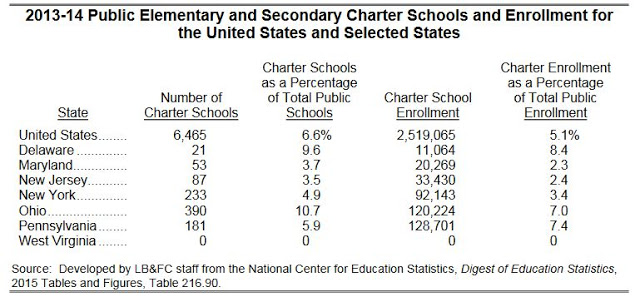
PA charter report

Now we come to cyber charter schools – the Count Draculas of the charter world.

The report estimates an additional $100 million in overpayments to cyber charters because of state law that overestimates their expenses. They are collecting much more money than they need to operate. They don’t have the same costs as brick-and-mortar institutions.

Cyber charter school students are given a computer and internet access. That’s about it. No costly building to run. Students usually do their lessons at home. Even when taking into account cyber charter staff, expenses are much lower than at other kinds of schools yet they are calculated without consideration of these differences.

Once again, state tax dollars that could be used to educate students become pure profit for charter operators. It is businessmen who win and students who lose.

The legislature used to acknowledge the burden charter schools put on local districts. The state budget used to include a line item reimbursing local districts for a percentage of their payments to charters. In 2010-11, that was $225 million. However, this money disappeared during the Gov. Tom Corbett administration when Republicans gained control of the legislature and prioritized tax cuts over charter school relief.

Though Corbett was defeated by Democrat Tom Wolf for the governorship, the legislature is still controlled by Republicans and the charter school reimbursement remains a distant memory.

But perhaps this new report signals a change in policy.

It contains several suggestions to fix Pennsylvania’s broken charter school laws. These include:

  • Permitting school districts to negotiate charter per pupil payment rates and methods.
  • Eliminating mandates for transportation that are inconsistent with services offered for district-operated schools.
  • Requiring the state to check with local districts when charter schools complain of underpayment.
  • Requiring greater transparency and fiscal accountability addressing problems like shell ownership, leasing, state payments, and conflict of interest policies.
  • Allowing audits of charter school funds.
  • Prohibiting the guaranteeing of loans where there is no direct school involvement.
  • Requiring charters to submit financial records for the district to review.
  • Requiring parents who place students in charters to first register with the local school district and then notify the district of changes in status.
  • Eliminating public school districts’ responsibility for charter school compliance with compulsory attendance requirements.

However, perhaps the biggest game changer is how charters set up shop in the first place.

Right now when charter operators want to open a school in a local district, the local school board gets to say yea or nay. However, school directors aren’t allowed to consider how this will financially impact the district. The report suggests this be changed; Districts should be allowed to approve or deny charters based on dollars and cents.

Currently local school directors are forced to approve charters that they know will hurt their students. This change would require charters to be equal partners with traditional districts or else be blocked. In effect, it would transform them from parasites to symbiotic organisms.

And as luck would have it, there are already two separate but similar bills that have been introduced that propose many of these changes.

One (Senate Bill 670) was introduced by Sen. Jim Brewster (D-McKeesport). The other (Senate Bill 198) was introduced by Sen. Vincent Hughes (D-Philadelphia). Brewster’s bill would “realign and redefine how local school districts, charter schools, students and taxpayers interact.” Hughes’ legislation would “provide local school boards with the tools to better oversee charter schools in their school districts.”

Charter school reform is something that members of both parties have expressed interest in. However, until recently Republican efforts at it have been light on reform and heavy on destructive means to further deregulate an already dangerously unregulated industry, thus worsening the problem.

Charter support has been strongly bipartisan. Champions of this new report claim that these suggested reforms aren’t anti-charter. They’re an effort to make both charters and traditional public schools work together instead of against each other.

Time will tell whether lawmakers are willing to do so.

Given the large donations received from the charter industry to lawmakers on both sides of the aisle, true reform may be difficult.

But at least we now have a state-sanctioned report to point to when referencing the multitude of problems associated with the industry.

Charters have been officially recognized by the state as parasites.

Will lawmakers do something to stop that unending sucking sound?

Why Are So Many Democrats Behind Backdoor School Voucher Expansion in Pennsylvania?

 democrats_neoliberalism


Democrats are supposed to be liberals, progressives.


That means upholding the Constitution and the Separation of Church and State.


So why are so many Pennsylvania Democrats sponsoring an expansion of the state’s de facto school voucher bill?


A total of 11 out of 84 sponsors of HB 250 are Democrats. The bill would expand the Educational Improvement Tax Credit (EITC) and Opportunity Scholarship Tax Credit (OSTC) programs.


The Commonwealth already diverts $200 million of business taxes to private and parochial schools. That’s money that should be going to support our struggling public school system.


The new bill would add $50 million to each program for a total of $100 million more flushed down the drain.


Pennsylvania has a budget deficit. We’ve cut almost $1 billion a year from public schools. We can’t afford to burn an additional $300 million on private and church schools.


We expect Republicans to support this regressive nonsense. Especially in gerrymandered Pennsylvania, they’ve gone further and further right to please their Tea Party base and avoid being primaried.


But the few Democrats left in the House and Senate are likewise in districts that would never vote Republican. You’d expect them to get more and more progressive. Instead, even here we see them taking steps to the right!


Democratic sponsors of the bill are almost exclusively from the state’s urban centers – Philadelphia and Pittsburgh.


They are:


Vanessa Lowery Brown (Philadelphia County)

Donna Bullock (Philadelphia County)

Dom Costa (Allegheny County)

Daniel J. Deasy (Allegheny County)

Michael J. Driscoll (Philadelphia County)

Jordan A. Harris (Philadelphia County)

William F. Keller (Philadelphia County)

William C. Kortz II (Allegheny County)

Joanna E. McClinton (Delaware & Philadelphia County)

Harry Readshaw (Allegheny County)

Mark Rozzi (Berks County)


These corporate tax giveaways are based on the premise that our public schools are failures and that students must be rescued from them. The Commonwealth has developed a list of approximately 400 “failing schools” and created a voucher-like system allowing students living near them to take public taxpayer money to go to private and religious schools. Students can also go to another public school in a different district, if they will accept them. However, few public schools take part in the program because school boards know it’s just another attempt to weaken their districts.


How does the state define a “failing school”?


Partially it’s based on standardized test scores. Districts with the bottom 15% of reading and math scores on the Pennsylvania System of School Assessments (PSSA) and Keystone tests are supposed to earn this label. However, the state has been notorious for including districts that actually are making academic progress.


Since low test scores are highly correlated with poverty, that’s the real indicator. If you live in a poor enough district, you’re probably eligible.


What about charter schools?


It’s funny you asked. Though they often have subpar test scores, they rarely are included on the state’s list of “failing schools.” They even exclude most of the state’s execrable cyber charter schools. The Center for Research on Education Outcomes (CREDO) at Stanford University found that students in every single Pennsylvania cyber charter school performed “significantly worse” in reading and math than their peers in conventional public schools. But somehow that’s generally not failing enough to earn you a voucher-like tax credit.


How can we tell that students at private and parochial schools are doing better than those in public schools?


We can’t.


The scholarship organizations have no auditing requirements and almost no reporting requirements. Moreover, private and parochial schools don’t have to take the federally-mandated standardized tests! So there’s no way to do an apples-to-apples comparison!


But here’s the best part. The EITC law prohibits state administrators from requesting any information related to academic achievement. You’re not even allowed to ask!


However, the law goes out of its way to remove regulations on how these tax dollars are spent. For instance, schools taking these tax credits can spend as much as 20% of the money to cover pure administrative costs.


Yet the public schools are still responsible for many of the costs of students living in their attendance areas but who use these de facto vouchers. For instance, there’s no limit to how far away an EITC student can go with their publicly-subsidized scholarship. But the student’s home district is legally obligated to provide transportation for up to ten miles.


Vouchers have been repeatedly defeated on every referendum held on the subject in the entire country. One of the reasons people have been up in arms against Donald Trump’s nomination of Betsy DeVos as U.S. Education Secretary has been her support of vouchers.


What do voters have to do to tell legislators that they don’t want school vouchers – no matter what you call them? What do voters have to do to show that they support our public school system – a system that despite being underfunded and weighed down with corporate education reforms remains one of the best in the world?


And when will Pennsylvania’s Democrats start acting like Democrats on the subject?

Pennsylvania: No School Property Tax for the Rich, Poor Still Pay

propertytaxmoney

Eliminating property tax to fund public schools sounds like a great idea!

Until you read the fine print.

Because what Pennsylvania legislators are proposing won’t actually eliminate property taxes – unless you’re rich.

And it won’t ensure students get the funding they need.

And it will limit school boards’ local control.

But it will benefit the rich and big corporations, which is really the only reason we’re talking about it – AGAIN.

Let me break it down for you.

First, the bill being shopped around is called the Property Tax Independence Act or SB 76. It would get rid of all property taxes used to fund public schools and replace them with increases in sales and income taxes.

Somehow these increases would need to generate an additional $12 billion a year in revenue so that we can keep funding our schools at the present level. That’s some tax increase – and guess who’s going to pay the bulk of it – YOU.

Guess who’s not going to pay much of it – the huge corporations who used to pay property taxes on all those commercial, industrial, oil and gas properties.

This is a huge giveaway to big business, and it’s a substantial hike for regular Commonwealth citizens like you and me.

But that’s not all!

If you live in a poor school district, you’ll still have to pay property taxes. That’s right – if your district is in debt, you’ll still get a property tax bill to pay it off.

Considering that the state cut almost $1 billion a year in school funding for the past 6 years and that most districts have had to go into debt, increase taxes or both, you’re probably not going to see your property taxes go away anytime soon.

They might go down up to 40%. Or they might not go down at all. AND you still have to pay higher sales and income taxes.

But here’s the best part.

Pennsylvania has the dubious distinction of being the national leader in unfair school funding.

We spend 33% more money on our rich students than on our poor ones. That’s the greatest disparity in the entire country!

And that’s saying something in a nation where spending more on wealthy kids is the norm.

However, this new bill won’t do anything to change that. In fact, it will lock-in that disparity.

Rich districts that today spend $23,000 per student will still spend $23,000, and poor districts that today spend $8,000 per student will still spend $8,000. But instead of your tax dollars going to the kids in your community, they’ll go to the state to be distributed everywhere. This means folks living in poor neighborhoods will probably be paying higher taxes so that they can fund the wealthiest kids. Likewise, rich parents will probably pay less while the difference is made up from taxes collected from the poor.

Call me crazy, but that just isn’t fair.
Finally, it takes away a lot of the local control from your local school board.

At present, if your local district has needs, your board can meet them by raising taxes. But under this bill, the only entity that can do that is the legislature.

I know, I know – your taxes are already too high. But the issue is who is more suited to making that decision – Harrisburg or your own community?

This bill is nothing new. Legislators have been trying to sneak it through for years.

Back in 2015 it passed the House but was defeated in the Senate when the Lt. Governor cast the deciding ballot against it. In 2013, it almost passed as an amendment to another bill, but the nonpartisan Pennsylvania Independent Fiscal Office ruined it by projecting a $1 billion shortfall within four years if it were passed.

However, the makeup of the Senate has changed. Now we have two new members who campaigned promising to pass this legislation, so it might actually squeak through.

The bill is being shopped around by state Sen. David Argall (R-Schuylkill/Berks) who authored it along with the Pennsylvania Coalition of Taxpayer Associations.

This group claims to be a simple citizens organization made up of 87 nonpartisan tax-conscious advocacy groups. But a quick look at the names of these organizations includes multiple uses of terms like “patriot,” and “freedom,” and “liberty,” and “conservative,” and “tea party.”

Nonpartisan, my butt!

Moreover, the stated goal of the group is just to pass this legislation.

That’s not a group of concerned citizens. It’s almost a PAC!

The organization has even endorsed candidates – some of them noted progressive Democrats like state Sen. Andy Dinniman (D-West Chester) and James Brewster (D-McKeesport), who both voted for the legislation in 2015.

To make it even more complex, the authors of the bill have a point. Property taxes are a terrible way to fund schools. They ensure that some districts will be better funded than others based on the local wealth of the community.

However, this bill does nothing to fix the inherent problems for children or poor and middle class communities. It compounds them.

Ironically, Gov. Wolf proposed a compromise solution two years ago with his first budget. He suggested reducing residential property taxes by $3.8 billion, targeting the biggest cuts for the neediest taxpayers and neediest schools. Moreover, he proposed increasing funding to the most impoverished districts so they could catch up to the well-funded ones.

But Republicans, who control both houses, refused to even consider it.

So here we go again. We have another Trojan Horse proposal. A good idea has been twisted and bastardized so that it serves the wealthy and private enterprise while doing irreparable harm to children and the poor. And even though it is an example of far right ideology, it has received bipartisan support.

Gov. Wolf is set to propose his new budget sometime this month. Sen. Argall is expected to reintroduce SB 76 during the subsequent budget negotiations.

It is a piece of zombie legislation that no matter how fetid and rotten just refuses to die. But this time, it just might bite us.

PA Legislature Plans Taking Away Teachers’ Sick Days

thumbnail_teachers-sick-719435

Dear Pennsylvania legislators:

So now you want to take away teachers’ sick days.

Sabbatical, sick days, bereavement leaves – the Senate Education Committee voted 7-5 to strip them from the law and make teachers bargain for them with their districts.

So the next time I get sick, you don’t want to guarantee I can take the day off. If my mother dies, you don’t want to protect my right to attend her funeral.

The full legislature still has to vote on it, but that’s pretty cold.

Which brings me to my first question: Why do you hate public school teachers so much?

Seriously. What did teachers ever do to you? Did we give you a bad grade when you were kids? Did we give you detention? What did we ever do to earn such animosity?

You obviously must have something personal against teachers.

It’s understandable. Even though the majority of Pennsylvanians voted for Democrats, most of you are Republicans. You have gerrymandered the state so that you artificially have the majority, and as such you must espouse the most radical positions possible. Otherwise, you’ll be primaried by someone even farther right – a Tea Partier, a plutocrat, an anarcho-capitalist, a fascist.

We see the same thing playing out nationally. Hello, Donald Trump!

So it’s no surprise that after stripping public schools of almost $1 billion every year for the past five years, after tens of thousands of teachers have been laid off, after you’ve given away millions of dollars to private corporations to run fly-by-night charter schools or through tax credits to religious schools – well, it’s no surprise that you feel the need to continue the war on teachers.

It’s paying off for you big time.

Not so much for our school children. They have had to deal with increases in class size, narrowing of the curriculum, reductions in extra-curriculars, cuts in tutoring – just about every deprivation imaginable.

I wonder – do you realize that every attack against teachers is also an attack against students? Making sick teachers come to school won’t improve kids’ educations. Forcing educators to choose between work or seeing their loved ones off to their final resting places won’t boost test scores. Do you understand that or do you just not care?

Follow-up, if I may: do you realize that most public school teachers are women? Does that factor in at all? Which do you hate more, the gender of most teachers or the fact that we are unionized?

Oh, and Pennsylvania School Boards Association, don’t think we’ve forgotten you. We know you requested this mess, Senate Bill 229. Instead of standing with your teachers to fight for fair, equitable, sustainable funding, you’ve decided to ask the legislature if you can stiff teachers to make ends meet. We’re there for your kids everyday, and this is how you thank us. That’s gratitude.

It’s what we get for being one of the last workforces to be unionized. We have the temerity to demand fair treatment. You can’t just do whatever you like with us, you have to actually sit down with us at the bargaining table and talk.

Legislators, we know it’s something that infuriates your base. No, I don’t mean the people who vote for you. I mean your real base – the corporations, millionaires and billionaires who pay your real salaries – the unlimited and shadowy campaign contributions that, let’s be honest, are really nothing less than legal bribes.

We shouldn’t be surprised that you have prioritized taking away legal protections for teachers’ sick days. It is quite in line with what you want to do to the profession. You no longer want highly qualified teachers making a middle class income who then can stay in our schools for their entire careers. You want lightly trained temps who use teaching as a stepping stone to a job that pays enough to live.

After all, if we afford teachers the status of professionals, they might actually be able to jump all the other hurdles we’ve put in front of them and educate the poor.

That would be terrible.

Despite all the standardized testing, Common Core, value-added measures, budget cuts, and constant propaganda about “failing schools,” they might actually teach these kids to think. That’s the last thing you want.

A thinking public might see how much you’re screwing them over. They might actually rise up and fight. They might refuse to accept the status quo that you are so desperately trying to protect.

That’s your real endgame. And though it makes me sick, I suppose I will no longer be able to take off.

I’ll just spend the day, coughing and wheezing with the children.

Yours,

Steven Singer

The Gadfly on the Wall