And since home-schooling operates with almost zero oversight, it is the most susceptible to child neglect and mistreatment.
Children who in traditional public schools would have a whole plethora of people from teachers to counselors to principals to cafeteria workers who can observe the danger signs of abuse are completely removed from the home-school environment.
Home-schooled children receive their educations almost exclusively from parents.
It is a situation that at least demands additional oversight. And at most it requires we rethink the entire enterprise as dangerous and wrongheaded.
Charter and voucher schools at least utilize whole staffs of people to educate children. The chances of something like this happening at these institutions is much smaller. However, both types of school also are much less accountable for their actions than traditional public schools.
And that is the common factor – responsibility. Who is being held answerable when things go wrong? At traditional public schools, there is a whole chain of adults who are culpable for children. At these other institutions, the number of people in the hot seat shrinks to zero.
Much of that has to do with the regulations each state puts on privatized schools.
In 14 states including Delaware, California and Wisconsin, parents don’t have to do anything but let the school district know they’re home-schooling. That’s it! And in 10 states including Texas, Illinois and New Jersey, you don’t even have to do that!
Kids just disappear without a trace. If no one reports them missing, we assume they’re being home-schooled.
But even in states that appear to be more exacting on paper, the reality is a virtual free-for-all.
Take my home state of Pennsylvania. To begin home-schooling, parents must notify the superintendent, have obtained a high school degree themselves, provide at least 180 days of instruction in certain subjects and maintain a portfolio of their child’s test results and academic records.
That sounds impressive. However, this doesn’t really amount to much in practice because these regulations have few teeth. Hardly anyone ever checks up to make sure these regulations are being met – and they’re only allowed to check up under certain circumstances and only in certain ways and at certain times!
Frankly, most of the time we don’t know what happens in charter and voucher schools, because few state governments insist on audits, unscheduled visits or reports.
Moreover, all privatized schools can withhold providing a proper education. Home-school parents can refuse to teach their children not just truths about science and history but the basics of reading, writing and math. Likewise, charter and voucher schools can cut student services and pocket the savings as profit. And no one is the wiser because the state has abrogated its responsibility to check up on students or even require they be taught much of anything at all.
Some, including myself, would argue that the regulations required of public schools by the state and federal government are sometimes too onerous, unnecessary or even just plain dumb. But that doesn’t change the fact that regulations are necessary. It just leaves open the question of which ones.
Looked at in the abstract, no one in their right mind would conceivably suggest the latter is a better educational environment than the former. However, we have been subjected to an expensive propaganda campaign to make us think otherwise.
Look. I’m not saying public schools are perfect. Certainly students can be abused there, too. The media salaciously reports every doe-eyed teacher who stupidly has a sexual relationship with a student – whether it be at a public or privatized school. But in comparison with the worst that can and often does happen at privatized schools, these incidents at public schools are extremely rare (1 in 800,000) and of much less severity.
Though both are bad, there is a world of difference between the infinitesimal chance of being propositioned by your high school teacher and the much more likely outcome of being treated like a prison inmate at 13 by the charter school corporation or being starved, shackled and beaten by your parents!
Human beings aren’t going to stop being human anytime soon. Wouldn’t it be better to entrust our children to an environment with regulations and accountability than letting them go off in some locked room and just trusting that everything will be alright?
Our posterity deserves better than privatization.
They deserve the best we can give them – and that means fully responsible, fully regulated, fully accountable public schools.
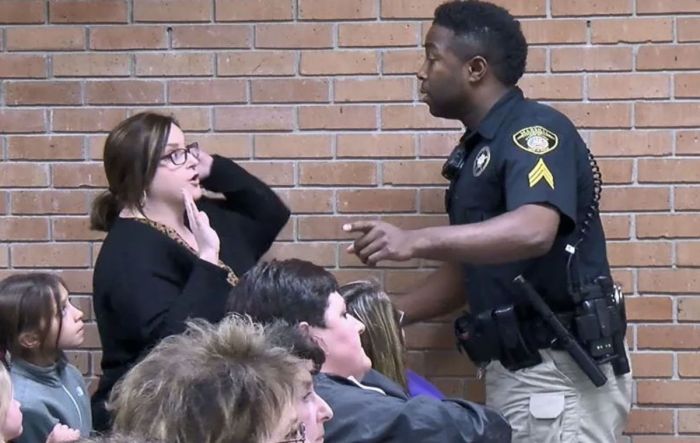
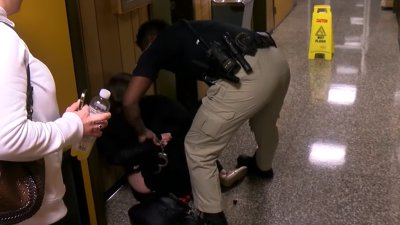
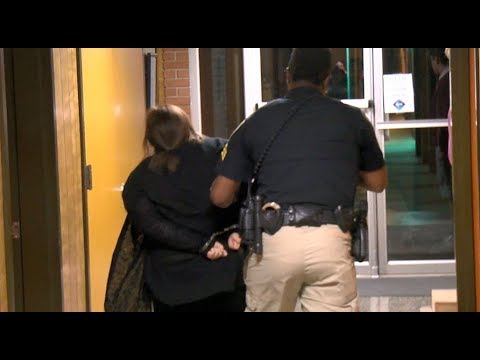
We’ve all seen the shocking video from Vermillion Parish in Louisiana this week where a teacher is tackled to the ground and arrested because she asked a question to the school board.
It’s a gross abuse of power that brings up many issues:
Public servants responding to the public with violence.
Elected representatives refusing to hear from their constituents and – in fact – taking action to silence them.
Leaders who are supposed to oversee children’s educations unconcerned with the lesson local kids will be taking home from the actions of adults who are supposed to set a better example.
The eight-member board had been deadlocked 4-4 on whether or not to give Superintendent Jerome Puyau a raise. Then one of the members died. Instead of his wife filling in until a new election could be held, board president Anthony Fontana , who was in favor of the raise, appointed a like-minded replacement and tried to force a vote.
So Deyshia Hargrave, a district teacher and parent, asked why the superintendent should get a raise while the teachers haven’t had one in several years.
It was a reasonable question, asked at the proper time, in a respectful tone, when comments were directed specifically at her.
However, Reggie Hilts, the Abbeville city marshal who also serves as a school resource officer, told her she was being disruptive and asked her to leave – which she did. When she got out in the hall, he forced her to the ground, put her in handcuffs and pushed her out of the building.
It was completely unjustified, a horrific violation of Hargrave’s rights and goes counter to the very purpose of public school.
It is the idea that district wide decisions about our children’s learning should be made by duly-elected members of the community in the full light of day. Except where doing so would violate an individual’s personal rights, all school documents are public. They are voted on in public. And they are subject to question and comment by the public.
If the taxpayers – the people who foot the bill for the majority of the district costs – don’t approve of what their representatives are doing, they can take steps to replace them.
Vermillion Parish School Board would do well to remember this.
The actions taken by City Marshall Hilts were either done at the behest of the board or certainly without any public dissent among the members.
They stomped on Hargrave’s First Amendment rights and ignored their responsibility to the community they serve.
If my description of how a public school is supposed to work sounds like a lecture, that’s intentional. These representatives could do with a lesson in how democracy works.
Our actions have consequences and those consequences only become more consequential when we become public servants. The board, the superintendent and certainly Hilts may very well have opened themselves up to legal action.
But beyond putting themselves in danger from having to pay punitive damages to Hargrave – that I hope they pay out of the superintendent’s bloated salary – they have betrayed a dangerous attitude toward the very concept of self-rule.
Whether they meant to or not, they have given the children of Vermillion Parish a lesson in government and community values.
Make no mistake. The children are watching. They get the TV news and status updates on Facebook and Twitter. They have access to YouTube. Doubtless, they have seen this video countless times. They have probably played it over and over again.
They saw their teacher brutally manhandled by a supposed law enforcement officer. And they heard the deafening silence from the school board about it.
They know now that this kind of behavior is deemed acceptable in Vermillion Parish. Beware the kind of behavior adults can expect from children who are given such a disgraceful example!
Moreover, these children are well aware of the matter in dispute.
The board is fighting to give the superintendent a $38,000 raise. Yet they refuse to give another penny to teachers – all while class sizes have jumped from 21 to 29 students, according to Hargrave.
That is not what leaders do who care about the well-being of students. It is a result of backroom deals and the good ol’ boys network.
The lesson is that hard work doesn’t matter. The only thing you should worry about is making a deal no matter whom it hurts. Just look out for numero uno.
After all, the board could give the teachers something – some token of appreciation to show that they value their continued commitment to the children of the community. But they don’t. Yet they fight tooth and nail to do so for one individual who has in no way proven himself indispensable.
Critics complain that teachers don’t deserve a raise because they already earn more money than the majority of the people who live in the community. (An argument which – by the way – would also apply to the superintendent.)
But even beyond basic logic, it’s a bogus line of reasoning!
Doctors attend patients in poor communities. They still earn high salaries – maybe not as high as they would serving the wealthy, but they have to be able to survive, to pay back the loans they took out to go through medical school, etc. So do lawyers, accountants and specialists of all kinds. That’s just capitalism. If you want someone to provide a good or service, you have to pay them a competitive wage. Otherwise, they’ll move on to greener pastures.
The kids see you pinching pennies. They know what that means – you don’t think they’re worth the investment.
The lessons of Vermillion Parish go far beyond Louisiana.
When Hilt wrestled a woman half his size to the ground and placed her under arrest for the crime of exercising her rights, he put the entire community in jail.
When the board directed him to act – or at very least neglected to stop him – they made themselves culpable in the crime.
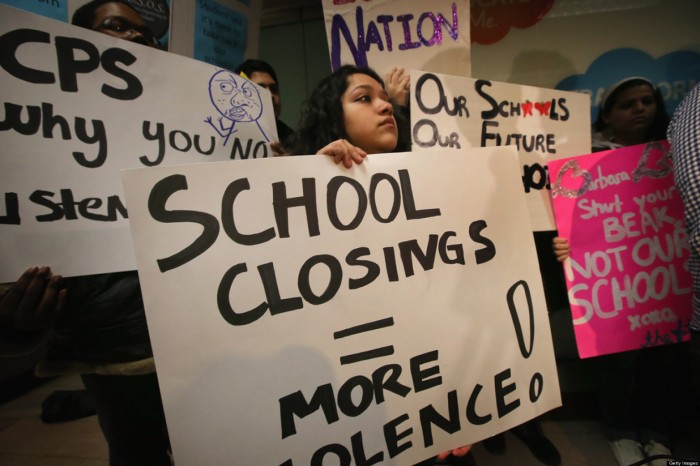
It’s funny. When you close schools serving minority students, they tend to move away.
That’s what’s happening in Chicago.
In the last seven years, Mayor Rahm Emanuel closed 49 schools serving mostly students of color. And from 2015 to 2016, alone, the city lost 12,000 black residents.
Huh.
Who would have ever thought that cutting funding to services for minorities might make them get up and leave?
But God forbid you suggest this is intentional!
These are just disparate facts. There is no conceivable causal link between making life intolerable for people and their leaving.
When has that ever happened before?
The Great Migration (1919-1950) when hundreds of thousands of blacks moved from the deep south to the shores of Lake Michigan looking for better opportunities?
Well, sure, but when else has that ever happened?
You can’t connect one dot to another.
That would just be rude.
Yet that’s just what Chris Kennedy, a candidate vying to run against Illinois Governor Bruce Rauner on the Democratic ticket, did this week.
“My belief is they’re being pushed out. This is involuntary. That we’re cutting off funding for schools, cutting off funding for police, allowing people to be forced to live in food deserts, closing hospitals, closing access to mental health facilities. What choice do people have but to move, to leave?” Kennedy said at a press conference.
“And I think that’s part of a strategic gentrification plan being implemented by the city of Chicago to push people of color out of the city. The city is becoming smaller and as it becomes smaller, it’s become whiter.”
The establishment immediately pushed back against him.
The Chicago Sun-Times couldn’t find any fault with Kennedy’s facts, but they called his interpretation “irresponsible.”
Emanuel’s office likewise issued a press release likening Kennedy’s claims with those of Republicans like Rauner and President Donald Trump, even though both of those individuals would be more likely to champion a plan to kick blacks out of Chicago than criticize it.
Kennedy’s remarks simply echo what black Chicagoans have been saying for years.
“To deny us the right to improve our schools as community institutions is a violation of our human rights. To destabilize schools in our community is a violation of our human rights. To have communities with no neighborhood schools is a violation of our human rights. . . . We are America’s mirror. Do you have the courage to accept what you see?”
Kennedy really isn’t saying anything different. He’s just echoing the concerns of the community he wants to represent.
“I don’t know what you can say when the strategic plan for Chicago Public Schools suggest that the entire community of Englewood can go an entire year without access to a high school,” Kennedy said this week.
“What are you saying to the people there? No one’s going to move there who’s got a high school kid. And anybody with a high school kid has to think about what they’re going to do. It’s just a device to empty out the community.”
The problem is not limited to Chicago. It’s emblematic of public school policy nationwide.
From 2003-2012, in New York City, 117 schools were closed. Sixty-three percent of the students affected were black.
In 2008, 23 schools were closed in Washington, DC. Ninety-nine percent of the students affected were black, Latino or Hispanic.
Since 2005, in Detroit, 130 schools have been closed. Ninety-three percent of the students affected were children of color.
And one and on.
We intentionally segregate students based on race and class, then allocate funds accordingly. Richer whiter students get all the resources they need. Poorer blacker students get crumbling schools, narrowed curriculum until their schools are shuttered and they’re forced to either move away or put up with fly by night charter schools.
Look at what happened in New Orleans.
After Hurricane Katrina in 2005, the state took over 107 of the city’s then-128 public schools, removing them from local control of the residents. The majority of these schools were turned into charters, closed or simply never reopened – a move affecting 90 percent of black students and only 1 percent of white students.
They call it school choice, but parents don’t have choice when 80 percent attend charter schools – some of which run a lottery enrollment process, she said. As a result, parents are forced to apply to multiple charter schools to ensure their children have somewhere to go to learn.
Your choice is between charter schools – 79 percent of which are rated “D” or “F” – and 15 state run public schools that are all rated “D” or “F,” she said.
“African-American students are more likely than their white counterparts to experience schools that are at risk of being closed down, phased-out, turned around or co-located,” Harper-Royal said. “To guarantee me a seat in a failing school system is not ‘choice.’ It’s racist is what it is.”
This is the reality for poor and minority students across the country.
These are all choices that result in winners and losers.
It’s time we recognized that. If we really want to champion civil rights and equity for all, we need to stop promoting racism as school policy and pretending to be surprised at the results.
In this article, I’m going to try to explain in the most simple terms I know the reality of segregation in our schools, how it got there and the various forms it takes.
I do this not because I am against public education. On the contrary, I am a public school teacher and consider myself a champion of what our system strives to be but has never yet realized. I do this because until we recognize what we are doing and what many in power are working hard to ensure we will continue doing and in fact exacerbate doing, we will never be able to rid ourselves of a racist, classist disease we are inflicting on ourselves and on our posterity.
America, the Segregated
It’s never been one monolithic program. It’s always been several co-existing parallel social structures functioning together in tandem that create the society in which we live.
I’m reminded of possibly the best description of American segregation on record, the words of the late great African American author James Baldwin who said the following on the Dick Cavett Show in 1968:
“I don’t know what most white people in this country feel. But I can only conclude what they feel from the state of their institutions. I don’t know if white Christians hate Negroes or not, but I know we have a Christian church that is white and a Christian church that is black. I know, as Malcolm X once put it, the most segregated hour in American life is high noon on Sunday.
That says a great deal for me about a Christian nation. It means I can’t afford to trust most white Christians, and I certainly cannot trust the Christian church.
“I don’t know whether the labor unions and their bosses really hate me — that doesn’t matter — but I know I’m not in their union. I don’t know whether the real estate lobby has anything against black people, but I know the real estate lobby is keeping me in the ghetto. I don’t know if the board of education hates black people, but I know the textbooks they give my children to read and the schools we have to go to.
“Now this is the evidence. You want me to make an act of faith, risking myself, my wife, my woman, my sister, my children on some idealism which you assure me exists in America, which I have never seen.”
As Baldwin states, there are many different ways to keep black people segregated. There are many different flavors of the same dish, many different strains of the same disease.
We can say we’re against it, but what we say doesn’t matter unless it is tied to action.
You can say you’re in favor of equity between black and white people all day long, but if the policies you support don’t accomplish these things, you might as well wear a white hood and burn a cross on a black person’s lawn. It would at least be more honest.
Segregated Schools
In terms of public education, which is the area I know most about and am most concerned with here, our schools are indeed set up to be segregated.
If there is one unstated axiom of our American Public School System it is this: the worst thing in the world would be black and white children learning together side-by-side.
They point to inequalities they, themselves, helped create and use them to push for a system that would create even worse inequality. They point to the segregation that they, themselves, helped install and use it as an excuse to push even more segregation.
And they do so by controlling the media and the narrative. They call themselves reformers when they’re really vandals and obstructionists looking to subvert the best in our system in order to maximize the worst.
School Segregation Today
Sure we don’t have very many all white or all black schools like we did before Brown v. Board. Instead we have schools that are just predominantly one race or another.
ALL kids are not divided by race. Just MOST of them.
White people and black people tend to live in different neighborhoods. Some of this is a choice. After a history of white oppression and racial strife, people on both sides of the divide would rather live among those with whom they identify.
Black people don’t want to deal with the possibility of further deprivations. White people fear retaliation.
However, white people generally enjoy a higher socio-economic status than black people, so there is some push back from black folks who can afford to live in whiter neighborhoods and thus enjoy the benefits of integration – bigger homes, less crowding, less crime, access to more green spaces, etc. But even when there is a desire, moving to a white neighborhood can be almost impossible.
State and federal laws, local ordinances, banking policies and persistent prejudice stand in the way.
In short, red lining still exists.
Real estate agents and landlords still divide up communities based on whom they’re willing to sell or rent to.
And this is just how white people want it.
They’re socialized to fear and despise blackness and to cherish a certain level of white privilege for themselves and their families.
And if we live apart, it follows that we learn apart.
The system is set up to make this easy. Yet it is not uncomplicated. There is more than one way to sort and separate children along racial and class lines in a school system.
There are several ways to accomplish school segregation. It comes in multiple varieties, a diversity of flavors, all of which achieve the same ends, just in different ways.
By my reckoning, there are at least three distinct paths to effectively segregate students. We shall look at each in turn:
Put the white neighborhoods in District A and the black ones in District B. It’s kind of like gerrymandering, but instead of hording political power for partisan lawmakers, you’re putting your finger on the scale to enable academic inequality.
However, sometimes you can’t do that. Sometimes you don’t have the power to determine the makeup for entire districts. Instead, you can do almost the same thing for schools within a single district.
That means the whiter districts get higher paid and more experienced teachers. It means they have broader curriculum, more extracurricular activities, a more robust library, more well-trained nursing staff, more advanced placement courses, etc.
Fewer funds mean fewer resources, fewer opportunities, more challenges to achieve at the same level that white students take for granted. A budget is often the strongest support for white supremacy in a given community or society as a whole. In fact, if you want to know how racist your community is, read its school budget. You want accountability? Start there.
The same holds even when segregation is instituted not at the district level but at the level of the school building.
It may sound ridiculous but this is exactly what happens much of the time. You have gorgeous new buildings with first class facilities in the suburban areas and run down crumbling facilities in the urban ones – even if the two are only separated geographically by a few miles.
Like any parasite, charter and voucher schools only survive in the proper environment. It usually looks like this.
Sometimes no matter how you draw the district lines or how you appropriate the buildings, you end up with a black majority and a white minority. That’s a situation white parents find simply intolerable.
White children must be kept separate and given all the best opportunities even if that means taking away the same for black children.
Once again, this creates the opportunity for a resource gap. The charter and voucher schools suck away needed funds from the public schools and then are subsidized even further by white parents.
The quality of education provided at these institutions is sometimes better – it’s often worse. But that’s beside the point. It’s not about quality. It’s about kind. It’s about keeping the white kids separate and privileged. It’s about saving them from the taint of black culture and too close of an association with black people.
Second, the situation can work in reverse. Instead of dividing the whites from the blacks, it divides the blacks from the whites.
This happens most often in districts where the divide is closer to equal – let’s say 60% one race and 40% another. Charter and voucher schools often end up gobbling up the minority students and leaving the white ones in the public school. So instead of white privatized and black public schools, you get the opposite.
And make no mistake – this is a precarious position for minority students to be in. Well meaning black parents looking to escape an underfunded public school system jump to an even more underfunded privatized system that is just waiting to prey on their children.
Unlike public schools, charter and voucher institutions are allowed to pocket some of their funding as profit. That means they can reduce services and spending on children anytime they like and to any degree. Moreover, as businesses, their motives are not student centered but economically driven. They cherry pick only the best and brightest students because they cost less to educate. They often enact zero tolerance discipline policies and run themselves more like prisons than schools. And at any time unscrupulous administrators who are under much less scrutiny than those at public schools can more easily steal student funding, close the school and run, leaving children with no where to turn but the public school they fled from in the first place and weakened by letting privatized schools gobble up the money.
The result is a public school system unnaturally bleached of color and a privatized system where minority parents are tricked into putting their children at the mercy of big business.
3) Tracking
But that’s not all. There is still another way to racially segregate children. Instead of putting them in different districts or different schools, you can just ensure they’ll be in different classes in the same school.
However, it most often results in further stratifying students socially, economically and racially.
Here’s how it works.
Often times when you have a large enough black minority in your school or district, the white majority does things to further horde resources even within an individual school building or academic department.
In such cases, the majority of the white population is miraculously given a “gifted” designation and enrolled in the advanced placement classes while the black children are left in the academic or remedial track.
It enables bleaching the advanced courses and melanin-izing the others. This means administration can justify giving more resources to white students than blacks – more field trips, more speakers, more STEAM programs, more extracurriculars, etc.
And if a white parent complains to the principal that her child has not been included in the gifted program, if her child has even a modicum of ability in the given subject, more often than not that white child is advanced forward to the preferential class.
CONCLUSIONS
Segregation is a deep problem in our public school system. But it cannot be solved by privatization.
In fact, privatization exacerbates it.
Nor is public education, itself, a panacea. Like any democratic practice, it requires participation and the economic and social mobility to be able to participate as equals.
Schools are the product of the societies that create them. An inequitable society will create inequitable schools.
Segregation has haunted us since before the foundation of our nation.
They don’t want their children to be educated among black students – maybe SOME black students, maybe the best of the best black students, but certainly not the average run of the mill brown-skinned child.
This has to stop.
There are plenty of benefits even for white students in an integrated education. It provides them a more accurate world-view and helps them become empathetic and prize difference.
But now she’s coming off like a special education advocate!
What a turnaround!
It’s almost like David Duke coming out in favor of civil rights! Or Roy Moore coming out in favor of protecting young girls from pedophiles! Or Donald Trump coming out in favor of protecting women from crotch grabbing!
It begs the question – who exactly is she trying to fool?
“No two children are the same. Each has his or her own unique abilities and needs. Personalized, student-centered education can help all children thrive, especially children with disabilities.” (Emphasis mine)
Though few people really disagree with this statement, the use of the word “Personalized” sets off alarm bells.
The term has come to mean “personalized learning” or “competency based education” which is code for making students sit on a computer or a device for hours at a time completing stealth assessments. These are programs made to look like video games that really just assess the same standardized material on the typical fill-in-the-bubble high stakes test.
“We’ve just scratched the surface in the role technology can play. I only have to look at my young grandchildren to see how powerful tech is. It is a thousand flowers, and we haven’t planted the whole garden.”
Another place she can look is her investment portfolio.
One group has barrels full of cash. The other has numbers. However, our laws are written to obscure exactly how much money any one side has. And if you have money, you can use it to buy bodies to line up on your side and “prove” you have numbers.
So when it comes to the American education system, which side truly represents the grassroots – those supporting privatized schools like charter and voucher institutions or those supporting public schools?
It’s kind of a ridiculous question to ask, when you come to think of it.
One side demands taxpayer dollars be available as profit that they can pocket and spend on mansions, yachts and jewelry. The other fights for transparency and for all taxpayer funds to be used in the service of educating children.
Which side do you THINK represents the little guy and which represents Goliath? Which side do you THINK represents the Rebel Alliance and which the Galactic Empire?
People get kind of upset when you try to do that. So when the villagers show up with torches and pitchforks, it does little good to argue that money equals speech. Better for the aristocrats to disguise themselves in peasant garb.
Enter Jeanne Allen.
She wants to convince you she’s the real underdog grassroots champion.
As Chief Executive Officer and Founder of the Center for Education Reform, she’s spent most of her career lobbying for public schools to be gobbled up by private enterprise.
So when the folks behind a new documentary about school privatization, “Backpack Full of Cash,” had the gall to cast her and her organization as the bad guy, she did what any grassroots activist would – she called the Hollywood Reporter.
I can’t imagine why anyone is calling her out. Can you?
But perhaps the most pernicious aspect of her argument is monetary.
Allen, the Center for Education Reform and the entire corporate education reform movement are the real grassroots, she says, because they are outspent by the opposition.
“The people praised in the film” (i.e. public school teachers) “get paid from taxpayer dollars,” Allen told the Hollywood Reporter, as if the people the film criticizes (charter and voucher operators) don’t also get paid from the same pot.
“The teachers unions spend $300 million a year on political races. We don’t have that kind of money.”
Is that true?
Are those pushing for corporate control of our schools really unable to match the monetary might of the big bad teachers unions?
Well, first let’s examine the number Allen bandies about as if it were fact.
$300 million. Do teachers unions actually spend that much annually on political races?
It’s doubtful. The entire operating budget for the National Education Association (NEA), the largest teachers union in the country, is only $367 million. And the union does an awful lot besides lobby lawmakers for pro-education public policy. It raises funds for scholarships, conducts professional development workshops, bargains contracts for school employees, files legal action on behalf of teachers to protect their rights, and partners with other education organizations to promote sound educational practices. Political lobbying is an important part of what unions do, but if they spent what they’re accused of spending on it – even if you include other unions like the American Federation of Teachers (AFT) – they couldn’t do the rest of what they do.
It’s based on a funding target the unions had for the 2008 election of which the unions fell short by almost a third. But now right-wingers and anti-labor trolls everywhere are married to that number and quote it as if it were fact.
And speaking of those who fight on behalf of poor beleaguered corporate America, how much do THEY have to spend fighting public schools?
Well, let’s just take two of their most famous backers – Charles and David Koch.
This duo runs one of the largest privately held companies in the United States: Koch Industries. It is involved in petroleum, chemicals, natural gas, plastics, paper and ranching. In 2013, Forbes said it had an annual revenue of $115 billion.
That’s an incredible amount of resources they can draw on every year when compared to teachers unions. The NEA would have to bring in more than three times its annual revenue to even come close to matching 1% of the Koch’s annual pay.
And do the Kochs spend on politics? You BET they do!
In 2012, alone, they spent at least $407 million on Mitt Romeny’s Presidential campaign! Yes, just that one campaign! They spent more on others! But even if we limit it there, that’s more than even the most absurd estimates of teacher’s unions political spending.
And they’re only two people!
We’re comparing about 3 million members of the NEA, and 1.5 million members of the AFT with two individual human beings.
Even if teachers unions spent $300 million, that only comes to less than $67 per member.
But you must realize, the super wealthy don’t want that. More than anything else it would exponentially increase the power of the unions and the middle class from which they come. Not to mention their allies – the parents, students, child advocates, etc.
You really don’t need a detailed analysis of each group’s relative financial worth. You just have to look at who is in each group.
Taken as a whole, the American people are an awfully cheap bunch.
We’ll spend trillions of dollars on guns and tanks to fight an overseas war, but if someone suggest we build a bridge or conduct a social program or anything that would help people actually live longer, happier lives, well, F- ‘em.
Tax cuts for the rich – WONDERFUL!
Feed the hungry – NOT ON MY DIME!
And it’s true even of our attitude toward little children.
Don’t believe me? Just look at our public schools.
Pristine Taj Mahal-like buildings for rich kids with broad curriculums and plenty of teachers to instruct privileged progeny one-on-one, and then across town on the other side of the tracks you’ll find dilapidated shacks for the poor forced to put up with narrow curriculums focused on standardized test prep and as many underprivileged children as they can fit in the room with one beleaguered teacher.
It doesn’t have to be this way.
We’re one of the richest countries in the world, yet we treat our own children – especially if they’re poor and brown – as if they were refugees from the third world.
Well, perhaps marginally better. To my knowledge no one is suggesting we send the unwashed masses back to Africa, Europe or wherever else they originally came from – at least those who can prove they were born here.
In education circles, small class size is the one universal constant. There is some debate about exactly how small classes should be (at least less than 20, maybe even closer to 10 or 15 students) and for which student groups it is most important, but the consensus in favor of small class size is overwhelming.
Study after study concludes that small class size increases academic performance. When compared with peers in larger classes, those in small settings end up being months ahead. They cover more material, with greater depth and achieve better comprehension in less time.
This is partly due to increased student engagement. Children are more interested in what’s being taught when they have a more personal relationship to it. In smaller classes, students are able to express themselves and participate more. Even children who don’t normally engage in such activities find themselves forced to do so. They can no longer hide behind the greater numbers of their peers. Everyone is visible, seen and heard.
As a result, students have better relationships with their peers and teachers. These better social interactions and trust often results in academic gains. This also can lead to less disruptive behaviors – even for students who typically act out in larger classroom environments. Previously troubled students end up spending less time in detention or suspension and more time in class learning.
As such, teachers are better able to see students as individuals and determine how best to differentiate instruction to meet every child’s needs.
Small class sizes in the elementary grades have long lasting effects even if class sizes increase in middle and high school. However, minority and impoverished students (child groups often experiencing significant overlap) benefit regardless of age. Small class sizes help combat the trauma and deprivations of living below the poverty line. Moreover, while small class size has a varying effect on different disciplines, it invariably helps increase writing instruction – even up to the college level. Schools that put a premium on writing would do best to reduce class sizes in all language arts classes, for instance.
However, students aren’t the only ones positively affected by small class size.
This also has an impact on teachers. Reducing class size increases teacher job satisfaction and retention. This is pretty important in a profession bleeding away practitioners. Fewer college students are entering education programs every year. Salaries are falling even as responsibilities and paperwork are increasing. A reform that helps counteract that while also helping students would appear to be just what the doctor ordered.
Unfortunately, administrators don’t seem to be getting the message. Instead of reducing class size for the most effective teachers, they often increase it. The main reason – test scores. Number crunching administrators think giving the best teachers more students means helping the most students. However, they aren’t taking into account the law of diminishing returns.
However, in today’s dog-eat-dog public school environment, you either pay a little now or a lot later. Right or wrong, competition is our overarching education policy. Public schools have to fight for education dollars with charter and voucher schools. And smaller class size is the number one selling point for so-called choice schools over their traditional public school counterparts.
Sure, it’s expensive to cut class size, but it’s also expensive to continue funding the district when students leave due to smaller classes at the local charter school. Though the media over-reports the value of high test scores, parents rarely decide where to send their children on that basis. Class size is often their number one consideration. They don’t want their children to be lost in the crowd. They want their children to be valued as individuals and their education to be properly personalized.
According to “More Than Scores: An Analysis of How and Why Parents Choose Schools,” two of the top five reasons parents who choose private schools over public institutions specifically reference class size – 48.9% cite class size out right and 39.3% cite “more individual attention for my child.” And the other three reasons – better student discipline, better learning environment, and improved student safety – are all dramatically influenced by class size.
If public schools want to continue to compete, school directors may have to commit to investing in class size reduction.
Yet the trend of the last decade has been in exactly the opposite direction.
Yes, there are plenty of competing ideas for how to improve our schools. And most of them come from corporate think tanks and big business lobbyists more interested in enriching themselves on the public dime than helping students.
Corporate education reformers want us to pay private companies to educate the poor. They want us to invest in privatized schools and standardized test conglomerates. They want us to subsidize publishers and tech corporations with new, untried, unnecessary academic standards that require us to buy boatloads of crap that don’t help and we don’t need.
You see the answer to improving education for the poor isn’t corporate welfare. It starts with equitably funding schools dedicated to the poor and minorities. It starts with providing them with the money required to meet student needs. And a large part of that includes cutting class size.
There is a significant consensus behind it. Moreover, it has parental, student and teacher support.
It’s a no brainer.
All it takes is a change in priorities and the will to actually get up off our collective asses and do something to help America’s children.
Clearly we’re speaking in generalities here. Every school – public or privatized – is different. But there is enough commonality to identify certain trends between each type of school to make general conclusions about each category. In short, despite any media or political propaganda to the contrary, public schools come out on top.
Here are the top 10 reasons public schools are the best choice for children, families and communities
1) Public Schools Attract the Best Teachers
When choosing a school for your children, you want them to have the best teachers possible. You want life-long, committed educators – people who entered the profession as a calling, who dedicate their lives to young people.
This is not the case at many charter or private schools. Their teachers often don’t have the same high level of education, experience, or commitment. In many states, they aren’t required to earn a 4-year degree from an accredited college, they routinely have less experience and higher turnover.
Think about it. If you were one of the best teachers in the country, wouldn’t you want to work where you get the highest salary and benefits? Of course!
2) Public Schools Have a Greater Sense of Community
Most public schools have been around for a long time. They are the heart of the communities they serve. They do so much more than just teach children. They host continuing education courses for adults, extracurricular activities, sporting events, academic clubs, public swimming pools, open libraries, and invite the community for local events, concerts, seminars, etc.
This is rarely the case at privatized schools. Charters and private institutions are often fledgling startups. They’re located in rented office spaces, renovated store fronts and other locations chosen more for their cost benefits to investors and not for their efficacy as places of education or community outreach.
Public schools have histories that go back generations. Everyone in the community knows the teachers who work there. Parents often send their kids to the same educators who taught them when they were young. Sometimes this goes back to grandparents and even great grandparents. Older brothers can advise younger sisters what it was like to have this teacher or that principal. The kinds of relationships you get at public school just aren’t there at institutions that model themselves on big box stores like WalMart and Target.
3) Public Schools Increase Educational Choice
Privatizers often talk about charters and voucher schools as if they are the only places that offer parents and students choice. It’s simply untrue. Many public school districts offer a tremendous amount of alternatives for students living in their neighborhoods. Larger urban districts often have magnet or theme schools. But even beyond that, most schools offer a wide variety of classes and curriculum. Students can take foreign languages, vo-tech, arts and humanities, independent studies, and advanced placement or college credit courses. Students can take advantage of a plethora of services designed to personalize their academic experience to meet their individual needs with special and gifted education, even choosing which teachers are the best fit for their learning styles.
Obviously, these options increase with the degree of wealth in a community, but they prove that increasing choice doesn’t have to mean privatization. It means equitable funding.
4) Public Schools Have Greater Diversity
Students learn a lot more than reading, writing and arithmetic in school. They also learn how to deal with different kinds of people – they learn to share this world with other humans from various racial, ethnic, religious, and sexual backgrounds. The more diverse an environment they grow up in, the more well-adjusted they will be for the adult world, and the less racist, sexist and prejudiced they’ll probably become.
Public schools are often a sea of diversity. They are the best place to meet the entire spectrum of humanity. On the other hand, charter and voucher schools are routinely segregated and homogenous. Sometimes privatized schools make efforts to fight against this, but you can’t make much headway when your entire system is based on sorting out the underprivileged in favor of white, affluent children whose parents can afford tuition (private schools) or poor black but high achieving children (charter schools).
Privatized schools rarely do this, and if they do, it’s by choice not necessity. They could close their books any day, make whatever decisions they like behind closed doors and layout bundles of cash for their CEOs or investors. Privatized schools are for-profit. Even when they aren’t explicitly labeled as such, they usually operate in the same way – cut student services to increase the bottom line. Their explicit goal is to make money off your child – not simply earn a middle class income like public schools. No, they want to get rich off of your dime.
Privatizers buy mansions and yachts with your money. Public school teachers pay off their mortgages. And in the rare instances where public school employees break the law and try to embezzle funds, they are much more likely to be caught because the books are right there for all to see.
If there’s one thing you can be reasonably sure of, it’s that your neighborhood public school will still be there. It’s been there for decades, sometimes hundreds of years. Charter and voucher schools are often fly-by-night affairs. Public schools are solid bedrock. If public schools close, it’s only after considerable public comment and a protracted political process. No one ever shows up to find the local public school chained shut. Not the same at charters or private schools.
7) Public Schools Have Greater Commitment to Students
When you enroll in a privatized school, the choice is all up to administrators. Is your child a safe bet? Can they let your little one in without breaking the bank? Will he or she make the school look good with better test scores? Will he or she be easy to educate?
Public schools, on the other hand, have a commitment to educating every child who lives in the district. They even take homeless children. Only under the most extreme circumstances would they expel a young person. No matter who your offspring is, no matter how good or bad a student, public school operators have faith they can help the youngster succeed.
8) You Have Ownership of Public Schools
With privatized schools, you’re paying for a business to provide services. Public schools belong to you. In fact, you’re the boss.
Public schools are run by your friends, neighbors and co-workers. Privatized schools are most often run by appointed boards of directors who are not beholden to you but to the investors. As education blogger Peter Greene puts it, “The charter is a business, run by people who don’t ever have to let you into their board room.”
In addition, many public schools go beyond even this level of parental involvement. They more often have PTAs or PTOs. They have advisory councils where elected parents, teachers and community members can work together to advise the school board on important maters like hiring superintendents. If parents and the community want a voice, the public school system is overflowing with options. Ironically, the community rarely has any say over privatized schools and parents can only vote with their feet.
9) Public Schools Provide More Amenities
Public schools routinely offer so much more than privatized schools. At many charter and voucher schools, parents are required to buy supplies for the whole institution. Public schools accept donations and sometimes teachers ask for help, but if parents can’t (or won’t) send in pencils or tissues, the school provides it gratis. And even when the district is cheap in this regard, teachers often make up the difference from their own pockets. It’s not right that they have to do so, but they constantly step up for your children.
Moreover, public schools offer a much expanded range of services for your children than privatized schools. Special education and gifted programs are first rate at public schools while often intermittent or nonexistent at privatized schools. And the requirements put on parents at public schools are much lower – less restrictive dress codes, fewer demands on parents’ time and they take a greater responsibility for your children.
Heck, private schools rarely even pay for transportation. Public schools offer a free ride via the school bus from home and back again.
10) Public Schools Match or Outperform Privatized Schools
When it comes to academic performance, comparisons all come down to what data you think is indicative of student learning and which factors you exclude. You can find plenty of studies funded by privatizers that unsurprisingly conclude their backers business model is the best. However, when you look at peer reviewed and nonpartisan studies, the story changes.
The Lubienskis, in particular, paint an extremely compelling picture of public school superiority based on numerous complex statistical models including hierarchical linear modeling and multivariate regression. In short, the authors conclude that after accounting for the demographic differences among various school sector populations, traditional public school students outperform those at private schools over time. Students typically enter public schools with much greater degrees of poverty than those entering private schools. As such, public school students start with greater academic deficiencies. Even so, public schools are able to make up for these deficiencies over time more easily than privatized schools. And by fourth grade, public school students actually have greater academic success than their demographically similar peers at private or charter schools. The Lubienskis call it “The Public School Effect.”
With all these benefits, you’d think we’d be cheering on our public school system, not denigrating it. However, the failing schools narrative sells a lot of people on privatized alternatives. But it’s not fact. It’s marketing.
What do you do when your corporate brand has become repugnant to consumers?
You REBRAND, of course! And that’s exactly what uber-rich widow, Laurene Powell Jobs, paid a boatload of celebrities to do last night all over your TV.
The program was called XQ Superschools Live, and it took over four major networks.
It’s ironic really. Using an almost 100 year old medium to push “schools of the future.” They tweeted and Facebooked all over it, but the focus was on the old boob tube.
Why? Because the audience they wanted wasn’t so much the young. They wanted the old – those deep pocketed investors who might be startled by all the flash and bombast and ask their grandkids if this was “cool.”
It was the most pathetic display of desperation I have ever seen in my life.
If there is any justice, Tom Hanks, Yo-Yo Ma, Samuel L. Jackson, Jennifer Hudson and Common will have to spend the rest of their lives to regain even a fraction of street cred.
They were nothing but a series of singing and dancing sell outs. This was a modern day minstrel show. A bunch of highly paid shills pretending to represent the common folk.
I’m talking raised fists at the end of dance numbers meant to evoke all the power of authentic activists like Black Lives Matter without really having any grassroots support or message.
To be honest, my overwhelming response was pity.
Did anyone really think this was going to connect with an audience?
And speaking of that audience, if you had no idea who XQ or corporate education reform was, you probably watched the screen in bemused confusion. What the heck was this crap? It was platitudes about improving high schools broken up by song and dance numbers. It made the MTV Video Music Awards seem like a college dissertation.
Yet, to the initiated, you could see the subtle nods to privatization and charter schools, the shade thrown on traditional public schools.
1) Corporate education reformers are THAT desperate to distance themselves from Donald Trump.
His wholehearted endorsement of their agenda has done them serious life threatening damage. He has exposed their racist, privileged, corporatist policies for exactly what they are. No amount of celebrities will replace that in the public consciousness.
2) Rich people cannot set education policy.
Steve Jobs widow may be a very nice lady. But she has no freaking clue about public education. Nor is she honest enough to engage actual classroom teachers in the discussion to find out.
Instead of relying on the billionaires of the world, we should tax them. Then we can afford to fully fund our schools and let the people actually in the classroom decide what’s best for the students in their care. Let parents decide. Let school boards decide. Not a privileged tech philanthrocapitalist.
3) Celebrities will do anything for money.
The things these Hollywood elite prostitutes did last night to sell snake oil would make porn stars blush. I will never look at any of these people the same. Some of them I knew were true believers because of other projects. Heck! As much as I love Common’s new album, he does rap about Corey Booker – so warning there. Viola Davis is an amazing actress but she was in the parent trigger propaganda film “Won’t Back Down.”
Being famous doesn’t mean you know a damn thing. We recognize their faces. We associate them with past roles and characters we loved. We think their political stands are authentic when they are often just a pose. We’ve got to stop respecting these people just because they’re celebrities.
What will the long-term effect of last night’s propaganda be?
I don’t know.
I seriously doubt anyone really bought that. But you know what they say – no one ever went broke betting on the stupidity of the public.
And that’s what this was – a high stakes wager on American gullibility.
Thank you for coming to this meeting on such short notice.
I know you have plenty more important matters to attend to this morning. I, myself, left a pile of ungraded papers on my desk so I could get here. Not to mention I urgently need to fix my seating charts now that I’ve finally met my students and know who can sit with whom. And I’ve got to track down phone numbers for my kids’ parents and go through a mountain of Individual Education Plans, and… Well, I just want you to know that I get it.
I know. Some of you have no choice. You live in a state or district where teacher autonomy is a pathetic joke. There are ways to fight that, but they’re probably not in the classroom.
It’s not you who I’m talking to. I’m addressing everyone else. I’m talking to all the teachers out there who DO have some modicum of control over their own classrooms and who are told by their administrators to do things that they honestly disagree with – but they do it anyway.
Listen, there are several reasons why we should refuse.
First, there’s simple job security. If your principal brought in a Teach for America temp and told you this lightly trained fresh from college kid was going to take over your classes, would you really sit down and instruct her how to do your job!?
I wouldn’t.
That’s the entire point behind this tech industry garbage. You are piloting a program that means your own redundancy.
You are engaged in an effort to prove that they don’t need a fully trained, experienced, 4-year degree professional to do this job. They just need a glorified WalMart greeter to watch the kids as they push buttons and stare at a screen. They just need a minimum wage drone to take up space while the children bask in the warm glow of the program, while it maps their eye movements, catalogues how long it takes them to answer, records their commercial preferences and sells all this data to other companies so they can better market products – educational and otherwise – back to these kids, their school and their parents.
They call this trash “personalized learning.” How can it really be personalized if kids do the same exercises just at different rates? How is it personalized if it’s standardized? How is it personalized if it omits the presence of actual people in the education process?
But we give in. We don’t want to rock the boat. We’re rule followers, most of us. We do what we’re told.
Most teachers were good students, and obedience is too often a defining quality of those who succeed in our education system.
I get it. You don’t want to be a fly in the ointment. You don’t want to make yourself a target.
Me, too.
How dearly I would love to be able to just comply. But I can’t simply go along with something I know in my heart to be wrong. And this is wrong on so many levels.
I sat through a meeting much like this one earlier this year where I was told exactly which programs to force on my students. All the while good teachers whom I respect went through the motions as if nothing was wrong. They talked about how to organize our classes in the system, how to assign test prep and how often, and how to access the data.
But we never discussed why.
We never discussed if doing so was a good idea. That was all taken for granted. It was a decision reserved for someone else, someone from a higher pay grade.
Yet classroom experience is rarely commensurate with salary scale especially once you cross the line into management. Nor is the experience of a handful of administrators equal to that of a plentitude of staff!
No. I’m sorry. At very least that is a discussion WE should be having.
And if an individual teacher thinks based on their own experience with their own students that they should go in a different direction, they should be respected enough as a professional to have the autonomy to do so.
We need to educate parents and the community about what’s happening. The classroom doors are too often closed to the public. The only information they get is from anemic administrators and a mass media that invariably just reports whatever propaganda the corporation puts on the press releases.
We are responsible for our students. We must protect them from the vultures out there trying to water down their educations and reduce the quality of their learning.
We are not the only ones who can take a stand. In fact, IF we are the only ones who do it, we will certainly fail.
But, along with parents, students and concerned citizens, we MUST be part of that resistance.






 gadflyonthewallblog