PA Legislature Plans Taking Away Teachers’ Sick Days

thumbnail_teachers-sick-719435

Dear Pennsylvania legislators:

So now you want to take away teachers’ sick days.

Sabbatical, sick days, bereavement leaves – the Senate Education Committee voted 7-5 to strip them from the law and make teachers bargain for them with their districts.

So the next time I get sick, you don’t want to guarantee I can take the day off. If my mother dies, you don’t want to protect my right to attend her funeral.

The full legislature still has to vote on it, but that’s pretty cold.

Which brings me to my first question: Why do you hate public school teachers so much?

Seriously. What did teachers ever do to you? Did we give you a bad grade when you were kids? Did we give you detention? What did we ever do to earn such animosity?

You obviously must have something personal against teachers.

It’s understandable. Even though the majority of Pennsylvanians voted for Democrats, most of you are Republicans. You have gerrymandered the state so that you artificially have the majority, and as such you must espouse the most radical positions possible. Otherwise, you’ll be primaried by someone even farther right – a Tea Partier, a plutocrat, an anarcho-capitalist, a fascist.

We see the same thing playing out nationally. Hello, Donald Trump!

So it’s no surprise that after stripping public schools of almost $1 billion every year for the past five years, after tens of thousands of teachers have been laid off, after you’ve given away millions of dollars to private corporations to run fly-by-night charter schools or through tax credits to religious schools – well, it’s no surprise that you feel the need to continue the war on teachers.

It’s paying off for you big time.

Not so much for our school children. They have had to deal with increases in class size, narrowing of the curriculum, reductions in extra-curriculars, cuts in tutoring – just about every deprivation imaginable.

I wonder – do you realize that every attack against teachers is also an attack against students? Making sick teachers come to school won’t improve kids’ educations. Forcing educators to choose between work or seeing their loved ones off to their final resting places won’t boost test scores. Do you understand that or do you just not care?

Follow-up, if I may: do you realize that most public school teachers are women? Does that factor in at all? Which do you hate more, the gender of most teachers or the fact that we are unionized?

Oh, and Pennsylvania School Boards Association, don’t think we’ve forgotten you. We know you requested this mess, Senate Bill 229. Instead of standing with your teachers to fight for fair, equitable, sustainable funding, you’ve decided to ask the legislature if you can stiff teachers to make ends meet. We’re there for your kids everyday, and this is how you thank us. That’s gratitude.

It’s what we get for being one of the last workforces to be unionized. We have the temerity to demand fair treatment. You can’t just do whatever you like with us, you have to actually sit down with us at the bargaining table and talk.

Legislators, we know it’s something that infuriates your base. No, I don’t mean the people who vote for you. I mean your real base – the corporations, millionaires and billionaires who pay your real salaries – the unlimited and shadowy campaign contributions that, let’s be honest, are really nothing less than legal bribes.

We shouldn’t be surprised that you have prioritized taking away legal protections for teachers’ sick days. It is quite in line with what you want to do to the profession. You no longer want highly qualified teachers making a middle class income who then can stay in our schools for their entire careers. You want lightly trained temps who use teaching as a stepping stone to a job that pays enough to live.

After all, if we afford teachers the status of professionals, they might actually be able to jump all the other hurdles we’ve put in front of them and educate the poor.

That would be terrible.

Despite all the standardized testing, Common Core, value-added measures, budget cuts, and constant propaganda about “failing schools,” they might actually teach these kids to think. That’s the last thing you want.

A thinking public might see how much you’re screwing them over. They might actually rise up and fight. They might refuse to accept the status quo that you are so desperately trying to protect.

That’s your real endgame. And though it makes me sick, I suppose I will no longer be able to take off.

I’ll just spend the day, coughing and wheezing with the children.

Yours,

Steven Singer

The Gadfly on the Wall

U.S. Public Schools Are NOT Failing. They’re Among the Best in the World

surprised-kid-investor-050213

Everyone knows U.S. public schools are failing.

Just like everyone knows you should never wake sleepwalkers, bulls hate red and Napoleon was short.

Wrong on all counts. Waking sleepwalkers will cause them no harm – in fact, they’re more likely to harm themselves while sleepwalking. Bulls are colorblind; they’re attracted to movement. And Napoleon was 5’7”, which was above average height for Frenchman during his lifetime.

So why do we believe that American public schools are doing such a terrible job?

Because far right policymakers have convinced us all that it’s true.

It’s not.

Let me repeat that in no uncertain terms – America’s public schools are NOT failing. They are among the best in the world. Really!

Here’s why: the United States educates everyone. Most other countries do not.

We have made a commitment to every single child regardless of what their parents can afford to pay, regardless of their access to transportation, regardless of whether they can afford uniforms, lunch or even if they have a home. Heck! We even provide education to children who are here illegally.

That can’t be said of many countries with which we’re often compared – especially countries comparable to the U.S. in size or diversity. So from the get-go, we have an advantage over most of the world.

We define education differently. Though our laws are woefully backward, in practice we look at it as a right, not a privilege. And for a full 13 years (counting kindergarten) it’s a right for every child, not just some.

But that’s not all! We also provide some of the highest quality education you can get in the world! We teach more, help more, achieve more and yet we are criticized more than any system in any country in the world.

TEST SCORES

Critics argue that our scores on international tests don’t justify such a claim. But they’re wrong before you even look at the numbers. They’re comparing apples to pears. You simply can’t compare the United States to countries that leave hundreds of thousands of rural and poor children without any education whatsoever. The Bates Motel may have the softest pillows in town, but it’s immediately disqualified because of the high chance of being murdered in the shower.

No school system of this size anywhere in the world exceeds the United States in providing free access to education for everyone. And that, alone, makes us one of the best.

It doesn’t mean our system is problem free. There are plenty of ways we could improve. We’re still incredibly segregated by race and class. Our funding formulas are often regressive and inadequate. Schools serving mostly poor students don’t have nearly the resources of those serving rich students. But at least at the very outset what we’re trying to do is better than what most of the world takes on. You can’t achieve equity if it isn’t even on the menu.

However, for some people, this will not be enough. They’ll say that despite our high ideals, the quality of what we actually provide our students is low. After all, those international test scores are so low.

First point: it depends on the scores you’re looking at. American elementary and middle school students have improved on the Trends in International Mathematics and Science Study every four years since the tests began in 1995. They are above the international average in all categories and within a few percentage points of the global leaders (something rarely mentioned on the nightly news).

Even on the PISA test administered by the Organization for Economic Cooperation and Development to 15-year-olds in about 60 countries, US children are far from the bottom of the scale. We’re somewhere in the middle. We’ve always been in the middle for all the decades since they’ve been making these comparisons. Our schools have not gotten worse. They have stayed the same.

IDEALS AND POVERTY

To some this just demonstrates that our schools have always been mediocre. But again you’re overlooking the consequences of our ideals.

The broader the spectrum of children who take a test, the lower the average score will be. In other words, if only your top students take the test, your average score will be very high. If only your top and middle students take the test, your average score will still be quite high. But if ALL of your students take the test, your average score will be lower.

Now add in poverty. Living in poverty reduces your access to health care, books, early childhood education and many other factors that increase learning throughout your life. Children from poor families are already more than a year behind those of rich parents on the first day of kindergarten. If you only test the wealthiest students, the average test score will probably be quite high. The average score will drop dramatically if you test all of your students.

That’s why many of these countries where the poorest children do not have access to education have higher test scores than the United States. You’re not comparing equals. The United States has the highest child poverty rate in the Western World. And we don’t hide them away. We include them on our tests. That has a major impact on our scores. But talking heads on TV almost always ignore it. They pretend it doesn’t exist. It’s the only way they can use these test scores to “prove” to a gullible audience that America’s schools are failing.

But if you fairly compare education systems and factor in the equal access we provide for all children to an education, our system comes out way on top. We have one of the best systems in the world.

But wait! There’s more!

SPECIAL EDUCATION

Not only does the United States serve all children regardless of academic achievement or poverty. We also serve far more students with disabilities.

Why are there so many special education children in the USA? Because we have a higher standard of living.

A standard pregnancy lasts about 280 days or 40 weeks. However, some mothers give birth to children after only 28 weeks. Two decades ago, these babies would not have survived. Today, they often do. Five years later that child will enter kindergarten and our school system will be responsible for teaching that student to read, write and learn math. In other countries, premature babies have a much lower chance of survival. They don’t survive to become the special education population. So things as diverse as the live-birth rate actually affect average test scores.

Another counterintuitive factor is the suicide rate. In many countries where pressure to perform at the highest levels on standardized tests is extreme, many children are actually driven to suicide. This is especially true in numerous Asian countries with a record of high scores on these international tests. So a higher suicide rate actually increases test scores.

Would you say this makes other countries superior to the United States? Heck no! In fact, just the opposite. I certainly wouldn’t wish more underperforming U.S. students were ending their lives so we could do better on international tests. Nor would I wish that more premature babies died to improve our international standing.

We have developed a special education system to help children at the edges that many other countries just can’t touch. In some countries these students are simply excluded. In others they are institutionalized. In some countries it’s up to parents to find ways to pay for special services. The United States is one of the only countries where these children are not only included and offered full and free access, but the schools go above and beyond to teach these children well beyond their 12th academic year.

In every public school in the United States these students are included. In math, reading, science and social studies, they are there benefiting from instruction with the rest of the class. And this, in turn, benefits even our non-special education students who gain lessons in empathy and experience the full range of human abilities.

Of course, most of our special education students are also included in our test scores. Yes, other countries that ignore these children and exclude them from testing get higher scores. But so what? Do you mean to tell me this makes them better? No, it makes them worse.

In many ways, we are the gold standard, not them. They should be emulating us, not the other way around. They should be jealous of the way we prize each other’s humanity. We shouldn’t be salivating at test scores achieved through shunning certain students in favor of others.

CURRICULUM AND STRATIFICATION

But it’s not just who we teach, it’s also what we teach.

Compared to many other countries, U.S. school curriculum is often much wider and varied. Countries that focus only on testing often leave out sciences, arts, literature and humanities.

Unfortunately, the push from policymakers even in the U.S. has been to narrow curriculum to imitate some of the worst practices of our competitors. But in many districts we still strive to create well-rounded graduates and not just good test-takers.

The bottom line: the curriculum at most American schools is more inclusive than that found internationally. We even include societal issues like alcohol and drug abuse prevention, stress reduction and relaxation, and physical fitness programs.

In addition we don’t stratify our children based on academic ability to nearly the same degree as many international schools. We don’t weed out our worst students through middle and high school until only our most capable are left in 12th grade. Nor is college only open to our best and brightest. We make a much greater effort than many other countries to keep this option open to as many students as possible regardless of whether they can afford it or not. The number of Americans with at least some college education has soared over the past 70 years, from 10 percent in 1940 to 56 percent today, even as the population has tripled and the nation has grown vastly more diverse. Meanwhile, Graduation rates are at an all-time high of 83.2 percent, and for the first time minority students are catching up with their white counterparts.

It’s not easy. But it’s something we’re committed to as a nation. And that’s not true around the world.

SIZE MATTERS

Finally, there’s the issue of size. The United States is a big country – the third most populous in the world. We have 324,450,000 people and growing. That’s about 50 million students in public schools.

It’s much easier to educate fewer children. Even excellent education systems would struggle with our sheer numbers. Small systems often outshine bigger ones. For instance, I might be able to make dinner for my immediate family, but I’d find it much more challenging to prepare a meal for a banquet hall of hundreds. Similarly, it remains to be seen whether smaller nations could handle educating a population as big and diverse as ours without collapsing.

By any fair measure, America’s public education system is simply stunning. But the media perpetuates the myth that we’re failing.

PUBLIC PERCEPTION AND THE MEDIA

After decades of hearing these falsehoods, the American public is strikingly divided. On a 2011 Gallup poll, parents were asked their opinion of their local school and the public was asked its opinion of schools in general. The results are enlightening. Parents who gave their local school an A grade were at the highest percentage ever (37%) whereas only 1% of respondents rated the nations schools that way. Why the difference? Respondents said it was mostly because people knew about their local schools through direct experience. They only learned about the state of education nationally through the news media.

Why is education reporting so biased? Part of it is monetary. Huge corporations make hundreds of millions of dollars off of the failing schools narrative. They sell new standardized tests, new test prep materials, new Common Core books, trainings for teachers, materials, etc. If they can’t demonstrate that our schools are failing, their market shrinks. And who do you think owns the shrinking media conglomerates? That’s right, many of these same corporations.

But even when journalists want to be fair, it’s difficult for them to get the inside story of how our public schools work. They are rarely permitted inside our schools to see the day-to-day classroom experience. Legal issues about which students may be photographed, filmed or interviewed, the difficulty of getting parental permissions and the possibility of embarrassment to principals and administrators often keeps the doors closed. In many districts, teachers aren’t even allowed to speak on the record to the media or doing so can make them a political target. So reporters are often in the position of being unable to directly experience the very thing they’re reporting on. Imagine if sportswriters never got to see athletes play or political reporters never attended a campaign rally. Of course there would be a disconnect!

So we’re left with a public education system that should be the envy of the world being portrayed as a loser.

THE BOTTOM LINE

As ever, far right politicians on both sides of the aisle, whether they be Democratic Neoliberals or Republican Tea Partiers, are using falsehoods about our public schools to sell an alternative. They say our public schools are beyond saving and that we need to privatize. They call it school choice but it’s really just an attempt to destroy the system that has so much going for it.

We should strengthen public education not undermine it. We should roll up our sleeves and fix the real problems we have, not invent fake ones.

People act as if “alternative facts” were invented by the Trump administration. Our policymakers have been using them for decades in a libelous and dishonest campaign against our public schools.

They are some of the best in the world – if only people knew it.

Pittsburgh Public Schools Advised to Repeat Same Mistakes Over and Over and Over…

screen-shot-2017-01-19-at-8-18-55-am


“Insanity: doing the same thing over and over again and expecting different results.”

-Albert Einstein (attributed)


“AAAUUURGH!”

-Charlie Brown


If I crash my car right into a wall, the worst thing to do would be to get into another car and crash it right into the same wall!


But that’s what the Pittsburgh Post Gazette thinks city school administrators should do.


A new comprehensive report about Pittsburgh Public Schools concludes that standardization and Common Core have produced zero progress in the district over the last decade.


And the editorial board of the city’s largest remaining newspaper says this means administrators should stay the course – indeed, double down on test prep and uniformity.


The 175-page report by The Council of the Great City Schools affirms that the district showed little to no improvement in the last 10 years.


“In fact, analysis of student achievement trends shows little to no improvements since 2007,” the report went on. “Although some scores went up and others went down over the period, achievement gaps are about the same — if not wider — than they were when the work started.”


You would think this would be a scathing indictment of administrators during this time who focused on test prep and uniformity to the exclusion of more student-centered reforms. In particular, during the same time covered in the report, administrators paid for new curriculum designed to standardize instruction across schools and grade levels. They instituted a value-added bonus system rewarding principals who run the schools with the highest test scores. They even increased the length of the school day to drive achievement.


They did all this, and it didn’t help a bit.


Some might see that as proof of the error of past ways.


But not the Post Gazette.


In the minds of the editorial board, this is a ringing endorsement of those policies that got us nowhere.


Mark Roosevelt, superintendent from 2005 to 2010, and Linda Lane, superintendent from 2010 to 2016, are actually singled out by the paper as heroes of reform!


Wait a minute. These are the people in charge when the district apparently was stalled. If anything, these functionaries should bear the blame, not get a pat on the back. We should do anything BUT continuing their work which lead to this dismal report.


But instead, the editorial board writes, “[T]he work of Mr. Roosevelt and Ms. Lane was not in vain. They inaugurated a coherent system of reforms, made the federal benchmark known as ‘adequate yearly progress’ twice in three years, restored the district’s credibility with the foundation community, forged a closer relationship with the teachers union and generated a new sense of optimism. The course they charted is worth revisiting.”


What!?


Voters are fed up with number-worshipping flunkies who don’t see kids as anything but data points. That’s why the community has consistently replaced number crunching school directors and administrators with people who have a new vision of education – a community schools approach.


The editorial board may look down their noses at current Superintendent Dr. Anthony Hamlet who took over just this summer and the positive changes he’s been making with the new progressive school board, but he’s only doing what the public wants. And given this new report, a new direction is exactly what Pittsburgh Public Schools needs!


In the ivory tower of big media, they don’t see it this way.


In fact, the PG goes so far as to imply that Dr. Hamlet and the new board are somehow responsible for Roosevelt and Lane’s failures.


“It may be that they [Roosevelt and Lane] did not stay long enough for their efforts to take root,” writes the Post Gazette, “that the reforms became too cumbersome to manage or that they were unable to fully impose their will on a sprawling school district with many constituencies.”


Please. Dr. Hamlet’s presence has not halted Roosevelt and Lane’s march toward progress. This report demonstrates that they achieved very little. Moreover, Dr. Hamlet has only been in office since June. He hasn’t been in the district long enough to flush student test scores down the toilet – especially when for more than nine of those years he was working in Florida.


Neither can you blame the community for being fed up with corporate education reforms that apparently don’t work.


No. If this report by a consortium of the nation’s 70 largest urban school districts shows failure in ‘burgh schools, that belongs to the bosses at the top during the last 10 years. If this is a failure, it is Roosevelt’s and Lane’s, not Dr. Hamlet’s. Nor can you place it at the feet of school directors, most of whom are new to the board.


But the media mavens can be forgiven slightly for coming to such an odd conclusion, because it’s supported by the organization that wrote the report – the Council of the Great City Schools. After all, the Council suggested this push toward standardization in the first place.


In February 2006, this same Council advised Pittsburgh to “recommit to a standardized, districtwide curriculum to ensure that every classroom is focused on a common set of rigorous expectations for student learning.”


And now that same Council is saying that doing so resulted in a fat goose egg.


Great advice, Guys!


Pittsburgh residents spent $156,545 of taxpayer money to find that out.


Still, it’s not a total waste. It’s probably the most comprehensive look at the district in recent history and drew expertise from two dozen executives from eight different city school systems. It also included interviews with 170 staff and community members.


The third-party review was part of Dr. Hamlet’s transition plan and “acts as a blueprint” to transform the district, he said. It includes a detailed review of the district’s organization structure, staffing levels, instructional programs, financial operations, business services, disciplinary policies, and research and data functions.


Of particular interest is school discipline data showing that the district has an “extraordinarily high” suspension rate compared with other cities and that its disciplinary actions disproportionately affect students of color. In fact, this seems to justify moves by Dr. Hamlet to enact a restorative justice disciplinary program instead of a strict zero tolerance policy.

The report includes numerous suggestions for improvements across the board including revamping the district’s central office structure and updating the district’s outdated PreK-5 literary curriculum – initiatives that are already underway.


But when it comes to a repeated call for standardization and canned curriculum across the district, it should be ignored.


Put simply, we’ve tried that crap. It doesn’t help.


We’ve got to get beyond our love for standardized tests. We know that poor students don’t do as well on these types of assessments as middle class or wealthy students. It should be no surprise, then, that an urban district like Pittsburgh with a high percentage of impoverished students will also have low test scores.


It’s the poverty, stupid!


We need to do something to address that directly, not attack a district that’s lost almost $1 billion annually in state funding for the last five years.


Moreover, this obsession with Common Core is completely unfounded. It has never been demonstrated that aligning curriculum to the Core will increase test scores or increase learning. In fact, there is mounting research to show that these academic standards are developmentally inappropriate and actually prevent authentic learning – especially in reluctant learners.


The Council of the Great City Schools is enamored with these policies because the organization has taken millions of dollars in donations from the Gates Foundation and other organizations connected with the testing industry. Even many charitable foundations have aligned themselves with this lucrative business model where corporations cash in when students fail and then cash in again by selling them the remediation and Common Core texts they convince us we need to pass the tests.


The editorial board of the Post Gazette is likewise blinded by dollar signs and data.


Like far too many non-educators, they give far too much credence to a person’s bank account than her expertise. The same people pushing testing and new academic standards also benefit financially from them. They have created at least one PAC in the city with deep pockets looking to unseat unsympathetic board members and discredit Dr. Hamlet so that they can install their own representatives.


This is a battle with plain sense and logic. It’s also a battle for control of Pittsburgh Public Schools.

The Racists Roots and Racist Indoctrination of School Choice

screen-shot-2017-01-15-at-8-10-02-am

“Simple justice requires that public funds, to which all taxpayers of all races contribute, not be spent in any fashion which encourages, subsidizes, or results in racial discrimination.”
-President John F. Kennedy

“Injustice anywhere is a threat to justice everywhere.”
-Dr. Martin Luther King, Jr.

Billionaires and far right policymakers are pushing for school choice.

I say they’re pushing for it because voters always turn it down.

Every single referendum held on school choice in the United States has been defeated despite billions of dollars in spending to convince people to vote for it.

But advocates aren’t discouraged that the public isn’t on their side. They have money, and in America that translates to speech.

The Donald Trump administration is dedicated to making our public schools accept this policy whether people want it or not.

But don’t think that’s some huge change in policy. The previous administration championed a lighter version of these market-driven plans. The main difference goes like this: Democrats are for charter schools and tax credits for private and parochial schools. Republicans are for anything that calls itself a school getting your tax dollars – charter schools, private schools, religious schools – if some charlatan opens a stand on the side of the road with the word “school”in the title, they get tax dollars.

In all this rush to give away federal and state money, no political party really champions traditional public schools. Ninety percent of children attend them. In opinion polls, a majority of Americans like their local community schools. But like most things Americans want, politics goes the other way. Universal healthcare? Have Romneycare. Universal background checks on all gun sales? Nah. That sort of thing.

However, what often gets lost in the rush of politicians cashing in on this policy is its racist roots.

You read that right. School choice was invented as a mechanism of white flight. Before the federal government forced schools to desegregate, no one was all that interested in having an alternative to traditional public schools. But once whites got wind that the Supreme Court might make their kids go to school with black kids, lots of white parents started clamoring for “choice.”

It was intended as a way to get around Brown vs. Board. In 1953, a year before that landmark decision, many white southerners felt it was vitally important to continue a segregated education. They deeply desired to continue having “separate but equal” schools for the races, yet the US Supreme Court seemed ready to strike that down.

Enter Georgia’s Gov. Herman Talmadge who created what became known as the “private-school plan.” Talmadge proposed an amendment to the Georgia Constitution to empower the general assembly to privatize the state’s public education system. “We can maintain separate schools regardless of the US Supreme Court by reverting to a private system, subsidizing the child rather than the political subdivision,” Talmadge said.

The plan goes like this. If the Supreme Court mandates desegregation (as it did), the state would close the schools and issue vouchers allowing students to enroll in segregated private schools.

Fortunately, Talmadge’s plan was never implemented in Georgia. But it became the model for segregationists everywhere.

In Prince Edward County, Virginia, the plan actually came to fruition – sort of.

Two years before the 1959 federal desegregation deadline, local newspaper publisher J. Barrye Wall explained what county leaders were planning:

“We are working [on] a scheme in which we will abandon public schools, sell the buildings to our corporation, reopen as privately operated schools with tuition grants from [Virginia] and P.E. county as the basic financial program,” he wrote. “Those wishing to go to integrated schools can take their tuition grants and operate their own schools. To hell with ’em.”

Ultimately the county refused to sell the public school buildings. However, public education in Prince Edward County was nevertheless abandoned for five years, from 1959 to 1964. During that time, taxpayer dollars were funneled to the segregated white academies, which were housed in privately owned facilities such as churches and the local Moose Lodge.

The federal government struck down the program as a misuse of taxpayer funds after only a year, but even so whites benefited and blacks lost. Since there were no local taxes collected to operate public schools during those years, whites could invest in private schools for their children, while blacks in the county were left to fend for themselves. Since they were unable and unwilling to finance their own private, segregated schools, many black children were simply shut out of school for multiple years.

In other states, segregationists enacted “freedom of choice” plans that allowed white students to transfer out of desegregated schools. Any black students that tried to do the same had to clear numerous administrative hurdles. Moreover, entering formerly all-white schools would subject them to harassment from teachers and students. Anything to keep the races apart in the classroom – and usually the entire building.

Eventually, segregationists began to realize that separate black and white schools would no longer be tolerated by the courts, so they had to devise other means to eliminate these “undesirables.”

Attorney David Mays, who advised high-ranking Virginia politicians on school strategy, reasoned:

“Negroes could be let in [to white schools] and then chased out by setting high academic standards they could not maintain, by hazing if necessary, by economic pressures in some cases, etc. This should leave few Negroes in the white schools. The federal courts can easily force Negroes into our white schools, but they can’t possibly administer them and listen to the merits of thousands of bellyaches.”

Mays turned out to be somewhat prescient. Though desegregation efforts largely succeeded at first, in the last 20-30 years whites accomplished through housing and neighborhood segregation what they couldn’t legally enforce through outright school segregation. District lines were drawn to minimize the number of blacks at predominantly white schools and vice versa. Moreover, since funding was often tied to local property taxes, whites could legally ensure black schools got less resources than white schools. And with standardized tests constantly showing students at these schools as failing, policymakers could just blame the school instead of what they’d done to set the school up for failure.

Today racist policies undermine much of the structure of our public schools. We should acknowledge this and work to peel it back. We need to ensure all schools are equitably funded, that class sizes are under control, that all students get a broad curriculum and the services they need. But in the absence of a new, robust desegregation policy, our schools will always be in danger of racist programs that can easily select which students to benefit and which to ignore.

Instead of doing this hard work, we’re engaged in resurrecting the school choice policies of the deep South and universalizing them across the country. School vouchers are extremely similar to Talmadge’s private school plan. The main difference is that vouchers don’t close public schools outright, they simply allow them to be defunded and ignored. With universal school vouchers, public schools often become the de facto holding area for whichever group of children the private schools refuse to accept or who can’t afford private school tuition even with the vouchers.

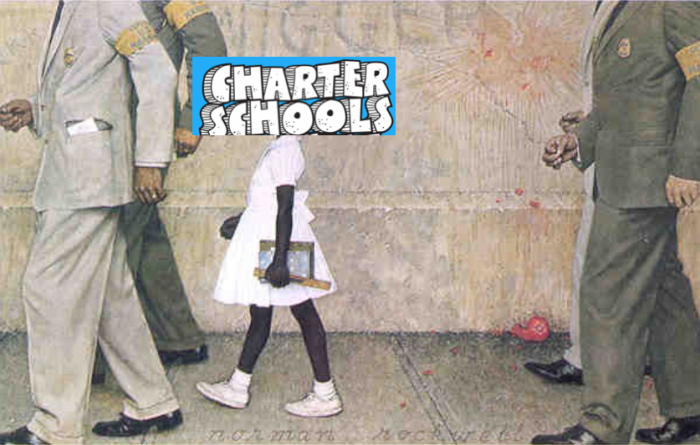
Charter schools are built on the Prince Edward County model. They’re administered as private institutions yet claim to be somehow public. As a result, they’re allowed to bypass many of the rules that protect students at public schools from discrimination and fraud. In effect, they’re largely unregulated. In the modern age, that means they can be incredibly substandard for long periods of time and no one knows or intervenes. The kinds of scandals perpetrated at some charter schools are simply not possible at traditional public schools. Some charters close without notice, have facilities used as nightclubs, involve taxpayer funds used for non-school purposes such as apartments for mistresses, the purchase of yachts, etc.

In both cases, charters and voucher schools often cater to mostly one race rather than another. That increases segregation at both these facilities and traditional public schools. But voucher schools can go a step further. They can even put racism on the curriculum.

Supporting the racial order is often what’s actually being taught at private and religious schools. They are infamous for revisionist history and denying climate science. What’s less well-known is how they often try to normalize racist attitudes.

The American Christian Education (ACE) group provides fundamentalist school curriculum to thousands of religious schools throughout the country. Included in this curriculum is the A Beka Book and Bob Jones University Press textbooks.  A Beka publishers, in particular, reported that about 9,000 schools nationwide purchase their textbooks.

These books include the following gobsmackers:

“[The Ku Klux] Klan in some areas of the country tried to be a means of reform, fighting the decline in morality and using the symbol of the cross. Klan targets were bootleggers, wife-beaters, and immoral movies. In some communities it achieved a certain respectability as it worked with politicians.”
—United States History for Christian Schools, 3rd ed., Bob Jones University Press, 2001

“God used the Trail of Tears to bring many Indians to Christ.”
—America: Land That I Love, Teacher ed., A Beka Book, 1994

“A few slave holders were undeniably cruel. Examples of slaves beaten to death were not common, neither were they unknown. The majority of slave holders treated their slaves well.”
—United States History for Christian Schools, 2nd ed., Bob Jones University Press, 1991

“To help them endure the difficulties of slavery, God gave Christian slaves the ability to combine the African heritage of song with the dignity of Christian praise.  Through the Negro spiritual, the slaves developed the patience to wait on the Lord and discovered that the truest freedom is from the bondage of sin. By first giving them their spiritual freedom, God prepared the slaves for their coming physical freedom. ”
-Michael R. Lowman, George Thompson, and Kurt Grussendorf, United States History:  Heritage of Freedom, 2nd ed. (Pensacola, FL: A Beka Book, 1996), p. 219.

“Africa is a continent with many needs. It is still in need of the gospel…Only about ten percent of Africans can read and write. In some areas the mission schools have been shut down by Communists who have taken over the government.”
—Old World History and Geography in Christian Perspective, 3rd ed., A Beka Book, 2004

Gay people “have no more claims to special rights than child molesters or rapists.”
—Teacher’s Resource Guide to Current Events for Christian Schools, 1998-1999, Bob Jones University Press, 1998

Brown v. Board of Education is described as social activism by the Supreme Court: “While the end was a noble one – ending discrimination in schools – the means were troublesome… liberals were not willing to wait for a political solution.”
-Teacher’s Resource Guide to Current Events for Christian Schools, 1998 – 1999 (Greenville, SC: Bob Jones University Press, 1998), p. 34

These are claims that are uncritically being taught to children at many voucher schools. If this were happening only at private schools, it would be troubling that racists were indoctrinating their children in the same hatred and bigotry of their parents. However, that we’re actually using public money – and planning to expand the amount of public money – to increase the racism and prejudice of the next generation is beyond troubling! It’s infuriating!

School choice does not enhance civil rights. It is inimical to them. It is part of a blatant policy to make America racist again. We cannot allow the Trump administration and any neoliberal Democrats who quietly support his ends to undo all the progress we’ve made in the last 60 years.

The bottom line is this – voters don’t want school choice. It does nothing to better childrens’ educations. It is a product of segregation and racism and even in its modern guise it continues to foster segregation and racism.

If we care about civil rights, social equality and democratic rule, school choice is something that should be relegated to the dust heap of history. It’s time to move forward, not look back fondly on the Confederacy, Jim Crow and segregationism.

Why Schools Should NOT Be Run Like Businesses

school-closures

America loves business.


We worship the free market. Nothing is more infallible – not reason, not morals, not even God.


Money is the true measure of success – the more you have, the better a person you are.


This perverted ideology has taken over much of American life. Where we once cared about our country, justice and fair play, today it has all been reduced to dollars and cents.


Every problem can be answered by business. Every endeavor should be made more business-like. Every interaction should be modeled on the corporate contract, and every individual should try to maximize the outcome in his or her favor. Doing so is not just good for you, personally, but it’s what’s best for everyone involved. And this dogma is preached by the high priests of the market who claim that as they, themselves, get wealthier, one day we too will reap the same rewards – but that day never seems to come.


These principles are articles of faith so deeply ingrained that some folks can’t see past them. They have become the driving force behind our country and much of the world. Meanwhile, most people get ever poorer, our environment gets increasingly polluted and everything is up for sale.


One of the last holdouts against this market-driven nightmare is the public school system.


We still have widespread educational institutions run democratically at public expense dedicated to providing every child with the tools and opportunities to learn.


They’re not perfect. Far from it. But they enshrine one of the last vestiges of the America of our grandparents. Democracy and justice are the system’s core values – not profit, expansion and market share.


However, our schools suffer from disinvestment. Since we’ve segregated the rich from the poor into privileged and impoverished neighborhoods, it’s easy to provide more funding and resources to wealthy children and less to poor ones. That’s the main reason why some schools struggle – they haven’t the resources of the Cadillac institutions. Whenever we look at school spending, we look at an average allotment never bothering to consider that most of that money goes to children of the wealthy and much less to poor kids. Nor do we consider that more than half of our public school students live below the poverty line. Public schools strive to overcome the barriers of poverty, but the way we fund them ensures many of them are burdened by these same factors.


To make matters worse, our federal and state governments have allowed huge corporations to profit off our schools through an industry based on constant standardized testing and then selling schools the remediation materials to pass the tests. That’s all Common Core is – a more efficient way to market text books and test prep materials regardless of their inherent value (or lack thereof) to students. The same people criticizing public schools for being untouched by a business ethic often ignore how much they have already been brutalized by free market capitalism and the profit motive.


In any case, despite all these encumbrances, these problems are all surmountable. Doing so only requires us to go in the opposite direction away from the boardroom and the Wall Street subprime bubble. We need to work intrinsically for the good of each student. We need to see them as ends in themselves and not just incidentally for how much profit they can generate.


Unfortunately, such a solution is inconceivable to those in power. It goes against everything in which they believe. Too many Americans have been converted to the cult of the market so that the only solution they can support is to double down on what’s not working – to turn public schools even further into a business.


It’s absurd. Not everything benefits from being sold for a profit. Imagine if your spouse suggested running your marriage that way. It would turn you both into prostitutes selling yourselves at ever cheaper rates while any self respect, dignity and love disappeared.


Some things just are not for sale. Would you give up your deepest held convictions because doing so might help you turn a profit? Today I’m not a Christian, I believe in Baal because he’s got a bigger market share. Today I’m skeptical about gravity because the Acme Parachute Company is offering a bonus to jump out of the tenth floor naked.


Only fools let themselves be manipulated in this way. And that’s exactly what corporations and big business are trying to do with our public schools. Make no mistake. These are our institutions – they belong to us – yet privateers see a way to gobble up tax dollars while downgrading the services provided. They want to play us all for suckers even if it means leaving the next generation of poor and middle class children in the lurch. The only thing that matters to them is making bank.


They say we should run schools like a business? What kind of business exactly?


There are many different kinds of free enterprise. A coal company runs much differently from a restaurant, for example.


Public schools are nothing like any for-profit business. Sure, historically we’ve had a small percentage of private schools, but our country has never survived on an education system that is wholly private. By definition, the model does not work for everyone. That’s what the term “private” means – belonging to one person or group and not another. Our schools traditionally serve everyone. No single business in the country does that day-in-day-out. Perhaps we could find some new paradigm that would fit public schools, but let’s not pretend we can take some business model that already exists and apply it willy nilly. At the start, this mindset is naive at best.


Second, most businesses fail.


Most public schools succeed. They have a proven track record. Why are we going to jump to a model that builds its success on the failure of competitors?


Competition means there will be winners and losers. That’s fine in sports. It’s even fine in most goods and services. There’s not so much at stake. If I go to a bad restaurant, I have a bad meal. No big deal. I just go somewhere else tomorrow. If I get a bad education, there is no do over. I’m screwed.


That’s just not acceptable. Would you bet your life on opening a new restaurant? Would you bet your child’s education? Schools might not live up to your expectations, but the system isn’t set up from the outset so that some of them will eventually crash and burn.


Third, businesses get to choose their raw materials. If you’re making pizzas, you buy the best grains, cheese, tomatoes, etc. But public schools don’t get to choose their students. They have to teach even those who are more difficult to instruct. They accept kids with special needs, kids who’ve been abused, who live in poverty, who are undernourished, etc. And that’s how it needs to be.


If we were to follow the typical business model where the goal is merely profit, we would try to find ways to weed out these difficult students and make them someone else’s problem. In fact, that’s exactly what many privately-run charter schools and vouchers schools do. If they want our tax dollars, they shouldn’t be allowed to discriminate against our children. We should be seeking to stop such nefarious practices, not universalize them.


Finally, businesses are not essentially democratic. Corporations are beholden to their shareholders and businesses are beholden to their founders. Who, exactly, fits that role if we model our school after a business?


Public schools are run by democratically elected school boards. Privately run charter and voucher schools often are run by appointees. They aren’t beholden to the public who provide the tax dollars they need to operate. They are beholden to the limited group of people who would profit from them economically.


This is a terrible model for public schools. It gives very little back to the taxpayer. It gives less value to the student.


Should we run our schools like businesses? Not if we value students and taxpayers more than the handful of investors looking to profit off our dime.

Four Practical and Four Moral Reasons to Make Your City a Sanctuary City

140702141351-immigration-boy-american-flag-story-top

There’s an entire underclass of people living among us.

These are people like you or me who have no choice but to do the most menial jobs for meager pay under the table. And when reality-TV-stars-turned-politicians like Donald Trump come around offering to solve all our problems with magic, you know who they blame for everything? THEM!

They’re illegal immigrants. They had the gumption to flee countries with worse economies than ours for the privilege of being our construction workers, housekeepers, gardeners and janitors. They are the fruit and vegetable pickers and the restaurant workers putting food on our tables.

They don’t collect social security, they don’t have health benefits or retirement plans and employers can pay them less than minimum wage. Heck! We can do almost whatever we want to them because who are they going to complain to – the police? If they do anything to get noticed by the law, they could be deported. So they keep a low profile doing the work no one else wants while the rest of us allow ourselves to be fooled into accepting them as easy scapegoats for all our ills.

What we need are sensible immigration laws that offer these people a path to citizenship, a way for them to climb out of perpetual servitude and fear. But that would cost us too much money, so it will never happen.

The least we can do – literally the least – is allow them some moderate amount of safety. We can let them partake in the minimum advantages of our society – protection from crime, a safe place to live, schools for their children, and an end to the fear that at any moment they could be kidnapped and taken away.

It’s called being a sanctuary city and more than 300 urban centers across the country have officially or unofficially adopted it as their local policy.

Though there’s no clear legal definition of sanctuary cities, in places like New York, Philadelphia, San Francisco and Houston, it goes something like this – if someone questions a person’s immigration status, local police don’t investigate it. You arrest someone for a non-violent crime, he does his time, then you let him free. If he has a long rap sheet, all bets are off, but in general you don’t hold him past his sentence for the feds to come and drag him away unless he’s got a substantial criminal record.

These sanctuary policies came under fire after the July 2015 death of Kate Steinle, a woman who was shot and killed in San Francisco, allegedly by an undocumented immigrant and repeat felon who had been deported five times to Mexico. He was being held by police but was released when drug charges were dropped. Police clearly made a mistake. Most law enforcement – even in sanctuary cities – would have contacted Homeland Security about someone like Lopez Sanchez. Moreover, deportation isn’t an answer either because Sanchez had already been given the boot multiple times. Unfortunately, the case has become the poster child for everything that’s supposedly wrong with these policies.

Trump became President on the backs of a promise to deport up to 3 million illegal immigrants because he said they are more violent and sanctuary cities result in increased crime. However, as are most things that come out of his mouth, it’s simply not true. These people are less likely to commit serious crimes than those born in the U.S. They can’t attract attention to themselves. Even in sanctuary cities, going on a crime spree is a sure way to get yourself deported.

On average, between 2011 and 2013 immigration courts ordered about 414,650 people removed from the country. Adding to those numbers won’t solve the problem, but there is something we can do.

If you live in a sanctuary city, protect that status. If you don’t, lobby to make your city a place of sanctuary. There are plenty of good reasons to do this – some practical, some moral. Here are four examples of each:


Practical

1) Holding Suspected Illegal Immigrants Drains Resources

Local and state police departments are not made of money. Like most public services these days, law enforcement agencies are cash-strapped. They only have so much funding to spend protecting and serving communities. Holding people in jail who are suspected of being in the country illegally costs money -money we don’t have to waste.

Moreover, the Department of Homeland Security has refused to even prioritize deporting convicted illegal immigrants. Suspects can spend days, weeks or longer in lock up waiting for the feds to get in gear.

It has become increasingly common for law enforcement to let these people go instead of taking responsibility for what is, after all, a federal job. Between January 2014 and September 2015, local and state law enforcement agencies declined 18,646 Immigration and Customs Enforcement (ICE) detainers, the Texas Tribune found. The majority were from California, where the notion of sanctuary cities first took root.


2) Holding Suspects Without a Warrant Can Get Your City Sued

Not all sanctuary cities lean left like Los Angeles. Many are deep in the red states and deeply conservative. In 2014, sheriff’s departments across the country announced that they would no longer honor detainer requests from the federal government. Instead, they would require ICE to get a formal warrant or court order before they would jail someone longer than they would otherwise.

The reason explicitly laid out in policy memos and press releases in places like rural Oregon, eastern Washington, and Kansas was to avoid expensive lawsuits. Federal courts in Pennsylvania and Oregon ruled in 2014 that detainer requests are not legally binding. In other words, counties jailing people based solely on those detainers could be violating individuals’ rights.

So these cities are trying to shield taxpayers from potential lawsuits. Residents may not consider themselves to be in sanctuary cities. Officials and sheriffs in these areas may even object to the label, but they are effectively doing the same thing.


3) Complying with the Feds Infringes on Local Autonomy

No one likes to be told how to do their job – especially police. Some law enforcement experts claim that the federal government is overstepping its authority by demanding state and local police to comply with requests for detention.

When Louisiana was considering a state law banning sanctuary cities, Jefferson Parish Sheriff Newell Normand, a Republican, gave legislators an earful at a senate hearing on the matter: “Don’t come down here with some overarching bullshit Republican philosophy from Washington, DC…. and tell me how to do my business!” he said. “This bill goes down to discretion of a frontline officer and usurps my authority as a manager in how I’m going to deal with my officers… Give me a break!”


4) Holding Detainees Makes Law Enforcement’s Job Harder

Being a police officer is hard enough. If the people in the community you’re trying to protect and serve are afraid you’ll detain them for suspicion about their immigration status, they’ll be less likely to co-operate in the everyday business of policing.

People will flee from police on sight because they’re afraid some minor incident is going to get them deported. This is exactly what happened in North Carolina after the state passed a law requiring officers to fully comply with ICE, according to Jose Lopez, the Durham police chief.

Some agencies say it leads to mistrust between the community and the police, because victims and potential witnesses don’t come forward to report crimes. The fear of being deported is too strong. That is a real threat to public safety.


Moral

1) Violations of Human Rights/Unconstitutional

Detaining a person in jail for unspecified periods of time simply on suspicion of being an illegal immigrant is certainly of dubious legality, but it may also be immoral.

It certainly creates a situation ripe for corruption and graft. From 2004 – 2012, it was common for law enforcement agencies to enter into agreements to help federal authorities with immigration enforcement. These agreements allowed local jails to house undocumented immigrants after they had served time on state charges and then bill the federal government for this service.

Unfortunately, this turned detainees from suspects into sources of revenue and profit. The program was widely criticized because it incentivized detentions in the same way that for-profit prisons incentivize convictions. Local jails made money from detaining suspected illegal immigrants, so detentions skyrocketed. Suddenly every brown skinned person walking the streets was a potential payday.

People disappeared without warning, explanation or recourse. Inmates sometimes were passed along to jails in other municipalities without any formal notice to family members, then into the immigration court system for an expedited removal hearing. In some cases, people were returned to their home countries in weeks. Detainees were unable to communicate with embassy officials from their countries of origin or notify family members of their arrests. They were simply gone.

At very least, it was a potential violation of international human rights accords. Civil liberties groups called it a vehicle for racial and ethnic profiling. One Tennessee sheriff said it allowed him to “stack these violators like cordwood.” The system was out of control. More than one analysis of who was deported and what happened during that process showed that most were people initially arrested for minor traffic violations and who had no criminal record.

This is not how you should treat people no matter how they may or may not have entered the country. Disappearing people is the mark of a fascist state, not the land of the free, home of the brave.


2) Historical/ Biblical Precedent

Offering sanctuary has a long and respected history.

The concept derives from the ancient imperative to provide hospitality to strangers. In Greek cities, slaves and thieves took sanctuary at the shrines of the gods. In Biblical times, people who committed accidental murder could escape to sanctuary cities where they could remain in safety. These cities of refuge were places for wrongdoers who did not merit the fullest sanction of the law but were instead supposed to be kept separate from the community for a certain period.

In the Middle Ages, accused felons were allowed to seek sanctuary in any church. They could stay there, fed by neighbors for up to 40 days. When they emerged, they could confess, give up all their belongings and go into exile. This delayed prosecution so the community could cool off and not make judgements in haste. It gave the community time to determine the facts and come to a fair sentence.

Even in America, sanctuary is not a new concept. Though we have been criticized for not doing more, we have continually offered safe harbor to thousands of refugees fleeing violence in other parts of the world from Central America to Africa to central Europe. This is why some municipalities use the term “sanctuary city,” – to connect with this long history. Their morality demands they protect immigrants.


3) Immigration Law is Broken, Unfair and Unjust

Sanctuary cities aren’t the problem. Our immigration laws are. Allowing rampant deportation does nothing to solve the very real issues we have with citizenship. We are, after all, a country of immigrants. It makes little sense to kick out people many of whom have longer ancestral ties to these shores than the white majority. This is our land? Actually, many illegal immigrants could make a stronger case for ownership.

In addition, illegal immigration is a breach of civil law, not criminal. Therefore, violators don’t deserve to be deported. They deserve a chance to make things right, to become full citizens. Our laws don’t adequately protect the needs of the strangers who, for the most part, have crossed the border to take work that is eagerly offered them. Deportation is purely a bureaucratic enforcement system, which can include long detainment and judgment without judge or jury. It’s an arbitrary prejudicial policy, not just law.


4) Deportation can be a Death Sentence

Some asylum seekers don’t come to this country just to find work. They’re fleeing incredible violence in their home countries. If we simply deport them, we may be sending them to their deaths.

Officially, asylum is limited to individuals who can provide evidence that they have faced persecution or might be killed if they return to their home country. And U.S. law says that most people caught inside the United States should be given a chance to prove those claims in an immigration court. However, there are more than 445,000 people awaiting immigration hearings. Most of these people cannot make a successful asylum claim but might have some other legal defense such as proof of a U.S. citizen parent or grandparent.

Even so, mistakes have been made. Expediting deportation, holding hearings in secret, etc. increase the potential that we’ll have blood on our hands. Many would rather err on the side of caution especially when the stakes are this high.


As we see, there are many reasons to make your city a sanctuary city. It’s a bipartisan decision that’s being politicized. The Trump administration is using the worst kind of racist dog whistles and proto-facist propaganda to convince the public that deportations must increase and sanctuary cities must be abolished.

However, there are plenty of practical and moral reasons to think otherwise.

The best argument against sanctuary cities is Trump’s threats to use the federal government against states and local municipalities.


Losing Federal Funding?

Trump has threatened to take away federal tax dollars from sanctuary cities. Last year, a proposal to defund sanctuary cities, introduced by Sen. Pat Toomey (R-PA), was blocked by Senate Democrats. Yet at least 18 states, including Iowa, Kansas, New Jersey, Oklahoma, and Pennsylvania, have considered comparable bills.

If these measures pass, they could cost municipalities billions of dollars.

But doing so would have drastic consequences for the federal government as well. It would be tantamount to declaring war on states and local governments. These monies that they’re threatening to withhold come from taxes. It’s our money!

The political fallout of such a decision would be disastrous for any administration foolhardy enough to go through with it. At very least it would destroy the Republican brand as being against federal intrusion and for states rights. Libertarians, alone, could flee the party in droves. And when the next election cycle came, the administration would find itself quickly out of office.


Becoming a sanctuary city is not without risk. However, it is the right thing to do. It protects your community financially, legally and morally. And it forces us to confront the real issue that no one wants to face – we need rational immigration policy. We can’t continue to live as a society with an underclass.

If we really want to make America great, that may be the first thing to do.

The Essential Selfishness of School Choice

img_5992

Say your friend Sheila invites you over to her house.

Sheila has just made a fresh pumpkin pie.

She offers you a slice.

You politely refuse, but she insists. She hands you the knife so you can take as big a piece as you like.

You start to cut and then ask, “Does it matter where I cut from?”

Sheila says, “No. Take whatever you want.”

You don’t like crust, so you cut a perfect triangle piece from the middle of the pie.

Sheila’s face reddens.

This wasn’t exactly what she meant, but what is she going to do? You took your slice, and now the rest of the pie is ruined. No one else can take a whole piece. Your choice has limited everyone else’s.

That’s what school choice does to public education.

It privileges the choice of some and limits the choices of others.

Advocates say parents should be able to choose the school their children attend.

And parents today do have many choices. About 90% send their kids to traditional public schools. Others home school, pay for private schools or opt for charter or voucher schools.

The problem comes with these last two options. In both cases, tax money meant to help all children is siphoned off for just one child. In the case of vouchers, tax money goes to pay part of the tuition at a private or parochial school. In the case of charters, we’re diverting tax money to a school that’s public in name but privately run.

That means less money for traditional public schools and more money for privately run institutions. That’s really what school choice is – a way to further privatize public schools.

Why is that bad?

3075829749_0ef3a3692c_z

First, it increases the cost and reduces the services for everyone.


Public schools pool all the funding for a given community in one place. By doing so, they can reduce the cost and maximize the services provided. One building costs less than two. The same goes for one staff, one electric bill, one infrastructure, etc.

When you start adding additional layers of parallel schools, you increase the costs even if you somehow divided the children evenly between the two systems (which hardly ever happens). You buy less with the same money. That translates to fewer services for the same kids, larger class sizes, narrowed curriculum, etc. Why? So that parents could choose School A or School B. So that privatizers get a bigger slice of the pie – right from the middle.

3075829749_0ef3a3692c_z
Second, each type of school has different goals.


Public schools are designed to educate. Corporate schools are designed to profit. Those are their very reasons for existing. It’s built into their DNA and is reflected in the way they’re administrated.

By law, public schools are not for-profit. They pay for goods and services, but at the end of the day, they aren’t beholden to shareholders or investors. They don’t need to bring in more money than they spend. All they have to do is educate children, and if they somehow end up with extra money at the end of that process, that money is bound by law to be reinvested as savings for next year.

Charter and voucher schools are not so constrained. Their reason for being is not education – it is profit. Where they can, they will cut services for children and reduce quality so that they can increase the bottom line. Even a casual glance at the news will show you a plethora of charter and voucher school scandals where privateers have stolen millions of dollars of taxpayer money instead of educating. To return to the dessert metaphor, they don’t care what their slice does to everyone else – they only care about the size of the slice.

3075829749_0ef3a3692c_z

Third, charter and voucher schools aren’t as accountable as traditional public schools.


Each type of school is supported by tax money. Therefore, each school should be held accountable for spending that money wisely. But the rules are radically different for public schools vs. choice schools.

Public schools have elected school boards made up of taxpayers from the community. Choice schools often do not. They are run by appointed boards who are only accountable to investors. Public schools are required to be transparent. Their documentation, budgets and meetings must be available to the media and community for review. This is not true of privatized choice schools.

If taxpayers are unhappy with the way a traditional public school is being run, they have multiple options for changing it. With choice schools, their only option is to withdraw their child. And in the case of taxpayers who do not have children in the system at all, they have no recourse at all. This is fiscally irresponsible and amounts to taxation without representation. This alone should be enough to make any true conservative withdraw support – however ideology has trumped logic and reason. Not only do they ruin the pie, they get to do so in secret.

3075829749_0ef3a3692c_z

Fourth, school vouchers rarely cover the entire cost of attending private schools.


They end up subsidizing costs for rich and upper middle class students while keeping away the poor. As such they create a system of cultural and racial education segregation. They create tiers of schools – the public schools being only for the poor, cheaper private schools for the middle class and expensive private schools for the rich.

This is not the best way to educate children. It is not the best way to organize a society. It entrenches social and class differences and builds in entitlements and racism for the wealthy. Surely our public schools have become more segregated even without vouchers, but that is no reason to make the situation exponentially worse. The size and placement of one’s slice shouldn’t depend on the color of your skin or the size of your bank account.

3075829749_0ef3a3692c_z

Fifth, all schools are not equally successful.


Though the media would have you believe otherwise, traditional public schools do a much better job of educating children than charter or voucher schools. Some choice schools have better outcomes, but the majority do no better and often much worse than traditional public schools. Moreover, children who continually move from school-to-school regardless of its type almost always suffer academically.

So when parents engage in these choice schemes, they often end up hurting their own children. The chances of children benefiting from charter or voucher schools is minimal. You can cut a slice from the center of the pie, but it’s likely to fall apart before you get it on a plate.

our-best-traditional-pumpkin-pie-ss

So in summary, school choice is essentially selfish. Even in cases where kids do benefit from choice, they have weakened the chances of everyone else in the public school system. They have increased the expense and lowered the services of children at both types of school. They have allowed unscrupulous profiteers to make away with taxpayer money while taxpayers and fiscal watchdogs are blindfolded. And when students return to their traditional public school after having lost years of academic progress at a substandard privatized institution, it is up to the taxpayers to pay for remediation to get these kids back up to speed.

Choice advocates talk about children being trapped in failing schools, but they never examine what it is about them that is failing.

Almost all public schools that are struggling serve impoverished students. That’s not a coincidence. It’s the cause. Schools have difficulty educating the poorest children. Impoverished children have greater needs. We should be adding tutoring, counseling and mentor programs. We should be helping their parents find jobs, providing daycare, healthcare and giving these struggling people a helping hand to get them back on their feet.

But instead we’re abandoning them. Most impoverished schools serving poor children receive less funding than those serving middle class or wealthy populations. In other western countries, it’s just the opposite. They provide more funding and resources for poor students to meet their greater needs.

School choice ignores all of this. If I may momentarily switch metaphors, instead of fixing the leak in our public school system, advocates prescribe running for the lifeboats. We could all be sailing on a strong central cruise-liner able to meet the demands of a sometimes harsh and uncaring ocean together. Instead we’re told to get into often leaky escape craft that even under the best of circumstances aren’t as strong as the system we’re abandoning.

And the reason is profits.

Have you ever noticed that the overwhelming majority of school choice proponents are rich white people?

Many of them own charter school companies or otherwise invest in the field. They aren’t advocating a policy to help children learn. They’re enriching themselves at public expense. Sure they point their fingers at union teachers making a middle class wage. Meanwhile these choice advocates rake in public money to buy yachts, condos and jewelry.

Make no mistake – school choice is essentially about selfishness. At every level it’s about securing something for yourself at the expense of others. Advocates call that competition, but it’s really just grift.

Public education is essentially the opposite. It’s about ensuring that every child gets the best education possible. Yes, it’s not perfect, and there are things we could be doing to improve it. But it is inherently an altruistic endeavor coming from the best of what it means to be an American.

We’ve all got choices in life. The question is what kind of person do you want to be? A person who takes only for his or herself? Or someone who tries to find an option that helps everyone?

pumpkin-pie

The Measure of Citizenship isn’t an Exit Exam – It’s Participating in Our Democracy

screen-shot-2016-09-28-at-10-08-57-pm

Pennsylvania legislators just flunked civics – big time.

Once again, instead of offering real solutions to eradicate the ignorance of the coming generation, they clothed themselves in their own.

A bi-partisan group of 47 state lawmakers is proposing forcing all public school students to pass a test on citizenship in order to qualify for a diploma.

House Bill 1858 would require all K-12 schools receiving tax dollars — including charters schools and cybercharters — to give their students the same 100-question test that immigrants seeking U.S. citizenship will have to pass starting in 2020. Any student who doesn’t get a sufficient score will not receive a diploma or GED equivalency.

While it is admirable that legislators are concerned that high school students don’t know enough about civics, it’s unfortunate that they think the solution is another standardized test.

After all, what does being a good citizen have to do with a multiple choice exam?

Citizenship is about political independence. It’s about exercising your rights, not memorizing them. It’s about engaging in the political process, not spitting back facts about what kind of tree George Washington chopped down. It’s about using the principals of self-determination to rise up to the level of personal and community involvement, of individual sovereignty and home rule.

This involves actually teaching civics, a subject that has been cut to the quick in our schools to make room for an increasing amount of test-prep in math and reading. It used to be common for American high schools to offer three civics and government courses. Two of them – “Civics” and “Problems of Democracy” – defined the role of a citizen in relation to current events and issues. However, in most districts now these have been condensed into one “American Government” course that spends hardly any time on how students can and should participate in their government. Moreover, this course isn’t even offered until junior or senior year – far too late to make much of a difference.

Maybe instead of  putting a metaphorical gun to kids heads and demanding they care about civics, you could actually provide some resources so teachers could… I don’t know… teach it!

How about actually funding our public schools? You well-meaning dunderheads slashed school budgets by almost $1 billion a year for the last six years, and your only solution to helping kids learn has been to put more hurdles in their way without offering anything to help them achieve.

That is a losing strategy. If you want to have a winning race horse, at some point you have to feed the freakin’ horse!

If lawmakers really want kids in the Keystone state to know something about civics, why not start by making it easier for schools to broaden the curriculum to include robust civics courses?

This means REDUCING the number of standardized tests, not increasing them. Inject some money into the system so schools can hire back some of the 25,000 teachers who have been furloughed. You want kids to learn how to be citizens? Provide them with excellent teachers who actually get to experience some meaningful professional development, teachers not overburdened with meaningless paperwork to justify their jobs at every turn, teachers encouraged with rewards for seeking National Board Certification, etc. And let’s reduce class size so kids actually have the chance to be heard by their teachers and might actually learn something.

Moreover, if you really want to assess if these lessons have been learned, assess whether students are actually participating in their Democracy.

That’s the thing about citizenship. It looks like a noun, but it’s really a verb. It only has meaning if you do it.

Have high school kids registered to vote? Have they volunteered to take part in the political process, to canvass or phone bank for a candidate they believe in? Have they attended a session of the state House or Senate? (Have you provided the funding for appropriate field trips?) Have they attended a rally or protest for a cause close to their hearts?

THESE are the measures of true citizenship. And there are things you can do to make it easier for students to take part.

But no one really wants that. Come on. This is still essentially the same legislature that passed a Voter ID bill a few years back to make it harder for people to participate in our Democracy. And it would still be on the books if the state Supreme Court hadn’t struck it down as Unconstitutional.

Citizenship!? This is the same legislature that redrew state districts to be so incredibly gerrymandered that the most radical factions of both parties are unchallenged each election cycle!

You know why children don’t know more about civics? Because they’re so disgusted and demoralized by the example you’ve shown them. When politics is nothing but a show, when hardly anything ever changes or actually gets accomplished in Harrisburg, you expect kids to get excited by citizenship!? HA!

All you know how to do is pretend. That’s what this is. Just throw another standardized test on the fire of our children’s education and you can act like you’ve done something.

May I remind you we’re still dealing with the last smoldering exit exam disaster you fostered on us – the Keystone Exams?

You spent $1.1 billion on these tests since 2008, and they’re a statewide joke! You required all students to pass these assessments in Literature, Algebra and Biology, but they’re so poorly constructed and confusing that only half of our students can pass all three. So you put them on hold for two years until you could decide what to do.

And before you even fix that mess, you actually have the gall to say, “Hey! Let’s make kids take ANOTHER test!?”

I know some of you mean well, but this suggestion is a disgrace.

It’s style over substance.

This isn’t a measure to reduce ignorance. It’s a measure conceived in ignorance that’s guaranteed to proliferate it.

Instead of Nixing the Keystone Exams, PDE Recommends a Cornucopia of Tests

frustrated-student-300x199

The answer is in.

After a summer of intense study, the Pennsylvania Department of Education (PDE) has a solution to our exit exam problem.

Last year we almost failed half of our high school seniors state wide because they couldn’t pass all three of our poorly constructed Keystone Exams. So we decided not to count the scores for two years in order to find a way to fix the problem.

And now PDE has a recommendation for the legislature.

Drop the Keystone Exams? Base graduation on the completion of high school classwork?

NOPE.

PDE still loves standardized testing. It just wants to give kids more choice about which standardized tests they can take.

Instead of having to pass the Keystone Exams in Algebra I, Literature and Biology, state policy-makers suggest a veritable Whitman’s Sampler of test-heavy paths to graduation.

Four choices.

Four paths to a diploma.

And they all involve lots and lots of multiple choice, sharpen-your-number-two-pencil, standardized tests.

PDE suggests that students can:

1)         Achieve scores on all three Keystone Exams that when averaged out produce a passing score. So maybe you fail the Biology test but your Algebra I and Literature scores are high enough to even out to a passing score.

2)         Achieve a passing score on some other standardized test approved by the state – SAT, ACT, etc. So maybe you take the Keystone Biology exam and the SAT for English and Math.

3)         For vocational students only – get passing grades in your high school classes, and pass a standardized assessment made for vocational students or otherwise provide evidence of success in that field of study.

4)         Get passing grades in your high school courses and provide at least three pieces of evidence of postsecondary success. More on what counts as evidence later.

PDE estimates these new alternative graduation requirements will be much more effective than the old ones.

The first option of allowing an average score on all three Keystone Exams, for instance, would mean that 72% of Pennsylvania students would thus be eligible for graduation vs. 51% under the old requirement.

The remaining 28% of high schoolers could then meet the graduation requirement by following one of the other three paths.

In most cases, this means more standardized testing – you just get to choose which test to take.

Under the fourth option, students only need to pass their courses and provide three pieces of evidence that they deserve to graduate. But what counts as evidence?
Please pick three from the following menu:

1)         Earn a passing grade in a dual enrollment course. In other words, pass a class in high school that will count as a college credit – maybe an advanced foreign language or math.

2)         Pass the Armed Services Vocational Aptitude Battery (ASVAB) – the entrance exam to qualify for military service. I don’t think you have to actually enlist, but you have to take and pass the test.

3)         Get a letter from an employer guaranteeing you have full-time employment after high school.

4)         Attain a high value industry credential.

5)         Get a certificate that you successfully  completed an internship related to your career goals.

6)         Pass a standardized test such as the PA Career Academic Work Standards assessment and/or SAT.

One notable absence from these choices is a Project Based Assessment (PBA).

Previous legislation allowed students who failed the Keystones to complete PBAs in place of one or more tests. Students would research a specific topic with a trained tutor who would evaluate students’ work and provide feedback. It was designed for students unable or unwilling to pass specific Keystone Exams.

However, this was extremely expensive.

Over the past year, approximately 6,700 students throughout the state completed 15,700 PBAs. In many cases, it took them more than 30 hours to finish each assessment. This put a tremendous burden on local school districts to hire additional staff and remediate students from missed coursework. It also cost the state more money to hire additional people to score the PBAs.

According to the report, an unnamed suburban southeastern district told PDE it had to hire nine specialists at a cost of $900,000. A large unnamed urban district estimated PBAs would cost it an additional $4.1 million. PDE, itself, would need an additional $7 million to grade these assessments.

There were also concerns of whether the PBAs could be completed in a secure fashion to make sure students weren’t cheating. However, the majority of concerns were financial.

As a result, PDE recommended doing away with PBAs.

This leaves the question of what to do with students whose parents opt them out of standardized testing. Under previous legislation, these kids could take PBAs. It is unclear what they could do now to achieve the graduation requirement since so many of the options suggested by PDE involve taking some form of standardized test.

It remains to be seen if lawmakers decide to trample on parents rights in this way.

So that’s it. Four paths to graduation.

There are many ways in which these alternatives are an improvement to the old pass-the-Keystones-or-else requirement.

First, the new plan acknowledges that students don’t need to be equally strong in all academic areas. Someone going into technical school has less reason to demonstrate skill in Biology than someone entering the medical field, for instance.

Also, this provides different options to qualify for a diploma instead of different kinds of diplomas. It had been suggested that students who don’t pass all tests might get a second tier diploma, perhaps even one of several tiers of diploma. So a blue diploma might mean you did pretty good, but not as good as a gold diploma, etc. We can be thankful PDE nixed that terrible idea.

Another positive is that PDE acknowledges standardized tests are not the only possible measure of success. Moreover, some measures of that success can be fairly determined at the district level.

Personally, I wish they went further with this. The authors of the report admit that colleges and employers rarely look at standardized test scores. Report card grades are a much better predictor of future success at both the college and career level. PDE cites three different peer-reviewed academic studies that come to this conclusion, but state education officials don’t have the bravery to likewise conclude that standardized assessments are unnecessary. Instead they play around at the edges, allow choice among standardized assessments and a complicated metric relying heavily on these assessments.

Moreover, as refreshing as it is to have state government admit that we can trust our local school districts to make some decisions about their students, why can’t we go one step further and say local districts can determine who deserves a diploma, in the first place? For centuries this is exactly what our schools did. In fact, the majority of people currently holding down jobs were determined to be ready for those jobs or their college experiences by just those same local school districts. Is America so incompetent that it needs standardized test corporations to bless everyone before being allowed to graduate? Would we be a better nation if everyone had to pass a standardized test to qualify for the workforce?

In short, the report from PDE certainly represents an improvement on the current Keystone Exam graduation requirement. However, it shows a real lack of courage and conviction by state functionaries.

There is no academic reason to have a graduation requirement beyond traditional coursework. It will only suppress the graduation rate as it has in other states in which it has been enacted. If we really wanted to increase the quality of high school graduates, we’d invest in them. We’d lower class size. We’d provide a wide curriculum. We’d provide equitable funding for children at different points on the socioeconomic scale. We’d provide services and tutoring for our most disadvantaged students.

Instead, we’re still just putting up more hurdles and demanding kids pull themselves up by their own bootstraps.

Something clearly must be done.

If the legislature doesn’t make changes, the requirement to pass all three Keystone Exams will apply to current high school freshman and sophomores.

There’s never been an exit exam like this in Pennsylvania before – in fact, almost the entire workforce, business community and state leadership somehow managed to get by without one. But whatever; these children today need to prove themselves.

Kids, passing your courses isn’t enough anymore. You’ve got to pass a test. Several of them in fact.

Never mind that you have to pass tests to succeed in your courses. THOSE tests are designed by teachers. You have to pass a real test – something designed by a corporation.

As big business continues to floods our lawmakers with campaign cash, somewhere along the way our representatives decided to spend a truckload of our tax dollars on big business – to make tests. Can’t imagine why.

In 2014, the legislature decided you’d have to pass a series of 10 Keystone Exams in core subjects. Fail even one of them and you’d get nothing but a certificate of attendance. So 12-13 years of schooling and you get this:

“Hey! Remember Paulie?”
 
 
“Yeah?”
 
 
“He was here.”

However, creating 10 brand new tests costs an awful lot of money. Pennsylvania shelled out more than $200 million before lawmakers said, “Okay, that’s enough,” and stopped with just the three we have. But before even these could be made permanent prerequisites of graduation, the scores came in.

It wasn’t good. About half of all students in both traditional public schools and charter schools couldn’t pass them all.

Why?

Well, the Common Core aligned tests were of dubious quality and zero validity based on actual educational research. Also, we cut off educational supports by slashing school budgets by almost $1 billion a year. Oh, and we spent way more money on rich students than poor students earning us the dubious distinction of having the most inequitable school funding in the nation.

Not exactly a recipe for success.

So what was the state to do – move forward and withhold diplomas for half of all students? Or Toss out the tests and move on?

Instead, lawmakers came up with a unanimous compromise – more time. The legislature decided to pause the Keystone requirement for two years in order to better study what could be done.

And now PDE has it’s test heavy solution to move forward.

People of conscience need to stand up and oppose any kind of additional exit exam in Pennsylvania. Parents, teachers and students need to band together. School board directors need to pass resolutions. Thoughtful lawmakers need to put forward progressive legislation.
The resistance has already begun.

What’s More Important – Fighting School Segregation or Protecting Charter School Profits?

Screen Shot 2016-08-31 at 4.12.13 PM


No one wants school segregation.


At least, no one champions it publicly.


As a matter of policy, it would be political suicide to say we need to divide up our school children by race and socio-economics.


But when you look at our public school system, this is exactly what you see. After the triumphs of the Civil Rights movement, we’ve let our schools fall back into old habits that shouldn’t be acceptable in the post-Jim Crow era.


When we elected Barack Obama, our first President of color, many observers thought he’d address the issue. Instead we got continued silence from the Oval Office coupled with an education policy that frankly made matters worse.


So one wonders if people still care.


Is educational apartheid really acceptable in this day and age? Is it still important to fight against school segregation?


Peter Cunningham isn’t so sure.


The former assistant Secretary of Education under Obama and prominent Democrat worries that fighting segregation may hurt an initiative he holds even more dear – charter schools.


Cunningham is executive director of the Education Post, a well-funded charter school public relations firm that packages its advertisements, propaganda and apologias as journalism.


Everywhere you look Democrats and Republicans are engaged in promoting various school choice schemes at the expense of the traditional public school system. Taxpayer money is funneled to private or religious schools, on the one hand, or privatized (and often for-profit) charter schools on the other.


One of the most heated debates about these schemes is whether dividing students up in this way – especially between privately run charter schools – makes them more segregated by race and socio-economic status.


Put simply – does it make segregation worse?


Civil Rights organizations like the NAACP and Black Lives Matter say it does. And there’s plenty of research to back them up.


But until recently, charter school apologists have contested these findings.


Cunningham breaks this mold by tacitly admitting that charter schools DO, in fact, increase segregation, but he questions whether that matters.


He says:


“Maybe the fight’s not worth it. It’s a good thing; we all think integration is good. But it’s been a long fight, we’ve had middling success. At the same time, we have lots and lots of schools filled with kids of one race, one background, that are doing great. It’s a good question.”


The schools he’s referring to are charter schools like the Knowledge is Power Program (KIPP) where mostly minority students are selected, but only those with the best grades and hardest work ethic. The children who are more difficult to teach are booted back to traditional public schools.


It’s a highly controversial model.


KIPP is famous for two things: draconian discipline and high attrition rates. Even those kids who do well there often don’t go on to graduate from college. Two thirds of KIPP students who passed the 8th grade still haven’t achieved a bachelor’s degree 10 years later.


Moreover, its methods aren’t reproducible elsewhere. The one time KIPP tried to take over an existing public school district and apply its approach without skimming the best and brightest off the top, it failed miserably – so much so that KIPP isn’t in the school turnaround business anymore.


These are the “lots and lots of schools” Cunningham is worried about disturbing if we tackle school segregation.


He first voiced this concern at a meeting with Democrats for Education Reform – a well-funded neoliberal organization bent on spreading school privatization. Even at such a gathering of like minds, some people might be embarrassed for saying such a thing. Is integration worth it? It sounds like something you’d expect to come out of Donald Trump’s mouth, not a supposedly prominent Democrat.


But Cunningham isn’t backing away from his remarks. He’s doubling down on them.


He even wrote an article published in US News and World Report called “Is Integration Necessary?”


Here’s the issue.


Segregation is bad.


But charter schools increase segregation.


So the obvious conclusion is that charter schools are bad.


BUT WE CAN’T DO THAT!


It would forever crash the gravy train that transforms public school budgets into private profits. It would forever kill the goose that turns Johnny’s school money into fancy trips, expense accounts and yachts for people like Cunningham.


This industry pays his salary. Of course he chooses it over the damage done by school segregation.


But the rest of us aren’t burdened by his bias.


His claims go counter to the entire history of the Civil Rights movement, the more than hundred year struggle for people of color to be treated equitably. That’s hard to ignore.


People didn’t march in the streets and submit to violent recriminations to gain something that just isn’t necessary. They weren’t sprayed by hoses and attacked by police dogs so they could gain an advantage for their children that isn’t essential to their rights. They weren’t beaten and murdered for an amenity at which their posterity should gaze with indifference and shrug.


We used to understand this. We used to know that allowing all the black kids to go to one school and all the white kids to go to another would also allow all the money to go to the white kids and the crumbs to fall to the black kids.


We knew it because that’s what happened. Before the landmark Brown vs. Board of Education, it’s a matter of historical fact. And today it’s an empirical one. As our schools have been allowed to fall back into segregation, resources have been allocated in increasingly unfair ways.


We have rich schools and poor schools. We have predominantly black schools and predominantly white schools. Where do you think the money goes?


But somehow Cunningham thinks charter schools will magically fix this problem.


Charters are so powerful they will somehow equalize school funding. Or maybe they’re so amazing they’ll make funding disparities irrelevant.


For believers, charter pedagogy wields just that kind of sorcery. Hocus Pocus and it won’t matter that black kids don’t have the books or extra-curriculars or arts and humanities or lower class sizes.


Unfortunately for Cunningham, the effects of school segregation have been studied for decades.


“Today, we know integration has a positive effect on almost every aspect of schooling that matters, and segregation the inverse,” says Derek Black, a professor of law at the University of South Carolina School of Law.


“We also know integration matters for all students. Both minorities and whites are disadvantaged by attending racially isolated schools, although in somewhat different ways.”


Minorities are harmed academically by being in segregated schools. Whites are harmed socially.


At predominantly minority schools, less money means less educational opportunities and less ability to maximize the opportunities that do exist. Likewise, at predominantly white schools, less exposure to minorities tends to make students more insular, xenophobic and, well, racist. If you don’t want little Billy and Sally to maybe one day become closeted Klan members, you may need to give them the opportunity to make some black friends. At very least they need to see black and brown people as people – not media stereotypes.


Even Richard D. Kahlenberg, a proponent of some types of charter schools and a senior fellow at the Century Foundation, thinks integration is vital to a successful school system.


“To my mind, it’s hugely significant,” says Kahlenberg, who has studied the impact of school segregation.


“If you think about the two fundamental purposes of public education, it’s to promote social mobility so that a child, no matter her circumstances, can, through a good education, go where her God-given talents would take her.  The second purpose is to strengthen our democracy by creating intelligent and open-minded citizens, and related to that, to build social cohesion.


Because we’re a nation where people come from all corners of the world, it’s important that the public schools be a place where children learn what it means to be an American, and learn the values of a democracy, one of which is that we’re all social equals. Segregation by race and by socioeconomic status significantly undercuts both of those goals.”


We used to know that public education wasn’t just about providing what’s best for one student. It was about providing the best for all students.


Public schools build the society of tomorrow. What kind of future are we trying to create? One where everyone looks out just for themselves or one where we succeed together as a single country, a unified people?


A system where everyone pays their own way through school and gets the best education they can afford works great for the rich. But it leaves the masses of humanity behind. It entrenches class and racial divides. In short, it’s not the kind of world where the majority of people would want their children to grow up.


More than half of public school students today live in poverty. Imagine if we could tap into that ever-expanding pool of humanity. How many more scientific breakthroughs, how many works of art, how much prosperity could we engender for everyone!?


That is the goal of integration – a better world.


But people like Cunningham only can see how it cuts into their individual bank accounts.


So is it important to fight school segregation?


That we’re even seriously asking the question tells more about the kind of society we live in today than anything else.