Decolonizing Through Dialogue: Authentic Teaching in the Age of Testing and Common Core

waitingsuperman3023


If you’re not careful, being a public school teacher can become an act of colonization.


This is especially true if you’re a white teacher like me with classes of mostly black students. But it’s not the only case. As an educator, no matter who you are or whom you teach, you’re a symbol of authority and you get that power from the dominant structures in our society.


Believe it or not, our schools are social institutions, so one of their chief functions is to help recreate the social order. Students enter as malleable lumps of clay and exit mainly in the shapes we decide upon. Therefore, as an educator, it’s hard not to fall into the habit of molding young minds into the shapes society has decided are appropriate.


In some ways this is inevitable. In others, it’s even desirable. But it also runs against the best potential of education.


In short, this isn’t what a teacher should be. My job in front of the classroom isn’t to make my students into anything. It’s to give them the opportunity, to generate the spark that turns them into their best selves. And the people who ultimately should be the most empowered in this process are the students, themselves.


But it’s easier said than done.


The danger is best expressed in that essential book for any teacher, “Pedagogy of the Oppressed,” where Paulo Freire writes:


“Worse yet, it turns them (the students) into ‘containers,’ into ‘receptacles’ to be filed by the teacher. The more completely she fills the receptacles, the better a teacher she is. The more meekly the receptacles permit themselves to be filled, the better students they are.”


In most cases this means Eurocentrism – a kind of worship of all things white and denigration of all things black, brown and all pigments between.


We take the status quo and find every blind justification for it. In fact, this can become the curriculum, itself. Every counter-narrative, every criticism of the power structure then naturally becomes a danger. Revisionist history becomes history. European philosophy becomes the only accepted definition of rationality. Ideologies of empire become obvious and inescapable. White becomes the norm and racism, misogyny, homophobia, xenophobia all become hidden and internalized.


You’ve heard the criticism of curriculums focusing exclusively on dead white males. This is why.


And not only does it silence minority voices, it reinforces a false view of the world. Folk singer Tom Paxton made that clear in this classic song:

What Did You Learn In School Today?”

What did you learn in school today,
Dear little boy of mine?
What did you learn in school today,
Dear little boy of mine?

I learned that Washington never told a lie,
I learned that soldiers seldom die,
I learned that everybody’s free,
And that’s what the teacher said to me,
And that’s what I learned in school today,
that’s what I learned in school.

What did you learn in school today,
Dear little boy of mine?
What did you learn in school today,
Dear little boy of mine?

I learned the policemen are my friends,
I learned that justice never ends,
I learned that murderers pay for their crimes,
Even if we make a mistake sometimes,
And that’s what I learned in school today,
That’s what I learned in school

What did you learn in school today,
Dear little boy of mine?
What did you learn in school today,
Dear little boy of mine?

I learned that war is not so bad,
I learned about the great ones we’ve had.
We fought in Germany and in France
And some day I might get my chance.
And that’s what I learned in school today,
That’s what I learned in school

What did you learn in school today,
Dear little boy of mine?
What did you learn in school today,
Dear little boy of mine?

I learned our government must be strong;
It’s always right and never wrong!
Our leaders are the finest men
And we elect them again and again,
And that’s what I learned in school today,
That’s what I learned in school


We can see why this kind of teaching is valued. It reinforces the status quo. But at its core education is essentially subversive. It supports new ways of thinking. It is by definition revolutionary. When you encourage students to think for themselves, some may come to conclusions that differ from the norm. This is entirely healthy and the only way societies can grow and change. But it’s inimical to the people in power who often are in charge of the educational system. They don’t want new ideas if those ideas will challenge their hold on the reigns of power. Socrates wasn’t forced to drink hemlock, after all, because his lessons supported the Athenian elite.


So we’re left with a real quandary. How do teachers remain free to inspire while being a part of a system that doesn’t value inspiration?


The natural forces of society work against authentic teaching like gravity pulling at a rocket. Unless you’re actively pushing against the ground, the most natural thing in the world is to just go with the flow. The textbook says this is the way. Teacher training programs often agree. Cooperating teachers who have been in the classroom for decades back it up. This is the best method. Just keep it up.


But it’s not. And you shouldn’t. There is another way even though it’s hard to see. And THAT’S often what you need to be doing for your students.


Let me pause at this point to make one thing clear: I don’t have all the answers.


I am no expert in how to do this. I have fallen victim to it, myself, more often than I’d like to admit. It may be next to impossible to avoid the accepted route much of the time. But if we want to be good teachers, we need to try.


If we really want to provide the best service to our students, their parents and the community, we have to break out of the mold. We have to allow our students the chance of seeing the world and not just our version of it.


The best ways I’ve found to do this are through selection of texts, use of Socratic Seminars and allowing as much choice as possible in assignments.


When selecting texts, you want to be as inclusive as possible. Provide students with the widest possible range of authors and opinions. In Language Arts, this means purposeful multiculturalism. It means authors of color being prized equally with the European cannon. It means women and transgender authors. It means authors subscribing to a wide range of beliefs and skepticisms. And it means accepting genres and forms that are often devalued like song lyrics, rap, Manga, graphic novels and anything that can be considered deep, substantial texts.


Finding such sources can be exhausting, but it’s also exhilarating. Unfortunately, not all schools permit teachers to do this to the same degree. Some districts mandate teachers only use certain texts already approved by the school board. Others provide a list of approved texts from which teachers can pick.


Each educator will have to find ways to navigate the system. It’s best if you can find support from administrators and in the community for what you want to do and go from there. But this can be a challenging road especially in our era of high stakes testing and Common Core which values authentic teaching not at all.


Another essential tool is class discussion. You may or may not be able to broaden the texts being discussed, but you can usually provide space for students to discuss those texts in class.


My 8th graders and I use the Socratic Seminar method of discussion extensively.


With almost every piece of literature, I write guided open-ended questions for the students to consider. The questions come out of the text, but I try to focus on queries that will get students thinking about how the text relates to their lives, gender and economic issues, questions of theme, race and opportunities to make connections of every type. Eventually, I even allow students to begin writing these questions, themselves.


The way I see it, my role is essentially an opportunity maker. It isn’t about finding an answer that will please me, the teacher. It’s about exploring the subject. It’s not about what I think. It’s about what students think. And that makes all the difference.


Finally, I’ve found it beneficial to allow students choice in their assignments.


There are many ways for students to demonstrate knowledge. They can write essays, take a test, create a collage, design a power point presentation, make an iMovie, act out a scene, etc. I try to expose students to multiple formats the first half of the year and then give them increased choice in how they’d like to express themselves in the second half.


Not only does this free students to think, it encourages the deepest kind of learning. It makes the lesson vital, important and intrinsic.


All of these approaches share a common feature: dialogue. They put the student, teacher and the author in a vital relationship. They take steps to equalize that relationship so that one isn’t more important than the others. It’s not just what the author, teacher or student thinks – it’s the interrelationship of the three.


Ultimately, it’s up to the student to decide the relative value of the results. Sure, they get grades. Sure, the system will judge students based on those grades. But the value of those grades isn’t as important as the resultant learning and the value students place on the experience.


To me, that’s the best kind of learning. And it’s the result of authentic teaching and dialogue.


It is the most inimical thing to colonization. Students are not enslaved to a system. They aren’t in servitude to a prepackaged group of ideas and norms.


They are valued and empowered.


Isn’t that what we’re supposed to be doing for them?

The Joy of Opting Out of Standardized Testing

o-KIDS-ARTS-facebook

Testing season is a gray period in my classroom.


But it’s a joy in my house.


As a classroom teacher with a daughter in the public school system, I’m always struck by the difference.


In school I have to proctor the federally mandated standardized tests. But I’ve opted my own daughter out. She doesn’t take them.


So at home, I get to see all the imaginative projects she’s created in her class while the other kids had to trudge away at the exam.


“Daddy, daddy, look!” she squeals.


And I’m bombarded by an entire Picasso blue period.


Or “Daddy, will you staple these?”


And I’m besieged by a series of her creative writing.


My daughter is only in second grade and she loves standardized test time.


It’s when she gets to engage in whatever self-directed study strikes her fancy.


Back in kindergarten I missed the boat.


Even as an educator, myself, I had no idea the district would be subjecting her to standardized tests at an age when she should be doing nothing more strenuous than learning how to share and stack blocks.


But when I found out she had taken the GRADE Test, a Pearson assessment not mandated by the state but required by my home district in order the receive state grant funding, I hit the roof.


I know the GRADE test. I’m forced to give a version of it to my own 8th grade students at a nearby district where I work. It stinks.


Ask any classroom teacher and they’ll tell you how useless it is. Giving it is at best a waste of class time. At worst it demoralizes children and teaches them that the right answer is arbitrary – like trying to guess what the teacher is thinking.


Then I found out my daughter was also taking the DIBELS, a test where she reads a passage aloud and is given a score based on how quickly she reads without regard to its meaning. In fact, some of the passages test takers are forced to read are pure nonsense. It’s all about how readers pronounce words and whether they persevere through the passage. It’s not so much about reading. It’s about grit.


No. My precious little one won’t be doing that.


I talked candidly to her kindergarten teacher about it. I trust her judgment, so I wanted to know what she thought. And she agreed that these tests were far from necessary. So I set up a meeting with the principal.


The meeting lasted about an hour. Sure, it was a little scary. No one wants to rock the boat. But even he agreed with most of what I had to say. He didn’t feel as strongly about it as I did, but he respected my wishes and that was that.


Ever since, my daughter hasn’t taken a single standardized test.


For me, it was a political statement as well as a parental one. I wanted to do my part to chip away at the corporate school reform movement. I know how much they rely on these test scores to justify closing poor schools like mine. I don’t want to give them a chance.


But little did I know what bliss I would be providing for my little one.


Beyond politics, I thought I was just protecting her from a prolonged period of boredom, unfair assessments and cognitively invalid measurements.


I wanted to shield her from adult woes. What I didn’t realize was I was opening a door for her creativity.


It’s amazing. All the other poor children sit there dutifully filling in bubbles while she pours her heart out onto the page.


She loves creating these illustrated books telling the wildest narratives: Colorful superheroes blast bad guys into oblivion. Game show hosts get lost in other dimensions. Even her Mommy and Daddy get in on the action riding Yoshi through Super Mario land.


Often she adds text to these adventures. Her spelling could use some work, but I’m impressed that an 8-year-old even attempts some of these words. Sometimes she writes more in her adventure books than my 8th graders do on their assigned homework.


I’ve even noticed a marked improvement in her abilities during this time. Her handwriting, sentence construction, word choice and spelling have taken a leap to the next level. While her classmates are wasting time on the assessments, she’s actually learning something!


I wish I could provide the same opportunities for my students that I have for my daughter.


It’s strange.


As a parent, I have the power to make educational decisions on behalf of my child. But as a trained education professional, I’m not allowed the same privilege.


Don’t teachers stand in loco parentis? Well this is loco, so let me parent this. Let me at least talk to their parents about it – but if I do that on school time, in my professional capacity, I’m liable to be reprimanded.


I have studied standardized testing. It was part of my training to become a teacher. And the evidence is in. The academic world knows all this stuff is bunk, but the huge corporations that profit off of these tests and the associated test-prep material have silenced them.


I have a masters in my field. I’m a nationally board certified teacher. I have more than a decade of successful experience in the classroom. But I am not trusted enough to decide whether my students should take these tests.


It’s not like we’re even asking the parents. We start from the assumption that children will take the tests, but if the parents complain about it, we’ll give in to their wishes.


It’s insanity.


We should start from the assumption the kids won’t take the test. If parents want their kids to be cogs in the corporate machine, they should have to opt IN.


As a teacher, I can try to inform my students’ parents about all this, but at my own peril. If the administration found me talking about this with parents, I could be subject to a reprimand. Giving my honest educational opinion could result in me losing my job.


As you can see, it hasn’t stopped me. But I teach in a high poverty, mostly minority district. My kids’ parents often don’t have the time to come up to the school or even return phone calls. They’re working two or three jobs. They’re struggling just to put food on the table. They don’t have time for standardized tests!


So every test season I sadly watch my students trudge away at their federally mandated bubbles. I see their anxiety, their frustration, their sad, sad faces.


And it breaks my heart.


But then I come home to my daughter’s exuberant creations!


You would not believe the joy of opting out!

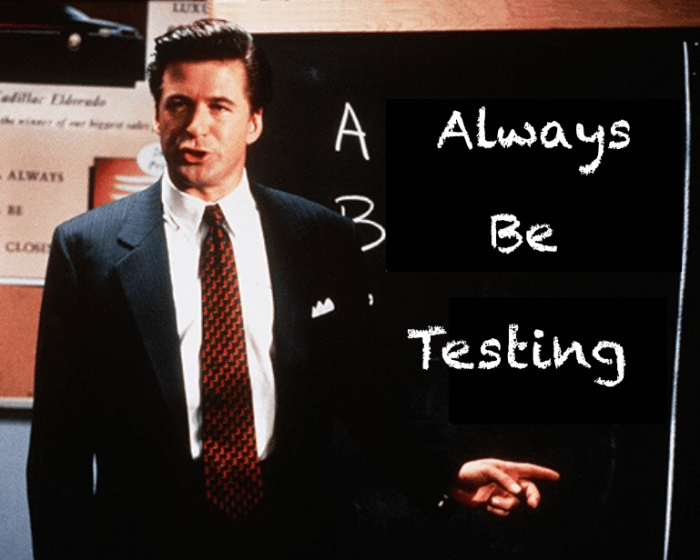
Always Be Testing – The Sales Pitch for Corporate Education Reform

Screen Shot 2017-03-15 at 10.31.13 AM

(After the “Brass Balls” speech in “Glengarry Glen Ross,” by David Mamet.)


(Rated PG-13 for language)


(Interior: a public school classroom during an after school staff meeting. Teachers are seated at student desks including Singer, Moss and Aaronow. Williamson, a middle school principal, stands in front of the room flanked by Blake, a motivational speaker brought in by the state. Singer is furiously grading papers. The other teachers are pleasantly chatting about trifles before Blake calls the gathering to attention.)


[Blake]
Let me have your attention for a moment! So you’re talking about what? You’re talking about that kid you failed, some son of a bitch who doesn’t want to pass, some snot-nosed brat you’re trying to remediate and so forth. Let’s talk about something important. Are they all here?


[Williamson]
All but one.


[Blake]
Well, I’m going anyway. Let’s talk about something important! (to Singer) Put that colored marker down!


[Singer]

But I’m grading papers…


(Blake)

I said Put that marker down! Markers are for testers only.


(Singer scoffs)


[Blake]

Do you think I’m fucking with you? I am not fucking with you. I’m here from downtown. I’m here from the Governor and the Legislature. And I’m here on a mission of mercy. Your name’s Singer?


[Singer]
Yeah. Mister Singer, actually.


[Blake]
You call yourself a teacher, you son of a bitch?


[Moss]

I don’t have to listen to this.

 
[Blake]
You certainly don’t, Madam. Cause the good news is – you’re fired. The bad news is you’ve got, all you got, just one week to regain your jobs, starting today. Starting with today’s meeting.


[Moss]

What!? The union contract doesn’t allow you to just fire us all without cause.


[Blake]

Union!? There ain’t no more union! This is a Right to Work state now, Bitch. And that means you have the right to work – for less – until I fire your sorry ass.


(Assorted grumbling)


[Blake]

Oh, have I got your attention now? Good. Cause we’re adding a little something to this month’s merit pay. As you all know, the teacher whose students get the highest test scores gets a bonus. First prize is a thousand bucks. Anyone want to see second prize? Second prize is a box of pencils. Third prize is you’re fired. You get the picture? You’re laughing now?


[Singer]

That’s ridiculous. Mrs. Moss teaches the advanced kids. All her students get high test scores.


[Blake]

What? And your kids are in the general track? They don’t get high test scores? Then step it up, Singer! You want to get a paycheck in this district, you’ve got to earn a paycheck. You got test prep manuals. The school board paid good money for them. Get those workbooks so your kids can pass the test!


[Singer]

Workbooks!? That’s not learning?


[Blake]

That’s where you’re wrong. Workbooks are the only learning that counts! Kids take the tests that show whether you’re doing your fucking jobs! You want to keep working here? You want to keep sucking at the public tit? You get those kids to pass the motherfucking tests. And those workbooks do that. They teach kids how to pass the motherfucking tests!


[Singer]

But my kids are all from poor homes. They’re malnourished. They don’t get the same medical care. There are no books in their homes. Many of them suffer from PTSD from abuse or exposure to violence….


[Blake]

And you think they deserve some kind of entitlement? A medal? Fuck them and fuck you! Let me make one thing perfectly clear – If you can’t get your students to pass shit, you ARE shit, hit the bricks, Pal, and beat it cause you are going out!


[Singer]

Are you kidding me right now? You want my students to pass these tests. The tests are unfair. They’re economically and culturally biased. The connection between the tests and learning is weak.


[Blake]
The fucking tests are weak? You’re weak. I’ve been in this business for fifteen weeks.


[Moss]
Fifteen weeks? Try thirty years.


[Blake]

Anyone who’s still a teacher after thirty years should be put to sleep. All you need is a year or two. That’s what I’m doing. Teach for America. Five weeks training, two year commitment, then move on to Washington where you can advise lawmakers on what schools need.


[Moss]

What’s your name?


[Blake]

Fuck you, that’s my name! You know why, Missy? Cause you drove a Hyundai to get to work. I drove an eighty thousand BMW. That’s my name.


[Singer]

I took the bus.


[Blake]

(To Singer) And your name is “you’re wanting.” You can’t play in a man’s game. You can’t teach them. (at a near whisper) And you go home and tell your wife your troubles.

(to everyone again) Because only one thing counts in this life! Get them to score above basic. Get them to demonstrate the minimum skills necessary!


[Singer]

What about what they think and feel?


[Blake]

No one gives a shit about what they think and feel. You hear me, you fucking faggots?


(Blake flips over a blackboard which has two sets of letters on it: ABT, and AITP.)


[Blake]

A-B-T. A- Always, B-be, T-testing. Always be testing! Always be testing!! A-I-T-P. Attention, interest, testing, passing. Attention — do I have your attention? Interest — are you interested? I know you are because it’s fuck or walk. Your kids pass or you hit the bricks! Testing – you will test those students by Christ!! And passing. A-I-T-P; get out there!! You got the students comin’ in; you think they came in to get out of the rain?


[Singer]

Actually, many of my students live in public housing down there by the railroad tracks. You know those slums? Roofs leak in half those units…


[Moss]

And for a lot of kids school is the only structure they get all day. Their parents are out working two to three jobs. They have to take care of themselves and often younger siblings.


[Singer]

And food. Don’t forget food. If it wasn’t for the free breakfast and lunch program, many of my kids wouldn’t eat…


[Blake]

Bullshit. A kid doesn’t walk into this school unless he wants to pass. That’s why they’re here! They want to learn! They’re sitting out there waiting to be told what to do. Are you gonna’ tell ‘em? Are you man enough to tell them?


[Moss]

I’m a woman. Most of us are women.


[Blake]

(to Moss) What’s the problem, Pal?


[Moss]

You think you’re such a hero, you’re so rich. Why are you coming down here and wasting your time on a bunch of bums?


(Blake sits and takes off his gold watch)


[Blake]
You see this watch? You see this watch?


[Moss]
Yeah.


[Blake]

That watch cost more than your SMART Board. (Takes off his shoe) You see this shoe? Italian. It costs more than your entire salary. (slicks back his hair) You see this haircut?


[Moss]

I get it.


[Blake]

Do you? Because I do. I made 26 million dollars last year. How much do you make? You see, Pal, that’s who I am. And you’re nothing. Nice person? I don’t give a shit. Good mother? Fuck you – go home and play with your kids!! (to everyone) You wanna work here? Test!! (to Aaronow) You think this is abuse? You think this is abuse, you cocksucker? You can’t take this — how can you take the abuse you get in a classroom?! You don’t like it — leave. I can go out there tomorrow with the materials you got, make myself a thousand dollars in merit pay! Tomorrow! In one class! Can you? Can you? Go and do likewise! A-I-T-P!! Get mad! You sons of bitches! Get mad!!


[Singer]

Oh, I’m mad. I’m mad that a shallow schmuck like you thinks he can come in here and tell us how to do our jobs. School is about so much more than test scores. You can’t reduce it all to a multiple choice assessment. These kids need a broad curriculum, not just reading and math. They need science, art, social studies, foreign language, recess – all the stuff the rich kids get at the $50,000 a year private schools. And all you want to give them are standardized tests!


[Blake]

You know what it takes to teach public school?


(He pulls something out of his briefcase. He’s holding up a hammer and a plastic model of a one-room schoolhouse. He puts the model down on Aaronow’s desk and then smashes it to pieces with the hammer.)


[Blake]
It takes school choice to teach in a public school. It takes charter and voucher schools, schools run like a business – not this mamby, pamby, commie, socialist shit!


[Moss]

Choice? Is that what you call letting private interests suck up public tax dollars without the same transparency and regulations as public schools? You mean schools not run by an elected school board, who meet in private and do almost whatever they please with our tax dollars? You mean schools that can turn away the hardest to teach children – unlike public schools that take everyone?


[Blake]
I’m talking about schools with balls!
(He puts the hammer over his crotch,– he puts it away after a pause)


[Blake]
You want a paycheck? Do like the choice schools do — Go and do likewise, folks. The money’s out there, you pick it up, it’s yours. You don’t–I have no sympathy for you. You wanna go into your classes tomorrow and test and get your kids to pass, it’s yours. If not you’re going to be shining my shoes. Bunch of losers sitting around in a bar. (in a mocking weak voice) “Oh yeah, I used to be a teacher, it’s a tough racket.” (he takes out a software package from his briefcase) This is the new Common Core aligned diagnostic system. It’s like the MAP, Study Island, iReady and iStation – only better.


[Singer]

Those programs suck.


[Blake]

This is better. With it, your students will sit behind a computer screen for several hours every day taking stealth assessments.


[Singer]

You mean mini-tests?


[Blake]

No. Not mini-tests. They’ll run through the program and get instruction on every Common Core standard and their answers will show how much they’ve learned.


[Singer]

They’re tests. Standardized tests. Every day.


[Blake]

This is the Pearson leads. And to you, it’s gold. And you don’t get it. Why? Because to give it to you is just throwing it away. (he hands the software to Williamson) It’s for testers. (sneeringly) Not teachers.


I’d wish you good luck but you wouldn’t know what to do with it if you got it. (to Moss as he puts on his watch again) And to answer your question, Pal: why am I here? I came here because the Governor and Legislature are paying me to be here. They’re paying me a lot more than you. But I don’t have to take their money. I can make that tying my shoes. They asked me for a favor. I said, the real favor, follow my advice and fire your fucking ass because a loser is a loser.


(He stares at Moss for a sec, and then picking up his briefcase, he leaves the room with Williamson)


[Singer]

What an asshole.


[Moss]

He may be an asshole but he’s got the state on his side.


[Aaronow]

This isn’t what I signed up for. This isn’t why I became a teacher.


[Moss]

What did you sign up for?


[Aaronow]

TO TEACH! Not to be some… some… glorified real estate agent!


[Singer]

It’s funny. We know how crazy all this testing, Common Core, and charter school crap is, but no one wants to hear us.


[Moss]

And now without collective bargaining, we can’t even speak up without fear of being fired.


[Aaronow]

Fear!? If we don’t push all this teaching to the test nonsense, they’re going to fire us. And if we do, they can replace us with computer programs. We’re damned if we do, damned if we don’t.


[Singer]

Not if people wake up. (Moss and Aaronow scoff) Not if the public takes a stand, if parents and teachers opt their kids out of the tests…


[Aaronow]

Didn’t you hear the man!? They’re putting the kids on computer programs to test them every day!


[Singer]

Then we fight every day. We protest every day. We get parents together and other concerned citizens and we go to the capital and we fight. Call your representative. Go to your Senator’s office. Stage a sit in. Hold a mock trial. Write a blog parodying a scene from a famous movie. Get public attention. Make some noise.


[Aaronow]

And you think people will care? You think people will know?


[Singer]

We’ll teach them. We’ll show them. That’s what we do.


[Moss]

We have no other choice.


[Aaronow]

Always be testing?


[Singer]

Always be teaching.


(Curtain)


The Original Scene from GlenGarry Glen Ross:

Allowing Guns in Schools is a Bad Idea

guns-in-school

Guns were not allowed at Donald Trump’s inauguration.


They were not allowed at his speech to the National Rifle Association (NRA).


Nor were they allowed at the Conservative Political Action Conference (CPAC) or at most of his hotels, golf courses and other properties.


But he wants them to be allowed at our public schools.


He promised to eliminate gun free zones at schools around the country on day one of his presidency.


With all the tweeting about crowd size, he didn’t get around to it. But he may – soon.


Press Secretary Sean Spicer promised in February that the President has an executive order in the works to address the issue.


Before running for Chief Executive, Trump had been much more moderate on guns. But since then he has echoed the NRA’s official position several times, saying that there are fewer shootings in areas where guns are permitted and that killers target areas prohibiting them.


However, it’s not true. From 2000 to 2013, only one shooting was stopped by an armed civilian. However, during that time, 21 shootings were stopped by unarmed bystanders. Moreover, from January 2009 to July 2015, only 13 percent of mass shootings took place in gun-free zones.


The law prohibiting guns in schools (with the exception of mostly law enforcement officers) was signed by Republican President George H. W. Bush in 1990. The law was upheld in 1995 by the U.S. Supreme Court.


So for now, it is illegal for unauthorized people to posses firearms inside or around a school.


Trump’s Education Secretary Betsy DeVos may have given everyone a good laugh suggesting schools need guns to protect from bear attacks, but Republicans are working to make this a reality – with or without the President. In January, Rep. Thomas Massie (R-Ky.) introduced a bill to repeal this legislation.


The question remains, are guns in school a good or bad idea? In a country of 350 million people and more than 310 million guns, would our schools really be safer if those firearms ended up in our classrooms?


F- NO!


Here are five reasons why:


1) Kids Will Get Ahold of Them


Kids get their hands on everything. As a parent, it’s exceedingly difficult to put anything down without your children ending up with it. And that’s only with one or two kids! Imagine it with a classroom of 20-30!


Look at how many times teachers’ cell phones unintentionally end up in student hands. It’s human nature. If kids know a teacher is packing, some of her students may go through her desk, her bag or otherwise find it.


Moreover, teachers often have to break up fights between students. Having a gun within reach of angry adolescents bent on doing each other harm is a recipe for disaster.


Unfortunately, children are not strangers to gun violence. According to FBI homicide data, of the 1,448 children who died as a result of gun violence in 2010, 165 of those deaths were at the hands of other children.


In most cases, trained teachers will keep firearms out of reach, but having them present in the classroom increases the chances of tragedy.


This is backed up by social science. The Journal of Pediatrics conducted a study in 2001 where twenty-nine groups of two to three boys, most of whom were around ten-years-old, had to wait for fifteen minutes in a room with a one-way mirror.  Two water pistols and a real handgun were partially hidden in various locations throughout the room.  If students found the handgun and pulled the trigger, it was rigged to make a firing sound and kickback realistically.


The result: 48 out the 64 boys found the handgun.  Of those, 30 handled the gun and 16 pulled the trigger. Approximately half of the boys who found the gun said they thought it was a toy or were unsure if it was real.  A full 90% of the boys who handled the gun or pulled the trigger had received some sort of gun safety education previously.


Make no mistake. Having guns within reach of children is an invitation for them to use them.


2) Schools Don’t Want Them


Most schools don’t want this responsibility.


Back in 2012, Michigan Republicans floated a bill to allow guns in schools. Superintendents throughout the state sent letters to Gov. Rick Snyder asking him to veto it (which he did). The American Federation of Teachers (AFT), one of the largest labor unions in the country with more than 1.5 million members, also wrote to Snyder, saying, “We should be doing everything we can to reduce the possibility of any gunfire in schools and concentrate on ways to keep all guns off school property.”


They know that guns in school will increase problems – not decrease them. Survivors of school shootings certainly aren’t coming forward demanding more guns. We should listen to them.


3) Teachers Will Misuse Them


Teachers are highly trained and have years of experience helping kids learn. They aren’t necessarily knowledgeable with how to safely use, store and operate firearms. Nor would some of them be suited to such training.


Everyone’s known those teachers who are lovably absentminded. Do you want them leaving their gun in an unlocked classroom? Just because you can help a student read and write, doesn’t mean you’re good in a gunfight.


I love teachers. I admire most of the educators in my building. I would not feel safe if they were all armed.


4) Kids Will Be Scared


Having a gun in class does not put people at ease. It does just the opposite. A gun is a threat of future violence. If students completely trust their teacher, they may be comforted, but students rarely feel that level of comfort with every teacher in the building.


Imagine the chilling effect a firearm can have on class discussion, on any sort of disagreement. Some students are victims of abuse at home and don’t fully trust adults. At present, the worst a teacher can do is just fail them. How would these children feel living with the threat of imminent death? In most states, teachers aren’t even allowed to paddle students anymore. Now we’re going to give them the power of life and death!?


How would parents feel? I love my daughter’s teachers, but I must admit I don’t want them strapped.


5) They Won’t Stop School Shootings


Most school shooters don’t pay much attention to whether they will survive their attack. In fact, they plan for just the opposite. The presence of guns will not deter them. It may even attract them.


Sometimes violence is a cry for help. Children act out not to achieve their aim but to be stopped by an adult. Having guns in school may make students feel safer about initiating a shooting because they think they’ll be apprehended.


Moreover, it makes the job of police responding to a shooting that much more difficult. How can they tell the difference between an armed perpetrator and an armed victim? Plus there’s the issue of friendly fire. When you have two people shooting at each other, bystanders get caught in the crossfire. This is not a good environment for children.


Critics will say it’s better than just the perpetrator being armed, but that’s the point. It’s better that NO ONE be armed at school.


Instead of increasing firearms around children, we should decrease and control them. But that’s a policy driven by rationality and not the profits of gun manufacturers.


This entire debate has been driven by what’s economically beneficial for one industry over everything else. Money has trumped science, reason and empathy.


If Republicans think guns are so vital, maybe they should pass laws to allow them at their own gatherings before forcing them on our public schools.


Children deserve a safe environment in which to learn. Adding guns to our already overburdened public schools is throwing a match at an already explosive situation.

I’m a Public School teacher. Hands Off My Trans Students!

ct-transgender-students-met-20150425

I’m a public school teacher.

I have a lot of different girls and boys in my classes.

In fact, some of them are neither girls nor boys.

Does that mean they should be discriminated against? Does it mean we should judge them, tell them they’re somehow less valuable than the other kids? Tell them who they are by telling them where to pee?

Heck, No!

Some kids don’t feel comfortable with a traditional gender identity. And it’s more common than you’d think.

It’s certainly more widespread than I ever would have thought until a little girl taught me a lesson… well, not a little girl, really.

A few months ago, I would have said she’s the cutest little girl in the lunch line.

Bright, vivacious, always a friendly smile and a kind word.

But she’s not a little girl.

And I didn’t know until she told me.

As a teacher given the unenviable role of line monitor, I have to find the bright spots where I can.

Letting only two hungry 5th graders in to get their lunch at a time and making the rest wait does not make you popular.

“Aaaargh! Why you always stopping me!?” They often say.

“Because you were third,” I reply.

“But why?” They often insist.

“It’s not personal. It’s numerical.”

And I let them through to continue the game tomorrow.

It goes on like that for about a half hour with little variation – until she gets to the front of the line.

“Hey, Mr. Singer!” Big smile and a wave.

And we’d be off on a conversation. She’d ask me how my day was, what I was teaching my students, how my daughter was. I’d ask how her day was so far, about pets, homework.

She’s actually not in my class. I only see her at lunch, but she always brightens my day.

For months, it went like clockwork. Until a few weeks ago when she appeared at the front of the line with her long hair chopped off into a bob.

“Nice haircut,” I said encouragingly.

“Thanks,” she replied. “You want to know why I got it?”

“Sure. Why?”

“I’m agender.”

“Oh,” I responded cluelessly. “What’s that?”

And she proceeded to explain that she didn’t feel comfortable identifying as male or female.

I nodded and then it was time to let her get her lunch.

I’ll admit it was unsettling. Here was this cute little thing and I didn’t even know what to call her now.

But the next day things progressed as usual. Ze came through the line with the same big smile. We had the same innocuous conversation and ze went to eat.

It made me think.

I’ve been teaching for more than a decade. Ze was probably not the first transgender student I’ve met. And when I thought back to all the children who’ve come through my classes over the years, faces started to pop up and hit me.

Gender is not black and white. (Come to think of it, neither is race.) No one is 100% male or female. I mean, sure people have a fixed range of sexual parts, but gender identity is more than that.

We each feel comfortable acting and identifying certain ways, and if you think about it, some of those ways don’t always line up with our cultural gender designation.

For instance, I cry my eyes out at certain movies. My daughter – who’s 8 – heard the song “Boys Don’t Cry,” the other day and said, “Well that isn’t true. Daddy cries all the time.”

Moreover, my wife loves football, basketball and hockey. Me? I could take them or leave them. If she wants me to watch the game with her, she’s got to beg or promise or put out the right snacks.

Wouldn’t it just make sense that some people are much further to one side or other of the gender spectrum than others? Wouldn’t it just make sense that sometimes your identity and your physical parts don’t match? Or maybe you’re so in the middle that it makes no sense to take a side?

I say again, I teach in a public school. We don’t push any kids away. We take everyone. And that means taking those kids who aren’t so easy to label.

I teach middle school. Transgenderism doesn’t come up too often.

Last year when bathroom bills were all the rage, some of my 8th graders brought it up during our Socratic Seminar discussion groups. And I let them talk about it.

We talked about why some people might think this is a good idea, why some might oppose it, etc. There were some boys who were hysterically against trans students using the bathroom with them, but most of my kids had zero problem with it. In fact, they knew that it had already happened.

Trans students are everywhere. You just rarely hear about them.

I don’t know which bathroom my lunchline buddy uses. I wouldn’t presume to ask. But it hurts me that there are people out there who want to limit hir.

These children have rights. They are little sweethearts. They’re full of life and joy. We should respect their humanity.

And to those who say letting them use a bathroom that corresponds with their identity will lead to kids being molested, let me ask – has that ever really happened?

The way I see it, the problem is people – any people – molesting others, no matter what room they do it in, no matter if they’re transgender or not.

Frankly, it doesn’t happen a lot at school, nor is it more pronounced with trans kids.

This has nothing to do with children. It has to do with old men and women who refuse to broaden their views about the world. It’s about the ancient making the young do as they say regardless of how doing so may trample on their right to be themselves.

Well, I won’t be a part of it.

You want to attack my trans students? You’ll have to do it through me.

I’m a guardian of kid’s rights. I’m a defender of children from whoever wants to do them harm.

I’m a public school teacher. That’s just what we do.

Randi and Lily, For the Good of Our Unions, Please Step Down. You Are a Distraction

28f329e0b3df889bf4067c6e4c6beee2

Dear Randi Weingarten and Lily Eskelsen Garcia:

Unions are facing hard times.

We are under attack by the new fascist wing of the Republican party.

So-called “right to work” laws are being drafted at the national level to strip us of our rights and transform us into the factory slaves of The Gilded Age. New court challenges at the state and federal level could make it next to impossible to collect dues without allowing countless free riders. And in the mass media criticism of teacher tenure is mounting despite widespread ignorance of what it even means.

More than ever we need to be united in our efforts to fight the forces of regression and tyranny. We need each other to protect our public schools and our students from those who would do them harm. But the biggest obstacle to doing that isn’t Donald Trump. Nor is it Mike Pence, Steve Bannon or even Betsy DeVos.

It is you. Both of you.

Frankly, as Presidents of the American Federation of Teachers (AFT) and the National Education Association (NEA), you have become a distraction.

When DeVos was blocked by protesters from entering a Washington, D.C., school this week, Randi actually took her side. She tweeted:

screen-shot-2017-02-11-at-2-23-12-pm

“Just heard a protester blocked & almost knocked Secy @BetsyDeVos down at Jefferson.We don’t condone such acts.We want her to go to pub schls.”

How dare you dictate to protesters what “we” want!?

This action may not have been something you, personally, condone. But DeVos just got away with purchasing her position as U.S. Secretary of Education. She and her billionaire family paid off mostly Republican lawmakers to the tune of $200 million allowing her to become the titular head of our nation’s public schools. This despite having never attended a public school, refusing to protect special education students, refusing to hold charter and voucher schools to the same standards, even refusing to keep guns out of our children’s classrooms! Well, Betsy, your money may buy you the title, but it buys you zero respect!

Randi, your statement just goes to show how tone deaf you and Lily are to the spirit of the rank and file.

We are not somewhat distressed at what is happening to our schools and our profession. We are enraged! We are taking to the streets! We are occupying our lawmakers offices and marching through community thoroughfares! And we aren’t throwing shade on other protesters behind the safety of Twitter.

For many of us, you both represent everything wrong with unionism. We are a people powered movement. We get our strength from the grassroots up, but you both try to rule from the top down.

Nowhere was this more apparent than in the early endorsements by both unions of Democratic candidate Hillary Clinton.

Neither one of you made an honest effort to gauge member opinions on these endorsements before going ahead. You thought you knew better. You pushed through these endorsements despite a strong vein of support for Democratic candidate Bernie Sanders.

Sanders was much more in-line with our needs and values. And he had much more support among progressives and independents. He had a much better chance of winning! Meanwhile, Clinton was just another neoliberal in a long line of neoliberals like President Barack Obama who would offer us only the back of their hands.

You wanted a seat at the table, and you didn’t mind how much it would cost the rest of us.

Lily, when you took the reins of the NEA in 2014, you famously said “We are what Democracy looks like.” I was never more proud of my union than at that moment. But that pride has turned to ashes in my mouth.

Many of us will never forgive either of you for the results of this election. We blame you for Trump.

Had you not dictated to us that we must support Clinton, had you supported a candidate with a real chance of wining, there is little doubt that we could have defeated the clown currently in the Oval Office. Moreover, under a President Sanders we would have had a real chance at a progressive future that benefits everyone – $15 minimum wage, universal healthcare, sanctuary cities, justice reforms, fair trade, free college tuition.

Trump did not win alone. Unwittingly, you were his biggest supporters. It was your hubris – along with that of corporate Democrats deaf to the voices of their base – that gave us these next four years. And none of you have learned your lesson.

Lily, your three-year term is up this year. Randi, your two-year term is up in summer 2018.

We can wait you out if we must. But do what’s best for the people you claim to represent. Step down now.

Otherwise, you can look for opposition in our Representative Assemblies.

Let me be clear. I don’t think either of you have broken any by-laws. I don’t think there is evidence for impeachment (if our by-laws even allow it). But members could easily make a motion from the floor for a vote of no confidence.

Support may already be mounting for such positions at the Region level. It could go to the State House of Delegates as a New Business Item and get a majority vote from the floor. Or perhaps at our next Representative Assembly, someone will just make a motion.

I don’t know if it would pass. But I know that this division among us is holding us back from being the force we can be. I know that it has stopped many of us from talking about how we fight external forces, because we are instead focused on enemies from within.

We want to transform our unions. We no longer want to focus solely on collective bargaining. We want to focus on social justice and the needs of our students and communities. To be sure, our labor rights are essential to this fight, but they cannot be everything nor can we be willing to give up on the needs of our students if the powers that be will only leave our salaries and benefits intact.

We want a union that is more at home in the streets than in the boardroom. We want leaders who mobilize us to fight not tell us what to think. We need leaders that listen to us – not the other way around.

As a classroom teacher and education activist, I make this request in no official capacity for any of the various groups to which I belong. I ask as merely another member of the NEA. I have no affiliation with the AFT.

Moreover, I have nothing personal against either of you. We met briefly at the Network for Public Education conference in Chicago two years ago. You were both congenial and inspiring. It may not seem like it now, but I hold tremendous respect for both of you. I think in your own ways you have accomplished much that benefits our members.

But the time has come to step down. You believe in accountability. Hold yourselves accountable.

Put the strength of our unions first. Let it no longer be about you. Let it be about us.

Here’s hoping you’ll do the right thing.

Yours,

Steven Singer

NEA and PSEA member

P.S. – If any NEA or AFT member reads this open letter and agrees with the sentiments expressed here, please add your name and union affiliation in a comment on my blog.

PA Legislature Plans Taking Away Teachers’ Sick Days

thumbnail_teachers-sick-719435

Dear Pennsylvania legislators:

So now you want to take away teachers’ sick days.

Sabbatical, sick days, bereavement leaves – the Senate Education Committee voted 7-5 to strip them from the law and make teachers bargain for them with their districts.

So the next time I get sick, you don’t want to guarantee I can take the day off. If my mother dies, you don’t want to protect my right to attend her funeral.

The full legislature still has to vote on it, but that’s pretty cold.

Which brings me to my first question: Why do you hate public school teachers so much?

Seriously. What did teachers ever do to you? Did we give you a bad grade when you were kids? Did we give you detention? What did we ever do to earn such animosity?

You obviously must have something personal against teachers.

It’s understandable. Even though the majority of Pennsylvanians voted for Democrats, most of you are Republicans. You have gerrymandered the state so that you artificially have the majority, and as such you must espouse the most radical positions possible. Otherwise, you’ll be primaried by someone even farther right – a Tea Partier, a plutocrat, an anarcho-capitalist, a fascist.

We see the same thing playing out nationally. Hello, Donald Trump!

So it’s no surprise that after stripping public schools of almost $1 billion every year for the past five years, after tens of thousands of teachers have been laid off, after you’ve given away millions of dollars to private corporations to run fly-by-night charter schools or through tax credits to religious schools – well, it’s no surprise that you feel the need to continue the war on teachers.

It’s paying off for you big time.

Not so much for our school children. They have had to deal with increases in class size, narrowing of the curriculum, reductions in extra-curriculars, cuts in tutoring – just about every deprivation imaginable.

I wonder – do you realize that every attack against teachers is also an attack against students? Making sick teachers come to school won’t improve kids’ educations. Forcing educators to choose between work or seeing their loved ones off to their final resting places won’t boost test scores. Do you understand that or do you just not care?

Follow-up, if I may: do you realize that most public school teachers are women? Does that factor in at all? Which do you hate more, the gender of most teachers or the fact that we are unionized?

Oh, and Pennsylvania School Boards Association, don’t think we’ve forgotten you. We know you requested this mess, Senate Bill 229. Instead of standing with your teachers to fight for fair, equitable, sustainable funding, you’ve decided to ask the legislature if you can stiff teachers to make ends meet. We’re there for your kids everyday, and this is how you thank us. That’s gratitude.

It’s what we get for being one of the last workforces to be unionized. We have the temerity to demand fair treatment. You can’t just do whatever you like with us, you have to actually sit down with us at the bargaining table and talk.

Legislators, we know it’s something that infuriates your base. No, I don’t mean the people who vote for you. I mean your real base – the corporations, millionaires and billionaires who pay your real salaries – the unlimited and shadowy campaign contributions that, let’s be honest, are really nothing less than legal bribes.

We shouldn’t be surprised that you have prioritized taking away legal protections for teachers’ sick days. It is quite in line with what you want to do to the profession. You no longer want highly qualified teachers making a middle class income who then can stay in our schools for their entire careers. You want lightly trained temps who use teaching as a stepping stone to a job that pays enough to live.

After all, if we afford teachers the status of professionals, they might actually be able to jump all the other hurdles we’ve put in front of them and educate the poor.

That would be terrible.

Despite all the standardized testing, Common Core, value-added measures, budget cuts, and constant propaganda about “failing schools,” they might actually teach these kids to think. That’s the last thing you want.

A thinking public might see how much you’re screwing them over. They might actually rise up and fight. They might refuse to accept the status quo that you are so desperately trying to protect.

That’s your real endgame. And though it makes me sick, I suppose I will no longer be able to take off.

I’ll just spend the day, coughing and wheezing with the children.

Yours,

Steven Singer

The Gadfly on the Wall

Why Teaching to the Test is Educational Malpractice

thumbnail_screen-shot-2016-11-03-at-12-20-50-pm

Malpractice is defined as “careless, wrong, or illegal actions by someone (such as a doctor) who is performing a professional duty.”

In some fields it can get you arrested. In most it’s at least frowned upon.
In education, however, it’s encouraged.

In fact, as a teacher, you can be singled out, written up or even fired for refusing to engage in malpractice. You are bullied, cajoled and threatened into going along with practices that have been debunked by decades of research and innumerable case studies.

Take the all-too-common practice of teaching to the test.

Not only do students and teachers hate it, but the practice has been shown to actually harm student learning. Yet it is the number one prescription handed down from administrators and policymakers to bring up failing scores on high stakes standardized tests.

Never mind that those same test scores have likewise been proven to be invalid, racially and culturally biased and inextricably linked with parental income. When the only goal is raising student test scores, what’s a little malpractice between friends?

In this article, I will explain the top five reasons why this policy is harmful. But first, we need to define our terms. There is a multitude of practices that are sometimes called teaching to the test. What exactly are we talking about here?

Assessment expert W. James Popham provides a helpful distinction: “curriculum teaching” vs. “item teaching.” Curriculum teachers focus on the full body of knowledge and skills represented by test questions. For instance, if the test is expected to include questions about decimals, the teacher will cover the full range of knowledge and skills related to decimals so students understand what they are, know how to manipulate them, understand how to use them to solve more complex problems, and are able to communicate about them.

By contrast, item teaching involves narrowing instruction, organizing lessons around look-a-like questions that are taken directly from the test or represent the kinds of questions most likely to be found on the test. In this way, the teacher only provides the chunks of knowledge students are most likely to encounter on exams. For instance, item teachers might drill students on a certain set of vocabulary words that are expected to be assessed rather than employing instructional strategies that help students build a rich vocabulary that best contributes to strong reading comprehension.

To be clear, when we talk about teaching to the test, we’re talking about item teaching. I maintain that there is nothing wrong with curriculum teaching. In fact, that is the preferred method of educating. It is a best practice. The problem is when we resort to endless drills and give students innumerable questions of the exact type we expect to be on the test.

Here’s why item teaching is to be avoided:

1) It Makes the Tests Even More Invalid

As noted, standardized tests are terrible assessments. They do not properly or fairly assess intelligence or academics. However, whatever validity they have is further eroded when schools teach to the test.

The problem is this: if all you want to do is artificially raise test scores, teaching to the test is effective. It works. This is why middle class or wealthier families often pay to enroll their children in a test-prep course before their kids take or retake the SAT exam. It most likely will boost their children’s scores. However, it defeats the purpose of the test, which is to predict academic success in college. All it shows definitively is that these children come from families wealthy enough to provide private tutoring.

I say it “artificially” raises test scores because it is not connected with a similar increase in learning. Students don’t learn more about reading or math from test prep. They learn how to take the standardized math and/or reading tests.

There is even evidence suggesting that real, authentic learning may suffer under these circumstances. But more on that later.

2) It Steals Instruction Time

There are only so many days in the school year. Taking away class time to focus on test prep reduces the amount of time where students are authentically learning. We already take away weeks of class time for the actual assessments. Then many schools take additional time for practice tests. Now we’re losing even more time to teach students how to take the tests.

How much time is lost? According to a report by the American Federation of Teachers, public schools spend an average of 19 days to a month and a half on testing and test prep combined. However, some districts spend much more time on teaching to the test than the average. One school included in the study spent an average of 20 to 40 minutes a day on testing. Moreover, this time increases dramatically in the most highly tested grades and poorest schools.

Taxpayers compensate teachers to teach – not game the system. Students want to learn real skills, not advanced ways to jump through hoops. It can be argued that teaching to the test robs everyone of time that can be better spent.

3) It Dumbs Down the Curriculum

Teaching to the test is not real teaching. Students are not being taught authentic skills. Researchers Lauren Resnick and Chris Zurawsky call it a recipe for bad teaching. “When teachers match their teaching to what they expect to appear on state tests of this sort,” they write, “students are likely to experience far more facts and routines than conceptual understanding and problem-solving in their curriculum…. Narrow tests…can become the de facto curriculum.”

The modern economy is not crying out for the next generation of test-takers. Economists Frank Levy and Richard Murnane warn that all kinds of jobs, but particularly higher paying jobs, increasingly require more complex critical thinking skills and much fewer rote and routine skills. Their 30-year analysis shows a steadily declining demand for workers who are able to do rote tasks and a skyrocketing demand for “expert thinking” skills. Employers want prospective employees with the ability to solve problems that require more than simply following rules or applying old knowledge to new situations. They need workers with complex thinking and communication skills.

In short, teaching to the test greatly reduces the depth of study and turns it into the same kind of mechanical process employers aren’t looking for at the expense of the kinds of skills they demand.

But that’s not all. An over-emphasis on the subjects tested, inevitably narrows the curriculum. Non-tested disciplines receive less attention during the school day. Time is diverted from subjects like physical education, music, and drama so that teachers can provide more instructional time on commonly tested areas like reading, writing and math.

The result is far less well-rounded students who are instilled with the false assumption that certain vital endeavors are meaningless or certainly subordinate to basic skills.

4) It Actually Hurts Learning

Not only does item teaching dumb down what’s being taught, it actually erodes basic skill development even in tested subjects. Explicit instruction in test taking strategies is not educationally neutral. It’s harmful.

For instance, researcher Monty Neill explained how test-taking strategies can erode authentic reading comprehension skills. Standardized reading tests often present students with a long passage followed by several multiple choice questions. One of the most common strategies is for students to read the questions first before reading the passage. In many cases you don’t have to read the passage to answer the question. Even if you do need to read it, the question provides students with a clue that they can look for when skimming the passage for the right answer. However, independent evaluators found that over-reliance on this strategy can lead to children who can find the correct answer on the test but cannot explain what the passage is about. The implication is that there may be a significant number of test wise students who lack the basic skills needed to be successful in higher education.

Additionally, even where tested subjects like reading and math are emphasized, the non-tested areas of these disciplines are underutilized. Reading, for example, isn’t just about passage comprehension. It includes listening and speaking skills that are not assessed on high stakes tests. So students can get advanced scores without having the requisite skills for mastery of the subject.

This is especially important for students going on to college. They will be expected to do many things they were not tested on such as making an oral presentation, conducting a science experiment, or writing a research report. For all the talk of Common Core aligned tests making students “college and career ready,” teaching to the test undermines this goal.

5) It Hurts Morale of Students and Teachers

And then we come to perhaps the worst part: motivation. Young children don’t need a reason to learn. They’re naturally curious and soak up knowledge like a sponge. However, as children mature and enter the higher grades, that natural curiosity can be damaged, dampened and even destroyed with long-lasting effects.

Teaching to the test turns school into a completely extrinsic exercise. It’s a game. Learn how to take the test so you can get a good score – don’t work hard to learn things you really care about. It should come as no surprise then that such emphasis has a negative impact on intrinsic motivation according to Edward Miller and Roberta Tovey’s Motivation, Achievement and Testing. In fact, though test prep gives students the tools to artificially raise their scores, it also can remove the motivation to get good scores in the first place. In short, it undermines the reason kids come to school at all: to learn and self-actualize.

And the damage isn’t limited to students. Item teaching also removes the joy of teaching for the teacher. It exacerbates feelings of frustration and disillusionment with the entire testing process. Wayne E. Wright (2002) documented the effects of high-stakes testing and the increased prevalence of teaching to the test in an inner-city California school. One teacher summarized her frustration with the schools test driven agenda by commenting:

“The most pathetic thing is that up until two years ago, I counseled young people, “Come into teaching. It is a wonderful profession.” Now I counsel them to find something else because this is not the profession I would choose for myself.”

(Wright, 2002, p. 28).

Recommendations and Conclusions

We’ve seen how damaging test prep can be. But does that mean it should never be utilized?

I don’t think there is definitive evidence to make that conclusion. Item teaching is not necessarily bad if done to best effect, under strict control and as minimally as possible. Doing this once or twice probably won’t poison the entire act of teaching, but it also won’t have a dramatic effect on the scores. Perhaps we should adopt a policy of cautious moderation and tread carefully.

However, it is clear that teachers should emphasize curriculum teaching over teaching to the test. Focus on student development of real critical thinking skills and the higher levels of Bloom’s taxonomy. In this way students will be more likely to apply their new cognitive abilities and content knowledge in areas that extend beyond the confines of a particular test. In short, they’ll actually learn stuff – the important stuff – not just how to take a standardized test.

Unfortunately, it’s not that simple. Administrators and policymakers often direct teachers to spend increasing amounts of class time doing item teaching. Almost every state includes hundreds of released test questions for just this purpose. An entire publishing industry exists to create and distribute item teaching materials. This is, in fact, one of the major ways the test companies make their money – make tests so hard kids fail and then sell schools the test prep materials to get students to pass.

What’s needed more than anything is to educate the educators – or at least their bosses. Teachers need to understand how harmful the policies are they’re being directed to undertake. Administrators need to understand that teaching to the test has diminishing returns in the long run. And our policymakers need to wake up and smell the coffee.

Test scores are neither adequate nor sufficient indicators of school success. Students cannot be reduced to numbers and evaluated as if they were produce.

Until we realize that as a bone-deep truth, we will continue to fail students as they continue to fail us. And our teachers will be continually forced to violate their deepest principles in order to stay in the classroom.


ENDNOTES:

Levy, F., & Murnane, R. J. (2004). The new division of labor: How computers are creating the next job market. Princeton, NJ: Princeton University Press.

Miller, E., & Tovey, R. (Eds.). (1996). Motivation, achievement, and testing. Boston: Harvard Education Press.
Neil, M. (2003b). The dangers of testing. Educational Leadership, 60(5), 43-46.
Popham, W. J. (2001, March). Teaching to the test? Educational Leadership, 58(6), 16’20.

Resnick, L., & Zurawsky, C. (2005, spring). Getting back on course: Standards-based reform and accountability. American Educator. Retrieved June 30, 2006, from http://www.aft.org/pubs-reports/american_educator/issues/spring05/resnick.htm

Wright, W. E. (2002). The effects of high stakes testing in an inner city elementary school: The curriculum, the teachers, and the English language learners. Current Issues in Education, 5(5). Online at http://cie.ed.asu.edu/volume5/number5.

Standardizing Whiteness: the Essential Racism of Standardized Testing

cookie_cutter_s

“As a method of social production, as well as social reproduction, standardized testing has had serious cultural implications, not the least of which has been the eternal question of American identity. Consistent with notions of American identity, standardized testing, as an opposition to a cultural other, represents the normalization of whiteness, richness, and maleness.”
-Andrew Hartman

“In this country American means white. Everybody else has to hyphenate.”
-Toni Morrison

We talk about standardized testing as if we don’t really understand what it is.

We say we want No child left behind!

And then we pass a law named after that very sentiment that ensures some students MUST be left behind.

We say we want Every student to succeed!

And then we pass a law named after that very sentiment that ensures every student will NOT succeed.

It would be absurd if not for the millions of children being forced to endure the harsh reality behind our pretty words.

It’s not these ideals that are the problem. It’s standardized testing.

Researchers, statisticians, and academics of every stripe have called for an end to high stakes testing in education policy. Parents, students and teachers have written letters, testified before congressional committees, protested in the streets, even refused to take or give the tests. All to deaf ears.

The federal government still requires all students in 3-8th grade and once in high school to take standardized tests.

But these assessments are graded on a curve. A certain amount of students are at the bottom, a certain amount are at the top, and most are clustered in the middle. This would be true if you were testing all geniuses or all people with traumatic brain injuries.

It doesn’t matter how smart your test takers are. There will always be this bell curve distribution. That’s how the tests are designed. So to talk about raising test scores is nonsensical. You can raise scores at school A or School B, but the total set of all test takers will always be the same. And some students will always fail.

But that isn’t even the worst part.

Standardization, itself, has certain consequences. We seem to have forgotten what the term even means. It’s defined as the act of evaluating someone or something by reference to a standard.

This socket wrench is a good socket wrench because it most closely resembles some ideal socket wrench. This McDonald’s Big Mac is good because it resembles the ideal McDonald’s Big Mac.

That’s what we’re doing to people – children in fact. We’re evaluating them based on their resemblance to some ideal definition of what a child should know and what a child should be.

But children are not socket wrenches nor are they Big Macs. It is not so easy to reduce them to their component parts and say this is good and that is bad.

When you try to abstract them to that point, it is impossible to remove various essential factors of their identity – race, gender, socio-economic status, etc. Nor would it be admirable if you could, because you would have abstracted to the point where the individual is no longer visible or valued. A child raised in poverty is simply not the same as a child from a privileged upbringing. A child from a culture that values cooperation is not the same as a child from a culture that values individual achievement. And that’s often a good thing.

But when you define a standard, an ideal, you make certain choices – you privilege some attributes and denigrate others. Since the people creating the tests are almost exclusively upper middle class white people, it should come as no surprise that that is the measure by which they assess success.

Is it any wonder then that poor kids and children of color don’t score as well on these tests? Is it any wonder that upper middle class white kids score so well?

We’ve known this for almost a century. Standardized tests do a poor job of assessing intelligence or knowledge. Those things are too complex and the tests are too simple. If you’re evaluating something equally simple like basic addition and subtraction, these tests can work alright. But if you’re trying to get at something complex like critical thinking or creativity, they end up doing little more than prizing the way some people think and not others. In short, they elevate the thought processes most associated with rich white kids.

It doesn’t mean poor and/or black children are any less intelligent. It just means rich white kids have the things for which the test designers are looking. Some of this is due to economic factors like greater access to private tutoring, books in the home, parents with more time to read to their kids, coming to school healthy and more focused. However, a large portion is due to the very act of taking tests that are created to reflect white upper class values and norms.

Think about it. Almost all the questions are field tested before they become a permanent part of the exam. Students are given a question that doesn’t count to their final score, but test makers tabulate how many kids get it right or wrong. So when most white kids answer a field tested question correctly and most black kids get it wrong, it still becomes a permanent test question because there are so few blacks relative to whites. Maybe it’s a question that references sun tan lotion, something with which darker skinned people don’t have as much experience. Imagine if a question referencing the hair care practices of  black people became a test item. White people would have difficulty with it because they can’t easily relate. But the field testing process doesn’t allow that because it normalizes whiteness.

So black kids stumble while white kids have an easier time. We even have a name for it: the racial proficiency gap.

Many well-intentioned progressive voices have bemoaned this problem and wondered how to solve it. But it’s not the scores that are the problem. It’s the assessments. They are doing exactly what they were designed to do.

That’s right. You cannot have such obvious, historical problems perpetuated year-after-year, decade-after-decade, and still think they are mere unintended consequences.

This is how the system was designed to work. This is how it’s always been designed to work.

If you were going to create a racist and classist school system from scratch, what would you do? How would you go about it?

You’d need the lower classes to have SOME mediocre education so they are able to do the menial work that keeps society running. But only so much. Education as a social ladder is all well and good as propaganda. But you don’t want that ladder to lead out of the basement for more than a few.

You need something that will create a hierarchy with people of color at the bottom and poor whites only slightly better off so they can feel ennobled compared to their darker subordinates.

You need a biased sorting mechanism – something that allows you to put students into privileged and unprivileged categories but that will look to all the world like it was doing so fairly. It would have to appear like you were choosing students based on merit.

You’d need something like standardized test scores.

This is how these assessments have functioned from their very beginnings.

When Carl Brigham and Robert Yerkes, U.S. Army psychologists during WWI, designed the alpha and beta intelligence tests to determine which soldiers deserved to be officers, they were creating a pseudoscientific justification for white privilege. They used biased and unfair assessments to “prove” that rich white folks were best suited to give orders, and the rest of us belonged in the trenches.

Brigham and Yerkes were drawing upon eugenics, also called “racial hygiene” or “scientific racism.” This was a radical misreading of Gregor Mendel and Charles Darwin. Eugenicists thought positive traits such as intelligence were widespread in Northwestern European races and almost nonexistent in others. Moreover, negative traits such as laziness and criminality were common in nonwhites and almost absent in those same Northwestern Europeans.

“We should not work primarily for the exclusion of intellectual defectives but rather for the classification of men in order that they may be properly placed,” wrote Yerkes.

THIS is the basis of standardized testing.

After the war, Brigham took the same principles to create the Scholastic Aptitude Test or S.A.T. – in principle the same exam still taken by 2.1 million teenagers every year to ensure they get into their chosen college.

The test was further refined by fellow eugenicist Lewis Terman, Professor of Education at Stanford University and originator of the Stanford-Binet intelligence test. Together these three men created the foundations for the modern field of standardized testing. And make no mistake – its axiomatic principle is still that some races are genetically superior and others are inferior.

Or as Terman put it:

“A low level of intelligence is very common among Spanish-Indian and Mexican families of the Southwest and also among Negroes. Their dullness seems to be racial, or at least inherent in the family stocks from which they come… They constitute a grave problem because of their unusually prolific breeding.”

After WWII, the eugenicist brand suffered from comparison to the Nazis who had been inspired by the findings of Brigham, Yerkes and Terman among others. In the post war years, we’ve discarded the overtly racist language but kept the assessments. Yet they still function the same way – sorting out blacks and the poor while prizing the rich and white.

This information is not secret. It is not kept under lock and key in some hidden military base somewhere. It’s accessible to anyone with Internet access or a library card.
We ignore it, because otherwise it would destabilize the current power structure – the corporate education policies that drive school practices in our country. We close our eyes and pretend it isn’t happening.

But it is.

“Standardized tests are the last form of legalized discrimination in the US,” said Education and Psychology Prof. Phil Harris.

With them you can give rich and middle class whites every advantage while withholding the same from students of color. And we don’t call it racism or classism because we pretend the whites earned their privileges by their test scores.

“We are using the testocracy as a proxy for privilege,” said civil rights theorist Lanni Guinier. Test scores are the excuse for prejudicial and unjust practices that would be impossible without them.

For instance, if you really wanted to help someone who’s struggling, you might offer extra help. But low test scores are used as the reason for withholding that help. We actually use these invalid scores as a means of demeaning and firing poor black kids’ teachers – as if anything they could do could completely overcome biased assessments and poverty. In this way, we not only remove those already in place to help these kids, we ensure few people will volunteer to take their place.

And when you have a teacher shortage in these poor urban neighborhoods, you can use that to justify further deprivations. Instead of teachers with 4-year education degrees, you can hire lightly trained Teach for America temps – college grads who’ve taken no coursework in education beyond a six weeks cram session.

And if the parents of these children complain, you can open charter schools to pull a quick bait and switch. Make them feel like they have a choice when really you’re pulling the rug out from under them. You provide them with a school with none of the safeguards of a traditional public institution – no elected school board, no transparency on how tax dollars are spent, little oversight, a right to refuse any student they wish, etc. And when the school goes belly up, these kids will be pushed back to their former traditional public school that has had to make due with less funding and now can provide even fewer  services than it could before students jumped ship.

Using standardized test scores to judge not just students but whole schools, you can destabilize the entire system of public education. Charter schools and traditional public schools fight over ever-dwindling funding, one required to prove everything it does, the other able to do whatever it wants until it closes with little to no consequences for charter operators who take the money and run.

The US Supreme Court ruled in Brown vs Board that we can’t have “separate but equal” schools because when they’re separate, they’re rarely equal. But somehow that doesn’t apply to charter schools.

Somehow we’ve stopped caring about integration – one of the central victories of the Civil Rights movement! This plays right into the hands of the corporate education reformers. They have done everything they can to increase segregation because it makes it so much easier to privilege rich white kids and crush poor black ones.

They don’t want an equal mix of black and white, rich and poor in our schools. That would make it much harder to select against one class of student while boosting another.

They need to keep the races and classes as separate as possible. Charter schools help in this regard, but they would be insufficient without the help from many white families who flee from these “other” darker complected kids. It’s just another way to send more funding to white kids and less to poor black kids. They say it’s based on local property taxes. That way they can pretend it’s all fair and above board. Rich folks have a right to be able to give their kids the best, and if poor folks can’t afford to do the same, who do you expect to pick up the tab?

Oh! And let’s not forget setting “high academic standards” while all this is going on. They throw out everything that’s been working and come up with a Common Core of knowledge that all kids need to learn. Don’t include black and brown history, culture or the arts – just the stuff the business community thinks is valuable because they know so much about what’s really important in life. And have the whole thing written up by non-educators and non-psychologists and don’t bother testing it out to make sure it works.

Your rich white kids will have no problem jumping through these hoops. But your poor black and brown kids will stumble and fall – just as planned.

This is what has become of our public schools.

This is corporate education reform.

This is our racist, classist school system.

And it’s all based on standardized testing – a perfectly legal system of normalizing rich whiteness.

Who’s More Valuable – a Union Busting Lawyer or a Union Worker?

man-laughing-loudly-300

There he was standing in front of me in line.


New gray pinstriped suit. Silk red Armani tie. White button down shirt so bleached it hurt my eyes.


We were waiting to board our plane to take us to Houston. Me, a public school teacher. Him, a union busting lawyer.


I was on my way to an education and civil rights summit. He was going to an annual lawyers conference, one of many he attends each year.


I got all this information not from talking to the guy. He was jovial enough but he just couldn’t contain his backstory to a single audience. He was in the mood to talk to anybody and everybody as we waited for the stewardess to tell us it was okay to board.


He spent most of his time talking with two representatives of the natural gas industry who had visited my home of Pittsburgh to invest in our rich deposits of Marcellus shale – and incidentally poison our environment. He also joked with another lawyer further up in line and already tipsy.


I listened to him yuk it up about exclusive golf courses, wine country and the presidential election (he’s a Trump supporter) and felt a warm dislike spread through my chest.


I looked at my faded t-shirt and jeans and wondered how it was that this guy gets so much for what he does and I get so little. Oh I get all the intangibles, but he gets… well… the money, pride and prestige.


There he was asking the gas guys about a good steak place for lunch in Houston. I love steak. I’d like to eat a nice, juicy steak. But I can’t afford it.


I’m only able to make this trip because I took the least expensive flight (coach, by the way – guess where he was sitting) and I was sharing a hotel room with a college professor who had saved up enough discretionary funds to cover the room.


While the attorney was dining on steak, I’d be lucky to store up a muffin or two from the hotel’s complimentary breakfast.


Yet there he was telling the whole world his story unafraid that someone would take offense.


Well, I do take offense, buddy.


You make your living finding ways to make it harder for me to make mine. You spend your whole day looking for legal loopholes and documented precedents to take away protections at my job, cut my pay and make me work longer hours without overtime. You eat at expensive restaurants and wear Italian leather shoes while people like me live paycheck-to-paycheck. You are nothing but a parasite.


Yet no one else seemed to take offense at his braggadocio. Only me. The natural gas guys clapped him on the back and congratulated him on the delicious rib eye in his future.


It makes me wonder why unions are so often made to seem the villain and guys like this are seen as good ol’ boys at best and merely innocuous at worst.


I teach young children how to read and write. I open their minds to the world around them and show them how to think critically. I raise up the weak and give succor to the needy.


What value does he add to society? Seriously! How does he make the world one bit better than the way he found it?


Yes, I am a union employee and proud of it. I collectively bargain for a fair wage. I band together with my colleagues for a middle class income so I can afford to be a teacher. I demand professionalism and autonomy so I can do the job. I seek fair treatment so I’m not constantly looking over my shoulder in case a school board member would rather give my job to one of his cousins. And if you’re going to fire me, I ask for due process – proof of wrongdoing.


Somehow in the eyes of the public this makes me a monster.


But this guy gives you nothing. He provides no return on your investment except that he stifles me.


He makes it harder if not impossible for me to stay in the profession. He works so I can’t support my family. He endeavors for me to be paid the minimum wage so I won’t be able to come home and help my daughter with her homework but instead will have to move on to my second or third job. He argues that I should not be considered a professional and should not be treated like an intelligent person with an advanced degree but should be a factory widget who does as he’s told. He tries to make anxiety my normal state. And he seeks to ensure I can be fired at will with no proof, no reason, just an employers whim.


If he achieves his ends, my students will not have a productive atmosphere in which to learn. When you weaken teachers, you weaken students. We all say to put the kids first, but you can’t do that when you put teachers last.


He does all this and still has the gall to boast of it aloud in public. All while I stay silent, seethe and silently rave.


So we got on our plane, and when we landed in Texas went our separate ways.


I spent the weekend fighting for children and families. He partied with his partners. As a taxpayer, you pay a lot of money for his services. I’m a bargain, a steal. You get next to nothing from him. I open the gates for the next generation.


And somehow I’m the bad guy.