East Pittsburgh, the neighborhood where his car was stopped and where he ran from officers before being shot three times in the back, is minutes from my house.
He went to Woodland Hills School District, minutes from my house.
If he hadn’t been in that car, he’d still be alive. If he hadn’t run from police, they wouldn’t have shot.
Maybe. Maybe not.
But being in the wrong place at the wrong time shouldn’t bring with it a death sentence. Running away shouldn’t bring with it the finality of the grave.
I wish there is something I could do to go back in time and change the results of that day. I wish there was something I could do to stop Donald Trump from being elected President. And though I did not vote for her, I would do anything to have Hillary Clinton defeat him.
On that day, though, I voted for Jill Stein.
There’s nothing I can do about that now.
I imagine going back in time and telling myself not to do it. “Go vote for Hillary,” I imagine Future Me telling an ailing younger version.
Yet even now, I’m not sure if I’d say that to myself.
Go vote for Hillary? Would it have made a difference?
Factually, no. One more vote wouldn’t have put her over the top in my home state of Pennsylvania.
Stein got 49,941 votes – 5,649 more than Trump’s margin of victory.
So if every Stein voter had cast a ballot for Clinton, she would have won the state – though she’d still lose the Presidency by 10 electoral votes.
But if the same process were repeated even in a few other swing states Clinton lost, the result would change. Clinton would have won and be sitting in the Oval Office right now.
Those are just facts. Or at least they’re facts manipulated in a game with counterfactuals.
If this had happened, then this other thing would have happened, too.
However, it is rarely so clear even with numbers.
For instance, Stein ran in 2012, too. She ran against Obama and Romney. She got 20,710 votes in Pennsylvania.
That’s tens of thousands of Green voters who didn’t cast a ballot for centrist Obama. I don’t think it’s fair to assume they would have voted for centrist Clinton, either.
So if we subtract that 20,000 from Stein’s 2016 totals, (49,941 – 20,710) you get 29,231 new people who voted Green who didn’t do so in 2012.
That’s less than Trump’s margin of victory (44,292).
So even if every NEW Stein voter cast a ballot for Clinton, Trump still would have won the state.
The point?
I don’t think it’s factual or fair to assume Stein or Stein voters gave Trump the election.
If I had voted for Clinton, even if I had advised my readers to vote for her, the end result probably would have been the same.
These are the things I think about in the middle of the night when sleep won’t come.
Is there anything I could have done to change things? In trying to make things better, did I make things worse?
I don’t assume I have that much power – either way.
I still think THAT more than any scribbling on my blog contributed to her loss.
Compared to Trump, Barack Obama was one of the best Presidents we’ve ever had. But compared to Trump, so was George W. Bush. So would be an inanimate carbon rod!
I suppose I should have been more frightened of Trump back then. But my anger at the Democrats who continually stabbed me and other progressives in the back outweighed my fear of this buffoon.
Perhaps I was wrong in that.
I don’t think it’s too much of an assumption to say we all underestimated Trump. We all underestimated how many people in this country would vote for him.
Perhaps we’d do better fighting against Trump than fighting amongst ourselves.
I still believe there is a silent majority of Americans for whom the status quo is unacceptable. Most of us don’t want a wall on our border – we want healthcare for all. Most of us don’t want families separated and undocumented immigrants scapegoated and rounded up – we want a path toward citizenship. Most of us don’t want our democracy subverted and the wealthy to have a greater say in our policies – we want freedom and justice for all.
We just need a way to find each other again. We need to find a way to look past any political, social, racial, gender or cultural differences and find a common humanity.
What better way to do that than in a common cause?
I hope you’ll join me by stopping the recriminations and take on the fight.
We may never fully solve the riddle that was the 2016 election.
It had a heart on the front and the following message on the back:
“Happy Fathers Day! Dad, you are my superstar. You help me when I’m sad. And I love everything you do for me. That is why I wish you a Happy Fathers Day.”
It was a sweet token of affection from a 9-year-old to her sleepy daddy sitting at the kitchen table.
But it got me thinking.
All over this country fathers are probably receiving something similar from their children.
Hawaiian shirts, blotchy neckties and more finger paintings than you could fit in the Louvre.
But the sentiment is probably the same.
Thank you for being there for me.
But are we there for America’s children?
We may be there for our own kids, but where genetics end, are we there for others?
Two thousand children forcibly separated from their parents in our name and we dare to celebrate Father’s Day?
From April through May, the policy has separated 1,995 minors from 1,940 adults traveling with them who said they were the children’s guardians.
A country that doesn’t respect the rights of parents – even if those parents aren’t documented US citizens – has no right to pretend it values fatherhood or motherhood.
At best, we value WHITE parenthood, and that, my friends, is not good enough.
Look at what we subject our own children to in the public school system.
In the name of accountability we bestow upon them high stakes standardized tests to “prove” even those meager funds are wasted – yet we ignore the financial disparity, the social problems, the health issues and a host of other obstacles the underprivileged face.
Does a society that routinely treats its children this way deserve a thank you card? I think not.
Last month, the CDC released a report indicating that the U.S. birth rate ― the number of babies born nationwide ― is the lowest it’s been in 30 years and is below the “replacement” rate needed to sustain the population.
Various media sources were quick to blame women nationwide. Women put off having kids because they want to focus on careers. They aren’t sexy or submissive enough.
Yet few look at the responsibilities of men in this equation.
Who is it behind the salary gap between men and women? Who conflates women’s healthcare with abortion and communism? Who makes it easier to get a gun in this country than proper maternity leave, childcare or any adequate resources to make having a family sustainable?
We don’t even support men who want to have families. Men make more money than women, but salaries are down for them as well. If there’s little support for pregnant women, there’s little support for the fathers who impregnated them.
We pretend family values are the bedrock of our society but we don’t do much to support families.
And when we look to the future, it doesn’t appear to be getting any better.
Big business and huge corporations are salivating all over the prospect of further monetizing our children.
Investment bankers and hedge fund managers are funding these programs and more to create a priceless database on each individual child that can be used for lifelong marketing, job placement, even profiling by law enforcement.
These are not practices that are done in the best interest of children. They are in the best interest of investors and free market privateers.
No wonder fewer people are having children! They don’t want their kids to become helpless victims to a society that cares less and less about our humanity and more and more about our marketability.
It is us vs. them – where the us is significantly limited by race, economics and class.
So this Fathers Day, we need to do more than accept a congratulatory pat on the back.
We need to accept our responsibility for the status quo.
If we don’t like the way things are, we need to commit ourselves to doing something about it.
Call and/or write your Senators and Representatives about the policy of separating undocumented parents and children. Visit your lawmakers’ offices and demand fair funding and an end to school segregation, high stakes testing and school privatization. Get active in your local school district going to meetings and making your voice heard. Do everything you can to educate the powers that be on the coming Ed Tech scandal and remove or block it from your district.
I’m not saying intelligence, classroom management and a host of other qualities are unimportant, but if you approach your students with good will in your heart, the rest seems to fall into place.
This isn’t a long-held pedagogical belief I could have articulated for you at the beginning of the school year.
It came to me – as did so much else – from my students.
At the end of the year as my 7th graders are finishing up their final projects and we’re tidying up the room, I always give them a little survey about their experience in the class.
“I’ve been grading you all year,” I say. “Now’s your turn to grade me.”
The surveys can be anonymous – kids needn’t put down their names, and whatever they write has no impact on their grades.
But this year it was one of the simplest comments that really got me thinking.
“He was kind.”
That’s what one of my students told me that I had done especially well during the year.
“He was kind.” That’s all.
It was a response that was echoed by many of my students.
Another child wrote:
“He was kind (and awesome). One of the best teachers.”
And another:
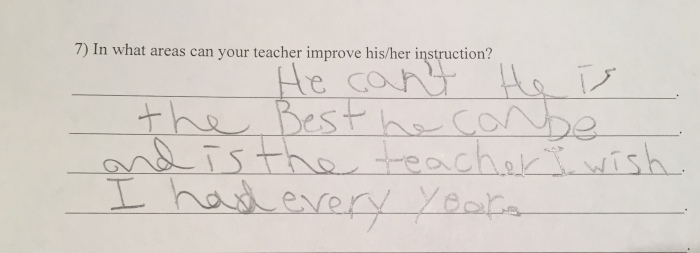
“He can’t [improve]. He is the best he can be and is the teacher I wish I had every year.”
This is all very flattering, but what exactly did all this niceness mean?
How did being a kind teacher help me do my job? What did I do that helped students learn?
They had an answer for that, too:
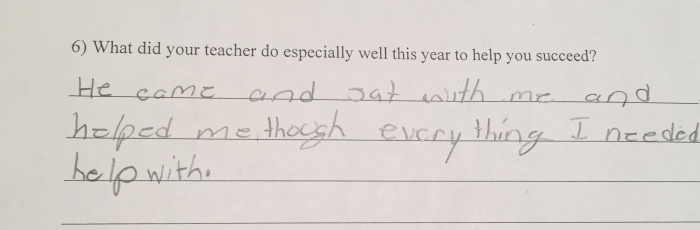
“He came and sat with me and helped me through everything I needed help with.”
***
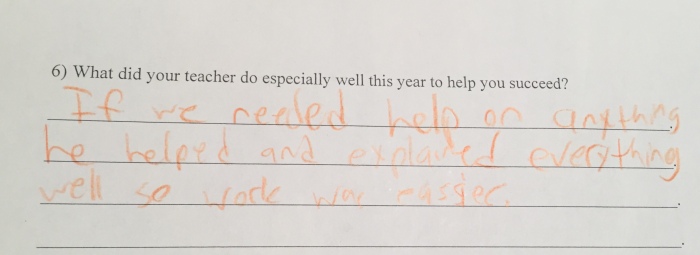
“If we needed help on anything he helped and explained everything well so work was easier.”
***
“What my teacher did to help me succeed was that he made me feel motivated to do the work in class and not giving us so much work at once.”
***
“[He] taught me how to write essays, indent on papers and showed me a lot of useful things.”
Another particularly enlightening comment was this one:
“I don’t know [how he could improve], but in this class you grew with us. So uh yeah.”
And I do try to change and grow with my students. When your mandate is to individualize instruction to fit each particular child, I don’t know how you can do otherwise.
This means opening yourself up and letting students know who you are and what you stand for.
“You’re not only a good teacher. You’re a good friend, and man.”
***
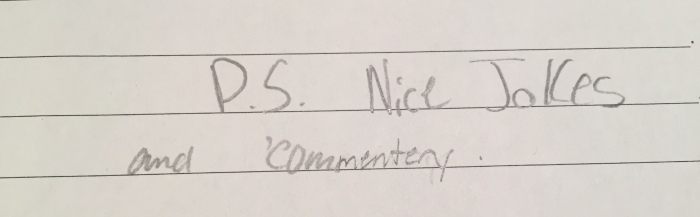
“P.S. – Nice jokes and commentary.”
Of course there were dissenting opinions. One child thought I was too nice:
“He is way too nice for me and you give way too much essays for people to handle. But overall grade 94%. He doesn’t like Tom Brady so yeah. And he likes the Steelers.”
I guess no one’s perfect. But how interesting she thought either she deserved a stronger hand or would have been more motivated by fear and consequences. Yet I have to take her with a few grains of salt because this student identified herself on her response and had a friendly rivalry with me about football. She said I was too nice but then referenced our interpersonal rapport.
Another student highlighted how I wasn’t excessively permissive:
[He was good at] “Helping me with instructions and keeping me on task.”
Most comments were unbridled approbation:
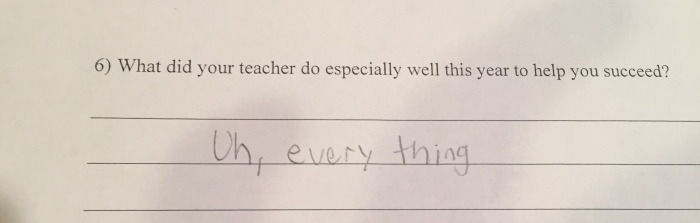
What did your teacher do especially well this year to help you succeed? – “Uh, everything.”
***
In what areas can your teacher improve his/her instruction? – “I’m not sure. That’s how good a teacher he was.”
***
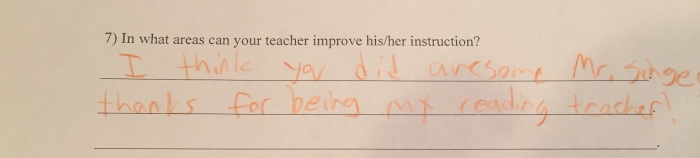
“I think you did awesome, Mr. Singer. Thanks for being my reading teacher!”
***
“I don’t think my teacher needs to improve. He’s already a great teacher.”
And so another school year comes to an end.
I’ll miss this class. It was the first year I taught exclusively 7th grade. I’d taught one or two sections of that grade before, but never only that grade.
I’m more used to 8th grade. You wouldn’t think there’d be a world of difference between the two. And who knows? Perhaps if I teach the same grade level next year things will be even more unexpected because the kids will be different.
But when that final bell chimed, I was surprised that so many kids came up to me with hugs and tears.
They really didn’t want to see me go, and, frankly, I don’t want to see them go, either.
If I could follow them next year, I would.
I gave them everything I had to give.
I gave them my heart. I shared with them my life.
And I got back so much more.
That’s what non-teachers don’t understand.
Education is created through often reciprocal relationships.
Learner and teacher are tied together in a positive feedback loop. Sometimes it’s hard to tell which is which and sometimes there is no difference at all.
Thank you so much, last year’s students.
Thank you for letting me be your teacher.
Thank you for bringing out the best in me as I tried to do the same for you.
Those who demand otherwise are under the spell of one of the oldest myths in academia – grade inflation.
It goes like this: You can’t give all your students excellent marks! That would devalue what it means to get an A!
To which I reply: Bullshit.
Almost every plane that leaves an airport lands safely. Does that devalue what it means to travel? When you arrive at your destination, are you upset that everyone else has arrived safely or would you feel better if some of the planes crashed?
According to the American Journal of Public Health, 93% of New York City restaurants earn an “A” from the health department. Does that shake your faith in the food service industry? Would you feel better if more restaurants were unsanitary? Would your food digest more efficiently if there were more people going home with stomach pain and food poisoning?
Of course not! In fact, these stats actually reassure us about both industries. We’re glad air travel and eating out is so safe. Why would we feel any different about academia?
The idea of grade inflation is a simple imposition of the concept of economic value onto learning. It has no meaning in the field of academics, psychology or ethics. It is just some fools who worship money imaging that the whole world works the same way – and if it doesn’t, it should.
It’s nothing new.
Conservatives have been whining about grade inflation for at least a century. It’s not that the quality of teachers has declined and they’re letting all their students pass without doing the work. It’s that certain types of curmudgeons want to justify their own intelligence by denying others the same privilege.
It’s the “I’ve Got Mine” philosophy.
We see the same thing with Baby Boomers who grew up in the counter culture and pushed for progressive values in their youth. Once they got everything they wanted for themselves, they became conservatives in their old age and worked to deny the same things for subsequent generations.
It’s the very definition of Age scoffing at Youth – a pathology that goes back at least to Hesiod if not further. (Golden age of man, my foot!)
Moreover, there is no authentic way to prove grade inflation is actually happening. Grades are a subjective measure of student learning. They are human beings’ attempt to gauge an invisible mental process. At best they are frail approximations of a complex neural process that is not even bounded temporally or causally. If a student doesn’t know something now, they may come to know it later even without further academic stimulus. Moreover, isolating the stimulus that produced the learning is also nearly impossible.
The important thing is not grade inflation. It is ensuring that grades are given fairly.
If students work hard, they should be rewarded.
I am very upfront with my students about this. And doing so seems to have a positive and motivating effect on them.
This year, I had students who told me they had never read a book from cover-to-cover before my class. I’ve had students look at their report cards in shock saying they’ve never received such high marks in Language Arts before. And doing so makes them want to try all the harder next year to repeat the results.
They leave me excited about learning. They feel empowered and ready to give academics their all. Because the greatest lesson a teacher can instill is that the student is capable of learning.
Don’t get me wrong. I don’t just hand out these grades. Students have to earn them. They have to demonstrate that they have actually learned something.
Everyone rarely measures up to the challenge. But that’s not the point. Everyone COULD. There is nothing in my design that prohibits that outcome. I don’t start with the assumption that I’ll only have 3 A’s, 4 B’s, 10 C’s, etc.
In fact, it is THAT scarcity model that dumbs down academics. If I grade on a curve like that, I have to give out a certain number of high marks regardless of achievement. I’m committed to giving out those 3 A’s regardless of whether that trio of students deserve it or not. However, in my abundance model, I give exactly the number of A’s that are deserved. If that’s zero, no one gets an A. If that’s everyone, then everyone gets an A. It all depends on what students actually deserve, not some preconceived notion about how the world works.
To do this, I give very few tests. I just don’t find them to be very helpful assessments.
Most of my grades are based on projects, homework, essays, class discussion, creative writing, journaling, poetry, etc. Give me a string of data points from which I can extrapolate a fair grade – not just one high stakes data point.
This may work to some degree because of the subject I teach. Language arts is an exceptionally subjective subject, after all. It may be more challenging to do this in math or science. However, it is certainly attainable because it is not really that hard to determine whether students have given you their best work.
Good teaching practices lend themselves to good assessment.
You get to know your students. You watch them work. You help them when they struggle. By the time they hand in their final product, you barely need to read it. You know exactly what it says because you were there for its construction.
For me, this doesn’t mean I have no students who fail. Almost every year I have a few who don’t achieve. This is usually because of attendance issues, lack of sleep, lack of nutrition, home issues or simple laziness.
He never turned in homework, never tried his best on assignments, rarely attended and sleepwalked through the year. However, he knew his only chance was the state mandated reading test – so for three days he was present and awake. The resulting test score was the only reason he moved on to the next grade.
We’re homework-givers, pencil-providers, idea-encouragers, lunch-buyers, scrape-bandagers, hand-holders, hug-givers, good listeners, counselors, caregivers and – yes – sometimes even butt-kickers.
It’s no wonder that we occasionally get mistaken for mothers and fathers.
So if students thought their teachers or principals were scrutinizing them to determine their citizenship status, we’d be discouraging many with brown skin or extra-national credentials from ever coming back.
By suggesting that educators have a choice whether to obey established law or to become self-appointed border patrol officers, DeVos actually is prescribing how we should act.
White supremacy was bad enough before Trump was elected. I won’t help the unfortunately named Department of Homeland Security become the protector of a new white trash Fatherland.
I will defend my students. I will stand up for their safety and their rights.
That’s just what we do in public school. We look after our own.
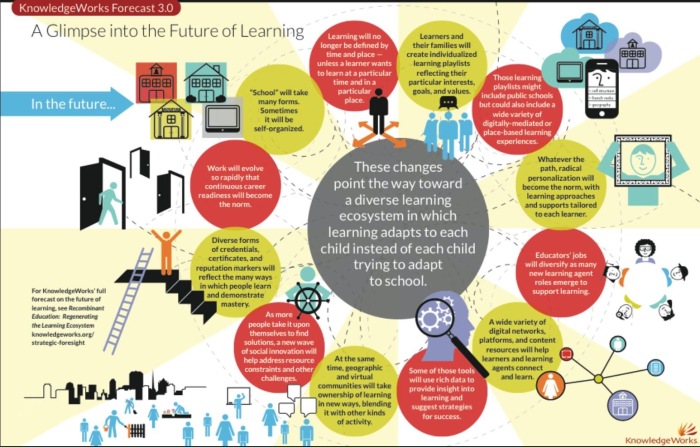
No schools, no teachers, just gangs of students walking the streets, stopping along the way to thumb messages to each other on social media, play a video game or take an on-line test.
That’s the world many EdTech entrepreneurs are trying to build.
Normally, the federal, state and local government collect taxes to fund an individual child’s education, which is then spent at a public or charter school.
At a public school all that money must be spent on the student. At a charter school some of that money can be pocketed as profit by the private company who runs the school.
Public schools provide a better alternative because the funding must be dedicated to the student, living within a district’s coverage area guarantees enrollment, the school must be managed by an elected school board with open meetings and a plethora of other amenities you won’t find at a privatized institution. But at least the charter school is a school!
However, an ESA or other voucher would allow that money to go elsewhere. It could go to funding the tuition at a private or parochial school where organizers can use it however they like – pocketing some and using the rest to help the child as you’ll find in most charter schools.
Reading a book or an article gives you a badge. Answering a series of multiple-choice questions on a reading earns you more badges. And if you’ve completed a certain task satisfactorily, you can even earn a badge by teaching that same material to others.
It’s the low wage gig economy applied to education. We just transform a crappy job market where workers bounce from a few hours of minimum wage labor here to a few hours of minimum wage toil there – all without benefits or union protections – into learning. Children bouncing from a few hours of Khan Academy videos here to a software package there and Voila! “Modern” education!
The wealthy will still get institutions of learning. They will still be educated by the most qualified teachers in the world. They will still learn how to learn.
It is only the poor and middle class who will be released like chickens into the pasture of a learning ecosystem.
And as an added benefit, the badge structure creates a market where investors can bet and profit off of who gains badges and to what degree on the model of crypto-currencies like Bitcoin! So all the stability of the pre-crash housing market! What could possibly go wrong!?
Let me be clear – this is the ultimate goal of the school privatization movement.
Charter and voucher schools are only the tip of the iceberg. They still require real human beings to act as teachers (though they need not be as well educated or have as much experience as public school teachers). They still require buildings and grounds.
Then they can pocket all the rest of the money taxpayers put aside to educate children and call it profit.
And they can use the programs students access to “learn” as a way to gather valuable marketing data about our kids. Everything students do on the device is free market research – every word they input, every keystroke, every site visited down to the slightest eye movement.
This is the logical conclusion of the monetization of education and an economy that only sees value in others as human capital that can be bought, sold and exploited.
This is where the privatization movement is going. And they’re laying the groundwork in legislation being proposed in our state capitals today.
However, given a few years to strengthen the technologies and systems needed for a full learning ecosystem, the same law would allow taxpayer money to be used in this way.
And it’s something hardly anyone is talking about.
Even if school vouchers never take off to the degree necessary to scaffold the most robust learning ecosystems, EdTech lobbyists are trying to install as much of this garbage as they can into our existing schools.
Few people are sounding the alarm because few people understand what’s going on.
This is not conjecture. This is not a conspiracy theory. This is the goal the edtech entrepreneurs will gladly tell you all about hoping you’ll invest.
There are hours of videos, pages of documents, mountains of graphs, charts and graphics about how this scheme will pay off for investment bankers and venture capitalists. (See below)
The only true way to win this battle is a cultural shift away from dehumanizing runaway capitalism.
Teachers provide inputs. Students give outputs. And those outputs demonstrate the intended learning.
Yet this framework was developed in the early 1900s. Using it today is to ignore a century of subsequent psychological advancements. It glosses over the impact of the unconscious, the social nature of understanding, physical differences, even the mediating thought processes between stimulus and response such as memory and problem solving.
Instead, we force students into inauthentic laboratory conditions (i.e. the classroom) upon which they are passive actors to be molded and shaped by expert educators.
Every time we post our learning objectives on the board or when we write our lesson plans beginning with the old chestnut – Students Will Be Able To (SWBAT) – we are hearkening back to early 20th Century thinking a hundred years out of date.
-Most problems with learning are attributable to inputs provided by the teacher.
None of these assumptions have been proven.
In fact, there is considerable evidence against each and every one of these premises, yet our entire system of corporate education is based on them like a house built on a foundation.
If we are truly to create a 21st Century school system, the only place to begin is here. Recognize our bedrock beliefs are mere speculation and question whether we should really support everything else that’s been built on such shaky ground.
WHAT IS LEARNING?
It is an empirical fact that human beings are capable of learning. It’s something we do every day. But what exactly does it consist of? What happens when a person learns?
Perhaps it’s best to start with a definition. We generally characterize learning as the acquisition of knowledge; the possession of facts, information or skills.
But how does one gain knowledge? How does one possess the intangible?
It seems that learning always involves thoughts – usually conscious impressions but sometimes unconscious ones, as well. However, not all thoughts qualify, only thoughts of a certain kind.
The notion must be true of the world. And often it is an idea that has surfaced before but that now can be recalled at will and used to create new concepts.
Perhaps I’m wrong, but it seems that no matter how you flesh it out, we’re talking about internal mind states.
Learning takes place in and of the brain. And this has consequences for our education system – an apparatus designed to make these brain states more frequent along certain prescribed lines.
IS LEARNING OBSERVABLE?
That depends. Can we lop off the top of students’ heads and peer at the gelatinous mass inside?
Not really. And even if we could, we wouldn’t understand what we were seeing.
Even if learning may be reducible to a complex set of on-and-off switches among synapses, that does not make it generally observable – certainly not without greater knowledge of how the brain works and advanced neural imaging equipment.
As such, the idea that learning is directly perceptible is not necessarily true. It may be evident in some second hand manner, but this is not the same as first hand experience. At best, what we see is a pale shadow of what’s actually going on in students’ gray matter.
That alone should send shock waves through the edifice of modern corporate education. We’ve built an entire apparatus to label and sort kids based on observing students. If those observations are inadequate to give us the full picture of these internal learning states, our system is likewise inadequate.
WHAT IS THE ROLE OF TEACHER INPUT?
To answer this question we must start further back – when and why does learning takes place.
A student experiences a new neural state that constitutes the acquisition of knowledge. Why?
Does it happen because of the input made by a teacher? Is it the result of experience? Is it the result of some other input – reading, interacting, writing, doing something? Or is it the result of something even the student him- or herself cannot easily identify or explain?
All of these are possible. All of these (and more) are the catalyst to learning at various times.
Certainly teachers are important. They can have a tremendous impact on their students. But they are not strictly necessary. They are not even the prime cause of learning. They facilitate learning in the way a doctor facilitates healing. The surgeon may set the broken bone, but it is the body that actually does the healing. And in the case of learning, the action is not entirely involuntary. It is much more active and intentional.
Learning may be a response to stimulus of some kind. But when does that response take place? Is it immediate?
There is no evidence that it must be so. Certainly there are times when one has learned something immediately. When a child first puts her finger in the flame, she quickly learns to remove it. However, there are some lessons that we don’t learn until many years after that stimulus. For instance, that our parents’ advice was often more sage than we initially gave it credit.
Which brings up another question – once you learn something, does it remain yours forever or is it susceptible to degradation?
If learning is an internal state – if it is the result of neural connections like any thought or memory – it is susceptible to fading. It can be lost or degraded.
Therefore, when students enter a class without prerequisite knowledge, it is not necessarily the fault of their previous teachers. Like any skill, memory or thought – recall is enhanced through repetition. Using the knowledge often results in greater retention.
If we want a more intellectual society, we should habitualize critical thinking and reward intelligence in our public interactions. Not the exact opposite.
CAN LEARNING BE MEASURED?
And finally, we are brought to perhaps the most vital question in the field of education – measurement.
What did students grasp and to what degree was it mastered?
As such, there is a tremendous amount of economic pressure to keep this premise that learning can be accurately measured. However, when looked at logically, it cannot be supported.
When we measure learning, what are we measuring? And how are we quantifying it?
If learning is an internal state, how do we calculate that? Possibly at some point in the future, we’ll be able to look at real time pictures of the brain and be able to tell which information has been learned and to what degree. But we are not at that point now. Perhaps we will never be.
Even if we were, what exactly would we be measuring? What units would we be using? Volts? Amps? Some new element susceptible to subdivision?
The fact that we can’t give a definitive answer to that simple question illustrates how vast our ignorance is of learning. We do not understand what goes on in our own heads that constitutes understanding expect in the broadest possible terms.
Yet how much importance we put on these crude attempts to measure the ineffable!
Grades and test scores are but the rudest approximations of the real phenomena hidden inside our skulls. Yet we sort and rank students on the pedagogical equivalent of cave paintings.
“It is easier to measure the number of semicolons used correctly in an essay than the wonderful ideas contained within it,” said Alfie Kohn. “The more focused you are on measurable outcomes, the more trivial your teaching tends to become.”
Or as Linda McNeil of Rice University famously observed, “Measurable outcomes may be the least significant results of learning.”
Kohn has repeatedly suggested that McNeil’s statement ought to be printed out in “36-point Helvetica, framed, and tacked to the wall of every school administrator’s office in the country” for these same reasons.
When we talk about knowledge and learning, we don’t know what we’re talking about.
CONSEQUENCES
That should make us reluctant to say anything definitive about learning beyond our own ignorance of it.
Yet, as in so much of human affairs, when has ignorance ever stopped us?
Imagine if, instead, we approached learning like explorers or scientists, mapping the shores of our ignorance and determining what helps us comprehend more and better.
I wish we were invested in that activity instead of a capitalist sham of education. We talk much about the skills gap between white and black kids without doing anything constructive about it – a chasm predicated on the fact that one category is predominantly poor and the other privileged.
Perhaps we would do better to talk about the ignorance gap of our own understanding of what it means to understand.
Perhaps then we wouldn’t be so bold as to monetize that which is fallacious and foolhardy.
I’m way too laid back for that. But my students know I will penalize them if they don’t hand in their assignments. And if it isn’t their best work, I’ll call them out on it.
The way I see it, grades and test scores offer an approximation of how well a student tries to achieve academic goals.
However, I think it transforms a self-directed, authentic pursuit of knowledge into grade grubbing. It makes an intrinsic activity purely extrinsic.
Learning no longer becomes about satisfying your curiosity. It becomes a chase after approval and acceptance.
We already know that measuring a phenomena fundamentally changes that phenomena. With a constant emphasis on measurement, children become less creative and less willing to take risks on having a wrong answer.
That’s one of the reasons I prefer teaching the academic track students to the honors kids. They aren’t used to getting all A’s, so they are free to answer a question based on their actual thoughts and feelings. If they get a question wrong, it’s not the end of the world. It hasn’t ruined a perfect GPA and put valedictorian forever out of reach.
Too much rigor (God! I hate that word!) creates academic robots who have lost the will to learn. Their only concern is the grade or the test score.
But if the goal is authentic learning, cheating doesn’t help. You can’t cheat to understand better. You can only fool the teacher or the test. You can’t fool your own comprehension.
If you find a novel way of realizing something, that’s not cheating – it’s a learning strategy.
However, classroom grades do have predictive value – especially when compared to standardized tests. Students with high grades in high school but middling test scores do better in college than students with higher test scores and lower grades.
Why? Because grades are based on something other than the ability to take one test. They demonstrate a daily commitment to work hard. They are based on 180 days (in Pennsylvania) of classroom endeavors, whereas standardized tests are based on the labor of an afternoon or a few days.
Yet even classroom grades have their limits.
I remember my high school graduation – sitting on the bleachers in my cap and gown listening to our valedictorian and salutatorian give speeches about the glorious future ahead of us.
Yet for each of those individuals, the future wasn’t quite so bright. Oh, neither of them burned out, but they didn’t exactly set the world on fire, either.
In fact, when I went to college, I found a lot of the highest achievers in high school struggled or had to drop out because they couldn’t adjust. The new freedom of college was too much – they partied and passed out. Yet a middle-of-the-road student like me (Okay, I was really good in English) did much better. I ended up in the honors college with a double major, a masters degree and graduating magna cum laude.
And it’s not just my own experience. The research backs this up.
The folks the researchers followed admitted that this wasn’t them. Many confessed that they weren’t the smartest people in their classes. They just worked really hard and gave teachers exactly what they thought they wanted.
So what’s the point?
Some people will read this and think I’m against all testing and grading.
Don’t get rid of grades and testing, just change the emphasis. Put a premium on curiosity and creativity. Reward academic risk taking, innovation and imagination. And recognize that most of the time there may be several right answers to the same question.
Heck other countries like Finland already do this.
As a result, their kids have some of the highest test scores in the world. By not focusing on standards and assessments, they counterintuitively top the charts with these very things.
There’s a lesson here for American education policy analysts.
Oh, we’re too good mannered to be brazen about it. We’d rather encourage you for trying than criticize you for getting something wrong.
But if you ask us for truth, that’s usually what you’ll get.
Just ask any first grader.
“Is my finger painting good, Miss Pebbles?”
“Oh my, it is!”
“Really?”
“Why yes. I love what you did with that smear of yellow and blue in the corner. Where they overlap, it turns green.”
“Do you think it’s good enough to compete against the seniors in the high school?”
“Maybe you’d better practice a bit more, Dear. At least wait until you can spell your name correctly before devoting your life to art.”
That’s why I was so delighted to get an invitation to do a TED talk.
Here was my chance to tell it like it is.
Sure, some people look to TED for encouragement and life affirming inspiration.
But the way I see it, the only real affirmation is honesty.
Otherwise, it’s just a bromide, a deception, an intellectual hard candy to plop into your skull and let your cranium suck on until all the sugar is gone.
We’ve all seen these TED talks on YouTube or the Internet – some well-dressed dude or dudette standing in front of a crowd with a headset microphone and a grin offering anecdotes and words of wisdom to a theater full of eager listeners.
But after hundreds of thousands of talks in scores of countries, the format has almost become a parody of itself. At many of these events, you’re just as likely to find some Silicon Valley tech millionaire waxing philosophic about his casual Friday’s management style as you are to hear something truly novel.
No, the way I see it, the TED extravaganzas are just asking for a bundle of truth wrapped in a plain brown box – quiet, unassuming and ticking!
I was rooming with Jesse “The Walking Man” Turner – an education professor at Central Connecticut University and famed social justice activist. He’s been involved with everyone from Moral Monday’s to S.O.S. Save Our Schools. But he’s most well-known for walking from Hartford to Washington, DC, to protest school privatization and standardization – a feat he did not once, but twice!
Anyway, one night as I was fading into sleep, he whispered to me from across the room, “Steve, you ever thought about doing a TED talk?”
“Huh? Whas tha, Jesse?”
“A TED talk. You ever thought about doing one?”
“Oh I don’t know. That would be pretty cool, I guess.”
“I organize an independent TED event at my school every year. We should get you on the schedule.”
And that was it.
I think. If there was any more to that conversation my conscious mind wasn’t involved in it.
But then the following year I got a call from Jesse asking if I was ready to come to Connecticut.
I wasn’t. I’d just had two mild heart attacks and wasn’t in a condition to go anywhere. I could barely gather the strength to go to school and teach my classes.
Then another surprise. I was one of three educators in western Pennsylvania nominated for a Champions of Learning Award in Teaching from the Consortium for Public Education. In the final analysis, I didn’t end up winning the award, but it was a huge honor.
And then to top it all off, Jesse called me back and asked me if I was ready to come to Hartford and give the TED talk another try.
I jumped on it.
How could I say no?
This year has been like a second chance, a new lease on life. I’ve been eating healthier, exercising, losing weight and taking nothing for granted.
But that comes with certain responsibilities.
I couldn’t go there and just mouth platitudes and self-help advice. I couldn’t just tell some touchy-feely stories from my classroom and conclude about how great it is to be a teacher.
But our profession is under attack.
Public schools are being targeted for destruction. The powers that be are using segregation, targeted disinvestment and standardized testing to destabilize public schools and replace them with privatized ones.
The school house is on fire! This is no time for heart-warming stories. It’s time for anger, agitation and activism!
But then the opportunity came to “practice” my speech in front of my entire school building.
I thought to myself, is THIS really what I want to talk about?
If I only get one shot at this – and I probably will get only one shot – do I really want to spend it on society’s unfair expectations?
That’s when I scrapped what I had and started over, this time focusing on “The Plot to Destroy Public Education.”
I must have rewritten my presentation at least five times.
Jesse said I’d have no more than 15 minutes so I practiced just about every night to make sure I was within that time.
The word may have gotten out around my school because the invitation to speak to the entire building quickly evaporated. Maybe there really was a scheduling mix up. Maybe not.
But it didn’t matter. My presentation was ready like a bomb – no hand holding, no concessions, just the truth.
The weeks flew by.
Before I knew it, it was time to fly to Connecticut. I couldn’t believe it was really happening.
When I got there, Jesse picked me up from the airport. He was a consummate host. He couldn’t have treated me better if I was royalty. He paid for my hotel, paid for most meals, drove me everywhere, kept me in good company and entertainment and even gave me a “Walking Man” mug as a token of his appreciation.
I was the only person flying in from outside of the Hartford area. Most of the other seven speakers were from there or had roots in the community.
All but two others were PhDs. The list of names, vocations and stories were impressive. Dr. Dorthy Shaw, a famed education and women’s studies professor, talked about surviving cancer. Dr. Noel Casiano, a sociologist, criminal justice expert and marriage counselor, told a heartbreaking personal story about the three people who mentored him from troubled teen to successful adult. Dr. Kurt Love, a CCSU professor focusing on social justice and education, talked about the greed underlying our economic and social problems. Dr. Barry Sponder, another CCSU professor focusing on technology in education, talked about flipped classrooms. Dr. Johnny Eric Williams, a sociology professor, talked about the myth of whiteness and how it corrupts how we speak about race.
Elsa Jones and her son Brian Nance were the only other non-PhDs. Jones is an early education consultant and the daughter of the Rev. Dr. William Augustus Jones, Jr., a famed civil rights leader who worked with Dr. Martin Luther King, Jr.
They were the ones I bonded with the most. All four of us went out for pizza after the talks.
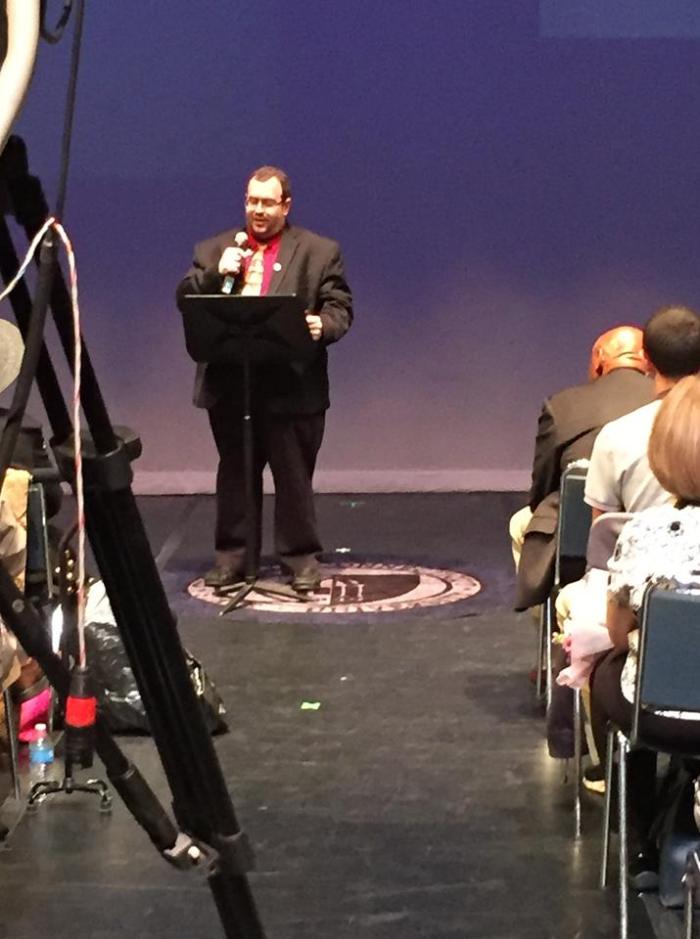
But when I first entered the Welte Auditorium in the Central Connecticut State University campus, it was truly frightening.
The building could hold hundreds, perhaps thousands of people. Yet organizers had limited the audience to only a hundred. All the seats were up on the stage.
There was a little circular rug where we were to stand and the camera people were setting everything up.
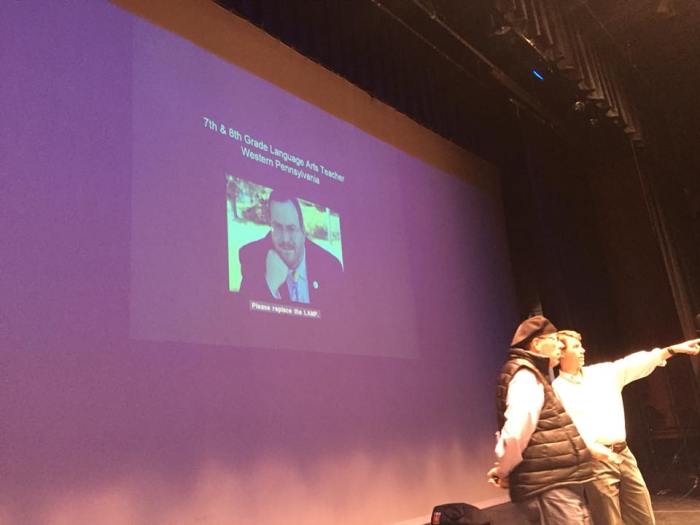
Behind us, a ceiling high blue-purple backdrop would showcase the TED logo and any slides we had prepared.
Which brings up an interesting distinction.
This was not a corporate TED event organized by the TED conference and sanctioned by their foundation. It was a TED “X” event, which means it was independently organized.
TED licenses its name for these grassroots X-events. There are a list of rules that organizers must follow. For example, all tickets to the event must be free. Contrast that with the corporate TED events where tickets go for thousands of dollars.
I was glad I was where I was. This was going to be the real deal – a thoughtful discussion of authentic issues. And somehow I was up there with these incredible thinkers and activists.
The moment came. Drs. Shaw and Casiano had already spoken. I got up from my seat in the front row to get my lapel microphone attached.
Jesse gave me a warm introduction letting everyone in on the secret of my tie – the design was a picture of my daughter repeated to infinity.
So I walked to my mark and started speaking.
It seems there was some sort of technical difficulty with the microphone. My voice didn’t appear to be coming from the speakers – or if it was, it wasn’t projecting very well. So I spoke louder.
Then Jesse came from the wings and gave me a hand mic and a music stand for my notes.
It took a moment to get used to handling the microphone, the clicker for my slides and my iPad (where I had my notes), but I got the hang of it.
And I was off and running.
I said it. I said it all.
The audience certainly didn’t seem bored. All eyes were on me. A few heads were nodding in agreement. Some faces seemed stunned.
When I ended, there was universal applause. A few folks patted me on the back when I got back to my seat and shook my hand.
And that was it.
I thoroughly enjoyed the remaining presentations but it was hard to concentrate in the post-TED elation.
Jones and Nance were probably the closest to what I was talking about and we got along like we’d known each other for years.
When I got back to the hotel, I felt elation and exhaustion in equal measure.
I had done it.
After months, years of planning, it was over.
Jesse tells me the video will be on-line in a matter of weeks. (I’ll revise this post with the video when it goes live.) Though he did mention that one point in my presentation made him a bit nervous – I had called out Bill Gates for his role in the destruction of public schools. However, Gates is a big donor to TEDs. Jesse half-jokingly said that the TED folks might take issue with that and refuse to upload my speech.
But whatever. I told the truth. If that gets me censored, so be it.
This will be something I’ll never forget.
I’m sorry this article has gone on so long, but there was much to tell. It’s not every day that someone like me gets such a stage and such a potential audience.
Hopefully, my video and my speech will be seen by many people who have never heard of this fight before. Hopefully it will open minds and stoke people to act.
And hopefully the mic issues at the opening won’t be distracting.
Thank you for following my blog and being there with me on this incredible journey.
I left nothing important unsaid. I gave it my all.
























 gadflyonthewallblog