White Privilege, Public Schools and Ugly Christmas Sweaters

Screen Shot 2017-12-22 at 1.02.56 PM

This is one of those stories that’s been bothering me for a while.


I won’t say it happened recently or at my current district, but after teaching in the public school system for almost two decades, you see a lot that most people never hear about.


So it was almost Christmas break and my middle school students were shuffling in to homeroom.


One of the girls turns to me and says, “Mr. Singer, am I okay to wear this?”


Hold up. I teach English.


I am not a fashionista or even particularly clothes conscious. So this question took me by surprise.


In the split second it took me to comprehend what she was asking and focus my eyes on the girl, I was expecting she might have on something too revealing or perhaps had an inappropriate slogan on her shirt or a marijuana leaf.


But no. She had on a simple blue long sleeve sweater with a red Superman symbol in the middle.


I was about to say that what she was wearing was perfectly acceptable, but then I remembered the dress code.


It was a new directive from the school board, and it was – frankly – a horror show.


We used to have a perfectly fine dress code that only made students refrain from clothing that was dangerous, inappropriate or sexually explicit. But then someone on the board heard about a neighboring district that modeled itself after a private school academy – so they had to do the same thing here.


It was beyond stupid. Only certain colors were allowed. Only certain kinds of clothing. No designs on t-shirts. And on and on.


I frankly paid no attention to it. But administrators did.


Though they rarely punished students for being late to class, improperly using cell phones or dropping an f- bomb, they swept through the building every morning to make sure every student was undeniably in dress code – to the letter.


And if a child was wearing a verboten item of clothing! Heaven forbid! That child was sent to in-school suspension for the remainder of the day unless a parent brought a change of clothing.


The same students would sit in “The Box” for days or weeks while their education was in suspended animation because they just couldn’t figure out which clothes the school board considered to be appropriate. (Or more likely they wanted a vacation from class.)


So when this girl – let’s call her Amy – asked me about her outfit, it was a pretty serious question.


And a difficult one.


Normally the Superman symbol would violate dress code, but I remembered that since it was only a few days before the holiday break, as an extra treat, students had been allowed to wear an “ugly Christmas sweater.” It was either that or conform to the usual dress code.


So all around me children were wearing fluffy red and green yarn creations sporting snowmen, Christmas trees and Santas.


But Amy was wearing a big red S.


By any definition, that’s not a Christmas sweater, and if the administrators wanted to take a hard line on the rules – and they usually did – she was out of dress code.


I told her what I thought. I said I had no personal problem with it and wouldn’t report her to the principal, but if she had a change of clothes, she might want to consider using them.


She didn’t.


And even if she did, it was too late. An administrator barreled into the room and proceeded to examine each child’s clothing.


Amy took her backpack and put it on backwards so that it covered her chest and the offending S.


Even that didn’t work.


When the administrator got to her, he asked to see what was under her backpack. She sighed and showed him.


But miraculously he said, “Okay,” and moved on.


Amy and I both breathed a sigh of relief. She was saved and wouldn’t have to spend the rest of the day in our school’s version of prison.


Before we could get too comfortable though, the hushed silence was broken when the administrator started screaming at another girl in the back of the room.


“That is not in dress code, and you know that’s not a Christmas sweater!” he screamed, cords standing out on his neck.


“How many times have I told you, but you think you can get away with anything…” and he continued to yell at her as she stomped out into the hall and presumably her locker.


And as she left, I saw that he was right. The girl he was yelling at – let’s call her Jada – was not wearing a Christmas sweater. She was wearing a plain gray and white flannel shirt. I don’t know how or why, but I guess that violated the dress code.


And for this offense she spent the day in in-school suspension.


I guess that’s not really Earth shattering, but it really bothered me.


It just seemed so unfair.


Jada was by no means a perfect student. But neither was Amy.


They both frequently broke rules and did pretty much what they wanted. They both could get an attitude, be catty, and mean.


However there was one distinguishing difference between them that immediately jumped to your attention – the color of their skins.


Amy was lily white. Jada was chocolate brown.


Now I’m not saying this administrator – who was white, by the way – was a virulent racist. I don’t know what went on inside his mind or heart.


In fact, I’d always thought of him as a fair-minded person who did his best to be impartial and treat students equally.


However, here was a case where he got it dead wrong.


Did he let Amy go because she was white? I don’t know. Did he come down on Jada because she was black? I don’t know.


My guess is that he was moving in a fog. He went to at least half of all the homerooms in the building checking each child to make sure they were in dress code. For some reason, when he looked at Amy, what he saw didn’t set off alarm bells. When he looked at Jada, it did.


Perhaps he remembered that Amy’s dad was a local cop and he didn’t relish having to call the police station to tell the officer that his daughter needed a change of clothes. Perhaps when he looked at Jada he was reminded of all the times she had been written up or defiant.


I say again – I don’t know.


However, there is little doubt in my mind that this is an example of white privilege – in action if not in intent.


The administrator gave Amy the benefit of the doubt because of her whiteness and came down on Jada because of her blackness.


This may not have been at the forefront of his mind – it probably wasn’t – but I believe that somewhere in his subconscious, racial attitudes and preconceptions played a part in this snap decision.


If I had taken him aside and mentioned it to him, perhaps he would have reconsidered. But probably not since I was just a subordinate.


Perhaps later after school over a few drinks he might have thought better of it.


But this kind of thing happens all the time.


White people make snap decisions about people of different races based on these same shadowy, unexamined racial preconceptions.


And in each case, the beneficiary is invariably the white person and the loser is the black person.


That’s white privilege. People like me and Amy get the benefit of the doubt, while people like Jada and the majority of my other students don’t.


It’s something we, white people, need to acknowledge.


I’ll say one more thing about dress codes.


I accept that they are necessary in a public school setting.


It’s difficult to teach if students parts are hanging out, if they’re displaying coded messages on their chests, have advertising or rude statements on their clothing.


I once reported a girl for wearing a shirt that said “WTF.” She didn’t realize that I knew what the acronym meant. Another time I reported a student for wearing flip-flops. They were dangerous because kids could trip and fall but also the incessant slapping of plastic against heels drives me bonkers.


But other than that, I rarely get involved in dress codes.


Frankly, I think too strict a restriction on what students wear and too stringent enforcement of such policies does more harm than good.


It’s the school equivalent of broken windows policing. Instead of lowering crime by cracking down on the little stuff, too punitive severity in a dress code teaches kids that rules are arbitrary. Moreover, it creates fear and distrust of authority figures.


And – intentionally or not – it is a mechanism for enforcing white privilege.


Anytime I’ve had to oversee in-school suspension, there have been a disproportionate number of students of color in there for dress code violations than white students.


I know that’s not scientific, but it’s the data that I have.


In fact, I strongly suspect that discipline based on dress code enforcement is rarely reported to the state or federal government because it would show a major uptick in discipline against black students. It would further prove that minorities are written up more than white kids and get more strict punishments.


Standardized dress is as bad as standardized tests. We shouldn’t demand all our children dress alike and conform to a nonsensical norm.


Especially when the norm is whiteness.


Ugly Christmas sweaters, indeed!


I mean how white can you get?

Will the U.S. Follow New Zealand’s Lead and Repeal National Academic Standards?


I-am-more-than-just-a-test-score-1024x683


Kiwis don’t like corporations telling them what to do.


Especially when it comes to educating their children.


That’s why this week, New Zealand’s Education Minister Chris Hipkins announced that schools in the pacific island nation would no longer need to use the national academic standards mandated by the government for the last decade.


“I don’t think anyone will be surprised that we are ditching a failed experiment,” he said.


“We want teachers focused on less testing and more teaching because that’s the way we’re going to improve students’ progress.”


I pause at this point for American readers to catch their breath.


Yes, a national government just reversed course on standardized, canned, one-size-fits-all academic standards for all students in its public schools.


Yes, they had spent millions of dollars to create, roll out and enforce the standards.


But now they see the results have been less than expected and they’re changing their collective minds.


Shocking, I know.


If only we still did things like that in THIS country.


But wait, there’s more.


Why exactly did New Zealand turn against its national standards?


Did parents hate them?


Yes.


Did kids hate them?


Yes.


Did teachers hate them?


Yes.


All things that could be said of our own Common Core. But was there more to it?


Yes.


In short, New Zealand’s national standards weren’t helping kids learn. In fact, they appeared to have the exact opposite effect.


New Zealand children’s performance on international tests dropped significantly since the standards were introduced in 2010.


And publication of these results showing 10-year-old’s reading achievement taking a nosedive since the standards adoption ignited an already smoldering public outcry.


New Zealand’s average score on the Progress in International Reading Literacy Study (PIRLS) had been steady for 15 years, but fell dramatically at the end of 2015. In short, New Zealand went from 23rd to 33rd out of 50 countries.


Funny.


The US has had a strikingly similar result on the same test with the same age children since the mandate to use the Common Core.


The PIRLS is an assessment given to fourth-graders in schools around the world every five years. In 2016, the average score for US students dropped from fifth in the world in 2011 to 13th. And the drop wasn’t merely perfunctory. It was “statistically significant” according to test organizers.


The biggest drop was for the lowest-performing students, what the organizers considered a sign that we’re providing much greater support for economically advantaged children than for underprivileged ones.


Why is this important?


Because Common Core was introduced across the nation in 2010-11. These fourth grade students were the first to be educated using the Core since Kindergarten, and far from creating a boost in achievement, it opened a chasm.


Reading scores went down just as they consistently have done time-and-time-again since we started using the standards.


Scores go down on state tests. National tests. International tests.


Meanwhile the test makers and their proxies keep telling us the problem is that the standards are simply more rigorous and it just will take time for our children to get up to speed. Meanwhile their publishing and software subsidiaries sell us hundreds of millions of dollars worth of new text books, new computer programs, new devices, new apps, new “specialists” and consultants offering professional developments, etc.


Choo! Choo! The gravy train is rolling. We can’t let something like international test scores derail the money train!


Keep in mind, this is the same international test and the same age group of children that caused a revolution in New Zealand.


Will our response be the same?


Probably not.


New Zealand’s authentic reform resulted from a political change. The National Party was replaced by the Labour Party, and repealing national academic standards was part of their platform.


It marked a sharp divide between the philosophies of both groups.


The National Party wanted more testing, more data, more standardization, more holding funding hostage to test scores – just like both Republicans and Democrats in the US.


However, the New Zealand Labour Party ran on significant reductions to standardized education, substantial cuts to standardized testing, repealing national standards and considerable investment in students, schools and teachers.


We in the US simply have no political equivalent.


There is no political party – right, left or centrist – that puts the needs of children, parents, teachers and working people at the center of its platform.


Both the left and right take billions of dollars in campaign contributions from the testing and privatization industries and thus support policies that serve the interest of their donors over their constituents.


There is a tremendous political opportunity here for one party to change course and support a winning strategy.


Republicans tried it in 2016 by lambasting Common Core and then quietly forgetting they could do a thing about it at the state level every day since.


Including today.


Admittedly their education policy is incoherent since they support every standardization and privatization initiative on record so long as a black President didn’t touch it. And even then their opposition melts away when they have the power to do something about it but no one’s looking because the President is too busy playing nuclear chicken with North Korea on Twitter.


Imagine if politicians promised to fix something and then had the courage to actually do it!


It worked in New Zealand.


It’s worked in many places all over the world.


Why can’t it work here?


Betsy DeVos – Extreme Image Makeover as Champion of Special Needs Children

Screen Shot 2017-12-11 at 4.21.29 PM


Meet Betsy DeVos, Champion of Students With Special Needs.


At least that’s who she’s pretending to be this week.


The wealthy Republican mega-donor who bought her position as Secretary of Education published an article in the current issue of Education Week called “Commentary: Tolerating Low Expectations for Students With Disabilities Must End.”


It was almost like she expected us all to forget who she actually is and her own sordid history with these kinds of children.


Up until now, the billionaire heiress and public school saboteur always put the needs of profitizers and privateers ahead of special needs children.


During her confirmation hearing, she refused to say whether she would hold private, parochial and charter schools receiving tax dollars to the same standard as public schools in regard to how they treat special education students. Once on the job, she rescinded 72 federal guidelines that had protected special education students.


But now she’s coming off like a special education advocate!


What a turnaround!


It’s almost like David Duke coming out in favor of civil rights! Or Roy Moore coming out in favor of protecting young girls from pedophiles! Or Donald Trump coming out in favor of protecting women from crotch grabbing!


It begs the question – who exactly is she trying to fool?


Does Education Week really expect us to buy

this crap? Or has the so-called corporate media enterprise simply caved to the Trump administration’s demand to publish a puff piece for rubes without any journalistic integrity?


Real journalists might have published this BS, but only after giving readers the proper context.


Not Education Week. The only nod toward objectivity was inserting the word “Commentary” in the title of DeVos’s article.


It’s almost like saying – DeVos ALLEGEDLY champions students with special needs.


Give me a break.


She’s championing a feel good decision from the US Supreme Court from March. Way to get on that, Betsy!


Moreover, the decision isn’t exactly substantive.


It basically says that public schools need to ensure their special education students make more than minimal academic progress.


Great! Who doesn’t want that?


Has Congress jumped on this decision to increase federal aide to help public schools meet this requirement?


Nope.


And neither is DeVos calling for any additional federal help. In fact, her administration is proposing CUTTING federal special education funding.


Yet when the Individuals with Disabilities Education Act (IDEA) was enacted in 1975 by the Gerald Ford administration, the federal government was supposed to fund 40% of the cost of all special education students. It has never met that promise.


Today, the federal government only shoulders 15.7% of the cost with the states and individual districts picking up the rest.


This is extremely unfair.


It costs roughly twice as much to educate a special education student as a non-special education student. Yet the numbers of special needs students are on the rise.


According to the U.S. Census Bureau’s 2015 statistics (the most recent available), students with special needs account for 8.8% of the population. That’s up an additional 100,000 students from the previous year.


And the areas with the largest increase of special needs students are the most impoverished.


So we’re expecting the poorest communities to take up the largest percentage of the tab.


There are several bills in Congress demanding the federal government increase funding to the 40% threshold, but DeVos didn’t see fit to mention them.


To her, money is a thing only worth being lavished on private, parochial or charter schools.


Instead, she mentioned “personalized” education as a remedy for special needs students in public schools.


She wrote:


“No two children are the same. Each has his or her own unique abilities and needs. Personalized, student-centered education can help all children thrive, especially children with disabilities.” (Emphasis mine)


Though few people really disagree with this statement, the use of the word “Personalized” sets off alarm bells.


The term has come to mean “personalized learning” or “competency based education” which is code for making students sit on a computer or a device for hours at a time completing stealth assessments. These are programs made to look like video games that really just assess the same standardized material on the typical fill-in-the-bubble high stakes test.


And the results of these assessments are likewise used against schools and students as an excuse to privatize and strip them of local control, legal protections and mandated transparency.


There are authentic ways to use technology to help kids learn, but the rush by corporations to cash in on this emerging market has been largely unregulated, unstudied and unchallenged.


DeVos has already noted her commitment to edtech solutions to academic problems.


At a conference for edtech investors earlier this year she said:


“We’ve just scratched the surface in the role technology can play. I only have to look at my young grandchildren to see how powerful tech is. It is a thousand flowers, and we haven’t planted the whole garden.”


Another place she can look is her investment portfolio.


Both she and her husband have a $5 million and $25 million investment in a shady “brain performance” company called Neurocore. DeVos even sat on the company’s board until she got her job as Secretary of Education and had to step down.


The company claims to be able to train young brains to think better by hooking kids up to hats with wires hanging out of them.


I’m not kidding. The whole things goes against just about every peer-reviewed study in the field of neuroscience, but DeVos claims her company can help cure attention-deficit/hyperactivity disorder, autism, anxiety, stress, depression, poor sleep, memory loss and migraines.


In other words, hooking kids up to machines of dubious scientific value is the cure for special education.


This is where we are people.


Our government is run by frauds and hucksters.


And the media calmly gives them an unchallenged platform to spout whatever nonsense they like with little to no skepticism.


So Betsy DeVos is a champion for students with disabilities, huh?


File that under B for Bullshit.


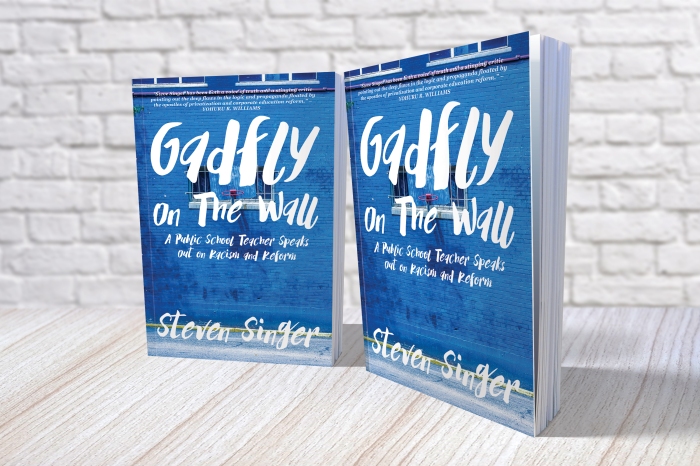
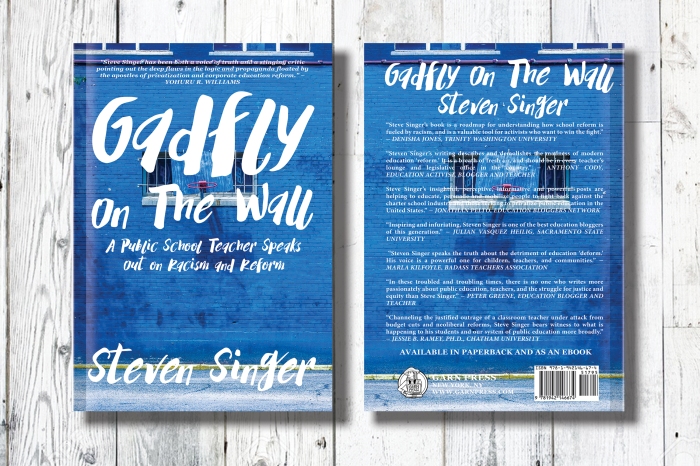
Like this post? I’ve written a book, “Gadfly on the Wall: A Public School Teacher Speaks Out on Racism and Reform,” now available from Garn Press. Ten percent of the proceeds go to the Badass Teachers Association. Check it out!

book-4

Two Theories Why Facebook Keeps Blocking Me When I Write About School Privatization

 AdobeStock_115924725-1080x675 

Facebook blocked me.


Again.


What did I do?


Did I post Russian-sponsored propaganda?


Nyet.


Did I post Nazi or racist memes?


Nein.


Did I post fraudulent or debunked accounts of factual events?


No.


So what did I do?


I had an opinion.


I took that opinion and wrote about it. I backed it up with facts, analogies, literary references and examples from my own experience as a classroom teacher in public school.


I took all that, wrote it up in a blog called “The False Paradise of School Privatization,” and posted it on Facebook.


It was the same kind of thing I do several times a week.


Write a blog. Post it on various Facebook pages and on Twitter.


And wait to see if anyone reads it.


But this time – BOOM!


I hadn’t even posted it to a handful of pages before the cyber arm of Mike Zuckerberg’s robo-security came down on me.


The same thing happened in October when I wrote an article called “School Choice is a Lie. It Does Not Mean More Options. It Means Less.”


I had hoped that that first time was just a fluke or that by now I had since sufficiently proven myself to be a human being and not some nefarious bot.


But no such luck.


After posting my latest article a few times on Monday, I got this message:


“ACTION BLOCKED


You have been temporarily blocked from performing this action.”


And I got a choice of clicking on:


“This is a mistake”


Or


“OK”

IMG_8706

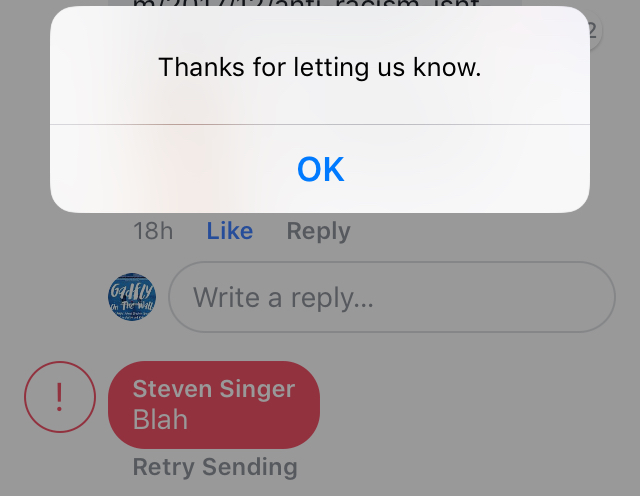
So I clicked on “This is a mistake,” and got the following:


“Thanks for letting us know.”


My only choice was to click “OK.”

IMG_8707

At some point I got a message telling me that I was blocked until Dec. 11 – a full week from my offense.


And now I have limited use of the social media platform.


I can still see posts.


I can like posts.


For some reason, I can even post and comment on my own page. But I can’t comment or post on other pages without getting the same error message.


At least I can’t do it consistently.


I’ve experimented and found that sometimes I can share posts to different pages. Sometimes I can’t.


It’s a bizarre, wonky system.


And it gets in the way of my work as an education blogger.


Facebook has more than 1.5 billion accounts. That includes more than 80% of all Americans.


Sharing my blog on the site gets me more readers than anywhere else.


Twitter is great and certainly more free. But when you push out a tweet, no one sees it unless they’re looking at their feed at that exact moment. Unless it gets retweeted – or you’re a famous unhinged former reality TV star turned President, then people seek out your own personal brand of nuclear-apocalypse-threatening madness.


So why does this keep happening to me?


I have two theories.


1) I am being purposefully censored by Facebook.


2) Facebook algorithms are targeting me because of how I post.


Let’s look at the first theory.


Could someone be actively censoring me?


Yes.


The proposal has a certain plausibility because the powers that be at Facebook undoubtedly disagree with what I have to say.


Mark Zuckerberg, Facebook’s founder, is a huge supporter of edtech, standardized testing and school privatization. He’s spent hundreds of millions of dollars trying to make public schools rely more heavily on high stakes tests, evaluating teachers on their students’ scores and pushing Personalized Education software packages on public schools. And when that doesn’t pan out, he’s even backed his own charter schools to do the same.


But that’s not all.


Since early January of this year, he’s had Campbell Brown on the job as the arbiter of truth for his on-line platform.


That’s right.


Brown, a school privatization lobbyist and former NBC and CNN personality, heads Facebook’s News Partnership Team.


The newly created position was part of Zuckerberg’s attempt to limit fake news on his social media platform while prioritizing information in the mainstream media.


What exactly is fake news? Whatever Campbell Brown says it is.


This is quite a lot of power to give one person, especially someone who has a reputation for partisanship.


Brown, after all, co-founded a charter school propaganda network called The 74, funded – unsurprisingly – by Betsy DeVos, Republican mega-donor and current Secretary of Education.


After leaving the anchor’s desk, Brown has had a second career helping corporations destroy public schools and public school teachers.


And she does. Not. Like. Me.


Let’s just say we’ve gotten into a few Twitter skirmishes.


When she became the face of a New York lawsuit attacking teacher tenure in 2014, she received a tidal wave of public backlash. So she went on the Colbert Report to complain about how those fighting for workplace protections for themselves and their students were “silencing the debate” on how best to reform public education.


I responded with a blog called “Shhh! Who’s Silencing the Debate on Real Education Reform” claiming that Brown was actually doing the very thing she claimed to be decrying in shutting out teachers’ voices and rights.


She responded by cherry picking her rudest critics and tweeting “Sorry Steve but sadly this is not what I characterize as debate,” as if I had had anything to do with these comments.

IMG_8708

As if any movement should be judged by its most extreme elements.


As if attacking someone’s job, someone’s kids and their future was fine so long as you did so with a smile and a polite comeback.


I don’t condone personal attacks, but I certainly understand them. In any case, Brown used the extreme fringes of her critics to condemn us all and conveniently refused to engage us – even those who had been unceasingly polite.


That lawsuit eventually failed, but Brown somehow landed on her feet.


Now she’s the one who gets to choose truth and falsity on Facebook.


Could she be actively working against people like me?


Yes.


Could she be directing Facebook’s programmers to select against posts that are negative to her pet projects?


Yes.


But there’s no way to know if she’s actually doing it.


Which brings me to my second theory.


Perhaps mindless Facebook algorithms are targeting me because of how I post.


I do, after all, try to post my articles on as many pages as I can.


They’re mostly pages focused on education and education policy with a few political and anti-racism sites thrown in, too.


Maybe I’m posting too quickly.


I might be triggering one of Zuckerberg’s bots to think I’m a bot, too, spamming up the works with advertising.


However, there’s a few problems with this theory.


Let’s say it’s true.


Why would that, alone, be reason to block me?


I’m not posting advertisements. I’m not asking for money. My blog doesn’t sell adds other than those WordPress puts on there, itself, so I can keep the page for free.


If an algorithm is stopping me because it thinks I’m unfairly selling something, it’s the result of some badly written code, indeed.


When programmers write code, that’s not impartial. It betrays their values. It betrays certain decisions about what’s acceptable and what isn’t.


For instance, I keep getting advertisements from Facebook asking me to pay money to the social media network so that they’ll post my articles on other people’s site for me.


I get reminders like “Boost this post for $3 to reach up to 580 people.”

IMG_8712

Oh, really?


So I’m blocked because I posted my own writing to sites that have accepted me as a member and whose membership includes many I consider friends and colleagues. But for a fee, Facebook will post that same article to various sites filled with people I’d consider to be complete strangers.


Somehow that doesn’t “violate community standards” – the reason they said they blocked me in October.


This is very telling.


It seems to indicate that there is nothing wrong with what I’m doing, per se. It’s just that Facebook wants to encourage me to let them do it for me – so they can monetize my account.


They’re stopping me from doing this on my own, because they think I’m a sucker who should pay them for the right to communicate with others.


And that’s a very real possibility.


These blockages may not be political. They may be a simple marketing strategy.


So what can I do about it?


Well, first I need to wait a week until my account is unfrozen and I get back all the features Facebook users usually enjoy.


Then I can try to go back to the way things were posting my articles at all my favorite virtual watering holes.


Only slowly.


Much more slowly.


I figure if I only post once every five minutes or so, I can have my article at all the places that seem to like having them in about the course of an evening.


But I have a life, damn it!


I can’t spend the twilight hours posting and waiting and posting and waiting.


I guess another alternative is to rely on friends to post for me.


Spread the love.


Have others circulate my articles far and wide.


And that’s a great strategy. It’s very hard for Facebook to do anything about it.


But it requires me to impose on others. I don’t like doing it.


My readers, friends and supporters have lives, too.


They have more important things to do than post my writing all over the Internet.


So where does that leave me?


I’m not sure.


If I continue as I have, I’m bound to be blocked and thrown in Facebook Jail again.


Even if I don’t, I’m at the mercy of the wealthy elites who control the network.


And if the FCC does away with Net Neutrality, as they’re threatening to do in a matter of days, it may not even matter.


Regardless of where I post on Facebook, my blog site will probably be slow to the point of molasses and maybe even shut down entirely.


This is the brave new world of the plutocracy unrestrained.


This is American fascism triumphant.


I am only a single point of the resistance.


My voice is only as powerful as those who share it.


If Facebook, Twitter or WordPress somehow takes me down, I’ve written a book, “Gadfly on the Wall: A Public School Teacher Speaks Out on Racism and Reform,” now available from Garn Press. Ten percent of the proceeds go to the Badass Teachers Association. Check it out!

book-1

Killing Net Neutrality Would Muzzle Many Teacher-Activists 

thumbnail_c7tcqv4e6khwocrbse2l

As a blogger, I’m a big fan of net neutrality.

If the communications giants get to favor or block particular Websites, people-powered blogs like this one probably would become isolated and irrelevant.

As it stands, the Federal Communications Commission (FCC) is expected to vote Dec. 14 to undo strict regulations on Internet service providers like Comcast and Verizon that stops them from slowing down or blocking any sites, apps, or otherwise deciding which content gets to users faster.

If the Republican controlled five-member committee votes as expected, it would muzzle free speech.

It would effectively stifle hundreds, thousands of grassroots activists who’ve taken to the Web to educate and protest against the plutocracy strangling our democratic freedoms.

Think about it.

Close your eyes and imagine a United States where you couldn’t access your favorite Websites without paying a fee or – as in China – maybe even at all.

Want to know why standardized testing is harming our children and their schools? Sorry. That costs extra.

Want to know why Betsy Devos’ latest plan to give your tax dollars to Roy Moore’s Christian Fundamentalist Middle School and Dating Center endangers child welfare? Sorry. That information is no longer available.

Sure, you could probably look it up in the library and find it in a book, but that requires a complete change in how we consume media.

Most of us get our news on-line. We don’t read paper newspapers or glossy photo-print magazines. Books, when we read them, are often occasional pleasures or e-texts.

Searching out such material would take a paradigm shift back to the way we used to do things 10 or 20 years ago. It wouldn’t be impossible, but it would be onerous.

Remember traveling everywhere with a pile of books weighing down your bag, or a newspaper and magazines folded under your arm? People seeking such information would really need to want it.

Moreover, articles published in this way would almost surely become out of date quickly at least in regards to particulars. You can easily write something about the evils of charter and voucher schools in general that will be true for years if not decades, but it won’t as easily apply to individual charter and voucher schools by the time it’s published and been on the shelf for a while.

Additionally, writing and publishing such articles would become increasingly more difficult. Unless individuals or groups of activists bought up archaic printing presses or somehow funded mass media campaigns at Kinko’s and there were likewise an as yet undiscovered distribution engine that could disperse such periodicals across the country and the world – unless all of that, the resistance would be relegated to mostly scholarly tomes.

Take it from me: writing a book is not easy.

I just published my first volume of some of my best blog articles for Garn Press called “Gadfly on the Wall: A Public School Teacher Speaks Out on Racism and Reform.”

I am embarrassingly proud of it, but this would not work for everyday activism.

Even though most of the articles were already written, it took a team of us months to revise them, insert end notes, edit, format, design a cover, market and all the other multidinous things that go into the process.

Whereas, with a blog, I can just write it and press “publish.”

The result isn’t as neat. It isn’t as error-proof. There’s bound to be spelling and grammar problems. It doesn’t pack nearly the authoritative punch. —But it’s so topical and subversive that it can slice through steel.

Campbell Brown can’t publish a billionaire-funded diatribe against those greedy teachers and their damn unions and their precious tenure without an army of teachers taking to the Web and showing her the error of her ways.

Bill Gates can’t send his well-paid trolls off to write op-eds praising Common Core without a grassroots tsunami of educators, parents and students responding with scores of counternarratives throughout the blogosphere.

And it’s net neutrality that allows us to do it.

The democratization of information made possible by the free Internet has greatly empowered the voices of the wise but penurious.

You no longer need a printing press or a think tank or a media empire to get information before the public.

Sure this means that even the lunatic fringe gets a voice in the conversation that is American culture, but it also allows ideas to win or lose based more on merit than money.

If enough people share an article on-line, it gets read. People see it. They know it.

False information is eventually found out, disproven and neutralized. But a factually-based critique of bad policy? That can move mountains. It can change the world.

And it has!

Think of how even neoliberal policymakers have rushed to claim they’re in favor of reducing standardized testing. Longtime standardization supporters like former President Barack Obama had to distance themselves from their own policies or face the torches and pitchforks of moms and dads everywhere.

Think of how Democratic and Republican partisans clamored over each other to denounce Common Core. Heck! The movement was so successful President Donald Trump even jumped on the bandwagon and used it as a rallying cry to help install himself in office.

And think of how the reaction to Trump’s dismal and dimwitted Education Secretary, Devos, caused a stampede away from school vouchers and even to some extent charter schools. Even longtime champions of privatization like Jeb Bush and Cory Booker are afraid to offer even a tentative thumbs up for fear of the Web’s blitzkrieg of Tweets, Facebook posts, blogs and other shade.

None of this would be possible without the Internet and the blogosphere.

None of this would be possible without net neutrality.

It’s no wonder Trump and his cronies want to destroy it. The open communication and debate on the Internet is a clear and present danger to his policies.

It is dangerous to the neoliberals and conservative fascists alike.

Though the movement fighting against corporate education reform has been rightly critical of unlimited technology for technology’s sake in our classrooms, that same confederation owes a great debt to technology for its current power.

We meet on Facebook and plan actions to be conducted IRL – In Real Life. Groups like the Badass Teachers Association, the Network for Public Education and United Opt Out use the technology to spread truth and question authority.

If the life line of net neutrality is severed, so will much of our activist networks.

I know we’re all concerned about competency based education, Teach for America and toxic testing, but we have to make room for net neutrality, too.

The 99% rely on it for the free exchange of ideas and the unhindered expression of our speech.

If the Trump administration crushes that venue, it will seriously weaken our ability to resist.

So before that day comes, exercise your rights.

Raise your voice for net neutrality – before it’s too late.


Please go to www.gofccyourself.com and urge the FCC to keep Net Neutrality.

My Students Are Addicted to Screens

07BRODY-facebookJumbo

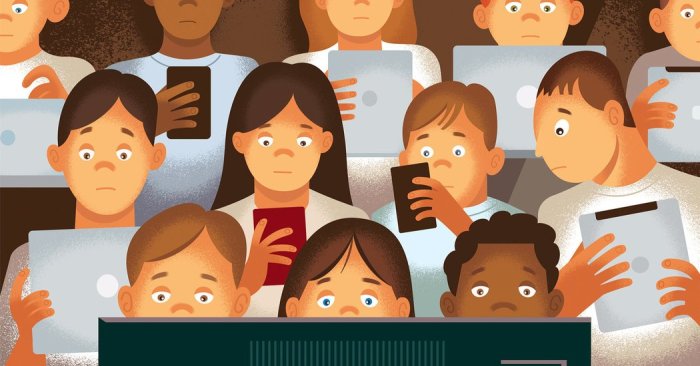
Michael sat at his desk with ear buds inserted, an iPad balanced in front of his eyes and an old fashioned paper book open on his desk.

His head was bopping and weaving. His eyes were transfixed on a YouTube video of an animated soldier blasting away bad guys. And his book was laid out in front of him, largely ignored.

This was during our class’ sustained silent reading time – a period of 15-20 minutes where my 7th grade students were supposed to read self-selected books. Eventually, they’d have to complete a project, but today all they had to do was read.

Still, many used the time the same way as Michael did – lost in cyberspace, merely pretending their eyes gloss over the page.

“And what did the teacher do?” I hear some readers say indignantly.

“If you allow this type of behavior, you’re worse than the child doing it.”

So come with me as I redirect Michael.

“Hey, buddy,” I say.

“Huh?” he responds as if awakened from a dream.

“Are you reading?”

“Uh. Yeah.”

“You’re not just watching that video and ignoring your book?”

“Nope,” he says now fully awake. And he proceeds to give me a canned summary of the text that he memorized from the Internet.

But I’m still skeptical.

“I’m going to take your iPad away just for SSR time,” I say.

BUT WHY!? I’M READING!”

“I just want you to be able to concentrate on what you’re reading.”

And as I gently pry the iPad from his curled fists, he stands up and gives me a look of pure hatred.

This is a look from a 7th grade boy who’s considering violence.

It’s the same look you’d get trying to take away a dog’s bone, or an addict’s crack pipe.

It truly depends on the child what happens next. Some will regain control, slam down into their seats and sulk. Others will whine and cause a scene. And some will lose all control and lash out.

This is what teachers deal with every day when it comes to technology in the classroom.

In point of fact, many of our children are addicted to their devices.
iPads, laptops, Smartphones – we might as well be giving them pills, joints and syringes.

According to Merriam Webster, addiction is defined as, “compulsive need for and use of a habit-forming substance… [characterized] by well-defined physiological symptoms upon withdrawal.”

For most students, their devices have become just that – a compulsion, the cause of a nearly irresistible impulse to check them, access them, use them to keep themselves entertained and plugged in.

With repeated use, it becomes habit forming, and separation from the device can lead to a kind of withdrawal.

From a neuro-psychological point of view, one wonders if repeated use is clinically damaging – especially to adolescent brains that have not yet fully formed.

From an educational point of view, one wonders if relying on such devices in class is pedagogically sound.

I’m not qualified to answer the first question (though it deserves much more study than it is receiving). But from my 15 plus years of experience in the classroom, I feel qualified to answer the second – and that answer is often a resounding “NO.”

In my kids’ everyday lives, this type of constant technology reliance doesn’t make them better students. It doesn’t give them access to more information. It makes them dependent on instant gratification and sensory overload.

Their minds are submerged in a soup of constant noise and conflicting demands for their attention. Stringing together thoughts and coming to reasoned opinions becomes increasingly difficult.

This isn’t to say that technology has no place in the classroom.

There are ways to use it that can enhance learning. However, in my experience these are NOT the ways it is being used most of the time. That takes, thought, planning, intention. Instead, many well-meaning administrators or school directors prescribe technology as an end in itself regardless of the goals of an individual lesson. They want to prove their buildings, schools or districts are cutting edge, and that only takes the constant use of technology – not surgical, intentional use.

It’s not that teachers don’t know how to apply it or don’t care. It’s that technology – especially the presence of a one-to-one device in the hands of every child at all (or most) times – creates more problems than it solves.

This is why the same people who invented these technologies strictly regulate them for their own children.

Bill Gates and Steve Jobs, two of the biggest tech titans in the business, famously limited screen time for theirs sons and daughters.

Gates, a Microsoft co-founder, refused to let his children have personal technological devices until they were developmentally ready for them.

“We don’t have cellphones at the table when we are having a meal,” he told the Mirror. “We didn’t give our kids cellphones until they were 14 and they complained other kids got them earlier.”

Today, most children get their own cellphones at age 10. And if their schools have one-to-one initiatives like mine, they have their own iPad as early as 5th grade with less but still substantial hours of usage as early as kindergarten.

Jobs, an Apple co-founder, also limited screen time for his children.

When asked if his children liked the original iPad shortly after it was launched, Jobs said, “They haven’t used it. We limit how much technology our kids use at home.”

In fact, according to Walter Isaacson, who wrote a near-definitive Jobs’ biography, technological devices were only allowed at prescribed times.

“Every evening Steve made a point of having dinner at the big long table in their kitchen, discussing books and history and a variety of things,” he said.

“No one ever pulled out an iPad or a computer. The kids did not seem addicted at all to devices.”

And this practice seems common among parents in Silicon Valley.

According to educators Joe Clement and Matt Miles, authors of “Screen Schooled: Two Veteran Teachers Expose How Technology Overuse is Making Our Kids Dumber,” those in the tech industry know the dangers of their own products on children.

A number of specialty Silicon Valley schools, say Clement and Miles, such as the Waldorf School, rely almost exclusively on low-tech tools to teach. This often means chalkboards and pencils. The emphasis is on learning interpersonal skills such as cooperation and respect – not the ins and outs of computer coding.

At Brightworks School, even the physical environment of the class is a tool to learning. Students attend class in treehouses and kids learn creativity by building things with their hands.

This is a far cry from the technological wonderland our kids are being sold by these kids’ parents.

No one really knows what effect it’s having on growing minds. However, psychologists are beginning to see alarming trends.

For instance, frequent use of social media makes an eighth-grader’s risk for depression 27% higher. Moreover, use of smart phones for at least three hours a day increases children’s risk of becoming suicidal. Some experts believe that increased use of technology has contributed to the teen suicide rate which for the first time eclipses the homicide rate.

We are jumping head first into an educational model that puts technological devices like a tablet at the center of learning.

Teachers assign lessons on the device. Students complete assignments on it. Projects are virtual as is research. Even conversations are conducted through a chat page, emails or messaging.

Why? Not necessarily because of any proven link to increased academic results. It’s because tech companies are marketing their devices to schools and students.

This is industry-driven, not pedagogically-driven.

There is an unquestioned bias that doing things with technology is somehow better simply because we’re using technology. However, an article written on a computer will not necessarily be better than one written with pen and ink. There are other factors involved.

Now Gates and company are pushing personalized learning objectives. Sometimes called competency based education, these continue to place the device in the center of what should be the student-teacher relationship.

Student learning becomes a video game and the teacher becomes a virtual avatar. Kids spend their time doing infinite standardized testing as if it were authentic education, yet it’s all on-line so it appears to be cutting edge. It isn’t.

It’s just another scam.

In my own classes, I’ve put the brakes on unquestioned technology. I only use devices, programs or applications that are (1) reliable and (2) when I know why I’m using them.

Even then, I find myself unable to even talk to students without beginning every lesson telling them to at least temporarily put their devices away so they can hear the directions.

Sure, I could give them a QR code to scan and get a written copy of the directions. I could upload a video for them to watch. But that limits direct feedback. It makes it more difficult for them to ask questions. And it makes it almost impossible for me to tell if 20-30 kids are actually doing the assignment before they turn it in for grading.

These are just kids, and like kids in any age they’ll take the path of least resistance. Often they’ll try to get through the assignment as quickly as possible so they can listen to music, or watch a video, or play a video game or chat on-line.

Lessons can be engaging or thought-provoking or spark the creative impulse. But you have to get students’ attention first.

That’s hard to do when they always have the option to crack their brains open over a virtual frying pan and watch it sizzle away.

To be fair, living in the modern world, we’re probably all somewhat addicted to technology. This blog isn’t written on papyrus and it isn’t being accessed in a hefty library volume.

I use social media – Facebook and Twitter mainly – to disperse it.

But there’s a difference between me and my students.

I’m an adult.

I know the concessions I’m making. I enter into this with eyes open. I have a lifetime of experience and knowledge with which to make such a decision.

Children don’t have that. They look to us to protect them.

We are their guardians. We’re only supposed to subject them to things that will help them learn, keep them healthy and happy.

But in our rush to be trendy and hip, we’re failing them miserably.

We’re letting business and industry take over.

It’s time to take a stand.

Our kids may be addicted, but we don’t have to be their pushers.

We need to get them clean and show them how to use this brave new tool with moderation and restraint.

School Choice is a Lie. It Does Not Mean More Options. It Means Less.

fake1


“A lie told once remains a lie but a lie told a thousand times becomes the truth.”

-Joseph Goebbels


Neoliberals and right-wingers are very good at naming things.


Doing so allows them to frame the narrative, and control the debate.


Nowhere is this more obvious than with “school choice” – a term that has nothing to do with choice and everything to do with privatization.


It literally means taking public educational institutions and turning them over to private companies for management and profit.


A FAKE DIFFERENCE AND A BIG DIFFERENCE


There are two main types: charter and voucher schools.

 
Charter schools are run by private interests but paid for exclusively by tax dollars. Voucher schools are run by private businesses and paid for at least in part by tax dollars.


Certainly each state has different laws and different legal definitions of these terms so there is some variability of what these schools are in practice. However, the general description holds in most cases. Voucher schools are privately run at (at least partial) public expense. Charter schools are privately run but pretend to be public. In both cases, they’re private – no matter what their lobbyists or marketing campaigns say to the contrary.


For instance, some charter schools claim to be run by duly elected school boards just like public schools. Yet the elected body is a proxy that gives over all management decisions to an appointed private board of company officers and a CEO. That’s not really the same thing as what you get at public schools. It’s a way of claiming that you’re the same without actually being it.


Likewise, voucher schools are subject to almost no regulations on how they spend their money – even the portion made up by tax dollars – but charter schools are subject to more state and federal oversight. This is why voucher schools can violate the separation of church and state – teaching creationism as fact – while charter schools cannot.


Yet, in practice, state and federal laws often allow charters much more flexibility than public schools and the state and federal government rarely checks up on them to see if they’re following the regulations. In fact, in many states, auditors are not even allowed to check up on charter school compliance unless specific complaints have been filed or long intervals of leaving them to their own devices have passed. So charters can also teach things like creationism as fact only more clandestinely.


In short, the differences between public and privatized schools is significant. Yet the difference between the two types of privatized education is more political and rhetorical than practical.


Despite these facts, when we talk about privatized schools, we ignore the real distinctions and focus on the fake ones. We overlook the salient features and instead describe privatized schools as vehicles for choice.


They’re not.


FAKE CHOICE


School choice.


Got choice?


Parents should have the freedom to choose the school their children attend.


But using “choice” as the ultimate descriptor of what privatized schools are and what they offer is at best misleading and at worst an outright lie.


They are essentially private businesses existing for the sole purpose of making a profit.


Yes, parents choose if they want their children to enroll in these schools. But they also choose if their children enroll in the neighborhood public school.


Critics say the public school option is not a choice because there is only one public school district in a given neighborhood. Yet isn’t it the parents who decide the neighborhood where they live? In most cases, even the wealthiest district has rental properties where people can move to take advantage of an exceptional school system.


Certainly the quality of a school shouldn’t be determined by a zip code. But this is an argument for funding equity, for providing each district with the resources necessary to educate the children in their charge, not an argument for privatization.


In BOTH cases, public and privatized schools, parents exercise choice. But the propagandists choose to call only one of them by that name.

And it is a misnomer.


Privatized schools – both charters and voucher schools – are under no obligation to accept all students who seek enrollment. Public schools are.


If a student lives in a public school’s service area, the district must accept that student. It doesn’t matter if educating that child will cost more than the average per pupil expenditure. It doesn’t matter if she is easy or difficult to educate, if she has a record of behavior or discipline problems, if she has special needs, if she has low test scores. The public school must accept her and give her the best education possible.


Privatized schools are legally allowed to be selective. They can deny enrollment based on whatever reasons they choose. Charter schools may have to be more careful about their explicit reasoning than voucher schools, but that’s just a restriction on what they say, not on what they do. The results are the same. If they want to deny your child entry because of her race, ethnicity, religion, sexual orientation, whatever – they can. They just have to put something more creative down as the reason why.


Vouchers schools don’t even have to give you a reason at all.


And charters have a multitude of ways to avoid accountability. They can simply pretend to have conducted a lottery. Or they can include an onerous series of demands for enrollment such as expensive uniforms, school supplies and parental volunteering at the school, to discourage difficult students from applying.


Moreover, even if they let your child enroll, they can kick her out at any time if she proves to be too expensive or it appears she’ll make the school look bad. This is why every year charter schools send a stream of struggling students back to the public schools just before standardized test time – they don’t want the students low test scores to reflect badly on the school – yet they’ll use the fact that they enrolled difficult students at the beginning of the school year to “prove” they aren’t selective!


That’s not choice. It’s marketing.


At best, it’s not choice for the parents or students. It’s choice for the operators of privatized schools.


WALMARTIZATION OF SCHOOLS


Critics will argue that these problems are a feature of the limited scope of so-called school choice programs. If there were more of them, the market would self-correct and many of these irresponsible practices would disappear.


Yet such a belief shows a complete ignorance of how business works in America.


The free market has not lead to more choice. It has led to consolidation.


When WalMart moves into an area, it doesn’t help boost the local mom and pop stores. It devours them. It’s a principle best described as the bigger fish eat the little ones.


Our system is designed to hide this fact by preserving separate companies with individual names and brands but that are all owned and operated by huge conglomerates. For instance, there are multiple newspapers and TV stations across the country all owned by a handful of huge corporations. The same with airlines, banks, pharmaceuticals, you name it.


That’s not choice. It’s the illusion of choice. And if privatization were given free reign over our public schools, we should expect nothing less.


If all or most of our public schools became privatized, after a short time we would have a handful of huge corporations dominating the field with near monopolies. Schools would be large charter and voucher chains, possibly with a variety of names and brands marketed differently, but providing pretty much the same generic services. It would be the WalMartiztion of education.


That goal is not the expansion of choice. It is the reduction of it.


MUSICAL CHAIRS


And what of those critics who claim school choice isn’t about privatization but about allowing students to attend even neighboring public districts?


First, this is rarely what so-called “school choice” programs do. And there is a very good reason for that.


It’s a terrible idea.


Let’s say you have three districts in your part of the state, one of which is exceptional and the other two struggle. If we allow students at the struggling districts to attend the exceptional one, what happens? You have a mass exodus to the exceptional district while the other two close due to lack of funding.


Now what? The one exceptional district has to somehow service more students than it can house and somehow create an instant infrastructure to meet their needs. Even under the best of circumstances, this is impossible. It would take years to do so, and in the meantime all students – even those who originally lived in the exceptional school’s immediate coverage area – will suffer.


Moreover, it ignores the realities on the ground. Why were there two struggling districts and one exceptional one? Almost always this is because of the wealth disparity between the three districts. The exceptional district probably serviced wealthier children. They have fewer needs than poor children. They have books in the home, less food uncertainty, less exposure to violence, racism and trauma.


Yet the rich district has an overabundance of resources to meet whatever needs its students have. It can levy higher taxes and thus spend more per pupil than the other struggling districts.


So when you combine the three districts, you end up being unable to continue spending the same amount per pupil. You probably have to decrease that spending and thus all students receive fewer services. However, at the same time, student needs for services increase because now you’re also trying to educate the more impoverished and racially diverse students from the two previously struggling districts.


No, even this kind of school choice doesn’t improve the quality of education. It degrades it.


The only solution is to provide each district with the funding necessary to meet students’ needs – whatever they are. That is the only way to increase the quality of education – not playing musical chairs with where students physically go to school.


SCHOOL CHOICE IS A LIE


At every level, so-called “school choice” is a lie.


It’s about preserving the status quo for the wealthy while providing substandard services for the poor and middle class.


It’s a power grab by the business community to profitize public funds set aside to educate children.


And perhaps the easiest way to combat it is the simplest: stop calling it school choice.


Call it what it is – school privatization.

‘Schools of the Future’ And Other Scams to Monetize Your Child

1963-jetsons-school


Do you feel it?

The future is coming.

There it is hovering just over the horizon.

You squint your eyes trying to get a quick peak before it arrives. But that rarely works. By the time it’s here, it’s never quite in the shape you expected.

Yet we always stop and listen to the prophets and prognosticators. Those google eyed figures, wearing trench coats and sandwich boards standing proudly on milk crates and cracking open their mouths to vociferously voice their “visions.”

They smell like B.O. There are insects in their hair. And their mouths spray halitosis as much as haloes.

Under normal circumstances, we wouldn’t trust them to park our cars, to give us directions, to do just about anything. But when it comes to “The Future” somehow we swallow their swill with conviction.

Through sheer force of charisma they convince us that their predictions will come to pass and if we’re smart we’ll invest in their brand of patented polished snake oil.

So we’ll be ready.

Just once I wish people would heed the skepticisms of the doubting Cassandras. But so it goes.

This week it’s “Schools of the Future.”

Everywhere you look it seems you’ll find some slickly produced inducement to “Rethink schools.” Some admonition to completely change public schools. Some empty promise in naked technology to save us all.

They’ll tell you that our public schools haven’t changed in a century. They’re set up for the agricultural past. Or schools are great for creating assembly line workers for the industrial revolution, but times have changed. And education needs to change with them.

Never mind that schools were never designed to supply any workforce. Their goal was – and is – to help the next generation become citizens capable of free thought.

But whatever.

This sales pitch about outmoded schools sounds really nice.

It resonates.

It makes us feel good.

Yes, I KNEW there was something wrong with my public school. That explains my own failures. I mean, I went through 12 plus years of public schooling and look at me! I’m not one of the handful of billionaires who own the world. It MUST have been the school’s fault!

Forget economic inequality, money in politics or any of that progressive crap! I could be sitting on top of the world with my boot firmly planted on the neck of everyone else – if only the public school had taught me right.

PLEASE!

But this is the comforting lie many folks tell themselves and one of the major reasons corporate school reformers get away with raiding public education. Their lies flatter white people’s vanity.

So billionaire Laurene Powell Jobs’ bought a four-network propaganda hour telling us to “rethink” high school while Education Secretary Betsy DeVos’ began her “Rethink Schools” publicity tour days later.

As if the thought never occurred to anyone else.

Rethink schools? What do you think classroom teachers do? We rethink every lesson every day!

It’s standard practice. We call it reflection. Some of us even keep reflection journals where we jot down things that worked and things that didn’t.

Haven’t these privileged fools ever logged on to the blogosphere? The Internet is fit to bursting with teacher blogs overflowing with ideas about how to change things up. This very blog has been pushing authentic reform after authentic reform – but the powers that be – people like DeVos and her billionaire philanthrocapitalist peers – aren’t listening.

You want to rethink schools? How about sitting down and shutting up?

Seriously.

Let the experts have a say for once.

Classroom teachers have much more experience than you do. We’re there every single day engaged in the actual practice of teaching children. You learn something about it by doing it for at least 180 days a year, for decades. And that’s not even counting the years of college preparation before even entering the classroom, the pedagogy, debate, and hard won wisdom of generations of teachers before us.

Meanwhile, all you have is a bank account.

You’ve hardly stepped foot in a public school to do more than spit on it. Nor did you likely experience it as a student or parent of students who go there.

You know nothing. And that’s no sin in itself.

Many people are ignorant of a great many things. I, for one, am completely ignorant of how to fly an airplane. That’s why I’d never dream of busting open the cockpit and preceding to tell the captain how to land the plane!

But you are not humble enough to admit your own ignorance. You think your money gives you the ability to do anything. After all, you DESERVE all those billions. It’s not an accident of birth or circumstances. You’re just that good, that special, that much better than the rest of us.

And what kind of brilliance do we get from these pampered prophets?

Here’s DeVos remarks to faculty and students at Woods Learning Center in Casper, Wyoming, from Sept. 12:

“…I’m issuing a bold challenge this week: it’s time to rethink school.

For far too many kids, this year’s first day back to school looks and feels a lot like last year’s first day back to school. And the year before that. And the generation before that. And the generation before that!

That means your parent’s parent’s parents!

Most students are starting a new school year that is all too familiar. Desks lined up in rows. Their teacher standing in front of the room, framed by a blackboard. They dive into a curriculum written for the “average” student. They follow the same schedule, the same routine—just waiting to be saved by the bell.”

All that money and the best you can come up with are that we should rearrange the desks!?

It just goes to show that you don’t know what goes on in real public schools.

My middle school classroom doesn’t have desks. We have tables that seat four.

Yes, those seats typically begin the day with students facing the teacher and the board. But you could say the same of seats at any auditorium since Plato’s day. I don’t hear anyone talking about rethinking that!

In any case, seats are mobile. I direct my students to move their seats all around the room. Just yesterday we had them in a circle. The day before, they were in small groups. And many days my students aren’t even in their seats – they’re wandering around the room doing some sort of task or project.

None of this is that revolutionary. Most middle school teachers do the same thing. You have to. Kids that age don’t have the attention span to sit in their seats in the same position for 40 plus minutes at a time.

Seats are often more stationary at the high school level, and they’re probably even less fixed at the elementary.

You would know this if you ever talked to a public school teacher. But, no. You know best because of your net worth.

Let me tell you something. Public schools today are much different than they were in the past.

For example, the way we teach special needs children is light years away from what it was just a few decades ago. We used to send these children to specialized facilities or classrooms in the basement well away from other students. Now, they’re mainstreamed and their educations are dramatically tailored to meet each student’s individual needs.

Schools used to just be about the three R’s – reading, writing and ‘rtithmetic. Today at wealthier districts, students have a wide range of courses to choose from. They have arts, music, foreign languages, vo-tech, extra-curriculars, computer science, robotics, drama, almost anything you can think of! I wish this were true at all schools, but that’s a funding issue, not a lack of innovation.

Many schools are less segregated today than they were before Brown v. Board. The courts have let us down in supporting this Supreme Court decision, instead permitting an awful lot of regression in some districts. But even at the most resegregated schools, they are rarely100% one race or another. We should do something to increase integration, but don’t tell me we haven’t made progress.

Let’s get one thing straight.

People like DeVos and Jobs only care about “rethinking” schools because they have a product to sell.

They’re promoting a problem so they can sell us the solution. They want us to buy more charter and voucher schools, more edutech competency based education B.S., more testing, more publisher and computer boondoggles.

You want real innovative reforms in our public schools?

Here’s what you do.

First step, give the reigns to public school teachers. We’ll tell you what needs to be done.

Here’s a short list:

-Stop privatizing and start supporting public schools.

-Give us equitable funding so that poor and minority students have the funding they need to learn.

Integrate schools again – both racially and economically – no more schools for rich white kids and schools for poor black kids.

Get rid of high stakes testing use funding allocation, spending decisions, principal classroom observations and student projects for accountability purposes, not scores on a limited and biased multiple choice test.

Repeal Common Core and let teachers write their own academic standards instead of being beholden to goals written by corporations to sell their own products and tests.

-Make a national commitment to reducing class size across the board, hire more teachers, increase their autonomy and salary.

Examine very closely every use of technology in the classroom to make sure student data isn’t being stolen by corporations, devices aren’t used for test prep or babysitting, and beware Trojan horse edutech applications like so-called personalized learning and competency based education.

Those are the kinds of reforms that would actually help improve our public schools.

But you can only learn that if you have the humility to listen to the experts – classroom teachers.

And people like DeVos and Jobs have proven they don’t have an ounce of humility.

Perhaps we don’t need to rethink schools. We just need to rethink our standards of expertise.

Small Class Size – A Reform We’re Just Too Cheap To Try

dreamstime_xl_38917155

Taken as a whole, the American people are an awfully cheap bunch.

We’ll spend trillions of dollars on guns and tanks to fight an overseas war, but if someone suggest we build a bridge or conduct a social program or anything that would help people actually live longer, happier lives, well, F- ‘em.

Tax cuts for the rich – WONDERFUL!

Feed the hungry – NOT ON MY DIME!

And it’s true even of our attitude toward little children.

Don’t believe me? Just look at our public schools.

Pristine Taj Mahal-like buildings for rich kids with broad curriculums and plenty of teachers to instruct privileged progeny one-on-one, and then across town on the other side of the tracks you’ll find dilapidated shacks for the poor forced to put up with narrow curriculums focused on standardized test prep and as many underprivileged children as they can fit in the room with one beleaguered teacher.

It doesn’t have to be this way.

We’re one of the richest countries in the world, yet we treat our own children – especially if they’re poor and brown – as if they were refugees from the third world.

Well, perhaps marginally better. To my knowledge no one is suggesting we send the unwashed masses back to Africa, Europe or wherever else they originally came from – at least those who can prove they were born here.

But we certainly aren’t bothering ourselves too much about taking care of them.

What would that look like? Nothing all that radical.

Imagine a classroom where students have the space to be individuals and not nameless cogs in the system.

Imagine ensuring students get consistent, individual feedback from the teacher on a minute-by-minute basis.

Imagine increasing the ability for the teacher to focus on learning and not on policing behaviors.

Imagine allowing students to concentrate on education and not various adolescent social issues?

All of these things are accomplished through reducing class size.

In education circles, small class size is the one universal constant. There is some debate about exactly how small classes should be (at least less than 20, maybe even closer to 10 or 15 students) and for which student groups it is most important, but the consensus in favor of small class size is overwhelming.

Study after study concludes that small class size increases academic performance. When compared with peers in larger classes, those in small settings end up being months ahead. They cover more material, with greater depth and achieve better comprehension in less time.

This is partly due to increased student engagement. Children are more interested in what’s being taught when they have a more personal relationship to it. In smaller classes, students are able to express themselves and participate more. Even children who don’t normally engage in such activities find themselves forced to do so. They can no longer hide behind the greater numbers of their peers. Everyone is visible, seen and heard.

As a result, students have better relationships with their peers and teachers. These better social interactions and trust often results in academic gains. This also can lead to less disruptive behaviors – even for students who typically act out in larger classroom environments. Previously troubled students end up spending less time in detention or suspension and more time in class learning.

As such, teachers are better able to see students as individuals and determine how best to differentiate instruction to meet every child’s needs.

The benefits go far beyond the classroom. Numerous studies concluded that reducing class size has long lasting effects on students throughout their lives. It increases earning potential, and citizenship while decreasing the likelihood students will need welfare assistance as adults or enter the criminal justice system. In short, cutting class size puts a stop to the school-to-prison pipeline.

It shouldn’t be surprising, then, that those students who benefit the most from this reform are the young, the poor and minorities.

Small class sizes in the elementary grades have long lasting effects even if class sizes increase in middle and high school. However, minority and impoverished students (child groups often experiencing significant overlap) benefit regardless of age. Small class sizes help combat the trauma and deprivations of living below the poverty line. Moreover, while small class size has a varying effect on different disciplines, it invariably helps increase writing instruction – even up to the college level. Schools that put a premium on writing would do best to reduce class sizes in all language arts classes, for instance.

However, students aren’t the only ones positively affected by small class size.

This also has an impact on teachers. Reducing class size increases teacher job satisfaction and retention. This is pretty important in a profession bleeding away practitioners. Fewer college students are entering education programs every year. Salaries are falling even as responsibilities and paperwork are increasing. A reform that helps counteract that while also helping students would appear to be just what the doctor ordered.

Unfortunately, administrators don’t seem to be getting the message. Instead of reducing class size for the most effective teachers, they often increase it. The main reason – test scores. Number crunching administrators think giving the best teachers more students means helping the most students. However, they aren’t taking into account the law of diminishing returns.

The biggest obstacle to reducing class size is financial.

Cutting class size often means hiring more staff. In the absence of state and federal legislators offering to fund such initiatives, district school directors invariably think it’s beyond them. They don’t want to do anything that might result in a tax increase.

However, in today’s dog-eat-dog public school environment, you either pay a little now or a lot later. Right or wrong, competition is our overarching education policy. Public schools have to fight for education dollars with charter and voucher schools. And smaller class size is the number one selling point for so-called choice schools over their traditional public school counterparts.

Sure, it’s expensive to cut class size, but it’s also expensive to continue funding the district when students leave due to smaller classes at the local charter school. Though the media over-reports the value of high test scores, parents rarely decide where to send their children on that basis. Class size is often their number one consideration. They don’t want their children to be lost in the crowd. They want their children to be valued as individuals and their education to be properly personalized.

According to “More Than Scores: An Analysis of How and Why Parents Choose Schools,” two of the top five reasons parents who choose private schools over public institutions specifically reference class size – 48.9% cite class size out right and 39.3% cite “more individual attention for my child.” And the other three reasons – better student discipline, better learning environment, and improved student safety – are all dramatically influenced by class size.

If public schools want to continue to compete, school directors may have to commit to investing in class size reduction.

Yet the trend of the last decade has been in exactly the opposite direction.

Today public schools employ 250,000 fewer people than before the recession of 2008–09. Meanwhile enrollment has increased by 800,000 students. Unsurprisingly, class sizes in many schools are at record highs.

Is this something we could really change?

Of course! It really wouldn’t be that hard.

We’ve accomplished much more difficult tasks as a nation. We beat back Hitler, became a global superpower and even put people on the moon!

After all that, we can’t find the will to hire more teachers and properly educate all of our native sons and daughters?

Yes, there are plenty of competing ideas for how to improve our schools. And most of them come from corporate think tanks and big business lobbyists more interested in enriching themselves on the public dime than helping students.
Corporate education reformers want us to pay private companies to educate the poor. They want us to invest in privatized schools and standardized test conglomerates. They want us to subsidize publishers and tech corporations with new, untried, unnecessary academic standards that require us to buy boatloads of crap that don’t help and we don’t need.

But the answer isn’t to hand over boatloads of additional monies to private industry. In large part it’s to hire an increased workforce to actually get in there and do the job of educating.

And before you cry about the cost, imagine the savings of cutting all the corporate education reform garbage! If we weren’t committed to corporate handouts as education reform, we might be able to increase the quality of our public education system and still save some money!

You see the answer to improving education for the poor isn’t corporate welfare. It starts with equitably funding schools dedicated to the poor and minorities. It starts with providing them with the money required to meet student needs. And a large part of that includes cutting class size.

There is a significant consensus behind it. Moreover, it has parental, student and teacher support.

It’s a no brainer.

All it takes is a change in priorities and the will to actually get up off our collective asses and do something to help America’s children.

Let’s cut the crap. Cut class size.

Betsy DeVos Wants Fewer Rights for Rape Survivors & More for Alleged Attackers

image

As a public school teacher, you see a lot of ugly things.

You see children with bruises under their sleeves. Kids who cringe when your voice gets too loud. Young people traumatized by sexual violence.

Even in middle school.

So when Betsy DeVos decided to take up for alleged rapists while making it harder for survivors of sexual assault to come forward, I took it kind of personally.

Last week, the Secretary of Education for the United States of America blithely announced her plan to no longer require colleges and universities that receive federal funds from prosecuting on-campus sexual assault with the same severity.

Yes. Seriously.

“The prior administration weaponized the Office for Civil Rights to work against schools and against students,” she said at George Mason University in Arlington, Virginia.

“The notion that a school must diminish due process rights to better serve ‘victims’ only creates more victims… If everything is harassment, then nothing is.”

In other words, the billionaire heiress in charge of protecting students’ civil rights thinks there is a power imbalance between rapist and victim. And she’s right. Except that she thinks the alleged rapist is on the losing end of that imbalance.

This may be the most preposterous thing she has ever said. And she’s infamous for saying preposterous things.

In matters of sexual assault, all the power lies with the accuser!?

Has Ms.DeVos ever met a survivor of sexual assault?

I have. I’m sorry to say that I’ve met some while working in our public schools.

To put it bluntly – they were my students.

Little children afraid to go home. Kids with backpacks and cartoon animals on their shirts. Barely teens who kept to themselves, arms locked across their chests. Youngsters who just wanted to stay in class as long as I was staying, who would draw and hum and soak up the least bit of human kindness.

Some of them eventually would confide in me, their teacher. Not that I asked. I would have preferred letting the guidance counselor handle it. I really wasn’t trained for it. But there’s only one thing to do when someone wants to tell you their story – you listen.

And that’s exactly what DeVos is telling us NOT to do.

Don’t listen to accusations of sexual assault unless there is a preponderance of evidence. Start from a position of skepticism and unbelief even so far as making accusers confront their attackers.

After all, it’s the only way to protect from false allegations. As if that were at all common.

Only someone devoid of empathy or intelligence could say such a thing with a straight face – much less present it as a statement of public policy.

Yet DeVos isn’t the only high ranking member of the Education Department voicing it.

Two months ago, Candace Jackson, the official responsible for enforcing campus sexual assault laws for DeVos’ department, told reporters that “90 percent” of sexual assault accusations “fall into the category of ‘we were both drunk,’ ‘we broke up, and six months later I found myself under a Title IX investigation because she just decided that our last sleeping together was not quite right.’”

Jackson, who heads the Department’s Office of Civil Rights, apologized for the statement after public backlash.

But now it’s federal policy!

Like much else from the Trump administration, it flies in the face of the facts.

False accusations do happen, but they are much less frequent than sexual violence. Only between two and ten percent of rape allegations are untrue, according to the National Sexual Violence Resource Center.

Moreover, the same report found that 63 percent of sexual assaults are never even reported to police. Survivors of this heinous crime rarely come forward because of shame, fear and embarrassment.

That’s something I saw first-hand from my students.

They weren’t bragging about an experience they’d lived through. They wanted more than anything to forget it, to ignore what had happened, to get on with their lives. But they just couldn’t. They felt so betrayed, so vulnerable, so guilty, so frightened.

 
DeVos’ new policy will do nothing to change that. If anything, it will only embolden would-be attackers to attempt more assault – a crime that already affects nearly a quarter of college women.

According to a National Institute of Justice report, 20 percent of young women will become the victim of a “completed or attempted sexual assault” while in college. And more than 6 percent of men will also be assaulted.

We shouldn’t be making it harder for people who have been brutalized to seek justice. The accused should have due process, but that’s what an investigation is. In the rare instance of false allegations, those unduly impugned should be exonerated.

Despite what she says, DeVos’ recent actions have nothing to do with that. Before passing down her decision, she met with “Men’s Rights” groups like the National Coalition for Men – organizations that I can honestly say, as a red blooded American male, certainly don’t speak for me.

This is politics, not any concern for justice. It’s no accident that DeVos serves at the pleasure of a President who was caught on a hot microphone bragging about engaging in sexual assault. It’s no accident that his base includes white supremacists. It’s no accident that his party continually stomps on women’s rights.

If we really wanted to help survivors of sexual assault, we’d take steps to make sure the crime they lived through never happens again. At very least, we could take steps to make it more rare.

Imagine if instead of abstinence only sexual education classes, our children were taught actual facts about human sexuality. Imagine if every child learned the meaning and necessity of consent. No means no. Period.

That could have a real impact on these crimes. Over time, we could create a culture of respect and understanding. That certainly seems a worthier goal for a Secretary of Education than removing support for victims of sexual assault.

As to the handful of students who turned to me for help, I really can’t tell you what happened to them afterwards. In most cases, I don’t know myself.

In each instance, I turned to the authorities to ensure my students received the help they needed.

I hope they got it.

Unlike Ms. DeVos, I put them first.