If I Were Secretary of Education – A Classroom Teacher’s Fantasy

thumbnail_fullsizerender

I will never be Secretary of Education.

Frankly, I’m just not qualified.

I’m only a classroom teacher. The powers that be don’t trust someone like me with that kind of responsibility. It’s okay to give me a roomful of impressionable children everyday, but there’s no confidence I can make sound policy decisions. For that we need someone with experience in management – not schools, pedagogy, children or psychology.

The presiding incumbent in this prestigious position, John King, somehow overcame that handicap. He had taught for three whole years at a charter school, but the bulk of his experience is in administration – administrating a Boston charter school with high suspension and attrition rates. He also was New York State Education Commissioner, where he single-handedly dismantled the state system of education and sparked one of the largest parental revolts in the nation in the state’s opt out movement.

The previous Secretary of Education, Arne Duncan, was much more qualified, having never taught a day in his life. Before getting Congressional approval, he was appointed to run a charter school and later was entrusted as CEO of Chicago City Schools where he likewise blundered his way to the top with policy decisions that devastated a great system of public education.

What do I have to offer compared to all that? I only have more than a decade’s worth of experience helping kids learn. I’m only one of 3% of teachers nationwide who are Nationally Board Certified. I’ve only earned a Masters degree in Education. I only help run a more than 56,000 member national education advocacy group, the Badass Teachers Association, and write a popular blog dedicated to education and civil rights.


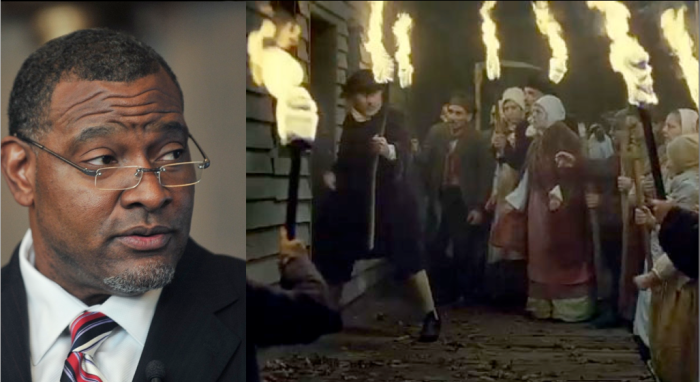
I’ve never sunk a major metropolitan school. I’ve never been run out of a populous state chased by citizens armed with torches and pitchforks.

But let’s close our eyes and imagine that somehow through the magic of education bloggery I was whisked into office at the U.S. Department of Education.

What would a person like me do as Secretary?


1) Respect the Limits of the Job

Though George W. Bush and Barack Obama come from opposite ends of the political spectrum, these two Presidents did more to increase the powers of the Department of Education than any chief executives before them. They turned it into – as former Education Secretary Lamar Alexander puts it – a national school board with the Secretary was the national superintendent.

The department forced test and punishment policies on the states, cudgeled and bribed state officials to enact lousy Common Core Standards, and held federal grants hostage unless states accepted every corporate education reform scheme big business could think up.

Don’t get me wrong. I’m a New Deal Franklin D. Roosevelt Democrat, but even I think these two administrations blatantly abused their power and overstepped their Constitutional authority.

So the first thing I would do is take a step back and follow the law. The recently enacted Every Student Succeeds Act (ESSA) sets explicit limits on federal power over education policy returning much of it to the states. As Education Secretary, I would respect the power of the states to control public education. It is the state’s job to set policy. It is the federal government’s job to provide support, encouragement and oversight.

Therefore, the role of the Department of Education is to ensure public schools are being properly funded, civil rights are not being violated and to be a repository for national data and research. I’d dedicate myself to that – not some corporate fueled power trip that both parties condemn except when they’re practicing it.


2) Push for More Federal Funding for Public Schools

Therefore, the first thing I would do is use the full power of the office to ensure the federal government is giving its utmost to help state public schools. I would use whatever grants were available to increase federal funding to the most impoverished schools. I would fully fund Title I. I would increase the federal share of Special Education – (Under Part B of the Individuals with Disabilities Education Act (IDEA) the federal government is supposed to fund 40% of the per pupil cost of all special education students but has never met this obligation. I would seek to rectify that if possible.) I would enact a national after school tutoring initiative. I would provide funding to hire additional teachers to reduce class size.  And as far as is possible, I would forgive college students loan debt so they can begin their lives with a clean slate.

This is something that those who seek to disband the U.S. Department of Education never seem to understand. The federal government has an important role to play in our school systems. It’s not the unfounded power grab of the last few decades, but we need another robust player on the field to help the states achieve their goals and also to keep the states honest.

If we disbanded the Department of Education, as some conservatives from Reagan to Paul to Cruz to Trump suggest, what would happen to Pell Grants, for instance? What would happen to the bundles of federal money that boost our public schools? Who would make sure states are doing their jobs? Where could we go to find accurate data about how our schools are doing nationally and not just state-by-state?

If we got rid of the department, at best these jobs would fall back on other government agencies that haven’t the funding, staff or ability to accomplish them. More likely, it would result in the elimination of billions of education dollars that the states simply couldn’t (or wouldn’t) replace. Abuses against students on the grounds of civil rights, gender, special education, etc. would skyrocket with little to no recourse. And we would be in the dark about how well we were educating our nation’s children.


3) Encourage States to Enact Accountability Measures that Don’t Include Standardized Testing

Accountability has become a dirty word in many education circles because of the way the Bush and Obama administrations have perverted it to mean test and punish. It has become a boondoggle for the standardized testing industry, an excuse to close poorly funded and often urban public schools to be replaced by unaccountable charter schools. While this is a terrible misuse of federal power, states must be responsible for the education they provide their children. And contrary to popular belief, this can be accomplished without resorting to the usual corporate reform measures.

As Secretary, I would put an immediate stop to the era of test and punish at the federal level. As it stands, the ESSA allows states to determine what they will use to demonstrate their educational progress for students. This is a state decision, but I would encourage states not to use standardized testing. I would offer to help any state interested to find new ways to show accountability. For instance, districts could submit to a simple audit showing student-teacher ratios, per pupil funding, discipline data broken out by race, degree of segregation, richness of the curriculum, etc.

Let me be clear: it is up to states to make these decisions. As Secretary, I would have no power to force legislatures or departments of education to do any of this. However, I’m willing to bet that many states would be excited by these possibilities and jump at the opportunity. Helping them achieve this would be my job.


4) Stop Federal Funding to Charter Schools, Teach for America and Common Core

Speaking of encouragement, I would stop all federal help for corporate education reform policies. That means turning off the money faucet for programs that enrich corporations and big business at the expense of school children.

This means not one more federal dollar to help private companies open new charter schools. Teach for America would have to rely on its corporate donors, not the taxpayers. And the Common Core gravy train would come to a screeching halt. No more money to help states enact the standards, no more bags of cash for book publishers and test manufacturers.

If states that had enacted the Core wanted to keep it, fine. If not, fine. But they would be on their own.

(In a sad aside, opposition to Common Core is most virulent from conservatives, yet there are an awful lot of state legislatures completely in GOP control that could get rid of Common Core tomorrow but which have done – and continue to do – nothing about it. No matter who the next Education Secretary is, the fate of Common Core is in the hands of state legislatures across the country – not the President, not Congress and not the Education Secretary. There’s far too much rhetoric and not nearly enough action.)


5) Do Everything I Can to Increase Teacher Autonomy, Respect, Pay and Training

Finally, I would use my position as Education Secretary to boost the greatest resource we have to help students learn – teachers. I would speak out on the need for educators to have autonomy in the classroom so they are empowered to meet student needs. I would work to increase public perception and respect for the profession. We simply can’t afford teacher bashing, because when you disrespect educators, you reduce their power to help kids. I would boost teachers pay through matching state grants. If you want the best possible teachers, you have to pay for them. If you want to attract the best people to the field, you need to ensure they will have a reliable middle class income and not have to work a second job or use their own money to buy school supplies. I would invest federal funds in training programs so the newest crop of teachers are up to date with the latest pedagogy and techniques. I would encourage more people of color to enter the field. And I would partner with teachers unions to strengthen protections for teachers while educating the public on the meaning of due process and the reality that strong unions mean fewer bad teachers in the classroom.


Are there more things we need to do to help improve our national system of public education? Certainly.


We need to start integrating schools again and stop the constant push to segregate through charter schools and white flight. We need to ensure every student receives adequate, equitable, sustainable funding. We need to change charter school laws so that they can’t cherry pick students and are as transparent and accountable as traditional public schools. We need to stop closing struggling schools and address root causes. We need to stop state takeovers except under the most dire of circumstances and set limits on how long states can stay in control. And we need to pass strong student privacy laws – even updating the Family Education Privacy Act (FERPA) to protect our children from predatory ed-tech companies that constantly data mine students and sell millions of data points on our children to the highest bidder.

There are a whole host of things needing done. However, most of these things go beyond the powers of the Department of Education and its cabinet level Secretary. They can only be addressed by the President, Congress, state legislatures and/or the court system. The Education Department can help steer that agenda, it can be an ally to real positive change, but it can’t go it alone.

Unfortunately, no matter who wins the Presidency in November – Clinton or Trump – neither seems likely to nominate an Education Secretary who would do any of the things I’ve outlined.


For all his talk of reducing the size of the government, Trump proposes increasing the federal footprint with school choice initiatives turning the Department of Education into a wheelbarrow marked “free money” for big business and parochial schools while forcing states to accept his school policies. Meanwhile, Clinton is likely to continue the course set by Bush and Obama of embracing every corporate school reform package from which Wall Street benefits.

It’s a crazy time full of crazy candidates and crazy solutions, but of this we can be sure – no one is crazy enough to let a teacher make decisions about public education policy.
Racism Never Ended – It Just Keeps Evolving

screen-shot-2016-09-16-at-11-55-13-pm

“One of our founding principles as a nation [is] that Black lives and Black bodies don’t matter; you see that in all our headlines today. This original sin lingers on, that’s why we got to call it sin… Slavery never ended, it just evolved. Mass incarceration is the current evolution of slavery.”
Jim Wallis  
 
 
“Even the most casual student of our country’s legal system should know that racism hasn’t existed since 1964 when we passed the Civil Rights Act. So obviously there’s no possible way for my statement to be considered racist if racism hasn’t existed for fifty years! I mean come on, racism? It’s 2015 people, racism is over.”

Antonin Scalia
 

When does brutality end – when it stops being practiced or when its effects stop being felt?

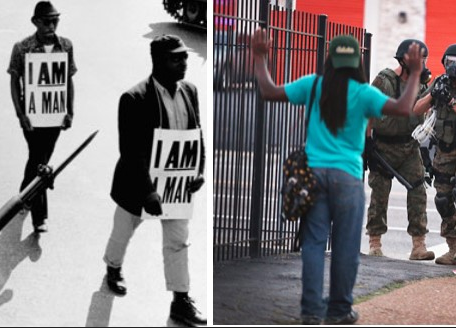
Neither condition has been met in the United States today. Black people still suffer under state-sanctioned barbarism just as the echoes of cruelty from years past continue to ring in our ears.

People of color – whether they be black, Latino, Hispanic, etc. – experience a much different reality than whites. They live under the constant threat of violence without justice. Their rights are continually being re-evaluated. They are subject to systems that wait for them to step out of line in even the most innocuous ways and then pounce.

And the white majority goes around blind to these perceptions while repeating the fairy tale that all wrongdoings were only in the past.

But it’s not in the past. Our history, written in blood, has never been allowed to dry on our forgotten chronicles of yesterday. When white eyes examine the facts, they often see a series of unrelated dots which they cannot – or will not – logically connect.

The Civil War is over, they say.

No. It’s not.

Slavery is over, they say.

No. It’s not.

Racism is over, they say.

No. It’s not.

We still are engaged in the struggle for basic human dignity. And the only way to even begin on that path is to recognize the truth staring us in the face.

Nothing has ended. It has only evolved.


THE CIVIL WAR


When did the American Civil War end?

This may seem a strange question to ask.

But when a country goes to war with itself, it may be difficult to discern when that conflict actually comes to completion.

History gives us many important dates to consider.

On April 9, 1865, commander of the Confederate armies General Robert E. Lee surrendered at Appomattox, Virginia. But there were still sizable Confederate troops left standing.

In fact, the bloodshed was far from over. President Abraham Lincoln was murdered a mere 5 days later by John Wilkes Booth, a Southern sympathizer. Andrew Johnson was sworn in as President on April 15, the next morning.

It wasn’t until April 26, that General Joseph E. Johnson surrendered nearly 90,000 Tennessee soldiers – the largest of a series of subsequent capitulations.

President Johnson declared the insurrection to be over on May 9. However, the last Confederate general didn’t surrender until June 23.

Which date shall we choose? Perhaps it doesn’t matter. The point is that the conflict clearly came to an end.

Clearly the Confederacy was defeated by the Union.

Wasn’t it?

The problem is how to tell.

The Southern states were brought back into the union. But the overwhelming reason behind their secession has not been settled.

Today partisans and talking heads will argue that slavery was but one of many reasons behind the split. But during the 1860s, there was no such confusion.

Four of the Southern states explicitly gave slavery as the impetus for the break.

But Alexander H. Stephens, the Vice President of the Confederacy, removed all doubt when he said:

“The new Constitution has put at rest forever all the agitating questions relating to our peculiar institutions–African slavery as it exists among us–the proper status of the negro in our form of civilization.

[…] The general opinion of the men of that day
[Revolutionary Period] was, that, somehow or other, in the order of Providence, the institution [slavery] would be evanescent and pass away.

[…] Our new Government is founded upon exactly the opposite ideas; its foundations are laid, its cornerstone rests, upon the great truth that the negro is not equal to the white man; that slavery, subordination to the superior race, is his natural and normal condition.”

So if the war was fought over the issue of slavery and the subjugation of black people, its end can be traced to the date at which slavery ended and black people were treated as equals with whites.

That day has not yet come.

Outright slavery came to an eventual end, but – as we shall see – it was replaced with another institution. Moreover, in the aftermath of Reconstruction, we were left with Jim Crow laws cementing white supremacy. Most newly “freed” blacks lived in squalid conditions with few rights, little pay and education. Their situation was only slightly different in fact from their state under slavery. These laws had to be struck down by the collective actions of the Civil Rights movement of the 1950s and ‘60s.

Only then were black people truly permitted to vote en mass. Only then were they permitted in the same public spaces and offered some actionable protections under the law. But social and economic change still lags behind.

Today, more than 150 years since the end of the war’s military conflicts, we’re left to ponder: have things really changed so much?

Certainly there are cosmetic differences. There are no open air slave markets, no rolling cotton plantations staffed by bare backed, lash marked, kidnapped Africans. But have black people really been put on an equal footing with whites? Do they enjoy the same freedoms and privileges? Are they truly free from bondage and oppression?

If we look with open eyes, the answer is no.


SLAVERY


Today no one is legally allowed to own another person. You can’t purchase human beings. You can’t deprive them of their liberty and rights. You can’t use them as a source of revenue for your own benefit.

At least, that’s what the law says. But it happens every day.

What is the modern prison industry if not a new form of slavery? No matter how you look at it, we lock up a higher percentage of our population than any other country in the world. The US represents 5% of the world’s population but has 25% of the world’s prisoners. And the majority of those inmates have brown skin.

Whether federal, state, or privately run, the result is a massive increase in incarceration for people of color. In fact, more black people are in prison today than were in bondage in 1865. That’s a higher percentage of the black population than South Africa locked up at the height of apartheid. Today one in three black males is likely to spend some time incarcerated. That’s not insignificant.

Technically no one owns these people, but they are deprived of their freedom. They are kept in prison and unable to leave. In lockup, they are forced to work and the profit from that cheap labor goes to the prison industry. Moreover, state and federal governments often farm out these prison services to private industry which then profits off that incarceration. In many cases, the government has a contract with these corporations to fill X number of beds or else be penalized with Y dollars. So the incentive is to provide a continual stream of persons bound to labor.

This looks a lot like slavery. It is a kind of plantation where big business is paid to keep people in chains.

However, one can anticipate the following objection: Slaves were born into their servitude. Prisoners are not. They are thrown behind bars because they freely broke the law.

This does represent a difference. But is it more than cosmetic?

People of color – especially black males – commit crimes at about the same rate as white people but are imprisoned nearly six times the rate of whites. They also get much harsher sentences than whites for the same crimes. They are often imprisoned for nonviolent drug violations. And once in the system, it’s hard to get out. To survive in prison, it is often necessary to become a criminal even if you weren’t much of one when you entered.

Even if you manage to get out, you now are a second-class citizen deprived of many of the rights and privileges of your neighbors. Spend any time in the system and you’ll increasingly be deprived of your right to vote and may find it difficult to achieve gainful employment. The chances of going back inside for someone who has already been there are huge.

That is not slavery. But it’s not far from it.

As Michelle Alexander writes in her landmark book The New Jim Crow: Mass Incarceration in the Age of Colorblindness:

“The genius of the current caste system, and what most distinguishes it from its predecessors, is that it appears voluntary. People choose to commit crimes, and that’s why they are locked up or locked out, we are told. This feature makes the politics of responsibility particularly tempting, as it appears the system can be avoided with good behavior. But herein lies the trap. All people make mistakes. All of us are sinners. All of us are criminals. All of us violate the law at some point in our lives. In fact, if the worst thing you have ever done is speed ten miles over the speed limit on the freeway, you have put yourself and others at more risk of harm than someone smoking marijuana in the privacy of his or her living room. Yet there are people in the United States serving life sentences for first-time drug offenses, something virtually unheard of anywhere else in the world.”


THE EVOLUTION OF RACISM


Even for those people of color who have never been incarcerated, there is the constant burden of living in a racist society.

It’s not so much that white individuals consciously practice bigotry and hate in their daily lives. It’s the systematic abuse that’s built into the very fabric of our governments and communities. No one has to decide to be racist. They just go along with the status quo without seeing how that status quo puts black people at risk.

And it doesn’t take much imagination to recognize how the realities of today grew from the prejudices of the past.


LYNCHING


Before the 1960s, it was common for black people – especially men – to be brutalized and murdered with little to no provocation. A look, a word, even the suspicion of violating unspoken social codes could earn a death sentence. Nor was the accused even given a chance to defend himself or explain. That generally doesn’t happen today. Southern trees no longer bare such ‘strange fruit.’

But the same cannot be said for our inner city streets, playgrounds and churches.

It doesn’t take much beyond suspicion of wrongdoing, a suspicion that only requires the sight of black skin to justify deadly force. People of color still are publicly executed with little to no provocation. Black people have been slaughtered in the last few years for the following offenses: buying Skittles and iced tea, driving with a broken tail light, being suspected of selling loose cigarettes, selling CDs in a parking lot, being scared and running the other way or even just attending a house of worship.

Instead of a white robe, a disturbing number of their executioners wear a badge and police blues. Many of these hits were conducted by the very law enforcement officers that are charged with the duty to protect and serve. And when these incidents come before a grand jury, they rarely go on to criminal court. In the eyes of the law, an unarmed black person killed by police rarely inspires any suspicion of wrongdoing on the officer’s part. To the courts, it’s not even conceivable that a crime may have been committed.

As Slate’s Chief Political Correspondent Jamelle Bouie put it:

“Our courts and juries aren’t impartial arbiters — they exist inside society, not outside of it — and they can only provide as much justice as society is willing to give.”

This phenomenon isn’t the same as the lynchings of old – but it’s awfully similar. In both cases, there is little provocation, no quarter given and no justice afterwards. In fact, the modern variety may be worse. US Police killed more black citizens in 2015 than were lynched at the height of segregation.


SEGREGATION


At first glance, one might assume segregation to be a thing of the past. There are no more separate lunch counters, separate bathrooms, separate schools, etc.

Brown vs. Board of Education made it illegal for public schools to be “separate but equal” because if they were separate, they were rarely equal.

Certainly progress was made in this regard during the 1960s, ‘70s and ‘80s. But as time has gone on, integrated schools just haven’t been a priority – even for the Obama Administration.

When you look at public schools today what you see is increasing segregation. Many districts are as segregated or worse than they were before the 1950s. So-called school choice initiatives have only made it worse with charter and voucher schools springing up that cater to one race at the expense of another. Cadillac charters open in otherwise economically diverse neighborhoods swooping in to provide white flight. Big corporations start cut-rate charters with empty promises for black kids while bleaching the student body at the neighborhood’s traditional public school.

But school choice isn’t the only problem. Economics plays a factor, too. Public schools often are funded based on local property taxes, so poor kids get much fewer resources for their schools than rich kids. And since most black students are poor, this provides a stealthy way to funnel more money and resources to the white kids than the black ones.

We don’t call it segregation because it doesn’t just affect minority children. It affects poor whites, too. Everyone agrees there’s a problem, but policymakers only propose measures that make it worse. Instead of fixing underlying inequalities, we punish under-resourced schools for the very academic problems they don’t have the resources to successfully eliminate. Instead of providing more and better equipped teachers, we hire lightly trained temps through Teach for America thereby reducing both the quality of education and the cost. Meanwhile private corporations line-up to start testing corporations, test prep publishers and for-profit charter schools at the expense of black and brown kids.

None of it would be possible without segregation. Our schools today are at least as separate and unequal as they’ve ever been. And no one in power cares.


VOTING RIGHTS


Perhaps the only progress we’ve made is in black people’s suffrage. At the time of the Civil War even in the North, blacks couldn’t cast a ballot or their vote was worth significantly less than that of white people. At least today people of color get the same say in the political arena as anyone else.

Or do they?

Since the Supreme Court gutted the Voting Rights Act, a plethora of states in both the North and the South have passed laws to make it harder for people of color to vote.

Voter ID laws have sprung up across the country requiring citizens to present photo identification at the polls. However, just any picture ID won’t do. These laws require exactly the types of identification black people are least likely to have. In addition, states pass restrictions on early voting making it difficult for black churches to help the majority of their congregations who don’t own cars to physically get to a ballot box. Likewise, polling places in black areas of town are closed forcing minorities to endure long lines to vote while people from white areas of town just waltz right in.

It’s not an outright ban on black voting. But it represents continued hurdles just as the Jim Crow laws of old required literacy tests, poll taxes and other forms of intimidation.


CONCLUSIONS


When we look closely at our society and how it treats blacks vs. whites, it becomes clear that something is terribly wrong.

There is deep inequality, deep inequity, deep assumptions about the relative worth of various peoples. In fact, our society creates and perpetuated these injustices. It’s baked into the system, taught to us in our unspoken assumptions, our prescriptions of right and wrong, propriety and norms.

If we step back and look at it from the long view, we can see exactly where this came from. It’s not new. It didn’t fall from the sky like a mysterious alien artifact.

The racism of today is merely the continuation of the racism of yesterday. We pride ourselves that we’re better than our forbears, but it’s only a slight matter of degree.

Black people still are subject to a form of slavery in our system of mass incarceration. They are lynched – often by law enforcement – with little to no consequences for their killers. They go to increasingly segregated schools. And they often endure severe obstacles in order to vote.

Therefore, the battles of the 1860s and 1960s have never fully been decided. The Civil War is not yet over. Slavery continues in a new form. And racism is entrenched in our nation, communities and people.

But if we recognize that, we’ve taken the first step to building a new and better world.

Do Unions Belong in the Fight Against Corporate School Reform?

ct-chicago-teachers-rally-met-0610-20150609


In the fight for public education, the forces of standardization and privatization are running scared.


They’ve faced more pushback in the last few years – especially in the last few months – than in a decade.


The Opt Out movement increases exponentially every year. Teach for America is having trouble getting recruits. Pearson’s stock is plummeting. The NAACP and Black Lives Matter have both come out strongly against increasing charter schools.


So what’s a corporate education reformer to do?


Answer: Change the narrative.


They can’t control the facts, so instead they try to control the story being told about the facts.


It’s a classic propaganda technique. As Malcolm X put it:


“If you’re not careful, the newspapers will have you hating the people who are being oppressed, and loving the people who are doing the oppressing.”


Their story goes like this – yes, there is a battle going on over public education. But the two sides fighting aren’t who you think they are.


The fight for public schools isn’t between grassroots communities and well-funded AstroTurf organizations, they say. Despite the evidence of your eyes, the fight isn’t between charter school sycophants and standardized test companies, on the one hand, and parents, students and teachers on the other.


No. It’s actually between people who really care about children and those nasty, yucky unions.


It’s nonsense, of course. Pure spin.


They want you to believe that the corporate vultures preying on our public schools are really just misunderstood philanthropists. And those demanding a fair shake for their own children and communities are really just paid shills from a monolithic and uncaring bureaucracy.


In essence, they want you to believe two things:


1) Despite profiting off the system and zero evidence supporting the efficacy of corporate school policies, they’re motivated purely by empathy.


2) Unions are evil by definition and they pervert everything they touch.


I’m not going to bother with the first claim here. There is an inherent bias from those who wish to change the laws so they can more easily profit off of schools without actually helping students learn and in fact exist at the expense of that learning. If you can’t see through the propaganda wing of the Walmart corporation, the Broad Foundation and Big Daddy Bill Gates, you probably won’t be very receptive to anything else I have to say.


Instead I will focus on the second claim, because it is the more pernicious of the two.


Put simply, unions are not perfect, but they are not evil. In fact, they are essential to the health of public education.


Many progressives are upset with teachers unions because of the current Presidential election. Both the National Education Association (NEA) and the American Federation of Teachers (AFT) endorsed Hillary Clinton in the primary election without what many would consider adequately polling rank and file members. For better or worse, the endorsements were top-down affairs reflecting the preference of union leaders.


That’s not how unions are supposed to work. And it’s having consequences for the way both members and non-members view teachers unions.


Critics infer from this that unions don’t represent membership. They are de facto arms of the waiting Clinton administration and the neoliberal agenda.


There may be some truth to this, but it does not represent the whole picture. Not nearly.


Unions are like any other democratic organization. The larger the association, the further from the grassroots the decision making body.


In the mammoth national unions, decisions are made by representatives most removed from our schools. They probably were teachers or support staff at some point in the past, but that may be ancient history. Now they are professional leaders and therefore at a remove from the grassroots.


By contrast, in our local chapters, leaders are most often working classroom teachers. Decisions are made by those still meeting students’ needs on a day-to-day basis. As such, they retain an authenticity and expertise that may be more cloudy in the large bureaucracies.


This isn’t to say the national unions are by definition unconcerned with the needs of teachers and students. I’m sure that most of the NEA and AFT leadership who decided to endorse Clinton did it because they honestly believe doing so will help public education. And – who knows – they may be right. But what they forgot in this case was the democratic process they were tasked with preserving. As such, they may have to pay a price for their hubris when their terms are up.


In most cases, the leaders of national teachers unions are at too much of a remove to see what is best for our schools. And they usually know that. It is up to the rank and file to tell them what to do, and that’s what happens every year at representative assemblies through various caucuses made up of work-a-day members. And if leaders overstep their authority it is members’ duty to hold them accountable at election time.


So even though the national organizations are most likely to go astray, they often don’t. Usually even these giants are trying to improve the situation in our public schools.


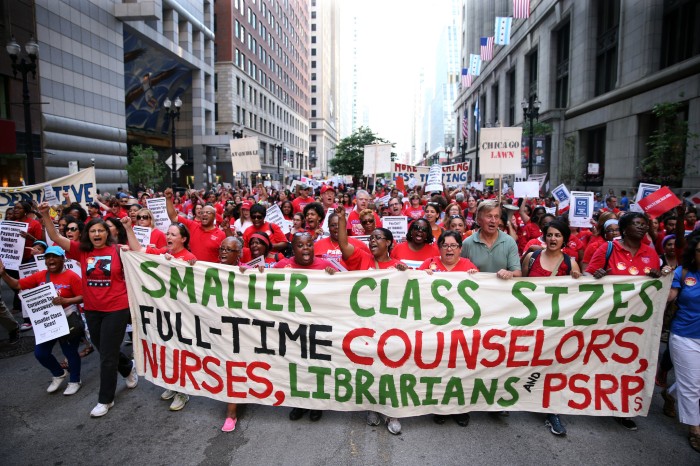
However, it can’t be denied that the most intense and passionate activism happens a bit closer to where the rubber hits the road. It’s those local chapters that are there everyday and make the most difference. They are the heart and soul of unionism.


So when corporate education reformers sneeringly deprecate their opponents as mere unions, they’re glossing over an important distinction. Opposition to privatization and standardization policies doesn’t come from the leadership of the NEA and AFT. It comes from the grassroots. This is not a top down initiative. It is bottom up.


This is how it’s always been. There is no political organization directing the fight to save public education. The Democrats certainly aren’t overly concerned with reigning in charter schools. It was grassroots Democrats – some of whom are also union members – who worked to rewrite the party platform to do so. The Clinton campaign is not directing anyone to opt out of standardized testing. However, voters are demanding that Clinton be receptive to their needs – and some of them are union members.


There is no great union conspiracy to fight these policies. It’s called public opinion, and it’s changing.


That’s what scares the standardizers and privatizers. They’ve had free run of the store for almost two decades and now the public is waking up.


They’re desperately trying to paint this as a union movement when it’s not. Unions are involved, but they aren’t alone. And moreover, their involvement is not necessarily an impediment.


The needs of the community and the needs of teachers are the same.


Both want excellent public schools.


Both want the best for our students.


Both want academic policies that will help students learn – not help corporations cash in.


And both groups want good teachers in the classroom – not bad ones!


The biggest lie to have resonated with the public is this notion that teachers unions are only concerned with shielding bad teachers from justice. This is demonstrably untrue.


Unions fight to make sure teachers get due process, but they also fight to make sure bad teachers are shown the door.


In fact, in districts with strong unions, MORE bad teachers are fired – not less, according to a new study by economics Prof. Eunice Han from the University of Utah.


The study entitled The Myth of Unions’ Overprotection of Bad Teachers concludes that when unions are strong and successfully bargain for higher salaries, they have an incentive to help ensure ineffective teachers don’t receive tenure. In short, it costs too much to keep bad teachers on staff. It is in the interests of the collective bargaining unit to ensure those unfit to teach move along.


Moreover, Han also concludes that strong unions actually help reduce the dropout rate. It just makes sense. When you treat people like the professionals they are, when you give them autonomy and respect, they’re free to concentrate more energy into their jobs than fighting to keep those jobs.


But unions stand in direct opposition to the efforts of corporate vultures trying to swoop in and profit off of public education. Teachers provide a valuable service to students. If your goal is to reduce the cost of that service no matter how much that reduces its value to students, you need a weak labor force. You need the ability to reduce salary so you can claim the savings as profit.


THAT’S why corporate education reformers hate teachers and their unions. We make it nearly impossible to swipe school budgets into their own pockets.


So do unions belong in the fight against corporate education reform?


Answer: Heck yeah! In fact, they are essential to it.


Irony Alert: The Founder of Trump University Is Selling School Choice

Donald-Trump-Donkey-Hotey

Donald Trump is in favor of school choice.

Well of course he is! After all, he made a lot of money scamming poor suckers out of their hard-earned cash with Trump University.

He knows how privatized education benefits the corporations who run the school and not the poor schmucks who want to learn.

If he gets his way, our national education motto will be caveat emptor.

He is betting the American public is so stupid they’ll give a man caught in a scandal for cheating people out of an education the power to set all education policy for our nation’s children.

And it’s all right there before the public.

In fact, the parallels between Trump University and school choice policies are apparent to anyone who looks. Here are just a few of the similarities:


1) False advertising

First of all, Trump University was never an actual university!

The New York State Education Department warned administrators when the institution was founded in 2005 that it was operating without a license. So what did the “school” do? It changed its legal name to The Trump Entrepreneur Initiative.

See? We’re not saying it’s a university anymore. I mean we still call it Trump University colloquially and in advertising brochures and so on. But on legal documents we never make that claim.

It’s a classic bait and switch scheme.

But the same could be said of many charter schools.

They don’t claim to be private schools. They claim to be public schools. However, they aren’t subjected to nearly the same transparency and accountability standards.

Public schools are run by an elected school board. Most charters are run by appointed boards.

Public school board meetings are held in public. Any taxpayer can attend, comment on the proceedings and demand access to public records such as its budget. Many charter school meetings are held behind closed doors. Taxpayers have no access or input in the decision-making process nor access to records that should by all accounts be public record.

Charter schools are public schools just like Trump University was a university.


2) Choosing Students

So who could attend Trump University?

Not just anyone. According to the “Private and confidential” playbook obtained by The Atlantic, the one essential qualification listed all in caps was “ALL PAYMENTS MUST BE RECEIVED IN FULL.” In other words, Trump’s school would accept anyone who could pay the entrance fee.

That same playbook, by the way, admonished staffers not to talk with reporters and “If a district attorney arrives on the scene, contact the appropriate media spokesperson immediately.”

Similarly, charter and voucher schools get to choose their students, too.

Advocates pretend school choice means parents get to choose where their kids go to school. Wrong! It means school administrators get to choose who they’ll accept.

At private schools that accept vouchers, the amount of taxpayer money spent at a traditional public school and given to the private school in the form of the voucher is rarely enough to pay for the full tuition. So voucher programs often make it impossible for poor kids to attend private schools. They just reduce the cost for rich kids whose parents can afford to pay the difference.

At charter schools, administrators are infamous for picking students based on the ease with which they can be taught. Sometimes they don’t accept students having academic difficulties or who are in special education programs. Other times they kick them out before state-mandated standardized tests. That way they can falsely inflate their own test scores and pretend like they’re doing a great job teaching all students when they’re not.


3) Quality of Services:

Former Trump University students are suing the reality TV star and Presidential candidate because they claim they paid tens of thousands of dollars for nothing.

You got a free 90-minute seminar that promised enrolling in the school would teach you everything you need to know about real estate investment. Then you were told to enroll in a $1,495 three-day seminar where you were told to enroll in increasingly more expensive additional seminars even up to an Elite Gold package costing $35,000.

However, very little attention was spent to actually teaching students much of anything. Each seminar was basically an advertisement for the next seminar.

Prospective students were told they would be “mentored” by “handpicked” real estate experts showing them Trump’s own real estate strategies.

But no one has yet been able to produce a single instructor handpicked by Trump. Moreover, many of these instructors didn’t even have any knowledge of real estate, They came from other academic fields.

Trump never reviewed the school’s curricula. It was developed by a third party for motivational speakers and timeshare rental companies.

Moreover, Trump never attended any of these seminars personally. Attendees were often told that he was in the building or on his way, but he never showed up. At one seminar, attendees were told they’d get to take their pictures with Trump but ended up getting pictures with his cardboard cutout!

Similarly, many of our nations charter schools provide a substandard education.

When compared with traditional public schools, no evidence has been found that they do a better job. In fact, the evidence says charter do no better and often much worse than traditional public schools.

One reason is that many charters don’t require their teachers to be of the same quality as traditional public schools. Charter often skimp by hiring uncertified teachers or Teach for America trainees who have no degree in education and have only passed a six weeks course.

Also, cyber charter schools, in particular, often use third party companies to create their entire curriculum. This is usually just taking a text book in a given subject, digitizing it and having students answer the questions that used to be in the back of the book.


The parallels are clear. Perhaps that’s why Trump feels comfortable championing choice in education.

He is, after all, an expert on how it works and how it cheats the public.

Creating one excellent education system for everyone is both cheaper and more efficient than dividing children up so they can be monetized. But such a system doesn’t allow corporations and investors to turn a profit. Let’s be real – that’s why Trump is advocating for it.

Several lawsuits have been filed about the Trump University scam and will continue haunting Trump well past the November election.

However, he still maintains it was “a terrific school that did a fantastic job”.

His son, Donald J. Trump, Jr., even gave a speech touching upon school choice at the Republican National Convention this week.

Young Trump never attended public school, but he knows his dad’s business model.

His comments came under fire largely because he repeated several passages written by conservative writer and law professor F. H. Buckley. However, the campaign defended the move saying Buckley helped write Junior’s speech.

It may not be outright plagiarism, but it shows the thinking of the Trump campaign. Rehash old ideas that have failed in the past and hope the voting public buys it.

And maybe they’ve got a point. As H. L. Menken wrote -“Nobody every went broke underestimating the intelligence of the American public.”

That’s what the Trumps are doing. And if their education policy becomes a reality at our nations schools, they’re going to do everything they can to ensure that stupidity continues for generations to come.

For them education isn’t about making America great again. It’s about providing an endless stream of suckers to be taken advantage of by the predators of big business.

Corporate School Reform for Rich Kids: A Modest Proposal

Screen shot 2016-07-19 at 8.37.14 PM

America’s wealthy children are in a crisis.

Every year they score better than most of their foreign counterparts on international tests.

They’re better in math. They’re better in reading. They’re better in science. Heck! American students just won the International Math Olympiad for the second year in a row! They beat heavy hitters like Korea, China, Singapore, Taiwan, North Korea, Russia, the UK, Hong Kong, Japan and 90 other countries!

Yet our media still refuses to acknowledge their accomplishments by lumping our wealthiest students in with the middle class and poor. They say American students are failing when it’s just the poor kids. And even when you add them all together, we’re in the middle, and we’ve always been in the middle since these international tests began.

It’s just not fair that our wealthy students don’t get recognized for their accomplishments. The media takes their exceptional scores and mixes them in with those of children living in broken homes going to under-funded schools in high crime neighborhoods. Obviously those kids are struggling. It’s not fair to make the wealthy look bad by mixing their scores in with these “ghetto” kids.

But that’s not the worst part. All this negative publicity is actually starting to force lawmakers to do something about it. There is a policy movement in our country that’s been around for nearly 20 years made to combat this exact problem. It’s called corporate education reform, and the rich kids are being left out!

Just look at all the programs being aimed at improving education for poor kids. I mean, sure, more than half of public school children live in poverty these days. But why should they get all these innovations?

If things keep up this way, the rich kids will get totally left behind. In the interests of fairness, we must make some of these same reforms available for the wealthy.

For instance, why is it only the poor kids who get the benefit of being taught by Teach for America recruits? These are idealistic youngsters who have a college degree – but not a degree in teaching – who get to come into an underprivileged environment and educate the masses. What about those from privileged upbringings? Shouldn’t they get the benefit of this program, too?

Think about it! These are young adults with lots of knowledge about the world and a real desire to help kids learn! Sure they don’t have enough desire to go out there and learn how to actually teach, but that’s just liberal indoctrination. You don’t need a degree to do that. A six weeks training program is fine!

Their enthusiasm makes up for any shortcomings in pedagogy. It’s like someone who loves medical dramas volunteering to do your surgery. Or maybe someone who watched every season of Law and Order volunteering to defend you in court. The attention to detail of a Trekkie at a Star Trek convention tops the knowledge of an astrophysicist any day!

Why is it only the poor kids that get that!? Rich children are being robbed of this opportunity. It’s time we furlough all their fancy teachers with their PhDs and Masters degrees and replace them with Teach for America.

But of course that won’t be enough.

The poor kids also have a huge leg up when it comes to academic standards.

Many wealthy families send their children to private schools with the best of everything. They have a wide curriculum, extracurricular activities, arts and music – everything impoverished public schools lack. But what they don’t have are universal standards.

That’s right. In most states, only our public schools have been forced to enact Common Core State Standards. These are a set of academic standards for all school children to ensure every student will be ready for college and/or a career by graduation.

Where are these standards for our rich kids? They’re being left behind! We let their private school teachers make up their own standards! How can we trust them with that? Despite their manners and good breeding, these are just teachers we’re talking about! What do they know about education?

Common Core standards were created with hardly any input from classroom teachers or child psychologists. Instead we relied upon self-appointed experts from the standardized testing industry. They decided what should be taught so it will line up exactly with their state-mandated tests.

Just imagine! Rich kids don’t get that benefit! No one teaches them to the test! Their teachers just guess and – still they get good grades – but imagine how well they’d do if they had the same benefits of the poor kids! If impoverished children fail, these same test corporations provide the remedial material! What better way to improve?

And that’s another thing! Why are the wealthiest kids who go to exclusive private schools exempt from taking state-mandated tests? How do we know they’re getting the best education possible if they haven’t demonstrated it on a multiple choice exam? These private schools could be totally faking it! We don’t know they’re providing a world class education without the proof standardized testing affords. Rich parents need to demand their kids be tested just like the poor kids.

One way they could do that while still reaping all the benefits of private schools is by enrolling in charter schools.

Rich parents rarely take advantage of that if they can afford the prestigious preparatory academies. But why? Choice is great and even more choice is greater!

Charter schools are really just private schools paid for with taxpayer money. They’re often run by private companies or unelected boards and in many cases expected to turn a profit. This also means they don’t have to do the same things as traditional public schools though for the most part they are subject to giving state-mandated tests.

In fact, they have very loose transparency requirements. We don’t really know much of what they do. But everywhere they’re touted as a massive improvement to the public school system.

They’re so good we don’t even demand that they prove how good they are. It’s just that obvious! (Pay no attention to peer reviewed studies that show them to be no better and often much worse than traditional pubic schools. That’s just scientific method mysticism.)

So why can’t there be more charter schools just for rich kids? Administrators get to pick which kids attend these schools anyway. Why not select just the upper crust, the crème de la crème, a better class of students? In fact, in many cases they already do. They select the students who already do the best academically and boot those with sub par skills or who are in need of special education. That’s how they inflate their test scores. But they also could select for economic factors instead of just academic ones.

Now you have to be careful. There have been a couple charter schools (actually quite a lot of them) that have been found to be scamming the public. Think Trump University for K-12. These schools steal taxpayer money, cut services, increase profits, disband and sneak away in the night. But there are many… well… a few high quality ones out there. And since choice is always good, shouldn’t rich families roll the dice on these institutions just like poor families?

Yes, there’s a chance rich kids educations will be ruined at charters – a big chance – but shouldn’t the wealthy have the same opportunity to gamble on their children’s futures that the poor do?

The point is this: there are plenty of shiny corporate education reforms out there aimed almost exclusively at the poor. If these reforms are so great, shouldn’t the rich get them, too?

Otherwise, these reforms are just opportunities for private industry to get rich quick off the backs of impoverished children! That can’t be right, can it?

The fact that the rich almost never take advantage of these reforms has to be a coincidence, right? Maybe they just don’t know how great these corporate school reforms are. I just can’t understand why no one is telling them, selling it to them.

After all, many of the people who create and propose these reforms have children who go to educational institutions that don’t use them. Arne Duncan was U.S. Secretary of Education, and his kids don’t experience the very policies he imposed on impoverished youngsters. Neither do Bill Gates’ and President Barack Obama’s kids. It’s just so unfair to them.

So I’m asking, please, let the children of the rich and powerful experience these same corporate educate reforms. Every child deserves the right to be taught by an untrained instructor. Every child should have an education devised by non-experts making huge profits off the results. Every child’s success should be determined through mass marketed, standardized, A,B,C exams. Every child should get to go to a school where the administration can reduce services and maximize profit.

Only then can we finally compare test scores between rich and poor. Only then will be one America!

Only then will no rich child be left behind.

(Or we could just give the poor kids all the benefits of the rich ones and throw away this corporate education crap, but no. That’s too radical. This is only a modest proposal.)

Witch Hunt Against Incoming Pittsburgh Public Schools Superintendent Escalates

Screen shot 2016-06-17 at 1.17.51 PM

To be or not to be.

That is the question for incoming Pittsburgh Public Schools Superintendent Anthony Hamlet.

He is set to takeover the district on July 1, but a well financed public smear campaign is trying to stop him before he even begins.

Big money interests oppose him. The public supports him.

Meanwhile the media helps fuel corporate attacks on the 47-year-old African American because of criticisms leveled by a Political Action Committee (PAC) formed to disband the duly-elected school board.

It’s ironic.

Corporate school reformers criticize Hamlet for allegedly plagiarizing a single statement in his resume. Meanwhile they have plagiarized their entire educational platform!

Mayoral or state takeover of the district? Check!

Close struggling schools? Check!

Open new charter schools to gobble up public tax dollars as profit? Check!

Hamlet represents a new direction away from corporate education reforms. The new school board who hired him has soundly rejected these policies of the old guard. Many of the same members are still on the board who first changed course in 2013 by tearing up a contract with Teach for America.

But the Empire strikes back with allegations of plagiarism and resume padding.

Yes, Hamlet used some of the same words from a Washington Post editorial in his resume. He wrote:

“A successful superintendent has to satisfy many constituencies, keeping high achievers in the system while devoting resources to those who need them most.”

The Post wrote:

“A successful superintendent has to satisfy many constituencies, keeping high achievers in the system even while devoting resources to those who need them most.” (Emphasis added)

These aren’t exactly the same words used by the Post. They don’t rise to the level of plagiarism, but he certainly should have attributed them or reworded the ideas.
On the other hand, his critics want to use the same policies that have failed again-and-again in Philadelphia, Newark, Little Rock, Memphis and elsewhere. They want to steal control of the district and give it to bureaucrats who will do what THEY say. They want to take money set aside to help all students and use it to enrich their friends and associates.

Sure, Hamlet used someone else’s words to describe a good idea of leadership. But his critics are using their own words to describe someone else’s terrible, failing educational platform.

Hamlet made a small forgivable error. His critics are seizing upon it to turn the tide in their favor and take away the community’s right to representative democracy.

Make no mistake. This is a witch hunt.

Critics are splitting hairs, disputing statistics and calling it fact.

Hamlet has a proven record as a principal in Palm Beach, Fl.

He says the schools he administered improved academically for various reasons. Critics point to Florida state records that show those improvements to be less dramatic.

So both sides agree those schools did well under Hamlet. What’s in dispute is the degree.

Hamlet counters that state data is inaccurate. He was there on the ground. He lists several factors not accounted for by the state that fully justify his statements.

For example, when he talks about school improvements, he counts the total number of student suspensions – if a student is suspended twice, he counts that as two suspensions. The state, however, ignores multiple suspensions. In this and other ways, Hamlet shows his data is more accurate than the state’s.

National data backs up Hamlet. Florida is infamous for being backward, regressive and untrustworthy in education circles, often spearheading some of the worst abuses of policy in recent history.

“This has been a hoopla,” said Valerie Allman, a Troy Hill parent and activist interviewed in the Pittsburgh Post Gazette. “And it’s taken the focus off what’s important: these kids. … We’re expecting him to climb this huge mountain at the same time we cut his legs out from under him.”

One of the reasons the board originally hired Hamlet is his background in “restorative justice.

Instead of simply punishing or suspending students who misbehave, the program calls for making students set things right.

At Palm Beach County Schools, Hamlet implemented this approach with help from Mara Schiff, a criminology professor from Florida Atlantic University. It’s “far tougher than sitting in detention,” Schiff said in the Post Gazette.

“You have to acknowledge what you’ve done … and take responsibility for the harm you’ve caused. It’s not a kumbaya approach.”

It’s widely acknowledged in education circles that suspensions can have lasting impacts especially on black students making them more likely to enter the school-to-prison pipeline. Finding an approach to increase discipline without adversely affecting students’ prospects is imperative. This is especially true since Pittsburgh Public Schools have been known to suspend black students at a rate four times higher than white students.

In fact, the district has already launched a restorative justice program at 20 schools.

“I have nothing but good things to say about Dr. Hamlet,” said Schiff. “He had a [restorative-justice] coordinator who was fabulous, and who Dr. Hamlet completely empowered.”

Another reason for Hamlet’s hire is his advocacy for community schools. Like many on the school board and in the district, he has pushed for social services to help students and the community to make the schools the center of the neighborhood.

“You can have the best teachers, the best curriculum, the best classrooms,” said Rev. Rodney Lyde, a Homewood pastor and president of the Pennsylvania Interfaith Impact Network. “But we need a place on-site that can comprehensively address the other impediments — like kids coming hungry, or from abusive situations.”

Despite community support, several well-financed organizations oppose Hamlet and the board’s authentic reforms.

Foremost among them is Campaign for Quality Schools Pittsburgh, a new PAC formed recently to make city schools great again – by doing the same failed crap that didn’t work before.

Also on the side of corporate education reform are the Pittsburgh Foundation and the Heinz Endowments. Representatives for both organizations have offered to pay for a new superintendent search if the district gives Hamlet his walking papers – a measure that probably would mean paying him at least a years salary without having him on the job.

This would also result in weakening the district’s ability to hire a new superintendent and increasing public mistrust of the electoral process. Such a move would pave the way for disbanding local control.

How generous of these philanthropies! I remember a time when giving meant providing the resources for organizations like public schools to fix themselves – not having the right to set public policy as a precondition for the donation. But in the age of Bill Gates and the philanthro-capitalists, this is what we’ve come to expect.

Even the editorial board of the Pittsburgh Post Gazette has drunk the Kool-aid. In a June 10 editorial, the paper published the following statement:

“The (school) board’s failure at this essential task calls its leadership into question, and will renew calls for legislation to dissolve the elected school board and move to an appointed system.”

Finally, we have A+ Schools – an advocacy organization that at one time championed the same kinds of reforms school directors are trying to enact. However, after a $1 million grant from the Gates Foundation, the group has become a cheerleader for weakening teachers unions, privatization and standardized testing.

Against these special interests stands a public school board and a community at the crossroads. Will they give in to public pressure and big money? Or will they allow Hamlet to do the job he was hired for and attempt to improve an urban district suffering from crippling poverty and state disinvestment?

This particularly tragedy has yet to find an ending.

To be or not to be?

The Charter School Swindle – Selling Segregation to Blacks and Latinos

Screen Shot 2016-05-31 at 4.22.46 PM


Segregation now!


Higher suspension rates for black students!


Lower quality schools for Latinos!


These may sound like the campaign cries of George Wallace or Ross Barnett. But this isn’t the 1960s and it isn’t Alabama or Mississippi.


These are the cries of modern day charter school advocates – or they could be.


School choice boosters rarely if ever couch their support in these terms, but when touting charter schools over traditional public schools, this is exactly what they’re advocating.


According to the Civil Right Project at UCLA, “The charter school movement has been a major political success, but it has been a civil rights failure.”


It’s choice over equity.


Advocates have become so blinded by the idea of choice that they can’t see the poor quality of what’s being offered.


Because charter schools DO increase segregation. They DO suspend children of color at higher rates than traditional public schools. And they DO achieve academic outcomes for their students that are generally either comparable to traditional public schools or – in many cases – much worse.


In Brown vs. Board of Education, the U.S. Supreme Court ruled that it is Unconstitutional to have “separate but equal” schools because when they’re separate, they’re rarely equal. Having two parallel systems of education makes it too easy to provide more resources to some kids and less to others.


Who would have ever thought that some minority parents would actually choose this outcome, themselves, for their own children!?


After Bloody Sunday, Freedom Rides, bus boycotts and countless other battles, a portion of minority people today somehow want more segregation!?


It’s hard to determine the extent of this odd phenomena. Charter advocates flood money into traditional civil rights organizations that until yesterday opposed school privatization. Meanwhile they hold up any examples of minority support as if it were the whole story. However, it is undeniable that large minority populations still oppose their school systems being charterized.


It’s especially troubling for civil rights advocates because black and brown charter supporters have been sold on an idea that could accurately be labeled Jim Crow. And they don’t even seem to know it.


The reason is two-fold: (1) the success of privatization propaganda and (2) the erosion of our public school system.


Charter schools are big business. Many of them are managed by huge corporations for a profit. They are run at taxpayer expense with little to no oversight. As you might expect, this often results in multi-million dollar financial scandals and worse outcomes for students. But these facts have not fazed some of the public. Propagandists know how to sell people on things that are bad for them: Fast food, miracle cures and charter schools.


They’ve marketed corporate McSchools as if these were mostly charitable institutions founded for the sole purpose of making children’s lives better. Meanwhile, funds that might actually help kids learn are funneled to hedge fund mangers and investors: Schools don’t open yet tax money disappears. Student services are reduced below that offered at comparable neighborhood public schools. Charter students are expelled for low test scores or special needs. Yet the public still buys the glossy full-color advertisement without bothering about the small print.


One thing corporate education reformers have over advocates of traditional public schools is their willingness to talk about race. They clothe their arguments in the terms of the Civil Rights movement. They talk about having high expectations for children of color. They talk about closing the achievement gap. They talk about understanding the needs of minority children.


It’s all bullshit.


Their “high expectations” are really just an excuse for treating brown and black kids as if they weren’t human. They put these children under intense pressure, berating them for wrong answers and kicking them out if they don’t perform.


Yet the academic results produced at charter schools are often less than stellar. Sometimes they’re downright abysmal. Instead of addressing the fundamental inequalities inherent in the achievement gap – economically and culturally biased high stakes testing, shoddy and developmentally inappropriate academic standards, etc. – they reinforce that status quo. It’s like instead of fighting a prohibition against sitting in the back of the bus, they berate black folks for not enjoying the ride.


I’m sorry. But when it comes to understanding the needs of black and Latino kids, I refuse to believe children of color need a second-class education system. (Just as I refuse to believe Teach for America’s claim that all black kids really need are less experienced, less educated and less committed teacher trainees.)


Perhaps if traditional public schools actually addressed these issues head on, privatizers wouldn’t appear to be saviors. There are real problems faced by children of color in our school systems. They have real needs that most of our schools – charter, traditional, private or parochial – just are not meeting. But while charter schools pay lip service to the problems without fixing them and in fact often making them worse, public schools pretend these problems don’t exist in the first place.


No wonder some minority parents choose charter schools. At least there they get the illusion that someone cares about their needs.


In fact, privatizers couldn’t sell their substandard products if it weren’t for what we’ve allowed to happen to our traditional public schools. Segregation is made worse in charter schools, but it is also prevalent at our traditional public schools – though often to a lesser degree.


We have allowed traditional public schools to be largely segregated based on parental income. We have schools for poor kids and schools for rich kids. Thus, we have schools for black kids and schools for white kids. And guess which ones are well-funded and which go lacking?


This is what people are really talking about when they mention “failing schools.” They pretend as if the teachers are failing, the principals are failing, the democratic process, itself, is failing. In reality, it is our state and federal lawmakers who are failing. They have failed to provide equitable resources that our nation’s children need.


Schools cost money. If you don’t provide the funding necessary to properly educate children, you will get an inferior result. Meanwhile, pundits play with numbers and make false comparisons to hide this basic fact – we aren’t providing all kids with the resources they need to succeed. Rich kids have enough. Poor kids don’t. But we look at national averages, add in unfunded legal mandates and pretend that tells the whole story.


How does this happen? Segregation. In fact, we’re allowing segregation of place to determine segregation of school. Instead of counteracting an unfair status quo, we’re letting the way things are today determine how things will be tomorrow.


Fact: people of different ethnicities tend to cluster together, like with like. Part of this is because people tend to self-segregate with people around whom they feel most comfortable. However, this is also a function of social planning. Banks tend to shy away from giving loans to families of color who want to move into white neighborhoods. Moreover, white homeowners are often reluctant to sell to families of color. The result is an America made up of black neighborhoods and white neighborhoods.


In organizing our public schools we could try to overcome these differences, but instead we amplify them. In many states we insist that schools be funded based on local property taxes. So poor brown and black people who happen to live clustered together get poorly funded schools for their kids. And rich white folks who live together in their gated communities get well-funded schools for their progeny.


Is it any wonder then that some people of color buy into the charter school lie? They’re offered the choice between an obviously under-resourced public school or a glossy new charter school that actually offers them less. But they don’t see that far. They’re tired of the indifference behind traditional public school funding and opt to try something different. Unfortunately, it’s just another lie and a more pernicious one for several reasons.


First, charter schools take an already segregated population and make it worse. Second, they weaken the already stumbling traditional public schools by siphoning off their dwindling funding. And finally, they obscure the fact that it’s often the same policymakers who champion charters that are responsible for eroding public schools in the first place.


People of color would be much better served by sticking with their traditional public schools and fighting to make them better. For all their faults, traditional public schools often provide a better quality education. They have more resources and less flexibility to take away those resources. They have more well-trained and experienced staff. And since they serve a more diverse population, they offer the chance for people of similar economic backgrounds but diverse cultures to join together in common cause.


Dividing people makes them weaker politically. When people band together, they have power. They can fight more effectively for what they deserve. Perhaps this is the greatest problem with charter schools – they destroy communities and rob neighborhoods of the collective power that is their due.


In many areas of the country, communities of color know this. Ask them in New Orleans what they think of their all-charter school district. Ask them in Chicago what they think of the city’s plan to close public schools and turn them into charters. Ask them in Philadelphia or any urban district taken over by the state.


They’ll tell you straight out how privatized education is cultural sabotage. They’ll tell you how it’s the new colonialism, another element of the new Jim Crow. They’ll tell you how important it is to fight for our system of public schools.


And when privatizers and propagandists try to paint all communities of color as if they support charter schools, these folks will loudly cry foul.


They aren’t buying the snake oil. The rest of us need to step up and help those who have been swindled to see the truth. Likewise we need to recognize their truth – that the struggle for civil rights is ongoing.


Because we can’t win the fight against privatization without them. And they can’t win the fight for equality without us.


We need each other.


Public school advocates need to recognize it’s not all about testing, Common Core and privatization. We can’t be so afraid to talk about race. We need to recognize that racism is not an unnecessary distraction, it’s at the center of our struggle.


We need communities of color.


We need our black and brown brothers and sisters.


Because only together shall we all overcome this madness.

The Arrogant Ignorance of Campbell Brown: Education Journalism in Decline

campbell-brown

Apparently facts don’t matter much to Campbell Brown.


Though her latest “fact” about public schools has once again been shown to be more truthiness than truth, she refuses to retract it.


During an interview published in Slate where she gave advice to the next president, she said:


“Two out of three eighth graders in this country cannot read or do math at grade level. We are not preparing our kids for what the future holds.”


It’s a scary statistic. The problem is it’s completely unsupported by evidence.


And when education experts called her out on it, she complained that SHE was being attacked.


When pressed, Brown admitted she got this figure from the National Assessment of Educational Progress (NAEP) a test given to random samples of students in fourth and eighth grades every two years.


However, Brown either misunderstands or misinterprets the scores. If one were to interpret the data in the way Brown suggests, the highest scoring countries in the world would be full of children who can’t read at grade level. Hardly anyone in the world would be literate or could add and subtract. It’s beyond absurd.


And when she was notified of her error by authorities in the field including Carol Burris, Tom Loveless and Diane Ravitch – who, by the way, served on the NAEP Governing Board for seven years – Brown responded by likening her critics to Donald Trump.


She wrote:


“That the people who disagree with my characterization would react by attacking me personally… speaks volumes. Those feigning outrage over the difference between “grade level” and “grade level proficiency” are the people who profit off the system’s failure and feel compelled to defend it at all costs. Sadly, in the age of Donald Trump and Diane Ravitch, this is what constitutes discourse.”


I especially like the bit where she attacks experts, teachers, and PhDs because they “profit off the system’s failure.” It’s pretty rich stuff coming from Brown who makes a pretty penny retelling the fairytale of “failing public schools.”


Once upon a time, Brown was a respected reported for NBC and anchorperson for CNN.


Now she’s a paid Internet troll.


I’m sorry if that sounds harsh, but it’s true.


She co-founded and edits a Website called The Seventy Four – a reference to the 74 million children across the country who are 18 or younger.


It might be more honest to call it The Four, instead, for the $4 million she receives annually from the mega-rich backers of school privatization to bankroll the endeavor.


She claims her site is “nonpartisan.” Funny. I guess that explains why she continually backs every cause and campaign championed by her donors.


Change all public schools to private charter schools? Check.


Block teachers unions from collectively bargaining? Check.


Ignore the overwhelming preponderance of stories about charter schools cheating the public and their students? Check.


When called out on her bias, she proudly proclaimed, “I have learned that not every story has two sides… Is The Seventy Four journalism or advocacy? For 74 million reasons, we are both.”


Pithy. Yet it remains unclear exactly how the nation’s school children will benefit from Bill Gates and the Walton Family having an even larger say in education policy.


Brown has sold her image and rep as a journalist so it can be used to purposefully mislead the public into thinking she is still dedicated to those endeavors. She’s not. What she’s offering these days is not News. It’s bought-and-paid-for public relations meant to destroy our nation’s public schools.


If anyone thought Brown retained even a shred of journalistic integrity left, she should have removed it when she called herself, “a soldier in Eva’s army.” This is a reference to Eva Moskowitz, the founder and CEO of a New York City charter school chain – Success Academy – where children are put under such pressure they wet themselves during testing and kids in first grade are shamed and berated for math mistakes.


As a public school teacher, myself, this makes me sad.


John Merrow, one of the elder statesmen of education journalism, recently proclaimed that we live in the “golden age of education reporting.”


I must respectfully disagree.


Yes, there is more being written about education policy and public schools than ever before.


But most of it is just paid advertisements from the standardization and privatization industry.


Look who’s funding these stories.


TV Networks such as NBC, MSNBC and Telemundo have broadcast various education segments on “Nightly News” and “Today” underwritten by Bill Gates and Eli Broad.


The Education Writers Association – which boasts more than 3,00 members – receives money from Gates and Walton. The L.A. Times receives funds from Broad for its Education Matters Digital initiative.


On-line publications also have been infiltrated. The Education Post took $12 million in start-up funds provided by Broad, Bloomberg and the Waltons. The site focuses on “K-12 academic standards, high-quality charter schools and how best to hold teachers and schools accountable for educating students,” according to the Washington Post.


Even well-respected education blogs including Chalkbeat and Education Week are funded in part by the Waltons (in the latter case, specifically for “coverage of school choice and [so-called] parent-empowerment issues.”) Education Week even tweets out paid advertisements for Teach for America as if they were news stories!


We’ve all seen “Waiting for Superman,” the infamous union bashing, charter loving propaganda film packaged as a documentary. Its popularity was helped with outreach and engagement funds by the Waltons and a host of other privatizers. It’s far from the only effort by market-driven billionaires to infiltrate popular culture with corporate education reform. They tried to sell the parent trigger law with “Won’t Back Down,” but no one was buying. Efforts continue in Marvel Studios television shows.


A plethora of teachers, academics and other grassroots bloggers have taken to the Internet to correct the record. But they are often ignored or drowned out by the white noise of the same corporate education reform narratives being told again-and-again without any firm footing in reality. In fact, after blogger and former teacher Anthony Cody won first prize from the Education Writers Association in 2014 for his criticism of Gates, the organization banned bloggers from subsequent consideration.


We bloggers are almost completely unpaid. We do it because we care about our profession. Meanwhile the so-called “news” sources are funded by corporate special interests, yet it is bloggers that are looked at as if they were somehow reprehensibly compromised and biased.


Education journalism is not going through a golden age. It’s a sham, a farce.


When we allow our news to be funded by private interests, we lose all objectivity. The stories are spun to meet the demands of the big foundations, the billionaires bankrolling them. And the real experts in the field are either not consulted or left to quixotically do whatever they can on their own time.


Education journalism isn’t about what’s best for children. It’s about how best to monetize the system to wring as many taxpayer dollars out of our schools as possible for corporate interests.


It goes something like this: reduce the quality to reduce the cost and swallow the savings as profit. But it’s sold to the public in propaganda that we call journalism.


As famed cartoonist and counter-culture figure Robert Crumb wrote in 2015:


“You don’t have journalists [in America] anymore. What they have is public relations people. Two-hundred and fifty thousand people in public relations. And a dwindling number of actual reporters and journalists.”


Nowhere is this as obvious as with Brown.


Just as Broad was initiating a plan in February to double the number of charter schools in the Los Angeles Unified School District, Brown’s site, the Seventy Four, was given control of the LA School Report, an on-line news site focusing on the second largest district in the country. Brown was expected to run interference for the takeover. She was running the propaganda arm of the privatization push.


And that’s really what’s happening with our education journalism.


I’m not saying there aren’t actual journalists out there trying to tell unbiased stories. But they are few and far between. They are beset by corporate interests. And anyone who wants to tell the truth is silenced or marginalized.


As we’ve seen, when you actually try to point out errors like Brown’s ridiculous assertions about eighth grade students, the media treats it as a he-said-she-said.


They say, “Wow! Teachers really hate Brown.” Shrug.


Meanwhile the truth is left murdered on the floor as our schools are pillaged and sacked.

Co-opting the Language of Authentic Education: The Competency Based Education Cuckoo

Reed_warbler_cuckoo

Cuckoo!


Cuckoo!


Such is the incessant cry of the hour from one of the most popular souvenirs of the black forest of Germany – the cuckoo clock.


Time is demarcated by the chirp of an 18th century animatronic bird jumping forward, moving a wing or even opening its beak before making its distinctive cry.


However, in nature the cuckoo has a more sinister reputation.


It’s one of the most common brood parasites.


Instead of investing all the time and energy necessary to raise its own young, many varieties of cuckoo sneak their eggs into the nests of other birds. When the baby cuckoos hatch, they demand an increasing amount of their clueless foster parents’ care often resulting in neglect of the birds’ own children.


Parental care is co-opted. The love and affection natural to raise parent birds’ own children are diverted to another source. And the more parent birds try to help the interloper’s child, the less they can help their own.


Corporate education reformers must be bird lovers. Or at very least they must enjoy antique cuckoo clocks.


In fact, one could describe the entire standardization and privatization movement as a Homo sapien version of brood parasitism.


Profiteers co-opt authentic education practices so that they no longer help students but instead serve to enrich private corporations.


When parents, teachers and administrators unwittingly engage in corporate school reform strategies to help students learn, they end up achieving the opposite while the testing industry and charter school operators rake in obscene profits.


But some of us have seen through the scam, and we think it’s cuckoo.


We’ve seen this kind of bait and switch for years in the language used by oligarchs to control education policy. For instance, the defunct federal No Child Left Behind legislation had nothing to do with making sure no kids got left behind. It was about focusing obsessively on test and punish even if that meant leaving poor kids in the rear view.


Likewise, the Obama administration’s Race to the Top program has nothing to do with quickening the pace to academic excellence. It’s about glorifying competition among students while providing them inequitable resources. Teach for America has very little to do with teaching or America. It’s about underpreparing poor children with unqualified instructors and giving cover to privatization operatives. School Choice has nothing to do with giving parents educational alternatives. It’s about letting privatized schools choose which students they want to admit so they can go through the motions of educating them as cheaply as possible and maximize profits for shareholders.


And on and on.


The latest such scheme to hoodwink communities out of authentic learning for their children is Competency Based Education (CBE) a term used interchangeably with Proficiency Based Education (PBE). Whatever you call it, this comes out to the same thing.


Like so many failed policy initiatives that came before it offered by the same group of think tank sycophants, its name belies the truth. CBE and PBE have nothing to do with making children competent or proficient in anything except taking computer-based tests.


That’s what the whole program consists of – forcing children to sit in front of computers all day at school to take unending high stakes mini-tests. And somehow this is being sold as a reduction in testing when it’s exactly the opposite.


This new initiative is seen by many corporate school reformers as the brave new world of education policy. The public has soundly rejected standardized tests and Common Core. So this is the corporate response, a scheme they privately call stealth assessments. Students will take high stakes tests without even knowing they are doing it. They’ll be asked the same kinds of multiple-choice nonsense you’d find on state mandated standardized assessments but programmers will make it look like a game. The results will still be used to label schools “failing” regardless of how under-resourced they are or how students are suffering the effects of poverty. Mountains of data will still be collected on your children and sold to commercial interests to better market their products.


The only difference is they hope to trick you, to hide that it’s even happening at all. And like a cuckoo pushing its egg into your nest, they hope you’ll support what’s in THEIR best interests while working against what would really help your own children.


And the method used to achieve this deception is co-opting language. They’d never enact what real classroom teachers want in school, but they will take our language and use it to clothe their own sinister initiatives in doublespeak.


So we must pay attention to their words and tease out what they really mean.


For instance, they describe CBE as being “student-centered.” And it is – in that their profit-making machine is centered on students as the means of sucking up our tax dollars.


They talk about “community partnerships,” but they don’t mean inviting parents and community members into the decision making process at your local school. They mean working together with your local neighborhood privatization firm to make big bucks off your child. Apple, Microsoft, Walmart – whatever huge corporation can sell computers and iPads to facilitate testing every day.


They talk about “personalized instruction,” but there’s nothing personal in it. This just means not allowing students to progress on their computer programs until they have achieved “mastery” of terrible Common Core standards. If standardized testing is a poor form of assessment, these edu-programs are worse. They don’t measure understanding. They measure zombie cognitive processes – the most basic surface type of spit-it-back to me answers.


And if that isn’t bad enough, such an approach subtly suggests to kids that learning is only valuable extrinsically. We don’t learn for intrinsic reasons like curiosity. We lean to get badges on the program, to progress forward in the game and compulsively collect things – like any good consumer should.


Today’s children already have problems socializing. They can more easily navigate cyber relationships than real flesh-and-blood interactions. And CBE will only make this worse. Not only will children continue to spend hours of after-school time on-line, the majority of their school day will be spent seated at computer terminals, isolated from each other, eyes focused on screens. And every second they’ll be monitored by that machine – their keystrokes, even the direction their eyes are looking!


I’m not making this up! It shows engagement, tenacity, rigor – all measurable, quantifiable and useful to justify punishing your school.


They call it “one-to-one computer technology.” Yes, each child will be hooked up to one device. But how does that alone help them learn? If every child had a book, would we call it one-to-one book access? They call it “blended learning” because it mixes instruction from a living, breathing person with sit-and-stare computer time. It sounds like a recipe. I’ll blend the sugar and milk until I have a nice whipped cream. But it conceals how much time is spent on each.


Don’t get me wrong. There are effective uses of technology in schools. But this is not one of them.


Students can make Keynote presentations, record movies, design graphics, write programs, etc. But taking endless testing disguised as a video game adds nothing but boredom to their day. A few years ago, I was forced by administrators to put my own students on iStation twice a week. (I’ve since convinced them to let us be.) In any case, when we used the program, it would have been more effective had we called it nap time. At least then my kids wouldn’t have felt guilty about sleeping through it.


The corporate education reformers are trying to sneak all of this under our noses. They don’t want us to notice. And they want to make it harder to actually oppose them by stealing our words.


When public school advocates demand individualized learning for their children, the testocracy offers us this sinister CBE project. When we decry annual testing, they offer us stealth assessment instead.


We must continue to advocate for learning practices that work. We can’t let them steal our language, because if we do, they’ll steal our ability to engage in authentic learning.


And to do that, we must understand the con. We have to deny the technocrats their secrecy, deny them access to our children as sources of profit.


We must guard our nests like watchful mama birds.


The cuckoos are out there.


They are chirping in the darkness all around us.


Don’t let them in.

New PAC Descends on Pittsburgh Public Schools to Charterize and Take Over School Board

Screen Shot 2016-04-11 at 11.39.31 AM

Prepare yourself, Pittsburgh.

A new Political Action Committee (PAC) has descended on the ‘Burgh to further privatize our public schools and wrest control away from parents who are in favor of school reforms that actually work.

It’s called Campaign for Quality Schools, but make no mistake. The wealthy special interests behind it don’t care about quality schools – they care about quality profits for their investors.

PACs are political committees organized for the purpose of raising and spending money to elect and defeat candidates. Unlike federal PACS which can only give up to $5,000 to a candidate per election, state PACs in Pennsylvania have no spending limits. In that way, they are like federal Super PACs which also have no limits on donation size.

Besides giving an unfair advantage to special interest groups, PACS also have notoriously been used for nefarious ends. For instance, former Republican U.S. Rep. John Doolittle’s leadership PAC paid 15% to a firm that only employed his wife. One Leadership PAC purchased $2,139 in gifts from the Bose Corporation. Former Republican U.S. Rep. Richard Pombo used his leadership PAC to pay almost $23,000 in hotel bills and buy $320 in baseball tickets for donors.

And now we’ve got one in Pittsburgh with its sights on city schools.

The moneyed interests behind it want to swipe control of even more Pittsburgh schools away from the community and give them to for-profit companies in the shape of charter schools. Since charter school boards are appointed, not democratically elected, this means the decisions about how these newly charterized schools operate would be made behind closed doors out of public view. The community would have no way to hold them accountable. Likewise, this means operators could spend taxpayer money however they want with little to no oversight. They would have nearly unlimited power to reduce student services and pocket the savings as profit.

THAT’S what they mean by “Quality” schools.

The PAC is run by the usual suspects of Pittsburgh corporate school reformers.

In 2015, four of the nine Pittsburgh School Director seats were up for grabs and voters sided in all cases against candidates running on a standardization and privatization platform. One of these losers is Kirk Burkley. He lost against Lynda Wrenn for school board and now is listed as chairman of the political action committee.

Though Burkley well outspent Wrenn, voters made it clear they didn’t want the lawyer specializing in bankruptcy, restructuring and creditors rights anywhere near our public schools. He only got 19% of the vote. Apparently Pittsburghers want candidates who support well-resourced community schools, positive discipline policies with supports, etc. But a host of wealthy investors behind this PAC must feel otherwise. They know better than you and me.

The PAC’s treasurer is Cate Reed, our own Teach for America (TFA) recruiter. Perhaps she took it personally when the newly elected school board overturned a decision by its predecessors to contract with TFA for three-years and pay $750,000. This is one of the few times – if not the only time –this has happened across the nation. Reed is also a Broad Center residency recipient. Established by billionaire Eli Broad, the Broad Center runs an unaccredited training program for school leaders, where candidates learn Broad’s philosophy of school management. Broad has no education experience. He is a self-proclaimed expert, a businessman who made his billions in home-building, mortgage lending, and insurance (AIG).

On the Broad alumni page, Reed speaks about making sure every child has an opportunity to succeed, especially students of color in low income communities.

“The Broad Residency affords me the opportunity to be a part of the change I wish to see—and to use my skills to pursue my wildest dream of educational equity,” she says.

The problem she identifies is real. However, her solution is ludicrous. You don’t provide better opportunities for poor black children by making the leaders of their schools unaccountable to the public. You don’t help poor black kids by removing qualified teachers from their classrooms and replacing them with lightly trained Teach for America recruits. You don’t help poor black kids by giving them an endless series of culturally and economically biased standardized tests and ignoring the fact that they receive substantially less resources than their richer, whiter peers.

Leigh Halvorson, one of the managers of the Heinz Endowment, gave the PAC a boost soliciting donations. She sent an email in early March asking for money. I’ll post the entire email below, but here is Halverson’s description of the PAC:

“I am proud to be part of a group that is launching Campaign for Quality Schools-Pittsburgh, a bi-partisan Political Action Committee that is committed to supporting candidates of any political party who (1) believe that all children, regardless of their background can succeed; (2) embrace policies that hasten the growth of high-performing schools that serve all children; and (3) have the courage to challenge the status quo and tackle this problem with fierce urgency and determination.”

In other words, she’s looking for folks willing to (1) pay lip service to helping kids while actively working to hurt them, (2) will work to privatize more Pittsburgh schools and (3) are willing to run for office counter to the emphatic will of Pittsburgh voters who soundly rejected the corporate school reform agenda in the last election.

Halvorson continued:

“Our kick-off event on March 2nd at 5:30 pm, at the home of Cate Reed and Doug Anderson, will feature State Representative Jake Wheatley, from District 19 here in Pittsburgh who embodies these principles.”

Wheatley, a Democrat, has been a longtime supporter of charter schools and an enemy of public school teachers. He is one of only two Democrats to vote a bill out of the House Education Committee that was meant to eliminate due process for teachers. The bill has been languishing in the legislature, but if approved, it would allow teachers to be fired for almost any reason. It would eliminate the provision that teachers cannot be furloughed for “economic reasons.” (NOTE: it could come up for a vote any day now.)

Wheatley also teamed up with Republican House Speaker Mike Turzai to hold a roundtable discussion praising charter schools and the need to increase them in the city. He joined Turzai again in January for a school choice rally in Harrisburg.

Halvorson closed her email like this:

“If you are unable to attend, but would like to donate, please see the attached invite for instructions how you can do that.”

The invite asked for donations of between $50 and $250 per person.

Reed and Halvorson are both on the board of A+ Schools – Pittsburgh Community Alliance for Public Education. The organization serves an advisory position to help improve city schools. Though the organization includes people on both sides of the standardization and privatization movement, it has been co-opted in recent years by a $1 million grant from the Gates Foundation given between 2011 and 2013. Since the grant, the organization went from issuing an annual “Report to the Community” on the state of city schools to pushing for corporate education reform measures such as doing away with teacher seniority. Many disillusioned volunteers now consider it to be a paid proxy for Gates to make it appear his pet projects are supported by communities.

Like most urban districts, Pittsburgh Public Schools is struggling because of lack of resources. If you live in a poor neighborhood, your school gets less money from local taxes to help kids learn. Moreover, the district has lost almost $1 billion annually in state funding for the last five years. Living in poverty increases the need for wraparound social services, tutoring, nutrition and counseling that isn’t present for more affluent kids. But there’s no money to help them, and it’s hard for students to concentrate on school when they’re experiencing food insecurity and post traumatic stress. Likewise, state and federal education policies are giving an increasing portion of our shrinking funding to charter schools while forcing the traditional public schools to give new and more difficult standardized tests and enact unproven and developmentally inappropriate academic standards. If these corporate education reformers actually wanted to improve Pittsburgh schools, they’d focus on the real problems – not make wild attempts to grab more money for charter schools, deprofessionalize our kids’ teachers and grab power for themselves.

It’s unclear how many people showed up to the PACs kickoff fundraising event and how much money the PAC took in. But one thing is certain – consider yourself on notice, Pittsburgh.

After being defeated for school board and after the board rejected Teach for America, the corporate education reformers are preparing to strike back.

They are gathering people and resources to take the five school board seats up for re-election in 2017.

Will we let them steamroll over us with their big money and political connections or will we continue to fight for reforms that actually help our children?

It’s up to you, n’at.


Halverson’s email:

Dear friends,

The single most important civil rights issue facing our country is the disparity in our education system. We have far too many children who are trapped in persistently failing schools, Here in Pittsburgh alone, 23 of the 52 PPS schools are performing in the bottom 15% in the state. It is unacceptable. We know we can do better because we’ve seen it — transformative school exists that are proving that poverty is not destiny- and we need more of them, right here in Pittsburgh. I am proud to be part of a group that is launching Campaign for Quality Schools-Pittsburgh, a bi-partisan Political Action Committee that is committed to supporting candidates of any political party who (1) believe that all children, regardless of their background can succeed; (2) embrace policies that hasten the growth of high-performing schools that serve all children; and (3) have the courage to challenge the status quo and tackle this problem with fierce urgency and determination. Our kick-off event on March 2nd at 5:30pm, at the home of Cate Reed and Doug Anderson, will feature State Representative Jake Wheatley, from District 19 here in Pittsburgh who embodies these principles. I know for some of you, political contributions or political action is unfamiliar, so if you have questions or just want to talk further about why we believe groups like this can make a real impact on the future of our city and on behalf of our little people, don’t hesitate to reach out. My cell phone is 503.320.2384. I hope you can join us in supporting policymakers that put students and families first. Please see the attached invitation for more details and drop Cate or I a quick email if you can attend. If you are unable to attend, but would like to donate, please see the attached invite for instructions how you can do that. If you know people that should be invited to this event, please share their emails with us ASAP. Any questions can be directed to campaignqualityschoolspgh@gmail.com. I hope to see you on March 2nd.