MythBuster: Do We Have a “Government-Run Education Monopoly”?

screen-shot-2016-11-22-at-11-48-57-pm


“There’s no failed policy more in need of change than our government-run education monopoly, and you know that’s exactly what it is.”

With these words, candidate Donald Trump unleashed his K-12 education policy at a campaign stop in September, two months before winning the general election.

In the speech, the former reality TV star and current President-elect vowed to spend $20 billion in federal tax dollars to encourage more charter and voucher schools nationwide.

It remains his most concrete executive policy offering to date. Yet it’s based on this characterization of public schools as a “government-run education monopoly.”

One wonders – is it true? Do we really have such a thing here in the U.S. or is it just propaganda to boost an unpopular education scheme?

The devil, it seems, is in the details.

The answer is both yes and no: Yes, public schools are government-run. No, they’re not a monopoly.

First, let’s consider “government-run.” Everything the government does from paving the roads, to delivering mail, to protecting us from invaders is “government-run.” The military is government-run. Would you rather a foreign power tell our soldiers what to do? Congress is government run. Would you rather big business come in and decide all our laws?

In that same spirit, yes, our public schools are indeed government run. But who else should run them? Russia!? The Mafia!? A media cabal?

In emphasizing the role of government in education, Trump appears to be trying to stoke the fires of anti-government sentiment. There is certainly a lot of that going around, deservedly so given the way the federal government has encroached on the states, the states have encroached on local government, etc.

However, public schools are not essentially federally-run schools, nor are they state-run schools. They are subject to federal and state mandates, but the major decisions about what happens in your neighborhood schools are made by your duly elected school board. They are not controlled by some nameless, faceless government bureaucracy. They’re controlled by you, your friends and neighbors – people you voted for and who are held accountable every few weeks at open meetings.

That, too, is government.

It’s not Big Brother. It’s Howdy Neighbor.

Let’s turn now to the “Monopoly” part.

A monopoly is the complete control of the supply or trade in a commodity or service. To put it in terms of the titular Parker Brothers board game, you have a monopoly when you own both Boardwalk and Park Place – you’re in control of what happens to all the dark blue properties. However, if you don’t have titles to BOTH, you don’t have a monopoly, and therefore can’t buy houses, hotels or charge double the normal rent.

Therefore, there is no education monopoly – no one has complete control of all the various kinds of schools. There are private schools, home schools, magnet schools, charter schools, even voucher schools. No one owns them all, no one tells them all what to do.

Yes, you could say that the overwhelming majority of them are public schools, but so what? That’s not a monopoly. There are far more personal computers out there than Macs. That doesn’t mean PCs have a monopoly on the field.

Once again, the term “monopoly” is meant to stir anti-government sentiment. We are meant to balk at the degree to which government – local government – is in control of our education system.
I’m sorry, but there is nothing objectionable about schools being controlled at the local level.

Are you upset by federal intrusions in school policy? Me, too.

Are you reeling about unfunded federal mandates? Me, too.

Are you angry about states sweeping in and stealing local control from impoverished inner city parents? Me, too.

But I’m just not one bit upset about being allowed a say in how my tax dollars are spent at my community school district. If you ask me, that how things SHOULD BE.

But Trump is proposing we change it. He’s proposing exactly the same kind of federal intrusion that drove many of us up the wall when it was done by President Barack Obama.

Obama used the Department of Education to bribe cash-strapped states into adopting Common Core. And now Trump wants to do the same thing with charters and voucher schools.

Excuse me, but it’s not the federal government’s job to dangle money in front of state legislatures with strings attached. The Department of Education is supposed to ensure all schools have adequate funding. It’s not supposed to tell us how we should be running our schools unless we’re breaking the law or violating students civil rights.

But what about parental rights? Shouldn’t parents be allowed to choose a school for their own children?

Heck no.

Hear me out. When you fall down the steps in your home alone, do you get to choose which governmental service comes to help you, or do you just call 9-1-1? When you need the police, do you get to choose officers from halfway across the state or make do with your local boys in blue? When your house catches on fire, do you shop around or call the nearest fire station?

It’s called a community for a reason. You’re a part of it, for better or for worse.

Our grandparents never thought they were so entitled they could pick and choose what governmental service should meet their needs. They joined the army, not Blackwater. They called the fire department where they volunteered. And they sent their kids to the local public school.

Yes, some public schools are better than others – which is just another way of saying that some are better funded. THAT is a problem we need to fix at the local, state and federal level. That’s something the President and Congress and our Governors and our state legislatures should actually be working on. But instead of meeting the real needs of their constituents, they’re too busy with all this choice nonsense.

Why? It’s a scam.

We’re talking Donald Trump here – founder of Trump University. He just settled out of court for $25 million for a fake business school that defrauded students out of hundreds of millions of dollars. If there’s one thing he knows, it’s a good scam.

Think about it.

Expanding charter and voucher schools, reduces accountability to taxpayers. These “choice” schools rarely are governed by elected school boards. They don’t have to abide by the same kinds of transparency standards as traditional public schools. They can spend our tax dollars in almost anyway they want behind closed doors, and there’s nothing we can do about it. In fact, there have been a rash of high profile scandals where charter and voucher operators have defrauded the public out of millions of dollars.

Who wants to expand that? Criminals!

Not me. I’m a taxpayer. I want a full account of how my money is spent, and most voters are with me.

We didn’t just vote for President a few weeks ago. Many states held referendums on whether to expand charter schools or not. In every case, voters decided against it.

But does Trump care? No way. This proposed school choice policy is yet another example of the federal government ignoring the will of the people in favor of wealthy donors hoping to further enrich themselves at public expense. It opens the door for profiteers to keep stealing our money.

And they justify it by offering a false choice:

Hey parents, they say. Want to enroll your children in a school with little to no accountability, a school you may not be able to afford unless you spend some of your own money in addition to the tuition you get from the state, a school that can turn you down for whatever reason including race, religion or nationality, a school that may very well be no better and often much worse than a traditional public school?

But they spin it, offering slick commercials and preying on the ignorant and hopeless. That weakens the traditional public schools because it means a loss in revenues. Therefore, the public schools get worse, which is a reason for more parents to try the ‘choice’ schools, etc. It’s an endless cycle where students lose but investors in for-profit schools win.

Invariably, it leads to a further social stratification of schools. The rich go to the best schools, the middle class to the middling schools and the poor to the substandard ones. You think we’ve got segregated schools now, wait until Trump’s school choice policies! It’ll benefit the Nazis of the alt-right who want more white flight, but most kids will lose.

Such a policy does not represent the best of America. This country was founded on the principles of working together. We haven’t always lived up to it, but our ideals are ones of shared sacrifice, community and brotherhood. Trump’s education policy is about selfishness and greed.

That’s your real choice. Which will it be?

Democrats Warned Not to Help Trump Enact Their Own Damn School Policies

screen-shot-2016-11-18-at-1-01-18-am

It must be hard to be a neoliberal Democrat in Donald Trump’s America.

Almost every policy decision you favor is also on the Republican President-elect’s to-do list. But if you work with him, you’ll ruin the illusion that there’s a difference between the two of you.

Take yesterday’s statement by Democrats for Education Reform (DFER) warning any Democrat not to accept Trump’s offer to be U.S. Secretary of Education.

DFER is a hedge fund managers’ pro-charter advocacy group. Despite it’s name, one would think the organization would be a natural ally for pro-school-choice Trump.

But, wait a minute.

I thought one of the first things Trump promised to do once he took the Oval Office was close the Department of Education.

Weeeeeelllllllll…. That’s so November 10th.

He’s already walking back that whooper just like he’ll soon have to admit that the Every Student Succeeds Act (ESSA) doesn’t allow him to end Common Core – another one of his campaign promises. Ending the Core is up to the states (has been for months, yet most Republican controlled legislatures just can’t bring themselves to do it for some reason).

It’s easy to see why Trump has had a Come To Jesus moment about the Department of Education. If he really wants to add $20 billion in school-choice programs, as he promised on the campaign trail, a big government office that hands out bundles of cash in return for states enacting his personal policy desires sure would come in handy!

This is where it gets really sticky.

Both Democrats and Republicans love school choice! Typically GOP politicians love all flavors of privatization – charter schools AND giving away vouchers to attend private schools with public tax dollars. Democrats usually are more finicky preferring just charter schools – though you don’t have to search long to find a neoliberal willing to embrace all things school choice. Many of them are members of DFER.

In fact, the leading voices of school privatization for the last 15 years have been Democrats. So it’s no wonder that faux progressives like Michelle Rhee and Eva Moskowitz made Trump’s short list to head the Department of Education.

Moskowitz, who has since turned down the offer, is founder of Success Academy Charter Schools, a chain of privatized institutions emphasizing endless test preparation and systematically weeding out struggling or special-needs students.

Rhee, who is still a contender, was chancellor of Washington, D.C., schools where she was given leeway to do almost whatever she wanted and boasted of high test scores. However, widespread cheating on the tests and public unrest at her tactics shot down her ascending star. She then started StudentsFirst, an organization using rich folks’ money to help elect Tea Party candidates who were in favor of both charter and voucher schools. As the organization faltered, she stepped out of the limelight.

One could think of few people more suited to Trump’s education agenda than Rhee.

But NO! Rhee – or another faux progressive – can’t do that, warns DFER President Shavier Jeffries. That goes against everything Democrats stand for – somehow.

Jeffries writes:

“It is, generally speaking, an honor for any person of any political persuasion to be asked by the President of the United States to consider a Cabinet-level appointment, but in the case of President-elect Trump, DFER encourages no Democrat to accept an appointment to serve as Secretary of Education in this new administration. In so doing, that individual would become an agent for an agenda that both contradicts progressive values and threatens grave harm to our nation’s most vulnerable kids.

“Foundational education reform principles – from raising standards and strengthening accountability, to expanding public-school choice, to furthering innovations in teacher preparation and support, and advancing resource equity – all find their roots in a progressive commitment to ensuring that all children, particularly our most vulnerable, have access to schools that enable them to fulfill their potential.”

Jeffries is worried about “raising standards?” Am I the only person here who read the ESSA? Common Core and academic standards aren’t the federal government’s business.

He’s worried about “strengthening accountability?” The ESSA already requires annual standardized testing in grades 3-8 and once in high school – same as it has since the George W. Bush administration.

“Expanding school choice?” You guys love school choice.

“Further innovations in teacher preparation and support?” That sounds like code for Teach for America and Value Added Measures – policies that Republicans love as much as you so-called Democrats.

“Advancing resource equity?” Now who are you kidding? DFER hasn’t done a thing to help poor schools get equitable resources. In fact, you’ve supported pulling the rug out from under poor schools based on those same standardized test scores you love so much.

So when it comes to policy, Jeffries and DFER are almost completely in synch with Trump. What’s the problem?

He goes on:

“This progressive commitment to equitable education policy also goes hand-in-hand with intersectional issues that affect our kids. While effective school policies are vitally important, so too are the environmental conditions affecting children and families.”

This is a shock to me. Jeffries and DFER support “no excuses” charter schools like Moskowitz’s. These are privately run schools that don’t accept a student’s poverty or abuse or health or anything to be used as an excuse not to get high scores on standardized tests. In fact, if any impoverished, underprivileged child can’t somehow pull himself up by his bootstraps, he’s often kicked out of these “no excuses” charter schools and sent back to a traditional public school.

But NOW Jeffries is complaining about “vitally important” “environmental conditions”!? You’ve got to be kidding me! That sounds like something under any other circumstances you’d call an excuse.

On any other day, DFER does nothing to help kids overcome their environmental factors. Jeffries claims we should ignore environmental factors, that focusing on them is the “soft bigotry of low expectations.” But NOW he’s suddenly seen the light!?

Sorry. I’m not buying it.

He goes on:

“A child who is homeless; a child without access to food or healthcare; a child whose parent cannot find steady work; a child whose dad is locked up for years on low-level drug offenses—each of these situations dramatically compromise the life chances of our children.”

Well, Hallelujah! Jeffries has seen the mountain top! Paying attention to the out of school factors is exactly what teachers, parents and students have been crying out for he and his neoliberal buddies to do for 15 years! Of course, doing so would invalidate the same policies he and Trump propose, but you can’t ask a neoliberal to be consistent. Baby steps.

He goes on:

“The policies and rhetoric of President-elect Trump run contrary to the most fundamental values of what it means to be a progressive committed to educating our kids and strengthening our families and communities. He proposes to eliminate accountability standards, cut Title I funding, and to gut support for vital social services that maximize our students’ ability to reach their potential. And, most pernicious, Trump gives both tacit and express endorsement to a dangerous set of racial, ethnic, religious, and gender stereotypes that assault the basic dignity of our children, causing incalculable harm not only to their sense of self, but also to their sense of belonging as accepted members of school communities and neighborhoods.

“For these reasons, no Democrat should accept appointment as Secretary of Education, unless and until President-elect Trump disavows his prior statements and commits to educating the whole child and supporting the communities and families they depend on.”

So what Jeffries really takes exception to here is Trump’s rhetoric.

Trump and DFER don’t have many policy differences. It’s just how they’re packaged.

Both Trump and Jeffries wants to give poor black and brown kids a substandard education. They both want to destroy the public school system and replace it with a privatized one. Both want to give endless standardized tests. But the real difference is that Jeffries wants to do this for the expressed purpose of protecting kids’ civil rights. Trump, apparently, wants to do it to violate them, or at least he’s indifferent to the civil rights implications.

Does that really constitute a significant difference between DFER and Trump?

No. It’s just branding.

Jeffries doesn’t want someone like Moskawitz or Rhee to be the face of Trump’s corporate education reform policies because he’s betting Trump will fail. And when that happens, he wants to be there when the next Democratic administration takes over – so he can enact the same damn policies all over again!

Why Teaching to the Test is Educational Malpractice

thumbnail_screen-shot-2016-11-03-at-12-20-50-pm

Malpractice is defined as “careless, wrong, or illegal actions by someone (such as a doctor) who is performing a professional duty.”

In some fields it can get you arrested. In most it’s at least frowned upon.
In education, however, it’s encouraged.

In fact, as a teacher, you can be singled out, written up or even fired for refusing to engage in malpractice. You are bullied, cajoled and threatened into going along with practices that have been debunked by decades of research and innumerable case studies.

Take the all-too-common practice of teaching to the test.

Not only do students and teachers hate it, but the practice has been shown to actually harm student learning. Yet it is the number one prescription handed down from administrators and policymakers to bring up failing scores on high stakes standardized tests.

Never mind that those same test scores have likewise been proven to be invalid, racially and culturally biased and inextricably linked with parental income. When the only goal is raising student test scores, what’s a little malpractice between friends?

In this article, I will explain the top five reasons why this policy is harmful. But first, we need to define our terms. There is a multitude of practices that are sometimes called teaching to the test. What exactly are we talking about here?

Assessment expert W. James Popham provides a helpful distinction: “curriculum teaching” vs. “item teaching.” Curriculum teachers focus on the full body of knowledge and skills represented by test questions. For instance, if the test is expected to include questions about decimals, the teacher will cover the full range of knowledge and skills related to decimals so students understand what they are, know how to manipulate them, understand how to use them to solve more complex problems, and are able to communicate about them.

By contrast, item teaching involves narrowing instruction, organizing lessons around look-a-like questions that are taken directly from the test or represent the kinds of questions most likely to be found on the test. In this way, the teacher only provides the chunks of knowledge students are most likely to encounter on exams. For instance, item teachers might drill students on a certain set of vocabulary words that are expected to be assessed rather than employing instructional strategies that help students build a rich vocabulary that best contributes to strong reading comprehension.

To be clear, when we talk about teaching to the test, we’re talking about item teaching. I maintain that there is nothing wrong with curriculum teaching. In fact, that is the preferred method of educating. It is a best practice. The problem is when we resort to endless drills and give students innumerable questions of the exact type we expect to be on the test.

Here’s why item teaching is to be avoided:

1) It Makes the Tests Even More Invalid

As noted, standardized tests are terrible assessments. They do not properly or fairly assess intelligence or academics. However, whatever validity they have is further eroded when schools teach to the test.

The problem is this: if all you want to do is artificially raise test scores, teaching to the test is effective. It works. This is why middle class or wealthier families often pay to enroll their children in a test-prep course before their kids take or retake the SAT exam. It most likely will boost their children’s scores. However, it defeats the purpose of the test, which is to predict academic success in college. All it shows definitively is that these children come from families wealthy enough to provide private tutoring.

I say it “artificially” raises test scores because it is not connected with a similar increase in learning. Students don’t learn more about reading or math from test prep. They learn how to take the standardized math and/or reading tests.

There is even evidence suggesting that real, authentic learning may suffer under these circumstances. But more on that later.

2) It Steals Instruction Time

There are only so many days in the school year. Taking away class time to focus on test prep reduces the amount of time where students are authentically learning. We already take away weeks of class time for the actual assessments. Then many schools take additional time for practice tests. Now we’re losing even more time to teach students how to take the tests.

How much time is lost? According to a report by the American Federation of Teachers, public schools spend an average of 19 days to a month and a half on testing and test prep combined. However, some districts spend much more time on teaching to the test than the average. One school included in the study spent an average of 20 to 40 minutes a day on testing. Moreover, this time increases dramatically in the most highly tested grades and poorest schools.

Taxpayers compensate teachers to teach – not game the system. Students want to learn real skills, not advanced ways to jump through hoops. It can be argued that teaching to the test robs everyone of time that can be better spent.

3) It Dumbs Down the Curriculum

Teaching to the test is not real teaching. Students are not being taught authentic skills. Researchers Lauren Resnick and Chris Zurawsky call it a recipe for bad teaching. “When teachers match their teaching to what they expect to appear on state tests of this sort,” they write, “students are likely to experience far more facts and routines than conceptual understanding and problem-solving in their curriculum…. Narrow tests…can become the de facto curriculum.”

The modern economy is not crying out for the next generation of test-takers. Economists Frank Levy and Richard Murnane warn that all kinds of jobs, but particularly higher paying jobs, increasingly require more complex critical thinking skills and much fewer rote and routine skills. Their 30-year analysis shows a steadily declining demand for workers who are able to do rote tasks and a skyrocketing demand for “expert thinking” skills. Employers want prospective employees with the ability to solve problems that require more than simply following rules or applying old knowledge to new situations. They need workers with complex thinking and communication skills.

In short, teaching to the test greatly reduces the depth of study and turns it into the same kind of mechanical process employers aren’t looking for at the expense of the kinds of skills they demand.

But that’s not all. An over-emphasis on the subjects tested, inevitably narrows the curriculum. Non-tested disciplines receive less attention during the school day. Time is diverted from subjects like physical education, music, and drama so that teachers can provide more instructional time on commonly tested areas like reading, writing and math.

The result is far less well-rounded students who are instilled with the false assumption that certain vital endeavors are meaningless or certainly subordinate to basic skills.

4) It Actually Hurts Learning

Not only does item teaching dumb down what’s being taught, it actually erodes basic skill development even in tested subjects. Explicit instruction in test taking strategies is not educationally neutral. It’s harmful.

For instance, researcher Monty Neill explained how test-taking strategies can erode authentic reading comprehension skills. Standardized reading tests often present students with a long passage followed by several multiple choice questions. One of the most common strategies is for students to read the questions first before reading the passage. In many cases you don’t have to read the passage to answer the question. Even if you do need to read it, the question provides students with a clue that they can look for when skimming the passage for the right answer. However, independent evaluators found that over-reliance on this strategy can lead to children who can find the correct answer on the test but cannot explain what the passage is about. The implication is that there may be a significant number of test wise students who lack the basic skills needed to be successful in higher education.

Additionally, even where tested subjects like reading and math are emphasized, the non-tested areas of these disciplines are underutilized. Reading, for example, isn’t just about passage comprehension. It includes listening and speaking skills that are not assessed on high stakes tests. So students can get advanced scores without having the requisite skills for mastery of the subject.

This is especially important for students going on to college. They will be expected to do many things they were not tested on such as making an oral presentation, conducting a science experiment, or writing a research report. For all the talk of Common Core aligned tests making students “college and career ready,” teaching to the test undermines this goal.

5) It Hurts Morale of Students and Teachers

And then we come to perhaps the worst part: motivation. Young children don’t need a reason to learn. They’re naturally curious and soak up knowledge like a sponge. However, as children mature and enter the higher grades, that natural curiosity can be damaged, dampened and even destroyed with long-lasting effects.

Teaching to the test turns school into a completely extrinsic exercise. It’s a game. Learn how to take the test so you can get a good score – don’t work hard to learn things you really care about. It should come as no surprise then that such emphasis has a negative impact on intrinsic motivation according to Edward Miller and Roberta Tovey’s Motivation, Achievement and Testing. In fact, though test prep gives students the tools to artificially raise their scores, it also can remove the motivation to get good scores in the first place. In short, it undermines the reason kids come to school at all: to learn and self-actualize.

And the damage isn’t limited to students. Item teaching also removes the joy of teaching for the teacher. It exacerbates feelings of frustration and disillusionment with the entire testing process. Wayne E. Wright (2002) documented the effects of high-stakes testing and the increased prevalence of teaching to the test in an inner-city California school. One teacher summarized her frustration with the schools test driven agenda by commenting:

“The most pathetic thing is that up until two years ago, I counseled young people, “Come into teaching. It is a wonderful profession.” Now I counsel them to find something else because this is not the profession I would choose for myself.”

(Wright, 2002, p. 28).

Recommendations and Conclusions

We’ve seen how damaging test prep can be. But does that mean it should never be utilized?

I don’t think there is definitive evidence to make that conclusion. Item teaching is not necessarily bad if done to best effect, under strict control and as minimally as possible. Doing this once or twice probably won’t poison the entire act of teaching, but it also won’t have a dramatic effect on the scores. Perhaps we should adopt a policy of cautious moderation and tread carefully.

However, it is clear that teachers should emphasize curriculum teaching over teaching to the test. Focus on student development of real critical thinking skills and the higher levels of Bloom’s taxonomy. In this way students will be more likely to apply their new cognitive abilities and content knowledge in areas that extend beyond the confines of a particular test. In short, they’ll actually learn stuff – the important stuff – not just how to take a standardized test.

Unfortunately, it’s not that simple. Administrators and policymakers often direct teachers to spend increasing amounts of class time doing item teaching. Almost every state includes hundreds of released test questions for just this purpose. An entire publishing industry exists to create and distribute item teaching materials. This is, in fact, one of the major ways the test companies make their money – make tests so hard kids fail and then sell schools the test prep materials to get students to pass.

What’s needed more than anything is to educate the educators – or at least their bosses. Teachers need to understand how harmful the policies are they’re being directed to undertake. Administrators need to understand that teaching to the test has diminishing returns in the long run. And our policymakers need to wake up and smell the coffee.

Test scores are neither adequate nor sufficient indicators of school success. Students cannot be reduced to numbers and evaluated as if they were produce.

Until we realize that as a bone-deep truth, we will continue to fail students as they continue to fail us. And our teachers will be continually forced to violate their deepest principles in order to stay in the classroom.


ENDNOTES:

Levy, F., & Murnane, R. J. (2004). The new division of labor: How computers are creating the next job market. Princeton, NJ: Princeton University Press.

Miller, E., & Tovey, R. (Eds.). (1996). Motivation, achievement, and testing. Boston: Harvard Education Press.
Neil, M. (2003b). The dangers of testing. Educational Leadership, 60(5), 43-46.
Popham, W. J. (2001, March). Teaching to the test? Educational Leadership, 58(6), 16’20.

Resnick, L., & Zurawsky, C. (2005, spring). Getting back on course: Standards-based reform and accountability. American Educator. Retrieved June 30, 2006, from http://www.aft.org/pubs-reports/american_educator/issues/spring05/resnick.htm

Wright, W. E. (2002). The effects of high stakes testing in an inner city elementary school: The curriculum, the teachers, and the English language learners. Current Issues in Education, 5(5). Online at http://cie.ed.asu.edu/volume5/number5.

Standardizing Whiteness: the Essential Racism of Standardized Testing

cookie_cutter_s

“As a method of social production, as well as social reproduction, standardized testing has had serious cultural implications, not the least of which has been the eternal question of American identity. Consistent with notions of American identity, standardized testing, as an opposition to a cultural other, represents the normalization of whiteness, richness, and maleness.”
-Andrew Hartman

“In this country American means white. Everybody else has to hyphenate.”
-Toni Morrison

We talk about standardized testing as if we don’t really understand what it is.

We say we want No child left behind!

And then we pass a law named after that very sentiment that ensures some students MUST be left behind.

We say we want Every student to succeed!

And then we pass a law named after that very sentiment that ensures every student will NOT succeed.

It would be absurd if not for the millions of children being forced to endure the harsh reality behind our pretty words.

It’s not these ideals that are the problem. It’s standardized testing.

Researchers, statisticians, and academics of every stripe have called for an end to high stakes testing in education policy. Parents, students and teachers have written letters, testified before congressional committees, protested in the streets, even refused to take or give the tests. All to deaf ears.

The federal government still requires all students in 3-8th grade and once in high school to take standardized tests.

But these assessments are graded on a curve. A certain amount of students are at the bottom, a certain amount are at the top, and most are clustered in the middle. This would be true if you were testing all geniuses or all people with traumatic brain injuries.

It doesn’t matter how smart your test takers are. There will always be this bell curve distribution. That’s how the tests are designed. So to talk about raising test scores is nonsensical. You can raise scores at school A or School B, but the total set of all test takers will always be the same. And some students will always fail.

But that isn’t even the worst part.

Standardization, itself, has certain consequences. We seem to have forgotten what the term even means. It’s defined as the act of evaluating someone or something by reference to a standard.

This socket wrench is a good socket wrench because it most closely resembles some ideal socket wrench. This McDonald’s Big Mac is good because it resembles the ideal McDonald’s Big Mac.

That’s what we’re doing to people – children in fact. We’re evaluating them based on their resemblance to some ideal definition of what a child should know and what a child should be.

But children are not socket wrenches nor are they Big Macs. It is not so easy to reduce them to their component parts and say this is good and that is bad.

When you try to abstract them to that point, it is impossible to remove various essential factors of their identity – race, gender, socio-economic status, etc. Nor would it be admirable if you could, because you would have abstracted to the point where the individual is no longer visible or valued. A child raised in poverty is simply not the same as a child from a privileged upbringing. A child from a culture that values cooperation is not the same as a child from a culture that values individual achievement. And that’s often a good thing.

But when you define a standard, an ideal, you make certain choices – you privilege some attributes and denigrate others. Since the people creating the tests are almost exclusively upper middle class white people, it should come as no surprise that that is the measure by which they assess success.

Is it any wonder then that poor kids and children of color don’t score as well on these tests? Is it any wonder that upper middle class white kids score so well?

We’ve known this for almost a century. Standardized tests do a poor job of assessing intelligence or knowledge. Those things are too complex and the tests are too simple. If you’re evaluating something equally simple like basic addition and subtraction, these tests can work alright. But if you’re trying to get at something complex like critical thinking or creativity, they end up doing little more than prizing the way some people think and not others. In short, they elevate the thought processes most associated with rich white kids.

It doesn’t mean poor and/or black children are any less intelligent. It just means rich white kids have the things for which the test designers are looking. Some of this is due to economic factors like greater access to private tutoring, books in the home, parents with more time to read to their kids, coming to school healthy and more focused. However, a large portion is due to the very act of taking tests that are created to reflect white upper class values and norms.

Think about it. Almost all the questions are field tested before they become a permanent part of the exam. Students are given a question that doesn’t count to their final score, but test makers tabulate how many kids get it right or wrong. So when most white kids answer a field tested question correctly and most black kids get it wrong, it still becomes a permanent test question because there are so few blacks relative to whites. Maybe it’s a question that references sun tan lotion, something with which darker skinned people don’t have as much experience. Imagine if a question referencing the hair care practices of  black people became a test item. White people would have difficulty with it because they can’t easily relate. But the field testing process doesn’t allow that because it normalizes whiteness.

So black kids stumble while white kids have an easier time. We even have a name for it: the racial proficiency gap.

Many well-intentioned progressive voices have bemoaned this problem and wondered how to solve it. But it’s not the scores that are the problem. It’s the assessments. They are doing exactly what they were designed to do.

That’s right. You cannot have such obvious, historical problems perpetuated year-after-year, decade-after-decade, and still think they are mere unintended consequences.

This is how the system was designed to work. This is how it’s always been designed to work.

If you were going to create a racist and classist school system from scratch, what would you do? How would you go about it?

You’d need the lower classes to have SOME mediocre education so they are able to do the menial work that keeps society running. But only so much. Education as a social ladder is all well and good as propaganda. But you don’t want that ladder to lead out of the basement for more than a few.

You need something that will create a hierarchy with people of color at the bottom and poor whites only slightly better off so they can feel ennobled compared to their darker subordinates.

You need a biased sorting mechanism – something that allows you to put students into privileged and unprivileged categories but that will look to all the world like it was doing so fairly. It would have to appear like you were choosing students based on merit.

You’d need something like standardized test scores.

This is how these assessments have functioned from their very beginnings.

When Carl Brigham and Robert Yerkes, U.S. Army psychologists during WWI, designed the alpha and beta intelligence tests to determine which soldiers deserved to be officers, they were creating a pseudoscientific justification for white privilege. They used biased and unfair assessments to “prove” that rich white folks were best suited to give orders, and the rest of us belonged in the trenches.

Brigham and Yerkes were drawing upon eugenics, also called “racial hygiene” or “scientific racism.” This was a radical misreading of Gregor Mendel and Charles Darwin. Eugenicists thought positive traits such as intelligence were widespread in Northwestern European races and almost nonexistent in others. Moreover, negative traits such as laziness and criminality were common in nonwhites and almost absent in those same Northwestern Europeans.

“We should not work primarily for the exclusion of intellectual defectives but rather for the classification of men in order that they may be properly placed,” wrote Yerkes.

THIS is the basis of standardized testing.

After the war, Brigham took the same principles to create the Scholastic Aptitude Test or S.A.T. – in principle the same exam still taken by 2.1 million teenagers every year to ensure they get into their chosen college.

The test was further refined by fellow eugenicist Lewis Terman, Professor of Education at Stanford University and originator of the Stanford-Binet intelligence test. Together these three men created the foundations for the modern field of standardized testing. And make no mistake – its axiomatic principle is still that some races are genetically superior and others are inferior.

Or as Terman put it:

“A low level of intelligence is very common among Spanish-Indian and Mexican families of the Southwest and also among Negroes. Their dullness seems to be racial, or at least inherent in the family stocks from which they come… They constitute a grave problem because of their unusually prolific breeding.”

After WWII, the eugenicist brand suffered from comparison to the Nazis who had been inspired by the findings of Brigham, Yerkes and Terman among others. In the post war years, we’ve discarded the overtly racist language but kept the assessments. Yet they still function the same way – sorting out blacks and the poor while prizing the rich and white.

This information is not secret. It is not kept under lock and key in some hidden military base somewhere. It’s accessible to anyone with Internet access or a library card.
We ignore it, because otherwise it would destabilize the current power structure – the corporate education policies that drive school practices in our country. We close our eyes and pretend it isn’t happening.

But it is.

“Standardized tests are the last form of legalized discrimination in the US,” said Education and Psychology Prof. Phil Harris.

With them you can give rich and middle class whites every advantage while withholding the same from students of color. And we don’t call it racism or classism because we pretend the whites earned their privileges by their test scores.

“We are using the testocracy as a proxy for privilege,” said civil rights theorist Lanni Guinier. Test scores are the excuse for prejudicial and unjust practices that would be impossible without them.

For instance, if you really wanted to help someone who’s struggling, you might offer extra help. But low test scores are used as the reason for withholding that help. We actually use these invalid scores as a means of demeaning and firing poor black kids’ teachers – as if anything they could do could completely overcome biased assessments and poverty. In this way, we not only remove those already in place to help these kids, we ensure few people will volunteer to take their place.

And when you have a teacher shortage in these poor urban neighborhoods, you can use that to justify further deprivations. Instead of teachers with 4-year education degrees, you can hire lightly trained Teach for America temps – college grads who’ve taken no coursework in education beyond a six weeks cram session.

And if the parents of these children complain, you can open charter schools to pull a quick bait and switch. Make them feel like they have a choice when really you’re pulling the rug out from under them. You provide them with a school with none of the safeguards of a traditional public institution – no elected school board, no transparency on how tax dollars are spent, little oversight, a right to refuse any student they wish, etc. And when the school goes belly up, these kids will be pushed back to their former traditional public school that has had to make due with less funding and now can provide even fewer  services than it could before students jumped ship.

Using standardized test scores to judge not just students but whole schools, you can destabilize the entire system of public education. Charter schools and traditional public schools fight over ever-dwindling funding, one required to prove everything it does, the other able to do whatever it wants until it closes with little to no consequences for charter operators who take the money and run.

The US Supreme Court ruled in Brown vs Board that we can’t have “separate but equal” schools because when they’re separate, they’re rarely equal. But somehow that doesn’t apply to charter schools.

Somehow we’ve stopped caring about integration – one of the central victories of the Civil Rights movement! This plays right into the hands of the corporate education reformers. They have done everything they can to increase segregation because it makes it so much easier to privilege rich white kids and crush poor black ones.

They don’t want an equal mix of black and white, rich and poor in our schools. That would make it much harder to select against one class of student while boosting another.

They need to keep the races and classes as separate as possible. Charter schools help in this regard, but they would be insufficient without the help from many white families who flee from these “other” darker complected kids. It’s just another way to send more funding to white kids and less to poor black kids. They say it’s based on local property taxes. That way they can pretend it’s all fair and above board. Rich folks have a right to be able to give their kids the best, and if poor folks can’t afford to do the same, who do you expect to pick up the tab?

Oh! And let’s not forget setting “high academic standards” while all this is going on. They throw out everything that’s been working and come up with a Common Core of knowledge that all kids need to learn. Don’t include black and brown history, culture or the arts – just the stuff the business community thinks is valuable because they know so much about what’s really important in life. And have the whole thing written up by non-educators and non-psychologists and don’t bother testing it out to make sure it works.

Your rich white kids will have no problem jumping through these hoops. But your poor black and brown kids will stumble and fall – just as planned.

This is what has become of our public schools.

This is corporate education reform.

This is our racist, classist school system.

And it’s all based on standardized testing – a perfectly legal system of normalizing rich whiteness.

F- It! I’m Voting For Jill Stein

jill_stein_fist_rtr_img


I have had it with this election.


Trump is a petulant, disgusting, fascist with terrible hair and a machismo complex. Clinton is a warmongering Wall Street lickspittle who smiles in your face as she secretly advocates policies that will hurt you and your family.


I simply refuse to choose between either one of them.


And before any of my so-called progressive friends start chiding me about third parties, let me just give you my reasoned argument: FUCK YOU.


Don’t tell me it’s a wasted vote. Don’t tell me it’s a vote for Trump. Read my lips: IT’S A VOTE FOR JILL STEIN!


No, I don’t want Trump to win. Yes, I agree Clinton is the lesser of two evils. But I simply cannot spend the rest of my adult life voting for evil.


Get real, people. When you keep choosing the best of the worst, it never ends. Do you really think things will be any different in four years? In eight?


The major parties will still give us a choice between dumb and dumber. I am done being a part of it. I’m opting out. Take your fake two-party Democracy and shove it.


When pundits and partisans talk about Presidential politics, they pretend it’s a game of chess. No. They think it’s fantasy football. Who won which debate? Who’s polling better with Latinos? Who’s got the most endorsements? They want you to take all this useless overcooked data and vote strategically, relying on the media to maximize the outcome regardless of the quality of the candidates involved. Unfortunately, it’s all baloney.


Few polls are actually scientific and even those that are given this dubious moniker are iffy at best. No matter what your opinion, you can find a poll or statistic somewhere to back it up. At least 60% of people know that!


This election has done a lot to foster my distrust of the media. The Associated Press calling primaries for Clinton before people were even done voting! Ignoring stories of voter irregularities! Giving Clinton debate questions ahead of time! Leaking a five year old video of Trump being a pig to bury Wikileaks emails that might otherwise hurt Clinton!


My God! We’ve gotten more actual news from whistleblowers in the past few years than journalists! And it’s pretty obvious why. The media is really just the public relations arm of the handful of corporations that own the dwindling number of newspapers, TV stations, search engines, etc. Very little makes it through the amalgamated filter that isn’t in the interests of the moneyed few.


Sorry. I prefer to think for myself.


There is just no reason to play games with your vote. It’s really quite simple. Vote for the candidate who best represents your values. That’s your only responsibility.


It’s up to each candidate to earn my vote. If I don’t cast a ballot for Clinton, I’m not a spoiler. She hasn’t done enough to prove to me that she’s the person for whom I should be voting. If that means she loses the election, it’s not my fault. She didn’t run a successful campaign. She didn’t give voters like me enough, she didn’t prove to us that she isn’t the same neoliberal lapdog of the elites that she’s always been.


She voted for the Patriot Act twice. She pushed for more troops in Afghanistan and US intervention in Libya. Her top donors are the same folks who crashed the economy – JP Morgan, Goldman Sachs, Morgan Stanley and Citigroup. She sold fracking to the world through the Global Shale Gas Initiative. She signed on to the Workplace Religious Freedom Act, which, according to the ACLU, would have effectively legalized discrimination, and she introduced a bill that would have made flag burning a felony.


I’m sorry. I don’t care how many pussies Donald Trump grabbed. I can’t vote for a person like that!


So why Jill Stein?


Easy. I’ve met the woman, and she’s the real deal.


No, she doesn’t have Clinton’s experience, but that’s a good thing. I’m not entirely satisfied with what Clinton did while Secretary of State, a U.S. Senator or First Lady. Better to hire someone with good intentions who has to learn on the job than someone who is immediately in a position to continue our endless series of petty wars, enrich the banks and compromise away protections for the environment.


As a father of a school age child and a public school teacher, education is my number one issue. Trump wants to tear everything down and give it all away to big business. Clinton wants to do much the same but more slowly and with a smiley face sticker on it. Stein is the only candidate who actually wants to help.


When United Opt Out held its annual conference in Philadelphia last year, Stein was the only candidate to actually come and speak with us. You read that right. She didn’t send a surrogate. She didn’t write a letter. She came in person and talked to us as a group and one-on-one. Heck! She even gave me a hug as a fellow activist working for change.


She is in favor of everything that needs doing for our public schools. She wants to stop endless high stakes standardized testing. She wants to stop school privatization. She wants to fairly fund all public schools. She wants to provide free college and end all student debt. She wants single payer healthcare paid for by cutting our bloated military budget with no raise in taxes. She wants to stop selling weapons to Saudi Arabia, stop giving weapons to Israel, freeze terrorist-funder’s bank accounts, end the War on Terror and engage in a policy of peace. Moreover, Stein wants the savings from slashing our biggest federal expenditure to be used to fund a New Green Deal, creating full employment and a living wage all while transitioning to 100% clean energy by 2030!


Now that’s a platform I can vote for without reservation.


However, I have no illusions that she’ll win. When tens of thousands of people can look at an admitted sexual predator like Trump with approbation, I know we’re just not ready as a species for a candidate like Stein.


We’re too stupid. Too racist. Too sexist. Too classist. Too much the evolutionary apes that conservatives refuse to believe in.

Yet those on the other side of the aisle are so civilized they’re willing to politely follow the leader over a cliff. They’ll ignore every criticism, silence any dissent as they’re given marching orders by the establishment all the while congratulating themselves for being so intelligent.


I’m not sure which is the bigger joke – this election or our electoral system. Trump whines that the election is rigged against him, and we laugh because he’s his own worst enemy. But the system is far from fair. You can’t tell me some of those primaries weren’t stolen from Bernie Sanders – people living in highly concentrated Sanders leaning districts facing long lines, closed polling stations and uncounted votes. Always against Sanders voters, hardly ever against Clinton or Trump supporters.


Even setting aside the crappy primary, look at our obsolete and eminently hackable voting machines. Look at our refusal to make election day a holiday. Look at our recent spat of voter ID legislation which makes it so much more difficult for the poor and minorities to cast a ballot.


This is the best system we can muster!? But of course it is, because the powers that be don’t want all of us to vote. They want just enough of us to foster the illusion of a democracy – a weak one that they can manipulate and control. They decided a long time ago they wanted Hillary Clinton to win. Trump is just there to scare the rest of us into voting for her so that we can pretend we had a choice.


I’m not saying things couldn’t go astray. If white nationalists come to the polls and everyone else stays away, we’ll have our new fuehrer. But the rich and powerful are betting on Clinton. She means stability for the market, she means the needs of business will be met and the rest of us will just sit back and take it because we had a “choice.”


Well, screw that. I’m not doing it.


I will proudly go to my polling place this November and give my vote to Stein. She’s earned it.

GetAttachmentThumbnail

Who’s More Valuable – a Union Busting Lawyer or a Union Worker?

man-laughing-loudly-300

There he was standing in front of me in line.


New gray pinstriped suit. Silk red Armani tie. White button down shirt so bleached it hurt my eyes.


We were waiting to board our plane to take us to Houston. Me, a public school teacher. Him, a union busting lawyer.


I was on my way to an education and civil rights summit. He was going to an annual lawyers conference, one of many he attends each year.


I got all this information not from talking to the guy. He was jovial enough but he just couldn’t contain his backstory to a single audience. He was in the mood to talk to anybody and everybody as we waited for the stewardess to tell us it was okay to board.


He spent most of his time talking with two representatives of the natural gas industry who had visited my home of Pittsburgh to invest in our rich deposits of Marcellus shale – and incidentally poison our environment. He also joked with another lawyer further up in line and already tipsy.


I listened to him yuk it up about exclusive golf courses, wine country and the presidential election (he’s a Trump supporter) and felt a warm dislike spread through my chest.


I looked at my faded t-shirt and jeans and wondered how it was that this guy gets so much for what he does and I get so little. Oh I get all the intangibles, but he gets… well… the money, pride and prestige.


There he was asking the gas guys about a good steak place for lunch in Houston. I love steak. I’d like to eat a nice, juicy steak. But I can’t afford it.


I’m only able to make this trip because I took the least expensive flight (coach, by the way – guess where he was sitting) and I was sharing a hotel room with a college professor who had saved up enough discretionary funds to cover the room.


While the attorney was dining on steak, I’d be lucky to store up a muffin or two from the hotel’s complimentary breakfast.


Yet there he was telling the whole world his story unafraid that someone would take offense.


Well, I do take offense, buddy.


You make your living finding ways to make it harder for me to make mine. You spend your whole day looking for legal loopholes and documented precedents to take away protections at my job, cut my pay and make me work longer hours without overtime. You eat at expensive restaurants and wear Italian leather shoes while people like me live paycheck-to-paycheck. You are nothing but a parasite.


Yet no one else seemed to take offense at his braggadocio. Only me. The natural gas guys clapped him on the back and congratulated him on the delicious rib eye in his future.


It makes me wonder why unions are so often made to seem the villain and guys like this are seen as good ol’ boys at best and merely innocuous at worst.


I teach young children how to read and write. I open their minds to the world around them and show them how to think critically. I raise up the weak and give succor to the needy.


What value does he add to society? Seriously! How does he make the world one bit better than the way he found it?


Yes, I am a union employee and proud of it. I collectively bargain for a fair wage. I band together with my colleagues for a middle class income so I can afford to be a teacher. I demand professionalism and autonomy so I can do the job. I seek fair treatment so I’m not constantly looking over my shoulder in case a school board member would rather give my job to one of his cousins. And if you’re going to fire me, I ask for due process – proof of wrongdoing.


Somehow in the eyes of the public this makes me a monster.


But this guy gives you nothing. He provides no return on your investment except that he stifles me.


He makes it harder if not impossible for me to stay in the profession. He works so I can’t support my family. He endeavors for me to be paid the minimum wage so I won’t be able to come home and help my daughter with her homework but instead will have to move on to my second or third job. He argues that I should not be considered a professional and should not be treated like an intelligent person with an advanced degree but should be a factory widget who does as he’s told. He tries to make anxiety my normal state. And he seeks to ensure I can be fired at will with no proof, no reason, just an employers whim.


If he achieves his ends, my students will not have a productive atmosphere in which to learn. When you weaken teachers, you weaken students. We all say to put the kids first, but you can’t do that when you put teachers last.


He does all this and still has the gall to boast of it aloud in public. All while I stay silent, seethe and silently rave.


So we got on our plane, and when we landed in Texas went our separate ways.


I spent the weekend fighting for children and families. He partied with his partners. As a taxpayer, you pay a lot of money for his services. I’m a bargain, a steal. You get next to nothing from him. I open the gates for the next generation.


And somehow I’m the bad guy.

Fighting for Public Schools Means Fighting Against Systemic Racism – United Opt Out Education and Civil Rights Summit

14725673_10107838928072169_5986293484745396608_n

What do you do when you hold a civil rights summit and none of the big names show up?

That’s what happened last weekend when United Opt Out (UOO) held its Education and Civil Rights Summit in Houston, Texas.

We invited everybody.

We invited the National Association for the Advancement of Colored People (NAACP). We invited the National Council of La Raza “The People,” the League of United Latin American Citizens (LULAC), the Urban League and several others.

None came.

But instead we were host to many of these organizations individual members.
Just how many people came to the Lone Star State for the summit? Thousands? Hundreds?

More like dozens.

Not only did the major civil rights groups neglect to send their leadership, but the bulk of our nation’s education activists also stayed away.

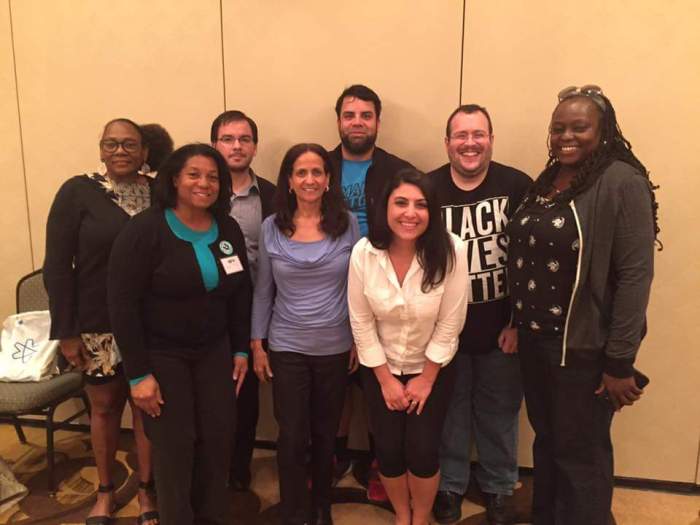
United Opt Out had just gone through a major reorganization on philosophical grounds. Only three of its long-time board members remain – Denisha Jones, Ruth Rodriguez and Ceresta Smith. They have since been joined by five new directors – Gus Morales, Zakary Rodriguez, Erika Strauss Chavarria, Deborah Anderson and Steven Singer (me).

The directors that left the group did so for various reasons, but some of them split along ideological lines. Some thought United Opt Out shouldn’t work with labor leaders or civil rights groups that weren’t perfectly aligned with all of UOO’s goals. So they left. Those who stayed are committed to working with almost anyone to push forward the cause, piece-by-piece if necessary.

As a result, this organization that had been growing by leaps and bounds, finds itself starting afresh. While last year’s conference in Philadelphia drew progressive luminaries like Chris Hedges, Jill Stein and Bill Ayers, this year’s gathering was more low key.

But it was far from somber. In fact, the board’s vision was vindicated in the most amazing way during the summit.

As Jesse “The Walking Man” Turner discussed the importance of reframing school policy to include students basic humanity, Gus looked up from his phone and announced, “The NAACP just ratified its moratorium on charter schools!”

We all stopped what we were doing and went to our phones and computers for verification. Denisha found it first and read the resolution in full.

We cheered, laughed and hugged each other.

This was exactly the kind of change we’ve been talking about! In fact, Julian Vasquez Heilig, education chair of the California and Hawaiian NAACP chapter, had originally been scheduled at the summit as a keynote speaker. When the resolution that he had been instrumental in crafting came up for a vote at the national NAACP meeting, he understandably had to cancel with us. Clearly he was needed elsewhere.

And now one of the largest civil rights organizations in the country has taken a strong stance on charter schools. Not only does the NAACP oppose charters as a solution to inequities experienced by children of color, they’ve now gone beyond mere ideology. They’re calling for action – no new charter schools.

It is a tremendous victory for parents, children and teachers everywhere. And a much needed win for civil rights and education activists. The civil rights community (including the Black Lives Matter movement) is starting to acknowledge that Brown vs. Board is right – we cannot have “separate but equal” school systems because when they’re separate, they’re rarely equal.

Let me be clear – UOO did not achieve this triumph alone. It took many people, some of whom probably have never heard of us. However, activists supporting our movement such as Julian were strongly involved.

And if we had listened to the naysayers who proposed only working with perfectly like-minded groups, this might never have happened.

As a national organization, the NAACP still supports standardized testing as necessary to hold schools accountable for teaching all students. But this was not always the case.

In October of 2014, there were 11 civil rights groups including the NAACP Legal Defense and Educational Fund (LDF) who wrote a letter to President Barack Obama asking him to reduce standardized testing.

Then in January of 2015, a full 19 Civil Rights organizations including the NAACP wrote to Congress asking lawmakers to preserve annual testing.

What changed in those three months?

All of these organizations accept huge donations from the corporate education reform industry including some of the richest people in the world like Bill Gates. While none of us were present at these decision making sessions, it seems clear that fear of losing their funding may have forced them to make hard compromises.

Should we then as education activists wipe our hands of them? Should we refuse to work with them on some issues because we disagree on others?

United Opt Out says no. We’ll work with almost anyone where we can, when we can. And the results were on display with the NAACP resolution calling for a charter school moratorium.

Perhaps now that we’ve found that common ground on school privatization, we can do the same with standardized testing. Perhaps we can help educate them about the history of this practice, how it was a product of the eugenics movement and has always been used to support white supremacy and keep people of color and the poor in their place.

If we can make that argument, think of the potential. Perhaps leadership at these big civil rights groups would be less willing to compromise if they understood that standardized testing was used to justify mass sterilizations of American citizens and it was greatly admired by the Nazis. Perhaps if they understood that our modern standardized assessments are little better and create a racial proficiency gap by their very design – maybe then threats from rich white philanthropists won’t seem as important. Perhaps if they understood that schools can best be held accountable by reference to the adequacy of the funding they receive and a detailed accounting of what they do with it, these organizations might be less inclined to rely on multiple choice testing.

In fact, this is why we were there together in Houston in the first place. We wanted to make our case to these same civil rights organizations.

They may not have sent their leaders, but their members were already here. And we spent the time working together to find ways to make our case.

It was really quite amazing.

Audrey Amerin-Breadsley, professor and author of the blog Vamboolzed, gave us an incredibly accessible and informative keynote on value-added measures (VAM), the practice of using students test scores as a way to evaluate their teachers. For instance, did you know this common practice was originally based on a model for the cattle industry? It’s junk science and has little relation to education, teachers and students. All it does is pit students and teachers against each other creating a culture of fear where educators can be unfairly fired at any time – not the best environment for learning. Yet ignorant, lazy and/or corrupt bureaucrats still champion it across the country as a solution to improving schools.

Sam Abrams, Director of the National Center for the Study of Privatization in Education (NCSPE) and an instructor at Columbia University, explained in minute detail how corporate education reform relies on bad statistics and is bad business. He explained how academics blinded by economics and unencumbered by any real-life experience of public schools came up with this scheme, which has been disproven by the facts again-and-again. Not only do the highest achieving countries such as Finland go a different route, but those that follow this market driven model find student achievement suffering. In short, our current education policies are really faith-based initiatives, a faith in the invisible hand of the market, and an ignorance of reality.

But perhaps most heartening was the series of talks given by the locals. Houston Federation of Teachers is one of the few labor unions to pass a resolution supporting parents rights to opt their children out of standardized testing. In fact, teachers and parents even run a free Opt Out Academy for children not taking the tests so that their education continues while their peers suffer through these useless assessments. We got to meet parent zero, the first parent to refuse testing in the district. We heard the community’s painstaking process of spreading the movement one family at a time. This was in effect an opt out cookbook, a how-to for anyone wishing to bring this social justice action to their own neighborhoods.

It was a weekend to give anyone hope.

We were small but we were powerful. Given a few years to rebuild, UOO could well be much stronger than we once were. Meanwhile parents across the country continue to refuse these tests for their children at an exponential rate.

There are many struggles ahead. But we have made real progress toward our goal of providing an excellent education for all children.

No longer can our governments be allowed to keep discriminating against them based on the color of their skin, their parents bank accounts and other factors. We’re standing for all students, because we don’t see them as consumers or data points. We see them as children, as human beings. And we stand together to protect and preserve that shared humanity.

What better way to spend a weekend?

State Senator To Propose Rewriting PA Charter School Law To Hold the Industry Accountable

screen-shot-2016-10-12-at-4-50-04-pm


Pennsylvania’s charter school law is a national disgrace.


It allows charters to defraud the public and provide a substandard education to our children.


Charter school managers pay themselves with taxpayer money for leases on properties they already own. They funnel money through shell companies into their own pockets. Academic achievement at many charters is far below par.


And it’s all legal.


That’s why state Auditor General Eugene DePasquale has long called it the “worst charter school law” in the country. But his call for sweeping reforms from the legislature has fallen on mostly deaf ears.


Until now.


State Sen. Jim Brewster (D-45) is in the early stages of proposing legislation that would ensure charter schools are held as accountable as other public schools.


Specifically it would require these types of schools, which are ostensibly public but privately managed, to be transparent, fiscally solvent and responsible to taxpayers.


“It has become abundantly clear that systemic changes are needed in how brick and mortar and cyber charters operate in Pennsylvania,” Brewster says.  “There is a growing frustration that charters are unaccountable.”


The bill doesn’t have a Senate number yet, nor has its specific language been made available. However, the State Senator from McKeesport announced plans to formally propose it in Harrisburg within the next several weeks.


Brewster’s bill would:

  • Require local school boards to sign off on any new charter construction project costing more than $1 million. The project would have to be backed by a financing arrangement with a local industrial development authority or other government entity. This way charters would have to prove that new construction projects are fiscally sound and won’t be abandoned after wasting millions of taxpayer dollars.


  • Compel charter schools to prove they have the funds to keep running for the entire school year. They would have to post a bond, other type of surety, or agree to a payment escrow arrangement. This would ensure charters don’t close suddenly leaving students and parents in the lurch.


  • Limit the scope of the state Charter School Appeal Board to solely determining whether the local school board acted appropriately in reviewing charter school applications. The state should not be approving new charter schools. That power should remain at the local district level, though the state can determine if local school boards are acting within the bounds of the law.


  • Require officials from the state Department of Education (PDE) to visit the proposed site of a charter school to ascertain the condition of its physical building. Their report will then be made a part of the charter application. This way charters can’t get away with paying themselves for properties they already own and they won’t be able to open with substandard buildings.


  • Mandate that a charter school applicant obtain approval from multiple school districts if the charter school draws more than 25 students from a specific district. Every district impacted by the opening of a new charter should have a say whether it can open.


  • Upgrade accountability by requiring a quarterly report on the operations of the charter school to the local school board – with the report delivered in person by a charter school official. While traditional public schools report on operations monthly, reporting four times annually would greatly increase charter school transparency. At present charters don’t have to provide such reports sometimes for years after opening. Moreover, having a flesh and blood representative of the charter school at these meetings would allow for the public to ask questions about how their money is being spent.


  • Make a structured financial impact statement part of the charter school application. This would include an estimation of enrollment multiplied by tuition payments. The impact statement may serve as the justification for denial of a charter application. This would be huge. Traditional public schools can be sucked dry of funding from fly-by-night charters without their record of proven success. Necessitating an impact statement of this kind would truly make the local district and the charter school educational partners and not competing foes.


  • Increase the percentage of certified teachers at charters from 75 percent to 90 percent of faculty, though current faculty would be grandfathered in. Except under extreme circumstances, all teachers at traditional public schools are certified. Making charters raise the bar close to that of traditional public schools is an improvement – though Brewster has in the past proposed legislation to require 100 percent of charter teachers to be certified. It’s unclear why he’s settled on 90 percent here.


  • Prohibit charter board members from receiving payments for school lease arrangements.  This issue was highlighted in August in the auditor general’s report where he found $2.5 million tax dollars being defrauded in this way. Charter operators have complained that nothing they did was illegal. This measure would ensure that in the future such moves would be explicit violations of the law.


  • Impose a moratorium on the approval of new cyber-charter schools since their academic performance has been so consistently below that of traditional public schools and brick-and-mortar charters. In fact, A recent nationwide study found that cyber charters provide 180 days less of math instruction and 72 days less of reading than traditional public schools. (By the way, there are only 180 days in an average school year.)


Brewster said these reforms offer a place to begin real robust regulation of the charter industry. However, he is open to adding others.


“The auditor general has made a number of worthwhile recommendations and I’ve combined some of these ideas with other features to produce what I believe is an excellent starting point for comprehensive reform,” he says.


“We need to dig deep and look critically at the charter law to make sweeping changes. In this year alone, the auditor general has pointed out that the reimbursement process is flawed, that there were too many reimbursement appeals and that the cyber charter law reeked with ethical issues, poor oversight and a lack of transparency.


“It is clear that the charter law is not helping schools, charters themselves or the taxpayers.”


There are more than 150 charter schools statewide enrolling more than 128,000 students, according to state data. Nearly half of these schools are in the Philadelphia area.

Two years ago, DePasquale released a set of specific recommendations to improve the charter law, which Brewster drew upon when writing his proposed legislation. DePasquale’s suggestions called for an independent board to oversee charter school processes and functions — including lease reimbursements and student enrollment. He also suggested public hearings involving charter changes, limits on fund balances and guidelines on calculating teacher certification benchmarks.


Brewster said he is not unduly singling out the charter school industry. He says he is confident making these changes will help charter schools by ensuring only high quality institutions are allowed in the Commonwealth.


The Democrat Representing the 45th legislative District says he realizes that October is late in the year to be proposing such sweeping changes. He is doing so now to raise awareness of the issue, though he doesn’t expect it to come to a vote until the next legislative session at the earliest.


He hopes to bring up many of these issues tomorrow (Oct. 13) at a Senate Democratic Policy Committee hearing at the Monroeville Municipal Building in Monroeville in his district.


The legislature tried to pass a charter school reform bill (House Bill 530 ) this summer but it had been rewritten into more giveaways to the industry than regulations. For instance, it would have allowed charters to open almost anywhere in the state without approval from local school districts. As such, it lost support.


Government watchers cautioned that this charter Trojan Horse bill might rear its ugly head again in Harrisburg. Here’s hoping that Brewster’s bill has more success and isn’t likewise bastardized into a piece of legislation that gives away the store.


If there’s one thing most people agree about in the Keystone state, it’s that we need charter school reform. Brewster’s Bill may be the answer to our prayers.

If I Were Secretary of Education – A Classroom Teacher’s Fantasy

thumbnail_fullsizerender

I will never be Secretary of Education.

Frankly, I’m just not qualified.

I’m only a classroom teacher. The powers that be don’t trust someone like me with that kind of responsibility. It’s okay to give me a roomful of impressionable children everyday, but there’s no confidence I can make sound policy decisions. For that we need someone with experience in management – not schools, pedagogy, children or psychology.

The presiding incumbent in this prestigious position, John King, somehow overcame that handicap. He had taught for three whole years at a charter school, but the bulk of his experience is in administration – administrating a Boston charter school with high suspension and attrition rates. He also was New York State Education Commissioner, where he single-handedly dismantled the state system of education and sparked one of the largest parental revolts in the nation in the state’s opt out movement.

The previous Secretary of Education, Arne Duncan, was much more qualified, having never taught a day in his life. Before getting Congressional approval, he was appointed to run a charter school and later was entrusted as CEO of Chicago City Schools where he likewise blundered his way to the top with policy decisions that devastated a great system of public education.

What do I have to offer compared to all that? I only have more than a decade’s worth of experience helping kids learn. I’m only one of 3% of teachers nationwide who are Nationally Board Certified. I’ve only earned a Masters degree in Education. I only help run a more than 56,000 member national education advocacy group, the Badass Teachers Association, and write a popular blog dedicated to education and civil rights.


I’ve never sunk a major metropolitan school. I’ve never been run out of a populous state chased by citizens armed with torches and pitchforks.

But let’s close our eyes and imagine that somehow through the magic of education bloggery I was whisked into office at the U.S. Department of Education.

What would a person like me do as Secretary?


1) Respect the Limits of the Job

Though George W. Bush and Barack Obama come from opposite ends of the political spectrum, these two Presidents did more to increase the powers of the Department of Education than any chief executives before them. They turned it into – as former Education Secretary Lamar Alexander puts it – a national school board with the Secretary was the national superintendent.

The department forced test and punishment policies on the states, cudgeled and bribed state officials to enact lousy Common Core Standards, and held federal grants hostage unless states accepted every corporate education reform scheme big business could think up.

Don’t get me wrong. I’m a New Deal Franklin D. Roosevelt Democrat, but even I think these two administrations blatantly abused their power and overstepped their Constitutional authority.

So the first thing I would do is take a step back and follow the law. The recently enacted Every Student Succeeds Act (ESSA) sets explicit limits on federal power over education policy returning much of it to the states. As Education Secretary, I would respect the power of the states to control public education. It is the state’s job to set policy. It is the federal government’s job to provide support, encouragement and oversight.

Therefore, the role of the Department of Education is to ensure public schools are being properly funded, civil rights are not being violated and to be a repository for national data and research. I’d dedicate myself to that – not some corporate fueled power trip that both parties condemn except when they’re practicing it.


2) Push for More Federal Funding for Public Schools

Therefore, the first thing I would do is use the full power of the office to ensure the federal government is giving its utmost to help state public schools. I would use whatever grants were available to increase federal funding to the most impoverished schools. I would fully fund Title I. I would increase the federal share of Special Education – (Under Part B of the Individuals with Disabilities Education Act (IDEA) the federal government is supposed to fund 40% of the per pupil cost of all special education students but has never met this obligation. I would seek to rectify that if possible.) I would enact a national after school tutoring initiative. I would provide funding to hire additional teachers to reduce class size.  And as far as is possible, I would forgive college students loan debt so they can begin their lives with a clean slate.

This is something that those who seek to disband the U.S. Department of Education never seem to understand. The federal government has an important role to play in our school systems. It’s not the unfounded power grab of the last few decades, but we need another robust player on the field to help the states achieve their goals and also to keep the states honest.

If we disbanded the Department of Education, as some conservatives from Reagan to Paul to Cruz to Trump suggest, what would happen to Pell Grants, for instance? What would happen to the bundles of federal money that boost our public schools? Who would make sure states are doing their jobs? Where could we go to find accurate data about how our schools are doing nationally and not just state-by-state?

If we got rid of the department, at best these jobs would fall back on other government agencies that haven’t the funding, staff or ability to accomplish them. More likely, it would result in the elimination of billions of education dollars that the states simply couldn’t (or wouldn’t) replace. Abuses against students on the grounds of civil rights, gender, special education, etc. would skyrocket with little to no recourse. And we would be in the dark about how well we were educating our nation’s children.


3) Encourage States to Enact Accountability Measures that Don’t Include Standardized Testing

Accountability has become a dirty word in many education circles because of the way the Bush and Obama administrations have perverted it to mean test and punish. It has become a boondoggle for the standardized testing industry, an excuse to close poorly funded and often urban public schools to be replaced by unaccountable charter schools. While this is a terrible misuse of federal power, states must be responsible for the education they provide their children. And contrary to popular belief, this can be accomplished without resorting to the usual corporate reform measures.

As Secretary, I would put an immediate stop to the era of test and punish at the federal level. As it stands, the ESSA allows states to determine what they will use to demonstrate their educational progress for students. This is a state decision, but I would encourage states not to use standardized testing. I would offer to help any state interested to find new ways to show accountability. For instance, districts could submit to a simple audit showing student-teacher ratios, per pupil funding, discipline data broken out by race, degree of segregation, richness of the curriculum, etc.

Let me be clear: it is up to states to make these decisions. As Secretary, I would have no power to force legislatures or departments of education to do any of this. However, I’m willing to bet that many states would be excited by these possibilities and jump at the opportunity. Helping them achieve this would be my job.


4) Stop Federal Funding to Charter Schools, Teach for America and Common Core

Speaking of encouragement, I would stop all federal help for corporate education reform policies. That means turning off the money faucet for programs that enrich corporations and big business at the expense of school children.

This means not one more federal dollar to help private companies open new charter schools. Teach for America would have to rely on its corporate donors, not the taxpayers. And the Common Core gravy train would come to a screeching halt. No more money to help states enact the standards, no more bags of cash for book publishers and test manufacturers.

If states that had enacted the Core wanted to keep it, fine. If not, fine. But they would be on their own.

(In a sad aside, opposition to Common Core is most virulent from conservatives, yet there are an awful lot of state legislatures completely in GOP control that could get rid of Common Core tomorrow but which have done – and continue to do – nothing about it. No matter who the next Education Secretary is, the fate of Common Core is in the hands of state legislatures across the country – not the President, not Congress and not the Education Secretary. There’s far too much rhetoric and not nearly enough action.)


5) Do Everything I Can to Increase Teacher Autonomy, Respect, Pay and Training

Finally, I would use my position as Education Secretary to boost the greatest resource we have to help students learn – teachers. I would speak out on the need for educators to have autonomy in the classroom so they are empowered to meet student needs. I would work to increase public perception and respect for the profession. We simply can’t afford teacher bashing, because when you disrespect educators, you reduce their power to help kids. I would boost teachers pay through matching state grants. If you want the best possible teachers, you have to pay for them. If you want to attract the best people to the field, you need to ensure they will have a reliable middle class income and not have to work a second job or use their own money to buy school supplies. I would invest federal funds in training programs so the newest crop of teachers are up to date with the latest pedagogy and techniques. I would encourage more people of color to enter the field. And I would partner with teachers unions to strengthen protections for teachers while educating the public on the meaning of due process and the reality that strong unions mean fewer bad teachers in the classroom.


Are there more things we need to do to help improve our national system of public education? Certainly.


We need to start integrating schools again and stop the constant push to segregate through charter schools and white flight. We need to ensure every student receives adequate, equitable, sustainable funding. We need to change charter school laws so that they can’t cherry pick students and are as transparent and accountable as traditional public schools. We need to stop closing struggling schools and address root causes. We need to stop state takeovers except under the most dire of circumstances and set limits on how long states can stay in control. And we need to pass strong student privacy laws – even updating the Family Education Privacy Act (FERPA) to protect our children from predatory ed-tech companies that constantly data mine students and sell millions of data points on our children to the highest bidder.

There are a whole host of things needing done. However, most of these things go beyond the powers of the Department of Education and its cabinet level Secretary. They can only be addressed by the President, Congress, state legislatures and/or the court system. The Education Department can help steer that agenda, it can be an ally to real positive change, but it can’t go it alone.

Unfortunately, no matter who wins the Presidency in November – Clinton or Trump – neither seems likely to nominate an Education Secretary who would do any of the things I’ve outlined.


For all his talk of reducing the size of the government, Trump proposes increasing the federal footprint with school choice initiatives turning the Department of Education into a wheelbarrow marked “free money” for big business and parochial schools while forcing states to accept his school policies. Meanwhile, Clinton is likely to continue the course set by Bush and Obama of embracing every corporate school reform package from which Wall Street benefits.

It’s a crazy time full of crazy candidates and crazy solutions, but of this we can be sure – no one is crazy enough to let a teacher make decisions about public education policy.

You Can’t Be Anti-Opt Out and Pro-Democracy

20130220-michels-edy-chamness-sign

Our lawmakers have a problem.

This summer they doubled down on one of the most anti-democratic mandates in the federal repertoire yet they claim they did so to protect states rights.

Here’s the problem.

Every year, hundreds of thousands of public school parents across the country opt their children out of standardized testing.

But Congress voted to keep mandating that 95% of students take the tests.

It all happened with the much celebrated bipartisan passage of the Every Student Succeeds Act (ESSA), the federal law that governs K-12 schools.

While lawmakers made changes here and there to let the states decide various education issues, they kept the mandate that students participate in annual testing.

They didn’t leave that to the states. Whether they were Republican or Democrat, almost all lawmakers thought it was just fine for the federal government to force our children to take standardized tests at least every year in 3-8th grades and once in high school.

If any school district, has more than 5% of students that don’t take the tests – for whatever reason – the federal government can deny that district funding.

Think about that for a moment.

Our lawmakers are supposedly acting in our interests. They’re our representatives. We’re their constituents. They get their power to pass laws because of our consent as the governed. Yet in this instance they chose to put their own judgement ahead of ours.

They could have made an exception for parents refusing the tests on behalf of their children. They just didn’t see the need to do so.

Why? Because they were worried about minority students.

It’s a laughable claim in so many ways.

It goes something like this – without standardized testing, we’ll have no way of knowing if public schools are educating students of color.

Let’s say for a moment that this were true. In that case, we can expect no parent of color would ever refuse standardized testing for his/her child.

First, this is demonstrably untrue. Black and brown parents may not be the most numerous in the opt out movement, but they do take part in it.

Second, in the majority of cases where white parents refuse testing, that would have no bearing on whether testing helps or hurts students of color. If the point is the data testing gives us on black kids, what white kids do on the test is irrelevant.

Third, even if opting out hurt students of color, one would assume that it is the parents prerogative whether they want to take part. If a black parent doesn’t want her black son to take a multiple choice exam, she should have the right to waive that exam and the responsibility would be on her head.

So there is absolutely no reason why lawmakers should have overstepped their bounds in this way and blocked all parents rights about what the schools do to their children.

It is a clear case of governmental overreach. And there are plenty of parents just waiting to bring it to the U.S. Supreme Court for the ultimate Constitutional test.

However, that probably won’t happen for the same reason it never happened through the 15 years of No Child Left Behind (NCLB) which also contained the annual testing rule.

The federal government has never withheld tax dollars based on students not taking standardized tests. officials at the U.S. Department of Education have made threats, but they have never devolved into action.

The bottom line is this: they know how Unconstitutional this mandate is, and they aren’t itching to have it tested in the highest court in the land.

It would open a whole can of worms about standardized testing. What is the federal government allowed to do and not allowed to do about education policy?

The ESSA is an attempt to reduce the federal role, but keeping the annual testing mandate was either a grievous mistake or the last vestiges of federal hubris.

But let’s return to the reasoning behind it – so-called civil rights fears.

Various groups including the NAACP asked for it to be included to protect minority students. Annual testing is the only way, they claimed, to make sure schools are teaching students of color.

It’s nonsense.

There are plenty of ways to determine if schools are meeting the needs of minority students – especially since most students of color go to segregated schools.

Even after Brown v. Board, we have schools that cater to black kids and schools that cater to white kids. We have schools for poor kids and rich kids.

It is obvious which schools get the most resources. Why isn’t that part of this “accountability” scheme? We can audit districts to see how much is spent per pupil on poor black kids vs rich white kids. We can determine which groups go to schools with larger class sizes, which groups have more access to tutoring and social services, which groups have expanded or narrowed curriculums, which groups have access to robust extra-curricular activities, which groups have the most highly trained and experienced teachers, etc.

In fact, THAT would tell us much more about how these two groups are being served by our public schools than standardized test scores. We’ve known for almost a century that these test scores are more highly correlated with parental income than academic knowledge. They’re culturally biased, subjectively scored and poorly put together. But they support a multibillion dollar industry. If we allow a back door for all that money to dry up, it will hurt lawmakers REAL constituents – big business.

So why were civil rights groups asking the testing mandate be kept in the bill? Because the testing industry is comprised of big donors.

Only a few months before passage of the ESSA, many of these same civil rights groups had signed declarations against standardized testing. Then suddenly they saw the light as their biggest donors threatened to drop out.

Make no mistake. Standardized testing doesn’t help poor minority children. It does them real harm. But the testing industry wrapped themselves up in this convenient excuse to give lawmakers a reason to stomp all over parental rights.

The conflict wasn’t between civil rights and parental rights. It was between parental rights and corporate rights. And our lawmakers sided with the corporations.

Let me be clear: legislators cannot be against opt out and in favor of individual rights.

The two are intimately connected.

Our schools have no business telling parents how to raise their kids. But our parents DO have a right to do the opposite. In fact, that’s how the system is supposed to work.

We, parents and citizens, control our schools – not you, our representatives. The principal can’t say you haven’t a right to opt out your kid. He’s just your representative. So is the teacher.

Everyone who works in the school is there to do what you want them to do for your child. Yes, they are well trained and have a world of knowledge and experience that we should draw on. And in most cases, they’re being forced to confront us by lawmakers who are tying their hands and directing them to do the dirty work.

We have common cause. We need to stand with our teachers and principals, our school boards and education professors. We need to stand together against lawmakers who think they know better.

In short, we don’t need lawmakers consent to opt out. They need our consent to stop us.

They get their power from us. They work for us.

And it’s time they get to work and rescind the annual testing mandate.