I Triggered Bill Maher By Writing About Standardized Testing and White Supremacy 


Bill Maher is mad at me. 


And I’ve never even met the man.  


I guess you could say we’re from different worlds. 


He’s on the West Coast. I’m on the East.  


He’s a political comedian. I’m a public school teacher. 


He’s a multimillionaire. I can barely make ends meet. 


What could I possibly do to provoke the ire of this man so much so that he took aim at me on his HBO TV show? 


 As near as I can tell, it started when I wrote a blog.  


Then people read that blog.  


It got popular and was republished throughout the Internet.  


And Maher disagrees with what I wrote.  


In fact, the very idea annoyed him as a prime example of namby-pamby liberals taking their agenda too far. 


What did I write in the article?  


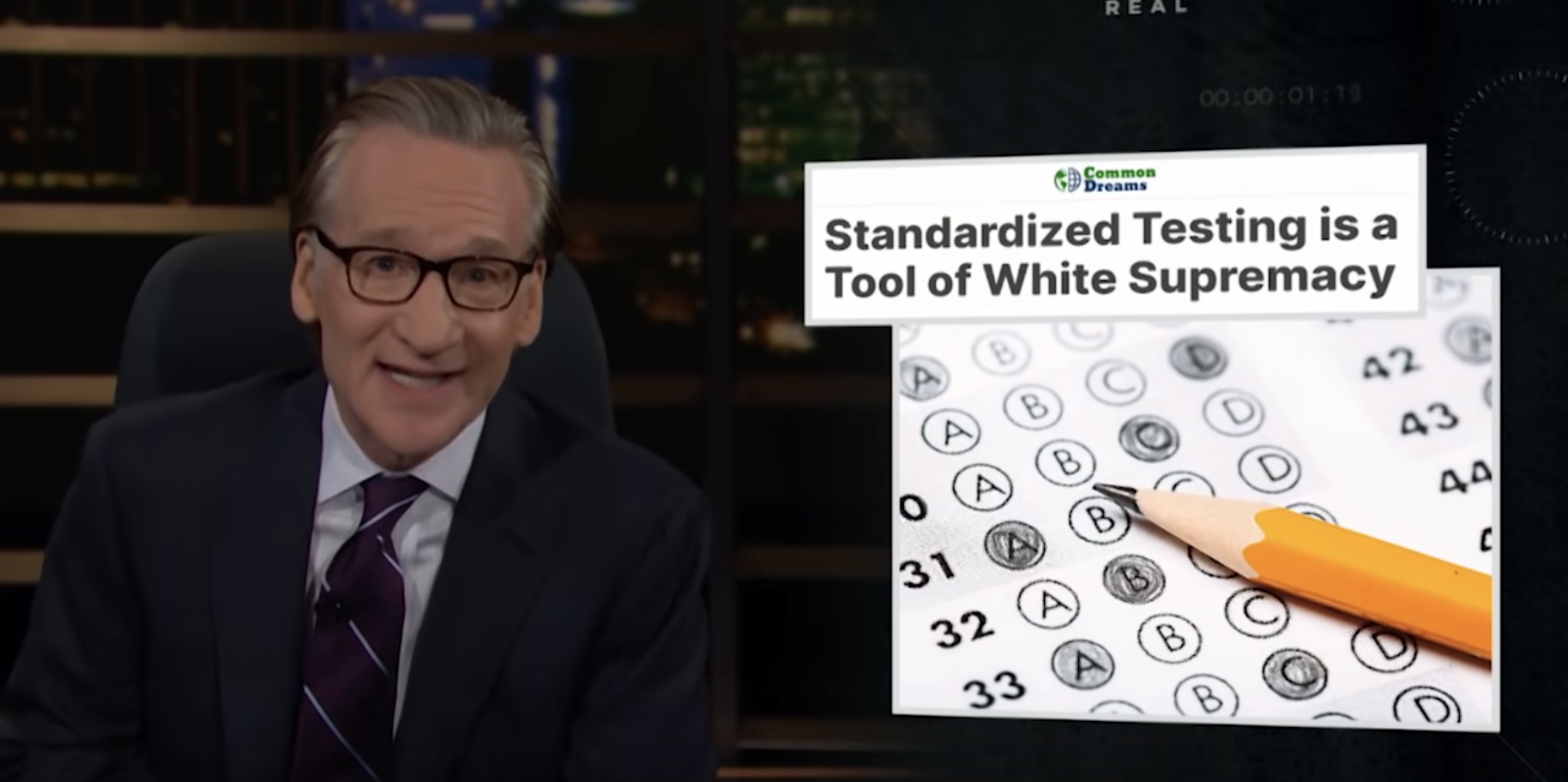
Only that standardized testing is a tool of white supremacy


In fact, that was the title of the article, which seems to be about as far as Bill read because he ignored any arguments, facts or historical citations in the piece.  


On his show, “Real Time with Bill Maher” this week, he posted the title of the article and the graphic that appeared with it when it was republished on commondreams.org


What he didn’t post was my name. I am the author, after all, but I guess that’s not important.  


The crucial bit was how triggered Bill was by my assertion.  


By connecting such allegedly alien concepts as standardized testing and racism, Maher thinks I devalued the meaning of “white supremacy.” 


Maher never actually examined my claim or what I wrote backing it up. Never mind the arguments I made in favor of my point, the sources I cited, the examples of actual bias or the documented history of standardized testing as a creation of the eugenicist movement.  


He was content to speak in a smarmy tone and make a pretty lame joke about what a racially biased test question might look like.


In fact, that’s probably why he (and his staff) picked my piece in the first place. They saw it as an opportunity to make a joke and whiffed at it pretty terribly. 


Here’s the relevant bit of his monologue: 


“In 2010 the New York Times used the term “White Supremacist” on 75 occasions. Last year, over 700 times. Now some of that to be sure is because Trump came along and emboldened the faction of this country that is truly white supremacist. It is of course still a real thing. But it shouldn’t apply to something like – as more than a few have suggested – getting rid of the SAT test. Now if we find the SAT test is slanted in such a way as to stack the deck in favor of Caucasians, if there are questions like Biff and Chip are sailing a yacht traveling at 12 knots to an Ed Sheeran concert on Catalina – if Catalina is 12 miles away, how many White Claws should they bring? Yes, then maybe. But of course the SAT doesn’t have questions like that so it becomes a kind of ludicrous exaggeration that makes lovers of common sense roll their eyes – and then vote for Trump.”  
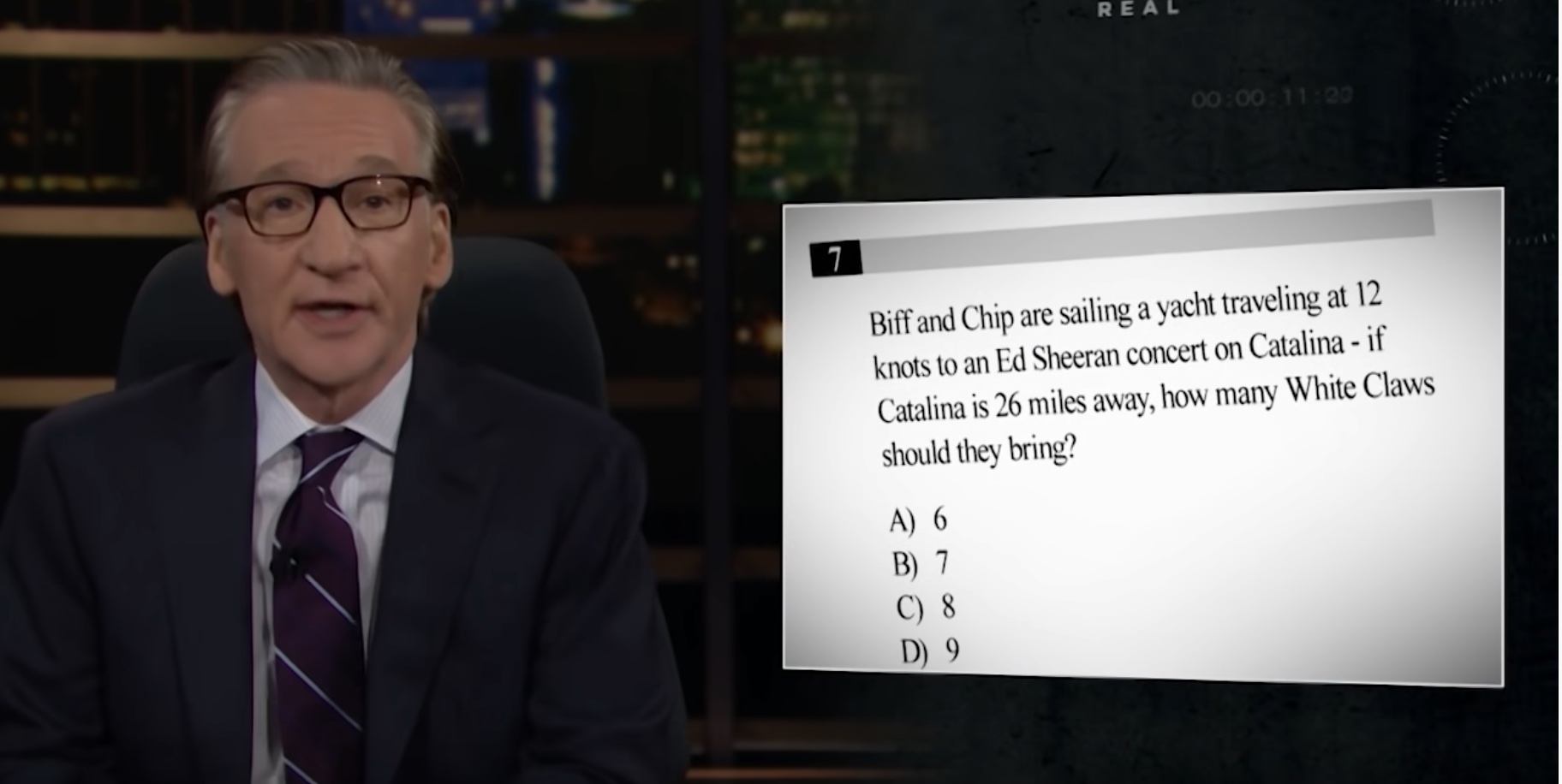


Queue audience laughter and applause.  


Funny stuff I guess.  


Not the comedy staff’s fake SAT question but Maher’s assurance that “The SAT doesn’t have questions like that.” 


Really, Bill? 


How about this one? 


Runner: Marathon 
(a) envoy: embassy 
(b) martyr: massacre 
(c) oarsman: regatta 
(d) horse: stable 


It’s a real SAT question famously discussed in the infamous 1994 book, The Bell Curve, by Richard Herrnstein and Charles Murray – a book that tried to use discrepancies in test scores to prove white people are smarter than black people. 


The answer is C, and it relies on a test taker’s knowing the meaning of regatta – something more likely to have come up in the daily lives of affluent white students than in the lives of less affluent minority students. If you don’t live by a body of water and/or don’t have much experience with rowing, you’re probably going to fail this question.  

It’s the same kind of question Maher’s comedy team came up with – find something white people are more likely to know than black people – but the Real Time writers just pilled it on over-and-over.

It doesn’t take five repetitions of something to make it biased. All it takes is one.


To be fair, my example is from the SAT analogy section, which was removed from the test in 2005. However, that doesn’t mean they got rid of the bias. 

In fact, the College Board, the organization that develops and administers the SAT, tacitly admits its test is biased.

It now provides an “adversity score” for poor and minority students to adjust raw SAT scores to account for high schools and neighborhoods “level of disadvantage.”

In other words, they know that poor and minority kids get lower scores so they’re trying to fudge the results to give them a boost.

Which would be entirely unnecessary if the SAT assessed them accurately in the first place.

They are literally trying to make up for how biased their test scores are.

Consider this.

Total SAT scores range from 400 to 1600 – or from 200-800 in both Math and Reading respectively.

According to 2018 data, combined SAT scores for Asian and White students average over 1100, while all other groups average below 1000. Meanwhile, students with family income less than $20,000 score lowest on the test, and those with family income above $200,000 scored highest, according to 2015 data. And the difference is significant – a 433 average Reading score for those with the lowest family incomes compared to an average Reading score of 570 for those with the highest family income. That’s a 137 point difference!

And it holds for racial groups, too. The average Reading score on the SAT was 429 for black students – 99 points behind the average for white students.

However, the College Board is trying to justify this by saying the discrepancy is because poor and minority students are more disadvantaged than white, affluent ones. In other words, it’s not the test that is unfair, but American society in providing better resourced schools with lower class sizes and more resources for white kids than children of color.

And while American society IS unfair to the poor and minorities, several studies indicate that the problem is even deeper than that.

The SAT is biased, too.

Several studies ( Roy Freedle of the Educational Testing Service from 2003, Maria Santelices and Mark Wilson from 2010, etc.) find notable differences between the verbal scores of black and white students whose educational background and skill set suggest that they should get similar scores.

Freedle says this is because SAT questions likely reflect the cultural expressions that are used commonly in the dominant (white) society, so white students have an edge based not on education or study skills or aptitude, but because they are most likely growing up around white people.

This makes sense if you examine how test questions are selected for the SAT. In his book How the SAT Creates Built-in-Headwinds, national admissions-test expert, Jay Rosner, explains the process:


“Compare two 1998 SAT verbal [section] sentence-completion items with similar themes: The item correctly answered by more blacks than whites was discarded by the Educational Testing Service, whereas the item that has a higher disparate impact against blacks became part of the actual SAT. On one of the items, which was of medium difficulty, 62% of whites and 38% of African-Americans answered correctly, resulting in a large impact of 24%…On this second item, 8% more African-Americans than whites answered correctly…”


 In other words, the criteria for whether a question is chosen for future tests is if it replicates the outcomes of previous exams – specifically tests where students of color score lower than white children. And this is still the criteria test makers use to determine which questions to use on future editions of nearly every assessment in wide use in the US.

But if all this isn’t enough to convince you that standardized tests really are a tool of white supremacy, consider their sordid history.

They are literally the product of the American eugenics movement.

Modern testing comes out of Army IQ tests developed during World War I.


 In 1917, a group of psychologists led by Robert M. Yerkes, president of the American Psychological Association (APA), created the Army Alpha and Beta tests. These were specifically designed to measure the intelligence of recruits and help the military distinguish those of “superior mental ability” from those who were “mentally inferior.” 


These assessments were based on explicitly eugenicist foundations – the idea that certain races were distinctly superior to others. In 1923, one of the men who developed these intelligence tests, Carl Brigham, took these ideas further in his seminal work A Study of American Intelligence. In it, he used data gathered from these IQ tests to argue the following: 


“The decline of American intelligence will be more rapid than the decline of the intelligence of European national groups, owing to the presence here of the negro. These are the plain, if somewhat ugly, facts that our study shows. The deterioration of American intelligence is not inevitable, however, if public action can be aroused to prevent it.”


Eventually Brigham took his experience with Army IQ tests to create a new assessment for the College Board – the Scholastic Aptitude Test – now known as the Scholastic Assessment Test or SAT. It was first given to high school students in 1926 as a gatekeeper. Just as the Army intelligence tests were designed to distinguish the superior from the inferior, the SAT was designed to predict which students would do well in college and which would not. It was meant to show which students should be given the chance at a higher education and which should be left behind. 


And unsurprisingly it has always – and continues to – privilege white students over children of color.

Is it an exaggeration to say that assessments specifically designed to favor affluent white people over impoverished minorities still does the same thing?

Is it ridiculous to describe the century long racial and economic discrepancy in test scores as something that supports white supremacy – especially when these results are shown time and again to be a feature of the tests and not just an artifact that recreates economic inequality?

Is it going too far to call out the racism of the SAT and other standardized tests like it when even the College Board admits its own scores are biased?

Does it devalue the term “White Supremacy” to point out real world white supremacy?

But Maher apparently isn’t interested in these questions.

After a few moments he moved on to another example of the left gone wild.


But I can’t do that because this isn’t just a bit for me.  


As I mentioned, I’m a public school teacher.  


I deal with the impact of standardized testing every day.  


I watch my students degraded, depressed and dehumanized by it year after year.  

It’s become cliche for privileged white people like Bill Maher to get cranky when someone points out real world prejudice.

But for those of us in the trenches, it is an everyday reality.

And that’s what triggers me.


Here’s the segment from “Real Time with Bill Maher”: (the relevant bit starts at 4:45)


Like this post?  You might want to consider becoming a Patreon subscriber. This helps me continue to keep the blog going and get on with this difficult and challenging work.

Plus you get subscriber only extras!

Just CLICK HERE.

Patreon+Circle

I’ve also written a book, “Gadfly on the Wall: A Public School Teacher Speaks Out on Racism and Reform,” now available from Garn Press. Ten percent of the proceeds go to the Badass Teachers Association. Check it out!

Reducing Students to Their Test Scores Will Only Increase Their Pandemic Wounds 


Read the following as quickly and accurately as you can:

‘I know I withought all by he middle on, ” said a between he name a buzzing, he for began open he the only reason for making.”

Very good, you’re told as your teacher clicks a stopwatch and writes on a piece of paper.

Now try this one:

“Twas brillig, and the slithy toves, Did gyre and gimble in the wabe:

All mimsy were the borogoves, And the mome raths outgrabe.”

The teacher frowns and writes for a minute straight without comment.

Okay. Give this one a shot:

“Lorem ipsum dolor sit amet, consectetur adipiscing elity, sed do eiusmod tempor incididunt ut labore et dolore magna aliqua.”

No, this isn’t a crash course in some foreign language.

It’s the DIBELS test.

Students as young as Kindergarten (and sometimes younger) are asked to read a text aloud in a given time and each mispronunciation is recorded and marked against them.

And, yes, the texts are often pure nonsense.


My first example was from a nonsense generator of Winnie the Pooh, the second was from “Jabberwocky” by Lewis Carroll and the last an example of Lorem ipsum, a placeholder text commonly used in the graphic, print, and publishing industries.

To my knowledge none are actually used on the DIBELS test but they give you an idea of what an adult version might be like if given to people our age and not just the littles.

Can you imagine being a child, feeling the pressure of a test and being presented with something that looked like those passages!?

The fear! The sense of urgency to say something before the time runs out! The feeling of inadequacy and confusion as you finished knowing you got it wrong!

And the assurance that this meant there was something wrong with YOU!

That’s reading assessment in the standardized testing age.

Decoding – or working out the actual pronunciation of words – is given primacy over actual comprehension.

Why? Because that way we can break reading down into simple, quantifiable tasks that can be used to sort and rank children.

You know. The goal of standardized testing.

It’s highly controversial among people who study reading acquisition, but extremely common in elementary and middle schools.

And extremely lucrative for the makers of the DIBELS test.

Today I was forced to leave my class of 8th grade students with a sub so an “expert”from the Allegheny Intermediate Unit could lecture me and the rest of my school’s English department in using DIBELS as a gatekeeper assessment for all students.

That way we can group the students more easily based on their reading deficiencies.

I literally had to stop teaching for THAT.

I was bopping around the classroom, reading students’ writing, helping them organize it, helping them fix their explanations and craft sophisticated essays on a short story.

But I had to STOP, so an outside contractor could explain to ME how to teach.

ME, a Nationally Board certified teacher with two decades of classroom experience.

And the rest of the department with similar experience and education. In the group was also the holder of a doctorate in education. Almost all of us at least held a masters degree.

It boggles the mind.

In this time of pandemic stress when just keeping enough teachers in the building to staff our classrooms is a challenge, administration is wasting our time with this.

Before Covid-19, I could almost imagine it.

We did a lot of stupid things back then. But now a deadly virus rages across the country. Several students and staff get sick every week.  


There is a shortage of teachers, aides, subs, bus drivers, and other staff. 


And even though most school buildings are open, most students are still suffering from the social and emotional effects of the never-ending disaster.  


Yet the people who set school policy refuse to see any of it.  


They’re like ostriches – in suits – with their heads planted firmly in the ground. 


Covid safety protocols, reducing teacher workload, providing counselors for students – none of that is even on their radar.  


All they want to do is reinstitute the policies that weren’t working well before the pandemic hit.  


The only difference is their sense of urgency.  


In fact, the only impact they even recognize of the last year and a half is the dreaded LEARNING LOSS.  


Kids weren’t in class consistently. They were in on-line classes, or hybrid classes or maybe they didn’t even show up to class at all.  


That means they don’t know as much today as they would have known had the pandemic not happened.  


So – we’re told – they’ve lost learning. 


Oh no!  


But what these decision makers don’t seem to understand is that this whole concept is kind of meaningless.  


All people learn at different rates. If you don’t know something today, that doesn’t mean you can’t learn it tomorrow.  


There’s no time table for understanding. It’s not a race. It doesn’t matter when you learn something only that you continue making progress. 


However, you’d need a classroom teacher to explain that to you. And these are more business types. Administrators and number crunchers who may have stood in front of a classroom a long time ago but escaped at the first opportunity. 


They look at a class full of students and don’t see human children. They see numbers, data.  


And they are just itching to get back to sorting and ranking students based on standardized test scores.  


After all – say it with me – LEARNING LOSS!!!! 


Unfortunately there’s a whole world of reality up here above ground that they’re ignoring. And up here continuing with their willful fantasy is doing real harm.  


When I look at my classes of students, I don’t see overwhelming academic deficiencies.  

Even their test scores don’t justify that myth.


According to the Pennsylvania System of School Assessments (PSSA), they’re pretty much where I’d expect them any other year.


But their behaviors are off the hook


They simply don’t know how to interact with each other without conflict.  


My students are desperate for attention – any kind of attention – and will do almost anything to get it.  


They’d prefer to be respected, but they don’t understand how to treat each other respectfully. So they aim for any kind of response.


To a large extent this is due to a disruption in the social and emotional development they would have received at school. But robbed of good role models and adequate consequences, they’re somewhat at sea.  


Moreover, the pandemic has had a devastating effect on their support systems at home. Parents, family members and guardians have lost jobs, become sick and some have even died.


They don’t know who to trust and who they can rely on.  


So when they get to school, we’re going to meet their needs with more standardized tests!?  


That’s one of the worst things we could do. 

Take a child who already has trust issues and force them to read nonsense sentences while we judge them with a stopwatch?


Erase their individual identities and try to see them primarily as their scores?


These are in the low group. These are in the middle group. These are in the high group.  


Instead of giving them robust pieces of literature to read, they’ll get nonfiction scraps devoid of any connection to their lives, interests or aptitudes.  


We’ll drill and kill them, make every day about teaching to the test instead of teaching to the student.  


We’ll let data drive the instruction instead driving it based on the actual living, breathing, human beings we’re supposed to be serving.  


And instead of relying on teachers – highly trained people with decades of experience in how children learn effectively – we’ll put our trust in mega corporations that make more money the less effective their materials are.  


Prepare for a test – they make money. 


Take a test – they make money. 


Fail the test and have to remediate – they make money.  


It’s a scam – an endless cycle – and administrators and policy makers keep falling for it.  


Will this help meet kids social needs?  


Absolutely not. They’ll be segregated by ability and forced to repeat confusing and mind numbing tasks as if that’s what education was.  


Will it help meet kids emotional needs?  


No way! Being forced to do the same thing over and over and continually told you’re a failure won’t teach anything except a kind of learned helplessness.  


Kids will learn “I’m bad at math” or “I’m bad at reading” rather than the joy that can be found in both activities.  


They’ll learn to give up.  


And they’ll take out the negative feelings all this generates on each other and their teachers.  


It doesn’t have to be this way.  


A new world is possible.  


The pandemic offers us a chance to stop repeating the same mistakes of the past.  


We can scrap standardized testing and focus on authentic assessments – teacher constructed assessments the are suited to the individual context, the individual students.  


We can focus on lessons that engage students and encourage them to learn intrinsically.


We can focus on what students know instead of what they don’t so they learn that they are capable, that they have the power to do the lesson.  


We could help students understand how to interact with each other and heal some of the social and emotional wounds of the past year and a half.  


But we can’t do that if we’re forced to continue with the same mistakes of the past. 

We have to recognize the reality teachers, students and parents are living through.

And we have to make decisions based on that reality, not the same old preconceptions that have never gotten us anywhere.


Like this post?  You might want to consider becoming a Patreon subscriber. This helps me continue to keep the blog going and get on with this difficult and challenging work.

Plus you get subscriber only extras!

Just CLICK HERE.

Patreon+Circle

I’ve also written a book, “Gadfly on the Wall: A Public School Teacher Speaks Out on Racism and Reform,” now available from Garn Press. Ten percent of the proceeds go to the Badass Teachers Association. Check it out!

What is Taught in Public Schools? Volunteer as a Substitute Teacher and See for Yourself! 

Some lawmakers want more transparency in public schools.

Meanwhile, there’s a nationwide substitute teacher shortage.

It seems to me we can solve both problems at once.

PROBLEM 1: BOGUS LEGISLATION

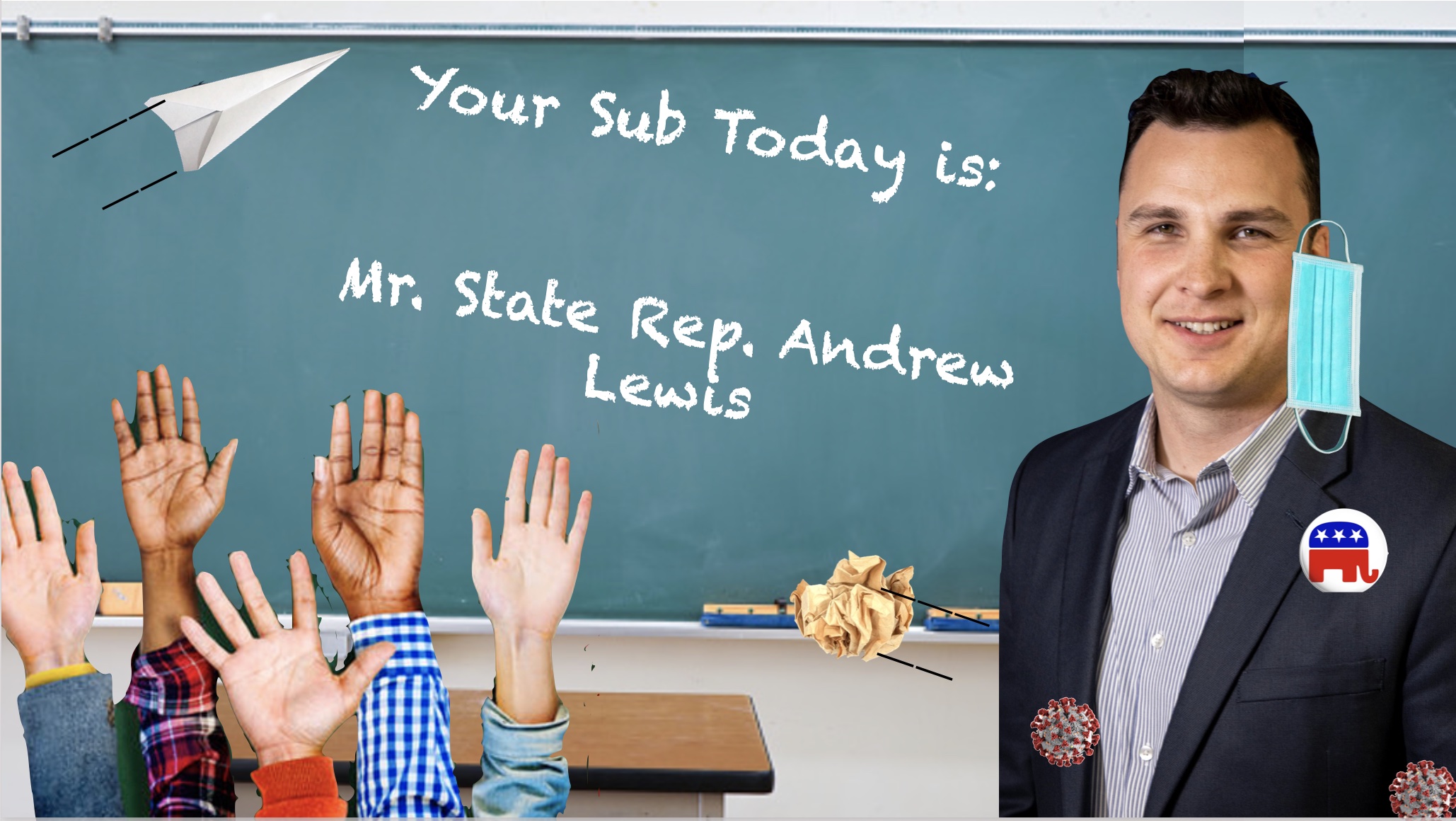
Pennsylvania state Representative Andrew Lewis is terrified that students are being taught things in school.

Things like history and science and – oh my word! – socialism.

To make sure this doesn’t happen, the Republican businessman is sponsoring a bill requiring public schools to post curriculum materials online.

This would include a course syllabus or written summary of every class, the state academic standards for each course, and a link or title for every textbook used.

It sets up a mountain of paperwork for the state’s already overburdened teachers to repeat information that’s readily available elsewhere.

Moreover, the whole thing is really just a political sham to stoke the radical Republican base. The measure has little chance of actually being implemented.

The bill (HB 1332) passed the House largely along party lines last week with a few Republicans joining Democrats against it.

Now it is set for a full vote by the Senate where it will probably sail through with GOP support after which Democratic Governor Tom Wolf has already promised to veto it.

So why is Lewis putting on this dog and pony show?

In a now deleted Facebook post, the 33-year-old Dauphin County man wrote:

“Parents need to be in the driver’s seat when it comes to education, not some out-of-state textbook publisher teaching heaven knows what (hint: anti-American socialism) to our students.”

Apparently Lewis doesn’t understand that parents vote and serve on school boards that, in fact, pick the textbooks which are used in public schools.

Moreover, I guess no one told him that state law already requires that public schools give parents and guardians access to information about instructional materials.

Or that Medicare, Social Security, Minimum Wage and Child Labor Laws are all examples of – GASP! – socialism.

Lewis and other Republicans continue to spread the insinuation that something nefarious is happening behind the closed doors of our public schools.

Well guess what, fellas! Those doors aren’t closed at all.

PROBLEM 2: SUB SHORTAGE

Nationwide there’s a substitute teacher shortage. And you can apply!

Even schools in the Keystone state are scrambling to find enough subs.

If you want to know what happens in public schools, you can do better than clicking on some Website. You can actually volunteer to come in and cover an absent teacher’s class!

“Substitute lists are very small in most districts,” says Mark DicRocco, Executive Director of Pennsylvania Association of School Administrators (PASA).

The organization reports that the Commonwealth is experiencing a dramatic decline in the supply of new teachers. 

The number of state Instructional I licenses granted for all subject areas in grades K-12 has decreased by at least 49% from 2011 to 2018. 

About eight years ago, 40,000 teachers were graduating from Pennsylvania colleges a year. This past year, it was only 14,000. 

That means not only fewer classroom teachers to replace those who retire, but fewer substitute teachers to take over for professional absences.

The situation has gotten so bad that the legislature (on which Lewis serves) had to pass a new measure allowing college students who are studying education to fill in as substitutes.

Many districts such as Erie, Greater Latrobe and State College have increased substitute pay to entice more people to apply for the job.

And, frankly, almost anyone can do it.

Even folks like Lewis and his Republican buddies! Heck! The legislature is only in session a few weeks every month! They have plenty of time to moonlight as substitute teachers and get the low down about what’s really happening in our public schools!

To be a sub in most public school districts in Pennsylvania, essentially all you need is a bachelors degree (it doesn’t even have to be in education) and pass criminal background checks.

Districts that aren’t experiencing a shortage may require a teaching certificate as well, but beggars can’t be choosers. In districts where it is hard to get subs (i.e. those serving poor and minority kids) you can get emergency certified for a year.

And many states are lowering the bar even further!

In Oregon, where the shortage of subs is even worse, the state is even temporarily waiving the need to have a bachelor’s degree!

SOLUTION: VOLUNTEER AS A SUB

Just imagine!

Republicans uneasy about public school can get in there and see it all first hand.

And they’ll even get paid to do it!

Not as much as they make as lawmakers. Pennsylvania’s legislature is paid the third highest salary in the country! Way more than classroom teachers or certainly substitutes. But they’d get remunerated for their time.

All they’d have to do is watch over classes of 30 or more real, live students!

Not only would lawmakers have a chance to look over teacher’s lesson plans, but they’d get detailed instructions from the absent teacher about how to actually teach the lesson!

They’d get to interact with principals as they’re told which additional classes they have to cover in their planning periods and which extra duties they’d be responsible for performing.

They’d get to do things like monitor the halls, breakfast and lunch duty, watch over in-school suspension, and – if they’re lucky – they might even get to attend a staff meeting and be front row center for all the educational initiatives being conducted in the school!

If our representatives took this opportunity, they would learn so much!

They might even understand that this critical race theory thing they’re being warned about on Fox News and on talk radio isn’t actually taught in public schools. It’s a legal framework you only find in colleges and universities, and even there it’s mostly in the law department.

They’d see that indoctrination isn’t really something we do in public schools.

I mean, sure, we encourage kids to stand for the pledge to the flag and things like that but when it comes to telling them how to think – that’s not a public school thing. That’s a private and parochial school thing.

They’d see that public school lessons give students information on a subject but then ask them to come to their own conclusions about it.

They’d see our students struggle with large class sizes, crumbling infrastructure and facilities, and an overabundance of standardized tests.

They’d see kids grappling with social and emotional needs caused by the Covid-19 pandemic, generational poverty, and systemic racism.

They’d see the scarcity of resources available to classroom teachers to meet those needs and the profusion of expectations heaped on them. (For example, the expectation of bills like HB 1332 that they post all their curriculum and daily lessons on-line in addition to everything else they have to do on a daily basis.)

They’d see the dangers of putting themselves on the front line of a global pandemic and in the line of fire of potential school shooters without adequate gun safety laws.

In fact, this would be such an educational experience, I think legislators on both sides of the aisle should take advantage of this unique opportunity.

And not even just those in Harrisburg. What better way for school directors to understand the institutions they’re overseeing than to volunteer as subs? What better way for the mayor and city council to understand the needs of children than putting themselves in the classroom when the teacher can’t be there?

Instead of pontificating about the culture wars, class grievances, business interests or innuendos, lawmakers might actually learn what the real problems are in our public schools and what needs to be done about them.

It could make them better public servants who craft legislation that would actually do some good in this world and not – like Lewis – just showboat to enrage partisans and stoke them to vote for people willing to feed their fears and prejudices.

Any takers?


Like this post?  You might want to consider becoming a Patreon subscriber. This helps me continue to keep the blog going and get on with this difficult and challenging work.

Plus you get subscriber only extras!

Just CLICK HERE.

Patreon+Circle

I’ve also written a book, “Gadfly on the Wall: A Public School Teacher Speaks Out on Racism and Reform,” now available from Garn Press. Ten percent of the proceeds go to the Badass Teachers Association. Check it out!
My Students Haven’t Lost Learning. They’ve Lost Social and Emotional Development  


There is a student screaming across the hall.  
  
He is holding his gut and rocking back and forth in cries of wordless emotional pain as the rest of the class looks on in bewilderment.  
  
Students from other rooms start to cluster around the door until a security guard makes them go away.  
  
I close the door to my own classroom and try to settle my students down – but we can still hear him through the walls.   
  
And then:  
  
“Shut up!”  
  
“You’re stupid!”  
  
“Why don’t you make me!?” 
 
  
Believe it or not, this is not what teaching middle school used to be like.   
  
Eighth grade students were never perfect angels, but at least by then they used to know how to talk to one another. They could usually interact without constant sniping. They knew what was expected to get respect from each other and at least tried to do it.   
  
But things have changed.   
 
After 18 months of a pandemic, even when they aren’t infected with disease, children still are suffering tremendously from the effects of Covid-19. 
 
Adolescents are dealing with higher rates of anxiety, depression, stress, and addictive internet behaviors.   
 
The Centers for Disease Control (CDC) reports that children between the ages of 5 and 11 visiting an emergency department because of a mental health crisis increased 24 percent from April through October of 2020 compared to the previous year. Among 12- to 17-year-olds, the number increased by 31 percent.  
 
Suicide attempts among 12- to 17-year-old girls increased by about 50 percent over winter 2019, according to the CDC. 
 
And these numbers are probably under reported since these increases took place at the height of a pandemic when many people were hesitant to seek medical attention.  
 
As usual, the place where these issues are most visible is our public schools
 
When Covid-19 swept our shores last year, much of the benefit of formal education fell through the cracks.   
 
Consistency went out the window. Many schools went to on-line learning or a hybrid model of in-person and on-line offset with increasingly common periods of quarantine.  
 
These were often necessary to keep kids and their families safe – and in some cases still are. As a society, we could have done more to blunt the blow such as paying parents to stay safe at home as well as supervise their children, but economic concerns took precedence to human ones.  
 
And now we’re seeing the cost
  
Many students attended school haphazardly and their parents often weren’t around to give them the kind of stability, role models or attention they’d normally get at school.   
  
Today, as the pandemic still smolders on, and schools struggle to function as if the danger had passed, the result is classes of emotionally needy and socially awkward children.  
  
There were so many fights in the halls of my building last week, we’re now operating on a soft lockdown to decrease unstructured time between classes.   
  
And you know what – it’s not really kids’ fault.  
  
They’re just trying to live in the world we’ve built for them.   
 
More than 674,000 Americans have died from COVID
 
According to the CDC, more than 140,000 children in the U.S. lost a primary or secondary caregiver such as a live-in grandparent or another family member to the virus. 
 
Globally, that’s more than 1.5 million kids who have lost a parent, guardian or live-in relative to the pandemic, according to the Lancet
 
No wonder kids are having trouble dealing with their emotions! Their support systems are shot! 
  
My students are bright, caring, energetic and creative people. They have the same wants and needs as children always have. They just have fewer tools with which to meet them.   
  
Administrators often focus on academic deficits.   
  
They worry about learning loss and what the kids can’t do today versus students in the same grades before the pandemic. But I think this is a huge mistake.   
  
My students are not suffering from a lack of academics. They’re suffering from a lack of social and emotional development.   
  
I teach Language Arts and, sure, my kids may not have been exposed as deeply to certain concepts as those who came before them. They may not have written an acrostic poem or read Dickens or had as much experience writing. But that doesn’t mean they’re deficient.   
  
Every child – every PERSON – learns at an individual rate. Some take longer than others. Some take more exposure, experience and practice. But learning is never lost.   
  
Teachers know this. That’s why we scaffold our lessons. We get to know our kids and where they are before we can gauge what they still need to learn.  
  
My students may not have read the play they would have in 7th grade, but I can help them understand the components of drama when we read a play in the curriculum for 8th grade. They may not have written a particular type of poem last year, but we can still read one and understand it this year.   
  
Many students have difficulties with spelling and punctuation. That’s true this year as well as any other. That doesn’t mean they’ve lost anything. It means they need more instruction and practice.   
  
I’m not worried about that. It’s really pretty similar to any other year.   
  
What does concern me is the level of immaturity and social awkwardness I’m seeing.   
  
People aren’t machines. You can’t flip a switch and they just learn.  
  
You have to create an environment that is conducive to learning.  
  
Part of that is creating a class culture where everyone feels respected and safe. That’s difficult to do when kids don’t know how to communicate without conflict.   
  
That’s difficult when their sense of safety has been deeply impacted. Community members whining about security measures like wearing masks and getting vaccinated don’t help this – not at all.   
  
In schools, we’re trying to instill a sense of consistency and care. We’re trying to teach kids the basics of human interaction again – something even some adults are having to relearn.  
  
And let me tell you – it’s extremely hard in large, anxious groups dealing with the continuing uncertainty of our times.   
  
My own health has suffered under the pressures with which educators are forced to contend. Unnecessary paperwork, increased expectations, lack of respect and compensation have teachers stretched to a breaking point.   
  
I was in and out of the hospital all last week and the district had great difficulty finding an adult to sub for me.   
  
For two days they resorted to hiring parents from the community to watch my classes. I’m told that one of them reported to the office at the end of the day and promptly told the secretary not to call her tomorrow, that she was never coming back.   
 
It’s hard for professional educators, too. 
 
According to a 2020 survey by the New York Life Foundation and American Federation of Teachers, only 15% of teachers feel comfortable addressing grief or trauma tied to the pandemic. 
  
My kids are not demons.   
  
They are not monsters or evil or incorrigible.   
  
They’re just kids who really need our love and support.   
  
I feel for them. I really do.   
  
When I’m here, I do everything I can to help them feel safe, secure, respected and cared for.   
 
It’s certainly not easy. 
  
At lunch the other day, one student came to my door and scratched on the window. He was in tears.   
  
I let him in and asked what was wrong.   
  
He was at his wits end about his home life and felt lost. I sat with him, we talked it out and I asked if there was anything else I could do for him.  
  
He said, “Yes. Can I have a hug?”  
  
So even now, with COVID out there in the community and my mask securely fastened, I did it. I gave him a hug.   
  
That’s the need I’m seeing in schools right now.   
  
It’s not academics. That will be fine if we can take care of the emotional and social needs of our students.   
  
But this can’t be accomplished by teachers alone – nor even administrators, school boards and districts.   
  
We need to build a world that cares about children.   
  
We need to value their lives and needs.   
  
It’s not enough to care whether a child is born. We have to care whether a child is taken care of, healthy and loved.   
  
And that means looking out for their parents, too.   
  
If parents didn’t have to sacrifice themselves to their jobs, they could spend more time with their kids.   
  
When your job constantly demands more time, at all times of the day and night, you can’t be there effectively for the ones you love.   
  
We talk about family values, but we do little to value families. Only their credit score and earning power.   
  
This is a problem that won’t be solved overnight.   
  
It may far outlast the pandemic, itself.  
  
To heal our kids, we have to heal our society.  
  
In fact, we can’t do one without doing the other.  


Like this post?  You might want to consider becoming a Patreon subscriber. This helps me continue to keep the blog going and get on with this difficult and challenging work.

Plus you get subscriber only extras!

Just CLICK HERE.

Patreon+Circle

I’ve also written a book, “Gadfly on the Wall: A Public School Teacher Speaks Out on Racism and Reform,” now available from Garn Press. Ten percent of the proceeds go to the Badass Teachers Association. Check it out!
Teachers Are Not Okay

At the staff meeting the other day, one of my fellow teachers turned to me and said he was having trouble seeing.

He rushed home and had to have his blood pressure meds adjusted.

Another co-worker was sent home because one of her students had tested positive for Covid-19 and she had gone over to his desk to help him with his assignment.

I, myself, came home on Friday and was so beat down I just collapsed into bed having to spend the next week going from one medical procedure to another to regain my health.


The teachers are not okay.

This pandemic has been particularly hard on us.

Through every twist and turn, teachers have been at the center of the storm.

When schools first closed, we were heroes for teaching on-line.

When they remained closed, we were villains for wanting to remain there – safe from infection.

Then there was a vaccine and many of us wanted to reopen our schools but only if we were prioritized to be vaccinated first. We actually had to fight for the right to be vaccinated.

When our students got sick, we sounded the alarm – only to get gas lighting from the CDC that kids don’t catch Covid and even if they do, they certainly never catch it at school.

We were asked to redo our entire curriculums on-line, then in-person for handfuls of students in funky two-day blocks, then teach BOTH on-line and in-person at the same time.

The summer was squandered with easing of precautions and not enough adults and teens getting vaccinated. Then schools reopened in August and September to debates over whether we should continue safety precautions like requiring students and staff wear masks and if we should expand them to include mandatory vaccinations for all staff and eligible students to protect kids 11 and younger who can’t take the vaccine yet.

It’s been a rough year and a half, and I can tell you from experience – TEACHERS ARE EXHAUSTED.

As of Sept. 17, 2021, at least 1,116 active and retired K-12 educators have died of COVID-19, according to Education Week. Of that number, at least 361 were active teachers still on the job.

I’m sure the real number is much higher.

According to the Associated Press, the Covid pandemic has triggered a spike in teacher retirements and resignations not to mention a shortage of tutors and special aides.

Difficulties filling teacher openings have been reported in Tennessee, New Jersey and South Dakota. In the Mount Rushmore State, one district started the school year with 120 teacher vacancies.

In Texas, districts in Houston, Waco and other neighborhoods reported teacher vacancies in the hundreds as the school year began.

Several schools nationwide have had to shut down classrooms because there just weren’t enough teachers.

The problem didn’t start with Covid.

Educators have been quietly walking away from the profession for years now due to poor compensation, lack of respect, autonomy and support.

For instance, teachers are paid 20% less than other college-educated workers with similar experience. A 2020 survey found that 67% of teachers have or had a second job to make ends meet.

This isn’t rocket science. If people refuse to work for a certain wage, you need to increase compensation.

But it’s not just pay.

According to a survey in June of 2,690 members of the National Education Association, 32% said the pandemic was likely to make them leave the profession earlier than expected. That’s almost a third of educators – one in three – who plan to abandon teaching because of the pandemic.

Another survey by the RAND Corp. said the pandemic increased teacher attrition, burnout and stress. In fact, educators were almost twice as likely as other adult workers to have frequent job-related stress and almost three times more likely to experience depression.

The CDC Foundation in May released similar results – 27% of teachers reporting depression and 37% reporting anxiety.

However, the RAND survey went even deeper pinpointing several causes of stressful working conditions. These were (1) a mismatch between actual and preferred mode of instruction, (2) lack of administrator and technical support, (3) technical issues with remote teaching, and (4) lack of implementation of COVID-19 safety measures. 

I have to admit that’s what I’m seeing in the district where I teach.

We have had several staff meetings in the four weeks since students have been back in the classroom and none of them have focused on how we are keeping students and staff safe from Covid. In fact, administration seems happy to simply ignore that a pandemic is even going on.

We’ve talked about academic standards, data driven instruction, behavior plans, lesson planning, dividing the students up based on standardized test scores but NOTHING on the spikey viral ball in the room!

We get emails and phone calls every few days from the district about how many students and staff have tested positive and if close contacts were identified. But nothing is done to stop the steady stream of illness.

And these communiques willfully hide the extent of these outbreaks. For example, here’s an announcement from Sept. 13:

“We have learned that a Middle School staff member has tested positive for COVID-19. There were no close contacts associated with that case. We also have learned that a Middle School student has tested positive. Close contacts for this case have been identified and notified. Thank you.”

This announcement failed to disclose that contacts for the student were the entire middle school girl’s volleyball team. That’s 16-17 students who were all quarantined as a result.

Teachers are tired of this.

And I don’t mean palm-on-my-head, woe-is-me tired.

I mean collapsing-in-a-heap tired.

We are getting physically ill – even when it isn’t directly attributed to Covid, it’s from the stress.

At my district, the school board even refused to mandate masks. It took action from the governor to require this simplest of safety precautions. Do you know how much these kind of senseless shenanigans drain educators who just want to make it through the day without catching a potentially fatal illness!?

There are so many teachers absent every day. We know because there aren’t enough subs, either, so those of us who do show up usually have to cover missing teachers classes between teaching our own classes and fulfilling our other duties.

Things cannot continue this way.

We need help and support.

We can’t be the only people responsible for dealing with society’s problems anymore.

You can’t just put us in a room with kids and tell us to work it all out.

You can’t refuse to listen to us but blame us when things go wrong.

No one’s going to stay for that – not even for the kids.

We are literally falling apart here.

We want to be there for our students, to give as much as we can, but many of us are running out of things to give.

The system is built on the backs of teachers.

And we are ready to collapse.


Like this post?  You might want to consider becoming a Patreon subscriber. This helps me continue to keep the blog going and get on with this difficult and challenging work.

Plus you get subscriber only extras!

Just CLICK HERE.

Patreon+Circle

I’ve also written a book, “Gadfly on the Wall: A Public School Teacher Speaks Out on Racism and Reform,” now available from Garn Press. Ten percent of the proceeds go to the Badass Teachers Association. Check it out!
Lack of Trusted Authority is Why Covid-19 is Kicking Our Butts

We have faced tough times before.

World wars, famines, pandemics, economic ruin.

But in each of these disasters, the majority of people thought they had somewhere to turn for knowledge and advice.

We had trusted authorities to tell us what to do, to counsel us how to handle these seemingly insurmountable disasters.

Today many of us face the Covid-19 pandemic feeling there are few sources to believe in – and that more than anything else – is why we are having such a difficult time coming together to overcome this crisis.

The media, government, science, religion – none hold a central place of confidence in most people’s lives. So when tough decisions about health and safety come into play, many of us aren’t sure what to do.

This wasn’t always the case.

Look back to World War II.

Not only did we defeat fascism but new vaccines put a wallop on illness and disease.

When we entered the fray, the US government organized new research initiatives targeting influenza, bacterial meningitis, bacterial pneumonia, measles, mumps, neurotropic diseases, tropical diseases and acute respiratory diseases.

And because there was an immense trust in government – after all, as a nation we had been attacked together as one at Pearl Harbor – there was enormous trust in these initiatives.

Before World War II, soldiers died more often of disease than of battle injuries. The ratio of disease-to-battle casualties was approximately 5-to-1 in the Spanish-American War and 2-to-1 in the Civil War. In World War I, we were able to reduce casualties due to disease through better sanitation efforts, but we could not protect troops from the 1918 influenza pandemic. During that outbreak, flu accounted for roughly half of US military casualties in Europe.

Much of the groundwork for innovation in vaccinations had already been laid before WWII. However, it was the organization of the war effort and the trust both the civilian and military population had in government that catapulted us ahead.

I’m not ignoring that some of this trust was misplaced. The US government has never been fully trustworthy – just ask the Asian American population forced into internment camps. However, the general feeling at the time that the government was a force for good, that we were all in this together and we all had to do our part had a vast effect on how we handled this crisis.

Today that kind of trust is gone.

In some ways that’s a good thing. It could be argued that “The Greatest Generation” put too much faith in government and the following years showed why too credulous belief in the good will of our leaders was unearned and unhealthy.

From Richard Nixon’s Watergate scandal to Bill Clinton’s sexual misconduct to George W. Bush lying us into a war of choice to Barack Obama’s neoliberalism to Donald Trump’s gross mismanagement and blatant racism – we can never go back to a WWII mentality.

Skepticism of government is kind of like seasoning. A certain amount is a good thing, but the inability to trust even government’s most basic ability to take care of its citizens and function in any meaningful way is hugely detrimental.

And this earned distrust has seeped into just about every source of possible certitude that might have helped us survive the current crisis.

The media used to be considered the fourth estate – one of the most important pillars of our society. After all, the freedom of information is essential to the free exercise of democracy.

However, the erosion of impartiality has been going on since at least the 1980s when the FCC under President Ronald Reagan abolished the Fairness Doctrine. Since 1949 this had required the media to present both sides’ of opinions. In 1987 a Democratic Congress passed a bill to reinstate the Fairness Doctrine but it was vetoed by Reagan.

This, along with the rise of talk radio and the insistence that news departments turn a profit, lead directly to the creation of more biased reporting skewed to a particular audience – Fox News and Sinclair Broadcast Group being the most prominent.

The fact that just six corporations own 90% of the media outlets in the country skew coverage to what’s in the best interests of big business. These corporations are GE, Newscorp, Disney, Viacom, Time Warner and CBS.


Finally, the loss of local newspapers and the purchase of those few that do exist by large media conglomerates further increase bias.

Few people feel they can trust the news anymore. They turn to the Internet, social media, Twitter and other sources that often are just echo chambers for what they already believe.

The irony is not lost on me that you are reading a blog by a public school teacher, not a professional journalist. But my aim is to use my experience in education to inform the debate.

It’s just too bad that I’m often forced to report the news when traditional news sources drops the ball.

Again skepticism of mass media is a good thing, but we should at least be able to count on the press as a reliable source of facts. However, these days few facts are free from bias, spin and editorial comment.

Even science is not immune.

The Centers for Disease Control (CDC) made several blunders handling this pandemic which hurt the organization’s credibility.

At the beginning of the pandemic, the organization refused to acknowledge and later emphasize the airborne spread of the virus. It took until May 2021 for the organization to fully recognize that fact.

Another blunder was the guidelines on what counts as “close contact.” It went from “within 6 feet” to “within 3 feet”, and the duration went from 30 minutes consecutively to 30 minutes cumulatively. It’s not so much that the evidence changed, but that political pressure forced the CDC to lower its standards.

World scientific consensus now is that the coronavirus is capable of airborne spread without close contact between two people. Airborne droplets can linger in the air indoors and infect any number of people from one superspreading host subject.

The CDC’s advice on close contact is based on old scientific research that just isn’t as good as modern experiments.

And the organization has misjudged so much more from the importance of masking (at first they said it wasn’t important, now they say it is important), whether children can catch the virus (at first they said this was unlikely and now they admit it happens but is often asymptomatic), whether Covid spreads in schools (they used to say the limited protections in place at schools made this unlikely and now they admit it is happening), etc.

One could argue that these were simple mistakes that have changed as better science comes in. However, in each case they appear to have initially been politically motivated and justified with limited or flawed studies that could not continue to be supported as new data came in.

At first the CDC told us that masking wasn’t important not because it was true, but to hide a shortage of masks that needed to be prioritized for medical staff. These needs are understandable, but hiding the truth and then changing your messaging doesn’t engender trust.

Misinformation about the impact of Covid on children was an attempt to keep schools open and stop the economy from shutting down as parents were unable to work. Not only did this put children at risk for economic gain, it has contributed to the current refusal of so many people to follow CDC guidelines about reopening schools.

Why do so many people refuse to have their children wear masks at school? Why is there so much vaccine hesitancy? Why anxiety about reopening plans that focus on close contacts?

The CDC owns a lot of the responsibility because it has repeatedly earned our distrust.

This isn’t to say everything coming from them is dubious. I think the guidelines the CDC has put in place for the current school year are supported by the facts.

I think there is evidence that people need to wear masks in schools. I think we need to vaccinate as many people as possible.

But these are just bare minimums.

I think the CDC is still focusing too much on the economic impact of its guidelines when it should be solely focused on the health and safety of students, staff and the community.

This is not a time for scientists to be playing politics.

We need them to be as transparent as possible – as trustworthy as they can be.

Unfortunately, the erosion of institutional credibility at so many levels has become a cycle to itself.

At multiple levels, sources that should be bedrock have become wet sand.

The federal government has not taken enough action to keep people safe. State governments have not taken enough action – and some have even taken action to prevent safety.

Even at the local level, many school boards have cowardly refused to put in place mask or vaccine mandates.

It is the systematic breakdown of a society.

We have few places left we can trust.

And that is why we are fractured and scared.

We don’t know what to do to keep our loved ones safe.

People seem forced to choose between taking the virus seriously and ignoring it.

Many refuse to admit that it could hurt them. They think it’s just the sniffles. Few healthy people die and they discount the potential longterm effects of catching it.

The US has only 4% of the world population but nearly a quarter of all Covid cases.

That’s not a coincidence.

In large part, it’s because we don’t know how to combat the virus because we don’t know who to trust.

And the resulting credibility vacuum has enabled unscrupulous politicians, agents of chaos and other charlatans to position themselves as experts.

When all information is equal, disinformation is king.

The solution to the pandemic may end up being easier than this riddle.

How our institutions can regain their credibility.

Especially when our politics doesn’t allow them to be honest, and fewer people are even listening to them every day.


Like this post?  You might want to consider becoming a Patreon subscriber. This helps me continue to keep the blog going and get on with this difficult and challenging work.

Plus you get subscriber only extras!

Just CLICK HERE.

Patreon+Circle

I’ve also written a book, “Gadfly on the Wall: A Public School Teacher Speaks Out on Racism and Reform,” now available from Garn Press. Ten percent of the proceeds go to the Badass Teachers Association. Check it out!

School Leaders Refusing to Mandate Masks Are Responsible for the Coming Storm

I would love for this to be a normal school year.

I would relish the opportunity to teach my classes of middle school students without a mask covering my face and obscuring my voice.  


I would enjoy being able to see the expressions on their faces as I welcomed them to class and got to know them.


But I am not stupid.  

I know that doing so would not be worth the cost.

The pandemic is not over – not in Pennsylvania. Covid-19 cases are on the rise in my community and an increasing number of children have gotten sick, been hospitalized or died. 

Forgoing masks would risk more. It’s just not worth it.

Only a month ago child Covid cases numbered in the zeroes or low single-digits each day in my home of Allegheny County, according to the Pittsburgh Post Gazette. During the past two weeks there have been as many as 30 to 40 new child cases a day. 


Some of these are kids 11 and younger who are not eligible for the COVID-19 vaccine. Some are  those 12 and older who have not been vaccinated. And a few are break-through cases among vaccinated kids, said Dr. Andrew Nowalk, clinical director of infectious diseases at UPMC Children’s Hospital of Pittsburgh. 


Both the Centers for Disease Control and Prevention (CDC) and American Academy of Pediatrics (AAP) are recommending everyone in schools – students, staff, visitors, etc. – wear masks whether they’ve been vaccinated or not. 


As a school director, why would you take a chance with the children in your care? 


There are so many questions I have about this situation that all seem to boil down to variations on that one


Dr. Todd Wolynn, CEO of Kids Plus Pediatrics, an independent pediatrics practice with several locations in the region, put it this way: 


“We’re here to ask one question to school districts not doing universal masking: Why is your situation safer [without a mask mandate] than what is recommended by the AAP and the CDC?” 


Why is it safer to forgo this precaution?  


Wearing a mask is not all that hard. We all did it throughout most of the last year and a half. 


Why is it so hard to just continue doing it a little while longer? 


I asked a similar question of Bryan Macuga, Assistant Superintendent of Steel Valley School District where I work.  


He mentioned at a district wide meeting that the new health and safety plan approved by the school board makes masks optional this year. I asked him why.  


He refused to give me an answer. He simply said that’s what’s been decided and would say no more.  


Superintendent Ed Wehrer was there at the meeting wearing a mask to – as he put it – “model” that behavior. Wehrer said he was empowered by the school board to mandate masks if it became necessary. He hasn’t done so nor did he find it necessary to answer my question, either. 


I can’t imagine it.  


If these leaders really think it is better not to mandate masks, why not explain their reasoning. We may agree or disagree with them, but they can’t even show us the courtesy of a straight answer to a fair question. 


Whatever their reasoning, most Allegheny County school directors must disagree with it.  


The majority of the county’s 43 school districts – 70% – have mandated masks in their schools. It’s heartening to see so many school leaders putting children over politics this way. I just wish I lived and worked in one of their communities.  


Only 13 county districts are making masks optional and most of those are clustered on the southeastern border with more rural (and Republican) Westmoreland County. 


I don’t understand how ideology makes people risk the lives of their own kids.  


Masks and vaccines should not be political.  


They should be the purview of science and reason


Throughout the rest of the state, the situation seems even worse.  


Pennsylvania has 500 school districts. Of 474 that submitted health and safety plans by July, only 59 reported plans to mandate masks for the 2021-22 year. This number is certainly higher now as districts changed their plans based on increases in Covid cases through August. But the situation is still incredibly frustrating. 


This week Gov. Tom Wolf called on the legislature to reconvene and pass a motion to mandate masks in Commonwealth schools.  


However, Wolf is a Democrat and the legislature is controlled by Republicans so this request was soundly rejected.  


It’s unclear whether Wolf will try to do this on his own under his authority as governor especially since voters just limited his ability to do so in a referendum in May.  


Politics. Stupid politics while our children are in danger.  


Elections have consequences but so do boneheaded decisions by elected leaders.  


The choice to make masks optional needlessly puts so much in jeopardy.  


Not just healthy and safety but the ability of schools to function well.  


One of the major takeaways of the last pandemic year was how ineffective and frustrating remote schooling is. Even under the best of circumstances in-person classes are far superior.  


However, refusing to put in place safety precautions like universal masking puts in-person learning at risk.  


If Covid infections are high enough, schools must close and go back to remote instruction.  


Why would school directors risk that?  


If their main concern is academics, why not install the kinds of provisions that at least allow for the best method of instruction?  


There seems to be a cynical calculus here – various games of chicken with local government against higher state and federal authorities.  


Republicans refuse to legislate safety precautions. Democrats often are too afraid to do so.  


The result is our current fractured map of diverse reactions to the same disaster.  


In short, it may take a larger disaster to break the political gridlock.  


Certainly kids will get sick. Without a doubt they will bring the virus home to parents, friends and family.  


But will the net result be bad enough to force – and I do mean FORCE – lockdowns, quarantines and remote schooling? 


I don’t know the answer. And neither do anti-maskers, but they are recklessly betting that the consequences won’t be bad enough to force their hand.  


Honestly, in a sane society this careless attitude endangering children and families would be enough to bring condemnation and shame.  


But in our broken system it will take a true catastrophe of epic proportions. Judging from last year, mask optional districts will do whatever they can to obscure the level of damage their policies are doing and stay the course unless the explosion is so big as to be impossible to hide.

We’re talking kindergarten classes full of Covid patients, tiny tots attached to ventilators, lawsuits and funerals in equal measure.


I don’t know if it will come to that, but if it does, we know who to blame.  


Any disruptions in education, any illnesses, any long-term effects must be laid at the feet of the decision makers who could have protected us from it but refused to do so. 


They have a responsibility that is being ignored.  


I can only hope that one day they receive the justice their actions today make them so richly deserve.


The following is a list from the Pittsburgh Post Gazette of public school districts in Allegheny County and their position on universal masking for the 2021-22 school year (as of Wednesday, Aug. 25): 


MASKS REQUIRED 


Allegheny Valley (Cheswick and Springdale boroughs; Harmar and Springdale townships) 


Avonworth School District (Ben Avon, Ben Avon Heights, Emsworth, Kilbuck and Ohio Township) 


Bethel Park 


Carlynton (Carnegie, Crafton, Rosslyn Farms) 


Clairton City 


Cornell (Coraopolis, Neville Island) 


East Allegheny (East McKeesport, Wall, Wilmerding, North Versailles) 


Fox Chapel Area (Fox Chapel, Sharpsburg, Aspinwall, O’Hara, Blawnox, Indiana Township) 


Gateway (Monroeville, Pitcairn) 


Hampton 


Keystone-Oaks (Dormont, Castle Shannon, Green Tree) 


Montour (Kennedy Township, Robinson Township, Ingram, Thornburg, Pennsbury Village) 


Moon Area (Crescent, Moon) 


Mt. Lebanon 


North Allegheny — (Marshall, McCandless, Bradford Woods, Franklin Park); masks required as a result of legal action. 


Northgate — (Bellevue, Avalon) 


North Hills (Ross, West View) 


Penn Hills 


Pine-Richland 


Pittsburgh Public Schools (Pittsburgh, Mount Oliver) 


Quaker Valley (Sewickley, Leetsdale, Edgeworth, Glen Osborne, Sewickley Hills, Sewickley Heights, Bell Acres, Haysville, Glenfield, Leet, Aleppo) 


Riverview (Oakmont, Verona) 


Shaler Area (Shaler, Etna, Millvale, Reserve) 


South Fayette 


Sto-Rox (McKees Rocks, Stowe) 


Upper St. Clair 


West Allegheny (Findlay, North Fayette, Oakdale) 


West Mifflin Area (West Mifflin, Whitaker) 


Wilkinsburg 


Woodland Hills (Braddock, Braddock Hills, Chalfant, Churchill, East Pittsburgh, Edgewood, Forest Hills, North Braddock, Rankin, Swissvale, Turtle Creek, Wilkins) 


OPTIONAL 


Baldwin-Whitehall 


Brentwood 


Chartiers Valley — Optional but “strongly recommended”; (Bridgeville, Heidelberg, Collier, Scott) 


Deer Lakes (West Deer, Frazer, East Deer) 


Duquesne City 


Elizabeth Forward 


Highlands (Tarentum, Brackenridge, Fawn, Harrison) 


McKeesport Area (McKeesport, Versailles, South Versailles, Dravosburg, White Oak) 


Plum 


South Allegheny (Port Vue, Liberty, Glassport, Lincoln) 


South Park 


Steel Valley (Homestead, Munhall, West Homestead) 


West Jefferson Hills (Jefferson Hills, West Elizabeth, Pleasant Hills)   


Like this post?  You might want to consider becoming a Patreon subscriber. This helps me continue to keep the blog going and get on with this difficult and challenging work.

Plus you get subscriber only extras!

Just CLICK HERE.

Patreon+Circle

I’ve also written a book, “Gadfly on the Wall: A Public School Teacher Speaks Out on Racism and Reform,” now available from Garn Press. Ten percent of the proceeds go to the Badass Teachers Association. Check it out!
Why Does Your Right to Unmask Usurp My Child’s Right to a Safe School?

“Daddy, I’m afraid.”

My 12-year-old daughter just had a nightmare, and I was sitting on her bed trying to calm her down.

“What’s wrong, Sweetie?”

“I’m worried about school.”

That’s something with which I can certainly relate.

Even after teaching for 18 years, I always get anxious before the first day of school, and I told her as much.

“Really?” She said.


“Yeah. But I can understand why you might be even more nervous than usual. I’ll be teaching the same thing I’ve taught for years. I’ll be in the same classroom working with the same adults. Only the students will be different. But you will be in a new building with new teachers…. And you haven’t even been in a classroom in over a year.”

“That’s just it, Daddy. What if the other kids make fun of me for wearing a mask? What if I get sick?”

Our local district is reopening in a week with a mask optional policy and no vaccine requirements.

Her question was expected, but I had been dreading it.

I knew my answers and they sounded inadequate – even to me.

I explained how she would be wearing a mask and is fully vaccinated so it will be extremely unlikely for her to get sick. And even if she does, it will be extremely unlikely she’ll get VERY sick.

“And if the other kids make fun of you, just ignore it. You are going to be safe. If they take chances, they’ll just have to suffer the consequences.”

It seemed to satisfy her, but I left her room feeling like a bad parent.

Covid-19 cases are on the rise again.

Nationwide, nearly 94,000 new child Covid cases were reported last week- a substantial increase, according to the American Academy of Pediatrics (AAP) and the Children’s Hospital Association (CHA).

Even in the Pittsburgh region where we live, the number of kids hospitalized with Covid at UPMC Children’s Hospital has nearly doubled in the last week, according to KDKA. That’s 50 hospitalizations in the past month including 20 in the last week.

My daughter is scared? So is her daddy.

I went to the local school directors meeting and asked the board to follow recommendations of the Centers for Disease Control (CDC) and Allegheny County Health Department by requiring masking and vaccinations for eligible students and staff. They refused.

Now I’m stuck in the position of keeping my little girl at home for another year by enrolling her in the district’s terrible on-line program, Edmentum, or rolling the dice with in-person schooling.

I’m told there will be more synchronous teaching this year in the remote program, but I don’t trust it.

Last year, she only made it through because my father-in-law – a former math teacher – and myself basically taught her everything the on-line program struggled to get across.

We just couldn’t do it again this year. It was a full time job – several full-time jobs – too hard on him and me both.

I hope we won’t regret it.

And then there’s my own work situation.

I teach at a neighboring district that looks like it will reopen the same way with masks and vaccines mere options.

I’m fully vaccinated but immunosuppressed. Might I be putting my own health at risk teaching under these conditions?

Last year, even with masks a requirement, students and staff at both districts came down with the virus nearly every week.

With the more infectious and deadly delta variant on the rise, might it be even worse this year – especially if we are lowering precautions?

Last year I burned my sick days waiting to be vaccinated before returning to the physical classroom. This year I could take a leave of absence, but once again my district is making no accommodations for people like me. I have to work or else try to survive on a reduced salary.

When you’re already living paycheck-to-paycheck, that’s not much of an option.

I just don’t understand it.

Don’t my daughter and I have rights?

We hear a lot about the anti-maskers and the anti-vaxxers. A lot about their rights. What about our right to safe schools?

Why is it that the right NOT to wear a mask supersedes the right to go to a school where everyone is required to wear one?

Because it isn’t – as I told my daughter – a matter of everyone having to deal with just the consequences of their own actions. My daughter and I have to deal with the consequences of everyone else’s actions, too.

Or to put it another way – if one person pees in the pool, we’re all swimming in their urine.

If someone else doesn’t wear a mask, hasn’t been vaccinated and hasn’t taken the proper precautions, they can spread the Covid-19 virus through the air and infect whole classrooms of people.

Everyone else could be wearing a mask. It just takes one person who isn’t.

Is it fair that everyone else has to pay the price for one person’s carelessness?

We talk about rights so much we seem to have lost entirely the idea of responsibilities. They go hand-in-hand.

Yes, you have the freedom to do whatever you like so long as it doesn’t hurt another person.

When your actions do hurt others, you have a responsibility to stop. And if you won’t do that, the government has a responsibility to stop you.

But in this anti-intellectual age, we’ve almost completely given up on that idea.

If people take precautions by masking up and getting vaccinated, the worst that will happen is they’ll be unduly inconvenienced. If my daughter and I are forced to exist in the same spaces with people not taking the proper precautions, we could get sick and die.

It’s not like we’re talking about two equal sides here. This is people who believe the overwhelming scientific majority vs. those who get their answers from YouTube videos and political figures. It’s doctors, researchers and immunologists vs. conspiracy theorists, internet trolls and the MyPillow guy.

I’m not even judging – believe what you like so long as it affects only you. But when it affects me, too, then we have a problem.

The lowest common denominator is allowed to run wild. They can do whatever they like and the rest of us just have to put up with it.

That’s why we’re beginning year two and a half of a global pandemic! Not enough of us got the vaccine by the end of the summer.

Now infections are rising and few policy makers have the courage to take a stand and protect those of us who took precautions from those of us who did not.

And don’t tell me our lawmakers don’t have the power. There is a mountain of precedent showing they have.

On the highway, you can’t just go wherever you want, whenever you want. There are lanes, speed limits, traffic lights.

Even vaccines! To enroll in Kindergarten, parents already have to prove their kids have been vaccinated against measles, mumps, rubella and a host of other diseases. Why is Covid-19 any different?

Public safety is a PUBLIC issue not a private one.

It just makes me feel so helpless.

I can’t do anything to protect my students.

I can’t do anything to protect myself.

I can’t do anything to protect my baby girl.

And I can’t wait for the school year to start!


Like this post?  You might want to consider becoming a Patreon subscriber. This helps me continue to keep the blog going and get on with this difficult and challenging work.

Plus you get subscriber only extras!

Just CLICK HERE.

Patreon+Circle

I’ve also written a book, “Gadfly on the Wall: A Public School Teacher Speaks Out on Racism and Reform,” now available from Garn Press. Ten percent of the proceeds go to the Badass Teachers Association. Check it out!

McKeesport School Board Makes Masks Optional as Covid Infections Rise Among Children

When I got to the McKeesport School Board meeting last evening, I was relieved to see a vote to follow the Centers for Disease Control (CDC), Pennsylvania and Allegheny County Health Department mandates about wearing masks in schools.

“Finally,” I thought. “The board is doing something sensible to keep our kids safe from Covid-19.”

Later I found out this motion didn’t mean what I thought it meant.

The district wasn’t mandating masks to protect kids during a global pandemic. It was vowing to follow any mandates put forth by higher authorities IF such mandates were passed.

In the meantime – in the absence of such mandates – the district passed a health and safety plan where masks would be entirely optional for students and staff.

The motion was approved 6-3, with only Mindy Sturgess, James Brown and Steve Kondrosky voting against it. Joe Lopretto, Diane Elias, Dave Donato, Tom Filotei, Ivan Hampton, and Jim Poston voted in favor.

I spoke to the board before the vote, during the public comment section, asking them to BOTH mandate masks and require eligible students and staff to be vaccinated.

Here are my comments in full:

“Thank you for allowing me to speak today.

Being a school director is a hard job. You give up time with friends and family every month to consider what’s best for the community’s children.

It’s especially hard during Covid-19. Decisions concerning public health should be made by the
President, the Governor and – honestly – scores of people before it gets to you. But during this global pandemic, the big dogs have continually passed the buck on down the line until it was on your desks.

It’s unfair.

You may all be nice people, but you aren’t experts on immunology or public safety. Nor do you have ready access to those experts.

But you are tasked with making decisions that directly impact the health and safety of district students and staff. You have an OBLIGATION to safeguard every child and adult.

So what is the best way to reopen schools this year?

Don’t ask me. I’m not an expert, either.

But I have heard from those experts.

The Centers for Disease Control (CDC) recommends all schools mandate masking and require vaccinations for all people 12 and older. The US Department of Education recommends the same. As does the American Academy of Pediatrics (AAP) and a host of other organizations in prime positions to know what is best.

You have an obligation to listen to them.

Only 63% of Pennsylvanian adults are vaccinated against Covid-19.

Less than 30% of Americans ages 12 to 15, and only 41% of Americans 16 to 17 are fully vaccinated, according to the CDC. And since they are not eligible yet, all children 11 and younger are not vaccinated.

This means our kids are in danger of catching this virus. Every elementary student and many in middle school are completely unvaccinated. And a good percentage of those older.

According to the district’s own Covid Tracker, 132 students and 89 staff were diagnosed with Covid since the pandemic began.

That’s 221 people. Far too many if you ask me – and with the more infectious delta variant, we can’t allow such numbers to continue.

Nearly 94,000 new child Covid cases were reported last week- a substantial increase, according to the AAP and the Children’s Hospital Association (CHA).

That’s not just Texas and Florida. That’s Pittsburgh, Pennsylvania, too.

According to KDKA, the number of kids hospitalized with Covid at UPMC Children’s Hospital has nearly doubled in the last week.

That’s 50 hospitalizations in the past month including 20 in the last week.

“The only way to protect these younger children under 12 is for those of us over 12 to get vaccinated and wear masks,” said Dr. John Williams, UPMC Chief of Infectious Diseases.

“The decisions that those who are leading our schools’ policies, I want them to think about masking and distancing together as possibilities for keeping people safe,” said Dr. Graham Snyder, UPMC medical Director of Infection Prevention and Hospital Epidemiology.

Don’t listen to me.

Listen to these people.

Mandate masks in McKeesport Area School District (MASD). It is not difficult. You did it last year. You can do it this year, no problem.

It is absolutely the LEAST you can do.

You should also mandate that all people 12 and older in district buildings be vaccinated and submit proof of vaccination.


If they refuse, you have remote options available.

Please put your politics and pride aside. This is not about which school district is tougher or proving a point about your independence and autonomy.

This is about keeping children safe.

Please do the right thing. Mandate masks and vaccinations at MASD.

When I was done, there was absolutely zero response.

They just went on with the meeting.

Every other person who spoke during public comments got some kind of response. For me – nothing.

I was still under the impression that the board was going to vote in favor of a mask mandate. I thought I had been too hard on them even bringing it up.

Ha!

The issue was finally addressed when the health and safety plan came up for a vote. Board member Sturgess asked Superintendent Dr. Mark Holtzman to address the issues and my comments.

It lead to the following interaction between Holtman and Sturgess before the vote:

Holtzman: “We will continue mitigation strategies, social distancing, managing the way in which children transition into the building, the way they eat lunch, things of that nature. It is recommended in the plan that masks are highly recommended for staff and students but they are optional so it’s the family’s choice, the students choice to wear a mask if they so choose, and if a mandate comes down from the Allegheny County Health Director then obviously we’d have to shift gears at that point. Masks also must be worn on transportation. That is part of a mandate that exists – children riding school transportation must wear masks. Approximately half of Allegheny County Schools at this point are providing optional opportunities for staff and students to wear masks based on the needs of the community. We have not seen the numbers rise in Allegheny County yet above the substantial level. That may change or shift the mandate so at this particular point that’s what’s recommended so we will continue to provide hand sanitizer, one way hallways, forward facing children in the cafeteria, and do everything that we can to continue to socially distance children based on how many children are in the classroom.”

Sturgess: “[Director of Allegheny County Health Department] Dr. [Debra] Bogen did highly recommend masks. If masks are not required and we are not able to maintain social distancing what does a close contact look like? Are we going to be putting a lot more of our students and teachers in isolation without having a backup plan?”

Holtzman: “The CDC’s recommendation is 3 feet right now. We’re able to provide 3 feet between children in our classrooms whether they’re full or not. So that’s helpful. Also if children and staff are vaccinated, they do not have to quarantine. Also if children choose to wear a mask, they don’t have to quarantine. So the rules have shifted and changed a little bit. Because we’ve had the best practice of probably any school district in Pennsylvania. I think we’ll be able to manage. I think we may run into a problem where it does become a big deal, but now Allegheny County Health Department has decided that they are going to manage the contact tracing, and we know how that’s going to turn out. That’s overwhelming for them. At some point they’ve given up on some things.”

“The other thing is when you ask for vaccinations, you don’t have a right to ask for vaccinations so… if you ask for a vaccination and someone is dishonest with you there’s no way to prove that. They have a right to do how they see fit. So even our staff members we don’t have a document that says who’s vaccinated, who’s not, who ignored the round that was available at the AIU, who decided to do it over the summer. So there’s also lots of examples of people vaccinated that become ill anyway. I think we have a number of different equations and a number of different views. Dr. Debra Bogen is outstanding. Allegheny County Health Department is outstanding, and we’re going to continue to talk with them every Thursday in our superintendent group. They’re going to continue to guide us…”

Sturgess: “What was her recommendation last week?”

Holtzman: “Recommending masks. I think from her explanations of it, they don’t know enough. So there’s not enough studies or details but they will admit or say it’s not impacting children the way it impacts adults…”

Sturgess: “She kind of backtracked that a little bit… Something I like about this [health and safety plan] that we did not have last year is the opportunity for that synchronous live instruction for students who choose the virtual option. I know as an educator I’m much more comfortable with having that available to our students when we didn’t have that available last year… K through high school – there’s been some arrangement for that live instruction to occur.”

Holtzman: “I think one of the challenges we face was determining how much of a negative impact is the virus having on our children vs. the fact that they may have gaps in their education for the past two years. On-line experiences have not been very robust or meaningful even when you provide live instruction in synchronous learning… What’s more detrimental, the illness? Is it truly going to reach the level of hospitalizing children regularly and those types of things? Or is this something that can be overcome for a slight couple days? …Not having kids in school for two years – for most districts not McKeesport – has been more detrimental for most children. We were very fortunate that our children who did have the virus were not hospitalized. That doesn’t mean we’re always going to be that lucky but those are some of the things we have to consider.”

So they voted to make masks optional and do absolutely nothing about vaccinations.

In my opinion, it is a big mistake.


They are ignoring the recommendations of medical professionals and immunologists choosing instead to simply pass these recommendations on to parents. It makes every child susceptible to the recklessness of one or two.

It’s the cowards way out of a tough choice – simply pass it on to someone else and make them responsible.

As to requiring vaccinations, Holtzman is obviously wrong. The district already requires students to show proof of a plethora of vaccinations before they can start kindergarten. Measles, mumps, rubella… Covid is just one more.

And there IS a record of Covid vaccinations – the vaccine card you get when you are injected. I have mine, my wife has hers, my daughter has hers.

Holtzman is again taking the cowards way out.

And the worst part is he’s proud of it.

He’s proud of how long the district has stayed open during the pandemic and left it all to chance for district students.

I wonder if this reckless attitude is why a slight majority (5 of 9 members) had to resort to a special meeting last month to renew his contract early. He resigned and a day later was offered a new contract. Many of those voting for the contract are lame ducks who would not have a chance to vote when his current contract was up.

And far from showing any guilt over the matter, the same school directors did the same thing with Assistant Superintendent Dr. Tia Wanzo at this meeting. They accepted her resignation and then immediately rehired her with a new contract. The vote was nearly the same as that for Holzman – Lopretto, Elias, Hampton, Poston and Filotei voted in favor. Kondrosky, Brown, Sturgess and Donato voted against it.

Hampton, Poston and Filotei all will be replaced in January. They either lost re-election during the May primary or decided to step down. Of those voting in favor, only Lopretto and Elias will remain on the board in the new year.

Clearly many on the board are doing whatever they please and not letting issues of morality or legality stop them.

It is a sad statement on the nature of our district.

But even worse, it is the children who may have to pay the highest toll.

Video of the complete meeting:


Like this post?  You might want to consider becoming a Patreon subscriber. This helps me continue to keep the blog going and get on with this difficult and challenging work.

Plus you get subscriber only extras!

Just CLICK HERE.

Patreon+Circle

I’ve also written a book, “Gadfly on the Wall: A Public School Teacher Speaks Out on Racism and Reform,” now available from Garn Press. Ten percent of the proceeds go to the Badass Teachers Association. Check it out!

The Government Should Make Unvaccinated Students & Staff Mask Up in Schools

As a classroom teacher, I cannot enforce safety protocols in my school all by myself.

I can’t make students and coworkers wear masks.

I can’t require people to show me their medical records to determine with any degree of certainty who is and is not fully vaccinated.

But when it comes to Covid-19, the federal government is again throwing up its hands and leaving all safety protocols to small town government officials, local school directors, and schmucks like me.


The result is a patchwork of inconsistent and inadequate safety directives that put far too many at risk.

Here we go again.

The Centers for Disease Control and Prevention (CDC) issued new guidelines Friday that it is safe for public schools to open for in-person learning so long as unvaccinated students and staff wear masks and an attempt is made to keep people 3 feet apart.

Children and adults who are fully vaccinated do not need to wear masks, according to the CDC.

However, these are all just suggestions.

There are no laws backing them up.

There is no federal mandate that anyone wear masks, that anyone prove their vaccination status or ANYTHING!

And as many parts of the world are battling new and more virulent strains of Covid-19 and some of the worst such as the Delta Variant are even beginning to show up on our shores, I want to know WHY.

Why is our government abrogating its responsibility to keep us safe?

It’s not like lawmakers aren’t already dedicated to protecting us in other ways.

The federal government has strict regulations to keep our foods and medicines safe. It has regulations to keep our motor vehicles and buildings safe. It even has specific regulations about which other vaccines children must have before they can enter the public school system.

Why is Covid-19 any different?

The government won’t let you drive without putting on a seat belt, it regulates your speed on the highway, and it won’t let you smoke a cigarette in a public place.

Why won’t it do the same kind of thing with Covid-19?

If the CDC is correct that unvaccinated people should wear masks in schools particularly in indoor and crowded settings, then our government should mandate we follow those guidelines.

Period.

“Vaccination is currently the leading public health prevention strategy to end the Covid-19 pandemic. Promoting vaccination can help schools safely return to in-person learning as well as extracurricular activities and sports,” the CDC said in a statement.

Unfortunately, CDC Director Rochelle Walensky has been her own worst enemy often garbling the organization’s message to avoid controversy. For instance, she stressed that decisions on safety measures should be put in place locally.

This has often been interpreted as leaving room for fewer safety precautions.

But this goes against Walensky’s other statements that MORE RESTRICTIONS may be necessary, not less.

In areas with low vaccination rates, higher viral spread or with increasing cases of new strains of the virus, she has suggested universal masking and other measures.

Whether this miscommunication is a result of a cowardly Joe Biden administration or Walensky’s own fault, it has hurt the vaccination effort. Instead of meeting the goal of 70% of Americans fully vaccinated by the July 4th holiday, we’re stalled at nearly 50%.

If there were actual mandates about what vaccinated people were allowed to do and those mandates were enforced, it would probably incentivize more people to get the shots.

At very least we should mandate masks at every elementary school in the nation. After all, children 11 or younger aren’t even eligible for the vaccine because it hasn’t been cleared for that age group yet. No need to check medical records. Elementary schools will be filled with the unvaccinated.

But no. Nothing.

It’s not even like these new CDC guidelines are extreme.

They fall well short of safety guidance in other parts of the globe.

The World Health Organization (WHO) is calling for all vaccinated people to continue to wear masks because of increased spread of variants of the virus.

The CDC isn’t going that far because of confidence that the vaccines being used in the US – the ones made by Pfizer, Moderna and Johnson and Johnson – are effective against new variants, according to Dr. Anthony Fauci.

“We know from good studies that the Delta variant is protected against by the vaccines that fundamentally are being used here. And that’s the reason why the CDC feels at this point they should not change their recommendation,” he said.

If the CDC guidelines are sensible and moderate, why won’t the federal government enforce them?

The answer seems to be multifaceted.

First, the vaccine and even Covid-19, itself, have been politicized by the Republican Party.

At this summer’s Conservative Political Action Conference (CPAC), participants cheered low vaccination numbers. Though vaccinated, himself, the former President has continually used fear of the vaccine as a tool to rally support.

There may be reluctance among Democrats to let their own political agenda be derailed by bogus cries of tyranny at public safety measures. (Of course given that those efforts already seem to be mostly derailed by reluctance to override the filibuster, this hardly seems to matter.)

Another overriding concern throughout the pandemic has been the economy.

Governmental officials from the federal to the state to the local level have been unwilling to put safety concerns ahead of capitalism. Business interests have repeatedly been prioritized over protections for human life.

In short, keeping schools open to in-person learning is necessary to keep parents working at their jobs. So any safety precautions that could jeopardize keeping the schools open jeopardizes profits.

Without the federal government stepping in, the decision probably will fall to most local school districts.

And this is entirely unfair to school directors. They should not have to make these kinds of life and death decisions.

In most cases, I would expect they’ll pass the buck on to individual teachers, parents and students.

If you want to mask up, you can. If you don’t, you won’t have to do it.

This will make individuals essentially powerless to protect themselves from the virus since wearing a mask doesn’t provide much protection to the wearer – it mostly protects others from the wearer.

And as to 3 feet social distancing, that’s impossible in most school buildings so it will just be ignored.

Like last school year, people will unnecessarily catch the virus.

The question is how much this will affect the national picture.

With schools closed for the summer, infection rates are mostly down. However, that could change in late August and September as they reopen.

If enough people don’t get the vaccine, that increases the chances for new variants of the virus to come into existence. With enough time, they can become resistant to the vaccines we have.

On the other hand, the pandemic could be over.

I fervently hope it is.

I want my classroom to return to normal.

I want to continue to make it better than normal.

But without the government stepping in here, we’re all just engaged in a game of chicken.

A game of chicken with a pandemic.


Like this post?  You might want to consider becoming a Patreon subscriber. This helps me continue to keep the blog going and get on with this difficult and challenging work.

Plus you get subscriber only extras!

Just CLICK HERE.

Patreon+Circle

I’ve also written a book, “Gadfly on the Wall: A Public School Teacher Speaks Out on Racism and Reform,” now available from Garn Press. Ten percent of the proceeds go to the Badass Teachers Association. Check it out!