“He Was Kind” – My Students Describe What I’m Like as a Teacher

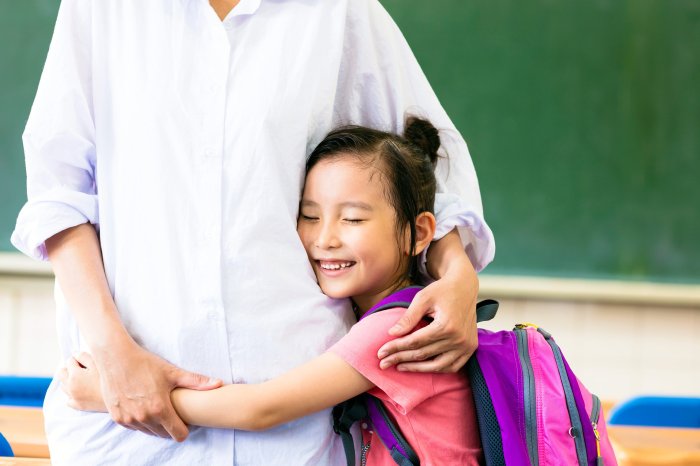
13-your-childs-teacher-stundet-hug


What’s the most important attribute of a good teacher?


Some might say intelligence.


You want a teacher who knows the subject matter and can convey it clearly to students.


Others might say classroom management.


You want a teacher who keeps things organized and gets kids to behave.


But for me the most important thing a teacher can be is kind.


I’m not saying intelligence, classroom management and a host of other qualities are unimportant, but if you approach your students with good will in your heart, the rest seems to fall into place.


This isn’t a long-held pedagogical belief I could have articulated for you at the beginning of the school year.


It came to me – as did so much else – from my students.


At the end of the year as my 7th graders are finishing up their final projects and we’re tidying up the room, I always give them a little survey about their experience in the class.


“I’ve been grading you all year,” I say. “Now’s your turn to grade me.”


The surveys can be anonymous – kids needn’t put down their names, and whatever they write has no impact on their grades.


Yet the results are always enlightening.


I wrote in detail two years ago about the survey and the kinds of responses I often get.


But this year it was one of the simplest comments that really got me thinking.


“He was kind.”


IMG_9669


That’s what one of my students told me that I had done especially well during the year.


“He was kind.” That’s all.


It was a response that was echoed by many of my students.


Another child wrote:


“He was kind (and awesome). One of the best teachers.”


IMG_9668


And another:


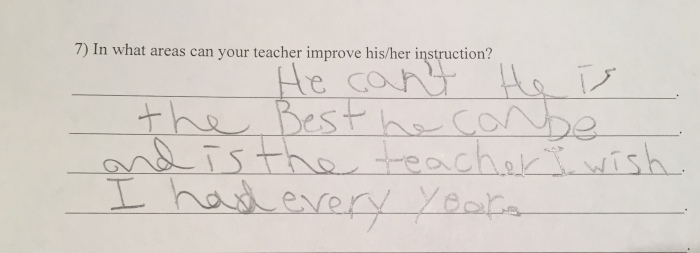
“He can’t [improve]. He is the best he can be and is the teacher I wish I had every year.”
 

IMG_9674


This is all very flattering, but what exactly did all this niceness mean?


How did being a kind teacher help me do my job? What did I do that helped students learn?


They had an answer for that, too:


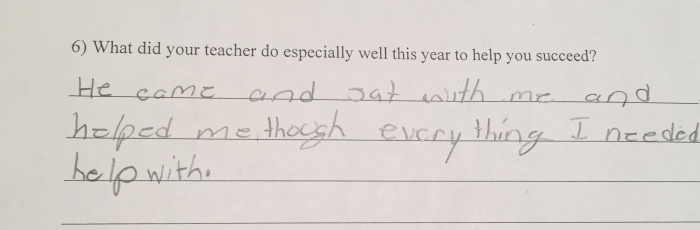
“He came and sat with me and helped me through everything I needed help with.”
 

IMG_9675


***


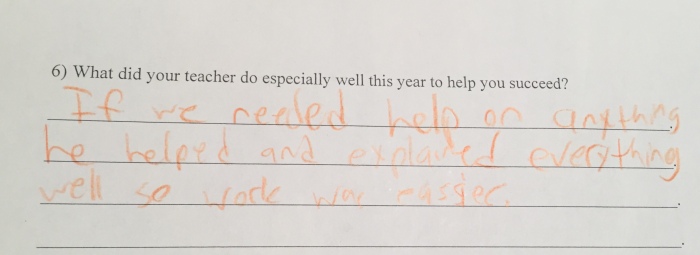
“If we needed help on anything he helped and explained everything well so work was easier.”
 

IMG_9662


***


“What my teacher did to help me succeed was that he made me feel motivated to do the work in class and not giving us so much work at once.”


IMG_9664


***


“[He] taught me how to write essays, indent on papers and showed me a lot of useful things.”


IMG_9677


Another particularly enlightening comment was this one:


“I don’t know [how he could improve], but in this class you grew with us. So uh yeah.”


IMG_9667


And I do try to change and grow with my students. When your mandate is to individualize instruction to fit each particular child, I don’t know how you can do otherwise.


This means opening yourself up and letting students know who you are and what you stand for.


I try not to inflict my political, religious or philosophical beliefs on my classes. However, I think some core values come through.


For instance, my students knew I was going to Connecticut to give a TED Talk on the current state of public schools.


They knew my thoughts on standardized testing and school privatization – perhaps not in detail but the general shape of them, certainly. They knew my firm conviction against racism, sexism and prejudice of any kind.


Perhaps that’s why one of them wrote this:


“You’re not only a good teacher. You’re a good friend, and man.”


IMG_9673


***


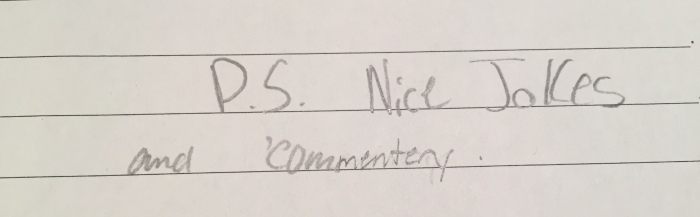
“P.S. – Nice jokes and commentary.”
 

IMG_9671


Of course there were dissenting opinions. One child thought I was too nice:


“He is way too nice for me and you give way too much essays for people to handle. But overall grade 94%. He doesn’t like Tom Brady so yeah. And he likes the Steelers.”


IMG_9679


I guess no one’s perfect. But how interesting she thought either she deserved a stronger hand or would have been more motivated by fear and consequences. Yet I have to take her with a few grains of salt because this student identified herself on her response and had a friendly rivalry with me about football. She said I was too nice but then referenced our interpersonal rapport.


Another student highlighted how I wasn’t excessively permissive:


[He was good at] “Helping me with instructions and keeping me on task.”


IMG_9670


Most comments were unbridled approbation:


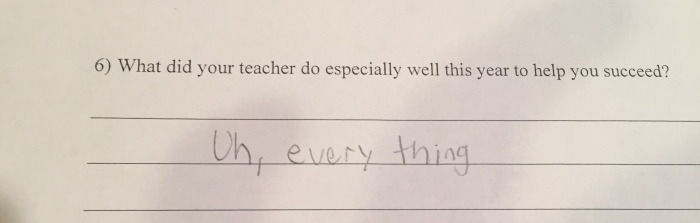
What did your teacher do especially well this year to help you succeed? – “Uh, everything.”
 

IMG_9666


***


In what areas can your teacher improve his/her instruction? – “I’m not sure. That’s how good a teacher he was.”


IMG_9676


***


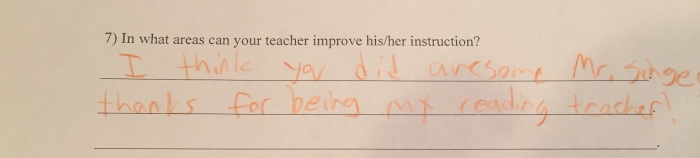
“I think you did awesome, Mr. Singer. Thanks for being my reading teacher!”
 

IMG_9663


***


“I don’t think my teacher needs to improve. He’s already a great teacher.”


IMG_9665


And so another school year comes to an end.


I’ll miss this class. It was the first year I taught exclusively 7th grade. I’d taught one or two sections of that grade before, but never only that grade.


I’m more used to 8th grade. You wouldn’t think there’d be a world of difference between the two. And who knows? Perhaps if I teach the same grade level next year things will be even more unexpected because the kids will be different.


But when that final bell chimed, I was surprised that so many kids came up to me with hugs and tears.


They really didn’t want to see me go, and, frankly, I don’t want to see them go, either.


If I could follow them next year, I would.


I gave them everything I had to give.


I gave them my heart. I shared with them my life.


And I got back so much more.


That’s what non-teachers don’t understand.


Education is created through often reciprocal relationships.


Learner and teacher are tied together in a positive feedback loop. Sometimes it’s hard to tell which is which and sometimes there is no difference at all.


Thank you so much, last year’s students.


Thank you for letting me be your teacher.


Thank you for bringing out the best in me as I tried to do the same for you.


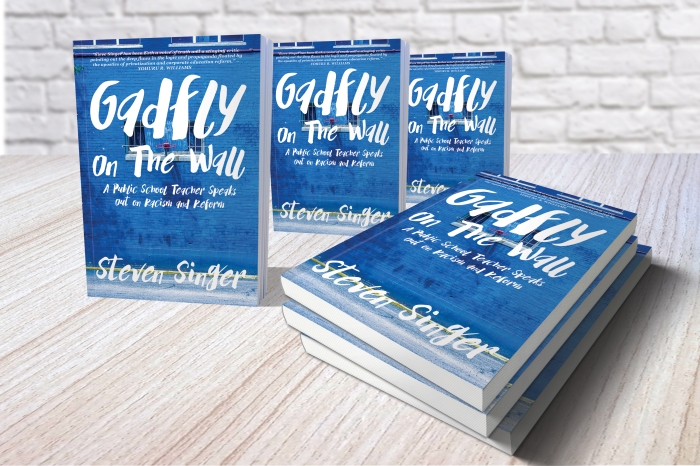
Like this post? I’ve written a book, “Gadfly on the Wall: A Public School Teacher Speaks Out on Racism and Reform,” now available from Garn Press. Ten percent of the proceeds go to the Badass Teachers Association. Check it out!

WANT A SIGNED COPY?

Click here to order one directly from me to your door!
book-2

Don’t Worry About Grade Inflation. Worry About Grading Fairly.

your-childs-grades-go-down-1494627682


Hard work should be rewarded.


If you earn an A in a given class, you should get an A on your report card.


And this is true no matter how many of your classmates work just as hard as you do.


If everyone in class gives it their best shot, they should all get A’s. It is not the teacher’s job to split hairs and sort kids into arbitrary categories in order to preserve a monetary myth about grades’ value based on a model of scarcity.


Those who demand otherwise are under the spell of one of the oldest myths in academia – grade inflation.


It goes like this: You can’t give all your students excellent marks! That would devalue what it means to get an A!


To which I reply: Bullshit.


Almost every plane that leaves an airport lands safely. Does that devalue what it means to travel? When you arrive at your destination, are you upset that everyone else has arrived safely or would you feel better if some of the planes crashed?


According to the American Journal of Public Health, 93% of New York City restaurants earn an “A” from the health department. Does that shake your faith in the food service industry? Would you feel better if more restaurants were unsanitary? Would your food digest more efficiently if there were more people going home with stomach pain and food poisoning?


Of course not! In fact, these stats actually reassure us about both industries. We’re glad air travel and eating out is so safe. Why would we feel any different about academia?


The idea of grade inflation is a simple imposition of the concept of economic value onto learning. It has no meaning in the field of academics, psychology or ethics. It is just some fools who worship money imaging that the whole world works the same way – and if it doesn’t, it should.


It’s nothing new.


Conservatives have been whining about grade inflation for at least a century. It’s not that the quality of teachers has declined and they’re letting all their students pass without doing the work. It’s that certain types of curmudgeons want to justify their own intelligence by denying others the same privilege.


It’s the “I’ve Got Mine” philosophy.


We see the same thing with Baby Boomers who grew up in the counter culture and pushed for progressive values in their youth. Once they got everything they wanted for themselves, they became conservatives in their old age and worked to deny the same things for subsequent generations.


It’s the very definition of Age scoffing at Youth – a pathology that goes back at least to Hesiod if not further. (Golden age of man, my foot!)


Moreover, there is no authentic way to prove grade inflation is actually happening. Grades are a subjective measure of student learning. They are human beings’ attempt to gauge an invisible mental process. At best they are frail approximations of a complex neural process that is not even bounded temporally or causally. If a student doesn’t know something now, they may come to know it later even without further academic stimulus. Moreover, isolating the stimulus that produced the learning is also nearly impossible.


The important thing is not grade inflation. It is ensuring that grades are given fairly.


If students work hard, they should be rewarded.


I am very upfront with my students about this. And doing so seems to have a positive and motivating effect on them.


This year, I had students who told me they had never read a book from cover-to-cover before my class. I’ve had students look at their report cards in shock saying they’ve never received such high marks in Language Arts before. And doing so makes them want to try all the harder next year to repeat the results.


They leave me excited about learning. They feel empowered and ready to give academics their all. Because the greatest lesson a teacher can instill is that the student is capable of learning.


Don’t get me wrong. I don’t just hand out these grades. Students have to earn them. They have to demonstrate that they have actually learned something.


Everyone rarely measures up to the challenge. But that’s not the point. Everyone COULD. There is nothing in my design that prohibits that outcome. I don’t start with the assumption that I’ll only have 3 A’s, 4 B’s, 10 C’s, etc.


In fact, it is THAT scarcity model that dumbs down academics. If I grade on a curve like that, I have to give out a certain number of high marks regardless of achievement. I’m committed to giving out those 3 A’s regardless of whether that trio of students deserve it or not. However, in my abundance model, I give exactly the number of A’s that are deserved. If that’s zero, no one gets an A. If that’s everyone, then everyone gets an A. It all depends on what students actually deserve, not some preconceived notion about how the world works.


To do this, I give very few tests. I just don’t find them to be very helpful assessments.


A test is a snapshot of student learning. It has its place, but the information it gives you is very limited.


Most of my grades are based on projects, homework, essays, class discussion, creative writing, journaling, poetry, etc. Give me a string of data points from which I can extrapolate a fair grade – not just one high stakes data point.


This may work to some degree because of the subject I teach. Language arts is an exceptionally subjective subject, after all. It may be more challenging to do this in math or science. However, it is certainly attainable because it is not really that hard to determine whether students have given you their best work.


Good teaching practices lend themselves to good assessment.


You get to know your students. You watch them work. You help them when they struggle. By the time they hand in their final product, you barely need to read it. You know exactly what it says because you were there for its construction.


For me, this doesn’t mean I have no students who fail. Almost every year I have a few who don’t achieve. This is usually because of attendance issues, lack of sleep, lack of nutrition, home issues or simple laziness.


I only have control over what happens in the classroom, after all. I can call home and try to work with parents, but if those parents are – themselves – absent, unavailable or unwilling to work with me, there’s little I can do.


And before you start on about standardized testing and the utopia of “objectivity” it can bring, let me tell you about one such student I had who was not even trying in my class.


He never turned in homework, never tried his best on assignments, rarely attended and sleepwalked through the year. However, he knew his only chance was the state mandated reading test – so for three days he was present and awake. The resulting test score was the only reason he moved on to the next grade.


Was he smart? Yes. Did he deserve to go on to the next grade not having learned the important lessons of his classmates? No. But your so-called “objective” measure valued three days of effort over 180.


The problem is that we are in love with certain academic myths.


MYTH 1: Grading must be objective.


WRONG! Grading will never be objective because it is done by subjective humans. These standardized tests you’re so in love with are deeply biased on economic and racial lines. Whether you pass or fail is determined by a cut score and a grading curve that changes from year-to-year making them essentially useless for comparisons and as valid assessments. They’re just a tool for big business to make money off the academic process.


MYTH 2: Learning is Economics.


WRONG! Grades are not money. They don’t function in any way like currency or capital. They aren’t something to be bought and sold. They are an approximate indication of academic success. Treating them as a commodity only degrades their value and the value of students and learning, itself.


Treating grades economically actually represses the desire to learn, dispels curiosity and eliminates the intrinsic value of education.


So go ahead – inflate the “value” of your grades.


Give A’s to every student who deserves it.


That’s how you promote learning and fairly assess it.


Like this post? I’ve written a book, “Gadfly on the Wall: A Public School Teacher Speaks Out on Racism and Reform,” now available from Garn Press. Ten percent of the proceeds go to the Badass Teachers Association. Check it out!

WANT A SIGNED COPY?

Click here to order one directly from me to your door!

book-1

Dear Betsy DeVos, I Will NEVER Report My Students to ICE

4e78f0eb558f3.image 


Teachers fill a lot of roles in our public schools.


We’re mentors to kids in need.


We’re aides to students struggling with new concepts and skills.


We’re homework-givers, pencil-providers, idea-encouragers, lunch-buyers, scrape-bandagers, hand-holders, hug-givers, good listeners, counselors, caregivers and – yes – sometimes even butt-kickers.


It’s no wonder that we occasionally get mistaken for mothers and fathers.


But one thing we will never be is a snitch.


Secretary of Education Betsy DeVos recently intimated that principals and teachers could report their undocumented children to Immigration and Customs Enforcement (ICE).


She’s not going to say what we should do one way or another. She’s just saying that this is something we COULD do if we wanted.


If that results in those kids and their families being deported, well we are a nation of laws, after all.


It’s a remark that sounds so reasonable to some folks.


Luckily, I speak dog whistle.


So did the U.S. Supreme Court back in 1982 when justices ruled in Plyler v. Doe that schools cannot deny children their right to a free education based on immigration status.


When kids are afraid to learn because they or their parents or extended family may be undocumented, that has a smothering affect on the classroom.


When ICE raids a local business, we see a sudden drop in class attendance.


So if students thought their teachers or principals were scrutinizing them to determine their citizenship status, we’d be discouraging many with brown skin or extra-national credentials from ever coming back.


By suggesting that educators have a choice whether to obey established law or to become self-appointed border patrol officers, DeVos actually is prescribing how we should act.


Well, not this teacher, Betsy.


Not now. Not EVER.


No matter who you are – black, white or brown – a public school is a sanctuary. It is where kids of all different races and creeds come to escape from the ravages of poverty, violence and indifference.


Teachers are not the enforcers of our broken, bent and biased immigration policy. It is not our job to oblige xenophobia and bigotry.


It is our job to teach, to protect and inspire.


Sure, I’ve made my fair share of calls to parents, healthcare professionals and Child Protective Services.


I’ve reported abuse, addiction and mental illness.


But I did that to protect my kids. And I do think of them as my kids.


When these little people come toddling into my class, I take a kind of ownership of them.


For the time they’re here, we’re family. I take interest in their lives and they take interest in mine.


They know all about my wife and daughter, my parents and grandparents. And I know about theirs.


We don’t just learn grammar, reading and writing. We share our lives with each other.


We share a mutual trust and respect.


If I reported even a single student for a suspected immigration violation, I would lose that forever.


It’s sad how much things have changed in a little over year.


Hispanic names have become Anglicized. Angelo has becomes Angel. Julio has become Jules. Jorge is now George.


The dulcet melody of Spanish has been silenced. You’ll only hear it in muffled voices if you wander by a few lockers, but never in class.


My kids aren’t even 13 yet, but many of them have already learned to hide.


Don’t appear different. Don’t let anyone know your roots extend beyond national borders.


Be “normal.” Be homogenized, bland American.


That’s the world we’ve built and it’s the one that DeVos is encouraging with her tin pot nationalism.


Some things don’t change when you cross municipal lines – human decency is one of them.


So I won’t be reporting any of my students to ICE.


I won’t help the Gestapo separate parents and children based on citizenship status.


I won’t help set up ethnic checkpoints where armed guards get to ask “suspicious persons” for their papers.


White supremacy was bad enough before Trump was elected. I won’t help the unfortunately named Department of Homeland Security become the protector of a new white trash Fatherland.


I will defend my students. I will stand up for their safety and their rights.


That’s just what we do in public school. We look after our own.


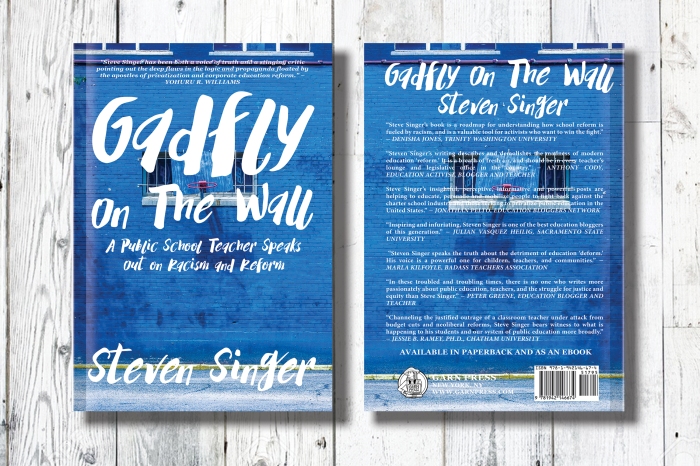
Like this post? I’ve written a book, “Gadfly on the Wall: A Public School Teacher Speaks Out on Racism and Reform,” now available from Garn Press. Ten percent of the proceeds go to the Badass Teachers Association. Check it out!

WANT A SIGNED COPY?

Click here to order one directly from me to your door!
book-2

School Vouchers and Runaway EdTech Pave the Way for the Destruction of the Very Concept of School

andres


School is where you learn to learn.


A teacher with an advanced degree and decades of experience devotes her time to figuring out what helps you comprehend the world around you.


And, if she’s good, she imparts that lesson to you as well.


Imagine if we took that away.


Imagine a world where there are no schools – just free range children plopped in front of a computer or an iPad and told to go learn something.


No schools, no teachers, just gangs of students walking the streets, stopping along the way to thumb messages to each other on social media, play a video game or take an on-line test.


That’s the world many EdTech entrepreneurs are trying to build.


And school vouchers are helping them do it.


Take Education Savings Accounts (ESAs) and other market based privatization schemes.


Normally, the federal, state and local government collect taxes to fund an individual child’s education, which is then spent at a public or charter school.


At a public school all that money must be spent on the student. At a charter school some of that money can be pocketed as profit by the private company who runs the school.


Public schools provide a better alternative because the funding must be dedicated to the student, living within a district’s coverage area guarantees enrollment, the school must be managed by an elected school board with open meetings and a plethora of other amenities you won’t find at a privatized institution. But at least the charter school is a school!


However, an ESA or other voucher would allow that money to go elsewhere. It could go to funding the tuition at a private or parochial school where organizers can use it however they like – pocketing some and using the rest to help the child as you’ll find in most charter schools.


But as bad as that is, vulture capitalists want to add another destination for that money – let it pile up in the bank where it can be used for discrete education services provided by the EdTech industry.


It’s almost like homeschooling – without the loving parent being in charge.


It goes by many names – a learning ecosystem, personalized learning, competency based or individualized education.


But it’s really a single person cyber school with little to no guiding principles, management or oversight.


Education is reduced to a series of badges students can earn by completing certain tasks.


Reading a book or an article gives you a badge. Answering a series of multiple-choice questions on a reading earns you more badges. And if you’ve completed a certain task satisfactorily, you can even earn a badge by teaching that same material to others.


It’s the low wage gig economy applied to education. We just transform a crappy job market where workers bounce from a few hours of minimum wage labor here to a few hours of minimum wage toil there – all without benefits or union protections – into learning. Children bouncing from a few hours of Khan Academy videos here to a software package there and Voila! “Modern” education!


In short, it’s school without the school or teachers.


And make no mistake, it’s not about improving the quality of education. It’s about providing the cheapest possible alternative and selling it to rubes as innovation.


The wealthy will still get institutions of learning. They will still be educated by the most qualified teachers in the world. They will still learn how to learn.


The best path to becoming a truly educated person involves human interaction and mentorship. You need experienced professional educators who use the empirical evidence they see in the classroom about your child to tailor lessons to their needs. The wealthy would never dream of making their children learn from the academic equivalent of an automated check out aisle or telemarketer robocall.


It is only the poor and middle class who will be released like chickens into the pasture of a learning ecosystem.


And as an added benefit, the badge structure creates a market where investors can bet and profit off of who gains badges and to what degree on the model of crypto-currencies like Bitcoin! So all the stability of the pre-crash housing market! What could possibly go wrong!?


Let me be clear – this is the ultimate goal of the school privatization movement.


Charter and voucher schools are only the tip of the iceberg. They still require real human beings to act as teachers (though they need not be as well educated or have as much experience as public school teachers). They still require buildings and grounds.


But this depersonalized learning approach allows them to do away with all of that. They can just provide students with an Internet accessible device and some dubious on-line tracking and management system.


Then they can pocket all the rest of the money taxpayers put aside to educate children and call it profit.


And they can use the programs students access to “learn” as a way to gather valuable marketing data about our kids. Everything students do on the device is free market research – every word they input, every keystroke, every site visited down to the slightest eye movement.


This is the logical conclusion of the monetization of education and an economy that only sees value in others as human capital that can be bought, sold and exploited.


This is where the privatization movement is going. And they’re laying the groundwork in legislation being proposed in our state capitals today.


In Pennsylvania, for instance, Senate Bill 2 proposes the creation of just such ESAs. If approved, the immediate result would be to boost private and parochial schools.


However, given a few years to strengthen the technologies and systems needed for a full learning ecosystem, the same law would allow taxpayer money to be used in this way.


And it’s something hardly anyone is talking about.


We’re fighting the privatization systems of today as the plutocrats set up the privatization systems of tomorrow.


Even if school vouchers never take off to the degree necessary to scaffold the most robust learning ecosystems, EdTech lobbyists are trying to install as much of this garbage as they can into our existing schools.


They are using one-to-one iPad initiatives and grants to fund up-to-date computers, Wi-Fi networks and software packages to pave the way for this brave new world of digital exploitation. They are selling our test score obsessed bureaucrats software like iStation and IXL that bridge the gap between test prep and learning ecosystems lite.


You can walk into many schools today where students spend hours on-line earning digital badges for watching videos and taking stealth assessments.


Few people are sounding the alarm because few people understand what’s going on.


This is not conjecture. This is not a conspiracy theory. This is the goal the edtech entrepreneurs will gladly tell you all about hoping you’ll invest.


There are hours of videos, pages of documents, mountains of graphs, charts and graphics about how this scheme will pay off for investment bankers and venture capitalists. (See below)


The only true way to win this battle is a cultural shift away from dehumanizing runaway capitalism.


We need to stop thinking that the private sector is always better than the public good. We need to stop allowing big business and corporations to get away without paying their fair share. We need to increase the voice of citizens and decrease the megaphone of money and privilege.


Otherwise, the science fiction dystopias of books like “Ready Player One” will no longer be fiction.


They will become the reality for every school child in this country.


A reality where school, itself, is a thing of the past.


And education is reduced to the mercenary collection of discrete skills that add up to nothing of value for the students except their own enslavement.


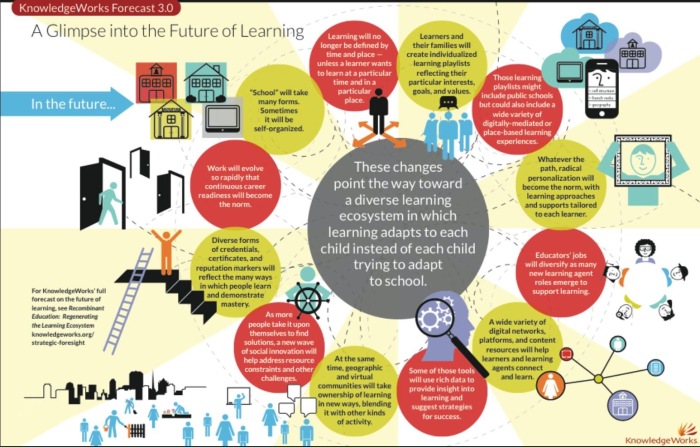
But don’t take my word for it. Here is the learning ecosystems model from the EdTech industry, itself, in corporate officers own words and graphics:

LEARNING IS EARNING – the scariest 6:58 video you’ll ever see.


KNOWLEDGEWORKS Vision for the Future of Education:

IMG_9654

Graphic as a PDF

More on KnowledgeWorks

Listing for PARENTS AS CONSUMERS Symposium

Read all about it here.


FIGHT BACK AGAINST SCHOOL PRIVATIZATION AND RUNAWAY EDTECH:

Like this post? I’ve written a book, “Gadfly on the Wall: A Public School Teacher Speaks Out on Racism and Reform,” now available from Garn Press. Ten percent of the proceeds go to the Badass Teachers Association. Check it out!

WANT A SIGNED COPY?

Click here to order one directly from me to your door!

book-2


Modernizing Education Starts With Questioning Our Assumptions

iStock_000040220958_Small-685x485


When it comes to education, we take an awful lot for granted.


For example, we look at learning almost entirely from a behavioral standpoint.


Teachers provide inputs. Students give outputs. And those outputs demonstrate the intended learning.


Yet this framework was developed in the early 1900s. Using it today is to ignore a century of subsequent psychological advancements. It glosses over the impact of the unconscious, the social nature of understanding, physical differences, even the mediating thought processes between stimulus and response such as memory and problem solving.


Instead, we force students into inauthentic laboratory conditions (i.e. the classroom) upon which they are passive actors to be molded and shaped by expert educators.


Every time we post our learning objectives on the board or when we write our lesson plans beginning with the old chestnut – Students Will Be Able To (SWBAT) – we are hearkening back to early 20th Century thinking a hundred years out of date.


We are enshrining a host of assumptions long past their fresh by date:

-Learning is observable.


-It happens immediately.


-It is measurable.


-Once you learn something it never goes away.


-Most problems with learning are attributable to inputs provided by the teacher.


None of these assumptions have been proven.


In fact, there is considerable evidence against each and every one of these premises, yet our entire system of corporate education is based on them like a house built on a foundation.


If we are truly to create a 21st Century school system, the only place to begin is here. Recognize our bedrock beliefs are mere speculation and question whether we should really support everything else that’s been built on such shaky ground.


WHAT IS LEARNING?


It is an empirical fact that human beings are capable of learning. It’s something we do every day. But what exactly does it consist of? What happens when a person learns?


Perhaps it’s best to start with a definition. We generally characterize learning as the acquisition of knowledge; the possession of facts, information or skills.


But how does one gain knowledge? How does one possess the intangible?


It seems that learning always involves thoughts – usually conscious impressions but sometimes unconscious ones, as well. However, not all thoughts qualify, only thoughts of a certain kind.


The notion must be true of the world. And often it is an idea that has surfaced before but that now can be recalled at will and used to create new concepts.


Perhaps I’m wrong, but it seems that no matter how you flesh it out, we’re talking about internal mind states.


Learning takes place in and of the brain. And this has consequences for our education system – an apparatus designed to make these brain states more frequent along certain prescribed lines.


IS LEARNING OBSERVABLE?


That depends. Can we lop off the top of students’ heads and peer at the gelatinous mass inside?


Not really. And even if we could, we wouldn’t understand what we were seeing.


Even if learning may be reducible to a complex set of on-and-off switches among synapses, that does not make it generally observable – certainly not without greater knowledge of how the brain works and advanced neural imaging equipment.


As such, the idea that learning is directly perceptible is not necessarily true. It may be evident in some second hand manner, but this is not the same as first hand experience. At best, what we see is a pale shadow of what’s actually going on in students’ gray matter.


That alone should send shock waves through the edifice of modern corporate education. We’ve built an entire apparatus to label and sort kids based on observing students. If those observations are inadequate to give us the full picture of these internal learning states, our system is likewise inadequate.

WHAT IS THE ROLE OF TEACHER INPUT?


To answer this question we must start further back – when and why does learning takes place.


A student experiences a new neural state that constitutes the acquisition of knowledge. Why?


Does it happen because of the input made by a teacher? Is it the result of experience? Is it the result of some other input – reading, interacting, writing, doing something? Or is it the result of something even the student him- or herself cannot easily identify or explain?


All of these are possible. All of these (and more) are the catalyst to learning at various times.


Thus we lose another premise – that teacher input is the essential cause of inadequate learning. If we cannot place a primacy on the teacher, we cannot wholly place blame there either.


Certainly teachers are important. They can have a tremendous impact on their students. But they are not strictly necessary. They are not even the prime cause of learning. They facilitate learning in the way a doctor facilitates healing. The surgeon may set the broken bone, but it is the body that actually does the healing. And in the case of learning, the action is not entirely involuntary. It is much more active and intentional.


In short, teachers can call students attention to something that sparks learning. They can bring about optimal conditions for learning to take place. But they are not by themselves sufficient for that learning. They cannot make it happen. Insofar as it is voluntary at all, it is up to the student. To give teachers sole reward or blame for student learning is absurd.


IS LEARNING IMMEDIATE?


Learning may be a response to stimulus of some kind. But when does that response take place? Is it immediate?


There is no evidence that it must be so. Certainly there are times when one has learned something immediately. When a child first puts her finger in the flame, she quickly learns to remove it. However, there are some lessons that we don’t learn until many years after that stimulus. For instance, that our parents’ advice was often more sage than we initially gave it credit.


Thus, again it is inadequate to place reward or blame on teachers for their students’ learning. You can judge a teacher for what he or she did to help, but not what you take to be the result. Just because the teacher’s input may not have sparked learning in the student now, that doesn’t mean that the same input might not engender learning at a later date, given time.


IS LEARNING PERMANENT?


Which brings up another question – once you learn something, does it remain yours forever or is it susceptible to degradation?


If learning is an internal state – if it is the result of neural connections like any thought or memory – it is susceptible to fading. It can be lost or degraded.


Therefore, when students enter a class without prerequisite knowledge, it is not necessarily the fault of their previous teachers. Like any skill, memory or thought – recall is enhanced through repetition. Using the knowledge often results in greater retention.


If we want a more intellectual society, we should habitualize critical thinking and reward intelligence in our public interactions. Not the exact opposite.


CAN LEARNING BE MEASURED?


And finally, we are brought to perhaps the most vital question in the field of education – measurement.


What did students grasp and to what degree was it mastered?


There is an entire industry based on providing accurate accounting of learning.


There are corporations making billions of dollars based on providing this service. Moreover, the school privatization industry is almost completely predicated on the “failure” of public schools as shown by the measurements of these testing corporations.


As such, there is a tremendous amount of economic pressure to keep this premise that learning can be accurately measured. However, when looked at logically, it cannot be supported.


When we measure learning, what are we measuring? And how are we quantifying it?


If learning is an internal state, how do we calculate that? Possibly at some point in the future, we’ll be able to look at real time pictures of the brain and be able to tell which information has been learned and to what degree. But we are not at that point now. Perhaps we will never be.


Even if we were, what exactly would we be measuring? What units would we be using? Volts? Amps? Some new element susceptible to subdivision?


The fact that we can’t give a definitive answer to that simple question illustrates how vast our ignorance is of learning. We do not understand what goes on in our own heads that constitutes understanding expect in the broadest possible terms.


Yet how much importance we put on these crude attempts to measure the ineffable!


Grades and test scores are but the rudest approximations of the real phenomena hidden inside our skulls. Yet we sort and rank students on the pedagogical equivalent of cave paintings.


“It is easier to measure the number of semicolons used correctly in an essay than the wonderful ideas contained within it,” said Alfie Kohn. “The more focused you are on measurable outcomes, the more trivial your teaching tends to become.”


Or as Linda McNeil of Rice University famously observed, “Measurable outcomes may be the least significant results of learning.”


Kohn has repeatedly suggested that McNeil’s statement ought to be printed out in “36-point Helvetica, framed, and tacked to the wall of every school administrator’s office in the country” for these same reasons.


When we talk about knowledge and learning, we don’t know what we’re talking about.


CONSEQUENCES


That should make us reluctant to say anything definitive about learning beyond our own ignorance of it.


Yet, as in so much of human affairs, when has ignorance ever stopped us?


We have to go about the business of educating. We have a society to run, markets to establish and consumers to exploit.


Imagine if, instead, we approached learning like explorers or scientists, mapping the shores of our ignorance and determining what helps us comprehend more and better.


There are so many tantalizing clues about what helps students learn, ways to foster the spark of inspiration, creativity and critical thinking.


I wish we were invested in that activity instead of a capitalist sham of education. We talk much about the skills gap between white and black kids without doing anything constructive about it – a chasm predicated on the fact that one category is predominantly poor and the other privileged.


Perhaps we would do better to talk about the ignorance gap of our own understanding of what it means to understand.


Perhaps then we wouldn’t be so bold as to monetize that which is fallacious and foolhardy.


Perhaps then we would be more curious, thoughtful and kind.


Perhaps then we could build a truly modern system of education that values students and not just how they can be transformed into profit.


Like this post? I’ve written a book, “Gadfly on the Wall: A Public School Teacher Speaks Out on Racism and Reform,” now available from Garn Press. Ten percent of the proceeds go to the Badass Teachers Association. Check it out!

WANT A SIGNED COPY?

Click here to order one directly from me to your door!

book-2

Respecting Student Free Speech Was Hard for Adults During Today’s School Walkout

BN-XV995_WALKOU_M_20180314111108


The kids are all right. It’s the adults you have to watch.


The walkout planned nationwide to protest gun violence today on the one-month anniversary of the Parkland shooting came to my western Pennsylvania school – and we weren’t ready for it.


In fact, up until today no one had mentioned a thing about it.


I had asked teachers if they wanted to do something and was told it was up to the students to lead.


I had asked the high school student council if they were interested in participating, but there wasn’t much of a response.


Then this morning in the middle school where I teach, there was an impromptu two minute meeting where we were told some kids might walk out and that we should just let them go.


Their right to free speech would be respected and there wouldn’t be any penalty for participating.


However, as a teacher, I was instructed not to bring up the subject, not to allow discussion and only to attend if all of my students decided to go.


That’s a hard position to be in.


It’s like being put in a metaphorical straight jacket.


But I tried.


When my 7th grade kids came in, they were all a buzz about something and I couldn’t really ask why.


The suspense was broken with a sledge hammer during second period when one of my most rambunctious students asked if he could use the restroom at 10 am. That was over an hour away.


I told him he couldn’t reserve an appointment for a bathroom break but he could go now if he wanted.


Then he explained himself. At 10 am he was walking out.


The room exploded.


They had heard about the nationwide walkout at 10 – the time of the Parkland shooting. They knew kids all across the land were leaving class for 17 minutes – 60 seconds for each life lost in the shooting.


But that was pretty much it.


They didn’t know what it was that kids were protesting. They didn’t know why they were protesting. They just knew it was something being done and they wanted to do it.


It was at this point I took off my metaphorical straight jacket.


I couldn’t simply suppress the talk and try to move on with the lesson – on propaganda, wouldn’t you believe!


We talked about the limits of gun laws – how some people wanted background checks for people wishing to purchase guns. We talked about regulating guns for people with severe mental illnesses, criminal backgrounds or suspected terrorists. We talked about how there used to be a ban on assault weapons sales and how that was the gun of choice for school shooters.


We even talked about what students might do once they walked out of the building.


They couldn’t just mill around for all that time.


Since we were in the middle of a unit on poetry, someone suggested reading poems about guns and gun violence.


Students quickly went on-line and found a site stocked with student-written poetry on the issue – many by students who had survived school shootings.


I admit I should have checked the site better – but we had literally minutes before the walkout was scheduled to take place.


Some of the poems contained inappropriate language and swear words. But they were generally well written and honest. And the kids liked them.


I let them print a few that they wanted to read aloud at the demonstration.


They were actually huddled around their desks reading poetry and practicing.


They were really excited about the prospect of standing up and being counted – of letting the world know how they felt.


One student even wrote her own poem.


She said I could publish it anonymously, so here it is:


“Pop! Pop! Pop!


Everyone crying, calling their parents, saying their last goodbyes.


Screams echo throughout the building.

Blood painting the white tiles.

Bodies laying limp on the ground

Screams of pain

Bullets piercing our skin.


Yelling and sobbing increase.

We are escorted out.


‘Is this what you wanted?’”


I barely had time to read it before the time came.


Students stood up and were confused by the lack of an announcement.


But this was not a sanctioned school event. If they took part, they were on their own.


It was my smallest class and several kids were already absent.


They all left and were immediately met by the principal and security. To their credit, the adults didn’t stop them, but they told them not to put their coats on until they were outside and to otherwise quiet down.


I made sure to emphasize that anyone who wanted was welcome to stay in class. But no one did.


After the last child left, I grabbed my coat and followed.


When I got to the front of the building I was surprised by the lack of high school students. There were only a handful. But there were maybe 50 middle school kids.


When the principal saw all my students had decided to participate, he asked me to stay in the lobby. He said it wasn’t necessary for me to attend.


That was hard.


I wanted to be there, but I didn’t want to be insubordinate, either.


My students were expecting me to be there. They were expecting me to help guide them.


So I stood in the doorway and watched.


Students did as I feared; they pretty much milled around.


A few of my students held their poems in hand and read them quietly together but there were no leaders, no organization.


After about 5 minutes, the adults pounced.


The resource officer criticized them since their safety was more at risk outside the building than in class. Administrators chastised the collective group for having no plan, for only wishing to get out of class, for not knowing why they were there and for not doing anything together to recognize the tragedy or the issue. They said that if the students had really wanted to show respect to those killed in Florida they would have a moment of silence.


The kids immediately got quiet, but you can’t have a 17-minute moment of silence. Not in middle school.


I saw some of my kids wanting to read their poems aloud but too afraid to call the group’s attention to themselves.


And then it was over.


The whole thing had taken about 10 minutes.


Administration herded the kids back into the building early and back through the metal detectors.


I can’t help feeling this was a missed opportunity.


I get it, being an administrator is tough. A situation like today is hard to stomach. Kids taking matters into their own hands and holding a demonstration!?


We, adults, don’t like that. We like our children to be seen and not heard.


We want them to do only things that will show us in a better light. We don’t like them taking action to fix problems that we couldn’t be bothered to fix, ourselves.


But what right do we have to curate their demonstration?


If they wanted to mill around for 17 minutes, we should have let them.


Better yet, we could have helped them organize themselves and express what many of them truly were thinking and feeling.


If I had been allowed out of the building, I could have called the assembly to order and had my kids read their poems.


But doing so would have been exceedingly dangerous for me, personally.


I can’t actively defy my boss in that way. It just didn’t seem worth it.


If we had had warning that this might happen and planned better how to handle it, that also might have been an improvement.


Imagine if the school had sanctioned it. We could have held an assembly or sent a letter home.


The teachers could have been encouraged to plan something with their students.


Obviously if the students wanted to go in another direction, they should have been allowed to do so.


But these are middle school kids. They don’t know how to organize. They barely know how to effectively express themselves.


Regardless of how we, adults, feel about the issue, isn’t it our responsibility to help our student self actualize?


Isn’t it our responsibility to help them achieve their goals?


I don’t know. Maybe I’m just a crazy hippie.


Maybe I’m some radical anarchist.


But I’m proud of my students for taking a stand.


It was unorganized and a mess.


Yet they stood up and did something we, the adults, really weren’t that keen on them doing.


Their message was a muddle.


But they had something to say.


They just haven’t figure out how to say it yet.

Gamification – The Hottest New Trend to Monetize Education

Screen Shot 2018-02-26 at 3.14.37 PM


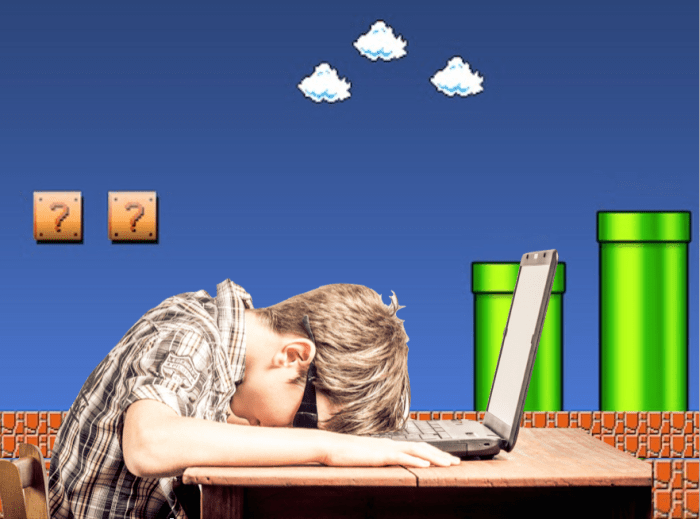
When I was a kid, Super Mario Bros. was my jam.


After school, I couldn’t wait to take on the role of plucky plumber Mario or his brother Luigi. I’d jump on a few turtle shells, bounce over a bottomless pit and smash just the right secret brick to get my flashing star power up and wipe the floor with endless levels of Koopa Troopas.


But through it all, I never really learned anything.


With the possible exception of a few Italian stereotypes, the only knowledge I gained was where the warp zones were, which blocks to hit and the muscle memory necessary to defeat the next bad guy.


However, now-a-days that’s all changed.


Someone in marketing and accounting has decided that the same techniques I used to save Princess Toadstool would make an exceptional method of pedagogy.


They call it gamification, the process of making academic lessons, courses and objectives look more like video games.


Sure, the process has applications in the business world and advertising, but its biggest market has been education.


In fact, the Gamification industry is worth $2 billion worldwide and some estimate it to jump to $22 billion by 2022.


Want to teach grammar? Welcome to the good ship Verb sailing on the seas of Nouns and Pronouns. Interjections, A-hoy!


Wish your students knew fractions? Let them blast away the wrong numbers so only the correct numerator matches with the correct denominator.


That kind of thing.


It’s incredibly popular in some circles.


Advocates claim it increases student engagement and enthusiasm, provides instant feedback and the opportunity for social interactions.


Critics say it reduces students’ attention spans, narrows the curriculum and replaces human interaction with canned interfaces.


But when something is bringing in this kind of cash for big business, it’s kind of beside the point whether it works or not.


It’s the latest form of snake oil out of the cobra factory, and your teacher may be forced to pour it into your children’s brains.


That’s just Education 2018. Under the old model, the hucksters would have to approach each teacher one-at-a-time and convince them to try the shinny new toy in the box. But when you remove teacher autonomy, that frees all the used car salesmen to go right to the one person in your district – often the technology coordinator or academic coach – who controls the purse strings and convince him or her to buy what they’re selling.


In short, I’m not a fan.


In fact, I think gamification is one of the dumbest fads to hit public schools since standardized testing.


Don’t get me wrong.


Games can have limited use in the classroom.


My students love reviewing already mastered material in teams or competing against each other individually.


But there’s a big difference between playing Jeopardy or Kahoot with soon-to-be-tested material and plopping kids on an app or software package that pretends to teach them the concept.

There’s a world of difference between a 10-minute detour and an entire curriculum structured around game theory.


The biggest problem seems to be this.


Games are not intrinsically valuable.


They are good or bad based on the amount of fun they provide the user.


Be honest. No one really cares if Link puts together the Tri-force. No one is losing any sleep over rampaging Metroids on the loose. No one is putting out an Amber Alert the next time Princess Peach is inevitably kidnapped by Bowser. The only thing that matters is if meeting these objectives and countering these fictional bad guys is fun and exciting.


However, the same is not true for the ends of education.


People care whether you can read and write. You may lose sleep over being unable to add, subtract, multiple and divide. Co-workers will be alerted if you don’t comprehend the basics of science and history.


And the higher the skill we’re aiming for, the greater the degree of importance.


Gamification divorces these two ends. It turns education from an intrinsic activity into an extrinsic one.


This is a big deal.


Students shouldn’t struggle through a reading passage so they’ll get a score or a badge. They should actually care about what they’re reading.


My students and I just finished reading Lois Lowry’s “The Giver,” and they loved it.


After the first few chapters, they weren’t reading for a grade or to please me, their teacher. They truly wanted to know what would happen next. And to fully understand that, they had to exercise and refine their reading skills.


Look at it like this.


When I was playing Super Mario Bros., I often took a few warp zones to the last board so I could beat Bowser quickly and win the game. But that means I skipped over most of the first seven boards.


This didn’t matter because the only reason to play was to win. But if those first boards had included something important to the experience, skipping them would have greatly diminished my experience.


Gamification reduces learning until its meaningless. Why would anyone want to know something unless it carried with it a video game like reward?


And that’s merely the worst part.


In practice, most of the applications and software being pushed on kids to increase enthusiasm and motivation aren’t really very much fun at all. After a few times through, there isn’t much reason to plow through exposition heavy content with little to do. This material doesn’t connect to students’ lives, it doesn’t foster authentic competition, it doesn’t stoke their sense of wonder – it’s just a boring set of hoops to jump through to satisfy the instructor.


Admittedly, it does provide instant feedback, but that doesn’t matter if students don’t care about the matter at hand.


Social interactions are possible here but rarely have I seen this opportunity explored. A good group project will get students more engaged socially than messaging back and forth about the software challenge du jour.


Education can be so much more than this.


Students are being robbed of authentic interactions, authentic instruction and authentic learning.


Not all things should be turned into a game.


Gamification is another example of trying too hard to market something to people who won’t actually be using it in the hopes that they won’t notice it doesn’t actually work that well.


The consumer isn’t the gamer – it’s the administrator who buys the program. And the people best suited to assess the program’s success – teachers and students – aren’t even part of the equation.


It’s about monetization, not education.


Mario may grab a bunch of coins on his way to save the princess, but it is the corporations who are getting rich off this sad fad.


All that glitters is not gold, just as all that is new and technological is not cutting edge.


Can we stop letting big business drive the field and let education be determined by educators?


Otherwise, it will be game over for an entire generation of kids duped into accepting crap for curriculum.

Gadfly on the Road – Reflections on My First Book Signing

28056398_10155659682963860_9112619102652029542_n


So there I was standing at a podium in Barnes and Noble before an audience of 25 people who had come to hear me talk about my book.


Speech uploaded to my iPad – check.


Cough drop – check.


Fear that no one would take me seriously – Oh, double, triple check!


Let me just say there is a big difference between sitting behind a keyboard pounding out your thoughts for consumption on the Internet, and being somewhere – anywhere – in person.


I’ve spoken at rallies. I’ve spoken at school board meetings. I’ve spoken in private with lawmakers and news people.


But none of that is quite like being the center of attention at your own invitation, asking people to take time out of their busy lives and drag their physical selves to some prearranged place at some prearranged time just to hear whatever it is you’ve got to say.


I had been practicing my remarks for weeks after school.


I had a 15-20 minute speech ready to go – a distillation of the main themes in my book, “Gadfly on the Wall: A Public School Teacher Speaks Out on Racism and Reform.”


Would people hear what I had to say?


I surveyed the audience. A few people I didn’t know. But there was my mom and dad, a bit more grey haired than I remembered yet doing their parental duty. There were a few colleagues from work – teachers, aides and substitutes. There were a few students standing in the back with their parents. One of my old high school buddies even showed up though he lived about a half hour away.


And there in the second row was my daughter.


For a moment, the whole world seemed to be nothing but her 9-year-old face – a mix of emotions – curiosity, nervousness, boredom.


In that moment, everything else disappeared. I had an audience of one.


I began.


It was surreal.


I spoke the words I had written weeks before, pausing to look up at the audience when I could.


Somehow I was both more and less nervous. I stumbled over parts that had caused no problems when alone. And I hit other points with more passion and purpose than ever before.


At certain points I found myself getting angry at the people behind the standardization and privatization of public education.


I rebuke these greedy saboteurs just about every week on my blog. But there was something different about putting the words on my tongue in public and letting the vibrations beat a rhythm on the ear drums of those assembled before me.


It was like reciting a spell, an incantation. And the effect was visible on the faces of those in front of me.


I glanced at my daughter, expecting her to be nagging her Pap to take her to the children’s section, but she was as entranced as the others.


And was I kidding myself or was there another emotion there? Pride?


I finished my remarks, getting a few laughs here and there. Anger and mirth in equal measure.


I thanked everyone for coming and took questions.


There were quite a bit.


Which aspect of corporate education reform was the worst?


Is there any way for parents to protect their children from standardized testing?


How has the gun debate impacted the move to privatization?


My mother even asked what alternative methods of assessment were preferable to standardized testing.


It went back and forth for a while.


When it seemed to die down, I thanked everyone for coming and said I would be there for as long as anyone would like to talk one-on-one and sign any books if people would like.


I had a line.


Thankfully, my wife brought me the nicest sharpie marker just before I got up there.


I tried to personalize as much as I could but everything seemed to be a variation on “Thanks for Coming.”


Students came up to me with huge grins. Parents asked more questions about their children. Lots of handshaking and hugs.


Teachers came up to tell me I had done a great job. Many introduced me to their kids – most itty bitty toddlers.


A former student who had already graduated got really serious and said, “It was about time someone said that.”


And it was over.


The store manager told me how many books we sold. I had no idea if that was good or bad, but he seemed well satisfied.


I packed everything up in my car and then went looking for my family.


I found them in the children’s section.


They had picked out a few books Mommy was purchasing. A really nice one about Harriet Tubman among them.


My daughter was sitting alone by a toy train set. She was worn out. It had been a long day.


“Daddy!” she said when she saw me. “You were amazing!”


And that was it.


That was all I’d needed.


She asked me about this or that from the speech. Obviously she didn’t understand the ins and outs of what I had said, but some of it had penetrated.


We talked about racism and why that was bad. We talked about what we could do to help stop it.


The rest of the time she held my hand and took me on a tour of the store.


I have hope for a better world, but if I’m honest, I’m not sure if writing this book or my activism or any of it will ever actually achieve its goal.


As ethicist Reinhold Niebuhr wrote, “Nothing that is worth doing can be achieved in our lifetime.”


But I’ve shown my daughter where I stand.


I’ve shown her where I think it’s appropriate to stand.


I’ve shown the same to my students, my family, my community.


They’ll do with that what they will.


I just hope that one day when I’m gone, my daughter will remember what I taught her.


She’ll remember and feel my presence though I’m long gone.


Photos:


Videos of the majority of my speech:

Part 1:

Part 2:

Part 3:


Wake Up, America! You Have a School Shooting Problem!

photos-century-poc


There have been 11 school shootings so far this year.


And January isn’t even over yet.


That makes about 50 for the academic year – roughly one a week.


Some involve no injuries. Some are suicide attempts. And some, like the latest in Kentucky, involve an active shooter hunting and killing children.


While gun violence is a problem throughout the country, it is especially virulent at educational institutions.


According to an FBI study that looked at incidents from 2000-2013, nearly one quarter of all U.S. shootings took place at schools. And they’re on the rise.


Yet this latest incident barely raised an eyebrow in the collective consciousness.


Hardly anyone even attempted to offer a solution.


The reason?


Since Sandy Hook, we’ve effectively given up.


In December of 2012 a gunman walked in to Sandy Hook Elementary School in Newtown, Connecticut, and killed 20 children and six adults, and we did nothing.


We stood by after the murder of elementary kids and couldn’t get up the collective energy to do one damn thing to stop things like this from happening again.


No new regulations.


No assault weapons ban.


No gun buyback programs.


NOTHING.


In fact, the only thing we did do was actually weaken gun laws to INCREASE the likelihood of more kindergarten kids dying by shot and shell.


In this country we have created a false dichotomy – it’s either children or guns — and we’ve chosen GUNS!


We’re told to buy bullet-proof backpacks, arm school teachers, and have gun wielding police patrol the buildings, but don’t do anything about the firearms, themselves.


America has 4.4 percent of the world’s population, but almost half of the civilian-owned guns in the world.

guns_per_capita

It’s no wonder, then, that our citizens are so much more likely to die at end of a barrel.


Since Sandy Hook, there have been more than 1,500 mass shootings (including those done at locations other than schools).

Screen Shot 2018-01-26 at 7.59.15 AM

According to the Gun Violence Archive, there have been at least 1,518 mass shootings, with at least 1,715 people killed and 6,089 wounded as of October 2017.


The database defines a mass shooting as one in which at least four people (not counting the shooter) were shot regardless of whether those wounds were fatal or not. And since some shootings go unreported, it’s likely only giving us the bare minimum.


But that’s just mass death and destruction.


The overwhelming majority of gun deaths are smaller scale – police brutality, domestic violence, suicides, accidents, etc. America’s total annual firearm deaths came to more than 33,000 in 2014.


This is patently absurd.


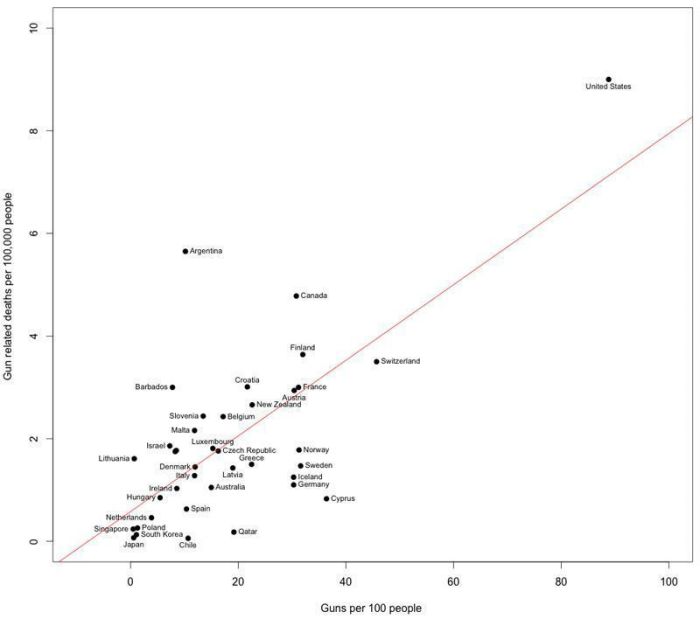
Other countries don’t have the same level of gun violence as we do, even per capita.


There are certain facts that we refuse to accept.


States with more guns have more gun deaths.

gun_ownership_states

Countries with more guns likewise have more gun deaths.

guns_country

Meanwhile, states with tighter gun regulations have fewer gun-related deaths.

gun_control_vs_deaths

Countries with more rigorous gun control likewise have fewer gun related deaths.

(Don’t believe me? See Florida’s “The Geography of Gun Deaths,” and a 2016 review of 130 studies in 10 countries, published in Epidemiologic Reviews.)


Yet we’re told that gun control is useless because new laws will just be pieces of paper that criminals will ignore. However, by the same logic, why have any laws at all?


Congress should just pack it in, the courts should close up and the army should just all go home. Criminals will do what they please – there’s nothing we can do about it.


This kind of thinking is the triumph of business over sense.


The gun industry is making billions of dollars off this cycle of gun violence: mass shooting, fear of regulation, increase in sales. Repeat ad infinitum.


We may never be able to stop all gun violence, but we can take steps to make it more unlikely. We can at least make it more difficult for people to die by firearm.


And this doesn’t have to mean getting rid of all guns.


It just means sensible regulations.


According to the Pew Research Center, when you ask people about specific firearm regulations, the majority is in favor of most of them – both Republicans and Democrats.


We don’t want the mentally ill to be able to buy guns. We don’t want suspected terrorists to be able to purchase guns. We don’t want convicted criminals to be able to buy guns. We want mandatory background checks for private sales at gun shows.

guns_support

Yet our lawmakers stand by helpless whenever these tragedies occur because they are at the mercy of their donors.


The gun industry owns too many lawmakers.


Our continued gun violence problem is a symptom of our flagging democracy.


In a Republic like ours, our representatives are supposed to enact our will in the halls of power. Yet they don’t actually represent us. They represent business and the wealthy.


Until we regain control of our government, we will always be at the mercy of the dollar and the gun.


Our children will remain merely the most innocent victims of our heartless and unfair politics.


Gun violence is not an everyday occurrence at our schools. In fact, children are actually safer there than anywhere else. But everything is relative. Going to class to learn you’re ABC’s shouldn’t bring with it even a moderate chance of fiery death!


But that’s 2018 America. We live in a culture of death.


You need no further proof of that than the weekly report of which school got struck by the lightning of gun violence. Which children were mowed down by the consequences of an out of control plutocracy today?


Bang. Bang. Democracy is dead.

The Further You Get From Public Schools, the Greater the Chance of Child Abuse

nn_mal_house_of_horrors_180118_1920x1080.nbcnews-ux-1080-600


A California home-school where parents shackled, starved and abused their children is a symptom of a larger disease.


And that disease is privatization.


David Allen Turpin and his wife, Louise Anna Turpin, were arrested after police found the couple’s 13 children living in deplorable conditions in their Perris, California, home.


Some of the children were actually young adults but were so malnourished investigators at first mistook them for minors.


It is a situation that just could not have happened had those children been in the public school system.


Someone would have seen something and reported it to Child Protective Services. But school privatization shields child predators from the light and enables a system where minors become the means to every adult end imaginable.


Let me be clear. Privatization is defined as the transfer of a service from public to private ownership and control.


In education circles, that means home-schools, charter schools and voucher schools – all educational providers that operate without adequate accountability.


We are taking our most precious population – our children – and allowing them to be educated behind closed doors, out of sight from those tasked with ensuring they are getting the best opportunities to learn and are free from abuse.


And since home-schooling operates with almost zero oversight, it is the most susceptible to child neglect and mistreatment.


Children who in traditional public schools would have a whole plethora of people from teachers to counselors to principals to cafeteria workers who can observe the danger signs of abuse are completely removed from the home-school environment.


Home-schooled children receive their educations almost exclusively from parents.


While most moms and dads would never dream of abusing their kids, home-schooling provides the perfect cover for abusers like the Turpins to isolate children and mistreat them with impunity.


It is a situation that at least demands additional oversight. And at most it requires we rethink the entire enterprise as dangerous and wrongheaded.


Charter and voucher schools at least utilize whole staffs of people to educate children. The chances of something like this happening at these institutions is much smaller. However, both types of school also are much less accountable for their actions than traditional public schools.


And that is the common factor – responsibility. Who is being held answerable when things go wrong? At traditional public schools, there is a whole chain of adults who are culpable for children. At these other institutions, the number of people in the hot seat shrinks to zero.


Much of that has to do with the regulations each state puts on privatized schools.


Just look at the regulations governing home-schooling.


In 14 states including Delaware, California and Wisconsin, parents don’t have to do anything but let the school district know they’re home-schooling. That’s it! And in 10 states including Texas, Illinois and New Jersey, you don’t even have to do that!


Kids just disappear without a trace. If no one reports them missing, we assume they’re being home-schooled.


But even in states that appear to be more exacting on paper, the reality is a virtual free-for-all.


Take my home state of Pennsylvania. To begin home-schooling, parents must notify the superintendent, have obtained a high school degree themselves, provide at least 180 days of instruction in certain subjects and maintain a portfolio of their child’s test results and academic records.


That sounds impressive. However, this doesn’t really amount to much in practice because these regulations have few teeth. Hardly anyone ever checks up to make sure these regulations are being met – and they’re only allowed to check up under certain circumstances and only in certain ways and at certain times!


Even when it comes to charter and voucher schools, most states, including Pennsylvania, go little further than that.  


Frankly, most of the time we don’t know what happens in charter and voucher schools, because few state governments insist on audits, unscheduled visits or reports.


For instance, though few charter or voucher schools starve, lock up or torture students, many have zero tolerance discipline policies. Few would claim even these controversial behavior management systems sink to the level of some home-school parents who have allegedly withheld food and bound children’s hands with zip ties. But adolescents being forced to sit silently with their eyes looking forward, hands on the table or else receive loud rebukes – as they are in many charter or voucher schools – may qualify as another kind of abuse.


Moreover, all privatized schools can withhold providing a proper education. Home-school parents can refuse to teach their children not just truths about science and history but the basics of reading, writing and math. Likewise, charter and voucher schools can cut student services and pocket the savings as profit. And no one is the wiser because the state has abrogated its responsibility to check up on students or even require they be taught much of anything at all.


Meanwhile, none of this is possible in the traditional public school setting because it must operate in the light of day. It is fully accountable to the public. Its documents are public record. Decisions about how it should be run and how tax dollars are spent are made at open meetings by duly-elected members of the community.


Some, including myself, would argue that the regulations required of public schools by the state and federal government are sometimes too onerous, unnecessary or even just plain dumb. But that doesn’t change the fact that regulations are necessary. It just leaves open the question of which ones.


The bottom line is this: Public school is the equivalent of teaching children in an open room with qualified educators that have proven and continue to prove they have no criminal record and are able and ready to educate.


Privatized schools are the equivalent of teaching children in a closed room with educators who may not deserve the name and may or may not have deplorable criminal pasts.


Looked at in the abstract, no one in their right mind would conceivably suggest the latter is a better educational environment than the former. However, we have been subjected to an expensive propaganda campaign to make us think otherwise.


Look. I’m not saying public schools are perfect. Certainly students can be abused there, too. The media salaciously reports every doe-eyed teacher who stupidly has a sexual relationship with a student – whether it be at a public or privatized school. But in comparison with the worst that can and often does happen at privatized schools, these incidents at public schools are extremely rare (1 in 800,000) and of much less severity.


Though both are bad, there is a world of difference between the infinitesimal chance of being propositioned by your high school teacher and the much more likely outcome of being treated like a prison inmate at 13 by the charter school corporation or being starved, shackled and beaten by your parents!


Human beings aren’t going to stop being human anytime soon. Wouldn’t it be better to entrust our children to an environment with regulations and accountability than letting them go off in some locked room and just trusting that everything will be alright?


Our posterity deserves better than privatization.


They deserve the best we can give them – and that means fully responsible, fully regulated, fully accountable public schools.