More Truth in Teacher-Written Education Blogs Than Corporate Media

Screen Shot 2017-07-08 at 1.15.14 PM


Let’s get one thing straight right from the get go: I am biased.


But so are you.


So are the parents, students, principals and school directors. So are the policymakers, the corporate donors and professional journalists.


Everyone involved in education policy is interested in one side or another of the debate. It’s just that some pretend to practice a kind of objectivity while others are open about their partiality.


It’s unavoidable. I’m a public school teacher. Not merely someone who’s taught in a public school for a few years – I’m an educator with more than 15 years experience in the classroom. And I’m still there.


I’m not a Teach for America recruit who committed myself to three years in front of children after a few weeks crash course. Where I am now was my goal in the first place. I’m not doing this to get the credentials for my real dream job, being an education policy advisor for a Congressperson or Senator. Nor do I plan to become a Superintendent, Principal or school administrator someday.


All along, my goal was to have a classroom of my own where I could help children learn.


Moreover, I’m a public school parent. My daughter goes to the same public school my wife and I both attended as children. We could have sent her to a charter or private school. But we made the conscious choice not to, and we’ve never regretted it.


Our local district serves a mostly high poverty population. More than half of the students are minorities. The facilities aren’t as up to date as you’ll find in richer neighborhoods. Class sizes are too large. But we decided that being a part of the community school was important, and much of what my child has learned there simply isn’t taught at schools where everyone is the same.


So when you read one of my blogs (even this one), it comes from a certain point of view. And I’m okay with that. You should be, too.


However, when you read an article in the Wall Street Journal, New York Times or Pittsburgh Tribune Review, there is a presumption of detachment and neutrality. But it’s bogus.


Those articles are written by human beings, too, and thus they are likewise biased.


The only difference is what exactly that bias is.


My preference is plain and on the surface. I am in favor of public schools over privatized ones. I support teachers over corporations making decisions about how to educate. I’m an advocate for children and families.


When you read an article in the mainstream media, you frankly have no idea which direction their inclinations swerve.


However, you do know that money often plays a major role in their editorial spin.


Journalism is a business. Perhaps it should be a public good. We used to look at it that way. We used to try to keep it separate from advertising. It didn’t have to make a profit.


But that’s all changed. Now it’s expected to bring in money. It’s expected to generate “value” for the corporation that owns it. However, we rarely stop to think how corrupting an influence that is.


For some people, my position as an educator discredits my knowledge of schools. Yet getting paid by huge testing corporations doesn’t discredit journalists!?


I speak here from experience, too. I used to be a professional journalist.


Before becoming a teacher, I worked full-time at various daily and weekly newspapers in Western Pennsylvania. I can tell you first hand that sometimes editors encouraged or physically rewrote articles to spin the story the way they wanted.


I remember writing a story about a local tax collector seeking re-election. I didn’t know him, personally, but I had heard several rumors about unsavory practices he had allegedly engaged in while employed in a different capacity as a public servant. So I did research and found that they were true. I had proof. I even confronted him, personally, with what I had found to give him a chance to explain.


However, when I submitted the article, my editor had a conniption. Apparently, the tax collector had called the paper threatening to cause trouble. So the article was completely rewritten to downplay what I had discovered.


None of it mattered that much. It was just a local tax collector’s race. Frankly, I can’t even remember if he won re-election. But it was demonstrative of what happens in editorial departments.


I’ve seen businesses complain about news articles and threaten to withdraw advertising. I’ve seen colorful, glossy info-packets sent to reporters seeking articles about subjects enticing them with the ease of approaching it from their point of view. I’ve had editors assign me stories that I thought were non-issues and then they tweaked my finished product so it had the implications they intended from the get-go.


If that happens at the local level, imagine what happens at the biggest corporate offices.


Now don’t get me wrong.


I’m not saying that mainstream media is nothing but lies. I’ll leave that claim for the President. But it IS biased. And as smart consumers of media, we need to be aware of it.


We need to be aware that corporate media is often going to take the side of big corporations. They’re going to be in favor of standardized testing, Common Core, charter and voucher schools. They’re going to talk up computer-based depersonalized learning. They’re going to uncritically criticize those standing in the way of corporate profits – i.e. teachers.


This doesn’t mean readers shouldn’t trust education reporting from professional journalists. There are writers out there who are trying to present both sides of the issue without editorial meddling. There are reporters who understand the big picture and are trying to expose the truth. Moreover, they have resources that bloggers often don’t – copy editors, fact checkers, knowledgeable and experienced colleagues in media, etc.


However, they are frankly working with significant limitations that teacher bloggers don’t have.


When I want to know how public schools work, I can simply appeal to my first hand experience. When a reporter want to do that, she is often stymied by rules and regulations that keep people like them out.


They are rarely permitted inside our schools to see the day-to-day classroom experience. Legal issues about which students may be photographed, filmed or interviewed, the difficulty of getting parental permissions and the possibility of embarrassment to principals and administrators often keeps the doors closed. In many districts, teachers aren’t even allowed to speak on the record to the media or doing so can make them a political target. So reporters are often in the position of being unable to directly experience the very thing they’re reporting on.


If I read a book about baseball, I might know a lot of facts about the players. But that can’t compare with someone who’s actually been to the games, been on the field, even played in the World Series!


At the same time, education blogs aren’t perfect either. For one, you have to be cognizant of who is writing them.


You’re currently reading The Gadfly on the Wall Blog. But that’s worlds different than reading the Education Gadfly. The latter site is owned and operated by the Thomas B. Fordham Institute. This organization actually runs charter schools in Ohio. They spend millions of dollars spreading propaganda on charter authorization, school choice, standardized curriculum, digital learning, standards, testing, etc.


I, on the other hand, am just a school teacher with a laptop. Education Gadfly has a paid staff. No one pays me a dime nor do I even sell advertisements.


To be fair, I operate on a free WordPress site and sometimes WordPress puts ads on my page. But I don’t see any of that money. It’s just the cost of having a free site. If I wanted to pay for it, I could get an ad-free site.


Also, once in a blue moon a Website that reposts my blog pays me a couple of bucks for the privilege. So maybe I’ve ordered a pizza or two with money from the blog, but I certainly couldn’t survive off the revenue from it. I would literally make more money working one week at WalMart than I’ve ever pulled in from three years of education bloggery.


These are the reasons why teacher-written education blogs are superior to the competition.


They aren’t beholden to corporate money or influence. They have first-hand experience of the subject.


Journalists have a hard job and they deserve our respect. But they can’t compare to the expertise of practicing educators.


If editors included our voices more, perhaps the mainstream media wouldn’t be so skewed towards corporate interests.


But that’s really the goal, in the first place.

Where Did All The Integrated Schools Go? Why Segregation is Still Bad

 Screen Shot 2017-07-05 at 2.22.58 AM

School segregation is bad.


Still.


It is shocking to me that in 2017 making this argument remains necessary.


But everywhere you look in the education debate you’ll find people clinging to their segregated charter schools, pushing for more segregated school vouchers, and lobbying to increase segregation at our traditional public schools.


You might be forgiven for thinking that the issue was resolved way back in 1954 when the US Supreme Court ruled in the landmark Brown vs. Board of Education case.


Justices decided that it was unconstitutional to have substandard schools for black and minority students while also maintaining pristine schools for white children, as was the practice in most parts of the country at the time.


They struck down the previous justification of “separate but equal” because when you have separate schools, they are rarely equal.


You might think that’s just common sense. When you have schools just for blacks and schools just for whites, the resources aren’t going to be divided fairly or evenly. One group will always get the upper hand. Better to mix the two groups so it’s harder to select against one or the other.


And this is true of almost every cultural division you can think of: race, gender, class, religion, etc. The only way to protect everyone is to make it harder to hurt one group without hurting them all.


Everyone should already know that. But it still strikes some as news.


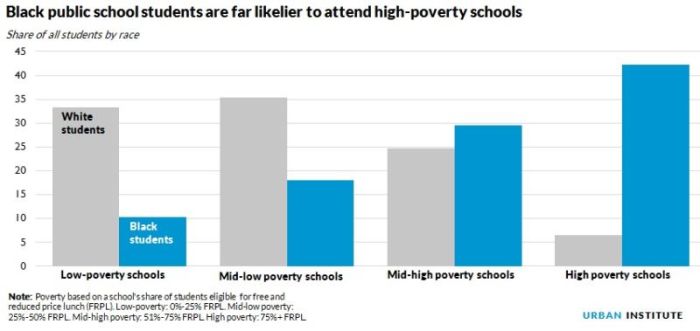
What may be less well known is the long, racist history of resistance to this ruling. In fact, what we now call “school choice” was invented during this time as an explicit attempt to avoid desegregation. “Charter Schools” and “School Vouchers” are modern terms that could almost as easily be used to describe the multifarious discriminatory attempts to stop racial mixing by reference to “choice.”


Take vouchers – allocating tax dollars to parents so they could “choose” to send their kids to private schools that won’t accept minorities – they tried it.


Or charters – setting up schools that are privately run but publicly funded so parents can “choose” to send their kids to schools allowed to discriminate against minorities during enrollment – they tried it.


And they’re still trying it and getting away with it.


It took decades for Brown v. Board to truly be enforced nationwide, and even after it became unavoidable, the fight to undermine it never truly died.


Betsy DeVos probably doesn’t consider herself a segregationist. Barack Obama probably doesn’t consider himself an advocate of “apartheid education”. But that’s what the policies each of them support actually accomplish. Both major political parties have been complicit – and are still complicit – in keeping our public schools separated by race and class.


There’s big bucks in it. Privatization means reducing accountability and transparency for how tax dollars are spent, which means unscrupulous corporations can pocket public money with no questions asked.


But it’s not just the charter and voucher industry that increase segregation. Our traditional public schools have also become separate and unequal.


After initial progress, our traditional public schools have been allowed to slip back into segregation. In many parts of the country, they are actually more segregated today than they were at the height of the civil rights movement in the 1960s.


According to a report from the U.S. Government Accountability Office, from 2000 to 2014, school segregation has more than doubled nationwide. That’s twice the number of schools comprised almost entirely of students living in high poverty and/or students of color.


The number went from 7,009 to 15,089 schools. And that’s just the worst offenders – schools with more than three quarters of students from only one race or class. Throughout the country there are thousands more schools not as extreme but still serving mostly poor and/or minority students, and thus receiving fewer resources, more teacher layoffs, dealing with larger classes and crumbling infrastructure.


It wasn’t always like this.


Classrooms were the most diverse from the 1970s through the early 1990s. At peak integration, four out of 10 black southern students attended a white school, while less than a third of all black students attended majority black schools.


What went wrong? The Supreme Court.


The highest court in the land laid down a series of decisions, starting with Milliken vs. Bradley in 1974, that effectively put the breaks on school integration. In fact, that first case is often criticized as “one of the worst Supreme Court decisions” ever.


It dealt with Detroit’s plan to integrate students by busing them from the inner city to the suburbs. The court ruled that such a plan was unconstitutional, because black students only had the right to attend integrated schools WITHIN THEIR OWN SCHOOL DISTRICT. If few white people lived there, well oh well.


And thus, de facto segregation was born.


If black and white people didn’t live together in the same neighborhoods – and they rarely do – then they wouldn’t be forced to go to school together. Forget that banks and insurance companies often refuse or limit loans, mortgages, and insurance to people of color for properties within specific geographical areas – a practice known as red lining. There was nothing municipal or school officials from minority jurisdictions could do to force integration across these artificial borders.


Between 1991 and 1995, the Court made matters even worse in three additional rulings. Justices decided that integration was merely a temporary federal policy and once the imbalance was righted, school districts should be released from any desegregation orders.


The results can be seen in almost every traditional public school in the country. There are rich schools and poor schools. There are black schools and white schools. And our federal and state education policies take advantage of the separation making sure that privileged schools get the lions share of resources while the others have to make do with less.


It is the key issue holding back our system of public education. Almost every school where students have low test scores has a disproportionately high level of poverty and students of color. If our schools were truly integrated, there would be none labeled “failing.” There would only be students who need extra help though they would be equally distributed throughout and thus not stigmatized. Unfortunately, re-segregation has allowed an easy scapegoat, and this, in turn, has been an excuse to build more charter schools and pass more school vouchers that drastically increase that same segregation.


Some people look at this situation and claim that it means we should abandon traditional public schools. If they’re already segregated, they argue, we should just invest in the choice schools.


However, doing so would not solve any of our problems. It would only exacerbate them. The solution to smoking is not more cigarettes. It’s quitting.


School segregation is terrible. That’s true at charter, voucher and traditional public schools.


The presence of segregation is no reason to abandon public education. It just means we need to fix it.


We need to overturn these destructive and short-sighted Supreme Court decisions. We need federal and state policies that recommit us to integration. At very least, we need a moratorium on new charter and voucher programs.


We need to value all children, not just those who resemble us racially, socially and/or economically.


That’s why school segregation is so bad.


It divides our children into discrete groups. It sets up the social structure and ensures the privileged will continue to be prized and the underprivileged will continue to be devalued. It teaches children to trust those like themselves and to distrust those who are different.


School segregation is the mother of racism and prejudice. And until we, adults, have the courage to tackle it, the next generation will grow up just like us – selfish, racist and blind.


John Oliver recently reported on the same issue (Warning: vulgarity):


Charter School Lotteries – Why Most Families Don’t Even Apply

Screen Shot 2017-07-03 at 1.33.34 PM

Who gets to enroll in your school?


This question is at the heart of the charter school debate.


While traditional public schools have to accept any student who meets residency requirements, charter schools can be entirely more selective.


They don’t have to take just any student. They can pick and choose based on pretty much whatever criteria they want.


Despite the fact that charters are publicly funded and privately run, transparency requirements are so low in most states that regulators aren’t even allowed to check up on their enrollment practices.


It’s a situation rife with the potential for fraud and abuse with America’s most vulnerable students often being victimized and huge corporations raking in record profits.


Critics say that charter schools routinely accept only the easiest students to educate. They take those with the best academic records, without disciplinary problems or special education needs. This allows them to spend less money to run their schools and claim all their students are doing well because of artificially inflated test scores.
But when critics level such charges against the charter school industry, the most common reply is an appeal to charter school lotteries.


When these privatized schools get more applications than they have seats, they often resort to a lottery to determine which students get to enroll.


The infamous propaganda movie “Waiting for Superman” had a much quoted scene where poor children held onto their lottery tickets as they hoped and prayed to be saved from a “failing public school.”


Advocates claim this is what makes charters fair: Students get in by pure chance.


But it’s not true.


More often than not, whenever enrollment data is available, it shows that charter administrators are, in fact, selective.


Take BASIS School Inc., a charter chain with 18 schools in Arizona, three in Texas and one in Washington D.C. The chain’s schools in Tucson and Scottsdale are highly ranked on Newsweek’s “America’s Most Challenging High Schools” list, and on the Best High Schools list of U.S. News & World Report.


However, their enrollment figures show them to be out-and-out cherry pickers.


They typically over-enroll Asian-American students and under enroll Latinos. They also enroll a much lower proportion of special education students than the state average and – shockingly – have zero English Language Learners.


Despite corporate accolades, this is not a successful model of public education. It is prejudicial, exclusionary and entirely the goal of for-profit educational institutions everywhere.


But besides outright corruption from charter administrators, there are other factors that suppress the neediest students from even applying to charter schools.


In short, they don’t want to go to these types of schools. They can’t afford losing the services and amenities they would typically receive at traditional public schools. They can’t afford the extra out-of-pocket costs charters demand.


Frankly, many charter schools are set up for middle class or wealthier students. Even if accepted, the poor would get fewer services and be forced to pay more than they could afford.


1) They Can’t Afford Uniforms


Many charter schools require students to wear uniforms. Most traditional public schools do not. Therefore, even though your local charter school is funded by tax dollars, it can be a hefty financial burden to attend.


How much more does it cost? That depends. Each charter school has different requirements.


For instance, in the New Orleans Parents’ Guide, the cost for a single uniform is estimated at more than $70. That’s at least $350 for a week’s worth of clothes. However, many estimates I’ve seen have been much higher.


Many charters require students to wear blazers – something a traditional public school student wouldn’t be caught dead wearing. These are pretty expensive items. They can cost anywhere from $80-$250 each.


Moreover, some charters, like most in the KIPP network, require everyday items like socks and shirts to contain an embroidered school logo. That’s at least an additional $10-15 per item.


For impoverished parents who routinely shop at local thrift stores or the Salvation Army, charter school uniforms can put them out of reach.


To be fair, about 19% of traditional public schools also require uniforms. However, they are typically much less expensive. In fact, they rarely amount to more than requiring clothing to be of a wide variety of colors and/or styles.


And if parents can’t afford the extra cost, traditional districts are required to either forgo the requirement or help parents meet it. They cannot deny children an education based on their parents inability to buy uniforms. Charter schools, on the other hand, can.


2) They Need Special Education Programs


Charter schools are rarely – if ever – known for their special education programs. Traditional public schools, on the other hand, are renowned for meeting the needs of diverse students with various abilities. If your child has special needs, going to a charter school simply may not be an option.


One reason for this is the basic structure of each type of institution. Traditional public schools are usually much bigger than charter schools. As a result, they can pool their resources to better meet special students needs.


At charter schools nationally, disabled students represent only about 7-8% of all students enrolled. At traditional public schools, they average a little more than 11%, according to a Government Accountability Office analysis of Department of Education data. So traditional public schools already have the staff, infrastructure and experience to help these children. Moreover, it would be cost prohibitive for charters to add them, especially when they’re designed specifically to make a profit.


Perhaps more troubling is this: charter schools rarely identify students as having special needs. Students who would get extra help and services in a traditional public school setting, do without in charter schools. In fact, parents who feel their children’s needs aren’t being met at charters, often disenroll them and place them back in their traditional public school for the extra help.


Parents with students who have learning disabilities or extra needs simply can’t afford letting their children languish in a privatized school setting that may well ignore their child’s individual needs.


3) They Need Free/Reduced Breakfast and Lunches


Though the state and federal government pay for free or reduced breakfast or lunch programs, charter schools often don’t offer them. Traditional public schools do. It’s that simple. If you’re having trouble feeding your children, sending them to a charter school can mean letting them go hungry.


Take Arizona. Statewide, more than 47% of all students receive free or reduced-priced lunch. However, charter schools in the BASIS network have none.  This doesn’t mean none of their students qualify. Clearly some of them do. The BASIS chain has chosen not to participate.


Why? Perhaps it’s to keep away students who have greater needs.


If so, it’s working.


Even when charters don’t actively weed out hard to teach students, they can set things up to make them less likely to apply.


4) They Need Busing To-And-From School


Often students don’t live within walking distance of their school. Traditional public schools routinely provide busing. Charter schools often do not. If you can drive your child to-and-from school, this is not an issue. If you’re poor and don’t have your own means of transportation, this is an added burden.


And if you think this is only a feature of the most fly-by-night charters, think again. The BASIS network – again, which includes some of the highest rated charters in the country – does not provide busing.


Traditional public schools are often at the heart of the community. They spring up around community centers, parks, and social gathering places. Charter schools are more often located at new or repurposed sites that can be miles away from the people they serve.


When the traditional public school offers a free ride to-and-from school, it can be an insurmountable burden to go to a charter where you have to find another way to get there. Parents who are working multiple jobs and/or the night shift may find it impossible to take their kids to the local charter. But perhaps this is exactly why charters aren’t offering busing in the first place. They don’t want these children.


5) They Don’t Have Time and/or Money For Extra Charter Demands


Charter schools demand an awful lot from parents. Traditional public schools do not. While children often benefit from involved parents, that’s not always possible. It’s unfair to require parental involvement as a prerequisite of enrollment.


Many charter schools require parents to volunteer at the school for so many hours a week. They often require “suggested” donations for extra services and for parents to buy books, supplies, or to pay an additional fee for extra curricular activities that would be provided for free at traditional public schools.


The BASIS network, for instance, requests that families contribute at least $1,500 a year per child to the school to fund its teacher bonus program. Families are also required to pay a $300 security deposit, purchase books, and pay for activities that would be free if the student attended a public school.


This is simply out of reach for the most disadvantaged students. Their parents are out of work or working multiple jobs to support them. They can’t volunteer at the school when they have to serve a shift at WalMart. They can’t afford the additional costs.


So, yes, charters often select against the poorest and neediest students when deciding whom to enroll.


However, even when they conduct fair lotteries to determine enrollment, they often set things up to discourage the neediest families from even applying in the first place.


NOTE: Special thanks to Priscilla Sanstead on this article.

Here’s an Idea: Guarantee Every Child an Excellent Education

Little African Girl At Wooden Fence With Thumbs Up.

Let’s get one thing straight: there are plenty of things wrong with America’s school system. But they almost all stem from one major error.

We don’t guarantee every child an excellent education.

Instead, we strive to guarantee every child THE CHANCE at an excellent education. In other words, we’ll provide a bunch of different options that parents and children can choose from – public schools, charter schools, cyber schools, voucher schools, etc.

Some of these options will be great. Some will be terrible. It’s up to the consumer (i.e. parents and children) to decide which one to bet on.

In many places this results in children bouncing from school-to-school. One school is woefully deficient, they enroll in another one. One school closes suddenly, they start over again at another.

It’s terribly inefficient and does very little good for most children.

But that’s because it’s not designed with them in mind. It does not put the child first. It puts the education provider first.

It is a distinctly privatized system. As such, the most important element in this system is the corporation, business, administrator or entrepreneurial entity that provides an education.

We guarantee the businessperson a potential client. We guarantee the investor a market. We guarantee the hedge fund manager a path to increased equity. We guarantee the entrepreneur a chance to exploit the system for a profit.

What we do NOT guarantee is anything for the students. Caveat emptor – “Let the buyer beware.”

Imagine if, instead, we started from this proposition: every child in America will be provided with an excellent education.

Sound impossible? Maybe. But it’s certainly a better goal than the one we’re using.

And even if we somehow managed to do it – even if every school was excellent – that doesn’t mean every child would become a genius. You can only provide the basis for an excellent education; it is up to the individual learner – with help from parents, teachers, and other stakeholders – to take advantage of what is put before him or her.

That is not a crazy goal to have. Nor does it mean that education would necessarily become stagnated.

It doesn’t matter what kind of school students go to – it matters that each and every school that receives public funding must be excellent.

That doesn’t mean they each must be excellent in the same ways. One wouldn’t expect them to be carbon copies of each other. Students have different needs. One would expect each classroom and each teacher to be doing different things at different times.

However, there are some things that are universal. There are some principles that are just better than others. Here are four:

First, it is better for schools receiving public funding to have to spend that money openly. They shouldn’t be able to spend that money behind closed doors without any public scrutiny or accountability.

Second, it’s better that the majority of the decisions made about how the school is run are made in public by duly-elected school board members drawn from the community, itself. That is much more preferable to political appointees who are not accountable to the parents and community.

Third, it is better if a school cannot deny a student enrollment based on that student’s special needs, race, religion, creed, sexual orientation, academic record or other factors. If the school receives public funds, it should not be allowed to turn anyone away.

Finally, it is better if a school teaches material that is academically appropriate, generally accepted as mainstream core concepts of the subject and Constitutional. Schools funded with tax money should not teach religious concepts like Creationism. They should not teach history and science from a Biblical point of view. They should not teach racial, sexual and religious discrimination.

None of these four principles should really be controversial. But each of them is violated by our current education system.

Some voucher schools violate the latter proposition. The other three are often violated by charter, cyber and voucher schools.

The only type of school that does not routinely violate these propositions is traditional public schools. Yet that is also the type of school being consistently undermined by most of our current educational policies.

So if we start from the idea that every student should get an excellent education, we start with the proposition to support and renew our public schools.

In doing so, we would need a national commitment to bringing every public school up to snuff.

Many of them already are – Hint: they’re found in rich neighborhoods. The ones that struggle are almost always found in poorer neighborhoods, and that’s no accident. It’s the result of savage funding inequalities.

What we’d need to do is ensure schools serving impoverished students receive equitable funding compared with schools serving the middle class and wealthy kids. Impoverished students must by necessity receive as much funding as the privileged ones. In fact, given the deprivations and increased needs of impoverished students, they should actually receive more funding. Middle class and rich kids have academic advantages over poor kids before they even enter kindergarten. They have more books in the home, more educated parents, better nutrition, better neonatal care, and often more stable home environments. If we really committed ourselves to making sure even these kids got the best possible education, we’d need to start spending more money on them.

Next, we’d need to do something about school segregation. Our public school system is now almost as segregated – and in some places even more segregated – than it was before the landmark Brown vs. Board decision 50 years ago. The only way to guarantee everyone an excellent education is to make it increasingly difficult to hurt some students without hurting all. There is no separate but equal. When we keep students apart by race or class, we ensure inequality among them.

And perhaps most important is this: we must remove the profit principle from education. We cannot allow decisions to be made based on what is best for corporations. Academic decisions about how to teach, how to assess student learning and how to assess teaching should be made by professional classroom educators.

This means no more high stakes standardized testing. No more Common Core. No more depersonalized computer-based learning. No more value added measures used to evaluated teachers. No more union busting. No more Teach for America.

We need to start valuing teachers and teaching again. And we need to pay and treat them as one of the most valuable parts of our society.

These measures would not be easy to accomplish, but they would have an immense impact on our schools.

This would require a substantial outlay of additional funding. We could save money by discontinuing costly practices that don’t benefit children (i.e. testing, charter and voucher funding, etc.). But make no mistake, it would cost money. However, we’re one of the richest countries in the world. We spend a ridiculous amount already on the military. You’re telling me we can’t find the money to spend on our children? If we’re not willing to spend on our future, we don’t deserve to have one.

It requires only a change in focus, a reevaluation of our priorities and goals.

Education should not be market driven. It should be student driven.

We should no longer guarantee business a class of consumers.

Instead, every student in this country no matter if they are rich or poor, black or white, male or female, gay or straight, religious or not – every student should be guaranteed an excellent education.

It’s really that simple.

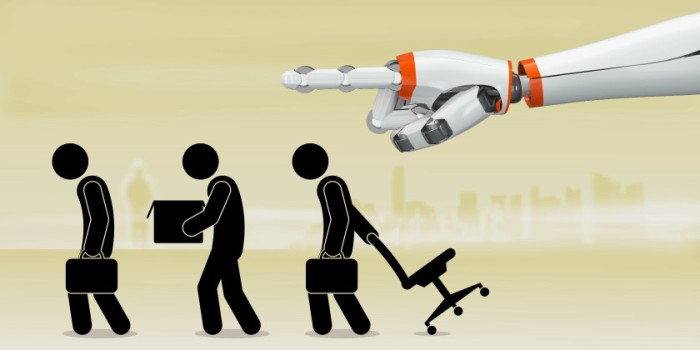
National Education Association Seems to Endorse Replacing Teachers With Computers

robots-replace-humans-840x420


When all the teachers are gone, will America’s iPads pay union dues?


It’s a question educators across the country are beginning to ask after yet another move by our national unions that seems to undercut the profession they’re supposed to be supporting.


The National Education Association (NEA), the largest labor union in the U.S., published a shortsighted puff piece on its Website that seemingly applauds doing away with human beings working as teachers.


In their place would be computers, iPads, Web applications and a host of “devices” that at best would need human beings to serve as merely lightly trained facilitators while children are placed in front of endless screens.


The article is called, “As More Schools Look to Personalized Learning, Teaching May Be About to Change,” by Tim Walker.


Teacher-blogger Emily Talmage led the charge with a counter article on her site called “Anatomy of a Betrayal.” She outlined the NEA’s change from being critical of such initiatives to joining with the likes of Jeb Bush and various foundations, tech firms and school voucher advocates in celebrating it.


Make no mistake.


This is not merely an examination of changing teaching practices. It is a movement by tech giants to further standardize and privatize America’s public schools.


This isn’t to say that technology can’t enhance learning. But classroom teachers with any kind of experience know that simply plopping a child in front of a computer screen is a terrible way to do it. It’s the equivalent of having all your questions answered by an automated voice on the telephone versus being able to ask questions of a living, breathing person.


And they have the gall to call it “personalized learning” as if it were meeting all the needs of students one-on-one. It isn’t.


It’s one-on-one, but it isn’t meeting anyone’s needs except bankers, hedge fund managers, charter school operators and tech investors.


It’s a way to drastically reduce the cost of education for poor and minority students by removing the need for a teacher. It’s the educational equivalent of an automated cashier in the grocery store, but unlike at Giant Eagle, it doesn’t just tally your bill, it pretends to teach.


This is the definition of a McEducation. It’s the logical extension of policymakers who think that 5-week trained Teach for America recruits are equivalent to education graduates with four-five year degrees and years of classroom experience. They’re just replacing TFA recruits with Apps.


Don’t get me wrong. America’s public schools have a lot of problems. They’re segregated by both economics and race. The poor and minority schools are inadequately funded and inequitably resourced. They are forced to compete for what little money remains with charter school vampires who are allowed to spend it however they like with little to no accountability or transparency. More money disappears down the gullets of voucher schools to subsidize the rich and indoctrinate Christian fundamentalists. And to top it all off, our public schools are forced to give scientifically invalid standardized assessments that are incentivized to fail as many students as possible so the same corporations that make the tests can sell districts remediation materials. Meanwhile, a large portion of these profits earned off public schools are reinvested in lawmakers reelection campaigns so they’ll pass legislation that continues to treat our children as golden geese for business and industry.


The NEA should know that. We have more than enough enemies to fight. But instead of taking arms, our national unions have been racing toward the bottom to compromise and keep that proverbial seat at the table. They’ll fight for teacher tenure. They’ll fight right-to-work legislation. But policies that undermine the very fabric of the profession? NAH.


We saw the same thing with Common Core. Educators knew you can’t teach higher order thinking skills to children without first doing the groundwork of process. But the book publishers had new textbooks to market so the NEA backed a horse they knew was dead at the starting gate.


And now we have the tech giants – the Zuckerbergs and Gates – slobbering over the profits they can make by callously removing teachers from the equation.


I’ve seen this first hand.


My district has a one-to-one iPad initiative. For two years, each of my students has had a device in every class. It hasn’t dramatically improved learning. At best, it’s increased students’ computer literacy. At worst, it’s a toy that actually distracts from authentic learning.


They allow me, the teacher, to give all assignments digitally. But that requires the network to function perfectly, the devices to be fully charged, the assignments to be entered precisely, the students to engage with them correctly and creatively – when handing students a paper and having them hand it back is actually much more efficient.


They allow students to look up unfamiliar vocabulary quickly, but they rob students of the context skills necessary to know which definition is appropriate, and experience using prefixes, suffixes and roots.


They allow students to easily access infinite information but without the skills to critically read it. More kids read the summary on the Internet than read the book – and even then, they don’t understand it.


They allow students to make colorful Keynote presentations and iMovies, but do nothing to prepare them how to intelligently organize the materials.


And – worst of all – they convince number crunching administrators that assignments, tests and lessons can be given digitally with hours of screen time. As if that was equivalent to authentic learning.


That is the end goal.


Everyone knows it. Isaac Asimov wrote about it in 1954 with his classic science fiction story “The Fun They Had” about a future where computerized home schooling was the norm. But even in his story, kids felt like they were being cheated out of something important that their ancestors had experienced in a traditional public school setting.


Instead of heeding his warning, our unions are rushing to make that world a reality.


You don’t strengthen unions by undercutting the professionals they’re supposed to represent.


Somebody needs to tell our union leaders – preferably by replacing them.

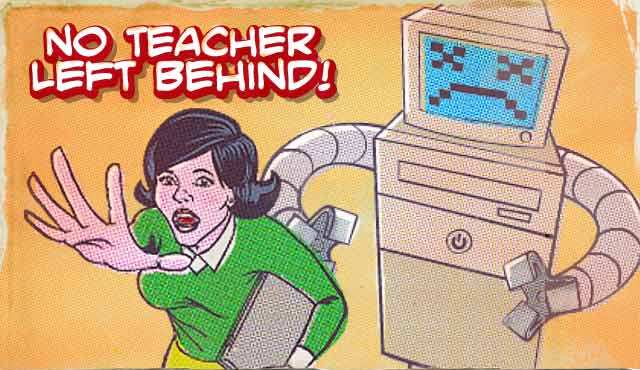
teacher-left-behind11

Charter Schools and Voucher Schools are Virtually Identical

Screen shot 2017-05-17 at 8.30.20 PM

The stark orange monolith that was Donald Trump is starting to crumble.

And with it so are the dreams of corporate education reformers everywhere.

Where in previous administrations they could pass off their policies as Democratic or Republican depending on whichever way the wind blows, today their brand has been so damaged by Trump’s advocacy, they fear it may never recover.

Under Presidents George W. Bush and Barack Obama, they could champion both charter schools and school vouchers with impunity. But now the privatizers and profiteers hiding in progressive clothing are trying desperately to rebrand.

Not only is Trump’s voucher plan deeply unpopular, but the public has already begun to associate any kind of school privatization with a doomed President.

So like cockroaches, neoliberals have begun to skitter to one type of privatization over another. Fake Democrats hide beneath unfettered charter school expansion. Bought-and-sold Republicans cling to the idea that we should spend taxpayer dollars on private and parochial schools.

But is there a real substantial difference between each of these so-called “choice” schemes? Or are they both just scams when compared with traditional public schools?

THE DIFFERENCES

Charter Schools and Private Schools are basically the same thing.

The biggest difference between the two is funding.

Charter schools are completely funded by tax dollars. Private schools – even when school vouchers are used – often need to be subsidized by parents. For instance, many private schools charge tuition of $30,000 – $40,000 a year. Vouchers rarely provide more than $6,000. So at best they bring the cost down but still make it impossible for most students to attend private schools.

Sure they may start as an effort to allow only impoverished children to use tax dollars towards private and parochial school tuition. But they soon grow to include middle class and wealthy children, thus partially subsidizing attendance at the most exclusive schools in the country for those families who can already afford it.

Parochial schools, meanwhile, are exactly the same except for one meaningful difference. They teach religion.

Their entire curriculum comes from a distinctly religious point of view. They indoctrinate youth into a way of seeing the world that is distinctly non-secular.

Progressives complain that using tax dollars to pay for student tuition at such schools – even only partial tuition – violates a foundational principal of our nation.

Using public money to pay for religious teaching has historically been interpreted as a violation of the establishment clause of the first Amendment to the Constitution – namely, “Congress shall make no law respecting an establishment of religion, or prohibiting the free exercise thereof…” Thomas Jefferson called it “a wall of separation between Church and State.”

This is further exacerbated in many parochial schools where religious teaching includes a blatant political bias toward conservatism. Children at many of these schools are taught that supply side economics, voter disenfranchisement and prejudice are normative bedrock truths.

These are the main distinctions between voucher and charter schools.

In short, they’re not all exactly the same. And corporate reform apologist are trying to rebuild their brand on these split hairs.

But the similarities between these types of school are much more striking.

THE SIMILARITIES

The biggest commonality between these types of educational institutions is how they’re run. Unlike traditional public schools – which are governed by duly-elected school boards – charter, private and parochial schools are overseen by private interests. They are administered by independent management firms. They rarely have elected school boards. Their operators rarely make decisions in public, and their budgets and other documents are not open to review by taxpayers. This is true despite the fact that they are funded to varying degrees by public tax dollars.

So in all three cases, these schools are run privately, but taxpayers pick up the tab.

It’s ironic. Sending kids to charters, private and parochial schools with public money is called school choice. However, each of these types of schools gives taxpayers much less choice about how their money is being spent.

The community funds the school, but almost all decisions are made by people outside of the community – people appointed, in fact, by bureaucrats or business managers.

To be sure, parents can express their displeasure of administrative decisions by disenrolling their children in the school. But beyond this nuclear option, they are powerless. Even more troubling, taxpayers without children or with children who do not attend these schools have no say whatsoever about how their money is spent.

And to add insult to injury, it doesn’t even really allow the parents to choose which schools their children attend. They can put in a request for their kids to attend a choice school, but enrollment decisions are made by these same private equity managers. In short, administrators make the ultimate choice – not parents.

If the religious school doesn’t want to accept your child for whatever reason including operators’ disapproval of your religious beliefs, they don’t have to accept him. If the private school doesn’t want to accept your child based on race, gender or nationality, they don’t have to accept him. If the charter school doesn’t want to accept your child because of bad grades or troublesome behaviors, they don’t have to accept him.

The traditional public school, however, cannot refuse a child who lives in district borders for any of these reasons. In effect, school choice really isn’t about parental choice. It’s about increasing choice for the operators of privatized schools – letting them choose their students and how to spend your money without any meaningful input from you.

And it’s true at all three types of school!

Those are pretty considerable similarities. Moreover, they highlight major differences between these so-called choice schools and traditional public schools.

This is important because we don’t even have to get into the academic records of individual schools. The way each type of school is structured shows the clear inferiority of choice schools compared to traditional public schools.

By their very structure, public schools give parents and taxpayers much more agency in children’s education and how taxpayer money is spent.

Second, the latitude for school administrators to perpetrate fraud on the public is maximized in so-called choice schools and minimized in public schools. This doesn’t mean public schools are perfect, but it is much better to have a school under public scrutiny and local control than otherwise. This is demonstrated by the huge numbers of charter school scandals popping up in the news every day, where charters close suddenly, money is misspent on luxury items for operators that have nothing to do with education, and – especially in cyber charters – the quality of education students receive is literally lower than having no formal education at all.

Finally, if public schools struggle, it is almost always due to a lack of equitable funding and a surplus of impoverished students. It is no accident that poor students receive less resources and larger class sizes than middle class or wealthy ones. Nor is it an accident that we judge the effectiveness of schools primarily on standardized tests which are so good at highlighting the results of lack of resources rather than any academic deficiency.

If we spent our education dollars ensuring equitable resources instead of funneling tax dollars to charter, private and parochial schools, we would better increase the quality of children’s education. But for the last few decades that has not been the goal of education policy. It has instead been to enrich these same privatized school managers and investors – the corporate education reform industry. Nor is it a coincidence that this industry and its subsidiaries counts itself as major donors to both political parties.

Before she was elevated to Education Secretary, Betsy DeVos was exactly that – a billionaire mega-donor pushing school privatization while getting richer off investments in the same. Now that she’s driving school vouchers off a cliff in the Trump train, her co-conspirators are getting nervous.

Neoliberal Democrats may try to save the movement by claiming charter schools are completely different. But they aren’t. They are fundamentally the same.

The public sees the clear similarities between these kinds of schools. And much of that is thanks to the incompetent boobery of Donald J. Trump.

Tax Cuts Are Theft.

TAX


Ben Franklin famously said that nothing is certain in this world except death and taxes.


But in our modern age, that might have to be amended to read, “death and tax cuts.”


These days, lawmakers on both sides of the aisle can’t figure out how to govern without continually cutting taxes – and invariably the beneficiaries of such largess are the rich.


No one likes paying taxes.


You do a job, earn money and have to give a portion of it to the government.


But no one likes going to the dentist, either. Yet it’s something most adults do because we understand its necessity. We know that ignoring basic dental hygiene and avoiding regular dental check-ups will most likely result in halitosis, mouth pain and the eventual decay of our teeth.


There are similar societal problems with tax avoidance, but we’ve been tricked into willful ignorance.


The rich have paid for an army of economists, libertarians and other would-be thinkers to come up with justifications for avoiding taxation as much as possible.


It’s completely disingenuous. This is prostitution as philosophy. It’s whoring out one’s mental faculties to come up with a smoke screen behind which the wealthy can get away without paying their fair share.


The idea basically comes down to this: taxation is theft.


The government has no right to tax its citizens because it only gets rights from the consent of the governed. People can only give the government rights they already posses. Since they don’t already have the right to tax each other, they can’t give that right to the government.


It’s pure sophistry.


It imagines a mythical world without government and then tells a story about how that government got its power. But few of us have ever lived in a world without government. Neither did our parents or grandparents back through the mists of prehistory. In fact, it is hard to conceive of a time when people existed with no social structure at all from which individuals could then cede rights to a collective group.


And once government exists, each individual citizen owes it a debt. We owe it for all the public institutions from which we benefit. If we went to public school, for instance, we owe it for our education. Even if we were educated privately, we owe it for being able to live in a society where most people are educated since the great majority of those people received that education from public school.


It only takes a moment of reflection to see the complex web of benefits every person receives from society that come from some public services. Think of the inventions funded at least in part by government investment. Think of the safety we enjoy due to law enforcement and the military. Think of the roads and infrastructure that allow us to live at a high standard.


These are all provided by government, and no matter how rich or poor you are, you have benefited tremendously from being a part of it.


As such, you owe that society a certain portion of your income to help support this system.


It’s not exactly complicated. But certain economists make it complicated in a cynical shell game while their masters getaway without paying their debts.


And when they do, who has to make up the difference? You do!


It’s not taxation that’s theft. It’s tax avoidance and – often – tax cuts.


No one gets rich because they’re inherently better than others.


A person worth $500 million is not 500 million times better than a person worth $1. They are both people and equally as valuable. Nor does income equate to how hard someone works. Many billionaires spend their days lounging around the pool drinking piña coladas. Many poor people spend their days scrubbing floors and toilets. The biggest difference between the two is luck.


The wealthy most often are rich merely because they won the lottery of birth or their business ventures succeeded due to pure chance. And even in the rare instances when people made a lot of money because of their intelligence or savvy, that doesn’t justify them being so unequally rewarded by our society compared to those of us without such talents.


If you judge a person solely on his/her bank account, you misjudge the majority of the population.


Some policymakers will acknowledge these points but still insist on tax cuts based on misconceptions and/or lies about how economies work.


They’ll say the United States already has some of the highest taxes in the world. We need to cut taxes to be competitive.


However, this is not true.


In 2014, total US tax revenue equaled 26 percent of gross domestic product (GDP) – well below the 34 percent average for developed countries, according to the Organization for Economic Co-operation and Development (OECD).


Screen Shot 2017-05-12 at 10.08.40 AM


Of all OECD countries, only Korea, Chile and Mexico collected less than the United States as a percentage of GDP. In many European countries, taxes exceeded 40 percent of GDP. But those countries generally provide more extensive government services than the United States.


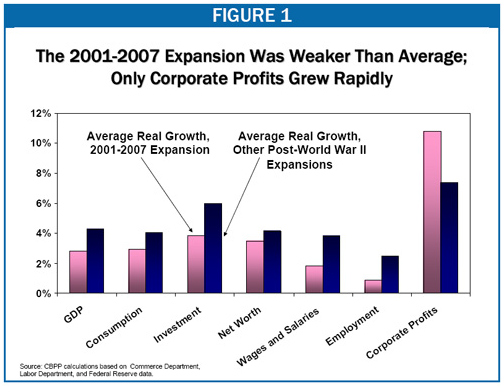
Some will argue that tax cuts are necessary to boost the economy. However, we have countless counterexamples to this popular fabrication. For instance, when President George W. Bush cut taxes from 2001 – 2007, the average annual growth rate was far below the average growth rate for any other period after World War II. In fact, only corporate profits experienced rapid growth. Over all, this expansion was among the weakest since World War II.


Screen Shot 2017-05-12 at 4.11.54 PM


In short, the US is doing a terrible job providing every citizen with the benefits of our society. We are disproportionately rewarding the rich while forcing the rest of us to pay for the services from which we all gain. Moreover, other countries provide even more bang for that buck.


Now this doesn’t mean that the government should tax us all into the ground.

Nor does it mean that the government should spend our tax dollars willy-nilly.


Taxation needs to be fair and spending needs to be regulated.


But constantly cutting rich people’s taxes is immoral. It is unfair to the majority of people making up the difference and struggling to survive when government services lag behind need.


Screen Shot 2017-05-12 at 10.34.01 AM


Our public schools are suffering under strategic disinvestment. Especially in poor neighborhoods that often disproportionately serve people of color, public schools cannot keep up with children’s needs. They aren’t providing an equitable level of service with those schools in richer, whiter neighborhoods.


Our policymakers try to solve the problem with charter schools, vouchers, standardized tests and Common Core. And the results have only been a worsening situation.


The real solution is simple – increased funding through fair increases in taxes on the wealthy.


Tax cuts are popular, but every time we let the rich get away with paying less, we have to either take more from the poor or take the knife to public services.


This affects the poor immediately in the form of reduced services, but it affects the rich, too. They have to live in a world where the majority has less – this means increased crime, increased drug abuse, increased ignorance, etc.


As a society, we must get beyond the selfish urge to look out only for what seems best for ourselves and our immediate friends and families. We must look out for our entire society. We must look out for the needs of everyone in it.


Otherwise, when we fall for these economic fallacies, we’re only stealing from ourselves.

Reaching Black Students Harder for White Teachers in the Age of Trump

Screen shot 2017-05-08 at 7.51.23 PM

“Not everything that can be faced can be changed. But nothing can be changed until it is faced.”
James Baldwin

“I have a great relationship with the blacks. I’ve always had a great relationship with the blacks.”
Donald Trump

Mariah’s eyes were wide as dinner plates.

She covered her mouth with her journal and pointed at the wipe board at the front of the room.

On it, I had written my question for the day. It’s how I usually begin class for my 8th grade students.

It read:

“Some movies and books like “To Kill a Mockingbird” describe what life was like in the South before the civil rights movement. To do so, they use the N-Word. Is it ever okay to us the N-Word? Why or why not? When might it be appropriate if at all? Why?”

I guess I’ve been teaching this for too long, because I didn’t expect Mariah’s reaction.

Not that was she alone. Several of my mostly impoverished and black students were looking around at each other in shock.

Kendra even said under her breath, “I don’t want to do this.”

We had just begun reading the novel yesterday. I thought it was time to address this issue before we were confronted with the word in the text.

In all of my classes that day, students had been interested in the query. But never had any of them reacted this way.

One student raised her hand and asked, “Which word are you talking about?”

I said, “I don’t want to say it, but it starts with an N and rhymes with trigger. Do you know what I’m getting at?”

They knew. Yet in removing doubt, I had only reinforced their outrage.

I thought maybe if they tried to write an answer first, it might help them organize their thoughts and maybe comprehend the point of the lesson. But they wouldn’t be directed back to the page.

Latrell was particularly upset. “It’s not always just words against black people,” he said. “How would you like it if we talked about words against white people?”

There were grumbles of agreement.

So there it was.

My white skin was the impediment. Here I was, a white man telling mostly black students to think about the appropriateness of the N-Word. I wasn’t trying to express an opinion of my own one way or the other. I wanted them to express their opinions.

But I had taken it for granted that asking them the question was appropriate in the first place.

I had forgotten that you can’t talk about racism with just anyone. It’s the same with sexual violence or abuse or a host of other topics that are deeply personal.

You need a relationship, the recognition of shared values and the promise of safety.

I assumed that I already had provided that for my students. In most classes that understanding seemed to be there. But for whatever reason, these students didn’t feel comfortable talking about this with me.

And I get it.

It’s the confluence of skin and history. No matter what I do, no matter what I say, I will always resemble the oppressor to some people. In the age of the Donald, it’s only gotten worse.

Building walls, casual misogyny, rushed deportations, religious intolerance – all are at the forefront of our modern social discourse now. These are matters not hidden under euphemisms or disguised as well-meaning public policy. They’re commands from on high, dictates coming from a mouth in a face that looks much like mine.

No wonder these kids didn’t want to talk about hate speech with me. I resemble the personification of hate speech.

I’ve been teaching “Mockingbird” for over a decade, but this was the first time in years that I paused not knowing what to do.

Should I force the issue and push forward? Should I give in and try to read the novel without the discussion? Should I put the book away altogether and find something else to teach?

I decided to get more information.

I asked the students to tell me how they felt. I asked them to explain what they were feeling.

Many were angry with me for even asking. They accused me of being racist. They tried to make me angry and blow up the lesson.

But I swallowed my pride and just let them talk.

After each statement, I repeated what I took them to be saying and asked if that was correct.

At first, many students didn’t even seem to be certain what they meant. When I repeated it to them, they shook their heads or said they weren’t sure.

Kendra spoke, “Mr. Singer, you tell me. Why are we talking about this? It don’t do nothing.”

I said, “Can we all agree that racism is a bad thing?”

But she deflected.

“Why’s it always got to be about black people? Other people experience racism,” she said.

And I agreed. I reminded them that we had just finished reading “The Diary of Anne Frank.” I asked why we had read it.

At first the loudest students said they didn’t know, but then Eva said it was to try to make sure nothing like the Holocaust ever happened again.

I nodded, and repeated my original question, “So can we all agree racism is bad? Raise your hand if you think racism is bad.”

They all raised their hands.

“Okay,” I said. “Then how do we stop it if we can’t talk about it?”

Kendra responded, “Mr. Singer, when we leave this class, none of this is going to matter. People are still going to be racist. Cops still gonna’ kill little black kids. People like you still gonna’ push people like me out.”

Others chimed in with similar comments.

I nodded, and said, “You’re right.”

That silenced them.

“You’re right, Kendra,” I said. “Maybe we can’t stop racism with what we say in here. Maybe no one can. But the hope is that if we talk about it, we’ll reduce it, we’ll cut it down to size. What do you think? Do you think we can take all the racism in the world and cut it down even by just a little bit?”

She didn’t say anything.

No one did. But hands were raised in the air. No one was shouting. No one seemed angry. Several students wanted to talk, and they were looking to me to organize the discussion.

So I let them talk.

All the time I had scheduled to write the journal fell through the hour glass and then some.

And when the discussion was petering out, I promised them that I would be available after class if anyone wanted to continue talking about it.

Then we picked up the book and continued reading.

I don’t know if it was the best class I’ve ever taught.

It was disturbing and uncomfortable.

I don’t see myself as anyone’s savior. But I’m there to help. I had hoped my students knew that.

But as a public school teacher, you learn not to take anything students do personally. They’re all going through a struggle you know little about.

I don’t want them to see me as an adversary. I want them to see me as a fellow traveler, as someone on their side.

But so much has changed in the last 100 days.

It’s a different world.

Racism and prejudice are no longer at the same remove. They never went away, but now they’re an unspoken presence coiled at our feet – constantly.

I have no answers. I ask questions and try to get my students to think about their own answers.

I just hope we’ll continue to have the courage to try.

Arne Duncan Designed Rahm Emanuel’s Latest Attack on Poor Students of Color

1357229004

Sometimes an idea is just too stupid to keep it all to yourself.

Ask Arne Duncan.

Sitting at his lonely desk as managing partner of the Emerson Collective, a limited liability corporation pushing school and immigration policy, he must have missed his days as President Barack Obama’s Education Secretary.

After all, he was the architect of Race to the Top, a federal policy that at best wasted billions of tax dollars without helping students learn – at worst it enriched private charter school operators, standardized test and publishing corporations and private prison operators without helping kids learn.

At the dawn of 2017 with Donald Trump just beginning to flush public education down the toilet in favor of school vouchers, Duncan took to the Internet wondering how he, too, could bring harm to inner city students.

On Jan. 11, he sent an email to Chicago Mayor Rahm Emanuel with a suggestion that was pure Duncan – let’s help poor children of color by making it harder to graduate!

Chicago Public School students have suffered from decades of budget cuts, teacher layoffs and even the closure of 49 schools almost exclusively in poor, black or Latino neighborhoods. A former district CEO even plead guilty to a $23 million kickback scheme.

As a result, the more than 400,000 students, 37.7% of which are black and more than 80% of which are poor, have struggled academically.

How would Arne help them? Make them submit more paperwork in order to get a diploma. They must prove that after 12th grade they’re going to college, trade school, an internship, the military or would otherwise be gainfully employed. OR ELSE they can’t graduate!

“Think about making completing a FAFSA [financial aid application] and applying to two or three colleges or the military a new CPS graduation requirement,” Duncan wrote to Emanuel in emails released to the Chicago Sun-Times through a Freedom of Information Act request. “Graduation rates continue to rise. This would signal the importance of ongoing education/training. A HS diploma is great, but not enough. No other school system I know of has taken this next step.”

Duncan followed up in February, and Emanuel replied, “Thanks. You know we are doing a version of your graduation requirement.”

Duncan responded, “Didn’t know. Good?”

No. Not good, Arne.

Because of your neoliberal meddling, when this year’s 9th graders finish their senior year, they’ll have to jump through yet another hoop to get their diplomas.

The Brookings Institute concluded in 2016 that cities like Chicago with pronounced income inequality are more likely to see higher rates of secondary school drop-outs, and lower graduation rates. An unrelated 2014 study found that Chicago ranked eighth among American cities in an index of income inequality.

None of that is helped by a new graduation requirement.

But Duncan disagrees.

He wrote an op-ed published in the Chicago Tribune praising the plan – his plan.

“Some people worry that raising graduation standards will cause more young people to drop out, but they’re wrong,” he wrote. “Young people don’t drop out because school is too hard. They drop out because it is too easy and they are not engaged. They don’t understand how it’s relevant to their lives.”

Wrong, Arne. It’s not a matter of school being too easy. It’s a matter of life being too hard. Imagine being an impoverished inner city student. You’re malnourished, there are few books in your home, you’re struggling to survive in a world populated by drugs and gangs, you’re suffering from post traumatic stress and your neighborhood school is closed, your teacher is laid off, there’s no tutoring, no arts or humanities classes. And they keep making you take endless high stakes standardized tests. THAT’S what makes students loose interest in school. Not because it’s too easy!

But Emanuel, a former investment banker and Obama’s White House Chief of Staff, only understands business solutions to human challenges.

When proposing this new graduation requirement, he said he got the idea from charter schools.

But of course! Private corporations running schools at public expense always know what is best!

Or is that NEVER know what is best? I guess it depends on whose interest you’re looking out for – businesspeople or students.

Emanuel doesn’t think this new policy is a major change.

“We already have around 62 percent of our kids are already either accepted into college or accepted into community college, and our goal is to make sure nobody spikes the ball at 12th grade,” Emanuel said. “We want to make 14th grade universal. That’s the new goal line.”

Is it, Rahm? It’s interesting that you’re doing this for inner city kids but no one is suggesting it for wealthy kids in the suburbs.

This statement about expectations explains why:

“Just like you do with your children, college, post-high school, that is what’s expected,” Emanuel said. “If you change expectations, it’s not hard for kids to adapt.”

So poor black and Latino kids need YOUR expectations. Is that it? It’s up to YOUR patriarchy to step in and tell them what to do with their lives after high school or else – what? They’ll just sit home on food stamps doing nothing?

This is Chicago – where police brutality is an everyday thing. Gun violence is out of control. And you think these kids and their parents live in crippling, generational poverty because they aren’t trying hard enough to get jobs or better themselves?

Those seem to be the underlying assumptions here. It’s not about giving these 18-year-olds a helping hand. It’s about pushing them to pull themselves up by their own bootstraps.

It only takes a second of thought to realize why this is a bad idea.

The district has been cutting staff positions left and right – especially at schools serving poor students of color. Has any additional funding been budgeted to ensure district guidance counselors are in place to help students meet this goal? NOPE.

Students can graduate if they prove they’ve got a job after high school. Those aren’t exactly growing on trees – especially jobs that pay more than minimum wage. What if students can’t find employment? That’s reason to withhold their diplomas? Your academic fate should be held up because there aren’t enough positions as a fry chef!?

Sure, seniors can apply to a local community college, which according to a spokesperson for City Colleges of Chicago, lets everyone in. But what if this isn’t the path for them? Not everyone is made for college. Why is the city stepping in to demand a post graduate plan from students? Isn’t this really just a recruitment plan for these community colleges and/or the military?

Is this even legal? These kids have passed all their classes. They’ve earned a diploma. You can’t simply withhold it because their post-secondary plans don’t meet with your approval.

When the district withholds its first diploma, look for a legal challenge where taxpayers will be in the uncomfortable position of paying for legal counsel to stop a child from graduating.

This Duncan/Emanuel policy is something you might expect from a certified moron like current Education Secretary Betsy DeVos. (She wants teachers armed against grizzly bear attacks.)

But it should be noted that both Duncan and Emanuel are Democrats. They’re just not progressives.

You wonder why a fool like Trump won the Presidency? It’s because of neoliberal attitudes like these. Both of these men were part of the Obama administration. And Hillary Clinton was following in the same footsteps – or certainly she didn’t speak out against it.

Emanuel’s political career is backed by the same big money conservatives that back Chris Christie, Mitt Romney and Bruce Rauner. He’s a puppet of charter schools, hedge fund managers and the Koch Brothers.

In fact, his corruption was so bad that during the 2016 primary, he became an issue for Democratic Presidential contenders. Bernie Sanders actually called him out in a tweet saying: “I want to thank Rahm Emanuel for not endorsing me. I don’t want the endorsement of a mayor shutting down schools and firing teachers.”

Screen shot 2017-04-18 at 12.51.54 PM

Rahm had endorsed Clinton putting her in a bad position. Ann O’Leary, Clinton’s education advisor, said in private emails that Emanuel was “bad for Chicago schools.”
Like Clinton’s campaign manager, John Podesta, O’Leary was a longtime supporter of corporate education reform policies – and so was Clinton. Hillary supported George W. Bush’s terrible No Child Left Behind – the law that changed federal education policy from focusing on equity to holding schools hostage for their standardized test scores.

O’Leary was worried about how Emanuel might hurt Clinton – especially in light of Bernie’s tweet.

In a private email to senior Clinton staff, she wrote:

“Bernie is beating us up over Rahm’s record on schools in Chicago. The Chicago school system is overloaded with debt and likely to run out of cash before the end of the school year. As a result, they are withholding their pension contributions, and laying off teachers and support staff.

I reached out to Randi W[eingarten, President of the American Federation of Teachers] and she suggested that she tweet something tomorrow making it clear that Rahm and Rauner have been bad for Chicago schools and then HRC [Hillary Rodham Clinton] retweets.

That sounds like a toxic idea to me given Rahm’s endorsement, but I don’t think this issue is going away.

We could: (a) have HRC say something more forceful about the state working to help Chicago pay off debt so the schools can focus on teaching and learning; (b) have Randi say something more mild and we could retweet. But I do worry that short of going after Rahm, these options are not going to be satisfactory. So the (c) option is to stay silent for now.

Thoughts?”

O’Leary’s final decision was to do nothing.

And we all know how that turned out.

Screen shot 2017-04-18 at 12.52.54 PM

The worst part is that the Democrats don’t appear to have learned anything.

Here’s what Duncan had to say just this month about how Democrats should be fighting the Trump administration’s education policies:

“The federal government is disinvesting in public education and withdrawing from accountability, so states and districts have to step up and lead.”

But Arne, your administration disinvested in public schools, too. Emanuel is famous for it!

And we all know what “accountability” means to neoliberals like you. It means endless standardized testing and closing schools catering to poor students of color. It means giving charter schools, book publishers and testing corporations a blank check.

No one is going to vote for that anymore.

That is just not a viable alternative to Republican policies that take all of this to its logical conclusion.

Destroying public schools slowly is not a viable alternative to destroying them quickly. Democrats need to either discover their real progressive roots or else move aside for grassroots groups to take over.

That’s a suggestion worth sending to your buddies Rahm, Hillary and Barack via email.

Dept of Ed Hires Anti-Civil Rights Crusader to Protect Student’s Nonexistent Civil Rights

Screen shot 2017-04-16 at 1.27.11 AM

Candice Jackson is a victim of oppression.

When she was attending Stanford University in the mid-1990s, a minority calculus tutoring group refused to help her because she was white.

Sure she could probably afford to pay for private tutoring, but it was the point of the  thing.

She came from a family where both parents ran medical practices. Her dad, Dr. Rick Jackson, even unsuccessfully ran for Congress. You know – just like black families redlined into the ghetto and struggling to find work because of their African-sounding names.

Why shouldn’t the limited amount of tutoring spaces serve her as well as people from traditionally less privileged backgrounds? White lives matter, ya’ll.

“I am especially disappointed that the University encourages these and other discriminatory programs,” she wrote in the Stanford Review. “We need to allow each person to define his or her own achievements instead of assuming competence or incompetence based on race.”

With that kind of empathy and innate understanding of social justice, I – for one – am overjoyed that U.S. Education Secretary Betsy DeVos has hired Jackson to run the department’s Office for Civil Rights.

Well, she’s acting assistant secretary for the office. Technically she was hired as deputy assistant secretary, because that doesn’t require a confirmation hearing. A permanent assistant secretary will have to be approved by Congress – if DeVos ever gets around to nominating one.

I’m sure she’ll do that soon. There’s no way she’d sneak in someone who doesn’t believe in civil rights whose main job is to protect civil rights! That would be like hiring a Secretary of Education who doesn’t believe in the mission of public education tasked with protecting public schools!

That’s unpossible!

And Jackson is all about civil rights. The 39-year-old attorney is anti-women’s rights, anti-distributive justice and possibly even anti-compulsory education and anti-Civil Rights Act of 1964!

Just perfect!

I mean what does the Department of Education have to do with civil rights anyway?

According to the department’s own statistics, black students are at least six times more likely than white students to attend poor schools. These schools have smaller budgets, fewer resources, a crumbling infrastructure, larger classes and higher student needs based on the trauma of living in poverty – worse nutrition, lack of books in the home, exposure to violence and abuse, etc. Meanwhile, white students are three times more likely than blacks to attend rich schools overflowing with resources, pristine infrastructures, small class sizes, and fewer needs.

k2sij4hm9oqedzpfqslp

j1wqdpqnvg4fuwjx7opd

Is that fair? Should the government do anything about ensuring all students receive the same opportunities?

Heck no!

That’s up to… I don’t know… somebody else. And what about all those poor white kids trapped in poor schools with a majority of students of color!? Who’s going to help the six percent of white kids in mostly black schools escape?

Betsy DeVos – that’s who! Donald Trump – who is really indistinguishable from Dr. Martin Luther King, Jr., and her are proposing a school voucher program so that these white kids can go to a charter, private or religious school.

The black kids? Maybe the choice schools will accept some of them, I mean if the appointed boards and CEOs who run them want to take these kids, it’s really all up to them. We aren’t going to force them to do anything. We’re all libertarians here in Washington now. You wouldn’t want us to trample on the civil rights of charter and private school operators, would you?

Of course not!

And we’re certainly not going to do anything to help these impoverished public schools succeed. No additional funding. No preferential treatment! The free market will sort things out – it always does.

And people wonder why DeVos needs to be protected by U.S. Marshals at a cost of $1 million a month.

Her department is doing away with services the public has come to rely on: protecting special needs students, protecting college students from predatory loans, and now prosecuting civil rights violations.

The liberal snowflakes! Pull yourselves up by your bootstraps! Why are you demanding the government provide you with actual services in return for your tax dollars? You should be demanding tax cuts. That way you can just buy everything you need, yourselves, like the billionaire DeVos family and even the well to do Jacksons.

It’s a wonder why DeVos doesn’t pay for her own security detail – or why President Trump demands we pay for the extra security for all his trips to Mar-a-Lago.

But in any case, the extra security is clearly necessary for DeVos. Every other Education Secretary in history has been able to make due with protection from the Secret Service – from agents already on the payroll and in fact still on the payroll now. But when you’re striping the public of services and enacting programs like school vouchers that Americans angrily don’t want, you need the extra protections.

It’s like Saddam Hussein and Kim Jong Un. They didn’t and don’t have Royal Guards just because they love/loved pageantry. They need/needed protection from the people. That’s how you know you’re best serving the people. You need protected from them.

This is the conservative dream – federal employees appointed by bureaucrats instead of voted on by representatives, public servants who don’t believe in public service, and a military machine protecting them from the taxpayers.

This is the kind of administration that will finally ensure that never again will any white person ever be inconvenienced by people of color and all their needs! Never will the poor or minorities ever receive any federal help that could be perceived by white people as extra help – if we forget about all that we have helping us.

Finally we’ll all be equal. And some of us will be even more equal than others!

Screen shot 2017-04-16 at 1.30.48 AM